The WeSearch Corpus, Treebank, and Treecache
A Comprehensive Sample of User-Generated Content
Jonathon Read
♣, Dan Flickinger
♥, Rebecca Dridan
♣, Stephan Oepen
♣, and Lilja Øvrelid
♣♣University of Oslo, Department of Informatics
♥Stanford University, Center for the Study of Language and Information
{jread|rdridan|oe|liljao}@ifi.uio.no,[email protected] Abstract
We present the WeSearch Data Collection (WDC)—a freely redistributable, partly annotated, comprehensive sample of User-Generated Content. The WDC contains data extracted from a range of genres of varying formality (user forums, product review sites, blogs and Wikipedia) and covers two different domains (NLP and Linux). In this article, we describe the data selection and extraction process, with a focus on the extraction of linguistic content from different sources. We present the format of syntacto-semantic annotations found in this resource and present initial parsing results for these data, as well as some reflections following a first round of treebanking.
Keywords:User-Generated Content, Open-Source Corpus, Manually Validated Treebank, Automatically Created Treecache
1
Background—Motivation
An ever increasing proportion of the Internet is comprised of so-called User-Generated Content (UGC). Applications that seek to ‘tap into the wisdom of the masses’ demand various levels of natural language processing (NLP) of these kinds of text. For statistical parsing, for exam-ple, Foster et al. (2011) observe that common off-the-shelf parsers—trained on the venerable Wall Street Jour-nal data—perform between ten and twenty F1points worse when applied to social media data. To enable more R&D into the linguistic properties of common types of UGC as well as into the technological challenges it presents for NLP, we are making available a freely redistributable, partly annotated, comprehensive sample of UGC—the We-Search Data Collection (WDC).
The term ‘domain adaptation’ has at times been used to characterise the problem of tuning NLP tools for specific types of input (Plank, 2011). In our view, however, it is desirable to reserve the term ‘domain’ forcontent proper-ties of natural language samples (i.e. the subject matter), and complement it with the notion of ‘genre’ to characterise formalproperties of language data (i.e. the text type). On this view,parser adaptationwould typically comprise both domain and genre adaptation (and possibly others). Thus, in the WDC resource discussed below, we carefully try to tease the two dimensions of variation apart—seeking to en-able systematic experimentation along either of the two di-mensions, or both.
In this work, we develop a large, carefully-curated sample of UGC comprised of three components: the WDC Cor-pus, Treebank, and Treecache. Here, the corpus comprises the unannotated, but utterance-segmented text (at variable levels of ‘purification’); the treebank provides fine-grained, gold-standard syntactic and semantic analyses; and the treecache is built from automatically constructed (i.e. not manually validated) syntacto-semantic annotations in the same format.1
1
In recent literature, the termtreebankis at times used to refer to automatically parsed corpora. To maintain a clear distinction between validated, gold-standard vs. non-validated annotations,
The article is structured as follows: Section 2 describes the selection of sources for the data collection and Section 3 goes on to detail the harvesting and extraction of content from these data sources. In Section 4 we describe the organ-isation of the corpus into three versions with different for-mat, as well as organisation with respect to genre/domain and standardised train-test splits. Moving on to annotation, Section 5 presents the annotation format for the data collec-tion, while Section 6 describes initial parse results for the full data collection and Section 7 provides some reflections regarding quality and domain-and genre specific properties of the data following an initial round of treebanking. Fi-nally, Section 8 details next steps in terms of corpus refine-ment and ultimate release of the resource.
2
Data Selection
When selecting data for our corpus, we are firstly inter-ested in a variety of registers of user-generated content (i.e. genres, in our sense) that represent a range of linguistic formality. To date, we therefore obtained text from user forums, product review sites, blogs, and Wikipedia. Al-beit ‘user-generated’ only in a stretch, future versions of the corpus will also include open-access research literature. Secondly we acquired text from sources that discuss either the Linux operating system or natural language processing. The choice of these domains is motivated by our assump-tion that the users of the corpus will be more familiar with the language used in connection with these topics than (for example) that used in the biomedical domain.
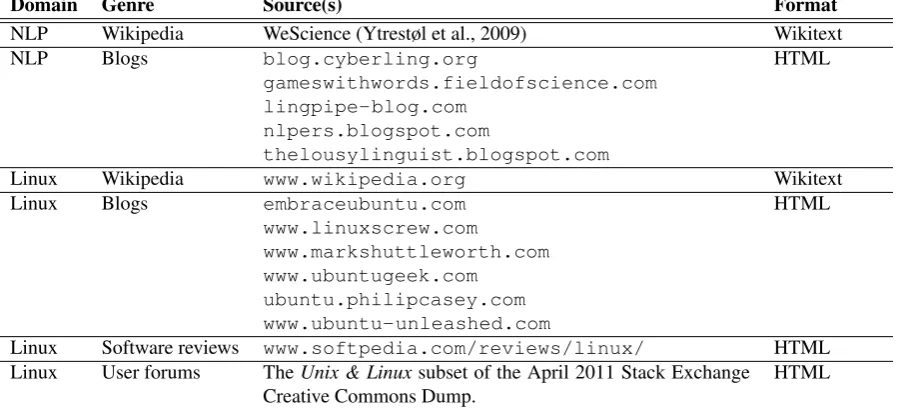
Table 1 lists the complete set of data sources for the first public release of the WDC.2The selection reflects
linguis-tic variation (ranging from the formal, edited language of Wikipedia and blogs, to the more dynamic and informal
we coin the parallel termtreecacheto refer to automatically cre-ated collections of valuable, if not fully gold-standard trees. Note that this notion is related to what Riezler et al. (2000), in the con-text of Lexical Functional Grammar, dub a parsebank—though not fully identical to the interpretation of Ros´en et al. (2009) of that term (also within the LFG framework).
2See www.delph-in.net/wesearch for technical
Domain Genre Source(s) Format
NLP Wikipedia WeScience (Ytrestøl et al., 2009) Wikitext
NLP Blogs blog.cyberling.org
gameswithwords.fieldofscience.com lingpipe-blog.com
nlpers.blogspot.com
thelousylinguist.blogspot.com
HTML
Linux Wikipedia www.wikipedia.org Wikitext
Linux Blogs embraceubuntu.com
www.linuxscrew.com
www.markshuttleworth.com www.ubuntugeek.com
ubuntu.philipcasey.com www.ubuntu-unleashed.com
HTML
Linux Software reviews www.softpedia.com/reviews/linux/ HTML
Linux User forums TheUnix & Linuxsubset of the April 2011 Stack Exchange
Creative Commons Dump.
HTML
Table 1: Sources of user-generated content in the WDC 1.0.
language of product review sites and user forums) and es-tablishes a broad domain of information technology—in or-der to extend and complement prior related initiatives (Bird et al., 2008; Baldwin et al., 2010; Flickinger et al., 2010; Foster et al., 2011; Sch¨afer et al., 2011). To make redis-tribution of the final corpus as straightforward as possible we attempted to select sources that were published under an open licence. Where this was not possible we contacted the authors for redistribution permission. Thus, the WDC is a completelyopen-sourceresource.
3
Harvesting and Extraction
Sampling user-generated content from potentially noisy on-line sources necessitates the interpretation of various markup formats, as well as the determination of which components of a Web page, say, actually correspond to relevant and linguisticcontent (as opposed to, for exam-ple, navigational elements, meta-information, rigidly struc-tured, or non-linguistic data). The paragraphs below de-scribe this process for each data format.
The blogs and reviews are written in HTML, with docu-ment structure and formatting conventions varying for each data source. Despite this, however, it is possible to extract content in a fairly generic manner, given the following in-formation for each source:
1. A regular expression that extracts the title of a web page. We did not extract titles from the HTML body of the page as their representation (and even presence) was not consistent across sources. Instead we use the title from the HTML header, after first stripping automatically-generated text such as the blog title.
2. A regular expression that identifies thestarttag of the post body. It is not feasible to define a pattern that extracts the entire body due to the possibility of nest-ing elements. Instead the start of the post is identified, then the subsequent text is searched until the closing tag is found.
3. A function that removes superfluous, automatically-generated text from the post body. In most cases this was not necessary, but some blogs include automatically-generated text, such as author identi-fication messages, links to related posts, or links to share posts on social networks. We remove such con-tent as it is not representative of the linguistic concon-tent.
Obtaining text from posts in the Stack Exchange forums is much more straightforward, as the HTML is effectively sanitised by the data dump, being stored as entries in a database. Thus, content is easily extracted from the appro-priate columns.
Text from the blogs, reviews and forums was segmented us-ing the sentence splitter from the Stanford CoreNLP Tools.3
These tools record token positions using character offsets, enabling us to track sentence positions, and thus record pointers from corpus items to positions in the source HTML documents. This means that (a) there is full accountability in terms of extractions from and modifications to the raw source files and (b) a parser’s output may be used to an-notate the source files—as done, for example, by the ACL Anthology Searchbench (Sch¨afer et al., 2011).
To complete the preprocessing a number of steps were per-formed in parallel. These include: removal of superflu-ous whitespace; removal of tables and comments; replacing imgandcodeelements with placeholders; and ensuring segmentation following sentence-breaking tags.4We retain a small subset of elements5which we believe to be
infor-mative for subsequent processing (see Section 4). Such el-ements are preserved, but their attributes are removed (e.g. thehrefattributes ofaelements). Better elimination of some non-linguistic content (e.g. displayed code snippets or formulae that donotform a constituent in a sentence)
re-3Available at www-nlp.stanford.edu/software/
corenlp.shtml.
4Specifically, instances ofbr,div,li,porpre.
5Specifically, instances ofa,b,em,h1,h2,h3,kbd,li,s,
sb-hd mc c
hdn bnp-qnt c
n - pr-i le
I
hd-cmp u c
v prd was le
was
hd-cmp u c
v pas odlr
v np le
intrigued
hd-cmp u c
p np ptcl le
by
sp-hd n c
d - the le
the
hd-cmp u c
n sg ilr
n pp c-ns-of le
possibility
hd-cmp u c
p np ptcl-of le
of
hdn bnp-vger c
vp np-ger c
hd-cmp u c
v prp olr
v np le
running
hdn bnp c
n-hdn cpd c
aj-hdn norm c
w hyphen plr
aj - i-one le
one-n - mc le
trial
w period plr
n pl olr
n - c le
experiments.
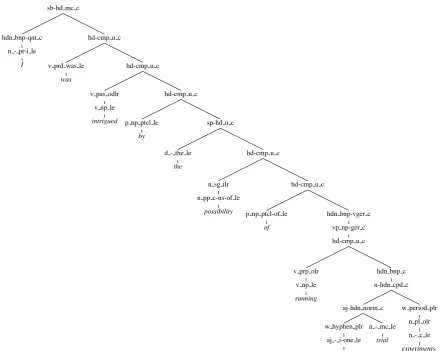
Figure 1: Syntactic representation for I was intrigued by the possibility of running one-trial experiments. The HPSG derivation is labelled with identifiers of grammatical constructions and types of lexical entries.
mains an open challenge, to achieve a good balance of text coherence and ‘purity’.
For the Wikipedia sections, a different preprocessing pro-cess was used. To extract a coherent, domain-specific part of Wikipedia we followed the established methodology and toolchain of Ytrestøl et al. (2009). For the Linux-related WDC sub-corpus, sub-domains are approximated by cre-ating a seed set from relevant items in the Wikipedia cat-egory system. We then performed a connectivity analysis of articles linked to by the seed set, and discard those that are infrequently referenced. Once linguistic content had been extracted, we segmented the text into ‘sentence’ (or other top-level utterance type). Again following Ytrestøl et al. (2009), for this first public release of the WDC we combined the open-source tokeniserpackage6 with a
handful of heuristic segmentation (or in a few cases, anti-segmentation) rules that take advantage of surface layout properties.
4
Corpus Organisation
In extracting relevant content, some aspects of layout can actually affect linguistic analysis (and thus it can be de-sirable to keep some markup in the corpus): For example,
6
See www.cis.uni-muenchen.de/˜wastl/misc/
for background.
knowing that a segment of text comes from a heading or an itemised list might activate special syntactic analyses, em-phasised text may indicate foreign or otherwise, and forced geometric layout can interact with sentence segmentation. Thus, we provide the WDC data in three distinct formats, viz. as (L0) the raw source files; (L1) the linguistic content only, but with most markup preserved in the original syn-tax (HTML or Wikitext); and (L2) the same textual content, but with markup elements considered potentially relevant to linguistic analysis normalised to a format-independent scheme.
The L0 version is organised as subsets of domain and genre collections. Each subset contains a directory for each source; files within the directory correspond to the path on the source site.
The L1 and L2 organisation is also by domain and genre, but differs in that texts are collected into sections of ap-proximately 1,000 sentences. Each section contains arti-cles from a single source web site, and artiarti-cles are not split across sections. For each domain and genre collection (ex-cept NLP Wiki7) we reserve sections as follows: held-out
7A different numbering convention is used for the NLP Wiki
hh1,
h4:pronh0 : 1i(ARG0x5{PERS1,NUMsg,PRONTYPEstd pron}), h6:pronoun qh0 : 1i(ARG0x5,RSTRh7,BODYh8),
h2: intrigue v 1h9 : 18i(ARG0e3{SFprop,TENSEpast,MOODindicative,PROG-,PERF-},ARG1x9,ARG2x5), h2:parg dh9 : 18i(ARG0e10{SFprop},ARG1e3,ARG2x5),
h11: the qh26 : 29i(ARG0x9{PERS3,NUMsg,IND+},RSTRh13,BODYh12), h14: possibility n ofh30 : 41i(ARG0x9,ARG1x15{PERS3,NUMsg,GENDn}), h16:udef qh45 : 75i(ARG0x15,RSTRh17,BODYh18),
h19:nominalizationh45 : 75i(ARG0x15,ARG1h20),
h20: run v 1h45 : 52i(ARG0e21{SFprop,TENSEuntensed,MOODindicative,PROG+,PERF-},ARG1i23,ARG2x22), h24:udef qh53 : 75i(ARG0x22,RSTRh25,BODYh26),
h27:compoundh53 : 75i(ARG0e29{SFprop,TENSEuntensed,MOODindicative,PROG-,PERF-},ARG1x22,ARG2x28), h30:udef qh53 : 62i(ARG0x28,RSTRh31,BODYh32),
h33:cardh53 : 62i(ARG0e34{SFprop,TENSEuntensed,MOODindicative},ARG1x28,CARG1), h33: trial n 1h53 : 62i(ARG0x28{PERS3,NUMsg}),
h27: experiment n 1h63 : 75i(ARG0x22{PERS3,NUMpl,IND+}) {h1=qh2,h7=qh4,h13=qh14,h17=qh19,h25=qh27,h31=qh33} i
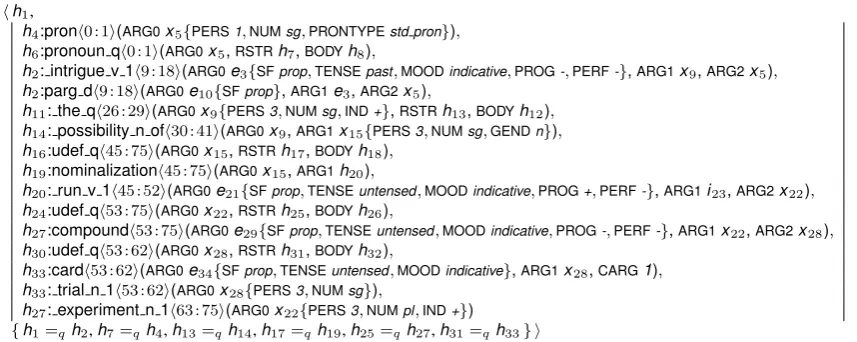
Figure 2: Semantic representation of our running example (compare to Figure 1). The details of underspecification are not important here, but note that the arguments of the passive are adequately recovered.
data (00, 01); test data (02, 03); and training data (04 and upwards). Test data is randomly drawn from the collec-tion, except when (as for Linux and NLP blogs) there are multiple sources in a collection, in which case Section 02 is instead drawn from a single source which is not repre-sented in the training sections. The rationale for these sin-gle source test sets is based on one potential use case for this data collection, which is as a resource for exploring do-main and genre effects. These single source test sets could enable researchers to test whether a model could be learnt for the ‘blog’ genre that would generalise to truly unseen text. The mixed source test sets are based on the conven-tional idea that test and training data are drawn from the same distribution.
Articles in L1 and L2 are organised chronologically where this makes sense (i.e. for blogs, reviews, and forums), and identified using an eight-digit code. This identifier is ac-companied by a pointer to the L0 source file. Each item is accompanied by a character offset that points to its lo-cation in the source file, and a list of character offsets that represent deletions made in the cleaning process described in Section 3. Wikipedia, as an encyclopedia, doesn’t have a chronological order to its articles, and so utterance iden-tifiers were just assigned sequentially.
5
Format of Annotations
The type of syntacto-semantic annotations available both in the WDC Treebank and Treecache follows the best practices of the WeScience Treebank and WikiWoods Treecache (Ytrestøl et al., 2009; Flickinger et al., 2010) and is exemplified by Figures 1 and 2. The annotation is obtained from a broad-coverage parsing system couched in the HPSG framework—the LinGO English Resource Grammar (ERG; Flickinger, 2002). Internally, each full HPSG analysis is characterised by the derivation tree (in Figure 1), labelled with identifiers of HPSG constructions (at interior nodes) and lexical entries (at leaf nodes). When combined with the grammar itself, the derivation provides an unambiguous ‘recipe’ for invoking and combining ap-propriately the rich linguistic constraints encoded by the ERG, a process that results in an HPSG typed feature struc-ture with, on average, about 250 attribute – value pairs
(in-cluding detailed accounts of morpho-syntactic properties, subcategorisation information, other grammaticalised prop-erties at the lexical and phrasal levels, and a compositional approach to propositional semantics). At the same time, we anticipate that just the abstract labels of the derivation provide valuable information by themselves, as they anal-yse syntactic structure in broad types of constructions, e.g. subject – head, specifier – head, head – complement, and adjunct – head among the nodes of Figure 1.
A more conventional representation of syntactic informa-tion is available in the form of constituent trees labelled with ‘classic’ category symbols (not shown here), using an inventory of 78 distinct labels in the default configuration. Conceptually, these labels abbreviate salient properties of the full HPSG feature structures, and there is technology support for customisation of this process. In a nutshell, a technologically somewhat savvy user can adapt the tem-plates used in mapping specific feature structure configu-rations to abbreviatory category symbols and re-run the la-belling process, i.e. obtain a custom set of constituent trees from the original derivations.
Domain Genre Section(s) Items Length Types Coverage Resource Exhaustion
Linux Blog Held out (00, 01) 1966 14.4 5898
Test (single source) (02) 1577 13.5 3976 85.8% 4.1%
Test (mixed source) (03) 1074 14.2 3760 83.4% 4.7%
Train (04–65) 57599 12.9 47443 82.2% 4.1%
NLP Blog Held out (00, 01) 1969 17.8 6763
Test (single source) (02) 659 20.0 3032 81.3% 10.9%
Test (mixed source) (03) 994 18.0 4232 83.1% 7.2%
Train (04–42) 36104 17.1 36778 83.4% 5.8%
Linux Wiki Held out (00, 01) 1583 19.2 4842
Test (02, 03) 1894 19.2 6342 86.2% 9.9%
Train (04–45) 37263 18.5 50228 85.4% 9.6%
NLP Wiki Held out (14–16) 2412 20.0 9426
Test (13) 1001 17.6 4570 86.9% 8.2%
Train (01–12) 10557 18.1 10173 87.0% 7.4%
Linux Forum Held out (00, 01) 2051 14.7 4771
Test (02, 03) 2007 14.6 4659 78.9% 3.0%
Train (04–65) 53160 14.5 31816 79.7% 2.9%
Linux Review Held out (00, 01) 1994 21.1 5028
Test (02, 03) 2010 19.8 4955 80.6% 6.6%
Train (04–13) 9667 19.1 10976 81.4% 5.6%
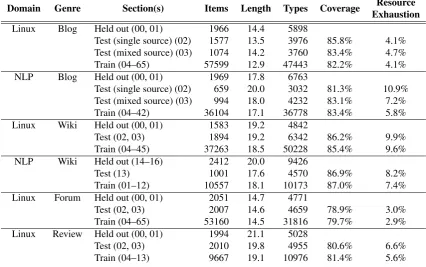
Table 2: Various corpus statistics, in terms of counts, average length, vocabulary size, and initial parsability.
are normalised: the mapping of syntactic functions to se-mantic arguments is reversed in the passive construction, but at the MRS level the passive and active variants re-ceive identical semantics—as would be the case with other diathesis alternations analysed by the grammar, e.g. the da-tive shift inKim gave Sandy a book.vs.Kim gave a book to Sandy.
6
Initial Parsing Results
In order to get some idea of the parsability of the data, we parsed all test and training sections of the data in the L1 version of the data collection. We used the PET parser (Callmeier, 2000) and the 1111 release of the ERG, with additional HTML markup handling rules added to the pre-processing stage. No other adaptation was made to the standard parser for this run. Statistics for each section are shown in Table 2, including the number and average length of the items, the number of unique, non-punctuation tokens and what percentage of the items the parser was able to analyse.
We see that the highest parse coverage is over the Wikipedia text, which follows both from the more formal register and possibly because the grammar has been previously adapted to the NLP Wikipedia text. Indeed, the majority of parse failures in this genre are caused by resource exhaustion, due to setting a time and memory limit in the parser. Parse coverage numbers for the blog and review genres are over 80 %, with higher coverage over Linux blogs mostly related to the shorter average utterance length, which results in less time outs. The Linux Forum sections stand out here as the most difficult text to parse. While the drop in coverage is not so large, we would expect higher coverage over such short utterances, since (as can be seen), resource limitation is less of a problem. An initial examination of the unparsed
utterances showed that some of the issues were caused by ungrammatical utterances, or sentence fragments possibly caused by imperfect segmentation. Other problems how-ever were domain-specific, including example commands within a sentence, or domain-specific senses of common
words such asmake,screenandbash.
Differences in domain are most often explained as lexical differences (Rimell & Clark, 2008; Hara et al., 2007). To get some idea of the lexical properties of the corpus sec-tion, we used the methods of Rayson & Garside (2000) to find those lexical items most distinctive of the various sections. While many such terms are predictable (ubuntu, install,sudofor Linux versuslanguage,words,modelfor NLP), there are some unexpected trends. One example is the strong preference for first person pronouns (I, we) in the NLP blogs contrasting with a higher than expected pro-portion of youacross the Linux blogs. Opportunities for further exploration of such effects, as well as non-lexical differences, are some of the benefits we anticipate from this corpus.
7
Initial Treebanking Reflections
segmen-tation breaks were introduced, following punctuation marks mistaken for clause boundary marks such as the exclama-tion mark that is part of the nameYahoo! or the final pe-riod in one common spelling ofPh.D.in mid-sentence. We expect to investigate improved sentence boundary detec-tion, to be attentive to the more frequent of these sentence-boundary conditions that we find in the UGC data; but we will also manually correct the segmentation for the portion of the corpus to which we add gold-standard linguistic an-notation.
Our method for assigning syntactic and semantic annota-tions is the same one presented in Ytrestøl et al. (2009), where we parse each sentence using the ERG (see Sec-tion 5 above), record the most likely analyses (up to a max-imum of 500), and then manually select the correct anal-ysis from this parse forest, recording both the derivation tree and its associated semantic representation. Since we expect user-generated language data to present linguistic and orthographic variation different from the largely edited texts previously considered in ERG development, the early rounds of annotation will also help us to identify opportuni-ties for improvements in the grammar, leading to more than one cycle of annotation for at least these early sections. For an initial profile of the behaviour of the grammar on this kind of data, we manually annotated the section of the corpus for which we had already hand-corrected the sen-tence segmentation, and made several observations. Some of the necessary additions to the grammar are unsurpris-ing for this genre of text, such as missunsurpris-ing lexical entries for emoticons (such as ‘:)’ or ‘:-)’or ‘:P’), exclamations (‘D’oh!’ or ‘ah-ha’), and abbreviations (e.g. ‘btw’, ‘omg’, or ‘imho’). Similarly genre-specific informal expressions such asthe likes of [...]andcrammed in some [...]also ap-peared in the course of this annotation exercise, as did some domain-specific entries such as the Linux-forum verb gc-ed(‘garbage-collected’). Somewhat to our surprise, we did not find very many grammatically significant typographical errors in this formally unedited text: only in 27 of the 1078 items did we find grammatically relevant authored errors, including lexical substitutions (e.g. is for in), omissions (missing articles), insertions (e.g. could could), or scram-bled word order (e.g.defined by bag the).
After making the obvious improvements to the ERG lexi-con and then running through the annotation cycle (parse – update – treebank – tune) a few times, we ended up with just over 80 % of the 1051 well-formed items in this 1078-item section of the corpus receiving a manually confirmed cor-rect analysis. We have not yet put any effort into more sub-stantial improvements to the grammar that may be moti-vated by syntactic phenomena of unusual frequency in this corpus (such as the creative and enthusiastic use of paren-theticals), but we expect further improvements in annotated coverage to result from working with this corpus.
8
Discussion—Outlook
The next steps in developing the WeSearch Data Collection (WDC) include a round of parser adaptation, including tun-ing of the statistical parse selection model and potentially some grammar modification to address the special features of the different genre. As part of that tuning, we will need to
address genre- and domain-specific challenges that came up in the exploratory processing—often relating to the inter-face of markup interpretation and linguistic analysis. One issue in particular is how technical material such as source code, formulae and configuration file snippets should be (a) detected, and (b) handled. Manual verification of segmen-tation and analysis over subsets of the data is another stage which we will perform before the first public release of the corpus, planned for May 2012.
Finally, we release the WDC in the hope that it may contribute to a growing pool of community resources for further research into the information available in user-generated content. We hope that such a curated corpus, separated by domain and genre, and with deep syntacto-semantic analyses will allow research beyond that which currently available resources permit.
Acknowledgements
References
Baldwin, T., Martinez, D., Penman, R., Kim, S. N., Lui, M., Wang, L., & MacKinlay, A. (2010). Intelligent Linux in-formation access by data mining: the ILIAD project. In Proceedings of the NAACL 2010 workshop on computa-tional linguistics in a world of social media: #SocialMe-dia(pp. 15–16). Los Angeles, USA.
Bird, S., Dale, R., Dorr, B., Gibson, B., Joseph, M., Kan, M.-Y., Lee, D., Powley, B., Radev, D., & Tan, Y. F. (2008). The ACL anthology reference corpus: A ref-erence dataset for bibliographic research in computa-tional linguistics. InProceedings of the 6th International Conference on Language Resources and Evaluation(pp. 1755–1759). Marrakech, Morocco.
Callmeier, U. (2000). PET - a platform for experimenta-tion with efficient HPSG processing techniques.Natural Language Engineering,6(1), 99 – 107.
Copestake, A., Flickinger, D., Pollard, C., & Sag, I. A. (2005). Minimal Recursion Semantics. An introduc-tion. Journal of Research on Language and Computa-tion,3(4), 281 – 332.
Flickinger, D. (2002). On building a more efficient gram-mar by exploiting types. In S. Oepen, D. Flickinger, J. Tsujii, & H. Uszkoreit (Eds.),Collaborative language engineering(pp. 1–17). Stanford: CSLI Publications.
Flickinger, D., Oepen, S., & Ytrestøl, G. (2010). Wikiwoods: Syntacto-semantic annotation for English Wikipedia. In Proceedings of the 7th International Conference on Language Resources and Evaluation(pp. 1665–1671). Malta.
Foster, J., Cetinoglu, O., Wagner, J., Roux, J. L., Nivre, J., Hogan, D., & Genabith, J. van. (2011). From news to comment. Resources and benchmarks for parsing the language of Web 2.0. InProceedings of the 5th Interna-tional Joint Conference on Natural Language Process-ing.Chiang Mai, Thailand.
Foster, J., Cetino˘glu ¨Ozlem, Wagner, J., & Genabith, J. van. (2011). Comparing the use of edited and unedited text in parser self-training. InProceedings of the 12th Interna-tional Conference on Parsing Technology (IWPT 2011) (pp. 215–219). Dublin, Ireland.
Hara, T., Miyao, Y., & Tsujii, J. (2007). Evaluating impact of re-training a lexical disambiguation model on domain adaptation of an HPSG parser. InProceedings of the 10th International Conference on Parsing Technology (IWPT 2007)(pp. 11–22). Prague, Czech Republic.
Plank, B. (2011). Domain adaptation for parsing. Ph.d. thesis, University of Groningen.
Rayson, P., & Garside, R. (2000). Comparing corpora us-ing frequency profilus-ing. InThe workshop on comparing corpora(pp. 1–6). Hong Kong, China: Association for Computational Linguistics.
Riezler, S., Kuhn, J., Prescher, D., & Johnson, M. (2000). Lexicalized stochastic modeling of constraint-based grammars using log-linear measures and EM train-ing. InProceedings of the 38th Meeting of the Associa-tion for ComputaAssocia-tional Linguistics(pp. 480 – 487). Hong Kong, Hong Kong.
Rimell, L., & Clark, S. (2008). Adapting a lexicalized-grammar parser to contrasting domains. InProceedings of the 2008 Conference on Empirical Methods in Natu-ral Language Processing (EMNLP 2008)(pp. 475–484). Honolulu, USA.
Ros´en, V., Meurer, P., & Smedt, K. D. (2009). LFGParse-banker. A toolkit for building and searching a treebank as a parsed corpus. InProceedings of the seventh inter-national workshop on treebanks and linguistic theories (pp. 127 – 133). Utrecht, The Netherlands.
Sch¨afer, U., Kiefer, B., Spurk, C., Steffen, J., & Wang, R. (2011). The ACL Anthology Searchbench. In Proceed-ings of the ACL-HLT 2011 system demonstrations (pp. 7–13). Portland, Oregon, USA.