1104
A Morpho-Syntactically Informed LSTM-CRF Model
for Named Entity Recognition
Lilia Simeonova FMI Sofia University
Bulgaria
lilia.valentinova. simeonova @gmail.com
Kiril Simov, Petya Osenova LMaKP
IICT-BAS Bulgaria
{kivs,petya}
@bultreebank.org
Preslav Nakov Qatar Computing Research Institute, HBKU
Qatar
Abstract
We propose a morphologically informed model for named entity recognition, which is based on LSTM-CRF archi-tecture and combines word embeddings, Bi-LSTM character embeddings, part-of-speech (POS) tags, and morphological information. While previous work has focused on learning from raw word in-put, using word and character embeddings only, we show that for morphologically rich languages, such as Bulgarian, access to POS information contributes more to the performance gains than the detailed morphological information. Thus, we show that named entity recognition needs only coarse-grained POS tags, but at the same time it can benefit from simulta-neously using some POS information of different granularity. Our evaluation re-sults over a standard dataset show sizeable improvements over the state-of-the-art for Bulgarian NER.
1 Introduction
Although in recent years theNamed Entity Link-ing(also known as Named Entity Disambiguation) task has been central in NLP research, the Named-entity recognition (NER) task has remained far from solve, having in mind the productivity of names and the amount of information available in the era of big and noisy data.
NER plays a critical role in the processing of texts with application to many real-world Natural Language Processing (NLP) tasks such as Ques-tion Answering, InformaQues-tion ExtracQues-tion, Machine Translation, Dialog Systems, and chatbots, where it is sometimes called Concept Segmentation and Labeling(Saleh et al.,2014).
Traditionally, NER has focused on recognizing en-tities such as person (PER), organization (ORG), location (LOC), and miscellaneous (MISC). This tradition goes back to the Message Understand-ing Conference (MUC) for English (Grishman and Sundheim,1996), and the subsequent CoNLL 2002/2003 shared tasks, which also targeted other European Languages such as Spanish, Dutch, and German (Tjong Kim Sang and De Meulder,
2003).1 This same setup was followed in more re-cent work for a number of other languages, and we also follow it in the present work.
Early systems relied on hand-crafted rules with pattern-matching (Appelt et al., 1995). Un-fortunately, this required an large pre-annotated datasets, collecting which was time-consuming and error-prone. The next step was to add gazetteers and lexicons that were generated auto-matically or semi-autoauto-matically (Popescu and Et-zioni,2005). Adding such resources required spe-cial approaches to resolve the ambiguity between names and common words. Such problems were solved using models such as Hidden Markov Mod-els (Zhou and Su,2002) and Conditional Random Fields (Sutton and McCallum,2012).
In our work here, we use deep neural net-works for Bulgarian NER. Lample et al. (2016) have shown remarkable results for English, us-ing a combination of Bi-LSTMs (Bi-directional Long Short-Term Memory) and CRF. However, the approach is problematic for morphologically rich languages. The main problem is the missing information within word embeddings for the nu-merous word forms involved in multiword names that require additional grammatical knowledge in order to be processed properly. Here we incor-porate such information as additional input to our neural model.
1Other schemata such as ACE (Doddington et al.,2004)
Our contributions are as follows:
• We show that for morphologically rich lan-guages such as Bulgarian the access to POS and morphological annotation is crucial and can yield very sizeable performance gains.
• We achieve sizable improvements over the state-of-the-art for Bulgarian NER.
• Finally, we make our data and code freely available, which should enable direct com-parison in future work.2
2 Related Work
Our work is based on Bulgarian, but we claim that it is appropriate also for other languages with rich morphological systems like Slavic and Ro-mance languages, for example. For that rea-son, we present first the best results for NER in other Slavic languages having in mind that they are synthetic, while Bulgarian is a predominantly analytic language whose morphological richness lies exclusively in the verbal system and not so much in the nominal one. Analytism implies more types of multiword named entities in Bulgarian but less inflection variety, and different distribution of the common types for these languages. The di-rect comparison of the numbers presented below should be taken with a grain of salt as they are on different datasets and for different languages. Yet, they are indicative for the different methods used for these languages.
For Russian, a Hybrid Bi-LSTM approach was applied by Le et al. (2018), who achieved preci-sion of 89.57, recall of 84.89, and F1 score of 87.17. These results are comparable to the ones by our model using the same approach.
For Czech, Strakov´a et al.(2013) reported pre-cision of 88.27, recall of 78.00, and F1 score of 82.82 using a Maximum Entropy Markov Model. The feature modeling also proved to be working in Czech, as their best results used features based on morphological analysis, two-stage prediction, word clustering, and gazetteers.
For Polish,Piskorski et al.(2004) achieved pre-cision of 91.0, recall of 77.5, and F1 score of 82.4. They used the SProUT system, which is an NLP platform, consisting of pattern/action rules.
2http://github.com/lilia-simeonova/
NER-bg/
In the last years, the interest in NER for Slavic languages grew. Two shared tasks were orga-nized —- the first and the second Multilingual Named Entity Challenge in Slavic Languages. They have been descibed in (Piskorski et al.,2017) and (Piskorski et al., 2019). The challenges in-cluded several tasks: recognition of mentions of named entities in Web documents in seven Slavic languages (Bulgarian, Croatian, Czech, Polish, Russian, Slovak, Slovene, Ukrainian), their nor-malization/lemmatization as well as cross-lingual linking.
Our evaluation on NER in this paper is more similar to the relaxed evaluation parameter where the string is detected and classified, not the in-variant. Considering the complexity of the task, the drop of the results per language and per entity types have been expected. Such a task, however, is also good motivation for improving the NER sys-tems for Slavic languages, including Bulgarian.
There is some previous work on NER for Bulgarian. Georgiev et al. (2009) presented a model using Conditional Random Fields with sev-eral hand-crafted features. They combined well-established features used for other languages with language-specific lexical, syntactic, and morpho-logical information. Their result is the previous state-of-the-art for Bulgarian.
So far, the highest reported results for NER are for English. For example, Chiu and Nichols
(2016) reported an F1 score of 91.20 using Bi-LSTM + CNN + gazetteers + linking, whilePassos et al.(2014) achieved an F1 score of 90.90 using a new form of learning word embeddings that can leverage information from relevant lexicons. For German,Gillick et al.(2016) achieved an F1 score of 82.84, which shows that the rich morphology causes a drop in the performance.
Currently, the prevalent paradigm in NLP is to use neural networks, typically based on LSTMs or CNNs. As we have mentioned above,Lample et al.(2016) proposed an LSTM-CRF model for NER.3 The model uses a bi-directional LSTM to encode the left and the right context of the cur-rent input word. Then it passes the concatenation of the two hidden vectors (one produced by the left LSTM and one by the right LSTM) to a CRF model. Its task is to ensure the global consistency of the NER tags.
3They also proposed a transition-based model inspired by
In this model, each input word is represented as a concatenation of its word embedding and the character-level embedding for the word produced by a character Bi-LSTM. The character embed-ding provides features for the suffix and the pre-fix of the word. Thus, the left-to-right character-based LSTM embedding models the word suffix, while the right-to-left one models the word prefix. The word embeddings are trained in an unsuper-vised manner on external data, while the character-based LSTM embeddings are trained on the train-ing data as part of the end-to-end traintrain-ing of the full LSTM-CRF model. This model does not need any explicit feature engineering nor does it need manual gazetteers; yet, it achieved state-of-the-art performance for four languages: English, German, Dutch, and Spanish. Here we take this model as a basis, and we augment it to model part-of-speech (POS) and grammatical information, which turns out to be very important for a morphologically complex language such as Bulgarian.
Strubell et al.(2017) extended the above model by substituting the LSTM with Iterated Dilated Convolutional Neural Networks, a variant of CNN, which permit fixed-depth convolutions to run in parallel across entire documents, thus mak-ing use of GPUs, which yields up to 20-fold speed up, while retaining performance comparable to that of the LSTM-CRF model. They further ag-gregated context from the entire input document, which they found to be helpful. In our preliminary monolingual experiments, this model performed very similarly, but slightly worse, than the LSTM-CRF model, and thus we chose LSTM-LSTM-CRF for our experiments below.
3 Data
In this paper, we work with a Bulgarian corpus, annotated with BIO tags and positional tags, the same as in the CoNLL-2002 shared task (Tjong Kim Sang, 2002). The data is in BIO format, which encodes for each token in the text whether it is at the beginning of the expression of inter-est (Named Entity in our case), inside or outside of it. The annotation in the available Bulgar-ian data comes from the manually annotated Bul-garian treebank, known as BulTreeBank (Simov et al.,2004a). In the treebank, each NE is repre-sented as a constituent consisting of one or more tokens. Each NE phrase is annotated by the cate-gories Person, Organization, Location, and Other.
Христо Стоичков пристигна в София
Hristo Stoichkov arrived in Sofia
B-PER I-PER O O B-LOC
Table 1: An example in BIO encoding.
The BIO tags for the tokens forming a given named entity (NE) in the treebank are created on the basis of the syntactic annotation. The first word in the phrase is marked as the beginning of the NE, while the rest of the tokens ar emarked as inside of the NE. The tokens that are not part of any NE are encoded as outside elements. In or-der to represent the category of the NE, each tag for begin and inside tokens includes a modifier for the category. Thus, we use nine labels: B-PER, I-PER, B-ORG, I-ORG, B-LOC, I-LOC, B-MISC, I-MISC, O. The example in Table1shows a sim-ple sentence annotated with two named entities: a person name (Hristo Stoichkov) and a location name (Sofia).
Besides the BIO tagging, the texts in the dataset inherited the morphosyntactic annotation from the treebank. This annotation uses the BulTreeBank Morphosyntactic Tagset (Simov et al., 2004b). The tagset is positional. It encodes parts-of-speech and grammatical features for Bulgarian. For ex-ample, Npfsi stands for noun, proper, feminine, singular, indefinite. This annotation offers an op-portunity to explore how the morphological fea-tures can affect NER.
The resulting dataset is divided into three dis-joint sets: training set (Train), development set (Dev), and test set (Test). Table 2 shows statis-tics about the annotated data. We can see that a large number of examples are labeled as Person names, and that the distribution of Locations, Per-sons and Organizations is not balanced. While we can still build a stable system based on this data, the class imbalance makes our model more vul-nerable to overfitting. Thus, we use early stopping in order to prevent the model from continuing to learn weights and parameters if it does not see an improvement in the final score.
Sent. Tokens PER ORG LOC MISC
Train 28,636 528,567 16, 804 3,028 6,786 911 Dev 4,063 64,014 2,514 515 1,021 227 Test 3,907 60,645 1,875 305 781 112
4 Model
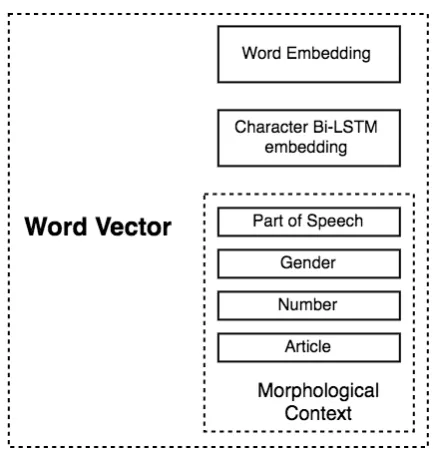
As mentioned above, we construct our model as a modification of the Bi-LSTM-CRF architecture from (Lample et al., 2016). After some exper-iments with the original system, we decided to modify its input: we added a vector represent-ing some of the information encoded in the mor-phosyntactic tags. Thus, we created the input vec-tors for the tokens in the sentences as a concate-nation of three vectors: a word embedding vector, a character embedding vector, and a vector con-taining some grammatical features, called a gram-matical vector. We experimented with different grammatical vectors, as explained below.
The rest of the Bi-LSTM-CRF architecture of (Lample et al.,2016) was kept as in the original model: First, we run a Bi-LSTM over the sequence of word vectors so that we could get their contex-tual word representation. We use a fully connected neural network to get a score for each of the tags. At the end, we run a CRF decoder to decide what the best combination of scores is.
The key takeout of our model is that we use some feature modeling to show that for a morpho-logically rich language such as Bulgarian using POS and grammatical information can improve the results. Thus, we mix automatically learned features — the word and the character embeddings —, with hand-crafted features encoded as a gram-matical vector.
In the rest of this section, we describe the dif-ferent components of our system.
LSTM-CRF Implementation For the imple-mentation of the general LSTM-CRF architecture, we use Tensorflow (Sak et al.,2014).
Word Embedding Nowadays there are many different approaches to train word vectors such as Word2vec (Mikolov et al.,2013), GloVe ( Pen-nington et al.,2014), FastText (Bojanowski et al.,
2017), and many more. In our experiments, we use the pre-trained Bulgarian word embeddings from FastText (Bojanowski et al.,2017).4 This choice was motivated by the fact that FastText uses the structure of the words by taking into considera-tion character n-grams, thus modeling morphol-ogy and many out-of-vocabulary words.
4In this work, we do not use any contextualization of
the word embeddings such as ElMo (Peters et al.,2018) and BERT (Devlin et al.,2019), as our Bi-LSTM architecture al-ready performs contextualization.
Character Bi-LSTM Embedding In order to produce character embeddings, we use a bi-directional LSTM over the character representa-tion of the text. For each character in the text, each of the two LSTMs produces an hidden vector. For each word, the hidden vector for the last character produced by the left-to-right LSTM models infor-mation about the suffix of the word. Similarly, the hidden vector for the first character produced by the right-to-left LSTM models information about the prefix of the word. Following the approach, used in (Ling et al.,2015), we constructed the final character embedding of the word as a concatena-tion of the prefix and the suffix vectors.
Grammatical Vectors We use several types of grammatical vectors or their combinations. They are divided into POS vectors that encode different combinations of parts-of-speech and morphologi-cal vectors encoding other grammatimorphologi-cal features.
POS Vectors The part-of-speech information for each word is represented as an a one-hot vector with eleven positions. This vector is concatenated to the vector for the word embedding. In the tagset, we have the following parts-of-speech: N
— noun, A — adjective, V — verb, H — hy-brid,D— adverb,R— preposition,P— pronoun,
C — conjunction, T— particle, M — numeral, andI— interjection. In our experiments, we di-vided these parts-of-speech into different groups depending on the role they play in the representa-tion of the named entities. For example, the tags A, N, H, R were viewed as a possible part of a named entity in contrast to the others that cannot form named entities. In this case, the one-hot vec-tor contains only two positions. The groups are given in the experimental section below. The Hy-brid tag (H) is special in the tagset. It refers to both family names and name adjectives. Bulgar-ian family names (as other Slavic ones) are proper names, but morphologically they behave like ad-jectives due to their adjectival origin.
Figure 1: Full input vector representation with concatenation of word embeddings, character em-beddings, and morphological features.
Another thing worth mentioning is that the nouns, adjectives and hybrid tags share some com-mon features. This information appears to be very useful for recognizing the more specific types of named entities. Note that the existence of a prepo-sition in a sequence can distinguish some further patterns as well.
The morphological features vary between the different entities, but there are few that can be de-fined for nouns, adjectives, hybrid tags and pro-nouns. Some of them are arguably useful, such as gender, number, and definiteness, and we will describe them briefly here:
Gender can have three values: masculine, femi-nine, and neutral;
Number can have four values: singular, plural, only pluralandcount form(which is only for masculine nouns for non-persons)’
Definiteness can have four values:indefinite, def-inite, short definiteandfull definite. The lat-ter two are for singular masculine nouns only.
For each word with a POS tag of noun, pronoun, adjective or hybrid, we concatenate a one-hot vec-tor representation for each of the features above (we use a zero vector for the rest). We form the final version of our word vector as a concatenation of all contextual vectors, as shown on Figure1.
Dropout In order to prevent overfitting, we use a dropout layer on top of our word vectors as de-scribed in (Hinton et al.,2012). For each presen-tation of each training example, we randomly ex-clude a hidden unit from the network with a certain probability. In this way, the system learns to detect and use more useful features.
5 Experiments and Evaluation
In this section, we present the experimental setup and the evaluation results for the different models we experimented with.
5.1 Training and Hyper-parameters
We experimented with different values of the hyper-parameters and we found that changing some of them can result in sizeable improve-ments. The most considerable difference was for the learning method and the learning rate. Our best resulst were achieved using the Adam optimizer (Kingma and Ba,2014), which is computationally efficient and has minimal memory requirements.
At the beginning, we set the learning rate to the initial value of 0.001, and then at each epoch, we multiplied it by a specific learning decay value. Decreasing our learning rate over time can help us find the minimum of our function without ac-tually missing it. While Adam already decays the learning rate at each iteration, previous work has found that tuning the initial learning rate could yield sizeable improvements over the default set-tings. Thus, we use this additional decay. (Wilson et al.,2017)
The word embeddings we use from FastText have a dimensionality of 300, while the character embedding vectors have a dimensionality of 100. In order to produce them, we uses the TensorFlow default Xavier initializer and then we ran a Bi-LSTM on top of them in order to obtain contextual vectors with no additional layers.
We set the batch size to 20 and the dropout to 2. The Adam’s parameters we used are as follows:
learningrate = 0.001;β1 = 0.9;β2 = 0.999;
= 1e−08; use locking = F alse. We also added a gradient clipping with a value of 1.
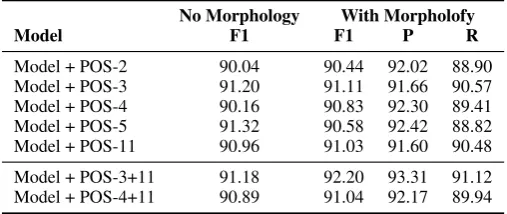
No Morphology With Morpholofy
Model F1 F1 P R
Model + POS-2 90.04 90.44 92.02 88.90
Model + POS-3 91.20 91.11 91.66 90.57
Model + POS-4 90.16 90.83 92.30 89.41
Model + POS-5 91.32 90.58 92.42 88.82
Model + POS-11 90.96 91.03 91.60 90.48
Model + POS-3+11 91.18 92.20 93.31 91.12
Model + POS-4+11 90.89 91.04 92.17 89.94
Table 3: Evaluation results for Bulgarian POS tagging. Shown are results where the standard input to the Bi-LSTM-CRF model is augmented with different POS tags and morphological features.
English Ivan Valtchev visited the Bulgarian Academy of Sciences. Bulgarian Иван Вълчев посети Българската академия на науките.
Tokens Иван Вълчев посети Българската академия на науките
POS11 N H V A N R N
POS2 ANHR ANHR O ANHR ANHR ANHR ANHR
POS3 ANH ANH O ANH ANH R ANH
POS4 NH NH O A NH R NH
POS5 N H O A N R N
Table 4: Example of the POS tags for annotation schemes of different granularities when applied to the same Bulgarian sentence.
5.2 Experiments
The experimental results suggest that adding grammatical features can have a sizeable impact on the performance of the general LSTM-CRF model for Bulgarian NER. In Table3, we can see an example of different combinations of POS tags, whereModelstands for Bi-LSTM-CRF and POS represents a one-hot encoding for the following:
POS11 = all part of speech tags separately
POS2 ”ANHR” vs. REST
POS3 ”ANH” vs. ”R” vs. REST
POS4 ”A” vs. ”NH” vs. ”R” vs. REST
POS5 ”A” vs. ”N” vs. ”H” vs. ”R” vs. REST
POS3 + POS11 POS11 vs. ”ANHR” vs. REST
POS4 + POS11 POS11 vs. ”ANH” vs. REST
Morph Gender, number, and definiteness
We further perform several experiments in order to determine whether we need the full set of part-of-speech tags or it is enough just to know whether the entity is part of the group of the nouns, adjec-tives, hybrid tags, and prepositions.
Model F1
(Georgiev et al.,2009) 89.40
Our model 92.20
Table 5: Comparing the previous state-of-the-art results to our best morphologically informed Bi-LSTM-CRF model.
In Table4, we see how the entities map to the different POS groups. It appears that knowing the concrete tag of each entity can help us improve the performance by almost one percent.
Table 5 shows our best result compared to the previous state-of-the-art result as reported in (Georgiev et al.,2009). They achieved an F1 score of 89.4% by sing regular expressions, gazetteers and non-local morpho-syntactic characteristics. Our model improves this to 92.20% without using any external resources.
Entity Precision Recall F1
Location 97.75 94.05 95.86
Person 95.67 94.23 94.95
Organization 75.57 96.34 84.70 Miscellaneous 96.15 22.73 36.76
Overall 93.31 91.12 92.20
Table 6: Detailed results for the different kinds of named entities.
Model F1
(1) LSTM-CRF (words only) 82.03 (2) fwd-LSTM-char + (1) 85.15 (3) bwd-LSTM-char + (1) 85.40 (4) Bi-LSTM-char + (1) 86.44
(5) POS11 + (4) 90.96
(6) Morph + (5) 91.03
(7) POS3 + (6) 92.20
Table 7: The impact of different components and different component combinations on the perfor-mance of our best model.
Table 7 shows the cumulative effect of adding different components to our model. The basic model we started with is shown on line (4). Then, on lines (1)-(3) we remove different components from this basic model, and on lines (5)-(7) we add POS and morphological information to it. We can see sizeable improvement for the standard Bi-LSTM-CRF model with only word vector rep-resentationa and the model with character-level LSTM. Interestingly, there is almost no difference between the suffix and the prefix vectors. We can further see that adding POS11 (5) vector im-proves the performance by almost four percent ab-solute. The morphological vectors and POS3 also improved the F1 score to 92.20 points absolute. These improvements show that using known lin-guistic knowledge such as grammatical features could improve the representation vectors learned over huge text corpora. From the point of view of feature learning, we speculate that vectors trained over texts in morphologically rich languages do not learn enough grammar such as POS and mor-phology. The character embeddings also seem not to help much. One explanation for this could be that the suffixes and prefixes in Bulgarian are also highly ambiguous.
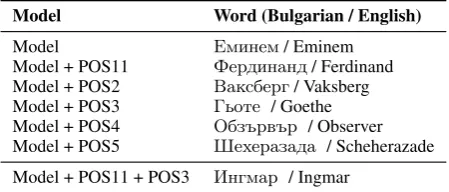
Model Word (Bulgarian / English)
Model Еминем/ Eminem
Model + POS11 Фердинанд/ Ferdinand Model + POS2 Ваксберг/ Vaksberg Model + POS3 Гьоте / Goethe Model + POS4 Обзървър / Observer Model + POS5 Шехеразада / Scheherazade
Model + POS11 + POS3 Ингмар / Ingmar
Table 8: Examples of words which could not be handled correctly by the specific configuration
6 Error Analysis
Our manual analysis of the errors shows that one of the main reasons for our model to work better when POS tags are provided is due to the pres-ence of many loanwords in the Bulgarian text. The LSTM-CRF model manages to learn the grammar of the language itself, but it needs additional help with words borrowed from other languages.
A common problem for the LSTM-CRF model is the mislabeling of foreign person or organiza-tion names. In such cases, the POS tags help by suggesting the possible part-of-speech for each word. In our test set, around 10% of the wrongly labeled words are loan words, borrowed primarily from English, Russian, German and Turkish. Ta-ble8, shows some examples of words that could not be handled properly.
The loanwords cannot be successfully recog-nized by our algorithm in all cases. Even though some people try to write them in Cyrillic, their structure is different from the typical structure of the Bulgarian words. That is why, we further tried to add gazetteers and lexicons with existing loan words in Bulgarian. Similarly to the way we added POS vectors, we created a one-hot vector for each word that says whether that word is part of our lexicon with loan words or not. We then concate-nated the vector to the rest of the word embed-dings. However, this approach did not result in significant improvements because new words are added to the language almost every day, and it is impossible to capture them all.
B-ORG I-ORG B-PER I-PER B-LOC I-LOC B-MISC I-MISC O
B-ORG 258 0 1 0 2 0 6 0 6
I-ORG 0 31 0 0 0 0 0 0 1
B-PER 9 1 1,169 6 8 0 7 0 58
I-PER 0 1 15 595 0 0 0 0 6
B-LOC 15 0 8 0 676 0 4 0 36
I-LOC 1 0 0 1 3 36 0 0 1
B-MISC 27 0 2 0 1 0 39 0 41
I-MISC 0 1 0 0 0 0 0 1 0
O 12 2 10 22 2 0 3 0 57, 522
Table 9: Confusion matrix for our best model on the test dataset: the columns represent the true labels and the rows show the predictions.
Table 9 shows a confusion matrix for the nine BIO tags that we used for the four kinds of named entities that we are recognizing. In the table, the columns represent the actual expected gold tags, while the rows show the predictions of our model. There are several interesting observations that we can make about this confusion matrix. First, it looks like the biggest problem for the model is with the tag B-PER, which is often confused with the tag O, i.e., Outside. This is probably due to the fact that in Bulgarian the first names sometimes have more than one meaning, which can confuse the model. The same argument holds for the tag B-LOC, which is also often confused with the tag O. Another place for improvements would be to distinguish better between B-LOC and B-ORG, as many places and organization have identical names, or at least the identical first words. The miscellaneous entities such as the names of books or movies can also have names that are identical to those of some organizations. Even more often, Miscellaneous entities could be confused with the Other category as they contain many common Bul-garian words.
7 Conclusion and Future Work
We explored the potential of using morphologi-cal information to a recurrent Bi-LSTM-CRF neu-ral network architecture with the aim to improve named entity recognition for morphologically rich languages such as Bulgarian, which pose differ-ent challenges for named differ-entity recognition com-pared to English. Our experiments have shown that adding morphological and part-of-speech in-formation to the model’s input yields sizable per-formance gains over a model that only relies on word-level and character-level embeddings as an input to the neural network.
In future work, we plan to extend the mod-eling of the morphological structure of the enti-ties. Here, we only used a limited number of fea-tures, namely gender, number and definiteness, but it might be interesting to add the full linguistic knowledge encoded in the BulTreebank. We fur-ther plan to explore features and models that can help identify loan words in Bulgarian.
Another promising research direction is to com-pare the differences in the graphical representation of named entities in Bulgarian and English. For example, in English all components of a named entity are capitalized (except for the functional words). In order to have comparable data, we en-vision to pre-transform the Bulgarian dataset to which to apply the English capitalization rule for the phrasal named entities.
Finally, we plan to experiment with differ-ent monolingual represdiffer-entations from ElMo ( Pe-ters et al., 2018), BERT (Devlin et al., 2019), ROBERTa (Liu et al.,2019c), XLNet (Yang et al.,
2019), and Ernie 2.0 (Sun et al.,2019), pooled rep-resentations from Flair (Akbik et al., 2019), dis-tilled representations from MT-DNN (Liu et al.,
2019a,b) or cross-language representations from XLM (Lample and Conneau,2019).
8 Acknowledgements
This research was partially supported by the Bulgarian National Interdisciplinary Research e-Infrastructure for Resources and Technologies in favor of the Bulgarian Language and Cultural Heritage, part of the EU infrastructures CLARIN and DARIAH – CLaDA-BG, Grant number DO01-164/28.08.2018