Analysing Market Sentiments:
Utilising Deep Learning to Exploit Relationships within the Economy
Tobias Daudert
Insight Centre for Data Analytics, National University of Ireland Galway [email protected]
Abstract
In today’s world, globalisation is not only affecting inter-culturalism but also link-ing markets across the globe. Given that all markets are affecting each other and are not only driven by fundamental data but also by sentiments, sentiment analy-sis regarding the markets becomes a tool to predict, anticipate, and milden future eco-nomic crises such as the one we faced in 2008. In this paper, an approach to im-prove sentiment analysis by exploiting re-lationships among different kinds of sen-timent, together with supplementary in-formation, from and across various data sources is proposed.
1 Introduction
Nowadays, modern societies and their welfare de-pend on market economies with the financial mar-kets at the heart. This means that millions of peo-ple around the globe are affected by changes in the markets (Khadjeh Nassirtoussi et al., 2014). The financial markets are not only driven by funda-mental factors (e.g. trends in GDP, inflation, em-ployment, monetary and fiscal policy) but also by psychology-related factors such as public mood. This behaviour can be observed in economic bub-bles which indicate irrational and emotional ac-tions of the market participants (Khadjeh Nas-sirtoussi et al., 2014). In today’s increasingly complex global economy, more sophisticated ap-proaches are needed to provide better insights and prevent future economic crises (Khadjeh Nas-sirtoussi et al., 2014). Therefore, it is impor-tant to understand what the markets, particularly
the financial markets as a proxy for the market economies, are influenced by, how they react, and how strong the influence is.
Given the existence of different sentiments and al-ternative data all affecting each other, an experi-mental approach to exploit their relations is pro-posed. The aim of this approach is to derive ad-ditional information from different data types in order to improve sentiment analysis. In this paper, we outline the proposal and detail its components, focusing on its fine-grained construction to exploit contextual sentiments in microblogs data and news data individually, as well as their mutual relation-ships.
2 Background
Within the last 17 years, sentiment analysis aiming at measuring public mood in respect of the finan-cial domain grew to an important field of research. Liu (2015) defines sentiment analysis, synony-mously called opinion mining, as “the field of study that analyses people’s opinions, sentiments, appraisals, attitudes, and emotions toward enti-ties and their attributes expressed in written text”. Market sentiment is defined as “the feeling or tone of a market, or its crowd psychology”.1 Prior
re-search has shown how sentiments and opinions can affect market dynamics, thus, making the fi-nancial domain a high-impact case study for sen-timent analysis in text (Goonatilake and Herath, 2007; Van De Kauter et al., 2015). Sentiments are extracted from various sources of data, such as news. Within this source, one can find discus-sions regarding macroeconomic factors, company-specific reports, or political information, which
1http://www.investopedia.com/terms/m/
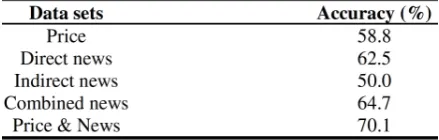
Schumaker et al., 2012; Zhai et al., 2007) have experimented with such a hybrid approach. Their findings are promising; most of the researchers could improve the accuracy of their classifiers by using additional, non-textual data. As an exam-ple, Zhai et al. (2007) used news, divided into company specific news and general market news, together with stock price information and stock price based calculated trading indicators. The re-sults show the highest accuracy for the approach combining all available information as presented in Figure 1. Only Rachlin et al. (2007) could not achieve the highest accuracy using a joint ap-proach; they achieved the best results only based on stock prices and from stock price generated in-dicators. In contrast to the proposed research in this paper, all the works mentioned are purely fo-cusing on stock price prediction. Different data is used to achieve a higher accuracy on stock price forecasts instead of using the multitude of infor-mation to additionally improve the textual senti-ment classifier itself. The textual sentisenti-ment, or media sentiment as described in section 2.4, used as input to their proposed models is not the same sentiment their predictions, as output, are referring to. For example, Schumaker et al. (2012) is claim-ing that a correlation between textual sentiment, news, and stock prices exists but a possible influ-ence of stock prices on textual sentiment remains unexplored.
Figure 1: Prediction Accuracy as achieved by Zhai et al. (2007)
However, online postings bear challenges given their informal writing nature which significantly differs from professionally written media articles or corporate documents (Kearney and Liu, 2014). Text short in length (such as microblog messages) can be quite opinionated, dense in information, dependent on the modelling of economic context, and challenging to parse due to the different
vo-cabularies used (Sinha, 2014). In addition, there are still qualitative information sources that have not been widely studied yet. Examples include business and political speeches, blogs, television news videos, and various social media platforms (Kearney and Liu, 2014). Many of the works to date are based on the specific news sources such as financial or corporate news (Kumar and Ravi, 2016).
2.3 Narrow Research Focus
Most of the work in this area is focused on spe-cific companies (Kearney and Liu, 2014; Kumar and Ravi, 2016). Similar methodologies can be applied to other markets such as bonds, commodi-ties, or derivatives which are potentially driven by public mood to a variable extent. Given the desire to address the general market sentiment, an overly narrow focus on individual markets is misleading since all markets are interfering with each other. Hence, it is necessary to not only study the U.S. markets but to consider additional markets linked to different languages such as German. To iden-tify and track this dependence, short and long-term studies regarding sentiment changes are required. However, the majority of the research only con-siders the news article time of release (Kumar and Ravi, 2016).
2.4 Different Sentiment Types
Current research is not taking different types of sentiment and their interference into account. The different sentiments include public sentiments (e.g. Twitter, Facebook), media sentiments (e.g. Wall Street Journal, Financial Times), expert sen-timents (e.g. analysts, investors), and company sentiments (e.g. Annual reports, CEO’s inter-views). These sentiments are highly contextual and expressed in different formats (Khadjeh Nas-sirtoussi et al., 2014).
2.5 Generally Accepted and Available Benchmark Data
frag-Microblogs News
“Das neue iPhone ist eine
Schande” t
Microblog Analyser
News Analyser
Sentiment Aggregator
Microblog Analyser
“Tim Cook takes a leave”
Data Stream Processing Stream
-0.243
-0.732
-0.927 -0.243
-0.343
-0.168
“Bad design: Apple’s new iPhone is overheating”
Sentiment
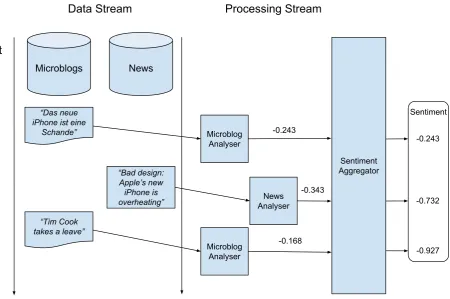
Figure 2: Proposed Experimental Setup. Fictive Numbers and Messages.
standard providing training and testing data for the News Analyser.
3.2.3 Sentiment Aggregator
The Sentiment Aggregator uses the document-based sentiment generated by the Microblog Anal-yser and the News AnalAnal-yser, as well as the textual data as input and generates the final sentiment for each document. It is independent from both Anal-ysers, as they are highly specialised and dedicated to their type of textual content, therefore, they do not take the environment into account, whereas the Sentiment Aggregator identifies relationships be-tween different documents and adjusts the given sentiments based on their relevance, the relation-ships between documents, and contextual infor-mation. It takes into consideration previous doc-uments and their sentiments, thus, not only the currently given textual data. As shown in Figure 2, the sentiment of the German Tweet ”Das neue iPhone ist eine Schande” derived by the Microblog Analyser is -0.243. Passing all this information to
the Sentiment Aggregator, the sentiment stays un-changed since there is no additional knowledge to this point. However, at the time the second doc-ument is processed, there is additional knowledge about the previous Tweet existing. Therefore, the Sentiment Aggregator takes this knowledge into account and amends the by the News Analyser purely textual-derived sentiment from -0.343 to -0.732. The Sentiment Aggregator uses natural language processing methods to recognise and ex-tract entities, identify relationships and determine the importance of each document. To achieve this highly complex task, a combination of knowledge bases and machine learning will be used. The knowledge bases will be based on the terms being tracked on Twitter. Besides own developments re-garding the weighting and linking of information, the GATE TwitIE will be used since as it is easily implementable and still one of the most powerful named entity recognition tools existing.9
Marjan Van De Kauter, Diane Breesch, and Veronique Hoste. 2015. Fine-grained analysis of explicit and implicit sentiment in financial news articles. Expert Systems with Applications, 42(11):4999–5010. Yequan Wang, Minlie Huang, Li Zhao, and Xiaoyan
Zhu. 2016. Attention-based LSTM for Aspect-level Sentiment Classification. pages 606–615.
Yuzheng Zhai, Arthur Hsu, and Saman K Halgamuge. 2007. Combining News and Technical Indicators in Daily Stock Price Trends Prediction. In
Ad-vances in Neural Networks ISNN 2007, volume