CSEIT411838 | Published - 25 April 2018 | March-April-2018 [ (4 ) 1 : 221-226 ]
National Conference on Recent Advances in Computer Science and IT (NCRACIT) International Journal of Scientific Research in Computer Science, Engineering and Information Technology
© 2018IJSRCSEIT | Volume 4 | Issue 1 | ISSN : 2456-3307
221
Face Recognition Techniques: A Survey
Sneha
1, Sanjay Sharma
21M.tech Student, Department Of Computer Science and Engineering, Shri Mata Vaishno Devi University Katra, Jammu & Kashmir, India
2Assistant Professor, Department Of Computer Science and Engineering, Shri Mata Vaishno Devi University Katra, Jammu & Kashmir, India
[email protected], [email protected]2
ABSTRACT
From the last several years, face recognition is rising as an interesting and thought-provoking topic in field of computer science. Face recognition system involves extracting features and then recognizing the face in spite of various conditions such as aging, illumination, lighting, variation in poses etc. There are various techniques used nowadays in recognition process. This paper gives a brief description about some face recognition techniques such as Bacteria Foraging Optimization, Back Propagation Neural Network, Discrete Wavelet Transformation and Linear Discriminant Analysis.
Keywords: Face Recognition, Bacteria Foraging Optimization, Back Propagation Neural Network, Discrete Wavelet Transformation, Linear Discriminant Analysis.
I.
INTRODUCTION
Nowadays in the field of computer science and technology, face recognition is gaining importance and is in demand among various research topics. It is demand due to the ease of its accessibility and uniqueness and is also user friendly. Nowadays the systems are becoming prone to various illegal authentication, frauds etc. So this problem can be easily solved by face recognition techniques. From the last years, various techniques in face recognition have been developed. This paper provides a brief explanation about some techniques of face recognition.
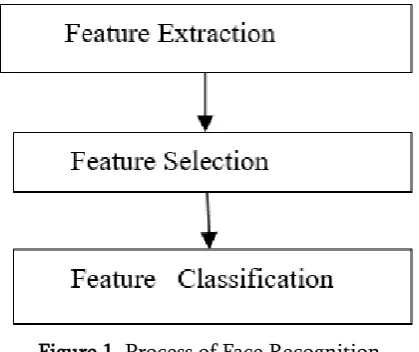
Figure 1. Process of Face Recognition
1. Bacteria Foraging Optimization
Classical BFO Algorithm
Three principle mechanisms are involved in original BFO that are named as chemo taxis, reproduction, and elimination-dispersal.[13]
Chemo Taxis: The jth chemotactic, kth reproductive and lth elimination dispersal step of the bacterium is represented as (j, k,l). The chemo tactic step size which bacterium takes during its each run or tumble is denoted by C(i). Then the movement of the ith bacterium in which computational chemo tactic step is represented as:-
(j+1 ,k, l) = (j,k,l) + c(i)
∆(i) is the direction vector of jth chemo tactic step. A step fitness, denoted as J (i,j,k,l) is evaluated with the action of run or tumble that is taken at each step of chemo taxis process.
Reproduction: The health of bacterium is calculated by summing the fitness steps during bacteria’s entire life, ∑ , where Nc denotes the maximum step in chemo taxis. The bacterium are kept in reverse order according to their health. Only the first half population is able to survive in reproduction step, and those bacteria that survive are left into two identical ones and are then placed at the same location. So bacteria’s population remains constant.
Elimination Dispersal: In many cases when the bacteria may get stuck in its intial positions or local optima , it can change its position or escape from rediscovered by Rumelhart and Mc Clelland in 1986. It performs any input output mapping by training multi-layer feed forward neural network. [14-17]
The basic idea behind BPNN depends on working principle of human brain. It is network of highly interconnected units. Back propagation means error propagation from backward, output to input. An activation function is used in it and the total error is reduced by updation of weight of network.
There are two learning procedure involved in DFT, DCT, but Discrete wavelet transformation (DWT) has many advantages over others. The ability of DWT to provide spatial, frequency representation of image builds our interest to use it for feature extraction.
An original image is taken of size N*N and is passed horizontally and vertically. The filtering arises four components namely LL, LH, HL, HH during its first decomposition level. The sub band LL is the most stable sub band and it represents the approximate coefficients of decomposition. Therefore it is used for generating next level of
Figure 2. Flowchart of Wavelet Transformation
4. Linear Discriminent Analysis:
Linear Discriminent analysis (LDA) is a method that attempts to figure out the difference between data classes. It separates the images of different classes and groups images of same classes.
II.
LITRETURE SURVEY
A. Bacteria Foraging Optimization
Rutuparna Panda, Manoj Kumar Naik and B.K. Panigrahi carried out research on face recognition using BFO algorithm. They used BFO- Fisher algorithm that used cost function for optimization. Hill climbing was used to maximize the cost function that is not possible in Genetic algorithm. The databases which were used in this work were YALE and UMIST for performance evaluation.
In Yale database, which contains of 165 images of 15 different persons, they took 4 images per person for training image and all other were used for testing purpose. They made a comparison between BFO-Fisher algorithm and Genetic algorithm and found out that BFO-Fisher was more effective as compared to GA and their increase in accuracy by 2.86% from 85.71% of GA-Fisher algorithm.
Secondly in UMIST database, which contains 564 images of 20 people , they found that their was 3.80% increase in accuracy from 94.29% of GA-Fisher algorithm.
Rasleen Jakhar, Navdeep kaur, Ramandeep Singh carried out a research on face recognition using BFO based selected features. In their paper they used DCT technique for extraction of features of an image, and then BFO was used for further reduction of extracted features. The BFO algorithm used in this paper is different from existing BFO algorithm as the bacteria used in this algorithm have memory that can be used to move the bacteria back to its previous position if the current position was not suitable. Secondly in this algorithm the bacteria’s position is randomly decided and therefore their is no need of elimination dispersal. The work was done on ORL database. As the ORL database contains 400 images of 40 different person, after using BFO algorithm it reduced the 400 features to 215 features. Then after a comparison was made with PSO-based feature selection and was
found out that average recognition rate of BFO-FS algorithm was greater than PSO-FS algorithm.
Daksha Yadav, Mayank Vasta,Richa Singh, Massino Testo carried out research on face recognition across age progression using bacteria foraging fusion. In the research they used two types of datasets on which they used the algorithm, one was FG-Net facial aging databases and other was IIIT Delhi face aging database. From the proposed algorithm, it was clear that not all the features were compulsory for face recognition across age progression therefore only a few were selected. Both the databases were divided into 2 sets where 30% of it was used for training and 70% for testing. Then after two experiments were carried out on both these databases, where in the first one they took one among the latest picture of every person and kept other pictures in gallery.
Similarly in second experiment, they took one among the younger images and kept others in gallery. The proposed algorithm was then compared with various fusion algorithms like Sum Rule, Weighted Sum Rule, SVM, GA-based Score Fusion. After comparing it they found that proposed algorithm yields greater accuracy then the others. In the first experiment accuracy of 54.3% was achieved on IIIT Delhi database and 64.5% on FG-Net database and the same was for second experiment as well. This proposed algorithm was also compared with many algorithms and the result was better than that.
seconds and the acceptance ratio was greater than 90%.
Mrs. Abhijeet sekhon, Dr. Pankaj Agarwal carried research on face recognition using BPNN technique. They used artificial neural network learning algorithm that is based on back propagation for human face recognition. There were eight features used for face recognition. During the research process it was observed that the system became unstable but was controlled by two parameters called learning rate an error rate. On the basis of weight value their was also one more observation that if the value of the weight was kept fix then it increased the system’s efficiency. The third observation was that if the number of hidden layer nodes is equal to number of output nodes then there is increase in accuracy. It was seen that BPNN takes a lot of time for training system which may decrease its usage.
Firoz Mahmeed, Shyla Afroge, Dr. Md. Al Maumeen, Abdul Matin carried out research on face recognition using PCA and BPNN. They used ORL database to carry out their research work. Six images per person were used for training purpose and four for testing. As there were image variances, so PCA couldn’t recognize the faces well and this increased mismatches. But in constrained environment it worked well and average recognition rate was more than 96%.
C. Discrete Wavelet Transformation
Meihua Wang, Hong Jiang and Ying Li carried out research on face recognition using DCT, DWT and SVM. This experiment is carried out on ORL database. Firstly the decomposition of the image was done by DWT and then 2D-DCT is applied on the low frequency image obtained from DWT and at the last SVM classifier is used to recognize face image. Recognition rate was 96% by the combination of DWT, DCT, SVM and a comparison was made with combination of PCA and SVM algorithm where the recognition rate was 94.29%.
Muzammil Abdul Rahman, Yusuf G. Dambatta, A.S. Muhammad and Abubakar S. Muhammad carried out research on face recognition using DWT. Yale database was used for carrying out experiments. There were total 200 images of 20 person which contained 20 images per person. The first 10 images were used for training and the last ten images were used for testing purpose. First the experiment was performed by PCA and then by the combination of DWT-PCA, and it was found that performance of the latter was higher than that of the first one. By PCA recognition rate was 92% while as by using the combination of both DWT-PCA the recognition rate was nearly 93%.
Moresh M. Mukhedkar, Samarjeet B. Powalkar carried out research on face recognition using DWT and PCA. This paper also includes the comparison between PCA and DWT-PCA algorithms. This paper includes the comparison of access time and recognition rate between the two algorithms. Result of this paper indicates that the access speed feature extraction for recognition rate of DWT with PCA is 34% greater than that of only PCA. The recognition rate is also 94% which is greater than PCA.
D. Linear Discriminant Analysis
Suman Kumar Bhattacharyya, Kumar Rahul carried out their work on face recognition by LDA. In their experiment they had done work on ORL databases. There are 40 subjects and each subject has 10 images. For testing purpose 1 image per person is taken which constitute 360 images. In the total process they correctly recognized 37 images and 3 were not recognized. Therefore true positive rate is 0.925 and true negative rate is 0.075.
users even if they are at distance and they are used for training purpose. The proposed method for taking the face images at distance were same like that of taking images from a particular distance. This proposed method also need less time and was convenient than earlier methods.
Mohd. Abdul Muqueet, Dr. Raghunath S. Holambe carried out work on face recognition using LDA and 2-Channel wavelet filter bank that is designed by factorization of generalized half band polynomial. For doing experiments they used ORL database. 3 techniques and have analysed some of the work done on these techniques. We have seen that BFO gave more accuracy than Genetic Algorithm and others and was more effective .BPNN alone takes a lot of time which may reduce its usage but when combined with other algorithms like PCA gives better results. We also found that by using DWT before any other techniques is also very useful as by using DWT we Massino Testo, “IEEE Conference on Computer Vision and Pattern Recognition Workshops”, 2013.
[2] Rasleen Jakhar, Navdeep Kaur, Ramandeep Singh,
“International Journal of Advanced Computer Science and Application”.
[3] Rutuparna Panda, Manoj Kumar Naik, B.K
Panigrahi, “Swarm and Evolutionary Computation”, 2011.
[4] Mrs. Abhhjeet Sekhon, Dr. Pankaj Agarwal,
“International Conference on Advances in
Computer Engineering and Applications”, 2015. [5] P.Latha, Dr.L. Ganesan, Dr. S. Annadurai, “Signal
Processing: An International Journal (SPIJ)”, Volume (3), 2013.
[6] Firoz Mahmeed, Shyla Afroze, Dr. Md. Al.
Mameen, Abdul Matin, “International Conference on Computer and Information Technology”, December -2015.
[7] Muzammil Abdul Rahman, Yusuf G. Dambatta, A.S.
Muhammad, Abubakar S. Muhammad,
“International Conference on Advances in
Engineering and Technology”, 2014.
[8] Moresh M. Mukhedkar, Samarjeet B. Powalkar,
“International Conference on Energy Systems and Applications”, 2015.
[9] Meihua Wang, Hong Jiang and Ying Li,
“International Conference on Computer
Application and System Modelling”, 2010.
[10] Suman Kumar Bhattacharyya, Kumar Rahul,
“International Journal of Communication Network Security”, Volume2 (3),2013.
[11] Hae-Min Moon, Dongjin Choi, Pankoo Kim, Sung
Bum Pan, “International Conference on Consumer Electronics”, 2015.
[12] Mohd. Abul Muqueet, Dr. Raghunath S. Holambe,
“IEEE”, 2016.
[13] H. Chen, Y.Zhu and R. Hu, “ Cooperative Bacterial
Foraging Optimization”, Research Article, Key Laboratory of Industrial Informatics, Shenyang Institute of Automation, Chinese Academy of Sciences, China,,2009.
[14] SarawatAnam, Md. Shohidul Islam, M.A. Kashem,
M.N. Islam, M.R. Islam, M.S. Islam,” Face Recognition Using Genetic Algorithm and Back Propagation Neural Network”, Proceedings of the International MultiConference of Engineers and Computer Scientists 2009 Vol I ,IMECS 2009, March 18 - 20, 2009, Hong Kong.
[15] BekirKarlik, AVehbiOlgac,” Performance Analysis
of Various Activation Functions in Generalized
MLP Architectures of Neural Networks”,
[16] R.Rojas,”The back propagation Algorithm”, Neural Networks, Springer-Verlag, Berlin, 1996.
[17] Abhishek Banerjee,” Impact of Principal
Component Analysis in the Application of Image Processing”, International Journal of Advanced Research in Computer Science and Software Engineering International Journal of Advanced Research in Computer Science and Software Engineering, Volume 2, Issue 1, January 2012.
[18] Z. Xiong and K. Ramchandran, “Wavelet Image
Compression,” Handbook of Image and Video Processing, A. Bovik, Ed., 2nd edition New York
Academic, ch. 4–5, 2005