Unsupervised Overlapping Feature Selection for
Conditional Random Fields Learning
in Chinese Word Segmentation
Ting-hao Yang
Institute of Information Science Academia Sinica
Tian-Jian Jiang
Department of Computer Science National Tsing-Hua University
Chan-hung Kuo
Institute of Information Science Academia Sinica
Richard Tzong-han Tsai
Department of Computer Science & Engineering Yuan Ze University
Wen-lian Hsu
Institute of Information Science Academia Sinica
Abstract
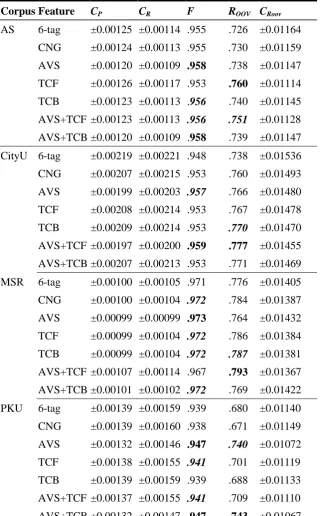
This work represents several unsupervised feature selections based on frequent strings that help improve conditional random fields (CRF) model for Chinese word segmentation (CWS). These features include character-based N-gram (CNG), Accessor Variety based string (AVS), and Term Contributed Frequency (TCF) with a specific manner of boundary overlapping. For the experiment, the baseline is the 6-tag, a state-of-the-art labeling scheme of CRF-based CWS; and the data set is acquired from SIGHAN CWS bakeoff 2005. The experiment results show that all of those features improve our system’s F1
measure (F) and Recall of Out-of-Vocabulary (ROOV). In particular, the feature collections which contain AVS feature outperform other types of features in terms of F, whereas the feature collections containing TCB/TCF information has better ROOV.
Keywords: Word Segmentation, Unsupervised Feature Selection, Conditional Random Fields
1. Introduction
machine translation assume the ready availability of a tokenization into words, which is relatively straightforward in languages with word delimiters (e.g. space), while a little difficult for Asian languages such as Chinese and Japanese.
1.1
Background
Chinese word segmentation (CWS) is an essential pre-work for Chinese text processing applications and it has been an active area of research in computational linguistics for two decades. SIGHAN, the Special Interest Group for Chinese Language Processing of the Association for Computational Linguistics, conducted five word segmentation bakeoffs (Sproat and Emerson, 2003; Emerson, 2005; Levow, 2006; Jin and Chen, 2007; Zhao and Liu, 2010). After years of intensive researches, CWS has achieved high precision, but the issue of out-of-vocabulary word handling still remains.
1.2
The State of the Art of CWS
Traditional approaches for CWS adopted dictionary and rules to segment unlabeled texts (c.f. Ma and Chen, 2003). In recent years, the mainstream is to use statistical machine learning models, especially the Conditional Random Fields (CRF) (Lafferty et al, 2001), which shows a moderate performance for sequential labeling problem and achieves competitive results with character position based methods (Zhao et al., 2010).
1.3
Unsupervised CRF Feature Selections for CWS
For incorporating unsupervised feature selections into character position based CRF for CWS, Zhao and Kit (2006; 2007) tried strings based on Accessor Variety (AV), which was developed by Feng et al. (2004), and co-occurrence strings (COS). Jiang et al. (2010) applied a feature similar to COS, called Term Contributed Boundary (TCB). Tsai (2010) employ statistical association measures non-parametrically through a natural but novel feature representation scheme. Those unsupervised feature selection are based on frequent strings extracted automatically from unlabeled corpora. They are suitable for closed training evaluation that any external resource or extra information is not allowed. Without proper knowledge, the closed training evaluation of word segmentation can be difficult with Out-of-Vocabulary (OOV) words, where frequent strings collected from the test data may help.
Chinese, character-based N-gram (CNG) is usually insufficient. For example, consider the following sample texts in Chinese
“自然科學的重要性” (the importance of natural science);
“自然科學的研究是唯一的途徑” (natural science research is the only way).
where many character-based N-grams can be extracted, but some of them are out of context, such as “然科” (so; discipline) and “學的” (study; of), even when they are relatively
frequent,. For the purpose of interpreting overlapping behavior of frequent strings, however, character-based N-grams could still be useful for baseline analysis and implementation.
3.2
Reduced N-gram
The lack of correct information about the actual boundary and frequency of a multi-character/word expression has been researched in different languages. The distortion of phrase boundaries and frequencies was first observed in the Vodis Corpus when the word-based bigram “RAIL ENQUIRIES” and word-based trigram “BRITISH RAIL ENQUIRIES” were estimated and reported (O’Boyle, 1993; Ha et al., 2005). Both of them occur 73 times, which is a large number for such a small corpus. “ENQUIRIES” follows “RAIL” with a very high probability when “BRITISH” precede it. However, when “RAIL” is preceded by words other than “BRITISH,” “ENQUIRIES” does not occur, but words like “TICKET” or “JOURNEY” may. Thus, the bigram “RAIL ENQUIRIES” gives a misleading probability that “RAIL” is followed by “ENQUIRIES” irrespective of what precedes it. A common solution to this problem is that if some N-grams consist of others, then the frequencies of the shorter ones have to be discounted with the frequencies of the longer ones. For Chinese, Lin and Yu (2001) reported a similar problem and its corresponding solution in the sense of reduced N-gram of Chinese character. By excluding N-grams with their numbers of appearance that fully depend on other super-sequences, “然科” and “學的” from the sample texts in the previous sub-section are not candidates of string anymore. Zhao and Kit (2007) described the same concept briefly as co-occurrence string (COS). Sung et al. (2008) invented a specific data structure for suffix array algorithm to calculate exact boundaries of phrase-alike string and their frequencies called term-contributed boundaries (TCB) and term-contributed frequencies (TCF), respectively, to analogize similarities and differences with the term frequencies. Since we use the program of TCB/TCF for experiment within this study, the family of reduced N-gram will be referred as TCB hereafter for convenience.
3.3
Uncertainty of Succeeding Character
Cohen et al., 2002; Huang and Powers, 2003; Tanaka-Ishii, 2005; Jin and Tanaka-Ishii, 2006; Cohen et al., 2006). The basic idea behind those measurements is closely related to one particular perspective of N-gram and information theory as cross-entropy or Perplexity. According to Zhao and Kit (2007), AV and BE both assume that the border of a potential Chinese word is located where the uncertainty of successive character increases. They believe that AV and BE are the discrete and continuous version, respectively, of a fundamental work of Harris (1970), and then decided to adopt AVS as unsupervised feature selection for CRF-based CWS. We follow their choice in hope of producing a comparable study. AV of a string s is defined as
)} ( ), ( min{ )
(s L s R s
AV = av av . (3)
In Equation (3), Lav(s) and Rav(s) are defined as the number of distinct preceding and succeeding characters, respectively, except if the adjacent character has been absent because of sentence boundary, then the pseudo-character of sentence beginning or sentence ending will be accumulated indistinctly. Feng et al. (2004) also developed more heuristic rules to remove strings that contain known words or adhesive characters. For the strict meaning of unsupervised feature selection and for the sake of simplicity, those additional rules are dropped in this study.
4. Other Related Works
This section briefly describes the following three related works.
4.1
Frequent String Extraction Algorithm
Besides papers of TCB/TCF extraction (Sung et al., 2008), Chinese frequent strings (Lin et al., 2001) and reduced N-gram (Ha et al., 2005) that are mentioned earlier, the article about a linear algorithm for Frequency of Substring Reduction (Lü and Zhang, 2005) also falls into this category. Most of them focused on the computational complexity of algorithms. More general algorithms for frequent string extraction are usually suffix array (Manber and Myers, 1993) and PAT-tree (Chien, 1997).
4.2
Unsupervised Word Segmentation Method
unsupervised feature selections into supervised CRF learning, those methods usually filter out word-alike candidates by their own scoring mechanism directly.
4.3
Overlapping Ambiguity Resolution
Subword-based tagging (Zhang et al., 2006) utilizes confidence measurement. Other overlapping ambiguity resolution approaches are Naïve Bayesian classifiers (Li et al., 2003), mutual information, difference of t-test (Sun et al., 1997), and sorted table look-up (Qiao et al., 2008).
5. CRF Labeling Scheme
5.1
Character Position Based Labels
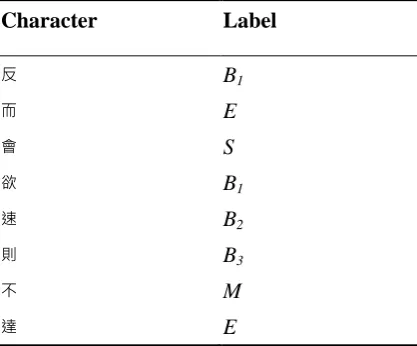
In this study, the 6-tag approach (Zhao et al., 2010) is adopted as our formulation, which achieves a very competitive performance recently, and is one of the most fine-grained character-position-based labeling schemes. According to Zhao et al. (2010), since less than 1% Chinese words are longer than five characters in most corpora from SIGHAN CWS bakeoffs 2003, 2005, 2006 and 2007, the coverage of 6-tag approach should be good enough. This configuration of CRF without any additional unsupervised feature selection is also the control group of the experiment. Table 1 provides a sample of labeled training data.
Table 1. A Sample of the 6-tag Labels
Character Label
反 B1
而 E
會 S
欲 B1
速 B2
則 B3
不 M
達 E
5.2
Feature Templates
Feature instances are generated from templates based on the work of Ratnaparkhi (1996). Table 2 explains their abilities.
Table 2. Feature Template
Feature Function
C-1, C0, C1 Previous, current, or next token
C-1C0 Previous and current tokens
C0C1 Current and next tokens
C-1C1 Previous and next tokens
C-1, C0 and C1 stand for the input tokens bound to the prediction label at current position individually. For example in Table 1, if the current position is at the label M, features generated by C-1, C0 and C1 are “則,” “不” and “達,” respectively. Meanwhile, for window size 2, C-1C0, C0C1 and C-1C1 expands features of the label M to “則不,” “不達” and “則達,” respectively. According to Zhao et al. (2010), the context window size in three tokens is effective to catch parameters of 6-tag approach for most strings not longer than five characters. Our pilot test for this case, however, shows that context window size in two tokens would be sufficient without significant performance decreasing. We also intentionally avoid using feature templates that determine character types like alphabet, digit, punctuation, date/time and other non-Chinese characters, to stay with the strict protocol of closed training and unsupervised learning.
Unsupervised feature selections that will be introduced in the next sub-section are of course generated by the same template, except the binding target moves column by column as listed in tables of the next sub-section.
By default, CRF++ generates features not only for the prediction label at the current position, but also for combinations of the prediction label at both the previous and the current position, which should not be confused with the context window size mentioned above.
5.3
A Unified Feature Representation for CNG, AVS and TCB
1
2 2
, )
(s =r if r ≤ x< r+ f
. (4)
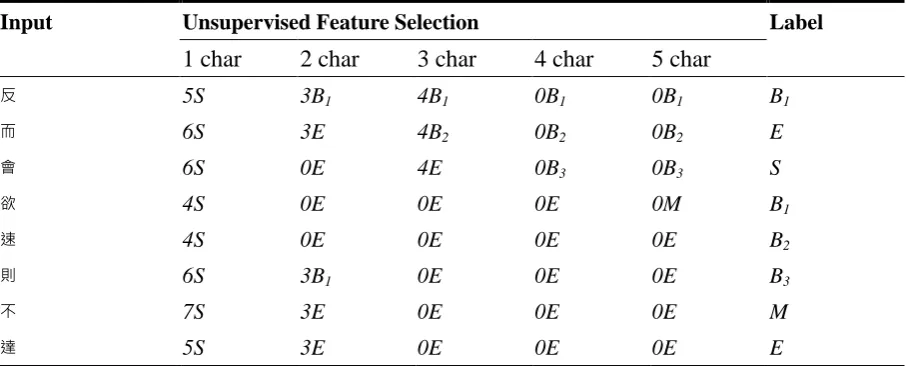
The logarithm ranking mechanism in Equation (4) is inspired by Zipf’s law with the intention to alleviate the potential data sparseness problem of infrequent strings. The rank r and the corresponding character positions of a string are then concatenated as feature tokens. To give the reader a clearer picture about what feature tokens look like, a sample representation for CNG, AVS or TCB is demonstrated and explained by Table 3.
For example, judging by strings with two characters, one of the strings “反而” gets rank r = 3 , therefore the column of two-character feature tokens has “反” denoted as 3B1 and “而” denoted as 3E. If another two-character string “而會” competes with “反而” at the position of “而” with a lower rank r = 0, then 3E is selected for feature representation of the token at a certain position.
Table 3. A Sample of the Unified Feature Representation for Overlapping String
Input Unsupervised Feature Selection Label
1 char 2 char 3 char 4 char 5 char
反 5S 3B1 4B1 0B1 0B1 B1
而 6S 3E 4B2 0B2 0B2 E
會 6S 0E 4E 0B3 0B3 S
欲 4S 0E 0E 0E 0M B1
速 4S 0E 0E 0E 0E B2
則 6S 3B1 0E 0E 0E B3
不 7S 3E 0E 0E 0E M
達 5S 3E 0E 0E 0E E
Note that when the string “則不” conflicts with the string “不達” at the position of “不” with the same rank r = 3, the corresponding character position with rank of the leftmost string, which is 3E in this case, is applied arbitrarily.
Although those are indeed common situations of overlapping strings, we simply inherit the above rules by Zhao and Kit (2008) for the sake of compatibility. In fact, we have done a pilot test with a more complicated representation like 3E-0B1 for “而” and 3E-3B1 for “不” to keep the overlapping information within each column, but the test result shows no significant differences in terms of performance. Since the statistics of the pilot test could be considerably redundant, they are omitted in this paper.
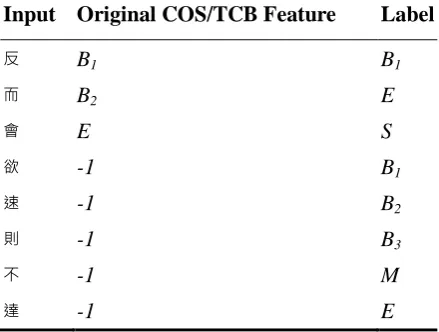
Table 4. A Sample of the Representation for Non-overlapping COS/TCB Strings
Input Original COS/TCB Feature Label
反 B1 B1
而 B2 E
會 E S
欲 -1 B1
速 -1 B2
則 -1 B3
不 -1 M
達 -1 E
Note that there are several features encoded as -1 individually to represent that the desired string is unseen. For the family of reduced N-grams, such as COS or TCB, it means that either the string is always occupied by other super-strings or simply does not appear more than once.
The length of a string is limited to five characters for the sake of efficiency and consistency with the 6-tag approach.
6. Experiment
The version 0.54 of the CRF++ employs L-BFGS optimization and the tunable hyper-parameter, i.e. the Gaussian prior, set to 100 throughout the whole experiment.
6.1
Data Set
The corpora used for experiment are from SIGHAN CWS bakeoff 2005. It comes with four different standards including Academia Sinica (AS), City University of Hong Kong (CityU), Microsoft Research (MSR) and Peking University (PKU).
6.2
Unsupervised Feature Collection
Unsupervised feature selections are collected according to pairs of corresponding training/test corpus. CNG and AVS are arranged with the help from SRILM (Stolcke, 2002). TCB strings and their ranks converted from TCF are calculated by YASA. To distinguish the ranked and overlapping feature of TCB/TCF from those of the original version of COS/TCB based features, the former are denoted as TCF to indicate the score source for ranking, and the abbreviation of the later remains as TCB.
TCB/TCF information usually has better ROOV.
Table 5. Performance Comparison After Post-processing
Corpus Feature CP CR F ROOV CRoov
AS 6-tag ±0.00125 ±0.00114 .955 .726 ±0.01164
CNG ±0.00124 ±0.00113 .955 .730 ±0.01159
AVS ±0.00120 ±0.00109 .958 .738 ±0.01147
TCF ±0.00126 ±0.00117 .953 .760 ±0.01114
TCB ±0.00123 ±0.00113 .956 .740 ±0.01145
AVS+TCF ±0.00123 ±0.00113 .956 .751 ±0.01128
AVS+TCB ±0.00120 ±0.00109 .958 .739 ±0.01147 CityU 6-tag ±0.00219 ±0.00221 .948 .738 ±0.01536
CNG ±0.00207 ±0.00215 .953 .760 ±0.01493
AVS ±0.00199 ±0.00203 .957 .766 ±0.01480
TCF ±0.00208 ±0.00214 .953 .767 ±0.01478
TCB ±0.00209 ±0.00214 .953 .770 ±0.01470
AVS+TCF ±0.00197 ±0.00200 .959 .777 ±0.01455 AVS+TCB ±0.00207 ±0.00213 .953 .771 ±0.01469
MSR 6-tag ±0.00100 ±0.00105 .971 .776 ±0.01405
CNG ±0.00100 ±0.00104 .972 .784 ±0.01387
AVS ±0.00099 ±0.00099 .973 .764 ±0.01432
TCF ±0.00099 ±0.00104 .972 .786 ±0.01384
TCB ±0.00099 ±0.00104 .972 .787 ±0.01381
AVS+TCF ±0.00107 ±0.00114 .967 .793 ±0.01367 AVS+TCB ±0.00101 ±0.00102 .972 .769 ±0.01422
PKU 6-tag ±0.00139 ±0.00159 .939 .680 ±0.01140
CNG ±0.00139 ±0.00160 .938 .671 ±0.01149
AVS ±0.00132 ±0.00146 .947 .740 ±0.01072
TCF ±0.00138 ±0.00155 .941 .701 ±0.01119
TCB ±0.00139 ±0.00159 .939 .688 ±0.01133
AVS+TCF ±0.00137 ±0.00155 .941 .709 ±0.01110
AVS+TCB ±0.00132 ±0.00147 .947 .743 ±0.01067
靠 / 单位 / 的 / 纽带 / 来 / 维持,” while the 6-tag approach see this phrase incorrectly as “依靠 /
单位 / 的 / 纽 / 带来 / 维持.” TCB also saves more factoids, such as “一二九.九 / 左右” (around
129.9) from scattered tokens, such as “一二九 / . / 九 左右” (129 point 9 around).
The above observations suggest that the quality of a string as a word-alike candidate should be an important factor for unsupervised feature selection injected CRF learner. Relatively speaking, CNG probably brings in too much noise. Non-overlapping COS/TCB seems to be a moderate choice with a lower training cost of CRF than those of other overlapping features. This confirms our hypothesis at the end of Section 1.3 that, including overlapping information as an unsupervised feature selection may help improving CWS performance of supervised labeling scheme of CRF.
7. Conclusion and Future Works
This paper provides a study about CRF-based CWS integrated with unsupervised and overlapping feature selections. The experiment results show that the feature collections which contain AVS obtains better performance in terms of F1 measure score, and TCB/TCF
enhances the 6-tag approach on the Recall of Out-of-Vocabulary. In the future, we will search for a hybrid method that utilizes information both inside and outside Chinese words simultaneously.
Acknowledgement
This research was supported in part by the National Science Council under grant NSC 100-2631-S-001-001, and the research center for Humanities and Social Sciences under grant IIS-50-23. The authors would like to thank anonymous reviewers for their constructive criticisms.
References
[1] Peter O'Boyle, “A Study of an N-Gram Language Model for Speech Recognition”, PhD Thesis, Queen's University Belfast , 1993.
[2] Cheng-Huang Tung and His-Jian Lee, “Identification of Unknown Words from Corpus”, Computational Proceedings of Chinese and Oriental Languages, vol.8, pp.131-145, 1994.
[3] Jing-Shin Chang and Keh-Yih Su, “An Unsupervised Iterative Method for Chinese New Lexicon Extraction”, Computational Linguistics and Chinese Language Processing, vol.2, no.2, pp.97-148, 1997.
Research and Development, vol.34, no.5, pp.332-339, 1997.
[5] Lee-Feng Chien, “PAT-tree-based Keyword Extraction for Chinese Information Retrieval”, in Proceedings of the 20th Annual International ACM SIGIR Conference on Research and Development in Information Retrieval, pp.50-58, 1997.
[6] John Lafferty, Andrew McCallum, Fernando Pereira, “Conditional Random Fields Probabilistic Models for Segmenting and Labeling Sequence Data”, in Proceedings of International Conference on Machine Learning, pp.591-598, 2001.
[7] Yih-Jeng Lin, Ming-Shing Yu, “Extracting Chinese Frequent Strings without a Dictionary from a Chinese Corpus and its Applications”, Journal of Information Science and Engineering 17, pp.805-824, 2001.
[8] Andreas Stolcke, “SRILM - An Extensible Language Modeling Toolkit”, in the Proceedings of Spoken Language Processing, pp.901-904, 2002.
[9] Mu Li, Jianfeng Gao, Chang-Ning Huang, “Unsupervised Training for Overlapping Ambiguity Resolution in Chinese Word Segmentation”, in the Proceedings of The Second SIGHAN Workshop on Chinese Language Processing, pp.1-7, 2003.
[10]Richard Sproat, Thomas Emerson, “The First International Chinese Word Segmentation Bakeoff”, in the Proceedings of The Second SIGHAN Workshop on Chinese Language Processing, Sapporo, July 11-12, 2003, pp.113-143.
[11]Wei-Yun Ma, Keh-Jiann Chen, “Introduction to CKIP Chinese Word Segmentation System for the First International Chinese Word Segmentation Bakeoff“, in the Proceedings of Second SIGHAN Workshop on Chinese Language Processing, pp.168-171, 2003.
[12]Haodi Feng, Kang Chen, Xiaotie Deng, and Wiemin Zheng, “Accessor Variety Criteria for Chinese Word Extraction”, Computational Linguistics, vol.30, no.1, pp.75-93, 2004. [13]Hanna M. Wallach, “Conditional Random Fields An Introduction”, Department of
Computer and Information Science, University of Pennsylvania, Tech. Rep. MS-CIS-04-21, 2004.
[14]Le Quan Ha, Rowan Seymour, Philip Hanna and Francis J. Smith, “Reduced N-Grams for Chinese Evaluation“, Computational Linguistics and Chinese Language Processing, vol.10, no.1, pp.19-34, 2005.
[15]Thomas Emerson, “The Second International Chinese Word Segmentation Bakeoff”, in the Proceedings of the Fourth SIGHAN Workshop on Chinese Language Processing, pp.123-133, 2005.
[16]Xueqiang Lü, Le Zhang, “Statistical Substring Reduction in Linear Time”, in the Proceedings of the 1st International Joint Conference on Natural Language Processing, pp.320-327, 2005.
SIGHAN Workshop on Chinese Language Processing, pp.108-117, 2006.
[18]Ruiqiang Zhang, Genichiro Kikui, Eiichiro Sumita, “Subword-based Tagging for Confidence-dependent Chinese Word Segmentation”, in the Proceedings of COLING/ACL, pp.961-968, 2006.
[19]Guangjin Jin, Xiao Chen, “The Fourth International Chinese Language Processing Bakeoff : Chinese Word Segmentation, Named Entity Recognition and Chinese POS Tagging”, in the Proceedings of The Sixth SIGHAN Workshop on Chinese Language Processing, pp.69-81, 2007.
[20]Wei Qiao, Maosong Sun, Wolfgang Menzel, “Statistical Properties of Overlapping Ambiguities in Chinese Word Segmentation and a Strategy for Their Disambiguation“, in the Proceedings of Text, Speech and Dialogue, pp.177-186, 2008.
[21]Cheng-Lung Sung, Hsu-Chun Yen, Wen-Lian Hsu, “Compute the Term Contributed Frequency”, in the Proceedings of The Eighth International Conference on Intelligent Systems Design and Applications, pp.325–328, 2008.
[22]Hai Zhao, Chunyu Kit, “Exploiting Unlabeled Text with Different Unsupervised Segmentation Criteria for Chinese Word Segmentation“, in the Proceedings ofThe Ninth International Conference on Intelligent Text Processing and Computational Linguistics, pp.17-23, 2008.
[23]Hai Zhao, Chang-Ning Huang, Mu Li, Lu, Bao-Liang Lu, “A Unified Character-Based Tagging Framework for Chinese Word Segmentation”, ACM Transactions on Asian Language Information Processing, vol.9, no.2, 2010.
[24]Hai Zhao, Qun Liu, “The CIPS-SIGHAN CLP2010 Chinese Word Segmentation Backoff”, in the Proceedings of The First CIPS-SIGHAN Joint Conference on Chinese Language Processing, pp.199-209, 2010.
[25]Richard Tzong-Han Tsai, “Chinese text segmentation: A hybrid approach using transductive learning and statistical association measures“