Knowledge Representation for Interrogatives in E-HowNet
Shu-Ling Huang, You-Shan Chung, Yueh-Yin Shih, Keh-Jiann Chen
CKIP, Institute of Information Science, Academia Sinica
{josieh, yschung, yuehyin, kchen}@iis.sinica.edu.tw
Abstract
In order to train machines to ‘understand’ natural language, we proposed a universal concept representational mechanism called E-HowNet to encode lexical semantics. In this paper, we take interrogative constructions as examples, i.e. concepts or sentences for asking questions or making inquiries, to demonstrate the mechanisms of semantic representation and composition under the framework of E-HowNet. We classify the interrogative words into five types according to their semantic distinctions, and represent each type with fine-grained features and operators. The process of semantic composition and the difficulties of the representation, such as word sense disambiguation, will be addressed. Finally, we’ll show how machine discriminates two synonymous sentences with different syntactic structures and surface strings to prove that machine understanding is achievable.
Keywords: semantic representation, interrogatives, E-HowNet
1.
Introduction
To understand natural language by machines, lexical semantic representation and
composition are the most important techniques. In this paper, we will take the interrogatives
as examples to demonstrate the mechanism of lexical semantic representation and
composition in E-HowNet (Chen et.al., 2004). E-HowNet uses the word sense definition
mechanism of HowNet (Dong, 1988) and the vocabulary of WordNet (Fellbaum,1998)
synsets to describe concepts.1 Its goal is to achieve near canonical semantic representation,
1The advantage of using WordNet synsets is that each synset has unique sense and sense similarity between two
that is, two sentences with different surface forms or in different languages may achieve
similar E-HowNet representations. Take sentences (1) and (2) as examples:
(1) 我能否拍照?Is it OK for me to take pictures?
(2) 我可不可以照相?Can I take photos?
Although the syntactic structure and surface strings of (1), (2) are very different, by using
lexical sense definitions in E-HowNet, we hope machine can ‘understand’ that they are
synonymous sentences.
Analysis of interrogative constructions is of great interest to linguists, as well as to
computer scientists, for example, those who engaged in QA techniques. Interrogative
constructions have played a central role in the development of modern syntactic theory.
Ginzburg & A.Sag (2000) have pointed that interrogative has been at the heart of work in
generative grammar, also in government and binding (GB) and head-driven phrase structure
(HPSG). Nonetheless, to date most syntactic work has taken place quite separately from
semantic and pragmatic work on interrogatives. Taking questions in Mandarin Chinese as
example, Shao (1996) has summed up the current study of interrogatives and listed the main
research themes as follows: the types of question, interrogative particles, querying focus and
its answer, degree of doubt and special interrogative sentences pattern etc.. Most of the above
themes are purely grammatical analysis. To build a frame-based entity-relation knowledge
representation model, we find interrogative construction a good and challenging example, for
it is feature-structured, free formed, and demanding for story comprehension. In other words,
it combines problems of syntax, semantics and pragmatics. Our approach is to find a
framework to represent interrogatives, therefore, semantic distinction of interrogatives is our
focus.
In E-HowNet, we made distinctions between content sense and relational sense and
represent senses of content words and senses of function words in different ways. For
instance, we represent phrase ‘bathe with cold water’ as (3)
(3) bathe with cold water
bathe def: {clean|使淨: patient={body|身體}}
with def: instrument={}
cold water def: {water|水: temperature={cold|冷}}}.
composition: {clean|使淨: patient={body|身體},
instrument={water|水:
temperature={cold|冷}}}.
In this case, content words ‘bathe’ and ‘cold water’ are represented differently from function
word ‘with’, for the latter plays the role of linking concepts. In much the same way,
interrogative words have more relational sense than content sense, so they are defined by
semantic role to denote relational sense and the operator ‘.Ques.’ to mark the querying focus
that is the object or its discrimination features which speakers want to know.
In the following section, we’ll briefly describe the previous work for interrogatives. Then,
we introduce our analysis of type classifications for interrogatives and their representation in
E-HowNet. Next, we present the composition of interrogative sentences and the difficulties
encountered. We conclude the paper by discussing our results and future works.
2. Background
Questions in Chinese studies traditionally attributed to mood category of syntactics.2 Most of
linguists consider there are four grammatical devices that explicitly mark an utterance as an
interrogative. 3First is question which can be answered by ‘yes’ or ‘no’, called factual
question, true and false interrogative or yes/no interrogative. Second is question which
includes Wh-words such as ‘who’, ‘what’ or ‘when’ and so forth, called Wh-word
2 Ma (1989)wrote the first grammar book for Mandarin Chinese. He classified interrogative words into mood
category. Later, Li (1930) and Lv (1942) have carried forward his viewpoint and influenced on modern research of questions deeply.
interrogative, or information seeking interrogative. Third is question which mentions two or
more possible alternative answers, called disjunctive interrogative or either/or interrogative.
Fourth is question which is composed of a statement followed by an A not A form, such as
dui bu dui ‘right not right’, xing bu xing ‘Ok not Ok’ etc., called A not A interrogative or tag
interrogative.4 From different analytical perspective, these four question devices may have
different hierarchy. For example, Lv (1942) framed them as (4) while Lu (1984) structured
them as (5):
(4) interrogative – Wh-word interrogative
– true/false interrogative – A not A interrogative
– disjunctive interrogative
(5) interrogative – true/false interrogative
– non true/false interrogative – Wh-word interrogative
– disjunctive interrogative
– A not A interrogative
Generally speaking, true and false interrogative and Wh-word interrogative are regarded
as basic types.
3.
Semantic Representation
3.1 Our classification of interrogatives
As we focus on knowledge representation, we are more concerned about semantic
discriminations for different interrogative sentences. Therefore, we take a sense-based
approach to create a hierarchical classification which is guided by a layered semantic
hierarchy of answer types, and eventually classifies interrogative sentences into fine-grained
classes, shown as (6):
4 Tag interrogative is formed by adding a short A not A question form of certain verbs as a tag to a statement. In
(6) interrogative –(A) true/false interrogative
– (B) Wh-interrogative –(a) asking factual information
– (b) asking relationship
– (c) asking opinion
– (d) option choosing
According to different querying focus, we separate (A) true/false interrogative from (B)
Wh-interrogative. Take sentences (7), (8) as examples:
(7) 你喜不喜歡這個遊戲?
Do you like this game?
(8) 有誰知道我可以在哪裡找到這個遊戲?
Who knows where I can find this game?
Sentence (7) belongs to the former question device because the entire statement is a querying
focus. Dissimilarly, sentence (8) indicates two querying focuses by using different
interrogatives ‘who’ and ‘where’. In other words, the true/false interrogative asks truth value
of the whole sentence. And the Wh-interrogative is used to ask information. By analyzing the
querying focus, the latter can be further divided into four types: (B-a) asking factual
information, such as time, location, quantity and so forth; (B-b) asking relationship, such as
kinship; (B-c) asking opinion or attitude, such as possibility, capacity, volition etc.; and the
last, (B-d) asking to choose an option. Sentence (8) refers to the type (B-a). For each of the
remaining types, we give an example as follows:
(9) 她是你的什麼人?
What is the relationship between you and her?
(10) 他可不可以吃辣椒?
Can he eat hot peppers?
(11) 淘米水是酸性還是鹼性?
Here, two distinctions have to be made. First, sentence (9) refers to type (B-b), but why need
we separate it from type (B-a) when they both use ‘what’ to make questions? In sentence (9),
the question word ‘什麼 what’ ask for relationship but not the type of a frame element or the
value of a semantic role.5 Chen et. al. (2004) proposed a complex relation description, i.e. a
representation denotes the relation between head and semantic role specifically. In general,
E-HowNet semantic representation model presumes the relations variables is the head, for
example, ‘white cloud’ will be define as (12): (12) white cloud
def:{cloud|雲: color(~)={white|白}}
In the definition, ‘~’ indicates the head ‘cloud’, and normally be omitted in the expression.
Conversely, word indicates complex relation always has another relation variable apart from
the head, so the variable needs to be marked clearly. For example, we express ‘mother in law’
as (13):
(13) mother in law
def:{human|人=mother(spouse(x:human|人))}
According to the representation model, when our querying focus is complex relation, we put
question mark before the relation role, such as mother, spouse, parents etc. to make the
interrogative definition. It makes the difference between interrogative type (B-a) and (B-b).
See more examples in section 4.
Second, some may argue that there is no distinction between type (A) and (B-b).
Comparing sentence (7) and (10), we find they both have a yes/no answer.
(7) 你喜不喜歡這個遊戲?
Do you like this game?
(10) 他可不可以吃辣椒?
Can he eat hot peppers?
But, further considering sentence (14):
(14) 他吃不吃辣椒?
Does he eat hot peppers?
We can still find the slight difference between a yes/no question and an information seeking
question. However, modal words like ‘can’, ‘shall’, ‘will’ bring richer meaning then general
verbs. They are not used to ask truth value but ask opinion or attitude. In Mandarin Chinese, ‘可不可以 can not can’ and ‘喜不喜歡 like not like’ are both with a A not A form, in
syntactical considerations, they are often assigned to the same type. But from the semantic
point of view, we decide they belong to both types.6
3.2Knowledge Representation for Interrogatives
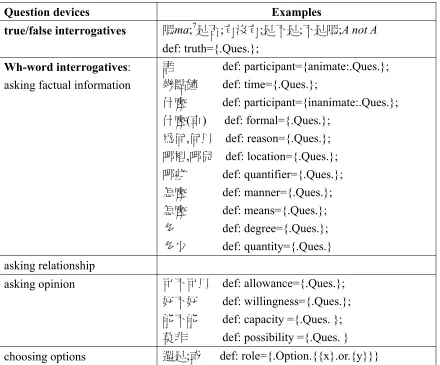
According to the classification above, we represent each type of interrogative as follows:
(15) true/false interrogative def: truth={.Ques.}
Wh-word interrogatives
asking factual information def: role={.Ques.}
asking relationship def:. Ques.RelationRole()
asking opinion def: ModalityRole={.Ques.}
option choosing def: role={.Option.{{x}.or.{y}}}
We use two operators, .Ques. and .Option., to denote querying focus or optional items. The
real examples are shown in the following table 1.
6Shao (1996) has classified A not A form into five classes according to A’s part of speech, shown as follows: (1)
A is a copula. e.g. 是不是 ‘be not be’ (2) A is a modal word e.g. 好不好 ‘ok not ok’ (3) A is an auxiliary e.g.
肯不肯 ‘willing not willing’ (4) A is a verb e.g. 懂不懂 ‘understand not understand’ (5) A is an adjective e.g.
The segmentation and parsing result of (16) is:
Theme[NP:資料data]+ reason[Dj:因何why]+Head[VJ3:漏失lose]
Then, we try to map surface syntax onto semantic structure for establishing truly integrated semantic relations. In example (16), we get the head ‘lose’ from segmentation and parsing process, and base on E-HowNet, the arguments of event ‘lose’ are ‘possessor’ and ‘possession’, we thus know the ‘data’ here is the possession of ‘lose’. Therefore, the composition is as follows:
def:{lose|失去:possession={information|訊息},reason={.Ques.}}
The other types of interrogative words also can be combined into different sentences, shown
as follows:
true/false interrogative
(17) 他病了嗎?
Is he sick?
def:{sick|病:experiencer={he|他},truth={.Ques.}}
(18) 你是否曾說過謊?
Have you lied before?
def:{lie|說謊:agent={listener|聽者},time={past|過去}, truth={.Ques.}}
Wh-word interrogative:
asking factual information
(19) 衣服上的墨水怎麼洗掉?
How to wash away ink stains on cloth?
def:{wash|洗掉:patient={ink|墨水:place={clothes|衣服}},means={.Ques.}}
(20) 哪些桌子壞掉?
Which tables are broken?
def:{OutOfOrder|壞:theme={table|桌子:quantifier={.Ques.}}}
asking relationship
(21) 她是你的什麼人?
What is the relationship between you and her? def:{he|他=.Ques.kinship(listener|聽者)}
(22) 莫非這是鬼城?
Is it possible a ghost town?
def:{be|是:relevant={this|這},content={ghost town|鬼城}, possibility ={.Ques. }}
(23) 由你開車行不行?
Is it ok for you to drive?
def:{drive|開車:experiencer={listener|聽者},willingness ={.Ques. }}
choosing options
(24) 他在這兒還是那兒住?
Does he live here or there?
def:{live|住:agent={he|他},location={.Option.{{here|這兒}.or.{there|那兒}}}}
(25) 他跪下來還是站在那裡求張三?
Does he kneel on the ground or stand there to beg ChangShan?
def:{beg|求:agent={be|他}, target={ChangShan|張 三}, means={.Option.{{stand| 站}.or.{kneel跪}}}}
4.1 Disambiguation
To achieve the goal of automatic composition, we have to face the challenge of sense ambiguities. In Chinese, ‘什麼she me’, ‘怎麼ze me’ and ‘多duo’ are most frequently used
interrogatives with ambiguous senses. Their sense disambiguation rules and representations
are discussed below:
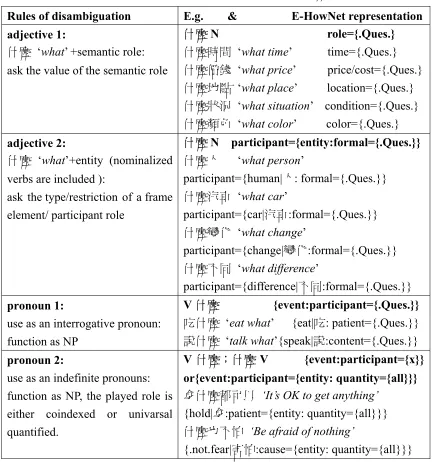
4.1.1 什麼
‘什麼 what’ plays the grammatical functions of adjective and pronoun. For each
function, there are two senses. Accordingly, we generalize four rules to disambiguate the word sense of ‘什麼’, and the details are shown in the table 2:
(26) 怎麼來
def:{come|來:means={.Ques.}}
(27) 怎麼來了
def:{come|來:reason={.Ques.}}
In short, we conclude the disambiguation rule as follows: (28) 怎麼(How)+event[-telic]
怎麼(Why)+event[+telic]
4.1.3 多
‘多how’ also plays the role of adverb. It’s usually followed by an attribute value, such as ‘甜
sweet’, ‘聰明smart’, ‘遠 far’, ‘大 big’ and so forth. It can be used to express the feelings of
exclamation or doubt. We can not simply distinguish these two senses by the context, but
need to rely on the tone. For this reason, we will deal only with the senses of doubt.
Incidentally, it is always possible to turn a declarative statement into a question by using a
slightly rising intonation pattern. For the same reason, we do not deal with such sentences
and few interrogative words such as ‘啊a’; ‘吧ba’ ; ‘呢ni’ as well.
‘多how’ with interrogative sense can be represent as below:
(29) 多+attribute value def:{attribute value: degree={.Ques.}}
The real examples are:
(30) 多甜 ‘how sweet’ def:{sweet|甜:degree={.Ques.}} = def: sweetness={.Ques.}
多聰明 ‘how smart’ def:{smart|聰明:degree={.Ques.}}= def: smartness={.Ques.}
多遠 ‘how far’ def:{far|遠:degree={.Ques.}} = def: distance={.Ques.}
多大 ‘how big’ def:{big|大:degree={.Ques.}} = def: size={.Ques.}
5. Conclusion and Future Works
To achieve near canonical semantic representation, we study the semantic representation and
represent interrogatives in a hierarchy as follows:
true/false interrogative def: truth={.Ques.}
Wh-word interrogative
asking factual information def: role={.Ques.}
asking relationship def:. Ques.RelationRole()
asking opinion def: ModalityRole={.Ques.}
choosing options def: role={.option.{{x}.or.{y}}}
We have cited two examples (1),(2) earlier to illustrate what is the ‘understanding’ of
machine towards natural language. After the discussion above, let’s see the result of this
work:
(1) 我能否拍照?Is it OK for me to take pictures?
Representation:
我 def:{speaker|說話者}
能否 def:allowance={.Ques.}
拍照 def: {TakePicture|拍攝}
Composition:
def: {TakePicture|拍攝:agent={speaker|說話者}, allowance={.Ques.}}
(2) 我可不可以照相?Can I take photos?
Representation:
我 def:{speaker|說話者}
可不可以 def:allowance={.Ques.}
照相 def: {TakePicture|拍攝}
Composition:
def: {TakePicture|拍攝:agent={speaker|說話者}, allowance={.Ques.}}
Although the syntax surface of (1),(2) is different, we find the result of composition is the
same. It means through the analysis of E-HowNet model, machine can judge the similarity of
simple sentence structure. For future researches, we will implement a parsing system
incorporated with E-HowNet model to demonstrate semantic composition process for more
complex sentences. To achieve this goal, apart from sense disambiguation, discordance
between synthetic structure and semantic relations is another critical problem. Take sentence
(31) as an example:
(31) 長途旅行不是很辛苦嗎? Isn’t it hard for Long-distance travel?
Its parsing result is:
Theme[VP:(manner[A: 長 途 long distance]+Head[VA4: 旅 行 travel])]+negation[Dc: 不
not]+epistemics[Dbaa:是be]+degree[Dfa:很very]+Head[VH16:辛苦hard]+particle[Td:嗎ma]
Let’s see the E-HowNet definition of (31) first:
def:{hard| 辛 苦 :theme={travel| 旅 行 :distance={far| 遠 }},degree={very|
很},truth={.Ques.}}
Comparing the semantic representation with syntactic structure, we find rhetorical interrogative ‘不是嗎Isn’t it ’ is segmented into three words in syntax analysis, but in
semantic point of view, they are integrated into one word and represented as ‘truth={.Ques.}’.
There are still many types of discordance between synthetic structure and semantic relations
need to be studied. That is, we have to find out the mapping rules and match coarse-grained
syntactic arguments to fine-grained semantic relations in the future. These rules should be
able to use both on declarative sentences and interrogative sentences, because most of
interrogative sentences are transformed from declarative sentences. Additionally, this study is
also useful to question-answering system for it not only represents the sense of question, but
also marks the focused information to be answered. As for the application on QA
technologies, it’ll be our future task as well.
Acknowledgement:
This research was supported in part by the National Science Council under a Center
References
[1] Chen Keh-Jiann, Huang Shu-Ling, Shih Yueh-Yin, Chen Yi-Jun, Extended-HowNet:
multi-level concept definition and complex relation description, Peking University, 2004
[2] Chen Keh-Jiann, Shu-Ling Huang, Yueh-Yin Shih, Yi-Jun Chen, Extended-HowNet- A
Representational Framework for Concepts, IJCNLP-05 Workshop, Jeju Island, South
Korea, 2005
[3] HowNet, http://www.keenage.com/, 1988
[4] Jonathan Ginzburg & Ivan A.Sag, Interrogative Investigations, Stanford University, 2000
[5] Li & Thompson, Mandarin Chinese, The Crane Publishing Co., LTD., 1997
[6] Sinica Treebank, http://turing.iis.sinica.edu.tw/treesearch/
[7] 石定栩(Shi, Dingxu), ‘疑問句研究’,收錄於 ‘共性與個性—漢語語言學中的爭
議’’,北京語言文化大學出版社,1999
[8] 呂叔湘(Lv, Shuxiang),中國文法要略,1942
[9] 邵敬敏(Shao, Jingmin),現代漢語疑問句研究,華東師範大學出版社,1996
[10] 馬建忠(Ma, Jianzhong),馬氏文通,商務印書館,1935 (first edition:1989)
[11] 陸儉明(Lu, Jianming), ‘關於現代漢語裡的疑問語氣詞’,中國語文,第五期,1984
[12] 湯廷池(Tang, Tingchi), `國語疑問句的研究',師大學報,第二十六期,1983
[13] 黎錦熙(Li, Chinhsi),新著國語文法(Chinese grammar on the national language),商