116 Guang-Lu Sun et al.
chunks from the English Penn Treebank [Marcus et al. 1993]. Parts of the sparkle project focused on finding various sorts of chunks in English, Italian, French and German texts [Carroll et al. 1997]. Chunking is required by many natural language processing applications, such as information retrieval, question and answering, information extraction, and machine translation, and has been one of the most interesting problems in natural language processing.
The Chinese chunking task involves two research issues that we address in this paper. The first is the chunking specification used to define chunk types and to build a data set for supervised learning. Compared with English chunking in the CoNLL-2000 shared task, there are also several types of Chinese chunking specifications and data sets. One is extracting chunks directly from the Chinese Penn Treebank (CPTB) [Xia et al. 2000]. Luo [2003] and Fung [2004] regarded chunking as an intermediate step between POS tagging and full parsing, and defined chunks as the lowest non-terminal, that is, a constituent whose children are all preterminals, and they used it in statistical Chinese full parsing [Bikel and Chiang 2000; Xu 2002]. Li [2003] also provided a definition of Chinese chunks and several rules for extracting chunks from CPTB, but she did some manual checking following extraction and pruning. The others types are not based on CPTB. Zhao and Huang [1999] defined Chinese base noun phrases. Based on the inner structure of phrases, Zhou [2002] defined 9 types of Chinese base phrases. At Microsoft Research Asia (MSRA), Li and Huang [2004] defined another chunking specification for annotating all of the chunks in the open Peking University corpus [Yu et al. 1996]. In this paper, we select two chunking specifications and the corresponding data sets: the lowest non-terminals corpus extracted from CPTB and the annotated chunking Peking University corpus by MSRA. For the sake of brevity, the former is referred to here as the CPTB chunking specification, and the latter as the MSRA chunking specification. We use them to compare the performance of different chunking models. We select two specifications, not just one, in order to verify that our proposed model is independent of the chunking specifications. We selected these two types of corpus because they are both based on open corpora, but their chunk specifications are quite different: the former consists of rules for extracting from a tree, while the latter is a guide for annotating chunks from a segmented and POS tagged corpus.
Chinese Chunking Based on Maximum Entropy Markov Models 117
and MBL [Bosch and Buchholz 2002]. With the CPTB and MSRA Chinese chunking specifications and data sets, we implement a chunking system based on maximum entropy Markov models (MEMM), which combine the transition probabilities and conditional probabilities of states. In open tests, we obtained F-scores of 92.68% with the CPTB data set and 91.02% with the MSRA data set; both results are better than those obtained by Li [2004] with the hidden Markov models (HMM) and maximum entropy model (MEM) under the same training and test data sets.
Section 2 describes two types of chunking specifications that were used in our experiments. Section 3 describes in detail the MEMM chunking model and compares it with the MEM chunking model and HMM chunking model. Section 4 presents experimental results obtained with our system, based on two types of chunking data sets. Finally, we draw some conclusions.
2.
Chinese Chunking Specification
For the sake of comparing the results of different chunking models, two types of chunking specifications and data sets mentioned in Section 1 are defined below.
The following constraints that guarantee feasible consistency and make chunks more applicable are obeyed in both chunking specifications.
1) No chunk can destroy phrase structures. In particular, object-predicate and verb-argument structures cannot be included in one chunk.
2) Any phrase composed of chunks has a flat structure. Neither the relations between chunks nor the words’ relations in chunks are divided.
2.1
CPTB Chunking Specification
Guided by Luo’s [2003] definition of chunks, we define a chunk as a constituent whose children are all preterminals. Twenty-three types of chunks can be extracted directly from CPTB without performing any pre- and post extraction process. Table 1 shows the tag of each chunk type in the CPTB specification. The tags and tag descriptions are the same as those for CPTB syntactic tags [Xue and Xia 2000].
Table 1. The tag of each chunk type in the CPTB specification Chunk tag
ADJP ADVP CLP CP
118 Guang-Lu Sun et al.
In order to identify the boundaries of each chunk in sentences, we define two boundary types, which are denoted by B and I. Let B be the beginning of a chunk, and let I be the interior of a chunk.
To sum up, combining chunk types with boundary types, the CPTB specification contains forty-six tags. The following is an example tagged based on the CPTB specification:
Example 1
布朗/B-NP (Brown) 表示/B-VP (denoted),/I-VP 双方/B-NP (two parties) 可以 /B-VP (can) 在/B-PP(in) 运输/B-NP(transportation) 、/I-NP 电讯/I-NP (telecommunication) 、/I-NP 发电/I-NP(generate electricity) 、/I-NP 金融 /I-NP(finance) 服务业/I-NP(service) 等/I-NP(etc.) 方面/B-NP(aspect) 取得 /B-VP(acquire) 进一步/B-ADJP(more) 的/B-DNP(of) 合作/B-NP(cooperation)。 /B-IP
(Brown indicated that the two parties can improve cooperation in terms of transportation, telecommunications, electric power, finance, services, etc..)
With this specification, the CPTB chunking data set can be automatically extracted from CPTB.
2.2
MSRA Chunking Specification
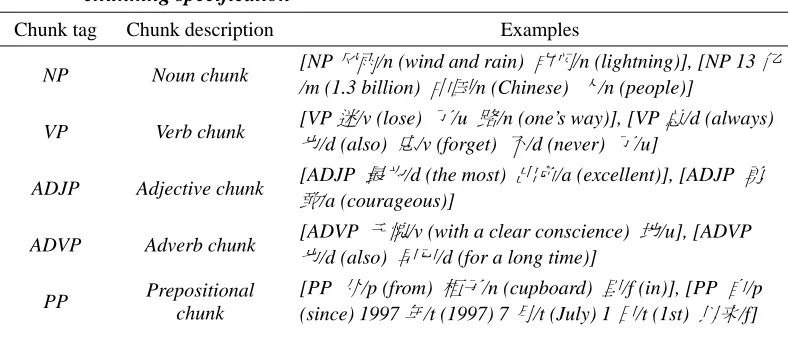
Guided by the CoNLL-2000 English chunking specification and the characteristics of Chinese, eleven chunk types are defined in the MSRA chunking specification. Table 2 shows the tag, description and examples for each chunk type.
Table 2. The tag, description and examples for each chunk type in the MSRA chunking specification
Chunk tag Chunk description Examples
NP Noun chunk [NP风雨/n (wind and rain) 电闪/n (lightning)], [NP 13亿 /m (1.3 billion) 中国/n (Chinese) 人/n (people)]
VP Verb chunk [VP迷/v (lose) 了/u 路/n (one’s way)], [VP总/d (always) 也/d (also) 忘/v (forget) 不/d (never) 了/u]
ADJP Adjective chunk [ADJP 敢 最为/d (the most) 出色/a (excellent)], [ADJP 勇 /a (courageous)]
ADVP Adverb chunk [ADVP 无愧/v (with a clear conscience) 地/u], [ADVP 也/d (also) 早已/d (for a long time)]
PP Prepositional chunk
Chinese Chunking Based on Maximum Entropy Markov Models 119
MP Numerical chunk [MP数/m (several) 千/m (thousand) 余/m (about) 件/q (piece)], [MP 十/m (ten) 次/q (time)]
TP Temporal chunk [TP 最近/t (recently)], [TP 1998年/t (1998) 10月/t (October) 1日/t (1st)]
SP Spatial chunk [SP 建国/v (the foundation of the state) 以来/f (after) ], [SP 最后/f (finally)]
CONJP Conjunction chunk [CONJP 而是/c (while)], [CONJP 但/c (but) 总的说来/c (generally speaking)]
INTJP Interjection chunk [INTJP 吗/y], [INTJP 了/y 吧/y]
INDP Independent chunk [INDP 新华社/n (Xinhua News Agency) 北京/n (Beijing) 1月/t (January) 19日/t (19th) 电/n (dispatch) ]
In order to identify the boundaries of each chunk in sentences, we define four boundary types, which are denoted by B, I, E, S. Let B be the beginning of a chunk, let I be the interior of a chunk, let E be the ending of a chunk and let S be a single word chunk.
Besides the above types, some special function words (‘的/of’, ‘和/and’, ‘与/and’, ‘或 /or’) in Chinese cannot be divided into any chunk types. We use O to tag these words and the punctuations as outside of any chunks.
To sum up, combining chunk types with boundary types, the MSRA specification contains forty-five tags plus O. The following is an example tagged based on the MSRA specification:
Example 2
中央/B-NP (central) 电视台/E-NP (television) 得到/S-VP (receive) 一/B-MP (a) 批/E-MP (passel) 思想性/S-NP (ideological nature) 强/S-ADJP (strong) 、/O 艺 术性/S-NP (artistic quality) 高/S-ADJP (high) 的/O 好/B-NP (excellent) 作品 /E-NP (work) ,/O 其中/S-NP (thereinto) 已/B-VP (already) 有/E-VP (have) 八 /B-NP (eight) 部/I-NP (measure word) 作品/E-NP (work) 开始/S-VP (start) 作 /S-VP (do) 投拍/S-NP (put to shot) 的/O 准备/S-NP (preparation) 。/O (Central Television has received a passel of excellent works of strong ideological nature and high artistic quality, of which eight have being prepared to put to shot.)
120 Guang-Lu Sun et al.
3.
Chunking Model
2Through the use of the chunk tags described in Section 2, the Chinese chunking problem can be abstracted as a classification problem. Below, we briefly introduce the HMM chunking model and MEM chunking model, and discuss these models’ limitations. To overcome these limitations, we propose the MEMM chunking model and describe it in detail.
3.1
HMM for Chunking
HMM is a statistical structure with stochastic transitions and observations [Rabiner 1989]. It can be used to solve classification problems involved in modeling sequential data. Li [2004] proposed the Chinese chunking model based on conventional HMM.
Given a word sequence W = w1, w2, … , wk and its POS sequence T = t1, t2, … , tk, where k is the number of words in the sentence, the result of chunking is assumed to be a sequence, in which the words are grouped into chunks as follows:
... [wi wi+1 ... wi+m] [wi+m+1 wi+m+2 ... wi+m+h] ...
The corresponding POS tag sequence is grouped as follows:
C =... [ti ti+1 ... ti+m ] [ti+m+1 ti+m+2 ... ti+m+h ] ... ... cj cj+1 ...
Here cj corresponds to the POS tag sequence of a chunk. [ti ti+1 ... ti+m ]Æ cj may also be thought of as a chunk rule. Therefore, C is a sequence of eleven possible chunk rules and some outside words, which we refer to as O. The chunking task is, thus, converted to that of finding a rule sequence. According to Bayes’ rule, it can be computed as follows [Xun et al. 2000]:
* arg max ( / , )
= arg max ( / , ) ( , )
= arg max ( / , ) ( )
c
c
c
C P C W T
P W C T P C T
P W C T P C =
. (1)
Here, P C( )is the probability of transition. It is seen as the rule’s n-gram model. A tri-gram among chunks are used to approximate
2
Chinese Chunking Based on Maximum Entropy Markov Models 123
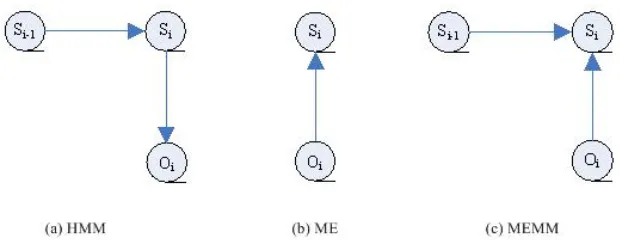
considering the probability of neighboring chunk tag transition. For chunking, the neighboring tags are dependent; for example the chunk tag next to B-NP should be I-NP or E-NP. To overcome this shortcoming, MEMM has been proposed. In it, the current state
s
i dependsnot only on the previous state
s
i−1 but also on the observation sequence O, as shown in Figure 1 [McCallum 2000].Figure 1. The dependency relation for HMM, MEM, and MEMM
MEMM combines the emission probability and transition probability of HMM into a unified function, P s( i|si−1, )O , where
s
i is a chunk tag and O consists of W and T.McCallum [2000] proposed an algorithm to solve the unified function. As the previous state 1
i
s
− is assigned to a certain s*, P s( i|si−1, )O is divided into S separately trained functions, Ps*(s Oi| ), where S is the size of the state space. Each separate function is trained using an exponential model. Thus, the number of states increases, and the data sparseness problem becomes more serious. Because there are forty-five types of chunk tags and some tags occur rarely in training data, it is hard to build forty-five separate, conformable exponential models.As a possible solution, a simplified method can be used to solve the unified function
1
( i| i , )
P s s− O . We split P s( i |si−1, )O into two functions in order to reduce the complexity of the model. P s( i |si−1, )O is estimated as follows:
1 1
( i| i , ) ( i| i ) ( i| i)
P s s− O =P s s− P s H , (13)
where P s( i|Hi) is the conditional probability of a state. Let Hi be histories of
s
i. Theprevious state
s
i−1 is seen as one of the histories in MEM, just like the representations of the observation sequence O. With this method, forty-five separate exponential models are replaced with one exponential model. Meanwhile, MEM, described in Section 3.2, is used to estimate P s( i|Hi).1
( i| i )
124 Guang-Lu Sun et al.
problem of the tag bi-gram. Since not all chunk tags can be followed between each other, three transition restricted rules are used to reduce the number of tag pairs. This can make smoothing more reliable. Let X be a certain chunk type, and let Y be a random chunk type. B, I, E, S, and O were defined in Section 2.2. Thus:
1) B-X can be followed by I-X or E-X; 2) I-X can be followed by I-X or E-X;
3) E-X, S-X, and O can be followed by B-Y, S-Y, or O.
Through three rules, five hundred and seventy-three types of tag pairs can be enumerated. Interpolation smoothing is used, and P s( i|si−1) is estimated as follows:
1 1
( i| i ) * '( i| i ) (1 ) * ( )i
P s s− =λ P s s− + −λ P s . (14)
Maximum Likelihood Estimation (MLE) is used to estimate the empirical probability
1
'( i | i )
P s s− and the tag unigramP s( )i . We set the empirical value
λ
to 0.7 in the MSRA data set.Finally, P s( i|si−1, )O can be estimated by means of P s( i |Hi) andP s( i|si−1). If Hi includes the previous state
s
i−1, then P s( i |Hi) and Z h( ) vary as the previous states
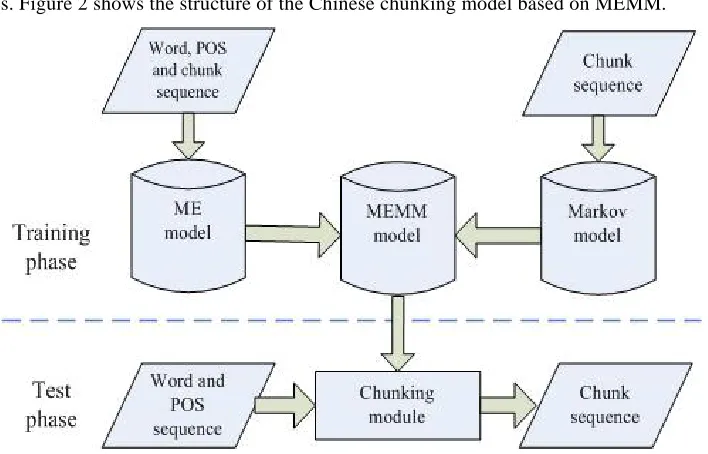
i−1 changes in P s( i|si−1) . By means of this method, P s( i |Hi) and P s( i |si−1) can be combined dynamically. The Viterbi algorithm is used to search for the optimal sequence of states. Figure 2 shows the structure of the Chinese chunking model based on MEMM.Chinese Chunking Based on Maximum Entropy Markov Models 125
3.4
Features in MEMM and MEM
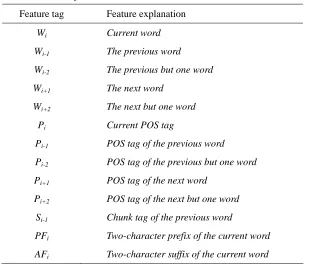
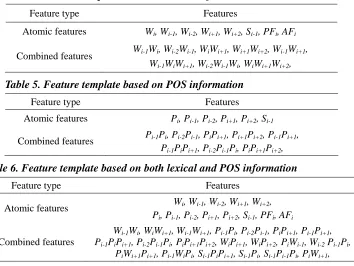
MEM and MEMM are both highly dependent on feature templates. For the sake of making a fair comparison between MEM and MEMM, both MEM and MEMM use the same feature template. The histories of the current state are a source for feature collection. The lexical and POS information of the current word, the left context consisting of two words, and the right context consisting of two words are regarded as histories. In addition, the affix information of the current word and the chunk tag of the previous word are atomic features [Ratnaparkhi 1996; Koeling 2000]. Table 3 shows the atomic features.
Table 3. Atomic features in MEMM and MEM
Feature tag Feature explanation
Wi Current word
Wi-1 The previous word
Wi-2 The previous but one word
Wi+1 The next word
Wi+2 The next but one word
Pi Current POS tag
Pi-1 POS tag of the previous word Pi-2 POS tag of the previous but one word Pi+1 POS tag of the next word
Pi+2 POS tag of the next but one word Si-1 Chunk tag of the previous word
PFi Two-character prefix of the current word AFi Two-character suffix of the current word
In order to compare the effectiveness of different types of features, we selected three types of feature templates. Table 4 shows the template based on lexical information only. Table 5 shows the template based on POS information only. Table 6 shows the template based on both lexical and POS information. Results obtained using different feature templates will be given in Section 4.
126 Guang-Lu Sun et al.
Table 4. Feature template based on lexical information
Feature type Features
Atomic features Wi, Wi-1, Wi-2, Wi+1, Wi+2, Si-1, PFi, AFi Combined features Wi-1Wi, Wi-2Wi-1, WiWi+1, Wi+1Wi+2, Wi-1Wi+1,
Wi-1WiWi+1, Wi-2Wi-1Wi, WiWi+1Wi+2, Table 5. Feature template based on POS information
Feature type Features
Atomic features Pi, Pi-1, Pi-2, Pi+1, Pi+2, Si-1 Combined features Pi-1Pi, Pi-2Pi-1, PiPi+1, Pi+1Pi+2, Pi-1Pi+1,
Pi-1PiPi+1, Pi-2Pi-1Pi, PiPi+1Pi+2, Table 6. Feature template based on both lexical and POS information
Feature type Features
Atomic features Wi, Wi-1, Wi-2, Wi+1, Wi+2, Pi, Pi-1, Pi-2, Pi+1, Pi+2, Si-1, PFi, AFi
Combined features
Wi-1Wi, WiWi+1, Wi-1Wi+1, Pi-1Pi, Pi-2Pi-1, PiPi+1, Pi-1Pi+1, Pi-1PiPi+1, Pi-2Pi-1Pi, PiPi+1Pi+2, WiPi+1, WiPi+2, PiWi-1, Wi-2 Pi-1Pi,
PiWi+1Pi+1, Pi-1WiPi, Si-1PiPi+1, Si-1Pi, Si-1Pi-1Pi, PiWi+1,
4.
Evaluation and Discussion
We will firstly describe in detail our Chinese chunking data set. Then we will present the chunking performance and discuss it.
4.1
Data Set
The CPTB chunking data set is based on data automatically extracted from CPTB, which has a total of around 100,000 word tokens. Following Bikel’s [2000] division, sections 001-270 (approximately 90% of the CPTB) were used for training, and sections 271-300 (approximately 10%) for testing. The remaining sections (301-325) were held for later development/tuning purposes. The CPTB chunking data set consisted of 3,822 sentences with 74,587 chunks and 92,729 word tokens. Thirty-one types of POS tags and forty-one types of chunk tags occurred in the data set. The average length (AL) of the chunks is 1.243 word tokens. Table 7 shows details of the training and test data sets.
Table 7. CPTB chunking training and test data sets
Data set Number of sentences Number of chunks Number of word tokens
Training 3474 68162 84749
Chinese Chunking Based on Maximum Entropy Markov Models 127
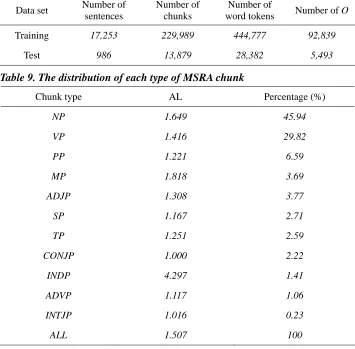
The MSRA chunking data set is based on the Peking University corpus, which has been segmented, POS tagged, and chunk annotated manually. The data set consisted of 18,239 sentences with 243,868 chunks and 473,179 word tokens. The vocabulary size was 34,793. Forty-two types of POS tags and forty-three types of chunk tags occurred in the data set. The AL of the chunks is 1.377 word tokens3
. Table 8 shows details of the training and test data sets. Table 9 shows the distribution of each type of chunk in the data set.
Table 8. MSRA chunking training and test data sets
Data set Number of sentences
Number of chunks
Number of
word tokens Number of O Training 17,253 229,989 444,777 92,839
Test 986 13,879 28,382 5,493
Table 9. The distribution of each type of MSRA chunk
Chunk type AL Percentage (%)
NP 1.649 45.94 VP 1.416 29.82 PP 1.221 6.59 MP 1.818 3.69 ADJP 1.308 3.77
SP 1.167 2.71 TP 1.251 2.59 CONJP 1.000 2.22
INDP 4.297 1.41 ADVP 1.117 1.06 INTJP 1.016 0.23 ALL 1.507 100
4.2
Experimental Results
Following the measurement approach adopted in CoNLL-2000, we measured the performance of Chinese chunking in terms of the precision (P), recall (R), and F-score (F). All the results were obtained in open tests.
3
128 Guang-Lu Sun et al.
For the CPTB chunking data set, the results are listed in Table 10. The results for HMM [Li 2004] are listed in the first row of Table 10. The second and third rows list the results for MEM and MEMM, respectively, where the same feature template defined in Table 6 was used. The empirical value
λ
mentioned in Section 3.3 was set to 0.65, based on the training data. It can be seen that, MEMM achieved the best results on the CPTB chunking data set.Table 10. Chunking performance achieved by applying different systems to the CPTB data set
Model P(%) R(%) F (%)
HMM 89.07 90.82 89.94
MEM 92.33 90.93 91.62
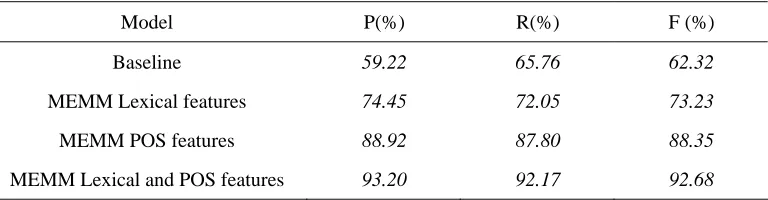
MEMM Lexical and POS features 93.20 92.17 92.68 In order to test the feature impact on MEMM, we tested MEMM chunking on the CPTB data set with the different types of feature templates described in Section 3.4. Table 11 shows the results. The chunk tag that had maximum occurrence probability for each word token was used to chunk its corresponding token. With this method, we got the baseline results listed in the first row of Table 11. The results obtained using the feature template in Table 4 are listed in the second row of Table 11, and then the third and fourth row is for Table 5 and Table 6. It can be seen that, the performance achieved using POS information only is much better than the performance achieved using lexical information only. The performance achieved using lexical and POS information is much better than the performance achieved using POS information only.
Table 11. MEMM chunking performance achieved by applying different feature templates to the CPTB data set
Model P(%) R(%) F (%)
Baseline 59.22 65.76 62.32
MEMM Lexical features 74.45 72.05 73.23 MEMM POS features 88.92 87.80 88.35 MEMM Lexical and POS features 93.20 92.17 92.68
Chinese Chunking Based on Maximum Entropy Markov Models 129
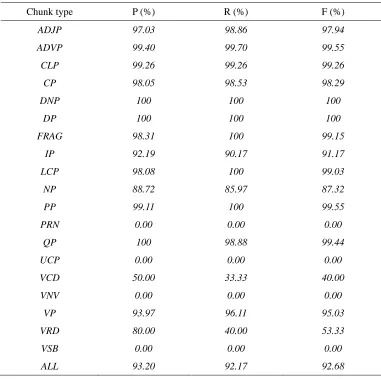
Table 12. The performance of each chunk type for the CPTB data set
For the MSRA chunking data set, Table 13 shows the chunking results. As before, MEMM and MEM used the same feature template, defined in Table 6. The experimental results show that the MEMM chunking model was more efficient for resolving the Chinese chunking problem. The reason is that MEMM chunking model uses sufficient context information that can describe actual language phenomena effectively, as explained in Section 3.3.
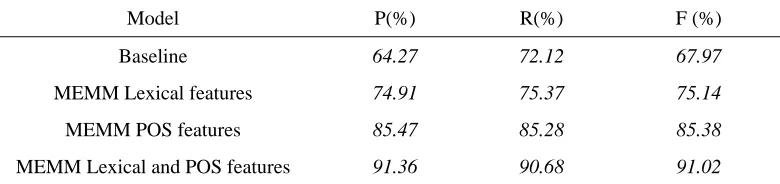
Table 14 shows the MEMM chunking results for the MSRA data set with different types of feature templates. The baseline and feature templates were defined the same as in Table 11. The performance achieved using POS information only was again much better than the performance achieved using lexical information only. One reason is that the model using lexical features has a more serious data sparseness problem than the model using POS features
Chunk type P (%) R (%) F (%)
ADJP 97.03 98.86 97.94 ADVP 99.40 99.70 99.55 CLP 99.26 99.26 99.26
CP 98.05 98.53 98.29
DNP 100 100 100 DP 100 100 100 FRAG 98.31 100 99.15
IP 92.19 90.17 91.17
LCP 98.08 100 99.03
NP 88.72 85.97 87.32
PP 99.11 100 99.55 PRN 0.00 0.00 0.00
QP 100 98.88 99.44
UCP 0.00 0.00 0.00 VCD 50.00 33.33 40.00 VNV 0.00 0.00 0.00
VP 93.97 96.11 95.03
130 Guang-Lu Sun et al.
does. The other reason is that POS tags have a stronger ability to predict chunk tags and that POS tag are the gold standard (because they are manually annotated). The performance achieved using lexical and POS information was again better than the performance achieved using POS information only. This means that lexical information can improve chunking accuracy because it provides sufficient context information for predicting the current chunk tag.
Table 13. Chunking performance achieved by applying different systems to the MSRA data set
Model P(%) R(%) F (%)
HMM 87.47 89.61 88.53
MEM 90.95 88.74 89.83
MEMM Lexical and POS features 91.36 90.68 91.02 Table 14. MEMM chunking performance achieved by applying different feature
templates to the MSRA data set
Model P(%) R(%) F (%)
Baseline 64.27 72.12 67.97
MEMM Lexical features 74.91 75.37 75.14 MEMM POS features 85.47 85.28 85.38 MEMM Lexical and POS features 91.36 90.68 91.02
Table 15 shows the performance of different chunk types for HMM and MEM when the total MEMM F-score in total was 91.02% on the MSRA data set. Because NP and VP chunks accounted for 75.76% of all chunks, their performance dominated the overall chunking performance. As shown, the performance of VP was somewhat better, while the performance of NP was much lower than average, just as in the experimental results for the CPTB data set (shown in Table 12). The performance of PP, CONJP, and INTJP was somewhat better because most of them are single words. For almost all the chunk types, the performance of MEMM is the best. HMM was better for the INDP chunk type because the AL of INDP was 4.297 and the HMM method can classify chunk types that have longer AL.
Chinese Chunking Based on Maximum Entropy Markov Models 131
scale of the training data set helps the chunking performance very little after the data set reaches a certain scale.
Table 15. The performance of each chunk type for the MSRA data set
86 87 88 89 90 91 92
10% 20% 30% 40% 50% 60% 70% 80% 90% 100%
Scale of training dataset(17,253 sentences)
F
-sc
ore(
%)
MEMM MEMM MEMM HMM MEM
Chunk type
P (%) R (%) F (%) F (%) F (%)
NP 88.64 87.48 88.06 85.95 87.59 VP 95.25 96.81 96.03 92.60 94.96 PP 93.98 93.88 93.93 92.86 94.27 MP 88.69 83.71 86.13 88.35 84.84 ADJP 92.26 84.76 88.35 84.17 86.03 SP 82.99 85.60 84.28 77.93 83.51 TP 92.02 92.02 92.02 89.91 84.57 CONJP 99.34 94.62 96.92 97.65 89.35 INDP 78.76 83.96 81.28 91.28 54.82 ADVP 91.98 79.68 85.39 76.84 83.73 INTJP 95.65 95.65 95.65 79.31 86.25 ALL 91.36 90.68 91.02 88.53 89.93
Chinese Chunking Based on Maximum Entropy Markov Models 133
Table 16 shows the number and percentage of each type of error in the MEMM results, compared with those in the HMM and MEM results. Four types of Chinese chunking errors are defined: wrong labeling, under-combining, over-combining, and overlapping. Since one chunking error can possibly result in two chunk tagging errors, there were 852 chunking errors. Under-combining and over-combining errors amounted to almost 90% in all the errors for all three models, so identifying the boundaries of chunks is important to get better performance. The reason why MEMM has the best performance is that the numbers of the two types of errors decrease when the sequential relations of the chunk tags are considered.
5.
Conclusion
In this paper we have proposed a new method of Chinese chunking based on MEMM. The transition probabilities of chunk tags are estimated using the Markov model. A smoothing algorithm is applied to deal with the data sparseness problem of the chunk tag bi-gram. The conditional probabilities of chunk tags along with histories are estimated through MEM. The two probabilities are combined dynamically in MEMM.
For the purpose of comparing the performance of different models, chunking models were applied to both the CPTB chunking data set and MSRA chunking data set. The experiments on the PTCB data set showed that the new model achieved an F-score of 92.68%, which was better than the F-scores of HMM and MEM in Chinese chunking. The improvement was 2.74% and 1.06%, respectively. The experiments on the MSRA data set showed that the new model had an F-score of 91.02%, which was also better than the F-scores of HMM and MEM. The improvement in this case was 2.49% and 1.19%, respectively. The reasons for the improvement have been analyzed through error analysis. We have also discussed the effects of different feature types and different sizes of training data sets on the performance of MEMM.
Acknowledgements
We thank Dr. Ming Zhou, Dr. Jianfeng Gao, Dr. Mu Li, Dr. Yajuan Lv, Dr. John Chen, and Dr. Hongqiao Li for their valuable suggestions and for checking the English in this paper. We also thank the members of the Natural Language Computing Group at Microsoft Research Asia. We especially thank the anonymous reviewers for their insightful comments and suggestions, based on which the paper has been revised.
References
134 Guang-Lu Sun et al.
Berger, A., S. A. Della Pietra, and V. J. Della Pietra, “A Maximum Entropy Approach to Natural Language Processing,” Computational Linguistics, 22(1), 1996, pp. 39-71. Bikel, D.M., and D. Chiang, “Two Statistical Parsing Models Applied to The Chinese
Treebank,” In Proceedings of the second Chinese Language Processing Workshop, Hong Kong, China, 2000, pp. 1-6.
van den Bosch, A., and S. Buchholz, “Shallow Parsing on the Basis of Words Only: a Case Study,” In Proceedings of the 40th Annual Meeting of ACL, Philadelphia, PA, USA, 2002, pp. 433–440.
Carroll, J., T. Briscoe, G. Carroll, M. Light, D. Prescher, M. Rooth, S. Federici, S. Montemagni, V. Pirrelli, I. Prodanof and M. Vannocchi, “Phrasal Parsing Software”, Sparkle Work Package 3, 1997, Deliverable D3.2.
Della Pietra, S., V. J. Pietra, and J. Laffery, “Inducing Features for Random Fields,” IEEE Transactions Pattern Analysis and Machine Intelligence, 19(4), 1997, pp. 380-393. Fung, P., G. Ngai, Y. Yang, and B. Chen, “A Maximum-Entropy Chinese Parser Augmented
by Transformation-Based Learning,” ACM Transactions on Asian Language Information Processing, 3(2), 2004, pp. 159-168.
Gao, J., J. Goodman, M. Li, and K. Lee, “Toward a Unified Approach to Statistical Language Modeling for Chinese,” ACM Transactions on Asian Language Information Processing, 1(1), 2002, pp. 3-33.
Li, H., C. N. Huang, J. Gao, and X. Fan, “Chinese Chunking with Another Type of Spec,” In Proceedings of the 3rd ACL SIGHAN Workshop, Barcelona, Spain, 2004, pp. 41-48. Li, S., Q. Liu, and Z. Yang, “Chunk Parsing with Maximum Entropy Principle,” Chinese
Journal of Computers, 25(12), 2003, pp. 1722-1727.
Li, X., and D. Roth, “Exploring Evidence for Shallow Parsing,” In Proceedings of the CoNLL-2001, Toulouse, France, 2001, pp. 38-44.
Kim Sang, E. Tjong, and S. Buchholz, “Introduction to the CoNLL-2000 Shared Task: Chunking,” In Proceeding of CoNLL-2000 and LLL-2000, Lisbon, Portugal, 2000, pp. 127-132.
Kudoh, T., and Y. Matsumoto, “Use of Support Vector Learning for Chunk Identification,” In Proceeding of CoNLL-2000 and LLL-2000, Lisbon, Portugal, 2000, pp. 142-144.
Kinyon, A., “A Language-independent Shallow-parser Compiler,” In Proceedings of 39th ACL Conference, Toulouse, France, 2001, pp. 322-329.
Koeling, R., “Chunking with Maximum Entropy Models,” In Proceeding of CoNLL-2000 and LLL-2000, Lisbon, Portugal, 2000, pp. 139-141.
Marcus, M. P., B. Santorini, and M. A. Marcinkiewicz, “Building a Large Annotated Corpus of English: The Penn Treebank,” Computational Linguistics, 19(2), 1993, pp. 313-330. McCallum, A., D. Freitag, and F. Pereira, “Maximum Entropy Markov Models for
Chinese Chunking Based on Maximum Entropy Markov Models 135
Luo, X., “A Maximum Entropy Chinese Character-based Parser,” In Proceedings of the Conference on Empirical Methods in Natural Language Processing, Sapporo, Japan, 2003.
Osborne, M., “Shallow Parsing as Part-of-speech Tagging,” In Proceeding of CoNLL-2000 and LLL-2000, Lisbon, Portugal, 2000, pp. 145-147.
Park, S. B., and B. T. Zhang, “Text Chunking by Combining Hand-crafted Rules and Memory-based Learning,” In Proceedings of the 41st Annual Meeting of ACL, Sapporo, Japan, 2003, pp. 497-504.
Ramshaw, L. A., and M. P. Marcus, “Text Chunking Using Transformation-based Learning,” In Proceedings of the 3rd ACL/SIGDAT Workshop, Cambridge, MA, USA, 1995, pp. 222-226.
Rabiner, L. R., “A Tutorial on Hidden Markov Models and Selected Applications in Speech Recognition,” In Proceedings of the IEEE, 77(2), 1989, pp. 257-285.
Ratnaparkhi, A.,“A Maximum Entropy Model for Part-Of-Speech Tagging,” In Proceedings of EMNLP’1996, New Brunswick, New Jersey, USA, 1996, pp. 133-142.
Xia, F., M. Palmer, N. Xue, M. E. Okurowski, J. Kovarik, F. Chiou, S. Huang, T. Kroch, and M. Marcus, “Developing Guidelines and Ensuring Consistency for Chinese Text Annotation,” In Proceedings of the second International Coference on Language Resources and Evaluation, Athens, 2000.
Xu, J., S. Miller, and R. Weischedel, “A Statistical Parser for Chinese,” In Proceedings of Human Language Technology Workshop, San Diego, USA, 2002.
Xun, E., C. Huang, and M. Zhou, “A Unified Statistical Model for the Identification of English BaseNP,” In Proceedings of the 38th ACL, Hong Kong, China, 2000, pp. 109-117.
Xue, N., and F. Xia, “The Bracketing Guidelines for the Penn Chinese Treebank(3.0),” Technical report, University of Pennsylvania, 2000, URL: http://www.cis.upenn.edu/~chinese/.
Yu, S., H. Duan, and X. Zhu, B. Sun, “The Basic Processing of Contemporary Chinese Corpus at Peking University,” Journal of Chinese Information Processing, 16(6), 2002, pp. 58-65.
Zhao, J., and C. N. Huang, “Analysis of Chinese BaseNP Structure,” Chinese Journal of Computers, 22(2), 1999, pp. 141-146.