Machine Learning for Mention Head Detection
in Multilingual Coreference Resolution
Desislava Zhekova
CIS, University of Munich [email protected]
Sandra K ¨ubler
Indiana University [email protected]
Abstract
This work introduces a machine learn-ing approach to the identification of men-tion heads needed for multilingual coref-erence resolution (MCR). We evaluate the method and compare it to a heuristic base-line and a rule-based approach, which are widely used in coreference resolution sys-tems. We use the CoNLL-2012 shared task data sets, which include data for Ara-bic, Chinese, and English. We show that for MCR, machine learning offers a com-petitive, flexible, and robust solution for mention head detection.
1 Introduction
Coreference Resolution (CR) aims to detect all lin-guistic expressions in a given discourse that refer to real world entities. Such expressions are gen-erally calledmentions. They need to be grouped into equivalence classes so that each class contains only mentions that refer to the same entity. The classes are calledcoreference chains. The task of CR includes not only the identification of coref-erence links between mentions, but also the de-tection of the mentions themselves. This subtask of CR has not been a main topic of interest, since most of the standard data sets for CR contained gold mention information. This situation changed in the most recent shared tasks on the topic of CR: SemEval-2010 Task 1 (Recasens et al., 2010), 2011 (Pradhan et al., 2011) and CoNLL-2012 (Pradhan et al., CoNLL-2012). The data distributed by these tasks included syntactic annotations, and it was considered an integral part of the task for the participating systems to develop their own meth-ods to detect mention boundaries.
Statistical approaches to the CR problem often recast the task to a binary classification exercise. For the latter, coreference is represented by a deci-sion model, such as the mention-pair model (Soon
et al., 2001). The mention-pair model, which is the most widely used model for CR, pairs the anaphor with a potential antecedent, and deter-mines whether they are coreferent or not. Since the decisions are taken independently for each possible antecedent, a global heuristic can be used to decide between multiple positive decisions or in cases where no antecedent was found.
The use of the mention-pair model implies that an instance consists of a pair of mentions, and, since vectors for machine learning (ML) need to be of a fixed length, each mention is generally represented by its syntactic head, plus informative features that describe the phrases and their con-text. As a consequence, there is an additional sub-task of CR that needs to be performed before the actual resolution process: mention head detection
(MHD). This is usually done by the use of simple heuristics or manually defined sets of rules (see section 2). In this work, we will investigate a novel ML method for multilingual MHD.
Multilinguality has presented additional issues to the coreference task, which were discussed and addressed by the two multilingual shared tasks on the topic SemEval-2010 Task 1 and CoNLL-2012. In general, MCR is faced with the same problems as monolingual CR: we have to optimize the 3 main stages in CR, the actual detection of men-tions (MD), the detection of the syntactic heads of the latter and classification, based on a selection of features that can represent the phenomena. In our current work, we assume a mention-pair corefer-ence model.
Identifying the head of a phrase is closely re-lated to detecting the grammatical structure of sen-tences. Thus, the annotation layers provided in the two shared tasks led to the development of suc-cessful methods for MD that were mostly based on the underlying syntactic structure of the sen-tences. To our knowledge most state-of-the-art CR systems have not regarded MHD as a
alone subtask of CR, but rather as part of the fea-ture extraction process. Since mentions often cor-respond to NPs, most approaches use variants of head finding rules, which were made popular by Collins (1999). Such rules are manually written and specify where to find the head for an individ-ual syntactic category.
In this work, we pursue the goal of MCR in the sense that we are developing an architecture that allows CR for multiple languages with only a min-imal adaptation to the individual language. This means that we also need a multilingual approach to MHD that does not require the development of head-finding rules for every language to be added to the system. Thus, we introduce a novel method for MHD based on a ML approach, and we com-pare it to two widely used approaches.
In section 2, we give a short overview of the state of the art, then we present the problems with respect to multilinguality and the head detection problem (section 3). In section 4, we describe the two existing approaches to MHD and propose our own ML method. Section 5 describes the data set and evaluation settings and presents a comparison of the ML approach with respect to the other two approaches. In section 6 we conclude our observa-tions and delineate future direcobserva-tions for this task.
2 Related Work
While there is a bulk of literature on CR for En-glish (Soon et al., 2001; Ng and Cardie, 2002; Ng, 2007, for example), MCR has only been addressed recently. The majority of work in this area was carried out in the context of the two shared tasks, the SemEval-2010 (Recasens et al., 2010) and the CoNLL-2012 (Pradhan et al., 2012) tasks. We fo-cus on MHD for the data from CoNLL-2012.
The majority of the systems participating in the two shared tasks used approaches that were fairly language dependent with respect to MHD. In the context of the CoNLL-2012 task, the systems by Chen and Ng (2012), Martschat et al. (2012), and Uryupina et al. (2012) used manually created sets of rules, based on head-finding models following (Collins, 1999). This means that every language other than English, which is targeted by these sys-tems, would need other, language specific, sets of rules. Bj¨orkelund and Farkas (2012) employed Choi and Palmer (2010)’s percolation rules for Arabic and English and the rules of Zhang and Clark (2011) for Chinese. Li et al. (2012) used the
head-finding rules from Penn2Malt, for English and for Chinese. The system by Martschat et al. (2012) relies on the Stanford SemanticHeadFinder (also an implementation of the rules by Collins (1999)) for English while the head detection for Chinese is provided by the SunJurafskyChinese-HeadFinder (an implementation of the rules pre-sented by Sun and Jurafsky (2004)). Martschat et al. (2012) did not work on CR for Arabic.
Uryupina et al. (2012) created their own heuris-tic rules for the Arabic and Chinese; for English, they used Collins (1999)’s rules. For Arabic, the first noun/pronoun was selected as head; in Chi-nese, the last noun/pronoun was chosen as the head. Uryupina et al. (2012) also made the obser-vation that the absence of expert linguistic knowl-edge can become an important obstacle when rules are to be developed manually for each separate language. Additionally, depending on the lan-guage, the collection of such rules may be a rather expensive task.
3 Issues in Multilingual MHD
The concept of a mention is closely related to NPs in syntax. The reason for this relation is that CR at present focuses on entities and often ignores event coreference. As a consequence, finding the head of a mention generally corresponds to identifying the syntactic head of the corresponding NP. The major difference lies in the fact that mentions often correspond to maximal rather than to base NPs.
If we approach the task of finding the men-tion heads by identifying syntactic heads, the task would be trivial if we had a full syntactic analy-sis, as provided in X-bar theory (Chomsky, 1970; Jackendoff, 1977) or inhead-driven phrase struc-ture grammar(Sag et al., 2003; Levine and Meur-ers, 2006). However, treebanks are generally an-notated in a more surface-oriented and flat anno-tation, in which heads of phrases are often not marked as such. The Penn Treebank (Marcus et al., 1993), which is the standard for training statis-tical parsers for English, for example, uses a flat annotation scheme for NPs, as shown in the exam-ples in (1). The annotation in the Penn Treebank for English also served as the model for the anno-tations in the Penn Arabic and Chinese treebanks.
(1) a. [NPThe average seven-day compound yield]
b. [NP [NP the ceiling] [PP on [NP government
debt]]]
# Feature Description
1 the target token
2 part-of-speech tag of the target token 3 part-of-speech tag of token−1
4 part-of-speech tag of token+1
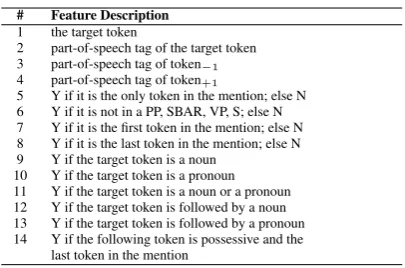
5 Y if it is the only token in the mention; else N 6 Y if it is not in a PP, SBAR, VP, S; else N 7 Y if it is the first token in the mention; else N 8 Y if it is the last token in the mention; else N 9 Y if the target token is a noun
10 Y if the target token is a pronoun 11 Y if the target token is a noun or a pronoun 12 Y if the target token is followed by a noun 13 Y if the target token is followed by a pronoun 14 Y if the following token is possessive and the
last token in the mention
Table 1: The 14 features for the MLH classifier.
good bias for a variation of NLP problems (Daele-mans and van den Bosch, 2005), more specifically TiMBL (Daelemans et al., 2010), an efficient im-plementation of thek-nearest neighbor (k-NN) ap-proach. MBL classifies a new instance based on thekclosest examples from the training set. If the
k nearest examples are distributed over different classes, the majority of the set is used. We do not perform parameter optimization.
In the current task of MHD, we create an in-stance for every word in a mention, and decide for this word whether it is the head of the mention or not. As mentions we select the set of gold men-tions provided by the task. Since mention head information is not provided in standard data distri-butions and was not included in the CoNLL-2012 data, we manually annotated a small data set.
In order to create the training/test data sets, all mentions from the training data are extracted, and each of the tokens for each of the mentions is rep-resented as a feature vector containing information about the context of the given token in the current mention. As features, we collect 14 language in-dependent values, listed in table 1. The features are extracted from the POS annotation layer.
One problem that is not handled by the MLH approach is that the tokens are classified individ-ually, i.e., it is possible that more than one token is classified as the head. However, mentions that do not contain coordinating conjunctions should be assigned exactly one head. Correspondingly, the existence or type of the coordinating conjunc-tion could be used in order to restrict the output of the classifier, which can be also regulated via a weighted classification procedure. In our work, we did not postprocess the output of the classi-fier, i.e., the output may contain multiple heads per mention.
5 Mention Head Detection Experiments
The evaluation of MHD is not a trivial task, since as noted before, mention heads are not included in standard linguistic annotation layers. It is also not part of the evaluation software provided by the shared tasks.
First, in section 5.1, we describe the data set and the experimental setup, including the CR system that we use. Then, we perform two different types of evaluation: In section 5.2, we assess the perfor-mance of the three MHD methods on the manually annotated data sets in an intrinsic evaluation, with-out integrating them into the full CR pipeline. And in section 5.3, we perform an extrinsic evaluation by using each of the three methods in an MCR sys-tem and compare the CR performance achieved by the approaches.
5.1 Data Set and Experimental Setup
For the following experiments, we used the CoNLL-2012 training and test data sets. In or-der to be able to assemble training data for the ML approach, we manually annotated a subset of the data for each of the three languages in the task. The data for Arabic includes an excerpt of 42 documents for training and 8 for testing. For English, we consider 100 documents for training and 20 documents for testing. Finally, for Chi-nese, 84 documents are annotated as a training set, and 16 are used as a test set. Note that Arabic has a significantly lower number of annotated docu-ments, which is not only the result of its smaller data sets, but rather a consequence of the fact that Arabic has a highly NP-rich syntactic structure, which accounts for substantially more training in-stances per document than for English and Chi-nese. The annotations for English were performed by the first author, the ones for Chinese and Ara-bic by linguistically educated native speakers. The mentions used for the experiments aregold men-tions, thus only coreferent mentions. Overall, the number of instances extracted are similar across all three languages. On average, the annotation of the data set required approximately two person-days per language.
language metric HeuristicH RuleH MLH
AR R 0.79 0.83 0.85
excerpt P 0.87 0.88 0.91
F1 0.83 0.85 0.88
EN R 0.65 0.92 0.87 excerpt P 0.70 0.97 0.98
F1 0.67 0.95 0.92
ZH R 0.84 0.96 0.97
excerpt P 0.98 0.98 0.99
F1 0.90 0.97 0.98
Table 2: MHD for excerpt data for all languages, Arabic (AR), English (EN), and Chinese (ZH), for all spans of mentions.
and uses TiMBL for classification. Since we are more interested in the effects of the MHD meth-ods on the full CR system rather than in the opti-mal performance that can be achieved by UBIU, we do not aim at language dependent system op-timization on any system component. We use the official CoNLL-2012 scorer, which provides five evaluation metrics: MUC (Vilain et al., 1995), B3 (Bagga and Baldwin, 1998), the two variants of CEAF (Luo, 2005), CEAFE and CEAFM, and BLANC (Recasens and Hovy, 2011). For compar-ison, we calculate a TOTAL score as the average of the F-score of all metrics.
5.2 Intrinsic Evaluation
The results in table 2 show an interesting out-come: HeuristicH, which requires only minimal language specific knowledge, leads to the low-est performance across all three languages, with an F-score of 0.83 for Arabic, 0.90 for Chinese, and 0.67 for English. This outcome shows that for Arabic and Chinese, we reach a very compet-itive performance with a rather simple heuristic. Remember that both Arabic and Chinese have a clearly unidirectional NP structure. For English, however, with its mixed directionality in NPs, the results are far below the results for the other two languages, with a difference of 23 percent points between Chinese and English. This difference is a direct consequence of the various issues specific to English that we introduced in section 3, such as nominal premodification. Therefore, HeuristicH should only be used when it is known that a lan-guage is unidirectional. Even in such cases, we cannot expect a high performance in every case.
The rule-based approach partially addresses the shortcomings of the HeuristicH baseline. It achieves an F-score of 0.85 for Arabic, 0.95 for English, and 0.97 for Chinese. This shows that we can reach very reliable results for English and
Chi-nese; especially for English, which shows an im-provement by 28 percent points, from an F-score of 0.67 to 0.95. For Arabic, however, the gain from the heuristic to the rule-based approach is minimal: it only gains 2 percent points, and it is far from reaching 90%.
The results for MLH show that this method is highly competitive: For Arabic (with an F-score of 0.88) and Chinese (with an F-score of 0.98), the ML approach reaches the best performance on the task. For English, the overall performance is 0.92, which is only 3 percent points lower than for the rule-based variant. Moreover, the scores for this language show that RuleH reaches a higher recall while precision is better for MLH. Part of the low recall for English may be due to the fact that the training set is restricted in size, which is detrimen-tal for English since there the task is more difficult because of the mixed directionality in NPs.
Note also that overall, for all languages, pre-cision is always higher than recall, which allows the conclusion that our simplistic approach in the ML method, allowing more than one head, does not harm the method’s performance. Overall, we can conclude that the MLH approach is capable of learning the different directionalities, and it is highly competitive, especially given that it is a lan-guage independent method that can be employed for any language for which POS information is provided, given a small annotated data set.
5.3 Extrinsic Evaluation
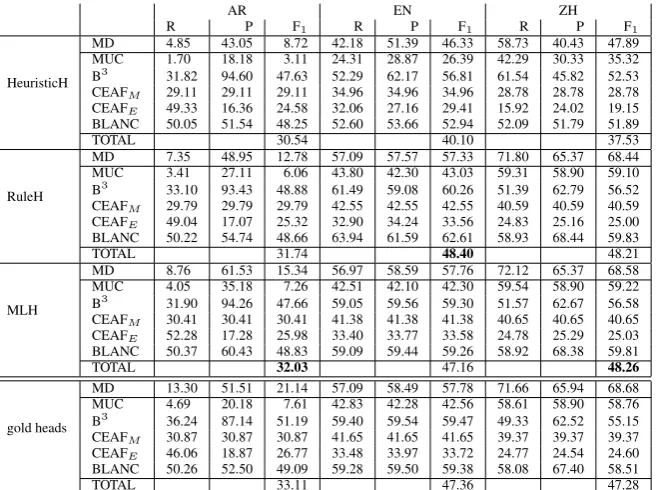
For the extrinsic evaluation, we integrate all meth-ods for MHD into the complete MCR pipeline. This shows whether the MHD methods have an effect on CR. The results are listed in table 3. As upper bound, we usegold standardheads. The re-sults show the same trends as in our intrinsic eval-uation: HeutisticH consistently reaches the lowest scores across all languages, with TOTAL scores as follows: Arabic: 30.54, English: 40.10 and Chi-nese: 37.53.
AR EN ZH
R P F1 R P F1 R P F1
HeuristicH
MD 4.85 43.05 8.72 42.18 51.39 46.33 58.73 40.43 47.89 MUC 1.70 18.18 3.11 24.31 28.87 26.39 42.29 30.33 35.32 B3 31.82 94.60 47.63 52.29 62.17 56.81 61.54 45.82 52.53 CEAFM 29.11 29.11 29.11 34.96 34.96 34.96 28.78 28.78 28.78
CEAFE 49.33 16.36 24.58 32.06 27.16 29.41 15.92 24.02 19.15
BLANC 50.05 51.54 48.25 52.60 53.66 52.94 52.09 51.79 51.89
TOTAL 30.54 40.10 37.53
RuleH
MD 7.35 48.95 12.78 57.09 57.57 57.33 71.80 65.37 68.44 MUC 3.41 27.11 6.06 43.80 42.30 43.03 59.31 58.90 59.10 B3 33.10 93.43 48.88 61.49 59.08 60.26 51.39 62.79 56.52 CEAFM 29.79 29.79 29.79 42.55 42.55 42.55 40.59 40.59 40.59
CEAFE 49.04 17.07 25.32 32.90 34.24 33.56 24.83 25.16 25.00
BLANC 50.22 54.74 48.66 63.94 61.59 62.61 58.93 68.44 59.83
TOTAL 31.74 48.40 48.21
MLH
MD 8.76 61.53 15.34 56.97 58.59 57.76 72.12 65.37 68.58 MUC 4.05 35.18 7.26 42.51 42.10 42.30 59.54 58.90 59.22 B3 31.90 94.26 47.66 59.05 59.56 59.30 51.57 62.67 56.58
CEAFM 30.41 30.41 30.41 41.38 41.38 41.38 40.65 40.65 40.65
CEAFE 52.28 17.28 25.98 33.40 33.77 33.58 24.78 25.29 25.03
BLANC 50.37 60.43 48.83 59.09 59.44 59.26 58.92 68.38 59.81
TOTAL 32.03 47.16 48.26
gold heads
MD 13.30 51.51 21.14 57.09 58.49 57.78 71.66 65.94 68.68 MUC 4.69 20.18 7.61 42.83 42.28 42.56 58.61 58.90 58.76 B3 36.24 87.14 51.19 59.40 59.54 59.47 49.33 62.52 55.15 CEAFM 30.87 30.87 30.87 41.65 41.65 41.65 39.37 39.37 39.37
CEAFE 46.06 18.87 26.77 33.48 33.97 33.72 24.77 24.54 24.60
BLANC 50.26 52.50 49.09 59.28 59.50 59.38 58.08 67.40 58.51
TOTAL 33.11 47.36 47.28
Table 3: MHD performance of HeuristicH, RuleH and MLH compared to the use ofgoldheads.
32.03 for Arabic and 48.26 for Chinese. For En-glish, RuleH is marginally better than the MLH approach. This mirrors the performance of both methods in the intrinsic evaluation. Moreover, the performance of the system when given gold men-tion heads for this language is 47.36, which is only 0.2 percent points higher than MLH’s perfor-mance. This shows that the latter approach already achieves a close to optimal performance.
The results of this experiment show that provements in MHD translate directly into im-provements of the overall CR system. Since the ML approach outperforms the rule-based ap-proach for two languages, we can conclude that MLH is highly competitive for MHD in a MCR context, as it is language independent in that it does not require any language specific knowledge or annotation layers, apart from POS information and a small data set annotated for heads. Note also that the RuleH total scores for English and Chi-nese as well as the MLH total score for ChiChi-nese are higher than the respective values given gold standardheads. This is due to an increased recall across the different metrics.
6 Conclusion and Future Work
We propose a machine learning approach to men-tion head detecmen-tion in the context of multilingual coreference resolution. We conducted an in-depth intrinsic and extrinsic evaluation of the method
and compared it to a heuristic and a language de-pendent rule-based approach, generally used in CR systems. Our results show that the ML ap-proach is language independent, given a small an-notated set, and that it performs competitively in a multilingual setting.
The proposed ML method for MHD includes a basic set of language independent features. Like any ML approach, features are very important to the overall performance of the learner. For this reason, one very promising direction of further in-vestigation is the thorough evaluation and exten-sion of the feature set used for classification. In order to keep the language independent nature of MLH, only language independent features should be added to the current set of 14 values.
As discussed in section 4, the MLH approach does not control the number of heads allowed per mention. Thus, a possible improvement of this method can be achieved by an additional restric-tion on the number of heads allowed per phrase that is bound by the type of NP and the existence of coordinating conjunctions used in the phrase.
Acknowledgments
Marc Vilain, John Burger, John Aberdeen, Dennis Con-nolly, and Lynette Hirschman. 1995. A Model-Theoretic Coreference Scoring Scheme. In Pro-ceedings of the 6th Message Understanding Confer-ence, Columbia, MD.
Yue Zhang and Stephen Clark. 2011. Syntactic Pro-cessing Using the Generalized Perceptron and Beam Search. Computational Linguistics, 37(1):105–151.