Computational Linguistics and Chinese Language Processing
Vol. 1, No. 1, August 1996, pp. 95-146 95 © The Association for Computational Linguistics and Chinese Language Processing
An Overview of Corpus-Based Statistics-Oriented
(CBSO) Techniques for Natural Language Processing
Keh-Yih Su
∗, Tung-Hui Chiang
+and Jing-Shin Chang
∗Abstract
A Corpus-Based Statistics-Oriented (CBSO) methodology, which is an attempt to avoid the drawbacks of traditional rule-based approaches and purely statistical approaches, is introduced in this paper. Rule-based approaches, with rules induced by human experts, had been the dominant paradigm in the natural language processing community. Such approaches, however, suffer from serious difficulties in knowledge acquisition in terms of cost and consistency. Therefore, it is very difficult for such systems to be scaled-up. Statistical methods, with the capability of automatically acquiring knowledge from corpora, are becoming more and more popular, in part, to amend the shortcomings of rule-based approaches. However, most simple statistical models, which adopt almost nothing from existing linguistic knowledge, often result in a large parameter space and, thus, require an unaffordably large training corpus for even well-justified linguistic phenomena. The corpus-based statistics-oriented (CBSO) approach is a compromise between the two extremes of the spectrum for knowledge acquisition. CBSO approach emphasizes use of well-justified linguistic knowledge in developing the underlying language model and application of statistical optimization techniques on top of high level constructs, such as annotated syntax trees, rather than on surface strings, so that only a training corpus of reasonable size is needed for training and long distance dependency between constituents could be handled. In this paper, corpus-based statistics-oriented techniques are reviewed. General techniques applicable to CBSO approaches are introduced. In particular, we shall address the following important issues: (1) general tasks in developing an NLP system; (2) why CBSO is the preferred choice among different strategies; (3) how to achieve
∗ Department of Electrical Engineering, National Tsing-Hua University, Hsinchu, Taiwan.
E-mail: [email protected] ; [email protected]
+ Advanced Technology Center, Computer & Communication Research Laboratories, Industrial
96 Keh-Yih Su et al.
good performance systematically using a CBSO approach, and (4) frequently used CBSO techniques. Several examples are also reviewed.
Keywords: Corpus, CBSO, Knowledge Acquisition, Class-Based Language Modeling, Natural Language Processing
1.
Introduction
In general, the development of a natural language processing (NLP) system must handle the following problems.
(1) Knowledge representation: how to organize and describe linguistic knowledge in a linguistically meaningful and computationally feasible manner. For example, one may describe linguistic knowledge in terms of grammar rules and restriction rules on grammatical constructs. On the other hand, the same knowledge could be described using a set of features and the associated probabilities in statistical approaches.
(2) Knowledge control: how to apply linguistic knowledge for effective processing. For instance, a context-free grammar may be carried out by an LR parser. The disambiguation process may be carried out by an expert system by consulting a set of disambiguation rules. Or a statistics-oriented system may adopt a statistical language model by using likelihood measures for choosing the most likely analysis among all.
(3) Knowledge integration: how to use the various knowledge sources effectively. A system may resolve ambiguity by using both syntactic and semantic constraints. It may also adopt a rule-based system for parsing; however, probability is used for choosing preferences instead of the rule-based system. A system adopting different paradigms (e.g., rule-based and statistical approaches) at the same time is called a "hybrid system" by some researchers [Su 92a].
(4) Knowledge acquisition: how to systematically and cost-effectively acquire the required knowledge and maintain consistency of the knowledge base, so that there is no confliction among the rules which may degrade system performance. Some systems may rely on human experts to induce linguistic rules based on linguistics theory or the materials they have observed. Statistical approaches, on the other hand, would automatically acquire the knowledge, which is the probability values in this case, via estimation processes, from a corpus.
An Overview of Corpus-Based Statistics-Oriented(CBSO) Techniques for 97 Natural Language Processing
however would be interpreted in quite different ways by people without any difficulty. However, both sentences present an ambiguity problem to an NLP system. The knowledge required for resolving such ambiguity and ill-formedness is usually non-deterministic, huge in amount, messy and fine-grained in nature although most people are not aware of these facts. Therefore, it is costly and time-consuming to acquire such knowledge by hand. As a result, usually, knowledge acquisition is the major engineering bottleneck for designing a large NLP system
Due to its important role in NLP, various knowledge acquisition strategies had been exploited in the literature. Roughly, the methodologies can be characterized into the following major categories, namely (1) rule-based approaches [Hutchins 86], (2) purely statistical approaches [Brown 90], (3) corpus-based statistics-oriented (CBSO) approaches [Chen 91; Su 92a], (4) symbolic learning approaches developed in the AI field [Michalski 83; 86], and (5) connectionist approaches (i.e., neural network approaches [Cottrell 89; Schalkoff 92]). Each category may have its own specific method for knowledge representation. Since the first three categories are frequently used in the NLP community, and the last two approaches have not shown much success in real NLP applications so far, this paper will discuss and compare the first three methodologies with particular emphasis on the CBSO approaches.
A rule-based approach usually has the following characteristics. (1) The linguistic knowledge is usually expressed in terms of high level constructs such as parts of speech, phrases, syntactic trees and feature structures, which are described in most traditional linguistics textbooks, and the knowledge is expressed in the form of syntactic or semantic constraints over such constructs. (2) Most rule-based systems have a strict sense of well-formedness; therefore, the rules are applied deterministically to reject ill-formed constructs. (3) Most rules are based on existing linguistic theories that are linguistically interesting. When the required knowledge does not appear in the literature, ad hoc heuristic rules may be used. (4) Such rules are normally induced by linguists based on their expertise. For instance, heuristics such as "a determiner cannot be followed by a verb" may be used in filtering out inappropriate part of speech tags in a rule based POS tagging system.
98 Keh-Yih Su et al.
large computation time is usually required. (3) The probabilities are usually estimated automatically to maximize the likelihood of generating the observations in a training corpus. Therefore, the knowledge acquisition task is simply an estimation process.
For instance, a purely statistical approach for translating an English sentence into a French sentence might be interested in asking which French words are most likely to be the translation of a particular English word, and what the most likely word order of the translated words is [Brown 90]. The most likely translation is then determined based on such probabilities for all possible target words and word orders.
The major advantage of a rule-based system is that existing linguistic knowledge can be incorporated into the system directly in a compact and comprehensive way. However, it is hard to scale up such a system for several reasons. First, the required knowledge is huge and messy; the cost for acquiring and maintaining the huge set of rules is extremely high. Second, it is not easy for such a system to resolve problems of ambiguity and ill-formedness, which usually need nondeterministic knowledge and require objective preference metrics to quantitatively qualify all possible analyses. Third, the portability of such a systemis poor when porting from one domain to another or from one language to a different language. Finally, although new included rules may improve the system performance for certain cases, they may not improve, and may very likely even degrade, performance in other cases. In other words, a local improvement made by modifying the rules for bad cases does not guarantee a global improvement for all cases; the result, then, is a `seesaw phenomena,' in which a few mistakes are corrected at the cost of producing even more new mistakes. Such phenomena have been observed in many cases in the history of NLP development. The induced effects for other unseen cases as a result of adding new rules, are, therefore, usually unpredictable. As a result, enlarging the rule base of the system does not guarantee that a monotonic increase in system performance will result. Besides, from a practical point of view, it is very difficult to maintain the rules, especially when the system must be maintained by many persons across a long time span. Therefore, scaling-up such a system often degrades the system performance and renders it cost-ineffective because it is very difficult to further improve the system performance in later stages.
An Overview of Corpus-Based Statistics-Oriented(CBSO) Techniques for 99 Natural Language Processing
easily adapted to other languages and domains since the estimation process is highly independent of any particular language and application domain. Furthermore, since no high level constructs are used in a purely statistical model, no preprocessing, such as syntax analysis, is required to produce such constructs; therefore, the optimization process of a purely statistical model can be implemented easily.
However, the parameter space of a purely statistical model is usually extremely large, and searching for the optimal solution is time consuming in many cases because the language model is not established on top of high level constructs. For instance, a practical NLP system should be able to handle 105words for real applications. Using a purely statistical approach
whose language model is a simple word trigram model would requires 105 (=
105×105×105)parameters to describe the complete probabilistic knowledge. According to the
general rule, the number of samples required to reliably estimate a set of parameter values is about 5 to 10 times the parameter size. Therefore, a text corpus having about 106words is,
theoretically, required to estimate the parameter values reliably in this case. The estimated parameter values might not be reliable if a large corpus is not available. (Although, practically many tri-gram combinations never occur, and a smaller corpus should be sufficient. However, the magnitude of the number of parameters is still huge.) For this reason, a system which attempted to extend the scope of knowledge by including more words in its n-gram model would be unaffordable in most applications. Ambiguity resolution, which must take long distance dependency into consideration, sometimes also would be infeasible using such purely statistical approaches. Therefore, a compromise must be made to take advantage of both rule-based approaches and purely statistical approaches. To avoid the drawbacks of both rule-based and purely statistical approaches, CBSO approaches were proposed in [Chen 91; Su 92a]. Basically, these approaches impose stochastic models on classes, not just on words as some n-gram models do, as will be described in the following sections.
In fact, words can be clustered into different equivalent classes of certain particular types for processing purposes, and many such equivalent classes are well identified in linguistics. For instance, words having the same parts of speech exhibit similar syntactic behavior. Therefore, we can use classes, instead of words, in developing statistical language models. A statistical language model based on part of speech trigram, for example, requires only about 106parameters to describe the complete statistical knowledge if we are using a tag set of 100
parts of speech. The size of the training corpus would be about 107in this case, which is
affordable in the current environment.
100 Keh-Yih Su et al.
disadvantages of a purely statistical method can be relieved. For instance, the size of the training corpus can be greatly reduced. The linguistic knowledge need not be learned from low level constructs. Long distance dependency can also be modeled since we are able to impose constraints among adjacent nonterminal nodes (such as NP and VP), whose head words may be far apart in the surface strings. All such advantages suggest use of the CBSO approaches proposed in the following sections.
2.
What are CBSO Approaches and Why CBSO Approaches
The CBSO approaches are hybrid approaches which take advantage of both rule-based and purely statistical approaches. A CBSO approach builds statistical language models on top of high level constructs such as annotated syntax trees. For example, a CBSO model for machine translation was proposed in [Su 90; 92a; 95] based on high level constructs such as parse trees and normal forms; the translation problem is modeled as an optimization problem which selects the best translation that maximizes the following translation score:
(1) P T S( | )i i
{
(
i| t( )) (
t( ) | 1 ( )t) (
1 ( ) |t 2 ( )t)
Ii
P T PT i P PT i NF i P NF i NF i
⎡ ⎤
≅∑ ⎣ × × ⎦
(2) × ⎣⎡P NF
(
2 ( ) |t i NF2 ( )s i)
⎤⎦(3) ×⎡⎣P NF
(
2 ( ) |s i NF1 ( )s i) (
×P NF1 ( ) |s i PT is( )) (
×P PT i Ss( ) | i)
⎤⎦}
,where (Si , Ti) is the i-th source-target translation pair, (PTs , PTt ) are the parse trees for the
source-target sentences, NF1sand NF2srepresent syntactically and semantically normalized
parse trees, called normal forms, of the source sentence, NF1t and NF2t are the normal forms
of the target sentence, and the summation of the probabilities is taken over all such intermediate representations, Ii. The three equations (1), (2) and (3) by themselves define the
generation, transfer and analysis models of a transfer-based MT system in a CBSO manner; they can be further simplified for implementation. (Some of the details will be given in later sections.)
An Overview of Corpus-Based Statistics-Oriented(CBSO) Techniques for 101 Natural Language Processing
For instance, in a CBSO approach for parts of speech tagging, we are interested in knowing the likelihood of a part of speech following a determiner and an adjective, and we use such knowledge to justify the most likely part of speech for a word which appears immediately following a word from the determiner category and the adjective category. Unlike a purely statistical model, which needs to estimate all the 1015 probabilities of
occurrences of word pairs in a system having 105words in its vocabulary, a CBSO tagger only
requires 106parameters, which correspond to all possible occurrences of part of speech pairs,
to model the system if the words are classified into 100 parts of speech.
In a more complicated system, such as a machine translation system, the CBSO approach will be even more demanding considering the huge amount of analysis, transfer and generation knowledge required to optimize the translation score, P(PTi|Si), for all possible
source-target sentence pairs (Si|Ti). In a purely statistical model, the huge number of possible
alignments will make this impractical for a large system. On the other hand, by introducing intermediate linguistics constructs, such as nodes in parse trees and normal forms, which represent particular syntactic or semantic equivalent classes, as shown in the above CBSO translation model [Su 95], the translation task can be greatly simplified by using a parameter space of affordable size. Using such a formulation, statistical optimization techniques can be applied to get the best translation objectively without resorting to rules or a large parameter space. Such a formulation thus combines the advantages of both the rule-based systems and purely statistical methods.
In summary, in comparison with rule-based approaches, the CBSO approaches can handle non-deterministic situations more objectively by adopting probabilistic measures estimated from the corpus. Knowledge acquisition for such a system is also less expensive and much faster than that for a rule-based system since the acquisition process is simply a parameter estimation process. The knowledge base, namely the probability values, can also be maintained more consistently as every parameter is estimated by jointly considering all the data in the corpus, which is a big plus compared with a rule-based system, especially when its knowledge is maintained by different persons across a long time span.
In comparison with purely statistical approaches, the CBSO approaches make use of well justified linguistics constraints and constructs in structural and semantic levels. Therefore, an unaffordably large corpus is not required in a CBSO approach to develop the underlying language model. Under such circumstances, the parameter values can usually be estimated more reliably than can those for a purely statistical model. Furthermore, models based on high level constructs have greater generalization capability for unobserved text. Therefore, a CBSO approach is usually more robust than are other approaches.
102 Keh-Yih Su et al.
strings, can be easily modeled for statistical optimization. Therefore, long distance dependency, which can not be handled in a purely statistical mode, can be handled easily in CBSO approaches. Finally, the searching space for optimal solution finding is significantly reduced in CBSO approaches. Therefore, CBSO approaches are preferred over purely statistical approaches.
To make a CBSO approach feasible, a corpus of moderate size, cheap computation power and well developed statistical techniques for reliable estimation of the parameter values are essential. Fortunately, large online electronic texts and dictionaries are becoming more and more easily accessible due to the rapid growth of the number of companies adopting online processing and publication in recent years. Microelectronic technology has also seen computation power, including processor speed and memory size, increase with time exponentially at very low cost. Furthermore, statistical techniques for parameter re-estimation, smoothing, backing-off, and robust estimation, which will be described in later sections, have been well developed and widely used in the statistics and speech communities in the last twenty years and further make CBSO approaches most appropriate for developing large scale NLP applications. Finally, the knowledge required to attack problems of ambiguity and ill-formedness, which are the two main problems in natural language processing, is largely inductive, not deductive. Statistical methods are especially appropriate for such problems. Therefore, we believed that CBSO approaches will be the most promising design methodologies for handling NLP tasks in the future.
3.
Techniques Frequently Used in CBSO Approaches
In a typical CBSO NLP system, several important issues, including feature selection, language modeling, corpus annotation, parameter estimation, smoothing and learning, must be taken into consideration.
For instance, in a part-of-speech tagging task, we may use the current word (wi) and the
assigned tags of two preceding words (ci-1, ci) as the feature vector to decide the tag of this
word. We then use the language model:
1 2
ˆ arg max ( | , ) ( | )
i
i i i i i i
c
c = P c c− c− ×P w c
to select the tag for wi, where P ( ci|ci-1, ci-2) is the probability that the current tag is ci given
that the preceding tags are ci-1, ci-2, and P ( wi|ci) is the probability that the current word will
be wigiven that the current tag is ci. The argmax operator returns the argument ciwhich
makes the product of the above two probabilities maximal among all possible ci. The
probabilities, of the form P (ci|ci-1, ci-2) and P ( wi|ci) , referred to as the parameters of the
An Overview of Corpus-Based Statistics-Oriented(CBSO) Techniques for 103 Natural Language Processing
the words in the corpus and then use MLE to estimate the parameters. Since the training corpus may not be large enough, many parameter values may be assigned zero probability according to the maximum likelihood criterion. Such assignments, in general, will result in poor performance for unseen input data. Therefore, smoothing techniques, which assign non-zero probabilities to unseen events, are important when the parameter space is large and the training data are sparse. Further details will be given in the following sections.
3.1
Designing Issues of an NLP System
In general, two kinds of features, namely statistical features and linguistic features (such as parts of speech and word senses) have been commonly used in various research works. Statistical features, such as mutual information and entropy, usually carry only statistical senses and carry few traditional linguistic notions. A few such features will be introduced in the following sections. Linguistic features, such as parts of speech, on the other hand, are usually used to designate certain properties of the linguistic constructs under consideration.
Good (statistical or linguistic) features should be able to provide discriminative information for the task. However, discriminative features are usually not easy to determine. Therefore, techniques for selecting the most discriminative features will be introduced in the following sections.
Given a set of features, the NLP system must make proper decisions based on a language model. The main purpose of language modeling is to choose a desired result from different alternatives for various kinds of linguistic problems, such as assigning the best POS to a word or assigning the best syntactic structure to a sentence. Therefore, the language modeling problem can usually be considered as a classifier design task, in which a set of features are given and decision rules are established to optimize certain performance criteria, such as minimum recognition error or minimum cost. We therefore introduce two commonly used classifiers, the maximum likelihood classifier and Bayesian classifier.
Note that some of the feature selection mechanisms are designed to select a set of features that maximizes the system performance. Therefore, feature selection and classifier design might be integrated as a single step. Examples, such as CART (Classification and Regression Tree), which integrate the two tasks will be introduced as well.
Third, before applying a language model to resolve problems, the values of system parameters must be specified in advance through some parameter estimation process; such values of the parameters represent our knowledge of the language; therefore, the knowledge acquisition task in a CBSO approach can be regarded as an estimation process.
104 Keh-Yih Su et al.
supervised training if the information for estimating the parameter values, such as the parts of speech of the words, is annotated by linguists in advance. However, corpus annotation is usually labor-intensive (and, hence, expensive). Another way to obtain the parameter values without making use of labeled corpora is called unsupervised training. Two typical unsupervised training methods, the EM algorithm and the Viterbi training algorithm, will be discussed in this paper.
The estimation process may introduce estimation errors due to insufficient training data. Although estimation errors can be reduced by increasing the size of the training corpus, the cost is generally too high to prepare a large annotated corpus. Therefore, several parameter smoothing procedures, capable of reducing the estimation error by smoothing unreliably estimated parameter values, are introduced.
Furthermore, the parameters, in general, are estimated using a maximum likelihood estimator (MLE) which assigns values to the parameters in such a way as to maximize the likelihood of the training corpus. The estimated values which maximize the likelihood of the training sentences, however, do not necessarily minimize the error rate (or other performance criteria) of the system when such values are used to resolve the NLP task. Therefore, such values may not provide the best discrimination power as far as the system performance for the training set is concerned. To compensate for the modeling errors and estimation errors, the adaptive learning process is usually required to adjust the parameter values to minimize the training set error rate.
Even though such values are properly adjusted so that the training set error rate performance is minimized, they may not be the best parameter values when used to resolve problems of ambiguity and ill-formedness in NLP tasks for testing set sentences that are never seen in training sentences. In most cases, the performance using such values, which optimizes the training set performance, is over-optimistic; the performance for unseen testing data, in general, will be degraded using such parameter values. To enhance the robustness of the system, robust estimators must be used so that the estimated values will still provide sufficient discrimination power when used on unseen testing data. For the above reasons, robust adaptive learning techniques capable of reducing the modeling error and statistical error as well as enhancing the discrimination capability and robustness will be reviewed. All the issues, including feature selection, language modeling, parameter estimation, parameter smoothing and robust oriented adaptive learning, will be addressed in the following sections.
3.2
Language Modeling as a Classifier Design Process
An Overview of Corpus-Based Statistics-Oriented(CBSO) Techniques for 109 Natural Language Processing
similar to the mutual information metric. It has been suggested in some researches (e.g., [Smajda 96] ) that this feature is a better indication of word co-ocurrence than is (specific) mutual information in some cases since it discards less infor- mative events corresponding to the x=0 and y=0 (0-0 match) cases in estimating word cooccurrence. For instance, if x represents a term in the source language and y is a possi- ble translation of x in the target language, than it is possible to evaluate the dice metric between such a translation pair and to tell whether y is the preferred translation of x.
3.4
Parameter Estimation and Smoothing
3.4.1 Parameter Estimation
The operation of the classifiers depends on the values assigned to the parameters of the system. Therefore, the parameter values encode all statistical knowledge of a CBSO model. The parameter estimation process thus corresponds to the knowledge acquisition process of such a model. In the parameter estimation process, the parameters are regarded as variables whose values are to be determined based on the observation of a training set. Various estimation criteria can be adopted so that the estimated values objectively optimize the stochastic behaviors of the training data. The most commonly used criterion for parameter estimation is the maximum likelihood estimation (MLE) criterion [Papoulis 84]; the "best" estimated parameter values are the set of values which maximizes the likelihood of obtaining the (given) training set.
By definition, given the training data X = {x1 , x2, ... xn} , the objective of the MLE
estimator is to find the parameter set L that maximizes the likelihood function P
(
X |Λ)
. If the'
i
x s are assumed to be independent, then the likelihood function can be rewritten as follows:
1
( | ) n ( | )i i
P X P x
=
Λ =∏ Λ .
To find the parameter values which maximize the likelihood function, we can take partial derivatives on the likelihood function with respect to all the parameters and set them to zeros. The solutions of the equations then correspond to the maximum likelihood estimate of the parameters. In other words, the maximum likelihood estimator can be acquired by resolving the solutions of
(
( | ))
0f P X
Λ
∇ Λ = ,
An Overview of Corpus-Based Statistics-Oriented(CBSO) Techniques for 113 Natural Language Processing
For instance, in the grammar checker application [Liu 93], 127 pattern rules are used to detect ungrammatical errors. At the first iteration, each of the 127 rules is applied independently to detect errors. The rule which maximizes a pre-defined score (corresponding to the number of detected errors minus the number of false alarms) is selected to be in the rule set Λ, and the other 126 rules are left in the original rule set Φ. At the second iteration, each rule in set Φ (which now consists of 126 rules) is combined with all the rules in Λ
(which contains only one rule in this case); the score of each combination is examined. Again, the rule with the highest score in combination with rule set Λ is added to rule set Λ. This procedure is repeated until a pre-defined number of rules in Φ are selected or when the score begins to decrease as new rules are incorporated.
It has been found that the score is not always increased by adding rules to Λ, which means that there is redundancy and conflict among rules or that there are rules which introduce many false alarms. This trend is shown in the following figure. For instance, region I of figure 1 shows that the overall score is increased initially when complementary rules are included. However, as more and more rules are included, redundancy or conflict among rules might prevent the score from increasing, as shown in flattened region II of the figure, and the score even decreases when more rules are applied, as shown in region III of the figure. Removal of redundant and conflicting rules is, generally, not an easy job for non-experts, or even for the linguistic experts. Nevertheless, rules of this kind can be detected easily by using the SFS algorithm.
114 Keh-Yih Su et al.
With the SFS algorithm, the statistical dependency between different features or rules is considered because this algorithm selects successive features or rules with reference to the current rule or feature set. However, SFS is a suboptimal search method because it does not jointly take all the feature combinations into consideration. Readers who are interested in other more advanced and complicated procedures for feature selection are referred to [Devijver 82].
3.5.2 Classification and Regression Trees (CART) [Breiman 84]
CART is basically a binary decision tree constructed by repeatedly splitting the tree nodes. The data of a node are split according to the most significant feature which minimizes a criterion function, usually referred to as an impurity measure. The tree grows until all the terminal nodes are either pure or contain the tokens which cannot be differentiated into different classes using the current available feature set; the former case means that the tokens associated with the terminal nodes are all correctly classified with the set of features along the branches of the classification tree; and the later case means that the data cannot be classified into correct classes using the currently available feature set. In the later case, the class associated with the node is determined by the majority-vote policy.
Taking the part-of-speech tagging model in [Lin 96] as an example, the features listed in the following are considered as potentially useful features for choosing the part-of-speech of a word:
• the left-2, left-1, right-1, and right-2 parts-of-speech of the current word; • the left-1 and right-1 words of the current word;
• the distance (number of words) from the beginning of the sentence to the current word; • the distance from the current word to the end of the sentence;
• the distance to the nearest right-hand side noun from the current word; • the distance from the nearest left-hand side verb to the current word; • the distance to the nearest right-hand side verb from the current word.
The impurity measure used to split the tree nodes is usually defined as i(t)=M(t)+E(t), where M(t) is the number of misclassified tokens in node t, and E(t) is the entropy of node t.
Once the initial classification tree is constructed, the tree is usually pruned to an optimal classification tree, which minimizes the number of errors of the validation data in a cross-validation set. This pruning step can often prevent the classification tree from being over-tuned by the training data.
An Overview of Corpus-Based Statistics-Oriented(CBSO) Techniques for 115 Natural Language Processing
speech of "out" is IN ("general preposition") or RP ("prepositional adverb which is also particle").
(Q1) Is the next word "of "?
(Q2) Is the part of speech of the previous word "VBN"?
(Q3) Is the distance to the nearest verb on the right-hand side less than or equal to 8? (Q4) Is the distance from the nearest verb on the left-hand side less than or equal to 8?
Figure 2. Example: the pruned classification tree for the word "out" [Lin 95]
3.6
Clustering
An Overview of Corpus-Based Statistics-Oriented(CBSO) Techniques for 117 Natural Language Processing
3.6.2 Hierarchical Clustering
In contrast to the dynamic clustering procedure, the hierarchical clustering is noniterative. The hierarchical clustering algorithm is performed in a bottom-up fashion, where two of the most similar clusters are merged to form a new cluster at each stage. Since each merging action will reduce the number of clusters by one, this algorithm terminates after n-1 steps, where n is the number of data. In addition, the number of clusters in the hierarchical clustering algorithm need not be known a priori. The algorithm of the hierarchical clustering algorithm is shown as follows:
Initialization: Each data point in Y ={y1 , y2 , ..., yn} represents an individual cluster, i.e.,
Cj={yj}, j=1, 2, ..., n.
Step1: Find Cp and Cr such that
( , ),
( , ) arg min ( j, k)
j k j k
p r D C C
∀ ≠
= , where D(Cp, Cr) is the
distance measure between clusters p and r. Step2: Merge Cp into Cr , and then delete Cp.
Step3: Go to step 1 until the number of clusters is equal to 1.
3.7
Supervised Learning and Unsupervised Learning
When estimating the system parameters, the maximum likelihood criterion is often used so that the joint likelihood of the training data, as calculated using the MLE-estimated values, is maximal among all the estimates. Estimated values which maximize the likelihood of the training data, however, do not necessarily maximize the system performance (e.g., minimal error rate) when they are applied for classification by the classifiers. The major goal of an NLP system, however, is to maximize system performance. Therefore, it is desirable to adjust the initial estimates to achieve the best system performance. This can be done by adjusting the parameters according to the scores given to a misclassified instance when an input is misclassified. Such parameters are then adjusted so as to reduce the number of errors.
An Overview of Corpus-Based Statistics-Oriented(CBSO) Techniques for 119 Natural Language Processing
performance for unseen testing data due to possible statistical variation between the training set and the testing set. In order to maintain good performance in the testing set, robustness issues need be considered [Su 94b]. In [Su 94b], the learning procedure is modified such that the parameters are adapted not only for misclassification cases, but also for correct classification cases when the score difference between the top-two candidates is less than a preset margin. This will ensure that the correct candidate has a score that is larger than the score of the most competitive candidate (i.e., the one having the second highest score) by a sufficiently large safety margin in the training set. With such a safety margin, the correct candidates, even in the unseen testing set, are likely to have the highest scores among all the competitors. The robustness of the system can thus be improved.
3.7.2 Unsupervised Learning
Since supervised learning needs a pre-labeled corpus, it may not be affordable for certain applications in which the cost of pre-labeling is quite expensive. In this case, an unsupervised learning procedure, which adopts the re-estimation procedure to self-label the corpus, is preferred. Two commonly used re-estimation procedures, namely the EM algorithm and Viterbi-training algorithm, are discussed in the following sections.
Expectation and Maximization (EM) Algorithm [Dempster 77]
An EM algorithm is an unsupervised learning process which iteratively conducts an expectation step, followed by a maximization step until a predefined criterion is satisfied. Formally, suppose that X and Y are two random vectors whose density functions are f (x| Λ)
and g(y| Λ) , respectively, where Λ is the parameter set under consideration. The random
vector X cannot be observed directly unless through the random vector Y. The mapping from X to Y is a many-to-one mapping. The major goal of an EM algorithm is to find the values of Λ which maximize g(y| Λ) given y by making use of the associated density f (x| Λ), under
which a refined model can be made or the modeling work is easier. Furthermore, let t(x)
denote sufficient statistics [Papoulis 90] of x, which contains sufficient information for
estimating Λ , and let Λ( )p denote the parameter values after p iterations. The next iteration can be expressed in the following two steps:
Expectation step: Estimate the sufficient statistics t(x) by finding
(
)
( )p ( ) | , ( )p
t =E t x y Λ .
Maximization step: Determine Λ( +1)p by using maximum likelihood estimation for maximizing h(t(x)| Λ) ⋅ h(⋅) . is the density function of the model from which t(x) is
An Overview of Corpus-Based Statistics-Oriented(CBSO) Techniques for 123 Natural Language Processing
disambiguating syntactic ambiguities have been exploited based on certain semantic classes [Su 88; Chang 92; Chiang 96], where classes are defined in terms of semantic categories.
Automatic clustering is also of great interest in many frameworks [Ney 91; Brown 92; Chang 93]. In those approaches, automatic clustering has been carried out to optimize a characteristic function, such as mutual information or perplexity. The automatic clustering mechanisms used in these frameworks can be viewed as variants of the hierarchical clustering and dynamic clustering mechanisms described in Section 3. [Brown 92], for instance, automatically acquires a few classes examplified as follows before the model is used:
Friday Monday ThursdayWednesday ... June March July ...
people guys folks fellows ... water gas coal liquid acid ... down backwards ashore ...
In addition, clustering researches on Chinese words have also been investigated in several works [Chang 93b; 張 94]. In [張 94], for instance, the vector quantization technique was adopted in clustering 5000 frequently used Chinese words into classes, and these classes were used to improve the performance of a speech recognition system. A few examples of the results are given here:
密集 低迷 老舊 激烈 .... 熱烈 六月 十月 三月 四月 ... 元月凌晨 清晨 深夜 上午 ...
In the vector quantization process, the ‘vector’ for a word consists of a number of frequencies, each frequency being the co-occurrence frequency between this word and a particular left hand side neighbor of this word in all word bigram pairs; two words which have similar distribution in their co-occurrence frequencies with their left neighbors are considered similar to each other. This similarity is then used in clustering
4.2
Detection
124 Keh-Yih Su et al.
checkers, will be reviewed in this section. Compound Noun Detection
In [Su 94a], the compound detection problem was formulated as a two class classification problem in which a word n-gram is classified as either a compound or a non-compound based on the normalized frequency of occurrence of the n-gram, the mutual information among the constituents of the n-gram and the parts of speech associated with the constituents. (See [Su 94a] for the definition of the normalized frequency and mutual information for trigrams.)
First, a list of bigram and trigram compound noun candidates are extracted from the input text. Then, the relative frequency count and the mutual information of these candidates are calculated. Next, the parts-of-speech of the words in the corpora are assigned by a probabilistic part-of-speech tagger. Given the statistics of the mutual information I, relative frequency count r, and parts of speech T, the classifier regards a candidate as a compound if the likelihood ratio,
( , , | ) ( )
( , , | ) ( )
c c
nc nc
P I r T M P M P I r T M P M
× λ =
× ,
is greater than 1 (or a threshold λ0). The probabilities P(I, r, T |Mc) and P(I, r, T |Mnc)
represent how likely the candidate, having mutual information I, relative frequency count r, and parts of speech T, is to belong to the compound noun class and the non-compound class, respectively; P(Mc) and P(Mnc) stand for the prior proabilities for a candidate to be generated
from the compound model, Mc, and non-compound model, Mnc, respectively.
To make the computation feasible, P(I, r, T |Mc) is simplified as follows:
P(I, r, T |Mc) ≈ P(I, r, |Mc)P (T |Mc)
where P(I, r, |Mc) is assumed to have bi-variate normal distribution, and P(T |Mc) is simplified
as
P (T |Mc) ≈ P (c0)P (c1 |c0 )P (c2 |c1 )P (c3 |c2 )
for any bigram whose parts of speech are [c1 , c2] and whose left/right neighbors have the parts
of speech c0 / c3, respectively. (Similar simplification is adopted for trigrams.) The recall is
96.2%, and the precision is 48.2% for bigrams using the above formulation. Trigrams are identified with a recall rate of 96.6% and a precision of 39.6%. With this formulation, compound words can be identified with small cost.
Unknown Word Detection
An Overview of Corpus-Based Statistics-Oriented(CBSO) Techniques for 125 Natural Language Processing
however, only 90-95% accuracy rate can be achieved in the case where there are unknown words [Lin 93]. To enumerate all the words in a dictionary is often impossible in real applications because new words and compound words are created every day. Therefore, it is important to develop a mechanism for detecting unknown words.
In [Lin 93], unknown words were detected by way of morphological analysis and using an unknown word detection model. A set of morphological rules were ordered and selected via the SFS algorithm to detect unknown words having regular forms, such as derived words. To identify the irregular unknown words, a two-cluster classifier, which is similar to the compound detection model, was used. Such a probabilistic model was shown to be useful in identifying irregular unknown words in the input text. Using the unknown word identification model in the Chinese word segmentation task, the number of segmentation errors was reduced by 78.34% in words and 81.87% in sentences for technical manuals. In the newspaper domain, the error reduction rates for words and for sentences were 40.15% and 34.78%, respectively. In [Tung 94], the entropy of neighboring words of an n-word chunk was used to extract potential unknown words. Manual editing was then conducted to acquire a list of unknown words. With this approach, 5366 unknown words were identified from a corpus of 178,027 sentences in about 3 hours through three identification/editing passes.
Automatic Rule Selection in Grammar Checker
Pattern matching methods are widely used in most grammar checkers because they can be implemented easily. However, the patterns used in most such approaches are usually hand-tuned. Therefore, it is hard for such approaches to maintain consistency among the patterns when the system is scaled up.
In addition, new patterns tend to be added whenever a specific type of error occurs. Adding new patterns sometimes introduces too many false alarms. Furthermore, bad rules cannot be effectively discarded unless a good objective measure of rule-preference is provided. Considering the above-mentioned problems, the SFS algorithm, as described in Section 3.5.1, was used in [Liu 93] to automatically select a subset of patterns according to an objective function, e.g., error count. The system with the selected patterns was shown to have a better score (corresponding to the number of detected errors minus the number of false alarms) compared with the system using the whole set of patterns.
4.3
Disambiguation
An Overview of Corpus-Based Statistics-Oriented(CBSO) Techniques for 127 Natural Language Processing
was used to model the tagging process. Syntax Disambiguation
Syntax disambiguation has been accomplished in various approaches, including stochastic grammars [Wright 91], probabilistic context free models [Briscoe 93] and probabilistic context sensitive models [Su 88, 91b; Chiang 92, 95]. Conventional probabilistic context free grammar relies on the following scoring function for selecting the best syntax tree:
( )
11
( ) K K ( )i i
P T P r P r
=
= ≈∏ ,
where T is a syntax tree which is generated by applying K production rules r1 , r2 ,...rK . This
formulation does not take context into account. Therefore, it may not be appropriate for processing natural language. In [Su 88, 91b; Chiang 92, 95], a context sensitive formulation was proposed. In this formulation, the disambiguation model is formulated as the process of finding the most likely syntactic structure L given the input word sequence W, i.e.,
arg max ( | ) L
Syn= P L W .
The probability P(L|W) is further simplified as
P( L| W) = P( L , T| W )≈ P( L| T)× P( T|W) ,
where T stands for the parts-of-speech associated with the syntactic structure L. The lexical
score, P(T|W), is defined in the same way as the standard part-of-speech tagging formula described in the previous section; and the syntactic score, P(L|T), can be estimated according
to the following model.
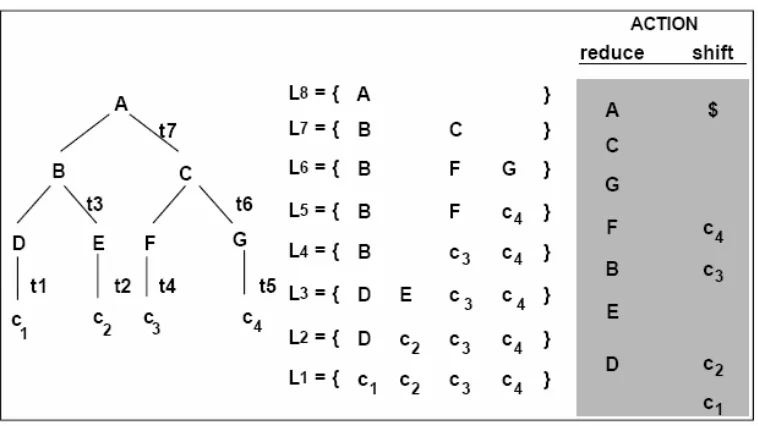
Any syntactic structure can be uniquely defined by the sequence of rewriting rules applied to the input words; the rewriting sequence, in turn, can be expressed in terms of the sets of intermediate phrases (i.e., terminal or nonterminal nodes) derived in the rewriting process. Each set of such intermediate phrases, referred to as a phrase level [Su 88], can thus be used in representing the syntactic structure of the input sentence.
To compute the syntactic score of the following syntax tree, for instance, the syntactic structure can be decomposed into the phrase levels L1 , L2 , ..., L8 shown in figure 3, in which
L1 to L8 simulate the actions of an LR parser. The transitions between the phrase levels can be
formulated as context-sensitive rewriting processes, and the transition probability corresponds to the probability of applying a particular phrase structure rule conditioned on a particular context. For example, the transition from L6 to L7 corresponds to applying the rule C→ F G
128 Keh-Yih Su et al.
Figure 3. The decomposition of a syntactic tree into different phrase levels
Let Libe the i-th phrase level and the label ti in the figure be the time index for the i-th
state transition corresponding to a reduce action. The syntactic score of the tree in the above figure is defined as [Su 88, 89, 91; Chiang 92, 95]:
(
)
(
) (
) (
) (
)
(
) (
) (
) (
)
8
2 1 8 7 6 5 5 4 4 3 2 2 1
8 5 5 4 4 2 2 1
( | ) | , , | | , | |
| | | |
P L T P L L P L L L L P L L P L L L P L L
P L L P L L P L L P L L
≡ ≈
≈ .
Each pair of phrase levels in the formula corresponds to a change in the LR parser's stack before and after an input word is consumed by a shift operation. Because the total number of shift actions is the same for all alternative syntax structures with respect to the same input sentence, the normalization problem, which is introduced due to the different numbers of branches in the parse trees, is resolved in such a formulation. In addition, the formulation also provides a way for considering both the intra-level context-sensitiveity and inter-level correlation of the underlying context-free grammar. With this formulation, the capability of context-sensitive parsing (in probabilistic sense) can be achieved using a context-free grammar.
An Overview of Corpus-Based Statistics-Oriented(CBSO) Techniques for 129 Natural Language Processing
Semantics Disambiguation
Ambiguities encountered in semantics comprise the thematic roles (cases) of constituents and meanings (senses) of words. Statistical approaches for these two topics are numerous, e.g., Liu et al. [1990] on the PP-attachment problem; Chang [1992] on semantic modeling; Brown et al. [1991b], Dagan [1991], Gale et al. [1992], Yarowsky [1992, 1994] on word sense disambiguation. In [Chiang 96], a probabilistic model was proposed to resolve the ambiguities of both case assignment and word-sense assignment. A score function P(NFi ,PTj ,POSk |W) is
defined to find the best combination of the semantic interpretation (or normal form) NF, the parse tree PT and the parts-of-speech POS for a given input sentence, W, using the following decision rule:
{
}
, ,
, ,
, ,
( , , ) arg max ( , , | )
= arg max ( , , | ) ( | , ) ( | )
= arg max ( ) ( )
i j k
i j k
i j k
i j k
NF PT POS
i j k j k k
NF PT POS
sem i syn j lex NF PT POS
NF PT POS P NF PT POS W
P NF PT POS W P PT POS W P POS W
S NF S PT S
=
× ×
× ×
{
(POSk)}
,
where Ssyn( . ) and Slex( . ) denote the syntactic score and the lexical score, respectively, which
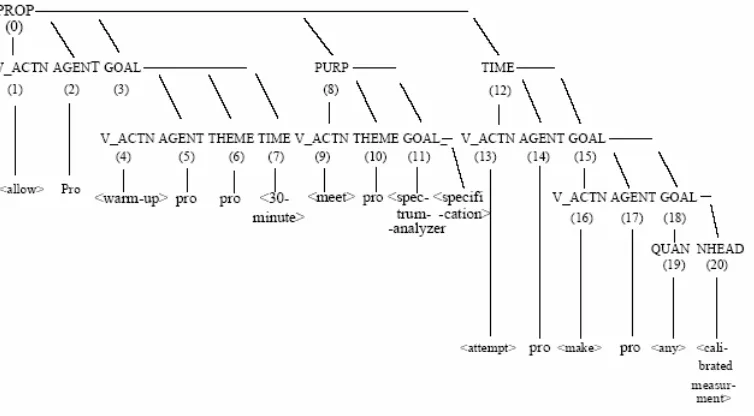
were discussed in previous sections. Figure 4 shows an example of a normal form which represents the semantic relationship between sentence constructs.
An Overview of Corpus-Based Statistics-Oriented(CBSO) Techniques for 131 Natural Language Processing
recover the complete parse when the input sentence does not fit the grammar of the system. When there are errors in a parse, it is desirable to recover from the errors so that proper interpretation can be given to the parse for better processing in the subsequent processing steps (such as lexical transfer and structure transfer in an MT system.)
Two types of errors are commonly encountered in real text. The first type is called an isolated error, which means that such an error will not prevent other parts from being constructed except at the root node (i.e., sentence) level. For example, if an ill-formed input sentence " ?? are made by DRAM" is encountered (where '??' is the missing part), then we are able to produce a verb phrase V2 as shown in figure 5. In this case, it is possible to insert a nonterminal node such as N3 (i.e., a Noun Phrase, such as "Printer buffers") so that we have a complete parse (S). In this case, recovery is not too difficult since the lack of N3 does not prevent other parts (up to V2, the Verb Phrase) from being generated until S is to be constructed. Another type of error is called an non-isolated error whose occurrence will prevent other parts frombeing constructed correctly. For instance, if the ill-formed sentence is "Printer buffers are ?? by DRAM", then recovering the complete parse is much more difficult since the word and hence the parts of speech is missing, which may prevent other parts (such as V1, V2 and S) from being generated correctly.
Figure 5. Examples of parsing errors.
134 Keh-Yih Su et al.
where P(M(L1i⇔ L2i)) is the probability associated with the type of match between L1i and L2i ; and P(δ(l1i , l2i))|M( ⋅)) is the likelihood of observing the value δ((l1i , l2i ) if the particular type of match is known.
Although the above formulation produces encouraging alignment performance based on the length information and the matching type information, we remind readers that there are other useful features which can be included in defining the random vector X so as to achieve better alignment performance. Such information may include bilingual lexicon information (such as the translations of the words within the passages), syntactic information (such as parts of speech and parse trees of the sentences) and semantic information (such as case information and word sense information). Depending on the information available, various alignment models can be developed based on the above general score function for alignment.
The argmin operation implies that the maximum likelihood selection problem can be regarded, alternatively, as a minimum distance problem if the negative of the log-scaled likelihood function is regarded as a distance measure between two aligned passages. Such a minimum distance searching problem is actually resolved very efficiently by using the dynamic programming technique given in [Gale 91a] with the distance function defined as follows:
{
}
log ( | _ ) ( _ )
d = − Pδ match type ×P match type ,
where P(match_type) (corresponding to P(M(L1i⇔ L2i))) is the prior probability of a particular
type of match (e.g., 1-1 match, 1-0 match) and P(δ | match_type) (i.e., P(δ(l1i, l2i )|M( ⋅)) ) is
the likelihood of the difference in lengths between the source-target sentences for a particular type of match. More precisely, δ is defined as 2 1
2 1 (l l c)
l s − ⋅
⋅ , where l1 denotes the total length of the
source sentence(s) in a matched pair, and l2 denotes the total length of the corresponding
sentence(s); c and s2 stand for the mean and the variance of
( )
2 1l
l , respectively. With such a
formulation, the minimum distance path and, hence, the best aligned passages, can be easily identified using the dynamic programming techniques.
136 Keh-Yih Su et al.
known. The best correspondence is obtained by using the dynamic programming technique over all possible correspondences. The performance was evaluated on a sample of 800 sentences, where 61% of the English words were matched with some French words, and about 95% of these pairs were judged as being correctly matched. Readers who are interested in the details are referred to [Gale 91b].
Besides single word correspondences, collocational correspondences have also been explored in [Smadja 92; Kupiec 93]. In these approaches, mutual information is used as a measure of correspondence, and an iterative or EM-based re-estimation procedure is used to find the best correspondences. Such aligned bilingual materials are applicable to a variety of applications, such as word sense disambiguation [Gale 92b] and lexicography [Smadja 96]. The most complicated system for full alignment at various levels will be a system which allows two-way training for acquiring the translation knowledge of a machine translation system. Such issues will be addressed in the following sections.
4.6
Machine Translation and Translation Knowledge Acquisition
Another important application for CBSO techniques is statistical machine translation [Chen 91; Brown 92; Su 92, 93; Chen 95]. Since the success of a CBSO MT system relies heavily on the translation knowledge acquired, the training issues for automatically acquiring such knowledge are particularly important for a large practical system. In particular, Su et al. [1995] proposed a two-way design method for automatically acquiring the translation knowledge of a parameterized MT system from a bilingual corpus. The two-way design can also prevent literal translations from being produced as occurs with the conventional one-way design scheme [Su 95]. In [Su 95], the training process was characterized as a two-end constraint optimization problem to reflect its attempts at two-way training from a bilingual corpus. Under such an optimization approach, the system designer can concentrate on the acquisition or compilation of lexicon knowledge and the tagging of shallow syntactic and semantic features of the lexicons. Only a brief overview of the two-way MT design will be given in the following; readers should refer to [Su 95] for details.
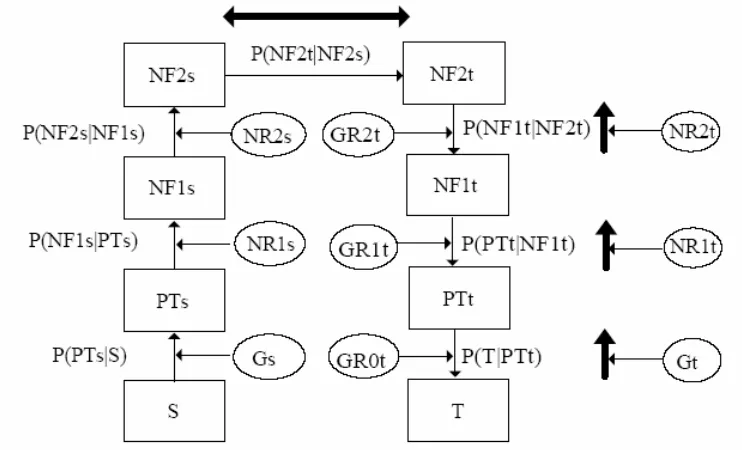
In [Su 95], it was assumed that a sentence is analyzed into a parse tree; the parse tree is normalized into a level-1 normal form, denoted as NF1, which is acquired by compacting excessive nodes in the parse tree; NF1 is then further normalized into a second level normal form, referred to as NF2, by labeling each constituent with case information. An example of such a normal form is shown in Section 4.3. The analysis and normalization processes are governed by the phrase structure grammar G and two sets of normalization rules, NR1s and
NR2s, as shown in figure 6, where the source sentence is denoted by S, and the parse tree is
denoted by PTs. (We shall use 's' and 't' in the subscripts of the symbols to refer to the `source'
An Overview of Corpus-Based Statistics-Oriented(CBSO) Techniques for 137 Natural Language Processing
operations, which are the inverse operations of the normalization operations of the target language, are directed by sets of generation rules of the various levels (GR2, GR1, and GR0); the output of such operations are the target normal forms, NF2t and NF1t, target parse tree, PTt,
and target sentence T's that can be enumerated in the reverse direction of the analysis processes.
Figure 6. Translation Model for a Parameterized MT System
(The bold arrows indicate the flow for training the required parameters of the two languages.)
The best translation will be selected based on the transition probabilities as shown in the above translation flow. Such transition probabilities can be mapped to the analysis, transfer and generation phases of a conventional transfer based MT [Chen 91]. To acquire the translation knowledge with special emphasis on producing target sentences that fall within the target grammar, Gt, a two-way training method was proposed as follows [Su 95].
An Overview of Corpus-Based Statistics-Oriented(CBSO) Techniques for 139 Natural Language Processing
respectively. Under such circumstances, all the translation output will fall within the range of those sentences that will be produced by native post-editors; therefore, source dependency is removed.
If we have annotated the corpora with the most preferred Ii for each sentence pair, then
the parameters can simply be estimated by counting the number of occurrences of the various intermediate forms. A practical problem is that such annotated corpora may not exist due to the high construction cost or because the amount of annotated corpora is too small, which may induce large estimation errors. Since an unannotated bilingual corpus is usually much easier to set up than is a fully annotated corpus, one promising solution to such a problem is to train the parameters using only a bare bilingual corpus, and to consider such an optimization procedure as a two-end constrain optimization problem. By two-end constrain, we mean that we are given only a parallel corpus of the source sentence (Si) and the preferred target translation (Ti),
including the preferred lexicon information, the functional forms of the syntax structures (defined by a phrase structure grammar) and the functional forms of the semantic trees. Here, there are only the two-end constraints on the given (S,T) pairs; the other intermediate representations are left unspecified.
To estimate the parameters from an untagged bilingual corpus, the Viterbi training approach [Rabiner 86], an unsupervised learning method, is adopted. The estimation procedure is described as follows:
1. Initial Selection: For each (Si, Ti) pair, we derive all possible parse trees, NF1 trees and NF2
trees for Si and Ti, respectively, and we randomly choose a path corresponding to the analysis
processes from the sentences to the NF2 trees. The source and target NF2 trees randomly selected in this way are considered to be a transfer pair for the translation.
2. Estimation: The parameters estimated using the Maximum Likelihood Estimator (MLE) for the system are estimated from the corresponding transfer pairs, parse trees and normal forms along the selected translation path. The parameters are uniquely determined once the translation paths are specified.
3. Re-selection: Compute the translation scores for the various possible paths (each path corresponding to a combination of parse tree, NF1 and NF2 ) with the new parameters acquired in step 2, and select the path with the largest score.
4. Re-estimation: Go to step 2, unless the parameters converge or satisfy a given stopping criterion.
140 Keh-Yih Su et al.
the process proceeds; the number of truncated candidates becomes a time increasing function as the parameters are estimated better and better.
5.
Concluding Remarks
In this paper, a brief review on the various CBSO approaches and applications in natural language processing has been given. We had identified the knowledge acquisition problem as the most challenging task in building a large scale NLP system. Hence, corpus-based statistics-oriented approaches, which are good at automatically extracting inductive knowledge, are preferred. To avoid having a large parameter space, which may not be affordable for most practical system, special emphasis has been placed on the use of probabilistic language models over high level linguistic constructs.
The central problem in designing a system based on the CBSO philosophy is to develop a language model that can optimize some performance criteria such as the minimum error rate, based on features observed in a training set. The features must be discriminative so that they can be used for better decision making. However, it is not easy to identify discriminative features; therefore, automatic feature selection approaches are desirable. The parameters to be used in the language model must be estimated from the training corpus based on an optimal estimation criterion, such as the maximum likelihood criterion, over the training set. Parameters estimated using this criterion, however, may assign zero probabilities to unseen events and, thus, may have unsatisfactory results when they are used for unseen testing set data. To resolve this problem, smoothing over the parameter values is necessary. In some cases, class information, which is required to reduce the number of parameters of a language model, is not available; automatic feature clustering techniques have, thus, been addressed in the paper. When estimating the system parameters, the training corpus may or may not be annotated using associated features. If the corpus has been annotated, robust adaptive learning, which attempts to adjust the system parameters based on misclassified instances, can be adopted to adjust the MLE estimated parameter, so that the adjusted parameters can minimize the error rate instead of maximizing the likelihood. Without an annotated corpus, unsupervised learning techniques can be applied to estimate the parameters iteratively. All such techniques form the basis for building a large scale NLP system.
An Overview of Corpus-Based Statistics-Oriented(CBSO) Techniques for 141 Natural Language Processing
References
Amari, S., "A theory of adaptive pattern classifiers," IEEE Trans. on Electronic Computers, IEEE Trans. on Electronic Computers, Vol. EC-16, June 1967, pp. 299-307.
Bahl, L.R., F. Jelinek and R. Mercer, "A Maximum Likelihood Approach to Continuous Speech Recognition," IEEE Trans. on Pattern Analysis and Machine Intelligence, Vol. PAMI-5, No. 2, March 1993, pp. 179-190.
Blahut, Richard E., Principles and Practice of Information Theory, Addison-Wesley Publishing Company. 1987.
Breiman, L., J.H. Friedman, R.A. Olshen and C.J. Stone, Classification And Regression Trees, Wadsworth Inc., CA, USA, 1984.
Briscoe, Ted, and Carroll, J., "Generalized Probabilistic LR Parsing of Natural Language (Corpora) withUnification-based Grammar," Computational Linguistics, Vol. 19, No. 1, 1993, pp. 25-59.
Brown, Peter F., John Cocke, Stephen A. Della Pietra, Vincent J. Della Pietra, Fredrick Jelinek, John D. Lafferty, Robert L. Mercer and Paul S. Roossin, "A Statistical Approach to Machine Translation," Computational Linguistics, Vol. 16, No. 2, June 1990, pp. 79-85.
Brown, P. et al., "Aligning Sentences in Parallel Corpora," Proceedings of 29th Annual Meeting of the Association for Computational Linguistics, 1991, pp.169-184, California, USA, June 18-21.
Brown, P. et al., "Word-Sense Disambiguation Using Statistical Methods," Proceedings of 29th Annual Meeting of the Association for Computational Linguistics, 1991, pp.
264-270, California, USA, June 18-21.
Brown, Peter F., Vincent J. Della Pietra, Peter V. deSouza, Jennifer C. Lai and Robert L.Mercer. "Class-Based N-gram Models of Natural Language," Computational Linguistics, Vol. 18, No.4, 1992, pp. 467-479.
Brown, Peter F., Vincent J. Della Pietra, Stephen A. Della Pietra and Robert L. Mercer, "Mathematics of Statistical Machine Translation: Parameter Estimation," Computational Linguistics, Vol. 19, No. 2, 1993, pp. 263-311.
Chang, J.-S., Y.-F. Luo and K.-Y. Su, "GPSM: A Generalized Probabilistic Semantic Model for Ambiguity Resolution," Proceedings of ACL-92, pp. 177-184, 30th Annual Meeting of the Association for Computational Linguistics, University of Delaware, Newark, DE, USA, 28 June-2 July, 1992.
Chang, J.-S. and K.-Y. Su, "A Corpus-Based Statistics-Oriented Transfer and Generation Model for Machine Translation," Proceedings of TMI-93, 1993, pp. 3-14.
Chang, Chao-Huang and Cheng-Der Chen, "Automatic Clustering of Chinese Characters and Words," in Proceedings of ROCLING-VI, pp. 57-78, ShiTao, Taiwan, R.O.C., 1993. Chen, S.-C., J.-S. Chang, J.-N. Wang and K.-Y. Su, "ArchTran: A Corpus-Based
142 Keh-Yih Su et al.
Chen, Keh-Jiann and Shing-Huan Liu, "Word Identification for Mandarin Chinese Sentences," Proceedings of COLING-92, vol. I, pp. 101-107, 15th Int. Conference on Computational Linguistics, Nantes, France, July 23-28, 1992.
Chen, Kuang-Hua and Hsin-Hsi Chen, "Machine Translation: an Integration Approach," Proceedings of the Sixth International Conference on Theoretical and Methodological Issues in Machine Translation, TMI-95, pp. 287-294, Leuven, Belgium, July 5-7, 1995. Chiang, Tung-Hui, Y.-C. Lin and K.-Y. Su, "Syntactic Ambiguity Resolution Using A
Discrimination and Robustness Oriented Adaptive Learning Algorithm," Proceedings of COLING-92, vol. I, pp. 352-358, 14th Int. Conference on Computational Linguistics, Nantes, France, July 23-28, 1992.
Chiang, Tung-Hui, Jing-Shin Chang,Ming-Yu Lin and Keh-Yih Su, "Statistical Models for Word Segmentation and Unknown Word Resolution," Proceedings of ROCLING-V, pp. 123-146, Taipei, Taiwan, R.O.C., 1992.
Chiang, Tung-Hui, Yi-Chung Lin and Keh-Yih Su, "Robust Learning, Smoothing, and Parameter Tying on Syntactic Ambiguity Resolution," Computational Linguistics, 1995, pp. 322-349, Vol 21, No. 3.
Chiang, Tung-Hui and Keh-Yih Su, "Statistical Models for Deep-structure Disambiguation," To appear in Proceedings of 4th Workshop on Very Large Corpora, 1996.
Church, K., "A Stochastic Parts Program and Noun Phrase Parser for Unrestricted Text," ACL Proc. 2nd Conf. on Applied Natural Language Processing, pp. 136-143, Austin, Texas, USA, 9-12 Feb. 1988.
Church, K. and P. Hanks, "Word Association Norms, Mutual Information, and Lexicography," Proc. 27th Annual Meeting of the ACL, pp. 76-83, University of British Columbia, Vancouver, British Columbia, Canada, 26-29 June 1989.
Cottrell, G.W., A Connectionist Approach to Word Sense Disambiguation, Morgan Kaufmann Publishers, 1989.
Dempster, A.P., N.M. Laird and D.H. Rubin. "Maximum Likelihood from Incomplete Data via the EM Algorithm," Journal of the Royal Statistical Socie
![Figure 1. Number of Rules vs Overall Score in SFS [Liu 93]](https://thumb-us.123doks.com/thumbv2/123dok_us/1096447.1138591/19.539.118.424.414.640/figure-number-of-rules-overall-score-sfs-liu.webp)
![Figure 2. Example: the pruned classification tree for the word "out" [Lin 95]](https://thumb-us.123doks.com/thumbv2/123dok_us/1096447.1138591/21.539.149.378.214.446/figure-example-pruned-classification-tree-word-lin.webp)