© 2018 IJSRCSEIT | Volume 3 | Issue 3 | ISSN : 2456-3307
Novel Pyranometers Based on Different Metals – A Comparative
Study
N. Khoat Nguyen*1, T. M. Phuong Dao2
*1Faculty of Control and Automation, Electric Power University, Hanoi, Vietnam
2Department of Electrical Engineering Technology, Hanoi University of Industry, Hanoi, Vietnam
ABSTRACT
This study aims to present the characteristic of solar irradiation of a novel pyranometer designed by a number of metals, namely copper, iron and aluminum. Normally, photovoltaic semiconductor material has been used to design traditional pyranometers. In comparison with these traditional pyranometers, the proposed one has dominant characteristics such as a high accuracy, a low maintenance cost and an optimum operating temperature. The novel pyranometer not only has the characteristics similarly to the high standard apogee pyranometer but also has much cheaper cost. In addition, its operational solar spectral broadband range varies from 300nm to 2800nm in comparison with a smaller variation range (i.e., from 360nm to 1120nm) for the apogee pyranometer. Another significant characteristic is that the newly designed pyranometer can forecast the variability of clear sky condition-based solar radiation and detect cloudy weather. Time response measuring the transient behavior of metallic slabs lies in the range of 3-6 minutes. The calibration of fabricated pyranometers resulting in correlation coefficients for copper, aluminum and iron pyranometers is 0.94, 0.92 and 0.98, respectively. A statistical analysis from this study provides a 98% matching between the fabricated and standard pyranometers.
Keywords: Solar Irradiation, Pyranometer, Data Acquisition, Fabricated, Visible Spectral Range
I.
INTRODUCTION
It is obvious the incoming solar radiation affecting on Earth’s surface is one of the most important concepts for researchers. It is explained to be the total radiation across a wavelength range of 280 to 4000 nm. Solar radiation is measured in Watts per square meter (W.m-2). Also, it is important that the accuracy of measurements of shortwave solar radiation can be carried out for research in climate change adaptation and renewable energy resource assessments [1-2]. A pyranometer, a type of actinometers, is used for the measurement of solar flux on the surface of a plane and the sensory part is fabricated to measure the flux density of solar radiation with 180 degree field of view. Traditional pyranometers do not depend on external power for
operation. The spectrum of solar radiation extends from an approximate range of 300 to 2800 nm. Essentially, pyranometers commonly operate with spectral sensitivity which is known to be "flat". For instance, beam radiation varies with cosine of the incident angle as required by the radiation and flux density measurements. When the solar radiations incident perpendicularly (900 angle of incidence, zenith angle) to the sensor then the full response will be obtained also half response 0.5 is obtained at 600 angle of incidence. In effect, pyranometers are required to have the common cosine response or directional response with a value which is near to a standard cosine characteristic.
of the calibration is the component integration. In this case, the pyranometer is first calibrated our door with clear sky ambience. Then, the reference global solar irradiance is obtained by adding two components of reference. Here, the component of the beam is obtained with reference to the pyrheliometers which are linked to the World Radiometric Reference. On the other hand, there is no known reference for the diffuse component internationally. Hence, with such a problem of no standard reference, a method for calibrating pyranometers for measuring the diffuse components has been proposed.
The shade/un-shade method is a modified method of pyranometer calibration that was used with thermal offset errors of less than 1 W/m2. The consistency of this method was tested by calibrating three pyranometers four times. Results showcased that the responsibility change was within ±0.52% for all three pyranometers. Also, several necessary tests were carried out on the effect of first calibrating pyranometer un-shaded, before carrying out them
with them shaded in diffuse irradiance
measurements. While three un-shaded pyranometers measurements were calibrated by the component integration method. In fact, the results show that for a clear sky diffuse irradiance, from dawn to dusk, it indicates that the three pyranometers are able to measure diffuse irradiance to within error of ±1.4 W/m2 variation against the reference irradiance.
The basic equipment to measure the combination of diffuse and direct solar irradiance is known as the
global solar pyranometer. The international
standards for the pyranometer should be
recommended that it is an equipment to measure the solar radiation from solid angle 2pi steradian projected in to surface of plane with a spectral range of 0.3 to 3.0 µm (WMO 1997). Nevertheless, the pyranometers are commonly used by scientist atmospheric climatologists, meteorologists and renewable energy researchers. The pyranometers are
effective in discriminating temperature
measurements in the temperature change of a black surface as compared to a reflective white surface. Even it can detect temperature changes in those materials that convert radiant energy directly to electrical energy against those of that convert thermal mass into electrical energy [2]. The predictability of the solar radiation is obtaining enormous attention to improve the quality of solar power systems. Here, clouds play an important role in the predictability forum. The scientific approaches, e.g. in satellite imagery, have been adopted to observe the cloud motion.
Study on the pyranometer has the result of obtaining the number of clouds that can occur at the field site at daylight period by the use of simple mean and variance statistics giving by the pyranometer irradiance pattern [3-4]. Also, thermopile detectors are useful to characterize different conditions of the atmosphere. As a thermal contact with a large base that behaves as a heat sink, thermopile is covered with various concentric hemispherical dome shapes to make it sensitive to far-IR radiation [5].
II.
BASIC CONCEPTS AND RELATED STUDIES
shade/un-shade method and another instance using the modified shade/un-shade method. This procedure is useful for the pyranometer calibration in the measurement of clear sky diffuse irradiance [7]. Here discussion is now made of recent trends in calibrating broadband solar radiometric instruments
and improvements in accuracy of their
measurements. An outlined software for
characterization of outdoor pyranometer calibrations and improved diffuse sky reference and radiometer calibration and given [8]. In fact, most often the thermopile pyranometers thermal offset is frequently underrated or ignored because of its small size.
Suggestions are abound that whether the
pyranometer is shaded or un-shaded, it has the same response in magnitude of pyranometer thermal offset measurement. Hence, by using a method known as the shade/un-shade method, a pyranometer can be calibrated accurately essentially for the reason that the thermal offset error effects are removed [9].
A thermopile pyranometer is described as having a glass dome shape filter absorbing cover that makeup the absorbing detector. Short-wave radiation approximately between 285 to 2800 nm goes through the glass domes and strikes a heat-absorbing, black sensor. Thermopile detectors are coupled to this absorbing surface which contains the black sensor for heating the thermopile. Thermopiles are composed of different metals junctions (e.g., constantan and copper connected in series). Here, it is arranged for difference between the reference and measuring junctions will produce a voltage which is proportional to the solar radiation. The traditional shade/un-shade method is useful in calibrating the diffuse-measuring pyranometer. With a standardized calibrated diffuse-measuring pyranometer, we can calibrate a larger number of global pyranometers
simply by the comparison of the reference irradiance with the microvolt (µV) output of the global instrument.
The term instrument’s responsibility (RS) is given by RS = V/E, where V denotes voltage signal and E is the reference global hemispherical irradiance measured in watts per square meter, W/m2. As usual it is ensured that the calibration takes place under condition of clear sky and with an extended range of given zenith angles. This results in the RS varying as a function of the zenith. Typically, the RS should not vary for any instrument under any given conditionality [10]. The sensing element of the pyranometer is silicon photo diode that response to variation of radiation with cosine angle of incidence that is known as zenith angle. Meanwhile, the maximum response is achieved when broadband radiation reaches perpendicularly on sensor that means the sun is supposed at its zenith. If sun reaches on the horizon then no response is obtained at the incident angle of 900. If the incidence radiation reaches at 600 it means that the response of the pyranometer is obtained half of maximum. Hence, it can be interpreted from the modern definition that the function of pyranometer must have cosine or directional response and that ideally response must be similar to the function of cosine. The term cosine error can be explained as the difference between the pyranometer’s ideal cosine response and real response is a cosine error [11].
III.
DESIGN OF NOVEL PYRANOMETERS
BASED ON DIFFERENT METALS
Isolation is the solar flux density, i.e. it was measured
in watt/m2. In high quality pyranometer,
thermocouples were electrically connected to form thermopile. When sunlight strikes a thermopile, it created a temperature difference across the junctions of the thermopile. This produced a small voltage proportional to the amount of incident energy. The advantage of thermopile-based pyranometers is that they respond across a very broad range of wavelengths, as required to measure isolation. Actually, in order to fabricate the proto-type pyranometer, we first need to find out the response time of the different metallic slabs used in the research. It is the property of the metals that they response when a light of specific power was fallen on them. The observed transient behaviour was measured in millivolts with respect to specific interval of time.
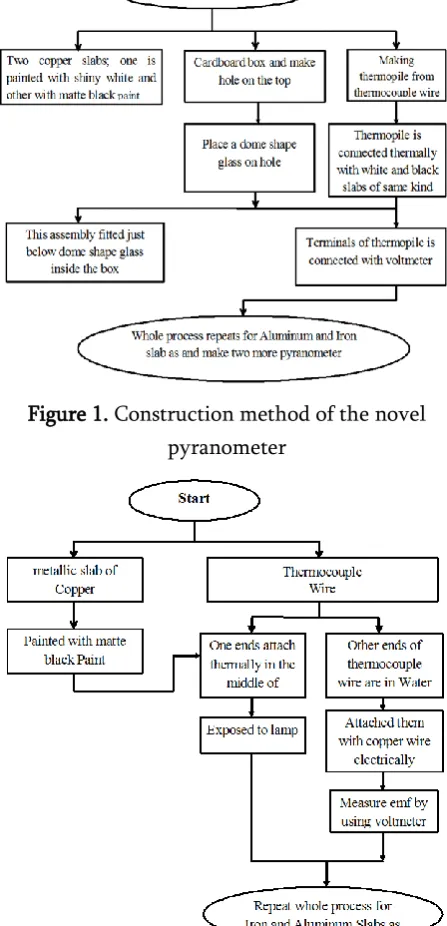
To design the novel pyranometer, a metallic slab of the aluminum with dimensions (22.32 x 100.23 x 0.5) mm was taken. This piece of aluminum slab was paint with matte black paint on both sides. During the painting, it was strictly monitored to avoid the air bubbles on the surface of the slab, after painting the slab was allowed to dry. The thermocouple wire was peer-out with the help of nozzle player and formed a junction, and then this junction was epoxy the one side of the aluminum black slabs that was on the stand, other end of the wire was dipped into the insulated beaker which was filled 75% of water. Then these were connected with copper wires. A thermometer was also used to record the reference temperature. The copper wires were attached with digital voltmeter to observe solar insolation in terms of the millivolts as shown in Figure 1.
Before fabricating the pyranometer, it was necessary check the time response of the slabs that would be used to construct the pyranometer. Therefore, a 100 watt lamp was placed at a distance of 8cm from black metal slab. Voltmeter showed the response on turning on the lamp. The response was the transient
character of metallic slabs. The voltmeter readings were tabulated with interval of every 10 second for a continuous period of 10 minutes, then turn-off the lamp; the procedure was repeated for four times. Such a procedure was repeated for other three metallic slabs to find out transient behaviour of the iron, stainless steel and copper.
Pair of metallic slabs of same type that have been mentioned above were taken in pairs. One of the slabs was painted with glossy white because it reflected light and the slab acted as a reference temperature and the other slab was painted with matt black paint which absorbed light. The dimension of Aluminum slabs were (0.5 x 100 x 22.23) mm use for the first. Five small pieces of appropriate length of the thermocouple wires were attached between two metallic (black and white) slabs and that formation constituted the thermopile. A beaker with insulated walls. An alcoholic thermometer with least count of 1oC used. A digital voltmeter of a high
accuracy (up to 400 mV). Matte black and glossy white paint used to paint the metallic slabs. A lamp of 100 watt power is used.
The data were recorded simultaneously for both the fabricated pyranometer and standard pyranometer after the interval of 15 minutes. The data were recorded from 8:00 A.M to 4:00 P.M for each pair of metallic slabs. The recorded data were analyzed with the statistical analysis by applying T-test. The results obtained are presented in the next section.
Figure 1. Construction method of the novel pyranometer
Figure 2. Schematic diagram of time response
IV.
RESULTS AND DISCUSSIONS
In this section, three different pyranometers are fabricated by three different metallic sheaths of
copper, aluminum, and iron. K-type thermocouple wire (Nickel-Chromium-Aluminum alloy) with range of measuring temperature was (0 to + 1100 K) of diameter 0.5mm. Two components of acrylic resin are used to connect the thermocouple wire to the metallic slabs.
The highest value of the Copper slab reading is 0.675 mV whom 63% value was 0.425 mV and its corresponding time was 120 seconds. The graph showed when a pyranometer should be fabricated with the copper slabs, then the response time in the flux of solar radiation would be 120 seconds.
The highest value of the Aluminum slab reading was 0.725 mV whom 63% value is 0.5 mV and its corresponding time was 65 seconds. The graph showed when a pyranometer should be fabricated with the aluminum slabs, then the response time in the flux of solar radiation would be 65 seconds. The highest value of the Iron slab reading was 0.86 mV whom 63% value was 0.5 mV and its corresponding time was 55 seconds. The graph showed when a pyranometer should be fabricated with the iron slabs then the response time in the flux of solar radiation would be 55 seconds.
In Figure 3, the transient behaviours of three metals (Cu, Al and Fe) are described as measuring of response time which is important parameter to be examined before fabrication of the pyranometer. When graph grows flat it means the pyranometer starts working. The difference in response time exhibited for different metals. Aluminum goes smooth earlier which means that if we design pyranometer by using Aluminum slab; its response is quick, which is very useful if we use it from one place to another and we require very short time for solar flux measurements.
applying statistics, the correlation coefficient of the both pyranometers were found 98%. Naturally, a 2% mismatching between the two pyranometers was due to the composition of the iron.
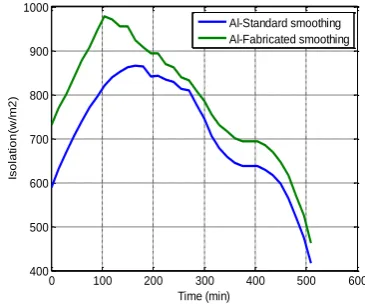
Figure 5 shows that there is a variation among the reading of the both pyranometers designed by aluminum. Their response is evaluated similarly to Figure 4. On applying statistics, the correlation coefficient of the both pyranometers was found 92%. Because of the composition of aluminum, it is found that there is a 8% mismatching between the two pyranometers.
Figure 6 indicates a variation among the reading of the both pyranometers using copper with a similar evaluation. The correlation coefficient of the both pyranometers is about 94%. It is found that there
exists 6% mismatching between the two
pyranometers was due to the composition of the copper.
Figure 3. Transient behaviors of three metals
Figure 4. A comparison of the standard and designed pyranometers using Fe
Figure 5. A comparison of the standard and designed pyranometers using Al
Figure 6. Comparison between the standard and designed pyranometers - Cu
Figure 7. Error between the standard pyranometer and the newly designed pyranometer fabricated by
iron slab
Figure 7 shows the absolute error between the standard pyranometer and the newly designed pyranometer fabricated by iron slab for high solar altitude and slow wind conditions, depends essentially on the calibration error, which was of the
0 2 4 6 8 10
Comparison Of Fabricated Iron And Standard Pyranometers
order of ± 5%. The discrepancy with respect to the reference instrument grows rapidly for the low solar altitude and /or for windy conditions. Degradation with time of the white and black paint may require a periodic recalibration. The instrument can be improved in all these respects; we believe, however, that the didactical value of the instrument itself does not depend strongly on these refinements.
In Figure-8, there is a strong matching of data between the designed pyranometer made from iron and copper slab, but the response of Aluminum is very quick and very high.
Three constructed pyranometers' slabs are exposed to a constant radiation flux, after a certain period of time they reached their equilibrium temperature. When the power input due to direct and diffuse can equal to the power loss towards the ambient through conduction, convection and radiation. An absolute calibration of our instrument was obtained by comparing it with a commercial pyranometer. This comparison gave a value of 1.6 mV output for the thermocouple series for about 824 W/m2 of the
incident solar flux. The value of the emf was found to be strongly dependent on the thermal contact of the junctions of the thermopile with two slabs.
The major limitation of the box this proto-type are due to the cosine response and to the non-hemispherical shape of the window glass. The last factor causes systematic error at low solar altitude, because the reflection losses are higher at angles of incidence on the glass. The absolute error, for high solar altitude and slow window conditions, depends essentially on the calibration error, which was of the order of ± 5%.The discrepancy with respect to the reference instrument grows rapidly for the low solar altitude and /or for windy conditions. Degradation with time of the white and black paint may require a periodic recalibration.
To determine the correction factor, the standard pyranometer and the data were individually
multiplied with five which is the correction factor for the standard pyranometer. The correction factor of the fabricated pyranometer find out by taking a mean of the standard pyranometer readings and this method gives the value of correction factor of that particular pyranometer.
It is the fact that the correction factor is multiplied by the individual readings of the fabricated pyranometer. In this way, solar isolation of the fabricated pyranometer is obtained. Next, a statistical tool of correlation co-efficient is established between the two fabricated pyranometers, which measure the degree of closeness between two calculated data of the fabricated and standard pyranometer.
Different metals have been used to construct the fabricated pyranometer, so there are different values of the correlation coefficients was found. For instance, the copper pyranometers obtain a 94% of the similarity and a 6% showed the mismatching of data. Similarly to the iron pyranometer the correlation co-efficient is 0.98 which is a 98% of the similarity and a 2% of the mismatching of data. For Aluminum, it is 0.92 and for Stainless-steel 0.73 correlation co-efficient. A recent research work was based on the calibration of the radiative data and the Tropospheric Ultraviolet Visible Model, which could be operated to infrared domain.
V.
CONCLUSIONS
The solar irradiance of the newly designed pyranometer has been measured and compared with that of an existing apogee pyranometer. The investigated results between the values obtained from both instruments have represented a good agreement. According to the analysis and discussion of the collected data, the obtained results pointed out that the constructed pyranometer is quite efficient for reliable measurement of solar irradiance. This
newly designed pyranometer has similar
standard pyranometers. The cost of this fabricated pyranometer is several times cheaper than the standard pyrometer. Additionally, it can forecast the variability of clear sky condition, solar radiation and detect cloudy weather. Statistical analysis proves that there is a 98% matching between the newly developed pyranometer and standard pyranometer. Time response of fabricated pyranometers lies in the range of 3-6 minutes and has broadband operational spectral range against standard pyranometer. It is portable and easy to use where a reliable measurement of solar irradiance is required.
VI.
ACKNOWLEDGMENT
The author wishes to thank Dr. Farman Ali Mangi for his assistance on doing the experiments.
VII.
REFERENCES
[1]. John A. D. and William A. B. 2013, Solar engineering of thermal processes. John Wiley & Sons.
[2]. Goswami D. Y.; Frank K. and Jan F. K. 2000. Principles of solar engineering. Second edition, CRC Press.
[3]. Lorenz A.; Hammer A. and Heinemann D.
2004. Short term forecasting of solar radiation based on satellite data. In Proc. ISES Europe Solar Congress EUROSUN2004, Freiburg, Germany.
[4]. Claude E. D. and Mark S. O. 1998. Estimating cloud type from pyranometer observations. Journal of Applied Meteorology, vol. 38, pp. 132-141.
[5]. Brett C. B.; Francisco P. J. V. and Simpson A. S. 2000. Characterization of thermal effects in pyranometers: A data correction algorithm for improved measurement of surface insolation. American Meteorological Society, pp. 165-175. [6]. Daryl R. M.; Thomas L. S.; Ibrahim R.; Stephen
M. W.; Afshin M. A. 2002. Recent progress in reducing the uncertainty in and improving
pyranometer calibrations. Transactions of the ASME, vol. 124, pp. 44-50.
[7]. Ibrahim R.; Tom S.; Daryl M. 2003. A method
to calibrate a solar pyranometer for measuring reference diffuse irradiance. Solar Energy, vol. 74, pp. 103-112.
[8]. Daryl R. M. 2005. Solar radiation modeling and
measurements for renewable energy
applications: Data and model quality. Energy 30, pp. 1517-1531.
[9]. Reda J. H.; Long C.; Myers D.; Stoffel, T. Wilcox S.; Michalsky J. J. and Nelson D. 2005. Using a Blackbody to calculate net long wave responsibility of shortwave solar pyranometers to correct for their thermal offset error during outdoor calibration using the component sum method. Journal of Atmospheric and Oceanic Technology, vol. 22, pp. 1531-1540.
[10]. Lester A., Myers. D.R. 2006. A method for improving global Pyranometer measurements by modeling responsibility functions. Solar Energy 80, pp. 322-331.