C O V E R F E A T U R E
The next several years will see the rollout of 3G sys-tems in the United States, Europe, and Asia.13G will initially support data rates in the tens to hundreds of Kbps range, with possible future support for data rates as high as 2 Mbps—most likely for low-velocity motion and short mobile-to-base transmission dis-tances. Intermediate 2.5G solutions will leverage much of the existing network infrastructure and offer data capabilities in excess of what is available in 2G but short of the eventual 3G speeds.
Although the exact form in which these various high-speed wireless data services will develop is uncertain, we will clearly see substantial improvement over today’s data rates in the very near future, thereby removing one of the wireless Internet’s most significant hurdles.
Service technologies
Another obstacle lies in the mobile devices them-selves, which typically suffer from small displays, lim-ited memory, limlim-ited processing power, low battery power, and greater vulnerability to inherent wireless network transmission problems. These usability chal-lenges make supporting common Internet standards such as HTML, HTTP, and TCP/IP difficult because they are inefficient over mobile networks.
WAP. To address these issues, a group of leading wire-less and mobile communications companies developed the wireless application protocol for transmitting and presenting wireless information and telephony services on mobile handheld devices. Whereas HTTP sends its payload in a text format, WAP uses a compressed binary format for greater efficiency. It offers a scalable, extensible protocol stack that handles security, session establishment, and other aspects of mobile communi-cations to make systems run more efficiently over today’s low-bandwidth wireless networks.
Bringing the
Wireless Internet
to Mobile Devices
E
ffectively mapping Internet content to mobilewireless devices requires not only new tech-nologies and standards, but also innovative solutions that minimize cost and maximize efficiency to the benefit of both content providers and consumers. The wireless Internet must deliver information to handheld device users regard-less of where they are and how they are connected, and in a suitable format—a challenge complicated by the dizzying array of devices, wireless standards, and applications.
UNDERLYING TECHNOLOGIES
A complex, interlocking set of technologies under-lie wireless Internet services and devices. Equipment providers such as Motorola, Nokia, and Siemens pro-duce the devices and the infrastructure to support wire-less data networking. Microsoft, Palm, Symbian, and other companies provide operating systems and micro-browsers for handheld devices. Application platform solutions from vendors including Openwave, Nokia, and Ericsson contribute the middleware infrastructure such as WAP (wireless application protocol) gateways. Middleware also includes a new generation of wire-less application platform infrastructure software to provide wireless applications and device independence for the increasing variety of handheld devices.
Network technologies
Most digital cellular networks are second-genera-tion (2G) networks. A complicated set of overlapping, mutually incompatible 2G and 1G (analog) standards exist in the United States, while the Global System for Mobile communications (GSM) technology is the most prevalent standard in Europe. The maximum data rate in most 2G networks is 14.4 Kbps or lower.
Transcoding and Relational Markup Language are promising middleware
solutions to the problem of bringing Internet content to the extremely
diverse and dynamic mobile wireless devices universe.
Subhasis Saha
Mark
Jamtgaard
2Roam Inc.John
Villasenor
University of California, Los AngelesInstead of using HTML, WAP uses Wireless Markup Language (WML), a small subset of Extensible Markup Language (XML), to create and deliver con-tent. As Figure 1 shows, the WAP gateway translates requests from the WAP protocol stack to the TCP/IP stack so they can be submitted to Web servers. The gateway translates WAP content into compact encoded formats that reduce the amount of data it sends over the low-bandwidth wireless network.
WAP is currently the most widely adopted wireless protocol in the world among carriers and handset manufacturers.
Launched in 1997 by Phone.com (now OpenWave), Motorola, Nokia, and Ericsson, the WAP Forum (http://www.wapforum.org) has grown to include more than 95 percent of the global handset market.
The forum is planning to update the WAP protocol to ensure compatibility with 2.5G and 3G wireless standards. On 30 January 2001, OpenWave unveiled its product architecture for wireless general packet radio service and 3G systems. This new platform, which simplifies migration from current WAP-based mobile services deployed on 2G systems, supports not only WML, but also XHTML, HDML (Handheld Device Markup Language), Compact HTML (a sub-set of HTML that emphasizes text and simple graph-ics), and WAP 2.0, scheduled for release later this year. The updated protocol will support full-color graph-ics, multimedia, and, for wireless operators, subscriber management capabilities.
iMode.WAP is not the only protocol aimed
specifi-cally at the wireless Internet. In fact, in recent months, some have questioned WAP’s long-term viability,2-4 par-ticularly in view of the explosive growth in competing technologies. The best-known non-WAP solution is iMode, a wireless Internet service that NTT DoCoMo introduced in Japan in February 1999. iMode relies on modifications and extensions of existing protocols. With iMode, smart-phone users can browse the Net with a touch of a button. iMode has a transmission speed of 9.6 Kbps, utilizes a packet-switched connec-tion, and has adopted CHTML as its markup language.
Other technologies
Location-based services that use device location information to modify communications content are
likely to become important for applications such as commerce and emergency services. Clearly, location-aware systems also raise complex privacy issues. Voice-based access is also likely to be important because of limited device display capabilities and because voice interaction has advantages in situa-tions where keypad entry is impractical—for exam-ple, while driving a car. Indoor wireless networks are also likely to be extremely important for Internet access. Because wireless LANs and PANs have less severe bandwidth constraints than wide-area cellu-lar networks, they allow access that is closer to “wired” Internet access.
MIDDLEWARE CHALLENGES
Common to WAP, iMode, and other similar solu-tions is the need to specifically recode Internet con-tent for wireless devices. A concon-tent provider offering a Web site to both desktop and wireless users currently must maintain two parallel versions of the site cus-tomized to wired and wireless devices. Middleware, one of the most dynamic and yet least understood technologies, offers an alternative to manually repli-cating content. Its basic purpose is to seamlessly and transparently translate a Web site’s existing content to mobile devices that support numerous operating systems, markup languages, microbrowsers, and pro-tocols. Creating a wireless presence using middleware, however, presents several key challenges.
Application integration
One challenge is integrating disparate content sources. Although some Web developers are begin-ning to store information in XML, most existing con-tent was developed for desktop-based, nonmobile HTML browsers. Typically, most Web sites have a layered structure that closely ties a presentation layer to an underlying logic layer. However, wireless devices require a drastically different presentation layer, and rearchitecting the entire site to decouple these layers would be extremely expensive.
Device independence
Another challenge is the proliferation of devices, browsers, and markup languages.5 For example, markup languages include such variants as HDML
Wireless application protocol microbrowser running on WAP-enabled devices HDML/ WML gatewayWAP HTML/ XML Wireless network Web server WAP protocol stack TCP/IP stack Figure 1. Accessing the wireless Web using a wireless- application-protocol-enabled device. A WAP gateway pro-duces a more efficient representation of the Web content that can be more easily trans-mitted over wireless networks.
3.0, WML 1.x for OpenWave, WML 1.x for Nokia, TinyHTML for PalmPilots, and CHTML for iMode. Different browser features—support for non-nested tables and images, nested tables but no images, images and nested tables but only one font size, and so on—compound the problem. Display capabilities range from two-line black-and-white displays to full-color displays with tens of thousands of pixels.
Optimal user interface
Creating a compelling user interface that is appro-priate for different device classes is another challenge. For example, a stock-trading site might want to expose
a market research function containing charts and graphs to a PalmPilot but not to a limited-display cell phone. To avoid forcing the cell phone user to scroll down numerous lines or navigate through multiple menus to access desired content, the two devices’ information architecture would have to be drastically different.
MIDDLEWARE SOLUTIONS
At first glance, it seems that the easiest way to address these problems is to rewrite existing Web con-tent in a language appropriate for a particular proto-col (see the “Internet Markup Languages” sidebar). This would involve, for example, creating
WML-SGML
Standard Generalized Markup Language is a general-ized common standard for describing an electronic docu-ment’s structure and organization. It does not specify a structure but instead allows for customized tag sets. SGML provides the primary framework for other lan-guages including HTML and XML.
HTML
Developed as the World Wide Web was coming to promi-nence, Hypertext Markup Language facilitates the visual presentation of information over the Internet. Its subsets include HTML 4 and HTML Strict, which address pre-sentational and structural issues differently.
XML
As Web developers recognized that SGML document distribution and presentation required unique tools, Exten-sible Markup Language emerged as a powerful alternative to HTML, which has predefined tags for specialized tasks. XML lets developers define their own markup elements and gives content authors greater flexibility for structurally and stylistically customizing Web documents. XML also offers HTML developers a framework for customizing and adding proprietary elements to HTML.
XHTML
Extensible Hypertext Markup Language supports modular and extensible Web access based on XML. With a few notable exceptions, it strongly resembles HTML 4. Released in January 2001 upon recommendation by the World Wide Web Consortium (W3C), XHTML repre-sents the most significant evolution of HTML since HTML 4’s introduction in 1997. XHTML essentially reformulates HTML as an XML application, enabling viewing by both HTML browsers and XML-based sys-tems. Consequently, most users can access Web pages regardless of their browser device.
XSL
Extensible Stylesheet Language enables transforma-tion of XML documents into a format recognizable to a browser. For example, developers can use XSL to transform each XML element into an HTML element. XSL also provides a means for reformatting organiza-tion of the display elements: It can add completely new elements; remove, rearrange, and sort elements; and test and make decisions regarding which elements to dis-play.
RML
Relational Markup Language is an XML application just as HTML and XML are SGML applications. RML is tailored to meet the specific needs of wireless Internet technologies. Developers use RML’s customized elements to add structural context to a Web site’s content for mul-tiple presentation formats. RML retrieves and caches client data from requested URLs, then uses predefined rule sets to convert the data from HTML and XML to RML. RML follows XML’s structural rules, but its spe-cific elements are unique.
WML
Wireless Markup Language evolved from XML, HTML, and Phone.com’s Handheld Device Markup Lan-guage. Designed to develop Web pages that developers can easily render on small wireless devices, WML per-mits more flexible information displays than HTML and lets users input commands without a keyboard. Cur-rently, developers must write a Web site in WML or a server must convert HTML to WML to translate the site and render it properly on WAP-enabled devices. WML is scalable and extensible because, like XML but unlike ear-lier versions of HTML, it lets users add new markup tags to meet changing needs. The WAP Forum is cooperating with the W3C to ensure that WML and XHTML will work together.
formatted content to fit various WAP devices, CHTML-formatted content for iMode devices, and so on. However, the wide range of devices, browser functions, gateway interfaces, and markup language nuances make this approach intractable.
User-transparent transformation
In user-transparent transformation, a middleware application transparently reformats content “on the fly” into a user-specific presentation, interface, and protocol. In this context, a middleware application sits between the existing content server and the user agent. Because the middleware application can auto-matically detect the kind of device being used and for-mat the contents accordingly, it is not necessary to maintain Web content in multiple formats.
User-transparent middleware approaches can process transcoding with or without a priori infor-mation. They can either strip down the content from an under-described source such as HTML or build up content from discrete pieces. However, end users still must scroll through hundreds of lines to get to the con-tent in which they are interested.
Relational Markup Language
Relational Markup Language incorporates two concepts—relational hierarchies of content and adding context to content—to resolve these prob-lems. Because it describes content through relation-ships, RML provides a write-once-deliver-anywhere solution. An interpreter can use the relational infor-mation to create an optimal inforinfor-mation architec-ture. As Figure 2 illustrates, converting application content to a normalized RML format facilitates cre-ating a modular architecture. When a new device, browser, gateway, or markup language emerges, adding one new module supports both current and future users.
Atomics and groups.The RML framework uses atom-ics—discrete pieces such as a word, sentence, para-graph, image, link, or any other piece of content—to create a framework that supports the addition of both relational data and context. RML encapsulates atom-ics into groupsto create a complex relational hierar-chy. As Figure 3 shows, groups contain one or more
(a) HTML WML XML HDML XHTML CHTML Page templates (b) HTML WML XML HDML XHTML CHTML Page templates RML
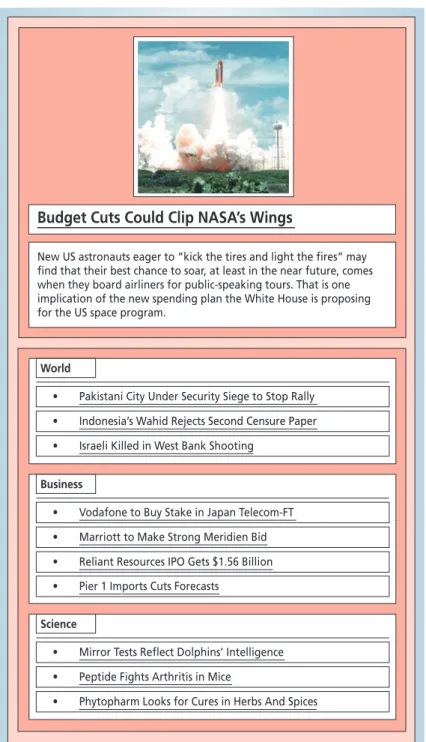
Budget Cuts Could Clip NASA’s Wings
New US astronauts eager to “kick the tires and light the fires” may find that their best chance to soar, at least in the near future, comes when they board airliners for public-speaking tours. That is one implication of the new spending plan the White House is proposing for the US space program.
World
• Pakistani City Under Security Siege to Stop Rally • Indonesia’s Wahid Rejects Second Censure Paper • Israeli Killed in West Bank Shooting
Business
• Vodafone to Buy Stake in Japan Telecom-FT • Marriott to Make Strong Meridien Bid • Reliant Resources IPO Gets $1.56 Billion • Pier 1 Imports Cuts Forecasts
Science
• Mirror Tests Reflect Dolphins’ Intelligence • Peptide Fights Arthritis in Mice
• Phytopharm Looks for Cures in Herbs And Spices
Figure 2. Creating a modular architecture using Relational Markup Language. (a) A tra-ditional wireless implementation can require different transcoding steps for each possi-ble combination of markup languages. (b) In contrast, an RML-based implementation provides an intermediate format for the automatic markup of all markup languages. The output can then be generated without regard to the original input markup language.
Figure 3. Breaking Web content into atomics and groups. This typical news site’s content decomposes into discrete pieces—links, sentences, paragraphs, and images—to cre-ate a framework supporting the addition of both relational information and context. The main group consists of all the atomics and groups that make up the site. Each top story’s image, headline, and introductory text form another group. The headline group includes three subsections: world, business, and science. Finally, each subsection and its associated story links form a group.
atomics, and they can themselves be part of larger groups.
Context.An interpreter can add contextual
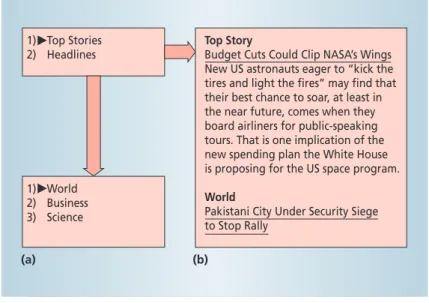
attrib-utes to the atomics and groups to optimize the infor-mation architecture for a specific mobile device. Adding context allows the RML document to handle current and future application calls that different devices make from the browser. The context attribute defines the type of application call, and context data defines the parameters the document needs to make the function call. Figure 4 shows how an interpreter can use relational information to create an optimal user experience.
RML also can differentiate between sequential and nonsequential content. For example, a page of text is sequential content, and a list of links to news stories is nonsequential content. If nonsequential content does not fit on one page—for example, the headlines subsection—RML collapses the associated groups into links.
Device-specific tasks may include click-to-dial, cre-ating an address book entry, or sending e-mail. Developers can use the RML framework to develop algorithms that optimize the user’s experience on a variety of mobile devices.
B
ringing Internet connectivity to wireless devices offers a number of well-known challenges. Simply delivering bits at a high enough rate to untethered devices and creating devices withsuffi-cient display, memory, and user interface features to allow efficient interaction with the Internet requires innovative technologies and new standards. The roll-out of 3G systems in the next several years will address many of these challenges. Equally important but less familiar hurdles lie in the mechanisms for bringing Internet content to an extremely diverse and dynamic universe of devices. Middleware such as RML will be critical to meeting the challenge of cre-ating a wireless presence. We anticipate that open standards based on this or similar techniques will gain acceptance. ✸
References
1. W. Sweet, “Cell Phones Answer Internet’ s Call,” IEEE Spectrum, Aug. 2000, pp. 42-46.
2. N. Leavitt, “Will WAP Deliver the Wireless Internet?,”
Computer,May 2000, pp. 16-20.
3. T. Lewis, “Why WAP May Never Get Off the Ground,”
Computer,Aug. 2000, pp. 112, 110-111.
4. K.J. Bannan, “The Promise and Perils of WAP,” Scien-tific Am.,Oct. 2000, pp. 46-48.
5. R. Comerford, “Handhelds Duke It Out for the Inter-net,” IEEE Spectrum, Aug. 2000, pp. 35-41.
Subhasis Sahais a former manager of the research and technology group at 2Roam. His research interests include multimedia compression and communication, wireless Internet and networking, and soft computing. Saha received a PhD in digital media from the Univer-sity of California, Davis. He is a member of the IEEE and the ACM. Contact him at [email protected].
Mark Jamtgaard is chief technical officer of 2Roam. His research interests include wireless communications and adaptive systems. He received a BS in electrical engineering from Santa Clara University. Contact him at [email protected].
John Villasenoris professor and vice chair of the Elec-trical Engineering Department at the University of California, Los Angeles. His research interests include communications, image and video coding, and con-figurable computing. Villasenor received a PhD in electrical engineering from Stanford University. Con-tact him at [email protected].
1) Top Stories 2) Headlines 1) World 2) Business 3) Science Top Story
Budget Cuts Could Clip NASA’s Wings New US astronauts eager to “kick the tires and light the fires” may find that their best chance to soar, at least in the near future, comes when they board airliners for public-speaking tours. That is one implication of the new spending plan the White House is proposing for the US space program.
World
Pakistani City Under Security Siege to Stop Rally
(a) (b)
Figure 4. Transformed Web content on two mobile devices. (a) The first page of a four-line cell phone display consists of a link to the top story and a link to headfour-lines, which in turn link to the world, business, and science stories, respectively. (b) A larger-display device includes the top story followed by expanded headline subsections.