Annotating Question Types for Consumer Health Questions
Kirk Roberts, Kate Masterton, Marcelo Fiszman, Halil Kilicoglu, and Dina Demner-Fushman
National Library of MedicineNational Institutes of Health Bethesda MD, USA
[email protected]; [email protected] Abstract
This paper presents a question classification scheme and a corresponding annotated corpus of consumer health questions. While most medical question classification methods have targeted medical professionals, the 13 question types we present are targeted toward disease questions posed by consumers. The corpus consists of 1,467 consumer-generated requests for disease information, containing a total of 2,937 questions. The goal of question type classification is to indicate the best strategy for selecting answers from publicly available health information resources, such as medical encyclopedias and medical research websites. The annotated question corpus, along with detailed annotation guidelines, are publicly available.
Keywords:question classification, question answering, medical language processing
1.
Introduction
Most research in automatic question answering has focused on well-formed factoid questions in the style of the TREC Question Answering evaluations (Prager, 2006). However, real-life questions that automatic systems must handle are typically not well-formed or explicit in their information needs. This is particularly the case for consumer health questions. Zhang (2010) focuses on consumer health ques-tions submitted to Yahoo Answers, finding these quesques-tions were largely concerned with diseases and symptoms, tained many abbreviations and misspellings, and often con-tained more than one actual question.
Furthermore, the type of answer to be provided to a con-sumer is qualitatively different than an appropriate answer for a medical professional. Many questions that the gen-eral public might have about diseases are answerable by reliable consumer health information resources, such as MedlinePlus1 or Genetics Home Reference2. Even these consumer-oriented resources might be difficult to navigate for users with little medical knowledge. Thus, a question answering system that could point a user to the most rel-evant encyclopedic articles or sections could prove useful. Some information providers, such as the NIH Genetic and Rare Diseases Information Center3 (GARD) not only an-swer consumers’ questions, but also make the questions and the answers publicly available.
In our own consumer question answering system, we have found a wide variety in the styles and types of questions even in a relatively focused area of questions about specific diseases, especially their treatments and outlook. Our rule-based classification of these questions into traditional treat-ment, cause, prognosis, diagnosis, manifestation, and gen-eral information types is sufficient for understanding and structuring simple questions, but it is insufficient for most of the questions submitted to our system. It is also clear that it is practically impossible to develop rules for under-standing the many types of complex questions, and thus a
1 http://www.nlm.nih.gov/medlineplus/ 2 http://ghr.nlm.nih.gov/ 3 https://rarediseases.info.nih.gov/GARD/
corpus-based machine learning solution is applicable. To our knowledge, there are few publicly available collections of consumer health questions, and none annotated at the granularity needed for our task. GARD questions are a good intermediate step from the simple questions, such as “is there any help availabe,for fibromalgia” that our sys-tem translates to “What are treatments for fibromyalgia?” to complex questions, such as the one in Figure 1.
My wife has been having shortness of breath in the mornings (mornings only). She has, what I think, excessive heart rate as well. Could this be anxiety attacks? I don’t think it would be a heart issue. She certainly isn’t overweight. SHe is 5’2”; and 100-105 pounds. if she is having anxiety attack... what is the best course of action? She seems to feel better when she lies down and rests...while either watching TV...or sleeps. SHe has no history in her family for heart disease either. WHat are your thoughts?
Figure 1: Consumer health question.
GARD questions, for example in Figure 2, are well-formed with few misspellings and are primarily focused on a spe-cific condition. Questions in the GARD corpus are obtained from the public and answered by experienced information specialists. We have annotated these questions with more detailed question types as the next step towards understand-ing a wide range of consumer health questions.
Do children with Cat Eye Syndrome generally experience a decline in physical abilities as they reach adulthood? Is there any shortening of the lifespan associated with this condition?
Figure 2: Consumer health question from GARD. For clarity, the remainder of this paper refers to the multi-sentence, possibly multi-question spans found in Fig-ures 1 and 2 asrequests. Aquestionrefers to a clause ask-ing for a sask-ingle piece of information. Section 2 of this pa-per describes previous work in question classification; tion 3 briefly outlines our proposed question types; Sec-tion 4 describes the process of annotating the GARD cor-pus; Section 5 provides numerous examples of each ques-tion type; and Secques-tion 6 describes our corpus.
2.
Background
In much of the literature, question classification is synony-mous with answer type detection (Hermjakob, 2001). An answer type corresponds to the answer’s expected class, typically a named entity type for TREC QA style factoid questions. For instance “Who is Tom Cruise married to?” has a PERSONanswer type, while “What was the capital of the Holy Roman Empire?” has a CITYanswer type. Li and Roth (2002) provide one of the first statistical methods for classifying answer types, along with a corpus on which many other methods have been judged. Their answer types form a 2-level hierarchy with six “coarse” types and fifty “fine” types. Roberts and Hickl (2008) demonstrate how such an answer type hierarchy can be arbitrarily extended as the need arises. The automatic classification of answer types has been shown to be a highly semantic task (Metzler and Croft, 2005) due to the short length and predictable syntactic structures of TREC-style questions. The single most important semantic feature involves finding and typ-ing the answer type term (capitalin the above question) to the answer type (Krishnan et al., 2005; Hickl et al., 2007). Despite the focus on answer type detection, there are other important forms of question classification, especially when question answering systems are designed to answer non-factoid questions or questions that require domain knowl-edge. For instance, the question “List the cities of the Holy Roman Empire.” still has a CITYanswer type, but also re-quires classifying the question’s function (Bu et al., 2010). Additionally, it was useful to identify a question’s topic or domain (Duan et al., 2008; Roberts and Harabagiu, 2012; Chan et al., 2013), especially when further domain knowl-edge is necessary to answer the question. In addition to the question classification tasks listed above, innumerable other tasks exist for the many classes of questions found in natural language (Chali and Hasan, 2012; Banerjee and Bandyopadhyay, 2012).
In contrast to the forms of question classification in TREC QA style questions, medical questions have presented very different classification methods. Ely and colleagues (1999; 2000; 2005) collected several sets of medical questions posed by physicians. These questions are available as part of the NLM Clinical Questions Collection4(CQ). On these well-studied question sets, automatic approaches have been proposed to classify question answerability (Yu and Sable, 2005), taxonomy (Kobayashi and Shyu, 2006), and topic (Yu and Cao, 2008). The diversity of possible ways med-ical questions may be classified speaks to their potential complexity. Because of this complexity, medical question answering does not appear to be a promising field for purely factoid question answering approaches. For this reason, many medical question answering systems utilize the PICO structure (Demner-Fushman and Lin, 2007; Schardt et al., 2007), which encodes a far wider range of information-seeking queries.
The complexity of medical questions is further com-pounded when answering questions posed by consumers, as shown in Figures 1 and 2. While answer types are certainly important in returning appropriate medical information to
4
http://clinques.nlm.nih.gov/
the consumer, we have found it is more appropriate to de-termine the general type of information the user is looking for (treatment, prognosis, symptoms, etc.). By classifying questions along these lines, then, our question answering system may choose the most appropriate passage selection strategy.
In this paper we present a set of question types and a corre-sponding annotated corpus designed for selecting an appro-priate strategy for consumer health questions. While pre-vious work has demonstrated the value of deep question taxonomies, we have focused only on an appropriate first-level set of types for now. The specific impact of dealing with consumer health questions (as opposed to questions posed by medical professionals) is two-fold. First, cer-tain ambiguities often present in consumer questions result in ontological choices about how best to organize the first level of our type scheme. Second, the distribution of ques-tion types can differ greatly between professional and con-sumer questions. While medical question answering sys-tems for professionals often focus on the PICO structure, consumer requests often contain more questions for gen-eral information, causes, and prognosis (Liu et al., 2011; Kilicoglu et al., 2013). Our types thus focus on classify-ing the most common classes of consumer questions, and ignore the PICO structure. While the corpus we present fo-cuses on genetic and rare diseases, we believe the following question types generalize well to other disease questions posed by consumers.
3.
Question Types
We propose the following question types. Examples and annotation rules are provided in Section 5. As an example of how the question types correspond to encyclopedic sec-tions, for each question type we list the sections of Med-linePlus where answers are most likely to be found (though our system uses several other sources as well).
(1) ANATOMY: Identifies questions asking about a partic-ular part of the body, such as the location affected by a disease. Answers to ANATOMYquestions are typi-cally found in the “Anatomy/Physiology” section. (2) CAUSE: Identifies questions asking about the cause
of a disease. This includes both direct and indirect causes, such as factors that might increase the risk of developing a disease. Answers to CAUSE questions are typically found in the “Common Causes” section. (3) COMPLICATION: Identifies questions asking about the
problems a particular disease causes. This primarily focuses on the risks faced by patients with the disease and does not include the signs/symptoms of a disease. Answers to COMPLICATION questions are typically found in the “Related Issues” section.
(4) DIAGNOSIS: Identifies questions asking for help mak-ing a diagnosis. Our question answermak-ing system is not designed to provide a direct diagnosis. However, the DIAGNOSIStype does include questions asking about diagnostic tests, or methods for determining the differ-ence between possible diagnoses (differential diagno-sis). Answers to DIAGNOSIS questions are typically found in the “Diagnosis” and “Testing” sections.
(5) INFORMATION: Identifies questions asking for gen-eral information about a disease. This includes type information about diseases (e.g., whether two disease names represent the same disease, or if one disease is a type of another disease). Answers to INFORMATION questions are typically found in the “Definition” and “Description” sections.
(6) MANAGEMENT: Identifies questions asking about the management, treatment, cure, or prevention of a dis-ease. Answers to MANAGEMENTquestions are typi-cally found in the “Treatment” and “Prevention” sec-tions.
(7) MANIFESTATION: Identifies questions asking about signs or symptoms of a disease. Answers to MAN -IFESTATION questions are typically found in the “Symptoms” section.
(8) OTHEREFFECT: Identifies questions asking about the effects of a disease, excluding signs/symptoms (MANIFESTATION) or predispositions (COMPLICA -TION). When the question requires medical knowl-edge to understand a given effect is actually a MANI -FESTATIONor COMPLICATION, it is instead classified as an OTHEREFFECT, the reasoning for which is pro-vided in Section 4. Answers to OTHEREFFECT ques-tions are typically found in the “Symptoms” and “Re-lated Issues” sections.
(9) PERSONORG: Identifies any question asking for a per-son or organization involved with a disease. This can include medical specialists, hospitals, research teams, or support groups for a particular disease. Answers to PERSONORG questions are typically not found in MedlinePlus articles, but may be found in links on MedlinePlus pages (especially for support groups). (10) PROGNOSIS: Identifies questions asking about life
ex-pectancy, quality of life, or the probability of success of a given treatment. Answers to PROGNOSIS ques-tions are typically found in the “Expectaques-tions” section. (11) SUSCEPTIBILITY: Identifies questions asking how a disease is spread or distributed in a population. This includes inheritance patterns for genetic diseases and transmission patterns for infectious diseases. Answers to SUSCEPTIBILITY questions are typically found in the “Mode of Inheritance” and “Prevalence” sections. (12) OTHER: Identifies disease questions that do not be-long to the above types. This includes non-medical questions about a disease, such as requests for finan-cial assistance or the history of a disease. Answers to OTHERquestions are typically found in the “Defini-tion” and “Descrip“Defini-tion” sections, though by definition these answers may be found anywhere in the encyclo-pedic entry.
(13) NOTDISEASE: Identifies questions that aren’t about a disease and thus not handled by our question answer-ing system.
Additionally, we propose one question attribute that could apply to any question of the above types:
(14) RESEARCH: Identifies questions asking for the latest research, such as medical publications or clinical trials. Answers to RESEARCH questions are typically found using specialized search en-gines such as PubMed5 for medical publications or ClinicalTrials.gov6for clinical trials. The choice of these question types started with an initial set (Van Der Volgen et al., 2013), but was altered over the course of the annotation process described in the next sec-tion. The final set of types is thus both based ona priori medical knowledge and specific issues that arise in con-sumer health questions.
To a large extent, the types are generalizable beyond con-sumer health questions, though the choice of how abstract or how specific the types should be was based on their dis-tribution in consumer health questions. For example, the types overlap quite a bit with those in the CQ set. In some cases, the CQ types are more broad than our types, and in other cases they are more specific.
4.
Annotation Process
As a source for consumer health questions about diseases, we used 1,467 publicly available requests on the GARD website. Because these requests contain multiple ques-tion sentences, and many of the quesques-tion sentences contain requests for different types of information, the questions were annotated for syntactic decomposition as described in Roberts et al. (2014). Figure 3 illustrates an example of question decomposition. This decomposition process re-sults in 2,937 questions from the 1,467 GARD requests.
Request:
I have been recently diagnosed with antisynthetase syndrome. Could you please provide me with information on antisyn-thetase syndrome? I am also interested in learning about prog-nosis, treatment, and clinical trials.
Decomposed Questions:
Q1) Could you please provide me with information on antisyn-thetase syndrome?
Q2) I am also interested in learning about prognosis. Q3) I am also interested in learning about treatment. Q4) I am also interested in learning about clinical trials.
Figure 3: Question Decomposition Example. Additionally, these requests are annotated with a FOCUS disease, typically one per request but occasionally more than one. The FOCUS is the disease the consumer is in-terested in learning more about. In Figure 2, the FOCUS isCat Eye Syndrome. In Figure 3, the FOCUS is antisyn-thetase syndrome. The FOCUS is not only important as a default value for resolving co-reference, but it is also useful for determining the question type. Since our question an-swering approach primarily utilizes medical encyclopedias, the FOCUSis often the encyclopedic entry, while the ques-tion type is the secques-tion of the entry in which the answer is found. For cause-and-effect questions, for example, if the FOCUSis the cause, the answer is likely to be found in the effect section, and vice versa.
5
http://www.ncbi.nlm.nih.gov/pubmed
6
A pool of five annotators (all the authors) were used: two MDs (MF, DDF), three computer science PhDs (KR, HK, DDF), and one medical librarian (KM). Annotation was performed with a custom annotation tool. On average, an-notators were able to manually classify approximately 10 questions per minute.
The initial set of question types was based on the study of consumer health questions by (Van Der Volgen et al., 2013). The eleven question types in that study were: ANATOMY, CAUSE, COMPLICATION, DIAGNOSIS, INFORMATION, LOCATION, MANIFESTATION, PREVENTION, PROGNO -SIS, SUSCEPTIBILITY, and TREATMENT. Using these types as well as the OTHERtype as a starting point, three annotators double-annotated the questions from 250 GARD requests. The average inter-annotator agreement (Kappa) for this round was 0.802, which is reasonably good agree-ment. To resolve annotation conflicts, all five annotators met in person to discuss major sources of disagreements. During the resolution process, it was decided that three changes would be made. First, the RESEARCH attribute was added as it was felt this was an important distinc-tion that indicated consumer-oriented medical encyclope-dias were not sufficiently detailed to answer these ques-tions. Second, the LOCATIONtype was re-named PERSON -ORGto emphasize the goal of looking for medical profes-sionals or organizations. Previously, requests for websites had been considered LOCATIONs, but a website can contain any type of information, and would thus only be considered an answer type as opposed to a search strategy. Finally, an ASSOCIATION type was added when a question asked about the relationship between multiple diseases.
In the second round, four annotators (two of whom partic-ipated in the previous round) double-annotated questions from 450 GARD requests. The inter-annotator agreement for this round was a slightly lower 0.742. This drop can likely be explained by the two additional annotators, but is more likely the result of adding an additional question type as both new annotators had participated in the first round conflict resolution session. During the second resolution process, it was decided to make two additional changes. First, the NOTDISEASEtype was split off from OTHERto indicate questions not relevant to a disease question answer-ing system. Second, and more importantly, the OTHEREF -FECT type was created. This type subsumed most of the ASSOCIATION questions, where the association is an ef-fect of the FOCUS. All other ASSOCIATION questions in-volve one disease being the same as, different from, or a sub-type of another disease, and were re-classified as IN -FORMATION. More notably, though, OTHEREFFECTsits in the ambiguous zone between MANIFESTATIONand COM -PLICATION. It is difficult for an automatic system to en-code sufficient medical knowledge to accurately differen-tiate between these two types. Indeed, this was a major source of annotator disagreement, as both are considered effects of a disease. Instead of merging both types into a single effect type, MANIFESTATIONand COMPLICATION remain but require explicit lexical evidence to classify them (such as reference tosymptoms orrisks). When medical knowledge is needed, questions are considered OTHEREF -FECT. The strategy for answering OTHEREFFECT
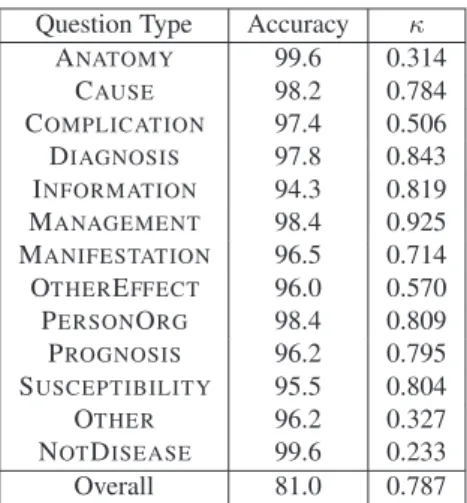
ques-Question Type Accuracy κ ANATOMY 99.6 0.314 CAUSE 98.2 0.784 COMPLICATION 97.4 0.506 DIAGNOSIS 97.8 0.843 INFORMATION 94.3 0.819 MANAGEMENT 98.4 0.925 MANIFESTATION 96.5 0.714 OTHEREFFECT 96.0 0.570 PERSONORG 98.4 0.809 PROGNOSIS 96.2 0.795 SUSCEPTIBILITY 95.5 0.804 OTHER 96.2 0.327 NOTDISEASE 99.6 0.233 Overall 81.0 0.787
Table 1: Inter-annotator agreement broken down by ques-tion type. Accuracy = % agreement between annotators, κ= Cohen’s Kappa.
tions is then simply the union of the MANIFESTATIONand COMPLICATIONstrategies.
In the final round, all five annotators double-annotated the remaining 767 GARD requests. The inter-annotator agree-ment for this round was 0.791, an improveagree-ment from the previous round. No further changes were made to the an-notation standard. Inter-annotator agreement for all rounds is broken down by question type in Table 1. In general, the more frequent types (see Table 2) have higher agreement scores, an exception being OTHEREFFECTquestions.
5.
Examples
To illustrate the question types presented in Section 3, we present the following examples from the annotated GARD data. For some types, informal sub-classes are described. At this point, however, only the 13 types are annotated. ANATOMYquestions are concerned with the body location of a disease, including where symptoms manifest (example 1) and if specific anatomical locations are possible body sites for a disease (2 & 3):
(1) Does IP affect any areas inside the body, such as in-ternal organs?
(2) I was researching metachondromatosis - is this some-thing that when felt is attached to the bone itself? (3) Can this cancer occur on someone’s back?
CAUSEquestions are concerned with the cause of the FO -CUSdisease, including direct causes (1-6) as well as factors that might increase the susceptibility of a disease (7-10):
(1) What causes this condition?
(2) Can pregnancy trigger such an issue? (3) Could this be caused by hip dysplasia?
(4) Can in vitro fertilization cause Duane syndrome? (5) Can you provide me with more information about this
condition, including its causes? (6) What are the genes involved?
(7) Are there any exogenous (outside) factors that cause Batten disease?
(8) Can a father taking an antidepressant contribute to the reason a baby has a trisomy?
(9) What increases the risk of males to have nondisjunc-tion during meiosis?
(10) Has any research been done to check whether there is any viral involvement?
COMPLICATIONquestions are concerned with longer term effects of a disease, usually in the form of risks (1-6), state-ments of the FOCUScausing some other longer-term dis-ease (7 & 8), or direct queries of complications (9 & 10): (1) Are carriers of cystic fibrosis at a higher risk for other
health conditions?
(2) Is there an increased risk of getting malignant disor-ders?
(3) Does propionic acidemia carry risk factors for hear-ing loss, especially progressive hearhear-ing loss?
(4) As an individual with G6PD deficiency, would living in a malaria risk country pose a greater risk to me compared with an individual who does not have this deficiency?
(5) Can you tell me if the risk for pre-eclampsia in preg-nancy is increased significantly for a woman over the age of 35?
(6) Would my diagnosis of nail patella syndrome increase my risk for a miscarriage?
(7) Can Charcot-Marie-Tooth disease cause a paralyzed laryngeal nerve?
(8) Can this lead to a pre-cancerous condition?
(9) I would like to ask about the serious complications as-sociated with this disease.
(10) What complications may occur in the future?
DIAGNOSIS questions are concerned with the method of diagnosing a particular disease. These questions can simply ask about the diagnostic process for a given disease (1-6), specific types of diagnostic tests (7-9) and even questions asking for a specific diagnosis7(10):
(1) Is it true that Smith-Magenis syndrome become more difficult to diagnose through genetic testing if the child is older than 24 months?
(2) Can Polycystic Kidney Diseases be diagnosed in preg-nancy?
(3) Can Bloom syndrome be detected before symptoms ap-pear?
(4) Can you provide me with information regarding diag-nosis?
(5) How is it diagnosed?
(6) I would like to know what test needs to be performed in order to be able to rule it out.
(7) Could you please let me know the name of the blood test used to diagnose a vitiligo carrier?
(8) Is genetic testing available for Asperger syndrome? (9) How can I learn more about genetic testing for this
syndrome?
(10) How can we know if it is hereditary amyloidosis or not?
7
Note that our QA system cannot provide a diagnosis, so for these types of questions we simply provide a disclaimer along with general diagnostic information.
INFORMATION questions are concerned with basic infor-mation about a disease. This includes specific requests for general information (1-5) and sub-type/super-type informa-tion (6 & 7), which commonly concerns cancer (8-10):
(1) What is this condition?
(2) Can you please provide me with general information about hyper IgD syndrome?
(3) I have osteopoikilosis and would like more informa-tion on this condiinforma-tion.
(4) How can I find information specific to adults with this condition?
(5) I would like general information on mucopolysaccha-ridosis I (MPS I).
(6) Is Machado Joseph disease a form of Parkinson’s dis-ease?
(7) What are the different types of syringomyelia? (8) Is TMT a cancerous classification?
(9) Is someone diagnosed with teratoma with malignant transformation (TMT) considered to have cancer? (10) Is astroblastoma a brain cancer?
MANAGEMENTquestions are concerned with the manage-ment, treatmanage-ment, and prevention of a disease. These ques-tions can be about general disease management (1), specific types of management (2 & 3), treatment (4-7), cure (8 & 9), and prevention information (10):
(1) What can we do to help him?
(2) Is there a diet guide that can help me plan a diet that is low in protein?
(3) She had scalded skin syndrome when she was a baby: will she need pain relief?
(4) Are there new therapies for treatment of pili torti? (5) What treatments are available for this condition? (6) Does this mean that if I were to get cancer in the future
I would not be able to be treated with chemotherapy? (7) How long does it usually take for this medication to
take effect?
(8) Is there a cure for HTLV-1 in general? (9) Can the condition be cured?
(10) Is there anyway to prevent LHON with certain vita-mins?
MANIFESTATION questions are concerned with the signs and symptoms of a disease, including asking what the symptoms of a disease are (1-6), whether specific issues are symptoms of the disease (7-9), and the typical magnitude of the symptoms (10):
(1) What are symptoms of ADPKD?
(2) I’d like to learn more about this syndrome including its symptoms.
(3) Are there any physical characteristics associated with the disorder?
(4) What symptoms may people experience as their dis-ease progresses?
(5) Can women have symptoms of glucose 6 phosphate dehydrogenase (G6PD) deficiency?
(6) Are there any things I should look out for?
(7) Is fatigue a common symptom of polyglucosan body disease?
(8) Are severe headaches symptoms of this condition? (9) Could this indicate that I am developing scleroderma
inside my organs?
(10) In autosomal dominant polycystic kidney disease (ADPKD), does the severity of symptoms of tend to be the same among affected family members?
OTHEREFFECTquestions are concerned with the effects of a disease that are not explicitly COMPLICATIONs or MAN -IFESTATIONs. This can include questions about a causal link between the FOCUS and another condition (1-5) or a general link (6 & 7), questions about specific effects of a disease (8 & 9), and unspecified effects that may alter nor-mal life processes (10):
(1) Does Klinefelter syndrome cause weight gain? (2) Does excess growth hormone have an effect on the
uterus?
(3) Is it normal for her to be hungry all the time?
(4) Can hyperphenylalaninemia caused by tetrahydro-biopterin (BH4) deficiency cause problems with eating solids in babies?
(5) Can tuberous sclerosis affect eye closure?
(6) Could this be connected to the septo-optic dysplasia? (7) I was wondering if people with Pfeiffer syndrome have
circulatory problems in their legs.
(8) Is hearing loss in people with Waardenburg syndrome type II likely to be progressive?
(9) How common is it for only one leg to have bowing? (10) Is it safe for them to bear children?
PERSONORG questions are concerned with finding indi-viduals or organizations that specialize in a particular dis-ease. This typically includes individual specialists (1-5), researchers (6 & 7), and support groups (8-10).
(1) How can I find a physician who is knowledgeable about this condition?
(2) Are there doctors who specialize in this condition? (3) I would like information about which doctors could
treat me.
(4) I have many questions, who can I talk to?
(5) Are there any doctors who specialize in this type of neurological dysfunction?
(6) Are there any new research studies enrolling people with carbamoyl phosphate synthase 1 deficiency? (7) How can I be seen by researchers at the National
In-stitutes of Health?
(8) Are there any support groups for adults with ble-pharophimosis type 1?
(9) How can I find other families that are in a similar sit-uation?
(10) I have prolidase deficiency and would like contact other sufferers.
PROGNOSISquestions are concerned with life expectancy and long-term quality of life. Specific types of questions include general prognosis (1 & 2), life expectancy (3), sur-vival probability (4 & 5), lifestyle changes (6), long-term prospects of symptoms (7 & 8), and the long-term proba-bility of symptoms emerging or returning (9 & 10):
(1) What can I expect from this condition?
(2) What is the prognosis?
(3) I would like to know what the life expectancy is for people with this syndrome.
(4) What are her chances of survival if it is a cancerous tumor?
(5) Is Devic disease fatal?
(6) Can you do any other types of exercises if you have Wolff-Parkinson-White syndrome?
(7) Is there any hope for a return of smell for someone who has never smelled?
(8) Am I going to have this for the rest of my life? (9) Is there any data that would suggest that kidney
prob-lems could show up later?
(10) As Burkitt is so rare, there is a lack of research whether the treatment is curative or palliative and I want to know what the chances are that it will return. SUSCEPTIBILITYquestions are concerned with the spread and prevalence of a disease. Common types of questions include whether a disease is genetic (1 & 2), its inheritance patterns (3 & 4), whether it is considered rare (5 & 6), and its prevalence in certain populations (7-10):
(1) Is this is a genetic disease?
(2) Is idiopathic thrombocytopenic purpura hereditary? (3) Is there any evidence that hemorrhagic shock and
encephalopathy syndrome is passed from parent to child?
(4) Will our baby inherit this condition from him? (5) How rare is this disorder?
(6) Is Gilles de la Tourette syndrome a rare disease? (7) Are people of certain religious backgrounds more
likely to develop this syndrome?
(8) If so, what are the chances for an individual to have both conditions?
(9) Could you tell me which database I could look at to find the most recent data on neuroblastoma epidemi-ology; in particular the prevalence in Europe? (10) How many cases of this condition have been identified
throughout the world?
OTHERquestions are by definition outliers from the normal question types our QA system is concerned with, though they are about a specific disease. Some more common in-clude questions about a disease’s name or history (1-3) and financial considerations (4-6), though many more types of OTHERquestions could be categorized (7-10):
(1) How did Zellweger Syndrome get its name?
(2) Does the ”M” in MOPD stand for microcephaly or Majewski?
(3) How will the recent discovery of the gene related to Kabuki syndrome affect her?
(4) Does Medicaid cover genetic testing?
(5) Are there any programs in New York to help with the cost of his dental work?
(6) Is there any funding out there to help me start some re-search on the effects of cooking naturally for children with this condition?
(7) Can I donate blood?
(9) Does this type of infection get reported to the depart-ment of health?
(10) Could my family, which has French Canadian her-itage, be related to the Canadian family described by Renpenning in the 1960s?
NOTDISEASEquestions in the context of the GARD cor-pus are generally about genetic tests (1), treatments (2), anatomical objects (3), or gene functions (4 & 5). While there are question types related to many of these (e.g., DIAGNOSIS, MANAGEMENT, ANATOMY), these questions are not specifically about a disease and thus cannot be an-swered by a disease question answering system:
(1) Are there factors that may contribute to a falsely posi-tive result?
(2) However, being a dextrocardia patient, I wonder if a pacemaker can be put in my heart.
(3) Is complex III in the mitochondria itself or is it part of the body?
(4) Is there any information about what those genes do? (5) Is there any information about what genes are on
chro-mosome 20q12?
RESEARCH questions are concerned with the most recent scientific information, and thus the answers likely wouldn’t be found in a medical encyclopedia, but in medical publica-tions or clinical trial databases. As the examples below il-lustrate, RESEARCHquestions may come from almost any question type, including CAUSE(1), DIAGNOSIS(2), IN -FORMATION(3 & 4), MANAGEMENT(5 & 6), OTHEREF -FECT(7), PERSONORG(8), PROGNOSIS(9), and SUSCEP -TIBILITY(10):
(1) Has any research been done to check whether there is any viral involvement?
(2) If cystic fibrosis testing was done by amniocentesis 6 years ago, have there been any new findings since then?
(3) Are there any clinical studies currently being per-formed?
(4) Could you please provide some of the latest informa-tion on this disease?
(5) Are there any new drugs (even under trial) to treat this condition.
(6) I would like to know whether current research is find-ing ways to cure this disease.
(7) Is there any research being done regarding a possible association between a history of diabetes and a diag-nosis of Ledderhose disease?
(8) Is there any research studies enrolling women with this tumor?
(9) Where can I find studies which discuss these risks? (10) Could you tell me which scientific reference I could
look at to find the most recent data on neuroblastoma epidemiology; in particular the prevalence in Europe?
6.
Corpus Description
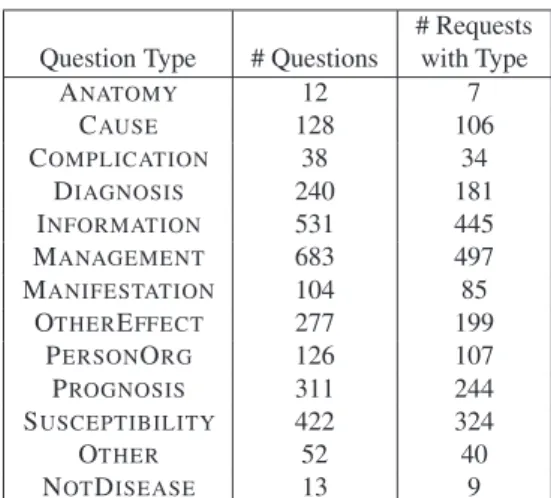
The annotated corpus contains 1,467 requests, with a to-tal of 2,937 decomposed questions. The frequencies of the question types in this corpus is shown in Table 2. The most
# Requests Question Type # Questions with Type
ANATOMY 12 7 CAUSE 128 106 COMPLICATION 38 34 DIAGNOSIS 240 181 INFORMATION 531 445 MANAGEMENT 683 497 MANIFESTATION 104 85 OTHEREFFECT 277 199 PERSONORG 126 107 PROGNOSIS 311 244 SUSCEPTIBILITY 422 324 OTHER 52 40 NOTDISEASE 13 9
Table 2: Frequencies of question types in GARD data as well as the frequencies of requests with at least one question of a given type.
common question types are MANAGEMENT and INFOR -MATION, with almost one-third of all requests containing a question of this type. The next most common types are SUSCEPTIBILITY, OTHEREFFECT, PROGNOSIS, and DI -AGNOSIS.
Table 3 shows the top ten words for each question type as ranked by the Fisher Exact Test. For classes with a sig-nificant number of annotations (e.g., MANAGEMENT, DI -AGNOSIS), these words largely conform to our intuitions. Many of these words were used as trigger words by our pre-vious, rule-based classification system. The fact that they are highly associated in the corpus means that a machine learning system trained on this data should be able to accu-rately identify questions of these types.
The annotated data set is available on our project website.8
7.
Conclusion
We have presented a question classification scheme and an annotated corpus based on 2,937 consumer health ques-tions. An automated system trained on this data should be able to aid a consumer question answering system find appropriate strategies for retrieving health information. In future work, we plan to experiment with machine learning approaches to this task as well as determine how well it gen-eralizes to other, more grammatically challenging datasets. Acknowledgements
This work was supported by the intramural research pro-gram at the U.S. National Library of Medicine, National Institutes of Health. We would additionally like to thank Stephanie M. Morrison and Janine Lewis for their help ac-cessing the GARD data.
8.
References
Somnath Banerjee and Sivaji Bandyopadhyay. 2012. Question Classification and Answering from Procedural Text in English. InCOLING Workshop on Question An-swering for Complex Domains, pages 11–26.
8
Question Type Top 10 Words
ANATOMY areas,inside,ip,body,affect,attached,felt,metachondromatosis,internal,researching
CAUSE causes,cause,caused,taking,exposure,factors,trisomy,genes,chemical,increases
COMPLICATION risk,complications,pre,individual,result,compared,country,greater,malaria,paralyzed
DIAGNOSIS testing,diagnosed,diagnosis,test,tests,genetic,available,tested,how,performed
INFORMATION information,about,provide,please,like,would,send,could,how,treatment
MANAGEMENT treatment,treated,treatments,cure,treat,therapy,options,diet,effective,prevent
MANIFESTATION symptoms,adpkd,among,dominant,polycystic,tend,autosomal,members,affected,kidney
OTHEREFFECT between,problems,associated,syndrome,information,normal,issues,about,how,cause
PERSONORG support,find,specialize,doctors,centers,contact,talk,area,groups,treating
PROGNOSIS prognosis,life,expectancy,long,term,expect,affect,person,back,ability
SUSCEPTIBILITY chances,genetic,inherited,rare,chance,information,child,passed,about,prevalence Table 3: Most associated words for each question type.
Fan Bu, Xingwei Zhu, Yu Hao, and Xiaoyan Zhu. 2010. Function-based question classification for general QA. InProceedings of EMNLP.
Yllias Chali and Sadid A. Hasan. 2012. Simple or Com-plex? Classifying the Question by the Answer Complex-ity. InCOLING Workshop on Question Answering for Complex Domains, pages 1–10.
Wen Chan, Weidong Yang, Jinhui Tang, Jintao Du, Xiang-dong Zhou, and Wei Wang. 2013. Community question topic categorization via hierarchical kernelized classifi-cation. In Proceedings of the 22nd ACM International Conference on Information & Knowledge Management. Dina Demner-Fushman and Jimmy Lin. 2007. Answering
Clinical Questions with Knowledge-Based and Statisti-cal Techniques.Computational Linguistics, 33(1). Huizhong Duan, Yunbo Cao, Chin-Yew Lin, and Yong
Yu. 2008. Searching Questions by Identifying Question Topic and Question Focus. In Proceedings of the 46th Annual Meeting of the Association for Computational Linguistics, pages 156–164.
John W. Ely, Jerome A. Osheroff, Mark H. Ebell, George R. Bergus, Barcey T. Levy, M. Lee Chambliss, and Eric R. Evans. 1999. Analysis of questions asked by family doc-tors regarding patient care.BMJ, 319(7206):358–361. John W. Ely, Jerome A. Osheroff, Paul M. Gorman,
Mark H. Ebell, M. Lee Chambliss, Eric A. Pifer, and P. Zoe Stavri. 2000. A taxonomy of generic clinical questions: classification study. BMJ, 321:429–432. John W. Ely, Jerome A. Osheroff, M. Lee Chambliss,
Mark H. Ebell, and Marcy E. Rosenbaum. 2005. An-swering Physicians’ Clinical Questions: Obstacles and Potential Solutions. J Am Med Inform Assoc, 12(2). Ulf Hermjakob. 2001. Parsing and Question
Classifica-tion for QuesClassifica-tion Answering. InProceedings of the ACL Workshop on Open-Domain Question Answering. Andrew Hickl, Kirk Roberts, Bryan Rink, Jeremy
Bens-ley, Tobias Jungen, Ying Shi, and John Williams. 2007. Question Answering with LCC’s CHAUCER-2 at TREC 2007. InProceedings of TREC-2007.
Halil Kilicoglu, Marcelo Fiszman, and Dina Demner-Fushman. 2013. Interpreting Consumer Health Ques-tions: The Role of Anaphora and Ellipsis. In Proceed-ings of the 2013 BioNLP Workshop, pages 54–62. Tetsuya Kobayashi and Chi-Ren Shyu. 2006. Representing
Clinical Questions by Semantic Type for Better Classifi-cation. InProceedings of the AMIA Annual Symposium.
Vijay Krishnan, Sujatha Das, and Soumen Chakrabarti. 2005. Enhanced Answer Type Inference from Questions using Sequential Models. InProceedings of EMNLP. X. Li and Dan Roth. 2002. Learning question classifiers.
InProceedings of COLING.
Feifan Liu, Lamont D. Antieau, and Hong Yu. 2011. To-ward automated consumer question answering: Auto-matically separating consumer questions from profes-sional questions in the healthcare domain. Journal of Biomedical Informatics, 44(6).
Donald Metzler and W. Bruce Croft. 2005. Analysis of Statistical Question Classification for Fact-Based Ques-tions.Information Retrieval, 8:481–504.
John M. Prager. 2006. Open-Domain Question Answer-ing. Foundations and Trends in Information Retrieval, 1(2):91–231.
Kirk Roberts and Sanda M. Harabagiu. 2012. Locational Relativity and Domain Constraints in Spatial Questions. InProceedings of the ACM International Conference on Advances in Geographic Information Systems.
Kirk Roberts and Andrew Hickl. 2008. Scaling Answer Type Detection to Large Hierarchies. InProceedings of LREC.
Kirk Roberts, Kate Masterton, Marcelo Fiszman, Halil Kilicoglu, and Dina Demner-Fushman. 2014. Annotat-ing Question Decomposition on Complex Medical Ques-tions. InProceedings of LREC.
Connie Schardt, Martha B. Adams, Thomas Owens, Sheri Keitz, and Paul Fontelo. 2007. Utilization of the PICO framework to improve searching PubMed for clinical questions. BMC Med Inform Decis Mak, 7(16).
Jessi Van Der Volgen, Bethany R. Harris, and Dina Demner-Fushman. 2013. Analysis of Consumer Health Questions for Development of Question-Answering Technology. InProceedings of the 2013 Annual Meet-ing and Exhibition of the Medical Library Association. Hong Yu and YongGang Cao. 2008. Automatically
Ex-tracting Information Needs from Ad Hoc Clinical Ques-tions. InProceedings of the AMIA Annual Symposium. Hong Yu and Carl Sable. 2005. BeingErlang Shen:
Iden-tifying Answerable Questions. In IJCAI Workshop on Knowledge and Reasoning for Answering Questions. Yan Zhang. 2010. Contextualizing Consumer Health
In-formation Searching: An Analysis of Questions in a So-cial Q&A Community. InProceedings of the 1st ACM International Health Informatics Symposium.