A Dissertation Submitted to the Faculty
of
Drexel University by
Stacey Lynn Porter in partial fulfillment of the requirements for the degree
of
Doctor of Education December 2016
This Ed.D. Dissertation Committee from The School of Education at Drexel University certifies that this is the approved version of the following dissertation:
Experiences and Challenges of Independent Study Charter School Educators: A Case Study
Stacey Lynn Porter
Committee: ____________________________________ Kathy D. Geller, Ph.D. ____________________________________ W. Edward Bureau, Ph.D. ____________________________________ Janet Balcom, Ed.D.
____________________________________ Date
iv Dedication
I dedicate this dissertation to my parents. The loss of my dad shattered my heart, but my mom lovingly picked up the pieces and taught me the importance of being a strong, independent, generous and driven woman. For these things I am eternally grateful.
To all the great teachers and school leaders who have inspired and trained me to work with special education students thank you giving me a solid foundation and
believing in me. Stacey Lynn Porter
v
Acknowledgments
My first teaching experience was over 18 years ago and those days at Alicante are forever burned into my being. The relationships and mentors there inspired me to remain in the field of special education and identified an unique gift in me to work with difficult students and mentor other teachers to successfully do the same. Since those days, I have worked at a comprehensive high school campus as the department chair for special education and in a charter school environment supporting students with disabilities. I want to thank the teachers I have encountered who have both challenged me and
collaborated with me. I also want to thank all of my students who have motivated me to do more to help you be successful in every school setting I have worked in.
To my friend Krystal Corwin, cheers to us for staying on course and embarking on this treacherous journey together. I am so grateful for the guidance and support of Dr. Kathy Geller who has encouraged me every step of the way. Thank you for
understanding my desire to balance time with my family in pursuit of this doctorate. Thank you to all my friends and family who were supportive of this dream even though they did not fully understand the commitment or purpose.
To my mom Teresa Porter for giving me a lifetime example of hard work, sacrifice, dedication, and determination: I am blessed to be your daughter. To my grandpa Ted Porter, who has always been a role model of service and dedication to others: I am blessed to be your first and favorite grandchild. To my dad Steven Porter and my grandma Sue Porter: you both showed me unconditional love, adoration, and support. Your memories live on through me and I pray I continue to make you proud.
vi
And finally, to Derrick Zimmer, your love, support and encouragement has given me the courage to stay the course. You started this journey with me and saw me through every step of the way. Through tearful episodes and moments of defeat, you never let me give up. Thank you for that and for giving me two beautiful boys to challenge and motivate me during this process. I pray my sacrifices have inspired them to work hard and pursue their dreams.
vii
Table of Contents
LIST OF TABLES ... ix
LIST OF FIGURES ... x
1. INTRODUCTION TO THE RESEARCH ... 1
Introduction to the Problem ... 1
Statement of the Problem to Be Researched ... 4
Purpose and Significance of the Problem ... 5
Research Questions Focused on Solution Finding ... 7
The Conceptual Framework ... 7
Definition of Terms ... 14
Assumptions and Limitations ... 15
Summary ... 17 2. LITERATURE REVIEW ... 20 Introduction to Chapter 2 ... 20 Literature Review ... 22 Summary ... 44 3. RESEARCH METHODOLOGY ... 46 Introduction ... 46
Research Design and Rationale ... 47
Site and Population ... 48
viii
Ethical Considerations ... 58
4. FINDINGS, RESULTS, AND INTERPRETATIONS ... 59
Introduction ... 59
Findings ... 61
Results and Interpretations ... 114
Summary ... 121
5. CONCLUSIONS AND RECOMMENDATIONS ... 122
Introduction ... 122
Conclusions ... 123
Recommendations ... 129
Summary ... 133
LIST OF REFERENCES ... 135
APPENDIX A: LETTER OF APPROVAL FROM DIRECTOR OF SPECIAL EDUCATION ... 143
APPENDIX B: LETTER OF APPROVAL FROM CEO ... 144
APPENDIX C: ONE-ON-ONE SEMI-STRUCTURED INTERVIEW PROTOCOL ... 145
APPENDIX D: INVITATION TO PARTICIPATE ... 147
ix List of Tables
1. Assumptions that May Have Influenced the Researcher’s Initial Approach to this Study ... 16 2. Data Collection Timeline ... 58 3. Participant Overview ... 60
x
List of Figures
1. Conceptual framework introducing research streams ... 10 2. Graphical representation of the three research streams ... 21 3. Graphical representation of themes and subthemes ... 62
xi Abstract
Experiences and Challenges of Independent Study Charter School Educators: A Case Study
Stacey Lynn Porter, Ed.D.
Drexel University, December 2016 Chairperson: Kathy D. Geller
Charter schools are becoming increasingly popular in K-12 education and are becoming an attractive alternative for parents of students with disabilities. While charter schools have more freedom to operate without having to comply with certain regulations, they are not exempt from the policies that support students with disabilities.
Independent study school charters offer an alternative education different than most traditional schools. Parents of students with disabilities appear to be gravitating towards independent study learning environments and moving away from a traditional classroom infrastructure that was designed to support the specialized needs of students with disabilities.
This study explores the perspectives and experiences of sixteen independent study charter school educators who work with students with disabilities in some capacity at their schools. The study sought to understand how these charter school educators provide specialized academic services and support in this unique educational setting. Challenges for educating students with disabilities in an independent study school setting, such as, implementing IEPs, accommodating learning needs and providing differentiated instruction will also be explored.
xii
The research questions that guided this study are:
1. How do independent study charter school educators describe their experiences teaching students with disabilities?
2. What challenges do independent study charter school educators face when supporting students with disabilities?
3. How do independent study charter school educators describe their preparedness to support the individualized needs of students with disabilities?
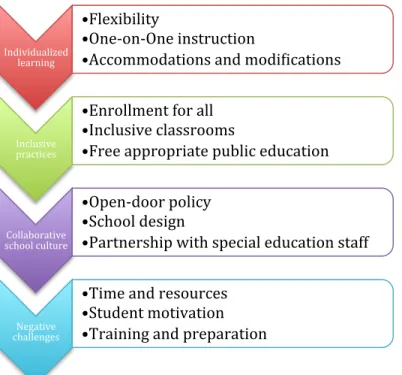
Through in-depth analysis of interviews, artifacts, and the researcher’s journal four findings emerged: (a) individualized learning, (b) inclusive practices, (c)
collaborative school culture, and (d) negative challenges. Four results were interpreted from the findings and situated within relevant literature: (a) Independent study charter schools “enrollment for all” policy can be misleading, as the school cannot always offer appropriate FAPE for some special education students; (b) Collaborative relationships between general education and special education educators influence inclusion; (c) Flexibility of educational approaches impact successful inclusion at the independent study charter school; and (d) Independent study charter schools enroll students with disabilities without hiring adequately trained general education teachers to work with them. Conclusions from the findings and results emerged and are offered in response to the research questions posed. Recommendations are then offered.
Chapter 1: Introduction to the Research
Introduction to the Problem Emergence of Charter Schools
Until the early 1990s, if a parent wanted to choose an alternative educational setting apart from a comprehensive public school campus, they would have had to pay private school tuition. With the rise of the charter school movement, the days of having to be educated within a specific neighborhood school no longer exist (Hubbard & Kulkarni, 2009; McCollom, 2010). The charter school movement began as a way to create a new kind of public school environment, one with more autonomy and flexibility over instructional and operational procedures (Plate, 2013; Rhim & McLaughlin, 2001). Charter schools with varying missions sought to serve specific populations of students, providing educational programs intentionally not designed to fit all students (Gross, 2011; Hubbard & Kulkami, 2009). Because of their ability to individualize educational practices and meet the diverse needs of students, charter schools offer the promise of serving students frequently marginalized in conventional school settings (Angelov & Bateman, 2016).
The charter school movement has had a substantial impact upon traditional public school enrollment across the United States (U.S.); charter schools are changing the landscape of the U.S. educational system. In 2013, more than 6,000 charter schools were in operation across the country. Their enrollments had risen by 40% since the 2007-2008 school year (California Charter Schools Association, n.d.). There are now more than 6,700 public charter schools enrolling over 2.9 million students across the country
(National Center for Learning Disabilities [NCLD], 2015). The State of California first authorized charter schools in 1992, and they are located in rural, suburban, and urban areas throughout California. In the 2013-14 school year, 104 new charter schools opened in California bringing the total number of charter schools in the state to 1,130 and making California the state with the highest number of charter schools and enrolled charter school students in the country (California Charter Schools Association, 2015; California Department of Education, 2015b). As of the 2015-2016 school year, there are an
estimated 581,100 students attending charter schools in California (California Charter Schools Association, 2015).
Charter schools have more autonomy than traditional schools over operations, staffing, budgets, and pedagogy, which has allowed them to be better equipped to develop new programs that serve students with diverse needs and to hire innovative and creative educators (Gross, 2011). Many charter schools provide smaller classroom settings, virtual learning opportunities, and creative approaches to learning, which have been enticing for parents of students with unique needs (Lange & Lehr, 2000). Denice (2014) found that charter schools, on average, produced better results and out performed district-run schools.
Charter schools are enticing to parents of special needs children in their search for alternatives to traditional school settings (Lange & Lehr, 2000; Stern, Clonan, Jaffee, & Lee, 2015). Historically, students with disabilities had limited choices and options in general classroom settings, being in separate classrooms being the norm. In recent decades, the rights of students with special needs became a priority, and improvements in including access to general education classes were made. In spite of these improvements,
Lake and Gross (2012) found that families of students with special needs continue to be generally dissatisfied with the services and supports available to them through the public school system.
Estes (2004) suggested that parents with special needs children have been searching for something different than what traditional public schools provide and often are making choices to leave public school settings with relatively high levels of special education services and support for schools with fewer services. Lake (2010) found that parents of students with disabilities have increasingly turned to charter schools to provide an alternative educational setting for their children. Plate (2013) noted that although charter schools are gaining increasing popularity with parents of children with special needs, these schools may not have been either designed for or staffed to provide needed and specific services for children with disabilities.
As parents choose to enroll their children with disabilities in publically funded charter schools, charter school teachers are challenged with educating this group of unique learners (Gross & Lake, 2014; Lake & Gross, 2012). Gross and Lake (2014) found that it is possible but challenging for charter schools to provide services to a wide range of students with special needs. Gross and Lake (2014) further suggested that it has been difficult to integrate students with disabilities into charter school classrooms
because many of these schools lack the systems and infrastructures to properly prepare and train educators to effectively support the unique needs of students with disabilities. While charter school teachers are expected to have the knowledge and skills to teach students with disabilities, providing meaningful and appropriate learning opportunities,
questions remain about their readiness (Munk & Dempsey, 2010; Villa & Thousand, 2000; Yell, 2012).
Independent study was authorized as a K-12 education approach in California in 1976, and these schools preceded the emergence of charter schools. Independent study began as a voluntary program designed to serve students who struggled in the traditional public school classroom. With the emergence of charter schools, the independent study pedagogy has been incorporated as one of several approaches charter schools may take. The most recent research on California independent study schools and enrollment was based on data from the 2008-2009 school year that indicated that at that time, 128,140 students were enrolled as full-time independent study students (California Department of Education, 2015b). No current data are available on the number of students currently enrolled as full-time students in independent study school settings in California.
As independent study charter schools have emerged, parents of students with disabilities have begun enrolling their children into these schools. While there is limited current research on independent study schools, there appears to be no research available on the experiences of special needs children in independent study charter schools.
Statement of the Problem to Be Researched
Independent study charter schools are becoming a popular school choice for parents of students with disabilities, yet little is known about how independent study educators are being prepared to provide individualized services and the requisite support for students with disabilities.
Purpose and Significance of the Problem
The purpose of this case study was to explore the experiences of teachers (both general education and special education) and administrators working in independent study charter school settings to understand the challenges they face and the adequacy of their preparation and instruction to support students with disabilities.
Charter schools are charged with the same level of responsibility as traditional public schools to provide a “free and appropriate public education” (FAPE) to all children with disabilities under the Individuals with Disabilities Act (IDEA). Charter schools that operate as independent study schools (non-classroom based) are prohibited from denying admission to special education students. California Education Code, Section 51745 states that a child’s Individualized Education Program (IEP) must specifically provide for participation in an independent study program. Students who enroll without a current IEP seeking independent study as an offer of “free appropriate public education” must have an IEP developed offering the independent study program as an appropriate placement.
Speaking to traditional public education settings, Guetzloe (1999) noted, “school systems across the continent are placing ever-increasing numbers of children with disabilities in the regular classroom, often without careful preparation of the students themselves, their peers, the faculty, or the environment” (p. 92). Guetzloe (1999) further suggested that anyone who works with students with disabilities needs training in (a) special education procedures and laws (e.g., IEPs, due process, and evaluation), (b) learning strategies and social skills instruction, and (c) classroom management of students who are inattentive and disruptive. Independent study charter school teachers
have been tasked with making curriculum accessible to all students while implementing the individualized supports and services outlined in a student’s IEP. It is not known how general education teachers in independent study charter schools are prepared to support this population. Further, little is known about how special educators support students in the independent study environment.
Are independent study charter school educators aware of the requisite
infrastructures and services that need to be in place to assure compliance and protect students with disabilities? Lake (2010) suggested that the failure of charter schools to establish policies around special needs students further contributes to compliance issues, which potentially places these schools in jeopardy of facing lawsuits and formal
complaints being filed by parents of students with disabilities whose IEPs are being violated.
Although limited, research on the educational practices and inclusion of students with disabilities in charter schools does exist; however, there is a significant gap in the current research exploring how teachers in independent study charter schools are being prepared to support children with disabilities and assure responsiveness to the children’s IEPs. The current research sought to explore the experiences of teachers (both general education and special education) and administrators working in independent study charter school settings to understand the challenges they face and the adequacy of their
preparation and instruction to support students with disabilities. The study sought to understand how these teachers and administrators are trained to provide special education services and supports, implement IEPs, and monitor the progress of students with
Research Questions Focused on Solution Finding
4. How do independent study charter school educators describe their experiences teaching students with disabilities?
5. What challenges do independent study charter school educators face when supporting students with disabilities?
6. How do independent study charter school educators describe their preparedness to support the individualized needs of students with disabilities?
The Conceptual Framework Researcher’s Stance
Philosophical approach. As a researcher, I believe that meaning is best understood by looking at the perceptions, views, and experiences of others. The philosophical paradigm I bring to this study of independent study charter school
educators and administrators is based on social constructivism. Social constructivism, as defined by Gergen (1985), is a way to expose “the processes by which people come to describe, explain, or otherwise account for the world (including themselves) in which they live” (p. 266). As a social constructivist, I believe people construct their own meanings of the world based on their lived experiences. “Social constructivists hold assumptions that individuals seek understanding of the world in which they live and work. Individuals develop subjective meanings of their experiences—meanings directed towards certain objects or things” (Creswell, 2012, p. 8). As a qualitative researcher, I am challenged to separate my own worldviews and beliefs from this research and recognize that my own background has the potential to shape my interpretation of the research (Creswell, 2012).
Researcher’s tacit experiences. I have been a special education teacher for 15 years and have worked in a variety of school settings. For 10 years, I have been
employed by a large public school district in Northern California; for seven of those years, I worked as a resource teacher and department chair for special education in traditional schools. For the recent three years, I have served as an Educational Specialist supporting multiple charter school campuses, all part of one bounded charter school system. The charters I support, while located in multiple public school districts, are part of their own local educational agency (LEA) and have a Memorandum of Understanding (MOU) with my public school district for special education services. As an educational specialist, my responsibilities are to deliver “pull out” services to identified students with disabilities, develop their IEPs, ensure compliance of IEPs, complete assessments, and monitor student progress. In my role as an educational specialist, I collaborate with charter school administrators and teachers to assure they accommodate and differentiate instruction for students with disabilities in their settings, meeting state standards for curriculum and student support. All of the charter schools I supported during the time of this study were unique in terms of grade level and teaching pedagogy, as well as
classroom design, and vary significantly from a traditional school model.
One of the schools with multiple campuses within this charter system is an independent study charter school. In this setting, all attending students are expected to work from home with the support of their parents, meeting with an assigned general teacher on-site at least once a week. The students also have opportunities to attend various labs and vocational programs throughout the academic year and have the potential to obtain more credits during a school year than would be possible in a
traditional public school. As parents increasingly choose to enroll children with disabilities into this independent study setting, in my experience many of the students with disabilities are coming to this setting with extreme credit deficiencies, and in some situations with severe disabilities, which require intensive teaching interventions.
Out of all the charters I have supported, the independent study charter school intrigues me the most. I am perplexed by its increasing popularity amongst families of students with disabilities. Through this case study research, I explored the experiences of educators and administrators with a goal to understand how they describe their
preparedness for and experiences with educating students with disabilities within the independent study pedagogy. In conducting the study, I identified my own assumptions and biases that emerged from my tacit experiences and focused on these educators’ experiences and the meaning they constructed from them.
Conceptual Framework
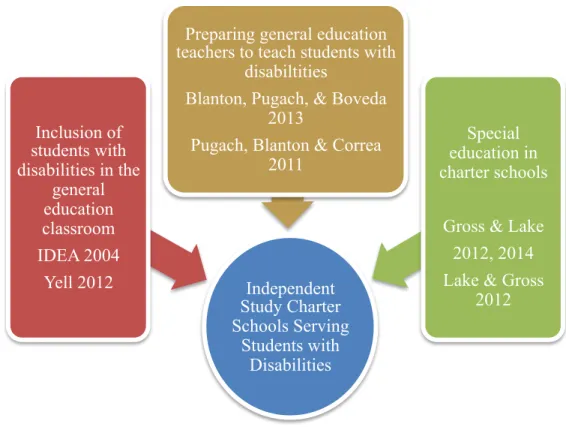
To inform the current study, three streams of literature are reviewed to inform the current research: (a) inclusion of children with disabilities in the general education classroom, (b) preparing general education school teachers to teach students with disabilities, and (c) special education in charter schools. There is limited research on independent study charter schools, and this specific focus is reviewed within the context of each of the three streams.
Figure 1. Conceptual framework introducing research streams.
Inclusion of students with disabilities in the general education classroom. Federal law mandates that students with exceptional needs are entitled to a free and appropriate public education (FAPE) in the least restrictive environment (LRE) (IDEA, 2004; Yell, 2012). The term “inclusion” is not specifically mentioned in the Individuals with Disabilities Act (IDEA; 2004), but is a term and philosophical approach used by educators to provide special education students the opportunity to spend most of their school day in the general education setting (Rozalski, Stewart, & Miller, 2010). Odom, Buysse, and Soukakou (2011) concluded that inclusion in the general education
classroom benefits both students with and without disabilities and identified that
Independent Study Charter Schools Serving Students with Disabilities Inclusion of students with disabilities in the general education classroom IDEA 2004 Yell 2012
Preparing general education teachers to teach students with
disabiltities
Blanton, Pugach, & Boveda 2013
Pugach, Blanton & Correa 2011
Special education in charter schools
Gross & Lake 2012, 2014 Lake & Gross
successful outcomes for inclusion practices for both groups are “belonging,
participating and the ability to form positive social relationships” (p. 347). According to Odom et al. (2011), teacher attitudes and beliefs contributed to the successful
implementation of inclusion; and collaboration between general education and special education teachers was found to be the cornerstone of a quality inclusive classroom.
Charter schools that operate much like traditional schools and charters that operate outside of this paradigm, such as independent study charter schools, are also obliged to include students with disabilities in their general education classrooms. A lack of resources and specialized trained staff are among the challenges that impact the
successful implementation of inclusion practices on charter school campuses (O’Neill & Rhim, 2015). Since the same federal laws apply to charter schools as they do to
traditional educational systems, Gross and Lake (2014) concluded that charters need to create partnerships with special education agencies and hire special education teachers and administrators who can collaborate and work effectively to support and train general education teachers to make inclusion a success.
Preparing general education teachers to teach students with disabilities. The success of inclusive classrooms depends on the ability of general education teachers to implement effective instructional strategies and comply with IEPs developed for students with disabilities. Coskun, Tosun, and Macaroglu (2009) conducted a study of general education teachers in public schools concluding that general education teachers in this setting lacked understanding and knowledge of how to implement best practices for special education students in their classrooms. Their research concluded that these general education teachers believed they were underprepared to support students with
disabilities. Teachers in their study perceived that they did not receive the necessary supports from special education teachers and administrators to implement successful inclusive practices (Coskun et al., 2009).
According to Oyler (2011), teacher preparation programs that certify both general and special education teachers need to prepare both groups to teach inclusively and to collaborate effectively with one another to support the unique needs of diverse learners in their classrooms. In a recent study of 109 colleges and universities across the country offering certification in elementary education, Allday, Neilsen-Gatti, and Hudson (2013) found that very few universities were adequately preparing new teachers for the demands of inclusive classrooms; nor were they offering sufficient coursework to address the academic and behavioral challenges general education teachers encountered when trying to successfully mainstream students with disabilities into their classroom environments. Prior research has suggested that the restructuring of pre-service teaching programs is necessary to better prepare both general and special education teachers for inclusive settings and to assure accountability for students with disabilities in the general education classrooms (Allday et al., 2013; Coskun et al., 2013; Harvey, Yssel, Bauserman, & Merbel, 2010; McHatton & Parker, 2013; Oyler, 2011; Van Laarhoven, Munk, Lynch, Bosma & Rouse, 2007).
Special education in charter schools. By definition, charter schools are: Independent public schools designed and operated by educators, parents,
community leaders, educational entrepreneurs, and others sponsored by local or state educational organizations that monitor their qualify and effectiveness but allow them to operate outside the traditional system of public schools. (Estes, 2009, p. 217)
While they are freed from complying with many state regulations, they are still obligated to comply with federal law regarding students with disabilities (Fierros & Blomberg, 2005; Lange & Lehr, 2000). Mulligan (2014) noted that charter schools are “required to provide services to students with disabilities” and bear the same
responsibilities as traditional schools do to make free appropriate public education available to all students (p. 4).
Charter schools must have policies and procedures designed to respond to the needs of students with disabilities and the special education process. Research has concluded that many are successfully educating students with special needs in their programs (Fierros & Bloomberg, 2005; Gross & Lake, 2014; Lake & Gross, 2011; Lange & Lehr, 2000). Yet, as the population of students with disabilities increases, some charter schools are coming under scrutiny for restrictive practices and not meeting expectations for free appropriate public education standards in the least restrictive environment (Drame, 2011; Estes, 2004; 2006; Gross & Lake, 2014; Lake & Gross, 2011; Stern, Clonan, Jaffee, & Lee, 2015).
Lake and Gross (2012) concluded that because the enrollment of special
education students in charter schools varies throughout the United States, charter school educators are at a disadvantage for accessing training and staff development opportunities that could provide the resources and tools to work more effectively with students with disabilities. They described how in Denver the district is working on ways to provide charter school teachers access to district-run special education trainings for district-wide personnel throughout the school year, noting that this is not a common practice for most public school districts (Lake & Gross, 2012). O’Neill and Rhim (2015) reported that
some charter schools in California have developed special education partnership programs with local universities, which provide mentoring services from special
education university faculty and offer specialized training and professional development opportunities for their teachers.
Definitions of Terms Free Appropriate Public Education (FAPE)
“A free appropriate public education means that special education and related services are to be provided as described in an individualized education program” (California Department of Education [CDE], 2009, p. 1).
Individualized Education Program (IEP)
When a child receives special education services under the Individuals with Disabilities Act (IDEA) he or she must have an Individualized Education Program (IEP). This is a written document listing, among other things, the special
educational services that the child will receive. (Center for Parent Information and Resources, 2015, p. 1)
Inclusion/Inclusive Education
“In today’s schools, the practice of educating all children with and without disabilities together in heterogeneous classrooms often is referred to as inclusive education or simply inclusion” (Hammeken, 2000, p. 8).
Independent Study
A public education alternative meant to meet students’ needs, interests, and learning styles while ensuring that students can meet their school district’s curriculum and graduation requirements. (Barrat & Berliner, 2009, p. 1) Least Restrictive Environment (LRE)
“Reflects the presumption that the student’s education will take place in a typical setting and with non-disabled students” (Turnbull, Huerta, & Stowe, 2009, p. 5).
Public Charter School
Independent public schools designed and operated by educators, parents,
community leaders, educational entrepreneurs, and others sponsored by local or state educational organizations that monitor their qualify and effectiveness but allow them to operate outside the traditional system of public schools. (Estes, 2009, p. 217)
Special Education
Specially designed instruction, at no cost to the parents, to meet the unique needs of a child with a disability, including, instruction conducted in the classroom, in the home, in hospitals and institutions and in other settings. (Center for Parent Information and Resources, 2016, para. 18)
Assumptions and Limitations Assumptions
As a special education teacher supporting independent study charter schools and as a special education educator for over 15 years, the researcher held five assumptions that may have influenced this study (see Table 1).
Table 1
Assumptions that May Have Influenced the Researcher’s Initial Approach to this Study Assumptions
(1) Special education students require daily specialized academic instruction. (2) Special education students benefit from attending school regularly.
(3) Alternative educational programs such as independent study schools are designed to serve students who are able to complete work independently with minimal support.
(4) Free and appropriate public education is difficult to provide in an independent study program when students with disabilities have IEPs that outline requirements for specific services and supports.
(5) Independent study charter school teachers have not been provided with adequate support to effectively educate special education students.
In the many IEP meetings the researcher has chaired and participated in, the team, consisting of teachers and administrators, generally recommend that a student benefits from attending school daily in order to be afforded the opportunity to learn and thrive in the classroom. The researcher believes that attending school daily supports the learning needs of special education students who generally require classroom accommodations such as: repetition, clarification, chunking of information, and checking for
understanding. Attending daily affords students with disabilities the opportunity to interact with their peers and teachers and supports both their growth academically and socially. The students with whom the researcher has worked who did not attend classes regularly fell behind and failed classes because they lacked the skills to complete the assignments and projects they missed while working independently. Further, students with disabilities have defined learning deficits that typically make independent work
difficult; many benefit from having their teachers personally clarify assignments, break directions down into steps, and model the desired skill acquisition.
Many of the students with disabilities with whom the researcher has worked in independent study programs benefit from daily specialized academic instruction from a trained special education teacher, weekly speech and language services from a speech therapist, and monthly services from a school psychologist. In the researcher’s recent experiences, independent study charter schools are not assigned a special education specialist to support general education teachers with successfully including students with disabilities into their classrooms on a daily basis.
Limitations of the Study
A limitation of the study is the researcher’s limited sampling from a single independent study charter school with three separate sites seeking to understand the experiences of general and special education teachers and administrators who support students with disabilities in their programs. As the data are limited to educators in a single charter school system in northern California, they may not generalize to all general and special education teachers and administrators in different independent study charter schools that serve special education students in their programs. In addition, the backyard research design model may affect participants in openly sharing their experiences with a researcher who is an employee from within the district.
Summary
Special education law mandates that students with disabilities are provided a free appropriate public education in the least restrictive environment and that the specialized services and supports are appropriate to their specific needs. Under the law, special
education students have the right to access general education curriculum and be
included in the general education setting alongside their non-disabled peers. Given that charter schools are public schools, they are also obligated to comply with federal
mandates impacting students with disabilities. Charters are required to provide inclusive classrooms and differentiate instruction for special education students, despite limited resources to be able to do so successfully. Similarly, independent study charter schools have the same responsibilities as other charter schools do regarding not discriminating against students with disabilities in their programs. IEPs need to reflect the student’s placement in an independent study charter school, identifying it as an appropriate placement for a student with a disability.
As students with special needs are enrolling in charter schools, the teachers and administrators that serve this population may be underprepared to successfully implement supports and services. Preparation programs for general and special education teachers are tasked with being able to prepare teachers for the inclusion of students with
disabilities in the mainstreamed classroom. Without a solid foundation of best practices for educating students with disabilities, teachers appear to be at a disadvantage in making inclusion a success. Teachers in independent study charters may face the same
challenges as teachers in district classrooms to comply with federal mandates and enroll students with disabilities and include them in the general education setting.
Complementary to each other, the three streams offer a foundation for
understanding the factors impacting independent study charter school teachers including students with disabilities in their general education classrooms. This case study is meaningful for researchers of charter schools because it explored the experiences and
challenges of independent study school educators who work with students with disabilities in a unique educational setting.
Chapter 2: The Literature Review
Introduction to Chapter 2
Parents of special needs students who are dissatisfied with traditional school settings work hard to find programs they believe will better support their child’s unique needs and learning abilities (Lake, 2010). Many of the parents seeking an alternative educational setting are turning to charter schools to better support their children with special needs (Estes, 2009; Hawkins-Pammer, 2000; Plate, 2013). Increasing numbers of students with IEPs are enrolling in charter schools and, more specifically, in alternative instructional models, including independent study charter schools. While many studies exist that support the success of charter schools in supporting the individualized needs of these students, little research has explored how independent study charter schools are serving students with disabilities and challenges the programs may face when enrolling special education students. The purpose of the current study was to explore the
experiences of teachers (both general and special education) and administrators working in independent study charter school settings to understand the challenges they face and the adequacy of their preparation and instruction to support students with disabilities. The Conceptual Framework
Independent study charter schools have the same obligations that traditional public schools and traditional charter schools do to serve students with disabilities. Because independent study schools are able to provide flexible educational programs and individualized instructional approaches for all students, they appear to be emerging as a popular alternative educational setting for students with special needs. The California
Department of Education (2015b) identified various elements of exemplary independent study schools and among these elements included that when special
education students enroll in an independent study program they must “continue to receive the supports outlined in their individualized education programs” (p. 3). Students with disabilities may have physical, developmental, and emotional disabilities that make inclusion in the general education setting a challenging endeavor. Specialized training and education for teachers is necessary for any school program to be able to adequately support the unique needs of students with disabilities who require special education services.
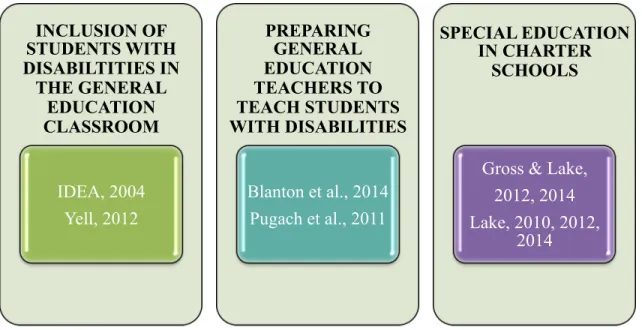
To frame the study, the literature review explores (a) inclusion of students with disabilities in the general education classroom, (b) preparing general education teachers to teach students with disabilities, and (c) special education in charter schools.
Figure 2. Graphical representation of the three research streams. INCLUSION OF STUDENTS WITH DISABILTITIES IN THE GENERAL EDUCATION CLASSROOM IDEA, 2004 Yell, 2012 PREPARING GENERAL EDUCATION TEACHERS TO TEACH STUDENTS WITH DISABILITIES Blanton et al., 2014 Pugach et al., 2011 SPECIAL EDUCATION IN CHARTER SCHOOLS
Gross & Lake, 2012, 2014 Lake, 2010, 2012,
Literature Review
Inclusion of Students with Disabilities in the General Education Classroom The road to inclusion. In the early 1900s, it was believed that children with disabilities were incapable of being educated, let alone being educated alongside their peers. Even with all states having compulsory education laws in place by 1918, young people with disabilities were frequently excluded from public school classrooms
(Osgood, 2005; Villa, Thousand, Meyers, & Nevin, 1996; Yell, 2012). In the late 1950s, U.S. courts upheld legislation that excluded students who they deemed would not benefit from public education or would be a disruption to others in the general education
environment (Yell, 2012). Such students were placed into separate settings or programs specifically created for students with disabilities (Osgood, 2005). Not until 1965 was there a national movement to provide equal educational opportunities for people with disabilities (NCLD, 2015). This movement led to the passage of the Elementary and Secondary Education Act (reauthorized in 2002 as the No Child Left Behind Act), which was established to improve the academic achievement of children with special needs (Elementary and Secondary Education Act of 1965 [ESEA 1965]). ESEA mainly provided support for students who were blind, deaf, and mentally retarded and did very little to support the education of students with disabilities in public schools (Osgood, 2005; Yell, 2012). Even with the changing mandates and movements, many students with special needs were still provided an education that was not appropriate to their needs, and they continued to be excluded from learning alongside their able-bodied peers (Yell & Dragslow, 2000). To combat the continued exclusion, in 1975, the U.S.
94-142 that guaranteed that eligible students with disabilities received an education suited to their unique needs.
[EACHA] mandated that qualified students with disabilities had the right to (a) nondiscriminatory testing, evaluation and placement procedures; (b) education in the least restrictive environment; (c) procedural due process, including parent involvement; (d) a free education: and (e) an appropriate education. (Yell, 2012, p. 53)
In 1990, the title of the EACHA ACT was changed to IDEA to assist states in meeting the educational needs of students with disabilities and to reallocate federal funding. Prior to 1990, the federal government provided more money to states that had higher numbers of special education students, causing many states to over-identify students in this category. In 1997, the act was yet again amended, affording all students with disabilities access to free and appropriate public education to meet their
individualized needs and prepare them for their transition into adulthood and
independency (California Department of Education, 2015a; Garten & Murdick, 2005; NCLD, 2015; U.S. Department of Education, 2015; Yell & Dragsow, 2000).
Congress has continued to update the law. It was reauthorized in 2004, which prompted a series of changes in the way that special education and related services are now being delivered. The reauthorization of IDEA 2004 stated that the purpose of the law is:
(A) to ensure that all children with disabilities have available to them a free appropriate public education that emphasizes special education and related services designed to meet their unique needs and prepare them for further education, employment, and independent living;
(B) to ensure that the rights of children with disabilities and parents of such children are protected; and
(C) to assist States, localities, educational service agencies, and Federal agencies to provide for the education of all children with disabilities;
coordinated, multidisciplinary, interagency system of early intervention services for infants and toddlers with disabilities and their families;
(2) to ensure that educators and parents have the necessary tools to improve educational results for children with disabilities by supporting system
improvement activities; coordinated research and personnel preparation; coordinated technical assistance, dissemination, and support; and technology development and media services; and
(3) to assess, and ensure the effectiveness of, efforts to educate with disabilities.
Sections 601(d) IDEA (2004) further provides that students with disabilities are to be educated alongside students without disabilities and that removing them from the general education classroom should only be the result when the severity of their disability prevents them from being successful, even with the use of supplementary aids and services. Placement categories note that children with disabilities may be served in: “general education class, special education class, special education school, home or in a hospital or private institution” (Sec.300.115). The principles of FAPE include the evaluation process, the IEP development, which includes the curriculum, supplementary aids, supports, services, and the placement in the least restrictive environment (LRE) for the student with a disability (Turnbull, Huerta, & Stowe, 2009).
Under IDEA when a student meets 1 of 13 qualifying conditions for special education—“mental retardation,” (as of 2013, term changed to intellectual disability) “hearing impairment, deafness, speech or language impairments, visual impairment (including blindness), a serious emotional disturbance, an orthopedic impairment, autism, traumatic brain injury, an other health impairment, a specific learning disability, deaf-blindness or multiple disabilities” (IDEA 20, U.S.C. 1401(3))—states are then mandated to provide services. Each student determined eligible for special education services is
required to have an IEP. Special education services that are to be provided are spelled out during the IEP development process, which under federal law is a team approach. The IEP team determines the appropriate services, supports, and length of specialized academic instruction a student will be provided and placement in the least restrictive environment (LRE). Yell (2012) concluded, “The IEP is the embodiment of a student’s free appropriate public education (FAPE)” (p. 184). He further suggested schools need to make “good faith efforts” to place students with disabilities in educational environments that are “less restrictive” (Yell, 2012, p. 271).
Inclusion. Hammeken (2000) defined inclusion and inclusive education as “the practice of educating all children with and without disabilities together in heterogeneous classrooms” (p. 8). A fully inclusive placement typically involves the student being placed for the full duration of the school day in the general education environment, with implementation of a special education student’s IEP in that setting (Yell, 2012).
Although the terms inclusion and mainstreaming are often used to define the least restrictive environment and are at times used interchangeably, they are not synonymous approaches (Rozalski et al., 2010; Yell, 2012). Rozalski et al. (2010) identified inclusion as a general philosophical stance in which special education students spend the majority of their school day in a general education setting. Whereas mainstreaming has been viewed as a relatively dated term that involves students with disabilities being included in the general education classroom for a minimal part of their day, typically in
non-academic activities and settings (Rozalski et al., 2010; Yell, 2012). Yell (2012) noted, “IDEA requires mainstreaming or inclusion when the general education classroom setting can provide an appropriate education” (p. 271).
The LRE mandate within IDEA requires that before schools place special education students in more restrictive settings, they must make efforts to support the learning of students with disabilities in less restrictive settings by implementing supplementary aids and services to help them be successful (Yell, 2012). Although IDEA favors the integration of students with disabilities into the general education environment, the law also recognizes that this setting is not conducive to learning for all special education students, and the Act acknowledges some students may require a more restrictive setting outside of the inclusive classroom and, at times, outside of a public school (Norlin, 2009; Turnbull, Huerta, Stowe, Weldon, & Schrandt, 2009; Turnbull, Wehmeyer, & Turnbull, 2007; Yell, 2012).
For a student with special needs to be successful in an inclusive general education classroom, Turnbull, Wehmeyer, and Turnbull (2007) recommended that the IEP team needs to determine “related services” and “specially designed instruction” and consider any “other educational needs” that need to be addressed for the student to make progress in the general education curriculum (p. 48). Villa and Thousand (2003) concluded that successful inclusive classrooms provide a variety of opportunities for students to learn through cooperative learning, partnered activities, project-based learning, alternatives to paper-pencil-based activities, integration of technology, and differentiated instruction.
Hawkins-Pammer (2000) conducted a study of Rhode Island public schools and concluded that the implementation of inclusive classroom strategies contributed to nearly 100 schools making improvements in closing the achievement gap in reading and math between students with disabilities and general education students. Elements of their inclusive practices included teachers having high expectations for all students,
collaboration amongst general and special education staff, the use of a variety of assessment tools, learning based projects, parent involvement, and differentiating classroom instruction to address all learning needs.
The inclusion movement has attempted to minimize the need for restrictive placements by creating new partnerships between general education and special
education teachers. In a study of special education teachers working in inclusive settings, Khaimah (2010) reported that the teachers viewed collaboration with the general
education teacher as the most important aspect of their professional roles in making inclusion a success. Thousand and Villa (2005) concluded that collaboration was one of the key variables in the successful implementation of special needs children in inclusive classrooms. Similarly, in a study of more than 600 educators, Villa et al. (1996) found that among general and special education teachers and administrators, collaboration emerged as one of the only variables that predicted positive attitudes toward inclusion. Osgood (2005) noted that teacher attitudes and lack of training contributed to the unsuccessful implementation of inclusion in many schools.
Proponents of inclusion offer evidence that it improves the classroom setting because the approach teaches all students to become more accepting and sensitive to one another and encourages collaboration between students and educators (Hammeken, 2000; Odum et al., 2011). Parents of students with disabilities have had a long and difficult road getting their children included in general education classrooms. Turnbull et al. (2007) found that parents of special needs children believe the general education
classroom did a better job of improving their child’s self concept, promoted friendships, enhanced reading and math skills, and better prepared their children for the real world.
Rafal (2009) noted, “people with disabilities and their advocates have long supported a notion of inclusion that guarantees a life with the same opportunities for participation in education, employment, leisure, community and domestic life as enjoyed by others” (p. 36).
Inclusion in charter schools. Federal law mandates that students with
disabilities have the right to access the general education classroom and curriculum in all public schools. As schools of choice, charter schools are also responsible for providing free appropriate public education in the LRE, ensuring that students with disabilities are provided special education programs, services, supports, and specialized academic instruction to students with special needs (Garda, 2012; Lake 2010). For some charter schools, the inclusion of students with disabilities can be costly to support, as the charter school or system is subject to the costs of the contracted district, which can be expensive and difficult to negotiate (O’Neill & Rhim, 2015). Charters who operate as their own LEA and do not contract with districts to fund the necessary resources frequently lack the capacity to hire experienced and trained staff with special education expertise that can support the needs of students with disabilities in an inclusive setting. O’Neill and Rhim (2015) recommended that charter schools without district affiliation network with other agencies and organizations to build stronger systems to support students with disabilities and further suggested that those charters with district affiliation communicate and collaborate with the contracted district to ensure appropriate services and supports are being provided.
Gross and Lake (2014) conducted a study on two charter schools, one in New York and the other in Denver, both with similar philosophies on educating students with
disabilities using a “high expectations, no excuse model” (p. 4). The administrators indicated their philosophy made them a perfect fit for students with special needs because their educational model is individualized specific to each student’s academic needs. They adapted their learning model to address individual needs and skill levels for students with special needs. Gross and Lake (2014) concluded that the challenges these two programs faced included the general education teachers’ lack of experience in dealing with emotional and behavioral outbursts in the classroom setting, as well as these teachers’ inability to modify and differentiate classroom instruction for learners at all levels.
Inclusion and independent study charter schools. Special education practices and IEP services were originally designed for traditional public school settings; hence, they may be difficult to adapt to non-traditional schools including independent study schools. However, under IDEA (2004), regardless of their instruction delivery model or the severity of a students’ disability, charter schools are required to provide equal access to students with disabilities. According to the California Charter Schools Association (2015), “while all charter schools are required to accept students with disabilities, there are special considerations for charter schools that operate exclusively as independent study programs” (p. 1). California Education Code Section 51745c requires that upon enrollment, students with disabilities have an IEP that specifically indicates that the independent study program is an appropriate setting. It further states for students lacking this provision in their IEP, the school is required to convene an IEP process team to review and discuss the appropriateness of the placement. If the IEP team deems
education, agreeing to provide supplementary services and supports. For students the IEP team does not find to be good candidates for independent study, the team is obligated to discuss and provide alternative education options.
Preparing General Education Teachers to Teach Students with Disabilities Throughout the equal rights movement for special education students, the focus has primarily been on preparing special education teachers to meet the challenge of providing an equitable education for students with disabilities. Less attention has been paid to preparing general education teachers for inclusive classrooms (Blanton, Pugach, & Florian, 2011). Cavendish, Harry, Menda, Espinosa, and Mahotiere (2012) found that many general education teachers felt they were underprepared and not able to meet the needs of special needs in their general education classroom, believing these students would be better served in separate special education classrooms. Giangreco and Doyle (2000) noted:
attitudes, decisions, and actions of general education teachers are critical factors in determining the success of a student with a disability in the regular education classroom. The general education teacher may be the single most important school staff member in determining the success of a student with disabilities in the general education classrooms. (p. 55)
Giangreco and Doyle (2000) also identified that many general education teachers agreed that a student with special needs has the right to attend a general education setting and welcomed them into their classrooms; however, these teachers believe the responsibility for directly teaching students with disabilities belongs to special education teachers because they have the training and skills for individualizing and differentiating instruction.
Antonak and Larrivee (1995) found that one of the most important factors impeding students receiving equitable access to the general education classroom is the perception general education teachers have regarding students with disabilities. In their study looking at the perceptions of general education teachers towards inclusion, Van Laarhoven et al. (2007) reported that these teachers perceived that students with disabilities negatively impacted the learning of others, the needs of students with disabilities were better served in the special education classroom, and special education teachers have better training to serve the special education population. According to Lopez, Monteiro, and Sil (2004), students with special needs “present serious challenges to teachers because they are difficult, time consuming and frustrating” (p. 413). Such negative perceptions frequently prevent teachers from accommodating the learning needs of students with disabilities in their classrooms, and, as a result, teachers may be less likely to implement the supports outlined in an IEP (Avramidis, Bayliss, & Burden, 2000).
As noted in the prior stream, for schools to have successful inclusion, a key element is the positive attitudes of teachers towards inclusion (Clampit, Holifield, & Nichols, 2004; Osgood, 2005). A plethora of studies on teacher attitudes toward inclusion have shown that teacher attitudes towards special education students is correlated with the amount of special education training they have received (Blanton, Pugach, & Boveda, 2014; Blanton et al., 2011; Bruns & Mogharreban, 2007; Conderman &
Johnson-Rodriguez, 2009; Pugach & Blanton; 2009; Subban & Sharma, 2006; Van Reusen, Shoho, & Barker, 2001). Hines (2001) found that one of the most influential elements that shaped the perceptions of general education teachers towards the inclusion of
students with disabilities is whether they had specific training and special education coursework that prepared them to support special education students.
Allday et al. (2013) noted that if general education teachers are to successfully include students with disabilities into their classrooms, then pre-service teacher programs need to adjust their coursework to educate general education graduates on working with the special needs population. Their study examined 109 bachelor degree pre-service teaching programs designed for elementary school teachers. Their results indicated that many teacher preparation programs do provide some type of instruction related to students with disabilities, but many provided an overview of disabilities in general or taught behavior management techniques. Few programs focused on how to differentiate instruction for students with special needs or presented how to work collaboratively with special education teachers.
Blanton et al. (2014) found that the revision of general education teaching
programs has long been a concern, even during the teacher education reform in the 1990s. Many pre-service teacher programs provide limited special education training and require only limited special education coursework; often times general education teacher
candidates are required to take a single special education course (Voltz, 2003). Heiman (2001) found that at least one special education course in a teacher preparation program does impact a teachers’ positive perception of inclusion. Conversely, Shade and Stewart (2001) found that while the limited amount of coursework for general education teachers dedicated to special education can be beneficial, requiring only one course was
insufficient to prepare teachers for inclusion. Agran and Alper (2000) noted that general education teachers need increased special education coursework that emphasizes
differentiated instruction, individualized instruction, and learning how to implement classroom modifications and accommodations for students with disabilities.
Many studies emphasize the need for special education and general education teacher programs to work together to develop strategies to measure student attainment and hold teachers accountable for student learning. Hardman, McDonald, and Welch (1998) explained:
The reality is that general nor special education alone has the capacity to respond to the growing diversity in the schools that includes students with disabilities, children from diverse backgrounds and students who are at risk of school failure. Collaboration is a key to raising expectations and increasing the performance of all students. (p. 10)
Pugach, Blanton, and Florian (2012) suggested that teacher preparation programs needed to examine new ways of “collaboration across the spectrum of pre-service teacher education” (p. 184). Blanton et al. (2014) recommended, “teacher education programs in general and special education should be a collaborative enterprise among the faculty in general and special education” (p. 40). Their research further concluded that special and general teaching programs can learn from one another by drawing from the expertise of faculty and should “capitalize on the research strengths of both general and special education by including what has been learned (e.g., evidence-based instructional
practices for students with disabilities in special education, teacher education curriculum in general education” (p. 35) in order to better prepare teacher to work collaboratively together to support the needs of students with disabilities in the regular classroom. They also recommended that an intersection of coursework would better provide general education teachers more opportunities to focus on intervention strategies for students with disabilities and better prepare them to differentiate instruction for all learners.
Special education teachers play an important role in supporting general education teachers’ preparation for including students with disabilities in their
classrooms. Coskun et al. (2009) found that general education teachers attributed their lack of preparation to not having access to well trained special education staff who are available to train them on how to accommodate and modify instruction to adequately meet student needs. Voltz (2003) found that although general educators provide
instruction for all students, he believes supporting instruction with developing IEPs and providing accommodations, modifications, and individualizing instruction so special education students can be successful in the general education curriculum belongs to the special education teacher. Special education teachers are tasked with developing
academic and behavioral supports that enhance student learning in the general education classroom. For special education teachers to work effectively with general education teachers, special educators also need to have a strong foundation in the general education curriculum to make it accessible for students with disabilities (Blanton et al., 2011). Orr (2009) concluded that special education teachers needed to be effective communicators and be able to work collaboratively with their general education colleagues in planning and implementing strategies that allow students with disabilities to thrive in the general education setting.
Soodak and Podell (1998) found that general education teachers are more likely to feel capable of accommodating the learning needs of students with disabilities when their administration encourages inclusion and provides opportunities for collaboration and teamwork with special education teachers. They are more likely to include students with disabilities in their classrooms when they believe the practice is supported by their
administration. Voltz (2003) suggested that administrators need to support
collaboration between special and general education teachers by modeling collaborative decision making and providing adequate time for planning and collaboration to occur.
Lack of instructional materials, resources, assistive technology, and classroom supplies has been found to contribute to general education teachers’ negative views of inclusion (Abbott, 2006; Coskun et al., 2009). DeSimone and Parmar (2006) found that general education teachers in schools with high levels of administrative support had more positive experiences with students with disabilities and had positive attitudes towards inclusion. Synder (1999) noted that administrators were also responsible for providing frequent and substantial training and professional development for general education teachers to equip them with being able to support special education students. Ryan (2009) found that when specialized trainings for working with students with disabilities are not offered, it can bring about “tension, stress and strain for both teachers and students alike in inclusive settings” (p. 189).
The preparation of general education teachers is not limited to any one type of public school setting. The research transcends public schools, charter schools, and alternative programs alike. Allday et al. (2013) identified four global categories general education teachers need to have to be prepared to include children with disabilities in the general education classroom.
First teachers should possess a basic knowledge of the characteristics of students with disabilities and understanding of their role and responsibility in the special education process. Second, teachers must understand how to differentiate instruction to meet the needs of students with various abilities. A third global knowledge base is effective classroom management strategies to promote academic engagement and pro-social behavior. Finally, to do this well, teachers
need to learn strategies to communicate and collaborate effectively with special education teachers. (p. 300)
Special Education in Charter Schools
Charters schools, as previously noted, are public schools run by groups of parents, teachers, and administrators and are under contract with local or state school boards. One of the purposes behind the creation of charter schools was to provide parents with more school options to meet their child’s individual needs. Charter schools are granted freedom from certain regulations in exchange for the promise of favorable student outcomes, such as improved test scores, attendance rates, and dropout rates (Lange, Rhim, Morando, & Ahearn, 2008). Although charter schools have freedom from
regulations, they are not exempt from ensuring that the rights of children with disabilities are protected within their schools.
IDEA (2004) offers students with disabilities access to general education settings and curriculum, and because charter schools are defined as public schools that receive federal tax money, they are required to grant enrollment to students with special needs (Lake & Gross, 2012; Winters, 2014). Parents of special education students are now enrolling their children in charter schools hoping that their instructional approaches and methods will provide a free and appropriate education and prove to be a better
educational fit for their children (Lake, 2010). Miron and Urschel (2010) noted that special education within charter schools is inherently challenged due to the autonomous and deregulated design of charter schools and the highly regulated and monitored system of special education.