Comparative Analysis of Microsoft Package (MSP) Competence
among Teacher Trainee Students in Botswana and Nigeria:
Implications for Curriculum Practices.
Ogwu, Edna.Nwanyiuzor (PhD) *Dept. of Arts Education, Curriculum Unit, University of Nigeria Nsukka, Enugu state, Nigeria, Univ. of Nigeria Nsukka postal code- 410001
Ogwu, Francis Chibuzor Computer Science Dept. UNN
Abstract
Most school curriculum is thwarted at the implementation level as a result of poor utilization of innovative Microsoft packages (MSP) for learning. The purpose of this study therefore is to determine the extent of utilization of innovative MSP for learning between teacher trainee students (TTSs) from Botswana and Nigeria, as well as their hindrances towards usage of these skills. Data was collected from 373 Higher education students’ from two institutions in Botswana (193) and Nigeria (180). Descriptive and Inferential statistics were used for data analysis. Results indicate a significant competency difference between Botswana and Nigerian TTSs in various MSP skills, with Botswana being more competent than Nigeria in two MSP skills (MS-excel & PPT). It also showed that TTSs’ from both countries were faced with many challenges ranging from lack of ICT knowledge, technical staff, computers, training, interest, time, and constant power outage among others. Implications for global best practices towards professional growth and development were discussed and recommendations made based on findings.
Keywords: Botswana, Competence, Microsoft package skill, Nigeria.
1.0 Introduction
Microsoft package (MSP) is an innovative skill used for learning via the computer to make learning easy. Many skills could be acquired using Microsoft (MS) skills such as MS- word MS-excel and MS-PowerPoint. This could be used for formatting text, inserting symbols, saving and retrieving documents, managing tables, using icons, connecting hypertext link, creating animation and multimedia presentations, creating graphs, charts, entering data and performing simple calculations as well as formatting tables and keeping activity records of all in the school system. These MSP skills have become necessary as it increases skills in calculations using excel as well as project presentations using powerPoint among others. This could be used for improving quality of education in various institutions, which might enhance learner’s interest and motivation.
Research has shown that most developing countries in the world today are still battling with the traditional technology mode of teaching in their respective countries. At this point, Boulton (2013) advocated for policy development towards the training of teachers on innovative instructional technology utilization. Many researchers have a converging idea that training teachers with innovative instructional technology skills empowers them towards sustainable development in learning (Ogwu & Ogwu, 2010; Osakwe, 2010; Shahadat, Muhbub, & Clement, 2012). These innovative practices are essential in establishing best output products worldwide using MSP. Attempt is made to introduce computer literacy in schools yet these skills seem underutilized by various teacher trainee students for learning. Most attempts made were on some specific subjects like physical education (Okposio, 2011), business education (Osuala, 2009), and accounting education (Bolt, & flynne, 2010). Others like Ebirim (2010) emphasized on distance learning using innovative technology such as ICT and some on social networking (Bouchard, 2011; Weller, 2010). Emphases were more on electronic learning using online. However, Microsoft package competence for teacher trainee students’ learning has not been effectively emphasized. This could be attributed to some challenges not yet known.
Challenges of utilization of innovative technologies like computer information technology have been attributed to factors such as: poor infrastructure, limited funding, inadequate ICT facilities, frequent electricity interruption (Aduwa-Ogiebaen & Iyamu, 2005), lack of time, poor curriculum planning, lack of technical staff support, poor equipment maintenance (Ogwu & Ogwu, 2010); poor ICT policy/project implementation strategy, reluctance to change by lecturers, poor teacher preparedness(Ajayi & Ekundayo, 2009). However, inhibitor of MSP utilization has not yet been specifically established.
In most part of Africa, it is believed that many students are still wallowing in ignorance towards the use of modern technology for teaching and learning. It is on this note that Nwagbo and Ugwuanyi (2011) lamented that
158
the pace of development in ICT in Nigeria is still relatively low among university students in Nigeria. Hence this study is carried out to compare teacher trainee students’ competence from Botswana and Nigeria, specifically on their MSP utilization for teaching in future. Research studies have demonstrated that Nigeria was ranked 112th on global ICT chart, behind African countries such as Southern Africa, Rwanda, Senegal, Mauritius, Kenya and Botswana (International Telecommunication (ITU), 2011). Although ICT was introduced into Nigerian schools, it is yet to have a desired impact in transforming the instructional system. The extents to which teacher trainee students are competent in various MSP skills were determined in this study using Botswana and Nigeria due to the experience the researchers from both countries. Botswana is a Southern African country but seems more advanced and organized academically than Nigeria, hence the choice of the two countries in Africa. A comparative study of this nature has not been established in Nigeria. It is on this note that two developing countries in Africa were used.
1.1 Statement of the Problem
The pace in ICT usage for teaching and learning seems sluggish in developing countries like Nigeria (Nwagbo & Ugwuanyi, 2011). This study is timely at a period where everyone is globalizing in terms of teaching, and learning in an innovative classroom environment. Best practices need to be established by teachers on training for efficiency and effectiveness in the use of innovative skills in Nigeria and Africa as a whole. This will increase economic productivity and growth in professionalism.
Findings from this study will be beneficial to students on training as well as potential teachers in various discipline, researchers, curriculum planners and government of various countries. The study, specifically, sought to ascertain the extent of MSP competence among TTSs between two developing countries of the world (Botswana & Nigeria) as well as the constraints to learning using the innovative skills for curriculum best practices.
1.2 Purpose and Hypotheses of the Study
The purpose of this study is to compare Botswana and Nigeria teacher trainee students’ competence in the use of MSP for learning as well as challenges facing them.
Specifically, the study:
i. compares TTSs’ general Mean competence in MSP by location.
ii. determines whether TTSs’ Location significantly influence their competence in various MSP skills for learning.
iii. determine the constraints facing TTSs in MSP utilization for learning in both countries.
Following from these objectives, the following null hypotheses were posited to be tested at an alpha level of .05. H01 : There is no significant difference between Botswana and Nigerian TTSs’ competence in various MSP skills (MS- Excel, MS-PPT, & MS-word) for learning
2.0 Research Methodology
Design: A descriptive inferential survey design was used since is a large and a comparative population that needs a generalization. This design was used to describe the situation of MSP competence comprehensively while inferential was used to test the null hypothesis in order to infer to the general population.
Area of Study: The area of the study was a Federal higher institution in South East, Nigeria and also a Federal higher institution in South Central Botswana where teachers are being trained. These are University of Nigeria (UNN) and University of Botswana Gaborone Botswana.
Population of Study: The population comprised of 330 final year teacher trainees from Botswana and 450 teacher trainees from Nigeria.
Sample and Sampling technique: Students were randomly selected with 193 from Botswana and 180 from Nigeria among education students only.
Instrument for Data Collection: Instrument designed was in two sections (A &B) Section A contains the demographic information of the respondents such as location, sex, age and area of specialization.
Section B is made up of Students Questionnaire on MSP Competence (SQMSPC) designed with 26 items containing various skills that were arranged in one cluster. Such that MSP skills comprises of 21 items; this was
measured using 4 point rating scale of (4= Very Competent, 3= Competent, 2= Less Competent, 1= Not Competent. The questionnaire comprises of both closed and open-ended items. The close-ended items measuring each MSP skills while the open-ended was used to determine the respondents free responses on their constraints to MSP competence. This was arranged in themes and described accordingly based on their frequencies
Instrument was face validated by 3 experts from curriculum and instruction, computer and measurement and evaluation department from both countries. Validation of the instrument was based on the research objectives. Their contributions were incorporated into the final draft of the items. A trail testing was then conducted using 25 respondents each from the two countries (Nigeria and Botswana).
Reliability of the instrument was tested using Cronbach’s Alpha (α) coefficient method based on the various MSP skills using inter item rate to test for the internal consistency of the items. Reliability on MSP skills contains 21 items which resulted to an index of .942. Specifically, MS word skills containing 11 items gave a Cronbach alpha index of .913; MS-Excel with 5 items gave .887; PPT with 6 items gave .881. It is based on this high tested reliability of the instrument was used for data collection.
Data Collection: Data was collected collaboratively from each country. This was carried out after their lecture period. The instrument was administered with the help of two assistants from both Botswana and Nigeria respectively. Instrument was collected by hand and also by post where necessary.
Data Analysis:Data was analyzed descriptively using Mean and standard deviation as well as anindependent t-Test to test the null hypotheses based on students location and the various MSP skills in order to infer to the entire population. This was necessary to compare the continuous dependent variable and the categorical independent variable, because of the binominal nature. Also, Frequency count was used to describe respondents’ free responses to the open-ended question. Real limit of numbers was used to take a decision on the Mean analysis as follows: 1.00-1.49; 1.50-2.49; 2.50-3.49; 3.50-4.00. The hypothesis was tested at 0.05 significant levels.
3.0 RESULTS
The results are arranged based on the research objectives and the hypothesis.
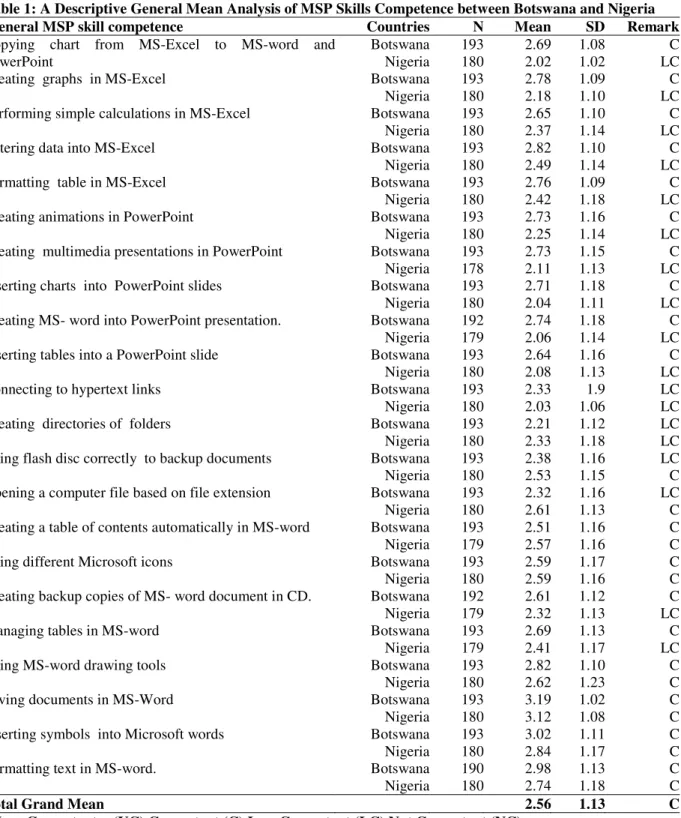
Table 1 compares TTSs’ general Mean MSP competence between Botswana and Nigeria.
The results in Table 1 generally show that TTSs’ from both Botswana and Nigeria are competent with a Mean of (M=2.56, SD=1.13) in various MSP skills. However, they are not very competent in these skills. A closer view in Table 1 also indicates that both countries are still less competent in some vital MSP skills especially in MS-excel and PowerPoint skills (see Table 1) for detail view.
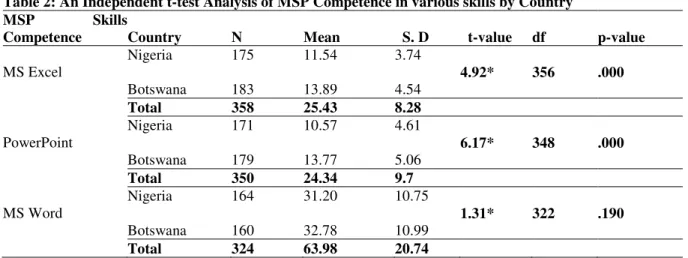
Hypothesis 1 was tested using an independent t-test analysis to determine TTSs competence in various MSP skills by their country (see Table 2).This hypothesis addresses research objective two.
160
Table 1: A Descriptive General Mean Analysis of MSP Skills Competence between Botswana and Nigeria General MSP skill competence Countries N Mean SD Remark
Copying chart from MS-Excel to MS-word and PowerPoint
Botswana 193 2.69 1.08 C
Nigeria 180 2.02 1.02 LC
Creating graphs in MS-Excel Botswana 193 2.78 1.09 C
Nigeria 180 2.18 1.10 LC
Performing simple calculations in MS-Excel Botswana 193 2.65 1.10 C
Nigeria 180 2.37 1.14 LC
Entering data into MS-Excel Botswana 193 2.82 1.10 C
Nigeria 180 2.49 1.14 LC
Formatting table in MS-Excel Botswana 193 2.76 1.09 C
Nigeria 180 2.42 1.18 LC
Creating animations in PowerPoint Botswana 193 2.73 1.16 C
Nigeria 180 2.25 1.14 LC
Creating multimedia presentations in PowerPoint Botswana 193 2.73 1.15 C
Nigeria 178 2.11 1.13 LC
Inserting charts into PowerPoint slides Botswana 193 2.71 1.18 C
Nigeria 180 2.04 1.11 LC
Creating MS- word into PowerPoint presentation. Botswana 192 2.74 1.18 C
Nigeria 179 2.06 1.14 LC
Inserting tables into a PowerPoint slide Botswana 193 2.64 1.16 C
Nigeria 180 2.08 1.13 LC
Connecting to hypertext links Botswana 193 2.33 1.9 LC
Nigeria 180 2.03 1.06 LC
Creating directories of folders Botswana 193 2.21 1.12 LC
Nigeria 180 2.33 1.18 LC
Using flash disc correctly to backup documents Botswana 193 2.38 1.16 LC
Nigeria 180 2.53 1.15 C
Opening a computer file based on file extension Botswana 193 2.32 1.16 LC
Nigeria 180 2.61 1.13 C
Creating a table of contents automatically in MS-word Botswana 193 2.51 1.16 C
Nigeria 179 2.57 1.16 C
Using different Microsoft icons Botswana 193 2.59 1.17 C
Nigeria 180 2.59 1.16 C
Creating backup copies of MS- word document in CD. Botswana 192 2.61 1.12 C
Nigeria 179 2.32 1.13 LC
Managing tables in MS-word Botswana 193 2.69 1.13 C
Nigeria 179 2.41 1.17 LC
Using MS-word drawing tools Botswana 193 2.82 1.10 C
Nigeria 180 2.62 1.23 C
Saving documents in MS-Word Botswana 193 3.19 1.02 C
Nigeria 180 3.12 1.08 C
Inserting symbols into Microsoft words Botswana 193 3.02 1.11 C
Nigeria 180 2.84 1.17 C
Formatting text in MS-word. Botswana 190 2.98 1.13 C
Nigeria 180 2.74 1.18 C
Total Grand Mean 2.56 1.13 C
Table 2: An Independent t-test Analysis of MSP Competence in various skills by Country MSP Skills
Competence Country N Mean S. D t-value df p-value
Nigeria 175 11.54 3.74 MS Excel 4.92* 356 .000 Botswana 183 13.89 4.54 Total 358 25.43 8.28 Nigeria 171 10.57 4.61 PowerPoint 6.17* 348 .000 Botswana 179 13.77 5.06 Total 350 24.34 9.7 Nigeria 164 31.20 10.75 MS Word 1.31* 322 .190 Botswana 160 32.78 10.99 Total 324 63.98 20.74
Specifically, results show a significant difference in TTSs competence in various MSP. Result on students competence in Microsoft (MS) excel as shown in Table 2 gave a t (356) =4.92, p<.05 with Botswana receiving higher Mean score than Nigeria. Based on this, the null hypothesis was rejected; hence, there is a significant difference in TTSs’ competence using MS-excel based on their location. Furthermore, results on Microsoft (MS) PowerPoint competence gave a t (348) =6.17, p<.05 with Botswana receiving higher Mean score than Nigeria. Based on this, the null hypothesis was rejected; hence, there is a significant competency difference in MS-PowerPoint usage for learning based on TTSs location. Lastly, results on MS-word usage gave a t (322) = 1.31, p>.05. Based on this, the null hypothesis was retained; hence, there is no significance difference between the two countries as far as MS word utilization is concerned for learning and research.
These results indicate that Botswana TTSs are more competent in MS-excel and MS-PowerPoint than Nigerian TTSs. They are more competent in the use of MS-excel for formatting Table, entering data, performing simple calculations and creating graphs and charts than Nigerian TTSs. Furthermore, results also indicate that Botswana TTSs are more competent in the use of MS- PowerPoint to create animations and multimedia during presentations, insert tables and charts during seminar presentation than Nigerian TTSs and used for connection to hypertext links. However both countries are equally competent in the use of MS-word for creating folders and tables, backups in CD; using different MS icons, drawing tools, saving documents, inserting symbols, formatting texts and others as seen in Table 1.
In as much as they are generally competent and less competent in various MSP skills, they are still not very competent in most of these skills (see Table 1). This has likely implication to teaching using best innovative practices in modern classroom environment today. It also has implications to teacher preparation for professional development. These skills are really very essential for learning and research and great expectations for teacher trainee students.
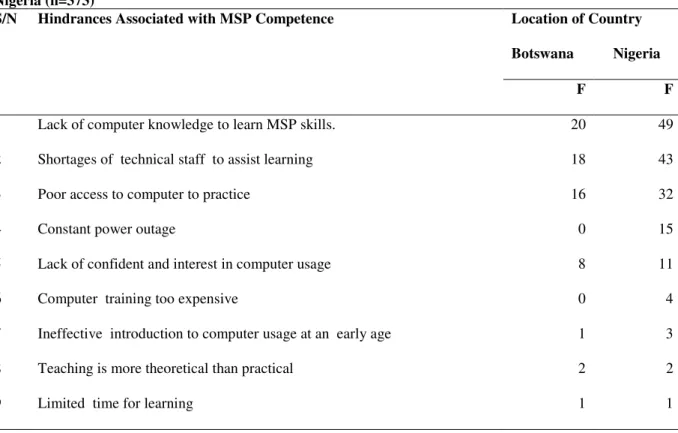
Research Objective 3 was addressed using common frequencies in themes from respondents’ open-ended questionnaire item (see Table 3).
162
Table 3: A Frequency Count of Hindrances associated with TTSs’ MSP Competence in Botswana and Nigeria (n=373)
S/N Hindrances Associated with MSP Competence Location of Country
Botswana Nigeria
F F
1 Lack of computer knowledge to learn MSP skills. 20 49
2 Shortages of technical staff to assist learning 18 43
3 Poor access to computer to practice 16 32
4 Constant power outage 0 15
5 Lack of confident and interest in computer usage 8 11
6 Computer training too expensive 0 4
7 Ineffective introduction to computer usage at an early age 1 3
8 Teaching is more theoretical than practical 2 2
9 Limited time for learning 1 1
Results in Table 3 show the open-ended question on challenges and constraints students face using MSP skills. Majority of the students from Nigeria (49) and Botswana (20) indicated lack of computer knowledge to learn the skills under MSP. Many from Nigeria (43) and also Botswana (18) indicated shortage of technical staff to assist learning. Most of these respondents from Botswana (16) and Nigeria (32) claimed to have poor access to computer facilities in their schools and personally, for practice. Other problems as highlighted in Table 3 include poor power supply, lack of confidence, high cost of computer training, late introduction to computer at an early age, teaching being more theoretical than practical and lack of time as seen in Table 3.
Results from frequency counts of the open- ended question as seen in Table 3 indicates that TTSs from higher institutions in both Nigeria and Botswana lack sufficient knowledge in computer skills hence they are not very competent in MSP usage. Other challenges as applicable are also seen in Table 3. These are relative to their level of competence in MSP as reflected in their respective countries (See Table 1). Furthermore, results indicate that Botswana and Nigerian TTSs are likely not able to use these skills significantly due to many challenges as mentioned in Table 3.
4.0 Discussion
Findings indicate that both Botswana and Nigerian TTSs are generally competent in the use of MSP skills for learning; they were still less competent in some specific MSP skills such as MS-excel and PowerPoint. Their significant competent in the use of various MSP skills has revealed a lot in Table 2.
Findings revealed that Botswana TTSs are significantly more competent in MS-Excel and PowerPoint skills than their Nigerian counterpart from West Africa. This converges with International Telecommunication (ITU), (2011) findings that Nigeria was ranked as 112th position in global ICT chart behind their Botswana counterpart. These findings indicate that Botswana TTSs are significantly more competent using MS- excel for formatting Tables, entering data, performing simple calculations and creating graphs and charts which is necessary for research and learning. They also use MS- PowerPoint to create animations and multimedia during presentations, for connection to hypertext links, insert tables and charts during seminar presentation than Nigerian TTSs. Although these differences exist, both countries were still less competent as far as these skills competency was concerned (See Table 1) for details. This might not be unconnected to challenges teacher trainee students from both countries face as indicated in Table 3.
Findings further indicate that both countries are competent in the use of MS-word for creating folders, backups in CD and tables; using different MS icons, drawing tools, saving documents, inserting symbols, formatting texts and others, since there was no significant competence difference between the two countries. However, they are not very competent in all the MSP usage. These skills are necessary for teachers’ acquisition in learning and research in a globalized world as converges with Ngwoke and Nummonde (2011). Location of students does not matter as far as utilization of MS-word was concerned. Studies have not been fully established in terms of comparative study in MSP competency by teacher trainee students.
Findings from the open ended questionnaire on challenges teacher trainee students from both countries face was based on their individual perspectives. Based on their converging ideas, students from both countries lacked sufficient knowledge in MSP for learning; shortages of technical staff to assist in learning; lack of personal computers for effective practice, constant power outage; lack of confident and interest, unavailability of network services, poor orientation to computer usage at an early age, high cost of training, lack of time amongst others as seen in Table 3. Most of these findings converged with most researchers like Ajayi and Ekundayo (2009) that lack of computers, literate teachers and power outage, hinders effective utilization of ICT in teaching and learning; that lack of interest influences e-learning (Ebirim, 2010); that integrative technology for teachers retards teaching (Bouchard, 2011; Weller, 2010). Never the less, many challenges are persistently occurring which need to be reinforced in order to remedy the situation through effective teacher preparation.
5.0 Conclusion
This study reveals that although both countries are generally competent in MSP skills, they are not very competent from the general assessment level. Botswana TTSs are significantly more competent in the use of MSP skills than Nigeria TTSs in specific area such as MS-excel and PowerPoint. There is no significant difference in TTSs competence specifically in the use of MS-word skills for learning. However, both countries are still less competent in some of these skills.
However competent the two countries are, both are still faced with challenges ranging from lack of computers knowledge, skilled manpower, constant power outage, lack of personal computers, confidence, interest, training, time among others. These challenges might have implications for their global best practices as teachers in future.
This finding has implications for teacher preparations, since Nigeria is still behind their fellow developing counterparts in MSP competence. Teaching using effective time saving skills such as PowerPoints, MS- Excel and MS- word would increase performance or achievement in learning. Skills could be used for presentations, analysis in action research, calculations, teaching and research.
5.1 Recommendations
• Teachers and technical staff should be well prepared towards MSP usage in order to teach students effectively. It is believed that shortages of technical ICT staff has influenced students’ effective competence in skills such as PowerPoint, MS-word and excel for productive learning.
• Sufficient computers in schools should be provided by the government to enable students have access to computer usage for effective acquisition of knowledge. Cost of computers should also be made affordable for an average student to possess and practice with.
• Teacher trainee students should be exposed to ICT capacity building workshops once or twice every year in their various institutions. This will increase their knowledge, interest and growth in MSP usage. This should be made free for student teachers. Policy development should be put in place towards the training of teachers in ICT usage as advocated by Boulton (2013).
• Government should provide stable, efficient and constant electricity supply to enable students take full advantage of using the computer for learning in schools.
• Facilities provided for learning should be monitored by the school authority from time to time to avoid fraud and vandalism of the materials for learning.
• More time should be allocated by the school authority for effective teaching and learning using computers in various institutions.
164
6.0 References
Aduwa-Ogiegbaen, S.E., & Iyamu, E.O.S. (2005). Using information and communication technology in secondary schools in Nigeria: Problems and prospects. Educational Technology and Society, 8(1), 104-112. Ajayi, I.A., & Ekundayo, H.T. (2009). The application of information and communication technology in Nigerian secondary schools. International NGO Journal, 4(5), 281-286. Retrieved from [http://www.academicjournals.org/INGOJ].
Bolt, S., & flynne, P. (2010).The customization of perdisco e-learning resources to enhance student learning in an Accounting course in various locations using differing modes of learning. International Journal of Learning, 16(6), 721 – 736.
Bouchard, P. (2011). Network promises and their implications. In the impact of social networks on teaching and learning (Online monograph). Revistade Universidady Sociedad del Conociento, 8(1), 288-302.
Boulton, H. (2013). Managing e-learning: What are the real implications for schools? The Electronic Journal of E-learning, 6(1), 11-18.
Ebirim, U. (2010). Integration of E-learning in distance education for the enhancement of distance education programme. Nigerian Vocational Association Journal, 15(1), 297-303.
International Telecommunication Union (ITU) (2011). Measuring the information society in Geneva. Retrieved from http://www.itu.int/net/pressoffice/backgrounders/general/pdf/5.pdf.
Ngwoke, D. U., & Nummonde, D. (2011). Optimizing E-learning opportunities for educational service delivery: A case for use of E-textbook in schools. Paper presented atthe Annual Conference of Institute of Education, University of Nigeria, Nsukka, 9th -12 May, 2011.
Ogwu, E.N., & Ogwu, F.J. (2010). Technologies and utilizations in schools: Implications to learning. Journal of Technology Integration in the Classroom, 2(1), 47-55.
Okposio, O.C. (2011). The use of ICT in the teaching and learning of Physical Education. Continental Journal of Education Research, 4 (2), 29-32.
Osuala, E.C. (2009). Business and computer education. Enugu: Chester Fool Agency Ltd.
Shahadat, H., Muhbub, H., & Clement, C. (2012). Barriers to the introduction of ICT into education in developing countries: The example of Bangladesh. International Journal of Instruction, 1 (2), 2-13.
Weller, M. (2010). The centralization delima in educational IT. International Journal of Virtual and Personal Learning Environments, 1(1), 1-9.