THE EFFECT OF CONCEPT MAPPING AND SELF-REGULATION
ON STUDENTS’ WRITING COMPETENCY
I.G. Sukranengrat
1, Marhaeni
2, Padmadewi
3Program Studi Pendidikan Bahasa, Program Pascasarjana
Universitas Pendidikan Ganesha
Singaraja, Indonesia
e-mail: [email protected]
1, [email protected]
2, [email protected]
3
Abstrak
Studi eksperimen ini bertujuan untuk menginvestigasi pengaruh peta konsep
dan kemandirian terhadap kemampuan menulis siswa kelas delapan SMP
Negeri 2 Singaraja. Penelitian ini menggunakan desain
posttest only control
group dengan rancangan faktorial 2x2. Sebanyak 60 siswa dilibatkan sebagai
sampel penelitian. Mereka dipilih dengan teknik sampel acak. Data
kemampuan menulis siswa dikumpulkan dengan instrumen yang merupakan
tipe tes essay. Data tingkat kemandirian siswa dikumpulkan dengan
kuesioner yang menggunakan skala Likert. Data yang diperoleh dianalisis
secara statistik dengan ANAVA 2 jalur pada taraf kesalahan 5%. Temuan
penelitian ini adalah 1) terdapat perbedaan yang signifikan dalam
kemampuan menulis antara siswa yang diajar dengan peta konsep dengan
yang diajar dengan metode konvensional. Itu dibuktikan dengan nilai
probabilitas 0.00, yang lebih rendah dari 0.05. dan 2) tidak terdapat pengaruh
interaksi yang signifikan antara metode mengajar (peta konsep dan
konvensional) dan tingkat kemandirian (tinggi dan rendah) terhadap
kemampuan menulis.
Ini dibuktikan dengan nilai probabilitas 0,778. Itu berarti
bahwa peta konsep sesuai untuk diterapkan bagi pengaturan diri siswa
tingkat rendah dan tinggi. Hal ini dapat dibuktikan dari analisis deskriptif yang
menunjukkan bahwa nilai siswa yang diajar dengan peta konsep adalah lebih
tinggi daripada yang diajar dengan teknik konvensional baik untuk pengaturan
diri siswa yang tinggi maupun yang rendah. Dari analisis deskriptif, nilai
rata-rata tinggi pengatuaran diri siswa diajar dengan keta konsep = 85,29,
sedangkan nilai rata-rata tinggi kemandiriian siswa diajar dengan teknik
konvensional = 79,82. Sementara bagi siswa pengaturan-diri yang rendah,
nilai rata-rata siswa yang diajar dengan peta konsep = 80,00, sedangkan nilai
rata-rata pengaturan diri siswa rendah diajar dengan teknik konvensional =
73,97.
Kata-kata kunci: peta konsep, kemandirian, kemampuan menulis
Abstract
This experimental study aims at investigating the effect of Concept
Mapping and self-regulation on the writing competency of the eighth grade
students of SMP Negeri 2 Singaraja. The design of this research was posttest
only control group with 2x2 factorial arrangement. 60 students were selected
as sample through random sampling.
The data of students’ writing
competency were collected by using an essay type test. Meanwhile, data of
students’ self
-regulation level were collected by using questionnaire with
Likert scale. The acquired data were analyzed statistically by two way ANOVA
at 5% significance level. This research discovers (1) there is a significant
difference in writing competency between the students taught with Concept
Mapping and those taught with conventional technique. It is proven by the
probability value of 0.00, which was lower than 0.05. and (2) there is no
significant interaction between the implementation of teaching technique
(Concept Mapping and conventional technique) and self-regulation levels
(high and low levels) on students’ writing competency. It is proven by the
probability value of 0.778. it means that Concept Mapping is appropriate to be
implemented for low and high self-regulation students. It can be proven from
the descriptive analyasis showing that the score of students taught with
Concept Mapping is higher than those taught with conventional technique
both for high and low self-regulation students. From the descriptive analysis,
the mean score of high self-regulation students taught with Concept Mapping
= 85.29; meanwhile the mean score of high self-regulation students taught
with Conventional technique = 79.82. Meanwhile for low self-regulation
students, the mean score of students taught with Concept Mapping = 80.00;
meanwhile the mean score of low self-regulation students taught with
Conventional technique = 73.97.
Keywords: concept mapping, self-regulation, writing competency
INTRODUCTION
Education plays very a significant role in this era since the quality of the education will influence the quality of the generation. It expects the educators to provide a good learning situation or meaningful learning experience for the students. Buchori (2001) argues that meaningful learning can survive learners, but meaningless learning just burdens the students.
In education context, learning is not merely focus on natural science, but also language. Language is very important. It is a part of human possession as a tool of communication for their social interaction and relationship. Nowadays, in addition to the first language, it is very important and useful for us to learn other languages spoken in other countries, like France, Japanese, Mandarin, and others. As a
matter of fact, English language is the most popular foreign language. It has an important role of communication which is used by almost all people in the world. Besides as a communication tool, English is also taught as a second or a foreign language. It is taught as a school subject in many countries including Indonesia.
Like what has been already known that in Indonesia, English has become an important school subject which is learned in every school level starting fromkindergarten until university. The government policy in determining English as acompulsory subject in schools is due to the practical consideration that English is formally acknowledged as an international means of communication. The major goal of teaching English is to enable the students to develop their
communicative competence in the four language skills, namely listening,speaking, reading, and writing skill.
In the context of Indonesian National Curriculum, the students are considered to be competent in English if the students can fulfill the competency standard and basic competency established by the government
through PERMENDIKNAS (National
Education Minister Law) no 22 year 2006 about Content Standard. Both competency standard and basic competency are established for each language skill. The teachers just need to develop the indicators of learning.
The establishment of competency standard and basic competency for each skill separately makes the language skills are also taught separately. In the context of this research, writing skill is the concern. Writing is chosen because written communication grows rapidly. It is caused by the development of technology. For example, people now tend to communicate through email, chatting in facebook or twitter, and short message service. Because the price of written communication is cheaper than oral communication, many people choose written communication. It makes writing skill should be developed in the school.
Writing in educational context is taught through several genres and short functional texts. The genre and short functional text taught depend on
competency standard and basic
competency established in each semester. So, the teaching genre and short functional text in each semester depends on the
competency standard and basic
competency established in the semester. Theoretically, writing is a phenomenon invented by humans to help in the communication process. It has become, indeed, a social and cultural practice in most societies today. Writing is a very complex process in which numerous cognitive and metacognitive activities take place, for instance, brainstorming, planning, outlining, organizing, drafting, revising, and so on. Cognitive aspects have received particular attention, as investigators have attempted to understand the thought
processes underlying the compositions of students (Flower & Hayes, 1981). Furthermore, Byrne (2004) states that writing is transforming our thoughts into language. It is a very complex skill that requires both physical and mental activity on the part of the writer.
Writing also involves composing, which implies the mastery either to tell or retell pieces of information in the form of descriptives or description, or to transform information into new texts, as in expository or argumentative writing. Perhaps it is best viewed as a continuum of activities that range from the more mechanical or formal aspects of writing down on the one end to the more complex act of composing on the other end (Omaggio Hadley, 1993).
From the three theoretical concepts of writing proposed the three different experts, it implies that writing is very complex to be mastered by the students, especially for Junior high school level. It needs good teaching writing strategy to be applied in this level. If it were not, the students would get difficulty in writing. To know how teaching writing is conducted in real field, an observation is done in SMP Negeri 2 Singaraja.
Based on the observation, it was known that the students get difficulty to write. They mostly have difficulty in arranging the ideas chronologically. Some of their ideas are zigzag. It makes their
ideas don’t flow smoothly. Further
observation about the teaching technique applied, it was known that the teacher just explained the generic structure of the text and asked the students to write based on the example. During writing, the students got less guidance. So, they felt writing was difficult and boring. As the consequence, students’ writing competency was low.
The phenomenon led to experiment teaching writing technique which had different characteristics from the teaching technique applied by the teacher. It was done to compare its effect with the
teacher’s teaching technique. So, it can be
chosen the better teaching technique to be applied. Here, Concept Mapping is tried to be experimented.
Concepts maps are graphics organizers that are structured hierarchically, presented in a two
dimension diagrams, and shows
relationships between concepts indicated by linking words (Novak & Gowin, 1984). Constructing concept map is one of the techniques that can be used for organizing and representing knowledge that include concepts, which are usually enclosed in circles or squares, and lines connecting the concepts. Traditionally, concepts maps have been used as a tool to engage students in learning content knowledge. However, concepts maps can also be used as a tool to facilitate writing. Previous research indicated that concepts maps has a positive effect on the students’ abilities to select concepts that appropriate to respond to a writing prompt, integrate facts into complete thoughts and writing ideas, and apply it in writing situations
Concepts map appear to facilitate learning and how to process information and transform it into expository writing. Concepts map provide students the freedom to express their knowledge on a given topic and present insights into the way they organize knowledge (Gouli, Gogoulou, & Grigoriadou, 2003) or as a tool to help students and teachers visualize the direction or focus of a research paper (Crane 1998).
A well written paper contains introductory statements that orient the readers to the topics, text structure, and purpose of the text, and that stage for the information that will follow, and concluding or summary statements that offer a wavelike function through the text simultaneously setting up and wrapping up sub topical presentations of information for readers to achieve effective communication (Halliday & Martin, 1993). Thus to write a good paper, one needs to be able to make relationships from a diversity of sources, selects the most crucial facts and details to support their position, omit irrelevant or extraneous facts, and synthesize into a coherent, well organized argument. Consequently, a concept map may be use as an aid in helping students structure a well organized paper.
There are a number of learning technique which can help students become better learners. The technique includes meaningful learning, organizing, note taking, identifying important information, and summarizing (Pressley, 1982). Technique such as concept mapping help students attend to task, focus on important textures, organize material, and maintain a productive psychological climate for learning (Weinstein & Mayer, 1986).
Based on those concepts, a concept map may be use as an aid in helping students structure a well organized paper. Thus, the purpose of this study is to investigate how students perceived concept maps as a tool in facilitating writing in their writing assignment. This is important to see the variety of ways the students used concept maps and how it could facilitate their writing.
In Writing tasks that require high levels of cognitive engagement are related to higher levels of intrinsic motivation and self-monitoring activities (Miller et al., 1993; Perry, 1998). Students' knowledge of writing strategies may affect how they plan their writing, including content generation, use of library sources, and even choosing to plan at all (e.g., Bereiter & Scardamalia, 1987; Gordon, 1990b; Perry, 1998). And Self-regulation is the way to integrates learning behaviors or strategies, motivation, and metacognition (e.g., Pintrich, 2000; Schunk & Ertmer, 2000; Winne, 1995).
Self regulated learning suggests that students engage in their own learning processes on metacognitive, behavioral, and motivational levels (Zimmerman 1986). Within self regulated learning, students are empowered with a common set of self regulating strategies in which they couple those strategies with a set of individually developed skills they have constructed over the course of their academic careers and personal experiences. Self-regulation of learning is a built-in learning process, whereby students develop goals and skills sets as well as apply those skills to a given learning situation, and internalize his or her
behaviors and acts upon those behaviors to increase positive behaviors and reduce their tendencies for negative behaviors.
As far as Concept Mapping is concerned, it has never been implemented in any classes in junior high schools, including in teaching the writing skill. In another side, by concerning the importance of self-regulation role in learning, it is urgent to research Concept Mapping and self-regulation together in writing. The interaction of them is predicted can affect
better on students’ writing competency. So,
it can get clear picture on how the main effect and interactional effect of both factors.
Based on the previous explanation about Concept Mapping, self-regulation
and students’ writing competency, there
were four questions which should be investigated in this research, namely:
a. Is there any significant difference in
writing competency between the students taught with Concept Mapping and those taught with conventional method?
b. Is there any significant interaction of
Teaching method (Concept Mapping and Conventional Teaching method)
and students’ self-regulation level (High
and Low) on students’ writing
competency?
METHOD
To administer this research, Posttest Only Control Group with 2x2 factorial design was applied. There were 60 eighth grade students of SMP N 2 Singaraja in the academic year 2010/2011 included to be the sample. To get the sample, cluster random technique was applied. Then, questionnaire was distributed to classify
students’ self-regulation level. The data
involved students’ writing competency and
self-regulation data. The data of students’ writing competency is score collected by essay test. Meanwhile, the data of students’ self-regulation level is collected by using questionnaire with Likert scale. The instruments were developed by creating blueprint and modifying the previous instrument used by other researchers. Then, those instruments were tested their validity and reliability. The data analysis involved descriptive and inferential analysis. Descriptive analysis aims at describing data by measuring mean and standard deviation. Meanwhile, inferential analysis aims at testing the hypothesis. Inferential analysis was done by using Two-Way ANOVA.
FINDING AND DISCUSSION
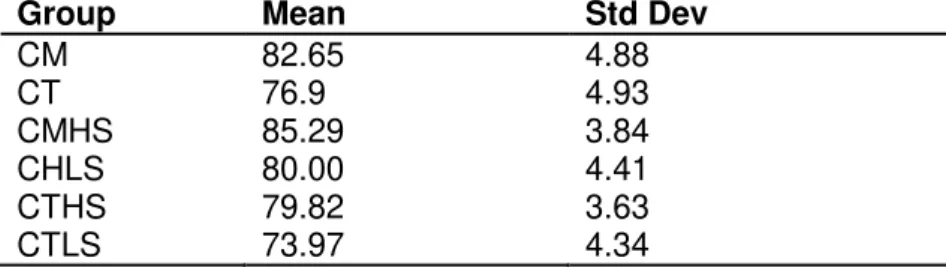
The calculation of descriptive analysis measuring mean and standard deviation to 6 groups of data can be presented in the table 1
Table 1Sum of the Calculation of the Central Tendency and Dispersion
Group Mean Std Dev
CM 82.65 4.88 CT 76.9 4.93 CMHS 85.29 3.84 CHLS 80.00 4.41 CTHS 79.82 3.63 CTLS 73.97 4.34 Notes: CM = Concept Mapping CT = Conventional Technique HS = High Self-regulation LS = Low Self-regulation Std dev= standard deviation
Based on table 1, it is known that (1) mean value of CM is higher than CT, (2) mean value of CMHS is higher than CTHS, and (3) mean value of CMLS is lower than CTls. In term of standard deviation (SD) value, SD value of CT is the highest value. It is followed by the value of CM, CHLS,
CTLS, CMHS, and CTHS. However, this result can not be used to answer the research problems. To answer research problems, inferential analysis by Two-way ANOVA was applied. The result can be presented in table 2.
Table 2 Sum of the Results of Hypothesis Testing by Two-Way ANOVA
Source F Sig. (Probability)
Teaching technique (TT) 33.928 0.00 Self-regulation level (SL) 31.878 0.00
TT*SL 0.080 0.778
To answer the first research question, it can be seen from the value of tt (teaching technique). From the table 2, it is known the sig value or probability of 0.00 which is lower than 0.05. It means that there is a significant difference in writing competency between the students taught with Concept Mapping and those taught with conventional method. Meanwhile, the second hypothesis is answered by looking the value of tt*sl. From the table 2, it is known that the value of tt*sl of 0.778 which is lower than 0.05. It means that there is no significant interaction effect on the implementation of teaching technique (Concept Mapping and conventional method) and self-regulation level (high and
low) on students’ writing competency.
Because there is no interactional effect between teaching technique and
self-regulated level on students’ writing
competency, it is not continued with Tukey test to know the interaction effect. From this result, it could be concluded that Concept Mapping technique was appropriate for both high and low self-regulated students. It could also be proven from the mean score of students having high and low self-regulated taught by both Concept Mapping and Conventional techniques. The mean score of high self-regulated students taught with Concept Mapping = 85.29, the mean score of low self-regulated students taught with Concept Mapping = 80.00, the mean score of high self-regulated students taught with Conventional technique = 79.82, and the mean score of low self-regulated
students taught with Conventional technique = 73.97.
Based on the result of hypothesis testing by two-way ANOVA, it is discovered that the teaching method implemented during teaching and learning process
affected significantly toward students’
writing competency of eight grade students of SMP N 2 Singaraja in the academic year 2010/2011. It is proven by probability value of 0.000 which is lower than 0.05, =.05. Further analysis shows that the mean score students taught with Concept Mapping technique was 82.65; meanwhile the mean score of the students taught with conventional writing technique was 76.9. It
means that the students’ writing
competency taught with Concept Mapping technique was higher than those taught with conventional writing technique. Based on the result of hypothesis testing and the analysis, it can be interfered generally that
students’ writing competency taught by
process writing approach and Concept Mapping is better than those taught by process writing approach and conventional method. It means Concept Mapping implemented with process writing approach
in writing contribute positively the students’
writing competency of eighth grade students of SMP N 2 Singaraja.
Concept Mapping guides students during writing through map that the students make. The map organizes the students minds and ideas so they can be coherence and chronological order. Then, the students just need to develop their map. It makes the students can write
chronologically and coherently. It is different from conventional method. The students write without any guidance like a map. They write directly what comes into their mind. The students do not have guidance to organize their ideas chronologically and coherently. As the
result, their ideas in writing can be “jump
over” to other ideas. It makes their writing
quality is low.
The same finding is also found by Straubel (2006), Mohamed and Omar (2008), and Sturm and Rankin-Erikson (2002). Straubel (2006) does meta-analysis research on 211 researches in which 49% of the research is in the area of concept mapping in writing and sciences. In the analysis, it is found that concept mapping helps students to write better than using common technique used. It is especially concept mapping guide the students to organize the students ideas well. Through the implementation of concept mapping, the students realize how they should organize their writing so the readers can easily understand their writing.
Mohamed and Omar (2008) conduct a research on the implementation of Concept Mapping for university level students. This research was descriptive qualitative research. Firstly, the students were asked to write paper. After the students submitted their writing, the students were assigned to write the map of their writing. Then, the students were assigned again to write paper based on the map they developed. The results were that
the students’ writing was better after the
students write the map. It indicates that concept mapping give good effect on
students’ writing skill.
Sturm and Rankin-Erikson (2002) conduct a research on twelfth-grade students. This was an experimental research with a repeat measures within-subject design. This research compared concept mapping and non-map in writing.
This research discovers that the students’
writing taught with concept mapping is better than the students taught with no map. In other words, the concept mapping
has more positive effect on students’ writing
competency.
The finding of this research is same as the previous researches. It means that Concept Mapping also affects better on
student’ writing achievement of Junior High
School students. It is so because previously researches, Concept Mapping is applied on Senior High school and university students. The step in making a map before writing is predicted to give contribution in guiding the students to write. Good mapping ideas lead the students to organize their ideas well. Here, the students linguistic components such as: grammar, vocabulary, and mechanics are needed to build up sentences or to transfer ideas into language.
Another conclusion from the result of hypothesis testing on the simple effect discovers that conventional method seems not to maximize with the nature of teaching writing. Conventional method does not have chances for the students to make draft of the students’ ideas. This teaching technique gives the students chance to write freely. However, it does not give guideline for the students to organize their
ideas before writing. It makes them “stuck to write”. As the consequence, they tend to
ignore and lazy to write. In other words, they do not enjoy their learning.
For further analysis, it is important to discuss whether the teaching method implemented in writing was the only factor
which affected students’ writing
competency. Corno and Mandinach (1983) state that self-regulated of cognition and
behavior is an important aspect of students’
learning and academic performance in the classroom context. It means that
self-regulated has effect on students’ academic
performance in the classroom. In the context of this research, the academic
performance refers to students’ writing
competency. This research also aims at finding out whether or not self-regulated affects significantly on development of
students’ writing competency.
Based on the hypothesis testing by Two-Way ANOVA, it is discovered that there is no significant interaction effect between the implementation of teaching technique (Concept Mapping and conventional method) and self-regulated
level (high and low levels) on students’
writing competency. From the mean score, writing competency of high self-regulated students taught with Concept Mapping is higher than those taught with conventional method and writing competency of low self-regulated students taught with Concept Mapping is higher than those taught with conventional method. It means that Concept Mapping affects better on both high and low self-regulated students.
What make Concept Mapping is effective for both high and low self-regulated students? Akeju, Rotimi, and Kenni (2011) states that in Concept Mapping implementation, the students face 4 steps, namely:
a. Identifying the major components of the concept. In writing, the students identify genre that they are going to write. Besides that, they also write ideas building up their writing. b. Arranging the concept components
in hierarchical order. Here, the concept components are arranged. c. Linking the components with linking phrases. Each idea is linked with other idea by using phrase. Here, the students start to write simple sentences.
d. Making cross link with directed line. Here, the students make cross line. The cross line indicates the arrangement of the ideas. It makes the students can organize their ideas chronologically.
By examining the steps carefully, it is clear that Concept Mapping guides the students to write or organize their ideas chronologically. Concept Mapping also directs the students to establish the genre components and ideas of their writing content. Linking one idea with the other ideas actually is a bridge for the students to produce perfect writing. All of the steps direct the students to produce high quality writing.
Zimmerman & Martinez –Pons (1986) states that self-regulation contains three components of sub-processes, namely: observation, judgment, and Self-reaction. High self-regulated students have
high self-observation on their learning (in this context is writing), self-judgment, and self-reaction. Here, the students make observation on the genre and content of their writing. Then, the students decide which content is selected to basic ideas on their writing later. Finally, the students give reaction if their writing is not match with their target. So, high self-regulated students are matched if they taught with Concept Mapping.
Meanwhile low self-regulated students have low observation, self-judgment, and self-reaction. They tend to write directly what come into their mind without observing components of genre and content of their writing. They also have low to judge the quality of their content of writing. It is so because they just wait correction from their teacher. In addition, they have reaction after their teacher correct writing.
However, those situations are controlled by the steps of Concept Mapping. With the steps of Concept Mapping, the students writing process are facilitated and controlled well. So, they have guidance to write. With the guidance, the students can write better even for low self-regulated students. So, the nature of Concept Mapping is predicted make the absence of interaction between teaching technique and self-regulated level.
CONCLUSION AND SUGGESTION
Based on the result of hypothesis testing, there are four conclusions that can be made. First, There is a significant difference in writing competency between the students taught with Concept Mapping and those taught with conventional technique. It is proven by the probability value of 0.00, which was lower than 0.05. From the result of descriptive analysis, it was known the mean score of the students taught with Concept Mapping technique was 82.65;meanwhile the mean score of the students taught with conventional writing technique was 76.9. It means that
the students’ writing competency taught
with Concept Mapping technique was higher than those taught with conventional
writing technique. Second, there is no significant interaction between the implementation of teaching method (Concept Mapping and conventional technique) and self-regulated levels (high
and low levels) on students’ writing
competency. It is proven by the probability value of 0.778. So, it could be concluded that Concept Mapping technique was appropriate for both high and low self-regulated students. It could also be proven from the mean score of students having high and low self-regulated taught by both Concept Mapping and Conventional techniques. The mean score of high self-regulated students taught with Concept Mapping = 85.29, the mean score of low self-regulated students taught with Concept Mapping = 80.00, the mean score of high self-regulated students taught with Conventional technique = 79.82, and the mean score of low self-regulated students taught with Conventional technique = 73.97.
Furthermore, based on the finding and conclusion, there are four suggestions suggested. First, Concept Mapping should be used in teaching writing as an alternative method to solve problems of
students’ low writing competency,
especially in organizing ideas. It is suggested since it affects better on
students’ writing competency. Second,
implementing Concept Mapping, the teachers do not need too worry on
students’ self-regulated level. It is so
because Concept Mapping has positive effect on both high and low self-regulated students. Third, for other researchers do research in implementing Concept Mapping with other skills, for example: speaking, reading, or listening. It is also suggested to use other moderator variables, such as: creativity, anxiety, motivation, etc.
REFERENCES
Akeju,O.O.Sympson, Rotimi,C.O, and Kenni,A.M.2010. Teaching with Concept Mapping Strategy in Nigeria Secondary School. Proceeding of the 2011 International Conference of Teaching, Learning, and Change.
International Association for Teaching and Learning
Buchori, M. (2001). Pendidikan Antisipatoris. Yogyakarta: Penerbit Kanisius.
Gouli, E., Gogoulou, A., & Grigoriadou, M. (2003). A coherent and Integrated Framework using Concept Maps for various Educational Assessment Functions, [Electronic Version]. Journal of information technology
Education, 2, 215-240. (httpwww.google.comurlsa=t&rct=j&q =&esrc=s&source=web&cd=1&cad=r ja&ved=0CDEQFjAA&url=http%3A% 2F%2Fcmc.ihmc.us%2Fcmc2008pa pers%2Fcmc2008-p172.pdf&ei=LRQLUdyNNIPXrQemp 4H4AQ&usg=AFQjCNF-q)
Halliday, M. A. K., & Martin, J. R. (1993).
Writing science: Literacy and discursive power. Pittsburgh, PA: Pro-ED.(http://www.google.com/url?sa=t& rct=j&q=&esrc=s&source=web&cd=1 &cad=rja&ved=0CDEQFjAA&url=http %3A%2F%2Fcmc.ihmc.us%2Fcmc20 08papers%2Fcmc2008-p172.pdf&ei=IBgLUbbLC8LQrQeUh4 GIDA&usg=AFQjCNF-q7ZmYIIKOsAHFeV2YO0Mm8owcg& bvm=bv.41867550,d.bmk)
Hammann, Lynne.2005. Self-Regulation on Academic Writing Tasks. International Journal of Teaching and Learning in Higher Education , Volume 17, Number 1, 15-26 available at http://www.isetl.org/ijtlhe/
Linda,Flower and John, Hayes R.2009. A Cognitive Process Theory of Writing:
College Composition and
Communication. Downloaded at December 29th,2012 at 10 am. This
paper is available at
http://prelimsandbeyond.wordpress.co m/2009/01/11/flower_hayes/
Marhaeni, A.A.I.N. (2005). Pengaruh Asesmen Portofolio dan Motivasi Berprestasi terhadap Kemampuan Menulis Bahasa Inggris. Jakarta: Universitas Negeri Jakarta (Disertasi yang tak dipublikasikan)
Mohamed, Wan Azlinda Wan and Omar, Badrul. Using Concept Map to Facilitate Writing Assignment. Conference on Concept Mapping. Tallinn, Estonia & Helsinki, Finland Nitko, A.J.1996. Educational Assessment of
Students. 2nd Edition. New Jersey: Merrill
Novak, J. D., & Gowin, D. B. (1984).
Learning how to learn. New York: Cambridge University Press.
Omaggio Hadley, A. 1993. Teaching language in context. Boston: Heinle & Heinle.
Pintrich, P.R. (2000). Multiple goals, multiple pathways: The role of goal orientation in learning and achievement.
Journal of Educational Psychology, 92, 544-555.
Printrich, P. R., Smith, D. A., Garcia, T., & McKeachie W. J. (1991). A manual for the use of the Motivated Strategies for Learning Questionnaire (MSLQ).
National Center for Research to Improve Postsecondary Teaching and
Learning. Ann Arbor: University of Michigan.
Pintrich, Paul R and De Groot, Elizabeth V. 1990. Motivational and Self-regulated Learning Components of Classroom Academic Performance. Journal of Educational Psychology, 82,33-40 Pressley, M. (1982). Elaboration and
memory development. Child
Development, 53, 296-309.
Schunk, D. H. (1983). Goal difficulty and attainment information: Effects on children's achievement behaviors.
Human Learning, 2, 107 -117. Schunk, D. H. & Zimmerman, B.J. (1998)
Self-regulated learning: From teaching to self-reflective practice. Guilford Press.
Zimmerman, B. J. & Martinez-Pons, M. (1986). Development of a structured interview for assessing student use of self-regulated learning strategies.
American Educational Research
Journal, 23, 614-628.
Zimmaro, D. M., & Cawley, J. M. (1998).
Concept map module [Online].