Physics Procedia 25 ( 2012 ) 874 – 878
1875-3892 © 2012 Published by Elsevier B.V. Selection and/or peer-review under responsibility of Garry Lee doi: 10.1016/j.phpro.2012.03.171
2012 International Conference on Solid State Devices and Materials Science
Complexity of Generating Multi-collisions for MD4 and MD5
Wei Gong, Yang Liu, Lei Pan
Department of Electronic & Information Tianjin Institute of Urban Construction
Tianjin , China
Abstract
MD4 and MD5 are cryptographic hash functions, which are used for many purposes. They are part of many cryptographic protocols. For most purposes, the hash function is required to be collision free. There are several studies of complexity for simple collisions for MD4 and MD5 in the past. In this paper, I will change the generators of simple collision generators to generators of multi-collisions and tell the results of generating multi-collisions for MD4 and MD5.
© 2011 Published by Elsevier Ltd. Selection and/or peer-review under responsibility of [name organizer]
Keywords: multi-collision MD4 MD5 cryptanalytic
1. Introduction
A collision for a hash function H is a pair of messages m and m’ that have the same hash: H(m) =
H(m’). For a secure cryptographic hash function, colliding messages can not be found more efficiently
than with a brute force attack. Because of the birthday paradox, such an attack requires about 2n/2
calculator steps and memory in the order of 2n/2 [1].
Hash functions following the Merkle-Damgard construction scheme iterate over all blocks of a message and update an internal state to calculate the hash of the complete message. Once two different messages m and m’ are found to lead to the same internal state of a hash function, any number of
collisions can be produced by appending any message k to m and m’ simultaneously: H(mФk) = H(m’Ф
k) [2].
Merkle-Damgard strengthened hash functions append a final block containing the length of the message before hashing for security purposes. Therefore, when Merkle-Damgard strengthening is used, the colliding messages are required to have the same length to produce a collision.
Available online at www.sciencedirect.com
© 2012 Published by Elsevier B.V. Selection and/or peer-review under responsibility of Garry Lee
y ( )
MD4 and MD5 are both 128-bit hash functions. Their block length is 512 bits. Both hash functions follow the Merkle-Damgard construction scheme, as all frequently used cryptographic hash functions.
However, all multi-collisions can be found for any iterated hash function if collisions can be found for any internal state of the hash function. The simple construction consists of the concatenation of two or more collision pairs are given [3]:
H(m1Фm2) = H(m’1Фm2) = H(m1Фm’2) = H(m’1Фm’2)
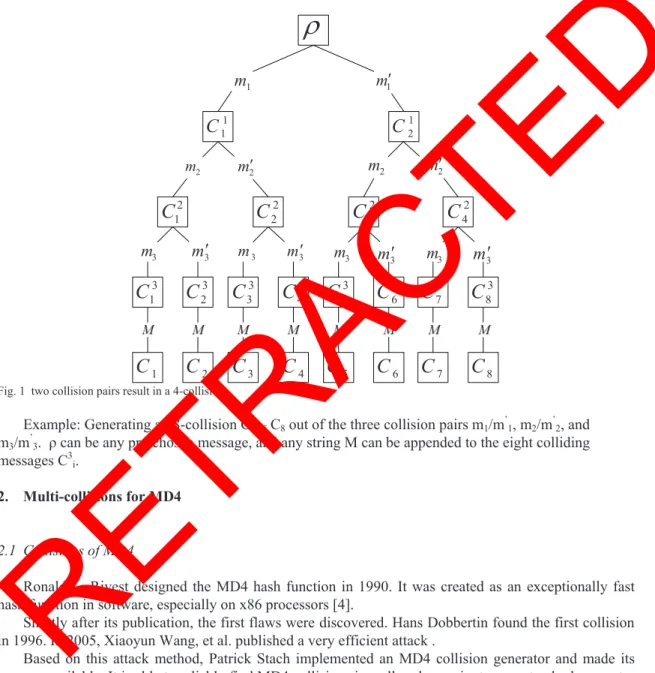
Here, two collision pairs result in a 4-collision (Fig.1). Therefore, a 2n-collision can be found with as little work as finding n collision pairs.
U
1 mc 1m
1 1C
C
12 2 1C
C
22C
32C
42 2 mc 2 m m2 m2c 3 1C
C
23C
33C
43C
53C
63C
73C
83 3m
c
3 m m3 m3c 1C
C
2C
3C
4C
5C
6C
7C
8 3m
c
3 m m3m
3c
Fig. 1 two collision pairs result in a 4-collision
Example: Generating an 8-collision C1 – C8 out of the three collision pairs m1/m’1, m2/m’2, and
m3/m’3. ȡ can be any pre-chosen message, and any string M can be appended to the eight colliding
messages C3 i.
2. Multi-collisions for MD4
2.1 Collisions of MD4
Ronald L. Rivest designed the MD4 hash function in 1990. It was created as an exceptionally fast hash function in software, especially on x86 processors [4].
Shortly after its publication, the first flaws were discovered. Hans Dobbertin found the first collision in 1996. In 2005, Xiaoyun Wang, et al. published a very efficient attack .
Based on this attack method, Patrick Stach implemented an MD4 collision generator and made its sources available. It is able to reliably find MD4 collisions in well under a minute on a standard computer. While there are slightly faster methods available for collision generation, there is no need to incorporate
2.2 Changes to the Source Code
Little changes had to be made to the program to create a generator for multi-collisions. Of course, the input of a new iteration of the collision finding algorithm has to be set to the intermediate hash of the last collision pair. Additionally, the two generated messages are hashed to verify the collision. Thus an implementation of the MD4 algorithm had to be added appropriately, an implementation by Chrisophe Devine was chosen.
To provide the actual multi-collision, all collision pairs are written to separate files. This also eases proving the correctness of the code. The generated files are of the form collision-n l. Here, n is the number of the collision, l only takes the values a and b for the two messages of each collision.
In order to measure the time spent on each iteration, the clock() function was used. The initial value of the random number generator is printed so that all computations can be repeated and verified.
The maximum number of collisions to be generated can either be provided at compile time, or directly in the source code.
2.3 Results
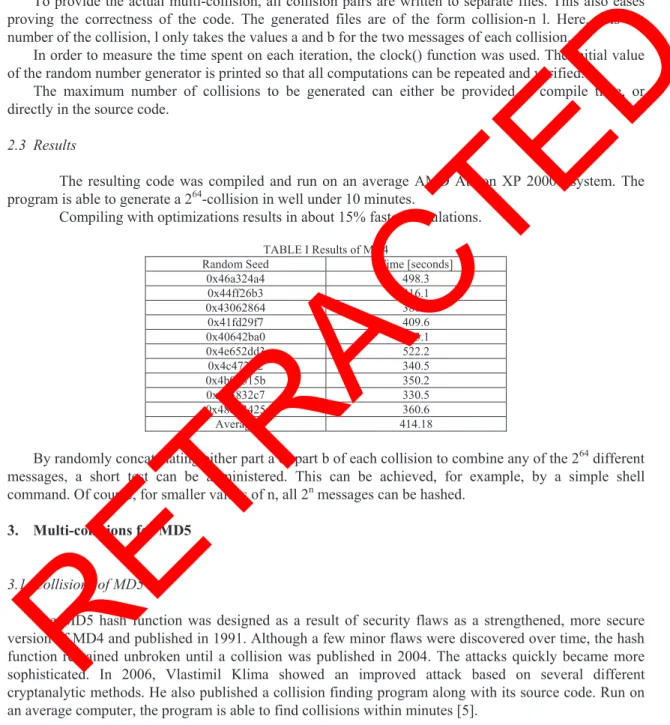
The resulting code was compiled and run on an average AMD Athlon XP 2000+ system. The program is able to generate a 264-collision in well under 10 minutes.
Compiling with optimizations results in about 15% faster calculations.
TABLE I Results of MD4
Random Seed Time [seconds]
0x46a324a4 498.3 0x44ff26b3 416.1 0x43062864 380.7 0x41fd29f7 409.6 0x40642ba0 533.1 0x4e652dd3 522.2 0x4c472ff2 340.5 0x4b0b315b 350.2 0x4a3832c7 330.5 0x48823425 360.6 Average 414.18
By randomly concatenating either part a or part b of each collision to combine any of the 264 different
messages, a short test can be administered. This can be achieved, for example, by a simple shell command. Of course, for smaller values of n, all 2n messages can be hashed.
3. Multi-collisions for MD5
3.1 Collisions of MD5
The MD5 hash function was designed as a result of security flaws as a strengthened, more secure version of MD4 and published in 1991. Although a few minor flaws were discovered over time, the hash function remained unbroken until a collision was published in 2004. The attacks quickly became more sophisticated. In 2006, Vlastimil Klima showed an improved attack based on several different cryptanalytic methods. He also published a collision finding program along with its source code. Run on an average computer, the program is able to find collisions within minutes [5].
RETRACTED
3.2 Changes to the Source Code
The code of the collision generator had to be heavily modified to give the desired results. Because of Czech variable names and comments, and especially due to of poor indentation, the code is somewhat hard to understand and modify.
The generator was made to compile in windows environments (for example, with the gcc of the cygwin environment), so different header files and function calls had to be used for time measurement. However, they were partly included as comments [6].
Additionally, several of the changes described above were also used here. I applied the same method of writing the collision pairs to files, as well as the modifications for the intermediate hash value to create multi-collisions as in the MD4 code. Also, the MD5 collision generator now prints similar information and incorporates the same method of providing the maximum number of desired collisions.
The time measurement was already part of the program, as was a verification of the hash value of the generated message pair. However, the algorithm evidently does not generate a collision under all circumstances, the probability of a failure is higher than 0. Therefore, I modified the verification step included code to restart the calculation of the current collision as needed.
3.3 Results
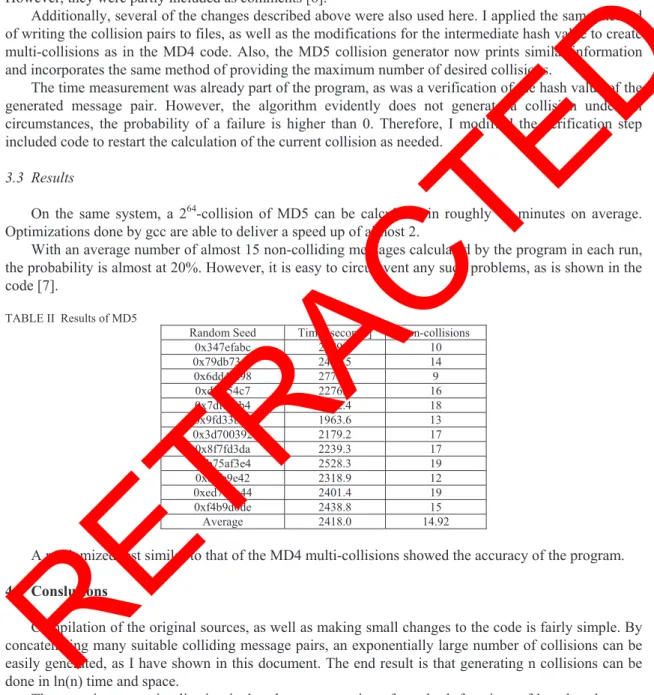
On the same system, a 264-collision of MD5 can be calculated in roughly 40 minutes on average.
Optimizations done by gcc are able to deliver a speed up of almost 2.
With an average number of almost 15 non-colliding messages calculated by the program in each run, the probability is almost at 20%. However, it is easy to circumvent any such problems, as is shown in the code [7].
TABLE II Results of MD5
Random Seed Time [seconds] non-collisions 0x347efabc 2679.8 10 0x79db7349 2413.5 14 0x6dd48f98 2774.1 9 0xd4ff54c7 2276.9 16 0x7dff21b4 2802.4 18 0x9fd33b05 1963.6 13 0x3d700392 2179.2 17 0x8f7fd3da 2239.3 17 0xb75af3e4 2528.3 19 0xbffe9e42 2318.9 12 0xed777c44 2401.4 19 0xf4b9d0de 2438.8 15 Average 2418.0 14.92
A randomized test similar to that of the MD4 multi-collisions showed the accuracy of the program.
4. Conslusions
Compilation of the original sources, as well as making small changes to the code is fairly simple. By concatenating many suitable colliding message pairs, an exponentially large number of collisions can be easily generated, as I have shown in this document. The end result is that generating n collisions can be done in ln(n) time and space.
The most important implication is that the concatenation of two hash functions of length n does not result in a security equal to a hash function of length 2
RETRACTED
n.y ( )
In 264 random messages, two will have the same 128-bit hash value with high probability, regardless
of the hash function used. Therefore, out of a 264-collision of MD4, two messages will likely also collide
under MD5 and vice versa.
Unfortunately, it is a very computationally demanding task to hash 264 messages of 1024 bytes each:
With a hashing speed of about 1 Gbit/second and 220 hashing processors, the calculations alone take 224
seconds, or roughly half a year. Additionally, 264 hash values, or 256 exabytes would have to be saved
into a database, and each newly generated hash would have to be compared against all existing values. Especially these memory requirements can be only considered at the far edge of feasibility [8].
Of course, a much more important result would be the generation of several single blocks that form an n-collision. This is possible for hash functions with a compression function which ha a longer input than output. In MD4 and MD5, it is theoretically possible to find 2384 input blocks that all have the same
hash value. Moreover, calculating a collision for MD4 ż MD5 would be a small breakthrough in hashing cryptanalysis. However, because of small differences of the two hash functions, especially the added round in MD5, makes combining cryptanalytic results of both hashes very complicated.
References
[1] Bart Preneel, Analysis and Design of Cryptographic Hash Functions, Dissertation, Katholieke Universiteit Leuven, February 1993
[2] Ronald L. Rivest, The MD4 Message Digest Algorithm, Lecture Notes in Computer Science, Volume 537, Advances in Cryptology– Crypto ’90 Proceedings, pp. 303–311, 1991.
[3] Ronald L. Rivest, The MD5 Message-Digest Algorithm, RFC 1321, April 1992
[4] Antoine Joux, Multicollisions in Iterated Hash Functions. Application to Cascaded Constructions, Lecture Notes in Computer Science, Volume 3152, Advances in Cryptology – Crypto2004 Proceedings, pp. 306–316, December 2004
[5] Hans Dobbertin, Cryptanalysis of MD4, Lecture Notes in Computer Science, Volume 1039, Fast Software Encryption 1996, pp. 53–69, February 1996
[6] Xiaoyun Wang, Xuejia Lai, Dengguo Feng, Hui Chen, and Xiuyuan Yu, Cryptanalysis of the Hash Functions MD4 and RIPEMD, Lecture Notes in Computer Science, Volume 3494, Advances in Cryptology – Eurocrypt 2005 Proceedings, pp. 1–18, May 2005
[7] Yu Sasaki, LeiWang, Kazuo Ohta, and Noboru Kunihiro, New Message Difference for MD4, Lecture Notes in Computer Science, Volume 4593, Fast Software Encryption 2007, pp. 329–348, 2007
[8] Vlastimil Klima, Tunnels in Hash Functions: MD5 Collisions Within a Minute, Cryptology ePrint Archive, Report 2006/105, April 2006