Cheating Prevention in
Peer-to-Peer-based Massively
Multiuser Virtual Environments
Von der Fakultät für Ingenieurwissenschaften,
Abteilung Informatik und Angewandte Kognitionswissenschaft
der Universität Duisburg-Essen
zur Erlangung des akademischen Grades
Doktor der Ingenieurwissenschaften
genehmigte Dissertation
von
Sebastian Schuster
aus
Berlin
1.Gutachter: Prof. Dr.-Ing. Torben Weis
2.Gutachter: Prof. Dr. Pedro José Marrón
Contents
1 Introduction 1
1.1 Motivation . . . 1
1.2 Contribution . . . 3
1.3 Organization . . . 4
2 Massively Multiuser Virtual Environments 5 2.1 Characterization . . . 5
2.1.1 The User Perspective . . . 8
2.1.2 The Operator Perspective . . . 12
2.1.3 Terminology . . . 14
2.2 The Anatomy of a Virtual World . . . 15
2.2.1 World State . . . 15
2.2.2 State Evolution . . . 17
2.3 Client/Server-based MMVEs . . . 18
2.3.1 Locality of Interest . . . 19
2.3.2 Replicated Simulations . . . 19
2.3.3 Player Movement and Actions . . . 20
2.3.4 State Consistency . . . 21 2.4 Peer-to-Peer-based MMVEs . . . 22 2.4.1 Challenges . . . 23 2.4.2 State Distribution . . . 23 2.4.3 Interest Management . . . 27 2.5 Cheating in MMVEs . . . 28 2.5.1 Cheating Types . . . 29 2.5.2 Cheating Countermeasures . . . 34
3 A Cheat-Resistant MMVE Architecture 39 3.1 Basic Idea . . . 40
3.1.1 Event-Based Simulation . . . 40
iv Contents
3.1.3 Limitations . . . 43
3.2 Architecture . . . 44
3.3 System Model . . . 46
4 A Self-Stabilizing Delaunay Overlay 47 4.1 Requirements . . . 47
4.2 Overlay Structure . . . 48
4.2.1 Key Space and Node Responsibility . . . 48
4.2.2 Node ID Assignment . . . 50
4.2.3 Primary Structure . . . 50
4.2.4 Routing Table . . . 52
4.2.5 Shortcuts . . . 56
4.3 Delaunay Structure Maintenance . . . 57
4.3.1 Self-Stabilization . . . 57
4.3.2 Adding and Removing Neighbours . . . 59
4.3.3 Pending Neighbours and Queuing of NetworkViews . . . 61
4.3.4 Comparing Neighbourhood Views . . . 62
4.3.5 Node Departure . . . 63
4.3.6 Reliability and Resilience . . . 64
4.4 Bootstrapping and Join . . . 67
4.5 Routing Table Maintenance . . . 70
4.5.1 Constraining Routing Table Entries . . . 71
4.5.2 Target Positions . . . 72
4.5.3 Querying Routing Table Entries . . . 73
4.5.4 Key Space Usage . . . 76
4.5.5 Redundant Routing Table Entry Querying . . . 78
4.5.6 Active and Passive Filling . . . 82
4.5.7 Connection Management . . . 84 4.6 Shortcut Maintenance . . . 86 4.7 Message Routing . . . 87 4.7.1 Unicast Messages . . . 88 4.7.2 Areacast Messages . . . 92 4.8 Resilience . . . 97 4.9 Discussion . . . 99
5 A Virtual World Storage 101 5.1 Requirements . . . 101
Contents v
5.2 Retrieving and Storing Data . . . 102
5.2.1 Data Space and Replication . . . 102
5.2.2 Data Retrieval on Disjoint Paths . . . 103
5.2.3 Storing Data . . . 106
5.3 World State Updating . . . 107
5.3.1 State Distribution and Replication . . . 107
5.3.2 Update Area Retrieval . . . 112
5.3.3 Player Actions . . . 113
5.3.4 Circular Maintenance Area . . . 114
5.3.5 Update Process Timing . . . 115
5.3.6 State Initialization . . . 118 5.4 Storage Maintenance . . . 119 5.4.1 Node Join . . . 119 5.4.2 Node Departure . . . 123 5.4.3 Effects of Churn . . . 125 5.5 Resilience . . . 126 5.5.1 Area Queries . . . 126 5.5.2 Point Queries . . . 130 5.5.3 Preventing Eclipsing . . . 132
5.5.4 Preventing Shortcut Tampering . . . 133
5.6 Discussion . . . 134 5.6.1 Reliability . . . 134 5.6.2 Scalability . . . 135 6 Evaluation 141 6.1 Network Simulation . . . 141 6.1.1 Simulator Environment . . . 142 6.1.2 Event Processing . . . 143 6.1.3 Network Communication . . . 145
6.1.4 Time and Clocks . . . 148
6.1.5 Node Lifecycle . . . 150
6.1.6 Bootstrapping . . . 151
6.2 Common Simulation Parameters . . . 152
6.2.1 Communication Parameters . . . 152
6.2.2 Timing parameters . . . 153
6.2.3 Lifecycle Settings . . . 153
6.2.4 Bootstrapper Settings . . . 154
vi Contents
6.3 Overlay Evaluation . . . 155
6.3.1 Overlay Test Szenarios . . . 156
6.3.2 Reliability . . . 157
6.3.3 Scalability . . . 170
6.3.4 Resilience . . . 175
6.3.5 Discussion . . . 183
6.4 Storage Evaluation . . . 183
6.4.1 Storage Test Scenarios . . . 184
6.4.2 Reliability . . . 187 6.4.3 Scalability . . . 194 6.4.4 Resilience . . . 210 6.4.5 Discussion . . . 225 7 Conclusions 231 7.1 Summary . . . 231 7.2 Outlook . . . 235 Bibliography 237 List of Acronyms 251 List of Publications 253
Chapter 1
Introduction
1.1 Motivation
Massively multiuser virtual environments (MMVEs) have become an increasingly popular Internet application in the last years. They allow a large number of users to join a simulated virtual online world. There, every user is represented by an avatar. The user controls his avatar to move through the virtual world and interact with his surrounding and the avatars of other users.
The most successful MMVEs are massively multiplayer online role-playing games (MMORPGs). In MMORPGs, users can play a role in a fantasy game world, fighting monsters together with other players, solving epic quests, advancing their characters to higher levels, and acquiring virtual wealth. World of Warcraft [16] by Blizzard Entertainment is the most prominent example, having more than ten million players worldwide as of March 2012 [92]. To play the game, users have to pay a monthly fee, allowing Blizzard Entertainment to make huge profits from operating World of Warcraft. The MMORPG market currently amounts to $12 billion in 2012 and is expected to grow to $17.5 billion per year by 2015 [115]. This market size makes creating MMORPGs interesting for game developing companies. Consequently, a lot of new MMORPGs have been announced or already entered the market.
However, there are considerable economic risks involved in developing and operating an MMORPG. After the initial development, there are significant costs to operate the game. Current MMORPGs are based on client/server technology. A central server contains the whole virtual world, receiving player actions from all the clients and supplying them with updates of the world state. This server has to be powerful and it needs a high bandwidth and low latency Internet connection to support just a few thousand players. If a company wants to support more players, it has to use
2 Chapter 1 Introduction
more servers with each server running an identical copy of the game world, called shard. Operating these servers creates considerable costs.
As long as player numbers are stable and servers are working to capacity, revenues should always cover operating costs. However, player numbers may vary greatly over time and for new games it is pretty had to predict their success. If companies over-estimate player numbers, they will provide too many servers with over-provisioned bandwidth resulting in higher costs and less profit or losses for the company. Un-derestimating the player numbers also causes problems. When World of Warcraft started, its operator was very much surprised by its success. Servers were overloaded, spoiling the game experience for players with high latency (lag) till the game reacts to player input, overcrowding of areas in game, and even regular server failure. It took the operator quite some time to keep up with the enormous success and open up new shards. At that time, competition in the market was not very intense. How-ever, there are many more competitive games today. Bad playing experience at the start and the resulting bad reputation might ruin the success of a game forever. Users will quit and play one of the competing games.
The need for high player numbers to cover costs of operation and the upfront un-certainty in player numbers form barriers for smaller companies. Without these problems, some niche games appealing to a smaller audience might become econom-ically more successful creating a more diverse market.
Peer-to-peer technology might help to solve these problems. In a peer-to-peer appli-cation, there is no central server all clients communicate with. Instead, all peers can communicate with each other, supplying services to other peers and using services other peers offer. Peer-to-peer file sharing applications have been very successful in distributing files, with peers exchanging data directly between each other. No expensive central server with large storage space to store files and high bandwidth to deliver files is necessary. The software creates the network out of participating computers, with each computer supplying storage space and bandwidth to other computers. In an ideal peer-to-peer application, every node would supply as many resources as it consumes.
Thus, a peer-to-peer-based MMVE could possibly support any number of players in one single world, without the operator of the game having to pay for servers or bandwidth. However, to apply peer-to-peer technology in MMVEs, a decentralized simulation of the virtual has to be developed. Instead of using a central server, peers exchange messages directly between each other to perform that distributed simulation. Despite changing network conditions and message latencies, players
1.2 Contribution 3
expect the simulation to advance as fast as the real wall-clock time, with reactions to player input occurring as fast as they would occur in the real world. Furthermore, the MMVE should work reliably despite nodes joining or even failing unexpectedly. Although several approaches have been discussed, so far no working peer-to-peer-based MMVE exists.
One reason for this is a serious issue threatening MMORPGs: Cheating. MMORPGs are highly competitive environments. Typically, a player advances his avatar to higher levels by fighting monsters and solving quests. He collects better equipment, which in turn enables him to fight even harder monsters and advance further. Virtual currency can be used to buy better equipment, too. Certain achievements can only be reached by investing enough time and having the necessary equipment and player skills. Thus, a player’s avatar is perfectly suited to demonstrate the player’s status to other players. For a lot of players, gaining achievements and advancing his avatar plays the major role in MMORPGs [128].
How the game is meant to be played is guarded by rules. They govern how players interact with the virtual world and other players and what the effects of interaction will be. These rules have to be the same for all players and they have to be obeyed by all players for the game to be considered fair.
Players playing by the rules have to invest a lot of time and effort to make progress. Consequently, there will always be some players trying to break the rules to get an unfair advantage: to cheat. Since avatars, equipment, and virtual currency are even traded for real money nowadays, there will be motivation and criminal energy for cheating. Cheating poses a serious threat to all MMORPGs. For honest players, fairness is a critical requirement. If honest players think they are competing with cheaters, they will simply quit the game and look for a better one.
1.2 Contribution
In current client/server-based games, enforcing rules is straight-forward. The whole game world and player interaction are centrally managed by a server able to check whether player actions conform to the rules. This server has full authority over the virtual world state and it can be trusted to stick to the rules since it is under control of the operator. In a peer-to-peer-based MMVE, the world state and its evolution is distributed between all peers. These peers cannot be trusted. An attacker could have made any kind of modification to the game program. The best one can hope
4 Chapter 1 Introduction
for is only a certain number of nodes being cheaters and the majority being honest. Under this assumption, a system using replication and redundant checking might become a viable remedy for cheating.
Our main contribution is the design and evaluation of such a system: a decentralized distributed storage able to ensure the virtual world only evolves to the rules even in the presence of a certain number of malicious nodes. This storage is based on our second contribution: the design of a self-stabilizing peer-to-peer overlay resilient to routing attacks malicious nodes could use to increase their influence on the operation of the storage.
1.3 Organization
This thesis is structured as follows: Chapter two contains the foundations this thesis is based on. It illustrates how current MMVEs look like, explains their current technical infrastructure, and shows what has been done to realize peer-to-peer-based MMVEs. It also discusses the problem of cheating, introduces different types of cheating, and shows the state-of-the-art to counter cheating. Chapter three presents the basic architectural design of our approach. In chapter four, we present a self-stabilizing overlay we developed to serve as the basis of a reliable virtual world storage shown in chapter five. Extensive evaluation follows in chapter six, while chapter seven concludes, summarizing the contributions of this thesis and showing open topics.
Chapter 2
Massively Multiuser Virtual
Environments
2.1 Characterization
A massively multiuser virtual environment is a virtual world able to host a massive number of users simultaneously. Richard Bartle gave the following definition of a virtual world in his seminal book [9]:
Virtual worlds are implemented by a computer (or network of computers) that simulates an environment. Some – but not all – the entities in this environment act under the direct control of individual people. Because several such people can affect the same environment simultaneously, the world is said to be shared or multi-user. The environment continues to exist and develop internally (at least to some degree) even when there are no people interacting with it; this means it is persistent.
Multi-user dungeons (MUDs) were the first successful applications to fulfil this vir-tual world definition. The first MUD was developed in 1978 by Roy Trubshaw and Richard Bartle. MUDs were completely text-based. A user could connect to a MUD server using a Telnet client. He created a player character: an entity representing the user in the virtual world. The state of the virtual world as seen by the player character was presented to the user with text descriptions. It was up to the user’s imagination to create an image of the world in his mind. He could issue text com-mands to control the actions of his player character. He could move to different neighbouring areas, inspect the local area, or interact with other entities in the local area. These commands were sent to the MUD server. It simulated the result of the action, updated the state of the virtual world, and sent the result of the action back
6 Chapter 2 Massively Multiuser Virtual Environments
to the user. When entering an area with another player character in it, users could interact by talking to each other or exchanging virtual items. Player characters could also interact with characters controlled by the server, so-called non-player charac-ters (NPCs). Some of them were friendly characcharac-ters players could talk to and obtain tasks to solve. Others are enemy characters players could fight. Some of these enemy characters continually moved through the virtual world to look for player characters to attack so the world kept changing even when no player characters were present. Thus, MUDs fulfil Bartle’s definition of a virtual world.
Bartle pointed out, that the fact that most MUDs were games allowing users to play a role in a fantasy game world heavily influenced the terminology to describe virtual worlds today. Users areplayers. When interacting with the virtual world they play
the game controlling their player character. Although it might be possible to use
virtual worlds as e-learning environment or collaborative work environment, most virtual worlds today are games.
While MUDs still exist, modern virtual worlds feature a graphical representation on the client. A user can actually see an image of the virtual world and interaction takes place via a graphical user interface. The first virtual world featuring graphics was Neverwinter Nights published in 1991. It could be played over the AOL online service and existed until 1997. Meridian 59 published in 1996 was the first 3D graphical virtual world. It was also the first to be playable over the Internet. Thus, it can be regarded as the ancestor of modern 3D virtual worlds. Ultima Online published in 1997 and Everquest from 1999 closely followed and were the first to become a commercial success. They still exist today. The most successful virtual world today is World of Warcraft [16] published in 2004, attracting millions of players.
According to Richard Bartle, most virtual worlds can be identified by five charac-teristics ensuring that a virtual world resembles the real world.
Rules: "The world has underlying, automated rules that enable players to effect changes to it (although not to the rules that grant them this ability). This is the world’s physics." Players can execute actions in the world that will change the world. For example, they can move their player character around changing the position of the player character in the world. The result of an action will be computed automatically according to the rules of the virtual world. These rules have been defined by the creator of the virtual world, they cannot be changed by players.
2.1 Characterization 7
Avatars: "Players represent individuals ’in’ the world. They may wield partial or total influence over an army, crew or party, but there is only one game entity that represents them in the world and with which they strongly identify. This is their character. All interaction with the world and other players is channeled through characters." This means a player is represented in the virtual world by his avatar or player character. Actions triggered by the player are executed by his player character. There might be additional characters influ-enced by the player, but his player character is the most important one. Thus, a multiplayer strategy game is not a virtual world be-cause there is no single character representing the player giving out all the orders.
Real time interaction: "Interaction with the world ta-kes place in real time. When you do something in the world, you can expect feedback almost immediately." Time in the virtual world passes like wall time in the real world. Similar to the real world, actions of characters have almost immediate effect. Furthermore, the world continues to change, even if a player character does not perform any actions. Thus, round-based games would not be a virtual world.
Shared world "The world is shared." Multiple players can join the vir-tual world at the same time. They can interact with each other directly or indirectly via the environment. A single-player role-playing game would not be a virtual world, as it can only be played by a single player although the first three characteristics might be fulfilled by the game.
Persistence "The world is (at least to some degree) persistent." This means the world maintains its state including the effects of player actions. When a player leaves the virtual world, the changes he affected to the world will remain. When he comes back, his player character will be located at the position he left and the world will have evolved according to its rules and the actions of the remaining players.
While the first graphical virtual worlds were called graphical MUDs, today the term massively multiplayer online role-playing game (MMORPG) is typically used for these games. The term "massively multiplayer" suggests that a high number
8 Chapter 2 Massively Multiuser Virtual Environments
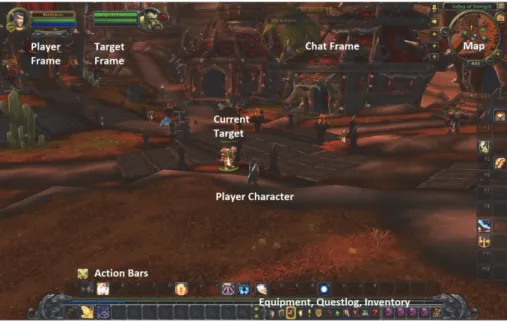
Figure 2.1: Representation of the virtual world in World of Warcraft as seen by the player
of players can simultaneously share the virtual world. With current client/server-based MMORPGs up to a few thousand players can join a virtual world at the same time.
2.1.1 The User Perspective
Similar to offline computer games, a player has to obtain the game software and install it on his computer before entering the virtual world. He also has to register at the game operator to create an account. After starting the software and entering account name and password, the user can create a new player character or select one of his existing player characters to enter the virtual world. Typical for role-playing games, a player can choose class and race of his created character and customize its appearance. Most MMORPGs feature a fantasy world and race choices include dwarves, elves, and gnomes. Typical classes are warriors, mages, and priests. A class determines the play style of a character, the available equipment, and the actions that can be performed. Warriors usually wear heavy armour. When fighting, they will try to get close to their target and their actions include various kinds of attacks performed with weapons like swords or axes. Mages wear only thin armour. They will try to keep their distance to the enemy and attack him with magical spells like fireballs. Priests can cast spells to heal characters and are often included when players play in groups to heal injured members. A player can have multiple player characters so when joining he can choose which role he wants to play at that time.
2.1 Characterization 9
After joining the world, the player will see a 3D graphical representation of the virtual world. Figure 2.1 shows how this representation looks like for the currently most popular MMORPG World of Warcraft [16]. It features a third person per-spective with a camera centred on the player character, zoom- and rotatable using the mouse. Player characters can move forward, backward, sideways, and rotate by pressing the associated movement keys. For example, pressing the arrow up key will cause the character to move forward and upon releasing the key the character will stop moving. Similarly, pressing the right arrow key will start rotating right and releasing it will stop the rotation. Holding up and right arrow at the same time will cause the player character to run clockwise in circles.
A graphical user interface is laid over the world view providing additional elements like a map, a chat frame, frames for showing the status of the player character or of the currently targeted character, and buttons giving access to player inventory or player equipment. The map shows a top-down view of the area surrounding the player character. Using the chat frame, players can talk to other players. The character status frames shows the amount of health a character has left and the available resources for performing actions.
Player Actions
Action bars contain the actions that can be triggered by the player by clicking on them or by pressing the shortcut key associated with the slot in the action bar. Actions include attacks or magical spells causing a certain amount of damage to the target character reducing the health of the target. When the health reaches zero, the target dies. Player characters that died will be resurrected. Non-player characters controlled by artificial intelligence (AI) will disappear and spawn again after some time has passed. Healing classes can also cast healing spells to add life points to their own health or to the health of allied characters.
To execute an action, certain preconditions have to be satisfied. Many actions need a target the action is performed on. The player has to select a target from the world using the mouse. It will appear in the target frame and all actions requiring a target will be performed on that target. When the player tries to attack the target, his player character must face the target and it must be within range of the attack. Maximum action ranges differ between actions. Melee attacks typically require being very close to the target while magical spells can be cast from longer ranges. Actions often cost some kind of resource such as mages needing mana to cast a spell. Only when enough of the resource is currently available, the action can
10 Chapter 2 Massively Multiuser Virtual Environments
be performed subtracting the cost of the action from the available resource. Often resources regenerate over time. If the player triggers an action and the preconditions are not fulfilled, he will receive an error message.
Otherwise, the action will be executed by applying effects to the world. A typical effect is causing damage to a character reducing the amount of health the character has left. The damage caused depends on attributes like strength, stamina, and intelligence of the player character as well as attributes of the receiving character like armour or damage resistances. These attributes depend on the level of the player character and its equipment. Player characters with higher level and better equipment are stronger, able to defeat stronger opponents.
Actions like magical spells often have an associated cast time that must pass before the effect is applied. For example, casting a fireball may require the player character to stand still and wait for two seconds before the fireball is actually launched and flies towards the enemy causing damage on impact. Any movement of the player character while casting will interrupt the action. Enemies getting in melee range of the caster might also perform a special action interrupting the casting. Upon execution of the action, the action must typically cool down for a certain time until it may be used again. Cooldown times are different for different actions with more powerful action having longer cooldowns so they can be used less often during a fight. There is also often a global cooldown that prevents any action from being executed after a former action has been triggered. In World of Warcraft, this global cooldown lasts 1.5 seconds but can be reduced by a certain attribute of the player character. This mechanism fosters a tactical use of abilities activating the right ability at the right time instead of letting the player hitting keys fastest win. The global cooldown further decreases action frequency to limit the amount of actions the server has to process in a given time.
Considering the large variety of actions of different classes that also includes healing, temporary strengthening effects for allies or weakening effects for enemies, and effects hindering or fastening movement of characters, fights feature interesting dynamic interactions. The interaction is usually not as fast-paced as in first-person shooters (FPS), but more tactical due to cooldowns and the wide variety of actions. The winner in player versus player fights (PVP) is determined by player skill as well as strength of player characters. NPCs can also perform certain actions but their AI is more predictable then a human enemies’ actions making defeating NPCs mostly a matter of player character level and equipment.
2.1 Characterization 11
How and how fast characters move, the set of available actions, their preconditions, effects, and how these effects are calculated make up a major part of the game mechanics or game rules. It is absolutely crucial these game rules cannot be broken as we will argue in the next section.
Motivations of Play
Fighting NPCs or other players makes up a large part of player activities but is just a means to an end. The world in role-playing games has a story players can experience. NPCs will send players on quests, asking them to defeat certain monsters in the world, to protect NPCs from enemies, or to collect certain items that are hidden and protected by monsters in a distant location. Sometimes multiple quests are chained together to tell a bigger story. By solving quests and defeating NPCs, player characters receive experience points. Upon receiving enough experience points the player character will advance to the next level, raising its attributes making it stronger. Quest rewards also include improved equipment also increasing player character’s strength. After becoming stronger, the player character can go to other areas of the world with stronger NPCs and solve quests and experience the story there.
In contrast to offline role-playing games, MMORPGs allow to play together in a group to solve quests and fight monsters together. This group play is often en-couraged as defeating the strongest NPCs requires coordinated play by a group of players fulfilling special roles like "tanks" absorbing damage, healers healing wounded players, and damage dealers bringing the enemy monsters down.
Virtual worlds also have an in-game economy where goods can be crafted from reagents in the world and items can be traded between players using an in-game currency. The primary purpose of obtaining these items is again to become stronger. However, some players also enjoy getting rich by crafting, buying, and selling items. Richard Bartle developed a typology of players classifying them according to their motivation for playing an MMORPG [9]. According to him, there are achievers, ex-plorers, socializers, and killers. Achievers primarily focus on advancing their player characters, becoming more powerful, richer, or obtaining the best equipment. Ex-plorers concentrate on exploring the world, experiencing the quests and the entire content that is available. Socializers primarily enjoy playing together with friends and the social interaction among players. Finally, killers enjoy playing the role of a bad guy killing other players and disrupting their game experience.
12 Chapter 2 Massively Multiuser Virtual Environments
Yee [128] argues this taxonomy of types is too strict as there could be multiple over-lapping motivating factors. He conducted a survey among 3000 players asking them for their motivation. Afterwards he classified the motivation into the three main factors achievement, social, and immersion. They were divided into several sub-factors. For example, the achievement factor is divided further into advancement, mechanics, and competition. Players focusing on advancement again enjoy increas-ing level and strength of their player characters to show off their status to others. Players focusing on mechanics have fun analysing the game rules to maximize their strength becoming the most skilful players. Finally, players who like competition especially enjoy defeating other players in fights or dominating the economy of the world.
Advancement and competition were among the most important factors mentioned by players. If competition and showing off the obtained status is that important to many players, it is absolutely crucial the competition is fair. The rules should be the same for all players. If some players are able to cheat and break the rules, honest players enjoying the competition will simply quit playing the game as they cannot win an unfair competition. This endangers the success of the virtual world. Thus, operators have to make sure cheating is not possible.
2.1.2 The Operator Perspective
Developing and running a virtual world causes considerable costs for the opera-tor. As of 2003, the average costs for development were estimated to be $7 million with $10 to $12 million being common [95]. Lately, the development cost of the MMORPG Star Wars: The Old Republic [39] were estimated to be the highest ever totalling $150-$200 million [96]. The main reasons for these high costs compared to developing traditional offline games are twofold.
First, a huge amount of content has to be created for the virtual world. For offline games, it is appropriate to offer 20 hours of entertainment until the game is played through. MMORPGs are designed to be played continuously. Every time a player enters the world, he needs something to accomplish. With many players in the world, the world has to be big to accommodate all the players and provide a variety of activities to choose from. Creating content like quests and 3D models for world objects requires considerably bigger effort compared to offline games.
Second, designing and implementing the technical architecture for an MMORPGs is much more challenging. Currently, it consists of servers running the virtual world
2.1 Characterization 13
simulation and clients visualizing the world and allowing player interaction. Even with this centralized architecture, an MMORPG is a distributed system and devel-opers have to face all the additional difficulties like partial failure and message loss. Still, the virtual world should always be available, run reliably, and it should be scalable so game interaction runs smooth even with a massive number of players. If player progress is lost, the world is not available, or interaction suffers from message delay or inconsistencies, players will be disappointed and quit eventually.
In addition to the initial development costs, launching the games requires invest-ments into server infrastructure and marketing. Afterwards, there are costs for running the virtual world, estimated to be as high as $3-$5 million per year [95] These include further developing and maintaining the world and adding new con-tent but also staff costs for player support and community management. Finally, the energy and bandwidth consumed by servers and any additional maintenance costs have to be paid as well.
A commercial operator of a virtual world expects revenues to make up for the running costs, to pay off the initial investments, and to generate a profit. The classical subscription-based model requires the player to first buy the game for a price comparable to offline games, covering a considerable part of the development costs but not generating a profit on its own [95]. Typically, 30 days of play time is already included. Afterwards, players have to subscribe by paying a fee to continue playing. This fee usually ranges from $10 to $15 per month, depending on the game and the subscription interval. World of Warcraft employs this subscription model generating a large stream of revenues with its 10 million subscribers as of 2012. Lately, the so-called free-to-play model has been applied successfully by MMORPGs like Lord of the Rings Online [116]. With this model, downloading the game client, creating an account, and playing the game is free of charge. However, after the player started playing and advanced its character some levels, the game will begin to charge the player for making additional content available. For example, higher-level regions of the world will not contain any quest givers and unlocking them has to be paid for first.
There is an in-game shop where players can buy these quest packs or a wide variety of items to increase the advancement speed or make playing the game more convenient. More character slots to create more player characters than the initially allowed number can also be bought. The operator assumes once a player started playing the game and got attracted to it, he will pay to continue playing. Even if he does not, he is still available to play in groups or build social connections with others
14 Chapter 2 Massively Multiuser Virtual Environments
who in turn pay to play. Considering the fact that Lord of the Rings Online runs on this model for quite some time and a lot of other MMORPGs have changed to this model lately, it seems to be quite successful.
The third model called pay-to-play is a hybrid between the two former models, requiring the player to pay for the game initially but no subscription is necessary. Guild Wars [3] and Guild Wars 2 [4] are examples for this kind of model. Guild Wars 2 also features an in-game shop generating running revenues.
No matter what model is used, having more players will generate more revenues. The major part of the costs is fixed like the development costs or staff costs for game maintenance and support. It does not make difference in cost whether a development team enhances the world to keep it interesting for 100.000 or 1 million players as they create the same content for every player. Some staff costs like support or community management might vary with player numbers. Bandwidth costs are probably the only costs that directly scale with the number of players. Therefore, a commercial game operator will always try to attract as many players as possible. When fixed costs are covered, every additional player generates a profit margin. Thus, operators are naturally interested in keeping the virtual world cheat-free so players stay attracted to it.
2.1.3 Terminology
A lot of terms have been used to describe what is essentially a virtual world: dis-tributed virtual environment (DVE), networked virtual environment (NVE), mas-sively multiuser virtual environment (MMVE), masmas-sively multiuser online game (MMOG), or massively multiuser online role-playing game (MMORPG). Each of these terms stress different aspects, for example DVEs and NVEs are used do de-scribe systems with smaller user numbers while all M*-terms include these massive user numbers. The term MMVE we use is more neutral towards potential uses of vir-tual worlds, also allowing systems like collaborative workspaces. In fact, MMORPGs like World of Warcraft with their 3D representation and their fast-paced fighting in-teraction in a fantasy game world are the main motivating and as of today only existing applications. Therefore, a user is a player and we will use the terms MMVE and MMORPG quite interchangeably.
There is a clear distinction between the terms player, player character, and node or peer of a player. A player is the user in front of the computer controlling the actions of his player character in the virtual world. A node or peer is the process on the
2.2 The Anatomy of a Virtual World 15
player’s computer part of our peer-to-peer network. However, to improve readability we will often use the term player instead of player character when the true meaning is clear from the context. We will also talk about the current position of a player or even the current position of a node when we are really referring to the current position of the player character of the player running the node. Where necessary and terms could be mixed up we will draw distinctions and use the original terms. Finally, when we say a player performs an action we really mean a player makes its player character perform an action. In a strict sense, this action is an action allowed by the game rules but not including movements. However, sometimes we will use the term action including both movement and actions in the strict sense to denote everything causing a change of world state triggered by a player.
2.2 The Anatomy of a Virtual World
Internally, a virtual world consists of a set of logical objects, also called entities. Each of these objects has attributes describing its state. The state of all objects in the world determines the state of the world. This state evolves over time as the world is simulated according to the world rules. Multiple physical copies or replicas might exist for each logical object on different hosts. In fact, every host rendering a view of the world needs a replica of the objects it renders or at least a partial copy of the object state to create a visual representation.
2.2.1 World State
The primary attribute associated with every object is its position. It decides where
in the virtual world the object is located. Positions are defined using a
three-dimensional coordinate system based on floating point numbers. Most virtual worlds are similar to the real world in that there is a ground plane with x- and z- coordinate defining the position on the plane. The y-coordinate specifies the height. The world is bounded with maximum and minimum values for x-, y-, and z-coordinate defining a cuboid space for the world. It mainly extends into the x-z-plane. Like the real world, virtual worlds are mostly flat. While it would be possible to use a spherical or toroidal shape for the world, it is very uncommon because it is more intrusive when new areas are added to the world. Thus, worlds have borders and new areas can be added behind these borders.
16 Chapter 2 Massively Multiuser Virtual Environments
Typically, every object has got an associated ID uniquely identifying the object among all others in the world. Furthermore, each object has got an associated graphical 3D representation realized using a textured 3D model to be rendered by the game client. The orientation attribute determines which direction in the world coordinate system the 3D model is currently facing.
Depending on its type, an object may have various additional attributes. Some of these may change dynamically over time, like the position and the orientation of an object if it is mobile. Others may be static like the ID of an object. Objects that have only static attributes are called static objects. The vast majority of the world is made up of static objects. The complete exterior of the world, the ground, mountains, buildings, and trees down to beds and chairs within houses are all static objects. They will never change so it is not possible to dig a hole in the ground, to chop a tree, or to move a chair.
Dynamic objects with variable attributes includes things like doors that can be opened and closed or chests that can be found in caves revealing valuable items when opened. These objects are typically immobile but player characters can interact with them changing their state. Mobile objects have additional attributes describing their current movement: a 3D vector describing direction and the speed of movement and another vector to describe the rotation of an object.
Most mobile objects are characters, moving through the world. This includes AI-controlled non-player characters like animals and monsters players can fight with or human characters players can talk to and obtain quests. These characters have attributes describing the powers they have, their current health, and the current state of the AI containing its plan or the goal it wants to accomplish. A player character has a lot more attributes, also describing its equipment, the items in its inventory, current action cooldowns, or the progress on different quests.
Objects like chairs might actually be dynamic and moveable in single-player offline games. In a shared world, the opportunities for players to change the world are purposefully limited. If chairs could be moved in an MMORPG, there would def-initely be players who would take them to inappropriate places like the dragon’s lair disrupting the game experience of others. Therefore, changes to the world are mostly limited to fighting and killing monsters in MMORPGs. The monsters will reappear after a while. This way the world always returns to the same state so all players can have the same experience.
The limitation of player influence on the world is also the reason why the inventory and the equipment of player characters are modelled as attributes of player
charac-2.2 The Anatomy of a Virtual World 17
ters instead of objects in the world. If items can be placed anywhere in the world, players could easily disrupt other players’ game experience.
2.2.2 State Evolution
A virtual world resembles the real world. Time advances like wall time in the real world and the state of the world changes continuously. Upon triggering an action, players expect an immediate response. This continuous real-time behaviour has to be simulated by a discrete step computation device. Therefore, discrete updates of the world state are calculated at a very fast rate, typically 60 Hz. This rate is high enough for humans to only perceive a continuous change, creating the desired impression.
Internally, two functions are used to realize this: Update() and Draw(). Update()
calculates the new state of the virtual world and afterwardsDraw()renders the part of the world visible to the player. At a frequency of 60 Hz, both functions will be called every 16.66 ms. Typically, the operating system is not a real-time system so invoking these functions at precisely the intended time cannot be guaranteed. However, on typical powerful systems 60 Hz should be reached on average. To prevent jitter in the update frequency from causing stuttering in the world, the time that has actually passed since the last update is also given as a parameter to the update function.
Update()inspects all dynamic objects in the world and calculates their updated state based on the old state and the amount of time passed since the last invocation of the update function. If Δt is the time since the last update, then the new positions
pnew of mobile object can be calculated using the formula pnew=pold+v∗Δtwhere
v is the current movement vector of the object andpold is its old position. Similarly,
the orientation of the object can be updated using its rotation vector and the passed time.
To be more realistic, the position updates are usually done using more sophisticated physics calculations. For example, while moving on the ground, the height of the objects is always set to the ground. If a character has an upward moving vector because it is jumping, gravity will change its movement vector over several updates so it will return to the ground. Friction can be simulated causing characters to slide down inclined planes so characters cannot walk up steep mountains. Movement of characters is also stopped if their 3D model starts to overlap with other objects like buildings or other characters so a player cannot just walk through walls.
18 Chapter 2 Massively Multiuser Virtual Environments
During the update, the AI state of NPCs is also updated, e.g. inspecting the sur-roundings of the NPCs and looking for close player characters to chase and attack. The update function also processes player input by sampling the state of player in-put devices. If the forward key is detected as being pressed when it was not pressed on the last update, the movement vector of the player character is changed to mov-ing forward. Similarly, if it was pressed but is detected as released, the movement vector component of the forward direction will be changed to zero. If the player presses a shortcut key to trigger an action, the update function will check whether all preconditions are met and start executing the action. It will add the action to the set of running actions. On further invocations, it will advance the state of any action in this set. It will subtract the elapsed time from the remaining cast time and apply its effects by modifying the state of the corresponding objects. When the action is finished, it will be removed from the set.
Movement of characters and most actions also have associated animations so players can actually see what is being done. Starting and updating the state of animations and blending different animations into another also happen inside the update func-tion. When the update is finished, the draw function renders the current world state. The 3D rendering is usually computationally much more expensive than up-dating and will take much more time than the update. When drawing has finished, any remaining time is skipped until the update-draw-cycle starts again. This basic principle is also used in distributed multi-user virtual worlds, as we will show in the following sections.
2.3 Client/Server-based MMVEs
Today’s MMORPGs like World of Warcraft [16] are all based on client/server tech-nology. The game provider operates powerful servers in a data centre simulating the virtual world or parts of it. With millions of subscribers, no server would be able to run a virtual world with that many players. Therefore, MMORPGs use a concept called sharding. Instead of one single virtual world, there are multiple shards each representing another copy of the virtual world. When creating a player character and joining a world, the player has to decide which shard he wants to play on. Each shard is run by its own servers. The player connects to the game server of its shard using his game client. The server sends the avatars of the player and the player selects one to join the world. Then the server sends the current state of objects to the client that will render the scenery around the player character.
2.3 Client/Server-based MMVEs 19
2.3.1 Locality of Interest
Sending all objects in the world to all players would not be scalable. Therefore, the amount of transferred data is reduced by sending only the state of dynamic objects to the client. Static objects which make up the majority of objects are already hard-coded into the client. Second, only the objects close enough to the player character for him to see and interact with are actually sent. This limited visibility and interaction range creates a circular so-called area of interest (AOI). Its radius is commonly smaller than the real-world visibility with typical values around 50 meters.
This locality of interest is the reason why distributed virtual environments can ac-tually scale to massive user numbers. If all clients were always interested in the whole world state, the amount of data sent to each of the clients would increase with every additional player quickly overloading the server. As long as players are evenly distributed all over the world, this locality limits the amount of data the server has to transfer. However, if there are hotspots in the world where a lot of players aggregate so they are all in each others’ AOIs, the server might still become overloaded. In the worst case, all player characters are in the same location and the system would not scale again.
2.3.2 Replicated Simulations
The server continuously updates the state of the virtual world as described in sec-tion 2.2.2. Since the server knows the posisec-tions of all player characters, it can send every client only the updated state within its AOI. Sending every player the state of its AOI 60 times per second would overload any server. Therefore, the client performs its own simulation of the local area. As long as no new objects enter its AOI or other player characters in its AOI perform actions, the simulation on the client will update the state on its own trying to make it consistent with the state on the server. However, standard consistency models like linear, serial, or causal consistency [60] cannot be readily applied as they do not fit well with the continuous changes of state, causing high response times [55]. Therefore, objects will only be loosely consistent as shown in the following.
When a player starts to move, its client will send a message to the server and it will include its movement into the local simulation beginning to move the player character. Upon reception of the message, the server will also begin to include the movement of the player character and it will calculate the set of clients whose player
20 Chapter 2 Massively Multiuser Virtual Environments
characters are in visibility range to the now-moving player character. It will send each of these clients a message so they can also include the movement of the player character in their simulation.
However, transferring messages takes a certain amount of time. When a player character starts to move, it will start moving immediately on its client. When the message arrives at the server it will start moving there, and when the messages from the server reaches the clients whose AOI the player character is in, it will start moving at these clients. Since the messages for the different clients can arrive at different times, the movement will not necessarily start at the same time on all clients. All clients and the server will see a different state with the moving player character being at a slightly different position depending on when the movement was started. These inconsistencies can easily be observed when two players are physically next to each other and start running forward at the same time as every player will see himself being in front. These small inconsistencies can grow fast considering that starting and stopping to move in conjunction with turning at slightly different times can lead to positions finally diverging a lot.
Therefore, the server is the only authority on the current state of the world and it can overwrite the states created by the simulations on the clients with its own. This way it prevents inconsistencies on the clients from becoming too big so the resulting inconsistency is a short-term inconsistency [89]. However, simply overwriting the state at the client could be very disruptive as positions of objects suddenly change when the client receives the updated state. Therefore, clients usually interpolate between their own state and the received state to create a smooth transition to the new state. This overwriting of the state mostly happens indirectly on the fly, as all player or NPC actions sent to the clients also contain the current position of the acting characters. This way the state never diverges too much.
Often there are additional dynamic objects in the world that are not relevant to any actions performed in the world but they make the world appear livelier. This includes birds flying in the sky or grass on the ground swaying in the wind. The dynamic states of these objects are never synchronized between clients and server as they do not exist on the server in the first place.
2.3.3 Player Movement and Actions
As player characters and their AOI move, the server will continuously send them the current state of objects entering their AOI. Similarly, if objects move into the
2.3 Client/Server-based MMVEs 21
AOI of a stationary player characters the client will be informed about their state by the server so it can include the objects into the local simulation.
When a player triggers an action, the client will locally check whether the precon-ditions for executing this action are met. If they are met, it will start executing the action and send a message to the server. The server will perform the same check and either start the action or respond with an error message. This can always happen as the state of client and server is not necessarily consistent. An enemy player could be just within range of a certain attack while the server already noticed that player started moving and is already out of range. The client will stop any animation it started for the action and display the server’s error message saying the target is out of range instead. The higher the latency to the server, the more likely inconsistencies and disruptive overruling by the server occur.
The effects of any actions are also calculated by the server. While the client may already start an animation for an attack, the final damage caused, often involving some randomness, is only decided by the server. The same is true for actions per-formed by NPCs. The client might simulate and perform all actions but the final effects on object states can always be overridden by the server. Animations played for actions are not synchronized with the server as the server does not include an-imations in its simulation. Anan-imations serve the same purpose as the nonrelevant objects to make the virtual world appear more realistic but they do not play a role in any state update calculations. Therefore, the times an attack animation hits an enemy character is not necessarily the time the server subtracts the damage from the health of the target.
2.3.4 State Consistency
In effect, the world state on clients and server is only loosely consistent [56]. How-ever, players could only see this if they did a side-by-side comparison of the views presented by multiple clients. Besides that, players might only notice this indirectly when positions of objects suddenly change or actions that should have been possible from the client’s view are denied because the client state was corrected by the server. These inconsistencies can still be disruptive or even lead to players taking wrong decisions based on the wrong state.
As long as players take actions and messages are in transit, the state of the world will be different on server and clients. The world state will be eventually consistent [120] so all clients and server will have a consistent state if they are not moving and
22 Chapter 2 Massively Multiuser Virtual Environments
not performing any actions. However, it is hard to define consistency for systems with continuous state changes. Traditionally, replicas of an object are said to be
consistent at time t if they have the same state. This definition has been adapted
by Mauve [89] for use in continuous systems defining the state to be consistent if all hosts that received all messages necessary to calculate the correct state at timet
have the same state at that time. Even this adapted definition fails to really capture the nature of continuous systems.
The times at which different hosts calculate their updates are never perfectly syn-chronized. When an object is moving and multiple hosts update its position, they would have to do this at exactly the same time to calculate exactly the same posi-tion. Even if all of them update the state of the objects within one millisecond, they will still generate slightly different position and the replicas of the object would not be consistent according to the former definition. On the other hand, if all the devi-ations are only caused because of the small differences in update time, this would still be sufficiently consistent.
Therefore, our definition of consistency at timetdefines world states to be consistent if updating the state from the last updated state to timet on all hosts that received all messages necessary to calculate the correct state attyields the same state. Hosts with clocks running ahead of the true time will already have updated their local state to time t+x. Their state is considered to be consistent with the state of others if it is reachable from the other’s state at timet.
2.4 Peer-to-Peer-based MMVEs
First proposals to implement distributed virtual environments on decentralized ar-chitectures reach back to the 1990’s targeting multiple users and distributed archi-tectures e.g. SimNet [20] or MiMaze [49]. These archiarchi-tectures could only support small user numbers since they used a decentralized architecture broadcasting all state updates to all nodes. This was shortly followed by rising popularity of the first successful MMORPG Ultima Online [38].
Later, peer-to-peer file sharing networks like Napster and Gnutella [57] became extremely popular allowing a large number of users to share files without needing expensive central servers and having to pay for file transfer traffic. Therefore, interest was rising to implement MMVEs based on peer-to-peer technology, freeing operators from the costs of running expensive servers and paying for their bandwidth. Instead,
2.4 Peer-to-Peer-based MMVEs 23
the bandwidth of clients/peers players already paid for is used. Furthermore, if designed right, peer-to-peer networks can scale very well. Applied to MMVEs, much larger virtual worlds could be realized and sharding would not be necessary.
2.4.1 Challenges
In a peer-to-peer based MMVE, there is no central server holding all objects in the world, updating them based on the actions received from clients, and distributing the updated state to interested clients. The objects in the world have to be distributed among the peers as no single peer is able to receive actions of all players and update the world state.
Consequently, events like the actions and movement of players have to be forwarded to peers responsible for the area the players are in. They are the authority for the state in that area. Players moving into this area will receive the state from these nodes. Furthermore, nodes in an area need to see the actions and movements of other player characters in that area so they can update their local simulation. The mechanism to get updates and actions to peers interested in these events is typically called interest management.
The peers have to form a structured overlay network on top of the underlying TCP/IP layer, to find peers based on their locations and exchange messages ef-ficiently. Furthermore, redundancy has to be employed to compensate for the un-reliability of peers so the world is simulated correctly despite nodes joining and leaving unexpectedly. In the following, we will analyse how existing approaches try to realize peer-to-peer based MMVEs focusing on their state distribution and their interest management mechanism.
2.4.2 State Distribution
After unstructured to-peer networks became very popular, structured peer-to-peer networks realizing a distributed hash table (DHT) like Chord [113] and Pastry [103] to store and look up data in a purely decentralized fashion have been developed. In DHTs, the connection graph is a special structure, e.g. a ring. Nodes in the ring have identifiers from a one-dimensional numeric key space and they are responsible for storing all data from a certain part of this key space, e.g. all keys closest to their own identifier. When storing or looking up data, a node can always
24 Chapter 2 Massively Multiuser Virtual Environments
decide whether it is responsible for a key or whether any of its neighbours in the structure is closer, forwarding the query to the closer neighbour.
In [70], DHTs were used as a backup persistent storage. Since DHTs generate keys for data using hash functions, they destroy any locality of data as they map data uniformly to the key space. Objects close in the world will have keys far apart so they will not be stored on the same node in the network. This makes executing range queries to retrieve state in an area very expensive.
Therefore, Mercury [15] used the basic ideas of distributed hash tables to form a structured overlay without using hash functions. It directly used the attributes of stored objects to map objects to the nodes responsible for storing it arranged in a ring structure. Thus, objects close in the attribute space were also close in the ring and range queries can be executed more efficiently. Mercury used multiple ring structures to support multiple attributes. In Colyseus [14], Mercury was used to store objects from a virtual world with 2-dimensional positions by using x- and z-coordinate of the positions as object attributes. However, having to route queries on multiple hops before data can be retrieved proved to be too slow considering the real-time interaction necessary for virtual worlds so Colyseus was only used for smaller multi-player games. Similarly, [37] proposed to use a spatial index on top of a generic DHT to store objects based on their locations. Again, maintaining the index and multi-hop routing in the DHT will be too slow for real-time interaction. Therefore, other approaches combined ideas of peer-to-peer-based and client/server-based MMVEs. Typical for these approaches is the splitting of the world area into zones and using coordinators responsible for data in their zone. As the world is mostly flat and objects are mainly distributed in the x-z-plane, the splitting typically happens using these two dimensions. This is common to all approaches distributing world state, including ours.
In [70], the world is split into disjoint fixed size zones. In each zone, there is one node responsible for updating the state in that zone essentially acting exactly like a central server for that zone with nodes forming a zoned federation. An underlying DHT is used to assign responsibilities for zones and serve as a backup storage. However, seamless change of zones was not possible because each zone was like a small virtual world with its own central server.
Therefore, [6] split the world into fixed size rectangular zones with one coordinator
per zone, allowing players seamless changing of zones. Whenever a player gets
close to a zone border and his actions may affect multiple zones, coordinators use
2.4 Peer-to-Peer-based MMVEs 25
only works if nodes holding locks are reliable. This system is targeted more at using multiple reliable servers than unreliable peers. Hydra [24] follows a similar approach, sacrificing seamless zone changes but implementing failover mechanisms for servers using replicated backup zones on different servers.
Mopar [129] partitioned the world into small hexagonal cells also allowing seamless transition between cells. Each cell has an associated home node which is determined using a Pastry DHT to map cell identifiers to the responsible nodes. This home node always knows which node currently located in a cell is the master node of that cell acting as its coordinator. All other nodes in a cell are slave nodes connected to the coordinator using it to exchange events and update their world states. Master nodes form an overlay connecting to all neighbouring master nodes, each updating the state in its own cell and synchronizing object transitions with its neighbours. Furthermore, they exchange information on player movement changing master node responsibilities and recording changes in master nodes at the home nodes so other nodes can always discover the master node of a cell using the DHT.
SimMud [80] uses a combination of a Pastry DHT and coordinators to simulate the virtual world. Similar to [70], the world is split into disjoint fixed size zones with no seamless transition. For each zone, there is a multicast group using Scribe [22]
on top of Pastry to realize application-level multicast. Every node periodically
reports its player character’s position and any state updates to all other nodes in the group. The other nodes use interpolation and dead-reckoning [110] to smoothen the visual representation of player character movement. Furthermore, each group has a coordinator responsible for updating the state of all non-player characters based on the actions of player characters and sending state updates of NPCs to its group. However, using Pastry’s multihop-routing to realize a scalable multicast with Scribe incurs a considerable delay for propagating updates and was too slow for real-time interaction.
All of the coordinator-based approaches so far use fixed size regions. The load on each coordinator depends on the number of players in a region correlated with its size. However, some areas might be more popular than other areas creating a higher load on coordinators responsible for these areas. Even approaches supporting differ-ent region sizes [24, 70, 80] require the developer to estimate popularity of regions beforehand and they cannot adapt to changing popularity over time. Therefore, coordinator-based approaches have been proposed using a dynamic partitioning of the world into zones.
26 Chapter 2 Massively Multiuser Virtual Environments
In [101], peer-to-peer technology is used to manage the server infrastructure simu-lating the world partitions. Similar to former approaches, the servers act as coor-dinators for their respective zone. Zones are dynamically generated similar to the 2-dimensional DHT CAN [98]. In CAN, every node is responsible for a rectangular zone and nodes in neighbouring rectangular zones are connected. Messages can be sent using the location as address, arriving at the node responsible for the zone the location is in. With one peer in the network, its zone would be the whole world. When another peer joins, it will send a message to its position arriving at the node responsible for the respective zone. That node will split its zone in two equally-sized zones and each of two nodes will become responsible for one of the split zones. In [101], servers form a CAN overlay and peers connect to the servers based on the zones they are currently in. These servers simulate the world state in their zone. They are connected to the servers of neighbouring zones so they can handle object transition and synchronize state. If a server experiences high load because too many players are in its zone, a new server will be added to that zone halving its size and reducing the load on that server. Similarly, servers with low load can be removed joining zones that have been split. This allows better load balancing than possible with fixed size zones. The hybrid architecture HYMS [28] also uses the CAN-based recursive splitting approach to control responsibility of servers for zones.
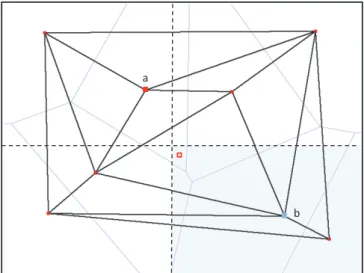
GROUP [19] uses a CAN-based overlay to store the world state in a completely distributed fashion. In GROUP, the peers themselves are assigned fixed random po-sitions in the world and are responsible for storing and updating all objects within their CAN-zone. These zones change dynamically as node join and leave the net-work and the objects have to be passed around. This dynamics was taken one step further with approaches using the current positions of player characters in the world to determine the responsibility for objects in the world. When every node is responsible for storing all objects it is closest to, a Voronoi tessellation [7] is cre-ated where each peer is responsible for all objects within its Voronoi cell, see also figure 4.1. Distributing state based on Voronoi tessellations is used in several ap-proaches like [13, 18, 67, 99]. They all have the advantage of a more fine-grained load balancing as nodes join the network or player characters aggregate in an area automatically shrinking zones. However, they also suffer from the increased over-head associated with transferring objects between nodes whenever player characters move. Therefore, using dynamic Voronoi tessellations might be more suitable to disseminating events as shown in the next section.
2.4 Peer-to-Peer-based MMVEs 27
2.4.3 Interest Management
Interest management mechanisms create an overlay structure allowing efficient dis-semination of events to all nodes interested in these events. These nodes can update their player character’s state if affected by an event and they can update their cur-rent world view. The interest management also has to adapt the structure of the overlay as players move. Maintaining an authoritative state for other objects in the world is the task of the state distribution mechanism.
A straight-forward approach to ensure all nodes receive all relevant actions of players is broadcasting all actions. Broadcasting was used in MiMaze [49] and also in [89] but it is inherently not scalable. SimMud [80] adapted this approach to use multicast groups to broadcast messages only within a fixed size area. This approach only provides limited scalability as the number of players per zone may not be too big. To exchange events more efficiently, later approaches focused on disseminating events only to players close enough to perceive the event. Only the players whose AOIs contains the player generating the event will receive it. Since AOIs typically have identical sizes, the relationship of being contained in another player’s AOI is sym-metric. Therefore, every player has to forward its events to all players within its AOI. To exchange messages efficiently, the overlay structure should reflect the lo-cality in the virtual world by connecting nodes close to each other so messages can be transferred within a few routing steps. While there are approaches to use only weakly-structured overlays and gossiping for event dissemination [108], most approaches rely on specific overlay structures for event dissemination.
In Solipsis [78], nodes are connected to all other nodes within their AOI. Thus, events can be forwarded directly to other nodes. Since players are moving constantly, con-nections have to be adapted accordingly. The network has to stay globally connected and a node has to notice when a new node enters its AOI and connects to it. To ensure that also in cases when all nodes in the AOI lie in one direction or the AOI
is empty, a node a maintains a second set of nodes outside its AOI. This set
con-tains the closest nodes whose convex hull concon-tains a. This ensures a node is always connected to outside nodes in every direction that can tell the node when a player enters its AOI. If connected nodes fail causing the node to lie outside the convex hull, it can issue a special query running in a circle around its position to discover nodes to repair the convex hull set. Nodes periodically exchange position updates to adapt the structure of the overlay.