California State University, Monterey Bay California State University, Monterey Bay Digital Commons @ CSUMB Digital Commons @ CSUMB
Capstone Projects and Master's Theses Capstone Projects and Master's Theses 12-2017
It is a Win-Win for Both: Cross-Age Peer Tutoring It is a Win-Win for Both: Cross-Age Peer Tutoring Lisa Cardenas
California State University, Monterey Bay
Follow this and additional works at: https://digitalcommons.csumb.edu/caps_thes_all
Recommended Citation Recommended Citation
Cardenas, Lisa, "It is a Win-Win for Both: Cross-Age Peer Tutoring" (2017). Capstone Projects and Master's Theses. 159.
https://digitalcommons.csumb.edu/caps_thes_all/159
This Capstone Project (Open Access) is brought to you for free and open access by the Capstone Projects and Master's Theses at Digital Commons @ CSUMB. It has been accepted for inclusion in Capstone Projects and Master's Theses by an authorized administrator of Digital Commons @ CSUMB. For more information, please contact [email protected].
Running head: IT IS A WIN-WIN FOR BOTH 1
It is a Win-Win for Both: Cross-Age Peer Tutoring
Lisa Cardenas
IT IS A WIN-WIN FOR BOTH 2
Abstract
Improving the benefits of cross-age peer tutoring is explored in this capstone project. This is important because students will be more successful in school if they receive extra support with the subjects they are struggling with. An evidenced based argument is offered that an
effective cross-age peer tutoring program will help to promote a positive school environment for students to thrive in. The three stakeholder perspectives examined were elementary school
teachers and a principal because they participate in a cross-age peer tutoring program. Three themes emerged from an analysis of the interview data, training the tutors, organizing and planning the lessons, and scheduling time for both training and planning. These themes were explored as ways to address the issue presented. Training is argued to be the most effective way to achieve the goals of a successful cross-age peer tutoring program. Based on the evidence, action was taken to train cross-age peer tutors.
IT IS A WIN-WIN FOR BOTH 3
Setting the Stage
My children have attended Lincoln Charter School from kindergarten through fifth grade. This charter school requires parent participation, consequently I have spent four to six hours a week working in my children’s classrooms. Working with the students year after year has given me a view of the different learning abilities of children. Some students just seem to absorb
information, understand it, and are ready to move on. This of course is ideal, however the reality is other students struggle and need more time to review material before it really makes sense. Although teachers do their best to help their students, they only have so much time to spread between the whole class. Fortunately, there are programs schools can implement, such as
cross-age peer tutoring, to help. Cross-age peer tutoring is a program where older students spend time one-on-one helping younger students. Unfortunately, lack of organization can deter from the success of the program, this is what I have witnessed.
Emily is an eighth grade student at Lincoln Charter. She signed up to be a Teacher
Assistant through the middle schools exploratory program. Emily was assigned to the fifth grade class and goes in on Monday and Wednesday afternoon for one hour. This is the perfect
opportunity to tutor students who need extra learning support. However, Emily spends all of her time making copies, labeling homework with the students’ names, filing homework, and
cleaning and organizing the classroom. The opportunity for struggling students to receive extra help is being wasted on busy work.
When I asked the fifth grade teacher what is the goal of the teacher assistant program, she responded, “I don’t know.” It turns out, the only communication she has received about the
Teacher Assistant Exploratory was the initial question, do you want a teacher assistant? Once she answered yes, she was told the days and times her teacher assistant would be in her class. There has been no further direction. It is up to the teacher to figure out how to occupy the teacher assistant for two hours a week.
I have met with three different teachers at Lincoln Charter and found that each had a very different response to the Teacher Assistant Exploratory. One teacher did not want to have a Teacher Assistant in her classroom because she felt it would be more work for her, the second teacher is using the Teacher Assistant as an office aide (Emily), and the third teacher accepted
IT IS A WIN-WIN FOR BOTH 4
two Teacher Assistants into her class and has integrated them into cross-age peer tutoring roles. These Teacher Assistants first listen to the teacher’s lesson with the class and then move about the class and help the students who need extra support.
Only one of the three teachers I spoke with are using the Teacher Assistants in a way that actually benefits the learning outcomes for their students. The other teachers are missing out on an opportunity to provide their students with extra one-on-one help. Since Lincoln Charter
school is not utilizing their Teacher Assistant Exploratory to its fullest potential this provides an opportunity to improve and strengthen it. The students deserve the extra support and
encouragement towards their success.
Literature Review and Synthesis
Cross-age peer tutoring is a program that pairs an older student with a younger student (Robinson, Schofield & Steers-Wentzell, 2005; Wright, 2002; Garringer & MacRae, 2008;
Paquette, 2008). Together they review coursework that the teacher has already taught. This extra time spent on coursework gives both the tutor and the tutee the opportunity to make educational improvements. All students learn at different rates and some may benefit from the extra
one-on-one time that cross-age peer tutoring provides. Also, creating an environment for positive learning outcomes is an important factor (Robinson, Schofield & Steers-Wentzell, 2005). As stated by Bruner (2009),“... the intellectual development of the child is no clockwork sequence of events; it also responds to influences from the environment, notably the school environment” (p. 39). An effective cross-age peer tutoring program will help to promote a positive school
environment for students to thrive in (Wright, 2002).
What is the Issue?
The need for an organized plan is crucial for success. However, all the planning, training, and maintenance of a cross-age peer tutoring program may seem daunting. Due to the amount of work needed to make an effective cross-age peer tutoring program, commitment and support from both the administration and teachers is a must. Many programs start off with good
intentions, but end up failing due to lack of follow through. The results are ineffective programs, untrained tutors, and poor outcomes for the tutors and tutees.
IT IS A WIN-WIN FOR BOTH 5
There is no need to search far for tutors, schools can utilize the great resource that already exists in their classrooms, the students. Typically, students who are are chosen to be tutors are two to four years older than the tutees (Robinson, Schofield & Steers-Wentzell, 2005). By using this resource and taking advantage of the natural tendency of younger students looking up to older students, cross-age peer tutoring can be a great way to connect the students and encourage learning. Furthermore, cooperative learning, which includes peer tutoring, “should be used
whenever teachers want students to learn more, like school better, like each other better, have higher self-esteem, and learn more effective social skills” (Johnson & Johnson as cited in
Sencibaugh, 2016 p. 362). Schools are missing out on the benefits that a well run cross-age peer tutoring program can provide for their students.
Why is it an Opportunity?
A well run cross-age peer tutoring program could provide educational gains for not just the tutee, but also the tutor (Garringer & MacRae, 2008). The authors state that, “Cross-age peer programs provide growth and learning opportunities for both mentors and mentees, resulting in a “double impact” (Garringer & MacRae, 2008, p. 1). The goal for cross-age peer tutoring has been to improve the learning opportunities for the tutee, however it turns out the tutor may also benefit from the extra review of material. According to Robinson, Schofield & Steers-Wentzell (2005), “Tutoring itself may provide additional practice carrying out computations and solving problems. However, given that tutors sometimes show academic improvements in non-tutored subjects, it is hypothesized that something other than extra instruction or practice may be influencing tutor outcomes” (p. 335). This “double impact” is a win-win for both the tutor and tutee.
Improving this program could also provide opportunities for the younger students to better understand material that may be confusing when introduced to the whole class by their teacher. Not only does cross-age peer tutoring provide a desirable one-on-one setting, but the tutors may also be able to explain the information in a way that is easier for the younger students to understand (Paquette, 2008). Another advantage to cross-age peer tutoring is that younger children can gather information on social behavior just by observing older children. According to Albert Bandura, “... most human behavior is learned observationally through modeling: from
IT IS A WIN-WIN FOR BOTH 6
observing others one forms an idea of how new behaviors are performed and on later occasions this coded information serves as a guide for action” (Bandura, 1977, p. 22). Using this natural tendency of younger students looking to older students for examples of behavior helps to make the cross-age peer tutoring program more successful. This is further explained in a school
context by Fiscus (2000):
Little kids strive to be like big kids, patterning behavior, dress, speech, and attitudes after older role models. Schools can use that influence through programs where older students set out to affect younger ones positively by teaching leadership skills, mentoring,
tutoring, and promoting safe behavior. (p. 25)
Taking advantage of this natural behavior, the opportunities for educational gains for both tutors and tutees are possible through cross-age peer tutoring programs. Schools just need to make the commitment to their students and provide effective programs.
What should be done?
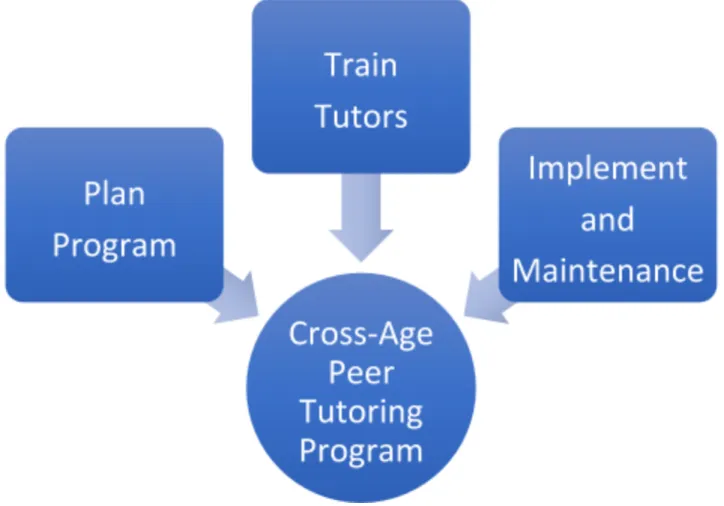
Figure 1. Elements of a Cross-age Peer Tutoring program. This figure illustrates effective elements for a Cross-age Peer Tutoring program.
IT IS A WIN-WIN FOR BOTH 7
Planning. As shown in Figure 1, the elements for a successful cross-age peer tutoring program include, planning, training the tutors, implementing the program, and following up with regular maintenance. In reference to the first element, planning, Thorpe and Wood (2000), state that defining goals and identifying areas of need are the first step. Identifying students who will benefit from tutoring, setting the criteria for tutors, locating where the tutoring will take place, and planning out lessons are all part of the plan too. Teachers will be in the best position for identifying their students who need extra help. They can also be a great resource for
recommending students who will make good tutors. Having a set list of qualifications for potential tutors is important. For example, at what grade can a student volunteer to become a tutor? Also, a good academic record and a positive and encouraging attitude are requirements since they will be regarded as role models. According to Bandura (1977), “When modeling is explicitly used to develop competencies, the more talented and venturesome are apt to derive the greater benefits from observation of exemplary models” (p. 89). Having a clear goal from the start and making certain requirements for tutors will ensure the outcome of quality tutors.
Once the goal is determined, tutees and tutors identified, setting a location for tutoring is next. Quiet locations such as the library or cafeteria before or after meal times is ideal. Finally, planning out materials and strategies for the tutors to use will help guide the learning experience. Having planned activities that are interesting and engaging is essential.
Training. Training the tutors ahead of time on how to tutor and on the subject they will be tutoring is an important piece of the program. “When training tutors, schools should give them opportunities to practice, and to demonstrate their mastery of the various skills taught” (Wright, 2002, p. 4). Training the tutors before they start working with their tutees will give the tutors more knowledge and confidence when tutoring. Not only should tutors be taught strategies for tutoring, but they should also be taught how they are expected to behave. Being polite and respectful while moving from class to class for tutoring, using praise to encourage tutees, and being a good listener are examples (Wright, 2002).
Implementation. Once the goals have been decided, the students who need extra learning support are identified, and the tutors have been trained, it is time to match tutors and tutees. There needs to be some thought when deciding who will work best with who, “Research
IT IS A WIN-WIN FOR BOTH 8
indicates that mixed-sex tutoring dyads may not produce results that are as large and as consistently positive as do single-sex dyads, although both kinds of tutoring dyads produce positive outcomes” (Robinson, Schofield & Steers-Wentzell, 2005, p. 356). Once the matches have been made, a quick meet and greet is recommended. As stated by Wright (2002), “An introductory meeting between tutor and tutee can also help to ‘break the ice’, allowing the students to be more comfortable with one another when the actual tutoring sessions begin” (p. 23). After the tutoring has begun, the maintenance of the program will be crucial.
Maintenance. There should be occasional and unannounced observations of the tutoring sessions to ensure the quality of the tutoring (Wright, 2002). Also, taking the time to check in periodically with just the tutors provides the opportunity for the teachers to better understand what is working and what is not. This can lead to adjustments to the material and strategies being used to better accommodate the tutee. It is important is to keep the program functioning at its optimum level. According to DuBois (2014), “Many programs employ match agreements and goal setting at the inception of the match, but programs often fail to keep these goals a priority for matches (p. 235). Following up with the tutors, making adjustments to the material, and keeping the goals a priority are all important for the success of the program.
A well organized and maintained cross-age peer tutoring program can be very beneficial for the tutee and also the tutor. In addition to the positive academic outcomes, the tutors are also looked upon as role models for desirable social behaviors. Although there is a certain amount of time and commitment required in order to implement and maintain a successful cross-age peer tutoring program, the overall benefits for the students is well worth the effort.
Method
Lincoln Charter School’s teacher assistant exploratory program provided an opportunity 1 for cross-age peer tutoring. However, this opportunity was being wasted due to lack of planning and organizing. For this Capstone Project the researcher investigated how Lincoln Charter
School teachers viewed the teacher assistant exploratory program and what they thought could be done to improve it. Based on an analysis of the individual semi-structured, face-to-face
interviews with Lincoln Charter teachers and the relevant research literature, the researcher used
IT IS A WIN-WIN FOR BOTH 9
what she had learned to formulate an action that responded to the focus issue in a way that inspired, informed, or involved a particular audience.
Context
Lincoln Charter School is a small kindergarten through eighth grade school located in the agriculturally rich Apple Valley. The school is tucked into a neighborhood area of lower
socioeconomic status where occasional gang related shootings have occurred. Lockdowns have taken place due to the close proximity of these shootings. As a safety measure an eight foot tall chain link fence now surrounds the perimeter of the school which does provide a sense of safety, but at the same time gives the look and feeling of being a penitentiary. Lincoln’s main school building was built in 1928 and proudly displays it’s historic site plaque. Even though Lincoln has a small school population, it has outgrown the original building. As a result, a row of eight
portables are now lined up across what was once parking lot and playground area. Since Lincoln is a charter school, enrolment is based on applications with priority going to siblings. As a result, there is a lengthy wait list and it is hard to get in. Because of the application process, it is not a little neighborhood school. Almost all of the students do not live nearby and are driven to and picked up from school by their parents since charter schools do not have district bus service. Many of the parents volunteer time each week either in their child’s classroom or helping to maintain the campus. There is a real sense of community at the school because of the parent involvement. The demographics of Lincoln reflect the Apple Valley in which it resides. The majority of the students, 75.4%, are Hispanic or Latino, 21% are white, and 1.8% are Asian. Furthermore, 39% of the students are socioeconomically disadvantaged and 21% are English learners.
Participants and Participant Selection
Anamarie. The 43 year old teacher of the mixed grade classroom, which includes first through third graders. She has been teaching for 21 years. The first part of her career included teaching kindergarten, second grade, ESL with K-6, but for the last seven years she has been teaching the mixed grade class. Anamarie is also the mother of three children, two of which have graduated from Lincoln Charter. Her youngest is in the fifth grade in Autumn Stewart’s class.
IT IS A WIN-WIN FOR BOTH 10
Autumn. The 31 year old teacher of the fifth grade class at Lincoln Charter school. She has been teaching for six years. During her six years of teaching she has taught kindergarten, first grade, and fifth grade.
Rose. The principal of Lincoln charter school. For the first 18 years of her educational career she taught middle school, 14 of which were at a nearby school and four at Lincoln. Four years ago she was promoted into the position of principal at Lincoln..
Emily. The eighth grade student who is in the Teacher Assistant Exploratory. She has been a student at Lincoln since kindergarten. This is her last year at Lincoln since she will be graduating and heading to high school next year.
Researcher
● How and why is the concern personally meaningful to you?
Over the past 10 years I have been volunteering at Lincoln Charter School. During this time I have witnessed many different learning styles. While some students seem to just absorb what is being taught, others struggle and need extra help. Witnessing the struggle some students have while working on assignments concerns me.
● What experiences, background knowledge, and personal qualities, skills, and/or talents qualify you to carry out this project?
While volunteering at Lincoln Charter School, I have had the opportunity to work with students who need extra learning support. I have worked in small groups and also one-on-one. This has given me the background knowledge that spending some extra time and focus with students who need extra help is very beneficial to their confidence in their educational abilities.
● We all have biases; the most insidious are those of which we are unaware or unacknowledged. What makes you different from the “informants” and
IT IS A WIN-WIN FOR BOTH 11
“influentials?” Is it race, ethnicity, social class, education, work experience, physical or mental ability, gender identity, sexual orientation, etc? How might these differences impact both your perspectives and work on the concern?
My self reflection brings up the ways in which I am different from the majority of the students at Lincoln Charter School, for example my race, ethnicity, and social class. I may of had a different set of experiences growing up because I am white and English is my first language, however, race, ethnicity, etc., is not the focus and should not be the focus of this project. My hope for this project is to improve the Teacher Assistant exploratory as I would like to make a difference in the learning experience of students.
Semi-Structured Interview and Survey Questions
Lincoln Charter School teachers Semi-Structured Interview (Webb, 2004) Describe the Exploratory teaching assistant program.
Is there a tutoring aspect to the program?
What do you see as the challenges of the exploratory teaching assistant program? What are the challenges with cross-age peer tutoring?
What is currently being done to improve cross-age tutoring opportunities? by whom - and what do you think about this? Why?
IT IS A WIN-WIN FOR BOTH 12
What do you think are the obstacles/drawbacks/disadvantages to improving cross-age tutoring opportunities?
Is there anything else that you would like to say about the teaching assistant exploratory opportunity and efforts to improve cross-age tutoring?
Procedure
Participants were recruited since they had participated in the teacher assistant exploratory program. Participants were interviewed and all interviews were done individually, face-to-face. Interviews took less than a half an hour, were audio-recorded (with participant consent), and took place at Lincoln Charter School. A semi-structured interview format was used for the
face-to-face interviews, to allow for follow-up questions to unclear, interesting or unexpected responses. All interviews were scheduled at the convenience of the interviewee.
Results
For this Capstone Project, two elementary school teachers, a principal, and an eighth grade student in the Teacher Assistant Exploratory Program were interviewed to see what they think could be done to improve the cross-age peer tutoring program. This is important because there are students who need extra learning support. Based on an analysis of the data and the
relevant research literature, three themes emerged (see Table 1). Evidence-based decision making required evaluating each potential Action Option by the following criteria: time, reasonableness, and sustainability. Based on the evaluation of each Action Option an action will be
IT IS A WIN-WIN FOR BOTH 13
Table 1
Evaluation of Action Options
Time it will take Reasonableness Sustainability
Training the Tutors High Medium Medium
Planning and
Organizing lessons
High Medium Low
Scheduling Low Low Low
Training the tutors
Training the tutors before tutoring sessions begin is a crucial part of a successful
cross-age peer tutoring program. As discussed in the literature review, Wright (2002), suggested that tutors be given the opportunity to practice the material before the tutoring sessions begin. However, the time needed to train tutors is difficult to come by. Teachers already have their days filled with their lessons and to add the training of a tutor is problematic. Anamarie, the teacher of a first through third mixed grade class, has two tutors assigned to her class. To train them she sat with them on the steps of the playground one day while her students were at recess. This time should have been a break for Anamarie, however, it was the only time available to train her tutors. Planning training sessions for the tutors without imposing on the limited time of the teacher would be of benefit for both the tutor’s and the teacher. Furthermore, according to Autumn (personal communication, October 11, 2017) the fifth grade teacher, some of the students in the teacher assistant exploratory “ can be shy and nervous about working with others.” This is another reason why training sessions are important, it would help build
confidence. The more comfortable the tutors are with the material and how to give feedback the better they will be with helping other students.
Planning and organizing lessons
In order to plan and organize lessons, the first steps, according to Thorpe and Wood
IT IS A WIN-WIN FOR BOTH 14
of time will help the teacher organize lesson plans to include tutors and also give focus for tutor training. Anamarie (personal communication, October 30, 2017) was able to achieve this, “I just basically looked at my window of time and what my needs were. So I scheduled it so that I could do three things during the period of time that they (the tutors) are here.” She also identified
students who needed extra help and said that, “I’ll usually pair them (the tutors) with a 1st grader who can use some support” (Anamarie, personal communication, October 30, 2017). Although Anamarie was able to organize her lessons to accommodate the tutors, this is not always the case. According to Autumn, this is a drawback for teachers. It is more work and takes more time to plan lessons that include a tutor. This sentiment was further echoed in a statement by the
principal, Rose. She commented, “that’s not really their (the teachers) job, their job is to teach the class, the teacher assistant’s job is to assist with that but the teacher shouldn’t have to run herd over them as well” (Rose, personal communication, October 31, 2017). This concern can be eliminated by having trained tutors. Tutors who know how to jump in and assist students will eliminate the need for the teacher to “run herd over them as well.”
Scheduling
Scheduling time for training and also for the tutoring sessions is important. However, this is an issue, according to Rose, (personal communication, October 31, 2017) “the timing and the space and someone who can supervise it” are big obstacles for the Teacher Assistant Exploratory program. Anamarie (personal communication, October 30, 2017) reflected this same feeling about obstacles when she stated that “a lot of it is time and logistics.” However, scheduling time at the beginning of a tutoring program to train will help the program run smoother. As mentioned in the literature review, once the training is finished, there will only be the need for occasional observations of tutoring sessions to ensure the quality (Wright, 2002). Next is figuring out how to best use the scheduled time. For example, Autumn’s tutor Emily, arrives during music class and she is unable to reschedule. Even with this conflict, there is still an opportunity for Emily to pull out a student for one-on-one tutoring. Scheduling one-on-one tutoring during music would also help fulfill Emily’s wish, (personal communication, November 3, 2017) as she stated, “I’d like to work with the kids more.” With a little more planning, organizing, and willingness to be
IT IS A WIN-WIN FOR BOTH 15
flexible within the given constraints of the schedule, it is possible to make some accommodations that will improve the tutoring program.
Conclusion
After evaluating each Action Option it is recommended that action be taken to train the tutors. Although training is high on the table for time, training helps build confidence and
understanding for the tutor on how to work with a student and give appropriate feedback. Once the tutors are trained they will be more comfortable jumping in to help students. Tutor training is important to the success of a tutoring program and after the tutor training lessons are prepared, the sustainability of the program is more attainable. The second Action Option, planning and organizing lessons, is also important. This action option is also high on the table for time due to the time it will take to plan lessons for students who need extra help. Evaluating and
understanding the areas of need and identifying which students would benefit from tutoring are key factors for the success of a cross-age peer tutoring program. The last Action Option is scheduling. Scheduling time for training, planning lessons, and tutoring sessions is low on the table for time. This is due to the restraints of scheduling. For example, the Teacher Assistant Exploratory has a set schedule for two days a week for one hour each day, there is no room for adjusting this time. Tutor training and also tutoring will all need to occur within the given schedule. Nonetheless, if the time and effort is not put into creating a cross-age peer tutoring program, it simply will not exist.
Although training is crucial, teachers may not be willing to put the time into the initial training sessions for the tutors. Once again, it takes time to plan the training and also time to perform the training. This could result in no training or the continued lack of training for the tutors. Even with the challenge of finding time to plan and perform the training, it is worth the effort. Once the tutors are trained the Teacher Assistant Exploratory program will run more smoothly. Well trained tutors will be more confident and they will be more likely to take the initiative to jump in and help students without the teacher having to constantly direct them. Putting in the extra time in the beginning will result in a smoother running program. Another benefit of a Cross-age peer tutoring program, like the Teacher Assistant Exploratory, is that it provides a setting where older students are looked upon as role models by younger students.
IT IS A WIN-WIN FOR BOTH 16
Through this program, both the tutors and tutees will learn values such as caring, compassion, cooperation, and friendship. These are all positive values that will benefit our schools and communities.
Action Documentation and Reflection
For this Capstone Project, my focus was on the improvement of the Teacher Assistant Exploratory program, a cross-age tutoring program, at Lincoln Charter School. Two elementary school teachers, a principal, and an eighth grade student in the Teacher Assistant Exploratory program were interviewed to see what they thought could be done to improve this cross-age peer tutoring program. After researching relevant literature and conducting the interviews three action options emerged, training the tutors, planning and organizing lessons, and scheduling. I chose to implement training the tutors because it will have the biggest impact on the improvement of the program. Once the tutors are trained they will have more confidence and understanding on how to work with a student and give appropriate feedback. Also, they will be more comfortable jumping in to help students and they will not need the constant direction of the teacher.
First, I created mini lessons to train the tutors. This included educational youtube videos that taught about meaningful praise and reading conferences that showed different ways to support a student while reading. I also used handouts which included a little quiz (photos of the training and copies of the handouts can be found in Appendix A). Next, I taught the lessons to the tutors in the Teacher Assistant Exploratory program. We met on the first day of the new exploratory session during their pre-scheduled time for the program. After a brief introduction about tutor training, they watched the first video on meaningful praise, then they worked through the handouts. I talked about each handout as they progressed through the little packet. After the meaningful praise segment, they watched a video on reading conferences. I showed them four different conferences stopping after each one to discuss the main points that I wanted them to remember. Then we read through the handout on two different ways to read with a student, paired reading and listening while reading. At the end of the session, I asked the tutors if they had any questions or comments about the training. Only one tutor spoke up asking for more clarification on listening while reading.
IT IS A WIN-WIN FOR BOTH 17
During the lesson I had modified the amount of reading conferences the tutors watched. I had originally picked out five and decided to only show four. I felt like four was enough at the time. I was glad that I had more than I needed and was able to modify as the lesson went along. Further changes I would like to make would be to find even more educational videos to choose from. An important next step will be putting together a binder including the mini lesson plan, the youtube links, and master copies of the handouts. This will be a quick guide for future tutor
training. Having this resource readily available will make training the tutors that much easier in the future. I would also like to expand the tutor training to include writing and math lessons. As new ideas and worksheets are found they can easily be added to the binder for future use.
Critical Reflection
From this project, I learned that I really enjoy delving into a subject. Although reading through many scholarly articles was not exactly fun, it was an essential piece of the project. Researching literature enabled me to understand the importance of a well structured cross-age peer tutoring program on a deeper level. Also, talking with experienced educators and learning from them was amazing. I was in awe of their knowledge. After researching, talking with
experienced educators, and finding ways to improve the Teacher Assistant Exploratory, I realized that I am capable to help make a change. It felt great knowing that my action of training tutors was very doable and helping to improve the program felt very rewarding.
After working through the lessons with the tutors it was clear to me that there is always room for improvement. Although I felt the training went well, I realized how teaching and
learning can be viewed in two different ways. Teaching to help students learn and also learning to teach. For learning to teach, practice and experience are key. It seems like a process, there will always be a need to make changes and adjustments. Finding different ways to deliver lessons that will be engaging and fun and finding lessons that are effective is going to be important for
success.
Working toward change involves a lot of different factors. For a cross-age peer tutoring program, planning and training are two of the main pieces. However, it really comes down to willingness. If those involved in a cross-age peer tutoring program, the teachers and tutors, are willing to create time for tutors to work with students and training the tutors for the best possible
IT IS A WIN-WIN FOR BOTH 18
outcome, then change is very possible. On the other hand, if the effort is not put in then the outcome will be an unsuccessful program that is disappointing. Luckily, I was able to work with a principal and teachers who were all very excited and open to ideas for improvements for their Teacher Assistant Exploratory program. Their willingness and effort is what will ultimately make a positive change.
While considering Major Learning Outcome (MLO) 1, I realized my personal development has grown in regards to my critical thinking skills, and writing and speaking
abilities. Each class I have taken and each service learning experience I have had over the course of my education here at CSUMB, has expanded my knowledge and confidence in the field of education. One class in particular stands out, HCOM 312: Cooperative Argumentation. I dreaded the idea of this class because I was sure I was going to have to stand in front of the class and debate various issues. Fortunately, this was not the case and it turned out to be an in depth critical thinking class. This class taught me to really read between the lines and think critically about everything I read and watch. These skills, to think critically and to write and speak well, are all important pieces of a solid foundation for a profession in education.
Another Major Learning Outcome that has had a major impact on my life is MLO 2: Diversity and Multicultural Scholar. I have learned about so many different cultures and my understanding and admiration has grown. The classes at CSUMB have been amazing,
Multicultural Children’s Literature, Immigrants and Equality in Education, Comparatives and International Education, and Cross Cultural Human Development are all classes that have all expanded my knowledge. As mentioned earlier, my ability to critically think and analyze has made the learning experience of these classes so much more meaningful. I believe many of these classes should be required for all majors, the more knowledgeable we are about other cultures, the more harmony there would be in the world.
Another Major Learning Outcome that resonates with me is MLO 3: Innovative
Technology Practitioner. This resonates with me because I have learned so much over the last few years about technology. My comfort and ability with technology has increased and I am now better at researching, creating tables and figures, and designing presentations. Although each class I have taken has enabled me to expand my abilities, I really give a lot of credit to Professor
IT IS A WIN-WIN FOR BOTH 19
Fuller in SBS 385: Environmental History of California. My first semester back as a re-entry student I took Professor Fuller’s class. Not only did I learn an in depth account of California’s history, but I also learned about technology. He maneuvered around on the computer projecting all his searches and presentations on the whiteboard. Just by watching him navigate through various screens and through his presentations, I learned so much. In addition to learning through observation, I was also required to practice what I had seen him do because of class assignments and presentations. The combination of observing and hands on practice really increased my abilities when working with technology.
As my final semester comes to a close, I think ahead to what is next for me. I believe that the necessary next steps for me to reach my professional goals are to continue my education. I will be applying for the Masters of Arts Education program with an emphasis on Special
Education here at CSUMB. While I continue my education, I also want to continue volunteering in the elementary setting. This will give me more experience with children and also it will give me the opportunity to continue learning from experienced educators. There is still so much to learn and I am excited about continuing my education.
References
Bandura, A. (1977). Social Learning Theory. Upper Saddle River, NJ: Prentice-Hall, Inc. Bruner, J. S. (2009). The Process of Education. Retrieved from
https://ebookcentral-proquest-com.library2.csumb.edu:2248/lib/csumb/reader.action?docI D=3300117&ppg=32
DuBois, D.L., Karcher, M.J. (2014). Handbook of Youth Mentoring. Thousand Oaks, CA: Sage Publications, Inc.
Fiscus, L. (2000). Older and younger kids help each other learn. Education Digest, 65(9), 25. Retrieved from
http://eds.a.ebscohost.com.library2.csumb.edu:2048/ehost/detail/detail?vid=0&sid=3f67f 9a9-84c4-4abf-9259-d365563ae2e2%40sessionmgr4009&bdata=JnNpdGU9ZWhvc3Qtb Gl2ZQ%3d%3d#AN=3054067&db=aph
Garringer, M., MacRae, P. (2008). Building effective peer mentoring programs in schools, an introductory guide. Retrieved from
IT IS A WIN-WIN FOR BOTH 20
http://educationnorthwest.org/sites/default/files/building-effective-peer-mentoring-progra ms-intro-guide.pdf
Paquette, K. R. (2008). Study of elementary students’ attitudes about writing after a cross-age tutoring experience. Reading Improvement, 45(4), 181-191. Retrieved from
http://eds.a.ebscohost.com.library2.csumb.edu:2048/ehost/detail/detail?vid=0&sid=1e1ef cc0-f360-43d0-802d-a2383176950e%40sessionmgr4009&bdata=JnNpdGU9ZWhvc3Qtb Gl2ZQ%3d%3d#AN=35898335&db=aph
Robinson, D., Schofield, J., Steers-Wentzell, K. (2005). Peer and cross-age tutoring in
math:outcomes and their design implications. Educational Psychology Review, 17(4), 327-362. Retrieved from
http://eds.b.ebscohost.com.library2.csumb.edu:2048/ehost/detail/detail?vid=0&sid=f7225 31f-217a-4870-9f83-f26067a4469c%40sessionmgr101&bdata=JnNpdGU9ZWhvc3QtbG l2ZQ%3d%3d#AN=19300908&db=aph
Sencibaugh, J.M., Sencibaugh, A.M. (2016). An analysis of cooperative learning approaches for students with learning disabilities. Education, 136(3), 356-364. Retrieved from
http://eds.a.ebscohost.com.library2.csumb.edu:2048/ehost/detail/detail?vid=0&sid=fe557 71b-b295-41a8-aa59-04df5115330a%40sessionmgr4010&bdata=JnNpdGU9ZWhvc3Qtb Gl2ZQ%3d%3d#AN=113989305&db=aph
Thorpe, L., Wood, K. (2000). Cross-age tutoring for young adolescents. Clearing House, 73(4), 239. Retrieved from
http://eds.a.ebscohost.com.library2.csumb.edu:2048/ehost/detail/detail?vid=0&sid=6ea17 ab1-da1c-4daf-8de6-8ac7b5315423%40sessionmgr4009&bdata=JnNpdGU9ZWhvc3Qtb Gl2ZQ%3d%3d#AN=2873304&db=aph
Wright, J. (2002). Kids as reading helpers: a peer tutor training manual. Retrieved from
http://www.interventioncentral.org/sites/default/files/pdfs/pdfs_interventions/peerTutorM anual.pdf
IT IS A WIN-WIN FOR BOTH 21
Lesson Plan on Compliments:
Today we are going to talk about compliments. You pay a compliment to someone when you say something nice about him or her. People like to hear comments about their good behavior, how hard they are working, or their appearance. When we compliment others, we should always be positive and always mean what we say. (Wright, 2002, p. L2-1)
Youtube video: Tutoring Tips: How to Give Meaningful Praise. (3:33)
https://www.youtube.com/watch?v=wyO5OrigCyY
Handouts:
· Sample compliment statements
· Is this a compliment or a positive statement?
· How would you give a compliment to this student?
Lesson Plan on Reading Tips:
We are going to learn some reading tips for working with students.
Youtube video: Reading Workshop: Conferences Kindergarten through Fifth Grade. (24:20, only using certain segments) https://www.youtube.com/watch?v=znLROuT6Z_4
Conference 1: One-on-one, uses meaningful praise
Conference 4: Two kids, warm up partner reading asking about prior knowledge (10:44) Conference 5: One-on-one, punctuation marks and voice changes (13:25)
Conference 7: One-on-one, 5th grader, comprehension questions (16:34)
Conference 8: One-on-one, 5th grader, asking about the book, novel vs. short stories (20:50)
Handouts:
· Paired reading
· Listening while reading
Pair up tutors to role play tutor/tutee and have them practice reading while providing meaningful praise and also corrective feedback.
OR
IT IS A WIN-WIN FOR BOTH 22
Is This a Compliment or a Positive Statement?
You should walk quietly when you are in the hall. ( Y / N )
I am really glad that you are always ready when I come over to help you. ( Y / N )
Please turn to page 8 in your book. ( Y / N )
Giving the student a high five when he or she reads a tough word correctly. ( Y / N )
Thank you for remembering to bring your reading book today. ( Y / N )
You worked really hard today. Good job! ( Y / N )
What time do you have to be back in your classroom today? ( Y / N )
I’ll bet that you have a lot of homework to do in your class. ( Y / N )
You always choose interesting books for tutoring. They are the kind of books that I would like to read. ( Y / N )
Are you happy that tomorrow is Saturday? ( Y / N )
When I listen to you read, I can tell that you have become a much better reader. ( Y / N )
(Wright, 2002, p. L2-2)
How Would You Give a Compliment to This Student?
You sit down next to the student you are going to help and see that they already have their book out and are ready to begin working with you.
You listen to the student read and notice that they struggle through some hard words but they keep on trying.
While the student is reading to you, a couple of other classmates are loud and disruptive.
Although your student stops and looks over at the commotion, he turns right back to where he left off reading.
IT IS A WIN-WIN FOR BOTH 23
The teacher asks you and the student to go to the library to pick up some books she checked out for the class. You notice that the student walks in the hall and also keeps his voice quiet while in the library.
Write down three ways that you would give a compliment to this student. Try to write them as you would say them.
1.____________________________________________________________________________ ______________________________________________________________________________ ___________________________________________________________________ 2.____________________________________________________________________________ ______________________________________________________________________________ ___________________________________________________________________ 3.____________________________________________________________________________ ______________________________________________________________________________ ___________________________________________________________________
Sample Compliment Statements
· I really like the way that you… · Thank you for…
· Great work today!
IT IS A WIN-WIN FOR BOTH 24
· You did a very good job of… · It was great that you…
· I can tell that you are trying really hard. Thanks!
(Wright, 2002, p. L2-2)
Paired Reading
Read with your student.
If the student reads a word wrong, skips a word, or doesn’t know a word use the 5 Second rule- wait at least 5 seconds before supplying the correct word.
· Point to the word · Tell them the word
· Have them repeat the word · Join them in reading aloud again
Listening While Reading
Take turns reading, while the other follows along silently. Then the student rereads the same part out loud. Continue taking turns until you are finished reading the story and occasionally ask
comprehension question.
· Who, What, When, Where, How? · Who is your favorite character so far? · Why?
(Wright, 2002, p.L3-3 and L3-8)