Jurnal Pendidikan IPA Indonesia
http://journal.unnes.ac.id/index.php/jpiiTHE EFFECTIVENESS OF PROJECT-BASED E-LEARNING TO IMPROVE
ICT LITERACY
E. D. S. Eliana1, Senam2, I. Wilujeng3, Jumadi4 1SMPN 2 Selakau Timur, Kaupaten Sambas, Indonesia
2, 3, 4 Universitas Negeri Yogyakarta, Indonesia
DOI: 10.15294/jpii.v5i1.5789
Accepted: 18 January 2016. Approved: 27 March 2016. Published: April 2016
ABSTRACT
This study aims to reveal the effectiveness of science teaching based on project-based learning to improve ICT literacy learners in the junior high school with the category of high, medium and low. This research uses descrip-tive method to describe the students’ equipness of ICT literacy in the science learning based on the project-based learning that is integrated with e-learning. All of the population in this study are junior high school of curriculum pilot project in 2013 in Singkawang. The sampling in this study uses stratified random sampling to determine three of the four schools that represent the school with a category of high, medium and low based on the National Examination score on 2015, namely, SMPN 1 Singkawang, SMPN 3 Singkawang, and SMPN 7 Singkawang and from each school are randomly selected one class. The data collection is done by the observation and question-naires of the students’ equipness in ICT literacy with effective criteria only if it is in a good or excellent criteria. Based on the analysis, project-based learning science-based learning is effective in equipping ICT literacy learners at junior high school at the categories of high, medium and low.
© 2016 Science Education Study Program FMIPA UNNES Semarang
Keywords: e-learning, ICT literacy, Project based learning, Teaching and learning process
INTRODUCTION
The need for information technology be-coming increasingly more important today where Indonesia is entering the free market of ASEAN or the ASEAN Economic Community (AEC). All of Indonesian people are expected to have the ability in the field of technology. The learners are expected to have skills in the field of information technology (ICT). Teachers who play a direct role in the education are required to be more creative in giving lessons to students.
The mastery of information technology on the learner or known as ICT literacy is impor-tant to the learners. The learners are required to be creative, innovative and responsive in facing the changes in the XXI century as confirmed by Magaña & Frenkel, 2009, “A child entering the
new century will Likely face more risks and un-certainties and will need to gain more knowledge and master more skills than any generation befo-re “this statement shows that in order to face the XXI century learners are required to learn more. Learners face the risks and uncertainties in the XXI century in line with the development envi-ronment so rapidly, such as technology, science, economics and socio-culture, so that students are required to learn more and be proactive in order to have the knowledge and skills / expertise were adequate, especially in the field of information technology (ICT). Ivankovića et al. (2013) states that “ICT literacy becomes an important precon-dition for the socialization and professional ca-reer. Therefore, education as an important factor of social development plays a key role in the ICT literacy. This means ICT literacy is very impor-tant to have for the learners.
*Alamat korespondensi: Email: [email protected]
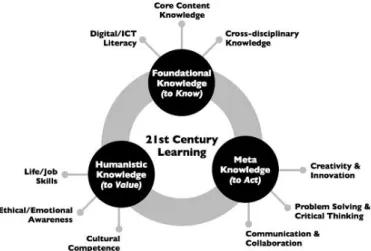
The importance of mastering ICT is be-cause ICT becomes one of an important require-ments by learners in the competence of the XXI century, it is the foundational knowledge compe-tency. The competence at XXI century is divided into three, namely foundational knowledge (to know), meta knowledge (to act), and humanistic knowledge (to value) and ICT literacy is one as-pect of the foundational knowledge in addition to core content knowledge and cross disciplinary knowledge (Kareluik, 2013).
ICT literacy is referred as one of the skills required for become successful in the XXI centu-ry (Wilson, et al., 2015). ICT literacy is defined as the ability to effectively evaluate, navigation, and build the information by using various digital technologies. ETS (2007) mentions “ICT litera-cy is using digital technology, communications tools, and / or networks to access, manage, in-tegrate, evaluate, and create information in order to function in a knowledge society” which me-ans ICT literacy is able to use digital technology, communications equipment, and / or networks to access, manage, integrate, evaluate, and create in-formation that is useful for the knowledge society. CETF (2008) defines ICT literacy is the ability to use digital technology and communication tools, and / or networks to access, manage, integrate, evaluate, create and communicate information to be function in the knowledge society.
Badke (2009) stated that ICT literacy is also known as “iSkill”. Learners who have the skill of ICT literacy need a learning with ICT. Ezekoka & Gertrude (2015) states “ICT is not designed to replace face-to-face interaction; it is designed to supplement it by allowing people to communicate anytime and anywhere “, which means that ICT is not designed to replace the face to face interaction between teachers and
learners, but ICT is designed to support the lear-ning and complements and enables teachers and learners to communicate wherever and whene-ver. According Krajcik (1994) use technology in project-based science to make the environment more authentic for students, because computers provide access to data and information, expand interaction and collaboration with others through the network, promote research laboratories, and merge tool used to produce the artifact.
The students’ knowledge about technology is important, in order to meet the ICT literacy, the learners can do it by via e-learning. E-learning is expected to allow learners to understand the ne-west knowledge and technology (ICT literacy) and facilitate learners to learn without being li-mited by the space and time. Based on the survey results on the use of information technology by the junior high school teacher in science class in Indonesia, showed that the use of ICT in teach-ing process is low (Sumintono, 2012). Therefo-re, we need a learning model that can facilitate the learners to have the ICT literacy. One of the learning model suggested in the curriculum 2013 is scientific approach, which is one of the XXI century learning model is project-based learning and to facilitate the learning of ICT literacy that can be integrated with e-learning. Blumenfeld et al. (1991) state that the project-based learning is a comprehensive approach to teaching and lear-ning that is designed for students doing a research on real problems. Bagheri & Abdullah (2013) sta-tes that “PBL could foreseeably ensure more ef-fective result by allowing the student to actively perticipate in the learning process and allowing the student to produce something in collaborating with other” Project-based learning can provide a more effective and allow learners to participate actively in the learning process and makes it
sible to produce something with the cooperation of others.
Project-based learning gives students the opportunity to broaden their knowledge and de-velop skills through problem solving and investi-gation. Real problems or questions arising form the core of every project-based learning experien-ce with e-learning, and learners must conduct in-vestigations and obtain the necessary information to arrive at a conclusion. Project-based learning also encourages students to share feedback and insights with colleagues in collaborative groups, and then use e-Learning modern technology to share their findings. ICT can improve learning outcomes in order to support a different sense; support new collaboration with online producti-on, computer and networking tools; supports the differentiation and diversity; and empowers stu-dents to personalize their learning process. There-fore, project-based learning using ICT should be introduced in the classroom to support learners to create their own knowledge (Soparat & Klaysom, 2015).
Soparat & Klaysom (2015) stated that ICT as a learning content project-based learning does not only support the development of main com-petencies of the learners. Nowadays, network, computer and internet access are used more than just search for data, email, or chat, but should be used to support the students education and should be focused on the content of the knowled-ge and competence.
Based on the several studies above can be stated that the project-based learning that is integ-rated with e-learning can give students the oppor-tunity to broaden their knowledge and develop skills based on problem-solving and investigation, using e-learning learners can search for and share information more widely and depth, supports the differentiation and diversity, empower learners to personalize the learning process, and provides an opportunity to learners to master information technology (ICT) deeper so that the needs of lear-ners in order to mastery ICT can be fullfiled.
METHOD
This research uses descriptive explorative method. Exploratory descriptive study aimed to describe the state of a phenomenon, in this study was not intended to test a specific hypothesis but describe variable as it is, symptoms or circums-tances (Arikunto, 2002). The phenomenon desc-ribed in this study is the equipness of learners’ ICT literacy in science teaching based on project-based learning that is integrated with e-learning.
The population in the study were all junior high school pilot project curriculum in 2013 in Singkawang. The sampling on this research using stratified random sampling to determine three of the five schools that represent the school with a category of high, medium and low based on the National Examination score on 2015. The three schools as the sampled are SMPN 1 Singkawang, Singkawang SMPN 3, and SMPN 7 Singkawang, Of the three schools have one of each class by cluster random to determine which classes will be given science learning based on e-learning integ-rated project-based learning.
Data collected by observation and ques-tionnaires of equipness of ICT literacy. Instru-ments used in this study are the development project-based learning made by Muskania (2015) which has been tested for its validity and reliabili-ty. For the observation technique, the instrument used is in the form of observation sheet. Questi-onnaires used to measure junior high school stu-dents of their equipness of ICT literacy.
The equipness of ICT literacy data are obtained through observation. The result scores were categorized based on the assessment by the 5 caparator categories (Anwar, 2002) Project based science learning is effective for improving junior high shool students’ skill of ICT literacy only if the equipness of ICT literacy observation results which is converted with a likert scale that are in the category of good or excellent.
RESULTS AND DISCUSSION
The equipness of ICT literacy in the schools in the category of high, medium and low measured using observation sheets and question-naires ICT literacy. The results of the equipness of ICT literay observations in this research is learners’ progress data toward ICT literacy by the tasks given to the learners. The equipness of ICT literacy data at the high school category of the observations are presented in Table 1.
According to table 1 the overall average of the ICT literacy equipness aspects is 98.96 when converted to likert scale is at very good criteria. The ICT literacy equipness from the question-naire results in the high category school learners are shown in table 2. The learners response to the ICT literacy questionnaire of high category school that is at very good criteria. Therefore, it can be said that Project based science learning is effective to equip ICT literacy learners of high junior category. Table 3 shows the equip observa-tion percentage of ICT literacy and the ICT lite-racy equipness average of learners from médium school category is at very good criteria.
Based the average on table 4, if it is con-verted to likert scale, the response of the ICT li-teracy average at low category school is in very good criteria. Based on table 5 the overall average of ICT literacy equipness aspects of 98.21% is at very good criteria. The ICT literacy equipness of the questionnaire results in a low category school learners are shown in table 6. The questionnaires average results of ICT literacy equipness is 84.24 if converted with the likert scale responses is in-cluded in very good criteria.
Table 1. The Percentage of the ICT Literacy Equipness, the Learners’ Average in Each Stu-dent Aspect in the High Category School
ICT LiteracyAspect Observation
Percentage (%) Access 93,75 Managing 100,00 Integrating 100,00 Evaluating 100,00 Making 100,00 Communicating 100,00 Average 98,96
Table 2. Questionnaire Assessment about the ICT Litercy Equipness in the High Category School Students
Criteria ICT LiteracyScore
Min 74,29
Max 99,05
Average 88,33
Deviation Standard 5,17
Table 3. The Percentage of the ICT Literacy Equipness, the Learners’ Average in Each Stu-dent Aspect in the Medium Category School
ICTLiteracyAspect Observation
Percentage (%) Access 89,24 Managing 100,00 Integrating 100,00 Evaluating 100,00 Making 100,00 Communicating 100,00 Average 98,21
The analysis results of the ICT literacy equipness are consequence to investigators al-leged. The results of this study are consistent with Muskania research (2015), the statement is a
pro-ject based science learning device can equip ICT literacy learners. Project based learning provides an opportunity for learners to broaden the kno-wledge base and develop skills through problem solving and investigation. Real problems or the questions that arise are the core of Project based learning. By using project based learning, we can encourage the learners to share and get feedback and insights and with e-learning integration, the learners can obtain more information and can share their findings widely.
Tabel 4. Questionnaire Assessment about the ICT Litercy Equipness in the Low Category School Students
Criteria ICT LiteracyScore
Min 60,00
Max 94,29
Rata-rata 84,24
Deviation Standard 7,03
Tabel 5. The Percentage of the ICT Literacy Equipness, the Learners’ Average in Each Stu-dent Aspect in the Low Category School
ICT Literacy Aspect Observation Percent-age (%) Access 89,24 Managing 100,00 Integrating 100,00 Evaluating 100,00 Making 100,00 Communicating 100,00 Average 98,21
Tabel 6. Questionnaire Assessment about the ICT Litercy Equipness in the Low Category School Students
Criteria ICT LiteracyScore
Min 60,00
Max 94,29
Average 84,24
Deviation Standard 7,03
Online learning can provide opportunities for the learners to read the material deeper, exer-cises and assignments, as well as interact directly with teachers via chat gives further motivation and generate more effectively than traditional classroom. Kubiatko & Vaculova (2011) explains that in this era, project based learning will be connected with ICT. ICT will provide a deeper
Social and Behavioral Sciences, 176(1), 1005-1011. Francese, R., Gravino, C., Risi, M., & Scanniello, G.
(2015). Using Project-Based-Learning in a mo-bile application development course An expe-rience report. Journal of Visual Languages and Computing, 31(1), 196–205.
Ivankovića, A. Š. (2013). ICT literacy among the stu-dents of the Faculty of Philosophy, University of Mostar. Procedia - Social and Behavioral Sci-ences , 93(1), 684-688.
Kareluik. (2013). What Knowledge Is of Most Worth:Teacher Knowledge for 21st Century Learning. Journal of Digital Learning in Teacher Education, 3(1), 127-140.
Krajcik, J. S. (1994). A Collaborative Model for Help-ing Middle Grade Science Teachers Learn Pro-jec-based Instruction . The University of Chicago Press, 4(1), 483-497.
Kubiatko, M., & Vaculova, I. (2011). Desaigning a Project Management e-course by Using Proj-ect Based Learning: Characteristic and The Experiences with Application in The Science Subjects. Energy Education Science and Technol-ogy Part B: Social and Educational Studies, 5(1), 65-74.
Magaña, S., & Frenkel, P. (2009). Transforming Teach-ing and LearnTeach-ing for the 21st Century. Pro-methean, 1(1), 32-41.
Muskania, R. (2015). Pengembangan Perangkat Pembe-lajaran IPA berbasis Project Based Learning untuk Membekali Foundational Knowledge dan Mening-katkan Scientific Literacy Peserta didik SMP. Yog-yakarta: Universitas Negeri Yogyakarta. Soparat, A. Arnold & Klaysom. (2015). The
Develop-ment of Thai Learners’ Key Competencies by Project-based Learning Using ICT. Internation-al JournInternation-al of Research in Education and Science, 3(1), 12-22.
Sumintono, B. W. (2012). Penggunaan Teknologi In-formasi dan Komunikasi dalam Pengajaran Guru Guru Sains SMP di Indonesia. Jurnal Pengajaran MIPA, 17(1), 23-31.
Wilson, M., Scaliseb, K., & Gochyyev, P. (2015). Re-thinking ICT literacy: From computer skills to socialnetwork settings. Thinking Skills and Cre-ativity, 18(1), 65-80.
learning and can develop the learners skills. The stages in e-learning integrated with project-based learning direct the learners to achieve these indi-cators in ICT literacy.
CONCLUSION
Based on the results and discussion of this study concluded that Project based science lear-ning is effective to equip the learners ICT literacy of junior school categories of high, medium, and low with the observations and questionnaires are in very good criteria. Project based science lear-ning integrated with e-learlear-ning can be applied as early as possible to equip ICT literacy because it is one of the XXI century competencies that must be owned by the current learner and as a provisi-on for future the which is full of global competi-tion.
REFERENCES
Arikunto.(2002). Metodologi Penelitian Suatu Pendekatan Proposal. Jakarta: PT. Rineka Cipta
Azwar, S. (2002). Tes Prestasi. Yogyakarta: Pustaka Be-lajar.
Badke, W. (2009). Media, ICT, and information litera-cy. Trade Journals, 33(1), 47-49.
Bagheri, M.,Ali, & M., Abdullah, M. C. (2013). Effect of Project Based Learning Strategy on Self Di-rected Learning Skill of Educational Technol-ogy Student. Contemporary Educational Technol-ogy, 5(1), 15-29.
Blumenfeld, P. C., Soloway, E. & Marx, R. W. (1991). Motivating Project-Based Learning Sustaining The Doing Supporting The Learning. Michigan: Law-rence Erbauw Associated, Inc.
CETF. (2008). California ICT Digital Literacy Assessments and Curriculum Framework. California: CETF. ETS. (2007). Digital Transformation A Framework for ICT
Literacy. United State of America: Educational Testing Service.
Ezekoka & K, Getrude. (2015). Maximizing the effects of collaborative learning through ICT. Procedia -