_____________________________________________
∗ Communicating author’s email: [email protected] 143
Performability of Work Teams: Balancing Hard and Soft
Issues
BEN S. KUIPERS*
Erasmus University Rotterdam, The Netherlands Faculty of Social Sciences and Performability, Rijswijk, The Netherlands
www.performability.eu (Received on March 28, 2008)
Abstract: Teamwork plays a vital role in today’s business environment, which is characterized by continual change and an increased demand for satisfaction by stakeholders. Teams can be understood as the basic units of an organization, as they are able to deliver improved business performance as well as improved quality of working life. This paper shows the importance of balancing the implementation and development of teamwork in organizations (that is, the “soft” issues) with the improvement of “hard” performance. Based on a longitudinal study involving more than 160 teams at Volvo Trucks in Sweden, the concept of performability is introduced to understand work teams, where this concept has, in fact, been applied at various organizations within the private sector as well as in the public sector throughout Europe.
Keywords: Teamwork, performance, industry, public sector
1. Introduction
The use of teams in organizations has grown increasingly popular over recent decades. Many publications in professional journals and the applied press have analyzed the successes of using teams as the basic units of an organization (Cohen and Bailey [6]; Katzenbach and Smith [10]). By increasing cooperation, allowing for responsibilities to be shared, creating accountability for goals and targets, and reducing organizational need for hierarchy and control, teams contribute both to better business performance and to the well-being of employees (Kuipers and De Witte [12]; Morgeson [18]).
However, teams do not become well-functioning entities by themselves. More must be done than simply designing teams and picking the right team members (Van Hootegem et al. [21]). High-performing teams demand that serious attention be paid to their implementation and careful development over time. Too often, companies appear to underestimate the need to attend to these issues, and thus, they witness failed teamwork. Most of the time teamwork itself then is blamed and abandoned, and the processes needed to achieve the positive results that teams offer are never implemented (Kuipers, De Witte, and Van der Zwaan [13]). This article focuses on the importance of developmental processes in teams and shows how these directly contribute to better performance.
Thus, the concept of performability of teams is introduced based on analysis of hundreds of teams in Volvo Trucks as well as various other organizations (Kuipers [11]). This concept focuses on both the ‘hard’ and ‘soft’ aspects of teamwork and has several practical applications, including a Performability Scan used to monitor team development as well as approaches used to support managers. These managers, remember, hold the key to successful teams.
2. Hard and Soft Aspects of Teamwork
There are two main approaches used to develop teams. One focuses on the so-called ‘soft’ aspects of teamwork, with teambuilding as its key-word. Optimizing cooperation processes are central to this approach, as it quite often involves phase models from group dynamics theories (Tuckman and Jensen [20]). There are companies that over-rely on such an approach and believe that, as long as team members cooperate, communicate, and feel good about their team, then high performance will be automatically achieved. Within each team, a mission is usually shared among members, but it usually remains vague and is not translated into targets and methods. Moreover, managers are often told to “back-off” from their team, as it is supposed to be fully self-managing. In this approach, maintaining harmony within in the team, avoiding conflicts, and ensuring the full commitment of all team members are the central issues in team communication. Accordingly, teamwork seems to be a goal in itself, with results often going unaddressed (see the final column in Table 1).
In part as a reaction to this ‘soft’ approach, as well as to the failure of many team programs due to lack of attention to performance, an opposing ‘hard’ approach has emerged. This approach, which often mandates the pursuit of clear objectives and lean production principles, overemphasizes the importance of measuring and steering in terms of both inputs and outputs (Womack, Jones, and Roos [23]). It is not uncommon that organizations try to resolve the problems that have risen from a ‘soft’ approach by embracing standardization, control and measurement. However, when the ways in which to pursue team goals are not clearly formulated or visibly managed by the team, members tend to be motivated by individual reward systems in their pursuit of goals. In addition, there tends to be more hierarchical leadership and top-down communication, thereby undermining trust and commitment among team members. Managers often interfere by taking over and giving orders only after the team has demonstrated that it has been moving in the wrong direction. Thus, planning and control often become the guiding principles, leaving teamwork as a hollow phrase (see second column Table 1).
Table 1 shows the effects that both of the approaches have on team functioning. In essence, both the ‘soft’ and ‘hard’ approaches have potential advantages. The key to developing high performing teams is, however, to use both simultaneously and to balance the leadership of teams by focusing on elements of each approach [11]. Such an integrated approach could help both in developing a shared team mission as well as in translating it into clear team goals. In this way, leaders can more easily and proactively realize when clear directions are needed or when it is more appropriate to encourage the team to develop its own solutions. In this integrated approach, communication is open and used effectively to also address tough issues. Planning and control go hand-in-hand in providing teams with all resources and support required to develop themselves as teams as well as to carry out their tasks. Individual goals, team goals and organizational goals support and strengthen each other (see first column in Table 1).
Table 1:Effective and Ineffective Teamwork
Ineffective teams Effective Teams
Focus on “hard” Focus on “soft”
Goals Clear goals and a shared mission
Rewarding the achievement of individual goals
Goals are abstract and often idealistic
Leadership Flexible leaders; style depends on situation
Top-down leadership No leadership because of self-management Communication Open internal communication,
transparency and mutual trust
Lack of
communication or only top-down, hidden agenda’s and distrust
Communication focuses on harmony and agreement
Commitment Commitment and identification with organization and goals
Little or no commitment
Commitment to the team
Feedback Constructive and mutual feedback; being prepared to even raise conflicts to improve behavior Feedback on performance Feedback on relationships, avoiding conflicts Planning and Control
Support, planning and control Planning and control No planning or control
Engagement of Management
Pro-active and self initiative to take action
Re-active; managers act after things went wrong
No idea about effectiveness
Term versus Individual
Holistic and multi-disciplinary Focus on individual efforts and gain
Focus on relations and team spirit
3. The 3R-Model: Finding a Balance in Teamwork
To implement teamwork effectively, both the ‘soft’ and the ‘hard’ aspects of teamwork must be taken into account. Based on a 3-year study of more than 160 production and
Internal
R
elations
Task
M
anagement
External
R
elations
Business
Performance
Well
-
being
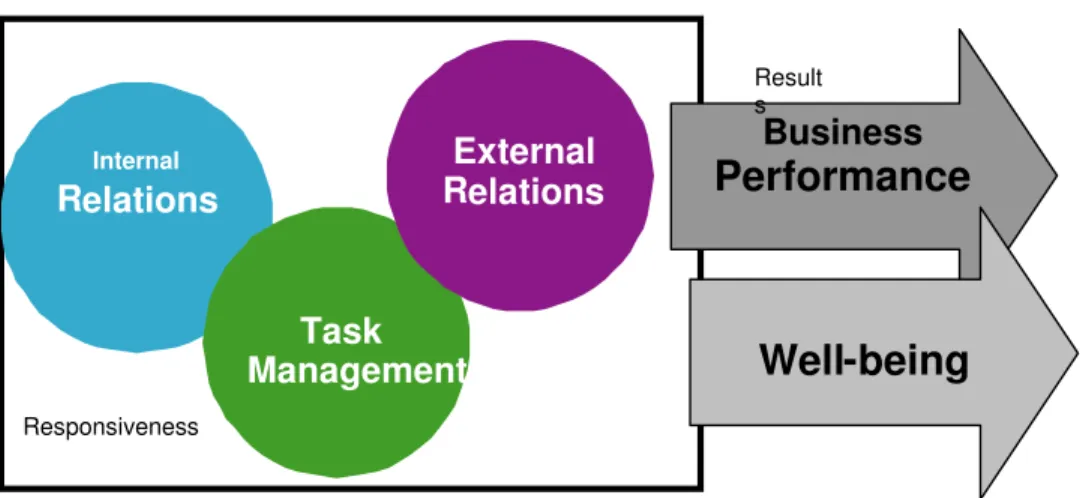
Responsibilities Responsiveness Result sservice teams at a Volvo Trucks plant in Sweden, a model of successful teamwork was developed that shows the importance of considering both these aspects of teamwork (Kuipers and Stoker [14]).
This model (see Figure 1), based on a general input-process-output model for teamwork, was further validated by replication of the study in a number of other team-based organizations in the Netherlands and Sweden, resulting in the development of a performability concept for teamwork.
We call this model as the 3R-Model of Teamwork. One of the R’s stands for Results, that is, the output of the model. The results of teamwork are central to teamwork In other words teamwork never should be a goal in itself. Rather, teamwork is especially useful when tasks need to be accomplished or goals need to be achieved that cannot effectively or efficiently be undertaken individually (Cohen, Ledford, and Spreitzer [7]). The first question a company should therefore ask itself is: “what do we want to achieve with teamwork?” Teams can contribute in two areas of performance: business performance and employee well-being. Specific goals can be formulated in both of these areas, such as using quality, productivity and costs as key-performance indicators for (‘hard’) business performance and measures for absenteeism, satisfaction and involvement for quantifying the (‘soft’) well-being of employees [12]. Before the implementation of teams or at least at the start of specific team development activities, organizations must be clear on their objectives or goals.
The input of the 3R-Model is expressed by Responsibilities. In fact, these responsibilities define the framework in which teams operate. The boundaries of this framework are set by outlining both the tasks and authority structure of the team. The team is also shaped by the available resources and leadership abilities within the team as they deliver products and services in pursuit of defined goals. Rules, standards and hierarchy limit the maneuvering space in which teams work as relatively independent and proactive units (Morgan [17]). However, a lack of clear guidance may make this maneuvering space for teams too wide and thus set expectations too high. Teams in such cases may struggle to reach their goals and eventually “drown”. Thus, there is a need for balance here in terms of both ‘hard’ and ‘soft’ aspects. Management must be clear on what it expects from teams by defining goals, tasks and rules, but it also needs to be clear about what teams can expect in terms of support, leadership and resources (Wellins, Byham, and Wilson [22]).
The process in this 3R-Model is finally reflected by Responsiveness. Responsiveness involves the ways in which teams actually behave and act in reaction to their given framework of responsibilities and goals (Kuipers [11]; Marks, Mathieu, and Zaccaro [15]). These behaviors and actions are the developmental processes by which teams transform responsibilities into results. Such processes do not occur naturally but rather are shaped by the expectations, support and leadership a team receives. Studies of several hundreds of teams, including production and service teams in both commercial and public organizations, show three basic processes (internal relations, task management and external relations) that express the responsiveness of teams [11, 14]. The Performability Scan has been developed to operationalize these processes. This is a survey that managers can distribute among members of a team to monitor the team’s development in each of these processes. The survey consists of 46 self-reported Likert-type items (1 = “strongly disagree”, 5 = “strongly agree”) based on some previously-discussed models of teamwork
[5, 8, 10, 20, 22]. It surveys team members on the three underlying dimensions of work teams:
• Internal relations, or “the way we work together”, indicates cooperation among team members, the way they handle conflicts and the extent to which they bond as a team through common planning and the realization of their common goals. • Task management, or “the way we organize our work”, indicate how the team
performs its tasks and utilizes its responsibilities.
• External relations, or “the way we deal with our customers and continuous improvements”, indicate how teams maintain their relationships with internal and external customers and suppliers and how they find new ways to improve products and processes.
These processes again show the need for balance in teamwork. To fully utilize the given maneuvering space, teams need to develop both a ‘soft’ approach involving cooperation within the team and with individuals outside the team (such as with customers), but also they also must develop a ‘hard’ approach as they plan and control their work efficiently and effectively in pursuit of their desired results.
4. Application of the Model
The model presented before should be seen as a dynamic model that requires careful monitoring. In many organizations, only the ‘hard’ outcomes are measured but, to fully support teams in their development, feedback is also required about team processes. Instruments, such as the Performability Scan, elucidate gain insights about the strengths and weaknesses of a team, which can be used to facilitate team development. In other words, the inputs can be modified by changing responsibilities, redefining tasks, updating goals and adjusting leadership. The Scan also helps in directly developing teams by using training activities, counseling in case of conflicts, improving team meetings and/or organizing activities between teams and customers to strengthen their relationships.
Nevertheless, the main focus remains on the results that are to be achieved, that is, both ‘soft’ and the ‘hard’ performance. Many organizations forget to measure team results or even give teams feedback about their performance. Although companies know exactly how much profit they make during a given period (Becker, Huselid, and Ulrich [1]), how many teams know the exact quality of results they deliver? Thus, there remains a big gap between what is expected from teams and what must be provided to them so that they can actually perform.
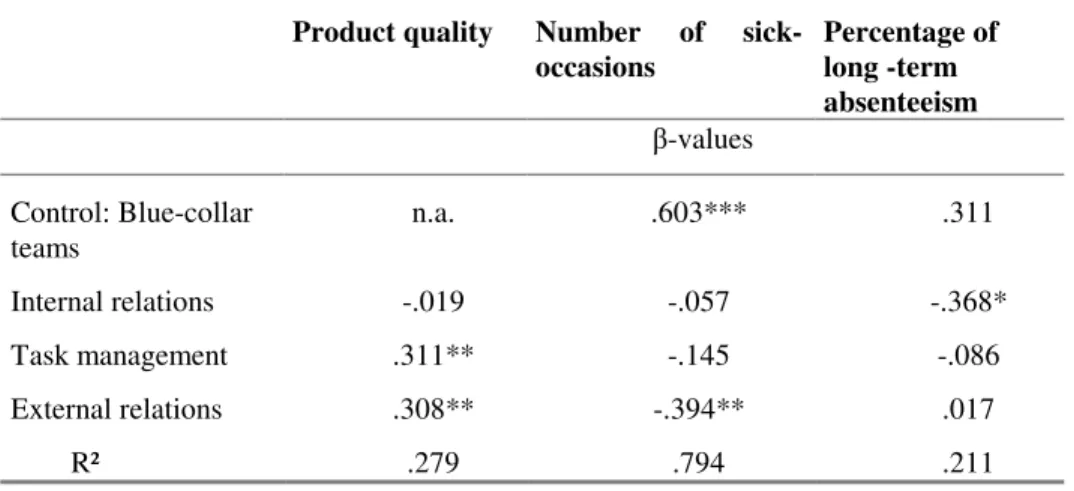
At Volvo Trucks in Sweden, it is quite common to measure quality figures, costs, utilization and absenteeism on a team level. The team processes of more than 160 teams were monitored over a 3-year period by administering the Performability Scan to more than 1600 employees and managers. By relating the data to performance figures, a statistical model was developed for a sub-set of the teams to clearly show how performance indicators can be improved by specific team processes (see Table 2).
The results of the regression model in Table 2 show a significant positive relationship between two of the team processes and the level of product quality in a team. That is, both the level of task management as well as external relations positively relate to one-year later product quality. The regression models for absenteeism were statistically controlled to account for any effects of worker type (that is, blue-collar versus white-collar workers) in the Volvo plant. These two groups only differ with regard to the number of sick days they took.
Table 2: Regression Results for One-Year-Later Business Performance and Quality of Working Life Measures
Product quality Number of
sick-occasions Percentage of long -term absenteeism β-values Control: Blue-collar teams n.a. .603*** .311 Internal relations -.019 -.057 -.368* Task management .311** -.145 -.086 External relations .308** -.394** .017 R² .279 .794 .211 *p<.05, **p<.01, ***p<.001
Generally, blue-collar teams have higher numbers of sick days than white-collar teams, whereas for long-term absenteeism, there is no significant difference. External relations seems to have a significant, negative relationship with the number of sick days; in other words, higher evaluations of external relations are related to lower one-year later sick days. Maintaining customer-supplier relationships may make people more committed to be at work than to stay at home when they do not feel well. They might feel more responsible, if not pressured, to be at work to satisfy the customers’ needs. Improvements in team processes, insofar as they are initiated by teams through their external relations, may also contribute to a healthier working environment. Internal relations show a significant, negative relationship with long-term absenteeism. This team process seems to be the only process with a significant effect as scores for internal relations become higher. Perhaps internal relations and a team’s attitude prevent long-term sick leave in earlier stages of a sickness, since team members benefit from their mutual attention to one another. These same dynamics may prevent a short-term sick leave turning into a long-term sick leave, since there is a feeling that the team cares for the sick member and vice-versa.
Table 3: The Performance Effects of Team Processes
Team processes Performance measures
internal relations better utilization and decreased long-term absenteeism
task management lower costs
external relations improved product quality and reduced short-term absenteeism
Source: www.performability.eu
Better team processes lead to better results (see Table 3). Besides the specific effects per process, the three processes combined also have clear positive effects on work satisfaction,
involvement and a reduction of stress in teams [11]. At Volvo, the concept of performability helped managers and teams create a common language to discuss teamwork. As a result, they now have a tool to more systematically discuss the development of teamwork with a clear focus on performance. Other companies have experienced the benefits of using this model and of monitoring teamwork with the Performability Scan; in doing so, they have been able to encourage more performance-oriented development activities.
In a waste-management company, the results of the Performability Scan were used to initiate a program to create a more customer-focused culture. The managers of about 25 teams were trained in workshops to engage in dialogues with teams about teamwork as well as to develop simple team plans to improve performance and customer orientation of teams. The program created more open communication and supported the development of leadership and result-responsible teams.
Several educational institutes were involved in projects using the Performability Scan to improve teamwork among teachers in order to support innovation in the educational system, as required by Dutch law. These projects revealed the importance of further developing both external relations and especially internal relations of teams, as teachers are more inclined by their profession to emphasize lone task management. Workshops were organized with teams to further develop common understandings in order to strengthen internal relations. The results showed that improving these relations not only increased teachers’ motivation and reduced stress related to changes in the educational system, but it also managed to further innovation in terms of objectively-measurable indicators.
A final noteworthy example comes from a project at an electronics plant, at which for years, the management has struggled with their approach to teamwork (Marshall [16]). First, a sociotechnical initiative was implemented in which team members were expected to cooperate across several shifts. This type of organization demanded substantial participation from all organization members especially when organizing meetings involving people of several shifts. Later when the performance appeared unsatisfactory, a different approach was employed that mostly involved using lean production principles to systematically reduce costs. Managers and teams still felt that more could be achieved with real teamwork, but they had difficulty in achieving this “real teamwork”. By using the Performability Scan, they were able to gain insights on how to encourage teamwork and thus combined a focus on both business performance and employee well being. The results showed an increase in commitment and a reduction in absenteeism on teams.
5. Conclusion
Teamwork is not just the latest management fashion. Throughout the years, many publications have shown the advantages of team-based organizations (Benders et al. [2]; Berggren [3]; Bettenhausen [4]; Campion, Medsker, and Higgs [5]; Dunphy and Bryant [8]; Grütter, Field, and Faull [9]; Sundstrom et al. [19]; Yeatts and Hyten [24]). However, teams need to be used and developed for a reason, as they are not a goal in and of themselves. Organizations can develop teams by starting to make clear what exactly they expect from them. As a consequence, they must put time and effort into creating a framework for teams in which they can develop and nurture their development processes. From managers, this demands a careful balance between focusing on ‘hard’ aspects of teamwork, such as rules and targets, and ‘softer aspects’, such as support, coaching and dialogue. Teams can be monitored regarding both their results as well as their processes.
Through monitoring teams, managers can create specific inputs to further develop the team processes that contribute most to the desired business goals as well as employee well being. Balancing these approaches leads to smarter teamwork, which has proven to provide better results (Kuipers [11]).
References
[1] Becker, B. E., Huselid, M. A., and Ulrich, D., The HR Scorecard, Linking people, strategy, and performance. Harvard Business School Press, Boston, 2001.
[2] Benders, J., Huijgen, F., Pekruhl, U., and O'Kelly, K. P., Useful but unused - Group work in Europe. European Foundation for the Improvement of Living and Working Conditions, Dublin, 1999 .
[3] Berggren, C., Alternatives to lean production: work organization in the Swedish auto industry. ILR Press, Ithaca, 1993.
[4] Bettenhausen, K. L., Five years of groups research: What we have learned an what needs to be addressed. Journal of Management, Vol. 17, No. 2, pp. 345-381, 1991.
[5] Campion, A. M., Medsker, G. J., and Higgs, A. C., Relations between work group characteristics and effectiveness: implications for designing effective work groups.
Personnel Psychology, Vol. 46, pp. 823-850, 1993.
[6] Cohen, S. G. and Bailey, D. E., What makes teams work: Group effectiveness research from the shop floor to the executive suite. Journal of Management, Vol. 23, No. 3, pp. 239-290, 1997.
[7] Cohen, S. G., Ledford, G. E., and Spreitzer, G. M., A predictive model of self-managing work team effectiveness. Human Relations, Vol. 49, pp. 643-680, 1996.
[8] Dunphy, D. and Bryant, B., Teams: Panaceas or prescriptions for improved performance.
Human Relations, Vol. 49, No. 5, pp. 677-699, 1996.
[9] Grütter, A. W., Field, J. M., and Faull, N. H. B., Work team performance over time: three case studies of South American manufacturers. Journal of Operations Management, Vol. 20, pp. 641-657, 2002.
[10] Katzenbach, J. R. and Smith, D. K., The wisdom of teams; Creating the high-performance organization. Harvard Business School Press, Boston, 1993.
[11] Kuipers, B. S., Team development and team performance. Responsibilities, responsiveness and results; A longitudinal study of teamwork at Volvo Trucks Umeå. PhD Thesis, University of Groningen, 2005.
[12] Kuipers, B. S. and De Witte, M. C., Teamwork: A case study on development and performance. International Journal of Human Resource Management, Vol. 16, No. 2, pp. 185-201, 2005.
[13] Kuipers, B. S., De Witte, M. C., and Van der Zwaan, A. H., Design or Development? Beyond the LP-STS debate; inputs from a Volvo Truck case. International Journal of Operations & Production Management, Vol. 24, No. 8, pp. 840-854, 2004.
[14] Kuipers, B. S. and Stoker, J. I., Development and Performance of Self-Managing Work Teams: A theoretical and empirical examination. International Journal of Human Resource Management. 2008 (In Press).
[15] Marks, M. A., Mathieu, J. E., and Zaccaro, S. J., A temporally based framework and taxomony of team processes. Academy of Management Review, Vol. 26, No. 3, pp. 356-376, 2001.
[16] Marshall, S., Input factors for team development in a shift-work organization: A study conducted at Philips Lighting Winschoten. Master's thesis, University of Groningen, 2006.
[17] Morgan, G., Organizational choice and the new technology, in The Socio-Technical Perspective, E. Trist and H. Murray, eds., University of Pennsylvania Press, Philadelphia, pp. 354-368, 1993.
[18] Morgeson, F. P., The External Leadership of Self-Managing Teams: Intervening in the Context of Novel and Disruptive Events. Journal of Applied Psychology, Vol. 90, No. 3, pp. 497-508, 2005.
[19] Sundstrom, E., McIntyre, M., Halfhill, T., and Richards, H., Work groups: From the Hawthorn studies to work teams of the 1990s and beyond. Group Dynamics, Vol. 4, No. 1, pp. 44-67, 2000.
[20] Tuckman, B. W. and Jensen, M. A. C., Stages of small group development revisited. Group and Organization Studies, Vol. 2, pp. 419-427, 1977.
[21] Van Hootegem, G., Benders, J., Delarue, A., and Procter, S., Teamworking: looking back and looking forward. International Journal of Human Resource Management, Vol. 16, No. 2, pp. 167-173, 2005.
[22] Wellins, R. S., Byham, W. C., and Wilson, J. M., Empowered teams: Creating self-directed work groups that improve quality, productivity and participation. Jossey-Bass, San Fransisco, 1991.
[23] Womack, J. P., Jones, D. T., and Roos, D., The machine that changed the world. Rawson Associates, New York, 1990.
[24] Yeatts, D. E. and Hyten, C., High-performing self-managed work teams: a comparison of theory, Sage, Thousand Oaks, 1998.
Ben S. Kuipers has a Ph.D. in management and is director of Performability in the Netherlands working with associated consultants throughout Europe. Part-time, he is Assistant Professor at Erasmus University Rotterdam and is currently involved in projects on human resource management, organizational change and teamwork. He has won several awards between 2001 and 2006 from associations in management, business economics, HRM and the Volvo Group for his research on team development and team performance.