Individualisation of Migration from the East? Comparison
of Diff erent Socio-Demographic Groups and their Migration
Intentions
Maarja Saar*
Abstract
Recent studies on Eastern European migration argue that moving for self-development reasons is becoming increasingly common among this group. Furthermore, it is suggested that migration from the East is becoming individualised and less dependent on social surroundings. Nevertheless, most such results rely on interviews conducted among certain social groups, such as the young and highly skilled. Hence, the comparison between diff erent social groups and their motivations is rarely provided and, therefore, the claims about increased individualisation might be premature. This article uses the Estonian Household Module Survey, including responses from 620 Estonians intending to migrate, to evaluate if migration fl ows are indeed becoming more individualised and less dependent on social surroundings. Using cluster analysis, three diff erent groups — self-development, economic and life quality migrants — are formed, which are then tested using regression analysis to check for the infl uence of socio-demographic variables. The article concludes that socio-demographic variables such as gender, age, ethnicity, family status and socio-economic status are still relevant for migration intentions. Indeed, a new group of Eastern European migrants, mainly oriented towards self-development, is emerging; however, it is small and consists mostly of young, Estonian-speaking females. The results complicate the notions of free mobility and liquid migration from Eastern Europe and illustrate that there is a need to pay attention to the increasing group diff erences in these societies.
Keywords: migration motives, individualization, Eastern Europe.
Introduction
Recent research on Eastern European migration has suggested that new mobility patterns are emerging. Instead of the stereotypical migrant, male and low skilled, looking for ways to accumulate money before returning to the home country (Drinkwater, Eade, & Garapich, 2009; Engbersen, Leerkes, Grabowska-Lusinska, Snel, & Burgers, 2013; Parutis, 2014), we see more and more highly skilled migrants that are interested in self-development, new cultural experiences, etc. Such mobility patterns have been related to the individualisation of these societies as well as to the prevalence of post-materialist values. Sommers and Woolfson (2014), on the contrary, claim that instead of the prevalence of post-materialist values, many people from the Baltics are motivated by economic troubles. The results from diff erent studies on Eastern European migration are indeed contradictory on the main motivation of migrants. This might be because the migration currents from Eastern Europe are becoming diversifi ed and more complex (Burrell, 2012; Engbersen et al., 2013; Morokvasic, 2004). However, apart from acknowledging the versatility, there has been very little eff ort to describe and explain such diversifi ed migration fl ows.
This article departs from the question of whether the versatility of migration motives of Eastern Europeans can be explained by their varying social background. Due to the qualitative nature of current research focusing on Eastern European migration and motivations, we lack suffi cient comparative data on the diff erences between social groups (Engbersen et al., 2013). Such discrepancies make it very diffi cult to understand the motivations of migrants in a more generalised manner, instead of focusing on individual stories. Hence, it is also very diffi cult to control for the individualisation of migration fl ows, since diff erent social groups and their migration motives are rarely compared. However, the claims on the individualisation of migration from Eastern Europe cannot be made solely based on the young and highly skilled.
This article analyses the connection between diff erent migration motives (intended) and socio-demographic variables. It uses quantitative data from the Estonian Household Module survey from 2008, which asked people if they intended to migrate and if so, for what reasons. Among 5500 respondents, 620 intended to move. The results will be analysed, fi rst to determine the infl uence of socio-demographic characteristics on migration motives, then using cluster analysis to identify diff erent groups based on migration motives, and fi nally employing regression analysis to determine if socio-demographic characteristics have any infl uence on determining to which group an individual belongs.
Estonia provides a good case for the study for numerous reasons: the extent of migration from the country, the rapidly increasing inequalities in the society, the prevalence of neoliberalist discourse, and proximity to the Western (Northern) societies. The aforementioned factors bring together the high emphasis on individualist and materialist values, increasing economic disparities, the strong stress put on individual responsibility for one’s economic wellbeing, and the proximity of potential places of exit. In a way, the country illustrates the cleavage present in most Eastern European societies, which so far has been mainly overlooked by migration studies.
The changing nature of Eastern European migration
Migration from Eastern Europe has traditionally been related to economic motives. However, several scholars have recently criticised such stereotypical representation of Eastern European migration (Black, Engbersen, & Okólski, 2010; Ciupijus, 2011; Burrell, 2010). Especially young and highly skilled Eastern Europeans are suggested to be part of a new generation of mobile Europeans for whom moving abroad is not only work-related but also involves lifestyle choices as part of a broader aspiration for self-development (Black, Engbersen, & Okólski, 2010; Krings, Bobek, Moriarty, Salamońska, & Wickham, 2013). Such changes have been connected with the transformations in these societies, such as individualisation, the introduction of the free EU mobility space, the increase in post-materialist values, and the importance of the project of the refl exive self. Overall, it is suggested that individuals no longer fi t into traditional categories such as family or class, but are forced to engage in refl exive decision-making about their lives. Mobility is part of such refl exive decision-making, as fl exibility becomes a requirement for the individuals in the second modernity. According to Engbersen, Snel, & Boom (2010), many migrants postpone marriage and having children, moving when they are single and have few family obligations.
Still, some argue that in addition to self-development related motives, Eastern Europeans do migrate with their families for the purpose of improving their family’s livelihood. In fact, Botterill (2014) criticised research on Eastern European migration for focusing only on the experiences of young, single people, often with an emphasis on patterns of individualised mobility as characteristic of post-accession migration. Both Botterill (2014) and McGhee, Heath, & Trevena (2012) argued that securing a livelihood for one’s family and living an economically more secure and sustainable life has been a concern for many Polish migrants. Drinkwater et al. (2009) have suggested that the category of
A8 (new accession countries) migrant worker needs to be questioned. According to them, A8 migrants engage in diverse migration strategies that encompass a range of movements from short-term movements linked to specifi c working contracts through to permanent settlement. Furthermore, Trevena, Glorious, Grabowska-Lusinska, and Kuvik (2011) have developed three diff erent categories of Eastern European migrants: target earners, whose main objective is to accumulate enough money for the purpose of investing in their home country; career-seekers, who wish to develop their career abroad; and fi nally drifters, who pursue goals other than professional advancement or saving for investment.
Nevertheless, most studies that aim to describe diff ering migration motives among Eastern European migrants are qualitative. Even though these studies provide a valuable contribution to understanding the versatility of diff erent migrants groups, what is currently lacking is a comprehensive overview of the social background of these dissimilar migrant groups (see also Engbersen et al., 2013). Although there is evidence that motives of Eastern European migrants diff er, we are left in the dark as to why such diff erences have emerged. Furthermore, if Eastern European migration has in fact individualised, such diff erences might not be explainable by the diff erent social background of these people. However, in order to check whether that is really the case, we would need to test the connection between migration motives and social characteristics.
As most of the research has favoured the theory on free mobility, there is little data on how socio-demographic variables infl uence current migration motives. Cook, Dwyer, & Waite (2011) suggested that the experiences of Eastern European migrants are more complicated than currently stated and depend on factors such as gender, ethnicity, qualifi cations, language, skills, etc. In migration research, the former biography has been mainly stressed by contextualist research on the 90s and currently by lifestyle migration research, which argues that the middle class is being increasingly characterised by new mobility patterns. In addition, there has been an assumption that the highly skilled tend to move for career advancement and cultural enrichment, whereas the low skilled generally consider economic factors more important (Conradson & Latham, 2005; Kennedy, 2010). When it comes to gender diff erences in migration patterns, several researchers have criticised the underlying assumption that women would mostly move for family reasons (Bilsborrow & Schoorl, 2006; Kofman, 2000). Furthermore, there is a lack of studies on how ethnicity infl uences migration motives. Only Aptekar (2009) and Cook et al. (2011) have noted that in addition to economic reasons, minorities (Russian speakers in Estonia and Roma) tend to move because of discrimination in the sending countries. Finally, there are no studies on how family status infl uences migration motives.
Most of the aforementioned studies focus on Western European migrants; however, due to the rapid changes following the dissolution of the Soviet Union, the impact of socio-demographic variables on migration motives might diff er signifi cantly in these societies. In addition, Horváth (2008) has stressed that it is important to consider values as potential drivers of migration, and several studies have illustrated that in Eastern European countries only the younger generation is infl uenced by post-materialist values that are so common in the West (Drinkwater et al., 2009). However, the research focusing on Eastern Europeans and the infl uence of socio-demographic variables on their motives is qualitative (Engbersen et al., 2013). Hence, there is very little comparative material on how variables such as gender, ethnicity, socio-economic status, family status and age infl uence migration patterns from Eastern Europe.
However, studying migration patterns, specifi cally migration motivations, is a daunting task not the least due to the fact that we can either study those who intend to migrate or the actual migrants. In both cases, the motives that are stated might depart from the motives at the moment of migrating. If we are to study those who have migrated, the motives stated at the moment of survey might vary from the motives at the time of migration. On the other hand, if we study those who intend to migrate, our study might include migrants who never carried out their plans. In this article, I have chosen to study migration intentions and, hence, will add some comments on the relationship between
migration intentions and the actual migration. A growing number of academics have started to use migration intentions as approximations of actual migration; however, more research is needed on the match between the two (see van Dalen & Henkens, 2008). According to Castaldo, Litchfi eld, & Reilly (2005), migration intentions provide information on whether the individual has considered migrating, therefore, these individuals could be considered as predisposed towards migrating. However, scholars have also found that there are gaps between intended and actual migration (see Krusell, 2009); not everyone who intends to migrate actually does so. Gordon & Molho (1995) have found that among internal migrants who had intentions of moving, 90% did so within fi ve years. Böheim & Taylor (2002) showed that those respondents who express an intention to move are three times more likely to move than those not expressing any intention. Finally, van Dalen & Henkens (2008) found that 24% of those intending to move had done so within two years of the interview; however, they suggest that more respondents probably did subsequently migrate. Such varying results might, of course, lead to potential problems in using motives of intentions as proxies for understanding migration behaviour. However, one can hypothesise that migration intentions and retrospective migration motivations might refer to diff erent things. While migration intentions might be more closely connected to the societal discourses, retrospective motivations might be related to migrants’ experience in the host country. Hence, I would say that using intentions is not a problem, if they are analysed as an indication of the host society and its mentalities.
Estonian society, migration, inequalities and value structure
According to data from Statistics Estonia, about 18000 people have left Estonia during the last three years. If we include the incoming migrants (many are return migrants), net migration is approximately 9000. The high number of return migrants suggests that Estonia is experiencing much circular migration. According to the most conservative estimations, 1.5% of the total population has migrated during the last ten years (see Krusell, 2009). However, Hazans and Philips (2010) have noted that if commuters are taken into account, the number of potential migrants can go up to 4.5 % of the total population. When it comes to the portrait of an average Estonian migrant, Hazans and Philips (2010) have suggested that most migrants are young and with secondary education. Randveer & Rõõm (2013) add that males and blue-collar workers are most likely to move. This is supported by the fi ndings of Anniste, Tammaru, Pungas, and Paas (2012), which demonstrate that highly educated people are less likely to leave Estonia. For many people, the underlying objectives for migration are economic (see Krusell, 2009). Nevertheless, other causes, such as improving language skills and gaining new cultural experiences, are also becoming important. As Kõiva, Käsper, Elme and Murruste (2010) have indicated, cultural experiences and self-development purposes dominate, especially among the highly educated group. This is supported by research on other Eastern European countries, where an increase in self-development related motives has been noticed. Jakobson, Kalev and Ruutsoo (2012) have identifi ed two main groups of Estonian migrants moving to Finland. The fi rst group consists of those with economic problems seeking better wages, and the second group comprises strategically recruited and highly skilled people, for whom that might have not been the fi rst migration experience. Still, most of the aforementioned studies are qualitative and a comprehensive study comparing diff erent socio-economic groups in the society is yet to be carried out.
In order to formulate hypotheses about diff erent social groups and their migration motives, I will analyse both inequalities as well as value structure in Estonian society. In Estonia, the structural and economic reforms have been the most radical ones amongst the post-socialist CEE countries (Bohle & Greskovits, 2007). One result of privatisation and rapid market liberalisation was a sharp rise in social inequalities. The main losers in this process were those in lower occupational positions, especially those in the agrarian and manufacturing sectors. Due to the strong infl uence of neoliberal
ideology, the consequences of structural unemployment were often felt mainly by individuals, leading to a situation where many people internalised the message of being agents separated from social infl uences (Heinla, Tart, & Raudsepp, 2013; Vihalemm & Kalmus, 2008). Woolfson (2009), Sippola (2013) and Lulle (2009) have argued that many individuals responded to neoliberal policies by ‘voting with their feet’ — migrating. Sommers and Woolfson (2014) have argued that especially after the economic crisis, Baltic States have experienced a new outfl ow of individuals, to whom they refer as the austeriat. The austeriat, mainly the young and unemployed, uses free mobility as a survival strategy. However, Sommers and Woolfson (2014) as well as Saar and Jakobson (2015) argue that more and more families are found among migrants. Still, it is somewhat unclear who exactly belongs to the austeriat group.
Vihalemm and Kalmus (2008) have argued that the Estonian value space has experienced considerable changes since the collapse of the Soviet Union. According to them, societal structures have been undermined and individual success is considered more important than the common good. According to Slater, consumer culture and its values are gaining ground in the country, and many people, especially among the younger generation, put great emphasis on material and social success. Saarniit (1998) has called this the process of individualistic pragmatisation of the Estonian value space. Nevertheless, such a process is most noticeable among those born in the 70s and the beginning of the 80s. For those born in the 90s, social and altruistic values are more important (see Rämmer, 2009). Women as well as Estonian speakers tend to also have a more post-materialistic orientation. Furthermore, women and men also occupy diff erent economic sectors, women being overrepresented in education, health and social care, whereas men dominate in business and industry (Masso, 2010), which to some degree leads to diff erent values. In terms of migration, such value diff erences in the society might indicate varying motives. For instance, it is likely that men and Russian speakers would migrate more for economic reasons. Hence, it is important to consider not only the material conditions of diff erent socio-demographic groups, but also their value orientations.
As briefl y mentioned above, there are signifi cant diff erences between the values held by Russian (30% of the population) and Estonian speakers. The background for diff erent values, as well as the potentially diff ering migration motives, is the materially and politically deprived situation of many Russian speakers (see Saar, Lindemann, & Helemäe, 2009). Because of such deprivation they are more likely to value material success more, especially the members of the older generation (Vihalemm & Kalmus, 2008). According to Rämmer (2009), value diff erences in Estonian society do not follow ethnic lines, but rather generational ones. Furthermore, Aptekar (2010) has claimed that among Russian speakers moving from Latvia and Lithuania, material reasons dominate, but many Estonian Russians fl ee due to political discrimination.
Overall, it is important to note that both material conditions as well as particular values held by certain social groups can have an impact on their migration behaviour. On the one hand, Estonia provides a case that inspires some migrants to fl ee from its neoliberal conditions and policies. On the other hand, many people have internalised both neoliberal values as well as individual responsibility for their lives (see Kalmus & Vihalemm, 2006). In terms of migration, that means that there can be signifi cant diff erences in potential motives and attitudes.
Based on the previous, I formed the following hypotheses:
First, as noted, Russian speakers tend to be in deprived situations in Estonian society and value material wellbeing more than Estonian speakers do. Estonian speakers, on the other hand, tend to aspire to high social positions and success. Therefore, I suggest:
1. Russian speakers intend to migrate more for fi nancial reasons, whereas Estonians tend to go because of the career potential.
Second, as several scholars have suggested, women are more socially oriented when it comes to migration, whereas men are more materialistic and focus on success. Therefore, I suggest:
2. Women intend to migrate more for social reasons, whereas men have fi nancial motives.
Third, based on theory, the highly skilled are seen more as being interested in career development, whereas the low skilled are motivated to migrate due to economic constraints. Also, as Kalmus and Vihalemm (2006) suggested, personal harmony seems to be more relevant to more highly educated people. Therefore, I propose:
3. People with lower education and occupational status intend to move more for fi nancial reasons than is the case for highly skilled people.
Fourth, I assume that since those who are married are less likely to migrate, they do so because of structural constraints such as unemployment or poverty.
4. Married people intend to move because of structural constraints such as an inability to fi nd a job or fi nancial diffi culties.
Finally, as mentioned above, several scholars have suggested that younger people migrate for self-development reasons and for career success, whereas older migrants move for economic reasons. However, Olofsson and Westin (2011) suggested that older people are more socially oriented, while Kalmus and Vihalemm (2006) claimed that younger people in Estonia are more materialistically oriented. Therefore, I would suggest:
5. Older people intend to move more for social and life quality reasons, whereas younger people are motivated by career success and material benefi ts.
Methodology
The data analysed in this study is based on an Estonian household module survey carried out in 2008 and 2009. The survey included various questions on subjects ranging from one’s phone usage to trips to foreign countries. In this article, only one module of the survey, the one regarding migration motives, is used. The survey had 5596 respondents, of whom 620 said that they were considering migrating. (The exact question was: Do you plan to work in a foreign country in the next fi ve years?) First, logistic regression analysis was carried out based on migration intentions to get a better overview of the socio-demographic characteristics of those who were planning to migrate. Those considering migration could choose between seven diff erent motivations: fi rst, better income; second, the possibility of improving language skills and experiencing another culture; third, better working conditions; fourth, better living conditions; fi fth, new experiences and professional development; sixth, family reasons; and seventh, lack of jobs in their profession in Estonia. These motivations were coded as binary in the data fi le. Based on the answers to the question about motivations, I formed three groups using K-means cluster analysis (the description of the groups is in the empirical part of the study). Second, I performed multivariate logistic regression analysis, which allowed me to analyse how socio-demographic variables infl uence migration motivations and also to see the infl uences of the variables. I included six diff erent variables: gender, occupational status, family status, language, education and age. Regression analysis was executed in four stages, resulting in four models. In the fi rst model, I included gender, age and language as demographic variables; in the second stage education was added; in the third, occupational status; and, fi nally, family status. I will now describe some of the variables in more detail.
Based on education, people were divided into fi ve groups: those with elementary and basic education, those with vocational education, those with secondary education, those with secondary specialised education and, fi nally, those with higher education. Labour market status was distinguished as follows: students or those temporarily at home (both have the intention to return to the labour
market and, therefore, diff er from the unemployed); managers and professionals; semi-professionals and clerks; service workers; skilled and unskilled workers (a lot of cases will be in de-skilled positions in the foreign country because there are problems with recognising qualifi cations inside EU); and the unemployed. Based on language, people were separated into those whose primary language was Estonian and others (primarily Russian speakers). Age groups were: 15-19; 20-29; 30-39; 40-49 and 50-59 (I excluded older people from the analysis, since there were so few). Finally, in family status, married, cohabiting, single and divorced were included.
Results
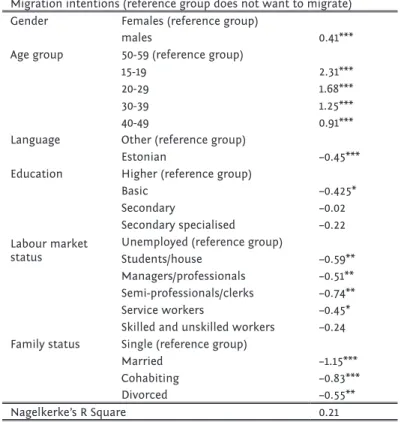
First, I will describe the group that intended to migrate based on the abovementioned six variables. As we can see from Table 1, males are more likely to want to move than females. Based on the age group, younger people are more prone to migrate than the oldest age group. People whose mother tongue is diff erent from Estonian are also more likely to become potential migrants. Surprisingly, education does not have a strong infl uence on people’s migration intentions; only people with basic education are less likely to have an intention of moving compared to those with higher education. Compared to unemployed people, almost all other groups are less likely to consider moving. Only those in blue-collar jobs are as likely to become potential migrants. Finally, single people are more likely to consider moving than all other family status groups.
Table 1: Regression analysis — migration intentions based on socio-demographic variables (B regression
coeffi cients)
Migration intentions (reference group does not want to migrate) Gender Females (reference group)
males 0.41***
Age group 50-59 (reference group)
15-19 2.31***
20-29 1.68***
30-39 1.25***
40-49 0.91***
Language Other (reference group)
Estonian –0.45***
Education Higher (reference group)
Basic –0.425*
Secondary –0.02
Secondary specialised –0.22 Labour market
status
Unemployed (reference group)
Students/house –0.59**
Managers/professionals –0.51** Semi-professionals/clerks –0.74**
Service workers –0.45*
Skilled and unskilled workers –0.24 Family status Single (reference group)
Married –1.15***
Cohabiting –0.83***
Divorced –0.55**
Nagelkerke’s R Square 0.21
Second, I will analyse the motivations for migration and their popularity. However, before going to my analysis I would like to make a short comment on the diff erences between the motives of those who intend to migrate and those who have migrated. As my data also included people who have carried out their migration plan, a separate group not included in this analysis, I can say that the diff erence between the reasons for migrating and intending to migrate were not great. The most signifi cant diff erence was that those who had migrated regarded the improvement of living and working conditions as more important factors for moving than was the case with those intending to move. The explanation for this may be that these factors might have become important only afterwards, but might also be related to the specifi cs of the group that returned after migration. Although there is a gap between those who carry out migration and those who solely intend to migrate, at least according to my data the diff erences in motivations for migration between these groups are not big. Table 2 illustrates all the reasons that were considered important for migration by respondents — this means that one person could choose more than one reason for migrating. As can be seen from the Table 2, better income was the most important reason for those people who were planning to migrate, 92% considered it signifi cant. Also, professional development and the benefi ts of being exposed to other cultural and linguistic environments were vital as migration motives. Family reasons proved to be the least signifi cant for people intending to migrate (10%), followed by the lack of professional opportunities.
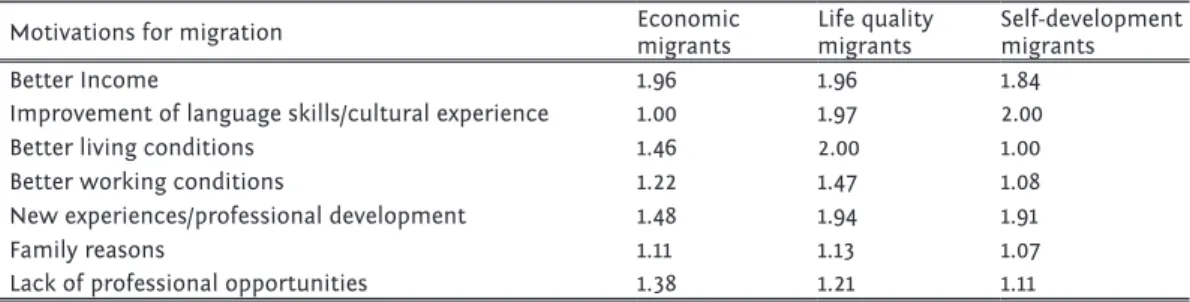
Based on the migration incentives, I distinguished three diff erent clusters (see Table 2). I chose to use three cluster versions because in this case the diff erences between the groups were notable and also each group was big enough to be representable. Respondents could choose whether the reason was important for migrating or not. The fi rst cluster can be characterised as consisting of people whose main incentives for migrating are economic. Other reasons are less signifi cant, although maybe it is worth noting that given the small number of people for whom a lack of professional opportunities
Table 2: The popularity of migration motives, %
Motivations for migration Agree
Better income 91.6
New experiences/professional development 84.0 Improvement of language skills/cultural experience 79.7
Better living conditions 54.1
Better working conditions 28.4
Lack of professional opportunities 21.5
Family reasons 10.3
Source: author’s calculations based on Household Module Survey 2008
Table 3: Three clusters based on migration motives
Motivations for migration Economic
migrants Life quality migrants Self-development migrants Better Income 1.96 1.96 1.84
Improvement of language skills/cultural experience 1.00 1.97 2.00
Better living conditions 1.46 2.00 1.00
Better working conditions 1.22 1.47 1.08
New experiences/professional development 1.48 1.94 1.91
Family reasons 1.11 1.13 1.07
Lack of professional opportunities 1.38 1.21 1.11
Note: scale: 1—not important; 2—important
was a push factor it proved to be more important for the fi rst cluster. The fi rst cluster then can be called ‘potential economic migrants’. In the second cluster, people regard several benefi ts, such as better income and living conditions, professional development and language skill improvement as relevant. They can, therefore, be termed ‘potential life quality migrants’, taking into consideration multiple aspects of the environment, not only economic gains. Criticism of local politics could also be behind this group’s motivations, as they ‘vote with their feet’ (see Lulle, 2010). In the third group, improved language skills and professional development are seen as most signifi cant. Unlike for the two other groups, income is less relevant as a reason for migrating. Also, better living conditions appear totally irrelevant in making a decision. Hence, I have decided to call this group the ‘potential self-development migrants’ (for ease of reading I will subsequently leave ‘potential’ out of the names of the clusters). In the following, I will briefl y describe the average person belonging to each cluster.
Among economic migrants there were more people from Eastern Estonia, speaking mainly a language other than Estonian (primarily Russian). Those people were older than the average respondent and were likely to have a family. There were more men than women and more blue-collar workers than members of any other occupational group among potential economic migrants. The unemployed were overrepresented as well. A big share of life quality migrants were working in service. In terms of the location, Central and Western Estonia were dominant (rural areas with sometimes higher unemployment). The average respondent belonging to this group was rather young (20-29) and single. Finally, self-development migrants had higher professional status (managers, professionals). Women and Estonians were overrepresented. Also, members of the youngest age group (15-19) were more likely to belong to this cluster.
Next, I will discuss the results of the regression analysis. As a reference group, I chose self-develop-ment migrants since this group diff ered more from the two others. Between the two other groups, the diff erences in terms of socio-economic variables were not as big and statistically signifi cant.
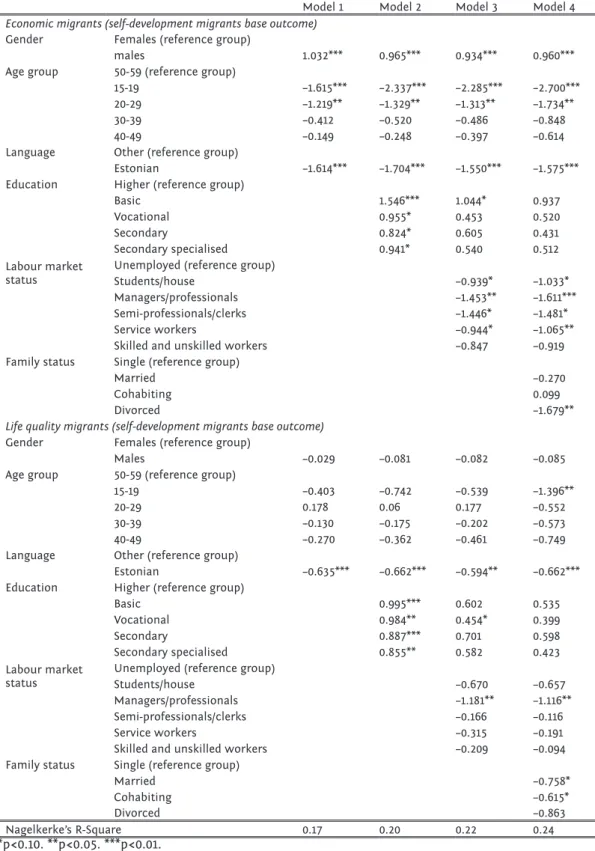
The impact of gender proved to be signifi cant in all four models. Males were more likely to become economic migrants than self-development migrants compared to females, whereas there were no gender diff erences in the odds of becoming a life quality migrant. This means that material motives were more important for men, whereas for women, self-improvement was seen as a signifi cant reason for migrating. To a certain degree, this follows my earlier hypothesis where I claimed that men are more likely to be motivated by the material gains of migration. Still, it is also important to note that there were no diff erences in belonging to the second cluster in comparison with the third, meaning that women were less likely to be migrating for social reasons than for self-development purposes, which somewhat challenges my hypothesis. There are many explanations for such diff erentiation based on gender. First, men and women have distinct occupations in Estonian society. Since my statistical data also included information on the economic sector of work, I also checked for the infl uence of gender when adding this variable to the model. It appeared that the infl uence of gender decreased signifi cantly when adding in the economic sector. Indeed in certain fi elds, migrating for self-development reasons was more likely than in others. A second possible explanation for the diff erences between the motives is the dominance of gender roles in Estonian society, where men are expected to be the income earners, whereas women, especially younger women, seem to favour the idea of lifelong learning. Also, some women might feel that due to the dominant gender roles in Estonian society, their professional growth is limited and they might consider moving for career advancement reasons. One should also diff erentiate between what is considered as a valid explanation for migrating and what is behind the actual motives. In that case, my results do not state that men are less interested in self-development, but they might just show that it is less socially acceptable for them to declare their interest in this area, compared to being economically successful.
When it comes to age, younger people were less likely to become economic migrants than self-development migrants compared to the oldest age group. However, there were no signifi cant diff erences in the odds of becoming a life quality migrant. Still, when adding family status to the
Table 4: Multinomial regression analysis — the likelihood of belonging to the clusters based on socio-demographic variables (B regression coeffi cients)
Model 1 Model 2 Model 3 Model 4 Economic migrants (self-development migrants base outcome)
Gender Females (reference group)
males 1.032*** 0.965*** 0.934*** 0.960***
Age group 50-59 (reference group)
15-19 –1.615*** –2.337*** –2.285*** –2.700***
20-29 –1.219** –1.329** –1.313** –1.734**
30-39 –0.412 –0.520 –0.486 –0.848
40-49 –0.149 –0.248 –0.397 –0.614
Language Other (reference group)
Estonian –1.614*** –1.704*** –1.550*** –1.575***
Education Higher (reference group)
Basic 1.546*** 1.044* 0.937 Vocational 0.955* 0.453 0.520 Secondary 0.824* 0.605 0.431 Secondary specialised 0.941* 0.540 0.512 Labour market status
Unemployed (reference group)
Students/house –0.939* –1.033*
Managers/professionals –1.453** –1.611***
Semi-professionals/clerks –1.446* –1.481*
Service workers –0.944* –1.065**
Skilled and unskilled workers –0.847 –0.919
Family status Single (reference group)
Married –0.270
Cohabiting 0.099
Divorced –1.679**
Life quality migrants (self-development migrants base outcome) Gender Females (reference group)
Males –0.029 –0.081 –0.082 –0.085
Age group 50-59 (reference group)
15-19 –0.403 –0.742 –0.539 –1.396**
20-29 0.178 0.06 0.177 –0.552
30-39 –0.130 –0.175 –0.202 –0.573
40-49 –0.270 –0.362 –0.461 –0.749
Language Other (reference group)
Estonian –0.635*** –0.662*** –0.594** –0.662***
Education Higher (reference group)
Basic 0.995*** 0.602 0.535 Vocational 0.984** 0.454* 0.399 Secondary 0.887*** 0.701 0.598 Secondary specialised 0.855** 0.582 0.423 Labour market status
Unemployed (reference group)
Students/house –0.670 –0.657
Managers/professionals –1.181** –1.116**
Semi-professionals/clerks –0.166 –0.116
Service workers –0.315 –0.191
Skilled and unskilled workers –0.209 –0.094
Family status Single (reference group)
Married –0.758*
Cohabiting –0.615*
Divorced –0.863
Nagelkerke’s R-Square 0.17 0.20 0.22 0.24
*p<0.10. **p<0.05. ***p<0.01.
model, the youngest group was less likely than the age group 50-59 to become life quality migrants, compared to becoming self-development migrants. The latter group fi ts my hypothesis, where I stress that older people should be more interested in improving their life quality. However, contrary to this hypothesis, economic motives proved to be less important to the youngest compared to the eldest. A possible explanation may be the strong prevalence of the neoliberal discourse that stresses individual development and career success, which makes the younger people put a high value on these factors. In addition to this, many younger people might be interested in migrating for study purposes and then later decide to stay for work. This, therefore, makes fi nancial reasons irrelevant and puts stress on new experiences and self-exploration. However, this does not mean that fi nancial motives are irrelevant in the long run since good educational credentials or excellent language knowledge can increase the chances of success in the labour market, both in the homeland as well as in the host country.
Estonian speakers are less likely to become economic and life quality migrants than self-development migrants, compared to the Russian speakers. This also fi ts my hypothesis, in which I stressed that Russian speakers are probably more motivated by economic gains due to their deprived situation in Estonian society. However, it was somewhat surprising that migrating for self-development is also a more important motive for Estonian speakers than life quality reasons, compared to Russian speakers. One could assume that being economically deprived and working in low status jobs, Russian speakers would also feel that their life quality was suff ering and that it could be enhanced by moving away. Seeing migration as a means to improve life quality could indicate discrimination in Estonian society. Also, coming from the lower social positions, Russian speakers might see their migration more as a response to structural constraints, rather than a free choice shaping their own individual life path. Finally, when it comes to the value structure of Estonian speakers, they put great stress on achieving success and a high position in society. Migration for self-development purposes might, therefore, be seen as a means of obtaining a higher position.
According to model 2, all educational groups except the more highly educated are more likely to become economic migrants than self-development migrants. However, when we add the labour market situation to the model, the eff ect of education diminishes. This means that education mainly has an infl uence through the labour market situation. Therefore, we can say that when it comes to migration intentions, the labour market position plays a key role. The reason why migration intentions are connected to occupational status might be merely due to practical considerations, meaning for instance those working in blue-collar jobs might intend to move for economic reasons more than others because they would experience the greatest increase in salary. Still, those with basic education are more likely to become economic migrants than self-development migrants compared to those with higher education, whereas those with vocational education have higher odds of becoming life quality migrants than self-development migrants compared to the higher educated. The second phenomenon might be explained by people with vocational education perceiving their working environment as bad in Estonia and seeing more advancement in this respect when moving abroad, than those with higher education.
All other groups apart from blue-collar workers are less likely to migrate due to economic motives than for self-development reasons, compared to the unemployed. This is quite logical taking into consideration that economic troubles can be relevant for the unemployed, especially considering very low unemployment benefi ts in Estonia (approximately 100 euros a month). Similarly, blue-collars might imagine their life in terms of lacking material necessities rather than as a project of self-development. Moreover, for them the fi nancial gains might be the highest. Professionals and managers also have lower odds of becoming life quality migrants than self-development migrants, when compared to the unemployed. This might stem from the fact that their living and working conditions as well as life quality are already comparatively good in Estonia. Therefore, they perceive professional development as a valid reason for migrating. In addition, lower educated people might expect to advance less professionally by moving than those with high skills. Therefore, their experiences in foreign countries
might not be that relevant for their CV. When adding the impact of the family status to the model, managers, professionals and service workers are even less likely to become economic migrants than self-development migrants in comparison to the unemployed.
Finally, cohabiting or married persons are less likely to belong to the life quality migrants group than self-development migrants compared to those living alone. This is a somewhat interesting result and a potential explanation could be that the perception of life quality might be infl uenced by both the double income as well as having a partner. If people with a partner evaluate their life quality as higher than those who are single, it is only natural that this is not important as a reason for migrating. Second, those who are divorced are less likely to become economic migrants than self-development migrants compared to those who are single. This is also a somewhat unexpected and interesting result. One possible explanation could be that those having overcome divorce become more conscious about shaping their lives and developing themselves, and they want to take a more proactive role in this through migration. In addition, recreating one’s identity and establishing a new system of values is easier abroad, so migration and the recovery process from an important life event might go hand in hand in this case.
Conclusion
The main objective of this article was to test the alleged individualisation of Eastern European migration. Several studies have noted that Eastern European migrants are more oriented towards self-development and their migration motives have become individualised. This article, however, has demonstrated the opposite. By checking for the impact of socio-demographic variables on migration motives, the article found that there were signifi cant diff erences between various social groups. The article has distinguished between three kinds of migrants: self-development migrants, economic migrants and life quality migrants. The results show that self-development migrants are likely to be young, highly educated, female, Estonian speakers and divorced. This is concurrent with the qualitative studies on Eastern European migration, which claim the new mobility patterns to be characteristic of the young and highly educated. However, these results also bring out the impact of gender roles as well as ethnicity and marital status, which have so far received very limited attention. The second group, economic migrants, are more likely to be older, blue-collar, Russian speakers and male. This confi rms the assumptions that younger people in Eastern Europe are increasingly inspired by post-materialist values, whereas the older generation still holds on to materialist values. However, the diff erences can also be explained by the increasing responsibilities related to aging, such as taking care of the family and relatives. Finally, life quality migrants are more likely to be either cohabiting or married, and in terms of most other variables stand between economic and self-development migrants. These results indicate that life quality migrants might move with their family for the purpose of improving the family livelihood.
Even though one can see some signs of new mobility patterns in the studied population, these relate to a very specifi c population. The group of self-development migrants is smaller than the two other groups and includes mainly young, highly skilled females. Many qualitative studies have indeed argued that it is the young and highly skilled who are more likely to have other motivations than economic concerns. However, this has not yet been checked quantitatively. Furthermore, rather little attention is given to the fact that there is a contradiction in claiming that migration from Eastern European countries has become individualised, while also suggesting that these individualised patterns characterise mainly the young and highly skilled. Whereas it might be true that the young and highly skilled see their life plans as a result of individualised refl ection, they are by no means acting independently of their social surroundings. Hence, it would be useful to distinguish between individualisation on a discursive level and individualisation in an individual’s behaviour.
To continue, few migration studies have paid attention to the increasing inequalities in Eastern European societies. On one hand, there is a group consisting of young, highly skilled people that have many opportunities, and for whom migration is mainly an act of liberation. On the other hand, there is an aging, socio-economically challenged group that migrates mostly for economic reasons and for whom moving is not desirable. Such results point out the societal inequalities where the young and highly educated can aff ord to view migration as a self-development strategy, whereas for the elderly it is a survival mechanism (see also Saar & Jakobson, 2015). There is also a third group, which is family-centred and values social security and is, therefore, attentive to a wide range of conditions infl uencing life quality. This group is most likely more versatile, which is also refl ected in the results, as it had very few strong correlations with socio-demographic variables. According to Saar and Jakobson (2015), this group probably includes people ranging from struggling single parents to wealthy couples.
The infl uence of socio-demographic variables can be partly explained by the emergence of class society in many Eastern European countries and the increase of material inequalities, but also by the value changes in these societies. Several Eastern European countries have seen a rapid increase in social disparities. However, such inequalities often run along socio-demographic lines, due to the advantages that were present for the younger, Estonian-speaking male population in the nineties. It is also important to note, according to Sippola (2013), that as a result of neoliberal policies, managing was put on the shoulders of individuals for whom migration becomes one potential solution. Hence, although mostly overlooked, neoliberalist policies in Eastern European societies have had a great eff ect on migration fl ows. However, this is not the complete picture as the value structure in these societies is also a potential explanation for the diff erence between migration intentions. Whereas the older generation, males and Russian speakers are more materialistically oriented, younger, highly skilled people have adopted post-materialist values. Hence, there is a strong connection between values and socio-economic wellbeing, which is refl ected in migration patterns. Currently there are many contradictory claims about Eastern European migration, starting from Woolfson’s rather dark vision of Baltic migrants belonging to the austeriat, and ending with Kring et al.’s (2013) much more positive tone about the empowerment and experimentation of Polish migrants in the UK. If we were to analyse the background of the studied migrants more carefully, we could produce a more detailed picture of Eastern European migration fl ows.
References
Anniste, K., Tammaru, T., Pungas, E., & Paas, T. (2012). Emigration After EU Enlargement: Was There a Brain Drain Eff ect in the Case of Estonia. University of Tartu–Faculty of Economics and Business Administration Working Papers Series, 87, 20.
Aptekar, S. (2009). Contexts of exit in the migration of Russian speakers from the Baltic countries to Ireland.
Ethnicities, 9(4), 507-526.
Bilsborrow, R., & Schoorl, J. (Ed.) 2006. Gender and International Migration: Evidence from the Nidi-Eurostat Study.
Black, R., Engbersen, G., & Okólski, M. (2010). A continent moving west? EU enlargement and labour migration from Central and Eastern Europe. Amsterdam: Amsterdam University Press.
Bohle, D., & Greskovits, B. (2007). Neoliberalism, embedded neoliberalism and neocorporatism: Towards trans national capitalism in Central-Eastern Europe. West European Politics, 30(3), 443-466.
Botterill, K. (2014). Family and Mobility in Second Modernity: Polish Migrant Narratives of Individualization and Family Life. Sociology, 48(2), 233-250.
Burrell, K. (2010). Staying, returning, working and living: key themes in current academic research undertaken in the UK on migration movements from Eastern Europe. Social Identities, 16(3), 297-308.
Burrell, K. (2012). Polish Migration to the UK in the’new’European Union: After 2004: Ashgate Publishing, Ltd. Böheim, R., & Taylor, M. P. (2002). Tied down or room to move? Investigating the relationships between housing
tenure, employment status and residential mobility in Britain. Scottish Journal of Political Economy, 49(4), 369-392.
Castaldo, A., Litchfi eld, J., & Reilly, B. (2005). Migration and Poverty in Albania: What factors are associated with an individual’s predisposition to migrate? Journal of Southern Europe and the Balkans Online, 7(2), 157-173.
Ciupijus, Z. (2011). Mobile central eastern Europeans in Britain: successful European Union citizens and disadvantaged labour migrants? Work, Employment & Society, 25(3), 540-550.
Cook, J., Dwyer, P., & Waite, L. (2011). The experiences of accession 8 migrants in England: motivations, work and agency. International Migration, 49(2), 54-79.
Conradson, D., & Latham, A. (2005). Escalator London? A case study of New Zealand tertiary educated migrants in a global city. Journal of Contemporary European Studies, 13(2), 159-172.
Drinkwater, S., Eade, J., & Garapich, M. (2009). Poles apart? EU enlargement and the labour market outcomes of immigrants in the United Kingdom. International Migration, 47(1), 161-190.
Engbersen, G., Snel, E., & Boom, J. de. (2010). ‘A van full of Poles’: liquid migration from Central and Eastern
Europe. In R. Black, G Engbersen, M. Okólski & C. Panţîru (Eds.), A continent moving west? EU enlargement and
labour migration from Central and Eastern Europe (pp. 115-140). Amsterdam: Amsterdam University Press. Engbersen, G., Leerkes, A., Grabowska-Lusinska, I., Snel, E., & Burgers, J. (2013). On the diff erential
attachments of migrants from Central and Eastern Europe: A typology of labour migration. Journal of
Ethnic and Migration Studies, 39(6), 959-981.
Gordon, I. R., & Molho, I. (1995). Duration dependence in migration behaviour: cumulative inertia versus
stochastic change. Environment and Planning A, 27(12), 1961-1975.
Hazans, M., & Philips, K. (2010). The post-enlargement migration experience in the Baltic labor markets. In
M. Kahanec & K. F. Zimmermann (Eds.), EU Labor Markets After Post-Enlargement Migration (pp. 255-304).
Springer.
Heinla, E., Tart, I., & Raudsepp, M. (2013). Post-socialist dynamics of value patterns in Estonia. Studies of
Transition States and Societies, (5)2, 35-51.
Horváth, I. (2008). The culture of migration of rural Romanian youth. Journal of Ethnic and Migration Studies, 34(5), 771-786.
Jakobson, M-L., Kalev, L., & Ruutsoo, R. (2012). Becoming Postnational? Citizen Discourses among Estonia’s Transnationals. In R. Vetik (Ed.), Nation-Building in the Context of Post-Communist Transformation and Globalization (pp. 115-140). P. Lang : Baltische Studien zur Erziehungs- und Sozialwissenschaft.
Kalmus, V., & Vihalemm, T. (2006). Distinct mental structures in transitional culture: An empirical analysis of values and identities in Estonia and Sweden. Journal of Baltic Studies, 37(1), 94-123.
Kennedy, P. (2010). Mobility, fl exible lifestyles and cosmopolitanism: EU postgraduates in Manchester. Journal of Ethnic and Migration Studies, 36(3), 465-482.
Kofman, E. (2000). The invisibility of skilled female migrants and gender relations in studies of skilled migration in Europe. International Journal of Population Geography, 6(1), 45-59
Krings, T., Bobek, A., Moriarty, E., Salamońska, J., & Wickham, J. (2013). Polish migration to Ireland:‘free movers’ in the new European mobility space. Journal of Ethnic and Migration Studies, 39(1), 87-103. Krusell, S. (2009). Eesti residentide töötamine välisriigis. Eesti Statistika kvartalkiri, 2/09. Tallinn.
Kõiva, M., Käsper, K., Elme, A., & Murruste, M. (2010). Pikaajaliselt välismaal viibivate eestimaalaste seas läbi-viidud kvantitatiivse küsitluse tulemuste kokkuvõte. Tallinn.
Lulle, A. (2009). Labour emigration: government and social partner policies in Latvia. EU Labour Migration since Enlargement: Trends, Impacts and Policies.
Masso, M. (2010). Mehed ja naised tööelus. In R. Marling, L. Järviste & K. Sander (Eds.), Teel tasakaalustatud ühiskonda. Naised ja mehed Eestis II (pp. 26-39). Tallinn: Ministry of Foreign Aff airs.
McGhee, D., Heath, S., & Trevena, P. (2012). Dignity, happiness and being able to live a ‘normal life’in the UK–an examination of post-accession Polish migrants’ transnational autobiographical fi elds. Social Identities, 18(6), 711-727.
Morokvasic, M. (2004). ‘Settled in mobility’: engendering post-wall migration in Europe. Feminist Review, 77(1), 7-25.
Olofsson, J., & Westin, K. (2011). East-Central European migrants in Sweden-Migration motives and migration outcome. Social Space, 2, 75-103.
Parutis, V. (2014). ‘Economic Migrants’ or ‘Middling Transnationals’? East European Migrants’ Experiences of Work in the UK. International Migration, 52(1), 36-55.
Rämmer, A. (2009). Eesti koolinoorte väärtused. In M. Sutrop, P. Valk & K. Velbaum (Eds.), Väärtused ja väärtus kasvatus. Valikud ja võimalused 21. sajandi Eesti ja Soome koolis (pp. 83-117). Tartu: Tartu Ülikooli eetika keskus.
Randveer, M., & Rõõm, T. (2013). The Structure of Migration in Estonia: Survey-Based Evidence. Research in Economics and Business: Central and Eastern Europe, 3(1).
Saar, E., Lindemann, K., & Helemäe, J. (2009). Ethnic-specifi c Mid-Career Job Mobility in Transnationalizing Estonia. TransEurope. Working Paper Series, 27.
Saar, M., & Jakobson, M.-L. (2015). Väljarandjate põhjendused ja muutuv kuuluvus. In R. Vetik (Ed.), Eesti Inimarengu Aruanne 2014/2015 (pp. 118-123). Tallinn: SA Eesti Koostöö Kogu.
Saarniit, J. (1998). Value Change and Value Marginality of a Generation: Ethnic Diff erences in Communist and Post-communist Estonia. In H. Helve (Ed.), Unifi cation and Marginalization of Young People (pp. 43-66). Helsinki: The Finnish Youth Research Society.
Sippola, M. (2013). The Awkward Choices Facing the Baltic Worker: Exit or Loyalty. Journal of Baltic Studies, 44(4), 451-473.
Sommers, J., & Woolfson, C. (2014). The Contradictions of Austerity: The Socio-economic Costs of the Neoliberal Baltic Model. London and New York: Routledge.
Trevena, P., Glorious, B., Grabowska-Lusinska, I., & Kuvik, A. (2011). Mobility in Transition: Migration Patterns after EU Enlargement: Amsterdam University Press Amsterdam, The Netherlands.
van Dalen, H., & Henkens, K. (2008). Emigration intentions: Mere words or true plans? Explaining inter-national migration intentions and behavior. Explaining Interinter-national Migration Intentions and Behavior (June 30, 2008).
Vihalemm, T., & Kalmus, V. (2008). Mental structures in transition culture: Diff erentiating patterns of identities and values in Estonia. East European Politics & Societies. East European Politics & Societies, (22)4, 901-927.
Woolfson, C. (2009). Labour Migration, Neoliberalism and Ethno-politics in the New Europe: The Latvian Case. Antipode, 41(5), 952-982.
Maarja Saar research interests are mainly connected to diff erent aspects of migration. She is fi nishing her PhD thesis in Södertörn University, Sweden, which focuses on highly skilled Estonians in UK, being interested in their refl exive practices. Currently she is working on the project focused on transnational portability of welfare, studying EU migrants and the possibility of transferring social benefi ts.