Adaptive Multi-Compositionality for Recursive Neural
Models with Applications to Sentiment Analysis
Li Dong
†⇤Furu Wei
‡Ming Zhou
‡Ke Xu
††State Key Lab of Software Development Environment, Beihang University, Beijing, China ‡Microsoft Research, Beijing, China
[email protected] {fuwei,mingzhou}@microsoft.com [email protected]
Abstract
Recursive neural models have achieved promising re-sults in many natural language processing tasks. The main difference among these models lies in the com-position function, i.e., how to obtain the vector repre-sentation for a phrase or sentence using the representa-tions of words it contains. This paper introduces a novel Adaptive Multi-Compositionality (AdaMC) layer to re-cursive neural models. The basic idea is to use more than one composition functions and adaptively select them depending on the input vectors. We present a gen-eral framework to model each semantic composition as a distribution over these composition functions. The composition functions and parameters used for adap-tive selection are learned jointly from data. We inte-grate AdaMC into existing recursive neural models and conduct extensive experiments on the Stanford Senti-ment Treebank. The results illustrate that AdaMC sig-nificantly outperforms state-of-the-art sentiment clas-sification methods. It helps push the best accuracy of sentence-level negative/positive classification from 85.4% up to 88.5%.
Introduction
Recursive Neural Models (RNMs), which utilize the recur-sive structure of the input (e.g., a sentence), are one family of popular deep learning models. They are particularly effec-tive for many Natural Language Processing (NLP) tasks due to the compositional nature of natural language. Recently, many promising results have been reported on semantic re-lationship classification (Socher et al. 2012), syntactic pars-ing (Socher et al. 2013a), sentiment analysis (Socher et al. 2013b), and so on. The main difference among RNMs lies in the semantic composition method, i.e., how to obtain the vector representation for a phrase or sentence using the rep-resentations of words and phrases it contains. For instance, we can compute the word vector for the phrase “not good” with the vectors of the words “not” and “good”. For many tasks, we even need to obtain the vector representations for sentences. The composition algorithm becomes the key to make the vector representations go beyond words to phrases and sentences.
⇤Contribution during internship at Microsoft Research. Copyright c 2014, Association for the Advancement of Artificial Intelligence (www.aaai.org). All rights reserved.
There have been several attempts in literature to ad-dress the semantic composition for RNMs. Specifically, RNN (Socher et al. 2011) uses a global matrix to linearly combine the elements of vectors, while RNTN (Socher et al. 2013b) employs a global tensor to model the products of dimensions. Sometimes it is challenging to find a sin-gle powerful function to model the semantic composition. Intuitively, we can employ multiple composition functions, instead of only using a single global one. Instead of find-ing more complex composition functions, MV-RNN (Socher et al. 2012) assigns matrices for every words to make the compositions specific. However, the number of composition matrices is the same as vocabulary size, which makes the number of parameters quite large. It is easy to overfit the training data and difficult to be optimized. Moreover, MV-RNN needs another global matrix to linearly combine the composition matrices for phrases, which still makes these compositions not specific. In order to overcome these short-comings and make the compositions specific, it is better to use a certain number of composition functions, and embed the role-sensitive (linguistic and semantic) information into word vectors to adaptively select these compositions rather than concrete words. The example “not (so good)” in senti-ment analysis illustrates this point. To obtain the polarity of this phrase, we firstly combine the words “so” and “good”, then combine the “not” and “so good”. Specifically, the first combination is a strengthen composition which makes the sentiment polarity stronger, and the second step is a negation composition which negates the positive polarity to negative. In this paper, we introduce a novel Adaptive Multi-Compositionality (AdaMC) method for RNMs. AdaMC consists of more than one composition functions, and adap-tively selects them depending on the input vectors. The model learns to embed the semantic categories of words into their corresponding word vectors, and uses them to choose these composition functions adaptively. Specifically, we pro-pose a parametrization method to compute the probability distribution for every function given the child vectors. We also introduce a hyper-parameter to model the adaptive pref-erences over the different composition functions and show three special cases of AdaMC. By adjusting this hyper-parameter, there is a continuous transition between these three special cases. Moreover, all these composition func-tions and how to select them are automatically learned from
supervisions, instead of choosing them heuristically or by manually defined rules. Hence, task-specific composition in-formation can be embedded into representations and used in the task. We have conducted extensive experiments on the Stanford Sentiment Treebank. The experimental results il-lustrate that our approach significantly improves the baseline methods, and yields state-of-the-art accuracy on the senti-ment classification task.
The main contributions of this paper are three-fold:
• We introduce an Adaptive Multi-Compositionality ap-proach into recursive neural models to better perform se-mantic compositions;
• We propose a parametrization method to calculate the probabilities of different composition functions given two input vectors;
• We present empirical results on the public available Stan-ford Sentiment Treebank. AdaMC significantly outper-forms state-of-the-art sentiment classification results.
Related Work
Semantic composition has attracted extensive attention in vector based semantic models. Leta andb be two words, represented by the vectors a and b. The goal of seman-tic composition is to compute vector c to represent the phrase ab. Most previous works focus on defining dif-ferent composition functions to obtain vectorc. Landauer and Dutnais (1997) use the average of a and b to ob-tain the representation for ab. Mitchell and Lapata (2008; 2010) suggest using weighted addition (c=↵a+ b) and element-wise multiplication (c=a b) to compute vector c. Another operation is the tensor product (Smolensky 1990; Aerts and Czachor 2004; Clark, Coecke, and Sadrzadeh 2008; Widdows 2008), such as the outer product, for com-position. The outer product of two vectors produces a ma-trix, which makes the representations become exponentially larger. An improvement of using the outer product is to use circular convolution (Plate 1991; Jones and Mewhort 2007) as composition functions. It compresses the result matrix of the outer product to a vector. Baroni and Zamparelli (2010) represent nouns as vectors, and adjectives as matrices. Then the authors apply matrix-by-vector multiplication for the adj-noun pair composition. Instead of using vector repre-sentations, Rudolph and Giesbrecht (2010) and Yessenalina and Cardie (2011) use matrices to represent the phrases and define the composition functions as matrix multiplication. However, most of previous settings are unsupervised instead of using the supervisions from the specific tasks, and evalu-ated by comparing the similarity between short phrases (e.g., adj-noun word pairs). For example, the “very good” and “very bad” are regarded as similar phrases, which sometimes is not feasible for specific tasks (e.g., sentiment analysis).
Recently, some works use the semantic composition in recursive neural networks to build deep models for NLP tasks, and have achieved some promising results. Socher et al. (2011) learn a matrixW to combine the vectorsa,b, and the composition result is W
a
b . Socher et al. (2012) as-sign matrix-vector pairs(A,a)and(B,b)for wordsaand
b, whereA,Bare matrices, and vectorsa,bare representa-tions. When two phrases are combined, the composition re-sult isW
Ba
Ab , whereW is a global linear mapping matrix. Yu, Deng, and Seide (2013) and Socher et al. (2013b) use a tensor layer to model the intersections between different dimensions of combined vectors.
Grefenstette and Sadrzadeh (2011; 2013) present a cat-egorical compositional model, which employs formal se-mantics (grammatical structure) to guide the composition sequence. Hermann and Blunsom (2013) and Polajnar, Fa-garasan, and Clark (2013) use the parsing results based on Combinatory Categorial Grammar (CCG) to guide the se-mantic composition. Socher et al. (2013a) propose to com-pute the composition vectors depending on the Part-Of-Speech (POS) tags of two phrases. Our work is significantly different from them. To begin with, we do not employ any syntactic categories (such as CCG combinators and types, and POS tags), which are assumed to have been obtained by existing parsers. In addition, sometimes the syntactic cate-gories are not helpful to guide the compositions for some tasks. For instance, both “not good” and “very good” are adv-adj pairs. However, the former is a negation composi-tion which negates the polarity strength, and the other one is a amplifier in the sentiment analysis task. Our proposed method learns to select the composition functions depend-ing on the current vectors (adaptively). Moreover, our model can also leverage these syntactic knowledge in a unified way by regarding them as features, instead of using them heuris-tically or by manually crafted rules.
Recursive Neural Models
The recursive neural models represent the phrases and words as D-dimensional vectors. The models perform composi-tions based on binary trees, and obtain the vector represen-tations in a bottom-up way. Notably, the word vectors in the leaf nodes are regarded as parameters, and will be up-dated according to the supervisions. Specifically, the vectors of phrases are computed by the composition of their child vectors. The vector of nodeiis calculated via:
vi=f g vil,vri (1)
wherevi
l,virare the vectors of its left child and right child,
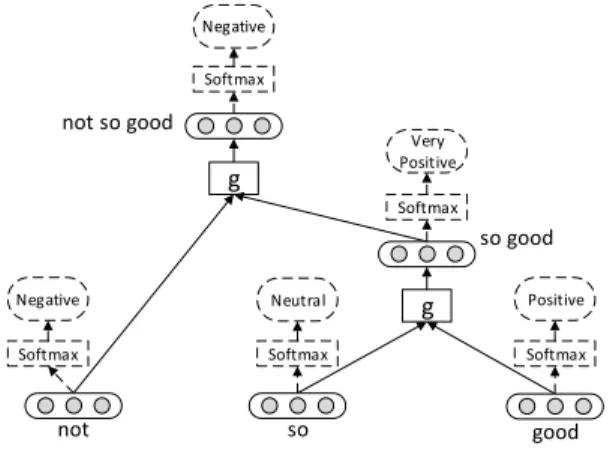
gis the composition function, andfis the nonlinearity func-tion (such as tanh, sigmoid, softsign, etc.). As illustrated in Figure 1, the representation of “so bad” is calculated by the composition of “so” and “bad”, and the representation of tri-gram “not so bad” is recursively obtained by the vectors of “not” and “so bad”.
The learned representations are then fed into a classifier to predict the labels for nodes. The softmax layer is used as a standard component, as shown in Figure 1. Thek-th element of softmax(z)isPexp{zk}
jexp{zj}. It outputs the probability distri-bution overKclasses for a given input. To be more specific, the prediction distribution of nodeiis calculated via:
not so good
g
Negative
Negative Neutral Positive
Very Positive Softmax Softmax Softmax Softmax Softmax so good not so good g
Figure 1: Composition process for “not so good”. Thegis a global composition function in recursive neural models. whereU 2RK⇥Dis the classification matrix,viis the
vec-tor representation of nodei, andyi is the prediction
distri-bution for nodei.
The main difference between recursive neural models lies in the design of composition functions. We describe two mainstream models and their composition functions.
RNN: Recursive Neural Network
The RNN (Socher et al. 2011) is a standard member of recur-sive neural models. Every dimension of parent vector is cal-culated by weighted linear combination of the child vectors’ dimensions. The vector representation of nodeiis obtained via: vi =f ✓ W vi l vi r +b ◆ (3) whereW 2RD⇥2Dis the composition matrix,bis the bias
vector,vi
l,vriare the left and right child vectors respectively,
andfis the nonlinearity function. The dimension ofviis the
same as its child vectors, and it is recursively used in the next composition.
RNTN: Recursive Neural Tensor Network
The RNTN (Socher et al. 2013b) uses more parameters and a more powerful composition function than RNN. The main idea of RNTN is to employ tensors to model the intersection between every dimension of vectors. The vector of nodeiis computed via: vi=f vi l vi r T T[1:D] vi l vi r +W vi l vi r +b ! (4) whereT[1:D] is a tensor,W 2 RD⇥2D is a linear
compo-sition matrix,bis the bias vector, andf is the nonlinearity function. The result of tensor product is
vi l vi r T T[1:D] vi l vi r = 2 6 6 6 6 6 4 vi l vi r T T[1] vi l vi r ... vi l vi r T T[D] vi l vi r 3 7 7 7 7 7 5 (5)
where T[d] 2 R2D⇥2D is the d-th slice of T[1:D]. It
ob-tains aD-dimensional vector which defines multiple bilinear forms. When all the elements ofT[1:D] are zero, the model
is the same as RNN.
Adaptive Multi-Compositionality for
Recursive Neural Models
We illustrate the main idea of proposed Adaptive Multi-Compositionality method in Figure 2. We use a compo-sition pool which consists of C composition functions
{g1, . . . , gC}. To obtain the vector of “so good”, we firstly
feed its child vectors (vsoandvgood) to a classifier to get
the probability P gh|vso,vgood for using each
composi-tion funccomposi-tiongh. Intuitively, we should choose composition
functions which strengthen the polarity of “good”, and pre-dict the “so good” as very positive. Similarly, we compute the probabilityP gh|vnot,vso good for every composition
function. Ideally, we should select negate composition func-tions to obtainvnot so good, and the polarity should be
neg-ative. As shown in this example, it is more reasonable to use multiple composition functions than finding a complex composition function for the recursive neural models.
not so good
Negative
Negative Neutral Positive Very Positive Softmax Softmax Softmax Softmax Softmax so good not so good g1 ... gC Composition Pool g1 ... gC Composition Pool
Figure 2: The composition pool consists of multiple com-position functions. It selects the functions depending on the input child vectors, and produces the composition result us-ing more than one composition functions.
Generally, we define the composition resultvias: vi =f C X h=1 P gh|vli,vri gh vli,vri ! (6) wherefis the nonlinearity function,g1, . . . , gCare the
com-position functions, and P gh|vil,vir is the probability of
employingghgiven the child vectorsvil,vir. For the
compo-sition functions, we use the same forms as in RNN (Equa-tion (3)) and RNTN (Equa(Equa-tion (4)). The key point is how to select them properly depending on the child vectors, i.e., how to define P gh|vil,vir . We define a parametrization
approach (named AdaMC), and show three special cases of it. By adjusting the parameter of AdaMC, there is a contin-uously transition between these special cases.
AdaMC: Adaptive Multi-Compositionality
To start with, we define the -softmax function as:-softmax(z) =P 1 iexp{ zi} 2 6 4 exp{ z1} ... exp{ zK} 3 7 5 (7)
wherez= [z1. . .zK]T is a vector. This function is known
as the Boltzmann distribution and Gibbs measure (Georgii 2011), which are widely used in statistical mechanics. When
= 0, the -softmax function produces a uniform
distribu-tion; When = 1, it is the same as softmax function; When
! 1, this function only activates the dimension with maximum weight, and sets its probability to1. We then em-ploy this function to compute the probability distribution for the composition functions via:
2 6 4 P g1|vli,vri ... P gC|vil,vir 3 7 5= -softmax ✓ S vi l vi r ◆ (8) whereS 2 RC⇥2Dis the matrix used to determine which
composition function we use, andvi
l,virare the left and right
child vectors.
Avg-AdaMC: Average AdaMC
We average the composition results, and this is a special case of AdaMC ( = 0). The probability of usingghis:
P gh|vli,vri = 1
C (9)
whereh = 1, . . . , C, andC is the number of composition functions.
Weighted-AdaMC: Weighted Average AdaMC
One special case of AdaMC is setting = 1. It uses thesoftmax probability to perform a weighted average. 2 6 4 P g1|vli,vri ... P gC|vil,vir 3 7 5=softmax ✓ S vi l vi r ◆ (10) whereS2RC⇥2Dis the parameter matrix.
Max-AdaMC: Max Output AdaMC
If we set ! 1 in AdaMC, it is a greedy selection al-gorithm and only outputs the composition result with maxi-mum softmax probability.
Model Training
We use the softmax classifier to predict the probabilities for classes, and compare the distribution with ground truth. We define the target vectortifor nodei, which is a binary
vec-tor. If the correct label isk, we setti
kto1and the others to0.
Our goal is to minimize the cross-entropy error between the predicted distributionyiand target distributionti. For each
sentence, the objective function is defined as:
min ⇥ E(⇥) = X i X j tijlogyji+ X ✓2⇥ ✓k✓k22 (11)
where⇥represents the parameters, and the second term is a L2-regularization penalty.
We employ back-propagation algorithm (Rumelhart, Hin-ton, and Williams 1986) to propagate the error from the top node to the leaf nodes. The derivatives are computed and gathered to update the parameters. The details can be found in thesupplemental materialdue to space limitations. The AdaGrad (Duchi, Hazan, and Singer 2011) is used to solve this non-convex optimization problem.
Experiments
Dataset Description
We evaluate the models on Stanford Sentiment Treebank1. This corpus contains the labels of syntactically plausible phrases, which allows us to train the compositional mod-els based on the parsing trees. The treebank is built upon 10,662 critic reviews in Rotten Tomatoes2, which is origi-nally used for sentence-level sentiment classification (Pang and Lee 2005). The Stanford Parser (Klein and Manning 2003) is used to parse all these reviews to parsing trees, and extract 215,154 phrases. Next, the workers in Amazon Me-chanical Turk annotate polarity levels for all these phrases. Most of the shorter phrases are annotated as neutral, and longer phrases tend to be with stronger polarity. All the sen-timent scales are merged to five categories (very negative,
negative,neutral,positive,very positive).
Experiment Settings
We use the standard dataset splits (train: 8,544, dev: 1,101, test: 2,210) in all the experiments. For all these models, we tune the parameters on the dev dataset. We use the mini-batch version AdaGrad in our experiments with the mini-batch size between 20 and 30. We employf = tanhas the non-linearity function as it is significantly better than the models without using nonlinearity (Socher et al. 2011). Each word in the vocabulary is assigned with a vector representation. To initialize the parameters, we randomly sample values from a uniform distributionU( ✏,+✏), where✏is a small value. It should be noted that the word vectors are regarded as pa-rameters, and will be updated in the training process.
Evaluation
We compare different methods on the Sentiment Treebank in this section to evaluate the effectiveness of our methods.
SVM. Support Vector Machine (SVM) achieves good per-formance in the sentiment classification task (Pang and Lee 2005). We use the bag-of-words features in our experiments.
MNB/bi-MNB. As indicated in the work of Wang and Manning (2012), Multinomial Na¨ıve Bayes (MNB) often outperforms SVM for sentence-level sentiment classifica-tion. The MNB uses uni-gram features, and bi-MNB also uses bi-gram features.
VecAvg. This model (Landauer and Dutnais 1997) aver-ages child vectors to obtain the parent vector. It ignores the word order when performing compositions.
1http://nlp.stanford.edu/sentiment/treebank.html 2http://www.rottentomatoes.com
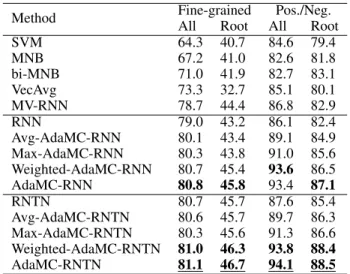
Method Fine-grainedAll Root AllPos./Neg.Root SVM 64.3 40.7 84.6 79.4 MNB 67.2 41.0 82.6 81.8 bi-MNB 71.0 41.9 82.7 83.1 VecAvg 73.3 32.7 85.1 80.1 MV-RNN 78.7 44.4 86.8 82.9 RNN 79.0 43.2 86.1 82.4 Avg-AdaMC-RNN 80.1 43.4 89.1 84.9 Max-AdaMC-RNN 80.3 43.8 91.0 85.6 Weighted-AdaMC-RNN 80.7 45.4 93.6 86.5 AdaMC-RNN 80.8 45.8 93.4 87.1 RNTN 80.7 45.7 87.6 85.4 Avg-AdaMC-RNTN 80.6 45.7 89.7 86.3 Max-AdaMC-RNTN 80.3 45.6 91.3 86.6 Weighted-AdaMC-RNTN 81.0 46.3 93.8 88.4 AdaMC-RNTN 81.1 46.7 94.1 88.5
Table 1: Results of evaluation on the Sentiment Treebank. The top three methods are in bold and the best is also
underlined. Our methods (AdaMC-RNN, AdaMC-RNTN) achieve best performances when is set to2.
RNN/RNTN. Recursive Neural Network (Socher et al. 2011) computes the parent vector by weighted linear com-bination of the child vectors’ dimensions. Recursive Neu-ral Tensor Network (Socher et al. 2013b) employs tensors to model intersections between different dimension of child vectors. We use the same settings as in the original papers.
MV-RNN. This model (Socher et al. 2012) assigns a com-position matrix for each word. Besides performing compo-sitions to obtain the vector representations, the model uses another global matrix to combine these composition ma-trices for phrases. The above baseline results are reported in (Socher et al. 2013b).
AdaMC. Compared with the original models, AdaMC-RNN and AdaMC-RNTN employ multiple composition functions, and determine composition functions depending on the child vectors in every step. We use 15 composition functions, and set the size of word vectors as 25 for AdaMC-RNN and 15 for AdaMC-RNTN in the experiments.
Avg/Max/Weighted-AdaMC. Special cases of AdaMC are used in RNN and RNTN. The number of composition functions and dimension of word vectors are the same as in AdaMC-RNN and AdaMC-RNTN.
Table 1 shows the evaluation results of different models. SVM and MNB are two effective baselines for sentiment classification (Wang and Manning 2012). We notice that Ve-cAvg performs better than bag-of-words methods on evalua-tions for all nodes, while the performances of root nodes are worse than them. It indicates that VecAvg achieves better results on short phrases, but it loses some sentiment infor-mation in the composition process for long phrases. We also obtain the conclusion that it is more difficult to get good composition results for long phrases than for short ones. So comparing the evaluation results for long fragments is more meaningful to us. Compared with VecAvg, the perfor-mances of RNN improve on both short and long phrases. MV-RNN uses more composition matrices and improves the
accuracies than RNN. Moreover, the RNTN, which employs tensors to model the intersections between different seman-tic dimensions, achieves better results than MV-RNN, RNN and bag-of-words models. This illustrates that more pow-erful composition functions help capture complex semantic compositions especially for the longer phrases and the effec-tiveness of recursive neural models.
We then compare our Adaptive Multi-Compositionality (AdaMC) method with baselines. First of all, we apply our approaches in RNN, and there are significant gains of the evaluation metrics. Specifically, the all nodes and root nodes fine-grained accuracies of AdaMC-RNN increase by 1.8% and 2.6% respectively than RNN which only em-ploys one global composition functions. For polarity (posi-tive/negative) classification, the all nodes and root nodes ac-curacies of our method rise by 7.3% and 4.7% respectively.
Moreover, we find that AdaMC-RNN surpasses MV-RNN. The MV-RNN assigns specific composition matrix for every word. It is easy to overfit training data, because the number of composition matrices is the same as vocabu-lary size. MV-RNN needs another global matrix to compute the composition matrices for long phrases, which makes the composition non-specific. However, AdaMC-RNN employs a certain number of composition functions and adaptively selects them depending on the combined vectors. The exper-imental results illustrate that AdaMC-RNN is a better way to achieve specific compositions than MV-RNN.
Furthermore, the fine-grained accuracies of AdaMC-RNN are comparable with RNTN, and the positive/negative ac-curacies are better than RNTN. Notably, although AdaMC-RNN employs fewer parameters than RNTN, it achieves bet-ter performances without employing tensors. The results in-dicate using multiple composition functions is another good approach to improve the semantic composition besides find-ing more powerful composition functions (such as tensors).
We also apply our method in RNTN, and obtain state-of-the-art performances. Compared with RNTN, all nodes and root nodes fine-grained accuracies of AdaMC-RNTN rise by 0.4% and 1.0% respectively. Considering positive/negative classification, the all nodes and root nodes accuracies of our method increase by 6.5% and 3.1% respectively than RNTN. This demonstrates our method can boost the performances even if we have used powerful composition functions.
Finally, we evaluate the special cases ( = 0,1, and ! 1) of AdaMC models, and they are all of help to improve the results. The performances of Weighted-AdaMC ( = 1) are most similar to AdaMC, and are better than Avg-AdaMC ( = 0) and Max-AdaMC ( ! 1) in both RNN and RNTN. To be specific, the results of Max-AdaMC-RNN surpass Avg-AdaMC-RNN. However, the fine-grained accu-racies of Avg-AdaMC-RNTN are slightly better than Max-AdaMC-RNTN, and the positive/negative accuracies are just the opposite. We will further explore the differences between these special cases in next section.
Effects of
We compare different for AdaMC defined in Equation (8). Different parameter leads to different composition selec-tion schemes. When = 1, the model directly employs the
(a) Root Fine-grained Accuracy
(b) Root Pos/Neg Accuracy
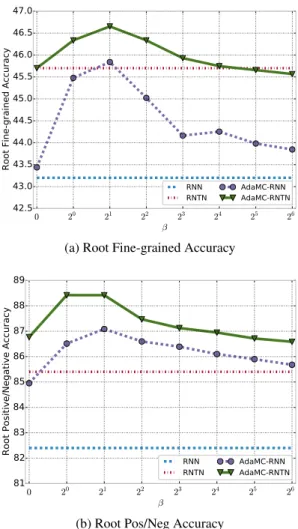
Figure 3: The curve shows the accuracy for root nodes as
= 0,20,21, . . . ,26increases. RNN and
AdaMC-RNTN achieve the best results at = 21.
really bad very bad / only dull /much bad / extremely bad / (all that) bad
(is n’t) (necessarily bad)
(is n’t) (painfully bad) / not mean-spirited / not (too slow) / not well-acted / (have otherwise) (been bland) great
(Broadway play)
great (cinematic innovation) / great subject /
great performance / energetic entertainment / great (comedy filmmaker) (arty and) jazzy
(Smart and) fun / (verve and) fun / (unique and) entertaining / (gentle and) engrossing / (warmth and) humor
Table 2: We use cosine similarity of composition selection vectors (Equation (8)) for phrases to query the nearest com-positions.
probabilities outputted by the softmax classifier as weights to combine the composition results. The = 0 makes the probabilities obey a uniform distribution, while ! 1 re-sults in a maximum probability selection algorithm.
As demonstrated in Figure 3, the overall conclusion is that the optimal tends to be between the setting of Weighted-AdaMC and Max-Weighted-AdaMC. Both the Weighted-AdaMC-RNN and AdaMC-RNTN achieve the best root fine-grained and pos-itive/negative accuracies at = 2, and they have a
simi-lar trend. Specifically, the Weighted-AdaMC ( = 1) per-forms better than Avg-AdaMC ( = 0) and Max-AdaMC
( ! 1). It indicates that adaptive (role-sensitive) compo-sitionality selection is useful to model the compositions.
The Avg-AdaMC does not consider role-sensitive infor-mation, while Max-AdaMC does not use multiple com-position functions to get the smoothed results. Weighted-AdaMC employs the probabilities obtained by softmax clas-sifier to make trade-offs between them, hence it obtains bet-ter performances. Based on this observation, we introduce the parameter and employ the Boltzmann distribution in AdaMC to adjust the effects of these two perspectives.
Adaptive Compositionality Examples
To analyze the adaptive compositionality selection, we com-pute the probability distribution (as in Equation (8)) for ev-ery composition, i.e., [P(g1|a,b). . . P(gC|a,b)]T where a,bare the child vectors. As demonstrated in Table 2, we query some composition examples and employ cosine sim-ilarity as our simsim-ilarity metric. To be specific, “really bad” is a strengthen composition which makes the sentiment po-larity stronger, and the most similar compositions are of the same type. Notably, we notice that the bi-gram “all that” is detected as an intensification indicator. The second ex-ample is a negation composition. “(have otherwise) (been bland)” is regarded as a similar composition, which illus-trates the combination of “have” and “otherwise” keeps the negation semantics of “otherwise”. The third case and the similar compositions are the combinations of a sentiment ad-jective word and noun phrase. This demonstrates our model embeds some word-category information in word vectors to select the composition functions. The last example is two sentiment words connected by “and”. The results illustrate our model recognize this kind of conjunction which joins two non-contrasting items. From all these cases, we find the compositions which are of similar types are closer, and our method learns to distinguish these different composition types according to the supervisions of specific tasks.
Conclusion and Future Work
We propose an Adaptive Multi-Compositionality (AdaMC) method for recursive neural models to achieve better seman-tic compositions in this paper. AdaMC uses more than one composition functions and adaptively selects them depend-ing on the input vectors. We present a general framework to model the composition as a distribution over the compo-sition functions. We integrate AdaMC into existing popu-lar recursive neural models (such as RNN and RNTN) and conduct experiments for sentence-level sentiment analysis
tasks. Experimental results on the Stanford Sentiment Tree-bank show that AdaMC significantly improves the baselines with fewer parameters. We further compare the distribution similarities of composition functions for phrase pairs, and the results verify the effectiveness of AdaMC on modeling and leveraging the semantic categories of words and phrases in the process of composition. There are several interesting directions for further research studies. For instance, we can evaluate our method in other NLP tasks. Moreover, exter-nal information (such as part-of-speech tags) can be used as features to select the composition functions. In addition, we can mix different types of composition functions (such as the linear combination approach in RNN and the tensor based approach in RNTN) to achieve more flexible choices in the adaptive composition methods.
Acknowledgments
We gratefully acknowledge helpful discussions with Richard Socher. This research was partly supported by the National 863 Program of China (No. 2012AA011005), the fund of SKLSDE (Grant No. SKLSDE-2013ZX-06), and Research Fund for the Doctoral Program of Higher Education of China (Grant No. 20111102110019).
References
Aerts, D., and Czachor, M. 2004. Quantum aspects of se-mantic analysis and symbolic artificial intelligence.Journal of Physics A: Mathematical and General37(12):L123. Baroni, M., and Zamparelli, R. 2010. Nouns are vectors, ad-jectives are matrices: Representing adjective-noun construc-tions in semantic space. In EMNLP, EMNLP ’10, 1183– 1193.
Clark, S.; Coecke, B.; and Sadrzadeh, M. 2008. A compo-sitional distributional model of meaning. InProceedings of the Second Quantum Interaction Symposium, 133–140. Duchi, J.; Hazan, E.; and Singer, Y. 2011. Adaptive subgra-dient methods for online learning and stochastic optimiza-tion.JMLR12:2121–2159.
Georgii, H. 2011. Gibbs Measures and Phase Transitions. De Gruyter studies in mathematics. De Gruyter.
Grefenstette, E., and Sadrzadeh, M. 2011. Experimental support for a categorical compositional distributional model of meaning. InEMNLP, 1394–1404.
Grefenstette, E.; Dinu, G.; Zhang, Y.-Z.; Sadrzadeh, M.; and Baroni, M. 2013. Multi-step regression learning for compo-sitional distributional semantics. InProceedings of the 10th International Conference on Computational Semantics. Hermann, K. M., and Blunsom, P. 2013. The role of syntax in vector space models of compositional semantics. InACL, 894–904.
Jones, M. N., and Mewhort, D. J. 2007. Representing word meaning and order information in a composite holographic lexicon.Psychological review114(1):1.
Klein, D., and Manning, C. D. 2003. Accurate unlexicalized parsing. InACL, 423–430.
Landauer, T. K., and Dutnais, S. T. 1997. A solution to plato’s problem: The latent semantic analysis theory of ac-quisition, induction, and representation of knowledge. Psy-chological review211–240.
Mitchell, J., and Lapata, M. 2008. Vector-based models of semantic composition. InACL, 236–244.
Mitchell, J., and Lapata, M. 2010. Composition in distribu-tional models of semantics. Cognitive Science34(8):1388– 1439.
Pang, B., and Lee, L. 2005. Seeing stars: exploiting class relationships for sentiment categorization with respect to rat-ing scales. InACL, 115–124.
Plate, T. 1991. Holographic reduced representations: Con-volution algebra for compositional distributed representa-tions. InIJCAI, 30–35. Citeseer.
Polajnar, T.; Fagarasan, L.; and Clark, S. 2013. Learning type-driven tensor-based meaning representations. CoRR
abs/1312.5985.
Rudolph, S., and Giesbrecht, E. 2010. Compositional matrix-space models of language. InACL, 907–916. Rumelhart, D.; Hinton, G.; and Williams, R. 1986. Learn-ing representations by back-propagatLearn-ing errors. Nature
323(6088):533–536.
Smolensky, P. 1990. Tensor product variable binding and the representation of symbolic structures in connectionist sys-tems. Artificial Intelligence46(12):159 – 216.
Socher, R.; Lin, C. C.; Ng, A. Y.; and Manning, C. D. 2011. Parsing Natural Scenes and Natural Language with Recur-sive Neural Networks. InICML.
Socher, R.; Huval, B.; Manning, C. D.; and Ng, A. Y. 2012. Semantic compositionality through recursive matrix-vector spaces. InEMNLP-CoNLL, 1201–1211.
Socher, R.; Bauer, J.; Manning, C. D.; and Ng, A. Y. 2013a. Parsing With Compositional Vector Grammars. InACL. Socher, R.; Perelygin, A.; Wu, J. Y.; Chuang, J.; Manning, C. D.; Ng, A. Y.; and Potts, C. 2013b. Recursive Deep Mod-els for Semantic Compositionality Over a Sentiment Tree-bank. InEMNLP, 1631–1642.
Wang, S., and Manning, C. 2012. Baselines and bigrams: Simple, good sentiment and topic classification. In ACL, 90–94.
Widdows, D. 2008. Semantic vector products: Some ini-tial investigations. InSecond AAAI Symposium on Quantum Interaction, volume 26, 28th. Citeseer.
Yessenalina, A., and Cardie, C. 2011. Compositional matrix-space models for sentiment analysis. In EMNLP, 172–182.
Yu, D.; Deng, L.; and Seide, F. 2013. The deep tensor neural network with applications to large vocabulary speech recog-nition. Audio, Speech, and Language Processing, IEEE Transactions on21(2):388–396.