PROGETTO INGV-DPC 2004-2006
PROGETTI VULCANOLOGICI
(Attuazione dei progetti di ricerca vulcanologici
di particolare interesse per il Dipartimento della Protezione Civile
previsti dalla Convenzione 2004-2006 tra DPC e INGV)
Allegato 2
al Decreto n. 179 - 18 maggio 2005
del Presidente dell’INGV
Prof. Enzo Boschi
Telefax: (39) 6 5041181Index
Section
Page
Introduction
4
Table of global financial request
6
Project V1
8
Project V2
12
Objectives
13
State of the art
14
Description of the activities
15
List of deliverables
22
Table man/months
24
Table of financial request
27
Project V3
28
Objectives
30
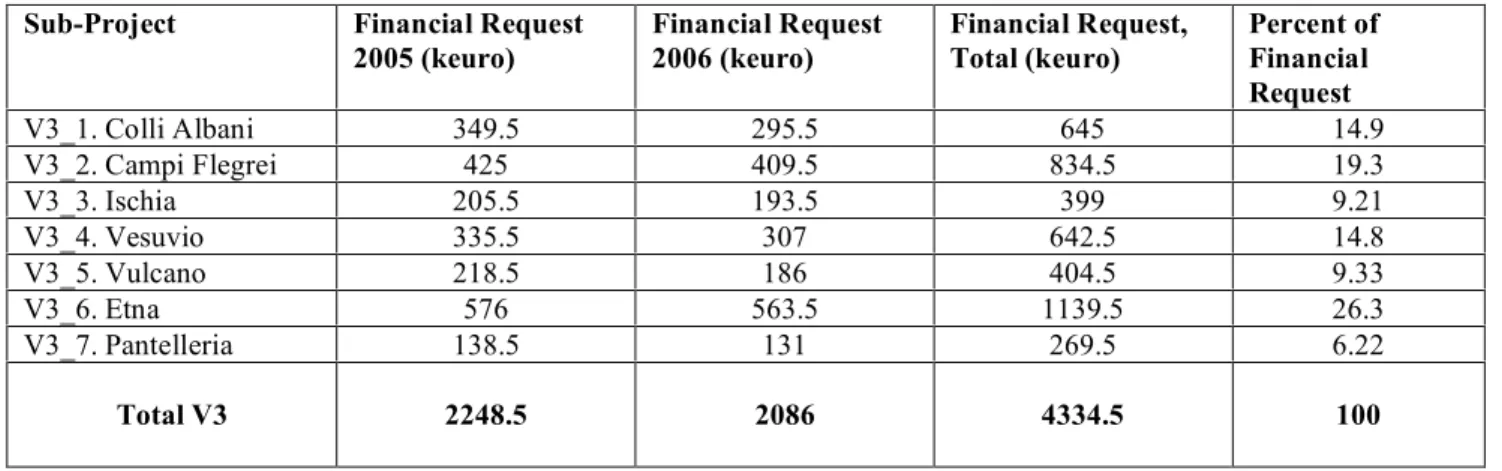
Synthetic table of financial request for project V3
30
Sub-Project V3_1 – Colli Albani
32
State of the art
33
Description of the activities
35
List of deliverables
39
Table man/months
40
Table of financial request
42
Sub-Project V3_2 – Campi Flegrei
44
State of the art
45
Description of the activities
46
List of deliverables
53
Table man/months
55
Table of financial request
57
Sub-Project V3_3 – Ischia
58
State of the art
59
Description of the activities
60
List of deliverables
65
Table man/months
66
Table of financial request
68
Sub-Project V3_4 – Vesuvio
70
State of the art
71
Description of the activities
72
List of deliverables
77
Table of financial request
92
Sub-Project V3_5 – Vulcano
82
State of the art
83
Description of the activities
84
List of deliverables
89
Table man/months
90
Table of financial request
92
Sub-Project V3_6 – Etna
94
State of the art
95
Description of the activities
96
List of deliverables
104
Table man/months
106
Table of financial request
110
Sub-Project V3_7 – Pantelleria
112
State of the art
113
Description of the activities
114
List of deliverables
119
Table man/months
120
Table of financial request
121
Project V4
122
Objectives
123
State of the art
123
Description of the activities
126
List of deliverables
134
Table man/months
135
Table of financial request
137
Project V5
138
Objectives
139
State of the art
140
Description of the activities
143
List of deliverables
149
Table man/months
151
INGV-DPC Project 2005-2006
Volcanology
The Agreement between Dipartimento della Protezione Civile (DPC) and Istituto Nazionale di Geofisica e Vulcanologia (INGV), for the period 2004 – 2006, establishes the organization of five Projects in the general field of Volcanology. The INGV Decree 26/11/2004 N. 387 nominates the responsibles of these projects. The same Agreement defines the general project objectives which must be aimed at providing clear answers to the major issues of interest for DPC. For the research in volcanology, these issues are essentially represented by: i) the assessment of the hazard associated with the various types of volcanic phenomena and with diffuse degassing, ii) the definition of the criticality levels, or the association of signs which indicate significant changes in the state of a volcano, and iii) the development of innovative techniques with the potential to add substantially to the above issues. Hazard and criticality levels are therefore the general objectives of INGV-DPC projects (with the addition of risk assessment, limited to project V5). Accordingly, each project includes a substantial part devoted to hazard assessment and definition of criticality levels, which are the subject of specific research, and are represented by clearly identified research products.
The Table below reports in a synthetic way the five INGV-DPC Projects in Volcanology and the corresponding responsibles.
Project Responsibles
V1*. Prosecution of the activities already financed in 2003 in the frame of GNV
Mauro Coltelli, INGV-CT
Francesco Latino Chiocci, Univ. Roma La Sapienza
V2. Monitoring and research activity at Stromboli and Panarea
Domenico Patanè, INGV-CT
Alessandro Tibaldi, Univ. Milano Bicocca V3. Research on active volcanoes, precursors,
scenarios, hazard, and risk
Paolo Papale, INGV Roma1 Stefano Gresta, Univ. Catania V4. Conception, experimentation, and
application of innovative techniques to study active volcanoes
Warner Marzocchi, INGV Roma1 Aldo Zollo, Univ. Napoli Federico II V5. Research on the diffuse degassing in Italy Giovanni Chiodini, INGV-OV
Mariano Valenza, Univ. Palermo
*NOTE: No additional funding is requested for Project V1 in this proposal.
The project responsibles have compiled the present proposal, after having informed and consulted the whole volcanological community through a first presentation of the INGV-DPC Agreement themes during the GNV General Assembly (Naples, December 2004), then through the publication in the web of project pre-proposals defining the project Tasks and requested deliverables of interest for INGV-DPC projects. The responsibles have collected the corresponding proposals of contribution by single research groups, have identified those which better fit the pre-proposal themes and objectives, and have optimized them in the frame of a coordinated project with clear, well-defined, and attainable objectives and deliverables. The resulting projects are organized in a series of interdependent Tasks matching the themes and expected results included in the INGV-DPC Agreement, and focused on the achievement of deliverables of primary interest for Civil Protection purposes.
Project V3, which comprises the research on the Italian active volcanoes with the exception of Stromboli and Panarea (forming the object of projects V1 and V2), is organised in 7 sub-projects dedicated to Colli Albani, Campi Flegrei, Ischia, Vesuvio, Vulcano, Etna, and Pantelleria. Lipari and the volcanoes of the Sicily channel are partly included in the research above (within the sub-projects Vulcano and Pantelleria, respectively), although dedicated research will be organised in the future, possibly, during the second year of project.
The entire Project includes 159 RU’s embracing 21 Italian and 1 foreign Universities (30 Departments), 6 CNR Institutes, 4 foreign Research Centers, 1 Italian Private Company, and 6 INGV sections. Participation to the whole Project includes a much larger number of Institutions, comprising 30 Italian Universities, 46 foreign Universities, 9 CNR Institutes plus 6 other Italian Research Centers, 26 foreign Research Centers, 5 Italian and 3 foreign Private Companies. A total of 953 researchers is involved in the Project, for a total of 7239 man/months, or 603 man/years.
For each project (and each V3 sub-project, see the following) at least threeproject meetings are planned.
The first one represents a kick-off meeting, within one month from the official start of the project, and its aim is that of i) providing all participating RU’s with the basic knowledge of the research skills in the consortium, and promoting collaborations between RU’s; ii) defining the details of project organization and the modalities and timing of exchange of data and results; iii) optimizing the first-year activities within all project Tasks.
The second meeting is planned shortly before the end of the first year of activity, with the aim of i) exerting a general control on the project activities, achievement of first year results, and production of first year deliverables; ii) if necessary, re-addressing part of the research foreseen to better match the project objectives; iii) ensuring further exchange between all RU’s participating to the various project Tasks, cross-correlating the results from each RU and each project Task in order to focus on open questions and unresolved issues; iv) organising the first-year project report to INGV.
The third meeting is planned about two months before the date of closure of projects, and its aim is that of i) organizing the further research in view of the end of the project, ii) extracting the general picture emerging from the whole research within each project, and underlying the open questions and unresolved issues; iii) organising the final project report.
A General Assembly is foreseen shortly after the end of the Project. During the assembly the Project results will be presented to the Civil Protection and the scientific community.
The organization of a few (indicatively, two per year) workshops on horizontal themes of great relevance for the project objectives is greatly auspicated. These workshops should not be just the occasion for presenting the scientific job and results of researchers, rather, they should be focused on the production of a document summarizing the state of the art and guide-lines on the specific workshop theme. The first workshop to be organized shortly after the beginning of projects should be dedicated to Volcanic Hazard, a theme which is generally faced by different research groups on the basis of quite different principles and paradigms. The guide-lines emerging from the workshop should therefore provide a common route for all projects, for which volcanic hazard is the final objective.
Finally, the facilities offered by the existence of the INGV-DPC projects are thought to provide an ideal background for the development of a INGV Task Force. The aim of the Task Force should be that of providing scientific, technical, and logistic support during volcanic crises out of the Italian territory. A significant and coordinated participation of Italian researchers in volcanic crises all around the world is an opportunity to export their knowledge and greatly increase their experience in interpreting pre-eruptive signals from unresting volcanoes, in forecasting volcanic scenarios, and in volcanic crisis response and management. This will result in an enormous increase
of the capabilities to face and manage volcanic crises in the Italian territory. A document prepared, and circulated among the scientific community, by a Working Group in the frame of the activities related to the 2001-03 GNV program constitutes the basis over which the Task Forxe is thought to develop.
The present project proposal does not include any financial request for the activities related to the organization of the final General Assembly, of the workshops on horizontal themes, and of the INGV Task Force. The possibility that such activities will be started and promoted by INGV in the frame of the present INGV-DPC project will be submitted to the INGV management and decision bodies in case this proposition should be positively evaluated.
The Table in this page reports in a synthetic way the budget requested for the whole INGV-DPC Project in the scientific sector of Volcanology, divided for each single project from V1 to V5. The single projects designed with the above philosophy and objectives, are illustrated in details in the following corresponding sections. Project V1, which represents the continuation of activities on Stromboli and Panarea activated and financed in 2003, is also briefly described in the following. For this project no further financial request is included.
Synthetic prospect of the financial request for the whole
2005-2006 INGV-DPC Project - Volcanology
*NOTE: V1 projects already defined, including financial request, in 2003. No additional funding is requested in this proposal.
NOTE: For the execution of projects V2-V5, the activation of 9.5 two-years “borsa di studio” and 4.5 two-years “assegno di ricerca”, is requested by INGV RU’s. Details are included in the footnotes to the financial Tables related to each project – see the following, and in the “Description of Research Units” volume which constitutes integral part of the present Project. The related costs are not included in the Table above. The costs for personnel requested by non-INGV RU’s are included in the Table above.
Project Financial Request
2005 (keuro) Financial Request 2006 (keuro) Total Financial Request (keuro) Percentage of Requested Fund V1*. Prosecution of the activities already financed in 2003 in the frame of GNV 235 22.5 257.5 3.76 V2. Monitoring and research activity at Stromboli and Panarea
359.65 387.85 747.5 10.9 V3. Research on active
volcanoes, precursors, scenarios, hazard, and risk 2248.5 2086 4334.5 63.3 V4. Conception, experimentation, and application of innovative techniques for the study of active volcanoes 415.3 369.8 785.1 11.5 V5. Research on the diffuse degassing in Italy 374 352 726 10.6 Total 3632.45 3218.15 6850.6 100.0
PROJECT V1
Prosecution of the activities already financed
in 2003 in the frame of GNV
Responsibles:
Mauro Coltelli, INGV Catania
Project V1
Prosecution of the activities already financed in 2003
in the frame of GNV
Coordinators:
Mauro Coltelli, Senior Researcher, INGV sezione di Catania, Piazza Roma 2, 95123 Catania,
[email protected], tel 0957165850, fax 095435801
Francesco Latino Chiocci, Professore Ordinario, Dipartimento Scienze della Terra, Università di Roma “La Sapienza”, P.le A. Moro, 5 – 00185 Roma, [email protected], tel.:
06/49914938, 06/44585075 fax: 06 4454729
For this project no further financial request is included in the present proposal. The project was made of six sub-projects financed in the frame of the response activities following the 2002-03 volcanic crisis at Stromboli volcano. Two of these sub-projects (N. 3 and 4 in the prospect below) had a length of one year, and are at present concluded. Other three sub-projects with duration of two years (N. 2, 5 and 6) , and one with duration of three years (N. 1) are still prosecuting their activities, and have presently reached the end of first year.
The activity of the project responsibles will be that of i) recovering the entire project documentation and making the point on the achieved results (already started); ii) coordinating the research activities during next two years, establishing the timing and modalities of scientific and finanacial report together with the responsibles of projects V2-5; iii) harmonizing the research and the activities within the project with those developed under project V2.
The prospect below reports in a synthetic way the aim, funding, and present state of each sub-project. At present the project responsibles are recovering the first year scientific and financial reports, which will be forwarded to INGV as soon as they are available.
Sottoprogetto 1: Studio dei maremoti generati da frane a Stromboli e dei segnali del sistema d’allarme marino installato dalla Protezione Civile (Allegato 1)
Responsabile: Stefano Tinti, Professore Associato, Dipartimento di Fisica, Università di Bologna
Durata del progetto: 3 anni
Finanziamento accordato: 74.000 € per il 1 anno (2003); 55.000 € per il 2 anno (2005), 22.500 €
per il 3 anno (2006)
Altre Università o Enti partecipanti: nessuno
Obiettivi:
a) Sistema d’allarme e analisi dei segnali b) Simulazione del maremoto e modello di frana
Stato delle ricerche:
Ricerca in corso secondo le modalità riportate nel progetto approvato
Sottoprogetto 2: Attività di fotogrammetria digitale e di controllo topografico (Allegato 2)
Responsabile: Maria Marsella, Professore Associato, Dipartimento di Idraulica, Trasporti e Strade, Università di Roma La Sapienza
Durata del progetto: 2 anni
Finanziamento accordato: 90.000 € per il 1 anno (2003); 50.000 € per il 2 anno (2005)
Dipartimento di Fisica, Università di Bologna (P. Baldi)
Obiettivi:
c) Progettazione e realizzazione di una rete di inquadramento topografico/appoggio fotogrammetrico
d) Restituzioni fotogrammetriche per estrazione di DTM e ortofoto digitali e) Misure di deformazioni
f) Elaborazioni e interpretazioni dei dati morfologici
g) Predisposizione di un CD Rom per la distribuzione dei dati e dei risultati del progetto
Stato delle ricerche:
Ricerca in corso secondo le modalità riportate nel progetto approvato
Sottoprogetto 3: Studio vulcanologico e geochimica-petrologico dell’eruzione 2002-2003 dello Stromboli (Allegato 3)
Responsabile: Mauro Rosi, Professore Ordinario, Dipartimento di Scienze della Terra, Università di Pisa
Durata del progetto: 1 anno
Finanziamento accordato: 73.000 € per il 1 anno (2003)
Altre Università o Enti Partecipanti:
Università di Cagliari (R. Cioni, Dipartimento di Scienze della Terra)
Istituto Nazionale di Geofisica e Vulcanologia e CEA-CNRS, (A. Bertagnini, P. Landi, N. Métrich)
Università di Firenze (L. Francalanci, E. Germiniani, C. Petrone, Dipartimento di Scienze della Terra)
Università di Urbino (A. Renzulli. M. Mattioli, P. Santi (Istituto di Vulcanologia e Geochimica)
Università di Parma (G.Serri, E.Salvioli, Dipartimento di Scienze della Terra) Università di Torino (M. Tribaudino (Dipartimento di Scienze Mineralogiche e Metrologiche)
Obiettivi:
a) Individuare un’eventuale ricarica profonda del sistema superficiale e stimarne tempi e modalità
b) Stimare il contenuto in volatili del magma profondo e le sue caratteristiche isotopiche c) Individuare eventuali variazioni chimiche, mineralogiche ed isotopiche e del contenuto
in volatili del magma superficiale coinvolto nell’eruzione
Stato delle ricerche:
Ricerca conclusa, è in atto la rendicontazione scientifica e finanziaria finale
Sottoprogetto 4: Condizioni di iniezione di dicchi nella Sciara del fuoco o nella zona dei crateri sommitali in relazione all’instabilità gravitativa di Stromboli (Allegato 4)
Responsabile Alessandro Tibaldi, Professore Associato, Dipartimento di Scienze Geologiche e Geotecnologie Università di Milano-Bicocca
Durata del progetto: 10 mesi
Finanziamento accordato: 50.000 € per il 1 anno (2003)
Altre Università o Enti Partecipanti:
Università di Urbino, Istituto di Vulcanologia e Geochimica Università di Parma, Dipartimento di Scienze della Terra Università di Firenze, Dipartimento di Scienze della Terra Università di Roma Tre, Dipartimento di Scienze Geologiche
Università dell’Insubria Dipartimento di Scienze Chimiche, Fisiche e Matematiche
Obiettivi:
a) Analisi cinematica dei dicchi con l’ obiettivo è di collocare temporalmente e spazialmente ogni dicco per poi procedere al confronto delle sue caratteristiche cinematiche e degli altri parametri
b) Analisi mineralogiche, petrografiche, isotopiche e geochimiche; caratteristiche reologiche dei magmi
c) Modellistica numerica delle differenti condizioni del fianco nord-occidentale del vulcano al fine di individuare quali sono le direzioni di minore resistenza all’intrusione di dicchi d) Modellazione analogica mirante alla comprensione fisica del meccanismo di iniezione di
un dicco in aree con topografia pronunciata e delle possibili cause innescanti
Stato delle ricerche:
Ricerca conclusa, è in atto la rendicontazione scientifica e finanziaria finale
Sottoprogetto 5: Progetto biennale per la prosecuzione delle attività legate all’analisi delle condizioni di stabilità della Sciara del Fuoco(Allegato 5)
Responsabile: Paolo Tommasi, Ricercatore, CNR, Istituto di Ricerca sulla Tettonica, Roma
Durata del progetto: 2 anni
Finanziamento accordato: 44.000 € per il 1 anno (2003); 10.000 € per il 2 anno (2005)
Altre Università o Enti partecipanti: nessuno
Obiettivi:
a) Analisi dettagliata delle caratteristiche morfologiche, strutturali, vulcanologiche legate all’evoluzione del fenomeno, da mettere in relazione con altri fenomeni avvenuti in tempi più o meno recenti e ben documentati.
b) Caratterizzazione dei materiali, che, vista la complessità litologico-strutturale dell’ammasso, dovrà essere a grande scala e riguardare quegli aspetti ancora non investigati del comportamento dei materiali.
Stato delle ricerche:
Ricerca in corso secondo le modalità riportate nel progetto approvato
Sottoprogetto 6: Attività future per lo studio della Sciara sommersa e dei fenomeni correlati all’evento del 30/12/2003 (Allegato 6)
Responsabili: Francesco L. Chiocci, Professore Ordinario, Dipartimento di Scienze della Terra, Università di Roma La Sapienza
Michael Marani, Ricercatore, CNR, ISMAR, Bologna
Durata del progetto: 2 anni (Chiocci), 1 anno (Marani)
Finanziamento accordato: 460.000 € per il 1 anno (2003); 120.000 € per il 2 anno (2005)
Altre Università o Enti partecipanti: nessuno
Obiettivi:
a) Studio della nicchia di frana e dei lineamenti erosivi (F.L. Chiocci); b) Studio del trasporto e messa in posto del materiale di frana (M.Marani).
Stato delle Ricerche:
Obiettivo a (Chiocci), ricerca in corso secondo le modalità riportate nel progetto approvato Obiettivo b (Marani), ricerca conclusa, è in atto la rendicontazione scientifica e finanziaria finale
PROJECT V1 – CONTINUATION OF THE ACTIVITIES
AT STROMBOLI AND PANAREA
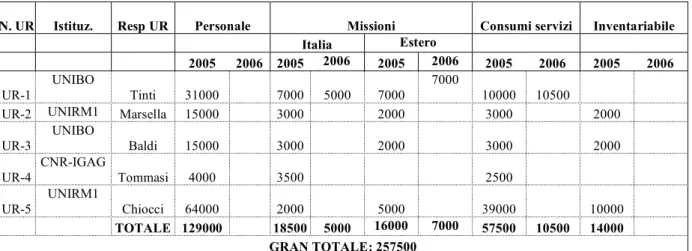
Table RU and related funding request
N. UR Istituz. Resp UR Personale Missioni Consumi servizi Inventariabile
Italia Estero 2005 2006 2005 2006 2005 2006 2005 2006 2005 2006 UR-1 UNIBO Tinti 31000 7000 5000 7000 7000 10000 10500 UR-2 UNIRM1 Marsella 15000 3000 2000 3000 2000 UR-3 UNIBO Baldi 15000 3000 2000 3000 2000 UR-4 CNR-IGAG Tommasi 4000 3500 2500
UR-5
UNIRM1
Chiocci 64000 2000 5000 39000 10000
TOTALE 129000 18500 5000 16000 7000 57500 10500 14000
PROJECT V2
Monitoring and research activity
at Stromboli and Panarea
Responsibles:
Domenico Patanè, INGV Catania
Project V2
Monitoring and research activity at Stromboli and Panarea
Coordinators:Domenico Patanè, National Institute of Geophysics and Volcanology, Section of Catania, P.zza Roma, 2, 95123 Catania, Italy, [email protected]
Alessandro Tibaldi, University of Milan Bicocca, Department of Geological Science and Geotechnologies, P. della Scienza 4, Milan, Italy, [email protected]
Objectives
The main objectives have been individuated on the basis of the contents of the “attached C” on the Institutional Decree of the coordinating committee of the “Framework convention DPC-INGV 2004-06” and on the basis of the general framework of objectives of specific concern for the DPC.
The present project has been constructed through a strong integration of the research units (RU) and the other ongoing project on Stromboli (V1 “Prosecution of already funded activities in the GNV framework in 2003”).
This project will focus on a series of fundamental objectives that we retain of paramount importance for the prosecution of researches finalized to the hazard evaluation. Some of these objectives have been chosen also keeping in mind that they have received less attention in the past. Main hazards for Stromboli are: explosive eruptions, surface and deep landslide phenomena with particular reference to the Sciara del Fuoco area (SdF), subvolcanic intrusions and lava effusions. Tsunami scenarios are already developed within Project V1. For Panarea, the estimate of danger related to the underwater gas emission zone to the east of the island (Lisca Bianca-Dattilo-Bottaro locality) and its eventual connection with a magmatic system at depth, is of particular importance. Moreover, the definition of “critical levels” constitutes an activity of particular concern, or rather of the ensemble of indicators that may suggest significant status changes in the volcanoes under study. In particular, we foresee that any future monitoring and research activity at Stromboli will benefit from a better understanding of the deep and surface structure of the volcano and of its feeding system.
We plan a main experiment of tomography at Stromboli to achieve a better knowdlege of the volcanic structure and of its plumbing system, and to locate the possible magma chamber, which up to now is unknown both for position and dimension. This result will be integrated with data coming from geophysical analysis of the upper feeding system and from field mapping of Holocene structures, dykes and eruptive fissures. All these data will be integrated into a unique three-dimensional structural-volcanological model of the volcano. This information will be also used to improve understanding of the mechanisms that govern the explosive activity and to better interpretate the monitoring data of deformation of the cone. In particular, we planned a series of applied research activities where data coming from various different methodologies of monitoring will be crosscutted for validation and comparison. We believe that all this will increase the base knowledge of Stromboli and will lead to a strong improvement of the comprehension of phenomena and behaviour of this volcano. This, in turn, will facilitate all scientists working on the real-time interpretation of the signals coming from this volcano, leading to a better reaction during possible future crisis.
As regards Panarea, the activities here proposed represent a first reaction to the phenomena of underwater degassing and fracturing occurred during the 2002-03 crisis. Here we propose three main objectives: the study of the origin of fluids outpoured from the sea bottom, the comprehension of the possible causes of the associated kms-long fracture pattern, and a better delineation of the age
and nature of the most recent volcanic activity in the area. All these objectives will contribute towards the understanding of the connection of these phenomena with a possible magmatic system at depth. We are aware that a complex geophysical oceanographic survey would be necessary in order to completely fulfil this last task, but neither research teams neither fund availability allowed it at present.
State of the art of the ongoing researches related to the objectives here proposed
A more suitable understanding of the internal structure of the volcano, its feeding system and its crustal roots, surely represent the basic tools to comprehend Stromboli’s activity, to develop models used for the study of the source mechanisms of seismic-volcanic events and the deformation field induced by magma upraise in the storage zones and along the feeding conduits, useful for estimating danger and critical levels of the volcano. Notwithstanding this paramount importance, we must recognize that studies aimed at understanding the volcanic structure and the nature of its plumbing system has been started only recently (Pasquarè et al., 1993; Chouet et al., 1998; Saccorotti et al., 1998; Tibaldi, 2001; Chouet et al., 2003; Tibaldi et al., 2003). These comprise geophysical, geological, field structural and geomechanical studies of brittle planes of failures at Stromboli, as well as field studies of lithostratigraphic and geometric characteristics of dykes. All these data have been collected at the surface, or up to 200 m under the crater zone by geophysical methods, thus representing a valuable but partial reconstruction of the volcano structure. Despite in the last two decades a quantity of published seismological studies include waveform and spectral analysis of sparse network data aimed at clarifying eruption dynamics and spatial properties of the source (e.g. Del Pezzo et al., 1992; Neuberg et al., 1994; Chouet et al., 1998), quantitative descriptions of the seismicity and recurrent explosivity (Falsaperla et al., 1992, 1999) the spatial extend and geometrical characteristics of the source and mechanisms of Strombolian explosive activity remain poorly understood, apart from a single work (Chouet et al., 2003). Notwithstanding, additional observations for the investigation of the spatial and temporal characteristics of Strombolian sources are needed as well as the definition of a reliable velocity structure of the volcanic edifice. For the latter only an approximate evaluation (poorly constrained at depths greater than 500 m) derived from the inversion of surface-wave dispersion data is still today available (Chouet at al., 1998). Therefore an effort is necessary to better defining the velocity structure of the volcano by tomography. This in order to enhance both the location of the sources of Strombolian explosion and the simulation of the three-dimensional wave propagation in heterogeneous media.
In January 2003, after the beginning of the 2002-03 eruptive crisis at Stromboli, the geophysical and geochemical monitoring systems of the volcano has been strongly improved. A digital permanent broadband seismic network composed of 13 stations was deployed by INGV and several automatic systems have been developed to recognize both low frequency and landslide seismic signals. Moreover, a system for automatic detection and location of low-frequency signals, such as VLP’s, has been implemented. All these monitoring systems have been used during the crisis as a proxy to changes in the input rate of magma and the degree of gas exsolved in the system. It is noteworthy that during last years, considerable work on modelling of the ascent of gas bubbles has been carried out. These kinds of simulation will be useful for modelling gas bubbles rising inside magma conduits, leading to better understanding Strombolian activity. Additionally, recent advances in the simulation of the eruption dynamics allows now to provide new tools for the investigation of time-dependent, multi-phase, 2D/3D magmatic and volcanic processes.
From the geological point of view, given that the system of dykes is magnificently exposed at Stromboli, and taking account that there are several dykes of very recent age, it is auspicious that they are analysed with greater detail, above all through a strong interdisciplinary approach that integrates structural, stratigraphic, petrographic, geochemical data, and numeric modelling. This would represent a further improvement and completion of work begun and started in 2004 in the project V1. In addition, there is a need to proceed with the mapping of the lava flows from
Holocene fissure eruptions outside the SdF; these, representing the surface expression of dykes of very recent ages, will be integrated with all the other data described above. Furthermore, a strong collaboration with the group that is to pursue further and deeper geophysical prospecting of the active feeding (dyke) system is here planned, in such a way as to correlate surface data with information coming from the inner part of the volcano. No geophysical studies at all exist on the magma chamber. Depth and characters of the pluming system has been estimated by petrological studies (Vaggelli et al, 2003, Francalanci et al., 2004, 2005), but uncertainties still remain on geometry and location of the magma chamber.
Regarding the lateral instability of Stromboli, a series of main flank and sector collapses have been individuated mainly on the NW side of the cone and secondarily on the opposite SE side (Tibaldi, 2001, 2003, 2004). In the NW side, multiple nested lateral collapses occurred in the last 13 ky leading to the present configuration of the SdF depression. SdF is also prone to surface landsliding, as the one occurred on 30 December 2002 which produced a tsunami. All this testifies to recent and active deformation of the SdF infill. Monitoring of SdF deformation has been carried out only after the 2002-03 crisis, by means of several different techniques such as laser measurements of benchmarks, GPS stations and ground-based radar interferometry (e.g. Nunnari et al., 2004; Mattia et al, 2004). Possible scenarios of deep-rooted deformations in the SdF have been investigated by numerical modelling based on a wide set of geotechnical and geomechanical field and laboratory tests in 2-D (Apuani et al., 2004, 2005). No comparison of different monitoring data sets have been carried out up to now. Similarly, no studies at all exist on possible rockfalls towards the Stromboli villages.
The dynamics of SdF deformation is linked not only to gravity force, but also to magma lateral force exerted by intrusions. This link is strongly dependant also on the geometry of the upper feeding system. This geometry also is related to possible models of magma ascent dynamics. With this premise, we retain that volcanological researches in general, as well as researches applied to Stromboli hazards, will benefit from strongly tying together all these studies on different aspects of the same problem. Thus, improvement on the knowledge of the feeding system geometry will be useful not only to the studies of the present SdF deformations and of possible future scenarios, but also to magmatological studies. Numerous studies on explosive activity have been carried out recently, regarding both analyses of outpoured products (Rosi et al., 2000; Metrich et al., 2001; Bertagnini et al., 2003; Arrighi et al., 2004), magma dynamics (Vergniolle et al., 1996; Ripepe et al., 2001, 2005; Chouet al., 2003) and crater gas emissions (Allard et al., 2000; McGonigle et al., 2003). Anyhow, further improvements in the understanding of the explosive Holocene and recent most activity are possible and desirable, in terms of eruptive mechanisms, typology and distribution of emitted products, chronology of eruptive events, and estimate of the probability of occurrence of volcanic phenomena. Similarly, further improvements on estimation of mechanisms responsible for the rarer but most dangerous paroxystic explosions are needed.
Description of the activities
The following methodologies are planned basing on the fact that the present project aims to stimulate and promote researches and studies orientated at supplying precise answers to the problematics of prime concern for Civil Protection. For Stromboli, such problematics are essentially made up of estimating the danger related to the various manifestations of volcanic activity (effusive and explosive) and slope instability. For Panarea, understanding what occurred during the 2002-03 crisis and what can be expected in the future, is of prime interest.
At Stromboli tens of years of studies have already been developed. We retain that new achievements can be reached by tying together the various groups which already operated at Stromboli in order to stimulate research in synergy. It is absolutely necessary to discuss all together the enormous amount of data collected by research and monitoring activities. This can be achieved by singling out mixed task forces in which the transverse nature of the disciplines can be
implemented. At the same time, taking into account the expected available funding, further new data will be collected under a dual scheme: 1) a few, selected main experiments which have never done before at Stromboli, nominally a tomographic survey and satellite interferometry, and 2) a series of lower-cost data collection mainly oriented to assure a prosecution of ongoing researches.
At Panarea instead, the researches focused on volcanic hazard are more at an embryonic stage. Past works were mainly aimed at understanding the volcanological evolution of the main island. As a consequence, we propose a few researches strongly focused on the new phenomena observed during the recent crisis and to understanding the Holocene geological evolution of the area where these phenomena occurred.
We remind that from the start-up of this project (i.e. during the call for proposals from single research units), we strongly worked to create groups bearing an interdisciplinary expertise aimed at resolving specific problems.
We also wish to stress that other researches at Stromboli have already been financed by special funding during the 2002-03 crisis and thus are not contained in the present project. Nominally they are studies of marine geology and researches focused on tsunami propagation.
In the following, we will describe the methodologies separately for Stromboli and Panarea and for tasks.
Stromboli
Task 1. Studies and investigations aimed at the reconstruction of the present structure of the volcano and its feeding system (Stromboli)
Coordinatore Alessandro Tìbaldi UR Sonia Calvari, INGV-Catania
UR Alessandro Tibaldi, Università Milano-Bicocca UR Mario Castellano, INGV-Napoli
UR Domenico Patanè, INGV-Catania
The structural models of Stromboli volcano are mainly based on surface geology and on scarce geophysical data. Moreover, our knowledge of the Stromboli volcano structure is limited to the upper few hundreds meters, whereas the giant volcano edifice is mostly submarine and not accessible to direct investigations. The extreme logistic of the volcano inhibits most of the classical geophysical investigations, including local seismicity and the 3D reconstruction of the sub-surface structure. All these methodologies are limited by the present seismic network density and geometry and need the acquisition of data at both inland and submarine stations. Temporary and permanent short period and broad band seismic stations operated on the volcano since several years. The almost continuous volcanic activity with seismic tremors and explosive events are sources of noise in the frequency band usable for earthquake locations, tomography and analysis of waveforms for the recovering of the deep structure. Therefore, seismological studies of past years mostly focused on the definition of the active long period magmatic sources and the modelling of seismic tremor. Broad band data are still not used for inference on the deep structure. In other Italian volcanoes, the use of 2D and 3D active and passive seismic experiments provided useful and original information on the deep structure. The analysis of broad band data could gives further constraints on the volcano deep structure and the presence of the magma chamber. At Stromboli, these studies are still not done. Therefore in order to get a first reliable image of the internal structure of the volcano and also of the part beneath the sea level, the deposition of a first nucleus of OBS/H around the island (RU Favali) and the joint use of seismic methods based on natural and controlled sources are considered in the present project. The integration of land seismological network with temporary
Ocean Bottom Seismometers and Hydrophones will improve, even over a limited time duration, the land-based network geometry during the experiment. Owing to the lack of recorded local earthquakes, as natural sources useful for tomographic purposes and the high cost of a 3D experiment, a preliminary 2D tomographic study will be done (RU Castellano), through active seismics (a series of inland shots and possibly airgun). Such a study, as preparation to realising a future high resolution 3D tomographic study, should be integrated with an high resolution Receiver Function analysis to define the 1D velocity model beneath each station, aimed to identify the crustal magma chamber and relevant discontinuities beneath the volcano (RU Patanè). Furthermore, to improve the first general structural model of the volcano (Tibaldi, 2004) other geological, petrological and structural investigations are considered in this project (RU Tibaldi and RU Calvari). These comprise detailed mapping of the structures related to the upper magma feeding system, represented by recent (Holocene) dykes and eruptive fissures. The products related to these structures will be analysed in a complete way by means of stratigraphic, lithologic, petrographic and geochemical methods. Absolute dating will also be performed. Structural, lithostratigraphic and petrochemical analyses of the logs of two new 200-m-deep boreholes (logged by Scarpa’s group at Punta Lena and Timpone with other Civil Protection funds) will also be performed by Tibaldi’s and Calvari’s Rus, together with their correlation with known surface lithostratigraphic units. We will integrate also these informations with the data on the hydrothermal system coming from Renzulli’s RU. The knowledge on Stromboli surface geology acquired in the past years by various teams will be integrated with the new geophysical and geological data here collected and transferred into a new 3-D model, that is presently lacking.
Evaluation of the dangers of effusive and explosive activity (Stromboli)
Coordinatore Mauro Rosi
UR Fabio Speranza, INGV-Roma 2
UR Lorella Francalanci, Università di Firenze UR Daniele Andronico, INGV-CT
UR Piergiorgio Scarlato, INGV Roma UR Antonella Bertagnini, INGV-Roma I UR Mauro Rosi, Università di Pisa
UR Maurizio Ripete, Universita' di Firenze UR Luca D’Auria, INGV-OV
UR Paolo Favali, INGV-Roma 2 UR Mario Mattia, INGV-Catania UR Paolo Papale, INGV-Roma1
The eruptive crisis of December 2002- July 2003, the large scale landslide of 30 December 2002 that also affected the submarine part of the volcanic edifice at Sciara del Fuoco, the tsunami that it caused as well as the paroxystic event of 5 April 2003, focused attention on the need to define “critical levels”, or rather to characterise well the ensemble of indicators that can highlight important status changes of this volcano. Obviously, the reduction of volcanic risk at Stromboli entails a better understanding of the surface feeding system (Task 1). In fact a better knowledge of the configuration of the shallow plumbing system (Task 1) is essential for understanding eruptive dynamics and trigger mechanisms of paroxysms, which are in some way both linked to the arrival of fresh magma at shallow levels. Recharge of shallow plumbing system is believed to be a cause of explosive eruptions and these data are fundamental tools for discovering new magma inputs in the system.
Although numerous studies on the past explosive activity have been carried out in recent years, further improvements in the understanding of the explosive Holocene activity are still necessary, in
terms of eruptive mechanisms, typology and distribution of emitted products, chronology of eruptive events; estimate of the probability of occurrence of volcanic phenomena in terms of typology, scale and recurrence of expected events; the study of the relationships between volcanic activity and lateral collapses. Also the modern eruptive activity at Stromboli has been the object of many investigations of a volcanological and petrological nature. The studies carried out have significantly contributed to improving understanding of the ordinary eruptive processes related to the external and internal dynamics to the conduits and to better characterising the petrology of emitted products. The research carried out on the ordinary explosions and on the paroxystic events have highlighted a close dependence in the dynamics of the magmas in relations to their volatile content.
New improvements on the evaluation of the dangers of effusive and explosive activity on Stromboli could be achieved by RU’s Speranza, Francalanci, Rosi and Bertagnini by i) a carefull characterization of the age of all the Holocene volcanics from Stromboli with paleomagnetic study and mineralogical and geochemical, ii) studies of magmas from the main explosive Holocene events (Secche di Lazzaro, Pizzo Sopra la Fossa and Recent Period II pyroclastic deposits), iii) stratigraphic trench method in sectors not studied before, to further expand the tephrochronology of Stromboli and iv) by an integration of fieldwork, geochemical, textural and mineralogical data and numerical modelling, respectively. This in order to understand the pre-eruptive role of magma in triggering the eruptions and the mechanisms governing paroxysmal explosions. All these researches will be primarily devoted to localization of storage zones basing on petrological models and assessment of the dissolved volatile content gradient in the magma column that feeds the explosive eruptions
Inside the project, a multi-disciplinary study of explosive activity on Stromboli will be performed by RU Andronico by detailed investigations on the processes controlling explosive activity. In this study morphological, textural and compositional analysis will be carried out on selected samples in order to constrain degassing processes, fragmentation, transport, cooling and deposition occurring in the shallow portion of the volcanic conduits in collaboration with the RU Scarlato which will perform a systematic sampling and analysis of ash-sized products from individual, well-observed explosions from a single vent using an airborne platform.
The RU Andronico will complement these studies with novel measurements of the flux and chemical composition of gases emitted during both explosive and quiescent degassing. These results will allow detailed calculations of bubble formation and ascent processes within the conduit of Stromboli, that will feedback directly to the textural/petrological analysis of eruptive products and allow comparison with investigations of visual observations of the explosions producing the analyzed samples and to geophysical parameters measured by RU D’Auria, which will also modeling gas bubble rising in arbitrary conduits. Constraining the fundamental physical and geochemical processes that control the explosive process will complement the modeling studies proposed by the RU Papale and provide comparison with volatile studies undertaken within RU Bertagnini.
The RU Scarlato will also provided a determination of the viscosity of Stromboli magma hydrated and these results will be used as input data for simulations of processes occurring in magma chamber and conduit by RUs D’Auria and Papale
Geophysical studies and researches aimed at defining times and modality of recharging of the surface feeding system will be performed by the RUs Mattia, D’Auria and Ripepe. By these RUs which managed the geophysical monitoring systems (geodetic and seismological) deployed on the volcano, we retain that it will be possible to evaluate in the next years, in real or almost real time, the fundamental parameters associated with the explosive activity of the volcano and define the times and modalities of recharging the system. This obviously in reference also to the explosive phases of paroxystic kind and to verify the probability of new effusive eruptions.
In the field of the forecasting of the greatest danger eruptive phenomena, it proves of basic importance to understand the reasons that lead to the sudden rise of highly gas-rich magmatic masses able to produce the most violent explosions and/or paroxysms. In our opinion these new studies should contribute to understanding the very mechanism of the biggest explosions through the study of emitted products and through the data deriving from visual (telecamera), petrological and geochemical monitoring and should equally be aimed at seizing on eventual precursor phenomena. These could be also allowed to tackle the main problematic on estimating the dangers related to the various manifestations of volcanic activity (effusive and explosive) and to the phenomena of instability of the slopes of the edifice, in particular the Sciara del Fuoco (Task 3).
Task 3. Evaluation of possible scenarios of deformation and dynamics of the Sciara del Fuoco (Stromboli)
Coordinatore Nicola Casagli
UR Nicola Casagli, Università di Firenze
UR Tiziana Apuani, Università degli Studi di Milano UR Alberto Renzulli, University of Urbino
UR Michael Marani, ISMAR-CNR
The historical and stratigraphic data document that the Stromboli system is in its present condition for a little less than two thousand years. Such behaviour has proved exceptionally stable and rarely disturbed in this arc of time. However, in analogy to what occurred during the recent eruptive crisis of 2002-2003, the geological-structural research into the last 10 Ky of its evolution have shown how the volcano has undergone important slope collapses. One of the biggest collapses of the Sciara del Fuoco (SdF) has moreover been related to a great explosive event whose products covered the entire island and whose dynamics may be interpreted as a product of the sudden depressurization of the magmatic and geothermic system. Recent investigations have outlined the submarine deep-water extension of the outcropping collapse scars of the SdF. Continuous surveys and monitoring of ground deformation along the SdF started during the 2002-2003 crisis can provide information about the failure mechanisms which drive the SdF slope instability and possibly suggest the eventual occurrence of a future possible collapse. We want to ensure that thanks to permanent monitoring activity it is possible to formulate even more precise models of the SdF dynamic. In our opinion a substantial improvement in the evaluation of the slope stability and hazard of the SdF is still necessary and this could derive from the cross validation of the independent deformation data. RU Casagli will elaborate the huge amount of ground deformation data acquired during the eruptive crisis and afterward by the deployed geodetic permanent monitoring systems (GBInSAR and Thedoro system). This in order to define the deformation pattern that have characterised the different portions of SdF and model the recorded ground deformation time series with both stochastic and deterministic approaches. Further numerical model of the SdF slope instability will be performed by the RU Apuani while an evaluation of the hydrothermal alteration state, which can also reduce the rock permeability enhancing the transmission of thermal pressurization, will be performed by the RU Renzulli. Finally a careful study of the transport and depositional processes of the 30/12/2002 by investigation of the unstudied portion of the debris avalanche deposits aimed also to distinguish morphology and thickness of recent and past landslide deposits will be performed by RU Marani. All these new investigations and researches could give a better comprehensive view of the failure mechanisms which drive the SdF slope instability and of its relationship with periodic recharge of the shallow feeding system.
We envisage a strong collaboration between all these groups, which will allow to correlate field data with numerical modelling and with monitoring data. This is not a common procedure because
it requires a complete knowledge of data coming from several different methodologies and from different groups of research, which must really cooperate. By the comparison and correlation between all these data it will be possible to validate simulations, modelling and interpretations. We remind that instability of Sciara del Fuoco, even for small landslides, represents a high hazard for the coasts of Stromboli, of the other Aeolian Islands, as well as for the southern Italian coasts of the peninsula and of Sicily. Landslides also of moderate size can produce tsunami whose recurrence can be very much higher than previously thought.
Task 4. Studies aimed at understanding the circulation of fluids
UR Corrado Cigolini, Università di Torino
Geochemical studies will be aimed at a better understanding of the transfer mechanisms of the magmatic gases from the deep system towards the surface and the individuation of interaction mechanisms with surface structures. These will be achieved by the works of a series of RU dealing with gas measurements all over the islands and in the active plume. Radon will be measured with the use of E-PERM detectors, new in monitoring active volcanoes. These have the advantage of minimising the exposure time to 1-4 days, thus increasing the possibility of correlating radon emissions with variations in the volcanic activity. Data collection, coupled with tracketch detectors (LR115) to overcome short-term fluctuations in radon, will be deployed on all the island, thus completing the present network which covers only the NE side of the cone. This will give a comprehensive view of how the volcano undergoes degassing in respect to its structural and magma dynamics. For this purpose, these data will be correlated with the new fractures developed in the summit part of the island in the last years in cooperation with the Tibaldi RU, with the seismicity patterns in cooperation with the Ripepe RU, and with other gas fluxes surveyed in the plume outpoured from the active craters in cooperation with the Burton RU.
Panarea
Task 5. Reconstruction of the explosive Holocene events and evaluation of the presence of a magmatic body in the area
Coordinatore Claudio Antonio Tranne
UR Claudio Antonio Tranne, Università di Bologna UR Donatella de Rita, Università di Roma 3
Recent studies in the Panarea area have shown the presence of deposits attributable to younger explosive activity than believed to date. A better knowledge of the most recent volcanic activity will be achieved by field and laboratory analyses focused on the youngermost products cropping out in the Panarea Island and in the various smaller conterminous islands (De Rita RU and Tranne RU). Stratigraphic reconstructions and absolute dating by radiometric techniques of the final explosive and effusive products will be carried out. Facies and sedimentological analyses will allow to define the eruption style and the degree of magma/water interaction. Particular attention will be given to the Palisi and Punta Falcone successions. These islets, in fact, have been interpreted as domes and are aligned along the main NE-striking fracture system whose prolongation coincides with the western margin of Stromboli. Considering that the recent degassing processes in the islets area and the last Stromboli eruption occurred contemporaneously, it is very important to know the exact stratigraphic position of these domes. Isotopic studies will also be performed on these recent products, in order to collect information on the different magmatic events. He/He ratios will be useful not only to know the isotopic composition of the most recent eruptions of Panarea, but also
to interpret the He/He values measured in the fumarolic gases emitted in the islet zone. This will be useful also to understand if these gases have or not a direct magmatic provenience.
We wish to highlight that an oceanographic cruise for geophysical prospecting on the possible presence of a magmatic body in the area east of Panarea has been taken into consideration. This has not been included in the present project for budget reasons as well as because the depth of the sea-bottom in the area is too low for the presently available vessels.
Task 6. Definition of the conditions leading to the development of the fracture field of the 2002-03 crisis along the Panarea-Stromboli axis
UR Massimo Mattei, Università ROMA TRE
At the end of 2002 there were various volcanic and deformation phenomena in the area of Panarea-Stromboli. The temporal coincidence of the phenomenologies and the breadth of the area affected pose notable questions on the causes and dynamics of the processes. In order to evaluate the possible causes triggering the NE-striking fracturing between Panarea and Stromboli, we want to study the influence of the regional tectonics on the local stress/deformations fields of eastern Aeolian islands through the integrations of numeric, analogue and real data (Mattei RU). New field structural data will be collected in the Panarea area and integrated with the data already mapped at Stromboli. These data will be correlated with the ones concerning the historical and instrumental seismicity of the eastern Aeolian archipelago. Published gravimetric, bathymetric and earthquake focal mechanism data will also be considered in order to define the Quaternary tectonic structures and kinematics of the area. All these data will be integrated into numerical modelling based on the Coulomb stress models. These models, widely used to minimise seismic and volcanic hazards, permit to understand the stress changes related to the activity of a fault, a dike, or an inflation source, taking also into account for mechanical heterogeneities and topography. The research group responsible for this task will strongly interact and take account of the on-going results, which will be reached in particular in the context of task 7.
Task 7. Studies aimed at understanding fluid circulation
UR Bruno Capaccioni, Università of Urbino
The Panarea crisis of November 2002 has led to a notable increase in the geochemical activity following the submarine escalation east of the island, in the Lisca Bianca-Dattilo-Bottaro area. Monitoring of the emitted gases has been carried out during this crisis. We want to ensure a
prosecution of this monitoring activity as well as to formulate models based on fluid circulation also on the post-2002 data set. A detailed mapping of submarine gas emanations will be carried out by an IR Laser system (RU Capaccioni). In situ measurements (pH, temperature) and collection of gas samples by scuba-diving will be performed. Helium isotope ratios will be analysed from gas
samples collected in submarine and sub-aerial conditions. In order to improve the comprehension of the meaning of the geochemical composition of these gases, as already describe above, isotopic data on He/He of the main magmatic products of the Panarea eruptive complex will be correlated. The geochemical aspects linked with the interaction between gas of magmatic origin and/or geothermics with sea water will also be investigated. A comparative analysis of thermo- and redox-sensitive inorganic and organic compounds will allow to better understand the chemical-physical processes acting in the hydrothermal feeding system and their spatial and temporal variability.
4. List of deliverables
Stromboli
Task 1. Studies and investigations aimed at the reconstruction of the present structure of the volcano and its feeding system (Stromboli)
1. Structural models of the volcano 2. Distribution map of Holocene dikes
3. Distribution map of lava flows from Holocene fissure
4. Scenarios of preferential diking in the cone based volcano and the various possible dike parameters
5. 2D seismic tomography sections of the volcano 6. Identification of the main deep discontinuities
Task 2. Evaluation of the dangers of effusive and explosive activity (Stromboli)
1. Reconstruction of eruption history and dating of the principal Holocene explosive events
2. Characterisation of the main explosive Holocene eruptions and reconstruction of their eruptive dynamics
3. Evaluation of the occurrence frequency of volcanic events.
4. Sampling and mapping of the products of ordinary activity and products emitted during past modern paroxysms
5. Laboratory measurements on magma properties
6. Relationships between eruptive dynamics and surface feeding system of the volcano
7. Evaluation of the trigger mechanisms of paroxystic eruptions; analysis of current activity.
8. Broadening of the analysis techniques of low frequency signals (tremor, explosion quakes, LP and VLP) also in terms of automatic processing
9. Deformation fields induced by recharging phenomena in the diverse levels of magma “storage” at Stromboli by means of ground deformations data.
10. Modelling of strain fields caused by the action of the conduit/s, and simulation of expected deformation fields
11. Models of simulation of the eruptive processes
12. Study of the seismicity associated with strong explosions aimed at constraining the variations at depth of the fragmentation level
Task 3. Evaluation of possible scenarios of deformation and dynamics of the Sciara del Fuoco (Stromboli)
1. Expected deformation scenarios of the SdF on the grounds of possible casuistic 2. Determination of the thermal, hydrothermal and pore pressure contributions on the instability of the SdF
3. Evaluation of the hazard linked to the dynamics of the SdF slope.
1. Data sets on geochemical discharge
2. Formulation of geochemical models on the relationships between the geothermic system and the gas interchange with the deeper magma sources.
Panarea
Task 5. Reconstruction of the explosive Holocene events and evaluation of the presence of a magmatic body in the area
1. map of the distribution of the most recent explosive/effusive products 2. dating of the main most recent volcanic events
3. characterisation of the eruptions and reconstruction of the eruptive dynamics
Task 6. Definition of the conditions leading to the development of the fracture field of the 2002-03 crisis along the Panarea-Stromboli axis
1. map of the late-Quaternary regional structures 2. map of the regional/local stress field
3. fracture models of the area
Task 7. Studies aimed at understanding fluid circulation
1. models of fluid circulation in the area 2. models of the cause of the crisis of 2002
PROJECT V2 – STROMBOLI AND PANAREA
TABLE MAN/MONTHS U.R Institutio ns Principal Responsible s Task1 Stromboli Present Structure and feeding system Task2 Strombo li Eruptive dangers Task3 Strom boli Sciara del Fuoco Task4 Strom boli Fluid circula tion Task5 Panarea Eruptive history Task6 Panarea Fracturi ng Task7 Panare a Fluid circula tion Mesi p. cofin. Mesi p. rich. UR-1 INGV-CT, INGV-OV, UniMI, CNR-IDPA Calvari, Orsi, Groppelli @ 58 UR-2 UniMiB, UniIns, UniUrb, UniFi, UniRoma Tre, Acad. NAUK (RU) Tibaldi, Pasquarè @ 50 17 (UniMi B) UR-3 INGV-CNT, INGV-CT, INGV-OV, INGV-Rm1, UniFi Castellano, Chiarabba, Bianco, Pino, D’Auria, Martini, D’Anna @ 75 UR-4 INGV-CT, INGV-CNT Patanè, De Gori @ 29 UR-5 INGV-Rm2, INGV-Rm1, UniAix (FR) Speranza, Sagnotti @ 24 UR-6 UniFi, CNR-IGG, GZG-Goettinge n (D), UniDarha m (UK) Francalanci, Tommasini, Vagelli, Heumann @ 61 UR-7 INGV-CT, CNRS (FR), UniBristol (UK) Andronico, Burton, Corsaro, Allard @ 59 UR-8 INGV-Rm1 Scarlato, Taddeucci, Freda @ 20 UR-9 INGV-Rm1, UniPi, CNRS (FR) Bertagnini, Landi, Pompilio, Metrich @ 40UR-10 UniPi, INGV-Rm1, UniCa, CNRS (FR) Rosi @ 38 UR-11 UniFi, INOA Fi, UniHawaii (USA), UniAlaska (USA) Ripepe, Harris @ 48 12 (UniFi) UR-12 INGV-OV, CNR-IAC, USGS, UniLancas ter (UK) D’Auria @ 30 UR-13 INGV-Rm2, CNR-ISMAR Favali @ 28 24 ( Borsa di Studio INGV-Rm2) UR-14 INGV-CT, UCSD (USA), INGV-Rm1 Mattia @ 36 UR-15 INGV-Rm1, UniPi, SNS-Pi, INGV-OV Papale, Longo, Barsanti @ 31 UR-16 UniFi, UniCt, INGV-CT, IPSC-SERAC, Casagli, Nunnari, Puglisi, Fortuny @ 36 36 (UniFi) UR-17 UniMi, UniMiB, UniUrb Apuani, Beretta, Sfrondini, Cancelli @ 29 12 (UniMi) UR-18 UniUrb, UniPar, UniCopen aghen (DK) Renzulli, Mattioli, Santi, Salvioli-Mariani, Tribaudino, Serri, Venturelli @ 86 10 (UniUrb ) UR-19 ISMAR-CNR, UniCt Marani, Gamberi, DI Stefano @ 60 UR-20 UniTo, UniMi, OpenUni (UK) Cigolini, Gervino, Bonetti, Callegari, Blake @ 48 10 (UniTo) UR-21 UniBo, INGV-OV, UniTo, Uni-Freiburg (D) Tranne, De Astis, Lucchi @ 27 UR-22 UniRmTr, Ismar, UniBo De Rita, Dolfi, Gasperini @ 64 12 (UniRm Tre)
UR-23 UniRmTre , INGV-CT, RSMAS Miami (USA) Mattei, di Grazia @ 20 12 (UniRm Tre) UR-24 UniUrb, UniFi, UniNaII, UniIns Capaccioni, Vaselli, Tedesco, Dossi @ 43 Totale 1040 145
PROJECT V2 – STROMBOLI AND PANAREA
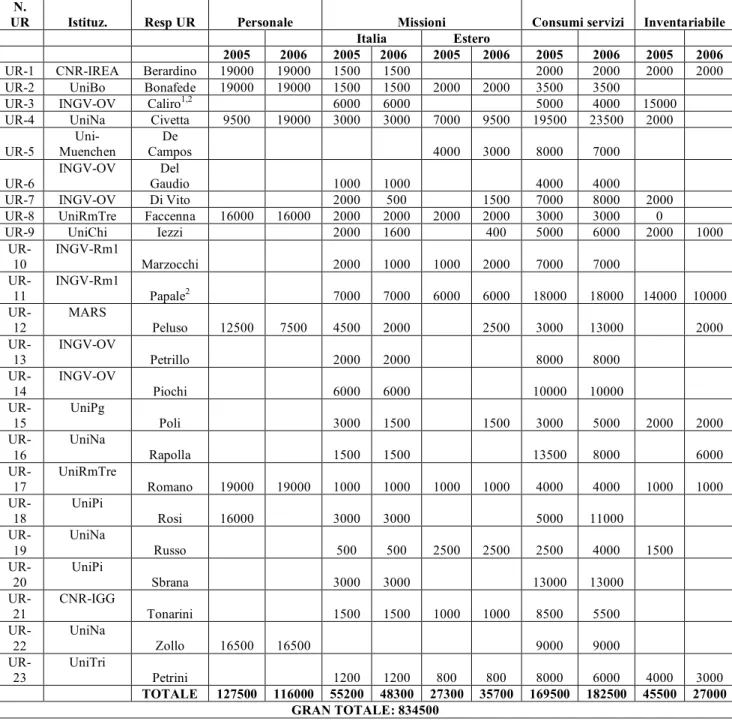
Table RU and related funding request
N. UR Istituz. Resp UR Personale Missioni Consumi servizi Inventariabile
Italia Estero
2005 2006 2005 2006 2005 2006 2005 2006 2005 2006
UR-1 INGV-CT Calvari 1500 5000 1500 5000 12000 10000 UR-2 UNIMiB Tibaldi 8000 15000 4250 4000 1500 1500 1600 2150
UR-3 INGV-CNT Castellano 5000 3000 78000 5000 UR-4 INGV-CT Patanè 1500 2000 2500 3000 3000 5000 2000 UR-5 INGV-Rm2 Speranza 6000 4000 2500 4500 1000 1000 3500 2500 UR-6 UniFi Francalanci 3000 3000 2000 8000 9000
UR-7 INGV-CT Andronico 2000 2000 6000 6000 6000 6000 2500 UR-8 INGV-Rm1 Scarlato 4000 4000 1000 8000 2000 1000 UR-9 INGV-Rm1 Bertagnini 4000 4000 1000 1000 10000 10000 UR-10 UniPi Rosi 2500 3500 1500 1500 9000 9000
UR-11 UniFi Ripepe 18000 3000 3000 1000 2000 UR-12 INGV-OV D’Auria 1500 1500 10500 10500 3500 3500
UR-13 INGV-Rm2 Favali1 2000 2500 2000 4000 5500
UR-14 INGV-CT Mattia 3000 1500 8000 3000 15000 4500 UR-15 INGV-Rm1 Papale 2500 2000 2000 2500 6000 6000 3000 3000 UR-16 UniFi Casagli 30000 17000
UR-17 UniMi Apuani 15000 3650 4000 2700 12150 500
UR-18 UniUrb Renzulli 14000 3500 2500 2500 6000 1500 6000 UR-19 CNR-ISMAR Marani 200 1250 800 1750 15000
UR-20 UniTo Cigolini 7000 7000 3000 2000 1000 500 500 2000 UR-21 UniBo Tranne 6500 3500 1500 500 3000 6000
UR-22 UniRmTre De Rita 8000 8000 2000 1000 1500 2500 5500 5500 UR-23 UniRmTre Mattei 18000 2000 2000 1000 1000 1000 2000 UR-24 UniUrb Capaccioni 13000 6000 3000 3000 1000
TOTALE 86000 79000 74600 66250 48300 54950 121250 182650 29000 5500 GRAN TOTALE: 747500
PROJECT V3
Research on active volcanoes, precursors,
scenarios, hazard and risk
Responsibles:
Paolo Papale, INGV Roma1
Stefano Gresta, Univ. Catania
Project V3
Research on active volcanoes, precursors, scenarios, hazard and risk
Responsibles:
Paolo Papale, Research Director, INGV sez. Roma1 “Sismologia e Tettonofisica”, Via della Faggiola 32, 56126 Pisa. Tel: 050 8311931, Fax 050 8311942. [email protected].
Stefano Gresta, Associate Professor, Dipartimento di Scienze Geologiche, Università di Catania, Corso Italia 57, 95129 Catania. Tel. 095 7195709, Fax 095 7195728, [email protected]
Project Organization
The project is organized in seven sub-projects, each related to a volcanic area in Italy for which research within the project is foreseen. Due to practical difficulty in keeping a close coordination of such a huge project, we propose to be supported by sub-project coordinators, selected among the researchers involved in each sub-project, and who are recognised by the scientific community to have significant skills in that specific volcanic area, as well as coordination capabilities. Sub-project coordinators will keep a closer control and coordination of the activities in their specific volcanic area, will represent the V3 project responsibles in front of sub-project participants, and will provide transfer of information between the project responsibles and participants. V3 project responsibles reported above keep the general responsibility and coordination of the whole V3 project, and also act as sub-project responsibles for the volcanic areas on which their scientific participation is maximum. The proposed sub-project coordinators already gave invaluable help and support to project responsibles in defining the scientific themes and requested deliverables, and managing the organization of each sub-project during the various phases of project preparation.
The seven volcanic areas (and related sub-project number), and the proposed sub-project coordinators are reported in the Table below.
V3 Project Organization
Sub-Project Number Sub-Project Name Proposed Coordinators
V3_1 Colli Albani Piergiorgio Scarlato, INGV Roma1 Mario Gaeta, Univ. Roma1 V3_2 Campi Flegrei
Paolo Papale, INGV Roma1 Lucia Civetta, Univ. Napoli and INGV-OV Napoli
V3_3 Ischia Giovanni Orsi, INGV-OV Napoli Alessandro Aiuppa, Univ. Palermo V3_4 Vesuvio Edoardo Del Pezzo, INGV-OV
Raffaello Cioni, Univ. Cagliari V3_5 Vulcano Gianfilippo De Astis, INGV-OV
Piero Dellino, Univ. Bari V3_6 Etna
Stefano Gresta, Univ. Catania Augusto Neri, INGV Roma1 Ciro Del Negro, INGV-CT V3_7 Pantelleria Walter D’Alessandro, INGV-PA