Improving students’ reading comprehension by implementing
TOEFL extensive reading activities
Maida Norahmi [email protected]
University of Palangka Raya
Yos Sudarso, Palangka Raya, Central Kalimantan
Abstract
The competence of TOEFL has now been demanded by not only English students but also non-English students. In the University of Palangka Raya, the undergraduate English students are required to have TOEFL score of 450 to propose their thesis and to register for graduation. Surprisingly, the average TOEFL score of undergraduate English students is 429 which is below the standard. Reading seemed to be a problem for the students since they wrongly maintained the time and strategies when facing the TOEFL Reading Comprehension texts. Based on the regulation and the data, the research was conducted as an action research focusing only on reading comprehension section of TOEFL and aiming at improving 41 students’ TOEFL Reading Comprehension. The participants joined extensive reading activities on the reading comprehension texts of TOEFL for three weeks. The activities were carried out by blended-learning, combining face-to-face reading activities and online activities via a group of WhatsApp and LINE. The results of the research showed that 51% subjects (21 students) made 5 or more correct answer improvements and 32% subjects (13 students) below 5 correct answer improvements on their TOEFL Reading Comprehension post-test registered after the activities were completed. Otherwise, there were 7 (17%) subjects experiencing no improvement at all.
Keywords: the competence of TOEFL, TOEFL Reading Comprehension,
extensive reading activities
INTRODUCTION
English proficiency of language learners are measured in many ways using various instruments whether they are internet-based or paper-based. Frequently mentioned, one of the popular instruments to test someone’s English proficiency in EFL context is TOEFL test. The scores gained from the
English test is believed to reflect someone’s or language learners’ competences in mastering and performing the English language (Heaton, 1995 p. 10; Hughes, 2003 p. 5). What has become a recent shocking news is that most of governmental offices required the TOEFL score of 450 for the civil servant applicants. Regarding the issue, having the competences of TOEFL is now viewed important in the academic sectors and also in working opportunities. The TOEFL test itself can be divided into TOEFL PBT (paper-based test) which is the one that was used as the instrument of this research, TOEFL CBT (computer-based test), and TOEFL iBT (internet-based test). The TOEFL PBT is the most widely used TOEFL test form in Indonesia, although in some big cities the administrators prefer using the iBT test form due to the more skill tested. The TOEFL PBT is also the only form used in Palangka Raya due to the limitation of supporting facilities and test administrators. There are three competences tested in TOEFL PBT, namely Listening Comprehension, Structure and Written Expression, and Reading Comprehension.
Based on the preliminary study conducted by the researcher, it was found that the scores of the subjects’ TOEFL reading comprehension were below the expectation. The subjects could only make below 25 correct answers out of 50 items in average. On the other hand, the expectation was that the subjects could make more than 30 correct answers since Reading Comprehension Test provides them with more time than the other sections. Besides, understanding the reading comprehension test materials do not need any kind of language rules, for example the grammar. The reasons underlining the problems are assumed on the failure of the subjects in applying the reading strategies so they did not focus on the answers and did not maintain the time allocation well (Sampson, 2013 p. 1). The capability of applying reading strategies is about the experiences of how frequent they are used when reading. It means the capability should be in the habit of the readers. The problems faced by the subjects when reading need to be solved to help the subjects improving the their TOEFL reading comprehension that can be useful in achieving higher TOEFL score in general.
Since reading is a habit and teaching reading as a habit for the subjects takes so much time, the activities of reading should be structurized in some ways. In addition, the most important object in reading activity is reading text (Erliana, 2011 p. 49). After reviewing previous research studies on the same field, the advantages of extensive reading came into the consideration. There were a lot of research (Renandya, 2007 p. 144; Iwahori, 2008 p. 84 ; Ewert, 2012 p. 143; Robb & Kano, 2013 p. 245; Miftah, 2013 p. 23; Alzu’bi, 2014 p. 34)
concluded that the extensive reading activities benefited the subjects in getting more accustomed, more joyful in reading and in achieving better reading comprehension. Extensive reading is an activity of reading that opens the opportunities for the subjects to read the materials they are interested in outside the class activities (Renandya, 2007 p. 134). Some research results revealed extensive reading contributed in improving reading comprehension and was perceived positive by the research subjects (Milliner, 2017 p.55).
Due to the urgency of solving the problem, the activities of the extensive reading were directed to TOEFL reading comprehension materials. According to Constantino (1997, p.116), Mason (2008, p.2), and Sampson (2013 p. 54) extensive reading affected the improvements on the TOEFL scores in which the subjects gained higher score in reading comprehension section after being treated by implementing the extensive reading activities. Furthermore, Cote & Milliner (2015 p. 86), Carney (2016 p. 84), and Milliner (2017 p. 56) also found that the subjects’ TOEIC reading scores were higher after they joined the extensive reading activities during the research. The two evidences showed the power of extensive reading in improving the subjects’ reading comprehension in English proficiency tests. Therefore, regarding the great advantages of extensive reading widely revealed by previous research, the extensive reading was viewed to have a success in solving the problems focused in this research.
Implementing the TOEFL extensive reading activities means allowing the students to read the TOEFL reading materials they intersted in outside the class. In other words, the subjects are free to read the materials at home or wherever and whenever they want. However, the activities still need the control from the researcher as the teacher-facilitator in order to keep the subjects’ reading activities in the track and make sure that the level of reading material difficulty fit the subjects’ proficiency (Renandya, 2007 p. 145). In controlling the reading activities, two kind of online communication applications were used. The research employed Whatsapp group and LINE group as the additional aids to boost subjects’ reading comprehension.
The TOEFL extensive reading activities employed the blended-learning system, in which the in-class activities were combined with those of off-class. The use of technology and blended-learning in extensive reading activities were proved to contribute positively in triggering motivation and in boosting subjects’ reading comprehension. The evidences of how powerful blended learning engaged the students to language learning environment came from several results of research done by Kobayashi & Little (2011, p. 115); Brown (2012, p. 15); Sahin-Kizil (2014, p. 185); Hunt (2014, p. 51); and Cote & Milliner
(2015, p. 86). Combining the goodness offered by blended learning and the online applications used and the the power of extensive reading, the research designed the TOEFL extensive reading activities by blended learning as the solution to the problems underlining the research.
METHOD
The information of how the research was conducted is presented as follows.
Research Design
The research was conducted under the stages of action research aimed at comparing the results of subjects’ reading achievements to the criteria which were set up as the target improvements. The criteria were qualitatively described based on the results of preliminary study (TOEFL reading pre-test) given to the subjects. There is no statistical calculation since the findings would not reflect any significant differences among subjects reading achievements as the results of the research afer the stages were completely implemented. The stages of action research implemented in this study, employing the concept from Kemmis and McTaggart (1988, p. 14), are presented in Figure 1.
Research Subjects
The subjects of the research were voluntarily asked to be involved in the implementation of TOEFL extensive reading activities and mentoring to improve their TOEFL reading comprehension. The subjects were the students majoring English Education Study Program of the University of Palangka Raya. The total subjects were 41 students of consisting of 20 students of the third semester and 21 students of the seventh semester. There were 7 male students and 34 female students joining in the research.
Figure 1. Action Research Design (Adapted from Kemmis and McTaggart, 1988)
Data Collection
A preliminary study was conducted as the first step in investigating the problem happening on subjects’ TOEFL reading comprehension. The researcher analyzed the data to find the source of problem and to conceptualize the action to be done in overcoming the problem. Furthermore, an action research was chosen to be applied on the problem to seek any improvements could be made
Reflecting the action
Analyzing the data collected from observation stage Comparing the result of data
analysis to the targeted indicators in the criteria of success
Observing the action
Observing and collecting the data dealing with subjects’ TOEFL reading comprehension by using research instruments in the form of test on TOEFL reading
comprehension Preliminary Study
Giving the subjects a pre-test on TOEFL reading comprehension
Analyzing the results of the pre-test
Planning the action
Designing TOEFL extensive reading activities
Constructing the TOEFL reading materials
Setting up the criteria of success Making instruments on TOEFL
reading comprehension test
Implementing the action
Conducting TOEFL extensive reading activities
Having students joined in-class and off-class reading activities
Using WhatsApp (WA) group and LINE group to monitor students’ TOEFL extensive reading activities (off-class)
Successful
Unsuccessful
Making conclusion and the report
Revising the plan and doing the next cycle
by TOEFL extensive reading activities. Since the research was conducted by employing the concept of action research, the data collection process was divided into four stages which were planning, implementing, observing, and reflecting. The stages are described as follows.
The Stage of Planning
In the planning stage, the researcher prepared all the needs dealing with the implementation of TOEFL extensive reading activities to improve subjects’ TOEFL reading comprehension. The planning stage consisted of designing the activities for subjects’ reading, organizing the procedure of in-class and off-class activities, constructing TOEFL reading materials, creating online group on WA and LINE, and setting up the criteria of success. The TOEFL extensive reading activities were planned to be in-class and off-class, consisting of six in-class meetings and four off-class meetings. The procedure of conducting the activities were discussed with the subjects since the activities were conducted out of the subjects’ regular campus schedules. And also, the prosedure of online meetings via WA and LINE was on the deal so all the subjects could join at the time. The online groups on WA (for third-semester subjects) and LINE (for seventh-semester subjects) were created after the preliminary study by inviting the subjects to the groups. The choice of the online media was based on the most used social media among the subjects. After the preparation was completed, the researcher set up the criteria of success as the targeted indicator for the improvements made.
Since the objective of this research was to improve subjects’ TOEFL reading comprehension by employing TOEFL extensive reading activities, the indicators of achievement reflected on the criteria of success was needed to recognize the improvements. The criteria of success, then, were treated as a standard to which the subjects’ TOEFL reading comprehension was compared. The criteria of success set up for the research are described in Table 1.
Table 1. Criteria of Success, Data Sources, and Instruments
The criteria of success Data source Instrument for
data collection At least 75% subjects made any
improvements in the total correct answer on the TOEFL reading test
Subjects’ TOEFL reading comprehension scores
TOEFL reading test At least 25% of the subjects who
made improvements in the first criterion made 5 or more correct
Subjects’ TOEFL reading comprehension scores
TOEFL reading test
answer improvements on the TOEFL reading test
The Stage of Implementing
The implementation of TOEFL extensive reading activities was adjusted out of the subjects’ regular or formal campus schedule. There were ten meetings in the total of meetings, divided into six meeting conducted in-class and four meetings conducted off-class for three weeks. The in-class activities included the teaching and learning process on TOEFL reading stragies, reading execises, and class discussion dealing with the subjects’ problems in reading or the execises given. There were two in-class meetings every week and two TOEFL reading texts given to the subjects in each meeting. During the in-class meetings, the subjects did the exercises (reading questions) following the reading texts. After the subjects were done with the exercises, class discussion was conducted to discuss the answers of the exercises and to create deeper understanding of the texts. Furthermore, TOEFL reading strategies were also explained at the end of every meeting so the subjects could apply the strategy in the next meeting.
Besides the in-class meeting, the research was also implemented off-class meetings for TOEFL extensive reading activities. The off-class activities were done by the aids of social media application, namely WA and LINE online groups. The off-class was on the choice of the research since there was needs to make reading as a habit not only in class but also at home. Regarding the needs, the researcher applied the two popular online communication applications in monitoring the reading activities at home. The WA and LINE were used since both of them offered many features that could make reading activities become more interesting and two most downloaded social media among the subjects.
The online groups were created to make sure all of the subjects received the same materials and researcher’s explanation. The off-class activities were conducted once at the weekend for three weeks. The researcher uploaded two TOEFL reading texts at the dealt time and the subjects downloaded them using their smartphones. The researcher gave the subjects some reading time and continued the online activities one or two hours later. After the subjects read the texts and answered the questions regarding the texts, class discussion was conducted by online. At the discussion time, the subjects might consult with the researcher on the group about the difficulties they faced when reading. The other subjects were also given the chance to comment, respond, or even
elaborate the discussion. The off-class activities usually took two or three hours to finish; however, the subjects still could be so relaxed during the off-class.
The Stage of Observing
After the activities were finished, the researcher collected the data dealing with the subjects’ TOEFL reading comprehension. The data collection instrument was a set of TOEFL reading comprehension test consisting of five reading texts followed by 50 question items. In the preliminary study, a set of equivalent TOEFL reading comprehension test was also administered to the subjects to reveal preliminary data. Both tests administered in the preliminary study and observing stage were taken from Longman Preparation Course for the
TOEFL Test: The Paper Test (Phillips, 2003 p. 237-247 & p. 232-233). Although the
items of the tests were different, the researcher still could guarantee that the level of difficulties was quite the same since they were taken from standardized TOEFL test book.
The purpose of observation in this research was to know the implementation of TOEFL extensive reading activities which had been conducted could make some improvements on the subjects’ TOEFL reading comprehension. The test as the instrument of collecting the data was administered in different days for the third-semester and seventh-semester subjects. The different test administration day was caused by the campus schedule of the subjects. However, there were no different test items for both groups. The results of the test, then, were analyzed by the researcher to make some calculation of the subjects’ correct answers. The improvements on the subjects’ TOEFL reading comprehension obtained were then compared to the indicator of achievement that was set up on the criteria of success.
The Stage of Reflecting
The decision of whether the TOEFL extensive reading activities were successful or not in improving the subjects’ TOEFL reading comprehension was made in reflecting stage. The results of the subjects’ correct answers on TOEFL reading comprehension were compared to the criteria of success. If the results could not show the improvements as being set up at the criteria, the cycle should be repeated. However, if they successfully achieved the criteria, the researcher came into a conclusion. In this stage, the researcher created a table to show the improvements made among the subjects. The further description of reflection process will be more explained and described in the following data analysis sub-heading.
Data Analysis
The reflection process should be more described in the data analysis process since the results were analyzed for the shake of comparing to the citeria of success. The process of analyzing the results of the TOEFL reading comprehension test collected from observation stage was carried out to determine how successful the TOEFL extensive reading activities in overcoming the problems faced by the subjects in reading the TOEFL texts. Besides determining the success of TOEFL extensive reading activities in solving the TOEFL reading problem, the reflection also discussed the factors that might cause the problem unsuccessfully solved.
The analysis of observation result was compared to the indicators set up previously in criteria of success. If the data showed that the indicators in the criteria of success had been achieved, it meant that the TOEFL extensive reading activities successfully solved the problem faced and there was no more cycle needed. However, if the indicators had not been achieved yet, some revisions were needed to employ the next cycle. For the data analysis, as previously mentioned, the researcher did not employ any statistical data calculation. The numbers were only used to count the total numbers of the score improvements of the test. It meant the number simply showed how many correct answers could be made by the subjects out of 50 question items given.
FINDINGS
Based on the results of data analysis on the subjects’ scores of TOEFL reading comprehension test, the findings of the research on the research subject (RS) are presented in table 2.
The findings (Table 2) revealed that there were 7 subjects experienced no improvements at all. The subjects who did not make any improvements on the total correct answers are indicated by the (*) in the table. Furthermore, there were 36 subjects experiencing improvements on their total correct answers. The improvements were varied in the range from one till twenty four more correct answers compared to those of preliminary test. The results indicated that 83% of the subjects made some improvements and achieved the first targeted indicator of the criteria of success.
Table 2. The results of the subjects’ scores of TOEFL reading comprehension test Subject Total correct answers on preliminary test Total correct answers on post-test Subject Total correct answers on preliminary test Total correct answers on post-test RS 1 28 40 RS 22 18 30 RS 2 29 34 RS 23 16 20 RS 3 15 25 RS 24 22 28 RS 4 29 36 RS 25 27 32 RS 5 21 26 RS 26 24 27 *RS 6 27 27 RS 27 23 33 *RS 7 24 19 *RS 28 16 15 RS 8 28 30 RS 29 24 34 RS 9 27 30 RS 30 18 22 RS 10 18 21 RS 31 20 23 RS 11 23 29 *RS 32 29 27 RS 12 24 32 RS 33 20 25 RS 13 23 24 RS 34 22 30 RS 14 20 25 RS 35 21 25 RS 15 8 32 RS 36 26 30 RS 16 29 30 *RS 37 25 25 *RS 17 27 27 RS 38 19 24 RS 18 25 33 *RS 39 28 26 RS 19 28 31 RS 40 25 29 RS 20 21 34 RS 41 30 35 RS 21 30 45
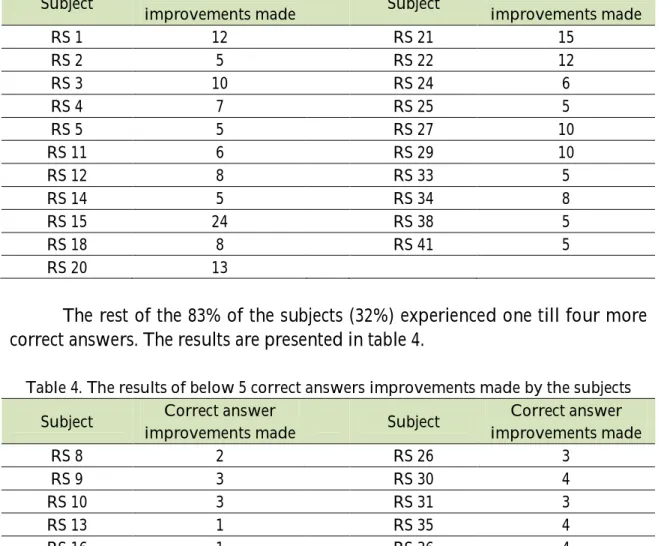
Also, among the 83% the subjects, 51% of them made 5 or more correct answers which exceeded the second targeted indicator set up on 25% of the subjects. The results are presented in table 3.
Table 3. The results of 5 or more correct answers improvements made by the subjects
Subject Correct answer
improvements made Subject
Correct answer improvements made RS 1 12 RS 21 15 RS 2 5 RS 22 12 RS 3 10 RS 24 6 RS 4 7 RS 25 5 RS 5 5 RS 27 10 RS 11 6 RS 29 10 RS 12 8 RS 33 5 RS 14 5 RS 34 8 RS 15 24 RS 38 5 RS 18 8 RS 41 5 RS 20 13
The rest of the 83% of the subjects (32%) experienced one till four more correct answers. The results are presented in table 4.
Table 4. The results of below 5 correct answers improvements made by the subjects
Subject Correct answer
improvements made Subject
Correct answer improvements made RS 8 2 RS 26 3 RS 9 3 RS 30 4 RS 10 3 RS 31 3 RS 13 1 RS 35 4 RS 16 1 RS 36 4 RS 19 3 RS 40 4 RS 23 4
Based on the data obtained as research findings, the research successfully improved the subjects’ correct answers on TOEFL reading comprehension test. The improvements indicated the achievement on the criteria of success set up previously. Since the two targeted indicators on the criteria of success were achieved by the research results, the research was considered successful in solving the subjects’ problems in TOEFL reading comprehension. The researcher finally decided not to repeat the cycle of action research and a report should be made after.
DISCUSSION
The TOEFL extensive reading activities were designed to make improvements on the subjects’ TOEFL reading comprehension. The problems rose when the results of preliminary reading test revealed that most of the subjects made below 30 correct answers out of 50 items. The expectation was made that the subjects could achieve more than 30 correct answers since the TOEFL reading comprehension section provide the longest test time of all. It stated by Sampson (2013, p. 1) that the subjects have more time to read and to decide the correct answer based on the texts since they poorly implemented the strategies of learning. Regarding duration of the research and the reading test scores on preliminary test, the researcher addressed to have two targeted criteria as the indicator of improvements on the subjects’ TOEFL reading comprehension. The two criteria were made to have more level of the improvements, focusing not only on any improvements made, but also on how many scores can be gained because of the improvements. The first criterion was addressed to seek whether the subjects have more correct answers or not, after the TOEFL extensive reading activities were conducted.
The researcher set up that 75% subjects or at least 30 subjects from 41 subjects joined the activities could make any improvements as the standard of success for the first criterion. The second criterion was made as more specific indicator to count the total of correct answers could be made if the subjects could make any improvements on the TOEFL reading post-test. The second criterion expected the subjects to make 5 or more correct answers compared to the scores they gained on the preliminary test. Regarding the limited time to conduct the research and considering the longer time to make the subjects accustomed to reading, the researcher set up 25% of the total subjects or at least 10 students could make 5 or more correct answers on the post-test. The achievement of both criteria assured the success of the research cycle whether it would stop only in the first cycle or it needed more cycle to conduct.
According to the data on research findings, it was found that 34 (83%) subjects could make any improvements on their post-test. The results showed that the first standard (criterion) set up previously was successfully achieved. Most of the subjects experienced improvements on their post-test scores, although some experienced the same scores even lower than the preliminary test. The achievements of the first criterion was predicted since, during the three weeks, the subjects were exposed to the reading materials and were asked to answer the questions following the texts. The results revealed that the subjects were more ready to read in the given time so they can manage the time
well and did the reading in more fluent ways. It was in line with one of Day & Bamford’s (2002, p. 138) ten principles in extensive reading, stating that the readers could perform faster reading since they were accustomed to keep reading forward by minimizing time-spending activities while reading. For those who did not make any improvements, the researcher came to an assumption that they might be influenced by some personal factors, such as anxiety, fatigue, and time pressure. The influencing factor of reading test materials could be minimized since the texts were similar in length and in the level of difficulties and were taken from standardized TOEFL reading test.
Reading is a kind of habit and the improvements on reading comprehension need much time to happen. The subjects should be provided with some times to make reading as their habit by doing extensive reading (Renandya, 2007 p. 135). The different scores on the post-test, which were higher than the preliminary one, indicated that the TOEFL extensive reading activities contributed positively to their reading comprehension. The TOEFL extensive reading activities were expected to expose the subjects to the habit of reading. The more the subjects read, the higher score they gain in reading comprehension test. In addition, Milliner (2016, p. 34) found that the extensive reading could also influence the subjects’ TOEIC scores by gaining more 12 points at the end of the course.
The use of online communication applicatrions in the research for the purpose of monitoring the subjects’ reading activities outside the classroom made the exposure of reading can be experienced by the subjects although they were at home. The monitoring was done to limit the subjects’ access to read unrelated materials (Day & Bamford, 2002 p. 140). The subjects only needed to download the reading materials which were in the Ms. Word file containing 4 -6 pages without any images and no need for them to print it out. In addition, reading through smartphone also contributed to the improvements on subjects’ reading comprehension since it enabled the subjects to easy and flexible reading activities (Milliner, 2016 p. 47). The opportunities for the subjects to directly ask their friends or the teacher personally about the difficulties they found when reading would influence their reading comprehension. It could happen since the subjects found some help in deciding the correct answer of the questions or they could apply the peers’ and teacher’s feedbacks to other reading activities Lan, Sung & Chang, 2006 p. 62). Simply saying, there were no delayed feedbacks from peers or the teacher when the subjects were reading . Therefore, the power of technology and the benefits of blended learning were influencing factors to the improvements gained.
Based on the data on research findings, the second criterion was also successfully achieved. As the standard, the researcher set up that 25% of the subjects or at least 10 subjects could make 5 or more correct answers on the post-test. The results of data analysis showed that there were 21 subjects (51%) successfully making the targeted improvements. The standard of 25% was made as the appropriate portion or expectation by considering the limited time that the subjects had for their reading activities. However, the results were quite surprising that the total of the subjects could reach the second criteria much more than the expectation. The consideration of setting the standard of 25% was due to the short time of the research. Therefore, the extensive reading allowed the subjects to apply more frequent reading strategies and then applied them when having reading comprehension test (Sampson, 2013 p. 54).
It is also important to take some consideration on those who made below 5 correct answers (1– 4 correct answers) on the post-test although the researcher did not compared them to the criteria of success. There were 13 subjects or 32% of the total subjects could make those improvements. Regarding the different increasing gained scores on the post-test, the researcher came into a conclusion that the subjects’ proficiencies in applying reading strategies were different during the reading activities. The factors influenced might be on the use of the terms reading a great deal, reading quickly, and real-world experiences which differentiate the gains among the individuals (Day, 2015 p. 294).Some subjects became more accustomed to reading exposure so they could apply the strategies and reading time efficiently to control any distraction when having the test. On the other hand, those who made lower correct answers might need more time and guidance in applying the strategies and more experiences to manage the reading time.
CONCUSION AND SUGGESTION
The action research was conducted in ten meetings within one cycle which was directed to improve subjects’ TOEFL reading comprehension. The analysis result of the findings showed that 83% of the subjects experienced some improvements on their TOEFL reading comprehension. After the implementation of TOEFL extensive reading activities, 51% subjects out of 83% did make 5 or more correct answers improvements in their reading post-test. Moreover, there were 13 subjects (32% of the 83% subjects) made below 5 correct answers improvements in the range 1 – 4 more correct answers. However, there were also no improvements in the total of correct answers for the rest 7 subjects (17%), even some experienced less correct answers on the
reading post-test result. Therefore, based on the achievement of the targeted indicators on the criteria of success, the research was proven effective and successful in improving the subjects’ TOEFL reading comprehension.
Regarding the successfulness of TOEFL extensive reading activities, there is a procedure to be followed. The procedure is 1) arranging the schedule of the reading activities; 2) constructing appropriate TOEFL reading materials; 3) coorporating the reading activities in blended learning as 60% for face-to-face meetings and 40% for online meetings; 4) combining the teaching and learning process with some popular online communication application; 5) giving the responses and feedbacks to the reading achievements or any questions while and after the reading activities; 6) providing opportunities to class discussion after the reading activities; and 7) teaching and modeling the TOEFL reading strategies during the after-reading discussion.
Some suggestion, then, are given to those who have similar concern to the improvement of reading comprehension generally and specifically, of TOEFL reading comprehension. The blended learning occupied in TOEFL extensive reading activities can be in different portion, such as 50:50 or 40:60 for face-to-face meetings and online meetings to gain other varied conclusions. Those who want to apply the procedure can also use different online communication applications or self-made application to maintain the off-class teaching and learning of TOEFL reading activities. The last, the procedure is suggested to be used to address other section of TOEFL test, like Listening comprehension section and Structure and Written Expression section in order to be fully applied for the improvements of TOEFL scores.
REFERENCES
Alzu’bi, M.A. (2014). The Effects of an Extensive Reading Program on Improving English as Foreign Language Proficiency in University Level Education. English Language Teaching, 7(1), 28-35.
Brown, D. (2012). Online support systems for extensive reading: Managing the tension between autonomy and institutional education. The Language
Teacher, 36(2), 11–16.
Carney, N. (2016). Gauging extensive reading’s relationship with TOEIC reading score growth. Journal of Extensive Reading, 4(4), 69-86.
Constantino, R., Lee, S.Y., Cho, K.S., and Krashen, S. (1997). Free voluntary reading as a predictor of TOEFL scores. Applied Language Learning, 8(1), 111-118.
Cote, T. & Milliner, B. (2015). Implementing and managing online extensive reading: Student performance and perceptions. The iallt Journal, 45(1), 70– 90.
Day, R. & Bamford, J. (2002). Top Ten Principles for Teaching Extensive Reading. Reading in a Foreign Language, 14(2), 136-141.
Day, R. (2015). Extending extensive reading. Reading in a Foreign Language, 27(2), 294–301.
Erliana, S. (2011). Improving reading comprehension through directed reading-thinking activity (DRTA) strategy. Journal on English as a Foreign
Language, 1(1), 49-57.
Ewert, D. (2012). The effects of Extensive Reading on adult reading behavior and proficiency in an intensive English program. Extensive Reading World
Congress Proceedings, 1, 141-144.
Heaton, J. B. 1995. Writing English Language Tests--New edition. United States of America: Longman.
Hughes, A. 2003. Testing for Language Teachers-Second Edition. Cambridge: Cambridge University Press.
Hunt, J.R. (2014). Extensive reading in english in hitotsubashi university pace classes: justification, establishment and objectives. Hitotsubashi Journal Of
Commerce And Management, 48, 43-53.
Iwahori, Y. (2008). Developing reading fluency: A study of extensive reading in EFL. Reading in a Foreign Language, 20(1), 70-91.
Kemmis, S. & Mc.Taggart, R. (1988). The Action Research Planner. Victoria: Deakin University Press.
Kobayashi, K. & Little, A. (2011). Learner perceptions on the usefulness of a blended learning EFL program. The JALT CALL Journal, 7(1), 103-117. Lan, Y.J., Sung, Y.T., & Chang, K.E. (2006). Collaborative early EFL reading
among distributed learners: A simulation pilot study. The JALT CALL
Journal, 2(2), 53-66.
Mason, B. (2008). TOEFL Preparation using Recreational Reading. Proceedings of
2007 (9th) International Conference and Workshop on TEFL and Applied Linguistics. Taipe: Ming Chuan University. Retrieved on 20 November
2017 from
http://www.benikomason.net/content/articles/toefl_preparation_using_re creational_reading.pdf
Miftah, M. Z. (2013). Implementation of intensive-extensive reading strategy to improve reading comprehension. Journal on English as a Foreign Language,
Milliner, B. (2016). Implementing a mobile-based extensive reading component: A report on student engagement and learning outcomes. JACET Summer
Seminar Proceedings No. 14. Tokyo: The Japan Association of College
English Teachers. Retrieved on 10 November 2017 from
https://www.academia.edu/24477615/Implementing_a_mobile-based_extensive_reading_component_A_report_on_student_engagemen t_and_learning_outcomes
Milliner, B. (2017). One year of extensive reading on smartphones: A report. The
JALT CALL Journal, 13(1), 49-58.
Phillips, B. (2003). Longman preparation course for the TOEFL test. The paper test. New York: Pearson Education.
Renandya, W. A. (2007). The power of extensive reading. relc Journal, 38(2), 133– 149.
Robb, T. & Kano, M. (2013). Effective extensive reading outside the classroom: A large-scale experiment. Reading in a Foreign Language, 25(2), 234–247. Sahin-Kizil, A. (2014). Blended instruction for EFL learners: Engagement,
learning and course satisfaction. The JALT CALL Journal, 10(3), 175-188. Sampson, N.E. (2013). An extensive reading approach to teaching English
second language reading comprehension with the American Language
Institute at the University of Toledo. Thesis. Toledo: The University of
Toledo. Retrieved on 23 November 2017 from
http://utdr.utoledo.edu/cgi/viewcontent.cgi?article=1215&context=theses-dissertations
Author’s Brief CV
Maida Norahmi was born in Sampit on October 12, 1989. She graduted from
University of Palangka Raya in 2011 and State University of Malang in 2014. She is now a lecturer of English Education Study Program, Teacher Training and Education Faculty, University of Palangka Raya starting from 2015.