BEARING FAULT DETECTION USING DISCRETE WAVELET TRANSFORM
SYAHRIL AZEEM ONG BIN HAJI MALIKI ONG
Report submitted in partial fulfillment of the requirements for the award of the degree of Bachelor of Mechanical Engineering
Faculty of Mechanical Engineering UNIVERSITI MALAYSIA PAHANG
ABSTRACT
Rolling element bearing has vast domestic and industrial applications. Appropriate function of these appliances depends on the smooth operation of the bearings. Result of various studies shows that bearing problems account for over 40% of all machine failures. Therefore this research is to design a test rig to harness data in terms of types of defects and rotation speed and also to develop method to detect features in vibration signals. Six set of bearings were tested with one of them remains in good condition while the other five has its own type of defects have been considered for analysis by using Discrete Wavelet Transform (DWT). The data for a good bearing were used as benchmark to compare with the defective ones. MATLAB’s Discrete Wavelet Transform ToolBox was used to down-sample the vibration signals into noticeable form to detect defect features under certain frequency with respect to time. From the result generated, Fast Fourier Transform (FFT) and Root Mean Square (RMS) plays an important role in supporting results analyzed by using DWT from MATLAB® Toolbox. A system with low operating speed yields unsystematic results due to low excitation. As the speed increases, the excitation increases thus making DWT works effectively. For data of insufficient excitation, defect features still may be discovered by calculating and plotting graph for the percentage of RMS value of each decomposition level compared to the original input. This shows that DWT appears to be effective in pointing out the location and frequency of defect when the excitation is high enough. If the excitation is low, RMS value of each decomposition level may support the result. Nevertheless, DWT also proves to be an effective method for online condition monitoring tool. Future research should be detecting defect features by using envelope analysis or based on statistical tools.
ABSTRAK
Galas mempunyai aplikasi domestik dan industri yang luas. Fungsi yang sesuai bagi peralatan serta mesin-mesin bergantung kepada kelancaran galas. Hasil daripada pelbagai kajian menunjukkan bahawa masalah galas merangkumi lebih 40% daripada kesemua punca kegagalan mesin. Oleh itu, kajian ini adalah untuk mereka bentuk sebuah rig ujian bagi memperoleh isyarat getaran dari segi jenis kecacatan dan kelajuan putaran. Kajian ini juga bertujuan untuk membangunkan kaedah untuk mengesan ciri-ciri di dalam isyarat getaran tersebut. Enam set galas telah diuji dengan salah satu daripadanya masih dalam keadaan baik manakala lima yang lain mempunyai jenis-jenis kecacatan yang tertentu dan telah digunakan bagi analisis menggunakan kaedah Penjelmaan Anak Gelombang Diskrit (DWT). Isyarat getaran yang diperoleh daripada galas baik telah digunakan sebagai penanda aras untuk dibandingkan dengan isyarat getaran yang diperoleh dari galas yang tidak sempurna. DWT daripada MATLAB ToolBox telah digunakan untuk mengurai isyarat-isyarat getaran kepada bentuk yang lebih ketara bagi mengesan ciri-ciri kecacatan di bawah frekuensi tertentu dengan merujuk kepada masa. Hasil daripada analisis menunjukkan, Penjelmaan Fourier Pantas (FFT) dan Punca Min Kuasa Dua (RMS) memainkan peranan penting dalam menyokong keputusan yang dianalisis dengan menggunakan DWT dari MATLAB ToolBox. Sistem dengan kelajuan operasi yang rendah menunjukkan keputusan yang tidak sistematik kesan daripada pengujaan yang rendah. Apabila kelajuan bertambah, peningkatan pengujaan menyebabkan analisis DWT dapat dilakukan lebih berkesan. Untuk data yang mempunyai pengujaan yang rendah, ciri-ciri kecacatan masih boleh ditemui melalui pengiraan dan graf peratusan nilai RMS bagi setiap tahap penguraian berbanding dengan input asal. Ini menunjukkan bahawa DWT berkesan dalam menunjukkan lokasi dan kekerapan kecacatan apabila mempunyai pengujaan yang cukup tinggi. Jika pengujaan rendah, nilai RMS bagi setiap tahap penguraian mampu menyokong keputusan. DWT juga telah terbukti menjadi kaedah yang berkesan sebagai alat pemantauan keadaan talian. Kajian akan datang perlu mengesan ciri-ciri kecacatan dengan menggunakan analisis sampul surat atau berdasarkan alat statistik.
TABLE OF CONTENTS
PAGE
EXAMINER’S DECLARATION ii
SUPERVISOR’S DECLARATION iii
STUDENT’S DECLARATION iv
ACKNOWLEDGEMENT v
ABSTRACT vi
ABSTRAK vii
TABLE OF CONTENTS viii
LIST OF TABLES x
LIST OF FIGURES xi
LIST OF SYMBOLS xiv
LIST OF ABBREVIATIONS xv CHAPTER 1 INTRODUCTION 1 1.1 Introduction 1 1.2 Problem Statement 2 1.3 Objective 3 1.4 Hypothesis 3 1.5 Scope of Project 3
CHAPTER 2 LITERATURE REVIEW 4
2.1 Introduction 4
2.2 Bearing 5
2.2.1 Types of bearing defects 5
2.3 Signal Processing Analysis 7
2.3.1 Frequency domain analysis 7
2.2.3 Time frequency analysis: Discrete Wavelet Transform 12
2.4 Condition Monitoring Method 15
CHAPTER 3 METHODOLOGY 17 3.1 Introduction 17 3.2 Design of Experiment 19 3.3 Experimental Setup 20 3.3.1 Sensor calibration 21 3.3.2 Tested bearings 22
3.3.3 Test rig design & fabrication 25
3.4 Data Analysis 27
3.5 Data Processing Algorithm 28
3.5.1 Discrete Wavelet Transform 28
3.5.2 Analysis using Discrete Wavelet Transform Toolbox 32
CHAPTER 4 RESULTS & DISCUSSION 34
4.1 Introduction 34
4.2 Data Acquisition 35
4.3 Decomposition Result 37
4.4 Root Mean Square Percentage Analysis 47
4.4.1 RMS Data for 2664 rpm 48
4.4.2 RMS Data for1466 rpm 50
4.4.3 RMS Data for 287 rpm 52
CHAPTER 5 CONCLUSION & RECOMMENDATIONS 56
5.1 Conclusion 56
5.2 Recommendations 57
APPENDICES
A RESEARCH GANTT CHART 61
B TECHNICAL DRAWINGS 62
C CNC MACHINE CODING 63
LIST OF TABLES
Table No Page
2.1 Types of bearing damage, appearance, and possible cause 6 2.2 Fault description in the ball bearings 16 3.1 Number of experiment run with various bearing defects 19
3.2 Types and location of defect 22
4.1 RMS percentage value for each level of decomposition 48 at 2664 rpm
4.2 RMS percentage value for each level of decomposition 50 at1466 rpm
4.3 RMS percentage value for each level of decomposition 52 at 287 rpm
LIST OF FIGURES
Figure No Page
2.1 Cutaway view of a caged ball bearing 5 2.2 A typical spectrum obtained from a rolling element bearing 9
with an inner race defect
2.3 STFT in displacement (a), velocity (b), and acceleration (c) 11 of a good bearing. The colour associates to the higher value
of the energy scale, and represents a high level of energy content 2.4 STFT in displacement (a), velocity (b), and acceleration (c) 12
of a faulty bearing. The colour associates to the higher value of the energy scale, and represents a high level of energy content 2.5 Comparison of known transformation methods. Time-series 14
(a), Fourier transform (b), STFT (c), and Wavelet transform (d)
3.1 Project’s flow chart 18
3.2 Bearing fault detection test rig consist of: coupling (a), tested 20 bearing (b), flywheel (c), healthy bearing (d), accelerometer (e), data acquisition system (f), and a PC with DASYlab software (g)
3.3 Actual bearing test rig 21
3.4 Outer race defect 22
3.5 Inner race defect 23
3.6 Contaminated defect 23
3.7 Point defect 24
3.8 Corroded defect 24
3.9 Healthy bearing 25
3.10 Bearing housing’s isometric view 26
3.12 Shaft’s front view 27
3.13 DASYLab’s layout 27
3.14 Flow chart for decomposition process by using MATLAB®’s 29 command
3.15 Filtering process at its most basic level 30 3.16 Down-sampling process from left to right 30
3.17 Wavelet decomposition tree 31
3.18 Discrete Wavelet Transform’s Toolbox main menu 32 3.19 Selecting data (a), choosing wavelet type (b), and changing 33
display mode (c)
3.20 Output for MATLAB Discrete Wavelet Transform’s Toolbox 33 4.1 Vibration reading when running at 287 rpm for healthy 35
bearing (a), PD (b), OR defect (c), IR defect (d), CN defect (e), and CB defect (f)
4.2 Vibration reading when running at 1466 rpm for healthy 36 bearing (a), PD (b), OR defect (c), IR defect (d), CN
defect (e), and CB defect (f)
4.3 Vibration reading when running at 2664 rpm for healthy 37 bearing (a), PD (b), OR defect (c), IR defect (d), CN
defect (e), and CB defect (f)
4.4 Decomposition result for healthy bearing at 287 rpm 38 4.5 Decomposition result for healthy bearing at 1466 rpm 39 4.6 Decomposition result for healthy bearing at 2664 rpm 49 4.7 Decomposition result for outer race defect at 287 rpm 40 4.8 Decomposition result for outer race defect at 1466 rpm 40 4.9 Decomposition result for outer race defect at 2664 rpm 41 4.10 Decomposition result for inner race defect 287 rpm 41
4.11 Decomposition result for inner race defect 1466 rpm 42 4.12 Decomposition result for inner race defect 2664 rpm 42 4.13 Decomposition result for corroded defect at 287 rpm 43 4.14 Decomposition result for corroded defect at 1466 rpm 43 4.15 Decomposition result for corroded defect at 2664 rpm 44 4.16 Decomposition result for point defect at 287 rpm 44 4.17 Decomposition result for point defect at 1466 rpm 45 4.18 Decomposition result for point defect at 2664 rpm 45 4.19 Decomposition result for contaminated defect at 287 rpm 46 4.20 Decomposition result for contaminated defect at 1466 rpm 46 4.21 Decomposition result for contaminated defect at 2664 rpm 47 4.22 RMS percentage vs. decomposition level for speed of 2664 rpm 49 4.23 RMS percentage vs. decomposition level for speed of 1446 rpm 51 4.24 RMS percentage vs. decomposition level for speed of 287 rpm 53 4.25 FFT result for contaminated defect at speed 297 rpm 55
LIST OF SYMBOLS
- Shaft rotation frequency α - Contact angle
Han(h) - Hanning function
V(tn) - nth measured voltage sample
LIST OF ABBREVIATIONS
AE - Acoustic Emission BG - Burnt grease B&K - Bruel & Kjær
cA - Approximate decomposition CB - Corroded ball
cD - Detailed decomposition
CWT - Continuous Wavelet Transform DWT - Discrete Wavelet Transform FFT - Fast Fourier Transform HDD - Hard disk drive
HFRT - High frequency resonance technique IR - Inner race
NDT - Non-destructive test
NiDAQ - National Instrument Data Acquisition System OR - Outer race
PC - Personal computer PD - Point defect RMS - Root Mean Square RPM - Revolutions per minute SPM - Shock Pulse Method
STFT - Short Time Fourier Transform UI - User interface
CHAPTER 1
INTRODUCTION
1.1 INTRODUCTION
Rolling element bearings has vast domestic and industrial applications. Appropriate function of these appliances depends on the smooth operation of the bearings. In industrial applications, bearings are considered as critical mechanical components and a defect in such a bearing causes malfunction and may even lead to catastrophic failure of the machinery.
Presently, vibration monitoring method becomes the most reliable tool as a part of preventive maintenance for rotating machines (Tandon and Choudhury, 1999). The vibration data often contain fault signatures where several signal processing techniques; often adapted to a precise defect type, results to online monitoring system.
There are many condition monitoring methods used for detection and diagnosis of rolling element bearing defects such as vibration measurements, temperature measurement, shock pulse method (SPM), and acoustic emission (AE). Various researchers suggested that stator current monitoring can provide the same indications without requiring access to the motor. This technique utilizes results of spectral analysis of the stator current or supply current of any part nearest to the rolling bearing element for diagnosis purpose (Schoen et al, 1995). Other signal processing technique for condition monitoring method includes averaging technique (Braun and Datner, 1977), adaptive noise cancelling (Chaturvedi and Thomas, 1981), and high-frequency
resonance technique (HFRT) (Prasad et al, 1984) was developed to improve signal-to-noise ratio for more effective detection of bearing defect. Among all these monitoring methods, the high-frequency resonance technique is more popular for bearing fault detection. However, most of the method requires additional computations and several runs of impact tests to find the bearing resonance frequency. Therefore, extra instruments such as vibration exciters and their controller are needed for HFRT (Prabhakar et al, 2002).
Discrete Wavelet Transform (DWT) on the other hand, were proven to be the best condition monitoring method/effective tool for detecting single and multiple faults in the ball bearings (Djebala et al, 2007; Prabhakar et al, 2002). A clear review on using DWT as condition monitoring method and possible early detection was given by Tandon and Choudhury (1999), Kim et al. (2002), and Staszewski (1998).
1.2 PROBLEM STATEMENT
Rolling bearings are the major components of rotating machine. Thus they are often subjected to various excitations which can cause dangerous accidents due to certain factors. Results of various studies show that bearing problems account for over 40% of all machine failure (Schoen 1995).
This data acquisition technique is a type of non destructive test (NDT) which doesn’t require the user to dismantle the bearing from the machine in order to check its condition as it may be presented through online monitoring.
Time-domain analysis lacks information in terms of frequency while frequency-domain analysis lacks information on time. Even though Short Time Fourier Transform (STFT) have both time and frequency domain analysis, but it is less accurate on both domain of analysis. But DWT on the other hand, produces vibratory signal in terms of time and frequency domain analysis which gives the most accurate readings for caged-roller bearing which is why DWT was chosen as the tool to analyze bearing defects.
1.3 OBJECTIVE
The objective of this project is:
a) Design a test rig to harness vibration data in terms of types of defects and rotation speed
b) Develop method to detect the defect features in the vibration signals by using time-frequency domain analysis
1.4 HYPOTHESIS
The expected result for this research is that there will be a difference in terms of vibration signals when bearing with different type of defects were tested by using wavelet transform method. DWT method is an advanced method to detect any changes in terms of vibration signal.
1.5 SCOPE OF PROJECT
In order to reach the project’s objective, the following scopes are identified: a) Only horizontal deep groove ball bearings will be used
b) Five types of bearing defects will be tested and they are outer race (OR) defect, inner race (IR) defect, point defect (PD), corroded ball (CB) defects, contaminated defect (CN), and a good condition bearing as the reference
c) Three different angular speed of lowest, medium, and highest speed will be used to acquire data for each bearings
d) Acquire vibration data from the rotating machine using a single axial accelerometer
e) Analysis will be done by using MATLAB®’s Discrete Wavelet Transform ToolBox
CHAPTER 2
LITERATURE REVIEW
2.1 INTRODUCTION
This chapter discusses the literatures that are related to bearing fault detection and discrete wavelet transform. In this chapter, the types of bearings, types of bearing defects, and common causes of bearing failures will be discussed. Moreover, the signal processing analysis on different types of domain analysis, and condition monitoring methods also on different types of domain analysis will also discussed.
2.2 BEARING
Bearing; as shown in Figure 2.1, is a mechanical device that allows constrained relative motion of 2 or more parts; typically between linear and rotational movement. There are many types of bearings often used in machineries when it involves rolling element and each one of them used for different purpose. These include ball bearings, caged ball bearings, roll thrust bearings, and tapered roller thrust bearings.
Figure 2.1: Cutaway view of a caged ball bearing
Source: The Timken Company. (2011)
2.2.1 Types of bearing defects
As well as there’s continuous usage there will always be unwanted defects on the material of the bearing. Generally, a rolling bearing cannot rotate forever. Under normal operating conditions of balanced load and good alignment, fatigue failure begins with a small fissure, located between the surface of the raceway and the rolling elements, which gradually propagate to the surface, generating detectable vibrations and increasing noise levels (Eschmann et al 1958). Continued stress causes fragments of the material to break loose producing a localized fatigue phenomenon known as flaking or spalling (Riddle 1955). The affected area expands rapidly afterwards contaminating the lubrication and
causing localized overloading over the entire circumference of the raceway (Eschmann et al 1958). Eventually, the failure results in rough running of the bearing
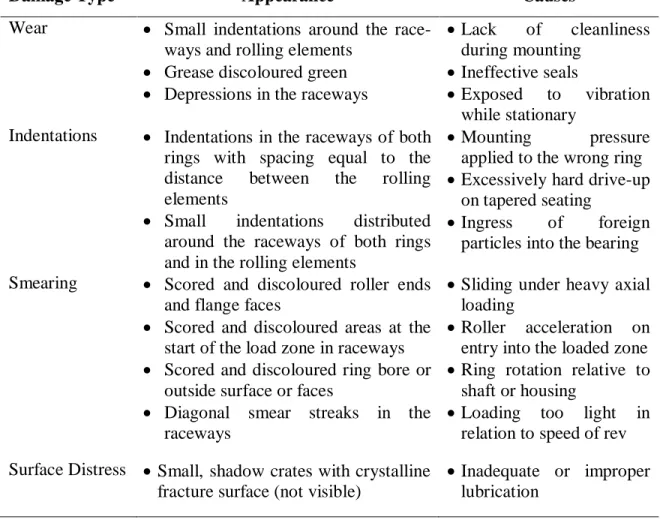
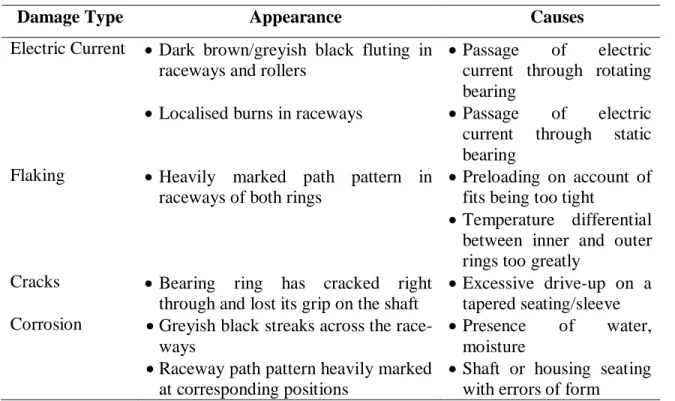
There are several types of common defects which may be clustered into 2 main types of bearing damages; primary and secondary damage. Primary damage consists of: wear, indentations, smearing, surface distress, corrosion, and electric current damage. While secondary damage consists of flaking and cracks. Table 2.1 shows different types of bearing damage, its appearance and cause.
Table 2.1: Types of bearing damage, appearance, and possible causes
Damage Type Appearance Causes
Wear Small indentations around the race-ways and rolling elements
Grease discoloured green
Depressions in the raceways
Lack of cleanliness
during mounting
Ineffective seals
Exposed to vibration
while stationary Indentations Indentations in the raceways of both
rings with spacing equal to the distance between the rolling elements
Small indentations distributed around the raceways of both rings and in the rolling elements
Mounting pressure
applied to the wrong ring
Excessively hard drive-up on tapered seating
Ingress of foreign
particles into the bearing Smearing Scored and discoloured roller ends
and flange faces
Scored and discoloured areas at the start of the load zone in raceways
Scored and discoloured ring bore or outside surface or faces
Diagonal smear streaks in the raceways
Sliding under heavy axial loading
Roller acceleration on entry into the loaded zone
Ring rotation relative to shaft or housing
Loading too light in relation to speed of rev Surface Distress Small, shadow crates with crystalline
fracture surface (not visible)
Inadequate or improper lubrication
Table 2.1: Continued
Damage Type Appearance Causes
Electric Current Dark brown/greyish black fluting in raceways and rollers
Localised burns in raceways
Passage of electric
current through rotating bearing
Passage of electric
current through static bearing
Flaking Heavily marked path pattern in raceways of both rings
Preloading on account of fits being too tight
Temperature differential between inner and outer rings too greatly
Cracks Bearing ring has cracked right through and lost its grip on the shaft
Excessive drive-up on a tapered seating/sleeve Corrosion Greyish black streaks across the
race-ways
Raceway path pattern heavily marked at corresponding positions
Presence of water,
moisture
Shaft or housing seating with errors of form
Source: SKF Handbook, 1994
2.3 SIGNAL PROCESSING ANALYSIS
2.3.1 Frequency domain analysis
Frequency-domain, also may known as spectral analysis of the vibration signal, is the most widely used method of bearing defect detection. The advent of modern Fast Fourier Transform (FFT) analysers to obtain narrowband spectra became easier and more efficient. Both low and high-frequency ranges of the vibration spectrum are of interest in assessing the condition of the bearing (Tandon and Choudhury 1999).
When an interaction of defect occurs in rolling element bearings, it produces pulses of very short duration. There will be an increase in the vibrational energy during high frequency due to the pulses excites the natural frequencies of bearing elements or the nearby structures. The resonant frequencies may be calculated theoretically as proved by (Tandon and Nakra, 1992).
Each bearing elements has their own characteristic rotational frequency. There’s an increase in vibrational energy at the element’s rotational frequency whenever there’s a defect on a particular bearing. These characteristic defect frequencies can be calculated from kinematic considerations. For a bearing with a stationary outer race, these frequencies are given by the following expressions:
Cage frequency , proposed by Mathew and Alfredson (1984):
Ball spinning frequency , proposed by McFadden and Smith (1984a):
Outer race defect frequency , proposed by Kim (1984a):
Inner race defect frequency , also proposed by Kim (1984b):
and
Rolling element defect frequency , proposed by Sunnersjo (1978):
(2.1) (2.2) (2.3) (2.4) (2.5)
where,
is the shaft rotation frequency in rad/s d is the diameter of the rolling element D is the pitch diameter
Z is the number of rolling elements, and α is the contact angle.
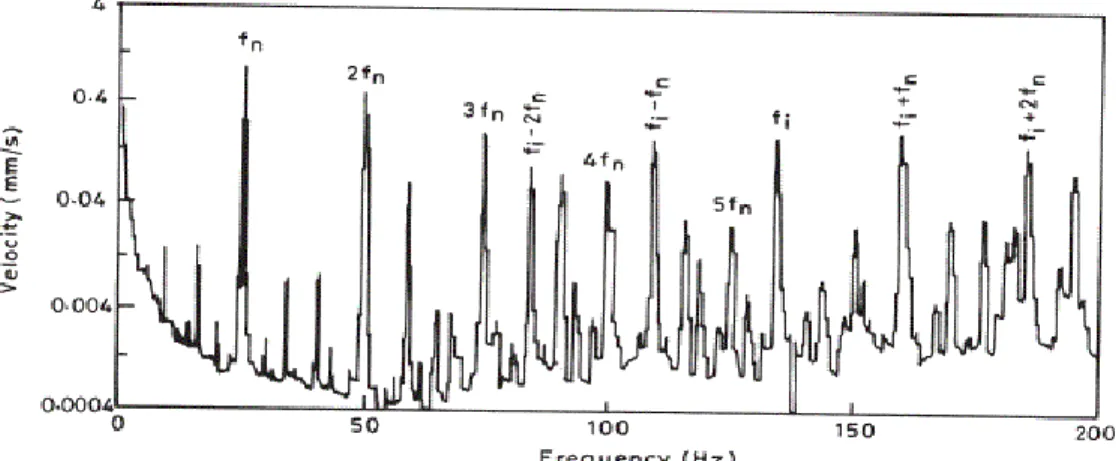
For normal speeds, these defect frequencies are usually less than 500 Hz (Tandon and Choudhury, 1999). However, these frequencies may be slightly different from values calculated as there are other external factors that influence the results such as slipping or skidding in the rolling element bearings (Prasad, 1987). An example of typical spectrum due to an inner race defect is shown in Figure 2.2. The sidebands have been attributed to the time-related changes in defect position relative to the vibration measuring position (Igarashi and Hamada, 1982). Tandon and Choudhury in 1999 manage to derive an expression for frequencies and relative amplitudes of the various spectral lines based on the flexural vibration of races due to a localized defect on one of the bearing elements.
Figure 2.2: A typical spectrum obtained from a rolling element bearing with an inner race defect
(2.6) 2.3.2 Time-frequency analysis: Short Time Fourier Transform
One of the shortcomings of the Fourier Transform is that it doesn’t give information on time at which a frequency component occurs. It will be a major problem to non-stationary signals compared to stationary signals. Therefore, one approach which can give information on the time resolution of the spectrum is the Short Time Fourier Transform (STFT). The STFT as proposed by Lyon (1984) is defined as:
where L represents the length of one block of data, tn is the time instant of STFT and
V(tn) is the nth measured voltage sample. The term Han(h) represents the Hanning
function chosen as the analysis window.
Figure 2.3 and Figure 2.4 represents the STFT computed for a good and a faulty bearing. The displacement measurements by laser vibrometer reveal vertical lines caused by a single dropout, which add impulse noise to the signal. The disturbances have not appeared in any of the measurements of velocity and acceleration.
Figure 2.3: STFT in displacement (a), velocity (b), and acceleration (c) of a good bearing. The colour associates to the higher value of the energy scale, and represents a
high level of energy content
Source: Cristalli et al. (2006)
The downside of the STFT is that it has a fixed resolution. The signal is presented with relation to the width of the windowing function. It determines whether there is good frequency resolution or good time resolution. A narrower window results to poor frequency resolution while wider window results to poor time resolution (Othman, 2009).
(2.7) Figure 2.4: STFT in displacement (a), velocity (b), and acceleration (c) of a faulty bearing. The colour associates to the higher value of the energy scale, and represents a
high level of energy content
Source: Cristalli et al. (2006)
2.3.3 Time-frequency analysis: Discrete Wavelet Transform
Discrete wavelet transform (DWT) provides a time-scale information of a signal, enabling the extraction of features that vary in time. This property makes wavelets an ideal tool for analyzing signal of a transient or non-stationary nature (Prabakhar, 2002). The continuous wavelet transform (CWT) of f(t) is a time-scale method that may be identified as the sum over all time of the signal multiplied by scaled, shifted versions of the wavelet function Ψ(t). Mathematically as proposed by McFadden and Smith (1984b),