I
MPLEMENTATION
S
CHEDULE AND
B
UDGET
Collaborative Engineering Program for
Resource Extraction and Renewable Energy
(RERE)
A Conceptual Framework for Multi-Institutional
Success in Advancing the Academic Topic Areas of:
•
natural gas extraction
•
wind power systems design
•
geothermal power systems design
•
solar power systems design
•
nuclear reactor maintenance and design
Submitted to North Carolina Legislative Research Commission
04 January, 2013
University of North Carolina – Charlotte
North Carolina Agricultural and Technical State University
2 |GS120-30.17(9)JOINT RESPONSE,UNC-C AND NCA&T
T
ABLE OF
C
ONTENTS
Page
Executive Summary
3Section 1: RERE Program Components
Objectives 5 Topic Areas 5 Education Approach 7 Research Approach 9 Practice Approach 9 Collaboration Approach 10 Administration 10 Nationwide Benchmarking 11 Assessment 11
Section 2: RERE Planning and Pilot Implementation Schedule
Planning and Pilot Implementation 12
Section 3: RERE Budget
Implementation Budget 13
Section 4: Budget Justification
Planning and Pilot Implementation 14
Faculty Hiring 14
Future Criteria for RERE Success 14
Appendices
15
Appendix 1: Course Analysis for RERE Adaptation Appendix 2: Putting the PSM Model to Work Appendix 3: RERE Research Considerations
Appendix 4: Joint On-site Planning Meeting Minutes Appendix 5: Initial Documentation
3 |GS120-30.17(9)JOINT RESPONSE,UNC-C AND NCA&T
Executive Summary
UNC Charlotte and NC A&T State University were directed by the Legislative Research Commission (LRC) of North Carolina (see Appendix 5) to develop a plan for establishing a collaborative
engineering program to focus on resource extraction and renewable energy (RERE). This RERE plan will focus specifically on five (5) thematic areas: natural gas extraction, wind, geothermal and solar energy, and nuclear reactor maintenance and design. The requested submittal date is January 4, 2013. Faculty and staff working groups from the two universities collaborated to generate the enclosed plan that leverages existing faculty expertise at UNC Charlotte, NC A&T, and other UNC system institutions to provide new undergraduate, graduate and certificate degree options. There are gaps both in curriculum and in research expertise that must be filled with new hires and it will be necessary to modify the content of many currently offered courses to create the required core courses and electives for the RERE Program. This plan focuses primarily on development of RERE education programs; however, to be of optimum benefit to the state of North Carolina there also must be corresponding research and practice activities in each of the RERE topic areas. While there is much research and practice underway in certain topics such as solar and wind energy, there is little research underway in North Carolina on shale gas extraction. That gap will be addressed in this RERE plan. In response to the charge by the LRC, the efforts of UNC Charlotte and NC A&T focused on specific enhancements of the state’s engineering curricula among the five cited topic areas in an aggressive timeframe. This proposal recognizes that the typical approach for curriculum
development would not satisfy the need to fast-track the RERE initiative. This plan requests funding starting in the spring of 2013 to plan and launch implementation of the RERE Program with funding for new hires and new research facilities to follow in the next 3 years. Student recruitment into the RERE programs will begin as early as January 2014.
Leadership of the planning effort has been provided by the Energy Production and Infrastructure Center (EPIC) and the College of Engineering at UNC Charlotte and the Division of Research and Economic Development and the College of Engineering at NC A&T. The focus of the Center for Energy Research and Technology (CERT) at NC A&T will be expanded to include the RERE Program so that going forward the two energy centers, EPIC and CERT, will provide leadership for both the educational and research components of the RERE Program. The two universities will work under the supervision of the UNC General Administration and will integrate expertise from other UNC system institutions to foster collaboration and leverage resources. The NC Community College System has initiated development of two year degree programs in sustainability and renewable energy. For graduates from those programs, the RERE Program will offer a continuation option leading to undergraduate and master’s degrees. The program will offer continuing education credits to practicing engineers seeking specialized education in RERE topics. The initial launch will build upon existing degree options but will evolve quickly into a joint degree program in which students are taught by faculty from both UNC Charlotte and NC A&T and possibly other UNC institutions. Likewise, students will perform research and/or practice work under the guidance of faculty from both universities. To assist with strategic planning and to assure continuous
improvement in the RERE program, an external Board of Advisors will be organized.
4 |GS120-30.17(9)JOINT RESPONSE,UNC-C AND NCA&T
Vision
A RERE collaborative engineering program will play an important role in achieving a
safe, secure and sustainable energy future for North Carolina through education, applied research and practice.
Leadership
The NC A&T CERT/UNC Charlotte EPIC partnership will provide leadership for theRERE program and organize collaboration among participating UNC System schools.
Timetable
Planning Phase (initial planning) Mar. 1, 2013–Dec. 31, 2013Pilot Phase (planning and pilot implementation) July 1, 2013–June 30, 2014 Expansion Phase (implementation and expansion) July 1, 2014–June 30, 2016
Budget
Planning Phase: 3/1/13 – 12/31/132 campuses: UNC Charlotte and NCA&T
Program Development: 3/1/13 – 6/30/13 $ 350 K Program Development: 7/1/13 – 12/31/13 $ 240 K SUBTOTAL $ 590 K Pilot Phase: 7/1/13 – 6/30/14
2 campuses: UNC Charlotte and NCA&T
Program development $ 240 K
New faculty positions $ 320 K
Research lab equipment $ 520 K
SUBTOTAL $1,080 K Expansion Phase: 7/1/14 – 6/30/16
Continuing support and expansion at UNC Charlotte and NCA&T Program support at $120K per year $ 240 K
Two-year operating budget $ 400 K
Continuing faculty positions from FY 14 $ 640 K
New faculty positions $ 960 K
Research lab equipment at $520K per year $1,040 K Long-term expansion to other UNC institutions $1,600 K SUBTOTAL $4,880 K TOTAL $ 6.55 M
This proposal describes a total budget of $6.55 M supporting a three-tier, four-year roll-out, piloted by UNC Charlotte and NCA&T during fiscal years 1 (partial) and 2. Then, during fiscal years 3 and 4, the program will be managed by UNC Charlotte and NCA&T and expanded to other UNC System institutions. The continuing operating budget is anticipated to be approximately $4.0 M per year after the initial implementation and expansion periods (after 6/30/16).
5 |GS120-30.17(9)JOINT RESPONSE,UNC-C AND NCA&T
Section 1:
RERE Program Components
Objectives
The RERE program will be created on a multi-university infrastructure, building upon existing capabilities and facilities, to deliver baccalaureate, post-baccalaureate, and professional education, research, and practice in resource extraction, renewable energy, and nuclear facilities. With the State’s needs as the primary focus, the RERE Program will expedite the transfer of knowledge and innovations to students, professionals, industry, and local and state communities for positive workforce, economic and technological development.
Topic Areas
As directed by the LRC, this RERE program will bridge from current energy offerings to a new in-depth focus addressing resource (natural gas) extraction, renewable energy power systems (wind, geothermal, solar) and nuclear reactor maintenance and design. This program will include in the educational components acknowledgement of other renewable energy sources such as wave energy and biomass; however, since research and development activities already exist in North Carolina that address these alternatives, this program will not fund new activity in those areas but will foster information sharing across the various renewable energy alternatives. In addition to technical focus on efficient and safe resource extraction, renewable energy generation technologies, and nuclear reactors design and maintenance, the curriculum will include topics in economics and public policy so that graduates are exposed to techniques to assess economic benefits, technical and economic feasibility, regulatory options and other issues that impact large scale implementation of energy production technologies (i.e. transmission, distribution and smart grid).
1.
Resource Extraction
Natural gas extraction, using hydraulic fracturing, is currently one of the upcoming technological opportunities to provide low-cost, abundant energy produced within North Carolina and North America at a low risk if performed in a sustainable and environmentally sound way. Fresh water utilization, waste water treatment and effective and environmentally sound horizontal drilling natural gas in shales of the central and eastern areas within North Carolina and can provide a large percentage of the state’s energy needs.
Extracting energy from other resources is equally important to provide a balanced and mixed portfolio in the generation mix for the purposes of energy security and price stability. Improved technologies to extract energy from coal, nuclear, ocean, biogas, oil and geothermal sources and a creative mix with other renewables need to be improved to make them more cost-effective, environmentally friendly and sustainable.
Minimizing and mitigating the environmental impacts of resource extraction will be the main focus of this program and still provide reliable energy production at an affordable price. Energy
conversion technologies like efficient turbines, power electronics and electrical machines will also be addressed as part of resource extraction in order to provide viable and cost effective power plants for these different extracted resources.
6 |GS120-30.17(9)JOINT RESPONSE,UNC-C AND NCA&T
2.
Renewable Energy Systems
In order to better prepare graduates for the workplace, the RERE Program will address a
variety of renewable energy sources. However, the focus of all activities will be in three
primary areas: wind, solar, and geothermal.
A.
Wind Power Systems Design
Wind generation has seen large-scale development over the last 10 years in the USA. The economics from wind power production have seen major improvements over this time with wind close to being at grid parity based on an energy production basis. Wind power
generation in North Carolina is somewhat limited to the Appalachian Mountains and coastal areas with offshore wind development the most promising opportunity for the state. B. Geothermal Power Systems Design
Geothermal energy in heat pump applications is very important to improve power utilization and energy efficiency. Geothermal systems have been proven effective in both residential and commercial construction but have not been widely implemented in North Carolina. Practical and cost effective utilization of geothermal systems will be explored in this program.
C. Solar Power Systems Design
Photovoltaic solar generation is well suited to be a large player in distributed generation developed in micro-grids around North Carolina. The challenge in sustaining the growth in solar energy is in terms of mitigating the negative impacts of renewable energy integration into the power grid. Solar power generation is a highly intermittent power resource that needs to be integrated into the grid and provide regular economic dispatch characteristics like regular power stations at a cost competitive way. So-called virtual power plants combining unsteady renewables like solar and wind with storage-offering sources like biogas and natural gas enable a reliable base-load power supply at a minimum emission of greenhouse gases and waste.
D. Other Renewable Energy Alternatives
Bio-energy in the form of biogas, biomass and biofuels is a good cost-effective option to help North Carolina have a more diverse energy mix, and there are plentiful resources in the central and western areas of the state. A number of universities in the UNC system have active bio-energy research programs underway and the state has created the NC Biofuels Center. These resources will be leveraged in the education and research components of the RERE Program but no new bio-energy initiatives will be created as part of the RERE Program. Similarly, the UNC System created the Coastal Wave Energy Research Project through the UNC Coastal Studies Institute to develop wave energy generation. The RERE Program will
incorporate information from that program but will not create new wave energy activities. Balancing distributed resources through the distribution network using all available systems including, distributed power like PV generation, energy storage, fast acting load management options and fast ramping distributed generation are anticipated to be implemented and demonstrated on distribution feeders. These networks require fast, secure and reliable point-to-point communications that can handle large amounts of data in a close to real-time scenario and form the limiting factor to integrate larger amounts of intermittent resources like PV and wind in the power networks. These high-speed communication networks will need
7 |GS120-30.17(9)JOINT RESPONSE,UNC-C AND NCA&T
to integrate the data transfer rates and provide a backbone for other Smart Grid applications like voltage regulation, reactive power management and a region oriented supply-and-demand balancing of electric energy.
3.
Nuclear Reactor Maintenance and Design
There are approximately 104 nuclear power reactors in operation in the USA. These plants have generated about 20% of U.S. electricity each year since 1991. North Carolina has 3 large nuclear power plants with plans from Duke Energy to build more in the future within its operating regions. Nuclear energy is a carbon free technology and a key part of a balanced generation mix. The nuclear industry has been successful at extending the operating design life of existing plants through
maintenance and selective refurbishment. The efficacy of continuing to extend nuclear plant life will be examined as well as specific maintenance and design techniques to extend plant life. Disposal of nuclear waste is often said to be the Achilles' heel of the industry. Presently, waste is mainly stored at individual reactor sites and there are over 430 locations around the world where radioactive material continues to accumulate. As of 2009 there were no commercial scale purpose built underground repositories in operation. Reprocessing can potentially recover up to 95% of the remaining uranium and plutonium in spent nuclear fuel, putting it into new mixed oxide fuel. France is the most successful reprocessor of spent fuel and efforts in the USA are lagging far behind. The only existing nuclear engineering degree program in North Carolina is at NC State University. There are no plans to create additional Nuclear Engineering degree programs through this initiative. However, this program will focus on nuclear applications of mechanical, electrical and civil
engineering disciplines and would collaborate with NCSU to leverage existing course offerings and research activities.
Education Approach
For many years, the lead institutions UNCC and NCA&T, have played a significant role in the education and preparation of the engineering workforce at the state and national level; these two institutions have a core of academic departments and programs, courses, and educational facilities related to the focus of this RERE collaborative effort. The institutions will integrate workforce preparation in RERE from the undergraduate level through the doctoral level, including professional development for practitioners. This approach is designed with the specific expectation that, over the long term, it can readily be extended to any number of UNC institutions.
Ten academic units at UNC Charlotte (Civil and Environmental Engineering, Electrical and Computer Engineering, Engineering Technology, Infrastructure and Environmental Systems, Systems
Engineering and Engineering Management, Mechanical Engineering, Geology, Public Policy, Economics and Architecture) and ten academic units at NCAT (Chemical, Biological, and Bioengineering, Chemistry, Civil, Architectural and Environmental Engineering, Computational Science and Engineering, Economics and Finance, Electrical and Computer Engineering, Energy and Environmental Systems, Industrial & Systems Engineering, Mechanical Engineering, and Physics) have relevant academic resources for this effort and will participate in the RERE Program.
8 |GS120-30.17(9)JOINT RESPONSE,UNC-C AND NCA&T
1.
Undergraduate Programs Founded on Existing Options
To pilot the RERE Program, NCA&T and UNC Charlotte will identify existing courses at the
undergraduate level at their campuses that can be expanded or adjusted to address the RERE topic areas with rapid payback in workforce development results for spring 2014 graduates. See
Appendix 1 for a representative listing of existing courses.
The RERE Program will develop into one that offers a variety of education experiences, addressing the needs of students and professionals at several levels. A seamless flow in, out, and through the program will accelerate the development of an educated workforce at multiple levels of expertise, allowing participants to construct a plan of study that meets their needs. The RERE Program accommodates students at all levels, from BS to PhD and allows professionals to enter the program for continuing education credits, certificates, or academic degrees. RERE will develop articulation agreements with community colleges to allow seamless transfer of students with relevant 2-year degrees into RERE programs.
Undergraduate students will select elective courses from a prescribed menu of courses relevant to focus area and will be recognized as having completed an “undergraduate concentration” in that particular area, such as renewable energy. To build these menus of acceptable undergraduate courses, the RERE program will depend heavily on 3 sources of coursework:
1) initially, existing courses at UNC Charlotte and NCA&T, with some courses modified to address desired topics and with common courses shared via distance education;
2) eventually, existing relevant courses at other UNC System campuses shared via distance education; and
3) eventually, new courses developed at UNC Charlotte and NCA&T, with common courses shared via distance education.
2.
Master’s Program Founded on Existing Options Plus the NC PSM Model
By taking existing courses in existing MS programs at NCA&T and UNC Charlotte, students will focus their master’s work in one of the five RERE areas. Additionally, the RERE Management Team will give a top priority to develop another option for RERE MS programs: a new professional science master’s (PSM) degree offered jointly between NCA&T and UNC Charlotte. The Professional Science Masters (PSM) is an outgrowth of the UNC Tomorrow strategic planning process. Now successfully integrated into graduate programs at a number of UNC system schools, the PSM program
demonstrates how the UNC System can meet the education, research and economic development needs of North Carolina. See Appendix 2 for a summary of current PSM offerings at UNC System schools. See Appendix 1 for a representative listing of existing courses.
3.
PhD Program Founded on Research Collaboration
UNC Charlotte has disciplinary PhDs in Mechanical and Electrical Engineering; NC A&T has disciplinary PhD programs in Electrical, Mechanical, and Industrial & Systems Engineering. These PhD programs have capabilities that will enable then to contribute to research in RERE topics. In addition, three inter-disciplinary PhD programs on the two campuses that have linkages to the RERE research areas: Computational Science and Engineering (NCA&T), Energy and Environmental
9 |GS120-30.17(9)JOINT RESPONSE,UNC-C AND NCA&T
Systems (NCA&T), and Infrastructure and Environmental Systems (UNC Charlotte). These PhD programs will share with RERE their extensive experience in providing interdisciplinary, advanced education, and in return they will benefit from the new and enhanced RERE courses and expanded facilities offered by this collaboration.
4.
Professional Development Program Founded on Flexibility
A unique feature of the RERE program will be the ease with which it accommodates professionals seeking to upgrade or expand their knowledge into these new areas. Applicable courses will be taught in one of several modes, making them more accessible to working professionals. Several optional course formats will be investigated.
1) traditional 3-credit, semester-long courses will be taught as a series of 1-credit, 5-week modules, allowing students to register for 1, 2, or 3 credits, thereby selecting topics and schedules most desirable to them;
2) traditional 3-credit, semester-long courses will be taught in a concentrated setting, requiring 6-8 hours per day over weekends or portions of the summer; and
3) traditional 3-credit, semester-long courses will be taught using a combination of on-campus, distance, and on-industry locations.
Research Approach
The multi-campus applied research initiative will focus on advancing natural gas extraction, wind power systems, geothermal power systems, solar power systems, and nuclear systems maintenance and design. It will be important to assess existing s research facilities in the UNC System which can be up-fitted most readily for RERE topic area research and help align related research efforts among all collaborating schools. This phase should be complete by spring 2016.
Facilities and resources will be assessed based on a target of creating a coherent, inter-institutional program for applied research with the goals of workforce, technology, and economic development. Such efforts in interdisciplinary research are gaining acceptance, and they are anticipated by funding agencies and expected by industry partners and sponsors. Still, many research programs focus on a single discipline or on a suite of disciplines within specified areas. The RERE Program, on the other hand, seeks to engage faculty and students in research within a broader interdisciplinary context. This approach enables them to appreciate, extract, and integrate techniques from the various aspects of a topic and then develop optimal solutions. Thus, the RERE program will be attractive to faculty, students, and industry partners looking to expand their knowledge and technologies to the inter-related systems of renewable energy, resource extraction, and nuclear facilities.
Practice Approach
It is the intent of the proposers that extensive field experience is provided at every level of the RERE engineering curriculum. The education components and the research components both require a “real-world” interface in order to place graduates into RERE jobs as soon as possible.
Every student in the RERE Program will be required to complete a “practice” component of the program. Such opportunities include internships, fellowships, field-based research projects,
10 |GS120-30.17(9)JOINT RESPONSE,UNC-C AND NCA&T
capstone projects, and technology development/entrepreneurship projects. These programs will include elements that are optional/required, paid/unpaid, and for credit/no credit. Details will vary depending on the degree or certificate awarded and will be developed at a later time, but an element of hands-on experience will be incorporated in each degree or certificate program.
Collaboration
Approach
Analysis of strengths, weaknesses, and areas of collaboration will be essential to the long-term viability of the RERE engineering program. Based on the outcome of the original planning phase more detailed collaboration plans will be presented. It is anticipated that the key collaborators, but not limited to the following people and organizations may include:
• Dr. Bill Leonard, Director of Energy Systems, NC State
• Dr. Alex Huang, Director, FREEDM System Center, NC State
• Dr. Ayman Hawari, Director, Nuclear Reactor Program, NC State
• Dr. Bill Edge, Director, Renewable Ocean Energy Program
• Tommy Cleveland, Solar Energy Engineer, NC Solar Center, NC State
• Dr. Dennis Scanlin, Coordinator, Appropriate Technology Program, Appalachian State University
• Dr. Thomas Meyer, Director, Energy Frontier Research Center, UNC –Chapel Hill
Administration
The proposers anticipate that the RERE initiative will be best served by utilizing the
multi-disciplinary strengths already embedded in the two universities with collaboration from other UNC System universities, including NCSU, UNC-CH and Appalachian State. At UNC Charlotte, energy related research and curriculum options have been consolidated under the Energy Production and Infrastructure Center (EPIC) see website: epic.uncc.edu. The NC A&T Center for Energy Research and Technology (CERT), housed in the College of Engineering, has operated for over 25 years with an emphasis on energy conservation, sustainable design, and energy use reduction in the built environments. NC A&T plans to expand the focus of CERT to include the five elements of the RERE initiative. Leadership of the implementation plan for the RERE initiative will then be the
responsibility of the two centers: the Center for Energy Research and Technology (CERT) at NC A&T and the Energy Production and Infrastructure Center (EPIC) at UNC-Charlotte. As indicated in Table 1, each center will manage the RERE program at their respective campuses. To assure continuous improvement in the RERE effort, an external Board of Advisors will be organized. The collaborative nature of these Centers will in turn facilitate opportunities to expand the RERE efforts on each campus, with other universities, and also with community colleges, other centers, and aligned public-sector entities such as the Catawba County Eco-Complex.
The proposers also recognize that the ultimate accountability for launching and overseeing the RERE initiative will involve the UNC General Administration (GA) in order to streamline all aspects of multi-institutional coordination. A single point of contact (SPOC) at the UNC GA will need to be designated.
11 |GS120-30.17(9)JOINT RESPONSE,UNC-C AND NCA&T
Table 1. RERE Management Team
UNC System RERE Single Point-of-Contact
NC A&T CERT
UNC Charlotte EPIC
Name
RERE Role
Name
RERE Role
RERE PROGRAM MANAGEMENT
CERT Director Dr. B. Burks Dr. B. Ram
RERE Leader
RERE Adv. Committee RERE Adv. Committee
EPIC Asst. Director Dr. J. Enslin Dr. D. Young
RERE Leader
RERE Adv. Committee RERE Adv. Committee
RERE PROGRAM ADVISORS
Dr. A. Ahmidouch Dr. M. Sundaresan Dr. S. Ilias Dr. K. Schimmel Dr. S. Hamoush Dr. M. Bikdash Dr. A. Megri Dr. G. Lebby
Nuclear Area Leader Renewables Area Leader Extraction Area Co-Leader Extraction Area Co-Leader Area Member and Advisor Area Member and Advisor Area Member and Advisor Area Member and Advisor
Dr. Z. Salami Dr. P. Selembo Dr. M. Pando Dr. V. Cecchi Dr. F. Goch Dr. M. Uddin Dr. J. Bird Dr. S. Chen
Nuclear Area Leader Renewables Area Leader Extraction Area Leader Area Member and Advisor Area Member and Advisor Area Member and Advisor Area Member and Advisor Area Member and Advisor
Nationwide Benchmarking
Curriculum advisors involved in the RERE planning efforts have made preliminary inquiries to understand the depth and scope of similar programs at such out-of-state institutions as Stanford University, Penn State University, Arizona State University, and the Massachusetts Institute of Technology. Although more work is needed to thoroughly benchmark North Carolina’s program, early work suggests the state is well-positioned to compete in the RERE arena nationwide.
Assessment
To validate the RERE program performance, a joint external advisory board will help assess the successes and challenges related to planning and launching the effort. The board will oversee and track key indicators, and help insure continuous improvement as the program matures and grows.
12 |GS120-30.17(9)JOINT RESPONSE,UNC-C AND NCA&T
Section 2: RERE Planning and Pilot
Implementation Schedule
Planning and Pilot Implementation
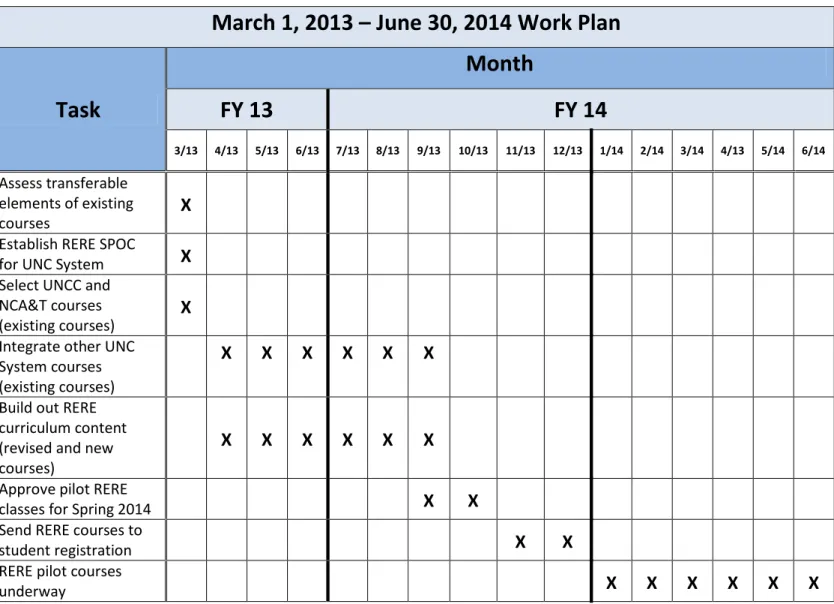
The first 16 months of the program are critical to its success. Assuming a start date of March 1, 2013, the four months remaining in FY 13 will be devoted to assessing and organizing existing courses at UNC Charlotte, NCA&T, and other UNC institutions and initializing the development of new courses. Then, the first half of FY 14 will be spent completing modifications to existing courses, developing new courses, and preparing course schedules for student enrollment.
Table 2. Planning and Pilot Implementation Phases Work Plan
March 1, 2013 – June 30, 2014 Work Plan
Task
Month
FY 13
FY 14
3/13 4/13 5/13 6/13 7/13 8/13 9/13 10/13 11/13 12/13 1/14 2/14 3/14 4/13 5/14 6/14 Assess transferable elements of existing coursesX
Establish RERE SPOC
for UNC System
X
Select UNCC and NCA&T courses
(existing courses)
X
Integrate other UNC
System courses (existing courses)
X
X
X
X
X
X
Build out RERE curriculum content (revised and new courses)
X
X
X
X
X
X
Approve pilot RERE
classes for Spring 2014
X
X
Send RERE courses to
student registration
X
X
RERE pilot courses
underway
X
X
X
X
X
X
NOTE: This work plan assumes that immediate funding support for the initial planning phase can be identified and disbursed no later than February of 2013.
13 |GS120-30.17(9)JOINT RESPONSE,UNC-C AND NCA&T
Section 3: RERE Budget
Implementation Budget
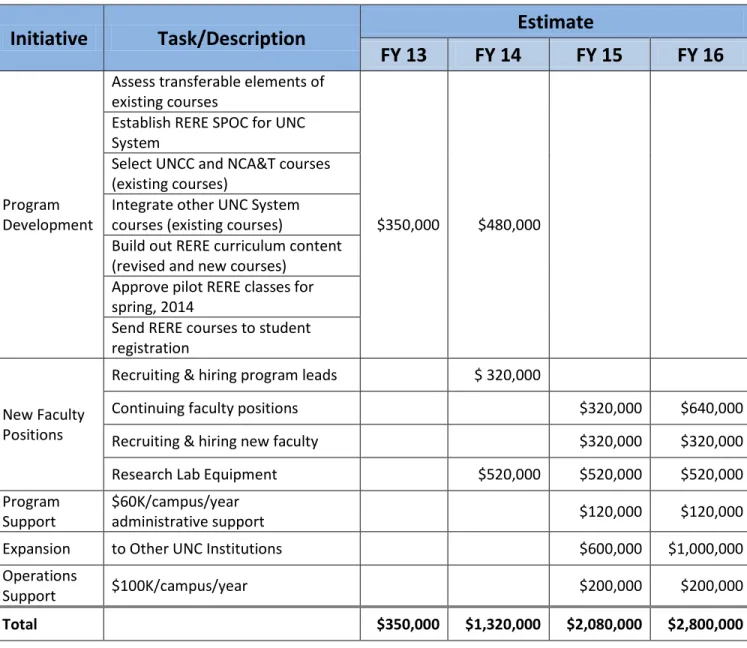
The RERE Program will be fully operational by June 30, 2016. This schedule engages four (4) fiscal years with a total budget of $6.55M and with each year requiring a different budget as summarized in Table 3. The continuing operating budget is anticipated to be approximately $4.0 M per year after the initial implementation and expansion periods end on 6/30/16. This budget will include funding to other UNC system organizations for the collaboration efforts.
Table 3. RERE Planning, Pilot Implementation and Expansion Implementation Budget (3/1/13 – 6/30/16)
Initiative
Task/Description
Estimate
FY 13
FY 14
FY 15
FY 16
Program Development
Assess transferable elements of existing courses
$350,000 $480,000 Establish RERE SPOC for UNC
System
Select UNCC and NCA&T courses (existing courses)
Integrate other UNC System courses (existing courses)
Build out RERE curriculum content (revised and new courses)
Approve pilot RERE classes for spring, 2014
Send RERE courses to student registration
New Faculty Positions
Recruiting & hiring program leads $ 320,000
Continuing faculty positions $320,000 $640,000
Recruiting & hiring new faculty $320,000 $320,000
Research Lab Equipment $520,000 $520,000 $520,000
Program
Support $60K/campus/year administrative support $120,000 $120,000
Expansion to Other UNC Institutions $600,000 $1,000,000
Operations
Support $100K/campus/year $200,000 $200,000
14 |GS120-30.17(9)JOINT RESPONSE,UNC-C AND NCA&T
Section 4: Budget Justification
Planning and Pilot Implementation
The initial launch of the RERE Engineering Program relies heavily in the intensive integration of curriculum planning at the two pilot universities. This work involves the assessment of transferable elements of existing courses, clarifying the RERE SPOC for UNC System, assigning tasks and responsibilities to NCA&T and UNC Charlotte, specifying curriculum enhancement and deploying related outcomes to classes as soon as spring 2014.
Faculty Hiring
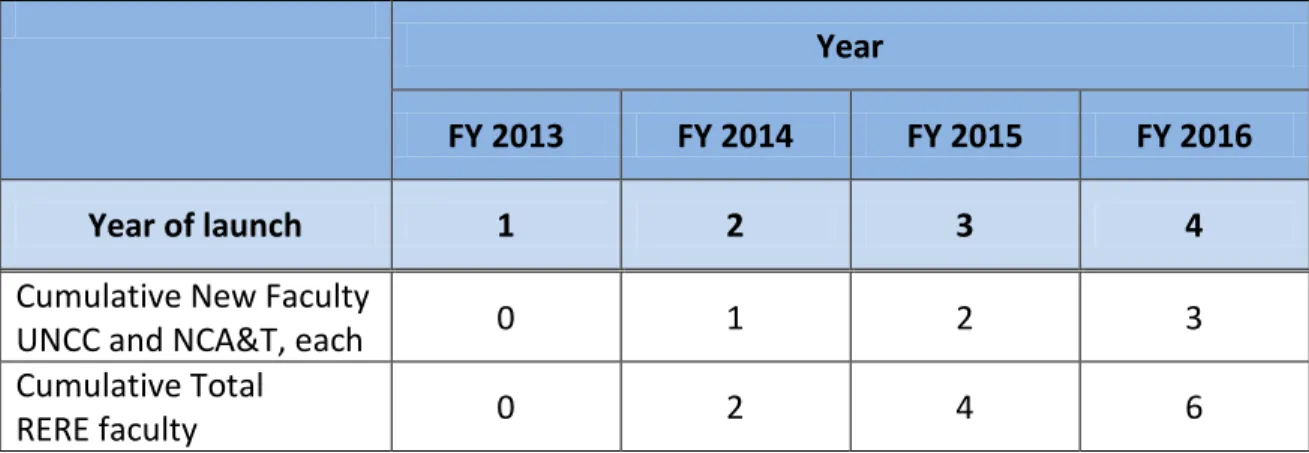
Crucial to this launch will be the addition of RERE faculty members, to be recruited and hired according to the schedule anticipated in Table 4. The faculty will be augmented with some administrative and staff positions.
Table 4. RERE Faculty Recruiting and Hiring Schedule
Year
FY 2013
FY 2014
FY 2015
FY 2016
Year of launch
1
2
3
4
Cumulative New Faculty
UNCC and NCA&T, each
0
1
2
3
Cumulative Total
RERE faculty
0
2
4
6
Future Criteria for RERE Success
The long-term success of the RERE effort will require support to benchmark and validate
a number of factors that typically justify continued support for academic curriculum.
These include but are not limited to anticipated demand for this program, the number
of universities in the U.S. offering similar or complimentary programs and the number
of students they serve; how the North Carolina approach is different from typical
engineering degree programs, ruling in or out the question of whether or not RERE
undergraduate programs should be accredited; how industry partners can be involved
to inform the curriculum content and research direction; how standards, professional
credentials, and state/federal laws and regulations influence the course content
(particularly in resource extraction), and how to determine if there are national
research trends with which NC RERE research should or could align.
15 |GS120-30.17(9)JOINT RESPONSE,UNC-C AND NCA&T
Appendices
Appendix 1: Course Analysis for RERE Adaptation
Appendix 2: Putting the PSM Model to Work
Appendix 3: RERE Research Considerations
Appendix 4: Joint On-site Planning Meeting Minutes
2 |GS120-30.17(9)JOINT RESPONSE,UNC-C AND NCA&T
A.
Mapping of RERE Expertise at UNC-Charlotte and NC A&T
Un
iver
si
ty
Departments
Programs
G eo th er ma l N ucl ea r En er gy Po lic y & Re gu la tio ns Re ne w ab le En er gy Re so ur ce Ex tr ac tio n Sma rt G rid So la r W as te Tr ea tme nt W in dU
NC Ch
ar
lo
tt
e
Civil & Environmental x x x x x
Electrical & Computer x x x x x x
Engineering Technology x x
Infrastructure &
Environmental Systems x x x x x
Systems Engineering. &
Engineering Mgmt x Mechanical Engineering x x x x x Earth Science x x x Public Policy x Economics x Architecture x x
NC A
&
T
Chemical, Biological &
Bio Engineering x x x
Chemistry
Civil, Architectural &
Environmental Engineering x x x
Computational Science &
Engineering x x x
Economics & Finance x
Electrical & Computer
Engineering x x x x
Energy & Environmental
Systems x x x x
Industrial &
Systems Engineering x
Mechanical Engineering x x x x
3 |GS120-30.17(9)JOINT RESPONSE,UNC-C AND NCA&T
B.
Flow Chart/Possible RERE Framework
PhD
focus on energy
MS
focus on energy
3 options
30 + 0 (all coursework)
27 + 3 (project)
24 + 6 (thesis)
Certificate
focus on energy
12-15 credits
Professional
development
and competency
requirements
traditional advanced electives
focus on energy
count for MS degree
and
count for BS degree
Modularized graduate
level courses
focus on energy
BS
Use elective courses
for
concentration in energy
or
4 |GS120-30.17(9)JOINT RESPONSE,UNC-C AND NCA&T
C.
Top Course Candidates for RERE Adaption
Possible NC A&T Courses
Cross-Cut
EES 711 Energy & Environmental Economics I
EES 712 Energy & Environmental Economics II
Nuclear
MEEN520 Fundamentals of Nuclear Energy
CIEN735 Earthquake Design
CIEN785 Advanced Concrete Mixtures
Renewable Energy
CHEN515/615 Energy and Energy Fuels Fundamentals
CHEN522/622 Green Engineering Fundamentals
CHEN508/608 Bioseparations Fundamentals
MEEN675 Solar Energy Fundamentals and Design
MEEN571 Turbomachinery
MEEN838 Renewable and Sustainable Energy
AREN570 Energy and the Environment
AREN572 Energy Conservation in Buildings
EES 720 Sustainable Energy Systems
EES 740 Fundamentals of Biomaterial Sciences & Bioprocess Systems
EES 741 Biomaterials Characterization
EES 742 Biomass Thermal Conversion Processes
EES 743 Biomass Biological Conversion Processes
EES 744 Environmental and Policy Studies of Biomass Use
Resource Extraction
MEEN835 Physico-chemical hydrodynamics
CIEN721 Advanced Soil Testing for Engineering
CIEN710 Hazardous Waste Management
5 |GS120-30.17(9)JOINT RESPONSE,UNC-C AND NCA&T
C.
Continued
Possible UNC Charlotte Courses
Cross-Cut
PPOL 8652 Energy and Environmental Economics
INES 8102 Infrastructure Systems
ENER 5140 Energy Management
CEGR 5237 Environmental Risk Management
Nuclear
CEGR 6129 Structural Dynamics
CEGR 5108 Finite Element Analysis
CEGR 5224 Concrete Design II
CEGR 6090 Nondestructive Testing
CEGR 6252 Soil Dynamics and Earthquake Engineering
CEGR 6090 Structural Health Monitoring
CEGR 6090 Structural Strengthening
PHYS 6261 Nuclear Physics
MEGR 5090 Introduction to Nuclear Systems
ECGR 4199 Fundamentals of Nuclear Science and Energy
ECGR 5090 Nuclear Reactor Engineering
Renewable Energy
ENER 5250 Analysis of Renewable Energy Systems
ENER 5260 Hydrogen Production and Storage
ENER 5280 Fuel Cell Technology
ARCH 5302 Environmental Systems Principles
ECGR 5090 Introduction to Renewable Energy
CEGR 5090 Sustainable Systems Design
CEGR 5090 Introduction to Bioenergy
ECGR 3090 Solar Cell Fundamentals
ECGR 4090 Solar Decathlon Design
ECGR 6890 Renewable Energy and Microgrids
Resource Extraction
CEGR 5141 Process Engineering
CEGR 6268 Advanced Soil Mechanics
CEGR 5234 Hazardous Waste Management
CEGR 5146 Advanced Engineering Hydraulics
CEGR 6146 Advanced Groundwater Analysis
CEGR 6090 Contaminant Transport in Soils
MEGR 6116 Fundamentals of Heat Transfer and Fluid Flow
MEGR 7101 Transport Processes
ESCI 5233 Geoenvironmental Site Characterization
6 |GS120-30.17(9)JOINT RESPONSE,UNC-C AND NCA&T
D.
Probable Structure – RERE Master of Science Program
Nuclear D&M
Renewable Energy
Resource Extraction
Transition Topics
Credit
Hours
Core3 courses 3 courses Core 3 courses Core N/A 9
Elective #1 Elective #1 Elective #1
Energy Related • Business • Energy Trading • Sustainability
12
Elective #2 Elective #2 Elective #2
Elective #3 Elective #3 Elective #3
Elective #4 Elective #4 Elective #4
Transmission & Distribution, Energy Focused Math, and Power Generation 3
Thesis and Advisor Approved Special Studies 6
2 |GS120-30.17(9)JOINT RESPONSE,UNC-C AND NCA&T
Current PSM Status, Potential RERE Collaboration Partners
CURRENT PSMSTATUS
SCHOOL CAPACITY PROGRAM DESCRIPTION PHASE
UNCC YES mathematical finance bioinformatics health informatics biotechnology business analytics active active active planning planning
NCA&T YES energy systems construction science planning feasibility
NCSTATE YES electric power systems engineering financial mathematics microbial biotechnology
geospatial information science & tech analytics biomanufacturing human nutrition feed science environmental assessment computer networking crop science computer gaming global health technology advanced medical technology forensic science and engineering poultry science
performance and protection science
active active active active active active active active active active active feasibility feasibility planning planning planning planning
ASU YES engineering physics/instrumentation engineering physics/nanoscience
nutrition and food systems
environmental science/hazard mitigation entrepreneurial information technology
active active
feasibility feasibility feasibility
UNCCH YES ecology and environmental biology geology and the environment applied mathematics
applied computer science geology and petroleum plant biology
molecular and cellular biology toxicology feasibility feasibility feasibility feasibility feasibility feasibility feasibility feasibility TBD
NOTE: UNC-Greensboro has an active PSM program in nanoscience. East Carolina University, Elizabeth City State University and UNC-Wilmington are the additional UNC
schools with PSM programs in some stage of planning.
TBD TBD
Additional PSM Resources
http://ncsu.edu/grad/psm/ http://www.npsma.org/
RERE
NCAT Research Centers and Unique Academic Programs
Center for Energy Research and Technology (CERT)
The Center for Energy Research and Technology (CERT) is a multidisciplinary research, training and outreach provider located in Greensboro, North Carolina. Grounded in engineering and built-environment sciences, CERT has galvanized a distinguished group of faculty, staff, graduate and undergraduate students in the pursuit of reducing energy & water consumption, promoting sustainable design practices and energy use/conservation/reduction measures. CERT has become the epicenter for energy research and study in the Triad area. CERT is accomplished at supplying energy analysis, research, instruction and outreach skills that will enable you to benefit from establishing a relationship with us.
PhD in Energy and Environmental Systems
The Ph.D. Program has three concentrations: Atmospheric Sciences, Sustainable Bioproducts, and Energy & Environmental Science & Economics. The program is designed to prepare men and women for positions in research and consulting in industry, government and service
organizations, and teaching and research positions in colleges and universities. Graduates will be able to: (a) conceive, develop, and conduct original research leading to useful applications in energy and environmental systems, and (b) incorporate into their professional work
considerations relating to scientific and social aspects of energy and environmental systems. NSF CREST for Bioenergy Center Research
Bioenergy Center will be an educational and research resource for the Nation in the field of thermochemical conversion of biomass to bioenergy. The topics of interest include: High-Quality Synthesis Gas via Biomass Gasification, Nanocatalysts for Biofuel and Steam Reforming Reactions, Reforming and Processing of Biofuels for Fuel Cells. Faculty from Chemical Engineering, Biological Engineering and Energy, and Environmental Systems are involved in the CREST Center. The research at this center overlaps with the Resource Extraction and Renewable Energy focus areas.
UNC Charlotte Research Centers and Unique Academic Programs
Energy Production and Infrastructure Center (EPIC)
The Energy Production and Infrastructure Center (EPIC) at UNC Charlotte was formed in response to the need from industry to supply highly trained engineers qualified to meet the demands of the energy industry – through traditional and continuing education, and provide sustainable support the Carolina energy industry by increasing capacity and support for applied research. EPIC is a highly collaborative industry/education partnership that produces a technical workforce,
2 |GS120-30.17(9)JOINT RESPONSE,UNC-C AND NCA&T
advancements in technology for the global energy industry while supporting the Carolinas’ multi-state economic and energy security.
EPIC has more than 50 faculty members working in energy related disciplines and has expanded the team with 17 new faculty members with expertise in Power and Energy Systems Modeling, Building Information Modeling, Large Power Structures Engineering, Water Containment and Corrosion, Power Infrastructure Design, Manufacturing and Construction Quality Assurance, Standards and Regulatory Engineering, Renewable Power Integration, Welding and Robotic Manufacturing, Power Electronics and Utility Applications, Power Systems Operations, Protection and Control, Energy Markets and Systems Engineering.
These EPIC associated faculty members are organized in several research clusters and focused centers that are summarized below:
• Power Systems Modernization, the host of the Duke Energy Smart Grid Laboratory with RTDS and system analysis tools.
• Large Energy Component Design and Manufacturing, spearheading manufacturing with the Siemens Large-scale Manufacturing Laboratory.
• Renewables and Energy Efficiency with clean-rooms focusing on PV cell and LED research as well as large-scale PV generation, off-shore wind power, biomass and small-scale hydro and ocean energy technologies, as well as grid integration issues.
• Power Infrastructure and Environmental Development with a world-class large-structures laboratory in a High-Bay facility, partly funded by Westinghouse and AREVA.
• Energy Markets and Systems Engineering, with Quality Assurance, Nuclear Safety, Regulatory and Standards for power systems including distributed energy markets and improved supply chain utilization.
• Sustainable Integrated Buildings and Sites (SIBS), an I/UCRC NSF Center with industry related research of PV integration in dense urban settings with limited roof space, poor orientation, insurance issues, etc. Energy modeling for DSM, energy storage, and renewables as well as thermal-energy storage for peak-shaving.
PhD in Infrastructure and Environmental Systems (INES)
The Infrastructure and Environmental Systems (INES) PhD Program prepares students at an advanced level to undertake the complex challenges facing urbanized regions, specifically those issues related to the interplay between the environment and infrastructure needed to support economic and social development. INES students develop interdisciplinary solutions to these challenges that incorporate the engineering, science, and management aspects of a problem. They are educated and trained to provide the design, construction, operation, and maintenance of critical infrastructure systems for energy production, water and flood management,
communications, buildings, transportation, waste containment, and earth monitoring and measurement networks, among others. Their work assists in policy and decision making, financing, and systems analysis to enhance governance, economic, ecological and social values.
3 |GS120-30.17(9)JOINT RESPONSE,UNC-C AND NCA&T
Infrastructure, Design, Environment, and Sustainability (IDEAS) Center
The IDEAS Center focuses university expertise on framing the challenges, providing the
leadership, and creating the solutions that will accelerate the technical and social shifts needed to make our natural and built environment more sustainable. The Center brings together the inter-disciplinary capabilities and resources needed by decision-makers to create, distill, translate, and disseminate technology and guidance documents. Through it support of research and education activities, the IDEAS Center provides a platform to assist faculty, students, and industry partners in transforming and advancing sustainable infrastructure, materials, energy, environment, and building and site design innovations and practices.
2 |GS120-30.17(9)JOINT RESPONSE,UNC-C AND NCA&T
Meeting Minutes
Renewable Energy and Resource Extraction (RERE) Meeting 10/3/12 at UNC Charlotte
Objectives of meeting: 1) layout program framework 2) select focus areas
3) designate people in charge
4) decide how to reach out to other institutions beyond UNCC and NCA&T 1) Program framework discussion
No time to propose new degree; must be embedded in or expanded on existing programs o concentrations at undergraduate level
o minors at undergraduate level o focus areas in MS and PhD
Must be collaborative across several institutions o Students take courses by distance from each campus
o courses "transfer" to the home institution who offers the degree
Framework must support a theme and emphasize unique aspects of the program o Themes: help State Energy Office and NC meet 20-yeqr goal; support energy workforce development; support US Gov’t energy workforce plan
o Uniqueness: industry interaction; seminars; overarching topics; applied nature;
interdisciplinary collaboration
Should include options for (see sketch below): o professional master's
30 credits of coursework
o research/project-based master’s
27 credits of coursework + 3 credits of project (not necessarily research-based)
24 credits of coursework + 6 credits of thesis (research-based)
Consider various delivery options o conventional semester
o by distance
o concentrated/executive = summers, weekends, short-time frames o modularized courses = 3 credit course = 3 “courses” @ 1-credit 2) Focus areas
1) nuclear energy with focus on design/repair/maintenance (engage NRC) 2) resource extraction with focus on natural gas fracking
3 |GS120-30.17(9)JOINT RESPONSE,UNC-C AND NCA&T
Minutes of RERE meeting at UNCC, 10/3/12 page 2
Focus Areas (Cont’d)
Courses must reflect interdisciplinary nature of renewables and include areas that
transcend all focus areas:
o business/economics/management o measurement/monitoring/performance o quality/reliability/safety
o policy/regulation o environment/waste
At least one (3-credit) MATH course should be required (calculus, statistics/probability, etc.)
3) People in charge:
Area or Item NCA&T UNC Charlotte
1 Overall Theme and
Unique Aspects Dr. Burks Dr. Enslin
2 Nuclear Energy Focus
Area Dr. Homaifar, Dr. Wang,
Dr. Hamoush
Dr. Salami
3 Renewable Energy
Focus Area Dr. Ilias, Dr. Sundaresan,
Dr. Schimmel
Dr. Valentina, Dr. Goch,
Dr. Uddin, Dr. Bird
4 Resource Extraction
Focus Area Dr. Picornell, Fernandez Dr. Dr. Young, Dr. Pando Dr. Chen,
5 Topics that Cross All
Areas Dr. Bala Dr. Young
6 Program Structure Dr. Bala Dr. Young, Dr.
Selembo
4 |GS120-30.17(9)JOINT RESPONSE,UNC-C AND NCA&T
Minutes of
North Carolina A&T – UNC–Charlotte RE/RE Proposal Meeting Monday, October 29th, 2012, 2:00PM to 6:30PM
Attendees:
UNCC: Jonathan Bird, Aba Ebong, Johan Enlin, Chris Hardin, Jy Wu, David Young NC A&T: Abdella Ahmidouch, Mufeed Basti , Marwan Bikdash, Barry Burkes, Sameer
Hamoush, John Kelly, John Kizito, Luba Kurkalova, Gary Lebby, Samuel Owusu-Ofori, Ahmed Megri, Bala Ram, Messiha Saad, Keith Schimmel, Paul Stanfield, Abu-Lebdeh Taher , Shih-Liang Wang
AGENDA
1. Welcome, Theme, Objectives (2PM – 3PM) 410 IRC (Drs. Burks, Enslin, Young, Ram, Schimmel)
2. Breakout Sessions (3PM – 5PM)
- Nuclear 328 IRC
- Resource Extraction 408 IRC
- Renewable Energy 410 IRC
- Cross-cut IRC 4th floor foyer
- Academic Programs & Proposal Dr. Burks’ Conference Room
At the breakout session, please fill out the attached sheets, so we can share during the wrap-up sessions, handwritten would be fine)
3. Dinner and wrap-up (5PM – 6PM) 410 IRC (Drs. Burks, and Enslin)
(share completed sheets from breakout sessions)
1. Dr. Barry Burks welcomed the attendees’ and explained the charge of the UNC-GA. Dr. Johan Enslin presented his draft document entitled “Collaborative Engineering Program in Resource Extraction and Renewable Energy”. Dr. David Young reviewed the minutes of the prior meeting on October 3rd at UNCC and the academic program framework discussed at the meeting. Dr. Keith Schimmel presented information about the Catawba EcoComplex and the projects underway there, as an example of a living laboratory for research. Dr. Bala Ram discussed the locations of the breakout sessions and the outcomes requested from the breakout sessions.
2. The breakout groups consisted of the following individuals: (i) Nuclear (Drs. A. Ahmidouch, Zia Salami, and S. Hamoush
(ii) Resource Extraction (Mr. Chris Hardin, Drs. Keth Schimmel, Abu-Lebdeh Taher, and Mufeed Basti)
(iii) Renewable Energy (Drs. Mannur Sundaresan, Jonathan Bird, and Aba Ebong) (iv) Cross-cut (Drs. Marwan Bikdash, Luva Kurkalova, Gary Lebby, and Paul Stanfield) (v) Academic Programs and Proposal (Drs. Barry Burks, Johan Enlsin, David Young, and
5 |GS120-30.17(9)JOINT RESPONSE,UNC-C AND NCA&T
Groups (i), (ii), (iii), and (iv) initiated discussions on existing course at the two campuses, and potential new courses in each of the areas. The groups also began discussion on research topic of interest in each of the areas.
Following is a summary of the discussions in group (v) on Academic Programs and Proposal. a) Academic Programs:
- Use existing BS, MS, PhD programs, not a new program at this time - In longer term we will work on developing a joint graduate program - 9 to 12 credits in collaborative mode
- 3 credits minimum physically in the other location b) Collaboration ideas:
- Offer courses in distance mode either full course or team-teaching - Block scheduling in summer with courses in each of the two campuses - Joint thesis advising
- Visiting summer scholars on each campus (invite faculty with expertise in the “gap” areas) - Out-of-state and international scholars
- International students
- Common location for projects: Catawba EcoComplex, Davidson Community College? - GTCC, CPCC and Davidson as transfer students
c) Proposal format:
- Will use UNC-GA “Request to Establish” template for proposal d) Weekly teleconference on Mondays, 130PM
I
NITIAL
D
OCUMENTATION
LEGISLATIVE RESEARCH COMMISSION
STATE LEGISLATIVE BUILDING RALEIGH, NC 27601
August 23, 2012
Senator Tom Apodaca Representative Tim Moore
Chairman Chairman
Legislative Research Commission Legislative Research Commission
North Carolina State Senate North Carolina House of Representatives
16 W. Jones Street, Room 2010 16 W. Jones Street, Room 1326
Raleigh, NC 27601-2808 Raleigh, NC 27601-2808
Dear Senator Apodaca and Representative Moore:
Pursuant to G.S. 120-30.13, as enacted in Section 66.7(b) of S.L. 2012-194, Senator Apodaca is designated as the Senate Cochair of the 2011-2012 Legislative Research Commission ("Commission"). Representative Moore is designated as the House Cochair of the Commission.
As you prepare your agenda for the Commission, pursuant to G.S. 120-30.17, we authorize the Commission to appoint the following Study Committees and Advisory Subcommittees to study the following matters and to refer one study to a state agency. The Cochairs and appointees to each Committee are also identified. Please restrict each study committee and advisory subcommittee to a maximum of four meetings unless additional meetings are pre-approved by our offices.
Authorized Joint Study Committees:
Pathological Materials - The LRC Study Committee on Pathological Materials shall study the issue of access by patients to pathological materials requested by a patient for the purpose of additional medical treatment evaluation or the evaluation of any legal rights of the patient. Specifically, the Committee shall consider:
1. State and federal laws and regulations that govern the administration, operation and certification of pathology laboratories;
3. Appropriate changes in state law that ensure patient access to pathological materials that are needed to obtain and evaluate the patient's medical needs and legal rights while also balancing pathology laboratories' duties to comply with federal and state licensure laws and regulations, patient care responsibilities, risk management obligations, and other relevant issues;
4. The impact of any state law change on the medical research industry including: pharmaceutical companies; government research institutions; and other industries dependent upon information obtained from pathological materials.
While conducting this study the Committee shall consult:
1. Persons who serve as advocates for patients who have requested pathological
materials;
2. Patients who have requested pathological materials from health care providers; 3. Representatives of hospitals responsible for the management of pathology
laboratories;
4. Pathologists responsible for the management of pathology laboratories;
5. Persons responsible for providing legal advice to mangers of pathology laboratories; and
6. Any other person or persons the Committee deems appropriate.
Senate Members House Members
I Sen. Goolsby Chair Rep. Murray Chair
Sen. Brunstetter Member Rep. Brisson Member
Sen. Brock Member Rep. Jones Member
Sen. Pate Member Rep. McGrady Member
Sen. Purcell Member Rep. Stevens Member
Contingency Fee Audits - The lRC Study Committee on Contingency Fee Audits shall study issues relating to the use of contingent fee-based contracts by the State Treasurer for purposes of unclaimed property audits, and by counties and municipalities for tax audit or assessment purposes.
Senate Members House Members
Sen. Gunn Chair Rep. Stam Chair
Sen. Brown Member Rep. Brown Member
Sen. Clodfelter Member Rep. Burr Member
Sen. Hise Member Rep. McCormick Member
Sen. Hartsell Member Rep. Wray Member
and relevance of training, align basic education and vocational and higher education training and ensure that students who are not college bound are career ready. Specifically, the Committee shall study the following:
1. The requirements and challenges North Carolina high school graduates face in
today's changing and demanding job market. The study should include a review of what North Carolina industries look for in well-qualified candidates for employment as it pertains to education, certification, and skill level;
2. The Career and College Promise program, specifically the Career and Technical Education Pathway and the Cooperative Innovative High School Pathway, to determine if the program is meeting the unique needs of students seeking to enter the workforce after completing high school. The study should include a review of the career clusters and pathways, work-based learning, career academies, time shortened programs, and certification and credentialing offered to determine if they meet the current needs of North Carolina's students and business community. The study should also examination current outreach and practices to raise student awareness of Career and Technical Education opportunities;
3. Progress in developing regional schools through S.L. 2011-241 which authorized local boards of education to jointly establish a regional school to serve enrolled students in two or more local school administrative units that will expand student opportunities for educational success through high quality instructional programming;
4. Article 10 of Chapter 115C of the North Carolina General Statues as it pertains to vocational and technical education to determine if modification is necessary to best reflect the intent of the General Assembly and provide the necessary opportunities and flexibility to establish innovative learning environments that provide students with practical work experiences and vocational skills;
5. Additional, cost-effective ways in which the Department of Public Instruction, North Carolina Community College System, and the business community can partner to offer enriched educational opportunities for students to enter the workforce with academic and marketable vocational skills after completing high school;
6. Potential legislative actions to further enhance connecting career technical education to education, workforce preparation, and economic development through innovative schools and high academic standards;
7. Any other issues associated with Vocational education deemed appropriate by the Committee.
Senate Members House Members
Sen. Brown Co-Chair Rep. Holloway Chair
Sen. Tillman Co-Chair Rep. Blackwell Member
Sen. Hise Member Rep. Blust Member
Sen. McKissick Member Rep. Cotham Member
Sen. Soucek Member Rep. Langdon Member
1. Available forms of digital learning environments in public schools by comparing the cost, infrastructure, technology, maintenance, usability, savings, effectiveness and demonstrated student outcomes associated with various digital learning models found in North Carolina as well as other states like Florida, Arizona, California, Maine, and Texas.
2. Parts 3 and 3A of Article 8 of Chapter 115Cof the North Carolina General Statutes as they pertain to school technology to determine if modifications are necessary to best reflect the intent of the General Assembly and provide the necessary opportunities and flexibility to establish digital learning environments in public schools.
3. Viable, cost-effective ways in which the Department of Public Instruction and local school administrative units can offer enriched educational opportunities to students through the use of digital learning tools such as laptops, handheld devices, digital textbooks, and other digital content.
Senate Members House Members
Sen. Soucek Chair Rep. Horn Chair
Sen. Carney Member Rep. L. Johnson Member
Sen. Clodfelter Member Rep. Lucas Member
Sen. Hise Member Rep. Saine Member
Sen. Rucho Member Rep. H. Warren Member
Authorized Joint Advisory Subcommittees:
Wetland and Stream Mitigation - The LRC Advisory Subcommittee on Wetland and Stream Mitigation shall study issues related to the overall policies and roles of agencies within State government, the federal government, and the private sector to plan, construct and monitor wetland and stream mitigation. The Advisory Subcommittee may specifically study the following items:
1. The process for annual adjustments of Ecosystem Enhancement Program fees,
including whether the use of the Civil Works Construction Cost Index System published by the u.S. Army Corps of Engineers as a basis for fee escalation is necessary given the past direction of the General Assembly to base program fees on actual costs;
2. Whether compensatory mitigation should be allowed any hydrologic area located in the same river basin as the site being mitigated. For purposes of this study, the terms "compensatory mitigation" and "hydrologic area" are as defined in G.S. 143 214.11;
program could be revised to lessen its economic impact on the State's businesses and industries;
4. Whether the State should withdraw from the Memorandum of Agreement between the U.S. Department of Environment and Natural Resources, the U.S. Department of Transportation, and the U.S. Army Corps of Engineers, which established the Ecosystem Enhancement Program in 2003;
5. Whether the North Carolina Department of Transportation should purchase its stream and wetland mitigation credits from an approved mitigation bank within the private sector where available;
6. Whether the State should consider assuming the Clean Water Act Section 404 permitting role from the federal government;
7. Whether the mitigation projects overseen by the North Carolina Department of Transportation, Natural Systems Unit have been effective and cost efficient;
8. Whether the North Carolina Department of Environment and Natural Resources' internal review process of stream and wetland mitigation projects designed, stamped, and signed by a licensed professional engineer is necessary and/or appropriate;
9. Any other issues associated with stream and wetland mitigation deemed appropriate by the Committee.
Senate Appointees House Appointees
Sen. Jackson Chair Rep. Lewis Chair
Sen. Daniel Member Rep. Hastings Member
Sen. Harrington Member Rep.ller Member
Sen. Rabon Member Rep. R. Moore Member
Sen. Walters Member Rep. T. Moore Member
Buck Smith, General Manager, Member Christopher A. Huysman, Member
Cleveland County Water Engineer
Dr. Curtis J. Richardson, Member David N. Levinson, Developer Member
Professor, Duke University
Nicholas School of the
Environment
Authorized House Study Committees:
Age of Juvenile Offenders - The LRC Study Committee on the Age of Juvenile Offenders shall study North Carolina's current juvenile justice system and identify reforms that may reduce long-term recidivism. Specifically, the Committee shall study:
1. What juvenile justice reforms are needed to implement the proposal in Senate Bill
434, Edition 3, for raising the age for misdemeanors;