Cloud Computing: User’s Perceptions About Security Issues
Md. Tuhinur RahmanDepartment of Business Administration, University of Asia Pacific, Dhaka, Bangladesh
Abstract
Cloud Computing, combination of parallel computing, grid computing, distributed computing and others, is the next generation internet based computing system which provides easy and customizable services to the users for storing and accessing cloud data from anywhere by connecting the cloud using internet. Cloud computing is a pay as you go method of computing for which organizations save millions of their costing. Despite having numerous advantages of cloud computing, it is entitled to some problems. Among those security issues are the most important which need to be considered as client data is transferred to cloud and the responsibility of ensuring security is vested to the cloud providers. If we want to make the growth and development of cloud computing then that security issues need to be resolved immediately which will increase the acceptability of the cloud to the users. As providing security is a major concern, security challenges needs to be addressed before implementing cloud computing in the organization.
Keywords: Cloud Computing, Parallel, Grid & Distributed Computing, Security Issues.
1.0 Introduction
This is the era of information technology. Without information technology it is not possible to achieve the organizational goals in this time because everything is dependent on this information technology (Rashmi, Sahoo & Mehfuz, S., 2013). The developed countries around the world adopted in a good way with this information technology and getting the benefits from this. But the problem is for the developing countries because they can’t cope with the changes of the technologies. They face the problem of resource sharing using information technology. From this thinking the concept of cloud computing is devised which is very much user friendly of sharing resources.
Cloud computing is model in which the services of information technology are very much available under one umbrella. Different sector having lower financial budget and resources can get the benefit of cloud computing as it is considered as one of the fastest growing technologies (Markoff, Barboza, 2010). But the arena of cloud computing is still in its embryonic stage as far as security issues and usage. Users are earnestly eyeing into cloud computing to apart from cost, not in the near future now-a-days the adaptation rate of cloud computing is at skyrocket and the vulnerability of cloud computing to viruses, worms, hackers and cyber-attacks will upsurge as terrorists and criminals would get this as a new frontier to attempt to giveaway private information, dislocate services and course harm to the cloud computing network. But it invites security as the data is shifted outside the control of the data owner and also maintained by third party. That’s why security issues and users’ concern are an important consideration about cloud computing.
2.0 Literature Review
Cloud computing is used as an expression to designate a variety of computing concepts that include a large number of computers linked through a real time communication network such as internet. According to B. Hay, K. Nance, and M. Bishop (2011), Cloud users concern regarding security issues, privacy, data safety has been increasing because of placing the essential and necessary information in the cloud. Popovi and Hocenski (2010) emphasized that cloud service providers face problems regarding security issues, requirements and challenges and this is at the time of cloud engineering. Hossain and Naym (2016) cited that in this era of Information and technology, competitive advantages of any nation depend on the Information and Communication Technology (ICT). And in this issue cloud computing will play big role.
Behl (2011) thinks that at the time of using cloud computing the users must have to think about the related security issues in the cloud environment. Bhel (2011) shows the security approaches taken by the cloud providers for ensuring safety of the users who are facing security problems in adopting cloud computing. Sabahi (2011) drawn attention about what are the users thinking about the security issues of cloud computing and what security issues they require. Sabahi (2011) stated a feasible solution for the user’s security concern through which users will be able to make them safe from being affected by any security problem.
Mohamed E.M et.al (2012) discussed that to be safe from security threat users and providers should know about possible security threat and proposed a model of cloud computing which is mainly for data security in cloud architecture. Wentao Liu (2012) based on cloud computing concepts, proposed some systems about cloud computing which will help to analyze security problems of cloud. Liu described about the cloud computing types users are using and what are their perceptions about cloud computing. Mathisen, E (2011) emphasized about the possible solutions to the cloud security vulnerabilities and security issues needed to be confronted with. There is
a common term that you will be concerned about anything after you get the feedback (Anderson, C., 2006). Users are getting their feedback as a security threat which may be data security, infrastructure security, breach of confidentiality and some others (Chen, M. Y. and S. Y. Tsai., 2010). Those security problems are making users aware about the security issues of cloud computing. And this paper will focus on users’ concern about security issues of cloud computing. There are some others paper on cloud computing and the relevant fields. Those paper provides the relevant guidelines about the cloud computing.
3.0 Cloud computing
Cloud computing is the third party based networking where users get relief from heavy infrastructure cost of networking machineries and use on the air computing service for various purpose, mostly storage and retrieval of data. Cloud computing is thought as the hosted online services which are accessed via the internet which is metaphorically depicted as a ‘cloud’ (Anderson, C., 2006).Cloud computing can be define in two ways, the one is, it is a computer facility that is provided via the internet, the other is that through the internet it is provided as an internet facility which will allow to access from different locations and because of its virtualized, elastic, scalable and on-demand services it’s getting popular (Anderson, C., 2006).
Cloud computing is considered as a model for enabling ubiquitous, on-demand access to a shared pool of configurable computing resources (e.g., computer networks, servers, storage, applications and services) which through using minimal management effort can be provisioned rapidly (Hasan & Qusay, 2011). That means cloud computing provides shared computer processing resources and data which helps the users to be free from doing those activities on premise of their organization as they can easily fix those activities by third party. Through on-demand access cloud computing means that users will use the cloud services as per their requirement (Farzad Sabahi, 2011). They don’t need to pay for the whole software or services. They are just entitled to pay the portion of software or service they are using.
3.1 Cloud Computing Deployment model
3.1.1 Public cloud: Public cloud is the type of cloud which offers services for everyone. The scope of the public cloud can’t be defined and there is less security. Generally, public cloud service providers like Amazon Web Service (AWS), Microsoft and Google possess and run the infrastructure at their data center and access is generally via the internet (Akhil Bhel, 2011).
3.1.2 Private cloud: Private cloud is usually designated for any single organization for the purpose of sharing its services among different departments of the organization. In comparison with other deployment models it is more secured cloud. This cloud requires physical footprint, allocation of space, hardware and environment controls and another important thing is these assets need to be updated periodically.
3.1.3 Hybrid cloud: Hybrid cloud is the combination of two or more different or same clouds like public and
private. Hybrid cloud is considered as more secure than public cloud and less secure than private cloud but in combination hybrid cloud is better than any cloud.
4.0 Cloud Computing Security Issues
In cloud computing, it is necessary to transfer huge amount of data. For this data transfer there are required different models of data transfer and communication means which may make the cloud computing data prone to security issues. Also the communication technology is considered as the security concern for the cloud computing approach. Different levels of security issues are also associated with the cloud computing environment.
As now-a-days many organizations are turning into using cloud computing for storing their private information with lower cost that’s why cyber-attacks will increase as terrorist and hostile nations and criminals see this as a new edge to steal private information and making harm to the enterprise or organization cloud
So things which are in online are always prone to cyber-attacks and cloud computing is not outside of this attacks. The prospects for cloud computing is enormous but the security concerns is the main hindrance to its advantages (Peter Mell and Timothy Grance, 2011).
5.0 Analysis and Result
A questionnaire was designed to evaluate the user’s perception about the security of cloud computing.
Figure 1: Age of the Respondents
In this survey there were 30 interviewees. Among them 7 respondents’ age are in the range of 30 to 34 years. And 2 of the respondents’ age are in the range of 35 and above. That means the largest group was about 70 percent whose age are in the range of 25to 29. And most of them have practical knowledge of using cloud computing or they are very much known about cloud computing.
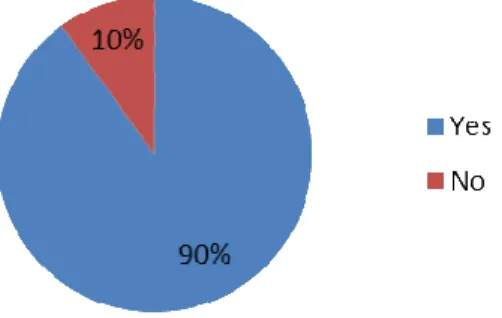
The below figure shows that how many participants have the practical knowledge in this field:
Figure 2: Respondents' reply on whether they have any practical knowledge or not
Among the participants of the survey one of the questions was whether they have any practical knowledge or not. Among the 30 participants 90 percent of the respondents answered that they have practical knowledge of cloud computing and a minority of 10 percent of the participant answered that they have no practical knowledge of cloud computing but in this case the participants may not use cloud computing but they have the knowledge of how cloud computing works. That’s why they responded in this survey.
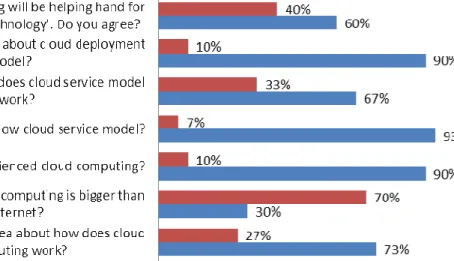
Figure 3: User’s responses about general perception of cloud computing
The responses of the respondents were collected using a questionnaire where they gave their consent putting Yes or No. 60% of the respondents said yes when asked whether they think cloud computing will be the helping hand for information technology. Almost 73% of the respondents said that they know how the cloud computing works as well as 90% of the respondents have already experienced it. 30% of the respondents thinks that cloud computing is bigger than Internet. When responding about the cloud service model, almost 93% of the respondents said they have knowledge about service model whereas 67% of the respondents know how it works. As well as90% of the respondents have idea or knowledge about cloud deployment model.
security threat for cloud computing and also 60% of the respondents think that outdated infrastructure can lead to security issue. 70% of the respondents think about data out of self-control can create security risk for cloud computing. A big number of respondents (90%) think that data breach or data loss can make cloud computing vulnerable. When responding about the satisfaction level of available cloud service, 70% said they are satisfied but they think (almost 93%) resource sharing is risky and they (60%) consider computing interface is unsecured.
6.0 Conclusion
In this paper the users’ concerns about security issues of cloud computing is analyzed. It is very clear that security threats are very dangerous for cloud computing though cloud computing offers numerous advantages. Those security threats make the cloud users reluctant to use cloud computing and they concentrate on the on premise IT infrastructure. There are many standard organizations like National Institute of Standards and Technology (NIST), Cloud Security Alliance (CSA) and Cloud Computing Interoperability Forum (CCIF) are always trying to develop standards through which they will resolve various security issues of cloud. The prospects of cloud computing is enormous though having some security problems.
References
B. Hay, K. Nance, and M. Bishop, “Storm Clouds Rising: Security Challenges for IaaS Cloud Computing”, pp. 1-7 (Jan. 2011). nob.cs.ucdavis.edu/ bishop/papers/ 2011-hicss-1/iaas.pdf
Kresimir Popovic & Zeljko Hocenski. Cloud computing security issues and challenges, in: MIPRO, 2010 Proceedings of the 33rd International Convention, 2010.p.344-349.
Jannatun Naym & Md. Akram Hossain, Does Investment in Information and Communication Technology Lead to Higher Economic Growth: Evidence from Bangladesh in: International Journal of Business and Management; Vol. 11, No. 6; 2016
Akhil Bhel, Emerging Security Challenges in Cloud Computing. Information and Communication Technologies, in: 2011 World Congress on, Mumbai, 2011.p.217-222.
Farzad Sabahi. Cloud Computing Security Threats and Responses, in: IEEE 3rd International Conference on Communication software and Networks (ICCSN), May 2011.p.245-249.
Eman M Mohamed, Hatem S Abdel kader & Sherif E., Enhanced Data Security Model for Cloud Computing, in: 8th International Conference on Informatics and Systems (INFOS), Cairo, May 2012.p.12-17.
Wentao Liu. Research on Cloud Computing Security Problem and Strategy, in: 2nd International Conference on Consumer Electronics. Communications and Networks (CECNet), April 2012.p.1216-1219.
Eystein Mathisen. Security Challenges and Solutions in Cloud Computing, in: International Conference on Digital Ecosystems and Technologies (IEEE DEST 2011), 2011.p.208-212.
Anderson, C. 2006. The Long Tail. New York: Hyperion.
Chen, M. Y. and S. Y. Tsai. (2010). Optimal provisioning of resource in a cloud service. IJCSI International Journal of Computer Science Issues, Vol. 7, Issue 6, pp. 95-99.
Rashmi, Sahoo, G. and Mehfuz, S. (2013). Securing Software as a Service Model of Cloud Computing: Issues and Solutions. International Journal on Cloud Computing: Services and Architecture, 3(4), 1-11. Doi: 10.5121/ijccsa.2013.3401
Markoff, J. Barboza, D. (2010, February 18), 2 China Schools Said to Be Tied to Online Attacks. Retrieved from http://www.nytimes.com/2010/02/19/technology/19china.html
L.M. Vaquero, L. Rodero-Merino, J. Caceres, and M. Lindner. A break in the clouds: towards a cloud definition, in: ACM SIGCOMM Computer Communication Review, 2008.p.50-55
Hassan, Qusay (2011). "Demystifying Cloud Computing" (PDF). The Journal of Defense Software Engineering. CrossTalk. 2011 (Jan/Feb): 16–21. Retrieved 11 December2014.