© Koninklijke Brill NV, Leiden, 2011 DOI: 10.1163/157181711X553942
Anti-Mafia Policies in Italy:
The Need for Collaborative Governance and Transition of
the Policy Actors from Isolation to Coalition
Baris Cayli
Università degli Studi di Camerino, Italy
1. Introduction
This article puts forth two main arguments. The first aim of this article is to simplify and classify the actors in the field of anti-mafia policies. Recently, classification of anti-mafia movements in Italy has been divided into direct and indirect policies through a methodology-based approach for implementation of these policies, which should be complementary to each other.1 While this article agrees that classification
of direct and indirect policies and their being complementary is important to having a coherent policy, this study argues that direct and indirect policies should be categorized according to an actor-based approach rather than a method-based one. Moreover, focusing solely on these two categorizations could be misleading unless the routes of direct and indirect anti-mafia policies during deployment are described. Thus, after distinguishing direct and indirect policy features, the article will argue that the direction of implementation is also significant, whether top-to-down (top-top-to-down) or bottom-to-top (bottom-up), according to the initiative, the intervening actors, and target group of these actors. Finally, it is noted that direct or indirect policies that are oriented either top-down or bottom-up are like the parts of a chain, so both direct and indirect policies should have equal importance and should all be perceived equally influential in the construction of anti-mafia policies.
1) A. La Spina, ‘Recent Anti-Mafia Strategies: The Italian Experience’, in D. Siegal and H. Nelen
The second contention of this article is that combined application of direct and indirect policies must show coordination and unification of the stakeholders, both state and non-state forces – state institutions, local people, and society in general – to reach an agreement on a structured policy analysis. These are indispensable factors to attain the optimum point (Fig. 1) and further protect it in the fight against the Mafia. This kind of policy action building is crucially significant for the actors of anti-mafia policies in order to avoid isolation and to open collaboration among the multiple actors.
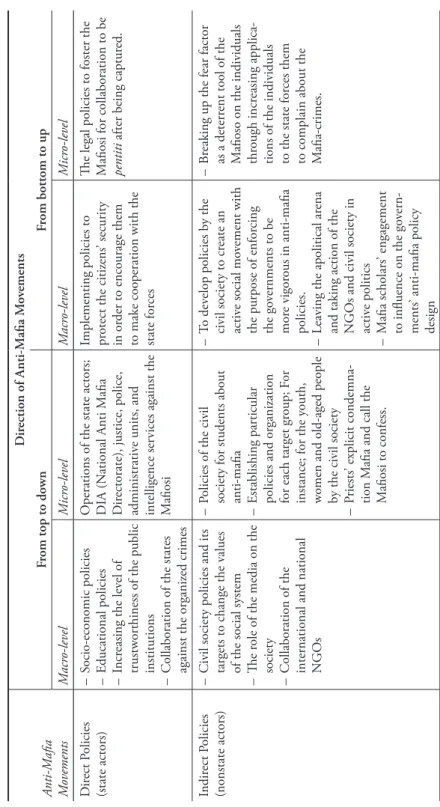
In sum, the first main argument of this article aims to make clear and consistent the types of anti-mafia strategies of the state and nonstate actors. The second main argument of this study will consider the reasons that a unified anti-mafia move-ment cannot be established. The main policy suggestions are focused on calling for the constitution of a cooperative union or organism as an essential need that should be bound legally to attain the optimum point in anti-mafia policies with the contribution of the state and nonstate actors (Fig. 3) who are categorized in the first section (Table 1).
This article is divided into four sections. The first section will address the role of the advocacy coalition framework (ACF) as the inspiration for structuring the whole article. The second section aims to examine the Mafia problem, presenting briefly the historical background of the Mafia phenomenon, the current situation, and the reaction to it in Italy. In the third section, the article will classify anti-mafia policies in three steps: the first step will concern the initiative of the actors, whether state or nonstate oriented, that is, direct or indirect; the second step will address the point of origin and route of direct and indirect policies, whether they are oriented top-down or bottom-up; and finally, the last step will consider the dimension of these policies, whether they are implemented at the macro or micro level (Table 1). Furthermore, the definition of the optimum point (Fig. 1) and how to reach the optimum point (Fig. 2) in the fight against the Mafia will be addressed in the third section. The fourth and last section of the article will, first, address the conflict among the state and nonstate actors in developing a unified anti-mafia policy and, second, organize the policy suggestions so that policy action will be undertaken through collaborative governance.
Finally, this article is limited to classifying anti-mafia policies and expressing the further steps that state and nonstate actors should follow. Thus, it seeks neither to explain each of these policies in a detailed way nor aims to illustrate them in the context of comparison.
2. The Role of the Advocacy Coalition Framework (ACF)
The Advocacy Coalition Framework (ACF) has been used largely in health, education, environmental, financial, planning, sport, drug, nuclear power, waste management, communication, tax, climate, and forest policies around the world.2
However, ACF has not yet been influential in the organized crime field of study. Furthermore, one criticism of ACF has been that it does not target collective action problems.3 Thus, this article may begin to fill a void in the application of
ACF in the field of organized crime policies and solutions to collective action problems. Therefore, the role of the ACF cannot be denied as a guide to this study in defining the policy problem, simplifying the policy actors through classification, building collaborative governance, and improving anti-mafia policies. Previously, five ways in which ACF could play a remarkable role in research were pointed out.4 The first is related to defining and simplifying the multiple policy actors
who are active politically, elucidating their mobilization and collective action. The second is using ACF as a policy analysis tool to determine “political landscapes.” The third is fostering collaborative governance through coalitions, even though there is competition among the actors, so that such collaboration may lead to a reflective learning process for each actor. The fourth is not using a single method of inquiry or theory but providing other approaches along with ACF in order to decrease bias. The fifth and last is the importance of expert-based information in the context of policy subsystems, which may be used for cross-coalition learning among cooperative coalitions.5 These five points will lead and guide this article and
will be significant in shaping the content and policy flow of this study. The first and second points have found their place in the first argument of the article. Initially, the historical background of the Mafia will include the orientation to the problem in order to map the political landscapes that will be helpful in understanding the relation between policy analysis and policy process. Furthermore, classifying anti-mafia policies and actors, as being the first point of ACF, will clarify the roles of the actors and the anti-mafia policies. The third, fourth, and fifth points will offer insights into the second argument of the article, which addresses the need to design anti-mafia policies through collaborative governance as being the third point. The fourth point will be followed by using actor institutionalized inquiry as
2) C.M. Weible, P.A. Sabatier and J. Flowers, ‘Advacocy Coalition Framework’, in J. Rabin and T.
A Wachhaus, Encyclopedia of Public Administration and Public Policy (London 2008) pp. 4–5.
3) E. Schlager, ‘Policy making and collective action: Defining coalitions within the advocacy coalition
framework’, 28 Policy Sciences (1995) pp. 242–270.
4) Weible et al., loc. cit., p. 7. 5) Ibid., p. 6–7.
already divided into state and nonstate actors and introducing the conflict among different actors. The need of expert-policy analysis will also be addressed in the last part of the article through participation of the related actors who have experience and technical proficiency and who know the realities of the local regions where the Mafia is active and vigorous.
3. Historical Background of the Mafia Phenomenon
The second point in designing research following ACF is to determine role of “political landscapes” and to map these landscapes.6 Before designing anti-mafia
policies, it is of utmost important to understand the depth and breadth of the background of the Mafia phenomenon and its relation with the political system in Italy. Therefore, the purpose of this section of the article is not only to act as a basis for the next sections in terms of understanding the somewhat hidden competition between state and nonstate actors in designing anti-mafia policies and their approach to each other but also to throw a light on the sociological and historical past of the country with the Mafia, with the aim of mapping places of these actors in policy design.
Examining the etymological meaning of the term mafia requires looking to the remarks of the Sicilian ethnographer Giuseppe Pitré. In 1889, he first indicated how the ‘mafia’ was perceived in Borgo, Sicily, stating that “the word mafia and its deriva-tives, meant, and still means, beauty, graceful, perfection and general excellence.” For men, this term mafia can mean “awareness of manhood, self-confidence and fearlessness but it never refers to arrogance or any kind of brutality.”7 In the first era
of the emergence of the traditional Mafia, dominant reasons for its development have been the effects of the economic situation in the region, which depends on agricultural economy;8 the political history of the region, which lacked a central
political authority;9 and the influential Mediterranean culture, which was a closed
traditional society.10 How the Mafia became so successful after its emergence was
explained by social networks and ‘control of the economic sphere, the trade union
6) Weible et al., loc. cit., p. 7.
7) C. Duggan, Fascism and the Mafia (New Haven, 1989) p. 15–16. 8) A. Blok, The Mafia of a Sicilian Village (New York, 1974).
9) E.J. Hobsbawm, Primitive Rebels: Studies in Archaic Forms of Social Movement in the 19th and
20th Centuries (Manchester, 1959) pp. 82, 95, 182. C.S. Hall and G. Lindzey, Theories of Personality (New York, 1978).
10) A. Cottino, ‘Sicilian Cultures of Violence: The Interconnections between Organized Crime and
Local Society’, 32 Crime, Law and Social Change (1999) pp. 102–113; R. Seindal, Mafia, Money and Politics in Sicily 1950–1997 (Denmark, 1998) pp. 10, 12, 90.
organizations, influence of judiciary, the police and administrative and political bodies.’11
Notwithstanding, the Mafia phenomenon still exists in certain parts of the society, but it is worth noting that this relationship commenced to be more observable clearly after the mid-20th century, in the decades of the 1960s, 1970s, and 1980s, when public funds were allocated for Mafiosi entrepreneurs, who lacked any professional capacity but could get the new public contracts because of their collusion with the politicians and bureaucrats; thus, a new phrase appeared: “mafia politicians”.12 Furthermore, the relationship between the politicians and the Mafiosi
from different Mafia groups should be defined largely as mutual because the two were dependent on each other in the exchange of legal and political protection and public contracts from the state to the Mafiosi and electoral votes and bribes from the Mafiosi to the politicians because they controlled the territories and politicians had legitimate power.13 Furthermore, this relationship and the corruption of the
politicians appeared in the public sphere as well. For instance, one of the most significant examples was the operation of “Clean Hands.” During this operation, 3,200 suspected bureaucrats and politicians were convicted between 1992 and 2002.14 On the other hand, even before such corruption, mafia domination in
politics was expressed and approved by such state-founded organizations as the Anti-Mafia Commission, which was established in 1962.15 Thus, this relationship
was generally defined as a political-criminal nexus in the literature.16
The clear existence of the Mafia phenomenon could also be found in almost every part of the society other than politics, especially when the Mafia’s power was more perceptible publicly. The most persistent trauma occurred in the summer of 1992, which was certainly one of the most turbulent times throughout the history of modern Italy; the brutality of the Sicilian Mafia reached its peak level, with striking and dramatic assassinations of the two famous prosecutors Giovanni Falcone and Paolo Borsellino, who were working against the Cosa Nostra (Sicilian Mafia). Following these murders, it was assumed that the Mafia was victorious in its resistance against the state and would continue to triumph against anyone who might hinder the Mafiosi. Undoubtedly, the emergence of such a perception was the
11) S. F. Romano, Storia Della Mafia (Salerno, 1966) p. 222.
12) P. Arlacchi, Mafia Business: The Mafia Ethic and the Spirit of Capitalism (Oxford, 1988) pp. 61,
167.
13) S. Maffei and I. M. Betsos, ‘Crime and Criminal Policy in Italy: Tradition and Modernity in a
Troubled Country’, 4 European Journal of Criminology (2007) pp. 461–482.
14) Ibid., loc. cit., pp. 470. 15) R. Seindal, op. cit., p. 50.
outcome of the violent bloodshed and histories of the different Mafia associations. What is more, the media’s bombing information and newspapers’ headlines about murder news of the police officers, judges, politicians, and local people, especially in the late 1980s and early 1990s, sent all society into a deep shock. Above all, the perception of the Mafia phenomenon shifted from the ‘southern question’ to the ‘national question.’ Consequently, the first specious argument about the invincible position of the Mafioso’s identity started deteriorating during those years. Thereafter, paradoxically, the assassinations precipitated the resources and motivation for anti-mafia movements on the part of the state and nonstate actors. Hence, these tragic events also constituted a catalyst for anti-mafia movements. In truth, it was declared that there had not been an ‘end of anti-mafia struggle and Italy succeeded in pulling itself out of the abyss, thanks to an extraordinary mobilization by all sectors of society.’17 Therefore, there was a renewal of the
anti-mafia struggles, managed by necessity with a high degree of solidarity and commitment for these activities. Considerable success was also attained recently through the arrest of the Mafia leaders. Additionally, recent study has indicated a noticeable decrease over the last two decades in mafia-type crimes.18 All these
efforts have forced Mafia groups to alter their expectations about the outcomes of their illegal activities. Soon after this verdict, they decided not to grab the atten-tion of the public with explicit violent performances anymore. Nevertheless, the eradication of the Mafia phenomenon from the country is still far from being a reality. Indeed, silently but profitably, the Mafia has still been playing an important role in subordination of the local people and maintaining ill-gotten gains. Their devastating suppression, especially of the local people, is evident in the recent statistic indicating that Mafia groups receive the most revenue from racketeering and usury, after illegal trafficking, which is 21,60 billion euro.19
Due to the recent developments in anti-mafia endeavours, the future of the Mafia becomes more controversial. Two contrasting stances typify the problem: The first one argues that Mafia associations may re-emerge with more power, consolidating their loss after their relatively decreasing supremacy over the last decades. The second concludes that different Mafia associations may continue to collapse and suffer from lack of compensation for their loss, so the Mafia cannot acquire adequate power to renew itself anymore. In this respect, how to increase the effectiveness of anti-mafia policies on behalf of the state and different segments
17) A. Jamieson, Antimafia: Italy’s Fight against Organized Crime (London, 2000) p. 20.
18) L. Paoli, ‘The Decline of the Italian Mafia’, in D. Siegal and H. Nelen eds., Organized Crimes:
Culture, Market and Polcies (New York, 2008) pp. 15–28.
19) ‘Le mani della criminalita sulle imprese’ SOS Impresa (2009). http://www.sosimpresa.it/userFiles/
of the societal and nonstate actors becomes crucially significant to assist in halting the Mafia. Therefore, the first principle of this article is to develop a classification in the management of anti-mafia policies in Italy through direct (state) and indirect (nonstate) actors. The second will be examining the direction of the policies as top-down or bottom-up and the dimension of the policies at either the macro or the micro level.
4. Classification of Anti-Mafia Policies
This section will address the policy actors who potentially have necessary roles in developing effective policy. Classifying policy actors in order to simplify the complex policy process is also the first point in the ACF.20 First, the importance of
the actors’ efficiency in their policies and other actors’ emerging later in the process will be addressed. Then, a detailed classification of the active actors’ endeavours in ant-mafia history will follow suggested changes to the policies.
Borsellino stressed that simply increasing the number of the policemen or magistrates in the region is not a good solution because the Mafia continue their activities with the newcomers, and to find the solution there is a need to go below the surface of the problem. Borsellino asserted that ‘the solution is to make the State work.’21 In this statement, he emphasized the importance of the politicians
and state officials having pure loyalty to the laws and preventing the power of the Mafia, which sustains its power through its human resources and networks across different segments of the society, elements that have been vital for domination since the emergence of the Mafia phenomenon. Thanks to popular resentment against the Mafia in the public, this phrase of Borsellino was echoed, at least in part, across the spectrum of the state over the last decades. Especially, after 1992, considerable changes in the law have been implemented against the Mafia.22 Thus,
there has been a slight change in the determination of the state in taking legal and administrative measurements against the Mafia in the last decades.
Individual, limited struggles against the Mafia began after the mid-20th century. Moreover, civil society began establishing new approaches in a more organized way, especially after 1992. These efforts should be noted as being fundamentally instrumental in making the state work through the use of soft power by nonstate actors. The basic principle of this soft power is the mobilization of the people in order to create a new culture of lawfulness and it is quite different from the role
20) Weible et al., loc. cit., p. 2. 21) Jamieson, op. cit., p. XXI
22) Seindal, op. cit., p. 52, 56, 92, 139, 166; Jamieson, op. cit.; J.C. Schneider and P.T. Schneider,
of the state power, that prefers to take more direct and hard actions against the Mafia. In light of these differences, anti-mafia policies in this article are largely divided into two groups of direct and indirect policies, which are followed by state and nonstate actors respectively.
5. Direct and Indirect Policies
The Mafia takes a place wherever there is weakness in public administration, a gap in the justice system, and corruption in management of public funds.23 Therefore,
the application of direct policies becomes more urgent and needs to be addressed carefully and decisively. However, in addition to direct policies, this article aims to address also the role of indirect policies, which are extremely important, in combination with direct policies, to increasing the effectiveness of the anti-mafia struggle. The indispensable importance of indirect policies can be verified because the Mafia phenomenon is highly related to the subordination of local people and public resources for both territorial power and legitimacy in order to increase the Mafia’s influence over the territory and to gain more illicit profits.
There have been many varied attempts in the fight against the Mafia in Italy. Especially in very recent years, the struggle has become both more intense and more diversified. In the meantime, this atmosphere of anti-mafia strategies fostered tendencies to classify these strategies. Therefore, anti-mafia measures were grouped as direct and indirect strategies, and it was argued that indirect strategies should be “complementary” to direct strategies in order to have the most effectiveness.24
Additionally, a methodology-based approach has been influential in making such distinctions. For instance, the punishment of criminals because of their actions was presented as the target of direct strategies. On the other hand, changing the attitudes and behaviour of the Mafiosi and local people was categorized as the goal of indirect strategies in the long run through the initiatives of ‘entrepreneurs, civic associations, public administrations, local bodies, schools and young people.’25 In
this respect, this article agrees with the statement that the initiative to make such a distinction between direct and indirect strategies and the attempt to combine these two types of strategies may be indispensable to increasing the suppression of the Mafia associations, so this statement draws a significant picture for initiating policy analysis based on the notion of anti-mafia strategies. Conversely, while the argument makes a good point in referring to the importance of both direct
23) Jamieson, op. cit., p. XXIII, 266. 24) La Spina, loc. cit., pp. 196–197. 25) Ibid., p. 197.
and indirect policies, it would be more valid and structurally significant to tackle anti-mafia policies and classify them by using an actor-based approach rather than a method-based one.
There are three main reasons for such a shift. First, the Mafia, as a complex historical, sociological, cultural, and economic virus, could be understood and be overcome, in principle, by the attempts of different actors in the field who have been the targets of the Mafia, either implicitly or explicitly. Second, the networks of the Mafiosi and their strategies are based on the networks that they established within the spectrum of three main actors: politicians,26 local people,27 and their
own members.28 For this reason, the roles of the actors become more significant
in dissolving these networks. Moreover, the policies of the Mafia associations are adjusted according to the decisions of collusive actors who facilitate and assist their illegal acts. Finally, anti-mafia policies that aim to break up the networks of the different Mafia associations are differentiated due to each actor’s (state or nonstate) particular duties that are applied. Therefore, the actor-based approach sheds light on anti-mafia policies that are implemented by these actors and aims to simplify the complex anti-mafia policies by classifying them as indirect and direct.
In the actor-based approach, the main distinction between direct and indirect policies is determined by the state and nonstate forces that are broadly represented by other minor actors. The prosecutors, magistrates, police officers, intelligence personnel, politicians, and mayors are examples of the minor actors who are represented by the state actors. Moreover, it is important to stress that the actors of the state and nonstate forces have been targets of the different Mafia groups in Italy. Unfortunately, these state actors have been murdered and threatened whenever they began threatening the legacy and illegal gains of the Mafiosi. Not only different minor actors of the state but also representatives of the nonstate actors consisting of local people, journalists, national and international nongovernmental institutions, priests, and other individuals who have explicitly resisted have experienced the brutality of the Mafiosi. Therefore, exclusion of both state and nonstate actors cannot be sufficient to eradicate the Mafia phenomenon in the country. Instead, classification of the actors should be kept as broad as possible to simplify the roles of actors and make easier the construction of anti-mafia policies.
26) Paoli, loc. cit., p. 20; Maffei and Betsos, loc. cit., pp. 463, 474.
27) R. Catanzaro, Men of Respect: A Social History of the Sicilian Mafia (New York ,1992) pp. 6, 20,
113.
5.1. Direction of the Policies (Bottom-Up or Top-Down)
After determining clearly the main players of direct and indirect policies as state and nonstate actors, the second structural analysis will distinguish the direction of anti-mafia policies. The first possible direction originates from the top and moves down, that is, from the upper level of the state and nonstate actors in order to create policies that affect the wider society and the actions of the policies on the target group. The second possible direction is from the bottom up, so its targets are structured by individuals or relatively small societal organizations and civil society and NGOs, which aim to affect the decisions of the policy makers in the top positions of bureaucracy or policy-making and even to seek changing policy makers and/or societal values and perceptions of the masses. Thus, the direction of policies could be oriented either from top down or bottom up.
There is certainly much to be said on this notion because the achievement of the policy orientation is also correlated with the point of origin of these policies. In this case, top-to–bottom-oriented policies indicate that the initiative for the implementation of the policies is from the powers and actors of the state and its institutions or by the actors of the civil society, priests, media, and so forth as nonstate actors. Accordingly, the difference in the initiative role is influential in the categorization as well. The usual goal of top-down orientation in anti-mafia policies is to yield strategies that can influence the masses, especially in the long run. On the other hand, unlike top-down policies, bottom-up policies arise from an individual-based approach and target relatively small organizations or groups. For instance, the state coopering with the individuals and providing security in order to be influential on the state actors’ targets is a prominent feature of bottom-up-orientated policies.
5.1.1. Top-down-oriented Direct Policies
Top-down-oriented direct policies have two main features. The first concerns the origin of the policies from the top so that they encompass the wider society to lead a change among the population through policies that are dictated from the top. The second one is related with the actors who implement those policies. Because they are called direct policies, the main role of implementing the policies should be held by state actors. Additionally, these policies are also divided into two levels – macro and micro – according to the dimensions of the policies on the target group. In order to make clear the classification, macro-level policies can be noted in four major areas, which are socioeconomic policies, educational policies, policies that aim to increase the level of trustworthiness of public institutions, and policies of collaboration of states against organized crime. Certainly, these policies can be implemented by direct intervention of the state actors, and because of their extensive target group, they can be classified as macro-level policies. As opposed
to macro-level policies, the target groups are relatively small for the micro-level policies. For instance, operations to capture the Mafiosi or to decipher illegal acts of the Mafiosi by police forces, intelligence agents, the justice system, and administrative units are categorized as micro-level policies. Furthermore, both macro- and micro-level policies are directly driven because of the main intervention of the state actors and are top-down oriented.
5.1.2. Bottom-up-oriented Direct Policies
In contrast to top-down direct policies, the initiative for bottom-up policies needs to come from the bottom, and state intervention plays a role in encouraging the actors at the bottom level to cooperate with the state actors. As is expected from macro-level policies, these policies are focused on constituting all citizens as the target group with the aim of providing high-level security for those who are under the threat of the Mafiosi. For the purpose of accomplishing these policies, the pro-tection of the witness has been main concern.29 For instance, there may be identity
changes for citizens, either temporarily or permanently;30 24/7 police protection;
and financial help secured for the ones who are under the Mafiosi threat.31 The
main purpose of these policies is to encourage more people to collaborate with the state. Additionally, micro-level policies are focused on particular group like the Mafiosi. Especially, many Mafiosi have already preferred to cooperate after being captured and have testified in the process popularly called pentito and technically called collaboratori di guistiza, ‘collaborators with justice.’ Therefore, the Mafiosi can enjoy some privileges as an outcome of their confessions to make these policies significantly instrumental in fostering Mafiosi confession.
5.1.3. Top-down-oriented Indirect Policies
In relation to two different types of direct policies, the particular distinction of indirect policies is the shift from state actors to nonstate actors. Nonstate actors are generally people who are free from being under any direct control and pressure of the state units and power while implementing their policies. The policies of these actors become more essential by targeting the masses through their specific and focused activities. Civil society, the media, and (inter)national nongovernmental organizations, as the main actors, illustrate their struggle by focusing on educational activities, information about legality, the notion of good citizenship, and strategic
29) Law 82/1991; Decree of the Ministry of Interior 161/2004, art. 7§1. 30) L’art. 3 comma 5 del D.Lgs. 119/1993.
31) A. Cauduro and A. Di Nicola, ‘IV Comparative Study, Italy: Legislation’, in G. Vermeulen (ed.),
propaganda against the Mafia. Finally, corporations of the different national and international nongovernmental organizations to increase the effectiveness of their policies are the last step of the macro-level policies that target the masses.
On the other hand, micro-level policies in this field are designed to concentrate on narrowly defined and particular actors. For instance, these activities include educational anti-mafia activities sponsored by the civil society for students in secondary and high schools, establishing and developing specific policies for women and old-aged people, and defining the role of the priests who have the potential to affect the acts of the local people. Moreover, priests may have the role of encouraging the Mafiosi to confess. These policies are prominent examples of micro-level policies in this category.
5.1.4. Bottom-up-oriented Indirect Policies
As noted, indirect policies are those in which nonstate actors play greater roles. Moreover, their roles are not related only to developing anti-mafia policies that target societal actors and ordinary people but also can be effective on the govern-ments. Their influence on the state actors and, especially, governments may cause reconsideration of anti-mafia policies. Basically, their pressure, first, depends on their success in mobilizing the masses against the governments’ policies or cor-ruption cases that create discontent in the society. Second, in order to reach such a target, activism through a political party should be perceived as the essential method. In contrast, nongovernmental organizations and civil society foundations prefer to be apolitical in their struggle against the Mafia in Italy. Finally, Mafia scholars may participate in the policy design of the government through their expert-based information in this field. Therefore, these three points are also macro-level policies that seek to be effective on the masses. Finally, micro-macro-level policies are more focused on motivating local people to cooperate with the police and judicial forces when they receive any threats from the Mafiosi or have any information about their associations. However, fear is still influential on the local people as a deterrent, but the civil society can provide emotional support and encouragement for the local people. Therefore, the flow of healthy information from local people (bottom) to the state forces (top) is secured and is considered one of the crucial tools in anti-mafia policies to break up the strength of the Mafia’s closed-network system and power over the territory.
6. Clash among Policy Actors and Searching for an Optimum Point
The classification of the different actors leads to the next step, which aims to detect the conflicts among the actors in order to determine an optimum point before making policy suggestions and proceeding to the second argument of the
article. In this section, the fourth point of the ACF will be introduced so as to draw attention to the gaps among the different actors and focus on the actor-based approach of the ACF.
Politics is the main instrument providing prosperity, administration, and peace in modern democracies, where the societies participate in politics and manage it directly or indirectly. In contrast, the Mafia has created an apolitical society with collusive politicians by exploiting deficiencies and gaps in the political and bureaucratic system in Italy. Not surprisingly, abusing ineffectiveness of the system with the aim of constituting power and widening economically and politically oriented illegal gains has been beneficial to the Mafia, and certain politicians have made use of this unethical environment. Therefore, after many proven cases of mafia-politicians from both right- and left-wing parties, recently, it was found that the government, parties, and parliament are the three least trustworthy institutions on the level of trust scale, respective trust levels of %25.1, %19.4, and %14.1.32 This
damaged trust in politicians by the ordinary people caused the civic organizations struggling against the Mafia to announce their apolitical positions.
In the recent situation, the links between the corruption in politics and different Mafia associations still exist in Italy. Even though prominent Mafia leaders, capo di
capi, have been captured in recent years, the news about the corrupt politicians has
kept the headlines of the newspapers busy. What is more, the ones related to the politicians from the government parties reinforce the doubts about the decisiveness of the current government’s Mafia fight. For instance, there are politicians in the Berlusconi government who have connections with the different Mafia groups in Italy. Marcello Dell’Utri is one of these politicians, who was convicted by the court because of his collusion with the Mafia.33 Not only the deputies in his government,
but recently ex-Mafia mobster Gaspare Spatuzza claimed that Berlusconi was a former political mediator and entered politics as a product of the Mafiosi agreement in the 1990s.34 In contrast, Berlusconi furiously objected to these statements and
as proof, captured the famous mafia leaders during his government period. Even if the statement of Berlusconi is true, it is absolutely essential to note that, to eradicate the Mafia, capturing some of the prominent mafia leaders and members is not sufficient because they have a strong and committed social network system.
32) S. Fabbrini, ‘The Transformation of Italian Democracy’,1 Bulletin of Italian Politics (2009) pp.
29–47.
33) P. Potham, ‘‘Berlusconi’s right hand man ‘has links to the Mafia.’’’ The Guardian (2005) http://
www.independent.co.uk/news/world/europe/revealed-how-story-of-mafia-plot-to-launch-coup-cost-reporter-his-life-494619.html.
34) “Mafia witness ‘boasted of links to Silvio Berlusconi’ “, BBC News (2009) http://news.bbc.
In addition, there are different types of Mafia groups in the country. Therefore, a Mafioso who has no link with the government could also be arrested.
A very recent occurrence of such a discrepancy between the government and civil society occurred in the case of confiscated goods. The Berlusconi government intended to sell confiscated goods by public auction to the Mafia associations. The government amendment on confiscated goods managed to capture the furious attention of the civil society, especially the ones who particularly focus on anti-mafia activities. Mancini noted the attempt of the Berlusconi government to have a ‘peaceful coexistence’ with the Mafia, indicating that it was ‘giving back with your left hand what you take away with your right hand.’35 In referring to
the taking back of the confiscated goods by the Mafiosi, Berlusconi replied, ‘We will seize them again.’36 At this juncture, the important point in this situation
is not to ask which party is more correct, but to focus attention on the tension between the government and the opposition because disagreement between the stakeholders who fight against the Mafia does the most harm to the success of this fight. Therefore, irreconcilable actions and attitudes should be the last to be welcomed in the anti-mafia policies.
Another example of conflict occurred between Italian Prime Minister Berlusconi and Roberto Saviano, who is the author of Gomorrah, which explains the links between the politicians and the Mafiosi while giving names. Berlusconi did not want to make the Mafia a topic, either in literature or the media. Prime Minister Berlusconi blamed the writer and journalist Roberto Saviano for ‘advertising the Mafia.’ Roberto Saviano responded
I believe that only the truth can give a country dignity … One thing is certain: Like many others I will continue to write. I was born in a wonderful albeit depraved country … An Italy that can only change when the South changes. … We will never fall silent. That I promise you. Loud and clear.37
There is no doubt that Roberto Saviano, with his book, sent a large shockwave through Italian society and the world concerning the facts of the Mafia. On the other hand, even though there are doubts about Berlusconi’s background with the Mafia, the crime rates decreased and well-known Mafia figures were put behind
35) R. Mancini, “Italy’s ‘coexistence’ with the mafia”, The Guardian (2009) http://www.guardian.
co.uk/commentisfree/2009/dec/15/italy-mafia-law.
36) “Wiretap Bill ‘To be softened’”, Ansa (2010) , http://www.ansa.it/web/notizie/collection/rubriche/
english/2010/05/25/visualizza_new.html_1815994132.html.
37) ‘Roberto Saviano defends himself against Silvio Berlusconi’, Die Zeit (2010), http://mobile.
bars in the last years of the Berlusconi government. If two parts really want to halt the Mafia phenomenon in the country, how could such an accusation occur and how this clash could have been prevented have been significant questions in the fight against the Mafia.
Recently, the current government attempted to amend a law passed by the Senate, article 266, which would forbid the use of bugs and wiretaps without proof of a crime having already been committed. The government defends the necessity of the law because it guarantees the privacy of citizens. However, many journalists have argued that investigations of illegal acts will be prevented with the change to this law. The head of the association of magistrates, ANM, Luca Palamara reported that ‘‘wiretaps should remain ‘a fundamental tool’ in the fight against complex criminal organizations.”38 Other Sicilian prosecutors remarked
that this amendment would put famous Mafiosi behind bars.39 Even though the
amendment has not been finalized yet, this example demonstrates how the ruling powers and other actors could take divergent positions when the issue is related to anti-mafia policies.
In this respect, there is an urgent need to determine the optimum point at which these two significant anti-mafia actors – state and nonstate actors – correspond. Therefore, the gap between the anti-mafia policies of the state and the anti-mafia movements of nonstate actors can be bridged by taking into account divergent and corresponding points of these two actors’ anti-mafia activities (Fig. 1). Certainly, defining the optimum level of the point of intersection and setting that level as a target to be reached will potentially strategically empower the fight against organ-ized crime in Italy because not only state, but also nonstate actors are part of the problem as the ones who are under direct influence of Mafia threat and pressure. In addition, citizens who are pay tax to the state but are also forced to pay extortion to the Mafia at the same time make up a considerable number of Italians, who are not only victims of the Mafia’s violence but victims of double taxation as well. Therefore, the effect of policy implementation cannot be independent of the policy and its setting.40 Even though the state has been the major actor and power in making the
policy, the significance of minor and local actors in the policy-making process is
38) “Wiretap Bill ‘To Be softened’”, loc. cit.
39) F. D’Emilio, ‘Italy’s anti-mafia fighters fear wiretap bill’, Washington Post (2010) http://www.
washingtonpost.com/wp-dyn/content/article/2010/05/21/AR2010052101885.html.
40) S. Maynard- Moody, M. Musheno and D. Palumbo, ‘Street-Wise Social Policy: Resolving
the Dilemma of Street-Level Influence and Successful Implementation’, 43(4) Political Research Quarterly (1990) pp. 833 – 848.
perceived as indispensable in the studies.41 It was found that it would be potentially
effective to understand the outlook at the local level through the eyes of the local people, local nongovernmental organizations, and other nonstate actors in different regions. The potential effects on the improvement and success of the policies have been acknowledged by nonstate actors.42
Thus, it is essential to implement diversified and focused anti-mafia policies through the contribution of all stakeholders in initiating and implementing effective policies. To this end, anti-mafia policies should embrace the same methodology that has been traditionally performed by different Mafia associations. The strategy of the Mafiosi is commonly based on spreading the risks among multiple circles of illegal activities, establishing close networks with other certain actors – politi-cians, international contacts, and local people – , dividing certain duties among particular members, focusing on the target, and idealizing the identity of the Mafia associations. These particular methods of the Mafia can be broken up by similar but more substantial efforts by the anti-mafia stakeholders through establishing stable contributions by both state and nonstate actors. Therefore, planning strategies step-by-step, coordinating different tasks with full commitment of cooperation, and altering the perception of the Mafia phenomenon to being a reason for unification of the different stakeholders, even the ones who have aligned in opposite parties politically, may add great value to the policies in the fight against the Mafia
7. From Risks to the Opportunities in Taking Action against the Mafia
In this last section, after discussing the influence of the fourth point on the emer-gence of the second argument, the third and fifth points of the ACF will facilitate policy suggestions arising from the second argument. The third point addresses the role of coalitions and collaborations among the actors. The fifth point indicates the importance of expert-based information in the improvement of policy actions for each sub-field. This section has three main topics of focus. First, it defines prior conditions that all actors should focus on in their perceptions of anti-mafia policies and argues that actors who have demonstrated lack of any constructive attempts in their approaches to each other must change. Second, another crucial point of this framework is how to break the power of the official authorities and politicians and bring both state and nonstate actors together to design policies. Finally, the “3 C” circles are introduced in order to foster anti-mafia policy design.
41) B. Hjern, ‘Policy Analysis: An Implementation Approach’, Annual Meeting of the American
Political Science Association (Chicago 1987).
State and nonstate actors may have naturally different priorities in the fight against the Mafia. The state forces are accountable to the law, and politicians have a tendency to take care of short-term benefits to protect their power and maintain their seats. Different from state forces, nonstate forces are more encouraged to criticize the policies and present new policy ideas because they are the ones who lack political responsibility and legal accountability, unlike the state actors. From these differences may emerge certain types of dissimilar approaches and proposals concerning anti-mafia policies. The two forces of state and nonstate forces, especially if they are politically aligned with different parties, may experi-ence sharp disagreement concerning the application of policies in the anti-mafia struggle. Such disagreement is echoed in the literature, called the devil shift in the advocacy coalition framework (ACF), in which the actors overstate the power and contradictory beliefs of their opponent actors.43
The second risk could be the hegemony of power that keeps the control legally because it makes policies and implements them. The state forces take their power from the law, and they only have the power officially to change the system or to make it functional. However, nonstate forces certainly have direct power to determine the politicians through polls, a change that is more difficult to attain but is the most effective so far. At this point, the mobilization effect of the nonstate forces on the masses has become one of the most remarkable ways to influence politics. Therefore, the risk of populist politics may invade the political spectrum and anti-mafia politics unless nonstate forces are successful in mobilizing the masses and making them politically active.
These two major risks help the Mafia the most and endanger the effectiveness of anti-mafia policies. The perceptions of the two actors – state and nonstate – concerning anti-mafia policies play a crucial role in eliminating those risks and even changing them into opportunities. The perception of both types of actors should be focused on anti-mafia policies as a national issue rather than as a topic for blaming the other. Second, breaking the hegemony of the policy-makers and politicians and forcing them to cooperate with nonstate actors can be achieved through the process of political mobilization of the masses in order to have their concerns taken into account.
A multilayered structure has been essential in coordinating the contribution of a range of social actors in terms of negotiating, implementing, and delivering services, so governance should entail inclusion of social partners and designs in order to facilitate agreement on actions among these actors (O’Toole 2000). Changing those risks into opportunities depends on cooperation of the state and
nonstate actors at the same junction in order to reach the optimum point (Fig. 2). This point should be clear, coherent, and consistent. State actors and politicians psychologically support the struggle of the nonstate actors and various NGOs. For instance, in 2009, the last conference of the biggest anti-mafia civil society organization, Libera, in Rome is an example because of the participation of the President of the Italian Republic, Giorgio Napolitano. There are also politicians who eagerly invite nonstate actors and people from nongovernmental organiza-tions that work against the Mafia to their meetings that are open to the public and media. This low but somewhat consistent interaction between the state and nonstate actors is shown in Fig. 1 as current situation..
At this point, it is important to consider more concrete steps and a planned system for the interaction of the state and nonstate actors concerning anti-mafia policies. To achieve the optimum point, the state actors’ perceptions concerning the anti-mafia policies should be changed. The state actors should stop thinking they should have the last word about anti-mafia policies because of their official power. On the other hand, nonstate actors should embrace the idea of offering constructive criticism to the government and state actors. Finally, nonstate actors should increase political mobilization of the Italian people to bring pressure on the decisions of the government and state actors.
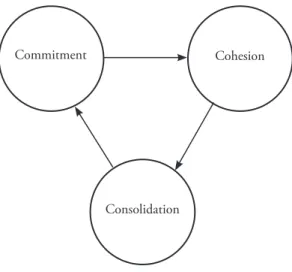
The optimum point stands is the point at which the state and nonstate actors as stakeholders are in agreement on anti-mafia policies. The struggle to reach such an agreement is certainly a long and arduous path, but in order to decrease the challenges and difficulties of such an agreement, both types of actors should be open to dialogue, partnership, and a set of rules that binds both state and nonstate actors legally. The last necessary feature for functional and durable policies is cooperation. As is shown in Fig. 3, “3 C” circles – cohesion, consolidation, and commitment – are needed in order to transform the theoretical framework of the actors into action throughout this circle. First, both state and nonstate actors should show their earnestness through cohesion. Arranging regular meetings or establishing a council that includes all stakeholders is the first step to manifesting and increasing the reliability of the actors for each other in this field. Second, consolidation can be provided after a certain level of cohesion has been established during these council meetings. Therefore, a work plan for anti-mafia policies can be started through the active participation of all the actors. To be effective in these policy actions, the last step can occur through each actor proving commitment with an agreement that binds all of the actors legally. Even though these “3 C” circles go step-by-step, it is a cycle, indeed, so it should be an ongoing process in which the participation of any stakeholder is open at any time because the cycle should continue to make the reliability, consistency, and uniformity stronger during the whole process while further improving these policies.
8. Concluding Remarks
The findings of this article have been focused on two main arguments. First, there is still confusion and lack of meta-level analysis concerning the definition of the actors and their roles while building anti-mafia policies. For this reason, this article has clarified these actors and constructed its argument on the basis of an actor-based approach before examining the second argument of the study. The actors (Table 1) can be classed into three subfields: state or nonstate; the direction of policies, top-down or bottom-up; and the dimension of the policies at the macro and micro levels. Such clarification has established each actor’s place in policy design and the invaluable but limited contribution of each unless joining with other actors to build common and consistent anti-mafia policies that meet at the optimum point (Fig. 1).
The second finding of this article is that the conflicts among the various actors, especially between politicians and nonstate actors, cause the decline of efficiency in the fight against the Mafia. Instead of conflicts, there is an urgent need for unification and collaboration of multiple actors, which could be achieved by changing the perceptions of the actors concerning each other and the issue of anti-mafia movements. Therefore, each actor has operated in isolation with policies that are beneficial but divergent from and inconsistent with other actors’ policies. In contrast to their traditional positions, the endeavours could be achieved by leaving the isolated and disconnected environments of the actors and unifying on one goal by combining all their resources: to halt the Mafia phenomenon in the country (Fig. 2). Last but not least, this article suggests that the struggle of such a unification could be comprised of reflexive and on-going 3-C cycles, in which the actors can pursue their aims while building their policy through cohesion, consolidation, and commitment (Fig. 3).
Table 1. Classification of Anti-M
afia M
ov
ements accor
ding to the dir
ection and actors
D ir ection of Anti-M afia M ov ements Anti-M afia M ov ements Fr om top to do wn Fr om bottom to up M acr o-lev el M icr o-lev el M acr o-lev el M icr o-lev el D irect P olicies (state actors) – Socio-economic policies – Educational policies – Incr
easing the lev
el of tr ustwor thiness of the public institutions –
Collaboration of the states against the organiz
ed crimes
O
perations of the state actors;
DIA (N
ational Anti M
afia
D
irectorate), justice, police,
administrativ
e units, and
intelligence ser
vices against the
M
afiosi
Implementing policies to protect the citiz
ens
’ security
in or
der to encourage them
to make cooperation with the state for
ces
The legal policies to foster the Mafiosi for collaboration to be pentiti
after being captur
ed. Indir ect P olicies (nonstate actors) –
Civil society policies and its targets to change the v
alues
of the social system
–
The r
ole of the media on the
society
–
Collaboration of the international and national NGO
s
–
Policies of the civil society for students about anti-mafia
–
Establishing par
ticular
policies and organization for each target gr
oup; F
or
instance; for the y
outh,
women and old-aged people by the civil society
–
Priests
’ explicit condemna
-tion M
afia and call the
M afiosi to confess. – To dev elop policies b y the civil society to cr eate an activ e social mo vement with
the purpose of enfor
cing the go vernments to be mor e vigor ous in anti-mafia policies. –
Leaving the apolitical ar
ena
and taking action of the NGO
s and civil society in
activ e politics – M afia scholars ’ engagement to influence on the go vern -ments ’ anti-mafia policy design – Br
eaking up the fear factor
as a deterr
ent tool of the
M
afioso on the individuals
thr
ough incr
easing applica
-tions of the individuals to the state for
ces them
Fig. 1. Current situation on the lines of the state and nonstate forces and optimum point where the lines of the forces should correspond to acquire the optimum point.
Top oriented Bottom oriented indirect
policies line Current situation Optimum point Direct policies Indirect policies Bottom oriented
Fig. 2. Direction of the anti-mafia policies and connection between them to reach the optimum level.
From Top to Down Indirect Policies Direct Policies From Bottom to Up OPTIMUM POINT Indirect Policies Direct Policies
Macro Micro Macro Micro
Fig. 3. 3c – commitment, cohesion, and consolidation are three points in the cycle to regulate and enhance the relationship between state and non-state actors while designing policies.
Commitment Cohesion