Journal of Transportation Management
Volume 27 | Issue 2 Article 8
1-1-2017
Full Issue (27.2, Winter 2017)
Journal of Transportation Management Editors
Follow this and additional works at:https://digitalcommons.wayne.edu/jotm
This Full Issue is brought to you for free and open access by DigitalCommons@WayneState. It has been accepted for inclusion in Journal of Transportation Management by an authorized editor of DigitalCommons@WayneState.
Recommended Citation
Taylor, John C. (Ed.). (2017). Full Issue (27.2, Winter 2017). Journal of Transportation Management, 27(1). doi: 10.22237/jotm/ 1498867620
Vol. 27 No. 2
Winter 2017
7 Using an Analytic Network Process Model to Incorporate
7 Using an Analytic Network Process Model to Incorporate
7 Using an Analytic Network Process Model to Incorporate
7 Using an Analytic Network Process Model to Incorporate
7 Using an Analytic Network Process Model to Incorporate
Qualitative F
Qualitative F
Qualitative F
Qualitative F
Qualitative Factors into Multi-
actors into Multi-
actors into Multi-
actors into Multi-Criteria
actors into Multi-
Criteria
Criteria
Criteria Global Modal Choice
Criteria
Global Modal Choice
Global Modal Choice
Global Modal Choice
Global Modal Choice
Decisions
Decisions
Decisions
Decisions
Decisions
Tyler T. Prevett and Bradley E. Anderson
23 Cultural and Structural F
23 Cultural and Structural F
23 Cultural and Structural F
23 Cultural and Structural F
23 Cultural and Structural For
or
or
or
orces: A P
ces: A P
ces: A P
ces: A P
ces: A Potentially Symbiotic or
otentially Symbiotic or
otentially Symbiotic or
otentially Symbiotic or
otentially Symbiotic or
Dysfunctional R
Dysfunctional R
Dysfunctional R
Dysfunctional R
Dysfunctional Relationship in the Journey T
elationship in the Journey T
elationship in the Journey T
elationship in the Journey T
elationship in the Journey Towar
owar
owar
owar
owards Supply
ds Supply
ds Supply
ds Supply
ds Supply
Chain Collaboration
Chain Collaboration
Chain Collaboration
Chain Collaboration
Chain Collaboration
Hugo A. DeCampos, Amydee M. Fawcett and Stanley E. Fawcett
39 Discovering the Power of Emotional Intelligence and
39 Discovering the Power of Emotional Intelligence and
39 Discovering the Power of Emotional Intelligence and
39 Discovering the Power of Emotional Intelligence and
39 Discovering the Power of Emotional Intelligence and
Organizational Identification in Creating Internal
Organizational Identification in Creating Internal
Organizational Identification in Creating Internal
Organizational Identification in Creating Internal
Organizational Identification in Creating Internal
Market-Oriented Supervision
Oriented Supervision
Oriented Supervision
Oriented Supervision
Oriented Supervision
Scott B. Keller, Bob Kimball, Bruce Brown, Giovana Patitucci and
M. Douglas “Doug” Voss
59 Data-Driven Insights: Assessment of Airline Ancillary
59 Data-Driven Insights: Assessment of Airline Ancillary
59 Data-Driven Insights: Assessment of Airline Ancillary
59 Data-Driven Insights: Assessment of Airline Ancillary
59 Data-Driven Insights: Assessment of Airline Ancillary
Services
Services
Services
Services
Services
Editor
Editor
Editor
Editor
Editor
Dr. John C. Taylor
Wayne State University
Associate Editors
Associate Editors
Associate Editors
Associate Editors
Associate Editors
Dr. George C. Jackson
Wayne State University
Delta Nu Alpha Support Services
Delta Nu Alpha Support Services
Delta Nu Alpha Support Services
Delta Nu Alpha Support Services
Delta Nu Alpha Support Services
Laura Plizka
Editorial R
Editorial R
Editorial R
Editorial R
Editorial Review Boar
eview Boar
eview Boar
eview Boarddddd
eview Boar
Martha Cooper
Ohio State University
Michael R. Crum
Iowa State University
William A. Cunningham
Air Force Institute of Technology
James M. Daley
Rockhurst University
Patricia J. Daugherty
Iowa State University
Kathryn Dobie
North Carolina A&T State University
M. Theodore Farris II
University of North Texas
Brian J. Gibson
Auburn University
Thomas J. Goldsby
Ohio State University
Stanley E. Griffis
Michigan State University
Curtis M. Grimm
University of Maryland
Jon S. Helmick
U.S. Merchant Marine Academy
George C. Jackson
Wayne State University
Carol J. Johnson
University of Denver
Scott B. Keller
University of West Florida
John L. Kent
Missouri State University
Leonard J. Kistner
Bainbridge State College
Daniel F. Lynch
Dalhousie University
Karl Manrodt
Georgia College
Ray A. Mundy
University of Missouri at St. Louis
John Ozment
University of Arkansas
Terrance L. Pohlen
University of North Texas
Anthony S. Roath
University of Oklahoma
Evelyn A. Thomchick
Pennsylvania State University
Theodore O. Wallin
ISSN# 1058-6199
Delta Nu Alpha International Boar
Delta Nu Alpha International Boar
Delta Nu Alpha International Boar
Delta Nu Alpha International Boar
Delta Nu Alpha International Boarddddd
Contact Information
Delta Nu Alpha Administrator 1720 Manistique Avenue South Milwaukee, WI 53172
[email protected] www.deltanualpha.org
Delta Nu Alpha Membership Information
See back page for form.
Jim Hall - President Henry Seaton - 1st Vice President
Sue Spero - 2nd Vice President Don Adams - Secretary / Treasurer Laura Plizka - Assistant Secretary / Treasurer
Directors Ned Booker - Director Christopher Burns - Director
Melinda Burns - Director Gary Heinz - Director Sally Lubinski - Director
Mike Rice- Director Jeff Wilmarth - Director
Editorial Policy
The primary purpose of the JTM is to publish managerial and policy articles that are relevant to academics, policymakers, and practitioners in the transportation, logistics and supply chain fields. Acceptable articles could include conceptual, theoretical, legal, case, and applied research that contributes to better understanding and management of transportation and logistics. Saying that, our policy requires that articles be of interest to both academics and practitioners, and that they
specifically address the managerial or policy implications of the subject matter. Articles that are strictly theoretical in nature, with no direct application to transportation and logistics activities, or to related policy matters, would be inappropriate for the JTM. Articles related to any and all types of organizations, and of local to global scope, will be considered for publication.
Acceptable topics for submission include, but are not limited to, broad logistics topics, logistics and transportation related legal issues, carrier management, shipper management of transportation functions, modal and intermodal transportation, international transportation issues, transportation safety, marketing of transportation services, transportation operations, domestic and international transportation policy, transportation economics, customer service, and the changing technology of transportation. Articles from related areas, such as third party logistics, purchasing and materials management, and supply chain management, are acceptable as long as they are related to
transportation and logistics activities.
Submissions from practitioners, attorneys or policymakers, co-authoring with academicians, are particularly encouraged in order to increase the interaction between groups. Authors considering the submission of an article to the JTM are encouraged to contact the editor for help in determining relevance of the topic and material.
The Editor information is: Dr. John C. Taylor, Associate Professor of Supply Chain Management, Department of Marketing and Supply Chain Management, School of Business, Wayne State University, Detroit, MI 48202. Office Phone: 313 577-4525. Cell Phone: 517 719-075. Fax: 313 577-5486. Email: [email protected]
Publishing Data
Manuscripts. Submit manuscripts to the editor by email attachment at [email protected]. Manuscripts should be no longer than 30 double-spaced pages and 7000 words. Guidelines for manuscript submission and publication can be found in the back of this issue.
Subscriptions. The Journal of Transportation Management is published twice yearly. The current annual subscription rate is $50 domestic and $65 international in U.S. currency. Payments are to be sent to Laura Plizka, Delta Nu Alpha, 1720 Manistique Avenue, South Milwaukee WI 53172.
FFFFFrrrrrom the Editor…
om the Editor…
om the Editor…
om the Editor…
om the Editor…
Welcome to the Winter, 2017 issue of the Journal of Transportation Management, being Vol. 27 No 2! This issue of the Journal starts with an article on global modal choice, includes an article on supply chain
collaboration, moves on to an article on internal market orientation and the benefits to a firm, and concludes with an article on international airline ancillary services for passengers.
Our first article examines global modal choice decisions. The research develops a model that can combine qualitative and quantitative factors in order to make the best modal choice decision. The second article uses a series of case studies to explore potential frameworks that can better categorize those factors that lead to exemplary supply chain collaboration. The third manuscript examines factors such as emotional intelligence that can lead to improved market oriented supervision in services businesses such as transportation and concludes that employees are better equipped to provide exceptional service when they are appropriately provided for and understand the company’s value proposition. The fourth article on international airline ancillary services investigates which services customers are most interested in, and reports the results by various demographic grouping of passengers.
At the Journal, we are continuing to make a number of changes that will improve the visibility of JTM, and improve its position in the supply chain publishing world. These include registering and updating journal information with several publishing guides, placing the journal content with the EBSCO, Gale and JSTOR databases faculty have access to, and placing abstracts of all past journal articles on an open area of the Wayne State University Journal web page. Full journal article PDF’s continue to be available to subscribers on the web page at www.business.wayne.edu/gscm
I look forward to hearing from you our readers with questions, comments and article submissions. The submission guidelines are included at the end of this issue’s articles and I encourage both academics and practitioners to consider submitting an article to the Journal. Also included in this issue is a subscription form and I hope you will subscribe personally, and/or encourage your libraries to subscribe.
USING AN ANALYTIC NETWORK PROCESS MODEL TO INCORPORATE QUALITATIVE FACTORS INTO MULTI-CRITERIA
GLOBAL MODAL CHOICE DECISIONS Tyler T. Prevett
USTRANSCOM Bradley E. Anderson Ball State University
ABSTRACT
This research develops and evaluates an Analytic Network Process (ANP) model to choose the correct mode of global transportation in the presence of complicating qualitative influences. The ANP model effectively combines important qualitative and quantitative factors into a global modal choice model. Although there is a great deal of research in the area of modal choice, the research often focuses singularly on cost or time factors. This research incorporates security, public opinion, and customer opinion into modal choice. One of the most difficult choices a transportation planner faces is deciding when qualitative factors outweigh the quantitative ones. A reliable tool to validate choice by including the important
qualitative factors with the quantitative is quite valuable in military operations, humanitarian support, and disaster relief.
INTRODUCTION
Modal choice for global transportation requirements is a complex decision. Generally, sealift is slower, but more cost-effective, while airlift is faster and more expensive. The decision to move something by air or sea is influenced not only by cost and technical limitations, but also by qualitative factors. This seemingly simple decision is complicated by a myriad of influential factors.
Most transportation research has focused on measurable metrics that address such factors as how much it costs to move something, whether the cargo arrives on time, the volume of cargo moved, or the number of items moved. This research is useful, but sometimes falls far short of what’s needed, as it neglects to consider the elements of the decision that aren’t dependent on numbers. Examples of ‘qualitative’ factors include pressure from public opinion, urgent need of materials for human survival and the political message conveyed. One only needs to look at the news, both historical and modern day, to see how political, social, environmental, and public administration
considerations affect the execution of many important endeavors.
Construction of the Trans-Alaskan pipeline is a vivid historical example of how a failure to consider the people and the environment, despite a national need for the oil, would cost billions of dollars and years of progress (Coates, 1991). A more recent example of choosing between 2 important alternatives in the face of many complicating factors is phase 4 construction of the Keystone Pipeline, also known as the Keystone XL Pipeline. The Keystone XL proposal faced criticism from environmentalists and a minority of the members of the United States Congress. In January 2012, President Barack Obama rejected the application amid protests about the pipeline’s impact on Nebraska’s environmentally sensitive Sand Hills region (Bloomberg
BusinessWeek, 2012). The debate on building the pipeline rages on. These are just 2 examples of the difficulty that looms when many qualitative factors are involved. These factors are common in military transportation, humanitarian assistance and disaster relief efforts, but decisions must be made much faster, as lives are at state. There has not been a
8
systematic examination of qualitative factors in the area of global modal choice, yet these factors can greatly influence mode choice.
In order to address the problem of choosing the correct mode of global transportation in the presence of complicated qualitative influences, this research formulates an Analytic Network Process (ANP) model that effectively and efficiently
combines the qualitative and quantitative factors into a single global modal choice model. The goal of the model is to get the required equipment to its
destination at the required time, but to do it at the minimum total cost, while addressing the qualitative variables as best as can be done. The importance of incorporating qualitative factors into a
transportation decision model is further demonstrated through the details of the High Mobility Multipurpose Wheeled Vehicle
(HMMWV) case used to validate the developed model.
We will first use a Literature Review to show this research’s position within the existing body of work,
as well as to justify this research and the methodology. The development and use of the ANP model follows the literature review in the order presented in Figure 1. This figure shows both the flow and order of the discussion as well as the methodology used to create and utilize the ANP model. All of the inputs to the ANP Model are described in the Research Design (Building the ANP Model) section. ANP Model Implementation is described in the following section, and Model Building Results are shown in the next section. The paper concludes with the HMMWV Case and Recommendations for Future Research.
LITERATURE REVIEW
Perhaps the two most thorough reviews of modal choice research were conducted by McGinnis (1989) and Meixell & Norbis (2008). However, none of the examined models consider qualitative aspects, nor do they integrate experts’ opinion into the decision.
Some research efforts have attempted to identify the qualitative criteria that influence the freight mode choice like Brooks (1990), Lu (2003) and Jeffs and Hills (1990). Jeffs and Hills (1990) formulated a factor analysis of the determinants applicable to freight movement in the United Kingdom. They highlight six categories of variables that influence the decision, but they were unable to formulate an overall decision model that incorporated the complex interactions among the variables, as is needed for an accurate decision to be made in research such as this. Without modeling those interactions, accuracy of the results is not assured. Jeffs and Hills (1990) recommended future research focus on the specific situation, characteristics and needs of the organization. Their view of evaluating determinants of the mode choice with an
organizational-specific model is shared by Young, Richardson, Ogden, and Rattay (1982).
In their examination of behavioral influence on freight mode choice criteria, Bolis and Maggi (2003) conclude that the mode choice must be in alignment with the organization‘s overall logistics strategy. The authors interviewed 4 logistics managers within an Adaptive Stated Preference experiment. While this is a small sample size, Bolis and Maggi (2003) argue that because of the expertise of these managers in the transportation system, their inputs can yield valid results. This paper utilizes a similar argument, but uses a greater number of interviews that better encompass the entire transportation system. Bolis and Maggi (2003) present the notion that an organization’s overall logistics strategy will impact how important different criteria are to the decision maker in any given situation, which is also key to this research. While existing research focuses on rail vs. truck modalities, Bergantino and Bolis (2004) considered the behavioral elements associated with a maritime mode choice. The study again shows that the particular situation and strategy of the customer plays an important role in determining applicable criteria for the mode choice. Their research relies on comparisons between the criteria, but also does not account for interactions among the criteria in a
systematic way. Therefore, it is not particularly useful for a high visibility global mode choice. The ability to consider both quantitative and qualitative data in a systematic way is a particular strength of an Analytic Hierarchy Process (AHP). Liberatore and Miller (1995) considered the mode choice between sealift and airlift using the AHP methodology with a focus on the entire logistics strategy of the focal firm. The authors note that their research represents the first time that AHP had been specifically applied to mode choice (Liberatore and Miller, 1995). They conclude that AHP offers a comprehensive, yet flexible methodology for addressing transport carrier and mode selection problems (Liberatore and Miller, 1995). Hundreds of researchers have used this methodology to model and make real-world decisions, such as choosing a subway layout in Istanbul or determining an
appropriate mix of advertising media (Saaty, 2000). The AHP decision model approach has also been subject to some criticism. Some authors have voiced objections to the model’s mathematical and theoretical base, arguing that relative comparisons can be arbitrary, and that the higher and lower criterion of the decision can have interdependencies (Dyer, 1990; Harker and Vargas, 1987). The basis of this criticism is that the AHP only allows
unidirectional influence along the hierarchical relationships (Cheng, Li, and Yu, 2005). Another limitation of the AHP is that the criteria at any given level of the hierarchy are considered to be mutually independent (Büyükyazici and Sucu, 2003). While this may be true in some cases and may be assumed in some cases to simplify the decision model, real-world problems are seldom so simple. Saaty (1999) points out that assuming independence unnecessarily limits interactions among elements within the same level and at different levels of the hierarchy. Another criticism of the model is that the decision maker can introduce inconsistencies into the model. For example, suppose in a car purchase example the buyer said that speed was more important than style, that style was more important than cost, but that cost was more important than speed. This is the circular inconsistent logic of A>B, B>C, but C>A.
10
To properly deal with these criticisms, the decision model developed here has been generalized to include interdependencies between internal elements and feedback between hierarchical criteria levels of the decision. This generalization of the AHP is termed an Analytic Network Process (ANP) model (Saaty, 2001). Feedback and inner dependence are included by way of another matrix transformation on relative priorities. Inner dependence is observed when an element within a cluster influences another element within the same cluster. A cluster is a group of closely related model elements, like the sub-criteria of an overall criterion or the alternatives to be considered. This model is also seeing wide usage in academic and professional arenas to assist in decision making (Coulter and Sarkis, 2005; Cheng and Li, 2005; Shang, Youxu, and Yizhong, 2004; Lee and Soung, 2000).
The ability of ANP to model inner dependence and feedback within a decision hierarchy makes it an appropriate model for mode choice. Ali Görener provides significant proof and further validation that ANP is the proper and most suitable method to use. His comparison of ANP and AHP in a
manufacturing setting shows that there are significant differences between AHP and ANP outcomes derived from interdependencies, outerdependencies and feedbacks (Görener,2012). In Rozann Saaty’s paper “A Validation of the Effectiveness of Inner Dependence in an ANP Model,” she shows at each step the results are nearer what we know occurs in the real world. Using a direct comparison of the AHP and ANP models, this validation shows that using feedback and dependence in an ANP model can get us closer to reality (Saaty 2013).
However, a review of the literature revealed no previous research of modal choice using the ANP methodology.
RESEARCH DESIGN (BUILDING THE ANP MODEL) To build an ANP model, we begin with the three distinct steps of problem identification (Forman and Selly, 2001). These steps are - 1) defining the problem, 2) identifying alternatives and 3)
researching the alternatives. The first two steps are straightforward, as our problem is in choosing the correct mode of global transportation, and the choices are airlift or sealift. Researching the alternatives for step 3 is quite challenging and reflects most of the effort and reason behind this research. ANP was chosen as the modeling
methodology for the third step, due to its capacity to incorporate complex interactions among criteria and to capture qualitative and quantitative variables. After the three problem identification steps are properly addressed, the ANP model is constructed for determining global modal choice.
To build the model, data is incorporated from the literature and personal interviews with transportation experts in different regions. Existing literature and interviews are used to determine appropriate criterion to include in the decision model, as well as their relative importance. Subjects for the
interviews were selected by contacting the U.S. Transportation Command for experts in the matching of sealift or airlift assets to a movement request. Ten subject matter experts, of those requested, agreed to be interviewed. The
interviewees consist of both service providers and customers in different regions of the world and all four service branches of the U.S. military (Army, Air Force, Navy and Marines). Experience ranges from a senior leader with 34 years of logistics experience to an interviewee with seven months experience in coordinating movement requests. All interviewed subjects have detailed knowledge of transportation functions and limitations and are experienced in both movement requests and mode selections. The subjects collectively have
experience in all major regions of the world. Interviews were conducted with subject matter experts during which each was asked seven primary and very open ended questions as follows:
1. Where do you work? How long have you worked in the transportation system? What do you do in the strategic Airlift/sealift system?
2. How does a movement request happen? 3. What do you perceive as the major criteria
to consider when requesting sealift or airlift as a mode of transportation?
4. How often does the lift occur exactly as requested? Can you recall any cases where one mode was requested, but a different mode was used?
5. From your perspective, what are a few major Criteria that complicate the modal choice?
6. What could be done to improve the decision making process?
7. Is there someone else you could
recommend I talk to about these kinds of issues?
An affinity diagram procedure was used to organize the ideas using the following steps (Brassard, 1989): Step 1 - Generate Ideas. The survey questions were used to generate a list of ideas. Interviews were recorded and subsequently transcribed to text. All subjects were advised that the interview would be recorded and that their identities would remain confidential.
Step 2 - Display the Ideas. The ideas were posted randomly on a table. Each interview was decomposed into discrete statements of the criteria that influence the mode decision, resulting in 240+ individual statements. Each statement represented a specific criterion and element applicable to the mode choice, and could also indicate interaction with other elements.
Step 3 - Sort the Ideas into Related Groups. The researchers physically sorted the individual statements and they were then reorganized into related concepts and groupings, using the following process:
Start by looking for two ideas that seem related in some way. Place them together in a column off to one side.
Look for ideas that are related to those you’ve already set aside and add them to that group.
Look for other ideas that are related to each other and establish new groups.
Step 4 - Create Header Cards for the Groups. A header is an idea that captures the essential link
among the ideas contained in a group of cards. This idea is written on a single card or post-it and must consist of a phrase or sentence that clearly conveys the meaning. The researchers developed headers for the groups by:
Finding already existing cards within the groups that will serve well as headers and placing them at the top of the group of related cards.
Alternatively, discussing and agreeing on the wording of cards created specifically to be headers.
Discovering a relationship among two or more groups and arranging them in columns under a superheader. The same rules apply for superheaders as for regular header cards.
Step 5 - Draw the Finished Affinity Diagram. Write a problem statement at the top of the diagram.
Place header and superheader cards above the groups of ideas.
Review and clarify the ideas and groupings. Document the finished Affinity Diagram. Once the cards have been sorted into groups, large clusters are sorted into subgroups for easier management and analysis. The result of the affinity diagramming procedure is a cause and effect diagram. Once the statements are transformed into the needed criterion, elements, and interactions that represent policy, practice, and priorities, they are all inputted to the SuperDecisions 1.6.0 software selected for this task and utilized for the
mathematical formulation of the mode choice. Data for needed mode decisions are inputted to the model for recommendation as discussed later in the HMMWV case study.
ANP MODEL IMPLEMENTATION Now that we have developed our ANP model, we discuss the steps the model goes through in
modeling a decision and presenting a
recommendation. SuperDecisions 1.6.0 software is utilized for the mathematical formulation of the model in this research, where the pairwise
12
judgments and synthesis are performed via graphical user interface (Super Decisions, 2006). There are three basic steps to modeling a decision using AHP that are also applicable to ANP: 1) decomposition, 2) comparative judgment, and 3) synthesis (Saaty, 1990; Büyükyazici and Sucu, 2003).
Decomposition
Decomposition of the decision problem is very similar between ANP and AHP and is the first phase of AHP model development. Since ANP breaks down the traditional one-way influence of the hierarchy, it is graphically represented differently as seen in the following figure as adapted from
Büyükyazici and Sucu (2003).
There are several important differences in this ANP network model. The first is terminology. The numerous criteria and alternatives depicted in the model are represented by the multiple clusters and the sub-criterion are called elements. When an element within a cluster influences another element within the same cluster, this relationship is called inner dependence and is represented by the arrow looping back to the same cluster as shown above. Similarly, when an element from one cluster influences an element from another cluster, this relationship is called outer dependence and is represented by the arrows between clusters. When the characteristics of one of the alternatives
influences a criterion or sub-criterion, this
relationship is called feedback and is represented
by an arrow moving from the alternatives cluster to a criterion cluster.In this way, the importance of the criteria and their sub-criteria not only influence the priority of the alternatives, but also influence the priority of the various criteria and other elements within the model. Saaty (1990/1997) helps us understand these relationships with a couple of examples.
“In inner influence one compares the influence of elements in a group on each one. For example if one takes a family of father mother and child, and then take them one at a time say the child first, one asks who contributes more to the child’s survival, its father or its mother, itself or its father, itself or its mother. In this case the child is not so important in contributing to its survival as its parents are. But if we take the mother and ask the same question on who contributes to her survival more, herself or her husband, herself would be higher, or herself and the child, again herself. Another example of inner dependence is making electricity. To make electricity you need steel to make turbines, and you need fuel. So we have the electric industry, the steel industry and the fuel industry. What does the
electric industry depend on more to make electricity, itself or the steel industry, steel is more important, itself or fuel, fuel industry is much more important, steel or fuel, fuel is more important. The electric industry does not need its own electricity to make electricity. It needs fuel. Its electricity is only used to light the rooms, which it may not even need. If we think about it carefully everything can be seen to influence everything including itself according to many criteria. The world is far more interdependent than we know how to deal with using our existing ways of thinking and acting. The ANP is our logical way to deal with dependence.”
This powerful network model can also represent extremely complex decision making by including as many clusters and elements as required for the objective, and each cluster can also entirely contain sub networks of criteria. The depth and complexity of the network model is limited only by the needs of the decision maker. The network model can also be expanded to incorporate different dimensionsof the decision, each of which corresponds to a given preference for an alternative based on an overall environment. For example, in estimating market share one might evaluate different alternatives based on the risk, opportunity, costs, or benefits each alternative presents (Saaty, 2003). These higher level dimensions are called control hierarchies, and represent a separate network of the same criteria for each dimension being considered (Saaty, 1999). The control hierarchies can be viewed as important higher level aspects in choosing between the model alternatives identified by the decision maker and integrated via the questions asked to gather the needed data. Saaty shows some example questions on bringing in data for a control hierarchy:
“For benefits and opportunities, ask what gives the most benefits or presents the greatest opportunity to influence fulfillment of that control
criterion. For costs and risks, ask what incurs the most cost or faces the greatest risk. Sometimes (very rarely), the comparisons are made simply in terms of benefits, opportunities, costs, and risks in the aggregate without using control criteria and subcriteria.”
In this transportation model the control hierarchy encompasses the entire model represented by the overall objective of “Sealift or Airlift for Global Modal Choice?”
In this research, data is drawn from interviews with subject experts in the military distribution system, and it is compiled to determine appropriate criteria to include in the model. Decomposition of the decision through interviews has been used by many researchers such as Bolis and Maggi (2003). After decomposition is complete, we begin the second phase of AHP building, which is comparative judgment.
Comparative Judgement
The comparative judgment phase of ANP is essentially the same as AHP. Each cluster is compared in a pairwise fashion relative to its importance to the objective. Similarly, pairwise comparisons of each element within a cluster are also constructed using the same qualitative and quantitative methods as described with AHP
models. The comparisons are done to establish their relative importance to weight the corresponding blocks of the supermatrix and make it column stochastic. A cluster impacts another cluster when it is linked from it, that is, when at
least one node in the source cluster is linked to nodes in the target cluster. The clusters linked from the source cluster are pairwise compared for the importance of their impact on it with respect to mode choice, resulting in the column of priorities for that cluster in the cluster matrix. The process is repeated for each cluster in the network.
Relative comparisons for all of the information in the decision can be interpreted as pairwise judgments and included in the overall decision model. In Saaty’s SuperDecisions 1.6.0 software, this
14
pairwise comparison can be made by pie chart, bar chart, questionnaire, or input directly into a pairwise comparison matrix (Super Decisions, 2006). A node is a sub-division of a cluster and typically represents the lowest level of input data that is examined. If customers is a cluster, then age, gender, and salary could be used as nodes. After all the nodes are created, nodes are chosen and linking to the other nodes in the model that influence it. The “children” nodes will then be pairwise compared with respect to that node as a “parent” node. An arrow will automatically appear going from the cluster the parent node cluster to the cluster with its children nodes. When a node is linked to nodes in its own cluster, the arrow becomes a loop on that cluster and we say there is inner dependence (Saaty, 1990/1997).
As an example, Figure 3 shows a notional model node that indicates that the type of cargo being
transported “very strongly” favors the use of sealift. The reason for the strength of the pairwise
comparison might be that the commodity is
extremely dense or heavy and might not be able to be transported by air. Within the software, a similar comparison is accomplished for each sub-criterion with respect to the alternatives.
Synthesis
After the second phase of AHP development is complete, we can begin the third and final stage of model development, known as Synthesis. The synthesis phase of ANP is much different than in AHP. In ANP, a supermatrix of the pairwise comparisons is constructed. This supermatrix consists of several partitions or sub-matrices which take into account the impact of elements on each other (Büyükyazici and Sucu, 2003). The supermatrix is organized with each element of the model occupying a column and a row. These columns and rows are grouped by their parent
cluster. In this way, there is a representation for how much each element of the model influences every other element of the model. Of course, elements can also exert no influence on each other, and a ‘0’ is entered in the matrix where these two elements intersect. The intersection of two clusters of elements represents a single pairwise comparison matrix, and the supermatrix represents the
compilation of all the priorities derived from pairwise matrices (Büyükyazici and Sucu, 2003). An important point is that the supermatrix must be column stochastic (Saaty, 1999). This means that the sum of each column within the supermatrix must sum to one so that the supermatrix converges when raised to an acceptably large power (Büyükyazici and Sucu, 2003). This can be done by multiplying the values within the sub-matrix by the relative weight of their interaction. Saaty (1999) represents the supermatrix using the notation: W is the
supermatrix, N represents the number of clusters, CN represents each cluster, eNn represents each element of the model, and WNn represents the appropriate sub-matrix weight.
The desirability of an alternative can then be computed in a similar fashion to AHP while
incorporating the effects of dependence between the elements of the model. While Saaty uses matrix representation for deriving the priority of
alternatives, this process can also be represented mathematically. The following summation was adapted from the work of Meade and Sarkis (1999) to represent the needed ANP related decision variables and represents the desirability of an alternative for a given control hierarchy.
(1)
Where:
Di is the desirability of alternative i.
Pjis the relative importance weight of the criterion j for the control hierarchy, D
kj
W
is the relative importance weight for element k of criterion j for dependency between componentI kj
W
is the stabilized relative importance weight as determined by the supermatrix for element k of criterion j for interdependency relationships between elements of the model.Sikj is the relative preference of alternative i with respect to element k under criterion j.
Kj is the index set of elements for criterion j, and J is the index set for all criterion.
The synthesis step is accomplished after entering all the pairwise comparisons. The relative priority of the alternatives will be displayed graphically and in terms of the raw derived priorities.
MODEL BUILDING RESULTS The following table summarizes the model elements of the developed modal choice model.
Criteria 1.0 represents the alternatives available to the decision maker, and criteria 2.0 to 7.0 represent elements of the decision. This procedure resulted in the identification of six main criteria elements and 28 sub-criteria elements for consideration in modal choice decisions (not including the airlift and sealift alternatives in this total). Throughout the interview process, it became apparent that criteria were indeed highly influential to each other. For example, the availability of aircraft was influenced to a high degree by worldwide global demand for airlift. These various relationships are captured by including inner dependence and outer dependence loops within the decision network. The
interdependencies (both inner and outer
dependence) can be seen in the following table by the many criterion that influence other sub-criterion.
Table 2 shows that the subjects indicated a high degree of interaction among the elements of the model. The left most column indicates the element that has influence over the criteria to the right. Some elements such as Leader’s Preferences and Platform Availability have a widespread influence over many other elements in the model. These criteria, sub-criteria and their dependencies were all entered into Super Decisions 1.6.0 (Super
16
Decisions, 2006) software to arrive at an overall network model.
Now that the decision model has been developed, it is necessary to evaluate the model. We will examine a specific case to validate the developed model. Complete data for a situation such as is modeled here is not easy for everyone to obtain, as many factors we consider are often either not collected or the data is not freely distributable. We were able to obtain needed data for validation and used the very relevant Department of Defense case of transporting
up-armor kits and armored High Mobility Multipurpose Wheeled Vehicles (HMMWVs).
HMMWV CASE (MODEL VALIDATION)
On December 25, 2003 The New York Times published the story “Army Stepping Up Its Humvee Orders For Troops in Iraq” where they expound on how the U.S. Army sent out an urgent call for armored HMMWVs, realizing that it had not ordered enough to protect its troops. In April 2005, the Government Accountability
Office published a report to Congressional Committees identifying nine commodities that were subject to systemic deficiencies and five reasons the shortfalls were realized. Ineffective distribution of armored HMMWVs and up-armored kits was cited as one of the prevalent systemic deficiencies (GAO-05-275, 2005).
Sealift is generally about 1/10th the cost of airlift, and it is the obvious choice for bulk and heavy assets to be moved, especially over long distances. However, monetary considerations were considered less important because armor kits and vehicles were considered critical to troop survival. News stories of American casualties due to roadside bombings of HMMWVs without armor led to heavy political influence on mode choice. Security and time considerations favor the use of airlift. Geographical
18
influence on mode choice is mixed. While the items are heavy and the distance to move them is great, which would favor sealift, the required location for these items is inland, which would favor airlift. Another important factor in this decision is that during the initial stages of the transportation problem there were very few armor kits to aggregate to an entire shipload for transportation.
The following table summarizes the data for sub-criteria preference with respect to the alternatives: The table represents preference for sealift or airlift based on the HMWVV data and can be interpreted as the relative importance of one criteria over another with respect to a given criteria. For example, in the 2.0 Costs table in Table 3 the bolded entry indicates that operational requirements are 2 times as important as system limitations with respect to the costs criteria. When a criterion does not have an impact on another criterion, it is not included in the pairwise comparison.
Once the steps of ANP are completed, as
previously discussed, the resulting vector is obtained from the HMMWV data and presented in Table 4. The bolded priorities within the table for airlift and sealift match the priorities derived using the Super Decisions1.6.0 software, and represent a
preference for using airlift for mode choice using the HMMWV case data (Super Decisions, 2006). The derived priorities for the individual sub-criteria presented in the table indicate the amount of influence each of these elements had in identifying airlift as the mode of choice. Each of the elements grouped in their main criteria display the amount of influence each main criteria had in the overall mode choice.
HMMWV CASE CONCLUSIONS
Overall, the developed ANP decision model shows a relative preference for airlift to deliver the
HMMWV armor requirements. In practice, this is the actual outcome chosen by decision makers. In a
hearing of the House Armed Services Committee, Congressman Hunter relayed that even much later in the conflict airlift delivered the majority of level 2 armor due to the “extreme importance to our warfighters” (Hunter, 2006).
Although the choice of airlift or sealift is a seemingly simple binary choice, it is anything but simple. One of the most difficult choices a transportation planner faces is deciding when qualitative factors outweigh the quantitative ones. Having a reliable tool to validate that choice by including the important qualitative factors with the quantitative is quite valuable.
FUTURE RESEARCH
The presented decision model was built using the inputs of 10 experts in the mobility system. One area of future research that could add validity to the model is to evaluate the accuracy and completeness of the model through additional case studies or by using a Delphi Methodology. Additional case studies would further validate the model, as would a follow-up survey of all subjects or examining the inputs of new experts. A survey could easily be built using WebSurveyor Desktop 4.1, and contain Likert scale ratings of each criteria and sub-criteria with respect to how frequently it impacts the modal choice, and how important it is to the modal choice.
CONCLUSSIONS
This research presents a unique decision model as well as a unique method of developing mode choice using ANP. Tools such as this decision model and other initiatives serve to aid decision makers by allowing them to make more thoroughly informed decisions in a systematic way that includes both quantitative and qualitative inputs not included in previous modal choice models. This multi-criteria integrated methodology and modeling technique could be applied to other transportation problems that require an important degree of qualitative factor decision making integration. This could include other military operations, humanitarian assistance/ logistics, or disaster relief where many qualitative factors need to be considered and priorities are not solely cost based.
REFERENCES
Bergantino, A., and S. Bolis (2004), “An Adaptive Conjoint Analysis of Freight Service Alternatives: Evaluating the Maritime Option”, Chapter 10 in Aura Reggiani and Larie Schintler (eds.), Methods and Models in Transport and
Telecommunications: Cross-Atlantic Perspectives., Berlin: Springer-Verlag. Bhushan, N. and K. Rai (2004), Strategic Decision Making: Applying the Analytic Hierarchy Process, CREAX Information Technologies Pvt. Ltd., ISBN: 1-85233-756-7. Bloomberg BusinessWeek, “TransCanada Wins as Obama Keystone Permit Seen”, 2012-10-08. Bolis, S., and R. Maggi (2003), “Logistics Strategy and Transport Service Choices: An Adaptive Stated Preference Experiment,” Growth and Change, 34(4): 490-504.
Brassard, M. (1989), “The Memory Jogger Plus+: Featuring The Seven Management Planning Tools”, Chapter 1, Affinity Diagram, Methuen, MA: Goal/ QPC.
20
Brooks, Mary R. (1990), “Ocean Carrier Selection in a New Environment,” Logistics and
Transportation Review, 26(4): 339-355. Büyükyazici, M. and M. Sucu. (2003), “The Analytic Hierarchy and Analytic Network
Processes,” Hacettepe Journal of Mathematics and Statistics, (32): 65-73.
Cheng, E., and H. Li. (2005), “Analytic Network Process Applied to Project Selection,” Journal of Construction Engineering and Management, 131(4): 459-466.
Cheng, E, H. Li, and L. Yu. (2005), “The Analytic Network Process (ANP) Approach to Location Selection: a Shopping Mall Illustration,” Journal of Construction Innovation, (5): 83-97.
Coates, Peter A., The Trans-Alaska Pipeline Controversy: Technology, Conservation, and the Frontier., Lehigh University Press ; London ; Cranbury, NJ : Associated University Presses, c1991.
Coulter, K., and J. Sarkis (2005), “Development of a Media Selection Model Using the Analytic
Network Process,” International Journal of Advertising, 24(2): 193-215.
Dyer, J. (1990),”Remarks On The Analytic
Hierarchy Process,” Management Science, 36(3): 249-258.
Forman, E. and M. Selly (2001), “Decision By Objectives: How To Convince Others That You Are Right,” World Scientific.
Görener,Ali (2012), “Comparing AHP and ANP: An Application of Strategic Decisions Making in a Manufacturing Company,” International Journal of Business and Social Science, 3(11): 194-208. Harker, P. and L. Vargas (1987), “The Theory of Ratio Scale Estimation: Saaty’s Analytic Hierarchy Process,” Management Science, 33(11): 1383-1403.
Hunter, D. (2006), R-CA, Chairman of the House Armed Services Committee. ¯House Armed Services Committee Holds Hearing on FY2007 Budget: Transportation Command and Component Commands” Congressional Hearing Transcripts, Washington DC.
Jeffs, V. and P. Hills (1990), “Determinants of Modal Choice in Freight Transport: A Case Study.” Transportation, 17(1): 29-47.
Shang, J., Y. Tjader, and Y. Ding (2004), “A Unified Framework for Multicriteria Evaluation of
Transportation Projects,” IEEE Transactions on Engineering Management, 51(3): 300.
Lee, J. and K. Soung Hie (2000), “Using Analytic Network Process And Goal Programming For Interdependent Information System Project Selection,” Computers & Operations Research, 27(4): 367.
Liberatore, M., and T. Miller (1995), “A Decision Support Approach for Transport Carrier and Mode Selection,” Journal of Business Logistics, 16(2): 85-115.
Lu, Chin-Shan. 2003, “Market Segment Evaluation and International Distribution Centers,”
Transportation Research Part E: Logistics and Transportation Review, 39(1): 49-60.
Meixell, M. and M. Norbis (2008), “A Review of the Transportation Mode Choice and Carrier Selection Literature,” The International Journal of Logistics Management, 19(2): 183-211.
McGinnis, M. (1989), “A Comparative Evaluation of Freight Transportation Choice Models.”
Transportation Journal, 29(2): 36-46. Meade, L. & J. Sarkis (1999), “Analyzing Organizational Project Alternatives for Agile Manufacturing Processes: An Analytical Network Approach,” International Journal of Production Research, 37(2): 241-261.
Saaty, R. (2013), “A Validation of the Effectiveness of Inner Dependence in an ANP Model”,
Proceedings of the International Symposium on the Analytic Hierarchy Process.
Saaty, T., and L. Vargas (2000), Models, Methods, Concepts and Applications of the Analytic Hierarchy Process, Boston: Kluwer Academic Publishers.
Saaty, T. (2001), “Decision Making with the AHP: Why Is the Principal Eigenvector Necessary?,” ISAHP 2001 Proceedings, Bern, Switzerland. Saaty, T. (2003), “Theory of the Analytic Hierarchy Process, Part 2.1,” The International Journal of Systems Research and Information Technologies, (1).
Saaty, T. (1990/1997), The Analytic Hierarchy Process, New York: McGraw Hill, 1980 and Pittsburgh: RWS Publications.
Saaty, T. (1999), “Fundamentals of the Analytic Network Process,” ISAHP, Kobe, Japan 12-14. Super Decisions 1.6.0, Freeware available at: http:// www.superdecisions.com/~saaty/. 20 Feb 2006. United States Government Accountability Office (GAO) (2005), “DOD Has Begun to Improve Supply Distribution Operations, but Further Actions Are Needed to Sustain These Efforts.” GAO-05-775. Washington.
Young, W., A. Richardson, K. Ogden, and A. Rattray (1982), “Road and Rail Freight Mode Choice: Application of an Elimination-By-Aspects Model,” Transportation Research Board, 838.
BIOGRAPHIES
Professor Anderson is an Assistant Professor in the Department of Information Systems and Operations Management, at Ball State University, Muncie, IN. He earned his PhD in Operations Management from Indiana University – Bloomington. He has published in such journals as the Journal of Transportation Management, Computers and Industrial Engineering, Mathematical and Computer Modeling, and the Journal of Defense Modeling and Simulation. He was a Logistics Readiness Officer, during a 23-year United States Air Force career. He is now the ‘Point Person’ for the Undergraduate Logistics and Supply Chain Management Major at the Miller College of Business, Ball State University. Email:
Tyler T. Prevett is the Deployment and Distribution Operations Center Chief at USTRANSCOM, Scott AFB, IL. He earned his Master in Air Mobility Degree from The Air Force Institute of Technology in 2006. He has worked in number of different roles during his career in the United States Air Force (USAF), including several roles at USTRANSCOM. In addition to his current position, he has also been the
Deputy Chief of Current Operations and the Deputy Chief of the Joint Operational Support Airlift Center at USTRANSCOM. He has also held the USAF position of Commander of an Operations Support Squadron. Email: [email protected]
CULTURAL AND STRUCTURAL FORCES:
A POTENTIALLY SYMBIOTIC OR DYSFUNCTIONAL RELATIONSHIP IN THE JOURNEY TOWARDS SUPPLY CHAIN COLLABORATION
Hugo A. DeCampos Wayne State University
Amydee M. Fawcett Weber State University
Stanley E. Fawcett Weber State University
ABSTRACT
Despite its promises to generate superior supply chain performance, supply chain collaboration remains an elusive goal for many organizations. While much research has explored various facets of successful management of supply chain relationships, the complexity of factors that can impact the quality of
collaboration make implementation difficult to achieve. This paper uses a series of case studies of twelve exemplary European firms from a supply chain standpoint to explore potential frameworks that can better categorize those factors that lead to exemplary supply chain collaboration. Both barriers and initiatives to overcome those barriers are identified and categorized as either structural or cultural. The study reveals an interesting relationship between these categories and provides a series of propositions that can inform future confirmatory studies in supply chain collaboration.
INTRODUCTION
What began in the 1950’s as an awareness of the need to understand and manage the cross-functional and interfirm physical flow of products (Bowersox, 1969) has evolved into an entire discipline
dedicated to understanding the value creation process of the end-to-end supply chain and its constituents (Mentzer et al., 2001). Supply chain management continues to evolve with an ever-dynamic global business environment and
continuous technological advances in order to meet the changing needs of today’s consumers (Drucker, 1994; Gattorna, 2010; Arora et al., 2016; Stevens and Johnson, 2016). Further, the supply chain organization is now being called upon to not only lower total operational costs (bottom line impact), but also to help the firm achieve desired outcomes commensurate with firm strategy (top line impact) such as innovation, sustainability, resilience, responsiveness and security (Melnyk, Davis, Spekman, & Sandor, 2010; Terjesen et al., 2012;
Wiengarten et al., 2014) all of which ultimately impact customer satisfaction (Anderson & Sullivan, 1993; Mentzer et al., 2001).
Collaboration among supply chain partners is a key initiative needed to capitalize on the full advantages of supply chain management. Collaboration with both upstream and downstream partners has been shown in the literature to result in improved performance (Ellram & Cooper, 1990; Frankel, et al., 2008; Nyaga et al., 2010; Huo 2012;
Schoenherr & Swink, 2012; Enz & Lambert, 2015). Logistics network planning tools, automated material handling systems, connectivity and other technological advances over the past decades have all served to support and further the cause of supply chain collaboration. Despite these advances,
however, collaboration within supply chains remains elusive. This paradox suggests that while progress in structural elements within a supply chain may provide the means for improved collaboration, achieving actual collaboration may lie more in
24
cultural human elements than in the structural elements discussed above (Beth et al., 2003). This research focuses on exploring the paradox by developing a richer understanding of the interactions among the cultural and structural barriers and initiatives within an organization that is seeking to embrace supply chain collaboration.
Fawcett et al. (2008) applies the dual lens of field theory (Lewin, 1951) and open systems design to explain how firms can successfully make the shift towards a collaborative paradigm in firm strategy and supply chain practice. Understanding what forces work for the change and what forces work against the change is an important consideration in the successful operationalization of this theory. While Fawcett et al. (2008) propose an overall three-staged framework for change implementation, this paper takes a focused look at how the choice of structural versus cultural initiatives as propelling forces for change may or may not impact the ability of the firm to proceed in their journey towards supply chain collaboration.
Given the exploratory nature of this research question, we conducted 12 separate case studies of European firms in order to identify real-world situations where these complex dynamics take place. Analysis of these case studies allows us to identify some potential relationships between the types of initiatives a firm undertakes to become a collaborative organization and the types of barriers that these initiatives are working to overcome. We find that not only are structural and cultural variables interrelated, but they also may take on a symbiotic or dysfunctional relationship, depending on how they are implemented. More specifically, in order for structural initiatives to take hold in an
organization, it seems that they are preceded or coupled with cultural initiatives focused on the same goals. If not, progress achieved under the structural initiatives will likely be tenuous at best and highly susceptible to reversal. In the section that follows, we discuss the theoretical background that
underpins our research. We then present the methodology and findings of the 12 case studies and conclude the paper with a synthesis of our findings and propositions for future confirmatory research.
Theoretical Background
Firms are not closed systems, but rather are open systems, susceptible to the influences of
environmental forces (Emery & Trist, 1965; Katz & Kahn, 1966). In order to be successful, firms should consider the impact and relevance of such environmental forces in formulating strategic and operational goals, priorities and tactics. Open systems theory helps explain the impetus for firms to engage in supply chain collaboration. Globalization, outsourcing and electronic connectivity are all environmental forces that changed the nature of the value-add process of products and services from one of vertical integration within a small number of firms to that of a globally dispersed supply chain where oft times the final product manufacturer is not even aware of where its components originate (New, 2010). Supply chain collaboration within such a complex context is necessary to effectively bring together the signals of supply and demand across the value chain in a way that firms can make the most efficient use of their resources to satisfy customer demand profitably. Thus, open systems theory combined with the global sourcing and technological dynamism of the past few decades help explain why supply chain collaboration is an important and relevant topic to understand.
Collaboration is defined as “…a process of decision making among interdependent parties…involves joint ownership of decisions and collective responsibility for outcomes” (Stank, Keller, & Daugherty, 2001). Supply chain collaboration can take place within the four walls of a single firm (intrafirm collaboration) or across firm boundaries (interfirm collaboration). Intrafirm supply chain collaboration involves coordinating functional groups (e.g. marketing, logistics, manufacturing and
purchasing) within a single firm to share relevant information so that the groups can align goals and processes to achieve a common supply chain objective. Interfirm supply chain collaboration takes place when a firm reaches across firm boundaries to similarly involve supply chain partners in the sharing of information, process and goal harmonization. Recent studies have shown empirical support for the hypothesis that internal integration capabilities precede external integration capabilities (Zhao, Huo,
Selen, & Yeung, 2011; Huo, 2012; Schoenherr & Swink, 2012; Stevens & Johnson, 2016 ). Aligned with these findings, we assume collaboration to be a journey that begins first with developing internal collaborative capabilities and then extends to developing external collaborative skills. As such, we recognized among the 12 firms studied that some firms were farther along the journey as compared to others. While some firms were
preoccupied with how to improve collaboration with suppliers and customers, others were still trying to figure out how to collaborate with other internal functions of the focal firm. Since both types of collaboration involve different stages of the same journey, we did not force the firms studied to focus on one type of collaboration or the other; rather we generalized both types as simply “supply chain collaboration”.
A collaborative organization is not a natural state that firms find themselves in. Studies in change management from the organizational behavior and general management literature have explored how firms embrace new paradigms and adjust to changing environments. We therefore integrate some of these concepts into supply chain management to enrich our understanding and to develop theory as to how firms can change from a natural state of non-collaboration to that of collaboration. One framework that is used to understand how firms can drive lasting change is field theory (Lewin, 1951). This theory highlights three key steps that organizations undergo in such a transformation: unfreeze, change and freeze. A company must first unfreeze from the status quo. This event is often characterized by an awareness of those in the organization that change is needed and typically coincides with a significant event that causes leadership and employees to question the assumptions of business previously held (Drucker, 1994). This critical step sets the stage for change to actually occur, which is our second step. Cultural and/or structural initiates are then implemented to execute the needed change and place the firm into the changed, desired state based on the awareness that took place in step one. Once the firm has achieved the desired change it must then freeze itself in the new desired state in such a way as to avoid
regressing back to the original current state. Our research includes companies that have already decided to “unfreeze” and are in the process of “change” - the second step of Lewin’s field theory. We therefore focus our study on this aspect of the change management process.
An important dynamic that is critical to the successful implementation of the steps discussed above is the interplay between the forces driving change and the forces resisting the change. If the forces resisting change are greater than forces driving change, then successful movement between any of the three steps above will be undermined and the firm will find itself not only regressing back to its original state, but potentially may find itself in a worse state given the potential increase in cynicism in the workforce that can arise when change management goes awry. In this study, the forces that act for change are defined as structural and cultural initiatives to increase supply chain
collaboration; the forces that act against change are the structural and cultural barriers that management identifies as impeding the firm’s journey to improving supply chain collaboration.
RESEARCH METHODS
As we launched the initial study, the importance of supply chain collaboration as a differentiating competency had emerged as a topic of interest. It was evident, however, that the enablers of
collaboration and their interactions were not well understood. The following steps were therefore taken to ground the research in existing literature and in managerial relevance. First, we conducted a literature review going back to the early 1980s using the ABI Inform and ProQuest databases. This review identified over 150 relevant articles that were subsequently used to design our interview guide. Second, we conducted six informal pilot interviews with supply chain managers to refine the questions and ensure managerial relevance. Third, we assembled an advisory board including managers and academicians, who provide us feedback on the research content and process.
26
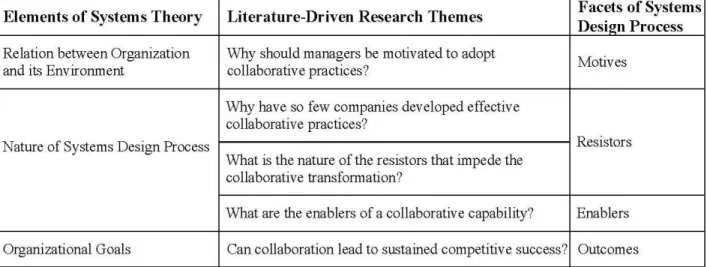
This three-step approach led to an open-ended, semi-structured interview guide that converged on five central themes that permeate the design of collaborative systems (Fawcett, Fawcett, Watson & Magnan, 2012).
1. Why should managers be motivated to adopt collaborative practices that are difficult, demand new skills, require technology
investment, and expose the organization to new risks?
2. What are the enablers of a collaborative capability?
3. What process factors make it difficult to develop collaborative capabilities?
4. Given the paucity of successful collaborative programs, what is the nature of the resistors that make the transformation to collaborative management so difficult?
5. Given the high transformation costs/risks, can collaboration lead to sustained competitive success? Simply stated, is it worth it to invest in a collaborative inventory capability?
Table 1 links these research themes to the core elements of systems design.
Sample and Context
The pre-field work also instilled context to interpret our findings about the construction of a collaborative
supply chain capability. To build theory related to the interactions among the cultural and structural barriers and initiatives within an organization that is seeking to embrace supply chain collaboration, we sought a context that could serve as an “extreme case” (Eisenhardt, 1989; Pettigrew, 1990). Extreme cases are useful in theory building since the
dynamics under investigation are often better defined and more easily documented than in other scenarios (Pratt, Rockmann, & Kaufmann, 2006). We therefore selected companies largely on the basis of their reputation for supply chain
collaborative excellence. Participants were active industry leaders in supply chain education.
In order to control for environmental variables while still maximizing the variation in the studied variables of interest, we narrowed our analysis to 12
European cases studies where the firms analyzed operate in a similar cultural environment and context. Each company was involved in one or more collaborative initiatives with customers,
suppliers, or both at the time of the interviews. Table 2 shows the demographic statistics for the interview companies.
Case Study Process
We employed a multi-case, interview-driven
methodology to explore the intricate what, why, and how questions associated with collaboration
28
(McCutcheon & Meredith, 1993; Meredith, Raturi, Amoako-Gyampah, & Kaplan, 1989; Yin, 1981). Interviews provide a robust opportunity to explore collaboration since they enable managers to
elaborate on the challenges they encounter—as well as the solutions they employ—as they seek to create deep functional skills while simultaneously fostering collaboration capabilities (Dyer & Wilkins, 1991; Eisenhardt, 1991). Multiple cases enable a replication logic, allowing researchers to confirm or disconfirm inferences drawn from each case and yielding more generalizable results (Spradley, 1979; Yin, 1981).
Once a company agreed to participate, a brief overview of the research objectives and a copy of the interview protocol were provided (Spradley, 1979). A semi-structured interview guide populated with open-ended questions was used to 1) allow managers to describe events and processes, 2) assure comparability of findings, and 3) provide flexibility in pursuing insight into unique practices and programs that became evident during the interview. The typical interview lasted 2 to 4 hours and involved senior managers who had responsibility for their company’s collaborative supply chain
initiatives.
During each interview, extensive notes were made for later reflection. In addition, secondary sources such as company presentations, new releases, process documentation, program descriptions, and performance scorecards were used to supplement interview findings. Together, the interview notes and background materials were used to 1) create rich and reliable structured case write-ups (Graebner & Eisenhardt, 2004) and 2) avoid “data asphyxiation” from the large amounts of data (Pettigrew, 1990). As the interview process continued, the researchers spoke often to compare notes regarding both the process and the content. This iterative discussion-based process was used to improve research reliability and validity as well as derive a consensus regarding their meaning (Eisenhardt, 1989). Data Analysis Process
Each case write-up was used for two analyses: within-case and cross-case (Eisenhardt, 1989;
Ellram, 1996; Yin, 1981) First, each case was viewed as a “stand-alone entity” to help describe the process and identify the issues encountered by each firm as it pursued a collaboration capability. Importantly, following the inductive process, we allowed ideas and themes to emerge from the data. Although we noticed similarities and differences among the cases, we refrained from further analysis until we had completed the interview process so that we could maintain the independence of the
replication logic.
Second, only after we completed all of the write-ups did we begin the cross-case analysis. Our goal was to identify and match patterns in order to develop a more robust and complete theoretical picture (Eisenhardt, 1991). Because of the varied and nuanced answers as well as the diversity of language and terms used by the interview managers, we determined that a careful manual evaluation process would provide the best interpretation of the interviews. This analysis consisted of three major steps.
1. Using the literature as background, we pursued an iterative, open-coding process—i.e., we traveled back and forth among the case write-ups and emerging constructs. As we began to identify common statements, we formed provisional categories and first-order codes. We used NVivo 8.0 for coding and analysis.
2. The two-person analysis team used a process of individual coding, collaborative discussion, and concurring to derive theoretical meaning from the cases. The team consisted of one of the original interviewers as well as one new researcher. The new researcher was brought in to avoid data processing bias (Pagell and Wu 2009). We repeated this process for every case until all of the cases were coded. As new concepts were discovered, the researchers returned to the previously coded cases to look for evidence of the newly identified phenomena. This process forced 100 percent inter-rater reliability among the researchers.
3. To focus our findings on the most critical issues, we employed two decision rules as part