COPYRIGHT AND CITATION CONSIDERATIONS FOR THIS THESIS/ DISSERTATION
o Attribution — You must give appropriate credit, provide a link to the license, and indicate if
changes were made. You may do so in any reasonable manner, but not in any way that suggests the licensor endorses you or your use.
o NonCommercial — You may not use the material for commercial purposes.
o ShareAlike — If you remix, transform, or build upon the material, you must distribute your
contributions under the same license as the original.
How to cite this thesis
Surname, Initial(s). (2012). Title of the thesis or dissertation (Doctoral Thesis / Master’s Dissertation). Johannesburg: University of Johannesburg. Available from:
i
LEARNING TO BECOME A TEACHER OF MATHEMATICAL PROBLEM-SOLVING
by
KATHLEEN FONSECA 920410889
Thesis submitted in fulfillment of the full requirements for the degree of
PHILOSOPHIAE DOCTOR in
EDUCATION at the
UNIVERSITY OF JOHANNESBURG
SUPERVISOR: PROFESSOR ELIZABETH HENNING CO-SUPERVISOR: PROFESSOR NADINE PETERSEN
OCTOBER 2018
ii
DECLARATION
I declare that the work on this thesis is my own unaided work and the work of others is appropriately acknowledged and referenced. I further declare that I have not submitted this work or any version of it to another university for assessment purposes.
iii
DEDICATION
I dedicate this thesis to my late mother and father, Amy & Tony Combrinck, and late matriarchal grandmother, mommy Constance
iv
ACKNOWLEDGMENTS
I wish to extend my gratitude to all who assisted, guided and supported me to complete this thesis:
My supervisors, Professors Elizabeth Henning and Nadine Petersen – I shall always be indebted to you, for your wisdom, guidance and patience. Your scholarly
knowledge and insights were invaluable and without which - this thesis would not have reached completion. In particular, I wish to express my immense gratitude for the time and resources invested in me.
Thank you to my colleagues in the Department of Childhood Education. Your
support, words of encouragement, kind gestures and scholarly advice greatly assisted me to complete this thesis.
Thank you to the National Research Foundation – A bursary for this study was awarded by the NRF-DST: Learning Science in and for the Primary School: Student Teachers’ Knowledge and Children’s Theory. Grant no: 90372.
Thank you Francois Naude for your assistance with the technical editing of this thesis.
A special thank you to a wonderful group of second year student teachers from the MATINA2 (2016) Module. Thank you for the insightful collaboration. It was a pleasure to work with you.
My appreciation to my friends and family for their material, moral and spiritual support. My heartfelt THANK YOU goes to my loving and caring husband, Charles and daughter, Schaedenet. Thank you for being my rock, pillar of strength and
comedians - you made sure I got my daily dose of laughter during this tough journey.
v
Finally, I thank my Heavenly Father for granting me the health, intellect, wisdom and strength to undertake this research and bring it to completion.
I have learnt that - the race is not given to the swift nor the battle to the strong but to him who endures until the end.
vi
ABSTRACT
I investigated student teachers in their second year of study as future teachers in the upper primary school, aiming to find out how they progress in a specific course module. The course is part of the curriculum of intermediate phase teacher education programme. The course is divided in modules, one of which is mathematics content in the second year of study. In the study, I propose that the students are in a transition between the world of school mathematics as their default modality and the world of a teacher of mathematics, which they are aiming to
become. This period of ‘becoming’ a teacher is especially challenging for students who did not
experience high quality mathematics education at school. In the thesis, I propose that the university learning space could serve as a site for an apprenticeship in problem-solving, in which students are made aware of their role as apprentices of their chosen profession.
I approached the study as a practitioner researcher, modelling problem-solving for students and viewing the activities as apprentices in a 'world of mathematical thinking' - thus more than a typical pedagogical space.
The sample of the study comprised a cohort of second-year student teachers (n = 62), in a mathematics content course (or a ‘module’ of a course). The module extended over a period of 12 weeks, with the aim to develop student teachers to become mathematical problem-solving proficient and to, ultimately, become an example for the learners in their future classrooms. The study had a dual focus - finding out how the student teachers’ mathematical proficiency developed by participating in a mathematical problem-solving course, and what the mediational challenges were.
I utilized aspects of ‘third generation activity theory’, specifically Engeström’s (1987, 2001) activity systems analysis (ASA) tool for the analysis of the data, which I sourced through a variety of methods. I gathered data from the students’ reflective journals, and their problem-solving task output as well questionnaires about their beliefs about problem-problem-solving in mathematics, and level of in-the-moment engagement.
The results from the study show that most students had changed their practices when solving mathematical problems. Their responses indicate an evolving awareness of interwoven strands
vii
of mathematical problem-solving proficiency. There was also evidence that self-regulative practices had shifted positively.
viii
TABLE OF CONTENTS
DECLARATION ... ii DEDICATION ... iii ACKNOWLEDGMENTS ... iv ABSTRACT ... viTABLE OF CONTENTS ... viii
LIST OF FIGURES ... xi
LIST OF TABLE ... xiii
CHAPTER 1 ... 1
OVERVIEW OF STUDY ... 1
1.1 INTRODUCTION ... 1
1.2 BACKGROUND AND RATIONALE OF THE STUDY ... 1
1.3 AIM AND OBJECTIVES OF THE STUDY... 4
1.3.1 Research question ... 5
1.3.2 Research methods ... 6
1.4 ANALYTICAL FRAMEWORK ... 6
1.4.1 Cultural historical activity theory as analytical tool and lens ... 7
1.4.2 Cultural historical activity theory and its Vygotskian lineage ... 7
1.5 STRUCTURE OF THE THESIS ... 18
CHAPTER 2: ... 20
PROBLEM-SOLVING AND MATHEMATICS ... 20
TEACHER EDUCATION FOR THE PRIMARY SCHOOL ... 20
2.1 INTRODUCTION: LIMINALITY OF STUDENT TEACHERS ... 20
2.2 STRUCTURE OF THE CHAPTER ... 21
2.3 MODELS OF PROFESSIONAL KNOWLEDGE NEEDED FOR THE TEACHING OF MATHEMATICS ... 23
2.3.1 Mathematical Knowledge for Teaching (MKT) framework ... 23
2.3.2 Strengths and weaknesses of the mathematical knowledge for teaching model ... 27
2.3.3 Frameworks combining mathematical content knowledge and mathematical thinking processes ... 29
2.4 MATHEMATICAL THINKING AND TEACHER EDUCATION ... 36
2.4.1 Schoenfeld’s understanding of mathematical thinking ... 37
2.4.2 Foundational components of mathematical thinking ... 37
2.4.3 Models of mathematical thinking as problem-solving ... 39
ix
2.5 MATHEMATICAL PROBLEM-SOLVING AS A CURRICULAR GOAL FOR LEARNING
MATHEMATICS ... 48
2.5.1 From mathematical process standards to common core state standards (CCSS) in the USA ... 49
2.5.2 Singapore’s mathematics curriculum framework ... 50
2.5.3 Mathematical thinking in the South African Mathematics Curriculum Framework ... 52
2.6 STUDENT TEACHERS’ MATHEMATICS KNOWLEDGE AND BELIEFS ... 54
2.6.1 Beliefs and student teachers’ mathematics learning histories ... 56
2.6.2 Conceptual and procedural knowledge of student teachers. ... 61
2.7 PREPARING MATHEMATICS TEACHERS FOR THE PRIMARY SCHOOL ... 65
2.7.1 Mathematical problem-solving courses in teacher preparation programmes ... 66
2.8 TEACHER EDUCATORS: PERSONIFYING MATHEMATICAL THINKING AND DOING FOR APPRENTICES ... 69
2.9 SUMMARY OF THE CHAPTER ... 76
CHAPTER 3 ... 77
DESIGN OF THE STUDY ... 77
3.1 INTRODUCTION ... 77
3.2 RESEARCH DESIGN: A CASE OF STUDENT TEACHERS’ LEARNING ... 78
3.2.1 The practitioner-researcher in the study ... 82
3.2.2 Ethical consideration dilemma ... 83
3.3 THE CASE STUDY SITE: MATHEMATICS CONTENT COURSE ... 86
3.3.1 Selection of participants and sampling ... 88
3.3.2 Design principles of the course ... 89
3.3.3 Characteristics of mathematical problem-solving tasks ... 96
3.4 EVIDENCE IN RELATION TO COURSE GOALS: VIEW OF LEARNING ... 106
3.5 DATA COLLECTION METHODS ... 107
3.5.1 Data collection instruments and time scale ... 108
3.6 ANALYSIS OF DATA ... 120
3.6.1 Mechanisms for data analysis ... 121
3.7 AUTHENTICITY OF THE RESEARCH ... 134
3.8 SUMMARY OF CHAPTER ... 135
CHAPTER 4 ... 137
THE DATA OF THE STUDY... 137
4.1 INTRODUCTION ... 137
4.2 THE MATHEMATICAL BELIEF SURVEY ... 137
4.3 THE ‘PROBLEMS OF THE WEEK’ AND WHOLE-CLASS DISCUSSIONS ... 147
x
4.3.2 Performance per heuristic used by student teachers in the ‘speed, distance and time’
problem ... 155
4.3.3 Performance per heuristic used by student teachers in the ‘crossing the river’ problem ... 160
4.3.4 Whole-class discussion: construction of system of competence ... 165
4.4 FLOW STATE SCALE ... 177
4.5 STUDENT TEACHERS’ SELF-REPORTED PERCEIVED LEARNING ... 184
4.5.1 Theme 1: ... 184
4.5.2 Theme 2: ... 187
4.5.3 Theme 3: ... 189
4.6 CHAPTER SUMMARY ... 195
CHAPTER 5 ... 196
DISCUSSION AND CONCLUSIONS ... 196
5.1 INTRODUCTION ... 196
5.2 DISCUSSION ... 197
5.2.1 Mathematical problem- solving beliefs ... 201
5.2.2 ‘Problems of the week’ and whole class discussion: Scaffolding the developing of mathematical problem-solving proficiency... 202
5.2.3 Level of engagement afforded by the mathematical ‘problems of the week’ ... 205
5.2.4 Student teachers’ reflections on learning through problem-solving ... 207
5.2.5 An activity system intervention: ‘Contradictions’ as source of change ... 209
5.3 KNOWLEDGE-FOR-PRACTICE CONTRIBUTION ... 215
5.4 IMPLICATIONS OF THE STUDY ... 216
5.5 LIMITATION OF THE STUDY ... 218
5.6 CONCLUSION ... 218
REFERENCES ... 220
APPENDICES ... 246
... 246
1.1 APPENDIX A: Ethical clearance certificate ... 247
1.2 APPENDIX B: Consent form for student teachers ... 247
1.3 APPENDIX C: Mathematical Problem-solving Belief Survey ... 247
1.4 APPENDIX D: Flow State Scale ... 247
1.5 APPENDIX E: Reflective Journal Questions ... 247
1.6 APPENDIX G: Mathematical Problem-solving Belief Survey Reversed items ... 247
1.7 APPENDIX H: Mathematical Problem-solving Belief Survey Frequencies; Means and standard deviation ... 247
xi
LIST OF FIGURES
Figure 1: Vygotsky's basic mediation triangle (adapted from Cole & Engestrӧm, 1993) ... 11
Figure 2: The structure of a human activity system (Source: Engestrӧm, 1987, p. 78) ... 14
Figure 3: Third generation activity theory (Source: Daniels, 2008, p.124) ... 16
Figure 4: The argument of the chapter ... 21
Figure 5: The chapter sections ... 22
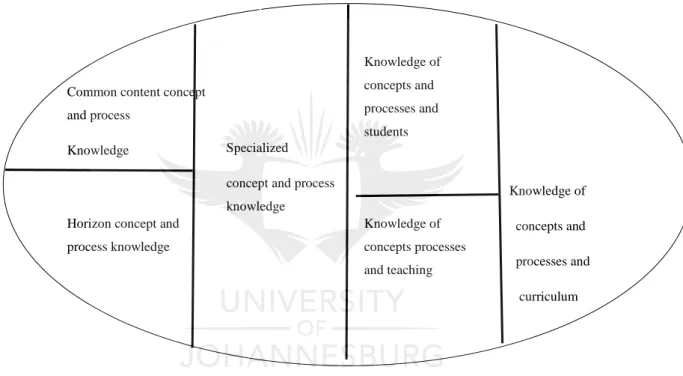
Figure 6: Mathematical Knowledge for Teaching Model (Source: Ball et al., 2008, p. 403) ... 25
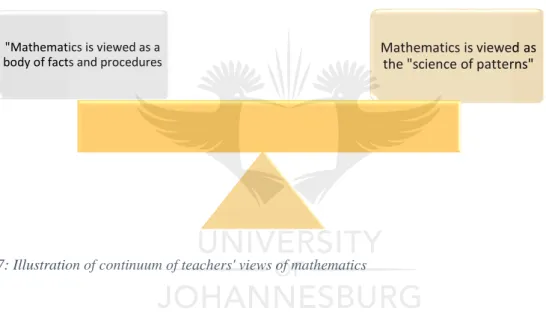
Figure 7: Illustration of continuum of teachers' views of mathematics ... 28
Figure 8: Foster et al.'s (2014) adapted version of Ball et al.'s (2008) MKT model (Source: Foster et al., 2014, p. 98) ... 30
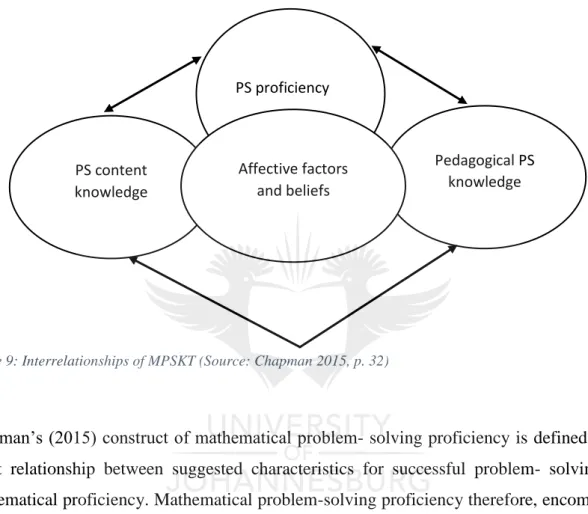
Figure 9: Interrelationships of MPSKT (Source: Chapman 2015, p. 32) ... 32
Figure 10: Polya’s (1945) four-stage problem-solving framework ... 40
Figure 11: Components of mathematical problem-solving ... 47
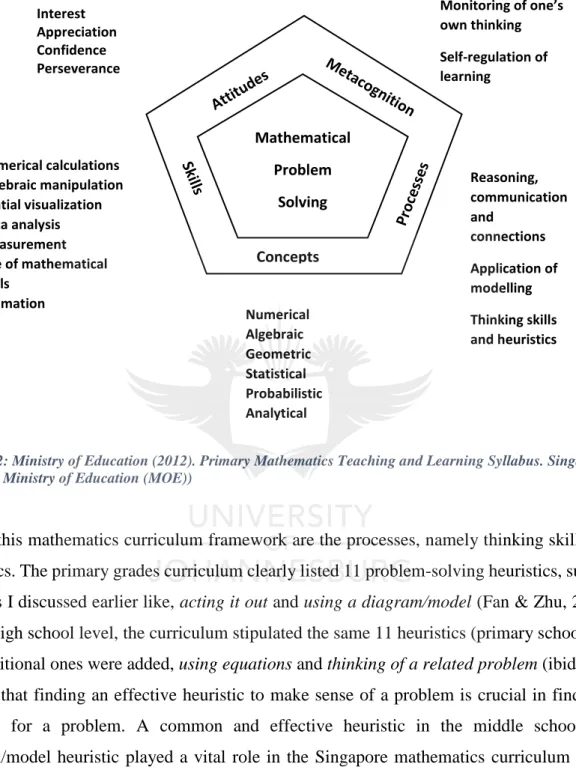
Figure 12: Ministry of Education (2012). Primary Mathematics Teaching and Learning Syllabus. Singapore. (Source: Ministry of Education (MOE)) ... 51
Figure 13: Structure of the intermediate phase mathematics programme ... 88
Figure 14: Breakdown of participants’ home language ... 89
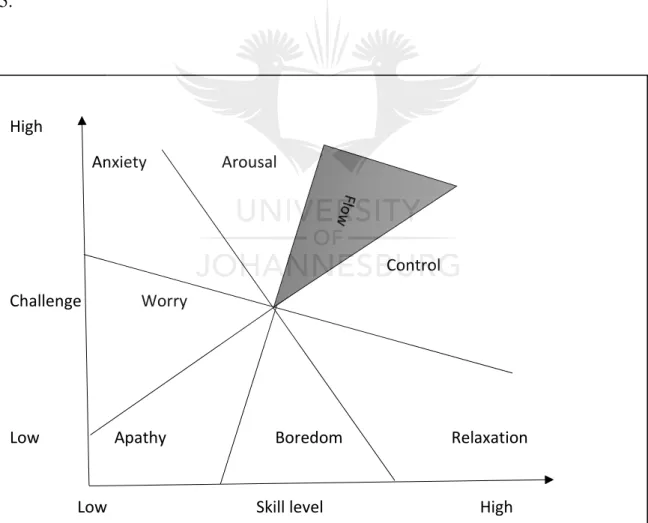
Figure 15: Flow chart (Source: Csikszentmihalyi, 2014, p. 139) ... 99
Figure 16: Pre-conditions of engagement, optimal learning experience and engagement. ... 101
Figure 17: Summary of data analysis approaches ... 121
Figure 18: Summary of themes traced from reflective journal responses... 133
Figure 19: Guess-and-check method: problem 1 full access ... 149
Figure 20: Algebraic/equation heuristic: problem 1 full access ... 150
Figure 21: Drawing heuristic: problem 1 full access ... 151
Figure 22: Table method: problem 1 full access ... 151
Figure 23: Guess-and-check heuristic partial access ... 152
Figure 24: Table method partial access ... 153
Figure 25: Answer only no heuristic ... 154
Figure 26: Arithmetic heuristic no access ... 154
Figure 27: Model method full access ... 156
Figure 28:Trial-and-error method full access ... 157
Figure 29: Algebraic heuristic full access ... 158
Figure 30: Algebraic heuristic partial access ... 159
Figure 31: Arithmetic heuristic partial access ... 159
Figure 32: Arithmetic heuristic no access ... 160
Figure 33: Acting it out heuristic full access ... 162
Figure 34: Diagram heuristic full access ... 163
Figure 35: Drawing method full access ... 163
Figure 36: Diagram heuristic peripheral access ... 164
Figure 37: Guess-and-check heuristic no access ... 165
Figure 38: Example of student teacher sharing solution strategy ... 167
xii
Figure 40: Research question and sub-question ... 196
Figure 41: Summary of core data collection instruments ... 197
Figure 42: Student teachers' engagement in mathematical problem-solving activity system ... 198
Figure 43: Lecturer-researcher activity system ... 200
xiii
LIST OF TABLE
Table 1: Perspective of mathematical problem-solving proficiency ... 33
Table 2: Knowledge and behaviour necessary for an adequate characterization of mathematical problem-solving performance (Source: Schoenfeld, 1985, p. 15) ... 41
Table 3: 21st Century Skills (Source: Griffin et al., 2012) ... 49
Table 4: Categories of teacher ... 60
Table 5: Set criteria for mathematics as an elective ... 87
Table 6: Summary of research questions and data collection instruments ... 109
Table 7: Mathematical problem-solving tasks as data collection instruments ... 116
Table 8: Problems of the week heuristic rubric ... 123
Table 9: Examples of coding and frequency count ... 128
Table 10: Themes and sub-themes for data on whole class ... 129
Table 11: Continuation of themes and sub-themes ... 130
Table 12: Student teachers' responses to pattern on multiple solution methods are possible ... 138
Table 13: Student teachers' responses to pattern: beliefs about the importance of understanding and reasoning ... 140
Table 14: Student teachers responses: pattern on predetermined steps are needed to solve a problem ... 141
Table 15: Student teachers' responses t pattern: beliefs about the importance of memorization ... 143
Table 16: Student teachers' responses to pattern: beliefs about the instruction of mathematical problem-solving ... 144
Table 17: Student teachers' responses to pattern: beliefs about the use of technology in mathematical problem-solving ... 145
Table 18: Student teachers' responses to pattern: beliefs about mathematical problem-solving as time consuming ... 146
Table 19: Performance per heuristic for problem 1 ... 148
Table 20: Performance per heuristic for problem 2 ... 155
Table 21: Performance heuristic for problem 3 ... 161
Table 22: Percentage responses to challenge-skill-balance ... 178
Table 23: Percentage response to having goals... 179
Table 24: Percentage responses to concentration level during problem-solving items ... 180
Table 25: Percentage responses for paradox of control and feedback ... 181
Table 26: Percentage responses for transformation of time items ... 182
Table 27: Percentage responses to autotelic items ... 183
1
CHAPTER 1
OVERVIEW OF STUDY
1.1 INTRODUCTION
The introductory chapter provides the background and rationale for this study of mathematics initial teacher education (ITE). I propose that initial teacher education is a complex phenomenon that should be understood within the political, social, cultural and economic context in which it is embedded. It should also take cognisance of the conceptual and epistemological beliefs underpinning its curriculum models (Flores, 2016). In trying to capture student teachers’ knowledge of a topic in the ITE mathematics curriculum, I studied a group of students over the course of one module of their coursework in the second year of the BEd intermediate phase (IP) program, aiming to deepen my understanding of their learning and to use the findings to improve my practice as a lecturer in the program. The chapter describes the background and context of the study, highlighting the challenges faced by mathematics teacher preparation programs. The motivation, aims and theoretical approaches are discussed briefly, followed by an argument about the need for studies such as this. This chapter concludes with a description of the structure of the thesis.
1.2 BACKGROUND AND RATIONALE OF THE STUDY
The route to having better prepared future primary teachers includes both encouraging and recruiting more mathematically able students and including key mathematics and mathematics pedagogy opportunities to learn (OTL) experiences (courses in teacher preparation program. Both demonstrated an important relationship to mathematical content knowledge MCK and mathematical pedagogical content knowledge (MPCK); both make a difference with respect to future teachers’ knowledge of mathematics and mathematics pedagogy. (Schmidt, Houng, & Cogan, 2012)
Schmidt et al., (2012), point out two of the main findings of the Teacher Education and Development Study in Mathematics (TEDS-M), which was conducted in 2008. The TEDS-M investigated how primary and lower secondary teachers are prepared to teach mathematics. These findings address two contentious aspects of mathematics teacher education – 1) the recruitment of suitable mathematically able students and 2), the importance of effective
2
mathematics courses in teacher preparation programmes. Beyond the US many researchers have argued about the importance of recruiting suitable candidates with strong academic qualifications (Wong et al., 2014). The recruiting of academically strong candidates has been emphasised because top performing school systems recruit “the top third of the academic cohort” into the teaching profession (Auguste, Kihn & Miller, 2010, p. 5). Furthermore, recruiting applicants who are weak in subject matter may put more strain on the limited resources of teacher preparation programmes in some countries; initial teacher preparation programmes will have to reteach the mathematics content that candidates should have learned while in school (Schwille, Dembélé & Schubert, 2007). This is the very issue which mathematics teacher education in South Africa is faced (Primary Teacher Education Project, 2018 – www. dhet.gov.za/)
In mathematics teacher preparation programmes, what is taught and how it is taught has become a major concern. I argue that the situation in South Africa requires enrichment of future teachers’ mathematics content knowledge even more than learning to teach mathematics. Schmidt et al., (2012, p. 276) report “promising findings” from the TEDS-M study, which show a clear relationship between the learning opportunities provided in mathematics courses and development of MCK and MPCK. In a similar vein, South African research findings have shown that there is a relationship between teachers’ mathematics knowledge and school learners’ mathematics learning outcomes (Spaull, 2013; Venkat & Spaull, 2014). Like Park (2003), many researchers, school managers, teachers, and policy-makers argue that teachers are the real driving force behind the improvement of quality in schooling systems. Spaull (2013), points out that “teachers are the primary locus of schooling systems around the world. Being the single most important element of the education system, the quality of a country’s teachers is intimately related with the quality of its education” (p. 24). This has been particularly evident in South Africa, with its apartheid history where teacher quality is a major challenge, due largely to generations of South Africans who have not learned mathematics optimally. As pointed out, by the Department of Higher Education and Training (DHET):
The problem of poor quality teaching and poor subject matter knowledge of our teachers … is one of the greatest impediments to improved delivery of quality education in the system as a whole, as measured by poor learner performance, not only
3
international tests (TIMMS and PIRLS), but also in our own systemic assessments and matriculation examination. (DHET, 2011, p. 77)
Poor mathematical performance in national as well as regional and international tests has been the driving force for international investigations such as the MT21-project (Schwille et al., 2007) and TEDS-M (Tatto et al., 2008) into the preparation of mathematics teachers in the US. The MT21-study, a cross-national study, investigated the preparation of middle school teachers in countries such the USA, Taiwan, Korea, Bulgaria, Germany and Mexico. Similarly, in South Africa, the Initial Teacher Education Research Project (ITERP) was initiated in response to the poor learner performance in national and international assessments (Deacon, 2016). Coupled with the low level of teachers’ subject matter knowledge in mathematics and language and literacy and inadequate systemic knowledge of how new teachers are being trained, ITERP was initiated by the JET Education Services, in collaboration with the Education Deans’ Forum, the DHET and the Department of Basic Education (DBE) (Deacon, 2016). This five-year study (2012- 2016) aimed at investigating the extent to which the initial IP teacher preparation programmes offered by five universities are adequately preparing teachers to teach in South African schools (Deacon, 2016). More specifically, it focused on whether the knowledge and skills acquired by student teachers during their preparation adequately prepare them to teach in schools (Deacon, 2016). The ITERP-project thus comprised various sub-studies: Bowie (2014) examined the intermediate phase (Grades 4 – 6)1 teacher preparation programmes of five South African universities and the mathematics curricula and modules offered to student teachers. Bowie and Reed (2016) examined initial teacher preparation programmes intending to prepare intermediate phase teachers to teach mathematics and English. As a result, of the findings, Bowie and Reed (2016), suggested teacher educators should review their four-year teaching degrees by adding courses that would produce competent and confident IP teachers in English and Mathematics.
Mathematics content courses play a pivotal role in the development of the knowledge needed to teach mathematics in both primary and secondary schools, especially in a country such as South Africa, where it is not possible to select candidates form the top third of the academic cohort of the 12th grade (matric). Candidates, therefore, enter with diverse levels of
1 The South African schooling system consist of three phases, the foundation phase (grades R – 3), the
intermediate phase (grades 4-6), senior phase (grades 7 – 9), and the further education and training phase (grades 10 -12). However, the intermediate phase includes grade 7 due to the structure of the primary schools, as primary schools includes grades R – 7. High schools include grades 8 – 12
4
mathematics content knowledge. Furthermore, candidates are ‘products’ of an education system that has been classified as the “worst education system of all middle-income countries that participate in cross-national assessments of educational achievement” (Spaull, 2013, p. 3). Teacher educators, especially mathematics teacher educators, are thus faced with the daunting task of designing mathematics courses that will adequately prepare student teachers to teach mathematics, bearing in mind the learning histories of the prospective teachers.
1.3 AIM AND OBJECTIVES OF THE STUDY
The deficiencies and lack of depth of student teachers’ mathematics knowledge is well documented (Ponte & Chapman, 2008; Ball, 1990; Wilson, Floden & Ferrini-Mundy, 2001). Findings suggest that, with appropriate opportunities to learn in initial teacher education programmes, this can be remedied (Ponte & Chapman, 2008). One avenue is to think of teacher education along the ideas of ‘opportunities to learn (OTL)’, which is defined is an “experience with an anticipated or intended outcome” (Tatto, et al., 2008, p. 23). Various recommendations are outlined in the literature. For instance, Ball (1990) recommended student teachers should experience mathematics differently than they did in school. In a similar vein, Ponte and Chapman (2008) point out that it is important for student teachers to engage in opportunities to learn that will allow for the re-construction of their initial knowledge of understanding mathematics and teaching of it.
Drawing on the recommendations made by Ball (1990), and Ponte and Chapman (2008), the mathematics content course that is the empirical focus of this study aimed to provide student teachers with mathematics experiences that are different to what most of them may have experienced at school. The course was, therefore designed to apprentice the student teachers in mathematical thinking. The argument for this design is that if student teachers are not apprenticed to engage in mathematical thinking (Schoenfeld, 1992; Burton, 1984; Mason, Burton & Leone, 1982, 2010; Devlin, 2012), it is unlikely that they will model mathematical thinking when they become teachers of mathematics. The work of apprentice mathematician-teachers includes, but is not limited to, 1) seeking patterns of underlying mathematical structures (Steen, 1991), 2) doing “trial and error, experimentation, 3) guesswork, (Halmos, 1985, p. 321), and 4) doing creative work, such as solving problems (Polya, 1945, 1957). Furthermore, as Seaman and Szydlik (2007, p. 171) propose, in doing guesswork and solving
5
problems mathematicians value “symbolic representations of, and notations for, objects and ideas”.
When mathematicians engage in problem-solving and experimentation, they do it as members of a community of mathematical practice. Schoenfeld (1992) explained that “membership in a community of mathematical practice is part of what constitutes mathematical thinking and knowledge” (p. 30). The practice foregrounded by this study is that of mathematical solving proficiency as basis for future teaching of solving. Mathematical problem-solving proficiency2 is a coining of Kilpatrick, Swarfford and Findell’s (2001), five interwoven strands of mathematical proficiency, Schoenfeld’s (1985), and Mayer and Wittrock’s (2007), components of mathematical problem-solving competence. At the core, of such a mathematical problem-solving practice is communication, collaboration, and knowing how to use the resources available in the problem-solving process optimally (Greeno, 1989). Halmos (1985) proposes that mathematical problem-solving is at the heart of mathematics.
The purpose of the study is to investigate second-year student teachers’ mathematical problem-solving learning experiences. I therefore, aim to find out how the opportunities to learn offered by the mathematics content course promote or hinder their emergent mathematical problem-solving proficiency. Working from in a case study research design, specifically a “first-person” practitioner researcher (Ball, 2000), I address the following research question:
1.3.1 Research question
How does student teachers’ mathematical problem-solving proficiency evolve over the duration of a mathematics content module in a teacher education program? The research question included sub-questions:
What are student teachers’ mathematical problem-solving beliefs?
How do the whole class discussions and the ‘mathematical problems of the week’ scaffold mathematical problem-solving proficiency?
6
What are students’ in-the-moment learning experiences during the problem-solving process?
What are student teachers’ self-reported learning experiences as participants in the mathematics content course?
1.3.2 Research methods
To respond to the research questions and thus achieve the objectives of the study, I utilized a number of different data gathering methods. Data gathering methods included questionnaires, document analysis, video lesson recordings and reflective journals. To address the first and third sub – questions I administered two surveys the Mathematical Problem-solving Beliefs Survey (sub-question 1) and the Flow State Scale (sub-question 3). The Mathematical Problem-solving Belief Survey was administered to find out the student teachers’ mathematical problem-solving beliefs on entering the course. The Flow State Scale was administered to find out the student teachers’ in-the-moment learning experiences during the mathematical problem-solving process. Solution strategies were collected and two problem-solving video-recorded lectures were used as data to address the second sub-question. Student teachers’ reflective journal responses were used to answer sub-question 4.
1.4 ANALYTICAL FRAMEWORK
Because the goal of this study was to investigate student teachers’ emergent mathematical problem-solving proficiency, I wanted to capture detail in ‘real time’ as much as possible. I agree with Hiebert and Gouws (2007, p. 374) that teaching is a “system of interacting features, rather than a collection of independent and interchangeable features. This means that the effects of teaching on students’ learning cannot be measured independently of the system in which they operate”. Considering the emphasis these authors place on the importance of the system context, I explicate the analytical ‘lens’ through which I investigated the unit of analysis of this study, namely how the students learned in the (activity) system in which they were partners during the course.
7
The analytical tool which I implemented to “gaze” (Wardekker, 2008) on the topic of the study is the activity system analysis (ASA), which is a heuristic designed by Engestrӧm (1987, 1991, 2001), following Leont’ev (1978). Engestrӧm’s (2001), tool was conceived from what has become known as third generation activity theory, referred to as cultural-historical activity theory (CHAT) after a decision made by the International Society for Cultural-Historical Activity Research (https://www.iscar.org/). CHAT has been described as “a powerful analytical tool that helps to reveal the fundamental aspects of social practices and supports structured, meaningful interpretations of empirical data” (Kaptelinin & Miettinen, 2005, p. 1).
1.4.1 Cultural historical activity theory as analytical tool and lens
CHAT, and specifically the application as ASA, has been referred to, but not limited to, as a useful adaptable, “… integrative road map for educational research and practice” (Roth & Lee, 2007, p. 188), a “powerful socio-cultural and socio-historical lens” (Jonassen & Rohrer - Murphy, 1999, p. 62) and a “practice-based and practice-orientated theoretical framework” (Foot, 2014, p. 31). According to Kuuti’s (1992), broad definition of activity theory (AT), it is a cross-disciplinary theory with a meta-theoretical philosophical basis, useful for analyzing different forms of “human practices as developmental processes, with both individual and social levels interlinked at the same time” (p. 13). Michael Roth, in (Roth, Radford & LaCroix, 2012), explained that activity theory, for him, is more of a heuristic which helps him to orientate himself to the world while remaining aware of the situatedness of culture, history and activity. He argues, furthermore, that activity theory is not just a theory for understanding but also a theory for action, a theory to assist in transforming the world, consistent with “The Eleventh Thesis of Feuerbach” (Roth et al., 2012). Similarly, in this study, CHAT serves as a heuristic for making sense of student teachers’ individual and collective mathematical problem-solving proficiency development and the need to construct usable knowledge for practitioners.
1.4.2 Cultural historical activity theory and its Vygotskian lineage
The origins of the concept activity lie in German idealistic philosophy, in which Kant, Fichte, and Hegel emphasized the role of mental activity (Tӓtigkeit) in constituting the relationship between subject and object. This was nevertheless an idealistic-subjective
8
interpretation. The concept of activity was brought into materialistic philosophy by Feuerbach, who emphasized the primary objective role of reality but only as an object of contemplation. The activity concept of Marx was developed as “practical-critical”, the central aspect in activity being the transformation of material objects (gegenstӓndliche Tӓtigkeit). (Klaus & Buhr, 1987, p. 12, cited in Kuuti, 19923)
Drawing from this quote by Klaus and Buhr (1987), the roots of CHAT, can be traced back to the tension between dualisms (e.g. individual vs collective; material vs mental) in the work of classic German philosophers, which Vygotsky had read (Kozulin, 1986; 1990; 1998) and from which he partly theorized a theory of activity. Vygotsky, (1978) argued that human development and learning (e.g. personality, communication, language, cognitive abilities) originate and develop from social and cultural interaction of an individual with the environment. His proposition was that signs and tools serve as mediational media for people to learn and to develop, and that these signs and tools permeate children’s learning and their development in specific settings. Many theories are likely to have stemmed from Lev Vygotsky’s work about semiotic mediation in human activity. Some of these are situated cognition (Lave & Wanger, 1991), distributed cognition (Rogoff, 1990) and cultural historical activity theory (Leont’ev, 1978, Engestrӧm, 1987). Their lineage is generally regarded to be in the work of Vygotsky. In addition to Vygotsky’s argument that all 1) higher mental functioning originate and develop socially and thus also culturally; he also argued that 2) all human actions are mediated and regulated by tools and signs, and 3) that the ontogenetic development of the individual mind is consistently in interaction with its phylogenetic roots and branches. Wertsch (1991) argues that these three interrelated themes characterize Vygotsky’s socio-historical work in psychology. I discuss each aspect in turn although they are interrelated.
Ontogenetic development of the mind
In conducting research on the effect of mediational means on children’s higher mental abilities, Vygotsky found that to study the development of higher mental abilities, a semiotic and cultural-historical methodological route yielded worthwhile findings. He proposed four genetic
domains, namely the phylogenetic domain, the sociocultural domain, the ontogenetic domain
3 In some instances, I include a full citation to maintain the style of an author, which I could only imitate in a
9
and the microgenetic domain (Lantolf, 2000, Cross, 2006). Cross (2006), explained the four genetic domains by stating the following:
The phylogenetic domain concerns the nature of human development as a natural species over the course of evolution; that is, the biological basis for human development. In contrast, the cultural-historic [sociocultural] domain is concerned with development of the ‘external’ world within which human activity unfolds; that is the social, cultural, and historic basis for development…The third domain, ontogenesis, therefore shifts the focus…to an understanding of the development of the ‘human’ across an individual lifespan [as they mature]… The microgenetic domain… focuses on specific, momentary fragments of development (Cross, 2006, p. 88 – 90).
Social origin of higher mental processes
The second theme evident throughout Vygotsky’s work is the notion that all human mental functioning has its origins in the social life of the individual. Vygotsky clearly articulated it in his “general genetic law of cultural development” which states:
Any function in the child’s cultural development appears on the stage twice, on two planes, first on the social plane and then on the psychological, first among people as an intermental category and then within the child as an intramental category. This equally applies to voluntary attention and logical memory, formation of concepts and development of volition. We have good reason to consider this proposition a law in the full sense of the word, but it stands to reason that the passage within from without transforms the process itself, changes its structure and functions. (Vygotsky, 1960, p. 131)
Vygotsky proposed that cultural development is the result of an individual’s social life and social activity, thus first between people (the social ‘plane’) and then on the psychological ‘plane’. In defining the word ‘social’, Vygotsky pointed that all culture is social. He furthermore, suggested that the development of higher mental functions do not take place only
10
neurologically, but also stem from the social dimension of human activity. In the history of phylogenesis, it is evident that higher mental functions are internalized relations of the social order (Vygotsky, 1960). In this sense, mental functions such as thinking, reasoning, problem-solving, or memory can be carried out in the inter-psychological plane (in collaboration with others), as well as on the intra-psychological plane (by an individual) (Wertsch, 1984). However, Wertsch (1984) warns that the individual’s processes of development in a social environment are not as simple and straight forward as it may appear, because higher mental functions develop from- and reflect the structure of the social environment. This means that the individual’s mental properties constitute “specific organizational properties” that reflect those of the social environment from which they were developed (Wertsch, 1984, p. 250). For example, if a student teacher attempts to solve a mathematical task in collaboration with a group of peers, the individual student will internalize the mathematical representations that had been used to effectively solve the task and when the student has to solve a task on her own, the student will likely use the same representations. Thus, Vygotsky suggested that to understand an individual’s mental growth it is best to examine specific patterns of interaction in which various individuals participate (Wertsch, 1984).
Mediation
The notion of the individual’s cultural development on the ‘inter-psychological plane’, emphasizing the social aspect of development and mediation. Mediation is the most fundamental concept of sociocultural theory, or as Scribner (1990) argues, it is most defining characteristic. Vygotsky (1978), introduced the basic concept of mediation - the notion that humans cannot directly ‘make contact’ with their non-material environment without the use of tools, especially ‘psychological tools’ or ‘signs, such as language and other symbol systems and tools that can be material or psychological. Mediation also underpins Vygotsky’s theoretical goal of linking the individual’s social and historical processes on the one hand and mental processes on the other (Wertsch, 2007). In this vein, Vygotsky argued that there always must be semiotic mediation, an ‘intermediate link’ between subject of activity and the object of activity as expressed in the well-known triangular model.
11
Figure 1: Vygotsky's basic mediation triangle (adapted from Cole & Engestrӧm, 1993)
In the mediational action, the ‘subject’ refers to an individual a person engaged in an activity and is in a dialectic relation with the ‘object’. The object is the goal of the activity that is held by the subject and motivates the existence of the activity. The mediating artifacts include psychological tools and technical devices (Vygotsky, 1981). Vygotsky gave the following as examples of psychological tools, “language, different forms of numeration and counting, mnemotechnic techniques, algebraic symbolism, works of art, writing, schemes, diagrams, maps, blueprints, all sorts of conventional signs, etc.,” (Vygotsky, 1981, p. 137).
Psychological tools, such as language, counting and algebraic symbolism are cultural tools, made by humans. They are inorganic and by their nature, they are social, and are directed towards the development of human intellectual capacities (Vygotsky, 1981). While, language and symbols are directed at changing an individual’s mental processes, technical devices are directed at mastering processes towards achieving the object (Vygotsky, 1981). To clarify the complex nature of Vygotsky’s notion of mediation, Wertsch (2007) distinguished between two main categories; explicit and implicit mediation. Explicit mediation is intentionally and explicitly introduced into a problem-solving activity, often by an outside party, (e.g. a teacher or experimenter), and the materiality of the signs involved (e.g. graph paper in a classroom) tends to be obvious and long lasting. Implicit mediation on the other hand is tacit in that it naturally involves spoken language (e.g. terms such as typical and spread), whose materiality is momentary (Wertsch, 2007).
Learning as mediated in this study means that someone or something acts as a mediator between the student teachers and the mathematics content to be learned. Wertsch (2007, cited in Moll, 2014, p. 31), one of the key interpreters of Vygotsky’s work proposed five broad categories of mediators that aid in transformation of both in individuals and their environments:
Mediating artifact/ Tool
12
Social mediation: interactions with other human beings, especially interactions whereby social groups incorporate a person into cultural practices.
Instrumental or tool mediation: the use of artefacts, such as a spoon or a pencil, created culturally and inherited socially, to engage in human practices.
Semiotic mediation: the use of symbol systems, such as language, writing, art, and mathematics.
Anatomical mediation: the use of the body, such as the hands and arms, which permit manipulation of the environment and representation of self in social life.
Individual mediation: the person’s subjectivity and agency in mediating his or her learning activities. (Wertsch, 2007, cited in Moll, 2014, p. 31)
The work of Vygotsky, Leont’ev and Luria could not exist without the concept of mediation, as captured in the statement, “(t)he idea of mediation … runs as the unifying and connecting lifeline throughout their work and that of the other representatives of the Soviet cultural-historical school” (Engestrӧm 1999, p. 21). The work of Vygotsky’s two associates, Aleksander Luria and Aleksei Leont’ev, who included societal, cultural and historical dimensions into an explanation of human mental functions, and have thereby further expanded Vygotsky’s notion of mediation (Roth & Lee, 2007). Luria and Leont’ev’s expansion led to the development of second-generation activity theory.
Second-generation activity theory
Leont’ev expanded on the concept of tool and sign mediation by identifying object-orientated activity as the unit of analysis. There are several translations (1974, 1978, 1981) of Leont’ev’s
work from Russian to English; I refer to the 1974 translation of the definition of object-orientated activity:
(It is) a molar and nonadditive unit of a material subject’s life. In a narrower and more psychological sense, activity is a unit of life mediated by mental reflection, whose real function is to orient the subject to the world of objects. Activity is thus not a reaction
13
or a totality of reactions, but rather a system possessing structure, inner transformations, conversations, and development. (Leont’ev, 1974, p. 10)
Leont’ev considered activity as central to all human mental functioning, because it includes both observable human behaviour and mental processes. Thus, from theoretical perspective of an object-directed activity, “learning is explained as a self-regulated meaning-making process in which individuals or groups of individuals choose to participate based on their (shared) goals and motives” (Yamagata – Lynch, 2007, p. 455). Furthermore, participation in the activity can bring about a qualitative change in the participant’s motives for participating in the activity (Rogoff, 1995). Yamagata-Lynch (2007) points that, due to translation issues, Leont’ev’s use of the word ‘object’ has caused some philosophical debates, because the word object has been interchangeably used as the goal of an activity or motive of an activity. However, Kaptelinin (2005) addressed these debates by stating that the “object of the activity can be considered the ‘ultimate reason behind various behaviors of individuals, groups, or organizations. In other words, the object of the activity can be defined as the sense maker,’ which gives meaning to and determines values of various entities and phenomena” (p. 5). ‘Object’ is thus gegenstand
(objek) as well as motif).
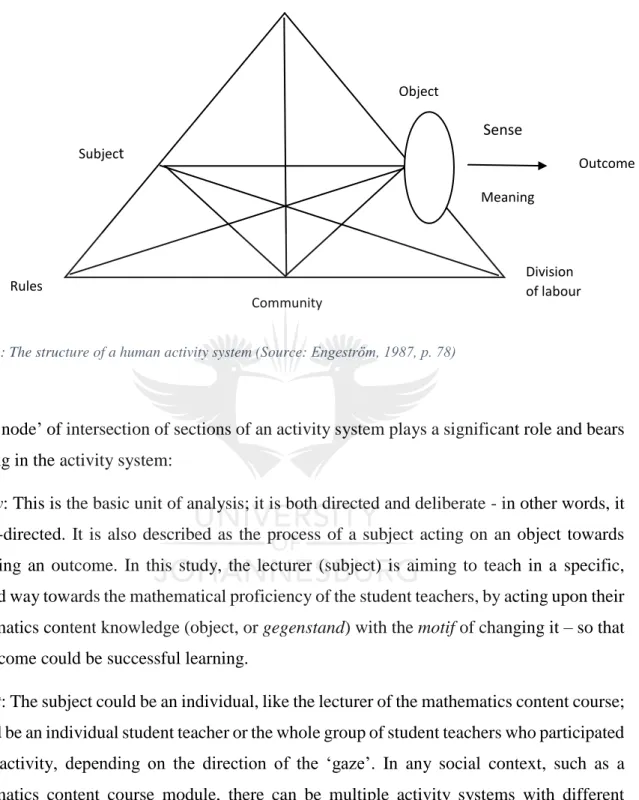
In second-generation AT, the unit of analysis was expanded to include a collectively mediated activity, which includes rules, community and division of labour in an activity system, with an emphasis on how these entities intersect with each other (Engestrӧm, 1999a). According to Engestrӧm (1999a) ‘rules’ can be explicit or implicit and the ‘division of labour’ refers to how the ‘community’ is organized. The expansion of Vygotsky’s triadic mediation model to include rules, community and division of labour is illustrated in Figure 2.
14
Figure 2: The structure of a human activity system (Source: Engestrӧm, 1987, p. 78)
Every ‘node’ of intersection of sections of an activity system plays a significant role and bears meaning in the activity system:
Activity: This is the basic unit of analysis; it is both directed and deliberate - in other words, it is goal-directed. It is also described as the process of a subject acting on an object towards producing an outcome. In this study, the lecturer (subject) is aiming to teach in a specific, directed way towards the mathematical proficiency of the student teachers, by acting upon their mathematics content knowledge (object, or gegenstand) with the motif of changing it – so that the outcome could be successful learning.
Subject: The subject could be an individual, like the lecturer of the mathematics content course; it could be an individual student teacher or the whole group of student teachers who participated in the activity, depending on the direction of the ‘gaze’. In any social context, such as a mathematics content course module, there can be multiple activity systems with different subjects but intersecting or having a common object.
Object: Daniels (2005), refers to the object as “what you have to shift to get to the outcome” (p. 1). In this study, the object is the student teachers’ mathematical problem-solving proficiency (gegenstand) that needs to be shifted (motif) to get to the outcome. The outcome is
Mediating artefacts: tools and signs
Subject Rules Community Division of labour Object Outcome Sense Meaning
15
students’ mathematical learning as expressed in terms of mathematical problem-solving proficiency.
Tools: Tools refer to the material and psychological tools the subject uses to act on the object to get the desired outcome. Tools (with signs) also mediate the relationship between the subject and the object.
Community: The community is the group or organization the subject belongs to or identifies with, e.g. the lecturer in the mathematics content course belongs to the community of other lecturers in the university as well as other mathematics teacher educators within the field of initial teacher education. According to Cripps-Clark (2014) Leont’ev (1978), described the community as a mediator between the subject and object, in a similar way to the tools. Foot (2014), refers to the “community of ‘significant others’ that consists of the people who share a common interest in and involvement with the same object” (p. 6).
Rules: Rules can be implicit and explicit and regulate the subject’s actions towards the object
and participation with the community (Foot, 2014).
Division of labour: This refers to how the tasks are shared amongst the community. Cripps-Clarke (2014) refers to the division of labour as the social roles that mediates between the community and subject. The allocation of tasking has implicit in it also power relations.
Third generation activity theory
Engestrӧm (1996, 2001) described first generation activity as Vygotsky’s mediational triangle, second-generation activity as the expansion of the subject’s environment, attributed to Leont’evs work and his own work on interactive network of activity systems as third generation AT. Roth and Lee (2007) explain:
Third generation activity theory endorses the fact that all activity systems are part of a network of activity systems that in its totality constitutes human society. Diverse activity systems are the result of a continuous historical process of progressive job diversification and collective division of labor at the societal level (Marx, 1867/1976). Thus, during societal development … the network is formed as activity systems lose their self-containment and exchange entities, including objects, means of productions, people, and various forms of texts. (Roth & Lee, 2007, p. 200)
16
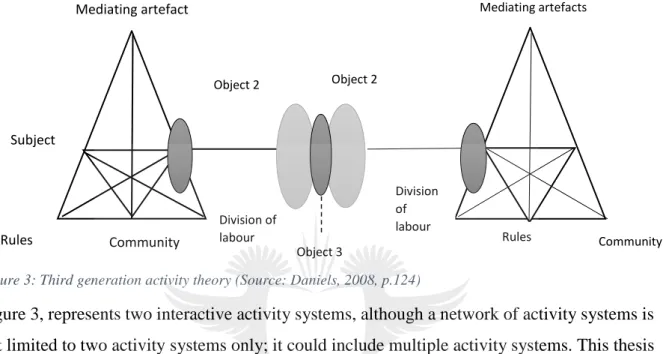
As explained by Roth and Lee (2007), human society is made up of an interactive network of activity systems when activity systems share objects, people and means of production. Two or more activity systems can share a common or shared object. This is evident by Engestrӧm (2001).
Figure 3: Third generation activity theory (Source: Daniels, 2008, p.124)
Figure 3, represents two interactive activity systems, although a network of activity systems is not limited to two activity systems only; it could include multiple activity systems. This thesis study’s ASA gives an example of two interacting activity systems, in which the common object is the development of mathematical problem- solving proficiency. In the one activity system, the student teachers are the subjects, acting on the constructs of mathematical problem-solving proficiency by means of the mediating tools, towards the outcome (the learning of developed mathematical problem-solving proficiency). In the second activity system, the lecturer is the subject, sharing the object of mathematical problem-solving proficiency with the students (object). The lecturer is also acting on the constructs of mathematical problem-solving proficiency by means of the mediating tools, towards reaching the outcome of improved mathematical problem-solving proficiency of the student teachers. Furthermore, these two activity systems are connected by multiple points of view, or ‘multi-voicedness’ (Daniels, 2008, p. 124). The multiple points of view exist because the participants in the activity system take on different roles due to the division of labour, the participants, and the activity system itself, which carries “multiple layers and strands of history engraved in its artefacts, rules and conventions” (Daniels, 2008, p. 124). It is important to take note that these two activity systems are in a continuous process of transformation and should therefore, be understood against their
Mediating artefact Subject Rules Community Division of labour Mediating artefacts Division of labour Rules Community Object 3 Object 2 Object 2
17
own histories. The source of the transformations and change the activity systems undergo is the inner contradictions (Daniels, 2008).
Inner contradictions
To explain what is meant by contradictions in activity theory, Kuuti (1996) explained:
Because activities are not isolated units but are more like nodes in crossing hierarchies and networks, they are influenced by other activities and other changes in the environment. External influences change some elements of activities, causing imbalances between them. Activity theory uses the term contradictions to indicate a misfit within elements, between them, between different activities, or between different developmental phases of a single activity. Contradictions manifest themselves as problems, raptures, breakdowns, and clashes. Activity theory sees contradictions as sources of development; activities are virtually always in the process of working through contradictions. (Kuuti, 1996, p. 34)
However, Foot (2014), pointed out that contradictions are not shortcomings, failures, problems to be fixed, or obstacles to overcome in activity systems, but are, rather, to be viewed as starting points, because they can also be viewed as points in the activity system from which innovations emerged (Foot, 2014). Roth and Lee (2007) highlight the fact that contradictions are historically accumulated inner contradictions within entities themselves, instead of being superficially referred to as ‘tensions’, problems or breakdowns, as many authors do (Lautenbach, 2010). Contradictions are key in activity systems because they can be viewed as the driving forces “that bring about change and development within and between activity systems” (Roth and Lee, 2007, p. 25).
The Centre for Activity Theory and Development Work Research (2007) website (http://www.edu.helsinki.fi/activity/) summarised contradictions on four levels: Primary contradictions, secondary contradictions, tertiary inner contradictions and quaternary contradictions. Primary level contradictions may be internal between the subject and object, for instance when a student teacher only study mathematics at university level because bursaries are only given to students who specialise in mathematics and science and not for the sake of having a profound understanding of mathematics. Secondary level contradictions may
18
occur between two fundamental entities such as between the subject and rules set by the community. Tertiary level contradictions exist between “the object (motive) of the dominant and the object of a culturally more advanced form of activity” (Roth & Lee, 2007, p. 26). An example of a tertiary contradiction is the difference between the object (motif) of a traditional mathematics classroom where students only learn to memorize facts and procedures and a reform mathematics classroom where students learn mathematics through problem-solving. Fourth level of contradictions may arise between a central activity system and a neighbouring activity system (Roth & Lee, 2007). For instance, a new graduate from a teacher education programme (system 1), who is expected to teach mathematics using technological devices at a STEM school (system 2), but was not prepared to teach mathematics using technology in the undergraduate programme, may experience such contradiction. Paying attention to inner contradiction during the analysis process is of great benefit to analysts for they gain greater understanding of how “larger socio-political and economic struggles mediate local practices, subjectivities, and therefore learning among children” (Roth & Lee, 2007, p. 26) and student teachers.
I argue that ASA (Engeström, 2015) is an appropriate analytical tool for this study because it examines subjectivity, knowing, and being in terms of cultural, historical and social contexts (Roth, et al., 2012). Furthermore, AT (currently CHAT) provides “powerful tools in order to conceptualize of the individual in non-individualist terms; individuals as being part of their community, as agents who interact with others all the time” (Roth et al., 2012). Knowing is also conceptualized in terms of becoming positioned critically within a socially, historically, and culturally constituted practice and not about constructing something (Roth, et al., 2012).
1.5 STRUCTURE OF THE THESIS
Chapter 2 places the study in the context of current initial teacher education and mathematics education literature and theoretical frameworks used in the field of mathematics education; these are integrally connected. Presenting them this way allows for a possibly better understanding of the usefulness of the various theoretical constructs in relation to the literature of studies of mathematics in Teacher Education.
In Chapter 3, I describe the empirical field the (mathematics content course), in which I present the design principles underlying the mathematics content course. I furthermore set out the research approach and design.
19
Chapter 4, provides an overview of the design of the study from a methodological perspective. It gives a description of the research design, the participants, the time line of data collection, data collection instruments and examples of data analysis. It also discusses the ethical considerations of the inquiry. The results of the analysis of the various data from different sources are included as well.
Chapter 5 comprises the interpretation and discussion of the findings, the knowledge contribution of the study, implications of the findings study and conclusions drawn from the thesis.
20
CHAPTER 2:
PROBLEM-SOLVING AND MATHEMATICS
TEACHER EDUCATION FOR THE PRIMARY SCHOOL
2.1 INTRODUCTION: LIMINALITY OF STUDENT TEACHERS
This chapter is a confluence of the constructs underpinning this study, with a discussion of some of the literature on initial mathematics teacher education and mathematical problem-solving as a frame for examining students’ learning and the pedagogy they experience in their pre-service years. The aim of the chapter is thus twofold; one is to place this study in the broader context of mathematics teacher education and the second is to explain the usefulness of the various constructs framing the study - specifically the ideas of Polya (1945), Schoenfeld (1985, 1992) and Chapman (2015). Foucault and Deleuze (1977, p. 208), propose that theory “must be useful and it must function.” Thus, by reviewing a selection of relevant literature, I propose to illustrate the usefulness and function of the various theoretical ideas, while I also give an account of some empirical evidence in the field of initial mathematics teacher education. I discuss the usefulness in the studies that I cite in various sections of the chapter. This chapter is centered around the overarching argument that university-level mathematics content courses for primary school teachers manifest (in what is known in anthropological studies) as liminal spaces. Such spaces, or periods, are characterised by transition. From this view, student teachers are in a liminal period, or “betwixt and between” (Turner, 1969) the world of school mathematics and the world of a teacher of mathematics. The liminal space of a university–level mathematics content course is an “in-between” place that bridges “what is”
the student teachers’ current mathematics content knowledge and “what can or will be”,
mathematics teachers maths knowledge and pedagogy with respect for the integrity of mathematics (Italics, Turner, 1987, p. 159). Figure 4 represents this argument of liminality.
21 Figure 4: The argument of the chapter
2.2 STRUCTURE OF THE CHAPTER
The chapter consists of nine sections, which have been sequenced to build on the theoretical argument. The first set of ideas in the chapter is about mathematical knowledge for teaching
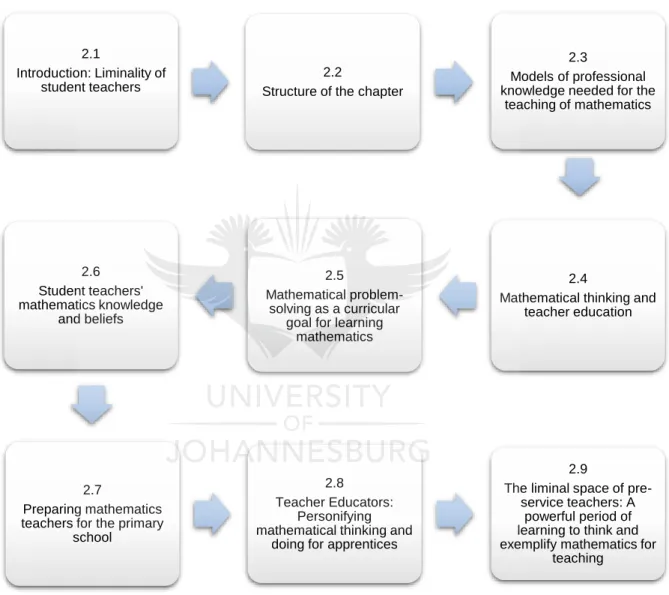
(MKT). The section about teacher knowledge is followed by a section in which I ‘unpack’ what I understand about the concept, ‘mathematical thinking’ as applied in this study. This is followed by a discussion about mathematical problem-solving as a curricular goal for learning mathematics. The chapter outline is presented in Figure 5. I highlight Section 2.7, which comprises studies about mathematics teacher preparation, specifically in courses about problem-solving, explaining the importance of this component of mathematical thinking. In a study about teacher education there is, inevitably, a discussion about teacher educators and how they personifying mathematical thinking as a model for the teacher apprentices. The conclusion
"What is" Student teachers'current mathematics content knowledge upon entering university-level mathematics courses Argument University-level mathematics content courses for primary school teachers operate as liminal spaces where student teachers are in as “betwixt and between” (Turner, 1967) world of school mathematics and the world of a teacher of
mathematics,while learning to maintain the integrity of mathematics as a way of knowing the world according to
mathematicians .
What 'can or 'will be' phase"
Mathematics teachers and the integrity of mathematics trhough its pedagogy
22
of the chapter is that there is a need for an in-depth study of student teachers’ liminal space as primary school teachers, who now not only have to learn to think mathematically during this time (in this space), but also have to act mathematically in the way that they teach, so that young learners can in turn be their ‘apprentices’ when the students enter the profession as novices.
Figure 5: The chapter sections 2.1
Introduction: Liminality of student teachers
2.2
Structure of the chapter
2.3
Models of professional knowledge needed for the
teaching of mathematics
2.4
Mathematical thinking and teacher education 2.5
Mathematical problem-solving as a curricular
goal for learning mathematics 2.6 Student teachers' mathematics knowledge and beliefs 2.7 Preparing mathematics teachers for the primary
school
2.8
Teacher Educators: Personifying mathematical thinking and
doing for apprentices
2.9
The liminal space of pre-service teachers: A
powerful period of learning to think and exemplify mathematics for
23
2.3 MODELS OF PROFESSIONAL KNOWLEDGE NEEDED FOR THE TEACHING OF MATHEMATICS
This study investigates how pre-service teachers’ mathematics content knowledge develops through a mathematical problem-solving approach in one module, arguing that without sufficient content of mathematics, and also thinking (and acting) mathematically, student teachers will remain in the ‘in-between’ hazy world as teachers. For progression in becoming
(deLeuze & Guattari, 1980) teachers of mathematics, they first and foremost need content knowledge and its tools for thinking. The notion of ‘content’ knowledge and ‘pedagogical content’ knowledge traces its roots back to the work of Shulman (1986, 1987). Lee Shulman’s (1986), American Educational Research Association (AERA) presidential address on the three-some content-related teachers’ knowledge domains (content knowledge,curriculum knowledge
and pedagogical content knowledge) and the Harvard Educational Review article4 have been instrumental in two pertinent questions in mathematics teacher education.
The first is about what constitutes the professional knowledge of mathematics teachers; and second is about which knowledge components should comprise mathematics teacher education curricula? Shulman’s (1986, 1987) typology of teacher knowledge domains pioneered the way for research about the knowledge needed to teach mathematics in both primary and secondary schools, as well as in the tertiary sector. In addressing the second analytical question, Shulman’s framework on teacher knowledge types informed the development of recommendations for teacher preparation curricula across the globe (e.g. Conference Board of the Mathematical Sciences, 2012) as well as standards for preparing mathematics teachers (Association of Mathematics Teacher Educators, 2017).
2.3.1 Mathematical Knowledge for Teaching (MKT) framework
Three content-related domains of knowledge, according to Shulman’s (1986) typology, have been at the center of mathematics education research after he referred to these dimensions of knowledge as the ‘missing paradigm’ in research on teachers. Pedagogical content knowledge (PCK) as the most influential teacher knowledge base has drawn the most interest in research
4 Shulman (1987) expanded teachers’ knowledge base to seven knowledge domains; content knowledge,
pedagogical content knowledge, curriculum knowledge, knowledge of learners and their characteristics, general pedagogical knowledge, knowledge of educational purpose and values, knowledge of educational contexts ranging from the working of group etc.
24
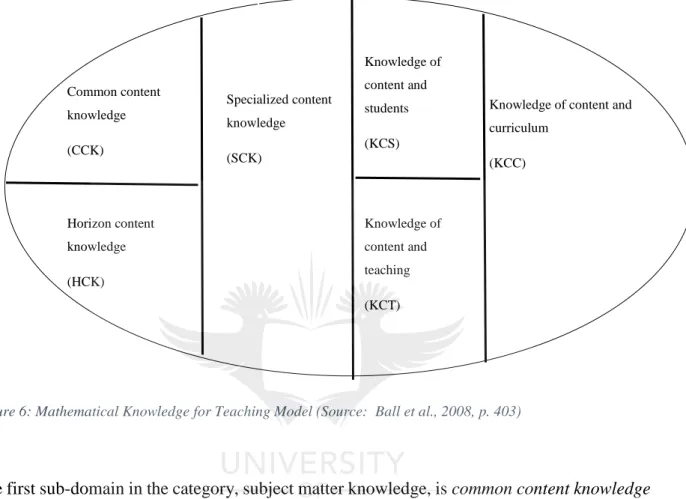
“….because it identifies the distinctive bodies of knowledge for teaching. It represents the blending of content and pedagogy into an understanding of how particular topics, problems, or issues are organized, represented, and adapted to the diverse interest and abilities of learners and presented for instruction” (Shulman, 1987, pg. 8). The notion of pedagogical content knowledge was and still is a topic of interest, not only in research in mathematics education but spanning across subject disciplines such as physics, chemistry, biology, social sciences, English, and so forth (Ball, Thames & Phelps, 2008). However, amidst all this interest, the notion of pedagogical content knowledge has remained ill defined. Ball et al., (2008) assert that definitions of pedagogical content knowledge in studies across subject disciplines have been superficial and lacked clarity. Furthermore, in the instances where there were clearer definitions of it, the boundaries between pedagogical content knowledge and other domains of knowledge remained blurred (Ball et al., 2008). In addressing the lack of clarity in defining what pedagogical content knowledge is and identifying the ‘blurriness’ between knowledge domains, Ball5 (2005, 2008) and her colleagues refined the notion of pedagogical content knowledge and introduced the term, mathematical content knowledge for teaching (MKT) to describe the professional knowledge needed for teaching mathematics.
The conceptual framework of MKT is an artifact of the two projects conducted by Ball and her colleagues over the past two decades (Ball, 1990; Ball 1993a; Hill, Rowan & Ball, 2005; Ball et al., 2008). The aim of these two research projects, the Mathematics Teaching and Learning to Teach Project and the Learning Mathematics for Teaching Project was to identify the mathematical knowledge required to teach. This was achieved by analysing teaching practices in grade K-8 classrooms in the US, and, based on these analyses, “a set of testable hypotheses about the nature of mathematical knowledge for teaching” were developed (Ball et al., 2008, pg. 390). These testable hypotheses lead to the refinement of the notion of PC. As a result, the MKT-model consists of two overarching knowledge categories, subject matter knowledge and PCK, mapped onto Shulman’s ‘subject matter knowledge and pedagogical content knowledge’. Each overarching knowledge category consists of three sub-domains of knowledge. Subject matter knowledge highlights the importance of knowing mathematics and consists of common content knowledge (CCK), specialized content knowledge (SCK) and horizon content knowledge (HCK). Pedagogical content knowledge highlights the importance of learning mathematics and the knowledge needed by teachers to promote this learning and, therefore, consists of knowledge of content and students (KCS), knowledge of content and teaching