WORKING PAPERS
Education and EmploymentPopulation and Human Resources Department The World Bank
February 1989 WPS 140
Building Educational
Evaluation Capacity in
Developing Countries
John Middleton,
James Terry,
and Deborah Bloch
Education monitoring, testing, and evaluation systems are
ur-gently needed in developing countries. Lessons from the
American experience suggest that investment plans should tie
evaluation standards, requirements, and funding to program
support for policy and institutional changes at the national,
intermediate and school levels of education systems.
l'he Policy, Planning, and Research Complex distributcs PPR Working Papers to disseminate the findings of work in progress and to encourage the exchange of ideas among llank staff and aU others interested in development issues. These papers carry the names of the authors, rflect only thcir views, and should be used and cited accordingly. The findings, interprrtations, and conclusions are the authors' own. They should not be attributed to the World Bank. its Board of Diaectors, its management, or any of its manber countries,
Public Disclosure Authorized
Public Disclosure Authorized
Public Disclosure Authorized
Plc,Planning, and Research |
Educational Ernploym*nt
Relatively few developing countries have makers with information useful in improving the established a sustainable capacity for educa- quality of schools.
tional monitoring and evaluation. As a result,
the efforts of governments and assistance These results were achieved through federal agencies to improve education have been policy and funding support for evaluation. hampered by lack of informnation on outcomes Standards, requirements, and financial
incen-and costs. tives for evaluation were tied to federal
financ-ing for school improvement programs. Institu-World Bank experience with educational tional capacity ' as developed at state, district, evaluation has been disappointing, emphasizing and school ievels.
monitoring of project inputs with little attention
to outcomes and costs. Efforts to develop a Similar investment strategies can be used in sustained evaluation capacity have largely developing countries. However, the strategies
failed. should be incremental, first putting systems in
place at relatively low levels of technical sophis-In the United States, educational evaluation tication, then raising the technical level as has become an integral part of education ma- institutional capacity is developed. Staff train-nagement. Large-scale research studies have ing and development, including the social give-1 way to student achievement testing and science and education faculties of universities, is local.zed evaluations that provide decision- essential to developing sustainable capacity.
This paper is a product of the Education and Employment Division, Population and Human Resources Depanment. Copies are available free from the World Bank, 1818 H Street NW, Washington, DC 20433. Please contact Cynthia Cristobal, room S6-035, extension 33640.
The PPR Working Paper Series disseminates the findings of work under way in the Bank's Policy, Planning, and Research Complex. An objective of the series is to get these findings out quickly, even if presentations are less than fully polished. The findings, interpretations, and conclusions in these papers do not necessarily represent official policy of the Bank.
Page
INTRODUCTION . . . 1
Definitions . . . 2
THE EXPERIENCE OF THE WORLD BANF ... ... 4
Overview of M&E Performance ... . . 4
Monitoring and Evaluation in Projects: Design and Achievements . . . 5
Recent and Past Practice in M&E Design . . . 5
Achievements . . . 7
Summary .... . . . 12
THE U.S. EXPERIENCE .... . . . 12
Origins of Educational Evaluation in the United States . . . 13
School Accreditation .... . . . 14
Impact of Federal Legislation . . . 15
Limitations in Available Methodologies . . . 16
Forces for Change .... . . . 17
Improved Utilization .... . . . 17
New Methodologies .... . . . 19
Changes in Legislation and Funding: The Rise of Local Accountability ... . . 24
Summary .... . . . 27
LESSONS FOR THE IDPROVEMENT OF MONITORING AND EVALUATION IN DEVELOPING COUNTRIES .... . . . ... . . . 29
Strategies for Building M&E Capacity ... . . 29
Who Should be Served. .... . . . 30
For What Purposes? . . . 31
What Information is Needed? . . . 32
What Kinds of Systems Are Needed? . . . 33
How Can Monitoring and Evaluation Systems Be Established and Sustained? .... . . . 34
A Conceptual Framework for Institutional Development . . . 35
The U.S. Experience Interpreted . . . 36
Implications for the Design of M&E Systems . . . 37
CONCLUSIONS: OPERATIONAL ISSUES FOR THE WORLD BANK . . . 40
EXECUTIVE SUMMARY
Despite more than two decades of financial and technical assistance, relatively few developing countries have established sustainable capacity for educational monitoring and evaluation. In consequence, the efforts of both governments and assistance agencies to improve education have been
significantly weakened by the absence of information, notably on educational outcomes and on costs. The effects of investments are difficult to gauge;
lessons of experience difficult to accumulate.
Directions for improved strategies for support of educational
monitoring and evaluation are sought from two sources. One is the experience of the World Bank. The second is the history of the development of
educational evaluation in the United States, where theory and practice are best developed and documented among developed nations.
The experience of the Bank has been disappointing, emphasizing monitoring of the delivery of project inputs, with very little attention to
the outcomes or costs of education. Efforts to develop sustained
institutional capacity for monitoring and evaluation have rarely sutceeded. As strategies for investment in education become more complex, the inability of governments and, consequently, assistance agencies to monitor and evaluate
the outcomes and costs of investments is an increasingly significant barrier to efficient use of scarce resources.
In contrast, over the past three decades monitoring and evaluation have become integral parts of the U.S. education enterprise. This development has been marked by the heavy influence of federal policy and funding, and by significant shifts in the nature and purpose of evaluation activity. The system that has emerged eschews large scale research evaluation in favor of localized evaluations built around achievement testing, and designed to provide decision-makers with a variety of information useful in improving education at the school and district level. Monitoring and evaluation is designed with a clear focus on the utilization of results, and has thus become an integral part of education management. It is a central element of current efforts to improve the quality of schools.
The paper concludes that while project monitoring will continue to be important, priority should be given to the establishment of sustained government capacity for monitoring and evaluation of the education system as a whole. This will require selective iavestment in capacity building in
countries with strong administrative frameworks and a clear policy commitment to monitoring and evaluation. Priority should be given to establishing the capacity for achievement testing, to primary education and to sectoral operations.
Lessons from the U.S. experience show the importance of achievement testing, and of policies and incentives that tie standards, evaluation
requirements and financial support for monitoring and evaluation to program support for educational change and improvement. Explicit institution building strategies are also necessary. These should highlight the evaluation function through institutional structures; build capacity at central, intermediate and school levels; build evaluation functions into job descriptions and incentive
schemes; support the professionalization of the evaluation field; and develop both the technical and managerial competence of staff. Strengthening the
social science and education faculrieb uf universities is needed to provide a pool of available technical expertise.
Institutional development strategies should be incremental. At the onset, all elements of a monitoring and evaluation system should be put in place for a significant sub-sector (or geographic region) of the education system. But the technical sophistication of these elements should be kept low. This will provide a core around which institutional development
activities can be organized. As this basic system becomes effective, it can be extended in scope and sophistication.
These investments will require a higher level of analysis and design work than that normally made available through donor or government resources.
The costs of such investments in M&E capacity will be significant. For the World Bank to be effective in addressing the absence of sustained monitoring
BUILDING EDUCATIONAL EVALUATION CAPACITY IN DEVELOPING NATIONS:
Lessons from the U.S. Experience, Strategies for Development Assistance
John Middleton James Terry Deborah Bloch
INTRODUCTION
Despite more than two decades of financial and technical support from bi-lateral and multi-lateral assistance agencies, relatively few developing countries have established sustainable capacity for educational monitoring and evalvation (M&E). Recent success in Kenya in developing and using evaluation information for educational improvement (Somerset, 1987), not only highlights the usefulness of monitoring and evaluation in improving the efficiency and effectiveness of education, but also raises once again the question of why M&E has not yet become widespread and effective tool for educational improvement in developing countries.
Nor, in the experience of the World Bank, has M&E been an effective tool for the improvement of development assistance operations. Weak
monitoring of the "software" aspects of projects, combined with nearly
universal absence of information on either educational or economic outcomes, has restricted the Bank's ability to learn systematically from experience.
In an era of constrained resources for education development, the lack of effective monitoring and evaluation significantly impairs efforts of governments and assistance agencies to make most effective use of the
resources that are available in pursuit of the twin goals of improved quality and expansion of education systems. As investments in more complex strategies
for educational improvement increase, including sector lending, learning from experience becomes even more important -- with a correspondingly more
significant place for effective monitoring and evaluation.
This paper seeks directions for improved strategies for support of monitoring and evaluation from two sources. One is the experience of the World Bank. The second is the history of the development of educational
evaluation in the United States, where theory and practice are perhaps best developed and documented among developed nations. The focus of the review is on policies and strategies for investment design; the technical details of evaluation design and implementation are treated only insofar as they affect broader policies and strategies.
The experience of the World Bank has been largely disappointing. Monitoring and evaluation in Bank education investments has focused on the delivery of project inputs; relatively little attention has been given to the assessment of educational outcomes. Investments in the development of
sustained institutional capacity for system monitoring and evaluation have most often failed. As a result, governments lack the capacity for ongoing
monitoring and evaluation, and the capacity of the Bank to learn from its own project evaluation system has been weakened.
'n contrast, over the past three decades evaluation has grown to become an integral part of the U.S. education enterprise. This period was marked by the heavy influence of federal policy and funding on a decentralized education system, and by significant shifts in the purposes and nature of
evaluation activities. 'Thile not free of political or technical problems, the
current practice of educational evaluation provides administrators a steady flow of information useful in improving the performance of schools.
The analysis is presented in four parts. The first examines monitoring and evaluation in past and present World Bank education
investments. The U.S. experience is reviewed in the second. In the third lessons from the U.S. experience are developed and assessed against the realities of developing country contexts. A concluding section identifies operational implications of the analysis for the World Bank and other assistance agencies.
Definitions
Educational evaluation encompasses a variety of purposes, models and techniques.l/ A major distinction is drawn between summative and formative evaluation. The purpose of the former is to develop information for judgments regarding the overall impact and effectiveness of programs, and thus on their continuation or replication. The purpose of the latter is to develop
information during program implementation for redesign and improvement. Both terms are used most frequently in categorizing types of evaluation for
interventions and innovations designed to change and improve educational practice.
A second distinction can be drawn between evaluation of specific interventions designed to change and improve education practice (often called "projects"), and ongoing evaluation activities designed to produce a regular flow of information on the system and its components. Project evaluation can be carried out as a free-standing effort where there is no ongoing, system-wide evaluation. Under these circumstances, however, the designs must provide substitute mechanisms needed to collect data on non-project schools,
increasing complexity and cost. Scattered project evaluations seldom result in reliable cumulative findings that help guide improvement of the larger system.
Numerous models, or methodologies, for educational evaluation have been developed. These provide integrated frameworks for the conduct of a range of monitoring and evaluation activities. Many tie a comprehensive set of evaluation activities explicitly to both summative and formative decision-making. Other models include systems analysis; professional review
(accreditation); the behavioral objectives or goals- basec approach, in which
1 The intent here is to establish a relatively few basic definitions in a complex field. A full review may be found in House, 1980.
-3-achievement of specified objectives is assessed; and the contrasting goal-free approach, in which all effects of a program are assessed, whether goal-reLated or not.
Models of evaluation are often confused with techniques for design, data collection and analysis. In general, most techniques can be used within a given model. Research evaluation, or evaluation research, is a term most closely identified with the use of the techniques of experimental and quasi-experimental designs, pre-post measures and multi-variate statistical analysis
for summative purposes. Monitoring, in. easingly with the aid of management information systems is comprisAd of a sL: of techniques (indicators, surveys, routine reporting, observation) that generate information for formative
purposes, as well as a data base useful, in combination with other types of evaluation, for summative judgments.
Student achievement testing and examination systems provide
crucially important information for evaluation of all kinds. If implemented routinely and for the education system as a whole, testing systems provide the
information that enables administrators, teachers, parents and students to assess educational performance across time, and to compare the performance of
different elements of the education systems -- schools, districts and states.
Achievement data also provide a framework within which the effectiveness of specific interventions (such as new curricula) can be judged against past practice.
There is a tendency in the Bank, and elsewhere, to combine the terms monitoring and evaluation to form the hybrid "monitoring and evaluation"
(M&E). These can be separate activities, each with its own purpose(s), models and techniques. Monitoring alone is essentially a formative management
process, providing a flow of information for improved implementation
--including program re-design. Evaluation alone is summative, concerned principally with outcomes and less with processes. Ideally, the two are
linked together in an integrated design which provides information on both processes and outcomes, strengthening the ability of decision makers to not
only assess outcomes, but trace the causal relationships between programs as actually implemented and achievements.
THE EXPERIENCE OF THE WORLD BANK
The World Bank and its Borrowers have faced two distinct but inter-related evaluation tasks. The first is the ionitoring and evaluation of specific investment projects. The second is the development of the capacity of Borrower agencies for sustainable monitoring and evaluation of the
performance of the education system and its components. In some cases, investments in project monitoring and evaluation have been intended to contribute to sustained institutional capacity.
Overview of M&E Performance
Since 1979, annual reviews of project evaluations conducted by the Bank's Operat.ons Evaluation Department (OED) have indicated that while monitoring of the delivery of physical inputs has been reasonably effective,
the same has not been true for the "softer" aspects of projects -- curriculum development and effectiveness, teacher training, and institutional
development. Evaluation of educational outcomes has been largely lacking. And the reviews find little impact on sustainable Borrower evaluation capacity.
The continuing lack of Borrower capacity for monitoring and
evaluation in turn significartly weakens the development of an information base for specific projects, with the result that project completion
evaluations suffer from inadequate data, most particularly on unit costs, educational outcomes and software component performance. These weaknesses in project evaluations have hampered the operational reviews through which the
Bank draws lessons from past experience to improve lending operations. (Johanson, 1986; Romain, 1986; Romain and Armstrong, 1987; Middleton and Demsky, 1988).
In an earlier era, when World Bank projects primarily financed civil works and equipment, weak Borrower capacity for monitoring and evaluation was, perhaps, less troublesome in its impact on sustainable development. However,
since the early 1970s Bacik investments in education have increasingly supported system change and improvement through curriculum development,
teacher training and management and organizational development. In a study of these change components, Verspoor found that the most successful investments focused " ... on the institutionalization of a capacity to manage change and the development of systems and structures capable of dealing effectively with unexpected events." (1988, forthcoming, p. ix). A steady flow of information on performance of the project at all levels, most especially the classroom, was important to success. The _tudy concludes that one of the four essential characteristics of effective educational change programs -- and thus of
institutionalization of effectiveness and efficiency measures -- is the establishment of effective mechanisms for the feedback of information on performance to support enroute program modification and improvement. Among such mechanisms, those that support regular collection and analysis of the outcomes of education -- student achievement, employment -- are centrally
- 5
-Yet evaluation of outcomes has been weakly supported. Only 08% of the project components studied by Verspoor supported the development of testing systems. In a review of 76 World Bank investments in vocational education and training, Middleton and Demsky (1988) found the same low level of attention to examination and certification processes, and to assessment of
the employment outcomes of training. In general, this lack of attention to assessing educational and economic outcomes is a clear indicator of low levels of investment in the development of permanent evaluation capacity, by
Borrowers and the Bank alike.
Monitoring and Evaluation in Projects: Design and Achievements
To gain more specific insight into the design of Bank support for monitoring and evaluation (both for projects and for broader system capacity), a sample of ongoing and completed projects was studied. Current design
practice was identified through a review of the 16 project appraisal reports approved in FY85-86. The design and effectiveness of past investments were assessed through an analysis of the appraisal reports and project evaluations
for the 17 education sector projects completed in the same period.2/
The review of investment design in completed and ongoing projects indicates increasing attention to the design of project monitoring systems at the appraisal stage. Evaluation of outcomes, however, has received very
little attention. Tihe data suggest that efforts to build Borrower capacity for system-wide M&E may be declining.
The record of success in completed projects has been very weak for project monitoring and evaluation as well as for the development of system capacity. Reasons include inappropriate designs, and lack of the policy and
incentive support that might overcome Borrower reluctance to support monitoring and evaluation efforts.
Recent and Past Practice in M&E Design
This component of the analysis focused on the design of support both for project monitoring and evaluation and for the development of system
capacity in both ongoing and completed projects. The basic question was whether or not provision was made for project monitoring and evaluation, development of M&E capacity, or both. Additional questions regarding investment design were:
a) Were indicators specified?
b) Was responsibility for M&E clearly assigned?
c) Were procedures for administration of M&E specified? d) Were decision points for use of M&E results specified? e) Were Rolicy sunport and/or incentives provided?
M&E objectives and methodology were also reviewed,
Although Bank appraisal reports provide relatively little
information, the design of investments in system capacity for M&E appears to have taken three principal forms. One is as part of overall efforts to develop institutional capacity for educational planninig. Support for M&E is usually included. Second has been support for monitoring and evaluation units in line ministries. The third has been the inclusion of M&E responsibilities in specialized education support institutions, such as curriculum development centers.
The inputs to these efforts have been specialist services,
fellowships and equipment (notably computers). The saiiie inputs have been used to support project M&E. In addition, special studies were included at
appraisal in about half of the 33 projects. Rationales for any particular combination of inputs have been weak and inconsistent.
The data on specific aspects of design indicate increased provision of project monitoring, and somewhat less attention to building system capacity in the later projects (see Table 1). Evaluation of learniitg or economic
outcomes has received little attention. On the surface, at least, more attention has been given in recent project appraisals to planning for monitoring, as seen in the assignment of responsibility, specification of administrative procedures and decision points, and the increased use of
indicators.
In the projects studied, the net effect of assignment of responsibility and spacification of procedures has been to design for
centralized monitoring systems that provide project information needed by the Borrower and the Bank. Decision points specified are invariably points during project implementation at which the Bank and the Borrower will consult on implementation progress. At least as reflected in project appraisals, other
levels of the education system -- states, districts, schools -- figure in the
process only as sources of information.
rhe increase in the specification of progress indicators as the basis for monitoring at appraisal is encouraging, indicating stronger levels of discussion between the Bank and Borrowers on the nature of the monitoring and evaluation effort. At the same time, the indicators used demonstrate convincingly that the Bank continues to ignore factors crucial to project evaluation. Of the 100 indicators used in the FY85-86 appraisals, there was one for student achievement, one for completion of a tracer study, and one for
unit recurrent costs. The remaining 97 were about equally divided between the
provision of inputs and the accomplishment of output objectives, most often enrollments.
Indicators thus support monitoring of project implementation progress, but not evaluation of project impact or costs.
-7-Table 1: Comparison of Monitoring and Evaluation Design in Appraisal Reports for Two Time Periods
Proiects
Completed Approved
in FY85-86 in FY85-86
Number of Projects 17 16
Project M&E Supported 9 13
M&E System Development 12 9
Supported Indicators Provided 1 9 Responsibility for 9 13 M&E Assigned Administrative 1 5 Procedures Specified Decision Points 0 7 Specified Policy or Incentive 1 2 Support Provided
Relatively low levels of attention to evaluation are also reflected in the limited discussion of M&E objectives and methodologies found in the appraisal reports of both eras. In general, evaluation of impact is
restricted to a few special studies, most to be carried out by consultants. With the exception of three sector loans (in Korea, Malaysia and Morocco), policy and incentive provisions designed to support the development of monitoring and evaluation have been absent from Bank investments. In these three cases criteria for sub-project evaluation and monitoring formed a
policy-level context; and, in the case of Morocco, release of the tranche of the loan is conditioned on an interim project review, providing some
incentives for project evaluation. Achievements
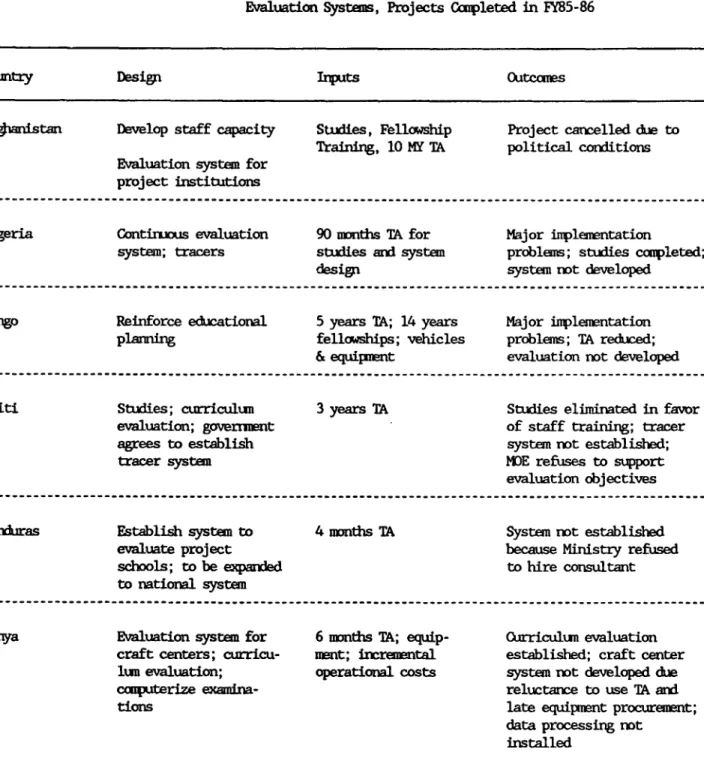
Of the seventeen projects completed in FY85-86, twelve made
provision for either project M&E or capacity development, or both. The fate of these investments, as shown in Table 2, was grim. All but two failed.
The two successful investments came in Lebanon and Korea. While information is thin in completion reports, a number of factors in success are apparent. Both nations had above average implementation capacity. In both cases, attention was focused on monitoring systems. In Lebanon, a simple
input of data processing equipment was assimilated and used. In Korea, a complex program of monitoring that included tracer studies and cost assessment
was made effective through the establishment of a strong institutior.al base in
specialized curriculum and research agencies with financial support for
operating costs from the Bank. It is also worth noting that the accreditation system, which involved site assessments to determine if institutions conformed to quality standards, was hampered to some extent by lack of incentives for
institutional compliance.
The causes for failure are readily apparent: weak implementation capacity, not compensated for by strong designs; and low levels of commitment to M&E, reflected in overt resistance on the part of the Government and in reduction or elimination of TA resources. Some of this resistance may be attributable to skepticism regarding the utility of long and complex
evaluation studies to the political reality of decision-making; some to the reluctance to be "evaluated" on the success of difficult and unpredictable projects and programs.
The low level of attention to evaluation of educational outcomes noted for the recent projects in the sample is replicated in the completed projects. On the Bank's side, lack of attention to evaluation of project outcomes may reflect the difficulty that has been encountered in attempting to go beyond monitoring of ploject inputs and processes. Recent case studies of three such efforts in Bank projects document serious problems in design and utilization (Searle, 1986). Among these were overly complex designs, lack of attention to unstable implementation processes, and failure to address the complex political and bureaucratic decision-making context in which evaluation
-9-Table 2: OutcaIs of I}vestnents in Mbnitoring and
Evaluation Systems, Projects Campleted in FY85-86
Country Desigi ixits Outcaes
Afwanistan Develop staff capacity Studies, Fellawship Project cancelled due to
Training, 10 MY TA political conditions
Evaluation system for project institutions
Algeria Contiius evaluation 90 months TA for Major inplntation
system; tracers studies and system problems; studies completed;
design systemn nt developed
Cngo Reinforce educational 5 years TA; 14 years Major inplementation
planming fellowships; vehicles problems; TA reduced;
& equipmnt evaluation not developed
Haiti Studies; curriculun 3 years TA Studies eliminated in favor
evaluation; goverrpmnt of staff training; tracer
agrees to establish system not established;
tracer system MOE refuses to support
evaluation objectives
Hrxkuras Establish system to 4 nmnths TA System not established
evaluate project because Ministry refused
schools; to be expanded to hire consultant
to national system
Kenya Evaluation system for 6 months TA; equip- Curriculun evaluation
craft centers; curricu- ment; incremental established; craft center
lum evaluation; operational costs system nmt developed due
ccuputerize examina- reluctarne to use TA arxi
tions late equipment procurement;
data processing not installed
Table 2: Outcomes of Investments In Monitoring and
Evaluation Systems, Projects Cmpleted in FY85-86 (contixued)
CoLmtry Design Inputs Outcones
Korea Establish penrmnent EstablLsbment & M&E effective and used in
capacity for mianpowr initial operating project management.
monitoring, curriculum costs of MSE agencies; Accreditation system
evaluation, accredita- TA, studies established, though lack of
tion of educational incentives for if,titutional
institutions. Criteria acceptance and urderfunding
and procedures for weakened the effort
evaluating sector sub-projects. Specific responsibilities
assigied to 3 agencies, including one rnw one. Quarterly reporting.
Labanon Computerized MIS; Equipment MIS installed
tracers
Madagascar Build educational TA, fellovships TA and fellowships
elimi-planning in decen- nated because of cost
tralizing system, over-runs; financed
school inventory, data instead by UNICEF with
processing; evaluation UNESCO execution. Only
Task Forces to organize one Task Force functioned.
formative evaluation Impact on capacity slight.
Data processing system dropped.
- 11
-Table 2: Outcomeis of Irvestmnnts in Monitoring and
Evaluation Systems, Projects Completed in FY85-86
(continued)
CGuntry Design Inputs Outcomes
Mali Evaluation in each of 5 Years TA Almost ignored in PCR.
the 5 conponents. All Some studies conducted; no
focused on project evidence of utilization
activities. National Pedagogical Institute for project curricula; AG training evaluation specialist; Enterprise training needs survey system by National Managemnt Institute; Regular evaluations of literacy program; Follow-up of pre-investnent study. National Research Team
Seregal Evaluation of all TA. Evaluation Severe inplemlentation
project activities. Specialist problems. Evaluation not
Build educational done as local staff not
planning capacity. traimed and found
evalua-Case stLdies, "indepth tion threatening. Tracer
evaluation;" tracers. system not established.
Government and IDA to consult on findings
Somalia Build permanent 2 Years TA - Local training provided;
evaluation system Evaluation Specialist; fellows fall to return to
Fellowships; Local their posts. training
Summary
While planning for monitoring of project inputs and processes has improved, it has generally been restricted to centralized information systems to support the project information needs of the Ministry and the Bank. Other levels of education have benefitted little. Evaluation of outcomes is largely lacking. Very little progress has been made in the establishment of
sustainable evaluation capacity, in part due to weak investment designs, and in part to perceived lack of utility of evaluation on the part of Borrowers. The strong policy and incentive support for project M&E and the development of system capacity that might address such reluctance has not yet become part of lending strategies. The Bank's experience with more complex research
evaluation studies has not been encouraging.
This situation gives rise to considerable concern in an era when educators in developing countries are challenged to improve system efficiency and effectiveness under conditions of scarce resources. And because meeting this challenge will require more complex strategies of educational change under conditions of great uncertainty (political, financial and technical), the need for effective evaluation is greater than in the past. Indeed, the development of testing and monitoring systems has been identified as a
critical input to the improvement of education in Sub-Saharan Africa (World Bank, 1987).
Finally, the evolving nature of Bank lending for education must be taken into account. The growing emphasis on sector and Alicy lending shifts the focus of the dialogue between Borrowers and the Bar. away from investments in specific institutions towards policy and organizational changes to improve system quality and efficiency. The details of implementation in these kinds of investments are increasingly left to Borrower determination. And while more traditional investment projects will continue to be an important part of the portfolio, resource constraints in Bank operations have reduced the amount of staff time available for preparation and supervision. In short, the
ability of Bank staff to engage with Borrowers in the development of
evaluation capacity is likely to be reduced. Under these circumstances, both Bank and Borrower staff need to have a clear sense of what kinds of evaluation capacity are most useful, and of the practical steps that might be taken to put it in place.
THE U.S. EXPERIENCE
The experience of the United States with educational evaluation is, in most respects, the longest and best documented among all developed
countries, in no small part because of the relatively high levels of financial support that have been made available through federal sources. Indeed, much of current world practice in educational evaluation is based on work
originating in the U.S. And while at first glance the resource-rich context of American educational evaluation may appear to have little relevance for developing countries, our review suggests that there are useful insights
- 13
-may consider in seeking to stimulate and sustain effective evaluation practice.
Much of this insight arises from the fact that the theory and
practice of educational evaluation in the U.S. have changed considerably over the past twenty-five years, both in response to changes in the policy context for evaluation and as a result of dissatisfaction among the evaluation
community with the approaches and methodologies with which the field began. The changes that have taken place have led to a clear focus on the generation of information useful for decision-making at the school and district level, and consequently, on achievement testing and on pragmatic and responsive
evaluation designs. The evaluation practice that has emerged is thus oriented toward incremental improvements in education quality; large-scale research-evaluation studies seeking generalizable truths about education have largely disappeared. These changes bring current practice in the U.S. close to the kinds of evaluation that will be needed as developing countries turn their efforts tce:ards quality and efficiency through programs of educational change and improvement.
The role of the federal government in stimulating and developing evaluation practice has been crucial over the past twenty- five years. The structure of much of this support has been analogous to World Bank investment projects in that funds are supplied to States and localities to support
interventions aimed at raising the quality of schooling. The history of this involvement yields insight into the possible effects of policy and financial incer. ives for evaluation. Importantly, as developing countries consider and in some cases initiate the decentralization of education management, lessons from the highly decentralized U.S. system become more relevant.
The discussion begins with an historical overview of the origins of educational evaluation in the U.S. Three major forces for changed practice are then discussed: the problem of utilization, the problem of methodologies, and the effects of changes in legislation and funding, including the rising
importance of the accountability of schools for student performance. Origins of Educational Evaluation in the United States
Educational evaluation in the United States developed in response to the social and political circumstances that defined the arena within which it matured. As one writer recently noted, evaluation, "unlike many other
sciences.. makes no distinction between applied and basic research. The real world of social programs is its only home; there is no laboratory for
evaluation practice." (Cook, 1986; p. 194).
Evaluation was an accepted part of the American educational scene before the turn of the century. Horace Mann directed an evaluation of the Boston schools in 1845 and Joseph Rice, between 1887 and 1898, conducted a study involving 33,000 students on the effects of the teaching of spelling. Standardized testing became popular in the early 1900s in response to a
greater emphasis on the efficient use of educational resources and increasing interest in the accreditation of educational institutions.
The term "education evaluation" was coined by Ralph Tyler in the early 1930s. His writings on evaluation were instrumental in establishing a new approach to evaluation. He supported the goals of the Progressive
Education movement of John Dewey and encouraged the pragmatic philosophy that set this group apart. His definition of evaluation called for a comparison of
intended with actual educational outcomes for a given group of learners. This had the advantage of providing for internal assessment of the effectiveness of an education program in terms of ics own goals, removing the need for costly comparisons between experimental and control groups, and foreshadowing current research on effective schools. Tyler's influence over the direction of
evaluation was at its peak in the mid 1940s and continued for the next 25 years.
The decade between the late 1940s and 1950s saw little substantive
activity within the field. Educational testing was expandled, and taxonomies
of objectives and statistical procedures were developed, but relatively little effort was made to use these techniques to improve education. Methodologies focused on the measurement of program effects, using before and after
measures, with very little attention to program processes. Federal and state governments were only marginally involved with education and evaluations, if done at all, were normally sponsored by local organizations.
School Accreditation
Although evaluation of the outcomes of schooling received little attention in this early period, considerable effort was devoted to the establishment and enforcement of standards for institutional quality. This emerged in the first fifteen years of the 20th century in the form of school accreditation (Young, et.al., 1983).
At the time, colleges faced a difficult problem: how to select among applicants from a large number of secondary schools with locally determined curricula, and with unknown levels of quality. The response was the
development of curriculum and institutional quality standards, and a process through which individual secondary schools could be certified, or
"accredited," on a voluntary basis. As the number of colleges participating in the system grew, it became incumbent on all secondary schools seeking success for their students in college admission to participate. Being "accredited" became the first mark of quality in the eyes of not only of
college admissions officers, but of parents and students as well. The process became institutionalized on a regional basis, and was extended to include post- secondary institutions.
Accreditation continues as an important part of educational
evaluation. It is managed by regional voluntary associations of schools and colleges. Officers of these associations are elected by member institutions, and are supported by a small professional staff. Each association sets
standards of quality for both public and private institutions of different
types -- colleges, vocational schools, specialized training institutions, and
both private and public secondary schools. Standards are established for facilities, faculty qualifications and numbers, curricula, degree
- 15
-institutions must periodically (usually every 5 years) prepare a self-study that demonstrates achievement of standards and documents ongoing efforts for institutional improvement. This report is audited through a visit of external
evaluators selected by the association. An independent audit report is
considered by the association officers, who may vote to continue full accreditation, or issue one of a set of less comprehensive endorsements. These range from limited accreditation, with notice of specific defects and a time period for correction (one to three years), to a more serious warning, to removal of accredited status.
In recent years the focus of the accreditation process has become formative as associations seek to assist institutions in improving quality.
The process has perhaps been most effective for private schools and colleges, for which accredited status is important to attracting students. Accreditation has been useful in guarding the public against consistently inadequate institutions. Well-established universities and schools take the process less seriously, but in general cooperate. The voluntary,
self-regulation model has proven attractive, enabling institutions to have a voice in the establishment of standards and in the evaluation process.
The accreditation model of institutional evaluation has also been adopted by a number of state education agencies as a complement to routine monitoring and other evaluation processes for public schools. In many of these cases it is extended to primary schools.
Impact of Federal Legislation
The technological challenge presented by the launching of sputnik in 1957 resulted in the National Defense Education Act of 1958. This legislation significantly increased the role of the federal government in education as the sponsor of a variety of new science, mathematics and foreign language
curriculum initiatives. Funding was also specifically provided for the evaluation of these efforts.
The Elementary and Secondary Education Act (ESEA) of 1965 further increased federal impact on evaluation. Of special importance was the requirement that specific evaluation provisions be included at each project site. This stipulation meant that in order to receive federal funds, each school district was required annually to submit an evaluation, using
appropriate standardized test data, documenting the effectiveness of its local
program in remediating the educational. deficiencies of its disadvantaged
students. In addition to mandating standardized test scores, the bill also called for an assessment of the congruence between educational outcomes and objectives. The effect was to "force evaluators out of the cool world of pure analysis into the maelstrom of political and administrative complexity."
(Cook, 1986; p. 197).
The legislation also provided administrative funding to the State education agencies (SEAs) through which funding passed to school districts. This funding supported the establishment of permanent evaluation capacity in the SEAs in the late 1960s and early 1970s. These units were responsible for
ensuring that federal requirements for evaluation were met. Evaluation activities were conducted by the staff of these units and contracted out to consultants.
Importantly, the combination of available funding and localization of evaluation greatly expanded the opportunity for academics and education professionals to practice the craft of evaluation. Funding was a particular
incentive to university faculty, who saw opportunities to apply social science research through the practice of educational evaluation. Evaluation developed as an academically respectable discipline, complete with professional
associations and journals.
Limitations in Available Methodologies
The evaluation approaches available at the time, however, proved inadequate. Testing materials designed to accommodate and rank the academic abilities of the middle class student did a poor job of recognizing the ability or measuring the academic gains of academically and socially
disadvantaged students. Evaluation designs were not able to distinguish or isolate the effects of projects, nor were they able to provide insight into the success or failure of implementation. Evaluators found themselves unable to provide evidence of the effects of the program treatment -- indeed, they were typically unable to identify the treatment or to specify the degree to which it had been implemented.
These shortcomings originated, in part at least, in the policy context of the era. The 1960s were a time of large social programs that rested on the belief that social science theory would point to the clear causes of target problems and suggest interventions (or projects) to overcome them. There was an implicit expectation that the various projects would be
implemented and evaluated in a way that would provide unambiguous answers regarding effectiveness. It was further assumed that demonstrated and
evaluated successes would be welcomed by policy makers and that the requisite program and policy modifications, which would become apparent as a result of
these evaluations, would be readily accepted.
This rational implementation model proved to be grossly inadequate in its description of the realities that faced evaluators and decision makers. Problems were not easily defined, and proposed solutions were often vague or contradictory. Administrators believed that continued program funding depended on positive evaluation, and were accordingly suspicious, if not
hostile. Evaluators failed to recognize that "evaluation is in many ways iust another political act that occurs in a context where power, ideology, and interests are more powerful determinants of decision making than feedback about programs." (Cook, 1986, p. 200). This led to conflict between program managers and evaluators, weakening the usefulness of much evaluation work.
As the 1970s began, it became widely recognized that the evaluation of educational programs, especially those federal programs directed at the educational needs and problems of disadvantaged and minority students, was in need of substantial revision both at the theoretical and technical levels. In 1971 a National Study Committee on Evaluation, set up by the professional
- 17
-education fraternity Phi Delta Kappa, announced that educational evaluation "was seized with a great illness" (Madaus, 1983; p. 14) and went on to
encourage the development of new methodologies of educational evaluation and new training programs for evaluators,
The call for new ideas was enthusiastically joined by many
evaluators: the late 1960s and early 1970s have been described as a period that was "vibrant with descriptions, discussions, and debates concerning how evaluation should be conceived" (Madaus, 1983; p.14). The same author goes on to point out that at that time, "the field of evaluation was amorphous and fragmented -- many evaluations were carried out by untrained personnel; others by research methodologists who tried unsuccessfully to fit their methods to program evaluations. Evaluation studies were fraught with confusion, anxiety, and animosity. Evaluation as a field had little stature and no political clout.' (ibid, p.15)
Forces for Change
The science and practice of educational evaluation had to change, and it did. Over the next decade a variety of new models and approaches were developed to meet the weaknesses that had emerged. In particular, the new models sought to deal with two closely related problems: weak utilization of
results, and narrow -- and often inappropriate -- methodologies. Towards the
erJ of the 1970s, changes in Federal legislation and financing, in conjunction with rising public expectations regarding the accountability of schools for
student achievement, significantly altered the focus and resources of evaluation efforts.
Improved Utilization
It has now generally been acknowledged that the appropriate role of educational evaluation is that of a management tool for the improvement of educational programs, not as a branch of pure or academic research
(Eichelberger, 1986). This relatively recent insight is the result of the work done on the questions of utilization.
The assumptions of the 1960s and early 1970s, that evaluations would either be of prime importance in determining future program funding or be readily adopted on their merits, were proven wrong. Indeed researchers examining utilization found little evidence that evaluations played any significant role in decision making, either on program management or on questions of continuation or termination (Leuton, 1981, 1983; Cook, 1986). The earlier optimistic expectations came to be characterized as naive. One authority said that "the failure to use evaluation findings has almost assumed
the proportions of a national scandal" (Cuba, 1981; p. ix).
Attention to the usefulness of evaluation results gained initial impetus from the work of Michael Scriven (1967), who highlighted the important distinction between sunmmative and formative evaluation. Summative evaluation, as he defined it, is "conducted after completion and for the benefit of some external audience or decision-maker (e.g. funding agency, historian, or future
possible users)." Formative evaluation, on the other hand, "is conducted
during the development or improvement of a program or product " (Scriven,
1977, pps. 150-63). It assumes that the program is in a state of flux and that it will continue to evolve. It has as a primary purpose the generation of information that will be useful for the modification and/or improvement of an existing and ongoing program, and thus has acquired a management focus.
Whereas evaluation was normally a summative activity prior to the mid 1960s, the utilization issue forced a reconsideration of this position. Growing recognition that evaluation after the fact has little or no capability
to contribute to program improvement led to an increasing emphasis on formative evaluation (see Patton, 1978; Cronbach and Associates, 1980; Stufflebeam et. al.,1971; Palumbo, 1984; McClintock, 1984).
The distinction between formative and summative evaluation also served to highlight the importance of the timeliness of information for decision making. This, in turn, led to increased emphasis on an integrated
relationship between evaluators and decision makers defined, at least in part, by the utility of that relationship to the needs of the program manager. Thus
the "front" and "back" ends of the evaluation process assumed greater
importance in order to insure a role for evaluation in decision making. Pre-evaluation activities, such as evaluability assessment and other activities designed to promote a shared understanding of the purposes of the evaluation,
are described as "front end." Those organization structures and incentives
designed to encourage usage are understood to be a part of the "back end." The roles of both evaluators and decision-makers began to change to meet the needs of integrated evaluation. Instead of serving as autonomous critics of the education system, evaluators moved towards membership in the education management team. Their commitment to usable evaluations increased, as did their sensitivity to the political dimensions of evaluation. Decision-makers began to accept the responsibility for defining decisions and decision-making processes, as well as for increased personal commitment to the
evaluation process and to utilization of results Burry (1985).
The relevance of evaluation to the perceived interests of the program participants is clearly one of the key indicators of evaluation utilization, and the research indicated that the involvement of an
administrator in the evaluation process is often the surest way to i'sure that
relevance. Patton (1978; p.64) identified the "personal factor" -- that is
"the presence of an identifiable individual or group of people who personally
cared about the evaluation and the information it generated" -- as being
especially important to the question of whether or not evaluations were used. It was increasingly recognized as well that decision makers,
especially within educational systems, must operate within a political, social, and economic environment in which decisions evolve from the complex and ongoing interplay of bargaining, compromise and negotiation. An
autonomous evaluation poorly linked to users is, within this context, in danger of becoming little more than ammunition in a battle between factions.
- 19
-As O'Reilly noted, results of evaluation research are more likely to be used by decision makers if the information is: (a) supportive of the
outcomes favored by the decision makers and (b) does not lead to conflict among the set of relevant actors. He observed that:
Evaluation research, regardless of the rigor with which the study was conducted, is not likely to be regarded by decision makers as objective, nonpartisan information... the utilization of such information in decision making will probably reflect not any objective measure of quality of the research, but a number of factors independent of the evaluation study such as the degree of consensus or conflict among those involved in the decision process, the relative power of the participants, pressures on the
primary decision makers, availability of other information, etc. (1981, p. 58)
The attempt to enhance utility has become one of the major themes supporting the development of new evaluative techniques. The importance of utilization is reflected in the current understanding that evaluation is most
likely to be used if it serves to encourage and support program development --and is not perceived to be simply a way of determining whether or not a program works or whether funding should be extended. The role of the
evaluator has clearly shifted from that of a researcher to that of the manager of a process. In this new role, the evaluator's job is to work with decision-makers to identify needed information, collect and organize data, and then work with decision makers to determine the ways that the information can be used most effectively.
The utilization issue has thus prompted a thorough rethinking of the legitimate purposes of evaluation. It has been suggested, however, that the utilization issue has become salient, at least in part, because of
methodological concerns. In the words of one evaluator, the failure to use evaluations "simply illustrates the poverty of traditional evaluations which are likely to fail precisely because they produce information that, while perhaps statistically significant, does not generate truly worthwhile knowledge." (Guba, 1981; p. ix).
New Methodologies
The prevailing evaluation methodology of the 1960s was built from the deductive research model of the social sciences. This approach had origins in agricultural and psychological research, in which controlled experiments were used to measure the effects of a treatment on a class of subjects. The treatment itself was based on theoretical models, ideally expressed as hypotheses regarding the causes and effects of treatment components. Sophisticated statistical modeling and measurement techniques were employed. The model had served well in other research contexts, and
found strong support in the academic community -- where many evaluators
Despite its scientific elegance, the model came under heavy
criticism in the early 1970s, particularly from a Rand Corporation analysis of a collection of federal policies and social programs. This study sought to find out why some federal social change projects were more successful than others. The authors concluded, with reference to evaluations, that most "...
ask the wrong questions and use the wrong measures. [The] study suggests that the problem with contemporary evaluation is deeply rooted -- that it stems from a fundamental lack of fit between the evaluation paradigm and the way that local projects operate and change takes place." (McLaughlin, 1980: p. 42).
The principal criticism was that the model failed to take into account the factors of principal importance in determining project
effectiveness at local levels. The major findings regarding successful projects were that:
o Implementatior dominated the outcome of planned change efforts; o Local factors shaped implementation more than the adoption of a
particular technology, the availability of information, or the funding level;
o Mutual adaptation between the project and the participants characterized implementation, with both changing over time. These in turn depended on important local factors. Local
administrative support; staff commitment, training and capability; site selection; and the broad-based participation of key stakeholders in the project were all valid predictors of project success.
But these factors were rarely addressed in evaluations based on the prevailing paradigm. The reasons lay in the nature of the paradigm itself:
... most project evaluations use an "impact" or "production function" model that correlates initial project inputs, such as level of funding and technology,
to project outputs such as student achievement gains. This evaluation approach assumes that project treatment has a primary and direct effect on project outcomes.
Local institutional factors and other variables that are important in the implementation process typically are omitted. Evaluators have lightly referred to these local factors as components of the "black box." The contents of the black box, it turns out, matter more to project
outcomes than do the other factors that evaluators attempt to calibrate and assess. Insofar as unidentified causal variables have major and direct effects on project
outcomes, an evaluation that fails to measure these variables can produce a specious finding of "positive program effects" or of "no significant difference."
21
-The model was thus weak in explaining the process components underlying implementation (Benson, 1987, p.43). This weakness made utilization of evaluations conducted this way difficult. Findings could not be trusted
--success or failure could not be attributed to the design or content of the program itself, so decisions to accept or reject a program could not firmly be made. Perhaps most importantly, the absence of insight into program
implementation left the evaluations of little use to local implementors seeking to improve and refine the program.
The Rand study identified five lessons from research on project implementat,kon with implications for evaluation methodology. First, treatment
(or program) effects are indirect. For example, the impact of a new
curriculum is mediated by the teachers, students and managers of the school in which it is implemented. Second, implementation choices dominate program outcomes. Third, implementation is a multi-stage, developmental process, in which the nature of the program changes. Fourth, implementors pursue multiple and often conflicting goals. And fifth, decisions made closest to the
delivery level for services are most influential in shaping the way in which the program is actually delivered.
These findings applied broadly to a wide range of social change programs, including education change efforts. Other analysts pointed toward particular problems in using the input/output paradigm to evaluate educational programs. Much decision-making on the educational process must contend with the lack of a firm foundation of educational theory. It is difficult for educators to isolate the particular educational intervention that produces a given learning outcome. This inherent quality of schools causes design difficulties for evaluations based on a theoretical mode of the education process (O'Shea, 1981). As one scholar noted:
In seeking to evaluate an educational program, we may be led astray if we try to follow too closely the model of the scientific research study. An educational program is not a stable, natural phenomenon with built-in operating characteristics that people may discover and put to use, but not alter in any fundamental way. An educational program is a human artifact, highly complex, infinitely variable, and subject to incessant change. It defies precise definition or accurate measurement. The outcome of a precisely controlled scientific-study of an
educational program is almost certain to be either inconclusive or misleading." (Ebel, 1980: p. 228).
In sum, the predominant "input/output" paradigm was weak on two counts, both related to the "black box" of program processes. First, it
failed to take into account local contextual and implementation factors, and research showed that these dominated program outcomes. Second, efforts to build theoretical models of the education process to establish the a priori
structure of the black box, needed to generate the hypotheses on which
measurement rested, were weakened by the absence of good educatiqnal theory. As a result, evaluation findings were difficult to use, either fot program
continuation or for program improvement. The paradigm was weak for summative purposes, and of less use for formative decisions.
The implications for evaluators and evaluation sponsors increasingly committed to utilization of evaluation results were significant. Projects and programs could not be validly judged in isolation from the context in which they operated; nor did the implementation factors important to success lend themselves easily to modeling and quantification. Indeed, program
implementation came to be seen as "... a complex, multi-stage process in which the phenomenon typically of interest to an evaluator -- the relationships between program inputs and system outputs -- is indirect and achieved against a noisy and constantly changing institutional setting." (McLaughlin, 1980: p. 13). Implementation is necessarily a heuristic process, one of learning and adjusting as opposed to a process of installation. Evaluation which fails to address these situational components will not develop information that has the immediacy and relevancy likely to be required by decision-makers.
Importantly, the earlier assumption that evaluations would lead to the identification of generalizable "truths" regarding the effects of
educational interventions appeared untenable. The imprecise, evolving and site-specific nature of the implementation process meant that generalizations across many sites were risky. Moreover, even for a given site, evaluation findings, while useful at a given time, would decay as the program continued to evolve.
The direction in which evaluation models had to go was increasingly clear. Evaluation would become a tool for educational management, for both ongoing programs and the project-based interventions designed to improve quality. Formative evaluation designed to meet the information needs of
decision-makers would be more useful than large-scale (particularly national) summative research- evaluation studies. These evaluations should take
explicit account of context and process variables: this meant increasing attention to smaller evaluation studies at local levels. In the United States, this approach had the further potential advantage of generating information more quickly for use by the local decision-makers who indeed had influence over education programs. Such studies would be more likely to affect the choices of these decision-makers than large scale national studies which they believed, often correctly, did not necessarily apply in their local context.
Clearly, new models and methods of evaluation were needed to meet the new vision of the purposes of evaluation. In response to this need a radically different approach to evaluation appeared. Known by various names
--"qualitative," 'naturalistic' -- this model explicitly addressed the need to measure process and context variables. And while it has not been adopted as a replacement for the input-output paradigm, it has influenced the models and current practice of educational evaluation in important ways, combining with more traditional measurement approaches to lead toward current eclectic evaluation practice.
Qualitative Approaches: Qualitative evaluation can be most
- 23
-encouraging any particular set of operating procedures and techniques. Indeed, given the very different philosophical base of qualitative
methodology, it is important to bear in mind that the approach embraces a wide variety of measurement techniques. The point of view is derived in large part
from the disciplines of ethnography and anthropology, and is distinctly different from the positivistic outlook on which the input/output paradigm is based. As a leading advocate the "naturalistic" approach has declared, "...
its basic tenets are virtually the reverse of those that characterize positivism." (Lincoln, 1986: p. 29).
This approach is derived from a philosophical outlook that:
... emphasizes that groups of people can and often do have
systematically different views of reality and consistently different ways of interpreting what actions, words,
objects, and so forth mean. [This outlook also assumes] that people take action on their ideas and beliefs about the way the world really is, in light of their notions of what things mean, regardless of what is verifiable
"scientifically" as "fact." (Dorr-Bremme, 1985: p. 66).
With this point of view, qualitative evaluators insist that the goal of evaluation must necessarily be more than just examining a program on-site. They maintain that in order to describe and understand, as completely as possible, the contextual framework within which any program operates, it is
necessary to "get inside" and explain the program and its consequences from the point of view of the participants. Unlike the positivist evaluator, who seeks to control processes and outputs by the imposition of hypotheses, experimental designs and pre-determined measures of outputs, the qualitative evaluator seeks to study and understand a program and its context as it occurs naturally, without prior controls.
These techniques rely on observation and interviews, buttressed by document analysis. Unlike much conventional positivistic research which relies on data collection and measurement and pre- specified times (i.e., before-and-after treatment), qualitative approaches emphasize continuous data gathering, with periodic validity checks with the participants in the process being studied. Thus, for example, qualitative research on the implementation
of an education reform would require that the evaluator participate in and observe the process, conduct structured or semi-structured interviews with key participants, and periodically prepare a summary analysis which identifies patterns and processes in operation. These summaries would be cross-checked with participants for validity. The evaluator would seek to reconcile any lack of consensus on the "truth" of the analysis through further data
collection and a search for deeper explanations (see Middleton, 1985, for more detail on this approach).
Qualitative research approaches have gained in s:.ature because of their ability to account for context and process in educational evaluations. A body of methodology has emerged to guide practice in education (Miles and Huberman, 1984; Guba and Lincoln, 1981), as well as in international