Florida International University
FIU Digital Commons
FIU Electronic Theses and Dissertations University Graduate School
11-9-2016
Second Language Learners’ Performance on
Non-Isomorphic Cross-Language Cognates in
Translation
Carlos I. Canizares
Florida International University, [email protected]
Follow this and additional works at:http://digitalcommons.fiu.edu/etd
Part of theFirst and Second Language Acquisition Commons,Other Linguistics Commons, and theSemantics and Pragmatics Commons
This work is brought to you for free and open access by the University Graduate School at FIU Digital Commons. It has been accepted for inclusion in FIU Electronic Theses and Dissertations by an authorized administrator of FIU Digital Commons. For more information, please [email protected]. Recommended Citation
Canizares, Carlos I., "Second Language Learners’ Performance on Non-Isomorphic Cross-Language Cognates in Translation" (2016).
FIU Electronic Theses and Dissertations. 3061. http://digitalcommons.fiu.edu/etd/3061
FLORIDA INTERNATIONAL UNIVERSITY
Miami, Florida
SECOND LANGUAGE LEARNERS’ PERFORMANCE ON NON-ISOMORPHIC
CROSS-LANGUAGE COGNATES IN TRANSLATION
A thesis submitted in partial fulfillment of
the requirements for the degree of
MASTER OF ARTS in LINGUISTICS by Carlos I. Canizares 2016
To: Dean Michael R. Heithaus choose the name of dean of your college/school
College of Arts, Sciences and Education choose the name of your college/school
This thesis, written by Carlos I. Canizares, and entitled Second Language Learners' Performance on Non-isomorphic Cross-language Cognates in Translation, having been approved in respect to style and intellectual content, is referred to you for judgment.
We have read this thesis and recommend that it be approved.
_______________________________________ Tometro Hopkins
_______________________________________ Feryal Yavas
_______________________________________ Virginia C. Mueller Gathercole, Major Professor
Date of Defense: November 9, 2016
The thesis of Carlos I. Canizares is approved.
_______________________________________
choose the name of your college/schools dean Dean Michael R. Heithaus
choose the name of your college/school College of Arts, Sciences and Education
_______________________________________ Andrés G. Gil Vice President for Research and Economic Development
and Dean of the University Graduate School
DEDICATION
I dedicate this thesis to my mother, Lidia, for her limitless dedication to my
father; her tenacity and undefeatable will inspire me every day, and to my dearest friend,
Sheryl Williams who has cheered me up and shored me up when no one else could.
ACKNOWLEDGMENTS
First, I must thank my thesis major professor, Dr. Virginia C. Mueller Gathercole
without who I could not have completed this work. Her guidance, insight, and patience
were invaluable in this process. Her support and encouragement up to the very last
minute is what kept me going. Thank you.
I must also thank Dr. Tometro Hopkins and Dr. Feryal Yavas for agreeing to be
members of my thesis committee and for their guidance and support. Their inimitable
instruction in linguistics informed me in such a way that made me believe I could take on
this endeavor. They are each one of a kind. Thank you.
To Dr. Ellen Thompson who is responsible for my interest in this topic in the first
place and for guiding me through the initial steps of the literature review process. To all
my professors at FIU who have guided me and informed me and who have ultimately
contributed to my understanding of linguistics, and to my classmates who have come and
gone, but were there when I needed their help studying or simply understanding a concept that wouldn’t sink in. Thanks for keeping me afloat.
ABSTRACT OF THE THESIS
SECOND LANGUAGE LEARNERS’ PERFORMANCE ON NON-ISOMORPHIC
CROSS-LANGUAGE COGNATES IN TRANSLATION
by
Carlos I. Canizares
Florida International University, 2016
Miami, Florida
Professor Virginia C. Mueller Gathercole, Major Professor
Do adult L2 English bilingual speakers have difficulty with cognate words whose
meanings are distinct across their two languages? This study explored the extent to which
variations in meaning in cross-language cognates affect translation performance in a
translation task by L2 English (L1 Spanish) speakers who learned English as adults. A
prep-phase experiment was conducted to test native English-speakers’ predicted completions of the study’s stimuli sentences, in order to choose the optimal stimuli for
the primary experiment. The method for the primary experiment of this study consisted
of a web-based translation task of 120 sentences from Spanish to English, while
controlling for polysemy and frequency. The results showed that adult L2 learners of
English did experience difficulty when translating cognates in sentences from their L1 to
their L2. The interaction of the Spanish word’s polysemous nature, Spanish word
frequency, English target frequency and English cognate frequency played a role in the
TABLE OF CONTENTS CHAPTER PAGE 1.INTRODUCTION ...1 2.LITERATURE REVIEW ...1 2.1. Cross-language Interaction ...1 2.2. Cognates ...4 2.3. Polysemy ...6 3.METHOD ...10 3.1. Overall Design ...10 3.1.1. STIMULI ...10
3.1.1.1. Words in target stimuli...10
3.1.2. FREQUENCY...11
3.1.2.1. Frequency of the Spanish words ...11
3.1.2.2. Frequency of the English target (non-cognate) words ...12
3.1.2.3. Frequency of the English cognate (non-target) words ...13
3.1.3. POLYSEMY OF THE SPANISH WORDS ...14
3.1.4. PREPARATORY-PHASE EXPERIMENT ...16
3.1.4.1. Participants ...17
3.1.4.2. Design of preparatory-phase experiment ...17
3.1.4.2.1. Stimuli ...17
3.1.4.2.2. Preparatory-phase procedure ...17
3.1.5. PRIMARY TRANSLATION TASK ...20
3.1.5.1. Target stimuli ...20
3.1.5.2. Words in filler stimuli ...21
3.1.5.3. Participants ...22
3.1.5.4. Procedure ...23
4. RESULTS ...25
4.1. English Cognates ...25
4.1.1. HIGH SPANISH POLYSEMY ...26
4.1.2. LOW SPANISH POLYSEMY ...28
4.2. English Targets ...28
4.2.1. HIGH SPANISH POLYSEMY ...30
4.2.2. LOW SPANISH POLYSEMY ...31
4.3. Other Expressions Used ...32
5. DISCUSSION ...33
5.1. English Cognates ...34
5.2. English Targets ...35
5.3. Other Expressions Used ...35
5.4. Cross-Language Interaction ...36
5.6. Polysemy ...37 5.7. Frequency ...37 5.8. Other Factors ...38 6. CONCLUSION ...38 REFERENCES ...40 APPENDICES ...42
1 INTRODUCTION
This study explores the extent to which variations in meaning in cross-language
cognates affect translation performance in a sentence translation task. Do adult bilingual
speakers, whose second language (L2) is English and whose first language (L1) is
Spanish and who learned English as adults, have difficulty with cognate words whose
meanings are distinct across their two languages? A considerable amount of research has
examined this type of question in relation to second language learners, English language
learners, English L2-ers, and late bilinguals. The present research involves adult English
language learners who learned English as adults and whose L1 is Spanish. This research
requires an understanding of three areas, namely (i.) cross-language interaction between
L1 and L2, (ii.) cognates and (iii.) polysemy.
2 LITERATURE REVIEW
2.1 Cross-language Interaction
One aspect of cross-language interaction relates to how lexical selection works
when two languages are involved. Lexical selection is the mechanism by which the
retrieval of a word (corresponding to a concept a speaker wants to express) takes place.
The selection of the target word is subject to competition from other activated lexical
items (Caramazza, 1997). The lexical selection mechanism activates not just the target
word but also other words that then compete to be selected to match the concept the
speaker wanted to express. For example, if the concept the speaker wants to express is
horse, it may be subject to competition from mare, filly, colt, stallion, and pony.
target word itself but also for other words that share aspects of lexical form with the
target word. Thus, word recognition is characterized as a parallel process in which
information at different levels interacts until a single lexical option surfaces (Kroll,
Sumutka, & Schwartz, 2005; McClelland & Rumelhart, 1981).
Moreover, research has shown that when the two languages of a bilingual are
involved, both languages enter into competition during lexical selection (Costa,
Caramazza, & Sebastián-Gallés, 2000). However, there are two views on how lexical
selection takes place. One view assumes that the lexical selection mechanism considers
only lexical nodes of the language currently being used (Language-Specific Selection
Models). While the other view is that any activated lexical node of either language may
enter into competition (Language-Non-Specific Selection Models). Costa, Colomé,
Gómez & Sebastián-Gallés (2003) propose that these two views may not be mutually
exclusive. They suggest it is possible that the degree to which lexical competition is
present in bilingual speakers may depend on their proficiency level. Nonetheless, in a
comprehensive review of experimental literature on the bilingual lexicon, Kroll,
Sumutka, and Schwartz, (2005) concluded that the evidence does suggest that in both
word recognition (reading) and production (speaking) there is language non-specific
selectivity. Thus, there is competition across the two languages in which activated
information interacts prior to selection. They point out, however, that the activated
information is different for production and word recognition. In production,
meaning-based representations in the form of the translation equivalent or semantic relatives as
well as the phonology of the alternatives are initially active. In word recognition, it is
Thus when bilinguals read words in one of their languages, information about
orthography, phonology and semantics in the other language becomes active (Kroll,
Sumutka, & Schwartz, 2005).
The Bilingual Interactive Activation plus model (BIA+), assumes that lexical information from a bilingual’s two languages is represented in an integrated lexicon
(Dijkstra & Van Heuven, 2002; Schwartz & Kroll, 2006). According to the BIA+ model,
the initial stages of lexical access, consists of bottom-up, non-specific selective activation of lexical information across a bilingual’s languages and the non-specific selectivity is
not constrained by information outside of the integrated lexicon. This model also
incorporates a distinction between a word identification system (the lexicon) and a
task/decision system which is affected by extra-linguistic factors such as task demands
and participant expectations. According to the BIA+ model the word identification
system is directly affected only by linguistic factors such as lexical, syntactic, and
semantic information. The important implication here is that by including both of these
systems, the word identification system and the task decision system, the authors
accommodated the wide range of evidence for language non-specific selectivity and the
more specific differences that arise across different experiments, tasks, and contexts.
Jiang (2004) investigated semantic transfer in second language learning with
Korean (L1) ESL speakers, replicating his earlier study (Jiang, 2002) with Chinese (L1)
ESL speakers. The participants were asked to perform a semantic judgment task in
which they decided whether or not two (2) English words were related in meaning. Two
types of related word pairs served as critical stimuli: (i) word pairs whose two (2)
not share the same L1 translation. The Korean (L1) ESL speakers responded to the
same-translation pairs significantly faster than to the different same-translation pairs whereas no such
same-translation effect was found for the control group of native speakers of English.
The same-translation effect found in L2 speakers served as evidence for the occurrence of
L1 semantic structures in L2 lexical representations and their ongoing interaction in L2
processing. In other words, the Korean (and Chinese in previous study) participants drew
from their L1 lexicon to process the word pairs in English even though their task
involved L2 stimuli with an L2 target.
2.2 Cognates
Cognates, defined here as words that have a similar form and meaning across
languages, may significantly reduce problems of lexical mapping between a bilingual’s
two languages (Schwartz, Kroll & Diaz, 2007; Peeters, Dijkstra, & Grainger, 2013).
With non-cognates there is no obvious indication of a relation between the two words of the learner’s two languages. For example, for a native Spanish speaker the surface form
of the English word head shows no obvious connection to the Spanish word cabeza. In
contrast, with similarity of form learners may assume, a priori, a similarity of meaning.
For example, a word such as hotel in English which has the similar (same
orthographically) form hotel in Spanish could facilitate transferring the meaning from the
source language to the target language quickly. In general, a word in a language learner’s
L1 language that matches the form and meaning of a word in the language learner’s L2
language may provide an advantage in L2 word learning. Since the experiment in this
research will involve a Spanish-English translation task, it is relevant that Spanish and
Latin (and Greek). However, the research discussed herein was not limited to
English/Spanish cognates.
Despite the possible advantage aforementioned, there is evidence that at least in
some cases, L2 learners may not in fact see a connection between cognates in their two
languages. Peeters, Dijkstra, and Grainger (2013) found that, in late bilinguals, identical
cross-language cognates may have two morphological representations because they
typically have been acquired in different environments and social situations with different
contexts; that is, late bilinguals generally learn their native language (L1) in one context
(i.e., as a child at home) while they learn their second language (L2) in a different context
(i.e., as an adult at school or in a foreign country). In a study regarding frequency, the
findings by Baayen (2010) also emphasize the importance of context. He found that the
context factor in frequency was more salient than the repetition factor. Baayen argued
that frequency of occurrence, when understood in the sense of repeated experience,
played only a minor role in lexical processing. Instead he claimed that other factors such
as neighborhood density and context are important to the frequency effect. Baayen
concluded that the word frequency effect is a secondary effect or byproduct
(epiphenomenon) of learning that links form to lexical meaning. Consequently,
frequency reflects a wide range of lexical distributional properties that are all
co-determining learning, such as the context factor.
Nonetheless, other research supports the notion that cognates help speed language
processing. Costa et al. (2000) had Spanish-Catalan bilinguals name pictures with
cognate and non-cognate names. The authors argued that when the semantic system
the lexical nodes spread to their phonological segments, pictures with cognate names
were named faster than pictures with non-cognate names because the phonological
information shared by the cognate and its translation was receiving activation from the
two lexical nodes. In contrast the non-cognate word was receiving activation from only
one source. Thus the retrieval of the target phonological representation was easier with
pictures with cognate names producing what the authors call the cognate facilitation
effect. In other words, bilingual participants named pictures with cognate names faster
than the pictures with non-cognate names in both their L1 and L2.
2.3 Polysemy
Notwithstanding the above, cognates may be a double-edged sword for a
developing L2 language learner. Even when words in the learner’s two languages do
share similar form and meaning their potential to be of a polysemous nature (in either or
both languages) may lead to a mismatch or misuse when translating from L1 to L2. For
example, Spanish uses one word política to refer to both politics and policy, two lexical
forms in English. The following translations (a) through (f) further illustrate this point:
(a) La política de devoluciones de la compañía es justa. (b) *The company’s return politics is fair. [policy]
(c) Él se comporta bien porque los padres le dieron una buena educación.
(d) *He is well behaved because his parents gave him a good education. [taught him good manners].
(e) El alcalde de Madrid prometió erradicar todos los suburbios de su ciudad. (f) *The mayor of Madrid promised to eradicate all the suburbs in his city. [slums]
forms onto semantic representations difficult for L2 speakers when learning and
translating such words. As the examples above illustrate, this is primarily a consequence
of their polysemous and cross-language non-isomorphic nature.
According to Finkbeiner, M., Forster, K., Nicol, J., & Nakamura, K. (2004), most words are polysemous and the range of senses or meanings a word can have tends to be
language specific and that words in one’s L1 have many senses while words in one’s L2
have few senses. In other words, an L2 speaker is aware of more meanings for words in
his or her L1 than in his or her L2. Finkbeiner et al. (2004) conducted a number of
translation lexical decision tasks (for example, measuring how quickly people classify stimuli as words or non-words) and semantic categorization experiments (for example, the difference between animal and non-animal) and found that in the translation lexical
decision experiments, L1 words primed (influenced the response for) words in the L2 but
L2 words did not prime the L1 targets. Put another way, the words with many meanings
primed those with few but those with few did not prime those with many meanings. In
contrast, these authors found that in the semantic categorization experiments, L1 primed
L2 and L2 primed L1 as well. To explain this difference, these authors start with the
assumption that L1 and L2 lexical semantic representations are asymmetrical, that is, L1
semantic representations are abundantly populated while L2 semantic representations are not. Finkbeiner’s schematic representation in figure 1 below shows how the semantic
representations (the sum of the grey, white and black circles) in L1 are more abundant
Figure 1. A schematic representation of two translation equivalents according to the Sense Model.
Finkbeiner, et al.’s Sense Model proposes that priming between semantically
related words depends on the proportion of shared senses. In lexical decisions it follows
that the proportion of primed senses belonging to the target word will be much higher
when an L1 word primes its L2 counterpart than when an L2 word primes its L1
counterpart. Consequently, according to this model, L2–L1 priming does not occur in
lexical decision tasks because an insufficient proportion of the L1 lexical semantic
representation is activated by the L2 prime. In semantic categorization tasks, however,
the model proposes priming to be symmetrical because the semantic information
recruited to generate a decision is restricted by the semantic category. In other words, the
abundance of senses previously described in L1 over L2 is reduced since some of those
senses fall outside of the category in question. The significance of this is that the amount
of priming may not only depend on the overlap in the semantic senses activated by the
prime and the target, but, critically, on the ratio of primed to unprimed senses associated
Elston-Guttler & Williams, (2008) investigated the influence of L1 lexicalization
patterns on the processing of L2 words in sentential contexts by advanced German
learners of English. Specifically, their focus was on cases where a polysemous word in
the L1 was realized by independent words in the L2. They used an anomaly detection
task in which participants had to indicate whether a target word formed an acceptable
completion to a sentence. Their study found some evidence that L1 polysemy affects L2
meaning interpretation; that is, L1 activation occurs during L2 reading. Although the
Jiang studies (2002, 2004) discussed above did not explicitly focus on cognates and
polysemy as such, they did imply a polysemous nature regarding the word pairs that
shared the same L1 translation. It is plausible that if the Jiang studies were to be
replicated in languages typologically related to English (i.e., Spanish) cognates might
play a greater role. These findings and those of Finkbeiner, et al. are relevant to the
present research because the question addressed in this study is whether an abundance of
meanings (senses) for the L1 cognate will mislead the L2 language learners to
inappropriately use the L2 cognate equivalent in an L1 to L2 translation task.
The literature reviewed indicated that a number of variables including but not
limited to frequency, context, and the proficiency of the L2 language learner play a role
in the extent to which the L2 learner experiences and translates cognates. Jiang (2004) suggested that additional research and evidence from observing learners’ actual word use
is needed, such as an experiment that uses words that are not distinguished in the L1 (e.g.,
política in Spanish, politics and policy in English). He further suggested that the
experiment should include sentences for which only one of the words is appropriate.
sentence as an important prompt for the lexical search of words appearing in that
sentence. That said, Jiang (2004) recommended that contextual cues other than meaning
should be minimized in sentences. According to Jiang, if L2 word use is mediated by L1
semantic structures, the L2 speaker should have a difficult time choosing the right word.
Otherwise, if the L2 participants can identify the right word for each sentence
consistently, then one can conclude that substantial semantic development has occurred.
Following these recommendations and suggestions for further research, the stimuli (see
the method section for detail) for the present research will be presented within the context of a sentence in the participant’s L1 language.
3 METHOD
The method for the primary experiment of this study consisted of a web-based
translation task from Spanish to English by adult Spanish-English bilinguals. There was
also a preparatory experiment to test native English-speakers’ predicted completions of the study’s stimuli sentences, for the purposes of choosing the optimal stimuli for the
primary experiment. The overall design of the primary study will be described first, and
then, in order to explain the full design, the preparatory phase experiment will be
described and its role in finalizing the stimuli for the primary study, and this will be
followed by the rest of the design for the primary study.
3.1 Overall Design
3.1.1 STIMULI
3.1.1.1 Words in target stimuli:
The goal was to develop a translation task that contained stimuli consisting of 80
have multiple translation equivalents in English. Each target test item was to be
constructed using the Spanish word, the English target word – i.e., the appropriate
(non-cognate) translation given the sentential context, and the English cognate (non-target)
word that is also a potential translation for the Spanish word, but not in the given
sentential context.
Each of the Spanish words in the final target stimuli set was to have multiple
translational equivalents, one of which is the corresponding cognate and others that are
not cognates. In order to establish the set of words to be tested, a set of 120 words was
chosen. From these, the goal was to find the 80 words for which native speakers of
English agreed on the best English word to fit the context. The initial sets of 120 words
were to be subjected to the prep phase test with monolingual English speakers, and from
those, the optimal set of 80 words would be chosen for the primary task.
The Spanish words are all nouns and were selected using Webster’s New
Spanish-English Dictionary (Merriam-Webster, 2006); Merrriam-Webster’s Collegiate Dictionary
(Merriam-Webster, 2006); wordreference.com (WordReference.com LLC, n.d.); and
Davies (n.d.) [Corpus of Contemporary American English and Corpus del Español]. The
choice of stimuli was controlled in relation to frequency and to polysemy, as follows:
3.1.2 FREQUENCY
3.1.2.1 Frequency of the Spanish words:
The Spanish words were grouped, first, with respect to frequency. The frequency
of the Spanish words chosen was controlled by selecting equivalent numbers of high
frequency Spanish words and low frequency Spanish words. The frequency was based
The KWIC function produces a raw frequency count and relative frequency rate per 1
million for each Spanish word searched. The KWIC relative frequency rate per 1 million
was used. For the purposes of the present study, the Spanish words with a frequency rate
of 10 occurrences per million or greater were classified as high frequency and words with
a frequency rate of less than 10 occurrences per million were classified as low frequency.
The 120 words and their frequencies are shown in detail in Appendix A-1 through A-4.
3.1.2.2 Frequency of the English target (non-cognate) words:
The English target (non-cognate) words in the target stimuli set were also nouns and were identified using Webster’s New Spanish-English Dictionary (Merriam-Webster,
2006); Merrriam-Webster’s Collegiate Dictionary (Merriam-Webster, 2006);
wordreference.com (WordReference.com LLC, n.d.); and Davies (n.d.) [Corpus of
Contemporary American English]. The English target words, like the Spanish words,
were controlled for frequency with both high frequency and low frequency words. The
frequency for each English target word was determined using the KWIC (key word in
context) function in the Corpus of Contemporary American English. The KWIC function
produces a raw frequency count and relative frequency rate per 1 million for each English
target word. The KWIC relative frequency rate per 1 million was used. The frequency
range cut-offs for the English target words varied from pattern type to pattern type as a
result of the selection sequence and the possible words available within a condition. First
the frequency for the Spanish word was determined and classified as either high or low,
using the numbers given above. Then the frequency for all the English target words in
the Spanish high frequency group was determined and the words were classified as either
the Spanish low frequency group. The process was then repeated between the English
Target word and the English Cognate word. Thus the resulting groupings reflect
"absolute" polysemy and frequency for the Spanish words across conditions, but relative
target frequency and cognate frequency across conditions. The words and their respective
frequencies are also shown in Appendix A-1 through Appendix A-4.
3.1.2.3 Frequency of the English cognate (non-target) words:
The English cognate (non-target) words in the stimuli set are also potential
translations for the Spanish words, but not in the given sentential context of the
translation task. The English cognates were also nouns and were also identified using Webster’s New Spanish-English Dictionary (Merriam-Webster, 2006);
Merrriam-Webster’s Collegiate Dictionary (Merriam-Webster, 2006); wordreference.com
(WordReference.com LLC, n.d.); and Davies (n.d.) [Corpus of Contemporary American
English]. Like the Spanish and English target words, the English cognates were also
controlled for frequency, in this case using the KWIC (key word in context) function in
the Corpus of Contemporary American English. Again, the relative frequency rate per 1
million words was used. The frequency range cutoffs for the English cognates varied
from pattern type to pattern type and were determined as described above. These are also
shown in Appendix C.
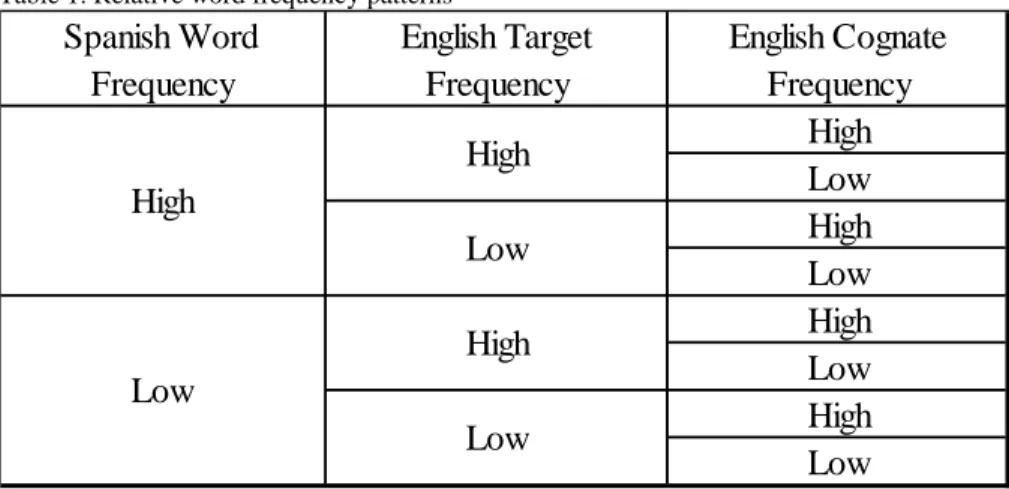
The control of Spanish word, English target, and English cognate frequency led to
Table 1. Relative word frequency patterns Spanish Word Frequency English Target Frequency English Cognate Frequency High Low High Low High Low High Low High Low High Low High Low
3.1.3 POLYSEMY OF THE SPANISH WORDS
In addition to controlling for the frequency of the Spanish word, the English target
(non-cognate) word, and the English cognate (non-target) word, the stimuli were
controlled in relation to the relative number of meanings for the Spanish word. The
Spanish words chosen for the stimuli set had either a relatively robust polysemous nature,
with many meanings (senses) or a relatively low polysemous nature, with very few
meanings (senses). For the purposes of this study a word with three (3) or more
meanings (senses) was classified as having a relatively robust polysemous nature, while a
word with two (2) meanings (senses) or less was classified as having a relatively low
polysemous nature. Determining the Spanish word’s number of meanings was a two-step
process:
1) Two sources were consulted, and the total number of meanings was a composite
of the meanings listed by the two sources. Webster’s New Spanish-English
Dictionary (Merriam-Webster, 2006) was examined first. As noun cognates were
one-word translation equivalents in English were also documented. Webster’s New
Spanish-English Dictionary numbers each meaning when more than one exists.
2) Each word was then looked up in the wordreference.com website
(WordReference.com LLC, n.d.) to identify and document any additional
meanings.
For the purposes of this study the composite of the meanings listed by the two sources
was used to classify the Spanish words as either having a relatively robust polysemous
nature or having a relatively low polysemous nature. The control of the polysemy of the
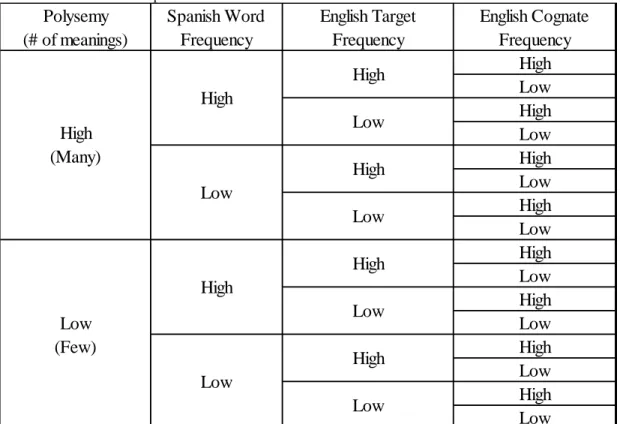
Spanish words, in combination with the frequency matching, resulted in a total of sixteen
(16) stimuli patterns as follows:
Table 2. The sixteen stimuli patterns
Polysemy (# of meanings) Spanish Word Frequency English Target Frequency English Cognate Frequency High Low High Low High Low High Low High Low High Low High Low High Low High (Many) Low (Few) High Low High Low High Low High High Low Low High Low
For each of the 16 types of stimuli, seven (7) or more sets of words (Spanish
word, English target word and English cognate) were selected for the prep phase of the
study. This yielded a total of 120 target stimuli sets. From these, a final list of 80 words
(5 per set) was determined / confirmed according to the results in the preparatory phase
experiment.
3.1.4 PREPARATORY-PHASE EXPERIMENT
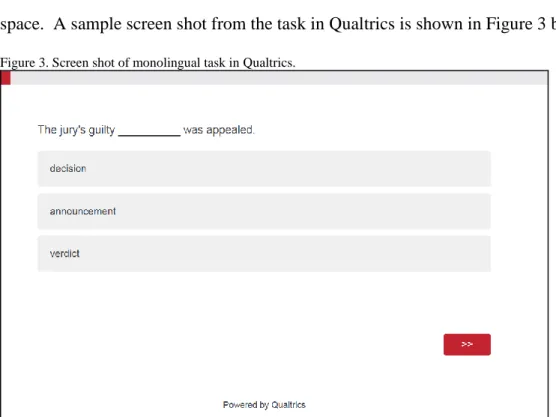
To ensure the best choice of English target (non-cognate) word stimuli for the
primary task above, a preparatory-phase experiment was conducted with monolingual
English speakers. The task consisted of the expected English translations of the target
sentences of the primary task, with a blank space in place of the English words to be
produced as the product of the translation. The monolingual English speakers’ task was
to choose from three (3) options which word they would expect to occur in that blank
space. A sample screen shot from the task in Qualtrics is shown in Figure 3 below:
3.1.4.1 Participants:
There were 20 participants in the preparatory-phase. The participants were 9
males, 10 females, and 1 anonymous native speaker of North American English. The participants’ ages ranged from 17 to 73 with a mean of 49.47 and a standard deviation of
20.07.
3.1.4.2 Design of preparatory phase experiment:
3.1.4.2.1 Stimuli
The preparatory-phase consisted of a multiple choice English sentence completion
task. Each sentence had a blank space in the body of the sentence. Immediately below
each sentence were three possible choices for the blank. The choices were nouns or short
phrases including a noun; the choices included the English target (non-cognate) word, the
English cognate (non-target) word, and one other synonym or related word. The stimuli
consisted of 120 sentences. An example of the preparatory-phase stimuli is shown in
Figure 3 above. The stimuli were randomized using a randomization function in the
Qualtrics software to scramble the presentation order of the 120 sentences. The
placement of the target word (non-cognate) response in each question was also controlled
and randomized.
3.1.4.2.2 Preparatory-phase procedure
The participants of the prep-phase were invited to the Qualtrics-based
(web-based) task by email. The email had a link to the Qualtrics-based task. At the website,
the participants were first shown the IRB approved Consent Form for the prep-phase and
asked to affirm or decline consent to participate by clicking on a corresponding button as
questionnaire, Appendix D. In addition to collecting minimal demographic information,
the questionnaire served to exclude participants that were not L1 English speakers or who
spoke Spanish or other language as an L2. After completing the questionnaire the
participants were given a brief instruction page that explained how to do the multiple
choice English sentence completion task. The instruction page is shown in figure 5
below.
Figure 5. Screen shot of instruction page for prep-phase language task in Qualtrics.
Of the 120 sentences, 112 sentences were evenly grouped in 16 sets of seven (7)
sentences. Each group represents one of the 16 controlled polysemy-frequency
patterns/sets discussed above. Each group included seven (7) English target
(non-cognate) and English cognate (non-target) words from the same controlled
polysemy-frequency pattern/set. Each group had two (2) extra sentences than required for the
primary experiment stimuli set. Of the 120 sentences, 8 were extra sentences from
various categories picked at random. The results of the prep-phase are shown in
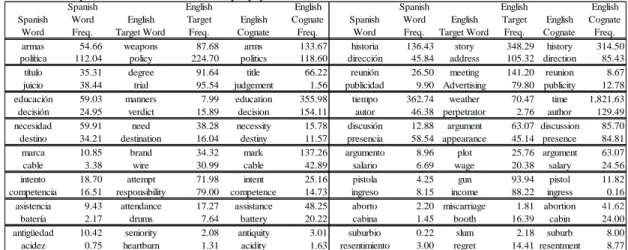
Appendix B-1 - B-4 and an excerpt of the words selected is shown below in Table 3.
Table 3. Sample list of words selected in prep-phase
Spanish Word Spanish Word Freq. English Target Word English Target Freq. English Cognate English Cognate Freq. Spanish Word Spanish Word Freq. English Target Word English Target Freq. English Cognate English Cognate Freq. armas 54.66 weapons 87.68 arms 133.67 historia 136.43 story 348.29 history 314.50 política 112.04 policy 224.70 politics 118.60 dirección 45.84 address 105.32 direction 85.43 título 35.31 degree 91.64 title 66.22 reunión 26.50 meeting 141.20 reunion 8.67 juicio 38.44 trial 95.54 judgement 1.56 publicidad 9.90 Advertising 79.80 publicity 12.78 educación 59.03 manners 7.99 education 355.98 tiempo 362.74 weather 70.47 time 1,821.63 decisión 24.95 verdict 15.89 decision 154.11 autor 46.38 perpetrator 2.76 author 129.49 necesidad 59.91 need 38.28 necessity 15.78 discusión 12.88 argument 63.07 discussion 85.70 destino 34.21 destination 16.04 destiny 11.57 presencia 58.54 appearance 45.14 presence 84.81 marca 10.85 brand 34.32 mark 137.26 argumento 8.96 plot 25.76 argument 63.07 cable 3.38 wire 30.99 cable 42.89 salario 6.69 wage 20.38 salary 24.56 intento 18.70 attempt 71.98 intent 25.16 pistola 4.25 gun 93.94 pistol 11.82 competencia 16.51 responsibility 79.00 competence 14.73 ingreso 8.15 income 88.22 ingress 0.16 asistencia 9.43 attendance 17.27 assistance 48.25 aborto 2.20 miscarriage 1.81 abortion 41.62
batería 2.17 drums 7.64 battery 20.22 cabina 1.45 booth 16.39 cabin 24.00 antigüedad 10.42 seniority 2.08 antiquity 3.01 suburbio 0.22 slum 2.18 suburb 8.00 acidez 0.75 heartburn 1.31 acidity 1.63 resentimiento 3.00 regret 14.41 resentment 8.77
The five English target words in each category picked the most by the monolingual
English speakers, and with no or minimal choices of the (non-target) cognate, were
chosen for the translation task. A target cut-off threshold was set at a minimum of 80%
of the monolinguals choosing the target word. When there was a "tie" within a given
group (i.e., more than one word was available for the fifth slot per category because the
target word had been chosen by an equal number of monolinguals), then choices of the
cognate were considered. The target word whose cognate was never picked or picked the
least among the other choices was then selected. When this criterion was also a tie, then
the choice with the least ambiguous sentence in Spanish was selected.
All but one of the final 80 words met this criterion: of the final 80 words, 43 were
selected by 100% of the monolinguals, 18 were selected by 95%, 13 by 90%, 3 by 85%,
and 2 by 80%. The one word (basis) that did not meet this threshold was selected by
75% of the monolinguals, and, while 25% of the monolinguals picked the distractor word
(foundation) in that trial, none of the monolinguals selected the English cognate (base).
Of the two words discarded in that category, one (direction) was only picked by 20% of
the monolinguals. Although the other discarded word (country) was picked by 85% of
the monolinguals, the cognate (nation) was picked by 15% of the subjects.
Consequently, (basis) seemed a better choice for the purposes of the translation task.
3.1.5 PRIMARY TRANSLATION TASK
3.1.5.1 Target stimuli:
From the results of the prep phase task, the five (5) English target (non-cognate)
primary experiment. In addition to the target stimuli, fillers and control stimuli were
constructed, as follows.
3.1.5.2 Words in filler stimuli:
Forty Spanish filler words were used in filler sentences. The filler words were selected using Webster’s New Spanish-English Dictionary (Merriam-Webster, 2006); and
the Merrriam-Webster’s Collegiate Dictionary (Merriam-Webster, 2006) at random.
Frequency and polysemy were not controlled for the filler words. The list of filler words
are presented in Appendix E.
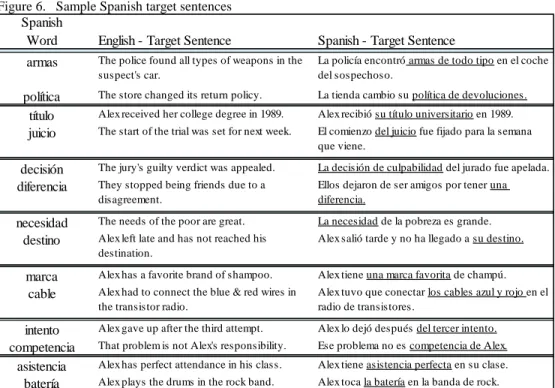
The target and filler Spanish words were presented in 80 target and 40 filler
sentences that are unambiguous in Spanish. For each sentence, the target or filler Spanish
word was included in a noun phrase or prepositional phrase. Sample sentences are
presented in Figure 6 below, and the full target set is shown in Appendix A. The list of
the filler sentences is attached as Appendix E.
Figure 6. Sample Spanish target sentences Spanish
Word English - Target Sentence Spanish - Target Sentence
armas The police found all types of weapons in the suspect's car.
La policía encontró armas de todo tipo en el coche del sospechoso.
política The store changed its return policy. La tienda cambio su política de devoluciones.
título Alex received her college degree in 1989. Alex recibió su título universitario en 1989.
juicio The start of the trial was set for next week. El comienzo del juicio fue fijado para la semana que viene.
decisión The jury's guilty verdict was appealed. La decisión de culpabilidad del jurado fue apelada.
diferencia They stopped being friends due to a disagreement.
Ellos dejaron de ser amigos por tener una diferencia.
necesidad The needs of the poor are great. La necesidad de la pobreza es grande.
destino Alex left late and has not reached his destination.
Alex salió tarde y no ha llegado a su destino.
marca Alex has a favorite brand of shampoo. Alex tiene una marca favorita de champú.
cable Alex had to connect the blue & red wires in the transistor radio.
Alex tuvo que conectar los cables azul y rojo en el radio de transistores.
intento Alex gave up after the third attempt. Alex lo dejó después del tercer intento.
competencia That problem is not Alex's responsibility. Ese problema no es competencia de Alex.
asistencia Alex has perfect attendance in his class. Alex tiene asistencia perfecta en su clase.
The translation task was constructed using Qualtrics, a web-based survey
platform. For the translation task, each sentence appeared in black text on a white
background. The sentences were shown to the participants on the screen one at a time.
Each sentence had a short phrase underlined and it was the participant’s task to translate
that phrase into English as used in the context of the sentence.
The software used consisted of MS PowerPoint, MS Excel, Windows 2010,
Qualtrics and SPSS. The web-based task was available 24 hours/day from 9/05/16 to
9/15/16. After the completion of the translation task, the results were collected for
coding into MS Excel and SPSS.
3.1.5.3 Participants:
The participants for the primary task (translation task) were Spanish (L1) –
English (L2) bilinguals -- in particular, adult intermediate to mastered English language
learners. For the purposes of this research intermediate to mastered English language
learners were defined to included bilinguals that met the following criteria: i) began
learning English at post high school age, ii) self-reported their level as intermediate,
advanced or mastered, and/or iii) was currently enrolled in intermediate level or higher
level English classes of a post-secondary level English language program.
Acceptance of participants was based on a language background questionnaire,
Appendix F. In aggregate the pool consisted of 50 participants. There were 13 male
(26%) and 37 female 74% participants. The mean age was 31.8 with a standard deviation
3.1.5.4 Procedure:
The participants were invited to the Qualtrics-based (web-based) task by email
and flyer. At the website, the participants were first shown the IRB-approved Consent
Form and asked to affirm or decline consent to participate by clicking on a corresponding
button as shown in Figure 7 below.
Figure 7. Screen shot of Consent to Participate selection in Qualtrics.
Next the participants were given a language questionnaire, Appendix F. In addition to
collecting minimal demographic information, the questionnaire served to exclude
participants who were not Spanish/English bilinguals or were native or near-native
English speakers. On completing the questionnaire the participants were given a brief
instruction page that explained the translation task of 120 sentences from Spanish to
Figure 8. Screen shot of instruction page for Translation Task in Qualtrics.
The participants typed their answer in the blank space (box) immediately below the
sentence. A sample of how each question appeared in Qualtrics is shown in Figure 9
below. The participants advanced to the next screen by clicking on the red arrows on the
screen. The participants were not able to go back. The last sentence was followed by a
final screen that thanked the participants for completing the translation task.
4. RESULTS
The responses of the participants could consist of the (incorrect) English cognate,
the (correct) English target, or some other expression. In most cases, the word used was
either the cognate or the target, so the proportional choices of these two were generally
inverses of each other. There was an occasional use of an expression other than the
cognate or target. For the purposes of analyses, the use of the English cognate will be
analyzed first, followed by an analysis of the use of the English target. Subsequent
qualitative analyses will examine those cases in which there were high numbers of other
expressions used.
4.1 English Cognates
Participants were scored “1” if they translated the Spanish cognate to the English
cognate non-target word. Participants were scored “0” if they translated the Spanish
cognate to the English target or any other word. A repeated-measures ANOVA in which
polysemy level (high, low) of the Spanish word ("polysemy"), frequency of the Spanish
word (high, low) ("Span freq"), frequency of the English target word (high, low) ("targ
freq"), and frequency of the English cognate word (high, low) ("cogn freq") were entered
as independent variables, and proportional use of the English cognate was entered as the
dependent measure.
The results showed a significant main effect for polysemy, F(1, 49) = 19.669, p <
.001; targ freq, F(1, 49) = 74.419, p < .001; and for cogn freq, F(1, 49) = 55.095, p <
.001. There were more uses of the cognate when the Spanish word had low polysemy
(.51) than when it had high polysemy (.44); when targ freq was low (.58) than when it
These main effects were modified by significant interactions of Polysemy X
Span Freq, F(1, 49) = 8.178, p = .006; Polysemy X Targ Freq, F(1, 49) = 17.911, p <
.001; Polysemy X Cogn Freq, F(1, 49) = 9.087, p = .004; Span Freq X Cogn Freq, F(1,
49) = 15.283, p < .001; Polysemy X Span Freq X Targ Freq, F(1, 49) = 25.563, p < .001;
Polysemy X Span Freq X Cogn Freq, F(1, 49) = 72.013, p < .001; and Span Freq X Targ
Freq X Cogn Freq, F(1, 49) = 22.065, p < .001.
Performance by polysemy level, Spanish frequency, target frequency, and cognate
frequency is shown in Figure 10 below. To explore the interactions, follow up analyses
were conducted in which the two polysemy levels were examined separately.
Figure 10. Means for proportional use of English cognate
0.710 0.680 0.474 0.378 0.408 0.621 0.569 0.496 0.192 Pr o p o rt io n al U se o f En gl is h C o gn at e 0.544 0.874 0.320 0.409 0.196 0.60 0.70 0.80 0.90 1.00 0.0
Targ Freq High - Cogn Freq High Targ Freq High - Cogn Freq Low Targ Freq Low - Cogn Freq High Targ Freq Low - Cogn Freq Low
Spanish Polysemy High Spanish Polysemy Low
Spanish Frequency High Spanish Frequency Low Spanish Frequency High Spanish Frequency Low 0.340 0.368 0.10 0.20 0.30 0.40 0.50
4.1.1 HIGH SPANISH POLYSEMY
For the items involving high polysemy in Spanish, analyses showed a significant main
and cogn freq, F(1, 49) = 82.3, p < .001. Again, the cognate was used in English more
often when the Span freq was high (.48) than when it was low (.40). Similarly, the
cognate was used in English more often when the targ freq was low (.51) than when it
was high (.37). Finally, the English cognate was used more often when the cogn freq
was high (.55) than when it was low (.33).
There were also significant interactions of Span Freq X Targ Freq, F(1, 49) =
15.763, p < .001; Span Freq X Cogn Freq, F(1, 49) = 87.894, p < .001; and Span Freq X
Targ Freq X Cogn Freq, F(1, 49) = 15.904, p < .001.
To further explore these interactions, additional analyses were conducted
controlling for the Spanish frequency. When the Spanish frequency was high, the results
showed a significant main effect for targ freq, F(1, 49) = 29.068, p < .001, with a low
targ freq (.60) yielding more cognate responses then high targ freq (.37), and cogn freq,
F(1, 49) = 156.453, p < .001, with high cogn freq (.71) yielding more cognate responses
than low cogn freq (.26). The results also show a significant interaction of Targ Freq X
Cogn Freq, F(1, 49) = 8.670, p = .005. Use of the cognate was especially high when the
target was infrequent and the cognate frequent.
When Spanish frequency was low, the results showed a significant interaction of
Targ Freq X Cogn Freq, F(1, 49) = 8.504, p = .005. In this case it appeared that even
when the cogn freq was high, it was avoided, possibly because the cognate in this
condition was known (familiar enough) not to be the translation equivalent for the
4.1.2 LOW SPANISH POLYSEMY
For the items involving low polysemy in Spanish, analyses showed significant
main effects for targ freq, F(1, 49) = 75.264, p < .001; and cogn freq, F(1, 49) = 6.828, p
= .012 . Here, the cognate was used in English more often when the tarq freq was low
(.42) than when it was high (.37).
There were also significant interactions of Span Freq X Targ Freq, F(1, 49) =
9.253, p = .004; Span Freq X Cogn Freq, F(1, 49) = 7.160, p = .010; and Span Freq X
Targ Freq X Cogn Freq, F(1, 49) = 10.803, p = .002.
To explore these interactions, additional analyses were conducted controlling for
Spanish frequency. When the Span freq was high, the results showed a significant main
effect for targ freq, F(1, 49) = 23.529, p < .001. The cognate was used in English more
often when the targ freq was low (.60) than when it was high (.39)
When the Span freq was low, the results showed a significant main effect for targ
freq, F(1, 49) = 82.578, p < .001; cogn freq, F(1, 49) = 14.124, p < .001; and a significant
interaction of Targ Freq X Cogn Freq, F(1, 49) = 13.026, p = .001. More cognates were
used when targ freq was low (.70) than when it was high (.34), and inversely the cognate
was used more often when cogn freq was high (.60) than when it was low (.44). The
fewest uses of the cognate occurred in the condition in which the targ freq was high but
the cogn freq low.
4.2 English Targets
A second set of analyses examined the correct use of the English target words.
Analyses were similar to those in the case of the use of the English cognates, but here
Spanish cognate to the English target non-cognate word (whereas in the previous
analyses, scoring gave a "1" for the use of the cognate). Participants were scored “0” if
they translated the Spanish cognate to the English cognate or any other word. A
repeated-measures ANOVA in which polysemy level (high, low) of the Spanish word
("polysemy"), frequency of the Spanish word (high, low) ("Span freq"), frequency of the
English target word (high, low) ("targ freq"), and frequency of the English cognate word
(high, low) ("cogn freq") were entered as independent variables, and proportional use of
the English target word was entered as the dependent measure.
The results showed a significant main effect for Span freq, F(1, 49) = 6.429, p =
.014; and targ freq, F(1, 49) = 139.279, p < .001. The English target word was used only
slightly more when the Span freq was high (.49) than when it was low (.44), and when
the targ freq was high (.58) than when it was low (.35).
These main effects were modified by significant interactions of Polysemy X Targ
Freq, F(1, 49) = 6.674, p = .013; Span Freq X Targ Freq, F(1, 49) = 6.601, p = .013; Span
Freq X Cogn Freq, F(1, 49) = 21.383, p < .001; Targ Freq X Cogn Freq, F(1, 49) =
6.205, p = .016; Polysemy X Span Freq X Targ Freq, F(1, 49) = 11.608, p = .001;
Polysemy X Span Freq X Cogn Freq, F(1, 49) = 307.241, p < .001; Polysemy X Targ
Freq X Cogn Freq, F(1, 49) = 6.780, p = .012; Span Freq X Targ Freq X Cogn Freq, F(1,
49) = 136.069, p < .001; and Polysemy X Span Freq X Targ Freq X Cogn Freq, F(1, 49)
= 12.253, p = .001.
Performance by polysemy level, Spanish frequency, target frequency, and cognate
frequency is shown in Figure 11 below. Here again, to explore the interactions, follow up
Figure 11. Means for proportional use of English target word
Spanish Frequency Low Spanish Frequency High Spanish Frequency Low Targ Freq High - Cogn Freq High
Targ Freq Low - Cogn Freq High
Targ Freq High - Cogn Freq Low Targ Freq Low - Cogn Freq Low
Pr o p o rt io n al U se o f En gl is h T ar ge t W o rd 0.90 0.10 0.0 0.80 0.70 0.40 1.00 0.76 0.740 0.402 0.30 0.20 0.60 0.50 0.486 0.396 0.352 0.432
Spanish Frequency High
Spanish Polysemy High Spanish Polysemy Low
0.427 0.214 0.570 0.600 0.132 0.818 0.235 0.257 0.611
4.2.1 HIGH SPANISH POLYSEMY
For the items involving high polysemy in Spanish, analyses showed a significant
main effect for targ freq, F(1, 49) = 58.881, p < .001. The English target word was used
more often when it was a frequent word (.57) than when it was infrequent (.38).
There were also significant interactions of Span Freq X Cogn Freq, F(1, 49) =
204.451, p < .001; Targ Freq X Cogn Freq, F(1, 49) = 12.944, p = .001; and Span Freq X
Targ Freq X Cogn Freq, F(1, 49) = 23.054, p < .001.
To further explore these interactions, additional analyses were conducted
controlling for the Span freq. When the Spanish frequency was high, the results showed
a significant main effect for targ freq, F(1, 49) = 53.604, p < .001; and cogn freq, F(1, 49)
= 135.314, p < .001; and no significant interactions. The English target word was used
target word was used more when cogn freq was low (.67) than when it was high (.32).
Use of the target was especially high when the targ freq was high and the cogn freq was
low. When Spanish frequency was low, the results showed a significant main effect for
targ freq, F(1, 49) = 22.701, p < .001; and cogn freq, F(1, 49) = 63.101, p < .001; and a
significant interaction of Targ Freq X Cogn Freq, F(1, 49) = 32.137, p < .001. Again here
the target was used more often when targ freq was high (.54) than when it was low (.37).
However, in contrast to the previous condition, here the target was used more when the
cogn freq was high (.61) than when it was low (.31).
4.2.2 LOW SPANISH POLYSEMY
For the items involving low polysemy in Spanish, analyses showed a significant
main effect for targ freq, F(1, 49) = 106.998, p < .001. The English target was used more
often when targ freq was high (.59) than when low (.32).
There were also significant interactions of Span Freq X Targ Freq, F(1, 49) =
16.059, p = < .001; Span Freq X Cogn Freq, F(1, 49) = 60.564, p = < .001; and Span Freq
X Targ Freq X Cogn Freq, F(1, 49) = 88.657, p < .001.
To further explore these interactions, additional analyses were conducted
controlling for the Span freq. When the Spanish frequency was high, the results showed
significant main effects for targ freq, F(1, 49) = 20.630, p < .001; and cogn freq, F(1, 49)
= 17.094, p < .001, and a significant interaction of Targ Freq X Cogn Freq, F(1, 49) =
45.433, p < .001. When controlling for Spanish polysemy low and Spanish frequency
high, the English target use was higher when targ freq was high (.57) and lower when low
than when low (.41). Further qualitative analyses were done to explain the absence of the
inverse condition expected and observed in most of the other conditions.
For Span freq low, the results showed significant main effects for targ freq, F(1,
49) = 137.408, p < .001, and cogn freq, F(1, 49) = 36.071, p < .001; and a significant
interaction of Targ Freq X Cogn Freq, F(1, 49) = 40.202, p < .001. Here the expected
inverse between English target use and English cognate use was present. The target was
used more when the targ freq was high (.61) than when low (.25) and the target was used
less when cogn freq was high (.33) than when it was low (.53).
4.3 Other Expressions Used
Although in most cases the responses of the participants were either the
(incorrect) English cognate or the (correct) English target, there was some use of an
expression other than the cognate or target. Figure 12 below shows cumulatively the
cognate use plus the target use for each condition demonstrating that these two choices
were generally inverses of each other. In one case in particular in which the use of
alternative words in the translation was high Spanish polysemy was high, the English
target frequency was low, and the English cognate frequency was low as well. This
means that a significant number of participants chose neither the target nor the cognate in
English. Specifically this occurred with two stimuli sentences: 1. Las autoridades
realizaron un examen del banco hoy, for which the Spanish cognate, English target and
English cognate were examen, inspection, and exam, respectively; and 2. La vela tiene un
olor estupendo, Spanish cognate, English target and English cognate were olor, scent,
cognate examen to test, and 26% (13) to various choices other than target or cognate.
Likewise, 82% (41) of the participants translated olor to smell.
Figure R-3, Comparison of raw use of English Cognate vs Target.
Targ Freq High - Cogn Freq High Targ Freq High - Cogn Freq Low English Target Use
Targ Freq Low - Cogn Freq High Targ Freq Low - Cogn Freq Low English Cognaet Use
0.90 0.30 1.00 R aw U se o f En gl is h Cogn at e an d T ar get 0.60 0.50 0.40 0.80 0.70 0.20 0.10 0.0 0.304
Spanish Frequency High Spanish Frequency Low Spanish Frequency High
Spanish Polysemy High Spanish Polysemy Low 0.444
0.176 0.660
0.304 0.368 0.292
Spanish Frequency Low 0.380 0.648 0.504 0.504 0.420 0.168 0.532 0.544 0.628 0.196 0.368 0.356 0.364 0.512 0.480 0.448 0.640 0.228 0.208 0.516 0.180 0.372 0.320 0.368 0.356 5 DISCUSSION
In general, these results support the position that cross-language non-isomorphic cognates may impede an L2 English language learner’s (ELL) ability to use the best
translation equivalent for a given context under certain conditions. In this study, the
conditions tested were the polysemous nature of the Spanish cognate word (two levels:
high, low), the frequency of the Spanish cognate (high, low), the frequency of the English
target non-cognate word (high, low), and the frequency of the English cognate, non-target
word (high, low). This was done through a translation task experiment. Two sets of
analyses were run to understand the conditions in which either the English cognate or the
5.1 English Cognates
The first set of analyses was conducted to measure the proportional use of the
English cognate in the translation task experiment. The results showed that polysemy,
the English target frequency, and the English cognate frequency were important in the participant’s choice of translation equivalent. The participants used the English cognate
more often when the Spanish word had a low polysemous nature, when the English target word’s frequency was low, and/or when the English cognate word’s frequency was high.
This can be interpreted to mean that when the L2 English language learners’ knowledge
of the Spanish word was such that it had a more absolute singular or very limited
meaning they would lean to the English cognate as their translation equivalent. Likewise, when the English cognate’s frequency was high, the L2 learners were more likely to use
it and map it onto the meaning of the Spanish cognate. In contrast when the English target word’s frequency was low it was less likely to be known and less likely to overtake
the cognate’s use.
The statistical measures/results also indicated that there were significant
interactions between the variables polysemy, Spanish frequency, English target word
frequency, and the English cognate’s frequency that affected the selection choice of the
English cognate as a translation equivalent. Specifically the use of the English cognate was especially high when the English target word’s frequency was low and the English
cognate’s frequency was high. However, there was some evidence that sometimes when Spanish frequency was low, even when the English cognate’s frequency was high, the
cognate was not used, possibly because the English cognate in this condition was known
word. In general however, the English cognate was used the least in the condition in which the English target word’s frequency was high but the English cognate’s frequency
was low.
5.2 English Targets
The second set of analyses was conducted to measure the proportional use of the
English target word in the translation task experiment. The results showed that overall the Spanish word’s frequency and the English target word’s frequency were significant in
the choice of the English target word as the translation equivalent. Analyses indicated
that the use of the English target word was especially high when the target frequency was high while the cognate’s frequency was low. Although under certain conditions such as
when the Spanish word frequency was low the target word was used more often even
when the cognate frequency was high. Again, this might be interpreted to mean that sometimes, even when the English cognate’s frequency was high, the English cognate
was not considered a match to the Spanish word because the L2 participant was more familiar with the meaning of the English cognate and knew it wasn’t the best match.
5.3 Other Expressions Used
In general the L2 participants chose either the English cognate or the English
target as the translation equivalent. In many of the conditions analyzed these two choices
appear inverse to each other. However, there were some expressions/words used other
than the cognate or target, particularly when the Spanish word was high in polysemy and
the frequencies of the Spanish word, the target word, and the English cognate were all
5.4 Cross-Language Interaction
The results of this study seem to further evidence an aspect of cross-language
interaction as it relates to how lexical selection works when two languages are involved.
It appears that the selection of the English target word was subject to competition from
other activated lexical items, namely the Spanish cognate and English cognate. This is
consistent with research that has demonstrated that when the two languages of a bilingual
are involved, they also enter into competition during lexical selection (Costa, Caramazza,
& Sebastián-Gallés, 2000). Consequently, in reading the sentence in the translation task
and in recognizing the Spanish cognate, information may have become active not only for
the Spanish cognate word but also for other words that share aspects of lexical form with
the Spanish cognate, such as the English cognate. Word recognition and use is
characterized as a parallel process in which information at different levels interacts
(Kroll, Sumutka, & Schwartz, 2005; McClelland & Rumelhart, 1981), in this case, until
either the English cognate, English target or some other expression surfaced and was
selected. Moreover, it is aspects of lexical form and its representation in the two
languages that become active; when bilinguals read words in one of their languages,
information about orthography, phonology and semantics in the other language becomes
active (Kroll, Sumutka, & Schwartz, 2005). Thus, when the participants in this study
read the Spanish cognate, information about orthography and semantics in the other
language became active.
5.5 Cognates
Cognates have a similar form and meaning across languages, and generally are
languages (Schwartz, Kroll & Diaz, 2007; Peeters, Dijkstra, & Grainger, 2013). In
contrast, with non-cognates, such as the English target words which were the best
translation equivalent given the context of the sentence in the study, there is no obvious
indication of a relation between it and the Spanish word in the translation task. A default
assumption might be that similarity of form corresponds to a similarity of meaning
between the Spanish cognate and the English cognate. Thus in certain conditions, the
participants chose the English cognate (incorrect word given the context) over the
English target word (correct word).
5.6 Polysemy
This study did find that relative polysemy was a significant factor in the participants’ choice of word to use. Moreover, under certain conditions, as explained above, the cognates may have been a double-edged sword for some of the L2 language
learners because of the Spanish word's multiple meanings. The number of senses or
meanings each word had was language-specific. In other words, the Spanish cognate in the participants’ L1 could have had four meanings while the English cognate only had
two meanings in their L2. Moreover, the L2 learners in the study would have been aware
of more meanings for words in their L1 than in their L2 (Finkbeiner, M., Forster, K.,
Nicol, J., & Nakamura, K. 2004).
5.7 Frequency
The word frequency of the Spanish word, English target word, and English cognate in this study were all significant in the participants’ choice of translation equivalent in completing the translation task. In the overall statistical results the frequency of the English target word and the frequency of the English cognate were
important variables in the use of either the target or the cognate. However, the frequency of the Spanish word also had a significant impact on the choice of the translation
equivalent.
5.8 Other Factors
In addition to the impact of cognates, polysemy and frequency on the choice of the best translation equivalent in this study, there were other factors that should be considered. The participants’ proficiency level in English, attitudes toward the L2, ageat which learning English started, length of time in the country, length of time spent
studying English, and whether or not they were currently taking English classes may have also been factors. However, the design of the experiment controlled, statistically
speaking, for the polysemous level of the Spanish cognate and the frequency levels of the Spanish cognate, the English target and the English cognate only. The proficiency level was controlled in as much as only intermediate to highly advanced L2 English language speakers were recruited. These other factors remain to be explored in future research.
6 CONCLUSION
This study set out to determine if L2 English (L1 Spanish) bilingual speakers who
learned English as adults had difficulty with cognate words whose meanings are distinct
across their two languages. Thus specifically, this study and experiment explored the
extent to which these variations in meaning in cross-language cognates affected L2
performance in a sentence translation task. The results of the experiment confirmed that
the variations in meaning due to cross-language non-isomorphic cognates do affect adult
the word frequency of the three words involved: Spanish cognate, English target
(non-cognate), and English cognate. The implication of these results include a better
understanding of the translation process of an adult L2 in relation to how they maneuver
through various conditions or patterns of frequency and polysemous nature of cognates.
This in turn informs linguists and Second Language Acquisition professionals as to the
potential of cognates to both facilitate and impede adult L2 speakers selecting the best