Lilian Kek Siew Yick,
Open University Malaysia,
[email protected]
Mansor Fadzil,
Open University Malaysia,
[email protected]
Harvinder Kaur Dharam Singh,
Open University Malaysia,
[email protected]
Working adults acquire valuable knowledge and skills throughout their lives and work experience. Learning occur through informal and non-formal means may be given due recognition and upon proper assessment, be used for advance standing or as an entrance qualification for access into higher education. Although the assessment of prior learning is common in developed countries, its practice in Malaysia is limited. Open University Malaysia (OUM) is a pioneer in the recognition of prior learning (RPL) efforts in the country. At present, its RPL practices include the (a) Flexible Entry System, a gateway for individuals to pursue higher education using lower academic entry qualifications and (b) Accreditation of Prior Experiential Learning (APEL), an avenue to assess and grant individuals with academic credits based on their experiential learning. This paper presents the RPL practices at OUM with a focus on APEL. It highlights the principles as well as processes of APEL within the institution. The description of the myAPEL system - an instrument specifically developed to capture and evaluate prior experiential learning based on specific learning outcomes - is included. The challenges involved in developing myAPEL and its benefits will also be discussed. This paper will be beneficial for institutions as well as learners who intend to capitalise on RPL.
Keywords: Recognition of Prior Learning, Accreditation of Prior Learning, Open University
Recognition of Prior Learning (RPL) is analogous to adult learning. Its practices are common in developed countries such as United Kingdom, Australia, South Africa, Canada, New Zealand and the United States. The definition of RPL varies according to the activities practiced within each country. For example, prior learning is known as Accreditation of Prior Learning in the United Kingdom; Recognition of Prior Learning in Australia, South Africa, Scotland and Ireland; Recognition of Current Competency in New Zealand and Prior Learning Assessment in the United States (Nyataya, Forman, & Fox, 1998). Although variations exist, the key notion lies in the fact that learning that occur from past experiences regardless of its source, time, and place can be recognised and duly acknowledged as credentials to the deserving individual.
RPL practices in Malaysia are limited. At institutions of higher learning, RPL allows working adults to further their education through distance learning on a part-time basis. The number allowable for admission however, is restricted. On the other hand, the practice is more intensive at open universities. Apart from admission to a programme of study, RPL is also used for advance standing, programme placement and award of academic credits.
This paper presents the RPL practices at Open University Malaysia (OUM) with a focus on Accreditation of Prior Experiential Learning (APEL). It highlights the principles as well as processes of APEL within the institution. The description of the myAPEL system - an instrument specifically developed to capture and evaluate prior experiential learning based on specific learning outcomes - is included. The challenges involved in developing myAPEL and its benefits will also be discussed. This paper will be beneficial for institutions as well as learners who intend to capitalise on RPL.
The concept of RPL is embedded within the Malaysian Qualifications Framework (MQF) and the Malaysian Qualifications Agency (MQA) Act 2007. The MQF acts as a reference point that explains and describes the Malaysian education system in an international context. The framework outlines the education pathways that link all higher education qualifications systematically. Based on the lifelong learning philosophy, the MQF recognises an individual’s potential to progress in higher education through the transfer of credits and recognition of prior learning. In other words, MQF has identified Accreditation of Prior Experiential Learning (APEL) as an alternative route for unconventional learners to progress into the various levels of qualification. Table 1 shows the mapping of APEL to the various levels of qualifications in the Malaysian Qualification Framework. According to the MQF, “the method of achieving learning outcomes should not be limited to only formal education, but its attainments can be assessed through APEL for learning acquired through formal, non-formal and informal means” (p. 4). In the MQA Act (2007) (Act 679), prior learning is defined as “knowledge, skills or attitudes previously acquired” (p.6) while the recognition of prior learning is “a verification process of an individual’s achievement of a set of learning outcomes acquired through formal, non-formal or informal learning irrespective of time and place” (p. ii). MQA has also identified APEL as “a systematic process that involves the identification, documentation and assessment of prior experiential learning” (translated from MQA’s website http://www.mqa.gov.my) to determine the extent to which an individual has achieved the desired learning outcomes, for access to a programme of study and/or award of credits.
Sectors MQF Levels
Skills Vocational & Technical Higher Education Lifelong Learning 8 Doctoral Degree 7 Masters Degree 6 Postgraduate Certificate & Diploma
5 Advance Diploma Advance
Diploma
Advance Diploma
4 Diploma Diploma Diploma
3 Skills Certificate 3 Certificate
2 Skills Certificate 2
1 Skills Certificate 1
Vocational and Technical Certificate
Source: Malaysian Qualifications Framework (http://www.mqa.gov.my/en/utama_mqf.cfm)
The Malaysian Ministry of Higher Education (MOHE) introduced the Open Entry System as an alternative admission route for non-conventional learners to undertake studies at institutions of higher learning in the country. OUM was selected to spearhead this initiative in 2006. Under the Open Entry System, applicants who do not meet the academic criteria for first degree studies at conventional universities, can now leverage on their prior learning and work experience. Although the admission requirement is relatively less stringent, the applicants are still subjected to other admission criteria namely age, a minimum qualification and an assessment of prior learning. For entry into an Undergraduate Degree Programme, an applicant must be at least 21 years of age and possess a minimum Lower Certificate of Education/Sijil Rendah Pelajaran/Penilaian Menengah Rendah while to enter into a Postgraduate Degree Programme, the applicant must have reached the age of 35 and possess a minimum academic qualification of Diploma/A-Levels/Sijil Tinggi Pelajaran Malaysia. The applicants will also be required to undertake the Flexible Entry Assessment whereby their prior learning and work experience will be assessed to examine their ability, interest and readiness to pursue the programme of choice. At present, more than 4,000 learners* have enrolled into OUM programmes through this route (*Source:
Data from Admission and Records, OUM). In 2009, a study was conducted to compare the persistency and performance of OUM learners from the Open Entry System with those from the conventional route. The study indicated higher persistency and performance among the former compared to the latter. (Latifah , Mansor, & Kek , 2009)
Another significant milestone of RPL at OUM is the Accreditation of Prior Experiential Learning (APEL). This initiative is an avenue that recognises, assesses and awards learners with academic recognition for experiential learning. Through APEL, learners can now claim course credits for non-formal and innon-formal learning apart from their non-formal learning. The European Commission’s Memorandum on Lifelong Learning differentiates between the three types of learning. Formal learning “takes place in education and training institutions, and leads to recognised diplomas and qualifications”. Non-formal learning, on the other hand, “occurs alongside the formal systems of education; however it may not necessarily lead to formalised certifications”. Such learning often happens at the workplace. Informal learning is viewed as “a natural accompaniment to everyday life”. It is unintentional and often overlooked as valuable learning. Regardless of the source of learning, APEL recognises the valuable knowledge, skills and competencies acquired by working adults and assesses the extent to which these match the specific learning and competency outcomes for a stipulated course. Credits are awarded to deserving learners if they are able to provide sufficient supporting evidence of their prior learning. By doing so, learners receive exemption and are no longer required to undertake studying of that particular course.
APEL is relevant to OUM as an institution of lifelong learning as well as for its learners who are mainly adults in the workforce. As an alternative form of assessment, APEL can benefit learners, their employers as well as the providing institution. APEL recognition indicates several advantages to learners. It encourages individuals to access formal education; it has potential cost and time savings in obtaining academic credentials; it reduces duplication in learning, and most importantly it boosts self-esteem and confidence among individuals as they gain validation for learning that occur through their work and life experiences. To employers, APEL provides recognition for workplace learning such as training and staff development activities as well as reduces the amount of time required for employees to be away from work due to their studies. From the institution’s point of view, APEL reflects flexibility in assessing adult learners, and enables appropriate learner placement programmes. APEL can also be a tool to retain and recruit adult learners apart from enhancing the institution’s image as a provider of lifelong learning.
The APEL principles used at OUM incorporated Evan’s (1988) guiding principles to APEL. Among them:
1. Learner is responsible for RPL claims
Learning occurs throughout an individual’s lifetime; consciously or subconsciously. Where relevant, learning that can be measured, can also be assessed for academic credentials regardless of its source and time. Through APEL, OUM has created an avenue for their learners; the working adults, to exchange experiential learning for academic credits. The prime responsibility now lies on
They must be able to document what has been learnt, relate it to course learning outcomes and provide sufficient evidence to support their claims.
2. Credits are awarded for learning, not experience
APEL awards credits based on learning and not on the experience itself. A common error in assessing prior learning occurs when learning is quantified by the amount of time spent having the experience rather than evaluating the learning that takes place. Not all experience is relevant to the learning outcomes for a course. APEL in particular only considers significant, relevant and evidenced learning. Experiential learning that contains academic value can be converted into course credits upon proper assessment and validation methods.
3. Separation of roles between advisor and assessor
There should be a distinction between the roles of the APEL advisor and assessor. An APEL advisor provides training and professional advice for learners. The advisor takes on the role of a facilitator who assists learners in preparing and compiling claims and evidence for prior learning assessment. The assessor, on the other hand, is the subject matter/course expert from the faculty. The assessor evaluates the learner’s claims by examining the evidence and using various validation methods, verifies and make judgment on the award of prior learning credits. The distinction between both roles is necessary to ensure objectivity and neutrality in assessment.
4. Quality assurance within the APEL process
A quality assurance mechanism must be established in order to create confidence amongst APEL users and the general public. The mechanism should comprise of: the inclusion of APEL policies at institution level, the establishment of an APEL assessment centre, clear guidelines and instructions on APEL procedures, and continuous improvement in APEL services to its stakeholders.
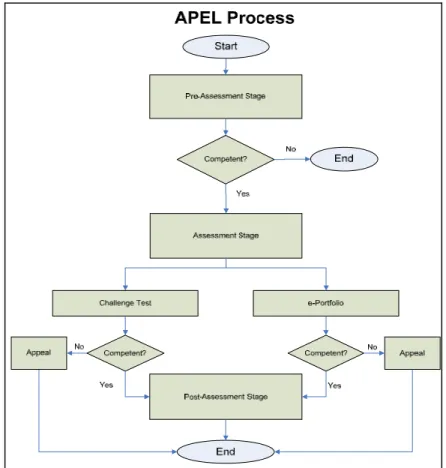
The APEL process outlines three major stages for learners who intend to pursue recognition for experiential learning. The three stages are the Pre-Assessment, Assessment and Post-Assessment stage. Since the assessment used at each stage varies, learners advance only upon satisfying the criteria for a particular stage. Figure 1 displays the APEL process at OUM.
At the Pre-Assessment stage, learners indicate their intention to apply APEL for courses which they claim to have prior knowledge. Learners complete an online Knowledge Resume; providing detailed information on education background, work experience, and other forms of learning relevant to the course applied. Thereafter, their applications will be reviewed by subject matter/course experts from the corresponding faculties. Only learners with relevant experiential learning and those who show potential of being successful will be allowed to proceed to the following stage of Assessment. The filtering process of applicants at this point would provide a clear and timely indication as to whether a learner should proceed with APEL. The next level is known as the APEL Assessment stage. Here, learners are assessed either through Challenge Tests (using various forms of assessment) or are required to build a portfolio of evidence to support their prior learning claims. Both assessments are developed based on specific course learning outcomes and are assessed by subject matter/course experts. The Post-Assessment stage includes processes resulting from the APEL assessment; namely the award of course credits and the appeal mechanism. Learners, who are successful in the APEL assessment, are awarded with course credits. They
are also exempted from undertaking the course. On the other hand, unsuccessful learners will be required to undergo the course through the usual method. An appeal mechanism is available should learners intend to petition for their results.
Figure 1: APEL Process at OUM
myAPEL is an online system developed for the purpose of prior learning assessment. It creates, manages and maintains information with regards to the learners’ application for prior learning credits. The system encapsulates and documents each assessment process; from the Pre-Assessment stage up to the Post-Assessment stage. This means that learners are able to view their progress from application to assessment and finally to the award/non-award of credits. myAPEL evaluates learners’ prior learning claims against specific course learning outcomes. The next section will only describe the use of myAPEL for portfolio assessment purposes.
In portfolio assessment, learners are guided on how to use the myAPEL system for online submission of portfolios. They are trained on how to write prior learning claims as well as select relevant evidences to support their claims. Learners then input their claims and attach evidences into the system before submitting the portfolios. They may attach various file types such as images, documents, web files, audio/video and even 3D files as evidence. The system allows learners time to make adjustments prior to
learners. Upon submission, the portfolios will be assigned to designated assessors using a random method of allotment. Assessors view the portfolios and are required to validate the evidences prior to their evaluation. They then rate the learner’s portfolio based on a-four criteria assessment rubric; namely relevancy, authenticity, sufficiency and currency. The evaluation is based on the extent to which the learners’ prior experiential learning claims and evidence matched the learning outcomes of the specific course. The outcome of the evaluation will determine if credits are awarded.
myAPEL is an integrative system that brings together relevant information of learners from various database sources for the purpose of prior learning assessment. The system is customised to each individual learner’s landscape based on their existing status within the programme of study. The myAPEL system manages the learners’ applications from the beginning up to the end. After the Post-Assessment stage, results must be integrated with the student information and campus management system. Due to its complexity, several challenges are encountered during its development; beginning from conceptualisation to its implementation.
1. Model Conceptualisation
According to Jafari (2004), building an online environment for assessment can be a daunting task. It begins with the understanding of the philosophy behind prior learning and requirements in each stage of assessment, and ends with the translation of those requirements into a software management system. Jafari (2004) identified the importance of stating the functional and technical requirements at the early stage of conceptual design. The interconnectivity between each processes and procedures must be identified prior to the development of the system.
2. System Development
myAPEL caters to a number of users, namely the learners, assessors as well as the system administrators. Due considerations must be taken when fulfilling the different needs of these users. System developers must create requirements that meet the expectations of users. Having a user-friendly interface would indicate the need to incorporate a “well-reasoned navigational scheme and logical user interface design” (Jafari, 2004, p.39). The infrastructure to support and sustain the system must also be put in place to handle massive submission of portfolios and integration of learner information to the existing database. It is also crucial for system developers to obtain feedback from users for future improvements of the system.
3. Implementation
Prior to the implementation, users must be trained to familiarise themselves with the system. Course modular and training manuals must be developed and made available for various users. Standard operating procedures must also be outlined and made known. Most importantly, service support personnel must be able to provide timely assistance and feedback to users of the system.
myAPEL provides an efficient and effective online environment for the purpose of prior learning assessment. By leveraging on the use of technology, this paperless system will minimise the risks related to handling of physical portfolios such as issues relating to storage, lost, theft or fire. Learners will also benefit as they are able to view the progress of their applications and results concurrently as they are being assessed. The results of assessment can be documented and integrated into the student information and campus management system for future reference. The information captured through the system can also be used for the formation of a credit bank system in the future.
The APEL process can be rigorous for any institutions that are practising or intend to pursue prior learning assessment. For APEL practitioners, further initiatives has to be taken to test the reliability and validity of the instruments used in evaluating prior learning. It is also crucial to examine the competency outcomes derived from the APEL assessment in comparison to other existing methods used for assessment. Institutions who intend to practice APEL must ensure that they have qualified experts and proper mechanisms in place to ensure success of the APEL endeavour. APEL should be incorporated as part of the institutions’ academic policies. Quality assurance on its mechanism and system must also be established.
As the leading open and distance learning institution in Malaysia, OUM will continue to enhance its RPL practices and to explore various dimensions of prior learning assessment. Efforts will be taken to improve the myAPEL system so as to create confidence among its users. OUM also intends to promote awareness on the availability of APEL as an alternative form of assessment besides capitalising on the myAPEL system as a tool to evaluate prior learning. The institution aims to change the public’s mindset towards the acceptance and recognition of prior learning. It is common for OUM to benchmark any of its efforts against international standards and best practices. The intention is clear, that is to inculcate a lifelong learning culture in the country and that APEL paves way towards the recognition of prior learning.
Evans, N. (1988). The Assessment of Prior Experiential Learning. London, CNAA.
European Commission, A Memorandum on Lifelong Learning, Unit E-3, (2011) Retrieve from http://www.irlgov.ie/educ/new/LifeLongLearninghtm.htm
Jafari, A. (2004) The “Sticky” ePortfolio system: Tackling challenges and identifying attribute. EDUCAUSE Review, Vol. 39, No. 4; pp. 38-49
Latifah , Abdol Latif and Mansor, Fadzil and Kek , Lilian Siew Yick (2009) Persistence and Performance: Does Prior Learning Really Matter? In: ICI9 - International Conference on Information, 12-13 August 2009, Kuala Lumpur.
Malaysian Qualifications Agency (2011). Retrieve on 13/10/11 from: http://www.mqa.gov.my
Malaysian Qualifications Framework (2011). Retrieve on 13/10/11 from: http://www.mqa.gov.my/en/ utama_mqf.cfm
Nyatanga, L., Forman, D. & Fox, J. (1998). Good practice in the accreditation of prior learning. Scotland: Cassell Education.