Higher Education Student Work Education Student Work
Spring 2018
Enabling Student Moral Development in the
Conduct Process
Evelyn Dina
Merrimack College, [email protected]
Follow this and additional works at:https://scholarworks.merrimack.edu/soe_studentpub Part of theHigher Education Commons
This Capstone - Open Access is brought to you for free and open access by the Education Student Work at Merrimack ScholarWorks. It has been accepted for inclusion in Higher Education Student Work by an authorized administrator of Merrimack ScholarWorks.
Recommended Citation
Dina, Evelyn, "Enabling Student Moral Development in the Conduct Process" (2018).Higher Education Student Work. 28.
Evelyn Dina
Enabling Student Moral Development in the Conduct Process A capstone project submitted in partial fulfillment of
the requirements for the degree Master of Education in Higher Education
At
Merrimack College May 2018
Acknowledgments
First, I would like to acknowledge my mom and dad for not only being incredibly supportive of my academic pursuits, but also for encouraging me to be a life-long learner. I love you both. To my friends, thank you for your patience and understanding throughout this journey. Lastly, to my partner, Paul, thank you for your unwavering support throughout this very long, but fast, year. I’m incredibly lucky to have you.
Abstract
College is not only an opportunity for students to develop various aspects of their identity, but also a time to develop their moral maturity (Mathieson, 2003). In order to further increase student moral development and the learning that takes place for students in the conduct process, institutions should strive to implement educational sanctions and restorative approaches. This project will outline the components to establishing a civic learning sanction, as well as a model for restorative-oriented administrative hearings to be utilized throughout the student conduct process at Merrimack College. Kohlberg’s (1976) Theory of Moral Development provides an understanding of the stages undergraduate students may exist in their development currently; his concept of exposure to moral dilemmas sets the stage for student conduct. Within the student conduct process, the new initiatives outlined in this project will serve as a catalyst to engaging students in moral discussions and reflection so that they may reach the next stage of moral development.
Table of Contents
Abstract………....3
Introduction………..5
Literature Review……….6
Moral Immaturity as an Antecedent to Unethical Behavior……….…………...6
Civic Education Programs and Moral Development………...8
The Effects of Judicial Conduct Processes on Student Learning……….………….11
Restorative Justice Benefits to Student Development……….……….….15
Theory Overview……….…..18
Project Buildout……….22
Restorative-Oriented Administrative Hearings………...…...22
Civic Learning Program Sanction………...………...……24
Advisory Board………...………...……27
Detailed Timeline………...…...…….29
Table 1: Summer Session, June 1 - August 1, 2018. Table 2: Fall Semester, August 6 - December 20, 2018. Communication Plan………...…...…31
Orientation Program of Conduct Initiatives………...32
Assessment Plan………..…...34
Conclusion……….…36 References………...….38-39 Appendices………...40-43
Enabling Student Moral Development in the Conduct Process
Colleges and universities within the United States have dealt with student disciplinary issues for centuries, such as violating campus alcohol policy or damaging college property (Kompalla & McCarthy, 2001). Student conduct offices within higher education serve to uphold campus community standards, find students accountable for policy violations. Though
researchers have sought to explore student conduct initiatives and their impact on recidivism and retention, this paper will serve to address the need to focus on student moral development in the conduct system.
Student conduct administrators have the ability to address moral immaturity, misbehavior, and unethical decisions within student conduct systems. Through traditional conduct systems used today, administrators primarily focus on assigning punitive sanctions that lack educational opportunities (Karp & Frank, 2016). Knowing this, how can student conduct administrators enable the moral development of students through learning in the conduct
process? What different approaches might be undertaken that better advance student learning and moral behavior?
In this paper, I will propose two new conduct initiatives that will seek to improve student learning and moral development through the conduct process at Merrimack College. Using Kohlberg’s (1976) Theory of Moral Development, the conduct initiatives outlined in this project serve to promote the moral development of students through formal education, reflection, and civic learning. Such initiatives will lead students to better understand community values,
acknowledge the impact of misbehavior, and rehabilitate student offenders so that they may feel prepared to operate independently as a responsible member of the community. The following literature review will demonstrate the concept of moral development among students, the
disadvantages of current student conduct practices, and a rationale for this project’s new initiatives.
Literature Review
In an effort to better understand the moral development of students in higher education conduct processes, this literature review explores various studies that examine the components of moral development (Mathieson, 2003; Colby, 2008;), student learning outcomes (Bernacki & Jaeger, 2008; Kompalla & McCarthy, 2001; Asher, 2008), and alternative methods to judicial conduct processes (Karp & Sacks, 2014; Karp & Frank, 2016; Koss, Wilgus & Williamsen, 2014). The literature reflects the importance of developing educational practices in student conduct systems, as well as the benefits of implementing restorative justice techniques for the rehabilitation of both student offenders and victims.
Moral Immaturity as an Antecedent to Unethical Behavior
Outlined in their article, Mathieson (2003) described the key components that determine “what a morally mature person is like” and more definitively answers, “what is moral maturity?” (p. 2). Mathieson (2003) sought to outline and “give structure to diverse writings” from various theorists and researchers who explored the elements of moral maturity (p. 2). The article reviewed twenty-six various sources, including theorists such as Chickering, Maslow, and Kohlberg, in addition to philosophers Adam Smith and Aristotle. Mathieson (2003) identified and outlined seven elements of moral maturity that included moral agency, harnessing cognitive ability, harnessing emotional resources, using social skill, using principles, respecting others, and developing a sense of meaning. Considering that most individuals will not reach full moral maturity within their lifetimes, Mathieson (2003) reminded readers that because student development may vary throughout college, “too much challenge can impede progress” (p. 6).
Mathieson (2003) recommends that program designers experiment and best utilize “well-meaning, informed stakeholders” throughout the process of developing moral development programs, in addition to utilizing the seven elements as a reference (p. 6). These seven elements of moral maturity aim to foster campus conversations surrounding the goals of moral
development programs, as well as guide program designers to establish such programs that will treat students as “travelers through life, not as objects to be transformed” (Mathieson, 2003, p. 6).
To further explore the elements of morality, Detert, Treviño and Sweitzer (2008)
conducted a study to better understand how an individual’s moral maturity can predict unethical
behavior. Detert et. al (2008) aimed to explore antecedents and outcomes of moral
disengagement, otherwise known as cognitive mechanisms that prevent the regulation of one’s own morality and ultimately allows individuals to make unethical decisions more easily.
Through this journey to further understand the components of moral disengagement, Detert et. al (2008) sought to answer the question, “Why do people make unethical decisions?” (p. 374). This study was carried out through a multi-wave survey of 307 undergraduate students in both the business and education colleges at a large public research university in the Northeast.
Survey one collected data pertaining to individual differences that may make moral disengagement more or less likely (Detert et. al, 2008). The set of individual differences that were identified included empathy, moral identity, locus of control, and trait cynicism, the belief that individuals will refrain from unethical behavior only when they believe they would get caught (Detert et. al, 2008). Survey two sought to measure moral disengagement among
respondents. Survey three contained an Unethical Decision-Making scale to better understand the process of partaking in unethical behavior. The surveys’ results found that the individual
differences of empathy and moral identity negatively related to moral disengagement, while trait cynicism and chance locus of control, positively related to moral disengagement. The surveys’ results found that the individual differences of empathy and moral identity negatively related to moral disengagement. On the other hand, trait cynicism and chance locus of control, or the idea that individuals blame fate for harmful outcomes, positively related to moral disengagement.
Other major findings confirm that moral disengagement not only predicts unethical decision making, but that it also serves as a mediator between the various individual differences and unethical decisions (Detert, Treviño & Sweitzer, 2008). Implications of these findings suggest that organizations can more easily identify individuals who are prone to moral disengagement based on these individual differences. Additionally, results from the survey suggest that the concepts of empathy and moral identity may be beneficial to incorporate in moral development programs for students. Such results may also help institutions implement training to enhance the individual differences that have a negative relationship with moral disengagement, or even help design “institution decision making systems” to address ethical issues (Detert, Treviño & Sweitzer, 2008, p. 385).
Civic Education Programs and Moral Development
In an effort to explore how education may promote students’ moral development, Colby (2008) aimed to describe the key dimensions of moral and civic development that are crucial to creating goals and strategies to further enhance moral and civic education in colleges and universities. Colby (2008) outlined key developmental dimensions that higher education should support in order for their undergraduates to reach their full potential of moral and civic
functioning. Though students generally enter college with a basic sense of morality due to their socialization and upbringing, there are still some developmental issues that must be confronted.
Such issues include student inconsistencies with moral practices, empathy, and impartiality, a decline in civic engagement among students, and a developed sense of responsibility and
accountability that may have been compromised by self-deception or limited to interactions with immediate family or friends.
Colby (2008) examined three major dimensions that are critical to the fully developed moral and civic functioning of students, as well as the strategies colleges and universities must implement to promote such development of their students. The three areas outlined are moral and civic understanding, motivation to act in morally just ways and do the right thing, and the
domain of practice in which students participate in moral and political discourse. Through their analysis of the various dimensions that affect the moral and civic development of students, Colby (2008) determined that there is still a need for moral and civic education practices in order to further political participation in students after college, and promote students’ moral and civic learning through co-curricular engagement. Implications of Colby’s (2008) findings conclude that higher education institutions can utilize the key dimensions of moral and civic development to guide the establishment of programs, strategies, and goals of moral and civic education. Such programs and strategies that are guided by these key dimensions may ultimately remedy student inconsistencies with moral practices, increase civic engagement, and develop a more defined sense of moral responsibility and accountability.
While Colby (2008) explored the components of moral and civic development, a more empirical study conducted by Bernacki and Jaeger (2008), identified how civic education programs impacted the moral and civic development for students. In an effort to further explore the developmental impacts of Service Learning (SL) courses on students, Bernacki and Jaeger’s (2008) study examined whether service learning courses increase moral development and moral
orientation more than similar non-service learning courses. At a Catholic university in
northeastern US, 46 students participated in the study; 25 students were enrolled in a SL course and 21 students were enrolled in a similar non-SL course. The students in the SL course were immersed in 30 hours of community service work and participated in self-reflection journals. Though students in the non-SL course explored similar themes and issues within the community, the course lacked community service hours and a reflection component to the curriculum.
Data was collected at the beginning and end of the semester through student administered surveys that utilized the Defining Issues Test, Moral Justification Scale, and Service Learning Outcome Scale. According to the results, scores on moral development and moral orientation did not change significantly for the SL students. However, SL students did self-report becoming more compassionate, having a greater understanding of and ability to solve social problems, and having a greater desire to make the world better. Though SL courses were not found to improve moral development or orientation of students in such classes, their reported changes in attitude may be considered “building blocks” for continued development of moral reasoning (p. 13). Such attitude changes in students still “suggests a restructuring of thinking,” meaning there are still benefits to implementing SL coursework (p. 13). Implications of these results may also conclude that one semester may not be enough exposure to SL to affect moral development, meaning SL courses may benefit student development if they are extended throughout college or embedded in various parts of the student experience.
In contrast to the concept of students participating in community engagement to further their moral development, Lies and Mariano (2008) examined how the community itself can contribute to the moral development of its students. Lies and Mariano (2008) reflected on the infamous incident at Duke University involving Lacrosse team members and allegations of rape,
particularly the community’s response and its involvement in influencing the moral and character development of its students. The authors posed the question, “How can communities contribute to the moral and character development of their young people, and what are the processes by which communities can, and have been observed to, go about doing this?” (p. 522). The chapter explored more specifically, community contribution to programs and initiatives that enhance moral character and development in young people.
Lies and Mariano (2008) focused on three community initiatives that promote positive youth development. These initiatives were William Damon’s (1997) Youth Charter approach, Darcia Narvaez and colleagues’ Community Voices and Character Education project (Narvaez, Endicott, Bock, & Lies, 2004), and Peter Benson and colleagues’ Developmental Assets
Approach (Benson, 1997, 2003a, 2003b). These three initiatives identified the importance of buy-in from various members of the community in order to establish a set standard, framework, and strategy for the successful implementation of a moral development education effort for their young people. Within each approach, diverse community members sought to establish a common goal and vision for the community at large through collaborative discussions about community values.
In sum, the implications of these initiatives will help serve as models for involving the community and its constituents throughout the process of developing and implementing moral education programs for its students. These findings also indicate that program development is an important component to the success of moral education initiatives, as they are too frequently begun by implementation without deep consideration for its structure. Lastly, while it may be difficult to include all of the various constituencies in the process of creating moral development
programs, their inclusion is ultimately effective and impactful for the implementation of such initiatives.
The Effects of Judicial Conduct Processes on Student Learning
In addition to understanding the ways that moral development is implicated in conduct processes, it is important to identify what methods work best to decrease student misbehavior. In an effort to better understand the relationship between judicial sanctions and recidivism and retention among college students in the student conduct process, Kompalla and McCarthy (2001) questioned what the student outcomes were pertaining to recidivism and retention rates for those assigned either active or passive sanctions in the student conduct process. Active judicial
sanctions included the assignment to an educational non-credit class, community service, and writing a reflective or educational paper. Passive judicial sanctions included a warning, disciplinary probation, and deferred suspension.
The study was conducted at a private institution with 11,400 undergraduate students and 2,150 graduate students. Four samples of students were examined from the student conduct database who were involved in misconduct during the 1997-1998 academic year. Student records were selected from all students in the student conduct database that completed their assigned sanction. Results from the study determined that overall recidivism rates were the same for students assigned both active and passive sanctions. Additionally, overall retention rates for students assigned to active sanctions were not higher than those assigned to passive sanctions. Implications of these findings may serve as a guide for higher education institutions to re-evaluate the structure of their judicial sanctioning process. Institutions may find better results in combining active and passive sanctions in order to deter repeat violations. Institutions should also look to establish and explore new types of “active” sanctions, as the results show sanctions
that are being considered active are not improving recidivism and retention rates. Additionally, student conduct offices can determine whether or not their judicial sanctions may accidentally not be addressing student misconduct in general, but instead may be focusing too much on specific conduct violations. Ultimately, institutions may be also avoiding the root issues of why students are violating campus policy that may include a lack of empathy or understanding of community values.
To further explore the educational outcomes of students assigned active sanctions in the conduct process, Asher (2008) sought to identify both recidivism rates and perceived learning of such students. Asher (2008) studied the recidivism rates associated with four types of education sanctions, including non-credit educational classes, community service, self-service education experiences, and reflection papers. Their research questions included, “[...] how do recidivism rates compare among students who previously completed each type of educational sanction,” and “How do students’ perceptions of learning differ by assigned educational sanction?” (p. 39). In order to answer these questions, the study utilized both recidivism data collected from an
institution’s student conduct system and a survey that was distributed to collect student opinions on the perceived effectiveness of their assigned sanctions. There were 192 resident students that violated the alcohol policy and were assigned sanctions during the spring semester of 2007. Out of the 192 residents, 112 responded to the survey that asked about their sanction assignment, frequency in violating the alcohol policy, and perceptions of their assigned sanctions.
The examined data revealed that recidivism data presented an overall repeat alcohol violation rate of 5.5% over the academic year, but the institution’s non-credit educational program for repeat violators displayed a 0% recidivism rate. The study, by examining student perceptions and new information learned, was able to determine that the majority of sanctions
had an educational impact on students. Implications for these findings suggest that some sanction assignments may be more effective on students based on them being a first offender or repeat violator, as results supported the use of non-credit educational programs, reflection papers, and community service for first time violators. Sanction assignments such as a counselling referral and non-credit educational program, that included personalized feedback and motivational interviewing, were more effective for repeat violators. Professionals in student conduct
administration may also find these results helpful to restructure existing educational programs to reflect this institution’s PEAR model, better known as the Personal Education, Assistance, and Referral program. This non-credit educational class may be useful in improving recidivism rates for low-level policy violations that involve alcohol.
Taking an alternative perspective to examining the relationship between student learning outcomes and the conduct process, Stimpson and Janosik (2011) studied the relationship between student characteristics and conduct systems. To further understand college student learning outcomes as a result of students participating in a student conduct system, Stimpson and Janosik (2011) asked the question, “What student characteristics are related to student learning in the conduct system?” (pg. 20). The study was conducted by utilizing the 2007-2008 administration of the Student Conduct Adjudication Processes Questionnaire (SCAPQ) that gauged the effectiveness and learning outcomes of student conduct systems. The questionnaire asked
students to rate the degree in which the student conduct process resulted in learning areas such as the understanding of consequences of misbehavior, expectations of student behavior, if students have learned skills to prevent violating policy in the future, and if they were less likely to violate policy in the future. Participants in the study included students from five different institutions in the Southeast, resulting in 510 respondents. Stimpson and Janosik (2011) were able to conclude,
based on the aforementioned variables, that learning that occurs through the conduct system does in fact vary based on student characteristics.
Though there were no significant correlations pertaining to the characteristics of age, credit hours, and cumulative GPA, the more significant findings pertained to gender. Results found that men were less likely to report increased learning of understanding the consequences of their behavior and less likely to report increased learning pertaining to the likelihood of not violating university policy in the future than women were. Implications of these findings include a better understanding of what characteristics influence student learning outcomes within a student conduct process, which is especially helpful when developing new educational sanctions, programs, and services that aim to increase student learning and moral development. As a result of this study, student conduct administrators should focus new efforts on developing men’s awareness of their future behavior and the consequences of that behavior.
Restorative Justice Benefits to Student Development
Though traditional conduct processes can be modified to improve recidivism and student learning, restorative justice offers an alternative approach to student conduct. Restorative justice is “a collaborative decision-making process that includes victims, offenders, and others seeking to hold offenders accountable” by having them accept and acknowledge responsibility and repair harm caused to victims and the community (Karp & Sacks, 2014, p. 156). A study conducted by Karp and Sacks (2014) sought to compare learning outcomes in model code conduct practices (or traditional conduct hearings) with restorative justice practices. Restorative justice practices include identifying harm, repairing harm, rehabilitating offenders, and empowering victims. Through the data collection effort known as the STudent Accountability and Restorative Research (STARR) project, Karp and Sacks (2014) obtained information about conduct cases
that varied by type of violation, type of conduct process, and type of institution. The STARR project examined 18 college and universities across the United States and analyzed 659 student conduct cases. Data was collected through the use of two surveys that were administered to student offenders, conduct officers, and other participants in the conduct processes throughout the study. The survey administered to student offenders analyzed six dimensions of student development that included just community/self-authorship, active accountability, interpersonal competence, social ties to the institution, procedural fairness, and closure.
The study found that the single most influential factor of student learning was the type of conduct process that was used, with restorative justice practices having greater impact on student learning than model code hearings. Implications of these findings suggest that student conduct administrators must keep an “open mind to creative educational strategies” in order to not only hold students accountable, but to include student offender input throughout the conduct process (p. 154). If conduct officers and administrators are committed to using these best practices, this study suggests that the implementation of restorative justice practices may be beneficial for the student development in the conduct system. Ultimately, a restorative approach is one way to achieve learning outcomes in conjunction with the model code practices, where restorative justice practices are utilized by focusing on sanctions that “repair harm and rebuilt trust,” but do not necessarily need to include harmed parties in the decision-making process (p. 170).
While research has been conducted to explore the positive impacts restorative justice processes have on student learning, Karp and Frank (2016) sought to explore its impacts on the reintegration of student offenders after the process. The study reflected on Dalhousie
University’s chosen response to students perpetrating gendered violence through utilizing the restorative justice process. Karp and Frank (2016) not only explored how the restorative justice
approach can be implemented on a college campus, but also the ways in which the process can express moral disapproval of offenders, and still provide support for their reintegration and rehabilitation. The article outlines three different approaches to campus discipline including punitive, rehabilitative, and restorative. The restorative model, according to Karp and Frank (2016), serves as a compromise to the punitive justice and rehabilitation methods that both negatively impacts recidivism through isolating offenders, and fails to clearly express moral disapproval of the offending behavior. The restorative model’s primary concern is about the harm, and ways in which an institution can problem solve with students regarding the reparation and reintegration of offenders.
Through the exploration of the STARR Project findings, various restorative models, and reparative and reintegrative sanction types, Karp and Frank (2016) argued that, “restorative justice offers a response at both the individual and community level that meets the needs of community accountability while avoiding the counterproductive labeling and outcasting of offenders” (p. 142). Karp and Frank’s (2016) dialogue provides policy-changing implications, as their article includes examples and guidelines for college conduct offices to create and
implement restorative justice models and reparative and reintegrative sanctions that align with the broad goals of liberal learning. These components, as well as an outline of steps necessary for a successful restorative process, can serve both as models and guidelines for institutions looking to restructure both their conduct processes and sanctions to ultimately improve student
development.
Similar to defining the impacts of the restorative justice model on student learning processes, Koss et al. (2014) focused on the approach’s impact on student development through sexual misconduct cases. In this article, Koss et al. (2014) outlined how restorative justice
techniques may enhance traditional student conduct processes for sexual misconduct on college campuses, while complying with the Dear Colleague Letter (DCL). They suggested that a criminal justice approach is not the only appropriate method for sexual misconduct cases as it does not align with the developmental goals and practices of student conduct in higher education institutions. Their research outlined the integration of restorative justice responses into traditional student conduct processes for cases involving sexual misconduct with students. While the DCL outlines similar outcomes and goals to restorative justice processes, it does not provide clear guidance for the use of restorative processes in sexual misconduct cases. In an effort to best support the use of restorative practices, Koss et. al (2014) distinguished between mediation and restorative justice, explored the quasi-criminal justice approach the DCL suggests, and defined the DCL guidelines to further clarify how sexual misconduct cases must be regulated.
In an attempt to successfully propose restorative justice efforts in alignment with DCL regulations for student sexual misconduct, Koss et. al (2014) outlined restorative responses through various action steps. The outline includes the routing stage, review stage, and repair stage, in which higher education institutions may implement a restorative response with an
understanding of compliance with law. Such a framework has implications for higher education
institutions to implement restorative justice practices that enhance compliance with the DCL, to prompt campus dialogue, and to determine instances when restorative justice alternatives to traditional processes are appropriate. Because traditional resolution processes “were not designed to meet victim’s needs or achieve goals other than punishment,” these outlined action steps can serve as a framework for institutions to not only comply to federal law, but also meet the needs of the conduct system’s developmental goals (p. 254).
As described in this literature review, there is a need for moral and civic education practices in student conduct, as students continue to wrestle with developmental issues (Colby, 2008). Though judicial student conduct processes may produce skewed results (Asher, 2008;
Kompalla & McCarthy, 2001), student characteristics can serve as a predictor in the reported variability of learning (Stimpson & Janosik, 2011). Research also suggests that alternative methods to judicial conduct processes, such as restorative justice practices, serve as a
compromise to traditional conduct models and have a greater impact on student learning (Karp & Frank, 2016; Karp & Sacks, 2014). The collective literature provides important knowledge for this project’s objective, which seeks to improve the moral development of students involved in student conduct systems.
Theory Overview
Kohlberg’s (1976) Theory of Moral Development sought to explore the phenomena that is an individual’s moral development that occurs throughout one’s lifetime. Modeled after Piaget’s theory of moral judgement for children (1932), Kohlberg (1976) wanted to better understand how individuals, beginning in early adulthood, make moral judgements and focused on this process more so than the decision or outcome (Patton, Renn, Guido & Quaye, 2016). Kohlberg specifically focused on the process of how individuals make moral judgements throughout their lives (Patton et al., 2016).
His theory described the ways that moral development happens through a series of six stages, separated into three levels. The three levels of morality include the Pre-conventional Level, the Conventional Level, and the Post-Conventional Level. Within the Pre-conventional Level, Kohlberg (1976) identified Stage 1, heteronomous morality stage, and Stage 2, the instrumental morality stage (Patton et al., 2016). These two stages sequence at the very
beginning of one’s life and indicate that an individual’s morality is based on the consequences of behavior to avoid punishment, as well as the self-interest of one’s moral decisions.
The Conventional Level describes an individual's conformity to social expectations through Stage 3, the interpersonal normative stage, and Stage 4, the social system morality stage (Patton et al., 2016). Stages three and four explain a school-age individual’s moral behavior that both conforms to the social order and its stereotypes, as well as the imperative to abide by its authority and societal rules.
In the Post-Conventional Level, individuals entering into or operating in adulthood have determined an autonomous concept of moral values; this level includes Stage 5, The social welfare morality stage, and Stage 6, the general ethical principles stage (Patton et al., 2016). Within Stage 5 there is a reciprocity with moral and legal rightness, however, individuals in this stage will find that personal values may not agree with laws, often taking precedent. Individuals operating in Stage 6 have a sense that morality is not exclusively in accordance with the law, but rather in alignment with their own deeply held moral values. Both stages five and six define what is right by the defined expectations in agreement with the whole society, as well as an
understanding of universal principles that apply in all situations (Patton et al., 2016). Below is a table that outlines the levels and stages of Kohlberg’s (1976) theory:
This capstone project includes the development of an alternative framework for
addressing students conduct issues, in order to enhance the moral development of undergraduate students involved in the student conduct process. Utilizing Kohlberg’s Theory of Moral
Development (1976), the project provides a lens to better understand the process in which these students develop their moral thinking throughout their lives. Kohlberg’s (1976) theory also provides an understanding of what “stage” undergraduate students may be in their development currently, and how the conduct process can help them move toward more advanced stages. Because student conduct processes serve as an opportunity for students to learn and reflect on their moral behavior, it also provides the chance for students to explore the various layers of a dilemma and ultimately grow in their moral thinking.
The catalyst for the moral development of students pertains to the moral dilemmas and cognitive conflicts they as individuals encounter throughout their life experiences. The conduct
initiatives outlined in this project, specifically restorative-oriented administrative hearings and a civic learning program sanction, will aim to progress students from one stage of moral
development to a higher stage of morality, as they navigate personal maturation and growth throughout college. Kohlberg’s (1976) stages serve as a framework for institutions not only to define what level of morality students may be operating in, but also to help institutions create outcomes for their students in the process of moral development.
Kohlberg’s (1976) moral discussion approach reasoned that moral development can be promoted through formal education (Barger, 2000). Through administrative hearings that implement restorative justice approaches, such as reflection and student offender input, progression among Kohlberg’s stages are possible. Within such restorative-oriented
administrative hearings, hearing officers will discuss moral dilemmas that will challenge the student offender to reflect on the inflicted harm, ways to repair the harm, and how to best rebuild trust between themselves and the community. This exposure to cognitive conflict, combined with reflective practices, will lead students to a “comprehension of a moral rationale one stage above their own” (Barger, 2000, p. 1).
Through the civic learning program sanction, students will engage in a higher stage of thinking that facilitates moral development. Kohlberg (1976) believed that “most moral
development occurs through social interaction” (Barger, 2000, p. 1). Students assigned the civic learning program as a sanction in the conduct process will engage in social interaction,
reflection, and moral discussions throughout a required number of service hours within the Merrimack College campus community. This integrated experience will provide formal education through civic learning, community engagement, and reflection of one’s moral decisions that will ultimately progress students in their moral reasoning.
The student conduct initiatives within this project aim to incorporate moral discussions, cognitive conflict, social interaction, and reflection. It is these major components that are
considered catalysts to what Kohlberg (1976) believed would lead to progression in his stages of moral development (Barger, 2000).
Project Introduction
This project details the components of a conduct initiative that will implement restorative justice practices and a civic learning program in order to enable student moral development in the conduct system. The initiative’s mission is to promote the moral development of students through engagement, reflection, and learning within administrative hearings and the sanctioning process. By utilizing this project, key stakeholders within the conduct system will be able to successfully implement processes that will help students better understand their role in the Merrimack community, community values, how their behavior can impact the community, and ultimately feel prepared to obtain future success as an engaged member of the campus.
Restorative-Oriented Administrative Hearings
The first component of the Office of Community Standards’ new conduct initiatives is the implementation of restorative justice practices in administrative hearings. In contrast to more traditional conduct practices, or model code hearings, restorative justice practices aim to identify and repair harm following conduct violations (Karp & Sacks, 2014). Model code administrative hearings are the more traditional one-on-one meetings with a conduct officer and accused student that serve to determine the student’s responsibility and subsequently assign sanctions that may involve warnings, probation, fines, or other punitive-like measures (Karp & Sacks, 2014). By contrast, restorative-oriented administrative hearings serve as a hybrid to the traditional one-on-one meetings, with the intent of applying restorative goals, identifying harm, and repairing harm
to the affected parties by the student offender. According to Karp and Sacks (2014), in one study restorative justice practices had a greater impact on student learning than model code hearings.
Because the purpose of this project is to enable the moral development of students, learning that takes place throughout the conduct process is crucial to such development. Research suggests that restorative justice practices in administrative hearings are a promising way to improve student learning and moral development at Merrimack College. Such a restorative justice approach to administrative hearings will allow for the moral disapproval of offenders by the larger community, while still including their input in the conduct process and providing support for their rehabilitation back into the community (Karp & Frank, 2016).
Restorative-oriented administrative hearings will be conducted by trained staff members of the Office of Community Standards or Residence Life. The meetings will continue to be one-on-one meetings with the student offenders as hearings are traditionally held. Trained
administrative hearing officers will utilize the “Restorative Coaching Through One-On-One Conversations” tip sheet (see Appendix B) that had been established by Skidmore College’s Project on Restorative Justice (Karp et al., 2018). Administrative hearing officers will utilize the steps and questions outlined by Skidmore College’s Restorative Justice Project team as a guide to explore types of harm, ways to repair harm collaboratively, and reflective practices in order to rebuild trust between the student offender and community.
The restorative-oriented administrative hearings to be conducted with Merrimack students will consist of the following developmental learning outcomes:
• Students will internalize the shared community values through their participation in the
• Students will be able to understand the impact of their moral behavior on the community, their role in the community, and their responsibility of abiding by the community’s standards.
• Students will take responsibility for their misbehavior through reflecting with a better sense of personal responsibility and active accountability to repair harm.
• Students will better understand the conduct process, find closure, and feel confident to obtain future success as a member of the campus community.
Through these learning outcomes, students will engage in higher stage thinking that facilitates moral development. Such reflection will present moral dilemmas and encourage discussion for students to ultimately progress from one stage of moral development to the next (Barger, 2000). Kohlberg (1976) believed that moral development promoted through formal education would provide individuals with the opportunity to face cognitive conflicts at their current stage and in turn develop them further as a result (Barger, 2000).
Civic Learning Program Sanction
The second component of the Office of Community Standards’ new conduct initiatives is a Civic Learning Program that will combine campus community service, on-site mentorship, and reflection as a sanction for students in the conduct process. The civic learning program will be known as the “Service Experience Program,” adapted from Moravian College’s Service Experience that is offered as a civic learning program through their Office of Student
Development (Moravian College, n.d.). The service experience program will require students to complete a total of 30 hours at an on-campus service site with various reflection exercises that will not only get students involved on campus, but also to help them become more connected to the Merrimack community.
According to Bernacki and Jaeger (2008), Kohlberg (1976) asserted that community service was “an important out-of-classroom element of moral education which forces students to confront moral issues” (p. 5). Through engaging in a service experience within the Merrimack campus community, students may be able to identify their role and responsibility in the
community more clearly. Such an experience may also present students with a new perspective that may ultimately lead them into reasoning at higher stage levels of moral development according to Kohlberg (Bernack & Jaeger, 2008). While research has not proven significant impacts of service-learning on moral development, perceived attitude shifts in students have been documented, such as becoming more socially conscious and compassionate (Bernack & Jaeger, 2008). Such changes in attitude, with reflective exercises, may provide an opportunity for students to understand their moral behavior and its relationship to the community at large.
The Office of Community Standards will collaborate with voluntary campus partners to provide a variety of on campus “service sites,” such as the college’s library, mail room,
recreational center, academic departments or schools, or other campus facilities, with an
associated site supervisor to host students assigned the service experience program. The purpose of the service experience program is less about students giving back to the community, but more about the involvement of the student and their connectedness to the campus community and its values. Site supervisors throughout the service experience will aim to give the student a sense of value or purpose in their site work through demonstrating their role on campus to the students as well as an explanation of how the student may fit into their collaborative success.
Throughout their site work students will also participate in reflective exercises with their on-site supervisors. Weekly reflection meetings with site supervisors will allow students to reflect on the importance of their site work, their role in the Merrimack College community, and
how their behavior may have disrupted that role. Once the service experience program hours have been completed, students will be required to submit a reflection paper on their learning and experiences throughout the service experience. The student will also need to participate in an exit interview conversation with a member from the Office of Community Standards regarding their site experience.
The service experience program to be assigned as a sanction to Merrimack students in the conduct process will include the following developmental learning outcomes:
• Students will better understand their role as a member of the Merrimack community and
the values associated with it.
• Students will contribute to their campus site and be familiarized with the importance and
value of the work that they participate in.
• Students will feel prepared to reflect on the community values and how their moral
behavior can impact the Merrimack community.
• Students will feel prepared to operate independently as an engaged member of the
campus community and be more able to take responsibility for their behavior.
Along with these learning outcomes students will not only be able to better understand their responsibility for abiding by community values, but also how their moral misbehavior has impacted the community. As students reflect with their site supervisors in their service
experience, they will ultimately wrestle with moral dilemmas they have experienced or will continue to experience. As Bernacki & Jaeger (2008) describe, service-learning experiences that include service work and personal reflection may serve as “building blocks” for continued development of moral reasoning (p. 13).
The Student Moral Development (SMD) Advisory Board will consist of five members that collectively represent the Division of Student Affairs, as well as the Offices of Community Standards and Residence Life. The five members include the Dean of Students, Director of Community Standards, Assistant Director of Community Standards, Director of Residence Life and the Associate Director of Residence Life. Mathieson (2003) suggests that informed
stakeholders should play a role in the development and implementation of moral development programs, therefore, members of the advisory board are determined based on their relationship to the departments and staff of both Community Standards and Residence Life. Together, the board will spearhead the new moral development student conduct initiative, by carrying out training for staff and graduate fellows, leading communications regarding the new conduct practices, and conducting a bi-annual assessment data review.
Members of the board are determined by their status as key stakeholders in the new student conduct initiatives being implemented across the division. Because staff and graduate fellows of the Community Standards and Residence Life offices play a crucial role in the conduct process, it is important to involve representatives from the professional staffs of both departments. As a crucial part of all student related initiatives, the Dean of Students serves to represent the Division of Student Affairs on the advisory board. The Dean will oversee the implementation of the new initiatives in the Departments of Community Standards and Residence Life, as well as participate in the assessment data review.
Representation from the Office of Community Standards include the Director and Assistant Director of the Department. The Director of Community Standards will oversee the implementation of the new initiatives in the Office of Community Standards. This person will also be responsible for assisting in communications efforts, creating and implementing trainings,
and leading the assessment data review for the board. Similarly representing the department, the Assistant Director of Community Standards will oversee the initiatives among the Community Standards graduate fellows. This person will also be responsible for assisting in communications efforts, facilitating trainings, and co-leading assessment data review.
The Director and Associate Director of Residence Life represent their respective
department, staff, and graduate fellows on the Student Moral Development advisory board. The Director will oversee the implementation of new conduct initiatives in the Office of Residence Life. Their role also entails assisting in the facilitation of training as well as participating in the assessment data review. The Associate Director of Residence Life will be charged with
overseeing the implementation of new conduct initiatives among the Residence Life graduate fellows. Because Residence Life graduate fellows hear most low-level conduct cases that occur in on-campus housing, a seamless implementation of the new initiatives is necessary for its success. They are additionally responsible for assisting in the facilitation of trainings and will also participate in assessment data review.
Collectively, the members of the Student Moral Development Advisory Board will ensure a timely and thorough implementation of Merrimack College’s new student conduct initiatives, as well as its communications, trainings, and assessment. The board will meet bi-weekly from June 1 to the end of the Fall 2018 semester on December 20. Following the close of the fall semester, the board will convene as needed as well as to conduct bi-annual assessment reviews. The board will convene to review assessment data, and make necessary adjustments, for two full academic years until the close of the student conduct initiative review at the close of the spring semester of 2020.
Detailed Timeline
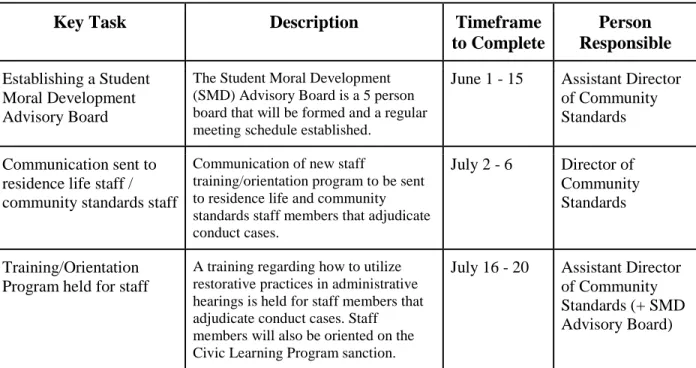
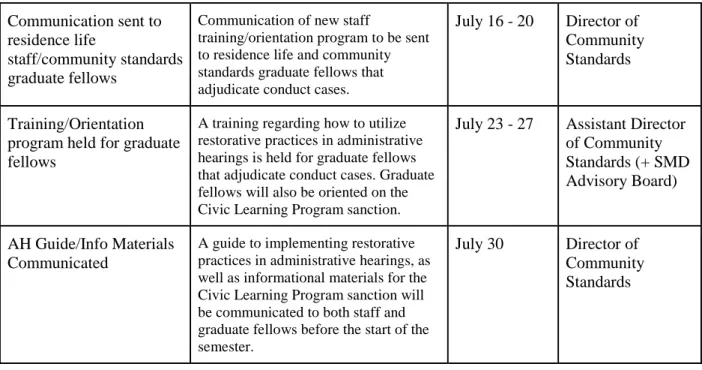
Outlined in this section is a detailed timeline for the new conduct system initiatives to be implemented at Merrimack College, through a partnership between the Office of Community Standards and Office of Residence Life. The timeline consists of two phases over the course of seven months. Phase one takes place during the Summer II session beginning June 1 and ending August 1. Key tasks in this phase include establishing the Student Moral Development (SMD) Advisory Board, a collective of professional staff from the Division of Student Affairs who will implement both staff and graduate fellow trainings on the use of the new conduct system
initiatives taking place in the Fall 2018 semester. Phase two takes place during the Fall 2018 semester beginning August 6 and ending December 20. Key tasks in this phase include the implementation of new conduct system initiatives, gathering staff feedback, and the Fall 2018 semester data review. Data collection and review for the Spring 2018 semester will closely follow that of the Fall 2018 semester.
Table 1. Summer Session, June 1 - August 1, 2018.
Key Task Description Timeframe
to Complete Person Responsible Establishing a Student Moral Development Advisory Board
The Student Moral Development (SMD) Advisory Board is a 5 person board that will be formed and a regular meeting schedule established.
June 1 - 15 Assistant Director of Community Standards Communication sent to
residence life staff / community standards staff
Communication of new staff
training/orientation program to be sent to residence life and community standards staff members that adjudicate conduct cases.
July 2 - 6 Director of Community Standards
Training/Orientation Program held for staff
A training regarding how to utilize restorative practices in administrative hearings is held for staff members that adjudicate conduct cases. Staff members will also be oriented on the Civic Learning Program sanction.
July 16 - 20 Assistant Director of Community Standards (+ SMD Advisory Board)
Communication sent to residence life
staff/community standards graduate fellows
Communication of new staff
training/orientation program to be sent to residence life and community standards graduate fellows that adjudicate conduct cases.
July 16 - 20 Director of Community Standards
Training/Orientation program held for graduate fellows
A training regarding how to utilize restorative practices in administrative hearings is held for graduate fellows that adjudicate conduct cases. Graduate fellows will also be oriented on the Civic Learning Program sanction.
July 23 - 27 Assistant Director of Community Standards (+ SMD Advisory Board)
AH Guide/Info Materials Communicated
A guide to implementing restorative practices in administrative hearings, as well as informational materials for the Civic Learning Program sanction will be communicated to both staff and graduate fellows before the start of the semester.
July 30 Director of Community Standards
Table 2. Fall Semester, August 6 - December 20, 2018.
Key Task Description Timeframe
to Complete
Person Responsible New Hearing Practices
& Sanction Implemented
The newly established restorative administrative hearing practices will be officially implemented in conduct cases beginning at this date. The Civic Learning Program sanction will also be a newly utilized sanction that can be selected on Merrimack College’s student conduct software. Advocate.
August 13 Director of Community Standards
Communication sent about new hearing practices/sanctions
Communication will be sent to staff/graduate fellows, that have been trained, regarding the start date of the newly established administrative hearing practices and sanction
August 13 Director of Community Standards
Data Collection Begins Assessment of student learning outcomes based on restorative administrative hearing practices and civic learning sanction begins as students are involved in the conduct system. Assessment for the civic learning sanction will begin on an “as completed” basis for students assigned the sanction.
August 13 Assistant Director of Community Standards
Communication regarding staff feedback
Communication will be sent to staff following the implementation of new conduct initiatives requesting feedback
October 1- 5 Director of Community Standards
through a meeting held by the Office of Community Standards.
Communication regarding graduate fellow feedback
Communication will be sent to graduate fellows following the implementation of new conduct initiatives requesting feedback through a meeting held by the Office of Community Standards.
October 8 - 12 Director of Community Standards Communication regarding joint staff / graduate fellow feedback at close of semester
Communication will be sent to both staff and graduate fellows requesting a meeting to provide feedback at the close of the semester. November 26 - 30 Director of Community Standards Fall 2018 Semester Assessment Review
Assessment data review will begin to track student learning outcomes and moral development based on new conduct initiatives. Data review will reoccur on a bi-annual basis during the Academic Calendar Year (Fall, Spring semesters)
December 3 - 21 Office of Community Standards + SMD Advisory Board Communication Plan
Communication regarding new student conduct initiatives will occur primarily within the Offices of Community Standards and Residence Life, specifically to both professional staff and graduate fellows. Such outreach will consist primarily of emails sent by both the Director or Assistant Director of the Office of Community Standards. Communication is a prominent component of the implementation of new student conduct initiatives and is present regularly throughout the timeline of the project.
The Director for the Office of Community Standards will primarily serve as the point person for communications. This person will be responsible for communicating information regarding the components of the new initiative, training information, notifications that request feedback, and assessment information or requests. Those receiving communication, the staff and graduate fellows that adjudicate conduct cases, will receive the necessary information to
Community Standards. The first round of communication will be sent to both staff and graduate fellows via email regarding the training program for new conduct initiatives (see Appendix A).
Following the training of both Community Standards and Residence Life staff, follow up communication that consists of informational materials pertaining to the new conduct initiatives will be sent to both staff and graduate fellows before the start of the semester. Another email notification will be sent to both audiences on the starting day of the administrative hearing practices and new sanction in mid-August. The next most important communication sent via email to staff and graduate fellows will pertain to the assessment of the new conduct initiatives (see Appendix A). Both staff and graduate fellows will be requested to meet with the Director and Assistant Director of Community Standards separately and jointly to provide feedback throughout and at the close of the first semester.
Orientation Program of Conduct Initiatives
To orient the community standards, residence life professional staff, and graduate fellows on the new conduct initiatives, an orientation program is necessary for the success of its
implementation. The orientation program will include training for administrative hearing officers to better understand and implement restorative justice practices in the restorative-oriented
administrative hearing structure. Training will also include an overview of the civic learning program sanction, the student expectations and requirements of the sanction, as well as information for how hearing officers will determine whether or not to assign the sanction to a student that has been found responsible in the conduct process. The learning outcomes for this training include that administrative hearing officers will:
• Feel confident to utilize restorative questions in order to help students reflect on their moral decisions, take responsibility for their misbehavior, and seek to improve their relationship with the community
• Understand the civic learning program sanction, its benefits, and its purpose for the moral development of a student
• Be able to recognize students that may benefit the civic learning program sanction There will be two training days lead by the Assistant Director of Community Standards that will span about 60 minutes. Though the training will not differ in content, it will allow for both professional staff and graduate fellows to have their own time to ask questions regarding the initiatives. The first component of the training will include defining restorative justice. The facilitator will also explain the benefits, from research, of utilizing restorative justice practices in administrative hearings and how it may impact a student’s moral reasoning and development. Both professional staff and graduate fellows will each be shown the “Restorative Coaching Through One-On-One Conversations” tip sheet (see Appendix B) and review restorative oriented questions that will be used in conversation with students in the hearing process. Following the review, trainees will collectively engage in a mock administrative hearing in order to practice utilizing restorative oriented questions and language in a low-risk setting.
The second part of the training will review the components of the civic learning program sanction, the expectations of the student participating in the program, and how to determine whether or not students should be assigned such a sanction. The facilitator will describe that student violators who seem to be lacking engagement on campus, do not find value in their student experience, or are unable to identify their importance to the campus community should be the individuals that are assigned the civic learning program sanction. It is crucial that trained
administrative hearing officers assign the civic learning program sanction to students based on their needs of campus community engagement; the sanction should not be bound to a specific violation that automatically determines whether or not this program is appropriate to assign to a student. Administrative hearing officers should assign this sanction to students that not only are seeking value in the community, but also to those who feel as though their misbehavior has led to difficulty rehabilitating back into the community.
Following the orientation program describing the new conduct initiatives for both professional staff and graduate fellows, these trained hearing officers will have a better sense of holding a restorative-orientated administrative hearing with students and the details of assigning the civic learning program sanction to students. Following the training, the Office of Community Standards will send electronic copies of the materials and guides that can be utilized by hearing officers when implementing the new initiatives.
Assessment Plan
Adapted from the STudent Accountability and Restorative Research (STARR) Project multi-campus study (Karp & Sacks, 2014), the assessment plan for the new Merrimack College student conduct initiatives will measure the learning outcomes of students in the conduct process. The format of the assessment will be a survey. Survey participants will include students that participate in administrative hearings; these cases will likely be low-level policy violations. Due to the restorative-oriented administrative hearing model and civic education program sanction, students who participate in administrative hearing meetings will interact with one or both components of the new student conduct initiative.
Student survey completion will be strongly suggested to the participants by the administrative hearing officer should they be found responsible for a policy violation.
Administrative hearing officers will communicate that students should complete the survey in addition to their sanction requirements. Responsible students will then be given the opportunity to complete the survey in-person or electronically following the end of the administrative hearing. Students who are assigned the civic learning program sanction will be provided the survey during their exit interview with a staff member. Should any student request an electronic survey, the hearing officer or staff member would be responsible for sending the survey via email. Students who complete the survey in addition to their sanction requirements will be incentivized with a $10 gift card to Dunkin Donuts.
In alignment with the learning outcomes of both the restorative-oriented administrative hearings and the civic education program sanction, the survey will seek to measure student learning throughout the hearing process. The questions presented in the survey will explore self-authorship, personal responsibility, accountability, community impact, and the overall
satisfaction with the conduct process. The data will be collected on a Likert scale from one to ten. Question samples are largely reflective of the STARR Project study (Karp & Sacks, 2014, p. 164), and include the following:
• To what extent were you able to communicate your thoughts and feelings about the
incident?
• How much were you able to meaningfully contribute your ideas towards the outcome?
• To what extent was the outcome tailored for you and your situation?
• How much did the process help you to take responsibility for the consequence of the
incident?
• To what extent did the outcome focus on repairing the harm that was caused by this
incident?
• How much did the process help you to understand the point of view of those most
affected?
• How much did the process help you to understand your responsibilities as a member of
the community?
• To what extent did you feel respected and supported throughout the process?
• Overall, how satisfied are you with the way this process was handled?
• Overall, how satisfied are you with the outcome of this process?
Through the evaluation of these questions, the assessment will measure student learning as a result of the new conduct initiatives being implemented in Merrimack College’s conduct system. It is the hope that students demonstrate significant learning and evidence of moral development. By assessing student learning in the conduct process, Merrimack College may be able to correlate such findings to an increase in student moral development. The data would also be able to track student perceptions of the conduct system. Assessment will begin the fall
semester of 2018 and will reoccur for the spring semester of 2019. The assessment will continue to be conducted for two full academic years until the close of the student conduct initiative review at the end of the spring semester of 2020.
Conclusion
To further enhance the moral development of undergraduate students who commit conduct violations, this project sought to answer how student conduct administrators may enable the moral development of students through learning in the conduct process. As a residence life professional who simultaneously serves as an administrative hearing officer for Merrimack College’s conduct system, I have witnessed a lack of moral development, understanding of community values, and consideration for community impact among student violators in the conduct system. Utilizing Kohlberg’s (1976) Theory of Moral Development, this project’s initiatives serve to advance students from one stage of moral development to a higher stage of moral thinking and understanding.
To engage students in higher stage thinking that facilitates moral development, two approaches were designed to advance students in the process. The first approach is a restorative-oriented administrative hearing that is facilitated by trained hearing officers. This component will enable students to explore types of harm resulted in their actions, discover ways to repair
harm collaboratively, and engage them in reflection in order to rebuild trust between themselves and the community. By engaging in reflection of moral dilemmas, students will ultimately develop further as a result according to Kohlberg’s theory (1976, as cited in Barger, 2000).
The second approach to advancing moral development in the conduct process is a civic learning program that is to be assigned as a sanction to students who lack an understanding of community values and are disengaged among their community. Through this sanction, students will engage in 30 hours of service on campus while participating in regular reflection. By participating in campus engagement and reflection, students will better understand their role in the community as well as the impact of their misbehavior. Such service-learning and reflection opportunities, as described by Bernacki & Jaeger (2008), may further enable the development of a student’s moral reasoning.
To conclude, by implementing restorative practices and civic learning within the student conduct system at Merrimack College, students will be able to learn through reflection, face cognitive conflict, and ultimately progress to a higher stage of moral thinking and development. Implemented and monitored by professional staff, these approaches to advancing student moral development will enrich a campus community to be accountable alongside a student body that is morally just.
References
Asher, K. M. (2008). Educating college students through judicial response: Examining the effectiveness of judicial sanctions for alcohol-related violations (Doctoral dissertation, University of Pittsburgh).
Barger, R.N. (2000). A Summary of Lawrence Kohlberg’s Stages of Moral Development. Retrieved from http://www5.csudh.edu/dearhabermas/kohlberg01bk.htm
Bernacki, M. L., & Jaeger, E. (2008). Exploring the impact of service-learning on moral development and moral orientation. Michigan Journal of Community Service Learning,
14(2).
Colby, A. (2008). Fostering the moral and civic development of college students. Handbook of moral and character education, 391-413.
Detert, J. R., Treviño, L. K., & Sweitzer, V. L. (2008). Moral disengagement in ethical decision making: a study of antecedents and outcomes. Journal of Applied Psychology, 93(2), 374. Karp, D. R., & Frank, O. (2016). Restorative justice and student development in higher
education: Expanding “offender” horizons beyond punishment and rehabilitation to community engagement and personal growth. Offenders no more: An interdisciplinary restorative justice dialogue, 141-164.
Karp, D. R., & Sacks, C. (2014). Student conduct, restorative justice, and student development: Findings from the STARR project: A student accountability and restorative research project. Contemporary Justice Review, 17(2), 154-172.
Karp, D.R., Williamsen, K., Behel, J., Fisher, D., Shafer, R., Story, J., McMurphy, T., Bacon, J., Kidde, J., Zarro, F. (2018). Restorative Coaching Through One-On-One Conversations.
Unpublished manuscript, Project on Restorative Justice, Skidmore College, Saratoga Springs, New York.
Kompalla, S. L., & McCarthy, M. C. (2001). THE EFFECT OF JUDICIAL SANCTIONS ON RECIDIVISM AND RETENTION. College Student Journal, 35(2).
Koss, M. P., Wilgus, J. K., & Williamsen, K. M. (2014). Campus sexual misconduct: Restorative justice approaches to enhance compliance with Title IX guidance. Trauma, Violence, & Abuse, 15(3), 242-257.
Lies, J., Bronk, K. C., & Mariano, J. M. (2008). The community contribution to moral development and character. Handbook of moral and character education, 520-536.
Mathieson, K. (2003). Elements of moral maturity. Journal of College and Character, 4(5).
Moravian College. (n.d.). Civic Learning Programs. Retrieved from
https://www.moravian.edu/studentdevelopment/civic-learning-programs-0.
Patton, L. D., Renn, K. A., Guido, F. M., & Quaye, S. J. (2016). Student development in college:
theory, research, and practice. Retrieved from https://ebookcentral.proquest.com
Stimpson, M. T., & Janosik, S. M. (2011). Variability in reported student learning as a result of participating in a student conduct system. College Student Affairs Journal, 30(1), 19.