Rylance, R, Rylance, R and Graham, P
Does the taught content of care planning live up to mental health student
nurses experiences and perceptions of practice?
http://researchonline.ljmu.ac.uk/573/
Article
LJMU has developed
LJMU Research Online
for users to access the research output of the
University more effectively. Copyright © and Moral Rights for the papers on this site are retained by
the individual authors and/or other copyright owners. Users may download and/or print one copy of
any article(s) in LJMU Research Online to facilitate their private study or for non-commercial research.
You may not engage in further distribution of the material or use it for any profit-making activities or
any commercial gain.
The version presented here may differ from the published version or from the version of the record.
Please see the repository URL above for details on accessing the published version and note that
access may require a subscription.
For more information please contact
[email protected]
Citation
(please note it is advisable to refer to the publisher’s version if you
intend to cite from this work)
Rylance, R, Rylance, R and Graham, P (2014) Does the taught content of
care planning live up to mental health student nurses experiences and
perceptions of practice? Mental Health Practice, 18 (2). pp. 30-36. ISSN
1465-8720
Art & science | recovery
Correspondence [email protected] Rebecca Rylance is a senior lecturer at the Faculty of Health and Applied Social Sciences of Liverpool John Moores University Peter Graham is quality improvement lead for the Priory Healthcare Division Date of submission July 31 2013 Date of acceptance January 20 2014 Peer review
This article has been subject to double-blind review and has been checked using antiplagiarism software
Author guidelines
rcnpublishing.com/r/mhp-author-guidelines
Abstract
Care planning should be a collaboration between the service user, caregivers and the relevant professionals. It is based on recovery principles, where clients identify their goals and how to work to reach them, rather than concentrating on illness, symptoms and problems. Mental health nursing students were taught the theory but observed that, in their clinical placements, this approach was often not followed in practice.
These issues were explored in two teaching sessions with six students. Subsequent focus groups were recorded, transcribed and analysed, yielding four main themes: care planning custom and practice, collaboration, organisational culture and student
assumptions about their mentors. Participants detailed how care planning might not be person-centred in practice. It was suggested that this might be due to clinical customs, strains and restrictions, lack of collaboration between service users and the multidisciplinary team, and inept organisational culture. The main challenge for services has been how to manage risk as well as the
person-centred approach, and the ‘competing dilemmas associated with care-versus-control issues’.
Keywords
Care planning, collaboration, recovery, student perceptions
Rebecca Rylance and Peter Graham examine why the person-centred
care that students learn about is not always a reality on the wards
Does the practice of care planning
live up to the theory for mental
health nursing students?
THE CARE Programme Approach (CPA) advocates that the care planning process should be a collaborative event between the service user, caregivers and the relevant professionals (Department of Health (DH) 2008). In Making Recovery a Reality, Shepherd et al (2008) argue that recovery is about clients defining their own goals and ambitions, and suggest that this can be achieved by moving away from illness, symptoms and problem formulation.
Our study examined the perceptions of a group of mental health nursing students and their observations of care planning in theory and in practice, following a series of evidence-based teaching sessions. The aims and learning outcomes for the sessions were:
■
■ To reinforce the fact that care planning is a shared and continuous process.
■
■ To consider the important factors in problem identification.
■
■ For students to be able to identify and list problems, strengths and needs with clients and caregivers.
■
■ To introduce students to goal setting.
■
■ For students to practise writing problem and goal statements.
Involving clients in care
The idea of mental health service users being actively involved in their own care is not new (Anthony and Crawford 2000, Tunmore 2000). The rise of the recovery movement in mental health services, with principles based on determination, self-management and hope (Alakeson and Perkins 2012, Hall et al 2013), has promoted the notion that clients are no longer passive recipients of care. Instead, they are actively taking charge of their own lives and being seen as ‘experts by experience’ on their own condition. The benefits of such an approach are well
R
C
practitioners while taking part in care planning? ■
■ Setting up the session. ■ ■ Environment. ■ ■ Agenda setting. ■ ■ Timescale. ■
■ Checking on the wellbeing of the service user. ■
■ What assessment tools/scales were used to assist in the generation of the problem statement, if any? ■
■ Was the service user engaged with the care planning process, if so, how?
■
■ Do you feel that the care plan was useful for the service user?
■
■ Do you feel that the care plan was useful for the service?
mental health. This also means that people with mental health problems are able to plan their own route to recovery’.
Much is written about the need for collaboration in care planning between clinicians, service users and their caregivers in mental health services. The refocusing of the CPA in 2011 (DH 2011b) recognises that clients will not engage with the care planning process unless it is meaningful to them, and their input is genuinely recognised. The Department of Health guidance states that care plans should be devised and agreed in partnership with the service users and, where appropriate, their caregivers. The therapeutic value of involving people in their own care cannot be underestimated. Stringer et al
(2008) also assert that care providers should better accommodate the needs and wishes of clients in their journey of care.
That said, to our knowledge it is not stated in the literature whether and to what extent practitioners in reality involve clients and their caregivers in care plans. The Triangle of Care (Carers Trust 2013) recommends that all care staff who undertake care planning should receive specific training on how to involve service users and their caregivers in the process.
The study
Mental health nursing students from Liverpool John Moores University undertaking the DipHE pre-registration nursing programme (March 2010 cohort) attended two dedicated teaching sessions on care planning as part of the theoretical component of the curriculum. The first session was entitled ‘Problem- and goal-centred care planning’ and was delivered by a lecturer/practitioner who leads on care planning for a local mental health trust. The teaching was recovery focused and encouraged the students to consider: the nature of collaborative practice; the use of language from the perspective of staff and client; and the issue of who ‘owns’ the care plan. A second, follow-up session explored these themes further and introduced the use of formulation to assist with the writing of the ‘problem’ statement, and was followed by focus groups to discuss what had been learned in theory and in practice. Practice settings included a range of in-patient and specialist community placements.
Method A naturalistic method of enquiry was selected to examine the relationship between care planning theory and practice as seen by mental
health nursing students in the clinical practice setting. Therefore, a phenomenological approach, which seeks to consider the whole person and values their experiences (Balls 2009), was chosen as the philosophical framework for the study. Phenomenology, which is a widely accepted research tradition in qualitative enquiry (Polit and Beck 2008), is not necessarily concerned with the production of grand theory but instead seeks a description of people’s ‘lived experience’, articulated by those who did the experiencing (Balls 2009).
Phenomenology seeks to understand the ‘essence of phenomena’ by placing emphasis on the way people make sense of their world (Polit et al 2001), and by doing so it recognises and values the meanings that people ascribe to their own existence. Thus a qualitative descriptive study, informed by a phenomenological approach, was framed to explore the experiences and perceptions of this group of mental health nursing students.
To generate narrative data, the focus groups were conducted using a semi-structured interview guide. Interviews are a primary method of data collection in qualitative research (Parahoo 2006) and there is some evidence to suggest that unstructured interviews generate greater depth and detail, but that semi-structured interviews are better suited when a researcher wants to be sure that a specific set of topics are covered (Polit and Beck 2008). Thus an interview schedule (Box 1) was created with some
Clients are no longer passive recipients
of care. Instead, they are actively taking
charge of their own lives
R
C
Art & science | recovery
preliminary questions to focus on areas of interest and to generate data.
The interview guide focused largely on the students’ observation of the care planning
practices of their mentors and of other registrants. The narratives recorded in the groups were subsequently transcribed and a thematic analysis was performed using Colaizzi’s analytical framework (Colaizzi 1978) (Table 1).
Sample A total of 25 nursing students were contacted, resulting in a sample comprising six third-year mental health nursing students. Students were recruited to the study via email following a series of taught theory sessions that they had received on care planning. Participation was voluntary and written informed consent was obtained from all participants. Assurances regarding confidentiality were given and all data was anonymised in accordance with legislation and local protocols. Ethical approval was granted proportionate review by Liverpool John Moores University.
Results
Ninety significant statements were extrapolated from the narrative data and 14 meanings were formulated. The meanings were then grouped into clusters of themes and subsequently sorted into four main categories: care planning custom and practice; collaboration; organisational culture; and student assumptions about mentors.
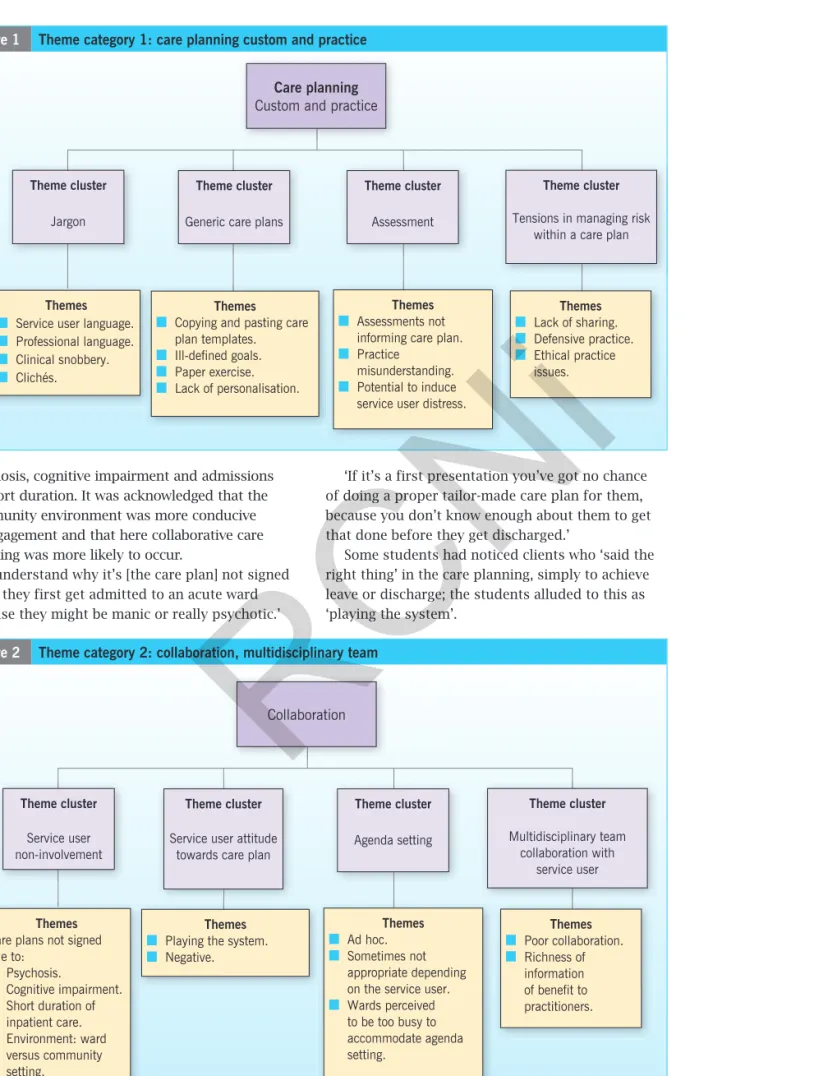
The findings and supporting narratives are shown in Figures 1 to 4 (see pages 33-35).
Custom and practice The theme category ‘care planning custom and practice’ relates to how the students talked about their observation and experience of care planning on the wards and in community settings. A key theme cluster was that of professional jargon and, in particular, the ‘professional snobbery’ that the participants perceived as manifesting during the process. The students acknowledged that a collaborative care plan should use client-friendly language but in doing so, they perceived this to look unprofessional to other agencies.
‘You got to use all this jargon… you can’t have a care plan in simple terms because it makes you sound thick.’
Participants also commented on the practice of copying and pasting generic care plans and the use of clichés such as ‘to remain well in the community’.
‘Staff just go to copy and paste and that goes on the care plan and you just tailor it to whatever they’ve come in with.’
‘It’s scary to think people are just copying and pasting theses huge kind of statements.’
In addition, it was observed that the care plans were not goal-focused but problem-focused, and tended to be a ‘paper exercise’ rather than a meaningful collaborative document.
A number of students pointed out that the assessment tools did not necessarily inform the care plans and that, when the care plan contained risk strategies, this was considered by the registered staff as a reason not to share the care plan with the service user, leading to practice misunderstanding and the potential for service user distress. This was judged by the students to be unnecessarily defensive and ethically unsound.
‘I’ve had an experience where you’re dealing with quite a high-risk individual in the community and because of the CPN’s [community psychiatric nurse’s] anxieties about his reaction to the care plan … he can’t see it, it’s not right’.
‘In his risk assessment but it was also in his care plan so it was like he can’t sign that because he can’t see it because if he sees that he’ll know what we’re kind of doing behind closed doors.’
The students observed that a tension exists in practice: ‘The balance between risk and a person’s rights.’
Collaboration The theme category ‘collaboration’ describes the participants’ observations and perceptions of service user involvement in the care planning process. The students commented that in the inpatient environment clients were rarely involved, which was attributed to the presence of
Table 1 Colaizzi’s analytical framework One Transcribed descriptions read by
investigator.
Two Significant statements and phrases extracted.
Three Meanings formulated from significant statements and phrases.
Four Meanings clustered into themes.
Five Results integrated into an exhaustive list of the phenomena.
Six Descriptions of the fundamental structure of the phenomenon.
Seven Descriptions returned to participants for validation.
(Colaizzi 1978)
R
C
Theme cluster
Jargon
Themes
■
■ Service user language. ■ ■ Professional language. ■ ■ Clinical snobbery. ■ ■ Clichés. Themes ■
■ Copying and pasting care plan templates. ■ ■ Ill-defined goals. ■ ■ Paper exercise. ■ ■ Lack of personalisation. Themes ■ ■ Assessments not informing care plan. ■
■ Practice misunderstanding. ■
■ Potential to induce service user distress.
Themes ■ ■ Lack of sharing. ■ ■ Defensive practice. ■ ■ Ethical practice issues. Theme cluster
Generic care plans
Theme cluster
Assessment
Theme cluster
Tensions in managing risk within a care plan
Care planning
Custom and practice
Figure 2 Theme category 2: collaboration, multidisciplinary team
Theme cluster
Service user non-involvement
Themes
Care plans not signed due to: ■ ■ Psychosis. ■ ■ Cognitive impairment. ■ ■ Short duration of inpatient care. ■ ■ Environment: ward versus community setting. Themes ■
■ Playing the system. ■ ■ Negative. Themes ■ ■ Ad hoc. ■ ■ Sometimes not appropriate depending on the service user. ■ ■ Wards perceived to be too busy to accommodate agenda setting. Themes ■ ■ Poor collaboration. ■ ■ Richness of information of benefit to practitioners. Theme cluster
Service user attitude towards care plan
Theme cluster Agenda setting Theme cluster Multidisciplinary team collaboration with service user Collaboration
psychosis, cognitive impairment and admissions of short duration. It was acknowledged that the community environment was more conducive to engagement and that here collaborative care planning was more likely to occur.
‘I understand why it’s [the care plan] not signed when they first get admitted to an acute ward because they might be manic or really psychotic.’
‘If it’s a first presentation you’ve got no chance of doing a proper tailor-made care plan for them, because you don’t know enough about them to get that done before they get discharged.’
Some students had noticed clients who ‘said the right thing’ in the care planning, simply to achieve leave or discharge; the students alluded to this as ‘playing the system’.
R
C
Art & science | recovery
Agenda setting was perceived as being ad hoc, occasionally inappropriate and not achievable in the inpatient environment, because of lack of time and the restrictions of the ward routine.
‘I’ve very rarely seen an agenda set unless you’ve got something specific you want to do with that person.’
The students perceived service user collaboration to be generally poor, despite identifying reasons why this might be the case. They all commented on the richness of information that could emerge from a collaborative approach that would benefit service users and staff.
‘I’ve sat with people and gone through their care plans, but you don’t see it enough.’
‘It’s also good for the practitioners.’
Culture of organisation The participants perceived that the culture of the organisation contributed to, or detracted from, the overall care planning process, and they alluded to the issue of time management. They suggested that the wards were less person-centred than the community setting and also that the CPA was too process-driven and task-focused. They also remarked that if the qualified staff did care plans correctly, they would actually save time.
‘I’ve seen it [care planning] done really well on the community and not too well on the wards.’
‘CPA is more of a time management task as opposed to designing client-centred care … a tick-box exercise.’
‘It’s quite frustrating at times … they go on about I haven’t got time, and I think if you just use common sense and wrote one line, you’d get three more care plans done instead of one and you’d stop staying until 7pm.’
The theme around care planning culture and standards related to the students’ observations of practice and in particular how that specifically related to the theory being taught in university.
‘If care planning is such an integral part of nursing, why is it that when you go into university you’re taught to do it right [and when] you go out into practice you’re the only person doing it right?’
Of particular interest was the suggestion that there were varying standards of care planning: the gold standard that was being taught in university, the trust’s standard and the actual practice standard.
‘We are taught the gold standard, then if you go on placement there’s a practical standard that has to be achieved, but what we see is a model standard.’
‘When we were trying to implement it [care planning] we were being told “this isn’t right, you’re not doing it right”, so it caused friction between people on placement and people in the university.’
‘When you’re coming towards the end of your training and then you say something about a care plan and they [trained staff] just cut you dead and you just go, yeah, you just feel stupid.’
Descriptions of how organisations prioritised staff training were interesting.
‘Why is it that the NHS don’t do these refresher courses [on care planning] the way that infection control is updated?’
‘That’s massive; it’s a bit of a bugbear for me actually.’
‘So why don’t we do e-learning, why don’t we do refresher courses once a year refocusing on care planning?’
One commented that organisations who
subscribed to performance-related pay assumed that the CPA was a tool of measurement.
‘Everything’s become performance-related … and obviously people think or assume (or it might be true) CPA is used to monitor that and that’s why [care plan] reviews are done – or why they aren’t done.’
Student assumptions about mentors The theme category of student assumptions about mentors revealed some cogent perceptions. The participants
Figure 3 Theme category 3: organisational culture, care plan approach
Theme cluster
Time management
Themes
■
■ Busy wards less person centred than community. ■
■ Care plan approach too process orientated. ■
■ Proper care planning saves time. ■ ■ Student. Themes ■ ■ Differences between theory and practice. ■ ■ Friction. ■ ■ Differing standards of care planning. Themes ■
■ Trust not investing in care planning training for registrants. ■
■ Conflicting training priorities. ■
■ Care plan approach and performance-related pay.
Theme cluster
Care planning culture & standards
Theme cluster
Priorities Organisational
culture
Students all commented on the richness
of information that could emerge from a
collaborative approach
R
C
qualified, the more knowledge and experience they naturally had. Therefore those mentors who did not use clinical assessment tools were seen as not doing so because they did not need to.
‘The mentors who have been qualified for years, they’ve got so much experience that they don’t need to rely on problem-solving models to then feed into care plans. Twenty five years in, they’ve got a massive amount of knowledge and you know it’s fabulous for they are doing it all from memory.’
Related to this, was the assumption that length of time since qualifying was related to being a good mentor.
‘Mentors who have been qualified for
three or four years, they’re brilliant because they still remember what it’s like to be a student.’
The value students ascribed to the length of time their mentors had been qualified was not examined further during the course of the study and undoubtedly requires more investigation.
Participants implied that mentors might behave differently when they had a student with them.
‘I think it just depends on how your mentor does things… now, whether that’s just because they’ve got a student with them…?’
Good mentors were associated with sound knowledge and application of the care planning process.
‘A really good mentor kind of understands the care planning process.’
Discussion
Our findings suggest that the principles of a recovery-focused approach to care planning are not reflected in clinical practice. The students who took part in our study noted that the inpatient areas often failed to collaborate with service users in the development of their care plans, possibly because of the person’s level of acuity. However, it may also be argued that mental health services have failed to adapt to the concept of recovery, as, historically, services had been designed around the belief that those with a severe and enduring mental illness do not recover (Anthony and Crawford 2000).
As previously stated, the push to put service users at the centre of their own care is supported by state guidance, most notably in Refocusing the Care Programme Approach (DH 2008). However, the participants in our study saw the CPA in practice to be a bureaucratic tick-box or time management exercise rather than a process for
meaningful engagement and a tool to provide person-centred care.
One of the most notable observations was on assessment and management of risk in clinical practice. The narrative data suggested that the identification of risk removed any attempt by staff to collaborate with the service user in developing a care plan to manage the risk. This echoes the thoughts of Hall and Wren (2008) who state that the main challenge for services has been to manage the ‘competing dilemmas associated with care-versus-control issues’. However, the principles described in Best Practice in Managing Risk (DH 2007) clearly advocate a collaborative approach.
Our findings indicated that ‘practice’ was not necessarily practising in an evidence-based way or in a way that complemented the theory being taught in university. These phenomena may have promoted a lack of trust and confidence among the students with regard to either the theory component of care planning that is taught in university or to what they see in practice.
Whether these findings reflect a broader cultural climate that remains over-patriarchal and problem-focused is unclear and doubtless requires further exploration.
The main limitation of this study is its small scale, which means it cannot claim to be representative of wider cohorts’ perceptions of care planning as taught and in clinical practice.
Theme cluster Relationships Themes ■ ■ Confidence in mentor instills student confidence and promotes learning. ■
■ Poor relationship has opposite effect.
Themes
■
■ Student belief that length of time qualified equates to extensive knowledge. ■
■ No reliance on tools required (‘it’s in their head’).
■
■ Magic ingredient: those mentors who remembered being a student
themselves.
Themes
■
■ Do mentors behave differently when with a student?
■
■ Student recognition of learning opportunities in relation to care planning. ■
■ Student
acknowledgement of a mentor being a learning resource.
Theme cluster
Knowledge related to length of time qualified
Theme cluster Mentor practice around care planning assumptions about mentors
R
C
N
i
Art & science | recovery
Conflict of interest None declared
Online archive
For related information, visit our online archive and search using the keywords
Alakeson V, Perkins R (2012) Recovery, Personalisation and Personal Budgets. Centre for Mental Health, London.
Anthony P, Crawford P (2000) Service users’ involvement in care planning. Journal of Psychiatric and Mental Health Nursing. 7, 5, 425-434.
Balls P (2009) Phenomenology in nursing research: methodology, interviewing and transcribing. Nursing Times. 105, 32, 30-33.
Carers Trust (2013) The Triangle of Care. Carers Included: A Guide to Best Practice in Mental Health Care in England. Second edition. Carers Trust, London.
Colaizzi P (1978) Psychological research as a phenomenologist. In Valle RS, King M (Eds).
Existential Phenomenological Alternatives for Psychology. Oxford University Press, New York NY.
Department of Health (2007) Best Practice in Managing Risk. DH, London.
Department of Health (2008) Refocusing the Care Programme Approach. DH, London.
Department of Health (2011a) No Health without Mental Health. DH, London.
Department of Health (2011b) Refocusing the Care Programme Approach. Policy and Positive Practice Guidance. DH, London.
Hall A, Wren M (2008) Care Planning in Mental Health: Promoting Recovery. First edition. Blackwell, Oxford, UK.
Hall A, Wren M, Kirby S (2013) Care Planning in Mental Health: Promoting Recovery. Second edition. Wiley Blackwell, Chichester, UK.
Parahoo K (2006) Nursing Research. Principles, Process and Issues. Second edition. Palgrave Macmillan, London.
Polit D, Beck C, Hungler B (2001) Nursing Research: Methods, Appraisal, Utilisation. Lippincott Williams and Wilkins, Philadelphia PA.
Polit D, Beck C (2008) Nursing Research Principles and Methods. Eighth edition. Lippincott Williams and Wilkins, London.
Shepherd G, Boardman J, Slade M (2008)
Making Recovery a Reality. Sainsbury Centre for Mental Health, London.
Stringer B, Van Meijel B, De Vree W et al (2008) User involvement in mental health care: the role of the nurse. A literature review.
Journal of Psychiatric and Mental Health Nursing. 15, 8, 678-683.
Tunmore R (2000) Nursing care plans in acute mental health nursing. Mental Health Practice. 4, 3, 32-37.
References
Implications for practice
■
■ In theory, the care planning process should be a collaboration between the service user, caregivers and the relevant professionals. However, care planning may not be collaborative, person-centred or goal-focused in clinical practice.
■
■ Obstacles include convention, practice restrictions, management of risk, lack of time and inept organisational culture.
■
■ Clients will not engage with person-centred care planning unless it uses familiar language and is meaningful, and their input is genuinely recognised.
■
■ The care planning approach benefits staff as well as service users and in the end saves time.
Neither should it be generalised to a larger field of mental health nursing students. All students were in agreement with the discussion points.
Conclusion
Our study has provided some unique insights into the perceptions and experiences of a group of mental health nursing students and how they observe care planning in clinical practice in contrast to how it is taught on their preregistration university course. The data have unveiled a number of
reasons why care planning is not person-centred in clinical practice. These include practice restrictions and customs, lack of collaboration and inept organisational culture. Our findings thus indicated a perceived marked difference between taught theory and clinical practice, which poses the question as to whether there is a theory-practice gap that should be addressed. The study also revealed some interesting and unexpected insights into the dynamics that exist between students and their mentors.
It is hoped that the significant findings from this study will be further investigated in a wider sample, more topics and in other fields of nursing practice.