University of South Florida
Scholar Commons
Graduate Theses and Dissertations Graduate School
January 2013
Knowledge, Involvement and Emergency
Preparedness
Season Groves
University of South Florida, [email protected]
Follow this and additional works at:http://scholarcommons.usf.edu/etd Part of theMass Communication Commons
This Thesis is brought to you for free and open access by the Graduate School at Scholar Commons. It has been accepted for inclusion in Graduate Theses and Dissertations by an authorized administrator of Scholar Commons. For more information, please [email protected].
Scholar Commons Citation
Groves, Season, "Knowledge, Involvement and Emergency Preparedness" (2013).Graduate Theses and Dissertations. http://scholarcommons.usf.edu/etd/4683
Knowledge, Involvement and Emergency Preparedness
by
Season Groves
A thesis submitted in partial fulfillment of the requirements for the degree of
Master of Arts
School of Mass Communications College of Arts and Sciences
University of South Florida
Major Professor: Scott Liu, Ph.D. Michael Mitrook, Ph.D.
Justin Brown, Ph.D.
Date of Approval: July 9, 2013
Keywords: Issues Processes Model, motivation, hazard, disaster, terrorism, disease outbreak, emergency preparedness, communication
DEDICATION
I want to extend my deepest thanks to my family for all their patience while I worked on this study. Without their constant support and willingness to help, my journey would have been much, much harder. To my little one for always bringing me smiles and reminding me why I chose the path that I have. To my oldest for showing me that hard work does pay off. To my husband for keeping up all the things I slacked on.
To Dr. Michael Mitrook and Dr. Justin Brown, thank you for adding me to your already full schedules and helping me with this milestone on my way to bigger and better things. And finally, to Dr. Scott Liu, without whose guidance I would still be running around in the dark attempting to make sense out of the world of communications and failing miserably. I raise my glass and say a cheer to all of you for the impact you had on me during the last two years and during the next steps on my journey. Thank you.
i
TABLE OF CONTENTS
LIST OF FIGURES iii
LIST OF TABLES iv ABSTRACT viii CHAPTER 1: INTRODUCTION 1 Background of Study 1 Statement of Problem 3 Rationale 10 Importance of Study 14 Overview of Study 15
CHAPTER 2: REVIEW OF LITERATURE 16
Theoretical Framework 16
Knowledge 18
Involvement 19
The Convergence of Knowledge and Involvement 21
Defining Preparedness 22
CHAPTER 3: RESEARCH HYPOTHESES 24
Rationale for Hypotheses 24
Hypotheses 26 CHAPTER 4: METHODOLOGY 27 Sample 27 Research Design 30 Instrumentation 31 Operationalization of Variables 32 Scale Reliability 33
ii CHAPTER 5: RESULTS 37 Descriptive Statistics 37 Hypothesis Testing 41 Hypothesis 1a 41 Hypothesis 1b 43 Hypothesis 1c 45 Hypothesis 1d 47 Hypothesis 2a 49 Hypothesis 2b 51 Hypothesis 2c 54 Hypothesis 2d 55 CHAPTER 6: DISCUSSION 58 Overall Preparedness 59
Involvement and Emergency Preparedness 61
Knowledge and Emergency Preparedness 63
CHAPTER 7: CONCLUSIONS AND RECOMMENDATIONS 68
Limitations of the Study 70
Suggestions for Future Research 71
Recommendations 73
REFERENCES 74
APPENDICES 82
Appendix 1: Consent Form 82
iii
LIST OF FIGURES
iv
LIST OF TABLES
TABLE 1. Age 28
TABLE 2. Gender 29
TABLE 3. Education Level 29
TABLE 4. Household Income 29
TABLE 5. Race 30
TABLE 6. Residence Type 30
TABLE 7. Reliability – Involvement 34
TABLE 8. Reliability – General Self Knowledge 35
TABLE 9. Reliability – Specific Knowledge 36
TABLE 10. Perceived Preparedness Level Descriptive Statistics 38
TABLE 11. Active Household Emergency Plan Descriptive Statistics 38
TABLE 12. Home Disaster Supplies Descriptive Statistics 39
v
TABLE 14. Training Attendance < 2years Descriptive Statistics 40
TABLE 15. Involvement Descriptive Statistics 40
TABLE 16. Knowledge Descriptive Statistics 41
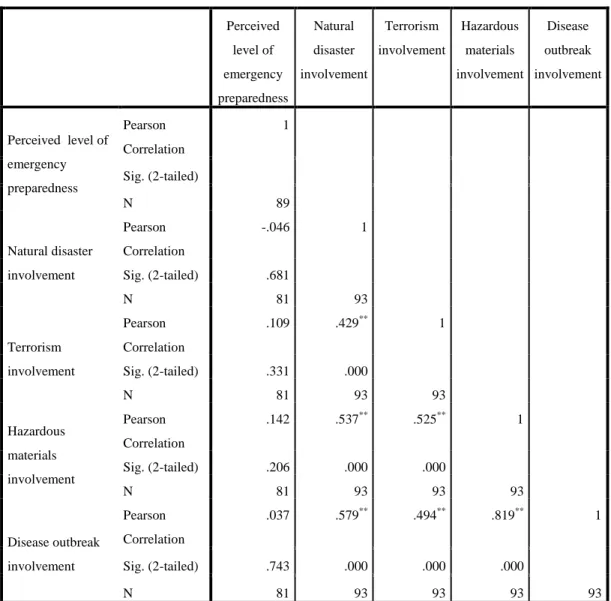
TABLE 17. Correlations Matrix – Involvement and Perceived Level of 42
Emergency Preparedness TABLE 18. Medians of Emergency Involvement 43
TABLE 19. Natural Disaster Involvement * Active Household Emergency 44
Plan Crosstabulation TABLE 20. Terrorism Involvement * Active Household Emergency Plan 44
Crosstabulation TABLE 21. Hazardous Materials Involvement * Active Household 45
Emergency Plan Crosstabulation TABLE 22. Disease Outbreak Involvement * Active Household Emergency 45
Plan Crosstabulation TABLE 23. Correlation Matrix – Involvement and Number of Emergency 46
Supply Items Stored TABLE 24. Natural Disaster Involvement * Training Participation 47
Crosstabulation TABLE 25. Terrorism Involvement * Training Participation 48
Crosstabulation TABLE 26. Disease Outbreak Involvement * Training Participation 48
vi Crosstabulation
TABLE 27. Hazardous Materials Involvement * Training Participation 48 Crosstabulation
TABLE 28. Correlation Matrix – Knowledge and Perceived Level of 50 Personal Emergency Preparedness
TABLE 29. Medians of Emergency Knowledge 52
TABLE 30. Natural Disasters Knowledge * Active Household Emergency 52 Plan Crosstabulation
TABLE 31. Terrorism Knowledge * Active Household Emergency Plan 52 Crosstabulation
TABLE 32. Hazardous Materials Knowledge * Active Household 53 Emergency Plan Crosstabulation
TABLE 33. Disease Outbreak Knowledge * Active Household Emergency 53 Plan Crosstabulation
TABLE 34. Correlation Matrix – Knowledge and Number of Emergency 55 Supply Items Stored
TABLE 35. Natural Disaster Knowledge * Participation in Emergency 56 Training Crosstabulation
TABLE 36. Terrorism Knowledge * Participation in Emergency Training 56 Crosstabulation
TABLE 37. Hazardous Materials Knowledge * Participation in Emergency 56 Training Crosstabulation
vii
TABLE 38. Disease Outbreak Knowledge * Participation in Emergency 57 Training Crosstabulation
viii ABSTRACT
This research formed a descriptive frame of the current levels of emergency preparedness and applied Hallahan’s Issues Processes Model to examine the relationship between knowledge, involvement, and emergency preparedness among the participants. The variables were measured in the context of self-perception. The research method involved a survey of students who are just becoming responsible for their personal emergency preparedness. The results suggest that students lack overall emergency preparedness measures and show that self-perceived knowledge is positively related to self-perceived emergency preparedness. Yet, higher self-perceived knowledge is negatively related to actual emergency preparedness actions. Thus, the more
knowledgeable the participants believed themselves to be the less likely they were to have an active household emergency plan. The results did not support involvement as a predictor of personal emergency preparedness. The findings highlight a serious
deficiency among the population sample. Knowledge of personal emergency
preparedness and related motivators can improve overall preparedness on local, state, and federal levels. Little is known about the relationship between knowledge and personal emergency preparedness. This paper presents findings that may assist public relations professionals in creating messages that account for the lack of preparedness and the contrary relationship between perceived knowledge and actual personal emergency preparedness.
1
CHAPTER 1: INTRODUCTION
“The work of the professional man… always bears some direct relation to well-defined fundamental principles. These principles may result from the experience of humanity, they may come from a priori reasoning, or they may rest upon combinations of these two. But no profession can be regarded as stable until it has such a body of well established principles as will guide a member of the profession in determining the actual value of his work, will teach him that his calling is honorable to himself and valuable to the
community and will determine what a line of action may elevate the professional and instill into him the lesson that he must do nothing to bring reproach upon his chosen profession. In a word, they give him ideals to struggle for, and to struggle for an ideal is the only method of gaining true and lasting satisfaction…”
“Recognizing….that the success…rests upon harmony with nature’s laws, and that she is merciless in showing his weakness, that this is the most accurate standard of which we know, we can draw some deductions from these principles and see what effect such a standard has upon the profession as a whole and upon the mind and character of the individuals.”
- National Engineer [1903]
Background of Study
The aftermath of several disasters across the United States demonstrates the need among citizens to be better informed in emergency planning and preparation techniques. Emergency management media campaigns have amped up efforts to reach U.S.
audiences, however, research has shown that segments of the population are still not preparing. More than 100,000 residents did not evacuate New Orleans prior to Hurricane Katrina’s landfall (Gabe, Faulk, and McCarty, 2005). In 2011 the Centers for Disease Control and Prevention (2012) studied members of two metropolitan cities and found that 25% and 20% reported they were “not prepared at all”. This demonstrates that a large
2
part of the population is completely unprepared for emergencies. The barriers to preparedness have been the topic of several government-sponsored studies (Federal Emergency Management Agency, 2003; 2007; 2009). However, the efficacy of the studies remains relatively unclear.
Federal, state, and local emergency organizations have responded to these recent events by increasing campaigns to promote preparedness. FEMA recently kicked off their media campaign entitled “Today is the Day Before” (Federal Emergency
Management Agency, 2013). This campaign plays off the premise that individuals will never know when a disaster will strike or how large it will be. The ads attempt to tap into fear, but provide little actionable knowledge. FEMA has undertaken several large
research studies focused on barriers to personal preparedness, yet the outcome of that research is not evident in these public service announcements. Similarly, New York City’s Office of Emergency Management Ready New York campaign created several media pieces that focused on responsibility for family members. Neither campaign is grounded in research of the intended audience. Hence, the disconnection between communication and emergency management rears its ugly head.
These two disciplines of communication and emergency management are undeniably integrated yet the relationship hides in the shadows rather than becoming a centerpiece for media creation. Broadly broken down into two lines of thought (rhetoric and social science), “Communication studies examine the symbolic transmission of meaning in a variety of contexts” (Richardson & Byers, 2007, p.2). In the realm of emergency management is the unmistakable need for examination of “human decisions, governmental policies, and economic development models” (Richardson & Byers, 2007,
3
p.4). The examination of specific publics communication needs is required to successfully employ tactics to create personal preparedness.
Communication inadequacy is the “most consistent observation about disasters” (Auf der Heide, 1989, p. 80). As evidenced by the failure of current media campaigns there are two very specific areas that should influence media creation: the current state of the audience and the influencers of that audience.
Determining the influencers of emergency preparedness behavior is central to creating campaigns that will impact personal preparedness within the U.S. population. Through knowledge of the intended audience emergency management organizations will be better equipped to design media campaigns targeting specific population segments, creating a culture of personal preparedness. This research attempts to fill two voids in emergency management communication. The first mission is to measure the personal preparedness levels of the population. Next, the study addresses the problem of emergency management communication by measuring the relationship between
knowledge and involvement with emergency preparedness. We first discuss the current state of emergency management.
Statement of the Problem
Emergency managers acknowledge that information flow is imperative to the success of any program. However, lack of knowledge of the receiver’s access,
interpretation, awareness, knowledge, and involvement (among others) indicates a failure of the system. A partnership between the disciplines of communication and emergency management is mutually beneficial as theories are cross-communicated and applied to
4
strengthening the knowledge base and the level of competitive intelligence available to create actionable plans.
In an attempt to bring professionalism and consensus to the emergency
management community, FEMA’s Emergency Management Institute Superintendent, Dr. Cortez Lawrence, convened a working group in 2007 (Federal Emergency Management Agency, 2007, p.4). The working group developed eight principles as a guide for the doctrine of emergency management, known as Principles of Emergency Management (PEM). Prior to this development the overarching model of emergency management was found in the Comprehensive Emergency Management Model but never fully realized in practice. Emergency management practitioners and academics outlined the principles of emergency management.
Individual and comprehensive vulnerability emerges as the core of emergency management. The vision of emergency management is identified as “seek[ing] to promote safer, less vulnerable communities with the capacity to cope with emergencies and disasters” (Federal Emergency Management Agency, 2007, p.4). This was led by David McCentire, whose research highlights lack of attention to vulnerabilities; the largest of which is the lack of attention of the publics themselves. McCentire (2004) recommends improving emergency management by “…think[ing] critically about
theoretical concepts and paradigms… ensur[ing] that our perspectives are realistic so that our policy guidelines will be achievable…[and]…consider[ing] the impressive utility of the concept of vulnerability” (p.11). The new vision of emergency management
5
creating valid, actionable plans catered not only to the specific geographic area but with the inclusion of individual and organizational variables.
Vulnerabilities lie in the lack of preparedness of populations. Research of this concept allows for more than event-driven planning; it opens the minds to objective anticipation. Lack of research has led to many faulty assumptions. One such myth is crisis reactions among civilian disaster victims – the belief has been that victims “are prone to panic… [revert to savagery]… leading to a breakdown of social order and criminal activity” while the research shows victim’s actually focus on “loved ones and neighbors and become … creative in dealing with the problems generated by disasters” (Canton, 2007, p.53). Properly assessing the population provides a more focused approach rather than casting a broad net and hoping for the best. Understanding the behavior of publics and other stakeholders is essential to developing actionable plans to decrease vulnerability while effectively distributing resources.
The mission of emergency management is to” protect communities by
coordinating and integrating all activities necessary to build, sustain, and improve the capability to mitigate against, prepare for, respond to, and recover from threatened or actual natural disasters, acts of terrorism, or other man-made disasters” (Federal
Emergency Management Agency, 2007, p.4). Emergency management is in its infancy as a discipline; hence defining the profession has been a major focus of those within the field.
The eight emergency management principles are outlined below. Each of the eight principles highlights the inclusion of the population as an essential ingredient to successful practices.
6
1. Comprehensive— emergency managers consider and take into account all hazards, all phases, all stakeholders and all impacts relevant to disasters.
2. Progressive— emergency managers anticipate future disasters and take preventive and preparatory measures to build disaster-resistant and disaster-resilient communities. 3. Risk-Driven— emergency managers use sound risk management principles (hazard identification, risk analysis, and impact analysis) in assigning priorities and resources. 4. Integrated— emergency managers ensure unity of effort among all levels of
government and all elements of a community.
5. Collaborative— emergency managers create and sustain broad and sincere
relationships among individuals and organizations to encourage trust, advocate a team atmosphere, build consensus, and facilitate communication.
6. Coordinated— emergency managers synchronize the activities of all relevant stakeholders to achieve a common purpose.
7. Flexible— emergency managers use creative and innovative approaches in solving disaster challenges.
8. Professional— emergency managers value a science and knowledge-based approach based on education, training, experience, ethical practice, public stewardship and
continuous improvement.
Emergency management encourages a comprehensive inclusion of all
stakeholders, including those of the general public. In order to have a comprehensive view of the population research must measure the specifics of the individuals within that population. Officials and organizations within emergency management are provided guidance on proper procedures and responsibilities, are required to provide status reports,
7
and are held responsible for their readiness levels. The general population is not held to such strict guidelines. Their positions as stakeholders are severely under-acknowledged, emphasizing the need for research into their current state of preparedness.
Anticipation of future disasters is essentially technology-based, but the ability of populations to weather disasters is measureable by examining populations themselves. Currently, progression is found in building upgrades and technological advances rather than incorporating individuals themselves into the equation. It is essential to study individuals to gather the “preparatory measures” needed to build “disaster-resistant and disaster resilient communities” (McCentire, 2004). Preparatory measures are outlined by the 2009 Citizen Corps National Survey to include active household emergency plans, setting aside supplies in the home, familiarity with emergency with emergency protocols and systems, and participation in emergency training (Federal Emergency Management Agency, 2009). The third principle directs the use of risk management to assign priorities and resources. Priorities should be assigned based on the most likely and most damaging scenarios. Knowledge of the state of preparedness within specific population is essential to a full and accurate risk assessment.
Integration of government and community presents a unity of effort that requires research into the elements. Integration requires the fifth principle of collaboration. The creation of relationships among emergency managers and the community require a high level of communication. This level of communication does not exist within most
frameworks. One-way communication is prevalent whereas two-way is limited by resources. Coordination among government entities and non-profit organizations has
8
increased since the events of 9/11 and Hurricane Katrina but incorporation of the largest stakeholder, the public, is not often included in the equation.
The seventh principle, flexibility, pertains to all aspects of emergency
management. As events occur emergency managers cannot predict the situation fully and must be able to deviate from a plan in the best interests of the stakeholders. The
environment of disasters is “characterized by change, uncertainty, and a sense of urgency in which communications and decision-making systems may break down and standard operating procedures may not apply” (Lewis, 1988, p. 174). Researchers Moore and Lakha (2006) explain that in disaster situations humans revert to preprogrammed
responses rather than adapting to the situation. The addition of research may reshape the ability to react adaptively by providing a larger base of knowledge for practitioners to pull from, essentially reprogramming “personal history and past experiences”
(International Association of Campus Law Enforcement Administrators, 2009a). The final principle highlights the value of science and knowledge-based
approaches to emergency management. All eight principles require an incorporation of the public is determining best fit practices. The four phases of emergency management all require this consideration and yet rarely do actually incorporate the public. This is
potentially because little is known about the specific public each emergency manager must plan for.
Concepts of emergency management have been around for a long time; the field, however, is in its infancy. Borrowing from other fields, the current theory progress is even younger. The application of emergency management studies how “humans interact, create, and cope with hazards, risks, and events” (Barsky, 2009). Yet,
9
as already mentioned the body of theory in this discipline is “unrecognized, underutilized, and underdeveloped” (Barsky, 2009).
Research applies competitive intelligence based on past and current practices to develop clearer principles and strategies for practical application by the organizations and stakeholders. “The theoretical knowledge that forms the basis of emergency management lies not in these technical skills but in social science research and a deeper understanding of the nature of disaster and the reaction of people and organizations to crisis” (Canton, 2007, p.38). The guidance of external disciplines’ theories is imperative to fully realize and take advantage of the relationships between the individuals and organizations that have a stake in the emergency management process. Emergency managers “… can better conceptualize the pathways flowing from and toward specific academic disciplines on whose research they must depend for the scientific knowledge in which the profession must remain grounded” (Drabek, 2007, p. 39).
The Principles of Emergency Management position the public at the center of all emergency management plans yet little is known about properly communicating with and motivating individuals. Examining specific publics for their current state of preparedness will provide the information needed to incorporate these publics’ needs into a successful emergency management program. The principles provide a basis for a comprehensive overall emergency program. Measuring the current state of preparedness provides a baseline for achieving an ideal state of emergency preparedness.
10
Rationale
A current problem within the field of disaster risk perception, which directly correlates to personal preparedness, is the basis of the National Research Council’s review of the Department of Homeland Security’s (DHS) risk analysis processes. The National Research Council recommends that DHS formulate a “well developed risk communication strategy” that “address[es] the deficiencies to adequately understand the social and economic impacts of terrorist attacks” (National Research Council, 2010). “Inadequate preparation and execution of risk communication and emergency response following [an attack] can weaken the state’s ability to mitigate the terror generated” (Sheppard, 2011, p.6). This issue of neglecting the public’s perception of risk essentially disregards their role in emergency management.
While understanding the risk perception of specific incidences is important Sheppard neglects the need to determine where individuals are on the
knowledge/involvement spectrum. Without the measurement of this aspect of the population, any risk management communication attempts may be thwarted by the reception of the target population. Creating a message designed to reach individuals who are highly motivated (knowledge/involvement) may actually fall onto a population that is not prepared to receive the message.
A longitudinal study completed by Logie-MacIver and Piacentini (2011) further defines the need to understand the target population. The researchers followed forty subjects recruited for their negative diagnostic test for colorectal cancer. The sample population was diagnosed with a minor bowel disease which affected them physically and could be relieved with a change of diet. Using a combination of the Stages of Change
11
Model and the Coping Theory, the researchers explored “ways that people made changes to their behavior in response to an external stimulus” (Logie-MacIver & Piacentini, 2011, p. 63). The participants were placed in three categories (maintainers, relapsers, and limited or no change) based on the changes they made to their diet and whether they were able to continue the behavior. The researchers found that the most important indicator of maintenance of the behavior was “knowledge concerning diet” attained through
socialization, leading to “long-term goal directed behavior” (p.72). Knowledge was a key ingredient to those participants in the maintainer category supporting the need for
knowledge in a target population.
The integration of knowledge and involvement is not a new concept. Peattie and Peattie (2003) concluded that better education and involvement (along with interaction and understanding) are required for the development of effective campaigns. Wood (2008) furthered this notion by touting the contemplation stage (The Stages of Change Model) and the importance of information rather than physical goods in social marketing. He proposed achieving this through interactivity and relationship building supporting active publics as message advocates.
The inclusion of involvement level among target populations is paramount to determining the effectiveness of messages. Lewis, Watson and White (2009) neglected to include involvement in their study that sought to improve understanding of emotion based messages, both fear-based and positively inclined. Involvement was found to be a limitation of the study. Cauberghe, De Pelsmacker, Janssens, and Dens (2009) researched anti-speeding campaigns that identified involvement as influencing message acceptance. The more the individual feels connected to the message the more likely they are to accept
12
it. Inclusion of knowledge and involvement is essential to effective communication campaigns to promote personal responsibility in emergency preparedness.
Interestingly, several studies report that individuals demonstrated a lack of perceived information on the current disaster or a lack of knowledge to conduct proper risk assessments. Hurricane Katrina has become the most recently highly studied disaster phenomenon. Tuason, Guss, and Carroll (2012) conducted a qualitative study for the purpose of “explore[ing] the unique experiences … of displaced survivors who fled Hurricane Katrina, sought shelter, and recovered in places that were unfamiliar to them” (Tuason et al, 2012, p.289). Key among the results was the finding that preparation for the storm was characterized by uncertainty and panic while communication (unaware of storms path, conflicting messages) and risk assessment (underestimating the severity) were both prime complaints. Participants shared a general feeling of vulnerability and distress, anxiety and worry, and fear (Tuason, et al, p.293). Participants felt abandoned by the governments and felt that their relationships with family and friends were strained, but feelings of empowerment grew as they realized they “needed to rely on themselves more than anyone else” (Tuason et al, p.294).
Earlier studies conducted immediately following Hurricane Katrina found similar results. Both of the following studies concentrated on the vulnerable communities in the aftermath of Hurricane Katrina, defined as those individuals of low socio-economic status demonstrated by their need to remain in the government-run shelters two weeks after the storm hit. The studies take place in the same major evacuation centers of Houston, Texas: Reliant Center, Reliant Astrodome, and George Brown Convention Center. In one study, participants did not recall any specific destinations in the evacuation orders described
13
outside of New Orleans. They also reported receiving information from television and social networks. However, information from television was reported as “nonspecific and ambiguous” for example participants remember messages to “go somewhere” (Eisenman, Cordasco, Asch, Golden, & Gilk, 2007, p.S109) but not where or how to get there.
A quantitative study, followed survivors of Hurricane Katrina to examine “how social determinants, such as socioeconomic position, are related to preparedness communication outcomes such as accessing and understanding evacuation information and evacuation behaviors during an emergency” (Taylor-Clark, Viswanath, & Blendon, 2010, p.222). The researchers based their research on two premises: that communication is one way to “mitigate misinformed risk perceptions and inappropriate behavioral responses” and that “people access … relevant information, understand it, and act on it” (Taylor-Clark et al, p.222). The purpose of the study stems from the potential
socioeconomic inequalities that may lead to deficits in access, exposure, and
understanding relevant information. While the study named Knowledge Gap Theory as its theoretical foundation, additional variables, other than SES, were found to exert influence over the participant’s actions in emergency management situations
.Involvement is referred to in the Hurricane Katrina as the inclusion of the emergencies’ proximity to the individual and was found to have an influence on the participants (Taylor-Clark et al, p.222). This supports the application of Hallahan’s Issues Processes Model as the basis for this study. The specific examination of emergency preparedness with variables of knowledge and involvement is warranted and will add to examination of this important topic. This research will further the understanding of the state of personal emergency management in order to create effective public communication campaigns.
14
Importance of the Study
This study furthers mass communication research in the area of emergency management preparedness. No studies specifically address the influencers of knowledge and involvement on any population segments for the specific discipline of emergency management. The specific population of college students has not been directly studied for their lack of preparedness. This demonstrates a gap in research for the overall application of media campaigns to reach this specific population segment. Upon completion the study provides a baseline for the overall state of emergency preparedness among college students.
By measuring the state of preparedness among college students, emergency managers can then identify the needs in relation to the Principles of Emergency
Management. The creation of campaigns based on these principles will be strengthened by specific knowledge of the college student population. Moreover, the inclusion of influential variables in the study provides a substantial basis to begin creating targeted emergency communication campaigns to increase the level of preparedness among this population.
College students have left the confines of their caretakers’ protection and are in the transition of developing their own emergency preparedness plans. This provides a unique opportunity to measure emergency preparedness during the transitional phase of young adulthood. Identification of motivating variables is paramount to creating effective communication campaigns.
15
Overview of the Study
Chapter two focuses on the literature most relevant to the purpose of the study, including the perception of individual preparedness, the concepts of knowledge and involvement as variables in Hallahan’s Issues Processes Model, and the definition of preparedness. Although there are several theories that may be applied to determine influencers of personal emergency preparedness, Hallahan’s Issue Process Model
provides the basis for the specific influencers of knowledge and involvement. This is the central focus of the study. By determining the role these two concepts play in the choice to personally prepare communications and emergency management professionals alike can apply Hallahan’s model to other specific populations.
Chapter three presents the specific hypotheses as the basis of this research, chapter four discusses the methodology and research design, and chapter five reveals the results which are then further explained in chapter six. The final chapter presents
limitations of this research study and suggestions for future investigations followed by the overall conclusion.
16
CHAPTER 2: LITERATURE REVIEW
Theoretical Framework
Hallahan’s Issues Processes model provides the basis for measuring the
relationship between knowledge, involvement, and emergency preparedness. According to the Issues Processes Model, the study of issue dynamics must “extend beyond abstract models of effective interaction between organizations and publics” to useable information that can be strategically applied to actual communication campaigns (Hallahan, 2001, p.33). “The model defines issue dynamics broadly as both the antecedent processes of how issues are created and the alternative responses that the organizations or institutions might use to respond to issues” (Hallahan, 2001, p.33). Based on this characterization, Hallahan (2001) identified five prime publics classified by their levels of knowledge of and involvement in a particular topic. While the model may seem constricting on its face, it allows for the fluidity of individuals to progress from one category of public to another based on their individual knowledge and involvement in particular topics or sub-topics. These serve as the focus for the model and are represented in the following diagram. The premise stands that if a person has a high level of knowledge and involvement, then their attitude will be favorable and may motivate the person to take action.
17 FIGURE 1. Five publics model (Hallahan, 2001).
Knowing the audience is most important when attempting to spread a message from sender to receiver. The inclusion of “…publics has been the most seriously
inadequate for the purposes of research and practice….publics are viewed solely from the perspective of the organization and not from that of the public’s themselves” (Leitch & Neilson, 2001, p.127). Newsom and Carrell (2001) argued that public relations writing is “tailoring messages for particular media and public” (p.3). Focus from the situational perspective considered a larger social-psychological process, positing that public discussion and debate over issues created societal change. Instead, Hallahan (2001) proposed a more dynamic explanation that fully encompasses the variety of degrees to which publics are organized “to discuss problems and issues” (p.33). In this light publics would encompass a group of individuals loosely organized toward an emergency
18
Knowledge
Organizations are constantly dealing with fluid audiences, understanding the different types and what is effective in creating persuasive messages will go a long way toward strategically enlarging audience reach. Recognizing the critical function of each audience in the communication process assists practitioners in developing messages aimed at particular population segments. “An understanding of what audiences know about products underpins what advertisers and scholars know about audiences’ message processing and decision-making (Wang, 2006, p.282).
Therefore, understanding what audiences’ know about emergency preparedness will assist in understanding how they will process message content providing
communications practitioners with future strategies addressing the effectiveness of outreach campaigns. “…Theorists have provided limited findings to address how knowledge influences an audience’s message processing of editorial content” (Wang, 2006, p.282). Understanding audience knowledge is an essential prerequisite to creating persuasive messages, the core of emergency management communication with the public.
Higher levels of knowledge positively correlate to better information processing. “Knowledge refers to beliefs, attitudes, and expertise that people hold in memory about a topic” (Hallahan, 2001, p. 35). Essentially, the higher the knowledge level, the more prepared to make sense of an issue and the more likely an individual is to take action. As knowledge increases, individuals become more aware of their personal responsibility in emergency preparedness which moves them toward higher knowledge and a more active state.
19
Involvement
Involvement has been shown to be a predictor of action. According to Hallahan (2001), “involvement … [demonstrates an] individual's predisposition to pay attention and communicate about a topic” (p.35). In situational theory, involvement is the extent to which a person feels a relationship to an issue (Grunig, 1997; Major, 1998). The higher the level of proximity/relevance/consequence, the more likely the individual is to take action.
Involvement is a psychological concept that when applied explains individual’s motivation to process messages. Involvement began as a psychological construct in the 1940’s and is now used to encompass a variety of concepts (relevance, connectedness, importance, personal concern, consequence, etc). “Involvement influences the processing of public relations messages in two ways: (1) as an antecedent, moderating individual’s willingness to focus attention on the message and (2) as the heightened processing of the message itself” (Heath, 2005, p. 453). The processing of messages is guided by the relevance and consequence felt by the receiver. Emergency preparedness messages often attempt to relay the consequence of doing nothing but it is unknown whether these messages create a sufficient amount of involvement.
According to Heath (2005) “involvement is most often defined as the degree to which an individual perceives a message as being relevant to him or her because the subject matter… has consequences in his or her life” (p.453). Grunig and Hunt (1984) replace relevance with connectedness while Heath and Douglas (1991) explain
20
collectively describe a variable that can be used as both a motivator and a predictor of the attendance to specific messages.
Michael D. Slater (1997; 2003) classified involvement into six subcategories: political or civic involvement, ego involvement, topic or issue involvement, task
involvement, impression-relevant involvement, and product involvement. Of importance for the current research is the topic or issue involvement which can be summed up as the “degree to which a person is concerned about a situation that could have an impact on the person’s life” (Heath, 2005, p.453). Similarly, both ego and task involvement may also influence an individual in their attentiveness to a message. Ego involvement links personal values or convictions to the message. An example would be the need to protect family members during an emergency. Task involvement describes the degree to which a person focuses on the “message in order to make a correct judgment or take action” (p.453). This can be identified in the attentiveness to emergency management messages such as the American Red Cross’s (2007) ongoing preparedness campaign “Get a kit, make a plan, and be informed”. Individuals attending to this message are gathering information to make decisions about the proper preparedness actions to take.
Grunig and Hunt (1984) found that involvement was a better predictor of activism than other tested socioeconomic variables. Grunig later found that there was a variation in the involvement level of those individuals in active publics versus those in passive
publics and the research suggested that public relations practitioners concentrate on the active publics (those with higher involvement). This suggestion ignores the importance of the rank and file described by Hallahan (2000a). Those with low involvement, the
21
when attempting to create messages. The inactive public is likely the public that needs the most help before, during and after a storm. Following Grunig’s suggestion would leave out the precise public that needs the information the most and provides the largest return on investment. Hallahan specifically suggests that the inactive public be
considered when creating messages. Hallahan (2000a, 2000b, 2001) expanded Grunig’s findings by dividing the two publics through the application of knowledge and
involvement creating the Issues Processes Model. This 2 X 2 category matrix is the basis of the current study (See Figure 1 for more details).
The Convergence of Knowledge and Involvement
Individuals with high levels of both knowledge and involvement in a topic are categorized under the active public sector; these individuals are commonly the leaders on a particular topic. This sector is willing and able to affect change on a particular subject (Hallahan, 2001, 34). Aroused publics encompass individuals with high levels of involvement and low levels of knowledge about a problem or how to resolve it. “This group includes people who have recognized a potential problem or issue but are not prepared to move into an activist role, they are motivated but lack the organization and could become active once they have acquired the necessary knowledge and skills” (Hallahan, 2001, p.34). The core of this population segment is made up of the followers of the active public.
Aware publics include individuals with high levels of knowledge about a problem but who lack personal involvement. Hallahan (2001) refers to this segment as the
22
mobilized by others. Those individuals with low levels of both knowledge and
involvement comprise the segment dubbed inactive publics. The most amount of work is needed with this segment as they require increased “motivation, ability, and opportunity to attend to communication” (Hallahan, 2001, p.35). The lack of self-interest fosters a severe disinclination to take part in any organized activity. “ Several factors are found to cause a lack of initiative: belief that no problem exists, failure to recognize a problem, assessment that a problem is not important enough to take action, conviction that others are attending to the problem, or belief that nothing can be done” (Hallahan, 2001, p.35). Lastly, the non public (the default category), represents individuals/ groups with no knowledge and no involvement in a particular issue. They are unlikely to become aware or involved with a particular issue and are not often studied.
Defining Preparedness
“The goal of public health disaster preparedness and response is for individuals and communities to “take simple steps to ensure that they have a supply of food, water and medicine, a reliable first aid kit, and a plan to find loved ones if communication and transportation networks are disrupted.” Ironically, the importance of this message is convincingly conveyed by the media and others during and after the disaster but is avoided before the event.” (Barnes, Hanson, Novilla, Meacham, McIntyre, and Erickson, 2008, p.604)
The Federal Emergency Management Agency (FEMA) constitutes the following as individual and household emergency management preparedness responsibilities:
- Reducing hazards in and around their homes
- Preparing an emergency supply kit and household emergency plan
23 - Volunteering with an established organization
- Enrolling in emergency response training courses (Federal Emergency Management Agency, 2008, p.17-18)
The 2004 National Response Plan (NRP) defines preparedness as, “The range of deliberate, critical tasks and activities necessary to build, sustain, and improve the operational capability to prevent, protect against, respond to, and recover from domestic incidents” (Department of Homeland Security, 2004, p.71). Purchasing safety gear such as fire extinguishers, planning for an event such as mapping out an evacuation route or a meeting point, actively looking for information such as visiting emergency web sites, news articles, or reading publications, discussing emergency preparedness topics with friends, neighbors, or colleagues, or taking a more public activist role in emergency management are all measures of action.
24
CHAPTER 3: RESEARCH HYPOTHESES
Rationale for Hypotheses
The purpose of this quantitative study is two-pronged. The overall intention is to examine the level of individual preparedness among the population sample. More specifically is the examination of the relationship between knowledge, involvement, and personal emergency preparedness. This research will attempt to fill the literature gap in public communications by identifying the relationship between the variables as
influencers in individual preparedness actions. In regards to the descriptive statistics the research question probes what the current level of personal emergency preparedness is among the sample population both on a self-perceived level and a specific level.
The Issues Processes Model provides a background for knowledge and
involvement as motivation for action or intent to act in many disciplines. This has yet to be tested in the emergency management arena. This research attempts to examine the relationship between the independent variables of knowledge and involvement and the dependent variable of personal emergency preparedness. With knowledge that a
relationship does exist guidance for future studies based on the Issues Processes Model can be undertaken. Based on past research studies the following hypotheses were developed to understand the relationship between the variables.
Involvement is the level of personal relevance to the topic presented. This
25
discuss the topic. The higher the level of relevance felt the more likely the individual is to take action. Involvement provides motivation to process the intended message and to further take action. Involvement functions to heighten the willingness to focus on the message and to process the message. Individuals who attend to these messages do so to gather information to determine the proper preparedness actions to take. Involvement has been shown to be a good predictor of activism, Hallahan’s active audience. Fostering involvement may move individuals from low levels of response to higher levels – thus moving them through Hallahan’s audiences.
Understanding an audience’s knowledge level, assists with determining how the intended message will be processed. This is especially important when the purpose of the message is to create a behavior. Communications practitioners will be able to base future strategies on specific knowledge levels to create greater processing of the message and a higher likelihood of action. The Issues Processes Model provides the theoretical support for the hypotheses. Identifying a correlation between knowledge and personal emergency preparedness will allow communication practitioners to cater public service messages to specific audiences thus increasing the level of understanding and ultimately action. As knowledge increases individuals become more aware of their personal abilities in
emergency preparedness which moves them toward higher knowledge and a more active state.
26
Hypotheses
H1a: There is a positive relationship between involvement with emergencies and perceived level of personal emergency preparedness.
H1b. There is a positive relationship between involvement with emergencies and having an active household emergency plan.
H1c. There is a positive relationship between involvement with emergencies and the number of emergency supply items stored.
H1d. There is a positive relationship between the levels of involvement with emergencies and participation in emergency training.
H2a. There is a positive relationship between knowledge of emergencies and perceived level of personal emergency preparedness.
H2b. There is a positive relationship between knowledge of emergencies and having an active household emergency plan.
H2c. There is a positive relationship between knowledge of emergencies and the number of emergency supply items stored.
H2d. There is a positive relationship between knowledge of emergencies and participation in emergency training.
27
CHAPTER 4: METHODOLOGY
Chapter 4 illustrates the research design and the methods for data collection used to test the hypotheses for the current study. The participants’ sample, instrument, and operationalization of variables will be discussed. Hallahan’s Issues Processes Model was the theoretical framework applied to the study to investigate the relationships between perceived knowledge, perceived involvement, and personal emergency preparedness.
Sample
The participants were comprised of a convenience sample of 890 students from the School of Mass Communications at the University of South Florida during the summer of 2013. A convenience sample is a selection of participants based on availability rather than a probability (Wrench, Thomas-Maddox, Richmond, & McCroskey, 2008). The absence of a probability-based selection does not negate the importance of the research but does limit the generalizability to those enrolled as participants. Efficiency of time and money is the purpose of choosing this method. The results may not be representative of the general population but do add to the current pool of studies, even is only in an exploratory view (Wrench, Thomas-Maddox, Richmond, & McCroskey, 2008). The purpose of exploring the relationship of knowledge,
involvement and personal emergency preparedness among this same population also substantiates the use of a convenience sample.
28
Of the 890 students invited to take part in the survey, 121 responded to questions. This was a low response rate (11.6%), but expected given the population sample. Further testing with other potential populations was not possible due to time restraints and attainability of access.
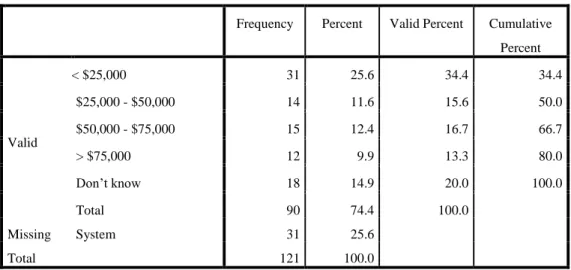
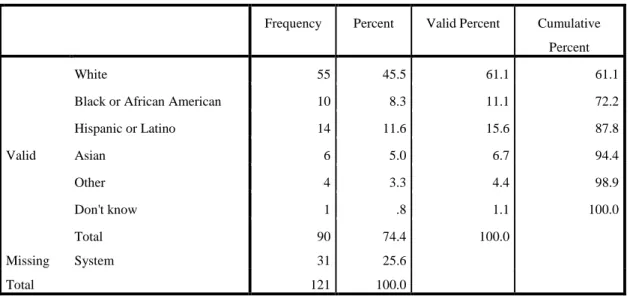
The respondents were asked ten demographic questions measured nominally to determine possible trend data. Tables 1-6 present key sample statistics. Of the 121 respondents, 88 provided their age. The ages ranged from 18 to 63 years, with the mean age of 23.44. A total of 92 participants provided their gender; of which 74 were female and 18 were male with 29 not responding. This equates to a sample that is approximately 61.2% female. Of the 121 respondents, 27.3% had an Associate degree and 22.3% had some college but no degree. Ninety of the respondents provided income information with the highest percentage (25.6%) coming in below $25,000. Ninety respondents also provided their race with the highest percentage (45.5%) choosing white. The residential description of the respondent’s residence showed urban and suburban with the
overwhelming majority of 31.4 % and 33.9%, respectively.
Table 1: Age
N Minimum Maximum Mean Std. Deviation
Age 88 18.00 63.00 23.4432 7.63064
29
Table 2: Gender
Frequency Percent Valid Percent Cumulative Percent Valid Male 18 14.9 19.6 19.6 Female 74 61.2 80.4 100.0 Total 92 76.0 100.0 Missing 29 24.0 Total 121 100.0
Table 3: Education Level
Frequency Percent Valid Percent Cumulative Percent
Valid
High school graduate or GED 6 5.0 6.7 6.7 Some college but no degree 27 22.3 30.0 36.7 Associate degree in college 33 27.3 36.7 73.3
Bachelor’s degree 21 17.4 23.3 96.7
Master’s degree 3 2.5 3.3 100.0
Total 90 74.4 100.0
Missing System 31 25.6
Total 121 100.0
Table 4: Household Income
Frequency Percent Valid Percent Cumulative Percent Valid < $25,000 31 25.6 34.4 34.4 $25,000 - $50,000 14 11.6 15.6 50.0 $50,000 - $75,000 15 12.4 16.7 66.7 > $75,000 12 9.9 13.3 80.0 Don’t know 18 14.9 20.0 100.0 Total 90 74.4 100.0 Missing System 31 25.6 Total 121 100.0
30
Table 5: Race
Frequency Percent Valid Percent Cumulative Percent
Valid
White 55 45.5 61.1 61.1
Black or African American 10 8.3 11.1 72.2
Hispanic or Latino 14 11.6 15.6 87.8 Asian 6 5.0 6.7 94.4 Other 4 3.3 4.4 98.9 Don't know 1 .8 1.1 100.0 Total 90 74.4 100.0 Missing System 31 25.6 Total 121 100.0
Table 6: Residence Type
Frequency Percent Valid Percent Cumulative Percent Valid Urban 38 31.4 43.7 43.7 Suburban 41 33.9 47.1 90.8 Rural 6 5.0 6.9 97.7 DK 2 1.7 2.3 100.0 Total 87 71.9 100.0 Missing System 34 28.1 Total 121 100.0 Research Design
A survey was utilized to assess the current level of emergency preparedness and measure the relationship between the independent variables. The use of a survey provided inexpensive and efficient access to a large population sample. The University Blackboard
31
was employed to reach participants by mass e-mail sent. This e-mail provided a link that the population sample could choose to click on and follow to SurveyMonkey. Once in
SurveyMonkey the participants chose to move on or stop the survey.
Instrumentation
The first section of the survey questionnaire was a statement of confidentiality. Participation was entirely voluntary and students had the option to choose to move forward or to stop the survey at this time. On the second page of the survey the directions provided students with definitions of the four types of emergencies of importance to the study: natural disasters, terrorism, hazardous materials accident, and disease outbreak.
The following twelve questions were adapted from FEMA’s Personal
Preparedness in America: Findings from the 2009 Citizen Corps National Survey. The 2009 Citizen Corps National Survey developed this questionnaire based on “previous research, preparedness modeling, and policy and guidance from the Department of Homeland Security” (Federal Emergency Management Agency, 2009).The research objectives of the 2009 Citizens Corps National Survey are a continuation of previous year’s data collection on individual preparedness for disasters. The original survey took place in 2003 and provided a baseline while the 2007 and 2009 surveys included refinements to incorporate additional areas of examination while also providing trend data (Federal Emergency Management Agency, 2009). The current research adjusted these previous questions to measure the overall variables of actual and perceived
preparedness (four questions), perceived involvement (three questions were used; belief was dropped due to ambiguity), and perceived knowledge (three questions). A question
32
pertaining to source confidence was dropped due to its ambiguity in measuring the intended variable. These variables were measured using both interval level questions and nominal level questions.
The remaining ten questions measured demographics of the sample population measured by nominal level questions. Age was measured by an open-ended question. These were measured to identify any trends among the sample population for possible indicators of future research avenues. The demographics questions measured residence type, volunteer status in disasters, sources of disaster information and housemate types as well as job status, education, age, race, and gender and income. Appendix 1 presents a copy of the e-mail invitation. Appendix 2 shows the full survey as presented to the participants.
Operatonalization of Variables
The research will consist of the following measures for: 1. Independent variables: knowledge and involvement 2. Dependent variable: individual emergency preparedness
The variables are all self-reported and based on the participant’s self-perception. The dependent variable of emergency preparedness was measured on the self-perception of personal emergency preparedness and also by three concrete measures of preparedness: active household emergency plan, disaster supplies, and training. The independent variable of involvement was determined by measuring relevance, importance, and personal concern. These variables have been identified as valid measurements of involvement through past research (Day, Stafford, & Camacho, 1995; Zaichkowsky,
33
1985). Finally, the independent variable of knowledge was evaluated through three self-perceived measures: confidence in knowledge of preparation, knowing what to do during an event, and knowledgeable with information pertaining to preparedness. Many of the variables were measured separately for four emergency types: natural disaster, terrorism, hazardous materials, and disease outbreak. This was done to identify differences among potential emergencies.
Scale Reliability
Utilizing the Cronbach Alpha Reliability test the scale reliability was calculated. This is considered the most commonly used single administration reliability test used by social scientists (Cronbach, 1951) and the most consistently reported (Wrench, Thomas-Maddox, Richmond, & McCroskey, 2008). SPSS for Windows was employed to
complete calculations once the recoded data set was entered.
The measurements for involvement included personal relevance, importance, and personal concern borrowed from the Personal Involvement Inventory. This scale
“successfully met standards for internal reliability, reliability over time, content validity, criterion-related validity, and construct validity” (Zaichkowsky, 1985, p.341). These are shown to be representative of involvement and applied by researchers in the
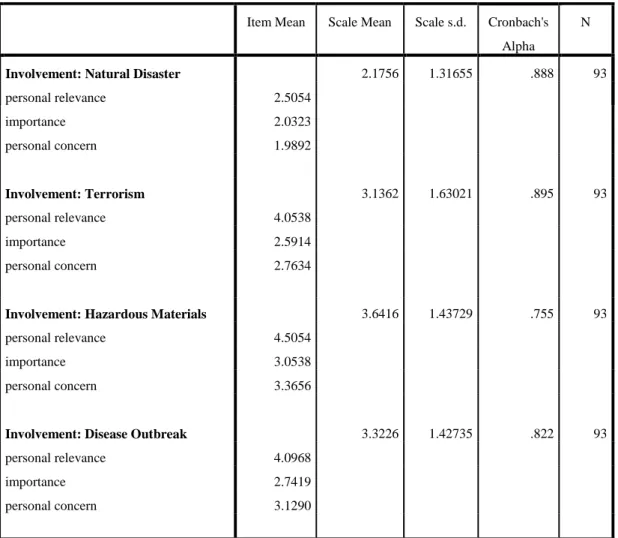
communications field. All three measures showed good reliability for the three of the four emergency types as shown in Table 7 below. The alpha reliability found for the Personal Involvement Inventory in the current study was interpreted as respectable by the
standards of Wrench, Thomas-Maddox, Richmond, & McCroskey (2008). The alpha reliability was measured for each of the four emergency types: natural disaster was .888
34
(M = 2.18, SD = 1.32); terrorism was .895 (M = 3.14, SD = 1.63); hazardous material was .755 (M = 3.64, SD = 1.44); and disease outbreak was .822 (M = 3.32, SD = 1.43). See Table 7 for more details.
Table 7: Reliability - Involvement
Item Mean Scale Mean Scale s.d. Cronbach's Alpha
N
Involvement: Natural Disaster 2.1756 1.31655 .888 93
personal relevance 2.5054 importance 2.0323 personal concern 1.9892 Involvement: Terrorism 3.1362 1.63021 .895 93 personal relevance 4.0538 importance 2.5914 personal concern 2.7634
Involvement: Hazardous Materials 3.6416 1.43729 .755 93
personal relevance 4.5054
importance 3.0538
personal concern 3.3656
Involvement: Disease Outbreak 3.3226 1.42735 .822 93
personal relevance 4.0968
importance 2.7419
personal concern 3.1290
Similarly, the Cronbach Alpha Reliability test was computed for two knowledge types: general self knowledge and specific knowledge. Under the general self knowledge
35
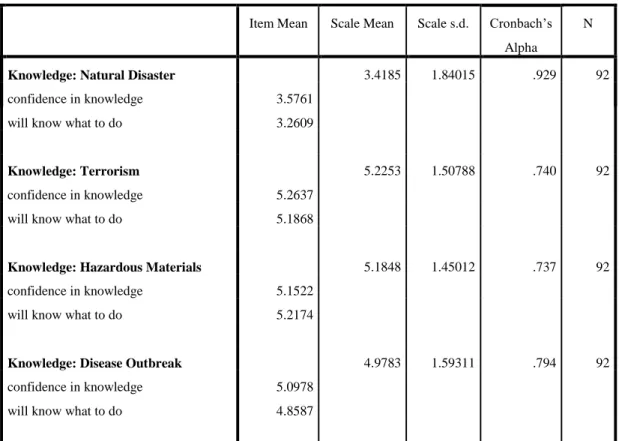
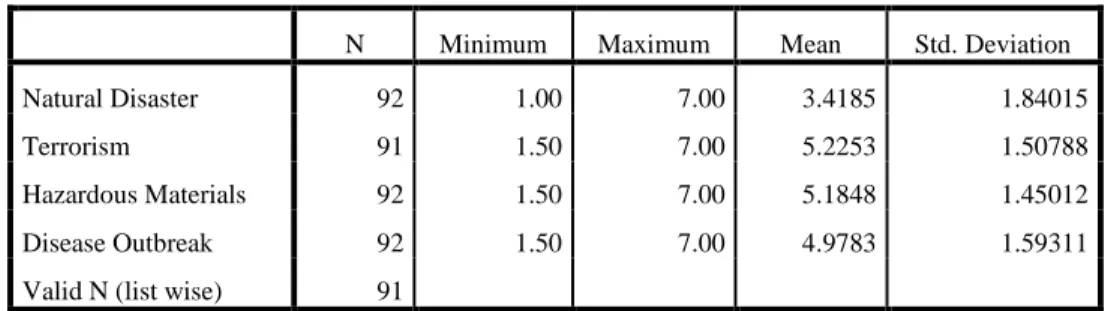
category natural disasters was calculated as the highest reliability at .929 (M = 3.42, SD = 1.84). While terrorism reported a reliability of .740 (M = 5.23, SD = 1.51), hazardous materials reported a reliability of .737 (M = 5.18, SD = 1.45) and disease outbreak reported a reliability of .794 (M = 4.98, SD = 1.59).
Table 8: Reliability - General Self Knowledge
Item Mean Scale Mean Scale s.d. Cronbach’s Alpha
N
Knowledge: Natural Disaster 3.4185 1.84015 .929 92
confidence in knowledge 3.5761 will know what to do 3.2609
Knowledge: Terrorism 5.2253 1.50788 .740 92
confidence in knowledge 5.2637 will know what to do 5.1868
Knowledge: Hazardous Materials 5.1848 1.45012 .737 92
confidence in knowledge 5.1522 will know what to do 5.2174
Knowledge: Disease Outbreak 4.9783 1.59311 .794 92
confidence in knowledge 5.0978 will know what to do 4.8587
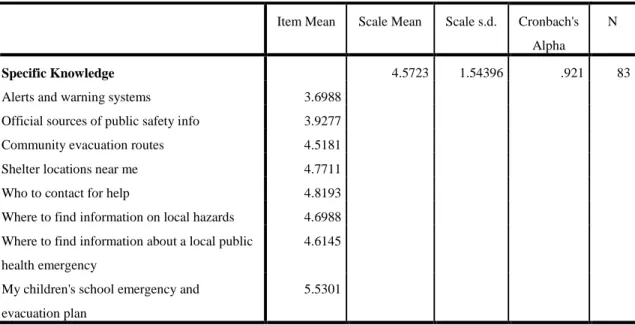
Specific knowledge was calculated based on self-reporting of knowledge of nine areas of emergency management preparedness. The alpha reliability for these nine areas was calculated at .921 (M = 4.57, SD = 1.54). Table 9 displays the results in more detail.
36
Table 9: Reliability - Specific Knowledge
Item Mean Scale Mean Scale s.d. Cronbach's Alpha
N
Specific Knowledge 4.5723 1.54396 .921 83
Alerts and warning systems 3.6988 Official sources of public safety info 3.9277 Community evacuation routes 4.5181 Shelter locations near me 4.7711 Who to contact for help 4.8193 Where to find information on local hazards 4.6988 Where to find information about a local public
health emergency
4.6145
My children's school emergency and evacuation plan
5.5301
All measures of Cronbach’s alpha were calculated within the acceptable range for reliability. The alpha reliability provided the statistical support for the measures of knowledge and involvement to move ahead with the hypothesis testing. The results of the hypothesis testing follow in chapter five.
37
CHAPTER 5: RESULTS
This research study was undertaken to both develop a descriptive overview of current individual emergency preparedness as well as measure the relationship between the independent and dependent variables. Descriptive statistics are presented below followed by a discussion of the hypotheses testing.
Descriptive Statistics
Descriptive statistics add to the currently growing body of research on the state of emergency preparedness among specific United States populations. The survey contained four different measures of individual emergency preparedness:
1. Perceived level of preparedness 2. Household Emergency Plan 3. Disaster supplies
4. Training
The perceived personal level of emergency preparedness was measured by an interval 7-point scale from “very prepared” to “not at all prepared”. Responses for eighty-nine participants were recorded ranging from a minimum of two to a maximum of seven with a mean of 4.60 as shown in Table 10.
38
Table 10: Perceived Preparedness Level Descriptive Statistics
N Minimum Maximum Mean Std. Deviation Personal level of emergency
preparedness
89 2.00 7.00 4.6067 1.56393
Valid N (list wise) 89
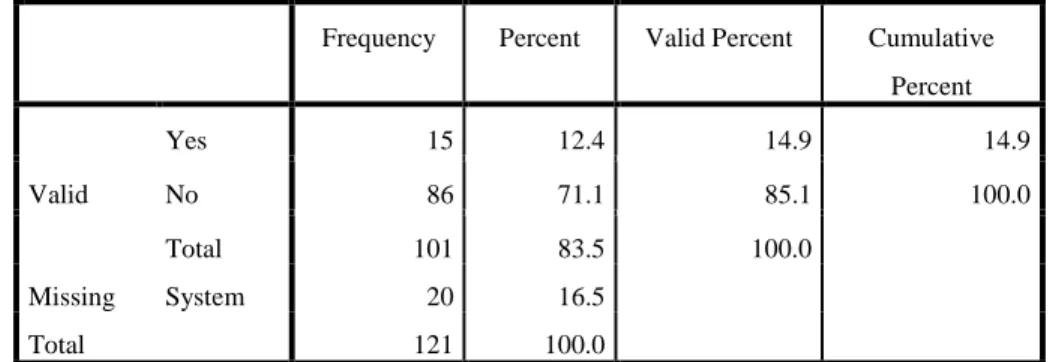
The self-reported household emergency plan was recorded on a nominal level, with a yes or no response. A total of 101 participants responded to this question with an overwhelming 85.1% stating they do not have such a plan. The data is presented in Table 11.
Table 11: Active Household Emergency Plan Descriptive Statistics
Frequency Percent Valid Percent Cumulative Percent Valid Yes 15 12.4 14.9 14.9 No 86 71.1 85.1 100.0 Total 101 83.5 100.0 Missing System 20 16.5 Total 121 100.0
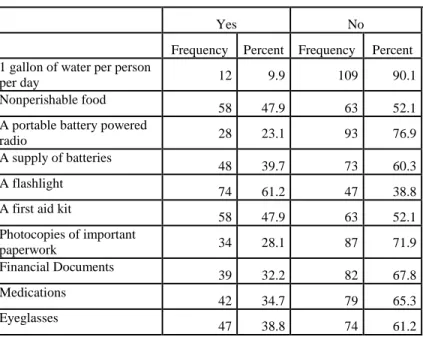
Participants chose all disaster supplies found in their homes as the third measure of individual emergency preparedness. As shown in Table 12 respondents chose from nominal question of ten disaster supplies. Directions directed participants to choose all that apply. These supplies are to be specifically for emergency purposes and ample enough for the entire family to subsist on. Flashlights, non-perishable food, and first aid kits were the top three most common items the respondents stated were in their homes for emergency purposes. Eyeglasses, medications, and financial documents were the bottom
39
three chosen. Table 13 shows that an average of 3.64 home disaster supplies was chosen by 121 participants.
Table 12: Home Disaster Supplies Descriptive Statistics
Yes No
Frequency Percent Frequency Percent 1 gallon of water per person
per day 12 9.9 109 90.1
Nonperishable food
58 47.9 63 52.1 A portable battery powered
radio 28 23.1 93 76.9
A supply of batteries
48 39.7 73 60.3 A flashlight
74 61.2 47 38.8 A first aid kit
58 47.9 63 52.1 Photocopies of important paperwork 34 28.1 87 71.9 Financial Documents 39 32.2 82 67.8 Medications 42 34.7 79 65.3 Eyeglasses 47 38.8 74 61.2
Table 13: Number of Emergency Supplies Descriptive Statistics
N Mean Std. Deviation No. of Emergency
Supply Items
121 3.6364 3.11716
Valid N (list wise) 121
In the final measurement of preparedness participants chose any training that they attended during the previous two years from a nominal question. A total of 101 responses were recorded. First aid skill training was chosen as the most common training attended, with a total of 15.8% of respondents. Community Emergency Response Training (CERT) followed with 5 respondents (5%) while Cardiopulmonary Resuscitation (CPR) training
40
was chosen by one respondent (1%). An overwhelming 78.2% reported not attending any of the training.
Table 14: Training Attendance < 2 yrs Descriptive Statistics
Frequency Percent Valid Percent
Attended CPR training 1 .8 1.0
Attended first aid skills training 16 13.2 15.8 Attended training as part of CERT 5 4.1 5.0
Total 101 83.5 100.0
Missing 20 16.5
Total 121 100.0
To determine the overall level of involvement in emergencies among the
population sample the average for each of the four emergencies was undertaken. A total of 93 participants responded. Involvement with hazardous materials ranked highest with a mean of 3.64, disease outbreak (M = 3.32), terrorism (M = 3.13) and natural disaster (M = 2.17).
Table 15: Involvement Descriptive Statistics
N Minimum Maximum Mean Std. Deviation Natural Disaster 93 1.00 7.00 2.1756 1.31655
Terrorism 93 1.00 7.00 3.1362 1.63021
Hazardous Materials 93 1.00 7.00 3.6416 1.43729 Disease Outbreak 93 1.00 7.00 3.3226 1.42735 Valid N (list wise) 93
Similarly, the overall level of knowledge of emergencies among the sample was averaged for each of the four types of emergencies. Participants self-assessed knowledge was the highest for terrorism (M = 5.22) and the lowest for natural disasters (M = 3.41).
41
The means of hazardous materials and disease outbreak knowledge were measured at (M
= 5.18) and (M = 4.97) respectively.
Table 16: Knowledge Descriptive Statistics
N Minimum Maximum Mean Std. Deviation Natural Disaster 92 1.00 7.00 3.4185 1.84015
Terrorism 91 1.50 7.00 5.2253 1.50788
Hazardous Materials 92 1.50 7.00 5.1848 1.45012 Disease Outbreak 92 1.50 7.00 4.9783 1.59311 Valid N (list wise) 91
Hypothesis Testing
In this section, hypothesis-testing results are presented. All hypotheses were tested using SPSS 20.0. An alpha level of .05 was used for all statistical tests. In this study, the impact of knowledge and involvement on personal emergency preparedness was measured by perceived preparedness level, having a household emergency plan, the number of disaster supplies stored, and attendance in emergency training.
Hypothesis 1a: There is a positive relationship between involvement with emergencies and perceived level of personal emergency preparedness.
This purpose of this hypothesis was to test the relationship between participants’ involvement with each of the four types of emergencies (natural disasters, terrorism, hazardous materials, and disease outbreak) and their overall perceived level of emergency preparedness. Pearson product-moment correlation coefficients were used to test the hypothesis. The results (Table 17) showed that none of the coefficients reached statistical