Nicholas Barr
Funding post-compulsory education
Book section
Original citation:
Originally published in Funding post-compulsory education. In: Johnes, Geraint, Johnes, Jill, Agasisti, Tommaso and López-Torres, Laura, (eds.) Handbook on the Economics of Education. Edward Elgar.
© 2017 Edward Elgar
This version available at: http://eprints.lse.ac.uk/69841/
Available in LSE Research Online: March 2017
This is a draft chapter that has been accepted for publication by Edward Elgar Publishing in the forthcoming book Handbook on the Economics of Education due to be published in 2017 LSE has developed LSE Research Online so that users may access research output of the School. Copyright © and Moral Rights for the papers on this site are retained by the individual authors and/or other copyright owners. Users may download and/or print one copy of any article(s) in LSE Research Online to facilitate their private study or for non-commercial research. You may not engage in further distribution of the material or use it for any profit-making activities or any commercial gain. You may freely distribute the URL (http://eprints.lse.ac.uk) of the LSE Research Online website.
This document is the author’s submitted version of the book section. There may be differences between this version and the published version. You are advised to consult the publisher’s version if you wish to cite from it.
Funding post-compulsory education
Nicholas Barr
September 2016 revised February 2017
London School of Economics
Handbook on the Economics of Education, Edward Elgar, forthcoming
Handbook on the Economics of Education 1 3 February 2017
Funding post-compulsory education
1Nicholas Barr2
1 Objectives
This chapter sets out a strategy for financing post-compulsory education. Though the analysis applies generally, it is particularly relevant to Europe, where countries with high institutional capacity face fiscal constraints, mostly with only limited mechanisms for cost sharing, and to the USA, which has badly-designed cost sharing.
Higher education matters: to transmit knowledge, as always; to promote core values, as always; and to develop knowledge for its own sake, as always. In addition, higher
education has come to matter also to promote economic growth, including the transmission of knowledge and skills to students and knowledge transfer to firms and government. This policy direction results from two drivers. Skill-biased technical change increases the demand for highly-skilled workers and hollows out the demand for medium skills. Second,
demographic change – declining fertility and rising life expectancy – creates downward pressure on the size of the workforce. A response to fewer workers is to make each worker more productive through increased investment in physical and human capital.
The two drivers point in the same direction – a need for more education and training (i.e. more people with higher skills), more frequent education and training, as skills go out of date more quickly, and more diverse education and training. Thus it is no accident that participation rates in post-compulsory education have risen, with no sign that the trend is slowing.
Against this backdrop, three objectives stand out:
Improving the quality of teaching and research.
Access, i.e. widening participation for students from disadvantaged backgrounds.
1 I am grateful to the editors and to Michael Otsuka, Andrew Norton and Gill Wyness for helpful comments. Remaining errors are my responsibility.
2 Professor of Public Economics, London School of Economics; [email protected];
Handbook on the Economics of Education 2 3 February 2017
Increasing the size of the sector. Returning to a small elite system is no longer an option. Deepening skills and spreading them across the population is important both to strengthen national economic performance and to increase social mobility.
2 Principles
This section discusses a series of principles that should underpin the finance and delivery of higher education in pursuit of these three objectives: cost sharing between taxpayers and the individual beneficiary; competition combined with regulation, including robust quality assurance; consumption smoothing, notably a loan system; insurance, because investment in human capital faces uncertainty; social mobility; fiscal parsimony of loan design; and a wide-ranging and continuing role for government as a necessary complement to the other policies.
Though the way these principles are implemented and the relative weight accorded each will vary, they are of general application.
Principle1: Cost sharing
The case for sharing cost has three elements.
EXTERNAL BENEFITS. It is widely agreed that higher education creates benefits to society over and above those to the individual. By increasing a person’s future earnings on average, higher education increases her future tax payments; her investment thus confers a ‘dividend’ on future taxpayers. Second, production benefits arise where education, by making someone more productive, also makes others more productive, e.g. the clustering effects of high tech industry in Silicon Valley, Cambridge (Massachusetts), and Cambridge (England). Third, cultural benefits include better parenting and increased civic engagement.
Absent the exception in Box 1, in the presence of external effects investment will be inefficiently low. Applicants take account only of their private benefits, exerting downward pressure on demand, with two potential ill-effects. The size of the sector might be smaller than efficient (if too few people choose to go to university) or quality might be inefficiently low (if lower demand leads to lower fees).
Handbook on the Economics of Education 3 3 February 2017
Box 1 Subsidising external benefits: The exception
Though the argument in the previous paragraph is generally correct, it does not hold where demand is price inelastic, i.e. where the number of people applying to Oxford or Cambridge (henceforth
Oxbridge) would change little, if at all, if fees increased by, say, £1,000, whereas a fee increase of that size would have a significant impact on demand at the generality of universities. In that case, the absence of a subsidy for Oxbridge does not reduce demand or supply, hence there is no efficiency loss. This does not imply that there is no social benefit, merely that there is no efficiency reason for subsidising its production.
Because it is difficult (a) to establish causality and (b) to measure benefits there is no definitive way to quantify the division between social and private benefits (Barr, 2012a, section 11.2.2). However, that some externalities are hard to measure does not make them unreal. Furthermore, the case for widening and deepening human capital is not only as investment, but also as insurance (under-investing risks being overtaken by South Korea). The cost share, like the poverty line, represents fiscal, political and social consensus as much as scientific fact.
FISCAL CONSTRAINTS. Education typically faces fiscal pressures from ageing populations, rising medical spending, etc. Cost sharing thus also helps to contain public spending. EQUITY ARGUMENTS. People from better-off backgrounds continue to be over-represented in higher education. Thus undue reliance on taxpayer finance has a regressive element, hence cost sharing also contributes to social justice.
For all three reasons – external benefits, fiscal constraint and distributional aspects – it is efficient and equitable that the beneficiary pays for his/her private benefits and taxpayer finance covers social benefits in excess of private benefits.
Principle 2: Competition – but regulated competition
Policy should contribute to improving quality, including a good fit between the needs of individuals and the economy on the one hand, and what universities provide, on the other.
COMPETITION IS USEFUL. Consumer sovereignty is more useful (a) the better is consumer
Handbook on the Economics of Education 4 3 February 2017
understand available information, (d) the lower the costs of choosing badly, and (e) the more diverse are consumer tastes.
Information about higher education is readily available, though its usefulness is incomplete because education is in part an ‘experience good’ – the student can judge quality and goodness of fit only by using the service. The move towards modular degrees reduces the costs of mistaken choice. And consumer tastes are diverse and degrees increasingly diverse. Thus, it can be argued that students are mostly well-informed, so consumer sovereignty is more useful for post-compulsory education than for earlier education. Though that argument is generally robust, it frequently does not apply to students from poorer backgrounds, taken up in Principle 5 (social mobility).
BUT NOT UNRESTRICTED COMPETITION. Competition does not necessarily mean an
unregulated market. Government remains a central actor (Principle 7) including ensuring robust quality assurance, discussed later (Box 2).
Principles 1 and 2 concern mainly the supply side. Principles 3-5 address demand-side constraints.
Principle 3: Consumption smoothing
Principle 1 argues that the beneficiary pays for his/her private benefits. However, students are generally credit constrained and thus need a mechanism that provides consumption
smoothing by allowing a student to borrow against his/her future earnings, i.e. a system of loans. For that purpose, loans should be sufficient to cover tuition fees and realistic living costs. There are symmetries between student loans (redistribution from earning years to ones younger self) and pensions (redistribution from earning years to ones older self).3
Principle 4: Insurance
WHY INSURANCE IS NECESSARY. Consumption smoothing points to a loan arrangement, but
efficient consumption smoothing requires insurance. In a prescient proposal, Friedman (1955) pointed out that loans to finance human capital are risky. They are risky for the borrower,
3 For that reason, my first UK proposal (Barr 1988, 1989) was for loan repayments to be an add-on to national insurance contributions.
Handbook on the Economics of Education 5 3 February 2017
who has imperfect information about his aptitudes for higher education and about future labour market outcomes. In addition, unlike home loans, there is no collateral: if someone does not earn as much as expected, there is no option to sell the degree to repay the loan. The absence of collateral makes such loans risky also for lenders. There is also potential adverse selection: if I take out a loan, I may conceal that I want to become an actor rather than an accountant. Or (moral hazard), I may work less hard, analogous to the sharecropper problem. Without insurance, borrowing and lending would be lower than efficient.
DIFFERENT APPROACHES TO INSURANCE. Friedman’s solution was equity finance whereby the borrower pays the lender a fraction of his/her subsequent earnings – the idea of income-contingent repayments – providing insurance against low current income.
To set the scene for later discussion, it is helpful clarify different ways in which writers use the term ‘income-contingent’.
Definition 1: repayments are contingent on lifetime income. Thus people with higher lifetime earnings repay more in present-value terms.
Definition 2: repayments stop when the borrower has repaid his/her loan in present-value terms. Income contingency affects the time path of repayments but, except for the lifetime poor, not the total repayment.
EQUITY FINANCE: THE GRADUATE TAX APPROACH. In this approach (broadly Definition 1), an individual repays a fraction of his/her income for life or until some specified date such as retirement. Pointing to the problems outlined above (lack of collateral, etc.), Friedman argued that,
‘The device adopted to meet the corresponding problem for other risky investments is equity investment plus limited liability on the part of shareholders. The counterpart for education would be to “buy” a share in an individual’s earning prospects: to advance him the funds needed to finance his training on condition that he agree to pay the lender a specified fraction of his future earnings’ (Friedman, 1955, p.138).
The resulting policy is a graduate tax, a device for risk sharing which Friedman justified in terms of the benefit principle.
Handbook on the Economics of Education 6 3 February 2017
Interestingly, the approach can be justified also in terms of ability to pay. Glennerster et al. (1968), argued that publicly-financed higher education,
‘…is reserved for a small and highly selected group… [And] education confers benefits which reveal themselves in the form of higher earnings. A graduate tax would enable the community to recover the value of the resources devoted to higher education from those who have themselves derived such substantial benefit from it’ (1968, p.26).
LOAN FINANCE. A different strand in the literature considers loan finance. In the simplest
arrangement, repayments stop when the individual has repaid in full in present-value terms. This is definition 2, above. Early proposals included evidence to the UK Robbins Report (1963) by Peacock and Wiseman (1962) and Prest (1962).
By the second half of the 1980s, as expanding higher education created fiscal pressures, the income-contingent idea bubbled back to the surface, including Farmer and Barrell (1982) and Barr (1988, 1989) in the UK and Reischauer (1989) in the USA. Proposals in Australia included the Wran Report (1988); see also Chapman (1988), and in New
Zealand, the Hawke Report (1988). For a survey of the way things looked at the time, see Barr (1991), for more recent surveys, Chapman (2006a) and Johnstone (2004) and for a US view, Dynarski (2013).
HYBRID DESIGNS. A graduate tax and a simple loan are two ends of a spectrum with
intermediate options. A graduate tax could be designed so that ex ante ‘dividends’ are no longer collected once the cohort of borrowers has repaid in full. Analogously, a loan could charge an interest rate equal to the cost of finance plus a cohort risk premium such that ex ante repayments stop once the cohort has fully repaid.
Thus the pure cases converge (for fuller discussion, see Barr 2010). What they converge to can be thought of as social insurance. The ‘insurance’ part is that the losses of those who are unlucky (i.e. with low lifetime income) are subsidised by those who are lucky (good lifetime income). The ‘social’ part is a common risk pool with nobody excluded, i.e. all students borrow on the same terms.
Handbook on the Economics of Education 7 3 February 2017
Principle 5: Social mobility
Social mobility is important not only for equity reasons but also because countries cannot afford to waste talent.
Two sets of impediment potentially stop someone going to university.
Credit constraints arise because many students and their families lack the resources to pay upfront. Well-designed loans are the primary instrument for addressing these constraints.
Constraints with earlier roots largely manifest themselves in poor school grades. The literature points to four sources of improvement: better policies for early child development; interventions during school years; policies to increase information and raise aspirations; and policies to address credit constraints during post-compulsory secondary education to assist completing high school.
INTERVENTIONS IN EARLY CHILDHOOD. A child’s first 1000 days (conception to age two)
strongly influence life chances (Heckman et al. 2013). Thus, for example, pre-kindergarten matters. Early childhood experiences have lasting effects. Children in England normally start school on 1 September after their fourth birthday. Thus an August baby is only just four, a September baby nearly 5, representing a 25 per cent difference in developmental experience. Crawford, Dearden and Greaves find,
‘ … large differences in educational attainment between children born at the start and end of the academic year in England. These differences are largest soon after children start school and decrease as they get older … but the gap remains educationally and
statistically significant at the end of compulsory schooling, when young people are starting to make choices about further and higher education’ (2013, p.1, emphasis added).
In the USA, Hoynes et al. (2016) study the introduction of food stamps, a programme that provides food-purchasing assistance for poor people, and find beneficial effects from improved nutrition that extend into adulthood. Attanasio et al. (2014) show striking results from early interventions in Columbia, where a programme of home visits aimed at promoting stimulation of children in poor families, both directly and through demonstration effects for
Handbook on the Economics of Education 8 3 February 2017
mothers; after 18 months, children in the treatment group had significantly higher cognitive skills than those in the control group, the improvement closing over a third of the gap between children in the top and bottom wealth quartiles.
IMPROVING SCHOOL ATTAINMENT. Historical data provide the simplest and most graphic
evidence. In 2002, students from poor backgrounds paid no tuition fees in England. In that regime, 81 per cent of children from professional backgrounds went to university but only 15 per cent of children from manual backgrounds (UK Education and Skills Select Committee, 2002, p. 19). However, as Figure 1 shows, when the sample is restricted to students with good high school graduation grades, about 90 per cent of students went to university. In other words, controlling for attainment, the socioeconomic gradient largely disappears. The
problem is not primarily a credit constraint but a prior attainment constraint.
Figure 1 Participation in higher education by socioeconomic group controlling for high school graduation grades, England, 2002.
Source: UK Office for National Statistics (2004, Fig. 2.15).
Chowdry et al. (2013), using more recent and more refined data and methodology, conclude that,
‘… our results make clear that the majority of the socio-economic difference in
participation in HE—including at high status institutions—arises as a result of substantial socio-economic differences in educational achievement earlier in life, and thus that policy
Handbook on the Economics of Education 9 3 February 2017
makers who are interested in increasing participation among pupils from lower SES backgrounds need to intervene earlier to maximize their potential impact’ (p. 455).
POLICIES TO IMPROVE INFORMATION AND RAISE ASPIRATIONS. Many students from
disadvantaged backgrounds are badly informed about higher education. If they under-estimate the benefits of higher education and/or over-under-estimate the costs, it is rational for them, given what they know, to be unwilling to take out a loan (see Usher 2006 for a Canadian study). Hoxby and Turner (2015) identify aspects on which students from low-income backgrounds are misinformed and find that interventions to improve information increase the likelihood that they will apply to a selective (i.e. elite) university.
A frequent information problem arises where someone does not know whether his/her interests and aptitudes are suitable for higher education. One solution is to offer a low-cost experiment. Non-repayable grants are one approach, with a particular case for full
scholarships for a student’s first year, by the end of which he or she will generally be well-informed and thus prepared to take out a loan for the rest of the degree. Flexible part-time options are another approach. Though limited in its application, a third approach to the ‘am I good enough?’ question is to teach some university courses in high school (see Barr 2012a, Box 12.7 for an example of a first-year university law course taught at an inner-city school).
POLICIES TO ASSIST COMPLETING HIGH SCHOOL. Students from low-income backgrounds may
face credit constraints when they reach school leaving age. Until 2012, Education Maintenance Allowances in England targeted financial support on students from poor families from age 16 to encourage them to complete high school.
In sum, policies to widen participation have two strategic elements: addressing credit constraints and addressing prior constraints. At its simplest, the story is utterly familiar to economists: higher fees move students back up their demand curve, pro-access policies shift the demand curve of people from disadvantaged backgrounds to the right.
Handbook on the Economics of Education 10 3 February 2017
Principle 6: Fiscal parsimony of loan design
WHY PARSIMONY MATTERS. Leaky loan systems (with which the world is littered) harm the
achievement of all three main objectives. They are expensive in fiscal terms, leading to restrictions in one or more of: the number of students; the number of loans; the size of loans; the breadth of the loan system (e.g. not covering living costs, or excluding part-time students, postgraduate students and students in sub-degree tertiary education); and spending on more powerful pro-access policies, including earlier in the system.
More generally, loans are an ineffective instrument for addressing equity goals. Increasing social mobility is a separate objective from consumption smoothing and should generally be addressed using different instruments.
DESIGNING THE CONSUMPTION SMOOTHING ELEMENT. In a well-designed loan, most borrowers repay in full. This requires a sensible choice of (a) interest rate, (b) repayment threshold and (c) repayment rate. The interest rate should be based on the cost of finance, e.g. the rate on long-run government bonds. A fairly low repayment threshold has the advantage that the repayment rate can be fairly low.
DESIGNING THE INSURANCE ELEMENT. Since a well-designed loan makes a loss on borrowers
with low lifetime earnings, the question arises of where the resulting costs should fall. Berlinger (2009) describes the Hungarian system which operates without taxpayer support. Barr and Shephard (2010) consider different ways of meeting the loss and (as discussed in section 5.3) conclude that the degree of self-financing should be optimised rather than maximised. ‘Leaky’ systems (the UK system being an egregious example) are suboptimal, but it does not follow that the optimal taxpayer share of losses is zero.
Principle 7: A wide-ranging and continuing role for government
Principle 2 (competition) is not an argument for a free market. Government has a central role in finance, regulation and setting incentives.
FINANCE. Taxpayer support for higher education is needed for multiple reasons.
Handbook on the Economics of Education 11 3 February 2017
Research: public finance for research (not discussed in this chapter) is justified not least because research findings can have the characteristics of a public good.
Student loans (Principles 3, 4 and 6): government action is needed to ensure that an administrative structure is in place, and generally also to cover at least some of the loss on borrowers with low lifetime earnings. In practice, government frequently also provides the loan capital.
Redistribution within higher education: a university may be doing useful work locally but face high costs (an access university in a city centre, for example), creating a potential role for government to redistribute towards such institutions.
REGULATION. Government has several roles.
Regulating fees: though universities operate in a (fairly) competitive market for teaching, elite universities also sell students access to the network of their peers – a positional good in respect of which universities have some monopoly power, helping to explain the high fees at some universities. The resulting monopoly rent is ploughed back into facilities, a distortionary upward bias leading to quality that is inefficiently high. The problem is recognised. As the President of a private US university put it, ‘It’s time to call an end to the amenities arms race.’4
Thus a government might wish to have reserve powers to regulate fees. Regulating borrowing per student: efficient consumption smoothing (Principle 3) requires that individuals should not borrow more than on average they can repay.
Ensuring policies to promote social mobility: government should finance, encourage and/or mandate policies that widen participation (Principle 5).
Ensuring quality assurance is discussed in Box 2.
Box 2 Robust quality assurance: An essential complement to competition
Quality assurance is important, particularly if the system includes for-profit institutions. Government should mandate quality assurance and monitor its effectiveness, but not necessarily provide it.
4 Oral presentation at the Lord Dearing Memorial Conference: The Future of Higher Education, The University of Nottingham, 11 February 2010.
Handbook on the Economics of Education 12 3 February 2017 One way to assess quality is through inspection. That approach, however, tends to have high transactions costs and may focus on process rather than outcomes.
An alternative approach is through well-informed consumers. A bright 16-year-old will ask questions like ‘will it be interesting?’, ‘will I be well taught?’ and ‘will I get a good job?’. Quality assurance should address those questions with information such as evaluation by students and others of teaching quality, in particular the contribution of teaching to student learning (i.e. value added), surveys of student experience, and next destination statistics – a market test of employers’ views of quality – thus giving prospective students the information they need to vote with their feet. That some of these variables are hard to measure is not an argument against the approach. The data should have
common definitions5 and be subject to rigorous audit.
Information is important also for matching students and courses. Given diversity of individual objectives, subjects, academic approach, modes of study, financial constraints and labour-market constraints, information has a key role in assisting individual choice.
Alongside mandatory publication of information, quality assurance also requires concentrated assistance for institutions with significant problems and reserve powers for removing accreditation.
SETTING INCENTIVES. Government has a role as setter of incentives, rather than as central
planner.
How much competition: with pure competition, institutions attracting large numbers expand, those that fail to do so may disappear. However, universities are not conventional firms: they do not maximize profit; and, as discussed in section 1, the ‘product’ is
multidimensional and differs across institutions. Thus unrestricted competition is suboptimal. At the other extreme, government could mimic central planning by deciding how many students study which subjects at which institution. Thus competition should be thought of as a continuum ranging from entirely unconstrained (pure competition) to 100 per cent
constrained (pure central planning). In an efficient implementation of Principle 2, competition should be optimised, the optimum being potentially different for different subjects (e.g. business studies more competitive than, say, music).
Subsidies for particular subjects: the quality objective includes a subject mix that fits the needs of the economy and individual preferences. Government may therefore wish to
5 For a voluntary US example of data based on a common template to assist comparability, see
Handbook on the Economics of Education 13 3 February 2017
assist particular disciplines, e.g. STEM6 subjects. It might also wish to encourage teacher training or nursing and could target resources accordingly.
Subsidies for particular students: universities could receive additional taxpayer support for students from disadvantaged backgrounds.
In sum, a regime that includes fees and student loans is more usefully seen not as a market system but as a public-private partnership with mutually reinforcing elements designed to achieve multiple objectives. The importance of government is demonstrated by systems where it is at least partly absent, notably the USA.
3 Analytical errors
Two sets of error stand out when designing a system for funding higher education in a given system with known characteristics. Mispricing risk runs counter to Principle 3 (insurance); and choosing the wrong policy instrument, frequently in the name of widening participation, runs counter to Principle 6 (social mobility).
3.1 Mispricing risk
Pricing risk wrongly has ill-effects discussed below. Box 3 frames the issue.
Box 3 Don’t confuse insurance and redistribution
The nature of insurance:
Automobile insurance premiums depend on each driver’s riskiness. A bad low-income driver
pays the same premium as a bad high-income driver of a similar car.
A central point is that what is insurance ex ante becomes redistribution ex post. The losses
of a driver involved in an accident are covered by the premiums of drivers not involved in an accident. The cheque the insurance company sends is an insurance payout, not redistribution. With student loans:
Borrowers with good incomes should repay in full in present-value terms (Principle 3)
Handbook on the Economics of Education 14 3 February 2017
Income-contingent repayments insure against low current earnings, forgiveness after n years
against low lifetime earnings.
Non-repayment by borrowers with low lifetime income is an insurance payout (Principle 4).
But confusion can arise because the insurance in question is income insurance, so that the distinction between insurance payout (efficiency) and redistribution (equity) is easily blurred.
Efficient insurance requires that risk is priced properly. For that reason, the interest rate is
central, reflecting the cost of finance and cohort risk.
The design question is where the loss on low-earning borrowers should fall: on the taxpayer, or on the cohort of borrowers through a cohort risk premium (i.e. a higher interest rate) or a surcharge (i.e. a fixed sum added to the loan to cover some or all of the loss). Thus we discuss in turn (a) an interest rate below the cost of finance (i.e. a taxpayer subsidy), (b) an interest rate above the cost of finance (i.e. a cohort risk premium), and (c) a surcharge. The conclusion is that a corner solution, i.e. exclusive reliance on any single method, is likely to be suboptimal.
AN INTEREST RATE BELOW THE COST OF FINANCE. The interest rate on student loans may be too low either through a grace period, whereby no interest is charged while the student is studying and/or by charging an interest rate below the cost of finance thereafter. Intuition suggests that interest subsidies help low earners. That intuition is correct for conventional loans, where a lower interest rate reduces monthly repayments. But with income-contingent repayments a lower interest rate has no effect on monthly repayments.
An interest rate below the cost of finance (e.g. a zero real rate of interest) raises two sets of problems. First, loans are fiscally expensive (see Shen and Ziderman 2009 for international evidence). Nobody repays in full in present-value terms. The subsidy applies to the whole loan for the lifetime of the loan. That lifetime is typically long, a desirable feature since it is efficient if the duration of a loan is related to the lifetime of the asset (hence 3-year car loans and 25-year home loans); but with an interest subsidy, the longer the duration the more expensive the subsidy. Behavioural responses are a further aggravation: someone who does not need the loan faces an incentive to borrow as much as possible and arbitrage the interest rate. As Principle 6 establishes, the high fiscal cost of blanket interest subsidies harms all three of the core objectives of quality, access and size.
Handbook on the Economics of Education 15 3 February 2017
A second problem is distributional: an interest rate below the cost of finance is progressive within the group of borrowers but, as the discussion of Principle 6 makes clear, mainly at the expense of people who do not go to university, i.e. benefits insiders at the expense of outsiders.
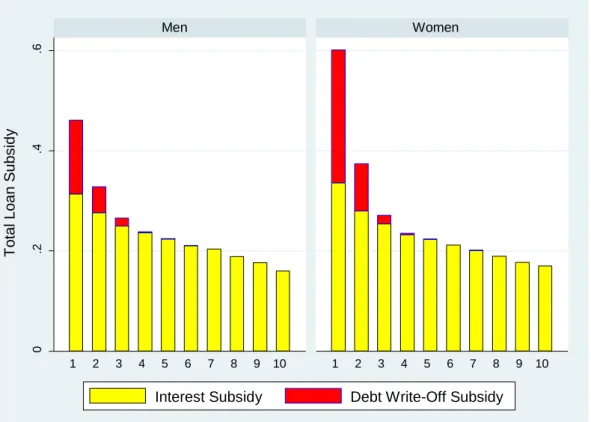
The logic is borne out by empirical evidence. Figure 2 shows that the interest subsidy (the lighter area) benefits everyone. With a blanket interest subsidy nobody repays in full in present-value terms. In sharp contrast, forgiveness after 25 years (the darker area) is well targeted insurance, exclusively benefitting people with low lifetime earnings.
Thus a blanket interest subsidy is harmful. In contrast, targeted interest subsidies (discussed in section 5.2) can be useful.
Figure 2: Pre-2012: Subsidy as per cent of total loan, by decile of lifetime earnings
Source: Johnston and Barr (2013, Figure 1) using data on salary paths from the Institute for Fiscal Studies.
AN INTEREST RATE ABOVE THE COST OF FINANCE. In principle it would be possible to cover the
costs of non-repayment by borrowers with low lifetime earnings by adding a cohort risk premium to the cost of finance. Beyond a certain point, however, an interest rate above the cost of finance creates problems:
0 .2 .4 .6 1 2 3 4 5 6 7 8 9 10 1 2 3 4 5 6 7 8 9 10 Men Women
Interest Subsidy Debt Write-Off Subsidy
T ota l Lo a n S ub s id y
Handbook on the Economics of Education 16 3 February 2017
Adverse selection among borrowers: if the risk premium is too large, students from well-off families and those who anticipate high earnings will tend to pay upfront, reducing the ability of the system to provide insurance to low earners;
Political problems can arise if low earners (and their parents) see real outstanding debt rising. With a write-off after n years that is not a problem if people are rational, but that is a mis-application of first-best analysis.
Distributional effects: an interest rate above the cost of finance is regressive within the group of borrowers, since low earners, who take longer to repay, face the higher interest rate for longer and therefore repay more in PV terms than higher earners.
A SURCHARGE. Suppose that a system has a zero real interest rate but charges $1,200 per
$1,000 of loan. For any lower interest rate there exists a surcharge that leads to the same overall level of subsidy as an arrangement with a higher interest rate and no surcharge. Thus in principle a surcharge can cover total interest (i.e. address the problem of the cost of a blanket interest subsidy). But a lower interest rate has very different marginal incentive effects to a positive real interest rate.
Adverse selection among borrowers: as above, if the surcharge is too large, students from better-off families and/or confident of high future earnings will tend to pay upfront, reducing the ability of the system to provide insurance to low earners;
Incentive against early repayment: once someone has incurred the fixed liability of the surcharge they face a low marginal interest rate; thus if someone has several loans (student loan, mortgage), student loans will be last in the queue for early repayment. That incentive matters because it adds to the cost of loans.
A small discount for upfront payments may be defensible, e.g. for small tuition charges or to cover only part of the loss of loans, since the resulting distortion is small, but does not extend well.
CONCLUSIONS.
An interest rate below the cost of finance has serious ill effects.
An interest rate slightly above the cost of finance might be a useful element, but beyond a certain point has ill effects.
Handbook on the Economics of Education 17 3 February 2017
A small surcharge may work well enough because the resulting distortion is small, but beyond a certain point has ill effects.
In all three approaches, the problem is more acute the greater the deviation of the interest rate from the cost of finance, the larger the loan, and the longer the duration of the loan. These conclusions reinforce the arguments in Barr and Shephard (2010), who conclude that the degree of self-financing of a student loan should be optimised rather than maximised. Leaky systems, as in the UK, are suboptimal, but it does not follow that the optimal taxpayer share of losses is zero.
3.2 Choosing the wrong policy instrument
‘FREE’ HIGHER EDUCATION TO WIDEN PARTICIPATION AKA ‘FEES HARM ACCESS’. Achieving
multiple objectives requires multiple instruments. It is mistaken to consider tuition fees in isolation, ignoring surrounding policies like loans and action to improve prior attainment.
Tuition fees alone will reduce demand and harm participation; and fees combined with financial support address credit constraints but not prior constraints. A body of literature (e.g. Dynarski 2002, 2003; Long 2007, 2010; Dearden et al. 2011) investigates fees and financial support, and is sometimes wrongly interpreted as showing the ill-effects of fees. An alternative interpretation is that their findings show the effects of credit constraints, either because there is too little financial support or because complexity reduces its effectiveness. If prior attainment and imperfect information are additional constraints, it is not surprising that evidence on the influence on participation of college aid per se is equivocal.
Undue reliance on taxpayer finance is mistaken because it hinders the achievement of all three core objectives. First, tax finance can address credit constraints but does nothing to address prior constraints. Thus it should not be surprising that a considerable socioeconomic gradient exists even where higher education is almost entirely tax financed (see the text around Figure 1).
Second, the lack of tuition fees can harm access by creating supply-side constraints. If higher education faces fiscal pressures, either numbers will be capped, harming access
Handbook on the Economics of Education 18 3 February 2017
directly, or quality will decline, harming access because universities lack the resources to assist students from disadvantaged backgrounds making the transition into higher education.
Third, tax finance has considerable redistributive effects. ‘Free’ is just another word for ‘someone else pays’, so the right question to ask is who pays. Part of the case for tax-financed health care or compulsory school education is that everyone uses them. Higher education is different: people choose whether to participate – and it is mainly people from better-off backgrounds who do so. Thus the taxes of poorer people, many of whom never complete high school,7 pay for the degrees of people mainly from better-off backgrounds.8
In sum, taxation (a) finances an activity consumed mainly by the better off, which (b) helps to maintain their position, while (c) simultaneously harming access through a shortage of places and by crowding out activities that genuinely widen participation.
DEBT AVERSION. Alongside ‘fees harm access’ is the argument that ‘loans harm access’, in particular that people from poor backgrounds are debt averse, Thus, it is argued, fees impede access even if covered by an income-contingent loan.
But policy should not rest on an indiscriminate diagnosis of debt aversion (see, for example, Chapman and Ryan 2005). Some people are, indeed, reluctant to borrow to finance their studies. But people from poorer backgrounds often have mortgages and credit-cards, so are not debt averse per se. Studies are flawed if they do not consider differences in attainment or wider reasons why someone might be reluctant to borrow.
Lack of prior attainment has already been discussed. The flawed argument is that people from poor backgrounds do not go to university because they are debt averse; thus resources to widen participation should finance grants for university students. What the evidence suggests is that poor people do not go to university largely because of low
attainment and, if that problem is fixed, are almost as likely to go to university as people from better-off backgrounds. Thus resources to widen participation should be used mainly to raise
7 In 2011, 68% of 19-year olds applying to university had parents with a degree, compared with 28% of 19-year olds with parents educated below A Level (UK Department for Education, 2011, Chart 2.1.2).
8 In economic terms, higher education is a superior good. Beyond subsidies commensurate with external benefits, there is no case for subsidising a superior good.
Handbook on the Economics of Education 19 3 February 2017
school grades, prevent drop out, and improve information. The mistake is to attribute to the credit constraint behaviour that is determined mainly by the prior attainment constraint.
That does not mean that debt aversion does not exist. A student from a poor background may be risk averse out of fear of the unknown, in particular uncertainty about how well he will do at university and about the benefits from a degree, including employment outcomes. To that extent, risk aversion is more an information problem than a debt-aversion problem. As with information problems, the primary response is to improve information, with grants secondary.
4 Policy design
4.1 The strategy
THE STRATEGY. A strategy for promoting quality, access and size has four elements.
Element 1: variable fees: universities should be financed from a mix of taxation and tuition fees (principles 1 (cost sharing) and 2 (competition)). Fees give institutions more resources and, through competition, help to improve the efficiency with which those resources are used.
Element 2: regulation: competition, however, does not mean unrestricted competition. Government has a central role (principle 7) of which an important part is ensuring robust quality assurance (Box 2).
Element 3: loans: students generally cannot afford to pay fees or living costs and therefore need access to loans large enough to make higher education free at the point of use (principles 3 (consumption smoothing) and 4 (insurance)), without excessive fiscal costs (principle 6, fiscal parsimony). Such loans fix problems of participation for well-informed students with good school attainment. If the world comprised only such students, the strategy would end there.
Element 4: policies to address constraints with earlier roots, notably lack of prior attainment, imperfect information and low aspirations (principle 5, social mobility).
Handbook on the Economics of Education 20 3 February 2017
To achieve multiple objectives, policy needs multiple instruments. The specific argument is that tuition fees combined with policies to address credit constraints and earlier constraints address all three of quality, access and size.
WHY VARIABLE FEES. Why should each university be allowed to set its own fees,
including charging different fees for different subjects, as opposed to a flat fee set by government? The argument for competition has been noted. Additionally, in a system with flat fees, finance is closed-ended: if fees rise but public finance for higher education declines, total university income stays the same, the only change being the balance between public and private finance. At the time of the 1989 reforms in Australia, introduced to address a funding crisis, the government promised that the fee income would be additional. Though true
initially, over time tax finance fell back and by 2000 the system was back in crisis. For the same reason, the introduction of fees in England in 1998 did not bring in extra money.9 Closed-ended funding has its roots not in political mendacity but in the intractable problem of establishing the counter-factual. If a country has a three-year planning cycle for public spending it is possible to verify that taxpayer support does not fall in those years, but beyond that period the issue is whether public spending is the same as it would have been had tuition fees not been introduced – an unanswerable question. Box 4 considers variable fees in more detail.
Box 4 Why higher fees at some universities?
It is sometimes argued that it is right to charge higher fees at a prestigious university (Oxbridge) because on average its graduates earn more than those of a local university. In assessing that argument, the starting point is to ask why Oxbridge graduates earn more.
They may be more productive because:
(a) Oxbridge has higher value-added in teaching, or
(b) Oxbridge students are stretched by their bright student counterparts, or
(c) Oxbridge students are brighter, so Oxbridge is merely a screening device.
It may not be productivity, for example higher earnings may be because
(d) Oxbridge attracts middle-class students with accents which employers prefer.
Cause (a) suggests an efficiency argument for higher fees.
Handbook on the Economics of Education 21 3 February 2017
Cause (d) suggests an equity argument for higher fees if, as a result, taxpayer support can be
diverted to activities to widen participation.
Cause (c), for the same reason, gives an equity argument for higher fees; it also gives an
efficiency argument for reducing public subsidies for higher education to the extent that it creates only private benefits.
Cause (b): higher fees are Oxbridge’s rent for admitting students to their bright peer group. A
place at Oxbridge is a positional good, so to that extent, universities have an element of monopoly
power – one of the reasons for regulation of fees, discussed earlier.
WHY NOT A SIMPLE GRADUATE TAX. Though in some ways appealing, a simple graduate tax is
problematical. First, the income is public money, ruling out net private finance until cumulative repayments by graduates outweigh cumulative outgoings. Second, funding is closed-ended. The combination of public finance plus closed-ended funding produces a system of central planning, muting competitive incentives and creating concerns about quality.
Furthermore, a graduate tax is a closed-economy model: if repayments are part of a person’s tax liability, they apply only to people with (say) UK taxable earnings, exempting students from other EU countries who study in the UK but then work elsewhere, and UK graduates who work abroad.
Finally, a graduate tax can be politically problematical: if the tax is compulsory, high earners repay many times what they had borrowed. If the tax is voluntary, the problem is adverse selection – the rich would pay upfront, reducing the capacity for the system to provide insurance to low earners.
These arguments against a simple graduate tax, i.e. pure equity finance, do not mean that the other end of the spectrum – pure loan finance – is the only answer. Section 5.3 discusses hybrid arrangements.
WIDER USES OF LOANS. The principles in section 2 apply widely, including loans for part-time
study and postgraduate study, and for at least some sub-degree tertiary education and vocational training.
Handbook on the Economics of Education 22 3 February 2017
4.2 Evidence from international experience
THE 2006 REFORMS IN ENGLAND. UK reforms have been studied extensively (Barr 2012b;
Chowdry et al. 2012; Dearden et al. 2012). Reform in 2012 took a mistaken path in several ways discussed in Barr 2012b: the fees cap rose too far too fast; the repayment threshold for loan repayments was increased excessively; and key interventions earlier in the system were abolished. Thus discussion here is about reform in England in 2006 which – by design – adopted the strategy set out above.
Reform in 2006 increased fees from a flat £1,000 per year, irrespective of university or subject, to a variable fee of up to £3,000, with income-contingent loans covering fees and living costs, and continuation of policies earlier in the system to address prior constraints.
The results were striking. Between 2006 and 2012, university income from tuition fees increased by 87 per cent. Taxpayer support remained broadly constant, so fee income was a net addition to university resources. At the same time, student numbers increased by 20 per cent and the number of grants and loans by 25 per cent. Perhaps most remarkable, the number of applicants from the most disadvantaged backgrounds rose by 53 per cent.
‘Substantial, sustained and materially significant participation increases for the most disadvantaged areas across the 04:05 to 09:10 cohorts are found regardless of whether educational, occupational or income disadvantage is considered. Typically, young people from the 09:10 cohort living in the most disadvantaged areas are around +30 per cent more likely to enter higher education than they were five years previously (04:05 cohort)… ’ (Higher Education Funding Council for England 2010, para. 28).
INCOME-CONTINGENT LOANS DO NOT HARM ACCESS. The longest historical record is Australia.
The evidence (Chapman 2006b, pp. 72-80; Cardak and Ryan 2009) shows an increase in overall participation since 1989 and, superimposed on that trend, that women’s participation grew more strongly than men’s, and that the system did not discourage participation by people in the lowest socioeconomic groups. Norton (2016) argues that, alongside lack of prior attainment, a shortage of places is a key impediment to access and hence that loans, by facilitating expansion, have had a net beneficial effect on participation.
Handbook on the Economics of Education 23 3 February 2017
INTEREST SUBSIDIES ARE EXPENSIVE. New Zealand is illustrative. Reform in 2000 introduced
a zero nominal interest rate during student days (previously a real interest rate was charged from the time the student took out the loan). In addition, the real interest rate charged after graduation was frozen below its previous level. Official estimates were that of every 100 that was lent, nearly 90 would be repaid under the old system. Because of the changes, it was estimated that only 77 out of every 100 would be repaid (New Zealand Ministry of Education 2002, p. 7). The change was so expensive precisely because the subsidy while still at
university applies to all students. A key message is that seemingly small adjustments can be very expensive, a general point evidenced by Shen and Ziderman (2009).
5 Possible future developments
5.1
Individual contracts
Palacios (2003) explores the idea of human capital contracts, whereby a person sells the right to x% of his earnings for n years, i.e. a form of equity finance. A parallel exploration by Del Rey (2012), looking to the literature on medical insurance, investigates giving students choice about the contract they take out. Thus the insurance element in the loan is based not on
average cohort risk but on perceived individual risk.
Individualised contracts, it is argued, improve efficiency because of the resulting market signals and the potential for privately-financed loans.
The limitations of the analysis are the assumptions of (a) no non-financial returns to higher education, and choices based on (b) full information, (c) rational behaviour and (d) non-altruistic utility functions. Fuller analysis needs to accommodate several second-best arguments.
ARE MARKET SIGNALS EFFICIENT? In principle, individual contracts make possible a loan on better terms for a more expensive degree with better earnings outcomes than for a cheaper degree with poorer outcomes. Though ostensibly efficient, it does not follow that the outcome is optimal, since the price of the loan is based only on private benefits, ignoring any external benefits.
Handbook on the Economics of Education 24 3 February 2017
BOUNDED RATIONALITY. The case for individual contracts assumes that borrowers are
well-informed. Though plausible for higher education per se, the assumption does not apply so readily to complex, long-term financial contracts.
Behavioural economics helps to explain bad choices in the face of complexity, examined extensively in the literature on pensions. In Sweden, despite considerable public education at the time that individual pension accounts were launched, by 2011, over 98 per cent of new entrants to the labour force made no choice and thus ended up in the default fund (Barr and Diamond 2008, section 9.3). Thus a well-designed default is considerably more important than if the simple model of rational choice were accurate.
RISK SHARING, UNCERTAINTY AND MISSING MARKETS. The second-best optimisation problem concerns (a) the extent of risk to which borrowers are exposed and (b) where the risks of the loss on the portfolio fall.
An additional complication is that what is involved is not risk (where the probability distribution of outcomes is reasonably well known) but uncertainty, where the risk cannot be quantified well. Breaking a leg is risk; different future rates of inflation are an uncertainty. A borrower’s future income is an uncertainty: neither side of the market knows the true
probability distribution of outcomes.
Uncertainty leads to missing markets and in, this context, missing insurance markets. A complete set of markets would include insurance against all future contingencies. Diamond (1967) explores economies with missing insurance markets, creating deviations from
optimality which government intervention might be able to improve. A central part of his argument is that governments also face uncertainty. Thus the right comparison is between imperfect market outcomes and imperfect government intervention. Findeisen and Sachs (2012) provide an early exploration of income-contingent loans in this type of second-best environment.
None of this argues against more sophisticated loan design, but suggests caution about translating theory into practice. This line of argument leads naturally to the observation that it is difficult enough to get even a simple, well-designed loan into play and then to preserve
Handbook on the Economics of Education 25 3 February 2017
the integrity of its strategic design. The rest of this section is therefore about potential improvements to a national system.
5.2
Refining interest subsidies
Principle 6 explains why student loans should be fiscally parsimonious. An implication, reinforced by Principle 5 (social mobility) is that borrowers with a good career should repay in full. The minimum interest rate that brings about this result is the cost of finance, e.g. the interest rate on long-term government bonds. To that rate can be added a cohort risk premium to cover some or all non-repayment by borrowers with low lifetime earnings. Thus borrowers have access to finance at the cohort risk rate rather than the considerably higher individual risk rate.
The cost of finance is the starting point in a unified national system with income-contingent repayments and forgiveness of any outstanding loan after n years. However, with a positive real interest rate, the outstanding debt of someone with low or no earnings can rise rapidly. In principle that should not be a problem for a rational individual, given forgiveness after n years, but in practice rising debt causes worry and hence political problems. Though interest subsidies have the serious ill-effects discussed earlier, targeted interest subsidies can have a useful role.
A SIMPLE TARGETED INTEREST SUBSIDY. To comply with Principle 4 (insurance), a real
interest rate should apply from the time that the borrower draws down the loan, to avoid the adverse effects of a grace period. Once a student has left university that interest rate should continue, except that in any year when his/her income is so low that income-contingent repayments do not cover that year’s interest, the real outstanding loan balance in that year is frozen, i.e. a zero real interest rate is applied.
The arrangement (that in New Zealand in the 1990s discussed in Box 5) has considerable advantages.
Genuine assistance to low earners.
Easy to explain: the interest rate is normally the government’s cost of borrowing, but with subsidies to protect low earners: people who are unemployed, taking a career
Handbook on the Economics of Education 26 3 February 2017
break, etc. pay a zero real interest rate; and after n years, any outstanding loan is forgiven.
Administratively simple: the design does not require the loans administration to gather any additional information.
Box 5 Targeted interest subsidies in New Zealand, 1992-2000
The system in New Zealand’s between 1992 and 2000 was highly cost-efficient, and protected low earners.
The default interest rate. It was estimated that a risk premium of 2 per cent would cover the
loss due to low lifetime earnings. The interest charge was 1 per cent above the government’s cost of borrowing, thus sharing the costs of non-repayment between taxpayers and the cohort of borrowers.
Targeted interest subsidies. If a borrower’s income was so low that repayments did not cover
that year’s interest, the outstanding balance was adjusted so that his or her real debt did not increase.
Political aspects. The system in New Zealand – as close to the ideal as anyone has managed –
did not survive. The government failed to explain the system and did not continue to campaign for it. As a result, populist political pressures led to the introduction of interest subsidies.
INTEREST SUBSIDIES BASED ON LIFETIME INCOME. A more sophisticated design gives the
interest subsidy only conditionally, and claws it back if the borrower subsequently has high earnings. Thus only borrowers with low lifetime earnings do not repay in full.
OTHER SUBSIDIES. Targeted subsidies could be applied more broadly, for example to people
with caring responsibilities. More radically, government could support caring activities by writing off (say) 5 per cent of the person’s outstanding debt each year. There could be a similar arrangement for occupations such as nurses and teachers which, being based on outcomes, are better targeted than subsidies for nurses and teachers during training.
5.3
Mixing equity finance and loan finance
10Principle 3 (insurance) implies a loss on low earners, raising the question of who should cover the loss: taxpayers, the cohort of graduates, universities, or a combination?
Handbook on the Economics of Education 27 3 February 2017
TAXPAYERS. This is the case in many countries and is good policy where losses are small.
However, a country facing tight fiscal constraints might want to cover the loss at least partly from other sources.
THE COHORT OF BORROWERS. This approach covers losses through a cohort risk premium
added to the cost of finance. As noted, the system in Hungary is of this type (Berlinger 2009).11 In such an arrangement, the system has two instruments – the cost of finance and a risk premium – to pursue the twin objectives of consumption smoothing and insurance. The system is robust: a downturn slows repayments, a cohort risk premium largely covers the cost of loans by extending the duration of repayments. Low earners are protected, since changes in the interest rate have no effect on monthly repayments and people with low lifetime income are protected by forgiveness after n years.
The purpose of the risk premium is explicit. It is an insurance premium. If the
objective is a self-financing system, the premium should cover the entire loss. Alternatively, the premium could cover some of the loss and the taxpayer the rest, as in New Zealand in the 1990s (Box 5).
This design can be interpreted in different ways:
As a loan with mandatory insurance, analogous to a home loan with mortgage protection insurance.
As a loan with a 100 per cent repayment rate, making it plausible to expand higher education and extend the system to part-time and postgraduate students, and to other students in post-compulsory education.
As a form of social insurance with a solidarity element within the graduate cohort.
As capped equity finance.12
11 Barr (2010) explores an alternative way of organising a cohort risk premium through a repayment extension. 12
Islamic law does not allow interest payments. It is possible to buy a house in ways compatible with Islamic law by making monthly rental payments for an agreed duration, after which ownership is transferred to the occupant. Formulating student loans as a capped graduate tax is analogous.
Handbook on the Economics of Education 28 3 February 2017
Notwithstanding its advantages, the mechanism needs to be designed with care. A high risk premium risks adverse selection. Furthermore, the mechanism gives universities an incentive to charge higher fees, since neither the university nor its low-earning graduates face the resulting losses.13 Thus a cohort risk premium may be only part of the story.
UNIVERSITIES. In this approach (Barr and Shephard 2010) each university pays an insurance
premium to match the predicted loss on the borrowing of its students on fees above £x per year. Since the marginal loss on loans rises with the size of the loan, higher fees increase the loss on loans disproportionately. University-specific insurance has the advantage of providing a countervailing pressure to the incentive to raise fees which can arise with a cohort risk premium. Britton et al. (2016) provide an early exploration of how to calculate such insurance premiums.
In sum, optimal finance may involve a mix of taxpayer, the cohort of graduates, and universities.
5.4 Loans to support international mobility
CONTRACT DESIGN. Australia and New Zealand illustrate the importance of contracts which
require repayments from borrowers who subsequently work abroad. In both countries repayment in their initial design was coupled with the liability to submit a tax return. Thus emigrants, with no domestic tax return, had no liability to repay, a costly mistake where migration is significant, and particularly with an interest subsidy. In contrast, the UK
specifies income-contingent repayments while the borrower is in the UK tax net, but requires repayment in other forms where someone subsequently works elsewhere.
MULTI-COUNTRY CO-OPERATION. An arrangement in which an individual country like the UK seeks to enforce repayments on borrowers working abroad becomes harder as international mobility grows. A light-touch approach is information exchange between tax authorities. For example, if someone with a UK student loan is working in Germany, the German tax
authorities could inform their UK counterpart that individual X, UK national insurance
13 The reforms in England in 2012 (Barr 2012b) create exactly such an incentive. This was both predictable and predicted (Barr and Shephard 2010, para. 22).
Handbook on the Economics of Education 29 3 February 2017
number y is working in Germany, tax file number z. It would be up to the UK loans administration to pursue repayment.
On a wider international canvas, since migration tends to be from poorer to richer countries, co-operation of tax authorities within the OECD would cover the vast bulk of loan repayments.
6 Conclusion
Principle 1 sets out three arguments for cost sharing: the external benefits of higher
education, fiscal constraints, and equity arguments. This chapter has been mainly about the first and third. The second, fiscal pressures, was initially a consequence of the move to mass higher education, itself in part a response to skill-biased technical change. The 2008
economic crisis intensified those pressures, and at the time of writing they look to be further intensified in Europe by the economic disruption resulting from the UK decision to leave the European Union. None of these pressures is likely to be resolved quickly, so fiscal pressures are a powerful argument for cost sharing that stands independently of the externality and equity arguments.
The chapter sets out a strategy for cost sharing relevant to any country with the capacity to implement student loans and quality assurance effectively. The core objectives – quality, access and size – are pursued through four mutually supporting elements:
Variable fees: universities should be financed through taxation and tuition fees. Fees bring in more resources, regulated competition encourages efficient use of those resources.
Regulation complements competition, robust quality assurance being an essential element.
A loan system is a further complement. A well-designed system provides
consumption smoothing, but combined with insurance to encourage the efficient level of investment in human capital, given the risks of such investment. Good design includes income-contingent repayments, forgiveness after n years and efficient pricing of risk.
Handbook on the Economics of Education 30 3 February 2017
Policies to widen participation are much wider than financial support. A central element is policies to improve prior attainment, which is the main impediment to access.
The economics of higher education finance is relatively straightforward; it is the politics that is hard.
References
Attanasio Orazio P, Fernández, Camila, Fitzsimons, Emla O A, Grantham-McGregor, Sally M, Meghir, Costas, Marta Rubio-Codina, Costas (2014), ‘Using the infrastructure of a conditional cash transfer program to deliver a scalable integrated early child development program in Colombia: cluster randomized controlled trial’, British Medical Journal , 2014;349:g5785
Barr, Nicholas (1988), ‘Student Loans Made Easy’, The Times, 28 July 1988, p. 12, reprinted in Barr and Crawford (2005, pp. 60-62).
Barr, Nicholas (1989), Student Loans: The Next Steps, Aberdeen University Press.
— (1991), ‘Income-Contingent Student Loans: An Idea Whose Time Has Come’, in G. K. Shaw (ed.), Economics, Culture and Education: Essays in Honour of Mark Blaug, Edward Elgar, pp. 155-170, reprinted in Barr and Crawford (2005, pp. 77-98).
— (2010), ‘Student loans to protect low earners’, Research Note, Policy Exchange, October 2010, http://www.policyexchange.org.uk/images/publications/pdfs/Student_loans.pdf — (2012a), The Economics of the Welfare State, 5th edition, Oxford and New York: Oxford
University Press
— (2012b), ‘The Higher Education White Paper: The good, the bad, the unspeakable – and the next White Paper’, Social Policy and Administration, Vol. 46, No. 5, October 2012, pp. 483–508.
— and Crawford, Iain (1998), ‘The Dearing Report and the Government’s Response: A Critique’, The Political Quarterly, Vol. 69, No. 1, January - March, pp. 72-84, reprinted in Barr and Crawford (2005, pp. 169-184).
— and — (2005), Financing Higher Education: Answers from the UK, (London and New York: Routledge.
— and Diamond, Peter (2008), Reforming pensions: Principles and Policy Choices, New York and Oxford: Oxford University Press.
— and Shephard, Neil (2010), Towards setting student numbers free, December 2010
Handbook on the Economics of Education 31 3 February 2017
Edina Berlinger (2009), ‘An Efficient Student Loan System: Case Study of Hungary’, Higher Education in Europe, Vol. 34, No. 2, July 2009, pp. 257-67.
Britton, Jack, Dearden, Lorraine, Shephard, Neil and Vignoles, Anna (2016), ‘How English domiciled graduate earnings vary with gender, institution attended, subject and
socioeconomic background’, London: Institute for Fiscal Studies.
Cardak, Buly A. and Ryan, Chris (2009), ‘Participation in Higher Education in Australia: Equity and Access’, Economic Record, Vol. 85, Issue 271, pp. 433–448, December. Chapman, Bruce (1988). ‘An Economic Analysis of the Higher Education Contribution
Scheme of the Wran Report’, Economic Analysis and Policy, Vol. 18, No. 2, pp. 171-88. — (2006a), ‘Income contingent loans for higher education: International reforms’,
Handbook of the Economics of Education, 2, 1435-1503.
— (2006b),Government Managing Risk: Income contingent loans for social and economic progress, London: Routledge.
—. and C. Ryan (2005), ‘The Access Implications of Income Related Charges for Higher Education: Lessons from Australia’, Economics of Education Review 24 (5), 491–512. Chowdry, Haroon, Dearden, Lorraine, Goodman, Alissa and Jin, Wenchao (2012), ‘The
Distributional Impact of the 2012–13 Higher Education Funding Reforms in England’, Fiscal Studies, Vol. 33, No. 2, pp. 211–236.
—, Crawford, Claire, Dearden, Lorraine, Goodman, Alissa and Vignoles, Anna (2013), ‘Widening participation in higher education: analysis using linked administrative data’, Journal of the Royal Statistical Society, Series A, 176, Part 2, pp. 431–457.
Crawford, C., Dearden, L. and Greaves, E. (2013). When you are born matters: Evidence for England, IFS Report R80, Nuffield Foundation.
Dearden, Lorraine ,Fitzsimons, Emla and Wyness, Gill (2011), ‘The Impact of Tuition Fees and Support on University Participation in the UK’, IFS Working Paper W11/17. —, Goodman, Alissa, and Wyness, Alissa (2012), ‘Higher Education Finance in the UK’,
Fiscal Studies, Vol, 33, Issue 1, pp. 73–105, March.
Del Rey, Elena (2012), ‘Deferring higher education fees without relying on contributions from non-students’, Education Economics, Issue 5, pp. 510-521.
Diamond, Peter A. (1967), ‘The Role of a Stock Market in a General Equilibrium Model with Technological Uncertainty’, American Economic Review 57, 759–776.
Dynarski, Susan (2002). ‘The behavioral and distributional implications of aid for college’, American Economic Review, vol. 92(2), pp. 279-285.