Self-organization in open source to support
collaboration for innovation: the Drupal case
Mixel Kiemen*
Vrije Universiteit Brussel, Pleinlaan 2, Brussel, Belgium. E-mail: [email protected]
Abstract: This paper explores a hypothesis on self-organization. Depending on the proper conditions, we expect spontaneous open innovation to emerge. Drupal has recently seen the emerging of a diverse business ecosystem. Drupal is a free and open source software (FOSS) project to manage content. Interviews have been taken with the pioneering businesses in the ecosystem to re-track their dynamic capabilities and managerial policy. We investigate how their decisions have implicitly resulted in self-organizing innovation. Unintentionally the decisions have intensified the complexity of the Drupal ecosystem. Complexity is good for our study, as it creates the proper condition for organization. In particular one policy is inline with the literature of self-organization. From this insight we examine the role of Technology Mediated Social Participation (TMSP). In the Drupal case TMSP requires both software development and event organization. We discuss how TMSP supports innovation and we consider examples in management policy that change because of the self-organizing innovation.
Keywords: Free and Open Source Software, open innovation, self-organization, complexity, stigmergy, creative interviewing, Technology Mediated Social Participation
1 Introduction
Free and Open Source Software (FOSS) has been studied for ten years by innovation management literature, some pioneers amongst others are (von Hippel 2001, Kogut and Metiu 2001; Lerner and Tirole 2002; Mockus et al. 2002; Johnson 2002; Lakhani and von Hippel 2003; von Krogh et al. 2003; Hertel et al., 2003; Mustonen 2003, Bagozzi and Rossi 2003). This paper is interested in the relation between openness of FOSS and Chesbrough’s (2003) open innovation. The relation is not without its paradoxes (West and Gallagher 2006). Still FOSS is considered a good case for open innovation and recent literature investigates the use of FOSS outside the software domains (Müller-Seitz and Reger 2009; Raasch et al. 2009). Our interest is inside the software domains to study self-organizing innovation.
This paper focuses on an observational problem to identify the key aspects that lead to harvesting wisdom of the crowds (Surowiecki 2005) by so-called crowdsourcing (Howe 2006). The recent success of so-called social media (e.g. Twitter and Facebook) has lead to build new theory that can explain the key aspects of such success stories. Kraut et al. (2010) calls this challenge Technology Mediated Social Participation (TMSP). Terms as crowdsourcing and TMSP are new, but the notion of self-organizing intelligence by
distributed agents is well studied in the cognitive domains. From studies on social insects Grassé (1959) introduced the term stigmergy. Stigmergy is derived from two Greek words: stigma (meaning sign) and ergon (meaning work). A process is stigmergic if the work (ergon) done by one agent provides a stimulus (stigma) that entices other agents to continue the job. Stigmergy has become popular for Artificial Intelligence research (Theraulaz and Bonabeau 1999). Heylighen (2006b) studies the stigmergic aspect of information system, like Wikipedia and FOSS development. For our FOSS case we can see TMSP more specifically as “IT supported stigmergy” that is reached by software development and event organization.
As general research method, we apply participatory action research. Participatory action research (McTaggart 1991; Elden an Chisholm 1993) requires us to be part of the project to retrieve the tacit knowledge. Our hypothesis is that the tacit knowledge can narrow the gap between literature on self-organization and literature on innovation management. It is considered our contribution to clarify this tacit knowledge and connecting it to literature. To retrieve the tacit knowledge of the businesses, the creative interviewing method (Mason 2002) has been used. With this tacit knowledge we identify the dynamic capabilities. Dynamic capabilities are the key indicators of a company’s wealth creation in environments of rapid changing technology (Teece et al. 1997). Still we are not addressing one company but a business ecosystem. Moore (1996) defines business ecosystem as complex interactions in an economic community that has no clear boundaries between customers, stakeholders and employees, as all are members of the same ecosystem.
This paper will particularly look at the Drupal ecosystem to investigate the self-organization of innovation. Drupal is a FOSS project focused on content management and this is considered very useful for TMSP. The ecosystem had an interesting evolution, we belief it is going trough the three phases of the innovation S-curve: start-up, growth and maturity. The start-up phase is marked between 2004 and late 2009. It began with the first companies going for a Drupal-only strategy and ended with the first acquisitions. We shall identify how the business decisions intensify the complexity of the ecosystem by creating a state far from equilibrium. Equilibrium is a state were opposite forces are balanced. Far from equilibrium the interactions are chaotically, but this are exactly the conditions needed for self-organization. Prigogine (1968) defines a dissipative system to explain how energy exchange in a complex and open system creates self-organization. One policy in particular seems to unintentionally transform the ecosystem to a dissipative system. We start this paper with positioning Drupal relative to other FOSS Content Management Systems. In the second section we elaborate how the interviews can clarify the dynamic capabilities, which intensify the complexity. The third section looks at organization by the dissipative system, the stigmergic mediation and the effect of self-organization on existing innovation management literature.
Positioning Drupal
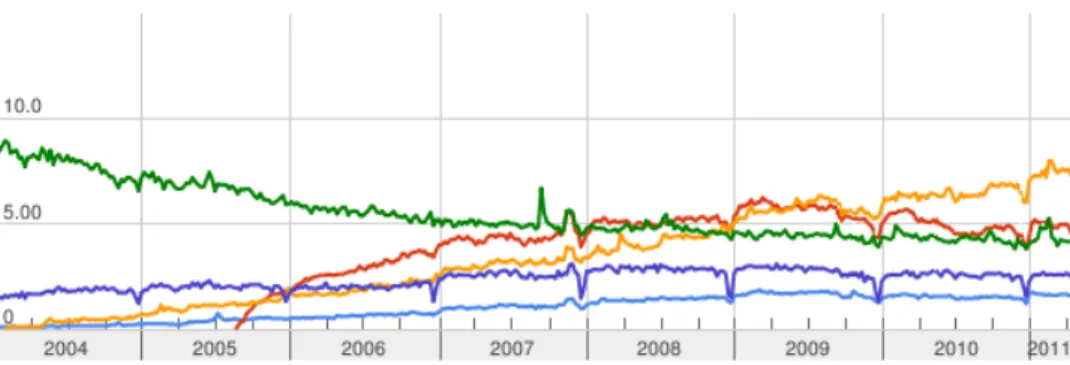
Drupal is FOSS project mostly described as a Content Management System (CMS), but sometimes also described as a software development framework. As with many FOSS projects, highly skilled software developers do the development. In figure 1 Google
Trends is used to quickly compare Drupal with other CMS projects. Google Trends returns how often a keyword is search during particular moment. While the data is thus not without its subjectivity, it can give us a relative comparison to some of the most common CMS projects: WordPress, Joomla, Lotus and Sharepoint. WordPress and Joomla are two FOSS projects, while Lotus (by IBM) and Sharepoint (by Microsoft) are business suites.
Figure 1 A relative comparization between: Lotus (green), Sharepoint (purple), WordPress (orange), Joomla (red) and Drupal (blue)
In Figure 1, we can see that before 2004, only the business suites were of interest, and clearly, Lotus was dominant. Now FOSS has taken over and WordPress is the most dominant. Wordpress is the most used system for small blogging sites, but for our needs its software framework does not have the required complexity. Joomla on the other hand has problems with its social participation. Joomla emerged out of a split with another FOSS project called Mambo and so it grew very fast, but it is now on a decline. Drupal may not be as much searched as Wordpress or Joomla, but it is particular an enterprise-oriented system. The difference can be seen in the Gartner report (Drakos et al. 2009) where Drupal is put in the visionaries’ quadrant of the “Magic Quadrant for Social Software in the Workplace”, while Joomla and WordPress are not considered.
TMSP has both a technical as a social dimension. This social-technical nature has an effect on the type of members a community attracts. We consider this attraction similar to what Florida (2005) has observed as the attraction by cities of talent. Indeed both cities and FOSS projects can be a medium that attracts talent. Florida (2002) introduces the term “creative class workers” to describe that talent. He also makes a distinction between the “super-creative core” and creative professionals. They can be both recognized in the Drupal case. The super-creative core form the lead of the community, they are totally dedicated to the creative process and bring new projects that go beyond the current paradigms. Still, it is often by the larger group of creative professionals that the culture is expressed. Little things make all the difference, like knitting socks, creating Drupal songs, Drupal games and making all kind Drupal-icon gadgets like cakes, Halloween pumpkins, t-shirts, etc. The social-technical nature is common to many FOSS projects. Still Drupal is well known for its community experience. This can be compared to Apple’s culture on user experience. Just as Apple users are committed to their products, so do we recognize that Drupal members are committed to their community.
Consequently many local and international Drupal events are created to support the community experience.
The business ecosystem of Drupal has its uniqueness. Some FOSS projects have one major company behind them. For example, the CMS WordPress has Automattic Inc, while the software platform Eclipse has IBM's RationalDivision. Many point to the company Acquia as performing that role for Drupal, but the differences are significant. While RationalDivision has changed the licensing in order to make their code OS. Acquia would only come to exist three years after the pioneering businesses were in the ecosystem. Other FOSS projects stay dominantly community projects, like Apache and Linux. In that case businesses build on top of the main projects. Drupal’s business ecosystem seems to be somewhere between those two categories, which result in a complex business relation too. Thus we consider Drupal to be the proper case for our research on self-organization.
Dynamic capabilities to intensify complexity
We expect the business ecosystem as a whole to have dynamic capabilities. Our problem is that the dynamic capabilities are unknown. Therefore qualitative interviewing methods are needed to discover the dynamic capabilities. Fontana and Frey (1998) make clear that for qualitative interviewing questions must be asked person to person. Mason (2002) sees the interaction as an investigation method that can process the tacit knowledge. She calls it the creative interviewing method. We first tested the method by interviewing the founder Dries Buytaert. He can be seen as a prototypical example of Florida’s “super-creative core”.
In 2001, Buytaert started Drupal as a hobby alongside his PhD studies. He often expresses his work in that period as “PhD by day and Drupal by night”. We see the first Drupal companies emerging in 2004, but during his PhD, Buytaert was not allowed to create commercial activities. He did co-founded the Drupal Association (a not-for-profit organization) in December 2006. After finishing his PhD in January 2007 he started exploring commercial opportunities. He founded Acquia in December 2007 and co-founded Mollom in March 2008. The balance between the businesses in the ecosystem has much to with the fact that the founder of Drupal would start its first company three years after the pioneering companies started working on Drupal. This way none of the businesses had a dominant position during the start-up phase.
For the creative interviewing we did an explorative interview with Buytaert, meaning that we searched for interesting aspects based on his founding activities and keynote presentations. For example we did ask why he emphasises on “co” when founding the organizations. Without hesitating he responded: “it is fun and easy”. He elaborated that the isolation he experienced while working on his PhD was in great contrast to the collaboration he had on the Drupal project and, indeed, he liked the latter better. He continues by explaining that he likes to be challenged and tries to compensate for any weaknesses by collaborating with people who he know are better than he is.
Considering that his story illustrated the dynamics leading to complexity nicely, we decided to keep a same open question approach for the other interviews. We formulated the questions as a challenge: “How did your actions contribute to the emerging of an open innovation ecosystem?” From that question on we started exploring the interview to extract the concepts of the dynamic capabilities framework (Teece et al. 1997).
The pioneering companies are identified first by looking at the sponsors of the early Drupal conferences, but then also via networking events during Drupal conferences resulting in 12 in-depth interviews. We are aware that not all pioneering companies have been interviewed, but 12 is a fair share of the pioneering companies and the pattern coming out of it seems stable. We talked mostly to founders, but in rare cases also to the business strategist of the company. The people and their companies in alphabetic order are: Aaron Pava of Civic Action, Chris Bryant of Gravitek Labs, Eric Gundersen of Development Seed, Jeff Walpole of Phase2 Technology, Liza Kindred of Lullabot, Matt Cheney of Chapter Three, Michael E. Meyers of NowPublic (now Examiner), Michael Haggerty of Trellon, Mike O'Connor of Commerce Guys, Tiffany Farriss of Palantir, Thomas Barregren of NodeOne, Todd Ross Nienkerk of Four Kitchens. To frame the other questions during our explorative interviewing let us look at the three categories of Teece et al. (1997) the dynamic capabilities framework: processes, positions and paths.
Agile processes and vicarious selection
The processes have three sub-categories: organizational/managerial, coordination/integration and reconfiguration/transformation. To discover these capabilities we asked questions like how big their team was and how they are organized. The size of the team was around 20 people. Except from the size and their agile management, each of the 12 companies’ business processes where very different. Businesses may be locally organized, virtual firms or a mix of both. Most businesses were also differently funded: some by investors, some by own money, some worked only with sweat equity (no capital call at all). The agile teams already ensured reconfiguration/transformation, but many companies also explain how their business strategy changed: from a development company to a training company, from consulting to development or the other way around. In this diversity the opportunity to share experience and explore new options was stimulated.
What some companies would consider trade secrecy was openly discussed between the members of the business ecosystem. We have witnessed this during the panel discussion in the Copenhagen conference (2010) where several of the pioneering companies shared their experience. Even more knowledge sharing was going on during an executive meeting in Brussels 2010. The fact that the sharing is now being broadcasted on events is considered part of the growth phase. The same openness has been going on during the start-up phase but in more one-on-one communication. The sharing illustrates a vicarious selection. Vicarious, which latterly means ‘substitute’, is an observational selection process. Campbell (1965) introduces the term to explain how natural selection can evolve to a more coordinated selection with more freedom and so the ability to speed up evolution of blind variation. So businesses openly shared their experience and from it anticipated new explorative opportunities. Let us recapitulate: the organizational/managerial were designed to be agile, which had a same pattern for each
business like team size and agile development methods. This allowed the coordination/integration and reconfiguration/transformation to be complex and explorative.
Emerging positions by divergent paths
The category “position” relates to assets of a business. As the businesses are playing in the same market and as the businesses are in a start-up phase the one asset for each company is similar: human capital. During the start-up phase, the companies have specialized and by the end of 2009 we see assets emerging that are well enough defined to allow acquisitions. Thus assets are emerging novelties created by vicarious selection. The processes play an important role in it, but so do the paths. Thanks to the Internet FOSS project are born globally with members all over the world. The members have very different interest, culture and history, which add to the complexity of the ecosystem. For business, their paths can explain the origin of the specialization and emerging assets, but it doesn’t define the specialization. The explorative processes and the divergent paths contribute to a complex ecosystem, which allows each company to find its own adventure. It is their call to adventure that defines the specialization.
We need to understand how paths lead to adventure and this is considered an effect of advanced stigmergy. Heylighen (1996b) mentions that stigmergy by ants is less complicated than stigmergy by humans, but fundamentally it is the same process: someone makes a mark and someone else feels the need to act based on that mark. With people we expect that the stigmergy triggered a person to set goals. Goals are quite stable if they are defined abstractly. For business, goals are expressed as policy. Although we do recognize good innovation practice, it is remarkable how little innovation management policy is used. This is an essential aspect we like to investigate in our research, so let us look at the policy in more detail.
We have noticed the presence of two policies by the pioneering companies. The policy is so general that we should recognize them in other FOSS projects too. We shall call the first policy the “community first” and the second “community contribution”. The “community first” policy makes business change their strategy in benefit of the FOSS project. We see two main reasons. Firstly, if the FOSS project fails, so would their business. Secondly, it increases their reputation drastic in the community, which can have all kind of benefits. For example different interviewees have repeatedly mentioned that their strategy has lead to attracting the best developers, which is important because good developers are a scarce resource. The “community first” policy adds to the complexity of the ecosystem. The “community contribution” policy allows employees to spend part of their time working on their own pet projects (in the community). While the policy is created for community building, it is indirectly responsible for changing the ecosystem in a self-organizing innovation system.
Open innovation by self-organization
It is our understanding that the “community contribution” policy is actually a special case of dissipative systems. Prigogine (1968) describes a dissipative system as a continuous flow of energy being dispersed in a medium. Such a design creates “far from equilibrium” state, which leads to self-organization. Dissipative systems are all around us (e.g. cyclones and hurricanes), but induced physical and chemical examples of dissipative systems (e.g. laser, Bénard cells and oscillating reactions) have added much credibility to the research on self-organization. The community policy creates a continuous flow of energy/attention by making time available of highly educated talent. This talent is directed to the FOSS project, but then it gets dispersed over the many concrete projects or problems. We shall refer to such dynamics as: “smart-attention dispersion”.
We consider smart-attention dispersion to be the essential force of innovation, based on Mokyr’s (1990) analytical study on the history of technology. He identifies the attention of the educated class in a particular time periods as the essential force for innovation. We can call such attention in a particular time period “zeitgeist”. Across the history of technology we always see a complex of different innovation related to the zeitgeist. Mokyr for example demonstrates how during a classical period the zeitgeist was directed to military, political and philosophical issues, resulting into innovations for such issues. The zeitgeist was different in the early Middle Ages, now the rule of Saint Benedict focuses on “pray and work”, this rule allowed the emerging of innovation around labour. Thus the smart-attention dispersion gives us a way to mediate complexity and discover absolute novelties that cannot be reach by any existing knowledge.
A key feature of self-organization is decentralization. Decentralization is a feature of both dissipative systems and stigmergy. It is also a key feature of the Internet. We shall identify stigmergic tools in the Drupal case, but without explaining what they do exactly as some of them are quite technical. The easiest way to see IT supported stigmergy is the landing page for projects. Two examples of such landing pages are the Drupal project, found at http://drupal.org/project/drupal, and a sub-project called “views”, found at http://drupal.org/project/views. This landing page contains much information like the number of commits by maintainers, issue queue about the project, etc. Particularly the issue queue is IT supported stigmergy. There is stigmergy via communication using natural language during events and in forums, blogoshere, IRC-channels, etc. Each ensures a different stigmergic opportunity. We also see stigmergic support for code, like the git repository and the unit testing architecture. From the interviewees it turns out that a stigmergic support for businesses exist.
The stigmergic support for businesses was not developed for the businesses but for developers. As the repository would track much information, it was a nice and small effort to give visibility of the contribution by counting the amount of contributions and returning the last date of submission. That information became the stigmergic support for open innovation. FOSS businesses often have a pragmatic or operational drive for innovation based on their customers need (West and Gallagher 2006). The good businesses would know the modules closely related to their needs and use the visibility system to take contact with the lead developers of such modules. Some cases explain how the lead developer would function as a negotiator between the two businesses. The
motivation is simple. The developer would see an opportunity to work even more on her/his pet project. The business would see an opportunity to hire the best developer for the job. The business of the developer would get revenue that hardly needs any management. The solution seems surprisingly simple and elegant, but notice that it is build on other levels of stigmergic activities (code & discussions) and requires a complex ecosystem to start with.
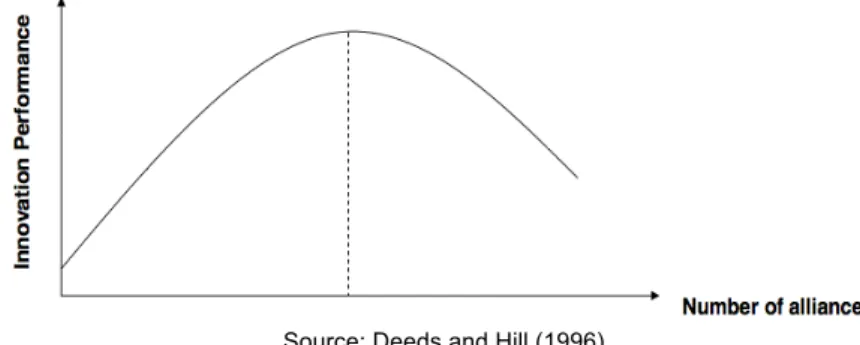
The self-organizing innovation seems to change the relation of policy significantly. For example, consider Deeds and Hill (1996) explanation of the relationship between innovation performance and the number of alliances for biotechnology firms (figure 3). Once the threshold is reached, more alliances are counterproductive, because they become too difficult to manage. Still with the distributed nature of the self-organizing innovation this bottleneck does not exist.
Figure 2 Relationship between innovation performance and number of alliances
Source: Deeds and Hill (1996)
Another management issue influenced by the self-organizing innovation is the managerial effort for ambidexterity. Ambidextrous organizations (see O'Reilly and Tushman 2004) are organizations with opposite cultures. They need top-level management to regulate the conflict zones where the different cultures meet. The Drupal ecosystem is clearly ambidextrous, but IT support is considered to solve the conflict zones by creating interfaces between the different components of the ecosystem.
Conclusion
This paper has discussed the effect of self-organization in a complex FOSS ecosystem, which was retrieved by creative interviewing. The Drupal case was chosen because indicators of TMSP were most fitting. The dynamic capabilities and the “community first” policy increased the complexity. The “community contribution” policy seems responsible for smart-attention dispersion, which results in self-organizing innovation. The smart-attention was always a natural selection process. With this paper we may start understanding how smart-attention dispersion is systematised by policy, IT support and a complex ecosystem. In on going research vicarious selection is used to study smart-attention dispersion for educational and innovative purpose. We are trying to mimic the conditions of the Drupal ecosystem and, on yearly basis, a restructuring of the policy is done by the emerging best practices. Other on going research is design science research
to build IT support for innovation based on the smart-attention dispersion and stigmergic mediation.
This paper also contains an opportunity of future research on business ecosystem. We will continue the participation action research and follow the Drupal project to see if we can identify the transition from growth phase to maturity phase. We have some ideas what the conditions of the change are, but they are currently just ideas. Only when the maturity phase has begun, will it be possible to be certain and report on it. At that time we shall do a similar exercise to identify the dynamic capabilities of the growth phase.
References
Bonaccorsi, A., Rossi, C. & Giannangeli, S., 2006. Adaptive entry strategies under dominant standards: Hybrid business models in the Open Source software industry. Management
Science, 52(7), p.1085–1098.
Deeds, D.L. & Hill, C.W.L., 1996. Strategic alliances and the rate of new product development: an empirical study of entrepreneurial biotechnology firms. Journal of Business Venturing, 11(1), p.41–55.
Drakos, N. et al., 2009. Magic Quadrant for Social Software in the Workplace. Gartner RAS Core
Research Note G, 171792.
Elden, M. & Chisholm, R.F., 1993. Emerging varieties of action research: Introduction to the special issue. Human relations, 46(2), p.121.
Enkel, E., Gassmann, O. & Chesbrough, H., 2009. Open R&D and open innovation: exploring the phenomenon. R&D Management, 39(4), p.311–316.
Florida, R., 2004. The rise of the creative class, Basic Books New York. Florida, R.L., 2005. Cities and the creative class, Psychology Press.
Fontana, A. & Frey, J., 1998. Collecting and interpreting qualitative materials. Interviewing: The
art of science, p.47–78.
Grassé, P.-P., 1959. La reconstruction du nid et les coordinations interindividuelles chezBellicositermes natalensis etCubitermes sp. la théorie de la stigmergie: Essai dʼinterprétation du comportement des termites constructeurs. Insectes Sociaux, 6(1), p.41-80. Hertel, G., Niedner, S. & Herrmann, S., 2003. Motivation of software developers in Open Source
projects: an Internet-based survey of contributors to the Linux kernel. Research policy, 32(7), p.1159–1177.
Hevner, A.R. et al., 2004. Design science in information systems research. Mis Quarterly, 28(1), p.75–105.
Heylighen, F., 2006a. Mediator Evolution: a general scenario for the origin of dynamical hierarchies. Worldviews, Science and Us.(Singapore: World Scientific).
Heylighen, F., 2006b. Why is Open Access Development so Successful? Stigmergic organization and the economics of information. Arxiv preprint cs/0612071.
Heylighen, F., 2007. Accelerating Socio-Technological Evolution: from ephemeralization and stigmergy to the global brain. Arxiv preprint cs/0703004
Howe, J., 2006. The rise of crowdsourcing. Wired magazine, 14(6), p.1–4.
Johnson, J.P., 2002. Open source software: Private provision of a public good. Journal of
Economics & Management Strategy, 11(4), p.637–662.
Kogut, B. & Metiu, A., 2001. Open-Source Software Development and Distributed Innovation.
Kraut, R. et al., 2010. Scientific Foundations: A Case for Technology- Mediated Social- Participation Theory. Computer, 43(11), p.22-28.
von Krogh, G. & Von Hippel, E., 2003. Special issue on open source software development.
Research Policy, 32(7), p.1149–1157.
Lakhani, K.R. & Von Hippel, E., 2003. How open source software works. Research policy, 32(6), p.923–943.
Lerner, J. & Tirole, J., 2002. Some simple economics of open source. The journal of industrial
economics, 50(2), p.197–234.
McTaggart, R., 1991. Principles for participatory action research. Adult Education Quarterly, 41(3), p.168.
Müller-Seitz, G. & Reger, G., 2009. Is open source software living up to its promises? Insights for open innovation management from two open source software-inspired projects1. R&D
Management, 39(4), p.372–381.
March, S.T. & Smith, G.F., 1995. Design and natural science research on information technology.
Decision support systems, 15(4), p.251–266.
Mason, J., 2002. Qualitative interviewing: Asking, listening and interpreting. Qualitative research
in action, p.225–241.
Mockus, A., Fielding, R.T. & Herbsleb, J.D., 2002. Two case studies of open source software development: Apache and Mozilla. ACM Transactions on Software Engineering and
Methodology (TOSEM), 11(3), p.309–346.
Moore, J.F., 1996. The death of competition: leadership and strategy in the age of business
ecosystems, HarperBusiness.
Mustonen, M., 2003. Copyleft–the economics of Linux and other open source software.
Information Economics and Policy, 15(1), p.99–121.
OʼReilly 3rd, C.A. & Tushman, M.L., 2004. The ambidextrous organization. Harvard Business
Review, 82(4), p.74.
Prigogine, I. & Lefever, R., 1968. Symmetry breaking instabilities in dissipative systems. II. The
Journal of Chemical Physics, 48, p.1695.
Peffers, K. et al., 2007. A design science research methodology for information systems research.
Journal of Management Information Systems, 24(3), p.45–77.
Raasch, C., Herstatt, C. & Balka, K., 2009. On the open design of tangible goods. R&D
Management, 39(4), p.382–393.
Surowiecki, J., 2005. The wisdom of crowds: Why the many are smarter than the few, Abacus London.
Theraulaz, G. & Bonabeau, E., 1999. A brief history of stigmergy. Artificial life, 5(2), p.97–116. Von Hippel, E., 2001. Learning from open-source software. MIT Sloan management review, 42(4),
p.82–86.
Von Hippel, E. & Von Krogh, G., 2003. Open source software and the“ private-collective” innovation model: Issues for organization science. Organization Science, p.209–223.
Von Krogh, G., Spaeth, S. & Lakhani, K.R., 2003. Community, joining, and specialization in open source software innovation: a case study. Research Policy, 32(7), p.1217–1241.
West, J. & Gallagher, S., 2006. Challenges of open innovation: the paradox of firm investment in open-source software. R&D Management, 36(3), p.319–331.