Experiential management learning
Research conducted in fulfilment of PhD studies
Richard Selby
Czech University of Life Sciences,
Abstract
“Experiential learning” theory explains how people learn through experience. The subject has been researched and documented, but most modern accounts are based on countries such as the USA, UK, Canada, Australia and South Africa, with little consideration for the smaller countries and islands. This dissertation seeks to correct this by analysing feedback from experiential workshops run for young, employed adults in some of the less-studied countries, and by comparing it with established concepts of culture and personalities.
The literature review begins with an examination of how and where people learn, followed by a summary of the history and present application of experiential learning techniques. This is followed by an examination of some of the theories of cultures and their characteristics, and a consideration of personality styles. The chapter concludes with some practical examples of experiential learning sessions.
The research section offers three hypotheses, the first intended to investigate correlation between Hofstede’s “Masculinity” index and the feedback received at the end of an experiential course to ascertain whether people from some cultures are more receptive to this type methodology than others. The outcome indicates that the more masculine or assertive the culture of the participant, the more critical they are of this methodology. Hofstede’s statement that there is a “strong link” between his individualism dimension and the results of management training was not replicated. The second hypothesis is to test whether young, employed, Czech adults prefer active learning programmes, or more social and small-group based programmes. An analysis of participants’ attitudes to experiential programmes run by a Czech outdoor management training company indicates that the more social and small group based programmes are more liked by Czech participants.
The third hypothesis is to test whether a module taught at the Czech University of Life Sciences for young Czech adults is more acceptable if experiential techniques are used. An analysis of participants’ attitudes taken on the first day of the course is combined with cultural characteristics of the participants to develop a tailor-made module. The degree of participants’ satisfaction is measured from the end-or-course review, which shows a marked improvement once this technique is used.
The discussion chapter considers some of the situations in which experiential learning techniques can be used to the benefit of the participants, both at university and at work. Another point considered is whether a post-course assessment/critique completed by the participants should be compulsory or voluntary, and how the timing of the assessment may influence the results given. The last part of this chapter considers the practical application of the technique and the situations in which it might be used.
The conclusion summarises the results of the tests for the three hypotheses, none of which were rejected, and summarises the benefits of the technique.
Key words
Experiential learning, memory, intercultural learning, intra-cultural learning, Kolb learning cycle, outdoor management training, post-course assessment
Souhrn
Teorie “Zkušenostního učení” vysvětluje, jak se lidé učí prostřednictvím zkušeností. Tento koncept byl již velmi dobře prozkoumán a dokumentován, ale většina moderních výzkumů je umístněna do velkých zemí jako USA, Velká Británie, Kanada, Austrálie a Jižní Afriky, nezohledňují tak specifika menších zemí či ostrovů. Tato studie se snaží zmíněný deficit zmírnit prostřednictvím výsledku zkušenostních seminářů, které se uskutečnily v některých méně studovaných zemích, a dale na základě porovnání se zavedenými koncepty kultur a osobnostních charakteristik. Přehled literatury začíná analýzou toho, jak se lidé učí, následovanou shrnutím historické a současné aplikace technik zkušenostního učení. Dále je připojen rozbor vybraných terií kultur a jejich charakteristik se zohledněním typických osobnostních stylů. Tato část práce na závěr uvádí praktické příklady semináře, který užívá techniky zkušenostního učení
Kapitola věnovaná výsledkům průzkumu nabízí tři hypotézy:
První si klade za cíl průzkum korelace mezi Hofstedeho “MAS Index” a zpětnou vazbu obdrženou na závěr již zmíněného semináře využívajícího techniky zkušenostního učení z něhož vyplývá, že lidé z vybraných kultur jsou senzitivnější k této technice nežli lidé z jiných kultur. Autor představuje svou hypotézu, že existuje souvislost mezi kulturou, z níž účastník semináře pochází, a jeho zpětnou vazbou poskytnutou na konci semináře. Tato souvislost může být interpretován jako míra, do jaké je konkrétní kultura vnímavá ke zkušenostnímu učení. Výsledky průzkumu indikují, že čím maskulinnější či asertivnější je kultura, z níž účastník průzkumu pochází, tím kritičtější k daným technikám účastník je.
Druhá hypotéza se zaměřuje na průzkum toho, zda mladí, zaměstnaní, dospělí Češi upřednostňují aktivní výukové programy nebo spíše sociálně založené výukové programy probíhající v malých skupinách. Analýza přístupu účastníků průzkumu naznačuje, že přístup českých vzdělávacích outdoor-managementových firem indikují, že Češi jednoznačně upřednostňují sociálně založené programy realizované v malých skupinách.
Třetí hypotéza sleduje, zda je studentů na České zemědělské univerzitě pozitivněji vnímána, jestliže jsou využity skušenostní techniky. První den semináře kombinuje kulturní charakteristiku účastníků se zkušenostní výukou za účelem přípravy “na míru šitého” modelu výuky. Spokojenost účastníků semináře je posuzována na základě závěrečného dotazníku, který dokladuje zásadní zlepšení spokojenosti účastníků s kvalitou semináře.
Diskusní část práce je věnována situacím, kdy jsou techniky zkušenostního učení využity ku prospěchu účastníků semináře nejen na univerzitě, ale rovněž i v zaměstanání.
Další úvaha je, zda post-kurz posouzení by mělo být dobrovolné nebo povinné, a zda načasování ovlivní výsledky
Klí
č
ové slovo
Zkušenostní učení, paměť, interkulturní učení, intra-kulturní vzdělávání, Kolb učení cyklu, trénink manažerských dovedností, post-kurz hodnocení
Acknowledgements
I would like to offer my heartfelt thanks to my wife, Alice, for her support and encouragement over the time I have been researching and writing this work.
Her love, understanding and patience has known no bounds, and the opportunity to use her as a sounding-board and her frank comments are greatly
appreciated.
I also appreciate the opportunity to discuss my work with my colleagues at the Czech University of Life Sciences and in the UK, including Peter Crowe MSc, Timothy Eyre MSc, Dr Neil Harvey, doc Ing Zdenek Linhart CSc, Ing Tomas
Macak PhD and Ing Jiri Mach PhD.
In particular, I wish to acknowledge the patience, support and encouragement from my supervisor, doc Ing Ivana Ticha PhD, without whom this work would
never have been started.
In Prague
Contents
Section Title Page
Title page 1
Abstract and Keywords 2
Acknowledgements 4 Contents 5 Chapter 1 INTRODUCTION 11
Chapter 2 LITERATURE OVERVIEW 12
2.1 How adults learn 13
2.1.1 Learning through life – why? 13
2.1.2 Learning through life – what? 14
2.1.3 Learning through life – how? 16
2.1.3.1 The role of memory 16
2.1.4 Learning through life – where? 17
2.1.4.1 The public sector 18
2.1.4.2 The private sector 19
2.2 Experiential learning theories and methodologies 21 2.2.1 Critical appraisal of work in the field 22
2.2.1.1 Kurt Lewin 22 2.2.1.2 John Dewey 23 2.2.1.3 Jean Piaget 23 2.2.1.4 2.2.1.5 2.2.1.6 David Kolb
The learning context The business game
24 24 26
2.3 Personality types 28
2.3.1 Kolb’s work on personalities 28
2.3.2 2.3.3 2.4 2.4.1
Dawson’s work on personalities
Commonality between Kolb and Dawson Intercultural considerations
Prof Geert Hofstede
31 32 33 33 2.4.1.1 Critics of Hofstede 35 2.4.2 Richard D. Lewis 37 2.4.2.1 2.4.3 2.4.3.1 Criticisms of Lewis
Other research into intercultural; differences in learning style
The GLOBE study
37 38 38 2.5 Examples of experiential management learning 41 2.5.1 Type 1: Formal, classroom-based experiential
teaching
42 2.5.2 Type 2: “Outdoor management training” 43
2.6 Results of literature overview 44
Chapter 3 OBJECTIVES AND METHODOLOGY 46
3.1 The first case study 46
3.2 The second case study 49
3.3 The third case study 50
Chapter 4 RESULTS 53 4.1 Structure of Research 53
4.2 Case study I – overseas experiential management
course. 53
4.2.1 Criticisms of the structure and content of the
questionnaire 55
4.2.2 Preliminary analysis of the responses 57
4.2.2.1 Analysis of the Dubai workshop 58
4.2.2.2 Analysis of the Ghana workshop 59
4.2.2.3 Analysis of the Lesotho workshop 59
4.2.2.4 Analysis of the Malta workshop 61
4.2.2.5 Analysis of the Nigeria workshop 62
4.2.2.6 Analysis of the St Lucia workshop 62
4.2.2.7 Analysis of the Trinidad workshop 64
4.2.2.8 Summary of analysis of workshops by venue 64
4.2.3 Analysis of workshops by the cultural backgrounds
of the delegates 66
4.2.3.1 Analysis of Caribbean workshops held in St Lucia
and Trinidad 66
4.2.3.1.1 The whole group of Caribbean delegates 68
4.2.3.1.2 The native English-speakers 68
4.2.3.1.3 The delegates from the Dutch-speaking countries 69
4.2.3.1.4 The Spanish-speaking delegates 69
4.2.3.2 Analysis of the East African grouping 70
4.2.3.3 Analysis of the Indian Ocean island delegates 71
4.2.3.4 Analysis of the Maltese grouping 71
4.2.3.5 Analysis of the Middle Eastern grouping 72
4.2.3.5.1 The Gulf countries 72
4.2.3.5.2 Libya and Egypt 73
4.2.3.5.3 Yemen 73
4.2.3.6 Analysis of the Southern Africa grouping 74 4.2.3.7 Analysis of Western African grouping 75 4.2.3.7.1 Analysis of West African workshop in Ghana with
mixed delegates 76
4.2.3.7.2 Analysis of West African workshop in Nigeria with
delegates mainly from one company 76
4.2.3.8 Summary of the analysis of the workshop by
culture 77
4.2.3.9 Analysis of the cultures involved in the workshops 77
4.2.3.9.1 Analysis using Hofstede 78
4.2.3.9.2 Analysis of results by culture using Cooper &
Bowles’ methodology 80
Analysis using Hofstede
Analysis of the results by culture using Cooper & Bowles’ methodology
4.3 Case study II – outdoor management programme (An example of experiential learning in the Czech Republic)
85
4.3.1 Analysis of feedback from outdoor training
programme 87
4.3.2 Further analysis of question 6 88
4.4 Case study III – Students at the Czech University of
Life Sciences 89
4.4.1 Analysis of the results 90
4.4.2 Comparison of these results using Dawson 92
4.5 An experimental experiential management
programme for Czech students 94
4.5.1 Measurement of success 96
4.5.2 Problems with this questionnaire 97
Chapter 5 DISCUSSION 98 5.1 5.2 5.3 5.4 5.5 Experiential learning
Experiential learning at university Experiential learning at work (OTP) Questionnaire Application of results 98 98 99 99 100 Chapter 6 CONCLUSION 102
6.1 Conclusion to the first hypothesis 102
6.2 Conclusion to the second hypothesis 103
6.3 Conclusion to the third hypothesis 105
6.4 Overall conclusion to the main objectives 106
6.5 Summary of conclusion 107 6.6 Further work 107 Bibliography Literature 108 Internet sources 111 Appendices 112 et seq 1 Typical schedule for Business Simulation
workshop
2 Questionnaire used for Business Simulation workshop
3 Master set of data from Business Simulation workshop
4 Selection of comments from the “free text” fields 5 Definitions of terms used to describe Česká cesta
courses
List of figures Figure
No. Title Page
2-1 The learning of Values and Practices 15
2-2 Memory structures and knowledge acquisition in a
cognitive model of tacit knowledge 17
2-3 CEDEFOP Methodology for determining total costs of providing vocational training, when utilising a company-owned training centre
20
2-4 Lewin’s experiential learning model 22
2-5 Dewey’s Experiential learning model 23
2-6 Piaget’s model of learning and cognitive
development 24
2-7 Kolb’s Experiential learning cycle 25
2-8 Effectiveness of participative methods 26
2-9 The simulation process and the Kolb learning cycle 28 2-10
2-11 2-12
Kolb’s learning styles (adapted by Armstrong and Mahmud)
Principle characteristics of Kolb’s personality types Dawson’s Personality styles
29 30 31 2-13 2-14 2-15
GLOBE society clusters
Comparison of the concepts of Masculinity vs Femininity
Experiential management learning – the main influences
38 40 44
3-1 Research plan 52
4-1 Overall rating for each workshop in the series 65 4-2 Overall rating analysed by different cultures
attending workshops 77
4-3 Profile of respondents who participated in Outdoor
Training Programmes 86
4-4 Analysis of response from Czech students regarding how assertive they viewed themselves and how assertive they viewed their compatriots
91 4-5 Analysis of response from Czech students regarding
how they viewed their own emotional level, and how they viewed their compatriots
92 4-6 Overlay of results from Czech students reporting
about themselves, on Dawson’s Personality styles chart
93 4-7 Overlay of results from Czech students reporting
about others of their own age group, on Dawson’s Personality styles chart
93 4-8 Analysis of an experiential teaching module at the
Czech University of Life Sciences 96
5-1 Correlation between
“Assertiveness/Non-assertiveness” and “Masculinity/Femininity” for the countries in the study
Table No.
List of tables
Title Page
2-1 Team “Business game” played in a classroom setting, measured as an “Experiential” programme
42 2-2 Team game played off-campus measured as an
“Experiential” programme
43
4-1 The basic questions asked 54
4-2 Results of ratings from the Dubai workshop 58 4-3 Results of ratings from the Ghana workshop 59 4-4 Results of ratings from the Lesotho workshop 60 4-5 Results of ratings from the Malta workshop 61 4-6 Results of ratings from the Nigeria workshop 62 4-7 Results of ratings from the St Lucia workshop 63 4-8 Results of ratings from the Trinidad workshop 64
4-9 Highest and lowest rating criterion 65
4-10 Results of ratings from all Caribbean workshops 67 4-11 Results of ratings of all native English-speakers from
the Caribbean workshops
68 4-12 Results of ratings of all native Dutch-speakers from
the Caribbean workshops
69 4-13 Results of ratings of all native Spanish-speakers
from the Caribbean workshops
69 4-14 Results of ratings from the East African participants 70 4-15 Results of ratings from the Indian Ocean island
participants
71 4-16 Results of ratings of participants from the Arabian
Gulf.
72 4-17 Results of ratings of participants from Libya and
Egypt
73 4-18 Results of ratings of the Yemeni participants 73 4-19 Results of ratings of the Southern Africa group of
participants
74 4-20 Results of ratings of participants from Western
Africa
75 4-21 Results of ratings on the West African workshop in
Ghana, with mixed participants
76 4-22 Comparison of Hofstede’s dimensions with overall
rating given
79 4-23 Correlation of Hofstede’s dimensions with overall
rating given
79 4-24 Results for the overall group for question No.1 81 4-25 Results for the Arab group of countries for question
No. 1
81 4-26 Results for the East African group of countries for
question No. 1
81 4-27 Results for the English Caribbean group of countries
for question No. 1
82 4-28 Results for Malta for question No. 1 82 4-29 Results for the West Africa group of countries for
question No. 1
82 4-30 Comparison between Hofstede’s Masculinity index
and favourability index from countries given
82 4-31 Comparison between Hofstede’s Masculinity index
and “Favourability index” for all questions asked, for the countries given
83-85
4-32 Summary of results of question 6 88
4-33 Comparison of attitudes of Czech adults to experiential courses
CHAPTER 1: INTRODUCTION
The author of this work was involved for several years in organising training for adult employees of various telecommunications companies in many countries. Many of these were located in countries of the British Commonwealth, but over the years other countries were included in the programmes for commercial reasons.
There was one particular series of experiential workshops organised in a number of different countries, facilitated each time by the same two (British) presenters, using the same materials in the same way, yet the feedback received from each of these workshops was very different. The reason for the differences was not understood at the time by the presenters, nor the commissioning organisation.
This dissertation is about experiential learning theory, which explains how people learn through experience. The subject has been previously researched and documented, but most modern accounts are usually based on countries such as the USA, UK, Canada, Australia and South Africa, with little consideration for the smaller countries and islands.
This dissertation seeks to correct this to some degree, by analysing the feedback from the experiential workshops run in some of the less-studied countries, and by comparing it with established concepts of culture and personalities. The author introduces his hypothesis that there is a link between the culture of the participants on the course, and the feedback obtained from the end-of-course review. This link can be interpreted as the degree to which a particular culture is receptive to the experiential learning technique.
The methodology is to work with three sets of data,
• Firstly to analyse a set of data from adult learners attending training courses
abroad, to determine whether a link exists between the culture of the participant and the degree to which the participant believes the training to have been favourable or unfavourable. This is followed by
• An analysis of data from Czech adult participants who attended a set of
outdoor management courses – to determine which type of activity are most acceptable to them, and
• Thirdly, an analysis of data from young Czech adult students prior to – and
after attending modules of the Management modules taught in English at the Czech University of Life Sciences. The data collected prior to the module was used to determine the personality types and learning preferences of the students. This was used to tailor the presentation style to match the preferences as far as was possible. The data collected after was to determine whether the module manager had been able to improve the acceptability1 of the modules once the attitudes and expectations of the participants is known.
1 The term “Acceptability” is used widely in this dissertation. The meaning is taken as “satisfactory,
and capable of reaching a required standard” [Cambridge dictionary]. It is usually interpreted here as meaning that something is being approved of by the participant or student.
CHAPTER 2: LITERATURE OVERVIEW
“I keep six honest serving-men (They taught me all I knew); Their names are What and Why and When
And How and Where and Who”
Rudyard Kipling “The elephant’s child”
This literature research is structured in the following manner:
In section 2.1: How adults learn
The title of this research includes the word “Management”, implying that the learner is not a child. This part considers the differences between the ways children and adults learn. For the purpose of this study, an adult is considered as anyone of age 18 and above.
In section 2.2: Experiential learning theories and methodologies
The terms are defined, and beginning with Kolb, the modern history of experiential learning is described, and the concept and usefulness of the “Business game” introduced.
In section 2.3: Personality types
Besides the possibility of intercultural differences, there are also intra-cultural personality considerations, meaning that within each culture (region or country) there exist a number of different personality styles. This part considers the possibility that experiential learning theory might be more readily accepted by some personality types than others.
In section 2.4: Intercultural considerations
From the research of the literature, much of the work on Experiential learning to date appears to have been carried out in the English-speaking countries. This part considers the possibility that experiential learning theory might be more readily accepted by some cultures than others, and uses work by Hofstede and others to explore this possibility.
In section 2.5: Personality types and intercultural issues considered together
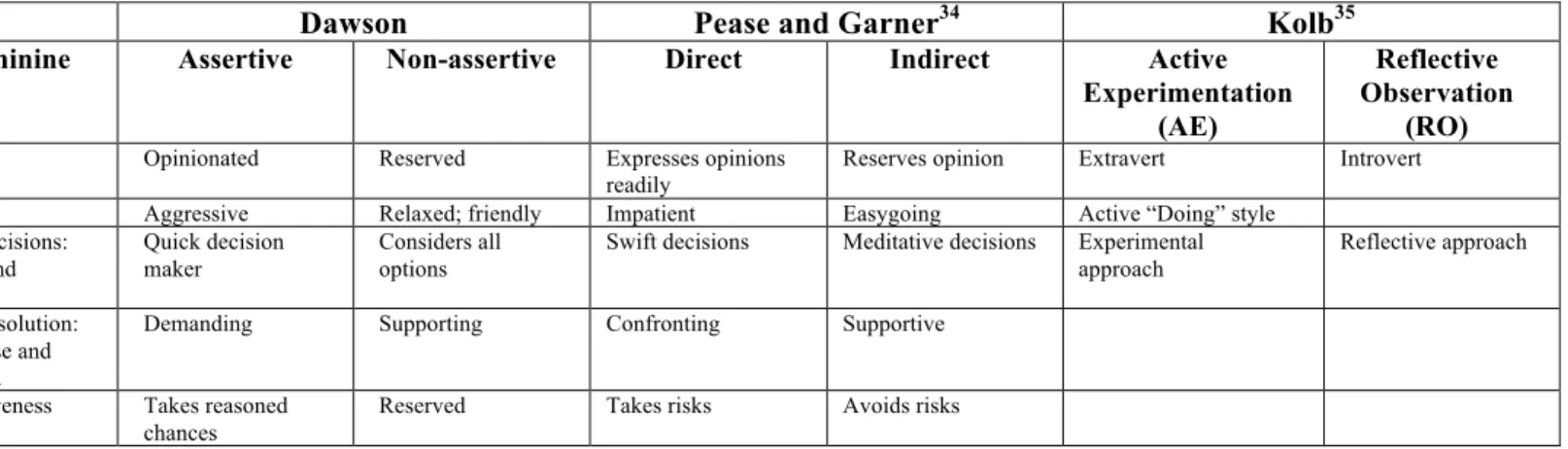
In this section the researcher compares terminology used by different writers, and identifies a distinct similarity between “Masculine/Feminine” from Hofstede, “Assertive/Non assertive” from Dawson, “Direct/Indirect” from Pease and Garner, and “Active experimentation/Reflective observation” (AE/RO) from Kolb.
In section 2.6: Types of experiential management learning programmes
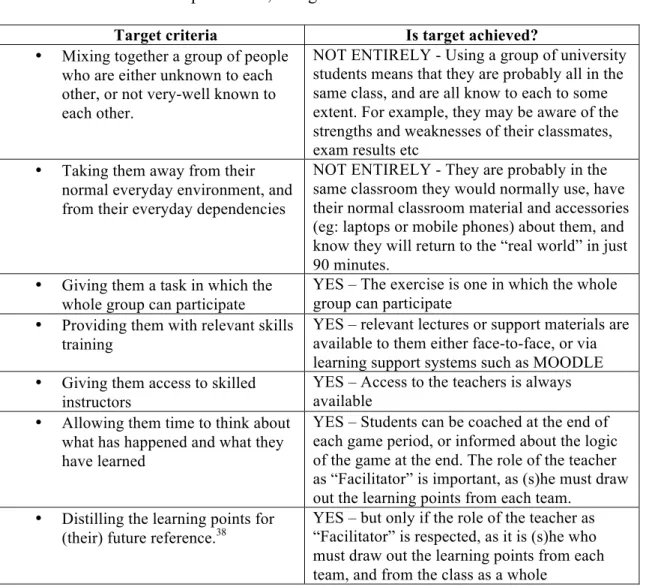
The first part of this section identifies from literature the components which are present in many experiential programmes. Following on, two types of experiential management learning programmes are identified and described.
In section 2.7: Summary of literature research
In this section, the main findings of the literature research are summarised. Firstly, the theoretical basis for experiential learning is established, by researching the work of Kolb and others, and by means of the available publications of the Experiential Learning Association; the benefits appear positive and valuable. The places and
means by which (adult) people learn are discussed, and comparisons made between them, based largely on the outcome of the Lambert Review for the British government and publications from the European Centre for the development of vocational training (CEDEFOP). Intercultural aspects are considered, mainly in this work through the writings of Hofstede and Lewis, supplemented by considerations of the intra-cultural aspects through the work of Kolb and Dawson.
--
2.1 How adults learn
Throughout life, whether or not they are aware of it, people are continuously learning. Their motives for learning alter as they grow older, and the techniques by which they acquire this new information also alter. In the following paragraphs of this section the questions of “Why”, “What”, “How”, and “Where”, as well as a brief consideration of “Memory” are addressed.
2.1.1 Learning through life – why?
In the paper “A theory of human motivation” [Maslow, 1943] described his concept of a “Hierarchy of needs”, in which he postulated that an individual has a series of basic needs, and that once the basic need is satisfied a person will then progress to the next higher need. He wrote:
“There are at least five sets of goals, which we may call basic needs. These are briefly physiological, safety, love, esteem, and
self-actualisation. In addition, we are motivated by the desire to achieve or maintain the various conditions upon which these basic satisfactions rest and by certain more intellectual desires.
These basic goals are related to each other, being arranged in a hierarchy of prepotency. This means that the most prepotent goal will monopolise consciousness and will tend of itself to organize the recruitment of the various capacities of the organism. The less prepotent needs are minimized, even forgotten or denied. But when a need is fairly well satisfied, the next prepotent ('higher') need emerges, in turn to dominate the conscious life and to serve as the center of organization of behavior, since gratified needs are not active motivators.”
Whilst recognizing that the majority of people never reach the level of “self actualisation”, there is a tendency to progress upwards through the hierarchy as one becomes older, whilst never ignoring the needs of the levels below. Thus, for a baby, the needs are largely “Physiological”, progressing upwards to reach “Esteem” by the time the teenage years are reached.
An understanding of this is crucial, in order to understand why people learn. Breathing, eating, drinking etc are instinctive or performed unconsciously; at this level the learning is involuntary, but to progress to the need of safety (and beyond) requires some conscious learning, and the higher in the hierarchy one
reaches, so the learning becomes more conscious. If the level of the hierarchy also tends to be a function of age, so conscious learning could be said to be developing as one grows older. Although people never stop learning unconsciously, from childhood and throughout life, a greater proportion of one’s learning becomes a conscious decision on the part of the individual. A person either decides to learn something for himself, or is told or encouraged to do so. Conscious learning may be either voluntary or compulsory.
Before leaving this discussion, the limitations of Maslow’s theory should be borne in mind. Maslow himself wrote that his theory “is not nearly as rigid as we may have implied”2, and identified 7 exceptions. Furthermore, the study was based on 1940’s North America, but has not been found to apply in the same sequence in all other countries3 nor for all situations. People living in India, for example, tend to put “Esteem” lower (i.e.: sooner) in the hierarchy, valuing status or respect for an individual at an earlier stage than valuing “Love/Belonging” [Blunt p.137].
2.1.2 Learning through life – what?
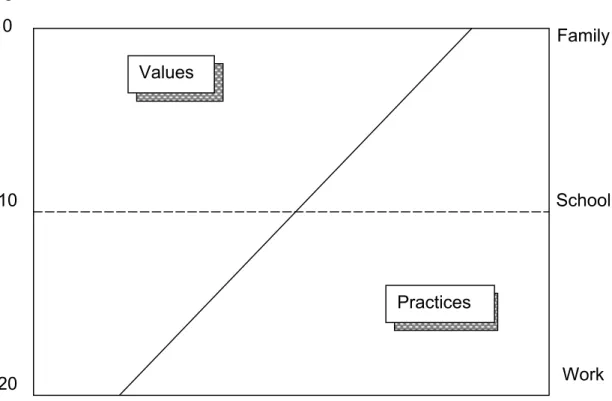
In the book “Cultures and Organisations – Software of the mind”, [Hofstede 2010] contrasts the way people learn at an early age, with the way they learn when they are older. From his studies he writes about “Values” and “Practices”. He believes that “Values are acquired early in our lives”, and describes them as “Broad tendencies to prefer certain states of affairs over others”. He shows this diagrammatically (see figure 2-1) to demonstrate that a person learns more values than practices when aged up to about 10 years old, and when older than that, more practices than values. He writes that values are “Largely unconsciously absorbed …. from our environment”, and explains that after about 10 years of age “…we gradually switch to a different, conscious was of learning, focusing primarily on new practices”.
2 Maslow, A. H. “A theory of human motivation”, 1943, Psychological Review vol 50, pp 386. 3 See for example, pp. 480-482 of Mullins, L.J., “Management and organisational behaviour”, 7th Ed
Figure 2-1: The learning of Values and Practices (From Hofstede4)
Voluntary learning
This term implies a level of choice on the part of the individual. If a person decides to learn something for himself, it is voluntary. It starts from early childhood, and continues into old age. A child may learn to play the piano, for example. There is no compulsion about this – the child does it because it wants to, and even at an early age is beginning to reach Maslow’s level of “Esteem”. As one grows into teenage years and beyond, this need for esteem remains a constant goal, with examples of voluntary learning including driving a car, learning an additional foreign language, learning to paint or gardening – all for the individuals’ own satisfaction and enjoyment.
Compulsory learning
This term would be used when one has to learn something. Some organization or somebody has decided or ordered that an individual must acquire certain learning. This begins in early childhood where a child is taught how to behave, mainly in the family scenario, and continues during the school years, as governments have decided to give all children the right to a basic education, to ensure that a child can at least read, write and perform elementary mathematical procedures. During adult life, this compulsory learning will often be decided upon by a persons’ employer for commercial reasons (see figure 2-1), but may also be imposed by the government who may wish to teach people how to behave, for example obey laws, follow new processes or
4 Hofstede G. and Hofstede G.J., “Cultures and organisations: software of the mind”, 3rd edition 2010
McGraw-Hill, ISBN 0-07- 166418-1, p. 10
Value
s
ValuesValues
Practices Age 0 10 20 Family School Workdeal with the introduction of a new currency unit – such as the Euro. Compulsory learning has spawned phrases such as “being sent to school” or “being sent on a course”. There is, however, a crossover which occurs at a certain stage, where, for instance, a young person at University may choose whether to stay on for another year, or leave and seek employment.
2.1.3 Learning through life – how?
The learning process has been well documented. The classic learning cycle from [Kolb 1974] illustrates that the process is not just a “one-off” event, but carries on throughout life. Kolb thought of it as a continuous cycle throughout life, though by the beginning of the 21st century he was describing it more as a “spiral” [Kolb, Boyatzis & Mainemelis 2001].
Throughout life the theory does not change, however the motivation and method of learning does. For example, the way a child learns is not the same as the way an adult learns. The differences can be seen if one considers learning a language. A child will learn to speak the language of its parents without any formal instruction, so by the time the child goes to school it will already know how to talk. In the same way, a young child will absorb any other language at the same time and acquire a second language just by “being there when it is spoken”. An adult who tries to learn the same second language will invariably tend do it analytically, by considering the construction of the language: the tenses, cases and other parts of speech.
It is by considering how people and their attitudes differ throughout life that an appropriate technique can be chosen to facilitate the learning.
2.1.3.1 The role of memory
The role of memory in learning and education cannot be overlooked. In the 1970’s the terms “Semantic” and “Episodic” memory were introduced. They were defined thus: [Tulving 1974]
• “Episodic memory refers to memory for personal events and the
temporal-spatial relations among these events.
• Semantic memory represents organized knowledge that a person
possesses about words and other verbal symbols, their meanings and referents, about relations among them, and about rules and algorithms for the manipulation of symbols, concepts and relations”
Prof. Robert Sternberg5 has also written extensively about memory and the part it plays in education. In his studies he attempted to show how Tulving’s concepts of memory interrelate (see figure 2-2. below)
5Dean of the School of Arts and Sciences, Professor of Psychology, and Adjunct Professor of Education at Tufts University, and Honorary Professor of Psychology in the Department of Psychology at the University of Heidelberg, Heidelberg, Germany.
Figure 2-2: Memory structures and knowledge acquisition in a cognitive model of tacit knowledge [Sternberg et al 2000]
It will be noted that he included a third type of memory, which he named
• “Procedural memory”, which he defines as “Memories on how to do
something (e.g.: skiing, biking, and tying your shoe)” [Sternberg 2006]
It is relevant to consider here the links shown in Figure 2-2 in more detail. According to Sternberg, the way a person behaves or performs is based on “Personal experience” and “Received knowledge”. He describes received knowledge as information which will probably have been received mainly passively; the learner will have listened to an instruction, a lecture or presentation in some form, and the knowledge will have entered the semantic memory, enhancing it with general knowledge, definitions, facts and historical dates etc. This is what happens at school, college and university. The student will have been filled with facts.
Personal experience, on the other hand, is mainly received actively. This personal experience is stored and remembered in the episodic memory and will include both trivial and substantial memories, such as a first kiss, graduating, or starting a first job.
According to Sternberg, however, both personal experience and received knowledge – together with elements from the episodic memory - are combined to feed the procedural memory, which ultimately (and when apparently relevant) also influences the semantic memory.
2.1.4 Learning through life – where?
Focusing on adult learners, there are limited options available – the learning can be facilitated in the Public Sector, or in the Private Sector.
Procedural memory Semantic memory Episodic memory Personal
experience knowledge Received
Behaviour/ performance C1 C2 C A B B A A1 A2
2.1.4.1 The public sector
The public sector in Europe is filled with schools, universities, colleges, academies and other institutions providing education. By their very nature, schools focus on children, whilst universities and colleges mainly on young adults (teenagers to late 20’s). In most European countries, colleges tend to be more biased to providing vocational training6, whereas universities focus more on providing academic education. In the UK, the Lambert Report7 [Lambert 2003] found that “Business is critical of what it sees as the slow-moving, bureaucratic and risk-averse style of university management.” The teaching methodology has evolved in each country in its own way, and suits the
environment it is in – though is sometimes conservative in its consideration of change, and sometimes reluctant to take on new ideas or methodologies. Coventry University stated, in their response so the Lambert Report8 that
“Businesses do not have time and do not see the University sector as adding value to their activities”. In institutions and societies where students follow their careers to become teachers and eventually professors, there is a danger that Universities and Colleges may become isolated from the rest of society, so it is vital that these institutions encourage, develop and maintain links with governments, businesses and communities in their region. The entire Lambert report addresses the need to bring universities and businesses closer together, and offers suggestions to the UK government of the day (ie: in 2003) of ways to achieve this.
Universities provide an excellent foundation for many young people starting out on life’s journey, but have to change to deliver education to adult learners. For example, the University of Manchester’s Institute of Science and
Technology (UMIST) reported to the Lambert Review in 2003 that they have “… continued to reshape and remodel a number of its postgraduate
programmes to make them more flexible”9. They added that, at the time, this involved creating “….new Masters Training Packages which have increasingly been able to encourage students to come from industry and take modules or full programmes over a number of years as part of their career development programme”. Universities tend to organise themselves around semesters and teaching periods, whereas an adult learner is more likely to require block teaching, at a time convenient to the purchaser of the programme. UMIST met this need with their new programme by providing:
“(i) One week intensive teaching blocks
(ii) One to three day intensive teaching blocks coupled with workbooks (iii) Through electronic distance learning technologies”8
Universities have excellent facilities, and are well placed to host conferences – which can help to build links with their surrounding business environment –
6 The word “College” is used here in its UK English sense, meaning “any place for specialised education after the age of 16
where people study or train to get knowledge and/or skills” (Cambridge dictionary on-line)
7 Richard Lambert published and presented his independent review of Business-University Collaboration to the UK Government
on 4 December 2003. He has been Chancellor of Warwick University since 2008
8 Coventry University’s response to the Lambert Review 2003, page 1, retrieved 14th April 2010 at
http://www.hm-treasury.gov.uk/d/ucoventryuni170403.pdf
9 “Delivering new university/business partnerships” written by UMIST in response to the Lambert review 2003, Annex 2, page 1. Retrieved 14th April 2010 at http://www.hm-treasury.gov.uk/d/utheuniversityofmanchester160403.pdf
yet often it is the hotels and purpose-built conference centres which host the more successful conferences.
2.1.4.2 The private sector In-house training
Probably the most appropriate way of teaching new employees is through “in-house training” programmes. The European Centre for the development of vocational training (CEDEFOP) stated that “Everyone regards continuing training, especially that provided by employers, as good, if not essential. Studies show that it can raise productivity and encourage innovation and so help improve competitiveness, market share and profitability10”. If the
company is large enough, there will be a training department, otherwise there will be at least someone who is responsible for training, and for companies who operate an ISO9000 (or similar) system, it is mandatory to implement a programme of continuously training their employees. A research paper11 from CEDEFOP notes that “Overall, enterprise size seems to have a strong effect on the extent to which the provision of continuous vocational training is
formalised: large enterprises have a much more formalised approach than small ones”. In its basic form, the in-house training might range from an initial briefing or familiarisation session for new employees, to “on the job training” (OJT), where a new employee will work next to an existing employee and learn the job by watching and helping, and beyond, to sending people on “attachments” to other departments or branches – perhaps even abroad. CEDEFOP adds that, in a recent survey, an “established pattern” appears ….. regarding the gap in training provision and enterprise size: in all [EU-27] countries, small enterprises are more frequently non-trainers than large enterprises”. They noted, however, that, “…..in countries such as Denmark and Austria this gap is small compared with some southern and eastern Member States (sometimes exceeding 50 percentage points)”.
Some larger organisations might have their own in-house training college, which can be a convenient solution, providing exactly the right training required by the company, and at the right time. The inherent danger of the in-house training college is, however, the possibility of becoming incestuous - so focussed on the company that they do not realise that there might be new or alternative solutions to the task in hand. “We’ve always done it this way” might be the answer to a challenge, without seriously considering the possible advantages of changing a method.
In-house training is also initially considered to be less expensive than other options. For basic and on-the-job training this may often be the case, however as a certificate has to be awarded to a successful participant on some occasions, the cost of accreditation can be significant. In cases where the business runs a private training college, the costs become more significant. The overheads of running the college (building costs, salaries, administration,
10CEDEFOP “Briefing note” March 2010, from the European Centre for the development of vocational training
11CEDEFOP Research paper No.2, “Employer-provided vocational training in Europe”, Luxembourg: Publications Office of the European Union, 2010, ISBN: 978-92-896-0626-4
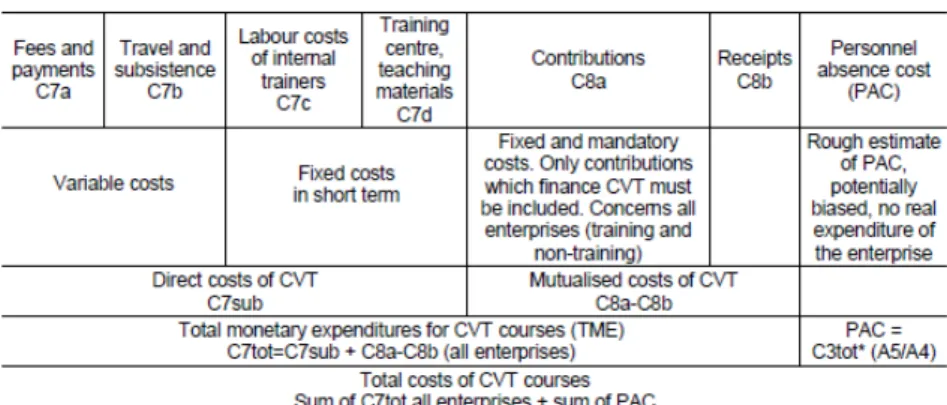
utilities etc) as well as the incidental expenses of travel and accommodation for the participants need to be recovered in some way, and the complete value of such an enterprise needs to be considered carefully. The real costs of providing vocational training to a staff member can be calculated using the CEDEFOP methodology, see figure 2-3.
Notes:
CVT = Continuous vocational training PAC = Personnel absence cost TME = Total monetary expenditure
Figure 2-3 CEDEFOP Methodology for determining total costs of providing vocational training, when utilising a company-owned training centre12.
Outsourced training
Outsourced training can provide a viable alternative for many companies. Currently most companies see this as hiring a consultant or trainer/s to deliver the required course, although there are alternatives such as distance learning (CD/VCD, video, books or internet), which can enable the participant to learn at his/her own pace.
An external consultant or trainer can provide a fresh view of training for an organisation, and can normally be flexible regarding timing of the training and venue. The method of training can range from a one-to-one intensive programme for (for example) a new director, to a more formally organised course. Often, the trainer will act as a facilitator – setting the scene so that the participators can discover things for themselves in a “workshop” environment. Consultants or trainers are usually familiar with the industry, and are sometimes accredited to deliver awards to successful participants (e.g.: Microsoft accredited trainers).
The cost of outsourced training can appear high when considered purely on a rate/hour basis, but when compared to the actual cost of maintaining an
12 From CEDEFOP Research paper No.2, “Employer-provided vocational training in Europe”, Luxembourg: Publications Office
house training college, plus the benefits of a fresh view of the company from an “outsider”, the outcome can be rewarding. CEDEFOP recommends an analysis of actual costs of providing training by various means, using the methodology illustrated in Figure 2-3.
2.2 Experiential learning theories and methodologies
There are numerous definitions of experiential learning, a few of which are given below:
“The process of acquiring skills, knowledge and understanding through experience rather than through formal education or training”
Centre for Lifelong learning at Warwick University, UK13 “Experiential education is the process of actively engaging students in an authentic experience that will have benefits and consequences. Students make discoveries and experiment with knowledge themselves instead of hearing or reading about the experiences of others. Students also reflect on their experiences, thus developing new skills, new attitudes, and new theories or ways of thinking”
Kraft & Sakofs (1988) “Experiential education is a philosophy and methodology in which educators purposefully engage with learners in direct experience and focused reflection in order to increase knowledge, develop skills and clarify values”
Association for experiential education14 “The process whereby knowledge is created through the transformation of experience. Knowledge results from the combination of grasping and transforming experience”
David Kolb (1984) The common link through all these definitions is the practical application of the knowledge. In 1972, the Management Development Branch of the International Labour Office (ILO), published documentation15 to support a course about training techniques for management development. The combined contributors did not use the term “Experiential learning”, but instead wrote of “Participative teaching methods” – a good description of the topic.
13 www.warwick.ac.uk/fac/soc/conted/SocratesAPEL/uk/glossuk.htm (accessed 27th August 2008) 14 http://www.aee.org/about/whatIsEE (accessed 27th August 2008)
15 Management development manual 36, 1972, “An introductory course in teaching and training
2.2.1 Critical appraisal of work in the field
David A Kolb, is often credited with being the creator of the term “Experiential learning” from his early paper on the subject [Kolb 1974], however this term was already in use. Kolb together with his colleague, Roger Fry developed the “Learning cycle”, and showed its relevance to experiential learning. David Kolb is currently (2010) Professor of Organizational Behaviour in the Weatherhead School of Management at Case Western Reserve University, in the USA. He is the recipient of four honorary degrees recognising his contribution to experiential learning in higher education. The work by Kolb and Fry was largely developed on foundations laid by Lewin, Dewey and Piaget [Kolb 1984].
2.2.1.1Kurt Lewin
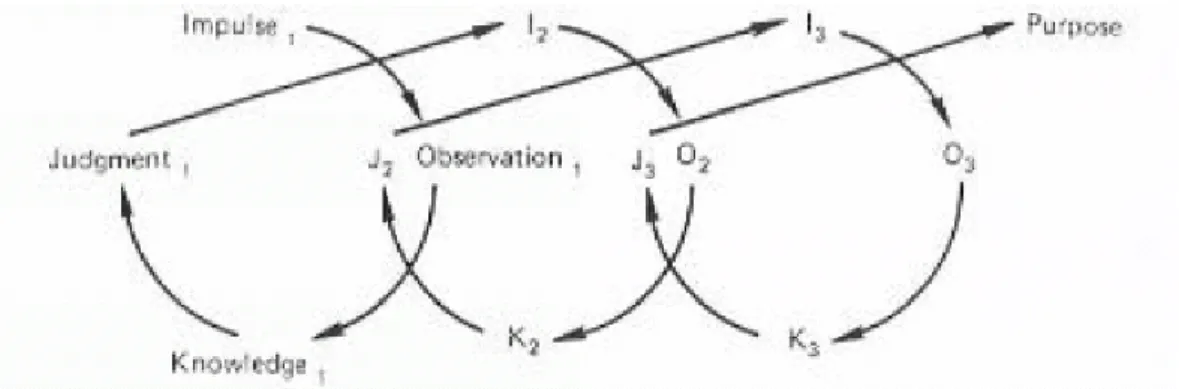
Kurt Lewin is known for his work in the field of organisational behaviour and group dynamics and with the development of the methodology of action research. From this he deduced that learning is optimised when there is a connection between the immediate, (“concrete”) experience and a period of analytic consideration. His diagram, the “Cycle of action”, represents this (figure 2-4), which became the precursor of Kolb’s “Experiential learning cycle”.
Figure 2-4: Lewin’s Experiential learning model
Concrete
experiences
Formation of abstract
concepts and generalisations
Observations and
reflections
Testing implications of
2.2.1.2John Dewey
John Dewey wrote about Experiential learning in 193816, and became known for having the opinion that the traditional education of that time was too concerned with delivering knowledge, and not enough on understanding the students’ actual experiences. He became known as the philosophical father of “Progressive education” (now known as Experiential education).
Dewey's theory is that experience arises from the interaction of two principles -- continuity and interaction. Continuity is that each experience a person has, will influence his/her future - for better or for worse. Interaction refers to the situational influence on one's experience. In other words, one's present experience is a function of the interaction between one's past experiences and the present situation. For example, one student’s experience of a lesson will depend on how the teacher arranges and facilitates the lesson, as well that student’s past experience of similar lessons and teachers. The concept is shown diagrammatically in figure 2-5.
Figure 2-5: Dewey’s Experiential learning model17
2.2.1.3Jean Piaget
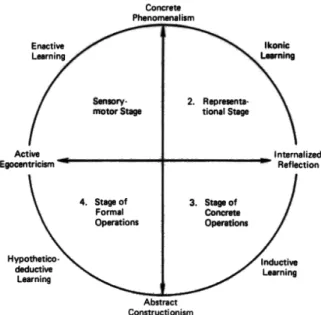
During his years at the University of Neuchâtel, Jean Piaget (1896 – 1980) became interested in how the human mind develops. During his work studying and designing methods of testing children’s intelligence, he became interested in the relationship between experience and human knowledge. He developed a model (Piaget’s model of Learning and Cognitive Development), figure 2-6, which describes the basic learning processes of children as they develop into adults. Four basic learning methodologies are apparent as the child develops, returning at adolescence to the same style which was first used (active orientation), demonstrating that the basic learning style is convergent. Kolb later used this to identify the basic developmental processes which shape the basic learning processes of adults.
16 Dewey, J. (1938/1997). Experience and education. Macmillan
17 Kolb, David A. (1984). Experiential Learning: Experience as the Source of Learning and
Figure 2-6: Piaget’s model of learning and cognitive development18
2.2.1.4David Kolb
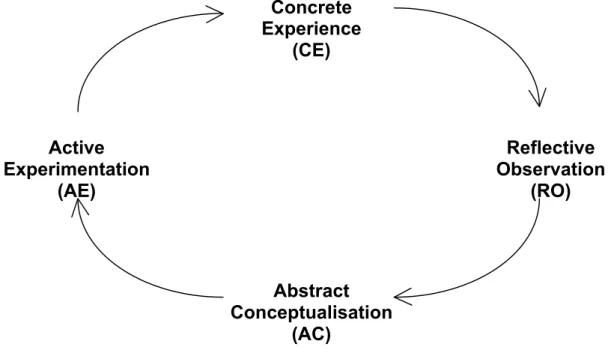
David Kolb built on the work of these three researchers to develop his “Experiential learning cycle” (also known as the “Kolb cycle”) shown in figure 2-7. From his 1984 publication entitled “Experiential learning”19 he described, “Learning [as] the process whereby knowledge is created through the transformation of experience.” He described experiential learning as involving the application of the information received from the teacher to the experiences of the student, rather than consisting of activity generated in the classroom alone. Thus, instead of a student acquiring knowledge exclusively from the teacher, it is learned through the process of taking the new information from class and testing it against their own real-life experiences. Kolb’s “Experiential learning cycle” consists of four phases:
• A “Concrete experience” which, in the classroom context would
probably not be a lecture, but instead some sort of activity such as a role-play, simulation, exercise, video etc
• A period of “Reflective observation” follows during, which the learner
is encouraged to think about the previous experience from a number of (possibly guided) perspectives.
• The third phase is called “Abstract conceptualisation” during which the
learner will consider, or develop theories, as to why what was observed actually occurred. The learner considers what is relevant to him (her) and draws conclusions.
18 Kolb, David A. (1984). Experiential Learning: Experience as the Source of Learning and
Development. Englewood Cliffs, NJ: Prentice-Hall Inc. – Page 25
19 Kolb, David A. (1984). Experiential Learning: Experience as the Source of Learning and
• The final phase is “Active experimentation” and is where the learner
tests out the theories which (s)he has developed, and considers ways in which this learning can be applied.
This cycle is continuous – the “Active experimentation” phase of one cycle leading on to the “Concrete experience” phase of the next cycle, where after a further period of “Reflective observation” the learner considers what might be done differently during the next “Abstract conceptualisation” phase. To emphasise this, an axis of time is sometimes shown in the figure.
Figure 2-7: Kolb’s “Experiential Learning Cycle” 30
2.2.1.5The learning context
The context is inseparable from the notion of learning and transfer [Fiore, Metcalf and McDaniel]. Theories such as Transfer appropriate processing (TAP) can support the understanding of experiential learning within a variety of different areas. In particular, and in the context of this dissertation, Fiore et al argue that TAP “supports the notion that initial strategies influence later problem solving, and that the matching of strategies during learning and test facilitates overall problem-solving effectiveness” (p.34).
Classes using simulations do not need to be exact simulations of the
environment in which the learner is placed for them to be used as a learning device. Research conducted for the United States Department of Aviation regarding the effectiveness of personal computer-based aviation training devices [Taylor et al] noted that the use of simulations with a high degree of accuracy had little, if any, impact on the actual operational job tasks. In fact, an article in the International journal of aviation psychology [Jentsch & Bowers in 1998] indicated that low fidelity simulations are equally effective.
Concrete Experience (CE) Abstract Conceptualisation (AC) Reflective Observation (RO) Active Experimentation (AE)
2.2.1.6The business game
The International Labour Organisation (ILO) training manual referred to earlier (in paragraph 2.2) listed a number of participative teaching methods, which included:
• Field studies • Incident method
• Case studies • Role play
• Decision simulations, or
Business games •
Group projects
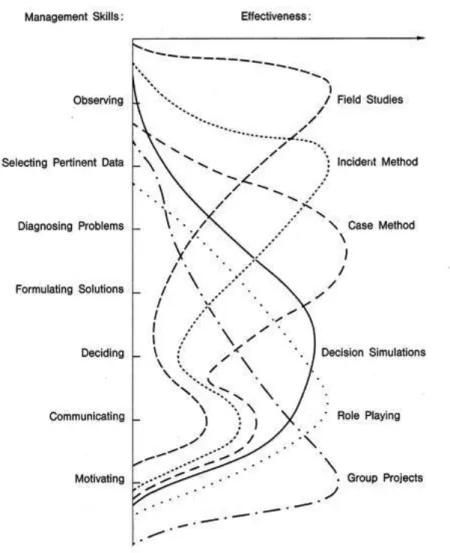
These are all different types of Experiential learning techniques, therefore it is interesting to consider an illustration20 developed by B. Hawrylyshyn (Figure 2-8), based on the experience of the Centre d’Etudes Industrielles in Geneva, indicating which management skills are best developed by different techniques.
Figure 2-8: Effectiveness of participative methods31
20From: Hawrylyshyn, B., “Preparing managers for international operations”, Business quarterly
The authors of the ILO manual observe that the main lesson is that, if training is intended to improve or develop multiple skills, then a combination of teaching methods should be used. This statement is probably true, however, the graph must be considered as a reflection of the thinking and attitudes of the learners at that time (1967). It seems likely that each of these methods have evolved considerably over the last 40 years, and a properly managed modern simulation (business game), for example, contributes to the development of each of the management skills to a much greater extent than apparent from the graph.
It is thought (by the ILO) that the concept of the business game was developed in Germany as a “War game” (“Kriegspiele”) which was used by the military. Apparently it was developed by the British army as a “Tactical exercise without troops”, and when it was taken to the USA it was seen by a visitor from the American Management Association (AMA), who realised its potential as a management learning tool. In the late 1950’s the AMA published their “Top management business simulation” – according to the ILO, it was the first business game, as such. G. R. Andlinger then published an article in the Harvard Business Review [Andlinger 1958], and also developed the “Andlinger game”. These games – and the simulation games in particular – were based on calculations which needed to be performed quickly by the game supervisor, and as computers were not widely available in those days, the simulations tended to be rather simplistic.
A confidential document originating from British Telecom21, seen by the author, studies the concept of the Business Game. They point out that developments in the use of technology (particularly the availability of computers) and significant developments in game theory as a result of work completed by John van Neumann and Oskar Morgenstern in 1994,22 have enabled more complex environments to be covered in greater detail.
Whilst recognising that a business game is only one example of experiential management learning, it is useful to notice how Kolb’s “Learning cycle” relates to business games, and simulations. This is illustrated in figure 2-9, where the importance of the briefing and de-briefing sessions within the business game process are shown in relationship to Kolb’s “Active experimentation” and “Reflective observation” phases.
21 “Business simulation model” – a confidential internal document produced by British Telecom
employees in August 2001 as a proposal for a client.
22 Brandenburger A. M., Nalebuff, B. J.; “The Right Game: Use Game Theory to Shape Strategy”;
Briefing Game/Simulation De-briefing
Allow participants to relate existing concepts to new situation and formulate tests
Concrete experience
Observations and reflections
Formation of concepts and generalisations Immerse into
“virtual” world Play Relate back toreal world
The Game Process
Figure 2-9: The simulation process and the Kolb learning cycle23
2.3 Personality types
In the previous section, the differences between people from different cultures have been discussed. It is not necessary to travel to another country to see evidence of different personalities and ideas. Two writers who have studied this are David Kolb [Kolb 1984; Kolb et al 2001) and Roger Dawson [Dawson 2005]. Their ideas are explained and discussed below:
2.3.1 Kolb’s work on Personalities
David Kolb has already been mentioned several times in this paper. Though Kolb, working with his colleague Fry in 1975, initially argued that possession of the abilities shown at each of these poles was critical for effective learning from experience, he later (1984) observed and acknowledged that not all people are strong at each stage in the cycle. In his continued his work on the Learning cycle he added two axes to his original diagram (reproduced here as figure 2-10), which point to the polar extremes of concrete-abstract and active-reflective. In summary he postulates that the “Concrete-Abstract [CE-AC] dimension represents how one prefers to perceive the environment or grasp experiences in the world [whereas] the Active-Reflective [AE-RO] dimension represents how one prefers to process incoming information”24. The CE-AC axis can be considered as containing the two dialectic concepts of “Feeling” and “Thinking”, whilst the AE-RO axis contains those of “Doing” and “Watching” (ie: doing and not doing).
23 Hussain S., Jensen, K. “Business Games. A review of the use of business games as organisational
learning tools”, 1996, internal British Telecom report
24 Kolb, 1984, as cited by Armstrong S.J. & Mahmud A., “Experiential learning and the acquisition of
managerial tacit knowledge”, The Academy of Management: Learning and Education 2008, vol 7, no 2, page 192
Figure 2-10: Kolb’s learning styles [Kolb et al 2001]
He considered the attributes of people who happen to fall into any one quadrant of his diagram, which he named as Accommodator, Diverger, Assimilator and Converger, in order to identify the principle characteristics of these people. These are summarised in Figure 2-11 [based on Armstrong & Mahmud 2008].
The results of these studies led Kolb to make two assertions, which are relevant to this study:
a) Matching learning context and learning style will lead to enhanced learning performance, and
b) A mismatch between learning style and learning context is likely to impede the process of learning and knowledge acquisition in a specialised profession Concrete Experience (CE) Abstract Conceptualisation (AC) Reflective Observation (RO) Active Experimentation (AE) Accommodator Converger Diverger Assimilator
Divergers Assimilators Convergers Accommodators Good at • Able to view concrete
situations from many angles
• Brainstorming
• Inductive reasoning • Ability to create theoretic
models
• Able to understand wide range of information and put in concise form
• Problem-‐solving and decision making • Practical application of
ideas and theories
• Carrying out plans and tasks
• Getting involved in new experiences
Interests and tendencies • Interested in people • Tend to be imaginative • Feelings-‐oriented
• More concerned with idea and abstract concepts than with people
• Technical tasks and specific problems through hypothetical-‐deductive reasoning rather than interpersonal issues
• Prefer trial-‐or-‐error approach based on own tuition or other people for information
Educational preferences • Arts subjects • History • Political sciences • Languages • Maths • Chemistry • Economics • Sociology • Physical sciences • Engineering • Business • Management
Career preferences • Social services
• Arts and communications
• Science • Information • Research • Technology • Economics • Environmental sciences
• Careers in organizations • Careers in business • Must be able to adapt to
changing circumstances
Reasons why • Good at establishing personal relationships, communicating effectively and helping other people • Able to make sense of
complex situations
• Good at gathering and analyzing information • Good at theory-‐building
and developing conceptual models
• Has technical and problem-‐solving skills • Likes quantitative analysis
and the use of technology
• Can use their
competencies in acting skills (eg: Leadership, initiative and action)
2.3.2 Dawson’s work on Personalities
Roger Dawson is a well respected American lecturer on the subject of business negotiation. He became interested in personality types after returning from a high-profile conference which he had attended, along with a number of his colleagues. He was intrigued to find that each of his colleagues had different opinions about the conference. One thought it was inspiring, another thought there was insufficient information given, another thought it was a complete waste of time, and another thought it was intimidating. He began to analyse the situation, and realised that each person had different levels of assertiveness and emotional feelings. From this he produced a diagram (figure 2-12), and considered the attributes of each quadrant – naming each one as either:
• Pragmatic, • Analytical, • Amiable, or • Extravert
Figure 2-12: Dawson’s “Personality styles”
Adapted by the author
Low High Assertiveness level High Low Analytical Analytical Analytical Amiable Analytical Pragmatic Analytical Extravert Emotional level
Pragmatists, he describes as people with a high level of assertiveness, and a low level on the emotional scale. In his opinion, pragmatists are very business-like, and do not like wasting time. For this reason, they dislike spectator sports (they prefer participative sports), dislike taking holidays, dress relatively formally and make decisions quickly.
Analytical people in his opinion are those who are low on the assertiveness scale and also on the emotional scale. He believes that this type of person thrives on information, always wants to know more details, and acts on facts. Typically, this type of person makes decisions slowly, and expects everything to be accurate and detailed. Typically this type of person might be an engineer or accountant – and if in a management role believes that management control can be done with the aid of many charts, tables and analyses.
Amiable people are those who are low on the assertiveness rating, and high on the emotional rating. These people like to build up trust, hate conflict, tend to act on feelings, and are slow decision-makers. They do not tend to be particularly tidy, probably have an old car (because they “like” it, and dislike the conflict involved in trading it in and buying a new one), and have lived in the same neighbourhood for a long time, for the same reason. These people, he believes, do not usually work as managers except perhaps in the middle ranks of the civil-service or other large organisation.
Extraverts, according to Dawson, rate highly on both the emotional scale and the assertiveness scale. They become enthusiastic and excited quickly, and are relatively fast decision-makers, tending to act on feelings. They are friendly, love being with people and enjoy spectator sports. They tend, however, to be rather poorly organised and are generally untidy.
Dawson, like Kolb, believes you have to work out the type of person you are, and the type of person you are dealing with, in order to match (or at least, prepare for) personality styles as much as possible. He believes that people in positions diagonally opposed in the diagram generally find it difficult to “get on with” each other. By this he means that the Analytical person finds it difficult to work with the Extravert, and the Pragmatist has difficulty with the Amiable person.
2.3.3 Commonality between Kolb and Dawson
The two major axes of Dawson’s chart are “Emotional level” and
“Assertiveness level”, and may be considered comparable to Kolb’s axes in this way:
• Kolb’s “Feeling-thinking” (AC-CE) axis can be considered analogous
to Dawson’s “Emotional level” axis because the definition of “Emotion” is “a strong feeling” [Cambridge dictionary].
• Kolb’s “Doing-watching” (AE-RO) axis can be considered analogous
to Dawson’s “Assertiveness level” axis as the definition of “Assertive” is “a display of behaviour” [Cambridge dictionary].
![Figure 2-2: Memory structures and knowledge acquisition in a cognitive model of tacit knowledge [Sternberg et al 2000]](https://thumb-us.123doks.com/thumbv2/123dok_us/9870892.2876955/17.892.147.743.106.483/figure-memory-structures-knowledge-acquisition-cognitive-knowledge-sternberg.webp)
![Figure 2-10: Kolb’s learning styles [Kolb et al 2001]](https://thumb-us.123doks.com/thumbv2/123dok_us/9870892.2876955/29.892.157.739.110.445/figure-kolb-s-learning-styles-kolb-al.webp)