Genotyping and Evaluation of
Pleurotus ostreatus
(oyster mushroom) strains
Anton S.M. Sonnenberg, Patrick M. Hendricks and Etty Sumiati
Applied Plant Research
Mushroom Research Unit PPO no. 2005-18
© 2005 Wageningen, Applied Plant Research (Praktijkonderzoek Plant & Omgeving B.V.)
All rigts reserved. No part of this publication may be reproduced, stored in a retrieval system or transmitted, i n any form of by any means, electronic, mechanical, photocopying, recording or otherwise, without the prior written permission of Applied Plant Research.
Praktijkonderzoek Plant & Omgeving takes no responsibility for any injury or damage sustained by using data from this publication.
PPO Publication no. 2005-18
This study was financed by the Ministry of Agriculture, Nature and Food Quality Project no.: 620154
Applied Plant Research ( Praktijkonderzoek Plant & Omgeving BV)
Mushroom Research UnitAdress : Peelheideweg 1, America, The Netherlands : PO Box 6042, 5960 AA Horst, The Netherlands Tel. : +31 77 4647575
Fax : +31 77 464 1567 E-mail : [email protected] Internet : www.ppo.wur.nl
Inhoudsopgave
pagina 1 SUMMARY... 4 2 INTRODUCTION ... 4 3 GENOTYPING COLLECTIONS ... 5 4 FRUITING TESTS... 6 4.1 Yield ... 6 4.2 Colour... 6 4.3 Quality ... 7 5 CONCLUSIONS ... 76 TABLES AND FIGURES ……… ……….………8
1
Summary
Oyster mushrooms (Pleurotus ostreatus) represent one of the most popular mushroom species grown in Indonesia. There is a need for strains that are better adapted to the climate conditions at Java, where most mushrooms in Indonesia are produced. Strains that can produce mushrooms at 22 to 28 oC and have a good yield and quality would improve the profit of mushroom growers substantially. In order to find strains that can be used for Indonesian growing conditions a large number of available strains were genetically examined. Two sources were used in this study:
- A collection of strains commercially used in Indonesia. These strains are collected by Dr Etty Sumiati from farmers and institutes at Java.
- The collection of fungal strains present at PPO, Horst, The Netherlands. This collection contains a substantial number of strains representing the genus Pleurotus. Most of these strains have not been genotyped or evaluated for the production of fruiting bodies. Unfortunately, no strains were obtained from natural environment in Indonesia. Most strains sent by Etty Sumiati appeared to be infected at arrival at PPO. We have identified the species type of the strains representing the genus Pleurotus by ITS-RFLP in order to identify unambiguously the species P. ostreatus (common oyster mushroom). Next, all P. ostreatus strains were genotyped by ISSR to examine the genetic variation between strains. It appeared that the PPO collection contains 167 P. ostreatus strains representing 68 different genotypes. The 24 strains collected from Indonesia represent 7 different genotypes but more than 50% is represented by one variety. This variety, i.e. type florida, originate from wild (Florida, USA) and can be grown at higher
temperatures. It lacks, however, the yield and quality present in most strains used in Europe and the USA.
Based on the genetic data and data on the origin of strains a selection of 40 strains was made that has been tested in 2 parallel cells (16 and 22 oC production temperature). ………..
2
Introduction
The oyster mushroom (Pleurotus) is one of the most cultivated mushroom types worldwide. The genus consists of a number of species. However, more than 90% of the Pleurotus crops grown world wide concerns the common oyster mushroom, P. ostreatus. Its ease of cultivation on different substrates makes it a popular species for small farmers. No expensive climate controlled growing houses are needed because of the availability of varieties that can complete their life cycle under different climatic conditions. The common oyster mushroom is also one of the most cultivated mushroom species in Indonesia, especially on Java. It is grown inland on elevated regions (1000 or more meters above sea level) where temperatures do not exceed 22-28 0C. In Europe and the USA, oyster mushroom varieties are grown at low temperatures (fruiting bodies are produced at temperatures of 15 to 18 oC). Mushroom farmers obtain high quality strains from companies specialized in the production of spawn (pure fungal inoculum for substrate). A large number of strains are available but previous research has shown that they represent only a limited number of genotypes. There are no spawn companies in Indonesia and import of spawn is too expensive for most growers. Strains are usually obtained by taking along strains from contacts in Western countries (or recently China and Taiwan) and they are stored on slant tubes in a
refrigerator or even at room temperature. This is not an optimal way of maintaining strains often resulting in decrease of quality after some time. Next to strain qualities, also a lack of varieties
specially adapted to the Indonesian growing/climate conditions is a problem. There is only one commercial variety available (“florida” variety) that is adapted to cultivation at higher
temperatures.
The goal of this research is to see if strains can be found that are more suitable for Indonesian cultivation conditions, i.e. can produce fruiting bodies above 22 oC and have a good yield and quality. Two types of sources for strains are used in this study: the collection of PPO and the collection of commercial strains used in Indonesia (collected by IVEGRI at Lembang). Since space and money is limited in this project, we first genotypes the available Pleurotus species and identified all P. ostreatus strain. Subsequently, the genetically variation within the species P. ostreatus was determined. A selection of 40 genetically different strains were tested on fruiting in two parallel cell test at 16 and 22 oC respectively.
3
Genotyping Collections
The collection of PPO contains ca. 5000 strains representing more than 100 species. Approximately 270 strains are Pleurotus species (including 24 strains sent by Etty
Sumiati/IVEGRI). Most of these are the widely cultivated common oyster mushroom P. ostreatus. The collection P.ostreatus of PPO consists of old and present-day commercial lines, gifts from other collections and private persons and strains collected from natural environment in different parts in the world. Especially in the last years, a number of strains have been obtained from China and Korea. Most strains of this collection have not been genotyped and not evaluated in a crop. Dr Etty Sumiati has collected 31 fungal strains from different sources in Indonesia of species that are grown commercially. Most of these are P. ostreatus species. She also has collected a number of strains from the wild, mainly in Java. Unfortunately, most of these strains appeared to be infected after arrival at PPO (those that were purified were not Pleurotus species).
Since this subproject focus now on P. ostreatus we have first checked on the correct species name. All Pleurotus spp. were genotyped using ITS-RFLP as described earlier (Report: “Evaluation of shiitake strains of the PPO collection”; Hortin Mushroom 2005-1). Four different restriction enzymes were used to digest the amplified ribosomal DNA region. In this way all species could be discriminated into the four groups in accordance with intersterility groups (Appendix: Table 1; Figure 1). The latter name is derived from the compatibility test between strains. Strains from identical species are compatible (fertile) whereas strains from different species can not be crossed (intersterile).
In table 2 (Appendix) a list is presented of commercial strains collected by Dr Etty Sumiati from different farms and institutes in Java. All these strains were identified as P. ostreatus by ITS-RFLP. In order to evaluate what strains have potentials for the Indonesian cultivation conditions we tested strains at 2 different fruiting temperatures, 16 and 22 oC. In this way we could also see what strains have potentials for the European and USA market or what strains could be a base for a breeding program for both climatic conditions. Since we have a limited space in our
experimental farm and the budget is also limited we had to make a selection of the 168 identified as P. ostreatus species. For this, all strains were first analyzed on genetic relatedness using the ISSR technique as described earlier (Report: “Evaluation of shiitake strains of the PPO collection”; Hortin Mushroom 2005-1). In this way we have made a selection representing a broad genetic variation. 68 Different genotypes were identified in 168 strains indicating that the collection P. ostreatus strains represent indeed a broad variation (figure 2; table 3). Most European (and USA)
commercial lines are represented by 3 genotypes: varieties with large fleshly fruiting bodies (HK 35 type), varieties with smaller fruiting bodies (P24 types) and varieties representing hybrids between the HK35 types and the florida type. The florida type has been isolated 50 years ago in Florida (USA) and can be grown at high temperatures. The hybrids can be grown at a broader range of temperatures. The fourth large group (genotype group 4) represents the original florida
isolate. These 4 groups represent almost 50% of the number of P.ostreatus strains present in the collection. Most of the other strains represent wild isolates or are derived from collections of institutes where no detailed information is available on the origin of the respective strain. These lines show a much higher genetic variation than the commercial lines.
Etty Sumiati has collected 23 strains from farms and institutes on Java. The ISSR genotyping showed that more than 50% (13 out of 24) of these strains are identical to the original florida
type. This indicates that this variety, capable of producing at higher temperatures, is the most popular/suitable strain among farmers in Indonesia. The florida variety, however, is not a strain that has the same yield and quality as the commercial strains used in Europe and the USA. The intension of the cell tests was thus to find a strain that has an improved quality and yield when producing mushrooms at 22 oC.
4
Fruiting tests
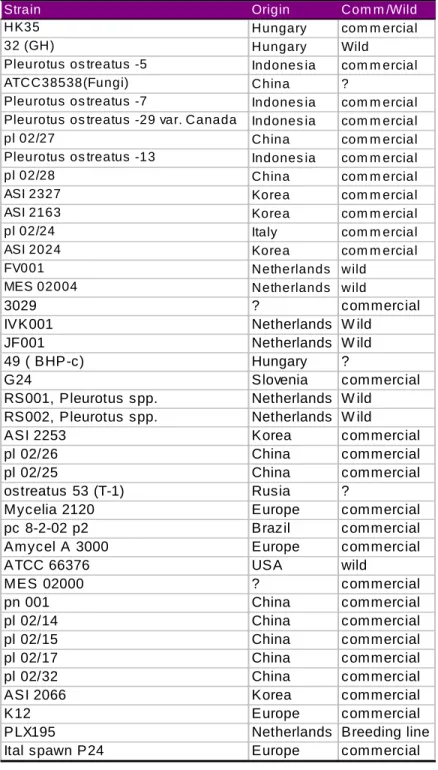
Based on the genotypes and the information we had on the origin of strains a selection was made of 40 strains (Table 4). They represent available strains from Java (4 strains; one of the florida
type), wild strains originating from different countries, and commercial lines used in European and USA crops. Spawn has been prepared form each strain using sorghum as carrier and pasteurized straw was used as substrate. This is a different substrate than used in Indonesia (saw dust with nitrogen rich additives). It is possible that the test results might not be completely comparable to Indonesian crop systems but it is likely that the performance of the strains (yield and preferred temperature) are comparable in the two systems, i.e. those producing best on straw at 22 oC will also be the best producer on saw dust with additives in Indonesian crop systems.
4.1
Yield
A number of strains did not fruit at all (Table 5). Most of these were strains collected from wild and had not been tested before. This is not an unusual observation for mushrooms collected from the wild. When comparing strains that did produce mushrooms, a considerable variation in yield is seen (Figure 3). A number of strains did produce only at 16 oC. This is also not unexpected as a number of strains are used for production in European and US crops and might have been selected for optimal growth at low temperatures. Most strains producing at both temperatures had a higher yield at 22 oC. At least 9 strains had a higher yield than the best producing Indonesian strain (boxed blue in figure 3).
4.2
Colour
The colour of the fruiting body is affected by the environmental temperature. At low temperatures,
mushrooms intend to have a darker colour than at higher temperature. The markets in Europe and the USA prefer dark mushrooms whereas the Indonesian people prefer light (even white) mushrooms. It might be that this preference is stimulated by the market as convenience because it coincides with the environmental temperatures used in both production systems. We have measured here the lightness of the mushrooms with a Minolta Chromometer.
As expected, most strains have a lighter color at 22 oC than at 16 oC (Table 6). It is interesting to see, however, that some strains do have a darker color at the highest temperature. Such strains (as HK35) might be useful in Western countries in summer periods.
The strains with a higher production as the Indonesian strains have a similar lightness as the Indonesian strains or are darker. Tests at IVEGRI will show what the color of these strains will be under Indonesian conditions.
4.3
Quality
Important quality characters of strains are the form and brim of the cap. In Europe and the USA oyster mushroom caps should look like shells and have a smooth brim. Mushrooms should also be large, have a regular look and a good shelf life. Whether all these characters are also
important for the Indonesian market is not known yet. From what I have seen at farms and on the local markets on Java, size and shapes of the caps are characteristics less important than in Europe and the USA (figure 5). For super markets and export, however, these characters might be more important. Shelf life is important for all markets world wide.
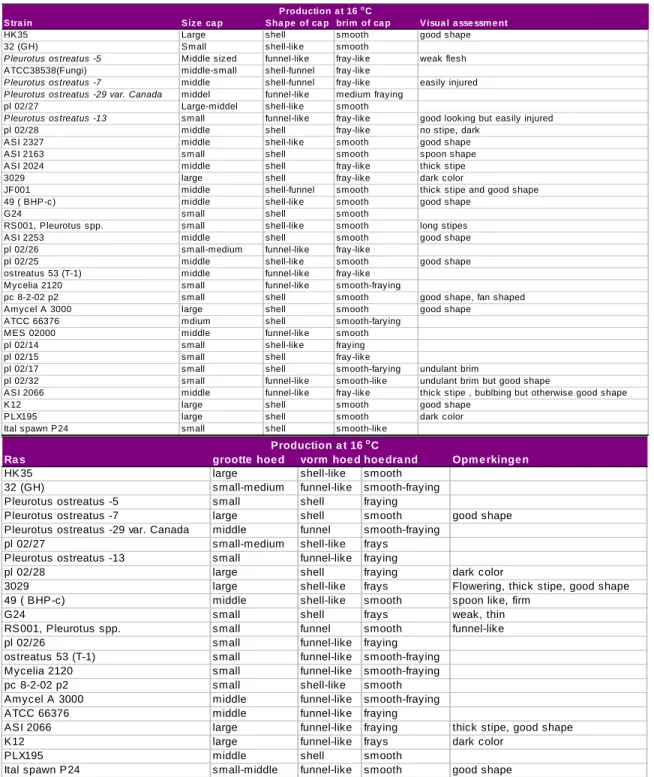
We have examined in this projects characters as size of caps, shape of caps and cap brims Table 7). In addition, in some cases a general impression of the mushrooms are given. From the
assessments of traits at both production temperatures it appeared that more strains tend to grown in a funnel like shape at higher temperatures. Nine strains had a more funnel like shape at 22 oC than at 16 oC, 9 strains showed no difference at both temperatures and only 3 strains tend to a more shell like shape at 22 oC. The Indonesian strains vary in form from pure shell to funnel like.
Cap sizes vary from small (8 cm diameter), medium (between 8 and 12 cm) and large (>12 cm diameter). The Indonesian strains represent all sizes at both temperatures. Hood brims of the Indonesian strains also vary from smooth to fraying. One Indonesian strain (P. osteatus-7) showed a quality usually seen with the best European strains (large caps, smooth brims, shell shape). This strain also was designated as “good looking” in the assessment of general quality and had a reasonable yield.
5
Conclusions
From the two cell tests done we can conclude that nine strains had a slightly or considerable higher yield than the 4 Indonesian control strains (Table . The colour and quality of these 9 strains vary from good to reasonable based on standards for the Western markets. It is wise to evaluate these strains under Indonesian conditions. A first test at the facilities at IVEGRI should indicate what strains can be an improvement for the Indonesian growers. The selected strains should then be grown by a limited number of growers near Lembang so that the project leader can evaluate the performance of the selected strains. IVEGRI can maintain these strains for companies so that fresh inoculates or mother spawn can be obtained on a regular base. IVEGRI can set up a
business for this and include new varieties for shiitake strains (Lentinula edodes). PPO can serve as a back-up for mother cultures.
Species Varieties/subspecies Intersterility group # strains Indonesian origin
P. ostreatus I 168 24
P. pulmonarius P.sapidus, P.sajor-caju II 59 3
P.cornucopiea IV 5
P. eryngii P. nebrodensis VI 27
P.cystidiosys P. abalonus, P. flabellatus, P. eous VII 15
total 274 26
Table 1. Species of the PPO collection and commercially available strains of Indonesia identified by ITS-RFLP
Grey P. ostreatus 0 P. ostreatus Originate from Germany and used in commercial crops
P. ostreatus -3 4 P. ostreatus Micrology LabFMNS, bogor Agnic. University
Pleurotus s.c. 4 P. ostreatus Micrology LabFMNS, bogor Agnic. University
P. ostreatus -5 4 P. ostreatus P4S Melati, Pasir Gaok Village, Kemang-Bogor (Maryam)
P. ostreatus -6 4 P. ostreatus P4S Kaliurang, Kalimuncar Village, Tugu Utara- Cisarua, Bogor (Badri)
P. ostreatus -9 4 P. ostreatus P4S Nusa Indah, Ciomas Village, Bogor (Cucu- Saraglh)
P. ostreatus -10 4 P. ostreatus Wisma Jamur - Cimacan, Cianjur (Yufan Oscar)
P. ostreatus -11 4 P. ostreatus PT. Cibodas Mas Biotek,Jl. Raya Cibodas Cianjur
P. ostreatus -15 4 P. ostreatus Rahmat, Cisarua Lambang
P. ostreatus -16 4 P. ostreatus Badri, Tugu Cisarua Bogor
P. ostreatus -21 4 P. ostreatus Forestry Research and Development/ Enjah, Ciapus- Bogor
P. ostreatus -25 4 P. ostreatus Bandung Institute of Technology, Bandung
P. ostreatus -27 4 P. ostreatus Bandung Institute of Technology(from Germany)
P. ostreatus -28 4 P. ostreatus Cita Lestari (Rahmat), Cisarua Lembang (from Cananada)
P. ostreatus -7 8 P. ostreatus P4S Kaliurang, Kalimuncar Village, Tugu Utara- Cisarua, Bogor (Badri)
P. ostreatus -24 9 P. ostreatus BP2AHP - Ngipiksari-Kaliuranf, Yogyakarta
P. ostreatus -26 9 P. ostreatus Kurdrat-Sukabumi
P. ostreatus -29 9 P. ostreatus Badri, Sukabumi
P. ostreatus -4 10 P. ostreatus Microbiology Lab-Indonesian Center for Science, Bogor
P. ostreatus -8 11 P. ostreatus P4S Nusa Indah, Ciomas Village, Bogor (Cucu- Enjah)
P. ostreatus -14 11 P. ostreatus Cucu - Sahati, Bogor
P. ostreatus -13 12 P. ostreatus Cucu - Sahati, Bogor
P. ostreatus -17 12 P. ostreatus Alang, Cisarua Lembang
P. ostreatus -12 P. ostreatus Beny Cibodas - Lembang
Table 2. Strains of P. ostreatus collected by Etty Sumiati from farms and institutes on Java. All strains represent commercial varieties. Most strains appeared to represent the florida variety that can be grown at higher temperatures.
Designation by Dr Sumiati
ISSR
genotype ITS-RFLP Origin
ISSR # strain in group Indonesian Type strain
0 28 0 European commercial strain ostreatus x florida 1 14 0 European commercial strains like HK35/Somycel 3015
2 8 0 European commercial strains like P24
3 3 0 European commercial hybride like Italspawn P70
4 20 13 P.ostreatus var. Florida
6 1 0 P.ostreatus var. Florida
8 1 1 Strain from Indonesia
9 3 3 Strains from Indonesia
10 1 1 Strain from Indonesia
11 4 2 Strains from China and Indonesia
12 3 2 Indonesian strains P.ostreatus var. florida
13 3 0 Strains from China
14 1 0 Strain from Korea
15 1 0 Strain from Korea
16 1 0 Strain from China
17 2 0 Strains from China
18 3 0 Strains from China and Korea
19 2 0 Strains from China and Korea
22 7 0 European commercial strains reduced spore production 23 5 0 European "winter"strain produces at low temperatures 24 5 0 European "winter"strain produces at low temperatures
25 1 0 Dutch Wild Isolate
26 1 0 Dutch Wild Isolate
27 1 0 European commercial strain
28 1 0 European commercial strain
29 1 0 Dutch Wild Isolate
30 1 0 Dutch Wild Isolate
32 3 0 European commercial strains like Somycel 3035
33 1 0 Strain from France
34 1 0 No Information
35 1 0 Commercial strain from Slovenia
36 1 0 Dutch Wild Isolate
37 1 0 Dutch Wild Isolate
38 1 0 No Information
39 1 0 Strain from Korea
40 1 0 Wild strain form China
41 2 0 Wild strain form China
42 2 0 European commercial strain and Russian wild strain
43 3 0 Strain from Russia
44 2 0 European commercial strains
45 1 0 Strain from Brasil
46 1 0 Strain from Hungary
47 2 0 European commercial strains (ostreatus x florida)
48 1 0 Strain from Russia
49 1 0 Strain from Russia
50 2 0 European commercial strain Amycel 3000 (P.columbinus??)
51 1 0 Strain from Germany
52 1 0 Strain from Hungary
53 1 0 European commercial strain
54 1 0 Strain from Japan
55 1 0 No Information
56 1 0 Wild strain form China
57 1 0 European commercial strain
58 1 0 European commercial strain
59 2 0 Strains from Hungary and Russia
60 1 0 Strain from Russia
61 1 0 Strain from France
62 1 0 Wild strain form China
63 1 0 Wild strain form China
64 1 0 Wild strain form China
65 1 0 Wild strain form China
66 1 0 Strain from Korea
67 1 0 Strain from Russia
Table 3. List of genotypes of P. ostreatus species present in the PPO collection including strains collected in Indonesia by Etty Sumiati from framers and institutes.
Table 4. List of strains used in cell tests at 2 production temperatures (16 and 22 oC).
Strain Origin Com m /Wild
HK35 Hungary com m ercial
32 (GH) Hungary Wild
Pleurotus os treatus -5 Indones ia com m ercial
ATCC38538(Fungi) China ?
Pleurotus os treatus -7 Indones ia com m ercial
Pleurotus os treatus -29 var. Canada Indones ia com m ercial
pl 02/27 China com m ercial
Pleurotus os treatus -13 Indones ia com m ercial
pl 02/28 China com m ercial
ASI 2327 Korea com m ercial
ASI 2163 Korea com m ercial
pl 02/24 Italy com m ercial
ASI 2024 Korea com m ercial
FV001 Netherlands wild
MES 02004 Netherlands wild
3029 ? commercial
IVK001 Netherlands W ild
JF001 Netherlands W ild
49 ( BHP-c) Hungary ?
G24 Slovenia commercial
RS001, Pleurotus spp. Netherlands W ild RS002, Pleurotus spp. Netherlands W ild
ASI 2253 Korea commercial
pl 02/26 China commercial
pl 02/25 China commercial
ostreatus 53 (T-1) Rusia ?
Mycelia 2120 Europe commercial
pc 8-2-02 p2 Brazil commercial
Amycel A 3000 Europe commercial
ATCC 66376 USA wild
MES 02000 ? commercial pn 001 China commercial pl 02/14 China commercial pl 02/15 China commercial pl 02/17 China commercial pl 02/32 China commercial
ASI 2066 Korea commercial
K12 Europe commercial
PLX195 Netherlands Breeding line
Ital spawn P24 Europe commercial
Strain 16 oC 22 oC Strain 16 oC 22 oC 3029 780 1037 ostreatus 53 (T-1) 356 443 32 (GH) 865 1725 P24 943 1001 49 ( BHP-c) 1143 861 pc 8-2-02 p2 543 716 Amycel A 3000 830 961 pl 02/14 358 0 ASI 2024 866 0 pl 02/15 600 0 ASI 2066 556 550 pl 02/17 804 0 ASI 2163 560 206 pl 02/24 0 0 ASI 2253 690 0 pl 02/25 754 0 ASI 2327 561 0 pl 02/26 644 782 ATCC 66376 507 1168 pl 02/27 819 1005 ATCC38538 303 0 pl 02/28 806 293 FV001 0 0 pl 02/32 382 0 G24 291 484 Pl ostr 5 469 179 HK-35 1040 873 PL ostr 7 821 839
IVK001 0 0 Pleurotus ostreatus -13 549 436
JF001 488 0 Pleurotus ostreatus -29 var. Canada 648 655
K12 1172 1722 PLX195 981 700
MES 02000 658 0 pn 001 0 0
MES 02004 0 0 RS001 533 523
Mycelia 2120 615 640 RS002 0 0
Production Temp. Production Temp.
Table 5. Yield (grams per package straw; ca. 18 kg) of different P. ostreatus strains grown at two different temperatures (16 and 22 oC).
Strain 16 oC 22 oC
HK35 73.30 67.28
32 (GH) 70.19 76.19
Pleurotus ostreatus -5 76.78 82.92
Pleurotus ostreatus -7 79.16 83.20
Pleurotus ostreatus -29 var. Canada 80.55 80.54
pl 02/27 73.34 72.16 Pleurotus ostreatus -13 79.47 77.99 pl 02/28 50.12 50.06 3029 59.27 60.45 49 ( BHP-c) 76.65 80.04 G24 83.93 76.79 RS001, Pleurotus spp. 66.92 79.62 pl 02/26 66.31 72.98 ostreatus 53 (T-1) 62.27 71.12 Mycelia 2120 70.30 77.04 pc 8-2-02 p2 67.24 71.77 Amycel A 3000 71.02 79.04 ATCC 66376 75.59 73.39 ASI 2066 82.09 84.93 K12 67.96 70.49 PLX195 64.58 72.03 Ital spawn P24 68.63 76.24
Table 6. Colour of mushrooms caps (L: Lightness of fruit bodies measured with a Minolta chromometer). Most strains show a lighter colour at 22 than at 16 oC.
Table 7. Quality assessment of mushrooms produced by strains at 16 and 22 oC.
Ra s grootte hoe d vorm hoe d hoe dra nd Opm e rkinge n
HK35 large shell-like smooth 32 (GH) small-medium funnel-like smooth-fraying Pleurotus ostreatus -5 small shell fraying
Pleurotus ostreatus -7 large shell smooth good shape Pleurotus ostreatus -29 var. Canada middle funnel smooth-fraying
pl 02/27 small-medium shell-like frays Pleurotus ostreatus -13 small funnel-like fraying
pl 02/28 large shell fraying dark color
3029 large shell-like frays Flowering, thick stipe, good shape 49 ( BHP-c) middle shell-like smooth spoon like, firm
G24 small shell frays weak, thin
RS001, Pleurotus spp. small funnel smooth funnel-like pl 02/26 small funnel-like fraying
ostreatus 53 (T-1) small funnel-like smooth-fraying Mycelia 2120 small funnel-like smooth-fraying pc 8-2-02 p2 small shell-like smooth Amycel A 3000 middle funnel-like smooth-fraying ATCC 66376 middle funnel-like fraying
ASI 2066 large funnel-like fraying thick stipe, good shape K12 large funnel-like frays dark color
PLX195 middle shell smooth
Ital spawn P24 small-middle funnel-like smooth good shape
Production a t 16 oC
S tra in Size ca p Sha pe of ca p brim of ca p V isua l a sse ssm e nt
HK35 Large shell smooth good shape
32 (GH) Sm all shell-like smooth
P leurotus ostreatus -5 Middle sized funnel-like fray-like weak flesh A TCC38538(Fungi) middle-small shell-funnel fray-like
P leurotus ostreatus -7 middle shell-funnel fray-like easily injured
P leurotus ostreatus -29 var. Canada middel funnel-like medium fraying
pl 02/27 Large-middel shell-like smooth
P leurotus ostreatus -13 sm all funnel-like fray-like good looking but easily injured
pl 02/28 middle shell fray-like no stipe, dark
A SI 2327 middle shell-like smooth good shape
ASI 2163 sm all shell smooth spoon shape
ASI 2024 middle shell fray-like thick stipe
3029 large shell fray-like dark color
JF001 middle shell-funnel smooth thick stipe and good shape
49 ( BHP-c) middle shell-like smooth good shape
G24 sm all shell smooth
RS001, Pleurotus spp. sm all shell-like smooth long stipes
A SI 2253 middle shell smooth good shape
pl 02/26 sm all-medium funnel-like fray-like
pl 02/25 middle shell-like smooth good shape
ostreatus 53 (T-1) middle funnel-like fray-like M ycelia 2120 sm all funnel-like smooth-fraying
pc 8-2-02 p2 sm all shell smooth good shape, fan shaped
A mycel A 3000 large shell smooth good shape
A TCC 66376 mdium shell smooth-farying
M ES 02000 middle funnel-like smooth
pl 02/14 sm all shell-like fraying
pl 02/15 sm all shell fray-like
pl 02/17 sm all shell smooth-farying undulant brim
pl 02/32 sm all funnel-like smooth-like undulant brim but good shape
A SI 2066 middle funnel-like fray-like thick stipe , bublbing but otherwise good shape
K 12 large shell smooth good shape
PLX195 large shell smooth dark color
Ital spawn P24 sm all shell smooth-like
P roduction a t 16 oC
Strain 16 oC 22 oC 16 oC 22 oC Origin
HK35 73.30 67.28 1040 873 European commercial
32 (GH) 70.19 76.19 865 1725 Wild/Hongarian
Pleurotus ostreatus -7 79.16 83.20 821 839 Indonesia
pl 02/27 73.34 72.16 819 1005 China
3029 59.27 60.45 780 1037 European commercial?
49 ( BHP-c) 76.65 80.04 1143 861 Wild/Hongarian
Amycel A 3000 71.02 79.04 830 961 European commercial
ATCC 66376 75.59 73.39 507 1168 Wild/USA
K12 67.96 70.49 1172 1722 European commercial
Ital spawn P24 68.63 76.24 943 1001 European commercial Yield (grams per
package) Lihtness
Table 8. Strains selected for IVEGRI based on the resulsts of the assessments of traits. The strains and data in ital is the best performing Indonesian strains in this evaluation.
F igur e 1. Id e n ti fi ca ti o n o f spec ie s w ith in th e gen us P leur otus usi ng IT S -R F LP . P rim ers w e re used to am pli fy the IT S reg ion of ri bos om al DNA. T h is DNA w a s di g e sted w ith A lu-I an d res u lti ng fr agm e nts sepa rate d on aga rose ge l a n d d y e d w ith E thi di u m B rom id e. Nex t to A lu _I, 3 oth er re st rict io n e n zym e s w e re used on sepa ra te s a m p le s (data not sh ow n). In th is w a y a ll P. ost reat us sp ec ie s cou ld be i d ent ifi ed w ith in th e co llect ion and used fo r gen otyp in g by IS S R . F igur e 1. Id e n ti fi ca ti o n o f spec ie s w ith in th e gen us P leur otus usi ng IT S -R F LP . P rim ers w e re used to am pli fy the IT S reg ion of ri bos om al DNA. T h is DNA w a s di g e sted w ith A lu-I an d res u lti ng fr agm e nts sepa rate d on aga rose ge l a n d d y e d w ith E thi di u m B rom id e. Nex t to A lu _I, 3 oth er re st rict io n e n zym e s w e re used on sepa ra te s a m p le s (data not sh ow n). In th is w a y a ll P. ost reat us sp ec ie s cou ld be i d ent ifi ed w ith in th e co llect ion and used fo r gen otyp in g by IS S R . 15
F igur e 2. IS S R pa tter ns of a sel e ct io n of P. ostreat u s stra in s o rig in at e d f rom In do nes ia and th e col le ct io n of P P O . T h e p ict ur e show s th at esp e c ia lly t h e w ild co llect ed stra in s s h ow a high g e n e tic v a ria b ili ty . Ba s e d on thes e g e net ic fing er p rin ts a sel e ct io n 40 ge n o types w a s m ade that w ill be te sted i n 2 p ara lle l gro w ing ce lls (1 6 an d 22 o C fr u it in g te m pera tures ). F igur e 2. IS S R pa tter ns of a sel e ct io n of P. ostreat u s stra in s o rig in at e d f rom In do nes ia and th e col le ct io n of P P O . T h e p ict ur e show s th at esp e c ia lly t h e w ild co llect ed stra in s s h ow a high g e n e tic v a ria b ili ty . Ba s e d on thes e g e net ic fing er p rin ts a sel e ct io n 40 ge n o types w a s m ade that w ill be te sted i n 2 p ara lle l gro w ing ce lls (1 6 an d 22 o C fr u it in g te m pera tures ). 16
F igur e 3. Y ie lds of 4 0 P . ostre a tus str a in s test ed in th e g row in g fac ili ties of P P O. S trains w e re gr o w n o n past eur iz ed straw and inc ubat ed at 24 o C for 14 days du ring the c o lo n izat io n of th e su bstrat e. T h is w a s don e in tw o p a ra lle l c e ll s. A fter th is veg e tat ive gr ow th, both ce lls w e re v ente d ( s u p p ly of f resh a ir w ith lo w C O 2 conten t) and t em peratur e lo w er e d to 16 o C (fi rs t ce ll; y ie lds in b lue bars ) or t o 22 o C (secon d ce ll ; y ie lds in re d-b row n ba rs) . It can be se en th at som e str a in s do not pr od uce at both t em per atur e s . A r e lat iv e ly la rg e num ber of str a in s d o p rod u c e at 16 o C but no t a l 22 o C. S trai n s u s ed in I nd ones ia ar e b ox ed b lu e. F igur e 3. Y ie lds of 4 0 P . ostre a tus str a in s test ed in th e g row in g fac ili ties of P P O. S trains w e re gr o w n o n past eur iz ed straw and inc ubat ed at 24 o C for 14 days du ring the c o lo n izat io n of th e su bstrat e. T h is w a s don e in tw o p a ra lle l c e ll s. A fter th is veg e tat ive gr ow th, both ce lls w e re v ente d ( s u p p ly of f resh a ir w ith lo w C O 2 conten t) and t em peratur e lo w er e d to 16 o C (fi rs t ce ll; y ie lds in b lue bars ) or t o 22 o C (secon d ce ll ; y ie lds in re d-b row n ba rs) . It can be se en th at som e str a in s do not pr od uce at both t em per atur e s . A r e lat iv e ly la rg e num ber of str a in s d o p rod u c e at 16 o C but no t a l 22 o C. S trai n s u s ed in I nd ones ia ar e b ox ed b lu e. F igur e 3. Y ie lds of 4 0 P . ostre a tus str a in s test ed in th e g row in g fac ili ties of P P O. S trains w e re gr o w n o n past eur iz ed straw and inc ubat ed at 24 o C for 14 days du ring the c o lo n izat io n of th e su bstrat e. T h is w a s don e in tw o p a ra lle l c e ll s. A fter th is veg e tat ive gr ow th, both ce lls w e re v ente d ( s u p p ly of f resh a ir w ith lo w C O 2 conten t) and t em peratur e lo w er e d to 16 o C (fi rs t ce ll; y ie lds in b lue bars ) or t o 22 o C (secon d ce ll ; y ie lds in re d-b row n ba rs) . It can be se en th at som e str a in s do not pr od uce at both t em per atur e s . A r e lat iv e ly la rg e num ber of str a in s d o p rod u c e at 16 o C but no t a l 22 o C. S trai n s u s ed in I nd ones ia ar e b ox ed b lu e. 17
Figure 4. Funnel (left) and shell (right) shape of oyster
mushrooms. Most markets prefer the shell like shapes. More strains produced funnel like mushrooms at 22 oC than at 16 oC. Whether this is an unwanted character for the Indonesian market is not