Rejuvenation and memory in model spin glasses in three and four dimensions
S. Jiménez,1,2V. Martín-Mayor,3,2and S. Pérez-Gaviro4,21Dipartimento di Fisica, INFM and SMC, U. di Roma La Sapienza, P.le A. Moro 2, Roma I-00185, Italy 2Instituto de Biocomputación y Física de Sistemas Complejos (BIFI), Corona de Aragón 42, Zaragoza 50009, Spain
3Departamento de Física Teórica I, Facultad de Ciencias Físicas, Universidad Complutense, 28040 Madrid, Spain 4Departamento de Física Teórica, Universidad de Zaragoza, Zaragoza 50009, Spain
共Received 24 February 2005; published 15 August 2005兲
We numerically study aging for the Edwards-Anderson model in three and four dimensions using different temperature-change protocols. InD= 3, time scales a thousand times larger than in previous work are reached with the Spin Update Engine共SUE兲machine. Deviations from cumulative aging are observed in the nonmono-tonic time behavior of the coherence length. Memory and rejuvenation effects are found in a temperature-cycle protocol, revealed by vanishing effective waiting times. Similar effects are reported for theD= 3 site-diluted ferromagnetic Ising model共without chaos兲. However, rejuvenation is reduced if off-equilibrium corrections to the fluctuation-dissipation theorem are considered. Memory and rejuvenation are quantitatively describable in terms of the growth regime of the spin-glass coherence length.
DOI:10.1103/PhysRevB.72.054417 PACS number共s兲: 75.10.Nr, 05.70.Ln, 75.40.Mg
I. INTRODUCTION
Nowadays the arena for comparisons between theory and experiments in spin-glass physics1 is out-of-equilibrium dynamics.2Spin glassesage,3as shown by the thermorema-nent magnetization: consider a spin glass that has spent a timetw below its glass temperature Tc in the presence of a magnetic field. Lett be the time elapsed since the magnetic field was switched off. The magnetization decays as a func-tion oft/tw, even fortw⬃1 day. The exponentcould be 1
共full aging兲,4 although there are recent experimental claims forbeing smaller than 1共subaging兲.5A somehow comple-mentary experiment consists in keeping the system for tw
below its glass temperature. Then, a magnetic field is switched on and the so-called zero-field-cooled共ZFC兲 mag-netization is recorded while it grows.6Full aging can be also observed in the ac magnetic susceptibility共,tw兲which, for
a fixed , decreases as tw grows. This time decay can be
rescaled as a-independent function of tw,2although,
ex-perimentally, one is restricted to the rangetw⬎1.
Memory andrejuvenation7,8 are sophisticated manifesta-tions of aging in experiments where the temperature is not kept constant. Rejuvenation arises when changing tempera-ture fromT1 toT2 共T1 andT2 smaller than the critical tem-peratureTc兲a system that has spent some time atT1, so that
共,tw兲barely depends ontw. Just after theT1→T2change, aging restarts. The imaginary part of the susceptibility sud-denly grows then relaxes. The tw dependency of
⬙共
,tw兲gets stronger, as for ayounger system. Rejuvenation means that the relaxation of
⬙
共,tw兲is very similar to the one of asystem just quenched fromT⬎TctoT2. Sometimes it is said that the relaxation is identical to the one of a system instan-taneously quenched toT2from infinite temperature共in Sec. III B, below, we elaborate on the different meaning of instan-taneous temperature quenchin a experiment and in a com-puter simulation兲. If the susceptibility just after the quench to T2 rises above the final value it had at T1, one speaks of strong rejuvenation.9On the other hand, when the system is
put back at temperatureT1,
⬙
共,tw兲continues its relaxationwhere it left it just before the temperature change 共memory effect兲. These effects can also be observed in the real part of the susceptibility 共see, e.g., Fig. 1 of Ref. 10兲, although rejuvenation is very diminished as compared with the imaginary part. With the sophisticated dip-experiment temperature-change protocol,7 memory and rejuvenation are truly spectacular.
Memory and rejuvenation have been found in systems quite different from spin glasses 共see, however, Ref. 11兲. Examples are structural glasses,12 polymers 关Poly methyl methacrylate共Refs. 13 and 14兲兴, and systems not particularly glassy共or not widely recognized as such兲, like colossal mag-netoresistance oxides.15 Moreover, a disordered ferromag-netic alloy,16becoming spin glass at lower temperatures, has shown rejuvenation and memory, through the dip-experiment protocol 共although in this case memory could be easily erased by lowering the temperature兲. Spin glasses display the quantitatively stronger effects, but it is unlikely that the physical mechanisms underlying memory and rejuvenation are specific of spin glasses.
The above definitions for memory and rejuvenation need qualification. Under very small temperature changes17 关say 共T1−T2兲/T1⬍5⫻10−3兴 the behavior of the spin glass is rather smooth. On the other hand, sharp memory and rejuve-nation can be observed18 for共T
1−T2兲/T1⬃0.07. The cross-over from small to drastic effects is rationalized using effec-tive isothermal waiting times.17,19 Consider the simplest temperature change protocol: a system is aged for timetwat
temperatureT1, then its temperature is suddenly shifted from T1toT2. After the shift, the ZFC magnetization is measured. The effective timetTeff,shift2 is the age of the isothermally aged
system at temperature T2, whose ZFC magnetization20 is most similar to the one of the temperature-shifted system 共the two relaxations are not identical17兲. Rejuvenation arises whentT2
eff,shift
/twis below experimental resolution.
Similarly, one can define19an effective time for the tem-perature cycle protocolT1→T2→T1:21one keeps the system
a timetwatT1, then shifts the temperature toT2, waits a time t2⬃20tw, shifts back the temperature to T1, switches on a magnetic field, and then records the ZFC magnetization. The effective timetTeff,cycle1 is obtained by looking to the system
aged at temperature T1 for a time tw+tTeff,cycle1 whose ZFC
magnetization is most similar to the one of the temperature-cycled system. One has memory, as we defined it above, whentT
1
eff,cycle/t
2 gets below experimental resolution. A large variety of spin-glass experiments find5,19for T
1⬎T2, tT1 eff,cycle tw = exp
冋
−T1−T2 x0T2册
, 共1兲 with22 x0⬃10−2. 共2兲 The theoretical investigation of these phenomena is less advanced than its experimental counterpart. Memory and re-juvenation can be recovered in the dynamics of abstract energy-landscape models.23 However, one wants to repro-duce these phenomena in the Langevin dynamics for the standard spin-glass model, the Edwards-Anderson 共EA兲 model.1This dynamics for the EA model can only be inves-tigated by Monte Carlo simulation. Yet, difficulties have arisen in numerical investigation of memory and rejuvenation.9,24–27 Furthermore, the progress achieved re-gards temperature-shift and temperature-cycle experiments. The dip-experiment protocol remains still as too complicated to be analyzed theoretically.Experiments where共T2−T1兲/T1 is very small can be ac-counted for by thecumulative agingscenario,17,19consisting in the three following hypotheses:
共i兲 Aging is ruled by the growth of a coherence length,28 signaling the building of a spin-glass order. For isothermal aging, this length is namedT共t兲,tbeing the total time spent
in the glass phase. This isothermal growth law has been stud-ied in experiments19 and simulations,29,30although the mea-sured T共t兲 grows by a small factor in both cases.
Numeri-cally, a power law,
T共t兲=ATtz共T兲, z共T兲=zc T
Tc, 共3兲 fairly fits the data. However, more complicated rules have been used.5,17–19
共ii兲 The coherence length always grows with time. It be-haves continuously upon temperature changes.
共iii兲 Effective times follow from theisothermalgrowth of the coherence length. Consider a temperature shift after ag-ing for timetwatT1. One has
T1共tw兲=T2共tT2
eff,shift兲. 共4兲
A timetafter the shift, the coherence length is
shift共t兲=
T2共t+tT2
eff,shift兲. 共5兲 Similar reasoning is used in the analysis of more complicated temperature-change protocols.
Equation共4兲is used in an indirect way, both in the analy-sis of simulations9,27and experiments.17–19Relations such as
Eq.共3兲, obtained in a different experiment, are used to con-vert the measured effective times into length scales and vice versa. It is difficult to find in the literaturedirectdata on the behavior of the coherence length upon temperature changes. A nice exception is the simulations of Ref. 24 where Eq.共5兲 was directly checked. Those simulations spanned 105Monte Carlo steps共MCSs兲. For comparison with experiments, recall that 1 MCS⬃1 ps.
Memory and rejuvenation appear as hardly compatible with the cumulative aging. Experiments show17 that
T1共tw兲
⬍T2共tT2
eff,shift兲
when the measured effective times are con-verted in length scales, both forT2⬎T1 andT1⬍T2, in con-tradiction with Eq.共4兲.
Two theoretical scenarios are currently being considered to account for memory and rejuvenation. Rejuvenation was interpreted in terms of temperature chaos,31 namely extreme sensitivity of equilibriumstates in the glass phase to small temperature changes. An overlap-length l0共T1,T2兲 is postu-lated to exist. Features at a scale smaller than l0 are unaf-fected by a temperature changeT1→T2while at larger scales the system is completely reorganized. Rejuvenation is then attributed to large length scales and strong rejuvenation re-quires smalll0. The ghost-domain scenario共see Ref. 18 for a recent account兲allows us to reproduce memory in the chaos scenario. The other scenario32is closer in spirit to cumulative aging. Rejuvenation after a negative temperature shift would arise from the so-called fast modes involving length scales smaller thanT1共tw兲, that were equilibrated atT1but fall out of equilibrium at T2. Memory would arise from time and length scales separation: back to temperatureT1, fast modes re-equilibrate very fast so that aging continues from the pre-viousT1state.
However, when it comes to actual calculations, it turns out that no convincing memory and rejuvenation has been found in computer simulations of three-dimensional 共3D兲 spin-glass models, either with a two-temperature9,24,26,27or with a dip-experiment protocol.25When the behavior of the coherence length is followed for times up to 105 MCSs,24 Eqs. 共4兲 and共5兲are fulfilled even for 共T1−T2兲/T2⬇± 0.33. Consistent with this finding, when the temperature cycle pro-tocol is analyzed in the EA model,27,33thex
0in Eq.共1兲turns out to be of order 1 rather than of order 10−2. Shouldx
0not decrease significantly for larger times, the whole low-temperature phase of the EA model could be accounted for by cumulative aging共i.e., the low-temperature phase would not be a spin-glass phase兲.
This contradiction with experiments is puzzling. It could be indicating that the EA model lacks some crucial ingredient25 共maybe long-ranged dipolar interactions?兲. Or maybe memory and rejuvenation involve time and length scales unaccessible to present-day simulations. Indeed, ex-periments are performed on a time scale which is about 108 times longer than typical simulations. Yet, experimentally,19 there are around ⬃105 spins in a coherent cluster 关hence
T共tw兲⬃40 lattice spacings兴, while simulations achieve共see
below兲 T共tw兲⬃10 lattice spacings. When length scales are
confronted, the differences with experimental conditions do not seem so dramatic.
As for higher space dimensions, a simulation26of the tem-perature cycle protocol for the 4D EA model, yielded strong
rejuvenation共as defined in Ref. 9兲. Yet, results in full agree-ment with cumulative aging, Eq. 共4兲, were reported for 共T1−T2兲/T2⬇± 0.125共the simulation time was smaller than 104 MCSs兲. In the Migdal-Kadanof lattice,34 where rather larger times can be simulated, rejuvenation was found for 共T1−T2兲/T1⬃0.1, suggesting thatx0 in Eq.共1兲does depend on the age of the system.
In this work, we report simulations of a 3D共made with the SUE machine35兲and a 4D EA model withbinary共rather than Gaussian24–26,34兲 couplings. Our 3D simulations are three orders of magnitude longer than previous ones. We use real replicas29to study the coherence length, that is directly calculated 共not inferred from effective times兲, through the temperature changes. In a temperature-cycle protocol, clear memory and rejuvenation effects are found for large values of 共T2−T1兲T1 both in three and in four dimensions 共Secs. III A and III B兲. We also observe strong rejuvenation共in the sense of Ref. 9兲, but only if we neglect corrections to the fluctuation-dissipation theorem.36 The coherence length is shown todecreaseupon some temperature changes, in con-tradiction with cumulative aging. Moreover, a valuetTeff,cycle1
compatible with zero can be obtained for T1= 0.9Tc andT2 = 0.4Tc, which is to be expected in view of Eqs.共1兲and共2兲 共Secs. III B and III C兲. Furthermore, we will show that the two-times dependency of the time correlation function can be accounted for with surprising accuracy by the coherence length at the two relevant times, both for isothermal aging and for temperature-shift protocols共Sec. III D兲. We perform exactly the same calculations for the 3Dferromagnetic site-diluted Ising model37 共where, in the absence of frustration, chaos is absent兲, obtaining very similar results. Although temperature chaos is probably present in models for spin glasses,34,38our results in the site-dilutedferromagneticIsing model suggest that it plays no role in producing memory and rejuvenation. This was maybe to be expected, since memory and rejuvenation is being found experimentally in materials where chaos in temperature seems to be absent or where a thermodynamic glass transition has never been found.12–14 Unfortunately, we have made no progress39in the analysis of the dip-experiment protocol.
II. MODELS AND SIMULATIONS
Specifically, we consider Ising variables,i= ± 1,
occupy-ing the nodes of a共hyper兲cubic lattice in three and four di-mensions with nearest-neighbor, quenched disordered inter-actions. We report results for the spin glass with random ±1 couplings and the 3D site-diluted Ising ferromagnet37共spins are lacking with probability 1 −p兲. We evolve the system using a sequential, local heat-bath dynamics. Our time unit 共1 MCS⬃1 ps兲is a full-lattice update. For the spin glass we studied the lattice sizeL= 60 in three dimensions共mostly in SUE兲, andL= 20 for four dimensions共on PC clusters兲with some tests in L= 30 finding no differences. For the site-diluted model we studied L= 100. The number of disorder realizations vary within 16 and 240.
In the following, we will call adirect quenchto the pro-cedure of placing a fully disordered system共infinite
tempera-ture兲instantaneously at the working temperature. This corre-sponds to an infinite quenching rate.
The fluctuation-dissipation theorem共FDT兲relates the au-tocorrelation function in zero magnetic field,
C共tw,tw+t0兲= 1 V
兺
i具i共tw兲i共tw+t0兲典, 共6兲 to the real part of the susceptibility: 共= 2/t0,tw兲
⬇关1 −C共tw,tw+t0,兲兴/T. Yet, off equilibrium, FDT needs to be generalized replacing T by T/X关C兴 (X关C兴 is a smooth function36 of C共t
w,tw+t0兲). Hence one assumes24–26,34 to be in pseudoequilibrium regime 共twⰇ1 thus X关C兴= 1兲, which
is not always true. We also obtain spatial information from the correlation function of the overlap field, qi共t兲
=i共1兲共t兲i共2兲共t兲, built from two independently evolving sys-tems with the same couplings, at the same temperature:
C4共r,tw兲= 1 V
兺
i 具qi共tw兲qi+r共tw兲典. 共7兲 III. RESULTS A. Strong rejuvenation?In Fig. 1 is shown the time evolution of the naive共,tw兲
(i.e.,关1 −C共tw,tw+t0兲兴/T)for the EA model in three dimen-sions共top兲and four dimensions共bottom兲for a共double兲 tem-perature cycle: T1→T2→T1→T2 共T1= 0.9Tc,T2= 0.4Tc兲. In three dimensions the system spendsts= 2⫻108MCSs at each
temperature共1000 times longer than previous works兲, while in four dimensionsts= 106MCSs. The results of a reference
run, with temperature fixed toT1, are also shown共continuous line兲. When the temperature drops to T2,共,tw兲 increases
over the reference curve and starts a new relaxation共strong FIG. 1. Top: Naive共= 2/t0,tw兲,t0= 5.3⫻106for the 3D EA model vs time. TheTcycle isT1→T2→T1→T2, each step lasting
ts= 2⫻108. The full line is a reference run at 0.9T
c. The inset shows the rejuvenation time共see text兲 vs t0. The dashed line is a direct quench to T2. Bottom: as top part for D= 4, t0= 1.6⫻104 and ts
rejuvenation9兲. When temperature is back to T
1, 共,tw兲
catches the reference run almost instantaneously 共memory兲. We calltrejthe time that the rejuvenated共,tw兲is above the
reference run 共see insets in Fig. 1兲, that is found to grow consistently with t0 共much faster in four dimensions兲. It is then conceivable that an effect of macroscopic time duration could be observed 共experiments explore t0⬃1013 MCSs兲. However, especially in three dimensions, trej⬍t0. This im-plies that this strong rejuvenation is confined to the regime
tw⬍1, which is out of reach for measurements of the ac
susceptibility 共note that strong rejuvenation is not always observed experimentally in the real part of the susceptibility10兲.
In agreement with Ref. 26, the relaxing curve after the temperature drop is independent ofts on the explored range
共ts= 106, 2⫻107, and 2⫻108MCSs inD= 3兲. Also shown in
Fig. 1 is the relaxation of共,tw兲for a direct quench toT2 共dashed line兲. Such an infinitely fast temperature drop is not realistic共see Sec. III B兲. Anyhow, the relaxation is not iden-tical to the one after the temperature shift, but the two be-come very similar共inD= 3, this happens fortw⬃4t0兲. This is in marked contrast with previous simulations wherets⬃104
andt0= 64.9 For such short times, one needs tw⬃500t0 for the two relaxation curves to approach each other.
Yet, in Fig. 1 we assumed to be in pseudoequilibrium regime. In order to estimate the FDT correction factorX关C兴 we use the following procedure. We stay for timets at T1, then change temperature toT2, wait for timetwand switch on
a small uniform magnetic field共h= 0.03兲. We then record the magnetization, m共tw+t兲, and C共tw,tw+t兲. The sought X关C兴
factor is obtained drawing T=m共t+tw兲T/h vs C共tw,tw+t兲
共insets of Fig. 2兲. The resulting plot,twindependent for large tw,36 can be fitted with two straight lines, yielding X关C兴. In
Fig. 2共top兲 we show the time evolution of the共,tw兲 for
the same cycle as Fig. 1 with ts= 2⫻107. Correcting with X关C兴reduces rejuvenation to the point thatstrong
rejuvena-tion is no longer seen. The susceptibility no more grows at the temperature drop toT2, although the relaxation restarts and still collapses appreciably with the 共,tw兲 curve
ob-tained from a direct quench. Similar conclusions are drawn in four dimensions.39We report in Fig. 2共bottom兲results for a cycle with a smaller temperature step 共T1= 0.9Tc, T2 = 0.7Tc兲. Here,共see inset兲, we stay in the pseudoequilibrium regime and rejuvenation isstrongerfor the smaller tempera-ture drop, once the correcting X关C兴 factor is considered. However, the collapse with the direct-quench curve starts only fortw⬃20t0.
1. Diluted ferromagnet
Memory and rejuvenation have been found in systems other than spin glasses. A disordered ferromagnetic alloy,16 becoming spin glass at lower temperatures, has shown reju-venation but much weaker memory, through the dip-experiment protocol. For comparison, we have simulated a site-diluted Ising model for p= 0.395 共Tc is accurately known37兲. All the interactions being ferromagnetic, there is no temperature chaos in this system. We have simulated a L= 100 system checking thatTⰆL in our simulation
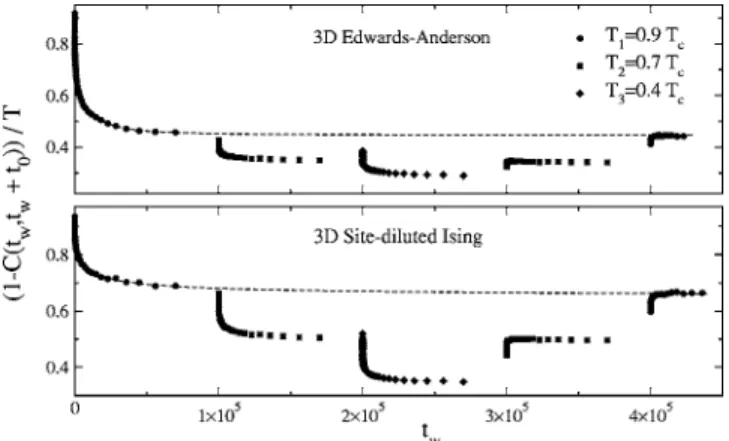
win-dow. We measure the naive susceptibility with the autocor-relation function共6兲. Just for fun, we try a three-step proto-col, T1= 0.9Tc→T2= 0.7Tc→T3= 0.4Tc→T2→T3, staying ts
= 105 MCSs at each temperature. The results are shown in Fig. 3共bottom兲together with the results for an equal protocol for the 3D EA model共Fig. 3, top兲. In both cases rejuvenation and adoublememory are observed. Also in two temperature cycles39 the susceptibility behaves as in the EA model. To this level of analysis, there is no clear difference between the Edwards-Anderson model and the site-diluted Ising model.
B. Comparison with experimental direct quench
In view of Eqs.共1兲and共2兲, and the large temperature drop that we are studying, one would expect a perfect rejuvena-tion effect. However, Figs. 1 and 2 show that the relaxarejuvena-tion after the first step at 0.9Tc considerably differs from the di-rect quench 共although this difference is smaller than for FIG. 2. 共Color online兲 Top: As Fig. 1 fort0= 4.3⫻105 and ts
= 2⫻107but correcting FDT violations. Inset: Off-equilibrium fluc-tuation dissipation relation共see text兲. Data can be nicely fitted to two straight lines. Bottom: As in top part forT2= 0.7Tc. Only the pseudoequilibrium regime is explored in this case共inset兲.
FIG. 3. Naive susceptibility in a three-temperature protocol共see text for details兲, for the binary EAD= 3 model共top兲 and theD= 3 site diluted ferromagnetic Ising model共bottom兲. The dashed line is a direct quench toT1.
shorter simulations9,24兲. This seems in plain contradiction with experiments 共see, e.g., Fig. 4 of Ref. 18兲. Yet, upon reflection, one realizes that the experimental direct quench bears little resemblance with the simulational one. In fact, the experimental sample that is “instantaneously” quenched to 0.4Tc, expends at least 10 sec共⬃1013MCSs!兲in the spin-glass phase.
In order to make a fair comparison with experiments, one should study the relaxation after a “soft” quench 共Fig. 4兲 from high temperature to the working temperature below the glass transition. Yet, the fastest quenching rate that can be achieved in experiments is far too slow to be reproduced in present-day computers. To achieve a very slow temperature drop from high temperature to working temperature, it is useful to consider Fig. 1 in a different way. One realizes that the system that has spent ts= 2⫻108 MCSs at 0.9Tc, then suffers an instantaneous temperature drop to 0.4Tc, is a better approximation to the experimental direct quench to 0.4Tc. In fact, the system spends quite a long time close to the critical temperature, where the time evolution—recall Eq. 共3兲—is faster. When looking to the double temperature cycle in Fig. 1, one needs to compare the relaxation in the first and in the second steps at 0.4Tc, the first corresponding to thereference direct quench, the second being looked at as the temperature-cycledsystem. This comparison is shown in Fig. 4, together with the relaxation after asoft quench.
The frequencies shown in Fig. 4 span three orders of mag-nitude. In all cases, the relaxation for the softly quenched
system,40 that has spent 1.2⫻104 MCSs in the spin-glass phase, is much closer to the one of the cycled system than the one of infinite quenching rate. Furthermore, the relax-ations for the first and the second steps at 0.4Tcare identical, up to our statistical accuracy共see Fig. 5兲. This you may wish to callperfect rejuvenation.
In Fig. 5 we perform a detailed comparison between the soft quench共with two quenching rates兲and the two-step pro-tocol. To have a feeling of the frequency dependence, we show the smallest and the largest frequencies in Fig. 4. For very short times, in the two-step protocols we find a quick decay of the susceptibility due to the sharp temperature drop. On the other hand, the softly quenched system shows a ba-sically constant behavior共the slower the quench, the lower the intial plateau is兲. When time becomes of the order of the total time spent in the spin-glass phase during the soft quench, the susceptibility starts to decay and becomes very similar to the two-step protocol. At t0= 8192, the two soft quenches catch the relaxation of the two-step protocol and become identical. At the smallest frequency, the fastest quench approaches but does not catch the two-step relax-ation. On the other hand, for the smallest quenching rate, the relaxation curve becomes identical to the one of the two-step protocol fortwⲏt0, which corresponds to the experimentally accessible time range.
Quite similar results are obtained for the diluted ferro-magnet, as we show in Fig. 6. Although it cannot be noticed at the scale of this plot, the relaxations in the first and second temperature step are not identical for the Ising model. They may be made to collapse if the times in the second step are rescaled by a factor of 1.2 共in a protocol 0.7Tc→0.4Tc →0.7Tc→0.4Tc, the needed rescaling factor is 2兲.
FIG. 4. 共Color online兲 Naive 共= 2/t0,tw兲 of the 3D EA model vs time, at temperatureT2= 0.4Tc, for several values oft0and thermal histories. In all cases,twis measured from the time of the 共last兲instantaneous quench toT2. Squares correspond to the instan-taneous drop from infinite temperature toT2. Circles correspond to the system that has spentts= 2⫻108MCSs atT1= 0.9Tc, then suf-fers an instantaneous quench toT2. Crosses correspond to the sys-tem that has been a timetsatT1, then timetsatT2, then timetsat
T1, and finally suffers the instantaneous quench to T2. Diamonds correspond to a gradual drop from 9Tc toT2in 20 000 MCSs共we incremented 1 /Tin 0.113/Tcevery 103steps, the system spending 1.2⫻104MCSs in the spin-glass phase兲.
FIG. 5.共Color online兲Closeup to the top and bottom panels of Fig. 4, excluding the data for the instantaneous drop from infinite temperature toT2= 0.4Tc. We also include data共triangles兲for a still slower drop from 9TctoT2in 200 000 MCSs共we incremented 1 /T
in 0.113/Tc every 104 steps, so that the system spends 1.2⫻105 MCSs in the spin-glass phase兲.
C. Coherence length
The coherence length may play a crucial role32 in this physics, and should be followed in detail during temperature changes. This was done previously in Ref. 24, for times up to 105MCSs. Results in agreement with Eq.共5兲were reported. We show here qualitatively different results for our longer simulations in three dimensions.
The coherence length may be obtained from non-self-averaging integrals of C4共r,tw兲 using a second-momentum
estimator.41,42Not having so many samples at our disposal, we have obtainedC4共r,tw兲 共whichis self-averaging for not
very larger兲. The resulting curve has been fitted to29 C4共r,tw兲= A r␣ exp
冋
−冉
r 共tw兲冊
册
. 共8兲In three dimensions, we find fair fits in the range 2⬍r⬍20, fixing␣= 0.65 and= 1.7 for all times and temperatures. The constant behavior of␣does not agree with the results for the 4D model with Gaussian couplings.26 To estimate errors in the three-parameter fit共8兲is very difficult. To have a feeling of their magnitude, let us report that␣= 0.7 yields good fits as well, with a 10% increasedestimate.
See in Fig. 7 共top兲, 共tw兲 for a direct quench to T2 = 0.4Tcand for a thermal cycleT1→T2→T1withT1= 0.9Tc and ts= 2⫻107. A power law with exponent ⬃0.144 fits
nicely T1共tw兲 for tw⬍ts, while the exponent for the direct
quench toT2is⬃0.065共full lines in Fig. 7, top兲. Note that the exponents follow Eq. 共3兲. During the T2 step, grows over theT1value, and it is larger than for the direct quench toT2. However, decreases when the system is back toT1. Memory is striking: data for the secondT1step, if translated backtsMCSs, are on top of the fit共obtained fortw⬍ts!兲. Let
us stress two points regarding this result:
共i兲 The coherence length can decreaseupon temperature
changes, violating cumulative aging, Eq.共5兲, and in contra-diction with the time and length scales separation scenario.32,43 However, the effect is not symmetrical for negative and positive temperature shifts, as it was inferred experimentally from effective-time measurements.17
共ii兲 The effective time for the temperature cycle is com-patible with zero共within our accuracy兲. This implies that, for ts⬃107,x0in Eq.共1兲isnotof order 1, as it was found27for ts⬃104.
As before 共bottom part of Fig. 7兲, the behavior of the diluted ferromagnet is completely analogous to the one of the EA model关including the power-law growth of T共t兲兴.
D. Coherence length and two-time correlations
A rather crucial feature of aging2is that two time scales,t 0 andtw, are involved. One would like to relate theone-time
quantityT共tw兲, to thetwo-time correlation function. A crude
estimate fort0Ⰷtwis C共tw,tw+t0兲⬀ D/2共t w兲 D/2共t w+t0兲 , 共9兲
i.e., the coherent cluster that at time tw+t0 has linear size
共tw+t0兲, at time tw was composed of mutually incoherent
clusters of linear size共tw兲.
Indeed共Fig. 8, top兲, the factor3/2共t
w+t0兲/3/2共tw兲absorbs
almost all thetwandt0dependency ofC共tw,tw+t0兲, both for a direct quench toT2and for theT2part of the thermal cycle. Note that even the constant value for C共tw,tw+t0兲3/2共tw
+t0兲/3/2共tw兲is equal for the direct quench and for the
ther-mal cycle. Also atT1,C共tw,tw+t0兲3/2共tw+t0兲/3/2共tw兲is
con-stant within a band of width 5% of its mean value.39 Quite similar results are obtained for the diluted ferromagnet, as we show in the bottom part of Fig. 8. In spite of the crudeness of the argument leading to Eq. 共9兲 and the uncertainty in the FIG. 6.共Color online兲As in Fig. 4, for the diluted ferromagnet
and ts= 105MCSs. Diamonds correspond to a gradual drop from 9TctoT2in 20 000 MCSs共we incremented 1 /Tin 0.117/Tcevery 103steps兲.
FIG. 7. Coherence length vs time, for the 3D EA model共top兲 and the diluted-ferromagnet共bottom兲. The thermal history has been aTcycleT1→T2→T1, beingts= 2⫻107for the EA model andt
s
= 105 for the Ising-diluted model. Crosses: second T1-step data, translated back in timets; dotted lines: fits to共tw兲=Atwx fortw⬍ts.
determination of, the results are surprisingly clear. Note that if Eq.共9兲was exactthe dynamics would be of the one-sector type,2 which we do not believe to be the case.44 Anyhow, given Eq. 共9兲, full aging4 is natural for a power-law growth of共tw兲.
Thus memory and rejuvenation are driven by the rate growth of T共tw兲 rather than by its value or by the
short-distance behavior ofC4共r,tw兲.32,26In our simulation,
rejuve-nation is due to a growth of upon cooling 共probably be-cause of a sudden fall into a nearby energy minima兲, provoking a change in the evolution ofC共tw,tw+t0兲. When temperature is shifted back toT1,T1continues its growth as if it had never being atT2 with analogous consequences for the correlation function共memory兲. This implies a nonmono-tonic behavior ofT共t兲, in contradiction with cumulative
ag-ing, Eqs.共4兲and共5兲.
E. Results fortw⬍1
Measurements of ac susceptibility are usually confined to the regiontw⬎1. On the other hand, thermal
magnetoresis-tance measurements can yield information on the time re-gimet0Ⰷtw. It is therefore worthwhile to have a look to our
correlation functions in this regime.
The main issue here is the characterization of the time decay of correlations共see Ref. 44 for a recent study兲. One finds2that, at least when the correlation function lies in some intervals关say C1⬍C共tw,tw+t0兲⬍C2兴, it behaves as a func-tion of t0/tw. It is possible that different intervals for the
correlation functions共usually called time sectors2兲 are ruled by different exponents. The existence of more than one time sector is a necessary共but not sufficient兲requirement for dy-namic ultrametricity.2 Some indications of the presence of more than one time sector in the dynamics of the EA model in three-dimensions were found in Ref. 44.
The experimental value ofis controversial. Recently,4it was claimed that it is= 1共full aging兲. Previous failures in recognizing this were ascribed to quenching-rate effects4 共re-call also Sec. III B兲. In the quickest possible quench, = 1 was clearly identified. This interpretation was recently dis-puted by the Saclay group,5that find⬍1.
Regarding computer simulations, the following scaling form for the time-correlation function was proposed,45 and found to work for a restrictedt0 andtwrange:
C共tw,tw+t0兲=t0−
x共T兲⌽
冉
t0 tw冊
. 共10兲
This equation implies that full aging should be observed in the t0Ⰷtw regime. More recent and longer simulations44
found deviations from Eq. 共10兲, at least at some tempera-tures.
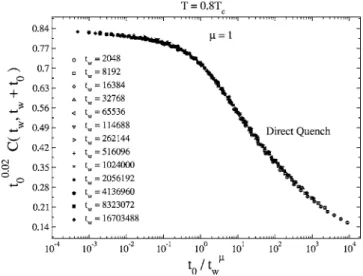
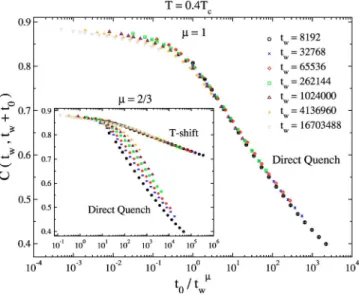
In Fig. 9 we plot our data for a direct quench from infinite temperature to 0.8Tc. Equation 共10兲works nicely with x共T兲 = 0.02, which can be interpreted as evidence for full-aging behavior. However, atT= 0.4Tc共see Fig. 10兲, we have been unable to find a working x共T兲. Actually, the relaxation is better interpreted in terms of two time sectors: for t0Ⰷtw,
= 1 seems to provide a proper scaling, while, at shortert0,
= 2 / 3 does a better job.
In the inset of 1, we compare the relaxations atT= 0.4Tc for the direct quench and for the system that stayed 2⫻108 MCSs at 0.9Tc, then suffers a temperature shift to 0.4Tc 共re-call that this is our slowest quenching rate from infinite tem-perature兲. For the slowly quenched system, the relaxation belongs to the= 2 / 3 time sector. Moreover, the relaxation after the T shift provides a limiting curve, in the large tw
limit, for the= 2 / 3 piece of the direct-quench relaxation. At least within the time range that we can study, it seems that the quenching rate does exert influence in the measured value of共as proposed in Ref. 4兲.
IV. CONCLUSIONS
In this work, we have compared memory and rejuvenation effects for theD= 3 and D= 4 binary EA model and for the FIG. 8. Top: C共tw,tw+t0兲关共t0+tw兲/共tw兲兴3/2 共points兲 and
C共tw,tw+t0兲 共lines兲 vstw, for the direct quench to T2, for the EA model in three-dimensions. Inset: As main plot for theT2step of the
Tcycle of Fig. 1. Bottom: As inset of top panel for the diluted Ising model.
FIG. 9. Correlation functionC共tw,tw+t0兲scaled byt00.02关see Eq. 共10兲兴after a direct quench toT= 0.8Tcvst0/tw.
D= 3 the site-diluted Ising model, finding quite similar re-sults. Maybe the most important question we have addresed is whether the Edwards-Anderson model has a spin-glass low-temperature phase, or not. The longer time scale reach-able with the SUE machine35 共three orders of magnitude longer than previous work兲, has allowed us to conclude that spin glass behaves like experimental spin glasses in a num-ber of ways:
共i兲 The relaxation of the ac susceptibility after a large temperature shift is as for adirect quench, provided that one does not interpret the term direct quench literally in the simulations共Sec. III B兲. We find little dependency in the pre-vious thermal history, once microscopically short times are neglected.
共ii兲 Values ofx0, defined in Eq.共1兲, are not of order 1 for waiting times⬃107MCSs共contrary to the finding of Ref. 27 for waiting times of order ⬃104 MCSs兲. This time depen-dence of x0 is consistent with the findings in the Migdal-Kadanof lattice.34
共iii兲 The coherence length may decreaseupon
tempera-ture changes, in disagreement with the cumulative aging sce-nario, and in agreement with recent experiments.17,18
共iv兲 The growth rate of the coherence length rules the decay of the time-correlation function.28 A very simple for-mula, Eq.共9兲, accounts for the behavior ofC共tw,tw+t0兲with surprising accuracy, for different temperature protocols. Con-trary to the findings of short 4D simulations,26we do not find a strong temperature dependency of the replica-field correla-tion funccorrela-tion, Eq. 共7兲, at short distances. We rather ascribe rejuvenation to the coherence length, which rules the long-distance behavior of the correlation function.
共v兲 The exponent for the t0/tw scaling of the decay of
C共tw,tw+t0兲, depends on the quenching rate. In agreement with recent experiments,4 we find that the faster the quench is, the easier it becomes to obtain= 1共see, however, Ref. 5 for experiments contradicting this expectation兲.
The above findings suggest that the 3D EA model behaves as experimental spin glasses do, contrary to what was in-ferred from previous shorter simulations.9,24,25,27 However, there are a few important differences.First, the out-of-phase and the in-phase susceptibility behave quite differently in experimental spin glasses共see, e.g., Ref. 10兲. This seems not to be the case for the EA model,9,27,39 within the accessible time window. Second, the coherence length is not found to decrease under positive temperature shifts, in contradiction with the inferred behavior from experimental measurements of effective times.17,18Third, in the dip-experiment protocol we have found39no memory and very weak rejuvenation, in agreement with Ref. 25 even if we study frequencies 15 times smaller. Fourth, recent simulations do not27,46 find stronger memory and rejuvenation effects for Heisenberg than for Ising models of spin glasses. This finding is in con-tradiction both with experiments共see, e.g., Ref. 19兲and with a recent calculation of overlap lengths in the Migdal-Kadannoff approximation.47The physical reasons underlying these differences between our best model for spin glasses and experimental spin glasses are not yet understood. It is of course possible that longer times need to be studied. How-ever, when time scales are converted to length scales, one finds that numerical coherence lengths are smaller than the experimental ones only by a small factor共see also Ref. 48兲. We have shown that the ferromagnetic site-diluted Ising model 共where chaos is absent兲follows very closely the be-havior of the EA model, at least in thetw⬎1 regime. This
is not totally unexpected, as we already know experimentally that systems quite different from spin glasses show memory and rejuvenation.12–16 The natural conclusion is that chaos, although probably present in realistic spin glasses,34,38,47 need not be invoked to explain memory and rejuvenation. However, it has been argued11that the experimental protocol introduced in Ref. 17 may help to discriminate temperature chaos from a somehow trivial restarting of the dynamics 共yet, see Ref. 49兲. More work will be needed to assess the usefulness of this interesting classification11 of aging sys-tems.
ACKNOWLEDGMENTS
We thank G. Parisi, A. Tarancón, L. A. Fernández, F. Ricci-Tersenghi, E. Marinari, and A. Maiorano for discus-sions. Numerical simulations have been carried out in the dedicated computer SUE and in the PC clustersRTN3 and RTN4, of U. de Zaragoza. S.J. and S.P.-G. acknowledge fi-nancial support from DGA共Spain兲and共S.J.兲from the ECHP program, Contract No. HPRN-CT-2002-00307, DYGLAGE-MEM. This work has been financially supported by MEC
共Spain兲 though research Contract Nos. FPA2000-0956,
FPA2001-1813, BFM2003-08532, and FIS2004-05073-C04. FIG. 10.共Color online兲Correlation functionC共tw,tw+t0兲after a
direct quench toT= 0.4Tcvst0/tw. Inset: Data of main plot vst/tw, = 2 / 3. We also plot data for a system that has been 2⫻108MCSs at 0.9Tc, then suffers a temperature shift to 0.4Tc.
1See, e.g.,Spin Glasses and Random Fields, edited by A. P. Young 共World Scientific, Singapore, 1997兲.
2J. P. Bouchaud, L. Cugliandolo, J. Kurchan, and M. Mézard, in
Spin Glasses and Random Fields 共Ref. 1兲; J. J. Ruiz-Lorenzo
Advances in Condensed Matter and Statistical Mechanics, ed-ited by E. Korutcheva and R. Cuerno共Nova Science Publishers, 2004兲.
3R. V. Chamberlin, M. Hardiman, and R. Orbach, J. Appl. Phys.
52, 1771共1983兲; L. Lundgren, P. Svedlindh, P. Nordblad, and O. Beckman, Phys. Rev. Lett. 51, 911 共1983兲; J. Appl. Phys. 57, 3371共1985兲.
4At least for 10−2⬍t/t
w⬍102; G. F. Rodriguez, G. G. Kenning,
and R. Orbach, Phys. Rev. Lett. 91, 037203共2003兲.
5V. Dupuis, F. Bert, J.-P. Bouchaud, J. Hammann, F. Ladieu, D. Parker, and E. Vincent, cond-mat/0406721.
6The ZFC magnetization is a function of t/t
w
,t being measured from the instant when the magnetic field was switched on. 7K. Jonason, E. Vincent, J. Hammann, J. P. Bouchaud, and P.
Nor-dblad, Phys. Rev. Lett. 81, 3243共1998兲.
8L. Lundgren, P. Svendlinsh, and O. Beckman, J. Magn. Magn. Mater. 31–34, 1349共1983兲; T. Jonsson, K. Jonason, P. Jönsson, and P. Nordblad, Phys. Rev. B 59, 8770共1999兲; J. Hammann, E. Vincent, V. Dupuis, M. Alba, M. Ocio, and J.-P. Bouchaud, J. Phys. Soc. Jpn. 69, 206 Suppl. A,共2000兲.
9H. Takayama and K. Hukushima, J. Phys. Soc. Jpn. 71, 3003 共2002兲.
10S. Miyashita and E. Vincent, Eur. Phys. J. B 22, 203共2001兲. 11P. E. Jönsson, H. Yoshino, H. Mamiya, and H. Takayama, Phys.
Rev. B 71, 104404共2005兲.
12H. Yardimci and R. L. Leheny, Europhys. Lett. 62, 203共2003兲. 13L. Bellon, S. Ciliberto, and C. Laroche, Eur. Phys. J. B 25, 223
共2002兲.
14K. Fukao and A. Sakamoto, cond-mat/0410602.
15P. Levy, F. Parisi, L. Granja, E. Indelicato, and G. Polla, Phys. Rev. Lett. 89, 137001共2002兲.
16E. Vincent, V. Dupuis, M. Alba, J. Hammann, and J.-P. Bouchaud, Europhys. Lett. 50, 674共2000兲.
17P. E. Jönsson, H. Yoshino, and P. Nordblad, Phys. Rev. Lett. 89, 97201共2002兲.
18P. E. Jönsson, R. Mathieu, P. Nordblad, H. Yoshino, H. A. Katori, and A. Ito, Phys. Rev. B 70, 174402共2004兲.
19F. Bert, V. Dupuis, E. Vincent, J. Hammann, and J.-P. Bouchaud, Phys. Rev. Lett. 92, 167203共2004兲.
20That is, one ages the system atT
2for timetT2
eff,shift
, then switches on the magnetic field and records the growing magnetization. 21We somehow simplify the protocol description; for details see
Ref. 19.
22The actual value ofx
0depends both onT1and on the anisotropy of the microscopic spin-spin interaction关the more Heisenberg-like the interaction is, the smallerx0becomes共Ref. 19兲兴. 23J.-P. Bouchaud and D. S. Dean, J. Phys. I 5, 265 共1995兲; M.
Sales, J.-P. Bouchaud, and F. Ritort, J. Phys. A 36, 665共2003兲; M. Sasaki, V. Dupuis, J.-P. Bouchaud, and E. Vincent, Eur. Phys.
J. B 29, 469共2002兲.
24T. Komori, H. Yoshino, and H. Takayama, J. Phys. Soc. Jpn. 69, 228共2000兲.
25M. Picco, F. Ricci-Tersenghi, and F. Ritort, Phys. Rev. B 63, 174412共2001兲.
26L. Berthier and J.-P. Bouchaud, Phys. Rev. B 66, 054404共2002兲. 27A. Maiorano, E. Marinari, and F. Ricci-Tersenghi, cond-mat/
0409577.
28See L. W. Bernardi, H. Yoshino, K. Hukushima, H. Takayama, A. Tobo, and A. Ito, Phys. Rev. Lett. 86, 720 共2001兲, and refer-ences therein.
29E. Marinari, G. Parisi, F. Ricci-Tersenghi, and J. J. Ruiz-Lorenzo, J. Phys. A 33, 2373共2000兲.
30T. Komori, H. Yoshino, and H. Takayama, J. Phys. Soc. Jpn. 68, 3387共1999兲.
31A. J. Bray and M. A. Moore, Phys. Rev. Lett. 58, 57共1987兲. 32J. P. Bouchaud,Soft and Fragile Matter, edited by M. E. Cates
and M. R. Evans共Institute of Physics Publishing, University of Reading, Berkshire, 2000兲.
33F. Ricci-Tersenghi共private communication兲.
34M. Sasaki and O. C. Martin, Phys. Rev. Lett. 91, 097201共2003兲. 35A. Cruz, J. Pech, A. Tarancón, P. Téllez, C. L. Ullod, and C.
Ungil, Comput. Phys. Commun. 133, 165共2001兲.
36L. F. Cugliandolo and J. Kurchan, Phys. Rev. Lett. 71, 173 共1993兲; S. Franz and H. Rieger, J. Stat. Phys. 79, 749共1995兲; E. Marinari, G. Parisi, F. Ricci-Tersenghi, and J. J. Ruiz-Lorenzo, J. Phys. A 31, 2611共1998兲; D. Hérisson and M. Ocio, Phys. Rev. Lett. 88, 257202共2002兲.
37H. G. Ballesteros, L. A. Fernández, V. Martín-Mayor, A. Munoz Sudupe, G. Parisi, and J. J. Ruiz-Lorenzo, Phys. Rev. B 58, 2740共1998兲.
38T. Rizzo and A. Crisanti, Phys. Rev. Lett. 90, 137201共2003兲. 39S. Jiménez, Ph.D. thesis, University of Zaragoza, Zaragoza,
Spain, 2005.
40Soft quench in this context actually means not infinite quenching rate, but dramatically faster than in experiments.
41F. Cooper, B. Freedman, and D. Preston, Nucl. Phys. B 210, 210 共1989兲.
42H. G. Ballesteros, A. Cruz, L. A. Fernández, V. Martín-Mayor, J. Pech, J. J. Ruiz-Lorenzo, A. Tarancón, P. Téllez, C. L. Ullod, and C. Ungil, Phys. Rev. B 62, 14237共2000兲.
43Parametrizations ofC
4共r,t兲 different from Eq.共8兲can be found, wheredoes not decrease; J. P. Bouchaud and L. Berthier共 pri-vate communication兲.
44S. Jiménez, V. Martín-Mayor, G. Parisi, and A. Tarancón, J. Phys. A 36, 10755共2003兲.
45H. Rieger, J. Phys. A 26, L615共1993兲; J. Kisker, L. Santen, M. Schreckenberg, and H. Rieger, Phys. Rev. B 53, 6418共1996兲. 46L. Berthier and A. P. Young, Phys. Rev. B 71, 214429共2005兲. 47F. Krzakala, Europhys. Lett. 66, 847共2004兲.
48K. Hukushima and Y. Iba, cond-mat/0207123.
49L. Berthier and J.-P. Bouchaud, Phys. Rev. Lett. 90, 059701 共2003兲.