Accountants' Ethical Sensitivity
Anis Triki
Master of Science in Management (Accounting)
Submitted in partial fulfillment of the requirements for the degree of
Master of Science in Management
Faculty of Business, Brock University St. Catharines, Ontario
"The man of character, sensitive to the meaning of
what he is doing, will know how to discover the ethical
paths in the maze of possible behavior."
Earl Warren (American Republican Politician and Judge, 1891-1974)Dedication
I dedicate this thesis to the people I love the most: my
parents. I enormously thank them for being always
available and their continuous support.
God keep them safe.
Abstract
O'Fallon and Butterfield (2005) in a review of the business ethics literature concluded that "ethical awareness" also called ethical sensitivity has received the least attention of the four steps in Rest's (1986) ethical decision making model. Available measures for ethical sensitivity are limited to specific contexts and suffer from several limitations. I extend the previous literature by creating a new measure for ethical sensitivity (AESS) that encompasses relevant dimensions for the accounting profession and is not specific to a particular setting. I also introduce a new individual differences variable to the accounting ethics literature. Specifically, I investigate the relationship between anti-intellectualism and ethical awareness. My findings support AESS as a measure of ethical sensitivity.
KEY WORDS: Ethical Decision Making, Ethical Sensitivity, Anti-intellectualism. ABBREVIATIONS: AESS: Accountants' Ethical Sensitivity.
NOTE: For my purposes the terms sensitivity and awareness are used interchangeably throughout this paper.
Preface
Ethical behavior is a must in the accounting
profession. Unfortunately, even though we work to
eliminate it all the time, we still see unethical behavior
in the profession. I am trying to support the profession
and help the accountants to move forward in this
effort.
Acknowledgment
I want to thank Professors Darlene Bay and Gail Cook for their tremendous support. They believed in me and never gave up on me. lowe my success as an academic to them and I will be forever thankful for their support.
I want to thank Professor Mark Julien for his valuable feedback.
I also want to thank Ms. Marisa Battista, and Ms. Betty McDowell, for their incessant support and kindness.
Table of Content
Section Page
I. INTRODUCTION ... 1
II. LITERATURE REVIEW ... 7
A. Ethical Decision Making Literature .... , ... 7
B. Ethical Sensitivity Literature ... , ... 15
a. Definitions ... 15
b. Research on ethical sensitivity ... 16
c. Operationalization of ethical sensitivity and critic ... 18
d. Independent variables and findings ... : ... 24
C. Empirical Studies of Moral Intensity ... 31
D. Multi-Dimensional Ethical Scale (MES) Literature ... 33
E. Anti-Intellectualism (AI) Literature ... 38
F. Machiavellianism Literature ... .42
G. Relativism and Idealism Literature ... .46
III. SCALE DEVELOPMENT ... 48
A. Accountants' Ethical Sensitivity Scale (AESS) development ... .50
a. Instrument Development. ... 50
b. Pretest ... 52
B. Hypotheses related to content validity ... .53
C. Supplemental analysis ... 55
IV. METHODOLOGy ... 56
A. Subjects ... 56
B. Sample ... 57
C. Control for Social Desirability ... .57
V. RESULTS ... 60
A. Internal Validity ... , ... 60
B. Construct validity ... , ... 60
C. Content Validity ... '" ... 63
D. Social Desirability Analysis ... 65
E. Further Analysis ... 66
F. Post Hoc Analysis ... 67
VI. DISCUSSIONS ... 68
VII. LIMITATIONS ... 71
VIII. FOR FURTHER RESARCH ... 72
Table of Content (Cont.)
x.
APEENDIX ... 85 A. Appendix 1: AESS ... 85List of Tables
Table: Page
1. List of Papers Relating to Ethical Sensitivity ... 18
2. Update for Papers Relating to Ethical Sensitivity ... 18
3. Jones' Moral intensity characteristics ... 32
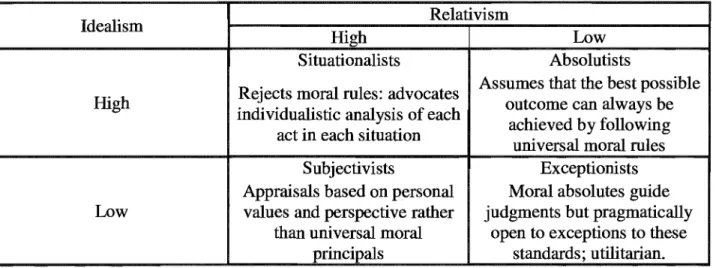
4. Taxonomy of Ethical Ideologies; ... .47
5. Studies and limitations ... 49
6. Descriptive Statistics ... 57
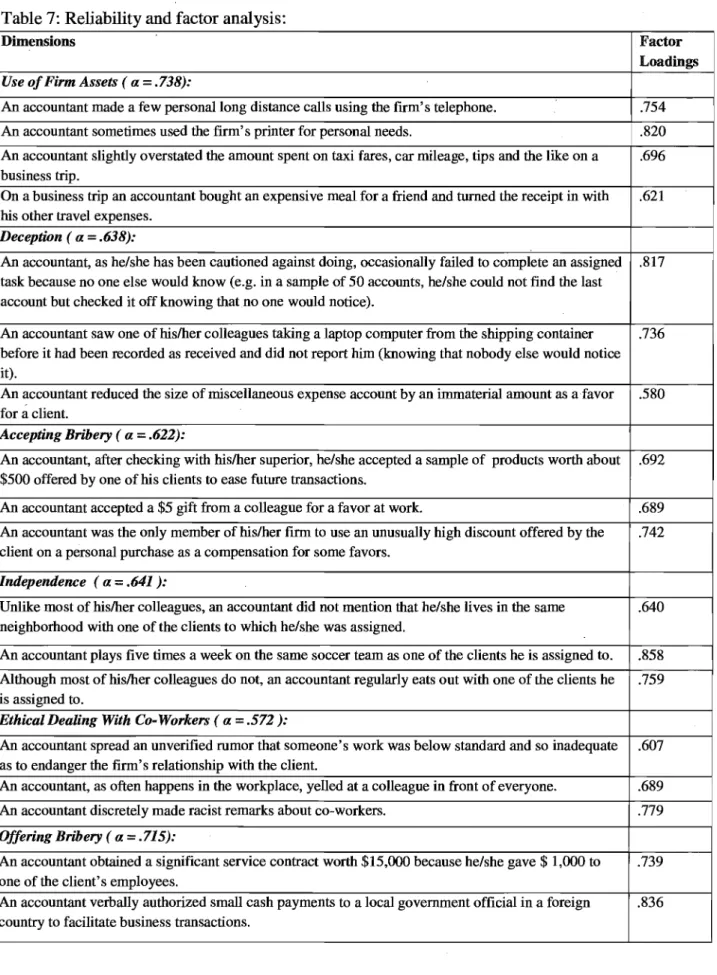
7. Reliability and factor analysis ... 62
8. Internal Reliabilities ... 64
9. Regression Analysis ... 64
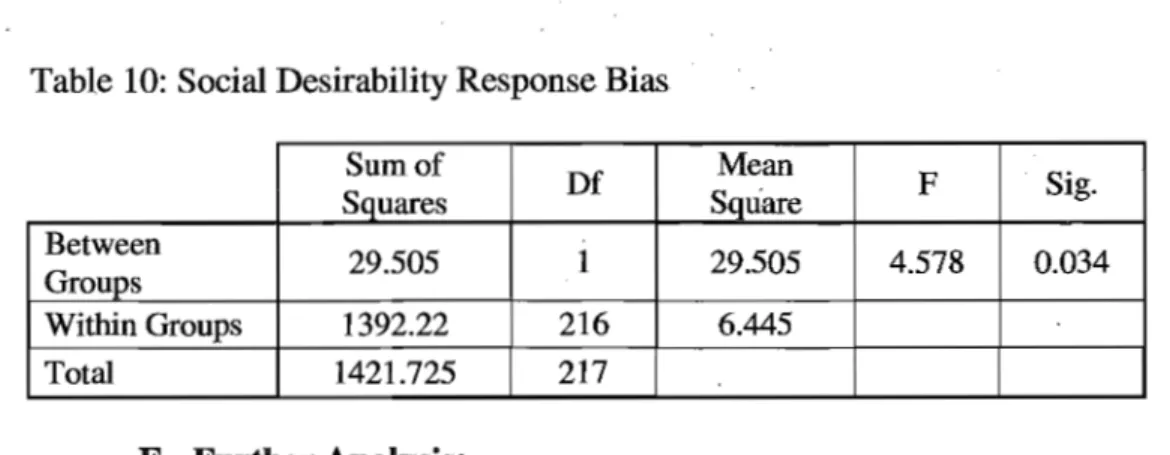
10. Social Desirability Response Bias ... , ... 66
11. Individual Regressions ... 66
12. Paired t-test for unethical items with high and low moral intensity ... 67
13. Paired t-test for ethical items with high and low moral intensity ... 67
Figure
Page
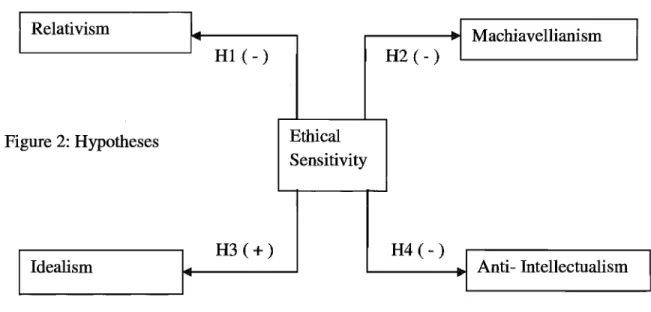
1. Rest'sModel. ... 12 2. Hypotheses ... 53I. INTRODUCTION:
Ethical decision making plays an important role in the accounting profession. Recent corporate scandals such as the Enron (2001) and WorldCom (2003) collapses brought the importance of ethical behavior in the business environment to a new level of awareness and increased the number of research studies in ethical decision making (O'Fallon and Butterfield's, 2005; O'Leary and Pangemanan, 2007). Many studies in ethical decision making rely on Rest's (1986) model, which divides the ethical decision process into four independent components: ethical awareness, ethical judgment, ethical intention and ethical behavior. By independent, Rest (1986) meant that the success of one step will not necessarily lead to the success of the following step. Ethical awareness (for my purposes, ethical awareness and sensitivity will be used
interchangeably) represents the first step of the ethical decision making process and is critical to the outcome. Hall (1992, p.37) states that "we need to sensitize people to moral issues and ambiguities. We should be more concerned, perhaps, about the person who passes by a moral dilemma without recognizing it than we are about the person who consciously and callously commits a wrong. In the long run, moral insensitivity could be our biggest problem". Individuals, before engaging in the ethical decision process, need to recognize the presence of an ethical issue. If they do not, they may engage in an unethical activity without knowing it. Thus any efforts to improve the level of ethical behavior in the accounting profession must be predicated on a high level of ethical sensitivity among accountants.
The most recent literature review on ethical decision making (O'Fallon and Butterfield's, 2005) exposed the scarcity of research in ethical sensitivity. More specifically, their analysis concluded that there were only 28 ethical sensitivity findings compared to 185 for ethical
of 174 (10.34 %) were about ethical sensitivity with only six of those from the accounting discipline. Interestingly, only one paper included a Canadian sample (Cohen et aI., 2001). I updated their sample and created a new list that included research in ethical sensitivity up to 2010. In the update to the review of the literature, there were only 26 journal articles on ethical sensitivity, from which three were in the accounting discipline. To summarize, I found only nine articles about accountant's ethical sensitivity and only two of them used a Canadian sample (Cohen et al., 1996 and Cohen et al., 2001). Interestingly, none of those studies included CMAs or CGAs in their sample. Based on my findings, research on Canadian accountants' ethical sensitivity is very limited and needs to be expanded to better understand the ethical conduct of Canadian accountants. Previous research showed significant differences between Canadian and U.S accountants' moral reasoning (e.g., Etherington and Schulting, 1995). I also recognize that some research failed to support the moral reasoning difference between Canadian and U.S accountants (e.g., Thome et al., 2003). The disagreement in findings in the moral reasoning literature supports the need to better understand the ethical characteristic of the accounting popUlation in both countries. Further, it should not be taken on faith that findings in the U.S. context will necessarily be generalizable to other cultures and other countries.
Research in ethical sensitivity is a very challenging task due to the situational nature of ethical behavior. Individuals may behave differently in different settings. Thus, the literature includes various methodologies to measure ethical sensitivity such as: vignettes or scenarios (Karcher, 1996; Cohen et aI., 1996; Yetmar and Eastman, 2000; Cohen et aI., 2001; Fleischman and Valentine, 2003; Valentine and Fleischman, 2003; Chan and Leung, 2006; Shawver and Senetti, 2009; Sparks and Hunt, 1998; Mugan et al., 2005), questionnaires (Ameen et al. 1996: Lau, 2010), and interviews (Lepper, 2005). However, ,previous operationalizations of ethical
sensitivity suffer from several limitations: the absence of a control for social desirability bias, the lack of attention to moral intensity elements, the homogeneous structure of the instruments, the scarcity of dimensions and vignettes and a lack of generalizability. Most of the previous findings on ethical sensitivity are strictly context specific and are not generalizable to other settings. Unfortunately, this approach may not give us a good understanding of accountants' ethical sensitivity capable of helping the profession move forward in addressing the ethics problem.
Ethical sensitivity, the first step of Rest's (1986) model, requires the recognition of an
ethical issue. The literature on ethical sensitivity includes several definitions for example,
Butterfield et al.'s (2000, p.982) definition "a person's recognition that his/her potential decision or action could affect the interests, welfare, or expectations of the self or others in a fashion that may conflict with one or more ethical standards", or Shaub's (1993) definition "ability to recognize the ethical nature of a decision" (p.147). Shaub's (1993) definition is in agreement with all of the available definition for ethical sensitivity. Therefore, for my purposes, I use Shaub's (1993) definition to conceptualize ethical sensitivity.
The purpose of this study is to create a new measure of accountant's ethical sensitivity called: Accountant's Ethical Sensitivity Scale (AESS).The AESS measure targets better generalizability, fewer limitations and a finer proxy for accountant's ethical sensitivity.
To accomplish this goal, I reviewed the literature on ethical sensitivity including non-accounting studies and identified the noted limitations. Based on these limitations, I identified a set of criteria that should be considered when constructing a measure for accountant's ethical
sensitivity. These include: controlling for social desirability; including moral intensity; and using a balanced setting with a variety of dimensions and multiple vignettes.
Previous literature on ethics indicates the necessity of controlling for social desirability bias (Fernandes and Randall, 1992). Furthermore, accountants have certain characteristics, such as Machiavellianism, that reinforce the necessity of controlling for social desirability specifically for this population. More precisely, accountants are characterized by a low level of
Machiavellianism compared to other professionals from other disciplines (Wakefield, 2008). Additionally, Machiavellianism is negatively correlated with social desirability (Jones and Kavanagh, 1996). Therefore, accountants are more likely to suffer from social desirability bias than individuals from other disciplines. Interestingly, out of the nine identified articles on
accountant's ethical sensitivity only five controlled for social desirability bias. However, most of these studies employed the "Halo Effect" measure for social desirability instead of using a separate instrument. The "Halo Effect" is measured by calculating the difference between what the individual reports he would do and what he believes his peers would do. However, there is evidence indicating that this methodology (the "Halo Effect measure") is not a reliable measure of social desirability bias. These findings raise questions about previous results regarding accountant's ethical sensitivity. Therefore, I included a control for social desirability bias.
Jones (1991) argues that moral intensity has an impact on individuals' ability to
recognize an ethical issue: "moral issues of high intensity will be more salient than those of low intensity" (p. 380). Therefore, moral intensity needs to be considered when establishing an ethical sensitivity measure. Interestingly, out of the nine accountants; ethical sensitivity studies, only two included moral intensity in their instrument. However, none of the studies included the moral intensity dimensions identified by Jones (1991). The literature shows that some moral intensity components are more predictive than others. The studies that controlled for moral
intensity did not pick a certain intensity component; rather, they varied the level of severity of their scenarios.
Jones (1991) proposed 6 moral intensity dimensions: magnitude of consequences, social consensus, probability of effect, temporal immediacy, proximity and concentration of effect. Including all of these dimensions will lengthen any instrument (each item would have 12 versions). Moreover, research on moral intensity (Frey, 2000; McMahon and Harvey, 2006) shows that a subset of these components may be enough to represent moral intensity. A consensus has been reached in the literature that magnitude of consequences and social consensus are important components of moral intensity (Waldron, 2009; O'Fallen and Butterfield, 2005; McMahon and Harvey 2006). Therefore, I include both: magnitude of consequences and the social consensus in my instrument to reinforce its reliability.
In order to measure ethical sensitivity, respondents need to distinguish between ethical and unethical issues. Interestingly, most of the research on ethical sensitivity (lout of 9) did not include an ethical statement in their instrument. The prevalence of unethical issues in the
scenarios jeopardizes the balance of the instrument. Individuals were asked to identify to what extent they perceived the issue as unethical knowing that it was unethical. In this case
respondents did not have to identify the issue as ethical or unethical. This approach does not fit the theoretical framework of the ethical sensitivity literature. For this reason, I created a balanced setting, in which I included ethical and unethical issues. The presence of ethical issues in the scenarios strengthens the balance of the AESS.
Previous instruments used to measure ethical sensitivity suffer from a limited number of dimensions. Unless the vignettes load on different dimensions, their usage limits the findings on accountants' ethical sensitivity to the context presented to the respondents. Only one instrument
in the ethical sensitivity literature has different dimensions and thus the potential ability to generalize its finding to a larger sample. The Multidimensional Ethical Scale (MES) explains why accountants perceive an issue as ethical or not and explains a proportion of their intention to commit an ethical act. However, it is important to mention that the MES does not fully explain the full complexity of the ethical decision dynamic but only explains a proportion of it.
Moreover, the MES literature contains many inconsistencies, which jeopardize claims about its reliability. Jones and Ponemon (1993 pAll), criticizing the Flory et al. (1992) study, argue that "the multidimensional scale fails to provide a useful psychometric construct for measuring the ethical thinking process for professional accountants". A consistent set of dimensions will mitigate this problem. Items in my instrument are associated with seven dimensions. These dimensions will contribute to a higher generalizability than previous attempts in the ethical sensitivity literature.
To summarize, the AESS mitigates several problems encountered with other instruments by controlling for social desirability, including a moral intensity treatment, creating a balance between ethical and unethical items, using a variety of dimensions and using multiple vignettes. The AESS targets Canadian accountants and for this reason, before finalizing the instrument, six accountants from three different accounting organizations, CAs, CMAs and CGAs, provided valuable feedback on relevance and wording. Changes were made based on their comments. Furthermore, I pre-tested the instruments' internal validity by administering it to fourth year accounting co-op students. These students have had accounting work experience. Again, minor changes were made to the instrument based on the feedback from this group.
Results from the analysis showed that the AESS has a good internal, content and construct validity. The data support the hypothesized relationships between Relativism,
Machiavellianism and Anti-Intellectualism, and ethical sensitivity. These relationships show that the instrument is actually measuring ethical sensitivity and that overall, results from this study provide support for the use of the AESS as a measure of accountants' ethical sensitivity.
The remainder of my paper is organized as the following. In the second section, I provide a literature review for ethical decision making and ethical sensitivity. I also review empirical studies of moral intensity and Multi- Dimensional Ethical Scale (MES). Then, I review research· results relating to the criterion variables used to establish content validity: Anti-Intellectualism (AI), Machiavellianism, Relativism and Idealism. In the third section, I present my model and develop my hypotheses. The fourth section explains the methodology used to develop and test the AESS. Section 5 reports the results from my tests. In section 6, I discuss my findings. Section 7 and 8 provide the limitation and future research respectively.
II. LITERA TURE REVIEW:
A. Ethical Decision Making Literature:
Ethical decision making plays an important role in the accounting profession. Recent corporate scandals such as the Enron (2001) and WorldCom (2003) collapses brought the importance of ethical behavior in the business environment to a new level of awareness and increased the number of research studies in ethical decision making (O'Leary and Pangemanan, 2007; O'Fallon and Butterfield's, 2005). The literature provides us with various definitions for ethical decision making. For example: Jones (1991 p. 367) defines an ethical decision as a "decision that is both legal and morally acceptable to the larger community' , , whereas an "unethical decision is either illegal or morally unacceptable to the larger community". The Australian Association of Social Workers (AASW) Code of Ethics (AASW, 1999,Section 5.1) defines ethical decision making as a "process of critical reflection, evaluation and judgment
al. (2001, p. 321) define ethical decision making as "decision making in situations where ethical conflicts are present".
The development of models of ethical decision making, like the development of agreed upon definitions, has been important to the development of research in business ethics. Ferrell and Gresham (1985), Trevino (1986), Rest (1986), Bommer et al. (1987) and Jones (1991) have all provided theoretical models that represent the foundation of research in ethical decision making. These conceptual models did not include empirical tests. Based on these models, empirical work took various forms to investigate the impact of various variables on ethical decision making. Below, I review several ethical decision making models. Only Rest's (1986) model contains specific reference to ethical sensitivity. However, the other models are important to understanding of the breadth of the research that has been conducted to date into ethical decision making.
Some research took place before the appearance of these theoretical frameworks (Carrol, 1975; Bowman, 1976; Brenner and Molander, 1977; Hegarly and Sims, 1978; Ward and Wilson, 1980; Dubinsky and Ingram, 1984). Most of this research looked at the impact of elements of the organizational environment such as pressure, reinforcement mechanisms (reward, punishment and availability of a code of conduct) and competitiveness (Carrol, 1975; Bowman, 1976, Brenner and Molander, 1977). Findings from these studies were mixed and very little attention was given to other factors such as cultural variables, personality characteristics and the intensity of the ethical issues. The lack of theoretical frameworks and guidance may explain why research in ethical decision making in the mid-seventies and early eighties could not precisely identify variables that may have an impact on ethical decision making (Bommer, 1987).
Ferrell and Gresham (1985), using a contingency framework, proposed determinants for ethical and unethical decision making. They identified 4 constructs: individual factors,
significant others, organizational factors, and opportunity. The individual factors (knowledge, values, attitudes and intentions) were based on philosophical perspectives: utilitarianism,
teleological and deontological philosophy, rights principles and justice principles. The influence of significant others was posited based on two theories: differential association theory
(Sutherland and Cressey, 1970) and role-set theory (Merton, 1957). Under the differential association theory individuals learn from others' behavior (Sutherland and Cressey, 1970). This plays an important role in the ethical decision process since it permits the identification of referents (individual that have an influence over others' behavior) (Ferrell and Gresham, 1985). The role-set theory complements the differential association theory by explaining the interaction between the focal and the referent individual. This theory focuses on the distance between these two types of individuals. Ferrell and Gresham (1985) expected that the greater the distance between the referent and the focal decision maker the less impact the referent can have on ethical/unethical decision making. This theory supports the investigation of whether individuals' ethical/unethical decision making in an organization is influenced by peer groups or upper management (referent other). Ferrell and Gresham (1985) also proposed that opportunity can be one of the determinants of ethical/unethical decision making. By opportunity we mean
punishment and reward (internal and external). The organizational factors include daily tasks such as meeting the business goals. Individuals within a firm seek recognition and good
performance evaluation. Ethical conduct within an organization may not always play in favor of reaching these goals. Reaching these goals and obtaining a good performance evaluation creates pressure that may push an individual to engage in an unethical behavior. Ferrell and Gresham
(1985) propOsed various propositions of how individuals may be influenced throughout their decision-making process.
Trevino (1986), based on Kohlberg's (1969) work, proposed a theoretical model that considers the interaction of individual and situational factors in the ethical decision making process. Kohlberg (1969) argued that individuals determine what is right and what is wrong based on their level of cognitive moral development (CMD). However, the cognitive
development by itself is not enough to explain or predict ethical/unethical behavior since someone's behavior could also be affected by individual and situational factors. Individual factors are "attributes that are unique to the decision-maker and covers two main features namely, demographic and psychological" (O'Leary and Pangemanan, 2007, p. 217). Trevino (1986) presented three individual factors: ego strength, field dependence and locus of control and, three situational factors: immediate job context (reinforcement and other pressure), organizational culture (normative structure, referent others, obedience to authority and
responsibility for consequences) and characteristics of the work (role taking and resolution of moral conflict). The model proposed by Trevino (1986) proposes that the interaction between these individual factors and the situational factors will have an impact on the connection between cognition and ethical actions.
Bommer et al.'s (1987) conceptual model reduces the complexity of the determinants of ethical/unethical decision making and represents the fIrst trial in the literature to map
determinants of ethical and unethical decision making. The model includes six components: work environment, professional environment, personal environment, governmentllegal environment, social environment, and individual attributes (moral level, personal goals, motivation mechanism, position/status, self-concept, life experiences, personality and
demographics). They argue that information acquisition, information processing, cognitive process, perceived rewards and perceived losses all mediate the relationship between
ethical/unethical behavior and these six components. They also point out that these factors do not uniquely determine ethical decision making, rather the combination between these factors
merely influences the decision maker's preference for ethical behavior over unethical or vice versa.
In the same paper, Bommer et al. (1987) presented another model for the decision making process which breaks it down into multiple steps. The manager first perceives a problem
associated with environmental factors (this step is quite close to ethical sensitivity). Then, he filters (selective perception process) the associated information. Finally, based on his individual attributes and cognitive process, he constructs the conceptual model of the decision space. Hogarth (1980) showed that people's capacity to receive information is limited. Bommer et al. (1987), building on Hogarth's (1980) work, concluded that decisions made by individuals could also reflect their limitation in information processing.
Rest's (1986) model has been most widely used in the accounting ethics literature. His model breaks down the ethical decision making process into four separate steps: (1) recognizing the moral issue, (2) making a moral judgment, (3) establishing moral intent, and (4) acting on the moral concerns. In the first step, the individual recognizes the existence of an ethical issue. Some individuals may not be able to recognize the presence of an ethical dilemma and therefore will not engage in an ethical decision making process. In the second step, the individual analyzes the ethical issue using his cognitive abilities. Individuals have different levels of cognitive moral development and therefore different ways to make a moral judgment (Kohlberg, 1976). Once an individual has made his moral judgment, he determines his intentions (Step 3). In this phase
individuals analyze the interaction of different factors at stake. For example, once an individual judged that a proposed action was unethical he may have the intention to behave unethically and may not. His intention will depend on other factors such as pressure or the opinions of significant others. Once an individual has determined his intentions, the last step is to implement his
intentions (act as planned). Rest (1986) argues that these steps are independent and the success of one does not depend on the success of the other. For example, an individual's intentions do not depend solely on his moral judgment.
Figure 1: Rest's Model
Ethical Ethical --'" Intentions Behavior
~
Perception Judgments
Jones (1991), from Rest's (1986) ethical decision making model, developed a new theoretical model to better understand the ethical decision making process. His model represents the first attempt in the literature to incorporate moral intensity issues into the ethical decision process. Jones' (1991) model focuses on the interaction between moral intensity and
Rests'(1986) four steps in ethical decision making (recognize moral issue, make moral judgment, establish moral intent and engage in moral behavior). A moral issue is present in a situation where "the action or decision must have consequences for others and must involve choice, or volition" (Jones, 1991 p. 367). Jones (1991) argued that individuals respond to the intensity of the moral issue and not just to the issue itself. Jones (1991, p.381) argues that "High-intensity moral issues are salient and vivid, they will be more likely to catch the attention of the moral decision maker ... " He proposed six characteristics: Magnitude of Consequences (Me): "the sum of the harms (or benefits) done to victims (or beneficiaries) of the moral act in question" (p. 374), Social Consensus (SC):" the degree of social agreement that a proposed act is evil (or good)" (p.
375), Probability of Effect (PE):" a joint function of the probability that the act in question will actually take place and the act in question will actually cause the harm (benefit) predicted" (p. 375), Temporal bnmediacy (TI): "the length of time between the present and the onset of consequences of the moral act in question (Shorter length of time implies greater immediacy)" (p. 376), Proximity (PX): "the feeling of nearness (social, cultural, psychological, or physical) that the moral agent has for victims (Beneficiaries) of the evil (beneficial) act in question" (376), and Concentration of Effect (CE): "an inverse function of the number of people affected by an act of given magnitude" (p.377).
Each component of moral intensity is expected to incrementally impact the intensity of the moral issue. Every moral issue encompasses all of these characteristics that interact which each other. For this reason we should only consider the incremental effect of each of these characteristics. These characteristics do not include the decision maker's personal traits or the effect of the environment around him. Moral intensity characteristics are strictly related to the particular moral issue. Jones (1991) argued that these characteristics will have an impact on individuals when recognizing the moral issue, making moral judgments, establishing moral intent and engaging in moral behavior. Organizational factors, on the other hand, will only intervene when establishing moral intent and engaging in moral behavior. Thus, Jones' moral intensity variables can be expected to impact ethical sensitivity, while his organization variables would not.
The models by Ferrell and Gresham (1985), Trevino (1986), Rest (1986), Bommer et al. (1987) and Jones (1991) were not empirically tested when they were proposed; A significant number of research studies in ethical decision making applied some aspects of their theoretical propositions and have provided empirical tests for those relationships.
Ford and Richardson (1994) provided a review of the empirical work done on the
determinants of ethical decision making. They broke down these determinants into two different categories: individual and situational factors. Individual factors consist of personal attributes (age, sex, religion and nationality), education/employment background (type of education, years of education, employment and years of employment) and personality traits (Machiavellianism, locus of control and other variables). Situational factors consist of referent groups (peer group influence, top management influence and sanction and rewards), code of conduct, type of ethical decision, organizational factors (organization effects (organizational climate), organization size, and organization level) and industry factors (industry type and business competiveness). Ford and Richardson (1994) concluded that empirical research in business ethics has not yet been able to establish a strong basis due to the limited research in some areas and mixed conclusions in others. Research results on personal attributes and education/employment background are mixed: some studies find that personal attributes and education/employment background have an impact on ethical decision making and other studies find that personal attributes and
education/employment background do not have an impact on ethical decision making. Results from research on personality traits are likewise not clearly established. However,
Machiavellianism has been verified as a personality variable strongly related to ethical decision making.
A more recent review of the literature (see list of journals below) was completed by 0' Fallon and Butterfield (2005). Their review of the literature included research in ethical decision making published in top business journals from 1996 to 2003. They grouped the ethical decision making studies into four categories following Rest's (1986) model. Based on their findings, ethical sensitivity has received the least attention in the literature followed by ethical intention.
0' Fallon and Butterfield (2005) constructed a table including the number of findings reported for different independent variables. Interestingly, a significant number of independent variables were only tested with the last three steps of Rest's model: ethical sensitivity was excluded. For example, locus of control and Machiavellianism were used in studies for judgment and intent but not for ethical sensitivity.
B. Ethical Sensitivity Literature: a. Definitions:
Ethical sensitivity, the first step of Rest's (1986) model, requires the recognition of an ethical issue. Individuals may engage in unethical behavior if they fail to recognize the presence of an ethical issue. For example, Gioia, a Ford Motor Company Recall Coordinator, was not able to recognize ethical issues when making the decision not to recall the Ford Pinto because his cognitive motivation relied upon scripts that did not include ethical dimensions (Gioia, 1992). He stated that he "unconsciously overlook[ed] key features of the Pinto case ... Although the
outcomes of the case carry retrospectively obvious ethical overtones, the schemas driving my perceptions and actions precluded consideration of the issues in ethical terms because the scripts did not include ethical dimensions" (Gioia 1992, p.385). Moreover, Hall (1992, p.37) stated that "we need to sensitize people to moral issues and ambiguities. We should be more concerned, perhaps, about the person who passes by a moral dilemma without recognizing it than we are about the person who consciously and callously commits a wrong. In the long run, moral insensitivity could be our biggest problem".
The literature on ethical sensitivity has employed several definitions for ethical
sensitivity. For example, Butterfield et al. (2000, p.982) define it as "a person's recognition that hislher potential decision or action could affect the interests, welfare, or expectations of the self
or others in a fashion that may conflict with one or more ethical standards". Shaub (1993, p.147) defines ethical sensitivity as the "ability to recognize the ethical nature of a decision". Shaub states that (1993, p.157) for him, the "recognition of the ethical issues in the scenario,
regardless of the importance attached to these issues, served as the absolute measure of ethical sensitivity". Bebeau et al.'s (1985, p.226) definition "involves an awareness that something one might do or is doing can affect the welfare of someone else (or may affect others' welfare indirectly by violating a general practice of commonly held social standard)", or Sparks and Hunt's (1998) conceptualization of Volker's (1984) theory, where they conceptualize ethical sensitivity as the "the ability to recognize that a decision-making situation has ethical content and the ascription of importance to the ethical issues composing that content" (p.95). All of these definitions have much in common with definition of the first step of Rest's (1986) model which consists of the decision maker's ability to recognize an ethical issue. For that reason, and because Rest's model is important to this research as well as many accounting ethics studies, that is the definition that is employed in this paper. Ethical sensitivity and ethical awareness are two interchangeable terminologies in the literature and for this reason they both appear in this paper.
b. Research on ethical sensitivity:
O'Fallon and Butterfield's (2005) review of the literature shows that, even though ethical sensitivity is an important step in Rest's (1986) model; it is the least explored dimension. Their work represents a continuation of previous literature reviews by Loe et al. (2000) and Ford and Richardson (1994). O'Fallon and Butterfield (2005) searched for the term "ethical decision-making" in ABIlInform and PsycINFO. They included articles published between 1996-2003 in the following journals: Academy of Management Journal, Administrative Science Quarterly,
Business Ethics Quarterly, Human Relations, Journal of Academy of Marketing Science, Journal of Business Ethics, Journal of Business Research, Journal of Marketing, Journal of Personal Selling & Sales Management, Accounting, Auditing, & Accountability Journal, Business &
Society, European Journal of Marketing, International Journal of Management, Journal of American Academy of Business, Journal of Applied Social Psychology, Journal of Management Studies, Journal of Managerial Issues, Journal of Marketing, Journal of Organizational Behavior, Managerial Auditing Journal and Organizational Behavior and Human Decision process. O'Fallon and Butterfield (2005) classified the 174 identified journal articles according
to where they fit into Rest's (1986) model. Their analysis indicates 28 findings for ethical sensitivity, 185 for ethical judgment, 86 for ethical intent and 85 for ethical behavior.
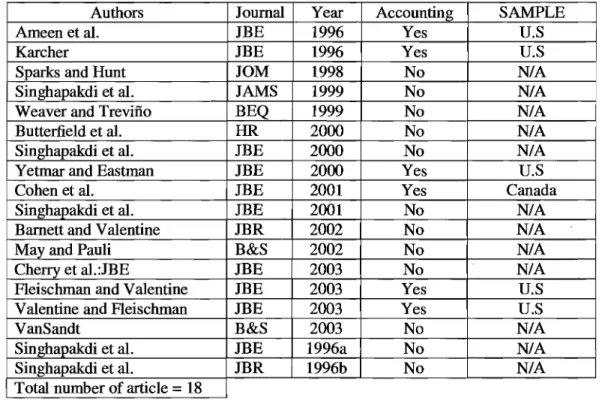
From their analysis, I extracted the articles related to ethical awareness (Table 1) and found 18 articles related to ethical awareness (10.34 % of the total number of articles). Interestingly, only 6 of these studies were in accounting and only one of them used a Canadian sample.
Following the same methodology, I updated the sample. To better match my objectives, I only included articles from ABIlInform and searched for "ethical sensitivity" or "ethical
awareness". After revising the search engine results (I only considered articles that were focused on ethical sensitivity), as illustrated below, I found 7 new articles in ethical sensitivity (Table 2). These papers form the basis of the literature review that follows.
Table 1: List of Papers Relating to Ethical Sensitivity
Authors Journal Year Accounting SAMPLE
Ameen et al. JBE 1996 Yes U.S
Karcher JBE 1996 Yes U.S
Sparks and Hunt JOM 1998 No
N/A
Singhapakdi et al. JAMS 1999 No
N/A
Weaver and Trevino BEQ 1999 No
N/A
Butterfield et al. HR 2000 No
N/A
Singhapakdi et al. JBE 2000 No
N/A
Yetmar and Eastman JBE 2000 Yes U.S
Cohen et al. JBE 2001 Yes Canada
Singhapakdi et al. JBE 2001 No
N/A
Barnett and Valentine JBR 2002 No
N/A
May and Pauli B&S 2002 No
N/A
Cherry et al.:JBE JBE 2003 No
N/A
Fleischman and Valentine JBE 2003 Yes U.S Valentine and Fleischman JBE 2003 Yes U.S
VanSandt B&S 2003 No
N/A
Singhapakdi et al. JBE 1996a No
N/A
Singhapakdi et al. JBR 1996b No
N/A
Total number of article
=
18*JBE: Journal of Business Ethics, * JBR: Journal of Business Research, *HR: Human Relations, *B&S: Business and Society, *JAMS: Journal of Academy of Marketing Science, *JOM: Journal of Marketing, *BEQ: Business Ethics Quarterly.
Table 2: Update for Papers Relating to Ethical Sensitivity
Author Journal Year Accounting Sample
Conroy and Emerson JBE 2004 No U.S
Lepper JBE 2005 No U.S
Mugan JBE 2005 No U.Sffurkey
Chan and Leung MAJ 2006 Yes Hong Kong
Oumlil and Balloun JBE 2008 No U.S/ Marroco
Shawver and Senetti JBE 2009 Yes U.S
Lau JBE 2009 No Not specified
* Managerial Auditing Journal
c. Operationalization of ethical sensitivity and critique:
Ethical sensitivity has been measured in various ways. Shaub's (1993) ethical sensitivity instrument consists of one auditing scenario that contains three moral issues. After reading the
scenario, he asked participants to indicate the number of issues they encountered in the case and the importance of the issue. The moral issues were: "1. the failure of staff to charge time required to complete the job ('eating hours"); 2. The use of client or firm time to write a note to a
prospective employer; and 3. The subordination of an auditor's judgment over an issue involving generally accepted accounting principles" (Shaub, 1993 p. 161).
Shaub's measurement of ethical sensitivity raises some concerns. His instrument asked respondents to list the issue(s) about which they were concerned. Some respondents may have seen an issue but were not worried about it, and therefore did not list it. Ethical sensitivity by definition is the recognition of an ethical issue and not the concern about it. Shaub (1993) used only one scenario to capture respondents' ethical sensitivity. Finch (1987, p.112) stated " ... on the basis of a single vignette one can probably make clear statements only about the particular circumstances specified". Moreover, Randall and Gibson (1990) argued in favor of using multiple vignettes instead of one or only a few. Increasing the number of vignettes is a very tempting approach to deal with the situational aspect of the ethical decision making process. Citing the work of Higgins, Power, and Kohlberg (1984), Trevino (1986, p.61O) explained that "moral action takes place in social context and can be influenced heavily by situational variables. Therefore, ethical/unethical behavior in practical situations is not simply a product of fixed individual characteristics, but results from an interaction between the individual and the
situation". However, the question becomes how many vignettes should one use (Finch, 1987). It will be very difficult to include all the possible combinations of ethical dilemmas. Furthermore, using multiple vignettes may be misleading. Vignettes represent hypothetical situations where the respondents need to picture themselves and their behavior. Respondents may behave differently in a real life situation than in a hypothetical situation (Rooks et al., 2000).
Ameen et al. (1996) measured ethical sensitivity by administering a 23 item questionnaire containing unethical issues with which students were familiar. The questionnaire asks students to provide their opinions about the severity of the stated unethical activity based on a 5-point likert scale. All the items included unethical behavior related to academic misconduct. This setting lacks ambiguity and makes it easier for respondents to know the purpose of the study.
Furthermore, respondents were not tested for their ability to recognize an unethical issue. The issue was there and they were asked to provide an opinion and judge its severity. As shown, the format of the instrument deviates from the definition of ethical sensitivity and does not test students' ability to recognize an ethical issue.
Karcher (1996) used three scenarios from the Trueblood Case Series (Deloitte and Touche, 1989). The chosen ethical issues were tax evasion, independence and plant relocation. The scenarios with different levels of severity were administered to CP As working for the Big Six firms. Participants were asked to write down the issues they encountered in the cases. Two independent judges had a list of the issues and coded the respondents' answers as dichotomous variables (issue mentioned or not). This study is limited by the use of only three vignettes. The low number of vignettes reduces the generalizability of the findings because some accountants may be able to recognize an ethical issue in those specific scenarios but not in others and vice versa.
Sparks and Hunt (1998) conceptualized two definitions of ethical sensitivity: (1) based on Shaub's (1989) theory: "Ethical sensitivity is the ability to recognize that a decision-making situation has ethical content" (p. 95) and (2) based on Volker's (1984) theory: "Ethical
sensitivity is the ability to recognize that a decision-making situation has ethical content and the ascription of importance to the ethical issues composing that content" (p.95). The first
definition considers ethical sensitivity as a dichotomous variable (recognize an issue or not) and the second definition considers it as a continuous variable (to what degree individuals recognize the issue). They created a research design to test for differences between these two definitions. They argued that teachers and students have different levels of ethical sensitivity. Their model included seven predictor variables (the independent variables) and two dependent variables (two approaches to measure ethical sensitivity). The first measure of ethical sensitivity consisted of the unweighted ethical sensitivity scores (identifies the number of ethical issues detected by the respondents, similar to the technique used by Butterfield as cited above). The second measure consisted of the weighted ethical sensitivity based on responses on a 7 -point Likert scale. They use a marketing research case to measure ethical sensitivity. Their instrument suffers from the same limitation presented in Karcher's (1996) study. The generalizability of their findings is limited to this unique scenario that contained a limited set of ethical issues.
Sparks and Hunt (1998) also explored the difference between the two definitions of ethical sensitivity and tried to empirically identify the superior view. The authors defined two measures for ethical sensitivity; the first model uses mean weighted measures for the dependent variable and the second model uses an unweighted measure (ranges from 0 to 3: it only shows the number of identified issues and does not show to what extent they were recognized). Then, using LISREL 7, they compared the model fit between both models. They argued that a
significant difference between those models will demonstrate that one approach is superior to the other one. Results using the equality constrained approach (paths between each dependent variable to the independent variable were equal) showed a significant difference between the two models. Due to the high correlation (.95) between the dependent variables the authors examined both models without the equality constraint and reported that the models were not significantly
different. These results are contradictory to the theoretical framework. Based on both definitions of ethical sensitivity, an individual needs to recognize an issue and then assess its importance. More precisely, the recognition of an ethical issue happens before the determination of its extent. Once an individual is assessing the magnitude of the ethical dilemma, we can infer that he recognized the existence of this ethical issue. This explains the high correlation between both dependent variables in this paper since recognizing an ethical issue is embedded in assessing its extent. We would not expect a significant difference in model fits.
Butterfield et al. (2000) measured ethical sensitivity qualitatively; they asked the respondents to list relevant issues in two scenarios. Then, they classified these issues in two categories based on whether included moral issues were mentioned or not. Once they coded all the issues listed by respondents, they added up the scores and came up with a moral awareness score. As discussed previously, the lack of diversification of ethical dilemmas represents a significant limitation to their findings.
Yetmar and Eastman (2000) used four tax scenarios containing eight ethical issues (one ethical issue in the first and second scenario, four ethical issues in the third scenario and two issues in the fourth scenario) and administered them to experienced professional accountants. Participants had to identify any issues they encountered and determine their degree of
significance on a 7-point likert scale. Each issue score ranged from zero to seven (zero if the respondent was unable to recognize the issue and one to seven, depending on the degree of significance accorded). The instrument included a different number of issues in each scenario. However, all scenarios included at least one issue. The inclusion of neutral scenarios is necessary to preserve the instrument's balance and to prevent an artificial increase in
and less severe ethical scenarios to mitigate increased sensitivity. Adding neutral statements reminds the respondents that the statements are not necessarily unethical and therefore they need to implement their judgment as if they were in a real life dilemma.
Mugan et al. (2005)' s ethical sensitivity instrument included sixteen vignettes, each containing an ethical dilemma. After administering the survey, they ask the respondents to judge the ethicality of the actions portrayed in the vignettes using a 7-point likert scale (from definitely ethical to definitely unethical). They speculate that this measure measures ethical sensitivity. More precisely, they defined ethical sensitivity as "the tendency to judge the conduct unethical, thus higher scores are associated with greater ethical sensitivity" (p.147). This definitions deviates from previous literature on ethical sensitivity and refers more to the moral reasoning component in the ethical decision process (Rest (1986)'s second step) where respondents have to rely on their cognitive abilities to judge what is right or wrong.
Lepper (2005) used a funnel interview technique (they start by asking the respondents questions in a general manner and get more specific toward the end) to measure ethical
sensitivity. In her study, she provided her interviewees with two taped ethical scenarios followed by interview questions and a questionnaire. The interviews lasted for about 45 minutes. The questions fit the definition of ethical sensitivity; however, the instruments suffer from significant limitations. First, only two scenarios were used; respondents who are familiar with those two specific situations will have different results from individuals who never faced such dilemmas. Second, face-to-face interviews may not be a reliable measure of ethical sensitivity because of the lack of anonymity and the increased risk of social desirability bias. Finally, both scenarios were taped; some respondents may not recall all the elements from the tape. More·specifically, some respondents may be better at recognizing ethical issues when they are presented
paper-based rather than in an audio tape. Her instrument format may suffer from a primacy/recency effect. Under the primary/recency theory, individuals are more likely to retrieve information about things said in the beginning and at the end than things said in the middle. Further, the interview format is very time consuming and limits the sample size that can be obtained.
Lau (2010) used the Attitude Toward Business Ethics Questionnaire (ATBEQ) to measure ethical sensitivity. Each of the 30 items on the ATBEQ represents a statement about an ethical issue. Once administered to the target sample, the researcher asks the respondent whether they agree or disagree with the statements. The ATBEQ was widely used to capture ethical values in a certain culture (e.g., Moore & Radloff, 1996; Sims, 2006). The authors speculate that ethical sensitivity (awareness) and ethical attitude toward business ethics is the same. The ATBEQ measures ethical values and does not capture someone's ability to recognize ethical issues. Most of the statements do not depict an ethical dilemma. Respondents only provide their opinions about broad moral value statements which do not picture an ethical dilemma where they have to make a judgment. For example, in item 24 on the ATBEQ: "the business world has its own rules", respondents only agree or disagree with the statement, but this does not provide us with their ability to perceive or judge an ethical dilemma.
d. Independent variables and findings:
Some research in ethical sensitivity has been conducted to identify factors that influence individuals' capability to recognize an ethical issue. Butterfield et al. (2000) investigated the impact of some of the moral intensity components defined by Jones (1991), as well as framing and competitiveness on moral awareness. Specifically, they examined the impact of magnitude of consequences (MC), framing (F) and social consensus (SC) on competitive intelligence practitioners (CI). They used a between subjects design, where they administered two scenarios
each with different manipulations. The usage of CIs represented an important feature in this study. The authors argued that the competitive intelligence field is relatively new and ethical codes are not fully defined. Therefore, respondents will rely more on their personal moral scripts rather than scripts determined by the industry. One scenario was about mystery shoppers and the other about hiring. In the mystery shoppers' scenario, a middle level manager had to choose between recommending a mystery shopping project or not. In this project, a significant amount of money was given to CIs and they were asked to buy financial plans from competitors and extract as much information as they could. In the second scenario, a middle level manager had to decide between hiring two individuals, where both individuals had equal competencies; however, one of them had information about the business's competitors and was willing to share these information once hired. Both of these scenarios were considered by the researchers to be ethically ambiguous. An ambiguous setting would help the researcher to better identify what drove the respondent's ethical awareness. Both scenarios contained manipulations for MC and F. For MC they used low and high manipulations. For example, in the mystery shopper setting, they told the respondents that the competitors would go out of business in the high MC treatment, and in the low MC treatment they would increase their own profits while decreasing the competitors' profits. The framing manipulations consisted of wording manipulations, where some words were chosen to better trigger the moral cognitions. For SC and competitiveness, they administered a questionnaire.
Butterfield et al. (2000), found significant support for the impact of MC and SC on ethical awareness. However, they found weak support for the impact of framing on ethical awareness. Interestingly; their findings related to the competitiveness hypothesis were in the opposite direction from the hypothesis. They predicted that competitiveness would mask their
moral cognitive framework and individuals would unquestioningly follow instructions given by the organizations. However, based on their findings, competitiveness increased moral awareness.
Using an exploratory approach, Sparks and Hunt (1998) investigated the impact of organizational socialization, professional socialization, empathy, relativism and ethics training on ethical sensitivity. Organizational socialization is "the process by which a person learns the values, norms and behaviors which permit him [ or her] to function as a member of the
organization" (Van 1976, p.67). Sparks and Hunt (1998) argued that the internalization of the organizational values should make the individual more ethically sensitive. In their findings, they reported a significant relationship between ethical sensitivity and organizational socialization. However, this finding is contradicted by findings reported by Shaub (1989), where he did not find a significant relationship between ethical sensitivity and organizational socialization.
Sparks and Hunt (1998) also included professional socialization in their model. The authors argue that a higher professional socialization means a higher learning of professional values and norms. They hypothesized that a higher professional socialization should be associated with a higher level of ethical sensitivity. Their findings partially supported this hypothesis. They also tested for the relationship between empathy and ethical sensitivity. Empathy included perspective taking (the cognitive component of empathy) and emotional contagion (the affective dimension of empathy). They argued that higher empathy should generate higher ethical sensitivity. They found a significant relationship between perspective taking and ethical sensitivity, and no significant relationship between emotional contagion and ethical sensitivity. They concluded that the impact of empathy on ethical sensitivity was cognitive in nature.
Ethical training was the last independent variable in their model. Sparks and Hunt (1998) argued that more training would result in a higher awareness of ethical dilemmas. Surprisingly, in their analysis, they found a negative relationship between ethical sensitivity and ethical
training. This contradicts the assumption that ethical awareness is learned. The authors argue that this reversed relationship may be due to ethics education that focuses on strengthening the
individual's relativistic behavior.
Sparks and Hunt (1998) argue that professionals should have higher ethical sensitivity than marketing students due to a higher exposure to ethical issues. They also argue that first year students will have lower ethical sensitivity than students in their final year. Those arguments are built upon the assumption that ethical sensitivity is a learning process and the more an individual learns about ethical dilemmas the more sensitive she becomes. Their results showed that there is a significant difference between practitioners and students. However, they found no difference between students in different years. Because this paper is exploratory in nature, we should be very careful interpreting the results. Research in ethical behavior showed that the individual's level of cognitive moral development (CMD) has an impact on ethical behavior (Green and Weber, 1997). The difference between marketing research practitioners and students' ethical sensitivity may be due to the difference in their CMD stage. It is possible that using the CMD approach provides a better explanation for the authors' findings. Students in the first and last year of their education may share the same CMD stage, which explains why they did not have a significant ethical sensitivity difference. Moreover, professionals may have a higher CMD stage than students and this also explains the results reported by the authors.
Shaub (1993) investigated the relationship between idealism, relativism, organizational commitment, professional commitment and ethical sensitivity. His scenario contained three
ethical issues. Eighty percent of his sample recognized the first issue, 23% recognized the second issue and 42% recognized the third issue. He reported a negative relationship between idealism and ethical sensitivity, and relativism and ethical sensitivity. Shaub (1993) predicted a positive relationship between idealism and ethical sensitivity: "idealists will tend to focus on harm to others. To the extent that an idealist perceives that others will be harmed by someone's actions. He/she would be expected to recognize an issue as having ethical content" (Shaub, 1993 p.154). He reported his findings (a negative relationship) as surprising. He explained the deviation from the predicted outcome by the unpredicted focus of its respondents (respondents focused on the avoided harm rather than on the caused harm). Yetmar and Eastman (2000) define idealism as "the extent of an individual's concern with the welfare of others and how strongly the individual believes that harming others is always avoidable" (p .275). Therefore, highly idealistic
individuals are concerned about the amount of harm associated with an action. They would spend more effort while assessing an ethical dilemma to avoid any possible harm to others. Karcher (1996) investigated the impact of specific factors on ethical sensitivity. She explored the nature of the issue, its severity, the respondents' age, their position and expertise, their prior exposure and their educational leveL Based on the results, age was a significant factor for recognizing an ethical issue. Older respondents had a higher level of ethical sensitivity. Interestingly, she could not support the relationship between the other factors listed above and ethical sensitivity. Based on her findings, employee position, previous exposure to similar ethical issues, degree level, gender and level of expertise did not have a significant relationship with ethical sensitivity.
Yetmar and Eastman (2000) built upon Hunt and Vitell's (1986, 1993) model of ethical decision making and investigated the impact of role conflict, role ambiguity, job satisfaction,
relativism and professional commitment on ethical sensitivity. These factors map into three of the five factors defined by Hunt and Vitell: role conflict, job satisfaction and job ambiguity represented the organizational environment; relativism was used for personal characteristics; and, professional commitment for the professional environment. Cultural environment and industry environment were not examined in this study. They provided support for the
relationship between role conflict and job satisfaction and ethical sensitivity. Role conflict had a negative relationship with ethical sensitivity, whereas job satisfaction was positively related. However, based on their results, no support was provided for the impact of relativism, professional commitment or role ambiguity on ethical sensitivity.
Ameen et al. (1996) investigate the role gender plays in ethical sensitivity. The effect of gender could be analyzed using the socialization approach or the structural approach (Betz et al. (1989). The socialization approach suggests there will be a difference between men and women when it comes to ethical sensitivity. More precisely, the socialization approach is based on the differing values that males and females bring to the work place. Males are usually more
competitive and are more likely to be willing to ignore the rules to achieve their objectives and females care more about work relationships and give more attention to the task. The structural approach posits no difference between males and females, since it argues that the reward system for ethical conduct should have an impact on both genders and therefore they would be similar. Ameen et al. (1996) adopted the socialization approach and argued that females should have a higher ethical sensitivity than males. Using accounting students as a sample, they distributed a 23 item survey depicting ethical dilemmas students may face in their environment. The findings supported their hypothesis and provided evidence that females were significantly more ethically sensitive than males.
Using Shaub et al.'s (1993) instrument to measure ethical sensitivity, Chan and Leung (2006) investigate the relationship between ethical reasoning, personality factors and ethical sensitivity. Their personality factors included: ethical orientation (relativism and idealism), locus of control, age, gender and academic performance. They administered their instrument to 156 accounting students in Hong Kong. They found no significant relationship between ethical sensitivity and ethical reasoning. Their finding supports Rest's (1986) theory by showing that high moral reasoning does not imply a better recognition of an ethical dilemma-those two steps in the model appear to be independent as posited by Rest. More interestingly,. they found a significant relationship between locus of control and ethical sensitivity.
The concept of locus of control comes from Rotter's (1954) social learning theory. In his book, he explains that individuals behave in a certain way to satisfy an expected reinforcement He pointed out that this attitude is determined by the individual's perception of her own influence on the outcome of the desired reinforcement. More precisely, some individuals may think that they control their destiny when others do not. Rotter (1966 .p 1) defines Locus of Control as: "when a reinforcement is perceived by the subject as following some action of his own but not being entirely contingent upon his action, then, in our culture, it is typically perceived as the result of luck, chance, fate, as under the control of powerful others, or as
unpredictable because of the great complexity of the forces surrounding him. When an individual interprets the events in this way, we have labeled this a belief in external control. If the person perceives that the event is contingent upon his own behavior or his own relatively permanent characteristics, we have termed this a belief in internal control."
Chan and Leung (2006) find that "internal" accounting students were better at
factors, locus of control was the only personality trait that significantly correlated with ethical sensitivity. No support was found for ethical orientation, age, gender or academic performance.
Lau (2010) investigates the relationship between ethics education, ethical awareness and moral reasoning. Her findings show that ethics education improves students' ethical sensitivity and moral reasoning.
C. Empirical Studies of Moral Intensity:
Jones (1991) argued that individuals respond to the intensity of the moral issue and not just to the issue itself. Jones proposed six characteristics of moral intensity (Table 3).
Some research studies have (e.g., McMahon and Harvey, 2006; Frey, 2000) investigated the dimensions of Jones' (1991) moral intensity. For example, Singhapakdi (1996) tested Jones' (1991) theoretical model empirically by testing the relationship between moral intensity and ethical perception (using four ethical scenarios). They tested the dimensions of the moral intensity using an orthogonal rotation. All of the responses related to moral intensity loaded on two factors. The first factor included MC, PE, TI, and CE and was labeled the "perceived potential harm! no harm" dimension. The second dimension included SC and PX and it was labeled "perceived social pressure". These results held for three out of four scenarios, the last scenario produced only one factor. Using regression analysis, they showed that both of these dimensions were significant determinants of ethical perception. Overall, their results provide empirical support for Jones' (1991) model: moral intensity is a determinant of ethical perception.
Table.3: Jones' Moral intensity characteristics
Moral Intensity Definition Examples
An act that causes 1,000 people to suffer a particular injury is of
The sum of the harms (or greater magnitude of consequence than an act that causes 10
MC: Magnitude benefits) done to victims (or people to suffer the same injury (p. 374)
of Consequences beneficiaries) of the moral An act that causes the death of human being is of greater
act in question" (p. 374) magnitude of consequence than an act that causes a person to
suffer a minor injury (p. 374)
The evil involved in discriminating against minority job candidates has greater social consensus than the evil involved in
The degree of social refusing to act affirmatively on behalf of minority job
SC: Social candidates. (p. 375)
Consensus agreement that a proposed The evil involved in bribing a customs official in Texas has
act is evil (or good). (p. 375)
greater social consensus than the evil involved in bribing a customs official in Mexico. (Nehemkis, 1975 as cited in Jones, 1991, p. 375)
A joint function of the Producing a vehicle that would be dangerous to occupants during routine driving maneuvers has greater probability of
probability that the act in harm than producing a vehicle that endangers occupants only
PE: Probability of question will actually take during rear-end collisions. (p. 375)
Effect place and the act in question
will actually cause the harm Selling a gun to a known armed robber has greater probability
(benefit) predicted. (p. 375) of harm than selling gun to a law-abiding citizen (p.375)
Releasing a drug that will cause 1 percent of the people who The length of time between take it to have acute nervous reactions soon after they take it has greater temporal immediacy than releasing a drug that will
the present and the onset of cause 1 percent of those who take it to develop nervous
TI: Temporal consequences of the moral disorders after 20 years. (p.376)
Immediacy act in question (shorter
Reducing the retirement benefits of current retirees has greater length of time implies
greater immediacy). (p. 376) temporal immediacy than reducing retirement benefits of
employees who are currently between 40 and 50 years of age. (p.376)
The feeling of nearness Layoffs in a person's work unit have greater moral proximity
(social, cultural, (physical and psychological) than do layoffs in a remote plant.
psychological, or physical) (p.376)
PX: Proximity . that the moral agent has for For U.S citizens, the sale of dangerous pesticides in U:S
victims (geneficiaries) of the markets has greater moral proximity (social, cultural, and
evil (beneficial) act in physical) than does the sale of such pesticides in Latin America.
question. (p. 376) (p.376)
A change in a warranty policy denying coverage to 10 people with claims of $ 10,000 has a more concentrated effect than a
CE: An inverse function of the change denying coverage to 10,000 people with claims of
Concentration of number of people affected $10.00. (p. 377)
Effect by an act of given Cheating an individual or small group of individuals out of a
magnitude. (p. 377) given sum has a more concentrated effect than cheating an
institutional entity, such as a corporation or government agency, out of the same sum. (p.377/378)