2016
Post-conflict reintegration in Central Bosnia:
current efforts and affairs
Drazen Juric Iowa State University
Follow this and additional works at:https://lib.dr.iastate.edu/etd
Part of theSocial and Cultural Anthropology Commons
This Thesis is brought to you for free and open access by the Iowa State University Capstones, Theses and Dissertations at Iowa State University Digital Repository. It has been accepted for inclusion in Graduate Theses and Dissertations by an authorized administrator of Iowa State University Digital Repository. For more information, please [email protected].
Recommended Citation
Juric, Drazen, "Post-conflict reintegration in Central Bosnia: current efforts and affairs" (2016).Graduate Theses and Dissertations. 14993.
Post-conflict reintegration in Central Bosnia: Current efforts and affairs
by
Drazen Juric
A thesis submitted to the graduate faculty
in partial fulfillment of the requirements for the degree of MASTER OF ARTS
Major: Anthropology Program of Study Committee: Maximilian S. Viatori, Major Professor
Grant Arndt Nell Gabiam
Iowa State University Ames, Iowa
2016
TABLE OF CONTENTS Page ACKNOWLEDGMENTS ... iv ABSTRACT………. ... v CHAPTER 1 INTRODUCTION ... 1 Background ... 2 Literature Review ... 7
Ethno-national Desires in the Federation ... 14
Research Design ... 18
Structure of the Thesis ... 20
CHAPTER 2 STATE-BUILDING, ETHNO-NATIONALISM, AND REFORM DIFFICULTIES IN POST-WAR BOSNIA-HERZEGOVINA ... 22
Background ... 23
State-building Efforts and Ethno-national Resistance ... 27
Developmental Desires ... 33
Recent Developments ... 35
Conclusion ... 38
CHAPTER 3 ETHNICALLY-DIVIDED EDUCATION AND RESISTANCE TO REINTEGRATION: AN UPDATE ON “TWO SCHOOLS UNDER ONE ROOF” IN BOSNIA-HERZEGOVINA ... 40
Background Pre-war and Post-war Education ... 41
Ethnically-divided Education ... 46
Education reform Efforts ... 48
Things to Consider ... 53
Recent Developments ... 55
Conclusion ... 57
CHAPTER 4 RESPONSE TO THE 2014 SUPREME COURT RULING IN THE CENTRAL BOSNIA CANTON ... 59
Background ... 60
Ethnographic Study ... 66
Primary school visit ... 67
Secondary school visit ... 70
Reflection ... 77
Center for Education ... 78
Conclusion ... 81
CHAPTER 5 CONCLUSION ... 83
ACKNOWLEDGMENTS
I would like to thank my committee chair, Max Viatori and my committee members, Grant Arndt, and Nell Gabiam, for their guidance and support throughout the course of this research. In addition, I would also like to thank my family, friends, and colleagues, as well as the department faculty and staff for making my time at Iowa State University a wonderful
experience. I want to also offer my appreciation to those who were willing to participate in my surveys and observations, without whom, this thesis would not have been possible.
ABSTRACT
In this thesis, I explore ethno-national resistance to reform efforts aimed at strengthening the national government and reintegrating the system of education in Bosnia-Herzegovina. This discussion stems from ethnographic fieldwork conducted during the summer of 2015, in
response to an October 2014 Supreme Court ruling in the Federation of Bosnia-Herzegovina that found the “two schools under one roof” program unconstitutional, and ordered an end to its practice. Fieldwork was conducted primarily in one town in the Central Bosnia Canton, and my goal was to see whether there had been any proposed changes to local schools in response to the 2014 Supreme Court ruling, and if there had not, what local attitudes regarding such a ruling were, along with attitudes about the “two schools under one roof” program, and education in BiH in general. I draw upon discussions concerned with post-conflict reconciliation, ethnic identity, and language ideology to explore the tensions that exist between state-level mandates aimed at reintegration, and the preferences of Bosnia-Herzegovina’s ruling elites. I demonstrate that the power-sharing mechanisms established in the Dayton Peace Accords have enabled
ethno-national leaders to resist reforms aimed at a centralized state, which has allowed the “two schools under one roof” program to continue. In doing so, I argue that ethno-national resistance to reform and reintegration efforts further encourages spatial divisions, and allows schools to become private spaces that are used for the reproduction of ethno-national identities rather than as forums for cohesion and the interaction of a common citizenry.
CHAPTER I INTRODUCTION
In this thesis, I explore ethno-national resistance to reform efforts aimed at strengthening the national government in Bosnia-Herzegovina (BiH) and reintegrating the ethnically-divided system of education, and in particular, the “two schools under one roof” program in the
Federation of Bosnia-Herzegovina (FBiH). This discussion stems from ethnographic fieldwork conducted during the summer of 2015, in response to an October 2014, Supreme Court ruling in the Federation of Bosnia-Herzegovina that said “organising school systems based on ethnic background and implementing curriculums on ethnic principles, which divide children was discriminatory.”1 The court ruling ordered schools to implement “common integrated multicultural education facilities.”2
Fieldwork was conducted primarily in one town in the Central Bosnia Canton, and my goal was to see whether there had been any proposed changes to local schools in response to the 2014 Supreme Court ruling, and if there had not, what local attitudes regarding such a ruling were, along with attitudes about the “two schools under one roof” program, and education in BiH in general. I chose the Central Bosnia Canton as the site of my research largely because it is officially an “ethnically mixed” canton (Bosniaks and Croats) and the “two schools in one roof” program is in effect in this area.
Although I was able to learn shortly after my arrival to the Central Bosnia Canton that no changes to the local schools had been proposed by the Ministry of Education in response to the 2014 Supreme Court ruling, I still found it worthwhile to engage in discussions with participants
1Dzidic, D. (2014). Bosnia Federation Rules Against Ethnically-Divided Schools. Retrieved April 19, 2016, from
http://www.balkaninsight.com/en/article/bosnian-federation-court-rules-against-school-discrimination
due to the government’s renewed commitments to work towards European integration. As part of this commitment, BiH’s leaders have pledged to ensure that “access to all levels of education and training is free of any discrimination on the grounds of gender, color, ethnic origin or religion.”3
In the chapters that follow, I draw upon discussions concerned with post-conflict reconciliation, ethnic identity, and language ideology to explore the tensions that exist between state-level mandates aimed at reintegration, and the preferences of Bosnia-Herzegovina’s ethno-national leaders. I demonstrate that the power-sharing mechanisms established in the Dayton Peace Accords have enabled ethno-national leaders to resist reforms aimed at a centralized state, which has allowed ethnically-divided education and the “two schools under one roof” program to continue. In doing so, I argue that ethno-national resistance to reform and reintegration efforts further encourages spatial divisions, and allows schools to become private spaces that are used for the reproduction of ethno-national identities rather than as forums for cohesion and the interaction of a common citizenry.
Background
Ethnically-divided education exists in Bosnia-Herzegovina as a result of the dissolution of Yugoslavia and the subsequent Bosnian war of independence. Divisions in education began in 1992, and further developed over the next three years, as the country was territorially and
politically divided between Serbs, Bosniaks, and Croats.4 In the area of this study, the Central Bosnia Canton, fighting between Bosniaks (Bosnian Muslims) and Croats (Bosnian Catholics) took place until late February 1994, at which point a cease-fire was adopted and the Washington
3Schroeder, H. (2012). 10 Years of BiH membership in the Council of Europe: Ending Segregation and Discrimination in
Education in Law and in Practice. Retrieved April 19, 2016, from http://europa.ba/?p=19244
4 Kreso, Adila Pašalić. (2008). The War and Post-War Impact on the Educational System of Bosnia and Herzegovina. International
Agreement was signed.5 The Washington Agreement established the Federation of BiH, which consists of ten independent cantons, and re-allied the Bosniak and Croat forces to defend the territory against the Serbs. It also left in place a decentralized system of education, which led to the creation of independent ministries at the cantonal level. This has resulted in mono-ethnic schools in ethnically homogenous areas, and the “two schools under one roof” program in areas with mixed populations.
The Dayton Peace Accords, signed by the Presidents of Croatia, Bosnia, Serbia, as well as representatives of Bosnian Croats and Serbs, on November 21, 1995, brought an end to the war in Bosnia-Herzegovina, and established the post-war constitution for the republic. The Dayton Peace Accords retained Bosnia-Herzegovina’s international borders, but divided the country into two autonomous entities: the Bosniak-Croat Federation and the Serb-dominated Republika Srpska.6 The agreement granted control of fifty-one percent of the territory to the FBiH and forty-nine percent to the Republika Srpska. It also created an independent “District of Brčko” in the northeast corner of the country.
The purpose of the Dayton Peace Accords was to bring an end to the violence in Bosnia-Herzegovina, which proved effective, but because the International Community in BiH (the United States, the EU, and Russia) worked to establish peace with the same leaders who led the country into war, what was established was the partitioning of the country along ethno-national lines. Although the agreement brought an end to the military violence, it also resulted in ethnicity being the main factor in Bosnian political identity.7 This has resulted in what has been referred to
5 Shrader, C. (2003). Muslim-Croat Civil War in Bosnia: A Military History, 1992-1994 (Eastern European studies (College Station, Tex.) no. 23). College Station: Texas A & M University Press, 160.
6 Although the territories are independent entities, their borders are non-sovereign. One reform that was passed in the early
2000s states that citizens of either entity now have full rights throughout the country. "The Constituent Peoples' Decision in Bosnia-Herzegovina," International Crisis Report, No. 128, 16 April 2002.
as an “ethnopolis,” a system of governance where politicians, if they want to be successful, must act as patrons for their ethnic constituencies, and people, if they want to survive, must navigate the ethnic avenues familiar to them.8 The Dayton Peace Accords also established the Office of the High Representative, an internationally-appointed position and the highest authority in the country, to oversee its implementation. The presence of the High Representative in the country will be discussed more in the next chapter.
As will be detailed in chapter three, education is highly decentralized in Bosnia-Herzegovina, and there are 14 ministries of education. Conversely, in the Republika Srpska, education is highly centralized because of the Serb majority, but in the Federation, the governments of each canton are obliged to transfer control of education to municipal
governments in areas where the majority population of a municipality differs from the majority population of the entire canton.9 Similar to the Republika Srpska, education is not contested in ethnically homogenous parts of the Federation, but in areas where control has been transferred to municipalities, ethnically homogenous schools are able to embrace mono-ethnic curriculums.10 In the separate curriculums, Croats use textbooks that are developed in Croatia, Serbs use textbooks developed in Serbia, and Bosniaks use textbooks developed in BiH, commonly referred to as the Federal curriculum.
It is reported that approximately 100,000 people were killed during the war in Bosnia-Herzegovina, and 2.3 million of the 4.4 million inhabitants were displaced. More than half of
8 Mujkić, A. (2007). We, the Citizens of Ethnopolis. Constellations,14(1), 112-128, 113.
9Constitution of the Federation of Bosnia and Herzegovina [Bosnia and Herzegovina], 18 March 1994, available at:
http://www.refworld.org/docid/3ae6b56e4.html [accessed 19 April 2016]
10Božić, G. (2006). Reeducating the Hearts of Bosnian Students: An Essay on Some Aspects of Education in Bosnia and
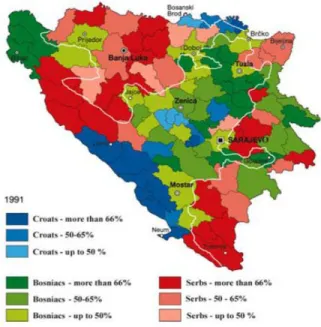
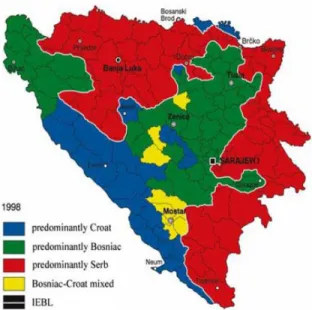
these were internally displaced persons, who remained in BiH.11 While most of Bosnia-Herzegovina’s schools became mono-ethnic as a result of the territorial divisions, the “two schools under one roof” program emerged in mixed areas due to a legal provision intended to encourage the return of displaced persons to their former homes, which was not as successful as envisioned.12 One of the reasons for this was that for many displaced persons, there was nothing to return to: no homes, jobs, or schools. For Bosniak refugees from eastern parts of the country, for instance, it was often the case that entire villages were forcefully evicted and destroyed. Similarly, much of the diaspora outside of BiH has not returned simply because there have been more opportunities for life abroad.13 As can be seen below, the ethnic composition of BiH shifted greatly during the war.14
Figure 1. Ethnic composition of BiH until 1991 (Source: Pašalić-Kreso 2008: 358).
11 Cutts, Mark. (1999). The Humanitarian Operation in Bosnia, 1992-95: Dilemmas of Negotiating Humanitarian Access. Geneva:
Centre for Documentation and Research, United Nations High Commissioner for Refugees, 1-26, 1.
12 Annex 7 in the Dayton Peace Accords grants rights of personhood, including the right to be educated in one’s national
language or mother tongue. This led to institutionalized divisions in education.
13Halilovich, H. (2013). Places of pain: Forced displacement, popular memory, and trans-local identities in Bosnian war-torn communities. New York: Berghahn Books.
Figure 2. Ethnic composition of BiH after 1998 (Source: Pašalić-Kreso 2008: 358). Rather than returning, people have continued to leave Bosnia-Herzegovina, and
classrooms have been going empty, according to recent figures.15 The preliminary results of the first post-war census, carried out in October, 2013, report that the population of BiH is
3,867,055, with an ethnic composition of: Bosniaks 48.4%, Serbs 32.7%, Croats 14.6%, and Others 4.3%.16 In addition, current estimates indicate unemployment is slightly more than twenty-five percent, while youth unemployment is more than sixty percent.17
Bosnia-Herzegovina is in a deficit and close to bankruptcy.18 Although unpopular, state-level mandates aimed at a centralized government and unified system of education offer the potential for reduced public sector spending as well as European standardization.
15 Zelenika, P. (2016, January 28). “U osnovnim školama u FBiH za pet godina 700 učionica ostalo prazno.” Retrieved February
02, 2016, from http://www.vecernji.ba/u-osnovnim-skolama-u-fbih-za-pet-godina-700-ucionica-ostalo-prazno-1055480 -This article reports that the number of students enrolled in primary education in the FBiH over the past five years (2011/12-2015/16) has dropped by 19,705 or 9.45%, resulting in approximately 700 empty classrooms. Figures are from the Federal Ministry of Education in the FBiH.
16The World FactBook: Bosnia and Herzegovina. (2016, March 17). Retrieved April 19, 2016, from
https://www.cia.gov/library/publications/the-world-factbook/geos/bk.html
17 EC: Commission Staff Working Document, BiH. 2015 Report. Brussels, 10.11.2015. Retrieved April 19, 2016, from
http://ec.europa.eu/enlargement/pdf/key_documents/2015/20151110_report_bosnia_and_herzegovina.pdf, 69.
18 Simic, D. (2016, January 25). “Bankrupt Bosnia Looks to IMF for Salvation.” Retrieved February 02, 2016, from
Literature Review
In the following section, I draw upon discussions that deal with post-conflict
reconciliation in areas where ethno-nationalism has played a role, as well as studies on language ideology and ethnic identity, intended to provide readers with a framework for contextualizing Bosnia-Herzegovina. After I read about the October 2014 Supreme Court ruling, an examination of the closely-related literature helped me to parse out the various desires of
Bosnia-Herzegovina’s ethno-national leaders, and to find common grounds between the legally separate peoples, which ultimately guided my study. In addition, due to my education in Political Science and Journalism, as well as Anthropology, this review draws on discussions from multiple
disciplines.
Currently in Bosnia-Herzegovina, there are three formally recognized constitutive nations or constituent peoples.19 As mentioned, they are Bosniaks, Serbs, and Croats, and as will be explained more throughout this discussion, the majority of each also strongly identifies along religious lines. For the most part, Serbs are Orthodox, while Croats are Catholic. The term Bosniak refers specifically to Bosnian Muslims, whereas the term Bosnian can refer to any citizen of Bosnia-Herzegovina. However, it is important to mention that in post-war BiH, most Croats and Serbs reject the term Bosnian and instead declare themselves Croatian and Serbian. In the past, the terms Bosnian and Bosniak were used synonymously, but the meanings of the two have diverged.20 Now, Bosnian is also used by people with mixed backgrounds, members of minority groups, and those who reject an ethno-national identification.
19 This means that they share power equally, regardless of population proportion.
20Bringa, T. (1995). Being Muslim the Bosnian way: Identity and community in a central Bosnian village / Tone Bringa. (Princeton studies in Muslim politics). Princeton, N.J.: Princeton University Press, 34.
Prior to the dissolution of Yugoslavia, the official language of the socialist-republic was Serbo-Croatian or Croat-Serbian.21 Within Bosnia-Herzegovina, it was acceptable to say that the language was Bosnian, but it was also understood that the language was only regionally different from the other two. As a result of the war, today in Bosnia-Herzegovina, there are three official languages: Bosnian, Croatian, and Serbian.22 As will be discussed more in chapter three, this has also been an area of nationalist contention, having to do with deeper claims to
Bosnia-Herzegovina, and surrounding questions concerning the legitimacy of the Bosnian state. Based on linguistic studies, it can be said that Bosnian, Croatian, and Serbian are one language that has standard variants.23 This is comparable to the case of American English and its accents across the United States.24 Ultimately, the variants “can be taught together in a single classroom.”25
Since the signing of the Dayton Peace Accords, scholars have reflected not only on the international response to the violence in BiH and the post-Dayton process, but also on academic and media coverage of the conflict as it took place. In particular, Gagnon notes that many were quick to portray the reasons for the inter-ethnic violence in Bosnia-Herzegovina as either
primordialist or essentialist.26 Some explanations supposed that the various groups in the Balkans had been in conflict ever since their settlement in the region, and that the most recent violence was just a resurgence of those “ancient ethnic hatreds.”27 This is problematic because it leads
21Hromadzic, A. (2015). Citizens of an empty nation: Youth and state-making in postwar Bosnia-Herzegovina. Philadelphia, PA:
University of Pennsylvania Press, 46-47.
22 Although Bosnia-Herzegovina’s state-level constitution does not list an official language, the entity and cantonal constitutions
recognize Bosnian, Croatian, & Serbian as separate languages.
23 Kordić, S. (2010). Jezik i Nacionalizam. Zagreb: Durieux. Retrieved 19 April 2016 from
https://bib.irb.hr/datoteka/475567.Jezik_i_nacionalizam.pdf, 77.
24 Wilson, T., Milano, S., Myers, L., Marini, L., Davis, G., Kolker, Andrew, . . . CNAM Film Library. (1987). American tongues / the
Center for New American Media presents; a videotape by Andrew Kolker and Louis Alvarez. (No dot version]. ed.). New York: Harriman, N.Y.: Center for New American Media; Distributed in the USA by CNAM Film Library.
25 Alexander, Elias-Bursać, Douglass K. Daniel, & Ronelle Alexander -- Ellen Elias-Bursać. (2010). Bosnian, Croatian, Serbian, a
Textbook: With Exercises and Basic Grammar. University of Wisconsin Press, xi.
26 Gagnon, V. (2004). ibid., xviii.
27 Robert D. Kaplan’s (1993) book Balkan Ghosts, has repeatedly been mentioned as an example that argues the ancient ethnic
hatreds thesis. Gagnon (2004) notes that the book was widely read at the time of its release, and potentially influential to policymakers.
people to think that the groups are incapable of coexisting, and that any successes are to be disregarded. It also leads to an assumption that the groups’ identities have not changed over time. Others linked the violence of the Bosnian war to the fall of socialism in the region, and stated that it was an ethnic war for national autonomy. This too is problematic because it assumes that ethnic conflict is a constant, and also produces correlations to earlier periods of violence in the region that are not necessarily factual. Furthermore, by describing the violence as an “ethnic conflict,” it appears distant and unrelated to Western events.
Gagnon counters that these assumptions fail to acknowledge that the violence in Bosnia-Herzegovina was in reality directed by ethno-national leaders and carried out by their forces as a strategy to suppress opposition parties and civilian populations: to effectively demobilize them. He explains that violence was used to instill fear and silence, and to reorganize the population into politically homogenous bases of support. Using a social constructivist approach, which considers social identity as “a process of identification rather than as a static attribute,”28 he posits that violent strategies were used by the ethno-national leaders to suppress opposition “exactly because” they were unable to rally popular support with ethno-national appeals.29 By analyzing available polling data leading up to and during the Yugoslav dissolution, Gagnon demonstrates that the population in the former Yugoslavia was more concerned with
unemployment and the economy, rather than ethno-nationalism.
Gagnon’s argument was later supported by the well known Slovenian, Slavoj Žižek, in the following quote: “Serbian aggression against Bosnia in 1992 did not spring out of a conflict between ethnic groups. It was purely and simply the attack of Serb-dominated pre-war
28 Gagnon, V. (2004). ibid., 8. 29 ibid.
Yugoslavia against Tito's post-war Yugoslavia.”30 Amidst the violence and displacement, ethno-national leaders preached assurance and cooperation while they secured control of resources and enterprises from the former socialist republic. By the use of the described strategy,
ethno-nationalists appeared the most organized and capable, and the International Community worked with them to bring peace to Bosnia-Herzegovina.
Katherine Verdery, one of the earliest American anthropologists to conduct ethnographic research in Eastern Europe after the fall of socialism, writes, “The end of socialism meant the importing of democracy, but it entered a context that was peculiar in several ways.”31 Verdery explains that the various nations in the eastern bloc were engaged in restoring older forms of identity from “supposedly democratic precommunist pasts,” and this “created discriminations between people based on ethnonational differences.”32 Discriminations arose as nations struggled to figure out voting and property rights, but also because citizens were determined by
ethnonational identity. Verdery concludes, “The sovereign thus [became] the ethnic collectivity; democracy [became] ethnocracy.”33 This research makes clear that discussions about citizenship in the former socialist world were intertwined with debates about national and cultural identity, and Verdery emphasizes that problems can arise when discussions are dealing with minority populations or non-citizens’ rights.
This analysis of citizenship is supported by Susan Gal’s comparison of Eastern European and Western ideologies concerning public/private distinctions.34 Gal writes that in the West, the distinction between public/private is primarily determined by the space being occupied whereas
30 Žižek, S. (1999). NATO, the Left Hand of God. Retrieved January 17, 2016 from http://www.lacan.com/zizek-nato.htm 31Verdery, K. (1996). What Was Socialism, and What Comes Next? (Princeton studies in culture/power/history). Princeton, N.J.: Princeton University Press, 297.
32 ibid. 33 ibid.
in the former socialist world, public/private was primarily determined by public(the
state)/private(the people) meaning that people, not spaces, constituted what was a public or private setting. She explains that in the West, the distinction between public/private has been foundational for political and economic theory, while in the former socialist world; the distinction is still being determined, and is a matter of language ideology. Gal states that it is useful to consider the distinction between public/private as,
a matter of language ideology because language ideologies are never only about language. They posit close relations between linguistic practices and other social activities…and provide insights into the workings of ideologies more generally.35
By considering these approaches, it becomes possible to see how ethnically-divided education in Bosnia-Herzegovina prevents the production of a united Bosnian identity. The “two-schools under one roof” program allows for the reproduction of ethno-national ideologies, and enables students to make public/private distinctions by identifying members of their own curriculum as private people, and members of the other curriculums as public people. The school, which should be a public space utilized for the purpose of educating young citizens, becomes a private space, and can be used to further the practice of othering.
Janet M. Fuller supports this with the understanding that social identity is defined as the socially constructed membership in a social group or category.36 She states that while language choice is not the only means through which social identity is constructed; it is intertwined in other communicative practices, which enable the “performance of identity.”37 Durrani and Dunne write that group identity is intertwined in things such as language, religious beliefs, and
35 Gal, S. ibid., 24.
36Fuller, J. (2007). Language Choice as a Means of Shaping Identity. Journal of Linguistic Anthropology,17(1), 105-129. 37 Fuller, J. ibid., 107.
the organizations and practices of institutions with which group members engage. They explain that “national identification is relational; it signifies loyalty and attachment to one community and casts others as outsiders.”38
Graz University scholar Florian Bieber also points out that nationalist parties stand in conflict with the foundations of a multinational or multireligious state. Bieber writes that the nationalist parties in BiH “cannot and do not seek to represent the whole population,” and only view themselves as representatives of their ethnic constituencies.39 He reasons that the
administrations of multi-national states such as BiH cannot represent the people as one nation-state, and must compromise and delegate. Bieber assesses that the parties claim to protect the national interest, but in reality they only fragment it.
In BiH, the decentralization of education along ethnic lines is a result of the
fragmentation of the national interest. Although decentralization may allow for more local control, it does not necessarily guarantee an increase in efficiency or quality. As the work of Akhil Gupta indicates, bureaucracies in systems like these usually function best for those who have political connections, cultural capital, and financial backing.40 Gupta notes that the state in India is made up of multiple levels of government, in addition to numerous organizations and programs, and demonstrates that the government does not operate as a whole, but rather moves along in a fragmented fashion.
Petričušić and Blondel maintain that as long as ethno-national elites do not encourage reconciliation and an increase of social capital, the rebuilding of trust between the groups will
38Durrani, Naureen, & Dunne, Mairead. (2010). Curriculum and National Identity: Exploring the Links between Religion and Nation in Pakistan. Journal of Curriculum Studies,42(2), 215-240, 218.
39Bieber, F. (2000). Bosnia-Herzegovina and Lebanon: Historical Lessons of Two Multireligious States. Third World Quarterly,
21(2), 269-281, 274.
40Gupta, A. (2012). Red tape: Bureaucracy, structural violence, and poverty in India / Akhil Gupta. (A John Hope Franklin Center book). Durham: Duke University Press.
not take place.41 Furthermore, Kelly Hill asserts that education, if used improperly like in the case of BiH by its ethno-national elites, can become a tool for social division and political indoctrination.42 Hill claims that a lack of social cohesion in an environment like Bosnia’s can actually further social divisions and increase prejudice, but she also states that education is still the best means for increasing social cohesion, if implemented correctly.
In the essay “Re-educating the Hearts of Bosnian Students,” Gordana Božić describes some of the challenges that teachers face when dealing with multiethnic classrooms.43 While her study is based in eastern Bosnia, and concerns Bosniaks and Serbs, it does serve as an example of students functioning in mixed classrooms. Božić describes a scenario in which Bosniak
returnee parents are unable to pay for their children to attend mono-ethnic schools in neighboring Bosniak towns, so they attend the local primary school, which operates under the Republika Srpska program. This program teaches the Serbian written language (Cyrillic) first, and then the Bosnian alphabet (Latin).
Nevertheless, Božić makes evident the necessity for reform in her account of the material being professed to students. For instance, the textbooks have a Serbian interpretation of history, and do not discuss the events of the war the way the Bosniaks know them. A couple of examples include the description of the diffusion of Turkish culture into the Bosnia-Herzegovina during the Ottoman reign, a focus on Serb victories in historic battles, allowing for claims to territory, and a diminished focus on the atrocities of the war.
41Cyril Blondel, & Antonia Petričušić. (2012). Introduction - Reconciliation in the Western Balkans: New Perspectives and Proposals. Journal on Ethnopolitics and Minority Issues in Europe,11(4), 1-6.
42Hill, Kelly. (2011). Possibilities for Social Cohesion in Education: Bosnia-Herzegovina. Peabody Journal of Education,86(2), 155-170.
43Božić, G. (2007). Conversations with Bosnian Youth: From the Youth Relay Race to the Successor Generation Initiative*.
Her conclusions are paralleled in the description Halilovich provides in his ethnography of displaced and diaspora communities, in which he depicts abandoned and overgrowing villages, renamed streets and landmarks, the aftermath of ethnic cleansing– a conscious
serbianization of former Bosniak territory.44 Halilovich notes the generation of students currently partaking in exchange trips across the country, but not learning the actual history of the nation. Hromadžić describes this as the “production of an empty state.”45
As the work of scholars interested in this region shows, genuine reconciliation cannot take place in Bosnia-Herzegovina until there is a consensus regarding the events of the past, which cannot be achieved as long as there is a system that encourages different interpretations, and which ultimately allows schools to become private spaces that are used for the reproduction of ethno-national identities rather than as forums for cohesion and the interaction of a common citizenry. As will be discussed more throughout this thesis, although the government of BiH has made renewed commitments to work towards European integration, and although the citizens of BiH have voiced a united concern over the political and economic stagnancy the country faces, resistance to reform efforts on the part of ethno-national leaders at multiple levels of government continues to encourage spatial divisions.
Ethno-national Desires in the Federation
In this section, I provide a brief analysis of the ethno-national divisions in
Bosnia-Herzegovina, but more specifically, the divisions between Bosniaks and Croats in the Federation of Bosnia-Herzegovina. Although these divisions were most visible during and immediately after
44Halilovich, H. (2013). Places of pain: Forced displacement, popular memory, and trans-local identities in Bosnian war-torn
communities. New York: Berghahn Books.
45Hromadžić, A. (2015). Citizens of an Empty Nation: Youth and State-Making in Postwar Bosnia-Herzegovina. Philadelphia, PA:
the war, they have remained on display. While Bosnia-Herzegovina’s government has made renewed commitments to work toward European Union membership, and while it can be said that there is a shared concern among the general population over the political and economic stagnancy, ethno-national resistance to reform and reintegration efforts has in some cases worked to encourage spatial divisions.
Croats are numerically the smallest of the constitutive peoples in Bosnia-Herzegovina, and Croat nationalism in BiH has deep ties to the fact that Bosnian Croats were not granted a separate entity at the signing of the Dayton Peace Accords, unlike Bosnian Serbs and the Republika Srpska, which functions as an independent political and administrative “mini-state” within Bosnia-Herzegovina. Croat nationalism views Croatia as the homeland and, in the extreme case, seeks to recreate Croatia’s historical boundaries to cover parts of
Bosnia-Herzegovina. Since the signing of the Dayton Peace Accords, the International Community has worked to reintegrate Croats and Bosniaks within the Federation, but it has been a slow process. It can be said that the Croats are more reluctant to reintegrate because, being the smallest of the three, they fear being voted out of power, and do not want a minority status.
In 2001, the Croat Chairman of the Presidency, Ante Jelavić, took formal steps to create a separate entity for Bosnian Croats and the High Representative to BiH at the time, Wolfgang Petrisch removed him from office.46 This caused great upset among Bosnian Croats, but they have not taken legal steps to create a third entity since then. The idea of a third entity was reintroduced in 2006 by then Bosnian Croat leader Ivo Miro Jović, but no measures were taken to implement the idea. Shortly thereafter, Jović was defeated in the election for the Croat
46Sperling, Valerie. (2009). Altered states: The globalization of accountability / Valerie Sperling. Cambridge; New York: Cambridge University Press, 144.
member of the Presidency.47 The official who replaced him, Željko Komšić, politically identified as a Bosnian Croat, and as a member of the Social Democratic Party (SDP BiH), rather than the right-wing Croat Democratic Union (HDZ BiH), and therefore was not viewed as a legitimate replacement by many Bosnian Croats who claimed that because the SDP BiH was primarily supported by Bosniak voters, he was falsely elected to represent Bosnian Croats.48 Bosnian Croats feared that because Komšić was not a nationalist, their constitutive status could be undermined by Bosniak voters. Komšić was re-elected in 2010. Because they are fewer in numbers, Croats see reintegration as favorable to Bosniaks, and nationalist arguments see it is a threat to Croat identity in Bosnia-Herzegovina.49
Part of that threat has to do with religious affiliations, as faith plays a large role in the identities of Bosnian Croats and Bosniaks. As mentioned, Bosnian Croats are predominantly Catholic and the Church in BiH receives influence and assistance from the Church in Croatia, which receives assistance from the state due to a treaty that was signed between the Croatian government and the Vatican in return for the Vatican’s recognition of Croatia’s sovereignty.50 Nationalist arguments stress that Croats are a Christian nation, and in more recent years have been concerned with the rise of Islam among Bosniaks.
47 As will be detailed more in the next chapter, Bosnia-Herzegovina has a three-member Presidency. There is a representative
from each of the three constitutive nations.
48 The following article states that Komšić received about four times as many Bosniak than Bosnian Croat votes. However, it also
states that he received support in parts of Western Herzegovina that were predominantly Croat: Jutarnji List:
http://www.jutarnji.hr/izbori-u-bih--nije-tocno-da-hrvati-nisu-glasali-za-zeljka-komsica--u-grudama-je-dobio-124-glasa-/893048/ (Retrieved January 17, 2016).
49Azra Hromadžić (2008) conducted ethnographic research on the administrative reunification of the well known Mostar
Gymnasium, and writes: “…integration was understood as forced incorporation into a seemingly equal power-sharing pluralist BiH state, which for most Croats, is experienced as one of Bosniak hegemony.” Hromadžić, A. (2008). Discourses of Integration and Practices of Reunification at the Mostar Gymnasium, Bosnia and Herzegovina. Comparative Education Review,52(4), 541-563.
50 Hedl, D. (2016, January 16). MOST Has Put the Church in Power in Croatia. Retrieved January 20, 2016, from
When considering Bosniak nationalism, it is important to see that it is fairly similar to Croat nationalism, as far as language and religion is concerned. As briefly mentioned earlier, Bosniaks refer to their language as Bosnian because that is the name of the language of the Bosnian people, but as Serb and Croat nationalists argue, this is also a political move because it makes Bosniaks appear as the “true natives” of Bosnia-Herzegovina. When it comes to religion among Bosniaks, Islam has become more visibly noticeable in Bosnia-Herzegovina since the break up of Yugoslavia.
During the war, the Bosniak-run government in Sarajevo received financial assistance from various Middle Eastern countries. In addition, though the figures are disputed, mujahideen fighters also came to Bosnia-Herzegovina and aided Bosniak efforts, but it is fair to say that they were never under strict control by the Sarajevo government.51 Croat and Serb nationalists saw this as the greatest of threats and argued that Bosnian Muslims were trying to turn Bosnia-Herzegovina into an Islamic state, but this was denied by the Sarajevo government. However, as a result of the influx of foreign fighters and Middle Eastern support, a conservative branch of Islam, known as the Wahhabi, came to Bosnia-Herzegovina, and has challenged the more relaxed and traditional Bosniak Islam.52
One of the primary ways that Bosniak nationalism differs from Croat and Serb nationalism in Bosnia-Herzegovina is that it advocates for a centralized form of government, with Sarajevo as the capital. Part of the reason for this has to do with the fact that Bosniaks are the largest of the constitutive nations, and a centralized form of government would mean that
51 Shrader (2003, ibid., 51-52) notes that mujahideen paramilitary groups in Bosnia-Herzegovina, were often at odds with their
Bosniak commanding officers because of cultural differences. For instance, Bosniak Muslims consumed alcohol and pork and did not share many of the conservative beliefs that the Mujahideen brought with them.
52 For an analysis of Bosniak Islam, see Merdjanova, I. (2013). Rediscovering the Umma: Muslims in the Balkans Between
they would have a majority status. The goals of Bosniak nationalists are more in line with those of the international community, and advocate reform. This is possibly due to the potential for a majority status, but at the same time, the call for a centralized government is tied to Bosniak victimhood during the war. It is reported that 65 percent of the total casualties were Bosniaks, 25 percent Serbs, and 8 percent Croats.53
Research Design
My research interests are shaped by my personal and academic experience. I am a Bosnian Croat from Central Bosnia, who moved to the United States in September 1996, when I was in the second grade. After moving to Des Moines, Iowa, I was privileged with the
opportunity and educated in a Catholic school, and did not come into frequent contact with many Bosnians. I often found myself explaining my background to my American peers, and realizing that I did not know enough about the events in BiH myself. Upon graduating from high school in 2007, I came into contact with anthropology at Iowa State University, and began to formulate answers to some of the questions I had concerning Bosnia-Herzegovina.
I have been fortunate enough to be able to visit BiH for approximately a month at a time during 2000, 2005, 2008, 2013, and two months during the summer of 2015, specifically for this project. My journeys prior to this study allowed me to maintain an interest in the culture, as well as to develop my familial and social kin networks in the region. At the same time, these visits allowed me to further my knowledge of the language, which enabled me to engage in discussions with participants on a fairly informal level, as well as closer examine current news and past documents. I chose the Central Bosnia Canton as the site of my research study partly because my
53 Ahmetasevic, N. (2007, June 19). “JUSTICE REPORT: Bosnia's Book of the Dead.” Retrieved on January 17, 2016 from
existing networks in BiH are located there, but largely because it is officially an ethnically mixed canton (Bosniaks and Croats) and the “two schools under one roof” program is in effect in this area. My goal was to see whether there had been any formal response in the Central Bosnia Canton to the 2014 Supreme Court ruling, and if there had not, what local attitudes regarding such a ruling were, along with attitudes about the “two schools under one roof” program, and ethnically-divided education in general.
When I arrived in the Central Bosnia Canton, I contacted members of my existing networks and shared with them the nature of my study. Relying on their advice, I reached out to potential participants, and spoke with individuals who had ties to education in the area, as well as with recent graduates of the local schools. I visited three schools and one learning center in the Central Bosnia Canton, and briefly met with the directors.54 When I met with these individuals, I mentioned my local background, and I also I referenced literature by Bosnian scholars which had influenced my own study. Upon doing so, my only actual question for participants pertained to whether they had heard about the 2014 Supreme Court ruling in the FBiH, which upheld a 2012 Mostar Municipal Court decision that found the “two schools under one roof” program
discriminatory, and unconstitutional.55
I asked only this question in my meetings with participants because it enabled me to answer whether there was a formal response to the court ruling in this canton (as in proposed reunification of the ethnically-divided classrooms and curriculums), and because I was slightly unsure about initiating discussions with participants regarding the divisions in education.
54 When I arrived in Central Bosnia on 5/26/2015, the school year was only a couple of weeks away from being over, so the
timing of my study was not expertly chosen.
55Engelhart, K. (2014, November 5). Bosnia-Herzegovina Court Orders End to Ethnic Segregation of Schoolchildren | VICE News.
Retrieved April 19, 2016, from https://news.vice.com/article/bosnia-herzegovina-court-orders-end-to-ethnic-segregation-of-schoolchildren.
Although education reform in Bosnia-Herzegovina is part of an ongoing dialogue among those interested in the development of the country, it is a sensitive topic nonetheless. My general approach to discussions with participants was to link this research study to my personal education and my ties to the area, as a result of which, I was interested in the legislation being implemented as Bosnia-Herzegovina progresses towards European Union membership. This allowed me to address my research design, but to engage in conversations on participants’ terms. I briefly reflect on this approach to discussions with participants in the fourth chapter, in addition to the discussions themselves.
Based on my findings, there have not been any immediate or proposed changes to the divided system of education in the Central Bosnia Canton to reflect the 2014 Supreme Court ruling. In addition, while many of my participants indicated they had not directly heard about the 2014 Supreme Court ruling, they were familiar with the debate at hand. To me, this verified the difficulty of implementing reforms, and led me to re-focus elements of my study to look at the deeper political and financial problems BiH faces.
Structure of the Thesis
This thesis consists of an introduction, three chapters, and a conclusion. As this discussion develops, I narrow in on the specific focus and area of study, which is ethnically-divided education and the “two schools under one roof” program in the Central Bosnia Canton, but initially I provide an overview of Bosnia-Herzegovina as a whole, and present a series of discussions aimed at understanding why there have not been any immediate or proposed changes to reflect the 2014 Supreme Court ruling.
Chapter II presents background information that is necessary for understanding the current socio-economic situation in Bosnia-Herzegovina. I detail the State in BiH, and provide insight into recent developments concerning the country’s path to membership in the European Union. In this chapter, I discuss the ethno-national tensions that continue to plague the country, arguing that the political and economic problems have overshadowed reform efforts aimed at reintegration.
Chapter III provides an overview of post-war education in Bosnia-Herzegovina. I
specifically focus on the “two schools under one roof” program in the FBiH, but I shine light on other ways ethnically-divided education takes place throughout the country as well. By breaking down the political and administrative side of ethnically-divided education, I demonstrate that reform is difficult to implement, both from the top-down and the bottom-up.
Chapter IV contains a brief survey of the attitudes that Bosniak and Croats in a mixed, semi-rural town in the Central Bosnia Canton have towards the 2014 Supreme Court ruling in the FBiH that found the “two schools under one roof” program unconstitutional. I explore the “two schools under one roof” in this area, as well as local attitudes regarding education reform and reintegration, and find that there have not been any proposed changes to the local schools to reflect the court ruling. In addition, I provide a snapshot of the circumstances students in a semi-rural mixed town in the Central Bosnia Canton face upon graduating from a system of ethnically-divided education. In doing so I argue that the general population is more desirous of economic stability as opposed to ethno-national autonomy, but that nationalist resistance to reforms has enabled divisions to continue.
CHAPTER II: STATE-BUILDING, ETHNO-NATIONALISM, AND REFORM DIFFICULTIES IN POST-WAR BOSNIA-HERZEGOVINA
Introduction
The post-war period in Bosnia-Herzegovina has been described as “a system of
institutionalized crisis.”56 As noted in the previous chapter, the Dayton Peace Accords, although effective in bringing about an end to the violence in BiH, resulted in the partitioning of the country along ethnic lines, and ethnicity as the main factor in Bosnian political identity. Considering once more that ethno-national leaders directed violence in Bosnia-Herzegovina to reduce the population into homogenous bases of support while they secured state enterprises in the ongoing liberalization of the region, it is possible to see there is validity to the phrase “institutionalized crisis,” and that the discouraging state-building efforts in BiH originate out of this premise. In addition, Mujanovic notes what emerged during the war in Bosnia-Herzegovina was a “patriotic mafia,” who preached “national liberation” and “the defense of our people,” but in reality pursued profiteering and privatization schemes.57 It has been twenty years since the signing of the Dayton Peace Accords, and the lack of significant progress in reform efforts makes it worthwhile to examine the democratic conditions in Bosnia-Herzegovina.
In this chapter, I detail the state in BiH, and provide insight into the power-sharing mechanisms established in the Dayton Peace Accords. I describe the post-war reform efforts and show that the Bosnian state remains a fragile one. Although the international community has invested heavily in the country thus far, the failures to cooperate by those in power indicate its presence is still necessary. Bosnia-Herzegovina’s leaders have repeatedly agreed to work
56 Mujanovic, J. (2014) “Institutionalized Crisis: The Case of Post-War Dayton Bosnia-Herzegovina. In the book Shannon, D. The
End of the World as we Know it? Crisis, Resistance, and the Age of Austerity / edited by Deric Shannon. Edinburgh, Scotland: Oakland, CA: AK Press. 107-119. 107.
together on paper, but many reforms designed to empower the national government have yet to be implemented. In addition, rather than open support for reconciliation, BiH’s ethno-national leaders have sought autonomy, and questioned the legitimacy of the Bosnian state.
As a result, I find it necessary to highlight the incompatibilities between the European Union state-building efforts in Bosnia-Herzegovina and the desires of BiH’s ethno-national leaders. At the same time, the ongoing events in the region draw attention to this matter because whether BiH “succeeds” in achieving European Union membership also hinges on the EU’s continued development. In this chapter, I show that resistance to reform efforts has enabled BiH’s ethno-national elites to continue to profit and to serve those who ensure their political power, rather than all of Bosnia-Herzegovina’s citizens. As will be detailed more in the next chapter, this has allowed ethnically-divided education to continue, resulting in the use of schools for the reproduction of ethno-national identities, rather than as forums for cohesion and the interaction of a common citizenry.
Background
Prior to the war, Bosnia-Herzegovina was one of six Yugoslav republics, and was classified as a mid-developed country, with a well-developed educational system.58 Amidst the collapse of communism, Yugoslavia also dissolved, and war broke out in 1991, first in Slovenia and Croatia, then more bitterly in Bosnia-Herzegovina. As the work of V.P. Gagnon shows, the war in BiH was waged by ethno-national leaders primarily based in Zagreb and Belgrade and carried out by their allies throughout the country. Adila Pašalić Kreso notes that a significant population shift took place during the war:
58 Dizdar, S. (1998). A development and perspectives of teacher education in Bosnia and Herzegovina. Ministry of Education, Science, Culture and Sports.
Not only did the population shift from rural to urban areas, but refugees from certain areas had to flee to areas controlled by people of their own nationality in order to escape the ethnic cleansing – in particular of non-Serbian populations – and live in safety.59 This territorialization was meant to facilitate the breakup of the country; areas that Croats occupied were to be absorbed into a “Greater Croatia,” while Serb areas were to remain part of what was left of Yugoslavia. The remaining area, a sliver running north to south, was to remain for Bosnian Muslims (Bosniaks). However, as a result of international involvement, a peace agreement was brokered by the United States, one that created a consociational democracy based on the ethno-national and territorial divisions fostered during the war. As will be discussed more in the next chapter, this resulted in the creation of separate ministries of education at multiple levels of government.
Bosnia-Herzegovina is composed of two autonomous entities, the Federation of BiH, further divided into ten independent cantons, and the Republika Srpska.60 There is also a jointly-administered, but separately governed, “District of Brčko,” located in the northeast.61 The cantons in the Federation are divided into 79 municipalities, while the Republika Srpska is more centralized in comparison, with 63 municipalities.
59 Kreso, Adila Pašalić. (2008). Ibid., p. 357.
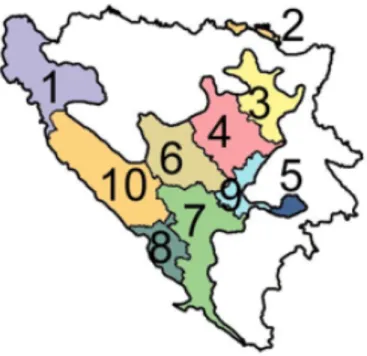
60 The ten cantons in the Federation of BiH are: 1. Una-Sana; 2. Posavina; 3. Tuzla; 4. Zenica-Doboj; 5 Bosnian Podrinje; 6.
Central Bosnia; 7. Herzegovina-Neretva; 8. West Herzegovina; 9. Sarajevo; 10. Herzeg-Bosnia or Canton 10.
Figure 3. Map of BiH with Cantons. Source: Spirit of Bosnia
The national government is located in Sarajevo, and is headed by three Presidents, three Vice-Presidents, a Council of Ministers, and a bicameral legislative branch. There is also a Constitutional Court, a High Judicial Court, and a State Prosecutor’s Office. The Bosniak and Croat members of the Presidency are elected by voters in the Federation, while the Serb member is elected by voters in the Republika Srpska. The presidential term is four years, and the three members rotate for the main position every eight months, beginning with whoever receives the most votes. The members of the Presidency do not wield tremendous domestic powers, but they do represent BiH in foreign affairs, and appoint the Chair of the Council of Ministers.
The highest governmental authority rests in the hands of the internationally-appointed Office of the High Representative (OHR), who is able to suspend any state or entity laws, and remove elected officials deemed a threat to the security of the state.62 The OHR reports to the
62 Patrice McMahon writes: “When the OHR was created, it had no institutional base to carry out its goals. As of January 2003, it
Steering Board of the Peace Implementation Council (PIC SB), an assembly of delegates from various national governments.63 The PIC SB has established a set of objectives and conditions that must be met for the closure of the OHR.64 One objective was completed when the
Parliamentary Assembly in BiH recognized the self-governance of the District of Brčko.
At the entity level, the Federation also has a President and two Vice Presidents, as well as a Prime Minister, appointed by its bicameral legislative branch. The Republika Srpska has a President and two Vice Presidents, but due to the Serb majority, power usually resides in the hands of the Serb President. The Republika Srpska has a Prime Minister and a unicameral legislature called the National Assembly. There is a separate Legislative Assembly and Mayor for the District of Brčko. Within the Federation of BiH, there are ten cantonal governments, and throughout BiH, individual municipal governments.
As mentioned, the government of Bosnia-Herzegovina formally recognizes three
constitutive nations/constituent peoples: Serbs, Bosniaks, and Croats, as well as several minority groups. Leaders of the constitutive nations have the power to nullify legislation deemed a threat to their national autonomy through a “vital national interest” veto, which has impeded reform and reintegration efforts. The veto was established to protect the groups from systematic
marginalization in the post-war period, but it has been used by ethno-national leaders to preserve the decentralized government and a weak state. For instance, the Constitution of
been given in recent years.” The powers of the OHR were expanded in 1997 under the “Bonn Powers,” and by 2001, over 100 laws were enacted by the OHR. McMahon argues that the presence of the OHR has further weakened the BiH state.
McMahon, P. C. (2004). “Rebuilding Bosnia: A Model to Emulate or to Avoid?” Political Science Quarterly, 119(4), 569-593, Pg. 587
63 The PIC’s Steering Board members are Canada, France, Germany, Italy, Japan, Russia, the UK, the US, the EU presidency, the
European Commission and the Organization of the Islamic Conference, represented by Turkey.
64The objectives and conditions set by the PIC are: the resolution of state property; resolution of defense property; completion
of the Brčko final award (completed); fiscal sustainability of the state; and entrenchment of the rule of law. The two conditions are signing the Stabilization and Association Agreement with the EU (completed), and obtaining a positive assessment of the situation from the PIC.
Herzegovina, established in Annex 4 of the Dayton Peace Accords, states that only individuals belonging to one of the three constitutive nations are able to hold office in many elected
positions, whereas members of minority groups such as Roma, Jews, and self-declared Bosnians are excluded.65
Even though the European court of Human Rights ruled in 2009 that the country’s
constitution violates minority rights when it excludes Jewish and Roma people from standing for either the three-member Presidency or the House of Peoples, ethno-national leaders have used the veto to strike down proposed amendments to the constitution. In the case of Bosnian Croats, the stated concern has been that a non-Croat could be elected as the Croat representative to the Presidency, which could result in Croats being outvoted on important matters. At the same time, it is possible to see that ethno-national leaders have used the democratic institutions available to retain their hold on power while the people who have an interest in changing the current situation are excluded from participation.
State-building Efforts and Ethno-national Resistance
In the following section, I analyze the post-war reform efforts in two periods, the first from 1996-2006, and the second from 2006-present. In doing so, I wish to draw attention to the fact that there has been a noticeable withdrawal of the International Community from BiH in more recent years, possibly due to conflicts and matters of interest elsewhere, but perhaps also due to assumptions that Bosnia-Herzegovina is ready to assume self-governance. While the
65On 22 December 2009, the European Court of Human Rights (ECtHR) ordered the abolition of discriminatory restrictions
against the Jewish and Roma people. Retrieved April 19, 2016 from
http://minorityrights.org/publications/discrimination-and-political-participation-in-bosnia-and-herzegovina-march-2010/. See the following January 2016 BBC interview with BiH Foreign Minister Igor Crnadak for more on the failures to amend the Bosnian constitution to reflect the ECtHR Sejdic-Finci vs BiH court case: http://www.bbc.co.uk/programmes/b06z1dvh.
international community (the EU, and to a slightly lesser degree, the U.S.) has invested heavily in Bosnia-Herzegovina thus far, a closer look at the successes and failures of the post-war reform efforts indicates that the international presence in BiH remains necessary.
The initial post-war reforms included the transformation of various institutions to coincide with the Dayton Peace Accords, as well as the creation of a single currency and a Central Bank. There were also wide-ranging military, police, and security reform efforts in this period, which were largely successful.66 In 2005, Bosnia-Herzegovina agreed to work towards a Stabilization and Association Agreement (SAA) with the European Union, a plan for
membership, but state’s ability to adopt the SAA mandates had been in doubt even then due to the decentralized nature of the government.67
In 2006, the U.S. and the EU launched a formal effort to revise Bosnia-Herzegovina’s constitution, known as the “April Package,” but it was defeated by two votes in the state parliament.68 As Sofia Sebastian notes:
While all major Serb parties, both Bosniak parties…and the Croat HDZ BiH stayed firmly behind the April Package, [The Party for Bosnia-Herzegovina] SBiH, the only Bosniak party that withdrew from negotiations in the last stage, and the Croat HDZ 1990 – a [more conservative] splinter of HDZ BiH created shortly prior to the voting of the AP - rejected the package along with other independent MPs.69
Sebastian points to ethno-national tensions, but also to disputes between administrations within cantons as reasons for the rejection of the package, in addition to misinformation among
66 Mujanovic, J. (2014) ibid., 109-111.
67 Perry (2010) underlines that the number of BiH Ministers of Parliament is “strikingly small:
The Parliamentary Assembly of Bosnia and Herzegovina consists of a 15-member House of Peoples (upper House) and a 42-member House of Representatives (lower House), and is the smallest bicameral state legislature in Europe. Many functions often held by the state are in BiH decentralized, accounting in part for this discrepancy.”
Perry, V. (2010). Fifteen Years of the Human Dimension in Bosnia and Herzegovina — The Ebb and Flow of State-building. Security and Human Rights, 21(4), 279-291. Pg. 282
68 Mujanovic (2014, ibid., 109-111) explains that the purpose of this was to align Bosnia’s state-level institutions with EU and
NATO policies, for eventual membership in both.
69 Sebastian, S. (2007) Leaving Behind Dayton: Constitutional Reform in BiH. Madrid: Fundacion para las Relaciones
members of the state parliament who assumed acceptance of the April Package would mean approval of the Dayton-established constitution of BiH, which was not voted on in the state parliament.70
It is perhaps not surprising then, that the second period of reform efforts in BiH has fared less well, and has been met with opposition by nationalist leaders. In particular, then Prime Minister and current President of the Republika Srpska, Milorad Dodik, opposed reforms aimed at a centralized government, and has argued that the 1996-2006 reforms stripped the Republika Srpska of its autonomy. After the April Package was defeated, Dodik claimed that any
subsequent reform efforts would have to recognize the autonomy of the Republika Srpska, and proceed from there. This was opposed by the Bosniak leader of the Party for BiH (SBiH), Haris Siljadzic, who called for a BiH without entity-level voting, and a strong state government.71
The SAA was signed in June 2008, but it was frozen the following year because BiH’s ruling parties failed to agree on an amendment to the constitution to reflect the “Sejdic-Finci” court case. However, this was not the only condition needed to unlock the SAA, and further attempts to satisfy the requirements were faced with challenges.72 While the SAA was in development, the Interim Agreement (IA) was enacted, which focused on fulfilling the trade-related portions of the SAA.73 The Interim Agreement enabled BiH to export agricultural goods
70 Perry (2010, ibid., 282) reports: “The BiH Parliamentary Assembly (PA) adopted 239 laws in its four-year mandate from
2002-2006 compared to the adoption of 168 laws by the PA between 2002-2006-2010 (78 laws were rejected in the Parliamentary Assembly from 2006-2010 due to the entity vote provision).” If a law is adopted at the national level, it must also be approved at the entity level before it is implemented. Ibid.
71Mujanovic, J. (2013). Reclaiming the Political in Bosnia: A Critique of the Legal-Rational Nightmare of Contemporary Bosnian Statehood. Theory in Action,6(2), 109-147. 115
72 The 2009 European Commission Report for BiH states: “The overall political climate has deteriorated in recent months and
the [constitutional amendment] process has been discontinued.” Pg. 8.
73 Other conditions in the SAA required BiH to implement a state aid law, conduct a national census, and close the Office of the
High Representative (OHR). The last condition was removed in 2010 by the EU and the OHR remains in function. A state aid law was adopted in 2012, but it was not implemented. The first post-war census was conducted in October 2013, and preliminary results were released. The census is scheduled for publication in June, 2016. It was delayed due to a dispute between the Statistical Agencies of the FBiH and the Republika Srpska, concerning use of the word “Muslim” to refer to an ethnic group. In 2014, the amendment to the BiH constitution related to the “Sejdic-Finci” court case was also dropped from the list of conditions required to unlock the SAA.
to the EU market almost entirely without fees. In 2009, the U.S. and the E.U. attempted to reform the constitution in BiH once more in a series of discussions referred to as the “Butmir Process,” which included proposals similar to those introduced in 2006. The goals of the Butmir Process were to empower the Prime Minister, and disempower the House of Peoples, in order to reduce it to a committee of the House of Representatives.74 The same year, the European
Commission (EC) allocated nearly 90 million euros to BiH under the 2009 Instrument for Pre-accession Assistance (IPA) program.75 These meetings added to the level of political deadlock in BiH at the time, which carried over into the 2010 elections, held in October.
As highlighted in the previous chapter, the re-election of Željko Komšić to the Presidency as the Croat representative was additional fuel for discourse, and rhetoric calling for a “third entity” by the Croats and secession by the Serbs persisted. While both Komšić and the Bosniak representative Bakir Izetbegtović were reported to be moderate candidates, the parties elected at the entity level, including Milorad Dodik winning the Presidency of the Republika Srpska, were less cooperative, and a national government was not immediately formed. Seven months after the elections, only the government of Republika Srpska was ready, and discussions among the parties attempting to form a coalition in the Federation had stalled. On March 17, 2011, two Muslim parties and a Croat party formed a coalition in an attempt to bypass the parties who had failed to do so, but the electoral commission ruled that they had formed illegally. High
Representative Valentin Inzko overturned this decision, which was followed by a response by nine Croat parties who issued a joint statement that said, “Inzko’s move reduced [Bosnian] Croats to ‘lower than a national minority’ and that it favour[ed] the Muslim majority.” In the city of Mostar, considered by nationalists the “Croat capital” in BiH, Bosnian Croat parties
74Anderson, L. D. (2013). Federal solutions to ethnic problems: Accommodating diversity. New York: Routledge, Pg. 40. 75 The 2009 IPA Programme was also intended to alleviate the impact of the financial crisis in BiH.
established a Croat National Assembly.76
Meanwhile, the National Assembly in the Republika Srpska started to debate the legitimacy of the state-level judicial institutions, and President Dodik began to call for a referendum to abolish the federal court and State Prosecutor’s Office. He accused these institutions of an anti-Serb bias, and of undermining Republika Srpska’s autonomy.77 Eight months after the general elections, the country formed a Parliamentary Assembly, and Dodik announced that the Republika Srpska would seek to challenge several legal developments in
Sarajevo.78 At the PIC Steering Board meeting in May 2011, High Representative Inzko reported
that the political parties were employing zero-sum politics, and that the country was facing the highest tensions since the signing of the Dayton Peace Accords.79 In September 2011, the office of European Union Special Representative (EUSOR) was opened, and was assigned with helping BiH progress towards EU membership. This was previously the responsibility of the OHR, now
tasked with monitoring the implementation of the Dayton Peace Accords.80
The same year, the International Crisis Group reported that Republika Srpska President Milorad Dodik’s anti-reformist stance was potentially motivated by concerns that state
prosecutors would indict him for corruption, or mis-use of office.81 And not to single out Dodik, the leader of the Alliance for a Better Future of BiH (SBB-BiH), Fahrudin Radončić, was implicated in a corruption scandal involving the Federation Development Bank. Radončić is the founder of BiH’s largest newspaper, the Dnevni Avaz, and has used the platform to wage a
76Hadzovic, E. (2011, April 19). Bosnian Croats Form National Assembly. Retrieved April 19, 2016, from
http://www.balkaninsight.com/en/article/bosnian-croats-to-form-the-national-assemly
77 Mujanovic (2014) ibid. Pg. 114.
78 Security Council Report - November 2011. Retrieved April 19, 2016 from
http://www.securitycouncilreport.org/monthly-forecast/2011-11/lookup_c_glKWLeMTIsG_b_7811243.php.
79 ibid. 80 ibid.