THE EFFECT OF SQRQCQ ON FOURTH GRADERS’ MATH WORD PROBLEM PERFORMANCE
Kristen Rose
A Thesis
Submitted to the Graduate College of Bowling Green State University in partial fulfillment of
the requirements for the degree of
MASTER OF EDUCATION May 2011
Committee:
Dr. Nancy Fordham, Advisor Dr. Cindy Hendricks
© 2011 Kristen Rose All Rights Reserved
ABSTRACT
Nancy Fordham, Advisor
Traditionally, mathematics and reading are seen as two separate entities; however, research suggests that problem solving and reading comprehension are linked. Much research is available regarding reading comprehension and fiction texts. The amount of research available decreases when reading comprehension and nonfiction texts are combined, and there is scant research reviewing reading comprehension and problem solving in the math classroom. To further explore this area of education, this research study was designed to evaluate the
effectiveness of the math and reading comprehension strategy Survey, Question, Read, Question, Compute, Question (SQRQCQ) on students’ word problem performance and their attitudes towards word problems. Fourth grade students learned and practiced SQRQCQ while being surveyed and assessed. It was found that in such a short time period, the usage of SQRQCQ did not increase students’ assessment scores; however, there was an increase in students’ confidence when solving word problems. The researcher concluded that although SQRQCQ did not show an immediate benefit in student achievement, comprehension strategies should be explicitly taught in the math classroom. The researcher suggests that further research surrounding math and reading comprehension be conducted over a longer period of time.
This thesis is dedicated to all of the content teachers who think the subject of reading is not their responsibility. I hope the ideas presented are opinion changing.
ACKNOWLEDGMENTS
To Mom, Dad, and Luke,
Your never-ending support and love has gotten me through a tough year. Cooking for me, washing my clothes, and slipping me money has helped too.
To Dr. Fordham,
You have been a constant mentor who has pushed and pulled a reluctant student through this immeasurable writing process. You have accepted nothing less than my very best, and I am proud to publish this study. I could never thank you enough.
To Dr. Hendricks and Dr. Earley,
Thank you for your guidance. My thesis is infinitely stronger because of your assistance.
To Amy and Kylie, We made it! Thank God.
To my fellow GAs,
TABLE OF CONTENTS
Page
CHAPTER I: INTRODUCTION ... 1
Statement of the Problem ... 2
Research Questions ... 3
Rationale ... 3
Definition of Terms ... 4
Limitations ... 5
CHAPTER II: REVIEW OF THE LITERATURE ... 6
Schema Theory ... 6 Cognitive Theory ... 7 Emergent Literacy ... 9 Expectancy-Value Theory ... 9 Comprehension Theory ... 10 Metacognition ... 12 Content Comprehension ... 14 Informational Texts ... 16
Informational Text Structure ... 19
SQ3R ... 20
Reading in the Math Classroom ... 21
Math Strategy and SQRQCQ ... 24
Cognitive Confusion ... 26
CHAPTER III: METHODS AND PROCEDURES ... 28 Research Design ... 28 Participants ... 29 Instrumentation ... 30 Procedures ... 31 Data Collection ... 31 Data Analysis ... 32 Summary ... 32
CHAPTER IV: DATA ANALYSIS AND DISCUSSION OF RESULTS ... 33
Data Analysis ... 34
Discussion of Results ... 39
Summary ... 40
CHAPTER V: SUMMARY, CONCLUSIONS, AND RECOMMENDATIONS ... 41
Summary of Previous Chapters ... 41
Conclusions ... 43
Recommendations ... 44
REFERENCES ... 48
APPENDIX A: PRE AND POST SURVEYS ... 54
APPENDIX B: PRE AND POST ASSESSMENTS ... 59
APPENDIX C: SQRQCQ BOOKMARK ... 66
CHAPTER I: INTRODUCTION
Ask any math student or his or her teacher. If given a choice, students would much rather attempt computation problems over word or story problems because, traditionally, students are more accustomed to the former. Given that word problems and computation problems require the same mathematical skill, one might wonder why students struggle when undertaking these tasks. When stepping outside of a math-only viewpoint, a teacher soon realizes that a completely different set of skills is needed to solve story problems. Fay (1965) describes three types of skills required in this situation. The first is that students need traditional math knowledge: addition, subtraction, division, and other basic and advanced operations. The second is that students need math vocabulary, meaning they need to know that “of” means multiply and so on. The third skill, Fay (1965) explains, involves problem-solving:
The third task [of problem solving], unfortunately, is often the source of confusion or error. Simply changing a multiplication problem from the conventional two-by-two block model to a less conventional form such as 23 times 46 = ___ results in a significant increase in the percentage of error among sixth grade pupils. Obviously, a reading study skill for this phase of mathematics is to be able to react intelligently to a computational problem regardless of its form. (p. 93)
From their earliest instruction in mathematics, students are taught to compute traditional numerical problems. Beginning in the middle grades, word problems begin to become a main focus in the mathematics classroom. A student needs to be able to apply reading skills when tackling this style of questioning in the math content area. Because math and reading are often seen as completely separate entities, students may believe they have hit a mental block when it comes to reading, understanding, solving, and explaining answers to written mathematical
23 X 46
problems. Unfortunately, students are rarely taught a concrete reading strategy for solving word problems. This gap in students’ education occurs because beginning at the middle grades,
teachers see themselves as specialists in their content areas, not necessarily one piece in an entire curriculum puzzle (Donahue, 2003).
Many strategies exist to aid students in technical reading; however, there are fewer strategies geared specifically at the math content area. One technical reading strategy, Survey, Question, Read, Recite, Review (SQ3R), was developed in 1941 by Robinson to help soldiers comprehend the technical reading of field manuals during World War II (Sticht, 2002). This strategy was adopted and has been used with nonfiction reading ever since. Later, during an International Reading Association conference in 1965, Leo Fay described his adaptation of the SQ3R strategy. Fay tailored the technical reading strategy to help students comprehend and compute word problems in the math classroom. This new strategy was called SQRQCQ, meaning Survey, Question, Reread, Question, Compute, and Question.
Statement of the Problem
Students in the United States cannot keep up with the rising math challenges they face. Research shows that when math assessment scores are compared to 40 other countries, students in the United States fall into the bottom half of the pile (Norris, 2004). One of the major
problems with math achievement is the fact that students cannot successfully solve word problems. Students may have a reading level on target with their grade level and computation ability; however, they cannot seem to integrate their various skills to determine a solution to a math problem written in sentences. Students need additional reading guidance in their math classrooms. Too often, math and reading are viewed as two separate entities. Teachers need a strategy to help bridge the content areas while in the math classroom.
Research Questions
This study addressed the idea that students need specific guidance when undertaking word problems in the math classroom because “mathematics performance and reading skills have been shown to be closely related” (Vilenius-Tuahimaa, Aunola, & Nurmi, 2008, p. 409).
Keeping this in mind, the study looked at the content strategy Survey, Question, Reread,
Question, Compute, Question (SQRQCQ). The study focused on the following question: “Does the strategy, SQRQCQ, increase performance results and student efficacy when students attempt word problems in their math classroom?” The study also focused on how students solved word problems before and after learning the SQRQCQ strategy.
Rationale
When researching how to help students solve word problems, a teacher will find much literature attesting to the fact that there is a connection between math and reading abilities, but not how to help students achieve in both subject areas by teaching the concepts in an integrated fashion. This study was designed to show students a content reading strategy and analyze its effectiveness when implemented in a math classroom. Mathematical text is different from other types of narrative or informational text. As teacher and researcher Metsisto (2005) states:
Research has shown that mathematics texts contain more concepts per sentence and paragraph than any other type of text. They are written in a very compact style; each sentence contains a lot of information, with little redundancy. The text can contain words as well as numeric and non-numeric symbols to decode. In addition, a page may be laid out in such a way that the eye must travel in a different pattern than the traditional left-to-right one of most reading. (p. 11)
This study of SQRQCQ is vital because there is simply not enough information currently published regarding strategies that enhance reading comprehension in math. Additionally, this study is important because it can show math teachers, who are not typically trained in content reading, how to teach their students to read and comprehend the mathematical language of story problems.
Definition of Terms Below are significant terms used throughout this study:
1. Informational text – “Informational text is a type of nonfiction that conveys information about the natural or social world” (6 reasons to use informational text, nd, np).
2. Narrative text – Narrative text is a traditional fiction story. According to Lauritzen & Jaeger (1997), stories “include all requirements of story: setting, characters, action direction toward goals, causation, and significance” (p. 35).
3. Word problems – Math word problems are math scenarios written out so students can apply mathematical knowledge in realistic situations (Jacobse & Harskamp, 2009).
4. These problems require a student to read and comprehend before he/she computes. This division scenario can be used as an example: “Mary has 156 crayons. If Mary passes the crayons out to six friends evenly, how many crayons would each friend receive?”
5. SQ3R – Robinson’s study skill, which helps students comprehend informational text in a systematic fashion (Robinson, 1946).
6. SQRQCQ – Fay’s study skill, which helps students comprehend their technical mathematics text in a systematic fashion (Fay, 1965).
7. Content literacy – Language and literacy development found within the content areas (Brozo, 2010).
Limitations
Because of the design of this study, several limitations occurred. First, this study was conducted in one fourth-grade, self-contained classroom with 29 students. It should be noted that because of the small sample size, results may not be generalizable to larger populations.
A second limitation was the fact that the examiner had no control over the sample population. At any time, subjects could be added or deleted from the class roster.
A third limitation of this study was the limited teaching time available. Because of time constraints while collecting data, students were taught the SQRQCQ strategy a total of three times. Additional teaching sessions may affect the results in further studies.
A fourth limitation was that students’ time to utilize the SQRQCQ strategy was very brief.
A fifth limitation was that because the researcher had no control over the sample population, not all students’ current reading abilities were at grade level.
A sixth limitation would be that students were self-reporting on the pre- and post-surveys. Students may have felt inclined to give “teacher friendly” answers.
CHAPTER II: REVIEW OF THE LITERATURE
Beginning in the intermediate grades, students enter an even more complex realm of learning, and they must comprehend a wider range of material to widen their knowledge base. The research summarized in this chapter shows that students also use comprehension skills in the math classroom. Because of this, students need to be explicitly taught content literacy strategies to aid them in the math classroom. This chapter will review theories that frame the idea of comprehension as well as research surrounding this concept, including information about
comprehension, content literacy, informational text, strategies to comprehend informational text, and one specific strategy, SQRQCQ.
Theoretical Orientation Schema Theory
Schema theory encompasses the idea that people file information into their memories much like books are filed in a library (Santrock, 2008). New information is easier to “locate” in a student’s brain, and older information takes longer to find, or may not be completely intact. Santrock explains that people do not store data exactly like a computer, and their minds can distort events as it files. These events are called schemas, which are “actions or mental representations that organize knowledge” (Santrock, p. 37).
This recognition is critical to any teacher because it explains why students need to learn information in a repeated fashion. Frequently, students cannot remember a new “event” in its entirety and need to be re-exposed to material. Additionally, students need to have schema activated before they begin to learn or read new material; they need to know what “book” they are locating. If students do not have a strong prior knowledge base or have misconceptions about a topic, they will not be able to learn new material as well. Once students engage their prior knowledge, they can begin to add new knowledge into their library. The overall key of schema
theory is that students are continually building their knowledge based on previous experiences. In reading, this can be done through discussion, a teacher reading aloud, hands-on activities, and more. The options are limitless for a creative teacher who has the goal that all students will comprehend new reading material. According to Semino (2000):
Schema theory is a theory of organization of background knowledge in long-term memory and of its use in comprehension…According to schema theory, comprehension involves an interaction between the (textual) input and the comprehender’s existing knowledge, and successful understanding depends on the availability and activation of relevant schemata. (p. 525)
Schema theory applies to any content area; however, it is especially applicable in math. Math is learned in a very systematic and sequential fashion, and new math knowledge builds on prior math knowledge. For example, students must learn to count before they can add, add before they can multiply, and multiply before they divide. Almost like walking up stairs, students must master each step in a mathematics curriculum before they can truly step up to the next level of learning.
Cognitive Theory
The schema theory falls into a larger realm which can be called cognitive theory, theory of cognitive development, or Piaget’s developmental stages. In these stages, theorist Piaget describes how children build schema throughout their lives, as well as four stages they encounter during cognitive growth. First, from the time children are born, they are continually building and adding to schemas. This is done through a process called assimilation and accommodation. According to Piaget (1970), “Assimilation is the integration of external elements into evolving or completed structures” (p. 706). In plain English, assimilation means that children fit new
knowledge into their preexisting knowledge. If that knowledge needs to be modified for new information to make sense, accommodation occurs. Piaget (1970) explains that accommodation is “any modification of an assimilatory scheme or structure by the elements it assimilates” (p. 708). Children are continually learning and attempting to balance assimilation and
accommodation, which is called equilibrium (Cherry, nd). As students reach equilibrium, they are able to move through the stages of cognitive development.
Huitt and Hummel (2003) explain Piaget’s four stages of cognitive development: The first is the sensorimotor stage, which begins at infancy. In this stage, cognitive development is shown through mobility and early language use (baby babbling). Next, children reach the pre-operational stage, which occurs during the toddler years and into early childhood. Children begin to use symbols (alphabet/numbers), are able to speak, and develop memory and imagination. The concrete operational stage is next, and children experience this stage during their elementary years and early adolescence. Children are able to think logically, manipulate symbols related to concrete objects (write/math operations), and develop operational thinking.
Although some may lag behind developmentally, fourth grade students are thought to be in this concrete operational stage. They are able to read, write, and perform math operations; however, everything they encounter in school is concrete, still able to be seen. This is true in their division and word problems: students are able to model and manipulate the scenarios in the word problems. In this stage, students need to have a solid foundation in their concrete
knowledge before they enter into the next more abstract stage of thinking.
The last stage developed by Piaget is called the formal operational stage (Huitt &
think abstractly and apply symbols to those thoughts. It is important to note that not all people encounter this last stage; many adults never leave the concrete operational stage.
Emergent Literacy
Emergent literacy is a theory that posits that at some point before children actually begin to read themselves, they have several understandings that acknowledge written language. Elliott and Olliff (2008) write, “In order to be successful in learning to read, prereaders should have knowledge of the alphabet, phonological awareness, letter-sound correspondences, awareness of print concepts and some experience using writing as a form of communication” (p. 551). Once students are emergent readers, they are ready to begin actual reading and writing. After students master stringing words into sentences and paragraphs at a fluent rate, the goal of reading
changes.
At about fourth grade, the difficulty of school texts increases significantly, and the focus of reading shifts from primarily recognizing words to understanding them (Sanacore & Palumbo, 2009). Students’ ability to recognize words quickly and automatically is essential at this point, since it frees mental energy for comprehension (Samuels, 1976). Difficulties in comprehension may arise from deficiencies in prerequisite skills, in lack of strategies for comprehending text (Carreker, Neuhaus, Swank, Johnson, Monfils, & Montemayor, 2007), or both.
Expectancy-Value Theory
In Bembenutty’s (2008) interview with Eccles, the researcher explained that she first began to examine why men were more likely to go into the math and science fields. To explore this trend, she looked at a classic expectancy-value model that encompasses people’s decisions in general. Eccles believes “People are most likely to do things at which they think they can
Eccles and her colleagues “proposed that children’s achievement performance, persistence, and choice of achievement tasks are most directly predicted by their expectancies for success on those tasks and the subjective value they attach to success on those tasks” (p. 50).
The choices that students make are also influenced by perceived consequences and social stigmas. In math, teaching math skills and comprehension through word problem strategies helps students feel confident in their abilities to understand and solve a problem. According to the expectancy-value theory, if students believe they can successfully accomplish a task such as a math word problem, they are more likely to value the process and work hard while finding a solution.
Comprehension
When a teacher asks a student what “comprehension” means, a popular response is “Being able to tell what happened in the story.” Comprehension is actually a more intricate process than often recognized. Fielding and Pearson (1994) explain, “Once thought of as the natural result of decoding plus oral language, comprehension is now viewed as a much more complex process involving knowledge, experience, thinking, and teaching” (p. 62).
Making meaning is the most basic form of comprehension. As Dooley (2010) explains, “… both terms, comprehension and meaning making, describe the same thing: making meaning with printed text” (p. 121). What is needed to comprehend text? Catts (2009) believes that, “The comprehension of written text is among the most complicated mental activities we engage in on a daily basis” (p. 178). Based on that belief, students need to be explicitly taught the skills of comprehension using research-based strategies. A strategy is an approach to learning that a teacher can model and a student can use when attempting to gain new knowledge. Fielding & Pearson (1994) explain:
Explicit instruction, the name given to one such widely researched model, involves four phases: teacher modeling and explanation of a strategy, guided practice during which teachers gradually give students more responsibility for task completion, independent practice accompanied by feedback, and application of the strategy in real reading situations. (p. 64)
Fielding and Pearson also explain that a successful comprehension curriculum includes large amounts of reading time, teacher-led instruction in comprehension, social learning, and the time to respond and discuss responses in reading.
Fielding and Pearson (1994) describe what is needed in a curriculum as well as what is vital for comprehension instruction, but what do students actually need to know to comprehend text? What should teachers strive to teach, no matter the subject area? First, one of the most important components of comprehension is metacognition. Metacognition is the knowledge of a person’s own thoughts or thought processes and is vital when comprehending text. Paris, Oka, and DeBritto (1983) explain, “Good readers stop periodically to check their own understanding and evaluate the truth and internal consistency of the information they have read” (p. 80). Students display some metacognition when they self-correct their oral reading; they know when a word pronunciation does not align with the story they are reading.
Boulware-Gooden, Carreker, Thornhill, and Joshi (2007) explain that students need to be taught specific strategies reflecting metacognition. One of the best is self-questioning. As
students read a text, they should ask themselves such questions: What’s going on in this selection? Does the new information align with the old? Do I understand what’s happening? Joseph (2010) concludes, “Metacognitive awareness can be taught with research emphasizing
classroom methods such as practicing techniques for introspective learning and talking about reading and thinking” (p. 100).
The end goal of teaching metacognition is that students are monitoring their
understanding--thinking about their comprehension as they read. Stolp and Zabrucky (2009) state:
Metacognitive experiences include the processes of evaluating and regulating one’s ongoing cognition and are not necessarily stable. For example, when students ask themselves questions during reading, they are evaluating their understanding. If students opt to reread one or more sentences or paragraphs because they are having difficulty understanding, then students are regulating their understanding. (p. 8)
Significant Historical Research Metacognition
In 1984, Paris and Jacobs constructed a study with two goals: One, they were curious to see the effect that reading awareness, or metacognition, had on comprehension skills. Two, the researchers also wanted to evaluate the effect of comprehension strategies on comprehension performance. Paris and Jacobs state, “Over the years, this kind of awareness has been referred to by terms such as ‘reflective thinking,’ ‘problem-solving skills,’ ‘consciousness raising,’ and most recently, ‘metacognition.’ Whatever label we choose, it is clear that the concept is important for understanding how children learn to read” (p. 2083). In the study, Paris and Jacobs set out to measure three strategic skills: evaluation, planning, and regulation. Their overall goal was to explore metacognition and the effects on comprehension when metacognition was manipulated.
Paris and Jacobs (1984) incorporated an instructional component into their study, designing it to be a long-term intervention for students. Students were presented with a
30-minute lesson twice a week for four months. The students were taught a wide range of comprehension skills. The subjects of the study were 91 third graders with a mean age of 8.5 years, and 92 fifth graders with a mean age of 10.5 years. All of the children were in self-contained classrooms, and there were a total of eight classrooms participating in the study. The classrooms came from separate schools, as they represented different socioeconomic indicators. Each classroom had virtually an equal amount of boys and girls, with 65% Caucasian students and 35% consisting of students from African-American, Asian, and Native American races.
The researchers used four methods of instrumentation, a structured interview about students’ reading awareness, and three different reading tasks designed to gauge comprehension. The interview was conducted twice, in the fall and in the spring, and consisted of Likert-scale items and open-ended questions. The Likert-scale items and 15 of those questions from the interviews were used when results were collected and analyzed. The instruction phase was called “intervention.” During the intervention stage, students were taught comprehension strategies geared towards increasing reading awareness, such as skimming, inferring, and summarizing. Bulletin boards supporting comprehension were also created, with themes such as “Being a Reading Detective” and “Tracking Down the Main Idea.”
After pre- and post-testing, results were collected and analyzed. Paris and Jacobs (1984) reported “there are significant links between awareness and comprehension across all children… All children in the study increased their reading awareness during the school year” (p. 2008). Students were grouped into low, middle, and high awareness groups. The results showed that the students in the high group significantly improved in comprehension; however, no significant differences were found in the middle and low groups. It should be noted, however, that on
average, the students in the experimental classrooms displayed higher comprehension than students in the control classrooms.
Fundamentally, students need metacognition while they read; however, students also need prior knowledge before they begin to read a text. Prior knowledge is defined by Tovar-Hilbert (2009-2010) as the “learner’s attitude, experience, and knowledge” (p. 5) he/she arrives with before reading. Tapping into prior knowledge with discussion or questioning activates students’ brains and prepares them for reading, aiding in the comprehension process. Lipson (1983) found texts that were culturally compatible with students’ beliefs were more likely to be comprehended than passages not culturally compatible. If a common text is being read in the class, the teacher can help to build prior knowledge through a common experience, video clip, teacher read-aloud, or discussion. Hailikari, Katajavouri, and Lindblom-Ylanne (2008) describe the importance of prior knowledge:
Inadequate or fragmented prior knowledge is an important issue to consider because if there is a mismatch between the instructors’ expectations of the student knowledge and the students’ actual knowledge base, learning may be hampered from the start of the studies. Trying to learn something without having adequate prior knowledge, or, worse, having misconceptions, may result in rote memorization. This type of surface learning may occur if students cannot relate the new knowledge to their existing knowledge frameworks. (pp. 1-2)
Content Comprehension
While research shows that students need explicit instruction, metacognition, and prior knowledge to help them comprehend new material, many content teachers do not teach reading skills, leaving the work to the language arts teacher. Tovani (2004) comments:
I understand why content-area teachers are resistant to these calls to teach reading. Who has the time for it, when new content requirements are being added all the time through state and national standards? Few, if any, content teachers chose the profession because they wanted to be reading teachers… (p. 7)
Tovani explains that she instructs teachers to look at reading in the content area as teaching students “how to remember and reuse the information we ask them to read” (p. 7).
The literature supports the belief that content area teachers are also responsible for students’ reading abilities, specifically comprehension. Thompson (2008) explains that the content areas have many different forms of reading, and literacy instruction needs to be incorporated into the content classroom. Loranger (1999) calls for content literacy because “Studies suggest that, as our economy changes from an industrial and manufacturing base to a technological base, students will need a high proficiency in reading and writing. Reading in the content areas is seen as a viable way to address that literacy crisis” (p. 239). Ogle and Correa-Kovtun (2010) find that five essential things are needed consistently for content instruction and comprehension improvement: reading at instructional or independent levels, chances to converse about content vocabulary, questions created and answered by students themselves, content teaching, and guidance when it comes to content texts.
In a case study surrounding content area literacy, one content area teacher’s teaching strategies were analyzed (Loranger, 1999). John Hodsdon, a sixth grade science teacher,
incorporated a unique component his class: he hosted silent reading and response journaling for the first ten minutes of every class. Hodsdon and his colleagues believed in teaching content area literacy. Loranger states, “All content teachers at his school assume responsibility for content
literacy--that is, the ability to use reading, writing, and study strategies to learn subject matter across the curriculum” (p. 239).
The content literacy program in the study was born out of necessity. Hodsdon’s school did not have money for an additional reading staff, so the content teachers shouldered the responsibility of teaching reading in their own classrooms. The school created a class called Reading in the Content Area (RCA), where four content teachers--English, social studies, science, and math--each taught reading skills in their classroom. Hodsdon was the science teacher included on this team (Loranger, 1999).
Hodsdon conducted daily Sustained Silent Reading and book shares in his science classroom (Loranger, 1999). Students created portfolios that contained journals, response logs, and reading trackers. The students were taught and utilized strategies such as
comparing/contrasting, sequencing, opinion versus proof, vocabulary and graphic organizers. RAFTs, a writing strategy in which students assume a role, establish an audience, and write in a selected format on a specific topic, were also implemented.
Students’ reading skills were assessed via portfolios, in which they selected five pieces of work that displayed their mastery in both the content area and reading. At the conclusion of the case study, Hodsdon’s professor, Loranger, states that Hodsdon had created a model classroom for content literacy, bridging theory and practice. While the data from this study was qualitative, Loranger (1999) believes that all content area classrooms can incorporate literacy just as
Hodsdon’s does.
Informational Texts
Most content text in the areas of social studies, science, and math are nonfiction.
Conderman, 2010). Duke (2004) explains, “We are surrounded by text whose primary purpose is to convey information about the natural or social world. Success in schooling, the workplace, and society depends on our ability to comprehend this material” (p. 40). As students enter the middle grades, they read an increased amount of informational text (Hall & Sabey, 2007). Hall and Sabey state, “By the sixth grade, more than 75% of school reading is done with non-narrative texts” (p. 261).
Chall, Jacobs, and Baldwin (1990) explain that students should be taught to read to learn. In the early grades, students are taught to read using primarily narrative texts. As students reach middle school, starting around the fourth grade, the overall goal of reading changes. Students are now expected to learn from a classroom text; however, students are not accustomed to this expectation. Duke (2010) explains that in the early grades “only 9.8% of the books and other materials in classroom libraries and only 2.6% of the materials on classroom walls and other surfaces were informational text” (p. 68). Because reading is primarily focused on narrative texts in the primary grades, students need additional support when confronting informational reading.
Informational texts have different text features than traditional narrative text to which student are accustomed. Students struggle to comprehend informational text because of “an (a) increase in unfamiliar and content-specific vocabulary, (b) use of new and unknown text structures, and (c) increase in headings/subheadings, captions, and graphics (i.e., charts, diagrams, and graphs)” (Hall & Sabey, 2007, p. 262). Even though students struggle with informational text, research describes several proven methods to help students comprehend their reading.
A study published by Symons, MacLatchy-Gaudet, Stone, and Reynolds (2001)
availability of information requires the development of effective information-seeking strategies” (p. 1). The researchers used Guthrie and Mosenthal’s (1987) problem solving model, consisting of five steps:
1. Goal formation, whereby the searcher establishes a goal (or problem to be solved).
2. Category selection, whereby the searcher chooses sections of text to inspect. 3. Extraction of information, in which the reader inspects the selected text to identify
goal-relevant information.
4. Integration, where the searcher makes a judgment regarding the relevance of the extracted information to the search goal and to other extracted information. 5. Recycling, or sequencing, by which the previous four components are organized
temporarily. (p. 2)
In their study, the researchers studied children’s (grades 3, 4, and 5) comprehension and the way they found information in a text. The 180 students selected had no significant academic difficulties. According the Symons et. al (2001), “Each student was instructed and tested
individually during one session that lasted approximately 30 [minutes]” (p. 6). They were asked to recall a time they had to find information, and then asked to find answers in an informational text.
The strategy outlined above helped students use their informational text resources such as the index. Students were also more likely to monitor the adequacy of their responses, increasing success compared to the control group. Overall, the researchers found that the students who were taught informational text strategies were able to answer comprehension questions more
instructed to monitor their success gave partially or completely incorrect answers to the search question, even when they had searched the key pages of text” (p. 16). Searching for information is something that’s done in every content area, including math. Symons et al.’s study supports the need for strategy instruction in every content classroom.
As discussed previously, students need background knowledge before they begin to read a text. Students also need a purpose for reading. It is part of the metacognition processes
discussed previously. Before students ask, “What is this text telling me?” they should ask “Why am I reading this?” In their book, Frank, Grossi, and Stanfield (2006) explain that three different types of prior knowledge are important for content literacy: topic knowledge, knowledge relating to text structure and organization, and prior knowledge in content vocabulary.
Second, teachers should use comprehension strategies to help their students comprehend nonfiction material. Frank, Grossi, and Stanfield (2006) explain that the origin of comprehension strategies came from F.P. Robinson, the author of Effective Study (1946). In his book, Robinson introduced a method called SQ3R, standing for Survey, Question, Read, Recite, and Review. This study skill began a trend of helping students comprehend using overviews, notes, study guides, and instructional frameworks.
Informational Text Structure
Informational texts, like textbooks, have unique structures that should be explicitly taught to students. According to Williams (2005), “Instruction designed to teach students to recognize underlying structure of text improves comprehension” (p. 7). Williams explains that expository or informational text is generally more difficult to comprehend because of unfamiliar content and structure. Fisher, Fray, and Lapp (2008) explain that “informational texts are commonly
chronological/sequence/temporal, and descriptive” (p. 553). Students should be taught text characteristics so they can recognize which way information is being organized in their reading. Before using a strategy like SQ3R described in the next section, students should also be taught features that are common in informational text, such as “headings, captions, illustrations, boldface words, graphs, diagrams, glossaries, and so on” (Fisher, Fray, & Lapp, p. 554). Once students understand the structure and features of informational text, using comprehension strategies and understanding material will become an easier process.
SQ3R
SQ3R is described by Sticht (2002) as a plan that helped the United States win World War II. He explains that colleges were inundated with Army personnel who needed to learn special skills. Because of the ongoing war, these students needed special accelerated courses. Robinson, a professor at the Ohio State University, led a new program called Learning and Study Skills, which taught the students how to learn through their reading. After working with this program, Robinson developed the SQ3R strategy, which has survived for more than 60 years.
SQ3R is a strategy that is now used to help readers tackle informational text. While it is a useful strategy, it is one that needs to be explicitly taught and practiced before independent use. Once the reader is comfortable with the strategy, SQ3R should generate a higher level of comprehension and a better retention rate (Robinson, 1946).
Roberts (2009) describes the five-step process involved in SQ3R. The S stands for Survey. Students should survey the chapter: headings, titles, introduction and summary, and pictures. The Q stands for Questions. Students convert the titles and surveyed materials into questions answerable through reading. The first R stands for Read. The student should read the material and attempt to answer the questions. The second R represents Recite. This R in the
strategy requires that students read aloud their questions and answers to check that the
information is logical. The third and final R is Review. Students should re-read their notes and sections of material that may still be unclear. Today, many classrooms use this strategy to help students comprehend informational text.
Robinson (1946), the creator of SQ3R, conducted a study that supported his strategy. In his course, he tested his students’ reading abilities by fluency and comprehension
pre-assessments. Then, he taught the students how to use the SQ3R method. Students were given time to practice the method and internalize the steps. Students were then given a
post-assessment, testing fluency and comprehension again. Robinson found that on average, student comprehension and accuracy in responding to comprehension questions increased by ten percent.
Reading in the Math Classroom
As discussed, informational text can be difficult to comprehend, and there are strategies tailored to help tackle informational reading in the content classroom; however, math texts present their own unique challenges. According to Vilenius-Tuohimaa, Aunola, and Nurmi (2008), technical reading skills, reading comprehension and reasoning skills affect student performance on math word problems. In their study, the authors found that even “after
controlling for level of technical reading, performance in mathematical word problems continued to be related to reading comprehension” (p. 422). The reality in today’s education is the view that reading and math are not related--they are two completely opposite subjects that utilize different skills; however, math teachers often find that student achievement plummets when students encounter word problems. In her chapter about reading in the math classroom, Metsisto (2005) quotes several math teachers:
“The students know how to do the math; they just don’t understand what the question is asking.”
“The thing I don’t like about this new series is the way the problems are stated; they’re hard for the students to get what to do.”
“The reading level is too hard for the students.”
“I have to simplify, to reword the questions for my students, and then they can do it.” (p. 9)
Mathematical text is considered informational text, text from which students read to learn and gain information from; however, it does differ from traditional informational text. Given that written mathematical language is considerably more difficult than traditional reading, students need background knowledge and strategy support to effectively read and solve word problems.
The following study supports the thought that math word problems and reading comprehension are related. In their study, The Association between Mathematical Word
Problems and Reading Comprehension, three professors at the University of Jyvaskyla, Finland, Vilenius-Tuohimaa, Aunola, and Nurmi (2008) researched the hypothesized link between reading comprehension and mathematical problem solving, as well as the link between reading comprehension, problem solving, and technical reading. The study screened fourth grade students, placed them into poor reader or good reader groups, and then tested their reading comprehension and math problem-solving abilities. The study found that technical reading fluency can predict reading comprehension and is related to math problem solving. Just as students must be emergent in literacy before they can read, the study results showed that
technical reading, the actual mechanics of reading such as phonics and fluency, should be taught before reading comprehension and word problems.
The study examined several key issues surrounding reading comprehension and math problem solving. Previous research had shown that word problem skills and reading
comprehension were related to overall reasoning abilities. Another main issue raised by previous research was that technical reading skills, such as word recognition, are connected to math and reading abilities. The third main issue raised by previous research was that parental education level and socioeconomic status influence students’ abilities on reading comprehension and math problem solving.
Because of published research, the researchers wanted to look at several main ideas in their study. First, they investigated how math problem solving and reading comprehension relate to each other. Second, they analyzed the extent to which technical reading levels relate to math word problems and reading comprehension. Third, they examined how gender and
maternal/paternal roles affected word problem skills and reading comprehension.
To conduct the study, 210 (eventually growing to 225) primary students, all born in 1993, were selected to be tested. The students were tested in the 4th
grade and were demographically similar. Twenty-four percent of the students received some form of special education services, and the classes were mixed heterogeneously by achievement.
First, family questionnaires were sent out and then mailed back to the researchers. The questionnaires inquired about parental education level and background. Once that data were collected, students were tested in technical reading ability and grouped into good or poor reader groups. Then, students were tested in reading comprehension, the test looking much like a standardized proficiency test, with short passages and multiple choice questions. They were also tested in math during a normal class period, given twenty word problems surrounding focus, change, combining and comparing.
Overall, the good reader group performed significantly better than the poor reader group. Girls in the good reader group were found to be better at reading comprehension, but no
significance was found in word problem abilities. In the poor reader group, neither males nor females outperformed the other gender. The researchers also found that technical reading skills were a strong indicator of word problem and reading comprehension performance. Additionally, maternal educational level and economic status had a direct impact on performance. This was true for paternal education level and economic status as well, although the impact was not as significant.
The researchers found a definite interplay between reading comprehension and math word problem abilities, even when gender and background are controlled. They stated that technical reading is crucial to math and reading programs, and that it should be taught before comprehension skills. Additionally, they found that no matter the achievement level, some reasoning abilities needed to be present.
Math Strategy and SQRQCQ
According to Heidema (2009), “Mathematics is about problem solving, and reading comprehension is an important component, especially for word problems” (p. 2). Heidema explains a skill model developed by Polya in 1957. In this model, Polya developed four steps to effectively solve word problems. The steps include understanding the problem, devising a plan, carrying out the plan, and looking back. Polya’s conceptual model and the successful SQ3R strategy were blended, and the idea of SQRQCQ was born.
SQRQCQ is a comprehension strategy specifically designed for word problems in mathematics. Fay presented his idea of SQRQCQ at an International Reading Association conference in 1965. Fay stated the reasoning behind the SQRQCQ strategy: “It is in the
problem-solving phase of mathematics…that the reading study skills have their major applications at both a general level of study procedure and a more specific level involving vocabulary,
comprehension and interpretation skills” (p. 93). SQRQCQ is a more directed approach to solving word problems, with very specific steps.
SQRQCQ has six steps. First, the student should survey the information; this is the first S (Survey). The student should scan the problem quickly to gain a general idea of what the
problem is about. Next, Q (Question): the student should determine the question the problem is asking. After that, R (Reread): the student should carefully reread the problem in order to
recognize important information. The fourth step, Q (Question) is to ask another question, “What mathematical operation(s) do I apply?” Here, students decide how they are going to solve the problem. C (Computation) is the fifth step. Students compute to find their answer. The final step is Q (Question). This time, students are asking themselves if the answer is correct and sensible. Essentially, they are reviewing and checking their work.
Fay (1965) states that for this method of study to be effective:
a twofold foundation is needed. The first is mathematical. The student must understand the number system and know the basic arithmetic facts. The second is vocabulary foundation that provides the basis for quantitative reasoning and the clues for the use of mathematical processes…Building upon the mathematical and language foundations, problem solving demands the application of comprehension and critical reading skills. (p. 93)
Although historical studies are scant in the area of SQRQCQ, there are advocates of the practice, since it aligns with the theories surrounding comprehension. Heidema (2009) supports
using the SQRQCQ strategy by explaining that it helps students focus on the problem, solve it, and reflect upon their understanding.
Cognitive Confusion
Although strategies such as SQRQCQ have great potential, Blais, Kerry, and Hughes (1993) explain that when new knowledge is being transferred, old knowledge can interfere with new tasks for a period of time. This is called negative transfer or cognitive confusion. When students are presented with a wide range of choices when making decisions, processing time can be affected, causing students to be confused during the process and negatively affecting
performance on a new task (Barnard, 2010). It should be noted, however, that when Fazey and Fazey (1989) studied cognitive confusion over a long period of time (over 500 trials), they found there were no negative long-term effects on learning.
Summary
Comprehension instruction has traditionally been viewed as the job of a reading teacher; however, research supports the idea that teaching comprehension techniques in the content classrooms is valuable and should be implemented. Hodsdon explains that literacy instruction can be beautifully implemented into a content classroom (Loranger, 1999). If students are taught reading and comprehension skills throughout the day, standardized test scores are bound to improve.
Strategies and methods of study are widely available to help students tackle informational text. Strategies like SQ3R can help students comprehend and retain information available in nonfiction passages. Informational text doesn’t just exist in language arts, science and social studies, but it is prevalent in math classrooms as well. Research has shown that reading comprehension skills directly affect math word problem performance. As students reach the
middle grades, they are faced with a growing number of math problems written out in story format. The math comprehension strategy, SQRQCQ, is potentially a strong strategy for solving word problems in the math classroom.
CHAPTER III: METHODS AND PROCEDURES
As students enter the middle grades, the study of math becomes less about basic computations and more about analytical thinking and problem solving. These thinking and problem solving abilities are affected by reading comprehension in the math classroom (Vilenious-Tuohimaa, Aunola, & Nurmi, 2008). Many strategies exist in reading and other content areas to help students digest informational text; however, the subject of math is often overlooked when it comes to reading methods. The purpose of this study was to examine if a defined strategy plan increased students’ word problem performance. A secondary purpose was to determine if having a well-defined word problem strategy boosts student competence in solving word problems. The study was driven by the question, “Does the strategy, SQRQCQ, increase performance results and student efficacy when students attempt word problems in their math classroom?”
Methods Research Design
This research study was developed as a quantitative study, in which the data was evaluated with measures of central tendency. The first purpose, the effect of SQRQCQ on students’ word problem achievement in math, was measured using scores from a pre-test and a post-test. On the pre-test, students were given 10 word problems related to the state’s fourth grade standards. The students were taught the strategy SQRQCQ and participated in guided practice three times in one week. Then, the researcher administered the post-assessment, which included 10 word problems of the same difficulty level. Score results were evaluated and analyzed.
The second purpose of this study, to assess student attitudes regarding word problems, was determined through a survey. Mertler (2008) describes survey design: “The researcher poses a series of questions, usually in written form, to participants who are willing to complete the survey…The analysis of data usually involves the calculation of frequency counts or percentages of response” (p. 83). A survey with questions surrounding attitudes and strategies the students use was administered twice, before and after teaching SQRQCQ. The researcher wanted to establish whether the confidence students have in their word problem abilities increases, decreases, or remains the same after exposure to the SQRQCQ strategy. Additionally, the researcher wanted to determine if students were identifying whether they use the SQRQCQ strategy. Mertler (2008) cautions, “It is important to remember that survey research simply takes a ‘snapshot’ of the phenomenon under investigation” (p. 83).
Participants
The chosen school was located near the university where the researcher was studying, making it a convenient place to conduct the research. The particular class of fourth grade students was chosen due to convenience sampling because of the willingness, cooperation and support of the classroom teacher. Both the teacher and the researcher had a shared goal of teaching and using a research-based strategy to help the fourth graders succeed in math. In the fourth grade, word problems become an integral part of the mathematics curriculum; therefore, the teacher believed the students would benefit greatly from a structured approach to these types of problems.
Sixteen fourth grade participants were included in this study. All participants were in the same self-contained classroom setting. The students attended a pre-K to fifth grade elementary school located in an economically diverse suburb of a moderately-sized city in the Midwest. For
the 2009-2010 school year, the elementary school was rated Excellent by the state. The third and fourth grade student classes each met state requirements in math and reading.
The school’s surrounding area was suburban, with four-to-eight percent of the families living below the poverty line. The median household income was $35,000-$65,000. The average family size was three-to-three-and-a-half. In the area, 85-95% of the public school students were Caucasian, non-Hispanic.
In the specific class participating in the study, there were no students on 504 or
Individualized Education Plans. There were six students whom the teacher identified as being “slightly behind” grade level in reading, meaning those students were reading at levels one-half to one-whole year lower than their peers.
Instrumentation Survey
This study implemented the use of one online survey during pre- and post-teaching. The survey was used to assess students’ attitudes about and approaches to word problems before and after learning the SQRQCQ strategy. The six survey questions were read by the teacher. The survey questions are included in Appendix A.
Assessment
A pre- and post-assessment was used as a second instrument in this study. (See Appendix B) During the collection of research, the fourth grade class participated in a unit focusing on mathematic operations. Because of this, the pre- and post-assessments consisted of 10 word problems geared towards addition, subtraction, multiplication, and division. Students were presented with the word problems and asked to use the SQRQCQ strategy, show their work, and
explain why their answer was correct. The 10 problems were completed individually with no assistance.
During the pre-testing, no strategy materials were available. SQRQCQ tools were utilized during the teaching of the strategy. The SQRQCQ strategy was taught three times in a one-week period. Each teaching session took approximately one hour. A classroom poster and individual bookmarks were available for student use during guided practice. (See Appendix C) The SQRQCQ bookmarks were available for student use during the post-test. The post-test questions contained 10 word problems of the same difficulty as the pre-test. The difficulty was controlled by using word problems of the same structure. For example, if on the pre-test Susie divided 120 crayons between two friends, then on the post-test Johnny divided 124 markers between four classmates.
Procedures
First, students were given a pre-survey to determine their attitudes and strategies surrounding word problems. Second, the students’ word problem abilities were assessed via a pre-test. Third, the students were taught SQRQCQ and participated in guided practice on a Wednesday, Thursday, Friday, and Wednesday during a one-week period. Third, the students were given a post-survey to track changes in attitudes and strategies. Last, the students’ word problem abilities were again assessed via a post-test.
Data Collection
The data collected consisted of survey responses from both the pre- and post-surveys. These data was collected via surveys printed from the online server, SurveyMonkey. The researcher conducted a frequency count of each answer selected for each multiple-choice
question. Qualitative answers were collected and listed. Pre- and post-assessment scores were collected when graded by the researcher.
Data Analysis
Students’ attitudes and approaches to word problems were analyzed by looking at responses to each question on the pre- and the post-surveys. Qualitatively, the researcher looked for a positive or negative trend surrounding the students’ attitudes toward solving word
problems. Also, the researcher was looking for a growing number of students who read a problem more than once before attempting and after answering a question. These data were evaluated using a frequency count on both the pre- and post-survey. Using the last survey
question, “What strategies do you use when reading and solving word problems? (You can select more than one.),” the researcher also looked to see if students were using elements of the
SQRQCQ strategy.
Student achievement was analyzed using pre- and post-assessment scores. The researcher used measures of central tendencies as well as a t-test and to compare the two score sets.
Summary
Fourth grade students participated in a study of the effects of SQRQCQ on math test scores. The purpose of this study was to discover if students’ word problem test scores increased after being taught the SQRQCQ strategy. The second purpose of this study was to see if students declared they used SQRQCQ and felt more confident answering word problems. The students experienced surveys, assessments, explicit strategy teaching and word problem practice. The data obtained were analyzed using central measures of tendency.
CHAPTER IV: DATA ANALYSIS AND DISCUSSION OF RESULTS
As reviewed in Chapter II, math text is more complex to comprehend than most reading material students encounter. Because of this, word problems in math can become a significant challenge due to both the reading comprehension and the technical math knowledge that is involved. Because of this predicament, this study was designed to determine if the strategy SQRQCQ (Survey, Question, Read, Question, Compute, Question) was beneficial when fourth grade students attempted to solve word problems. Additionally, the researcher wanted to discover if having a concrete word problem strategy, such as SQRQCQ, would improve
students’ attitudes toward math word problems. In this chapter, the results of the SQRQCQ pre-and post-surveys pre-and the pre-pre-and post-assessments will be summarized, as well as the
researcher’s observations made during the study.
Twenty-nine permission slips were distributed prior to pre-surveying and pre-testing. Seventeen parents allowed their students to participate in the study. Of those 17 permissions, 16 students elected to participate. On Day 1 of the study, students who had obtained parent
permission were read the Student Assent form by the researcher, found in Appendix D, to gain student permission to participate. At the time of the pre-test, four students were absent or in the principal’s office. Ultimately, 12 of the 16 consenting students took the pre-survey, found in Appendix A, which was read aloud to them by the researcher. The survey was given to assess students’ attitudes toward word problems. As students were read the prompts, they were asked to circle one answer that best described their thoughts or feelings, unless it was indicated that several answers could be selected.
Data Analysis
The first prompt students were given was “When I am given a word problem, I…” One student selected “can almost always solve it.” Eleven students selected “try my best to solve it.” The second prompt, “When I am solving a word problem, the first thing I do is…” was then read to the students. Two students selected the answer “start to solve it,” and 10 students selected the answer “read the problem.” When asked how many times they read a word problem before they tried to solve it, six students indicated they read a problem two times; three students indicated they read a problem three times, and three students indicated that they read a problem four or more times before they attempted a solution. Students were then asked how many times they read a word problem after they solved it. Ten students reported they reread problems sometimes, and two students reported they reread problems frequently. The very last prompt asked students about their use of strategies when solving word problems. Six students reported they underlined key points while reading a word problem. One student reported he or she circled important details. Ten students reported they reread problems. Eight students reported they used
computations to solve problems. Two students reported that they ask themselves, “What does this question want me to answer?” Two other students reported that they use no strategies to solve word problems.
After the assent forms were signed and students answered the pre-survey questions, the 12 students took the pre-assessment consisting of 10 word problems. (See Appendix B) Students were given unlimited time. Their desks were clear except for pencils and water bottles. The room was silent until every student was finished with the assessment. The researcher read the
directions to the students, and the rest of the test was done independently. The researcher graded the assessments. Each correct question was worth one point. A student’s total score was obtained
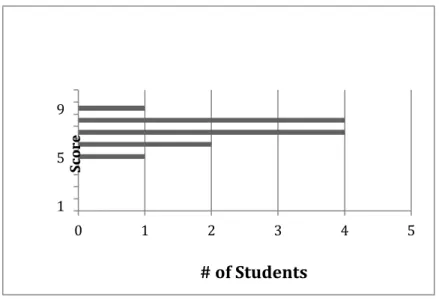
by adding all of the correct points together. Results indicated that the average score was 7.2 out of 10 available points (s=1.11). The median score was 7. The most frequently occurring scores were 7 and 8. A frequency chart of student scores is shown below:
Figure 1: Frequency chart of students’ pre-test scores.
After the preliminary exercises on Day 1 (Wednesday), the researcher taught the students the SQRQCQ strategy for the first time. The researcher distributed SQRQCQ bookmarks (See Appendix C) for the students and hung an SQRQCQ poster on the classroom wall. The
researcher and students went through several word problems together using the strategy. The researcher walked the students through the strategy letter-by-letter. The very first problem was about a child named Mark who had money in his account and was adding more each week. The students needed to find out how much money Mark would have after four weeks. So, the researcher started with the first letter, S for Survey. The researcher asked, “Survey? Survey. What’s this problem about in general? What’s happening?” A student then responded, “Mark is saving money.” The researcher then said, “Q. Question. What question is stated in the problem? What answer are we trying to find?” Another student explained that we were trying to find how much money Mark would have saved after four weeks. The next direction was to R -- Read
!" #" $" %" &" '" #" '" (" !"#$"%&'()*&+" %, #-)"
carefully. The researcher directed the students to read carefully by “jailing the details” and “slashing the trash,” both of which are sayings utilized in their regular classroom setting. After students read carefully, the researcher said, “Q. How are you going to solve the problem? What steps are you going to take?” Students raised their hands and reported they were either going to make a chart or draw a picture. Each respondent reported they were going to use addition. After students decided upon their own plan of action, the researcher asked them to C. Compute. Students found an answer to the inquiry about Mark’s savings account. Students were then directed to Q. Question. The researcher asked, “Did you answer the problem asked, and is your answer correct?” Students were then asked to prove their results. As the researcher left on Day 1, students were asked to practice the strategy whenever they encountered the word problem.
Day 2 and Day 3 of the study were on Thursday and Friday. Both days were used for guided practice. The researcher and students answered a problem together, and then the students were asked to solve several word problems with partners while the researcher circulated the room offering assistance. The researcher and the students then gathered as a whole group to answer and discuss the problems. During the third visit, the researcher reviewed SQRQCQ during one practice problem. Then, students were asked to complete two problems with partners and two problems individually. The researcher and students again gathered as a whole group to answer and discuss the word problems.
On Wednesday, the fourth and final day of the study, the researcher distributed the post-survey to the 16 students who had participated in the pre-assessment and follow-up strategy sessions. The researcher read the survey prompts to the students. As students were read the prompts, they were asked to circle one answer that best described their thoughts or feelings,
unless it was indicated that several answers could be selected. The survey was used to identify if students’ attitudes and strategies changed over the course of the study.
The first prompt on the post-survey was “When I am given a word problem, I…” Four students selected “can almost always solve it.” Twelve students selected “try my best to solve it.” The researcher then read the second prompt, “When I am solving a word problem, the first thing I do is…. One student selected the answer “start to solve it,” and 15 students selected the answer “read the problem.” When asked how many times they read a word problem before they tried to solve it, three students indicated they read a problem once, 10 students indicated they read a problem two times; one student indicated he or she read a problem three times, and two students indicated that they read a problem four or more times before they attempted a solution.
Students were then asked how many times they read a word problem after they solve it. One student reported he or she always reread problems, one student reported he or she never reread problems, and 14 students reported they sometimes reread problems. The next prompt asked students about their use of strategies while solving word problems. Twelve students reported they underlined key points. Four students reported they circled important details. Thirteen students reported they reread problems. Fourteen students reported they used
computations to solve problems. Three students reported that they ask themselves, “What does this question want me to answer?” One student reported that he or she asked him or herself, “What’s the problem about?”
The final question on the post-survey asked students how many times they used SQRQCQ when the researcher was not in the class. Seven students said they never used the strategy. Seven students reported they used the strategy once or twice. One student reported he or
she used SQRQCQ frequently. One student reported he or she used SQRQCQ every time he or she solved a word problem.
After the post-survey, the 16 students took the post-assessment consisting of 10 word problems. Students were given unlimited time. Their desks were clear except for pencils and water bottles. The room was silent until every student was finished with the assessment. The researcher read the directions to the students, and the rest of the test was completed
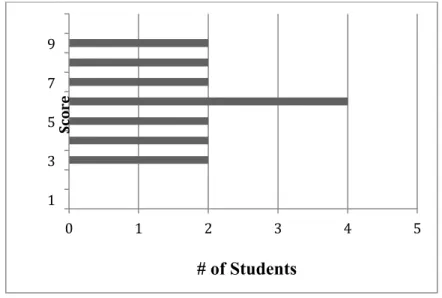
independently. The students were allowed to keep their SQRQCQ bookmarks. Grading the results, the average score was 6 out of 10 available points (s=1.81). The median score was 6. The score that occurred most frequently was 6. A frequency chart of student scores is shown below:
Figure 2: Frequency chart of students’ post-test scores.
!" #" $" %" &" '" #" %" '" )" (" # of Students %, #-)"
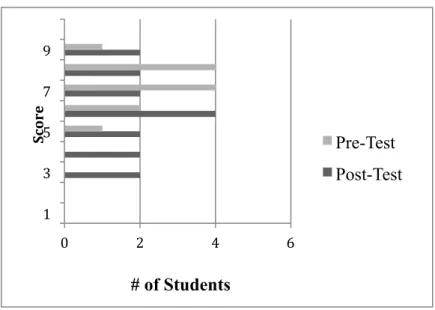
Figure 3: Frequency chart of students’ pre-test and post-test scores. Discussion of Results
When looking for answers to the question posed in Chapter 1, “Does the strategy, SQRQCQ, increase performance results and student efficacy when students attempt word problems in their math classroom?”, the response is two-fold. Analyses of the pre- and post-assessments
demonstrated that the mean of students’ scores dropped by 1.2 points. Although this was a drop, when the results were analyzed using the pre-test’s standard deviation, the post-test mean was not significantly lower than the pre-test mean, meaning that SQRQCQ was at least as effective as other pre-existing strategies. On the pre-survey, one student (8%) reported he or she could almost always solve a word problem. Eleven students (92%) reported that they tried their best to solve word problems. On the post-survey, four students (25%) reported they could almost always solve a word problem. Twelve students (75%) reported they tried their best to solve word problems. While the test scores decreased, a significantly larger percentage of students felt they could almost always solve a word problem, indicating that student confidence surrounding word problems increased. !" $" &" *" #" %" '" )" (" # of Students %, #-)" Pre-Test Post-Test