University of Nebraska - Lincoln
DigitalCommons@University of Nebraska - Lincoln
UNL Faculty Course Portfolios Peer Review of Teaching Project
2018
Course Portfolio for Math 407 Mathematics for
High School Teaching: Refining Conceptual
Understanding in a Mathematics Course for
Pre-service Teachers
Alexandra Seceleanu
University of Nebraska-Lincoln, [email protected]
Follow this and additional works at:https://digitalcommons.unl.edu/prtunl
Part of theHigher Education Commons,Higher Education and Teaching Commons, and the Mathematics Commons
This Portfolio is brought to you for free and open access by the Peer Review of Teaching Project at DigitalCommons@University of Nebraska - Lincoln. It has been accepted for inclusion in UNL Faculty Course Portfolios by an authorized administrator of DigitalCommons@University of Nebraska -Lincoln.
Seceleanu, Alexandra, "Course Portfolio for Math 407 Mathematics for High School Teaching: Refining Conceptual Understanding in a Mathematics Course for Pre-service Teachers" (2018).UNL Faculty Course Portfolios. 105.
Course Portfolio for Math 407
Mathematics for High School
Teaching
Refining Conceptual Understanding in a
Mathematics Course for Pre-service Teachers
Alexandra Seceleanu
May 2018
Abstract
My intention in this portfolio is to present my approach to teaching an upper-level mathematics course for pre-service secondary level mathematics teachers. Several teaching strategies are discussed in the context of designing a coherent approach to this course, which emphasizes the need for conceptual reasoning above all other goals. These strategies are evaluated and assessed in connection to the learning outcomes using samples of student work from the course.
Also presented are samples of course materials that were used to lead students through an organized discussion of the relevant concepts. These materials convey some basic mathematical knowledge and therefore may suited to other courses as well. Addi-tionally, this portfolio includes a survey of students perceptions and attitudes towards conceptual mathematics at the beginning of the course, which can be viewed as base-line information, as well as a sample of student work production and self-reflections at the end of the curse, which establish a certain growth in confidence and abilities.
Keywords: Undergraduate teaching, mathematics, conceptual reasoning, secondary education, pre-service teachers.
Contents
1 Introduction and Objectives of Course Portfolio 3
2 Benchmark Memo 1: Reflections on the Course Syllabus 4
2.1 Description of the Course . . . 4
2.2 Objectives of the Course . . . 6
3 Benchmark Memo 2: Description of Course Activities 9 3.1 Teaching Methods and Classroom Time . . . 9
3.2 Course Activities Outside of Class . . . 11
3.3 Course Materials . . . 13
3.4 Rationale for Choice of Teaching Methods . . . 13
4 Benchmark Memo 3: Document and Analyze Student Learning 14 4.1 The Nature of Student Understanding . . . 14
4.2 Student Understanding in Work Samples . . . 15
4.3 The Formative Assessment-Feedback-Evaluation Cycle . . . 16
4.4 Evidence of Students Meeting Learning Goals . . . 17
5 Planned Changes and Assessment of the Portfolio Process 18 5.1 Possible Changes, Redesigns, and Future Plans. . . 18
5.2 Summary and Overall Assessment of the Peer Review Process . . . 19
6 Appendix 20 6.1 Syllabus . . . 20
6.2 Sample In-class Activity Worksheet . . . 24
6.3 Samples of Student Work. . . 30
6.4 Sample Project . . . 37
Chapter 1
Introduction and Objectives of
Course Portfolio
I enrolled in the Peer Review of Teaching Project with the objective of making my instructional choices more informed and intentional and with a secondary objective of learning from the experience of the other participants.
With respect to my target course, Math 407 – Mathematics for High School Teach-ing, my first objective is to to examine the design of the course and make purposeful decisions regarding the design in a way that directly influences student learning. In particular, I would like to isolate the core conceptual underpinnings of the high school mathematics curriculum and make sure they are reflected in the course. At the same time, and perhaps as a higher priority, I would like to emphasize conceptual reasoning in the classroom and implement it in all the aspects of the course.
My second objective is to document the major resources, materials, strategies and interventions that I have created for the course, and make them available as a resource for teaching the course in the future. I would also like to document how these strategies and resources influence student learning and make the resulting conclusions available to those who study the education of pre-service teachers.
My third objective is to take a first step towards a more in-depth discussion of how con-ceptual reasoning and in particular proof writing can be tailored to the needs of future educators, with a view of subsequently redeveloping the prerequisite courses.
The course analysis comprised in this portfolio is performed primarily by means of examining student work. Although this may be surprising in a mathematics course, the analysis is predominantly qualitative as this correlates best with the rigors of con-ceptual reasoning. This includes a discussion on how systematic feedback on written assignments influences student learning and helps them in preparing for formal evalu-ations. This is viewed as a cornerstone of refining conceptual understanding.
Chapter 2
Benchmark Memo 1: Reflections on
the Course Syllabus
2.1
Description of the Course
UNL’s online course catalog presents the following rather cryptic description: UNL Course Bulletin Description:
MATH 407 – Mathematics for High School Teaching I
Analysis of the connections between college mathematics and high school al-gebra and precalculus.
Below is my own interpretation of what this should mean, based on reviewing the current algebra and precalculus curriculum for high school and on my knowledge of the topics covered in university courses offered in the mathematics department:
High School Mathematics College Mathematics Connections
Number Systems Intro to Modern Algebra Emphasis on the integers Functions and relations Calculus I, II, III Emphasis on functions
Intro to Real Analysis Relations not covered Trigonometry Calculus I, II, III Using trig identities
and polar coordinates Analytic Geometry Calculus I, II, III Recognizing equations
of curves and surfaces Notice that while all the main components of the high school algebra and precalculus curriculum areusedin mainstream college-level mathematics courses, such as the Cal-culus sequence, the only aspects that are revisited and reinforced at the college level are the number systems, particularly the integers and to a lesser extent the complex numbers, which are treated in college from an abstract algebraic viewpoint.
2.1.1
Purpose of the course
This course serves three major purposes. First: to offer students, who are pre-service teachers, a refresher on some of the main topics of the algebra and precalculus high school curriculum. Second: to strengthen the students’ conceptual reasoning skills and emphasize usage of conceptual as opposed to procedural reasoning in the classroom set-ting. Third: to make explicit connections between the course material and the practice of teaching at the high school level. This is needed as the students are heading into the practicum component of their program in the semester following this course.
2.1.2
Students
The students are all junior and senior level mathematics education majors, although there was one student who was both a mathematics and a mathematics education ma-jor. They will have taken the complete Calculus sequence as well as a “proofs-based” course in Modern (Abstract) Algebra, which will give them the intellectual framework to handle the abstract concepts in the course. These are the pre-requisites for the course. An initial survey showed that all students had also completed a course in Dif-ferential Equations and all but one student had completed a course in Linear Algebra. During the semester it became apparent that most students were simultaneously en-rolled in the Concepts in Geometry course, which is also part of the required curriculum for pre-service mathematics teachers. Normally they were supposed to have had this class the semester before, but the course was not offered that semester.
2.1.3
Position in the Math and Education Curriculum
This course is a required course for education majors seeking an endorsement in sec-ondary mathematics education. It is the first semester in a year-long sequence. The second semester, Math 408 – Mathematics for High School Teaching II, is described as an “analysis of the connections between college mathematics and high school algebra and geometry” and typically focuses more in-depth on topics from geometry.
The course is also cross-listed at the 800-level as Math 807. One student was enrolled in this version of the course while she was pursuing a masters degree in Mathematics Education.
2.1.4
The Course and the Broader Curriculum
The course is not a prerequisite course for any other course. Nevertheless, it is a course which informs the future activities of these students during their practicum and
beyond. Furthermore it should be viewed as a course that goes hand in hand with and complements teaching pedagogy courses offered by the education department. For a student view on this symbiosis please consult Appendix 6.5.
2.2
Objectives of the Course
2.2.1
Knowledge
Students should come away from the course knowing the conceptual underpinnings of high school algebra and precalculus.
Concretely, some of the main topics they should be familiar with include: • Number systems: the integer, rational, real, complex numbers,
• Relations and functions: similarities and differences between these notions, in-vertible functions and transformations,
• Trigonometric functions derived from the wrapping function of the number line around the unit circle,
• Elements of analytic geometry, with emphasis on conic sections.
2.2.2
Rigorous Communication Abilities
Students should be able to reason using the concepts above in a completely rigorous fashion. This includes making appropriate use of definitions, making mathematical claims and proving them according to the principles of formal and rigorous mathemat-ics communication. At the same time, students should learn how to rephrase their explanations in language accessible to a variety of ages and levels (e.g. middle school and high school students) without compromising the accuracy.
2.2.3
Conceptual Understanding
Student should understand and be able to articulate why the standard methods of high school algebra and pre calculus (e.g. the vertical line test) work the way they do starting from the relevant definitions. They should be able to understand this well enough to internalize the need of emphasizing the conceptual reasoning (the why’s) over the procedural (the how to’s) in their daily practice.
2.2.4
Perspectives and Attitudes
It is common for many students, even mathematics majors, to have a negative attitude toward writing proofs which they often view either as being overwhelming or as tedious. However, rigorous reasoning and validation of mathematical results via proofs lies at the heart of the discipline. It is often the case that after having experiences which demonstrate the power and beauty of certain proof techniques, some students become drawn to these aspects. Yet other students become at least acclimated to this rigorous environment when the process of proof writing is demystified by being placed into a rigorous framework.
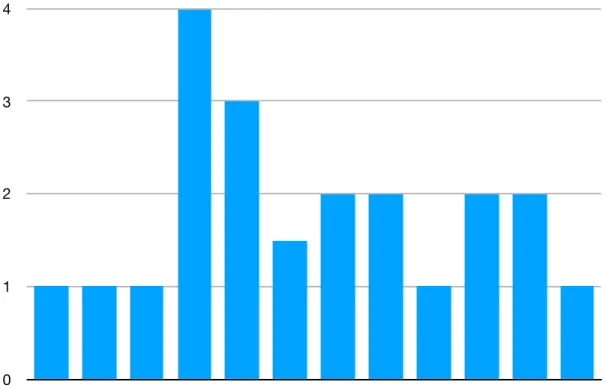
In terms of attitudes toward proof writing, a pre-class survey was administered to Math 407 students asking them to self-rate their abilities on a scale that includes:
1. I understand what proofs are, but I am not confident that I can write proofs. 2. I can write proofs, but am not completely comfortable with some proof methods 3. I can write proofs, but sometimes I get lost in the details.
4. I am completely comfortable with writing proofs and I can do this well.
Figure 2.2.4 presents a survey of students’ pre-class self-reported confidence in proof writing, with each column representing an individual student’s level of confidence.
0 1 2 3 4
One of my key objectives in this course was to improve both the skills and the self-confidence level of the students with respect to proof writing.
2.2.5
Impact on the Larger Society
As the focus of this course is on future educators, this is a major opportunity to make and impact on many more individuals that just the students in this course, since the current students will in turn use their knowledge to educate their students. It would be interesting (and I believe it is an ongoing effort in the mathematics education community) to track how teacher education is reflected in the later outcomes of their instructional practices.
2.2.6
Justification for the Goals
We want the student to come away from the course with an ability to make in impact in the lives of others through the teaching of mathematics at the high school level. Therefore, we want to give them the knowledge necessary for this purpose, as well as the rigorous thinking required to present the mathematics accurately and to involve their future students in a process of discovery and validation as they mature as mathematical thinkers. We also want to develop some practical skills, especially the practice of interacting with peers and students in regards to the mathematical content of the course.
It is necessary for students to achieve these goals if they want to understand more deeply and systematically the material involved in their future profession. Without conceptual mathematical training, they run the risk of passing on a mentality that mathematics is a collection of rote procedures and rules to their future students.
Chapter 3
Benchmark Memo 2: Description of
Course Activities
3.1
Teaching Methods and Classroom Time
The classroom time scheduled for this course is atypical, namely the course meets once day per week from 6-8:30 pm. Inquiring with the students enrolled in the Fall 2018 class, it appears that the main reason for this choice of course organization, which is that some of the students enrolled would be participating in practicum activities, is in fact not an applicable reason. In fact, students reported that they would start their practicum in thefollowing academic year.
Therefore, one of the changes I would suggest is to switch the format to the class meeting for 75 minutes twice a week during regular classroom hours (before 5 pm). This would allow sufficient time to maintain the active learning format described be-low, while also ensuring that the students’ attention remains within optimal levels throughout the duration of the class meeting.
Given the objectives of the course as well as the late meeting time, it is important that the course be structured in a manner that helps keep the students focused and maxi-mizes student learning. The main method employed to ensure these results consists of designing the course as an active learning environment, where students are presented with guiding questions and problems which they explore, in groups, during the class meetings.
In order to provide the structure and model good mathematics communication, sum-mary notes are typed up to record the classroom discussion and disseminate the main concepts and results.
3.1.1
How Are The Methods Used in Class?
A typical class is structured around an activity worksheet. Every week, the class discussion opens with an opening mathematical inquiry. For example, for the section on complex numbers the opening inquiry consists of an activity meant to get students to think about transformations that are obtained by composing a given transformation with itself. One can easily see that the transformation given by x 7→ x+ 4 can be decomposed as a sequencex7→x+ 2 7→(x+ 2) + 2 of two transformations which are each defined by adding the number 2 (or, geometrically as translation on the number line by 2).
A natural question arises as to what other transformations can be decomposed in a similar manner. In particular, for the transformation x 7→ −x (which can be vied as a rotation of the number line by 180◦) to be written as a composition of two identical transformations, one needs to decompose it into two rotations by 90◦, which correspond tox7→ix. This is a good jumping off point into the need for and meaning ofcomplex numbers, see the sample course activity worksheet 6.2.
In the rest of the time, students engage with each other in groups to solve various problems aimed at either clarifying certain mathematical notions or discovering new properties of these notions. At various points during the class (say 2-5 in the course of a 2.5 hour meeting), the students are asked to come together and summarize their findings to the class. They are often asked to report on the findings of their working group from their previous discussion. A formal summary of the findings is recorded by the entire class to solidify their ideas.
During the working sessions, I observe the progress of the groups, asking questions that alert them to any issues that arise or making suggestions aimed at resolving individual difficulties.
3.1.2
How Do The Methods Facilitate Course Goals?
1. Knowledge: Active discussion is activity that allows the student to engage deeply with the material. It also gives the instructor a chance to informally assess how students are doing, judge whether there are any misconceptions or clarifications that need to be addressed and proceed to do so in a timely manner. I found this instant feedback very beneficial and the direct interaction between the students and the material quite effective in boosting student confidence in manipulating the various mathematical concepts.
2. Rigorous Communication Abilities: Since much of the in-class communica-tion between students is oral, maintaining high standards for rigorous mathemat-ics communication presents a particular challenge. During the class discussions it became apparent that students would more naturally be able to come up with
the ideas involved in solving a particular task than be able to communicate their solution in completely rigorous terms. This was partially addressed in class by setting up rigorous proof frameworks whenever such a method of justification was appropriate. Models for rigorous proofs were discussed demonstrated on a few different occasions and more example were included in the course summary that was distributed to students weekly. This is intended to facilitate the students in learning further on their own, as they see different methods or further examples for certain proofs.
However, due to the active learning design of the class fewer fully worked out examples of mathematical proofs were presented in class than would have been presented in a lecture-based course. This sometimes lead to insufficient models for students to base their homework-solving efforts on.
3. Conceptual Understanding: Throughout the class discussions a recurrent theme was to emphasize the conceptual explanations over the procedural lan-guage. This was often stated explicitly in the assigned tasks, especially when the tasks involved the practice of explaining mathematics to a hypothetical high school student audience. To a large extend and to the extent to which the stu-dents developed their communication abilities referred to above this motto even-tually resonated with the students, as stated in a few of their end-of-semester reflections.
3.2
Course Activities Outside of Class
Outside of class, student had weekly problem sets and a term project to work on. The problem sets are meant to reinforce and expand upon the notions discussed in class. The projects involve a combination of several techniques learned in class: discovering new mathematics (making conjectures and proving the) and explaining it using a rigorous language that is appropriate language for the target audience.
3.2.1
Problem sets
The goal of the homework problems is to get students to work though the details of problems, focusing more thoroughly on the rigorous communication skills than the classroom discussion affords. The optimal distribution of the problems would include one or two problems that were discussed in class or closely resemble the classroom discussion and one or two problems that are designed to push the students out of their comfort level and pinpoint their understanding of the conceptual underpinnings of the material in a novel context. This distribution matches the two main goals of the problem sets: reinforcement and consolidation of the knowledge acquired and
building upon this knowledge. The represent two successive steps toward mastery of the material.
Whenever possible, teaching scenarios are built into the assigned problems. Tasks related to these scenarios may include clarifying misconceptions, reformulating expla-nations in language appropriate for a specific level of student development or writing an organized explanation of a definition or mathematical test as if it was being presented to a class.
3.2.2
Projects
Here is the full description of the term project assignment:
Your project, to be produced by teams of 3–4 students, will include a typed paper as well as a presentation to the class. The projects will consist of a guided discovery of a new topic, together with notes on how to teach this to middle/high school students in inquiry-based form.
Here are the main parts of the project:
1. A brief introduction to the problem you are addressing in your project. • Explain the importance of your topic and where it would fit within
the mathematics curriculum for middle or high school.
• Either in the introduction or in a separate background section include all the mathematics notions and facts that are required to understand your project. Typically this will consist of several definitions and other useful preliminary facts.
2. An account of your solution to the problem. This will include the following:
• Clarifications on any assumptions you are making. Note that the class presentations should have alerted you to what clarifications others may need to fully understand your topic.
• Revised versions of propositions/theorems and examples as per feedback on the first draft.
• Proofs for all propositions in paper, revised per the feedback on the first draft and on presentations.
3. A plan to lead the class through your findings in an inquiry-based manner. For this, please come up with two sets of questions for the class:
• A set of conjectural inquiry questions, meant to lead the class towards guessing (conjecturing) at least one of your propositions. • A set of proof inquiry questions, meant to lead the class through
discovering the proof for at least one of your propositions.
4. A conclusion summarizing your findings and presenting any advice you might give to an instructor who might use your notes to present the topic to their class.
5. Finally, include citations for your references at the very end of the paper
3.3
Course Materials
There is no required textbook for this class, however weekly typed up course summary notes were made available to students in addition to the weekly activity worksheets. The course material was developed based on the lecture notes for MODULE(S2): Algebra for Secondary Mathematics Teaching developed by Prof. Yvonne Lai at UNL with collaborators from other universities. MODULE(S2) means Mathematics Of Doing, Understand, Learning, and Educating Secondary Schools and is a project partially supported by funding from a collaborative grant of the National Science Foun-dation.
3.4
Rationale for Choice of Teaching Methods
Discussing mathematics is not a skill that is often practiced in the college classroom because of the time pressures of the curriculum. Changing the main classroom activity to discussion challenges the students to get engaged with the material in deeper ways. Homework is used to solidify the knowledge, practice rigorous mathematics communi-cation, and expand upon the knowledge acquired in the classroom.
3.4.1
Effect On Students’ Future Courses And Career
The course develops the fundamentals of mathematics encountered in the high school curriculum. It also affords pre-service teachers the opportunity to practice explaining these notions as illustrated in section 3.2.1. This has direct connections to the cur-riculum in the education department, in particular to the teaching methods courses, where students learn lesson planning and teaching methods applied to the high school mathematics curriculum; see Appendix 6.5 for a student testimonial.
Chapter 4
Benchmark Memo 3: Document
and Analyze Student Learning
In this chapter I describe the relationship between the activities documented in Chapter 3and their effect on promoting and enhancing student understanding.
4.1
The Nature of Student Understanding
There are several layers involved in understanding and interacting with the material in any mathematics class. While present in any mathematics course through paired/ group activities where students share their knowledge with each other, the third level of knowledge listed below deserves a particular emphasis in a course for pre-service teachers:
1. Working/procedural knowledge: This comprises an intuitive understanding of the mathematical concepts as well as a knowledge of the procedures involved in accomplishing some standard tasks such as solving an equation, producing the formula for the inverse of a function, applying a given transformation to a function.
2. Conceptual knowledge: This comprises conceptual understanding of the math-ematical notions, illustrated by proficiency in using the formal definitions of the notions involved as well as the ability to justify and validate the use and appli-cability of any procedures described above. A paramount
3. Transferable knowledge: This refers to being able to explainthe concepts and procedures above in a correct and coherent manner, usually for the benefit of others.
4.2
Student Understanding in Work Samples
It is clear that some students struggled with the concepts, and some concepts, for ex-ample de formal definition for the graph of a function, were never fully grasped even by the time of the final exam for a few students. On the other hand, some students demon-strated solid understanding, and were commended in the end-of-semester reflections by their peers for sharing their insight.
We examine three example drawn from student’s work on the first midterm exam. The question they address is:
Teach the definitions of invertible function and inverse function. Write this as if you were presenting a 5-10 minute lesson to a high school class.
The first sample, Appendix 6.3.1, shows work from a student whose understanding is mostly at the working/procedural level. She shows an intuitive understanding of the notion of inverse function as reversing the roles of the input and output of a function and the ability to recognize invertible functions based on their property of sending distinct inputs to distinct outputs. At the conceptual level, however, the sample displays some imprecision in stating the appropriate definitions. In fact, the first definition is stated in a manner that makes it vacuously trueAn invertible function is invertible if. . .and the second definition is stated in an incoherent manner. However, the studentdoesuse the correct definition (f−1 is a function) to verify that the function
in her example is invertible. This is surprising evidence that the content she is able to employ for knowledge transfer may exceed the the limitation of this student’s personal understanding.
The second sample, Appendix 6.3.2, demonstrates some level of conceptual level un-derstanding manifested through stating the appropriate definitions and relating the notions described to the graph representation for a function. However, by contrast to the previous case study, in this case there is a strong reliance on procedural language and techniques (the application of the horizontal line test for determining whether a function is invertible and the method of finding the rule for the inverse function) for the purpose of explaining the respective concepts.
The third sample, Appendix6.3.3, shows work from a student who possesses strong con-ceptual understanding and has some experience in a teaching assistant capacity. A few points to note are that this mock lesson uses language that is appropriate for beginning learners, while also demonstrating knowledge of and conveying the formal definitions for the concepts under analysis. The explanations draw from previous knowledge of the concept of a function, which is recalled and integrated seamlessly into the explanation. Although only one representation for functions is used in the examples, this sample demonstrates superior knowledge transfer techniques.
from work early in the semester, the need for further fine-tuning is to be expected.
4.3
The Formative Assessment-Feedback-Evaluation
Cycle
Because of the importance of writing in higher level mathematics, students were given feedback on all the major writing assignments, including the weekly problem sets and the drafts of their final project. One of the goals of this portfolio is to analyze to what extent the feedback obtained on their work on weekly problem sets effected the performance of the students on subsequent assessments (examinations).
In order for this connection to be explored independently of any confounding factors, each midterm and the final exam contained one problem which was closely related to a homework problem. We include a case study of an an example of a pre-test (student work on the formative problem set assessment shown in Appendix6.3.4) and post-test (student work on the midterm evaluation shown in Appendix 6.3.5) on two paired problems. One can remark the following responses to the feedback received:
• Better use of notation: on the formative assessment functions are always rep-resented by their rules. On the midterm evaluation the notation f(x) is used, although functions are still occasionally confounded with their rules.
• Clearer, well motivated algebra: Algebraic manipulations are made more clearly to explain why 16ax = 24ax. Furthermore the use of closure under multiplication
to explain why 4a is an integer is made clear.
Note that the feedback received (see the margins of the formative assessment in Ap-pendix 6.3.4) refers directly to the two items that exhibit improvement as shown above.
It is not clear whether improvements on formal evaluations can be related directly to feedback, even for paired problems. The following table summarizes the relation-ship between the average score on a problem on each of the three major evaluations: midterm 1, midterm 2 and the final exam and a paired homework problem.
Paired probl. 1 Midterm 1 Paired probl. 2 Midterm 2 Paired probl. 3 Final
87.8% 80.9% 69.4% 76.0% 86.2% 86.8%
A possible explanation for the greater improvement shown on the second midterm is that the students learned to take the feedbacks more seriously and implement the corre-sponding changes after having encountered the paired problem on the first midterm. A possible explanation for the equalization on the final paired problem is that by the end of the semester students had learned to produce reliable work which did not necessitate much adjustment any more.
4.4
Evidence of Students Meeting Learning Goals
4.4.1
Perceived Outcomes
In terms of the final grades, 4 of the 12 students were in the “A” range, and 8 were in the “B” range, which seems to be a typical distribution for an upper-level course in mathematics for teaching.
A major goal of the course was to emphasize conceptual understanding and rigorous mathematical reasoning and writing (proofs). Students self-reported increased con-fidence in their proof writing abilities. This may be due to a large extent to the introduction of “proof frameworks” which gave the students an entry point into the structure of the proof, which both helps them organize their reasoning and overcome the difficulty of staring at an empty page without knowing where to start. This shows a marked improvement in attitudes, compared to the data in section2.2.4.
In terms of content knowledge for teaching, all students made a genuine effort to master the material. It can be stated with certainty that each of them gained at least a working knowledge of the material.
In terms of conceptual understanding, students displayed a larger variability with re-spect to their levels of achievement. By the end of the course only a select number of students had internalized the formal definition for the graph of a function (although they all possess an intuitive, working knowledge of this notion). This is a matter that requires further attention and will be focused on in the future, see Chapter 5.
4.4.2
What Students Are Learning Beyond the Curriculum
Beyond the course material and good mathematics communication skills, students in this course reported learning other important skills. Perhaps the most prominent one is the ability to interact with their classmates in regards to the material. The same skill development is often reported by advanced mathematics students (for example, graduate students) as an adaptation response to the demands of higher-level mathe-matics. Therefore, in many respects, this course has contributed to the formation of a strong cohort.
Among the students at the very top of the class, some reported their intellectual cu-riosity being stimulated by various aspects of the course material. Furthermore, the students were challenged to learn professional typesetting for their projects using the typesetting environment LATEX, which is the standard choice for professional
Chapter 5
Planned Changes and Assessment
of the Portfolio Process
5.1
Possible Changes, Redesigns, and Future Plans
If I were to teach this course in the future, I would implement the following changes: 1. Set aside designated class time to emphasize good mathematics writing during
every class. This would involve designing relatively short and easy writing tasks that match the topic of each lesson and can be turned into more complex problems fit for homework assignments.
2. Continue to refine the formative assessment–feedback–evaluation cycle described in section 4.3. A first step would be to make this process more transparent to students, i.e., make them aware of the value of incorporating feedback into their intellectual products. Another idea would be to incentivize students to incorporate this feedback by offering an opportunity to write homework correction for partial or extra credit.
3. Make the connection between in-class work, problem set assignments and evalu-ations more evident by starting some of the homework assignment problems in class and continuing the paired problem strategy for exams.
4. It is clear that those students who had the added benefit of attending office hours on a regular basis had a far richer experience and fared better in the course. I would like to find a way to incentivize those students with a weaker background to make use of this opportunity and find a study group early in the semester. 5. Ponder some of the choices made for introducing mathematical concepts
current definition for invertible function corresponds to the notion of injective function, which is not standard in mathematics.
6. Make the connections between the course material andcollegemathematics more evident. This was originally planned for this course but this objective was re-moved in favor of focusing in depth on the other core objectives of the course. 7. Clarify the place of the course in the curriculum for mathematics education
ma-jors. In particular, clarify what elements of geometry can be assumed known.
5.2
Summary and Overall Assessment of the Peer
Review Process
The review process influenced me in the design of the following elements of the course: 1. I designed a pre-class survey in hopes of measuring student attitudes and
back-ground. I felt that this helped me to know my students better and tailor my material appropriately to their proficiency level.
2. I examined the overarching goals of the class and decided to keep only those that would best serve the students in their capacity as pre-service teachers. This countered of my first predisposition to overcrowd the curriculum and I ended up adding a single topic to the the syllabus from the previous year, namely complex numbers. I feel strongly that this topic is underemphasized in high school mathematics and also in college mathematics. Therefore, I believe this was a needed addition.
3. I determined the value of active learning activities as an organizational corner-stone for the course. It is clear that this afforded the students to interact with the material more directly than a traditional lecture format would have chal-lenged them to do. However, sometimes this method leads to insufficient rigor and it seems that more dedicated time for sample worked-out examples and short in-class proofs needs to be incorporated in the future.
4. I devised a way to evaluate students on their class participation based on an end of semester self-reflection that asked them to summarize the highlights of their in-class activities. This is a direct result of the peer review program, as this idea was suggested to me by a fellow participant during one of the PRTP small group meetings.
I am grateful to the Peer Review of Teaching Project for giving me the opportunity and motivation to look at teaching from an informed perspective and to record my experience with this course.
Chapter 6
Appendix
6.1
Syllabus
Syllabus
Math 407 – Spring 2018
Instructor: Dr. Alexandra Seceleanu
Office: 338 Avery Hall. Office hours to be determined during the first week of class. Email: [email protected]
Class Times and Location: W 6:00 –8:30 pm, Avery Hall – Room 109. Prerequisites: Math 208 and Math 310
Text: None required. Lecture summaries and handouts will be distributed in class. Web Page: All course material, including your grades, will be posted on Canvas. Course Objectives: There are two primary goals in this course:
• Understand the typical mathematical notions, constructions, problems and routines of high school algebra and precalculus – about sets, number systems, functions, and equa-tions – from a rigorous, advanced viewpoint;
• Gain fluency at communicating mathematics notions, justifications and proofs in precise yet accessible ways, identifying the destination of a proof and how this influences both the reasoning toward a solution and the writing up of the solution.
Material covered: The topics we will address in this course are:
• The formal language of mathematics, proof logic, and sets
• Number systems and their applications
• Relations, functions, and transformations of functions
• Topics in geometry and trigonometry
Grades: Grades for the course will be computed as follows:
Weekly homework 33% (10–11 problem sets) Class participation 10%
Group project 12% (includes paper & presentation) Midterms 30% (2 midterms×15% each)
Final 15%
Guaranteed cutoffs for letter grades are: 97-100% A+, 92-96.99% A, 90-91.99% A- etc. These cutoffs may be adjusted at the end of the semester, but only in favor of the students. Homework: Homework will be assigned weekly on Thursday through Canvas. Homework is to
be submitted individually, and is due in class on Wednesday of the week following the week it was assigned. Students are allowed to collaborate on solving the homework problems, but the writing of the solutions must be done individually. Late homework will not be accepted. Participation: This class will build on your experiences as learners, observers, and doers of math-ematics and mathmath-ematics teaching. Moreover, an integral part of the work of teaching is talking through and listening to mathematical ideas. The portion of your grade intended for participation will come from a combination of:
• Collaborating on in-class explorations with a group of peers and actively participating in class discussions.
• Explaining a piece of mathematics in response to a question or prompt, either from a student or from the instructor. Often this will involve coming up to the board.
Syllabus
Math 407 – Spring 2018
Project: Your project, to be produced by teams of 3–4 students, will include a typed paper as well as a presentation to the class. Potential topics will be announced by the third week of class. The projects will consist of a guided discovery of a new topic, together with notes on how to teach this to middle/high school students in inquiry-based form.
Oral Presentation: Each presentation will be 20-25 minutes in length. All team members will address the entire class at some point during the presentation. Presentations will take place either on Wednesday, April 18or onWednesday, April 25.
The structure for your presentation will include:
Conjectural inquiry (2-5 mins) + Proof inquiry (∼15 mins) + Wrap up (2-5 mins). Written Report: The final project paper is due on Friday, April 27. Prior to the final paper deadline, there are the following deadlines for successive drafts.
Outline – Due end of 7th weekThe outline will include at least the following.
• A clear statement of each of the propositions you will prove in your final paper.
• Examples illustrating what the propositions mean, and why the hypotheses (conditions) of the propositions are important.
• Summary of who is working on which proofs of the propositions.
• Conjectural inquiry questions for the propositions.
First Draft of paper – Due end of 12th week. The first final draft of your paper will include at least the following.
• Revised versions of propositions and examples as per feedback on the outline.
• Proofs for all propositions in paper.
• Conjectural inquiry questions, as revised per feedback on outline.
• Proof inquiry questions for the proofs of propositions.
Final Draft of paper – Due Friday, April 27. The final draft of your paper will include all the elements of the first draft above and additionally
• A “Wrapping things up” section
• A “Notes to teacher and curricular alignment” section. Midterm Exams: There will be two in-class midterm exams on
Wednesday, February 14 and Wednesday, March 28
Final Exam: The final exam is scheduled on Wednesday, May 2nd, 8:15 to 10:15 p.m.. Mutually agreeable alternatives will be discussed in class.
Department Grading Policy: Students who believe their academic evaluation has been prej-udiced or capricious have recourse for appeals to (in order) the instructor, the department chair, the departmental appeals committee, and the college appeals committee.
Students with Disabilities: Students with disabilities are encouraged to contact me for a con-fidential discussion of their individual needs for academic accommodation. It is the policy of UNL to provide flexible and individualized accommodation to students with documented dis-abilities that may affect their ability to fully participate in course activities or to meet course requirements. To receive accommodation services, students must be registered with the Ser-vices for Students with Disabilities (SSD) office, 132 Canfield Administration, 402-472-3787
Syllabus
Math 407 – Spring 2018
Academic Honesty and Integrity Academic honesty is the foundation of intellectual inquiry and academic pursuit. Every student must adhere to UNL’s policy for academic integrity, set forth in the Student Code of Conduct in the UNL Undergraduate Bulletin. Students who plagiarize or academically dishonest are at risk of receiving a failing grade on an assignment or for an entire course and may be reported to the Student Judicial Review Board. Academic dishonesty includes:
• Handing in work that is in whole or in part the work of another person;
• Submitting work from a class taken previously for work in this class;
• Using notes or other study aids or otherwise obtaining unauthorized answers for a quiz, assessment or examination; and/or
• Using the words, opinions, or ideas of another person without giving full credit and accurate citation information.
• Committing plagiarism by using phrases, sentences, paragraphs, and ideas from any source, without attribution. Sources include, but are not limited to books, magazines, newspapers, television or radio reports, websites and papers of other students. Of course, you may refer to textbooks or other sources for mathematical facts or definitions if you need a refresher, but you may not copy a proof of a homework problem from a textbook or any other source.
Academic dishonesty will not be tolerated in this course. Students who choose to violate the UNL Student Code of Conduct will be, at a minimum, reported to the Student Judicial Board and receive zero credit for associated assignments or projects. If you have any questions regarding this policy, please speak to the instructor. To review the Student Code of Conduct policy visithttp://stuafs.unl.edu/ja/code/three.shtml.
Technology in the Classroom Policy Technology has become a necessary part of working in any field. However, communications technology, such as smart phones, tablets, and lap-top computers, presents challenges in the classroom, especially when close attention to and involvement in course discussion are necessary for success. Therefore, the course policy re-garding technology is as follows:
• Technology use in the classroom is to be for the exclusive purpose of class-related activ-ities, such as note-taking or typesetting mathematics.
• Students who choose to violate this policy will be first asked to discontinue the non-class-related activity.
• Persistent problems with the inappropriate use of technology during class will result in a reduction of the student’s participation grade.
Attendance Policy Class attendance is essential for success in this course. Because the course meets once a week, unexcused absences will not be tolerated and you will lose participation points for every unexcused absence. Excused absences are limited to the following, all of which must be documented in writing: medical issues and university-related extra curricular activities. Students unable to attend class for any reason are responsible for the material covered in class and for turning in homework.
Week 9 – Wednesday, March 7
Math 407 – Spring 2018
OPENINGINQUIRY: TWO-STEP TRANSFORMATIONSLet’s think about the following transformations (functions) on the real number line:
• shift2:R→R, x7→x+2 • scale4 :R→R, x7→4x
• scale7 :R→R, x7→7x • scale−1:R→R, x7→ −x
For each of these, find a new transformationTisuch that thei-th transformation above can
be obtained by applyingTitwice.
Original Transformation Two-step transformation
shift2 shift2=T1◦T1 for T1(x) =
scale4 scale4 =T2◦T2 for T2(x) =
scale7 scale7 =T3◦T3 for T3(x) =
scale−1 scale−1=T4◦T4 for T4(x) =
Checking that • shift2 =T1◦T1 • scale4=T2◦T2 • scale7=T3◦T3 • scale−1=T4◦T4 1
Week 9 – Wednesday, March 7
Math 407 – Spring 2018
THECOMPLEXPLANEThe standard picture of the real numbers is a line:
−6 −4 −2 0 2 4 6
Every real number is associated to a point on the line and every point is associated to a real number.
Definition. Acomplex numberis a number of the formz=a+bi, wherea,b∈R.
The set of all complex numbers is denoted byC:
C={z|z=a+bi, anda,b∈R}.
Definition. For a complex numberz=a+biwe denote by Re(z) =aand Im(z) =bthe real and
the imaginary coordinate forzrespectively and we say that thestandard formforzis
z=Re(z) +Im(z)i.
Can we devise a representation for complex numbers similar to the real number line? What would be associated to the complex numberz=a+biin this representation?
Draw the set of points in the complex plane corresponding to complex numberszsuch that 1. Re(z) =1
2. Im(z) +Re(z) =1
Week 9 – Wednesday, March 7
Math 407 – Spring 2018
POLAR FORM FOR COMPLEX NUMBERSWe have used rectangular coordinates(Re(z), Im(z))to locate points in the complex plane, but these are not the only coordinates we can use.
Definition. Thepolar formfor a complex numberzis an expression of the form
z=r(cosθ+isinθ) =rcis(θ), wherer≥0 is a real number andθis an angle (in radians).
1. What dorandθrepresent for the point associated tozin the complex plane? 2. Express Re(z)and Im(z)in terms ofrandθ.
3. Expressrandθin terms of Re(z)and Im(z).
4. Find the polar form for all powers ofi, namelyin, wheren∈N.
Definition. Thecomplex absolute value(ormodulusormagnitude) of a complex number
z=a+biis defined to be|z|=√a2+b2.
Definition. Theargumentof a complex numberz, denoted Arg(z), is the unique angle Arg(z)∈[−π,π]such that
z=|z|(cos Arg(z) +isin Arg(z)).
The real numbers|z|and Arg(z)are thepolar coordinatesof the complex numberz.
Definition. Theconjugateof a complex numberz=a+biis the complex number ¯z=a−bi.
How doz, ¯zand|z|relate?
How does the point in the complex plane corresponding tozrelate to the point corresponding to ¯z?
Week 9 – Wednesday, March 7
Math 407 – Spring 2018
OPERATIONS WITH COMPLEX NUMBERSWhich form is better suited to describe each of the following operations?
Operation Description in rectangular form Description in polar form Addition (a+bi) + (c+di) =
Subtraction (a+bi)−(c+di) =
Multiplication bys∈R s(a+bi) = s(rcis(θ)) =
Multiplication inC (a+bi)(c+di) = r1cis(θ1)·r2cis(θ2) =
Notes on proofs for the above descriptions:
Geometric descriptions of the operations:
Draw the set of points in the complex plane corresponding to complex numberszsuch that 1. |z|=2,
2. |z−(2−i)|=1
Week 9 – Wednesday, March 7
Math 407 – Spring 2018
DE MOIVRE’STHEOREMCompute the first 10 powers ofz=2(cos(π
4) +isin(π4))in polar form:
z1= z6=
z2= z7=
z3= z8=
z4= z9=
z5= z10 =
Make a conjecture regarding a formula for the positive powers of a complex numbers with polar formz=r(cos(θ) +isin(θ)). Can you prove your conjecture?
Ifz=r(cos(θ) +isin(θ))is a complex number andn∈Nthen zn =
Notes on proof:
What does your conjecture say about the powers of the complex number cis(θ) =cos(θ) +isin(θ)?
cis(θ)n =
List all the functions f you know which have the property f(t)n = f(nt)for anyn∈N.
Week 9 – Wednesday, March 7
Math 407 – Spring 2018
EULER’S FORMULAANDEXPONENTIAL FORMTheorem. (Euler’s Formula)For allt∈Rwe have
eit =cis(t) =cos(t) +isin(t).
Corollary. (Euler’s Identity)
eiπ+1=0
Euler’s Identity provides a connection between five of the most important constants in mathematics.
Write the complex numbere32+iπ4 in standard form (rectangular coordinates).
Definition. We can rewrite the polar form of a complex number using Euler’s Formula as
z=reiθ=|z|eiArg(z).
This is called theexponential formforz.
Write the complex number−1 in exponential form.
6.3
Samples of Student Work
6.3.2
Sample 2: Mixed conceptual and procedural
understand-ing
6.3.3
Sample 3: Mastery of conceptual understanding and
knowledge transfer
Graphs and Rotations
Little Sparkly Donuts
Taylor Turner, Elizabeth Tyler, Kelly Glaser, Jenny Kortus
April 29, 2018
1 Introduction
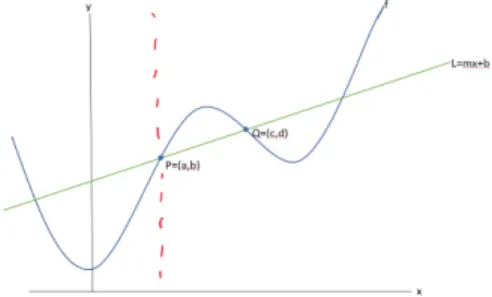
In this paper, we will be investigating, if possible, under what conditions you can rotate the graph of a function about the origin, and still have the resulting graph be the graph of a function? We will first recall the Vertical Line Test and how the Vertical Line Test helps us determine if the graph of a relation is a function. We will then look at three different examples, such as parabolas, lines, and exponential graphs, using the Vertical Line Test. Letθbe the angle between the lineL=mx+b
and they−axis.
2 Definitions and Examples
• A relation P from a set D to a set R a set of assignments from elements of D, called inputs, to elements of R, called outputs.[1]
• The graph of a relation r : D → R is defined as the set of points(a, b)∈R2
such thatr assigns a→b.[1]
• A functionf fromD toR is a relation fromD toR where each input inD is
assigned to no more than one output inR. [1]
• The graph of a function is defined as the point (a, b) is on the graph of f if
and only iff(a) =b.[1]
• Vertical Line Test: A relation r : R →R is a function iff any vertical line in
the coordinate plane intersects the graph ofr in at most one point. [1]
Question 1. Given a function below, can you find a point of rotation and angle of
rotation such that the function is no longer a function?
y=ex y=x2 y=mx+b
While exploring each of the above examples, we noticed that if you pick two points on the function and draw a line through them, this line can be rotated by some angle, θ, such that the line becomes vertical and fails the Vertical Line Test.
This led us to conjecture that given an arbitrary function, there exists a line that intersects the graph of a function in at least two points. This also led us to conjecture
that given the graph of an arbitrary functionf,G(f), there exists an angle,θ, such
thatG(f) rotated byθ is not the graph of a function.
3 Proofs
3.1 Prove that a line exists such that it intersects a given
arbitrary function twice.
Claim 1. Given an arbitrary function, there exists a line that intersects the graph
of a function in at least two points.
Proof. Given a function, f, we can represent the function as a graph such that f :D→R maps coordinates (x, y) from x →y. Because x can be assigned values
across its domain, that means many values of y will result, too. Thus, the graph
of f will have at least two coordinate points: say (x, y) and (a, b). Connect (x, y)
to (a, b) and, by definition, we have a line. This shows that there exists a line that
intersects the graph off in at least two point.
Now that we have determined how to find a line that intersects an arbitrary function twice, lets figure out how to choose a point of rotation.
3.2 How to choose a point of rotation.
To choose the best point of rotation we simply need to choose a point that intersects with functionf and lineLsuch thatLintersects the graph off in at least two places.
Now that we have determined how to choose a point of rotation, let’s figure out how to find the angle of rotation when rotating about this point.
3.3 How to find the angle of rotation when rotating about
a point that lies on the intersection of
G
(
f
)
and the line
L
=
mx
+
b
.
Claim 2. Given the graph of f, G(f), there exists an angle, θ, such that G(f)
rotated byθ around point P is not the graph of a function.
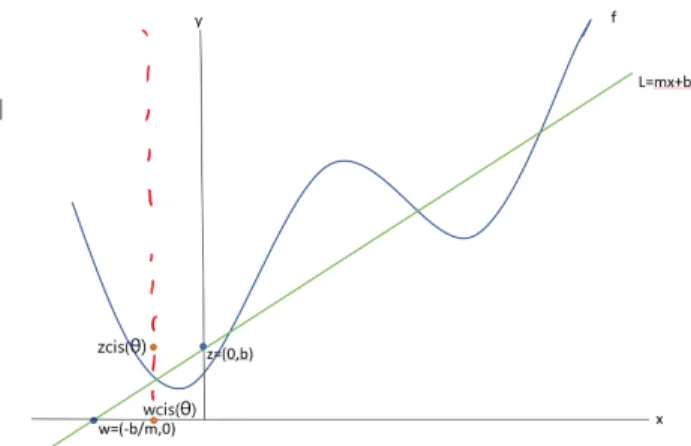
Figure 1: G(f) rotating about point P. 38
Proof. Let the center of rotation be the pointP that lies on the intersection ofG(f)
and the lineL=mx+b.
LetP = (a, b) and Q= (c, d)be two points on the lineL.
Thenm= d−b c−a.
Geometrically,tan(θ1) =m whereθ1 is the angle betweenL and thex-axis.
Solve forθ1:
arctan(tan(θ1)) = arctan(m)
θ1= arctan(m)
Therefore,θ1 = arctan(m)whereθ1 is the angle betweenL andx-axis.
We need to solve for the angel θ2 between the y-axis and L.
To findθ2, the angle between they-axis andL, we takeπ/2 - θ1.
Hence, θ2=π/2−arctan(m).
Therefore, Given the graph off,G(f), there exists an angle, θ=π/2−arctan(m),
such that G(f)rotated by θaround point P is not the graph of a function.
Now that we have determined the angle of rotation when rotating about a point that lies on the intersection ofG(f)and the lineL, let’s see what happens when we
rotate about the origin.
3.4 How to find the angle of rotation when centered at the
origin.
Claim 3. Given the graph of of f, G(f), there exists an angle, θ, such that G(f)
rotated byθ around the origin is not the graph of a function.
Proof. Let the point of rotation be the origin.
Letθbe the positive angle between the y−axisand L=mx+b.
In polar form, the imaginary axis is they−axis and the real axis is thex−axis.
Therefore, since we want both of the x-coordinates to be equal, we set the real coordinates in polar form equal to each other.
Then,Re(bicis(θ)) =Re(−b
m cis(θ)). We can write the above as:
Re((0 +bi)(cos(θ))) +isin(θ))) = Re((−b m + 0i)(cos(θ) +isin(θ)) 0(cos(θ) +bi(isin(θ)) = −b m cos(θ) + 0i(isin(θ) 0 + (bi2) sin(θ) = −b m cos(θ) 0−bsin(θ) = −b m cos(θ) −bsin(θ) = −b m cos(θ) −m b (−bsin(θ)) = cos(θ) msin(θ) = cos(θ) tan(θ) = 1 m arctan(tan(θ)) = arctan(1 m) θ = arctan(1 m)
Hence, θ = arctan(m1). Therefore, given the graph of of f, G(f), there exists
an angle, θ, such that G(f) rotated by θ around the origin is not the graph of a
function.
In part 3.3 we concluded that when rotating around a point on the intersection ofG(f) and line L, the angle,θ=π/2−arctan(m). In part 3.4 we concluded that
when rotating around the origin, the angle, θ = arctan(m1). By trig identity, we
know thatθ=π/2−arctan(m) = arctan(m1). Therefore, the point of rotation does
not effect the angle of rotation.
Now that we know how to choose an angle based on an arbitrary function, we will find how we can choose a function based on an arbitrary function.
3.5 Finding an
f
(
x
)
given an arbitrary
θ
.
Claim 4. Given an arbitrary angle,θ, such that θis not a multiple ofπ, there exists
a functionf(x)such that when rotated about the origin θ degrees, f(x) is no longer
a function.
Proof. Given an angleθ, such thatθis not a multiple ofπ, we want to find a function
such that when the function is rotated counterclockwiseθ degrees, it is no longer a
function.
In a geometric sense, this means that a rotation ofθdegrees would result in the
vertical line test failing, meaning that there exists a line such that it intersects the graph more than once. Thus, we can choosef(x) to be a line sincef(x)would then
intersectf(x)infinitely many times. So, we just need to findf(x)so that a rotation
byθ degrees would make it vertical, and thus no longer a function.
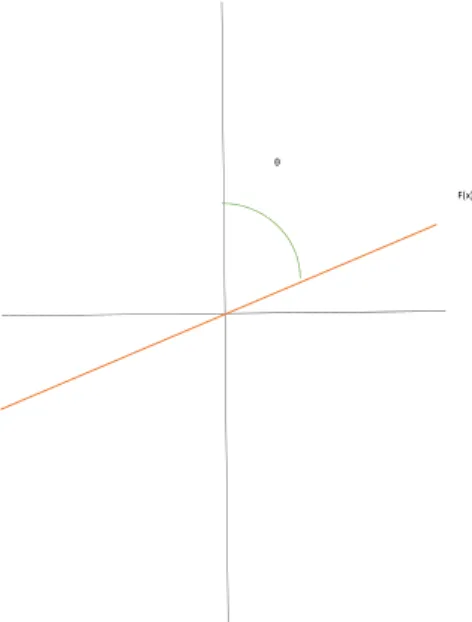
A graph is located below to show where θis found on the graph.
Therefore, this line has the formf(x) =mx+bwhereb= 0since it goes through
the origin. m can be found by calculating our change in y divided by our change
inx. Since θ is the angle between the graph and the y-axis, we must use π
2 −θ to
calculate the slope, m. Thus, the change in y would besin(π
2 −θ) and the change
inx would be cos(π 2 −θ). Therefore, m= tan( π 2 −θ). So, f(x) = tan( π 2 −θ)x for
any givenθ. Rotatingf(x) byθresults in a vertical line based on our construction
off(x), so f(x) is no longer a function when rotated counterclockwise by θ.
Claim 5. Given an arbitrary angle,θ, such that θ is a multiple ofπ, there does not
exist a function f(x) such that when rotated about the origin θ degrees, f(x) is no
longer a function.
Proof. There is the unique case of if θ = kπ, where k is an integer. In this case,
our slope would betan(π2 −kπ) = tan(jπ2) wherej is an integer. Since cos(jπ2) = 0,
thenm is undefined for this case. Therefore, the chosen line does not even start as
a function. Since a rotation ofπ radians is equivalent to changing f(x) to−f(−x),
and we know that −f(−x) is still a function, there is no function that becomes a
non-function after rotation ofπ radians.
F(x) θ
4 Conclusion
In conclusion, we first used the Vertical Line Test to conjecture whether or not an arbitrary function could be rotated about the origin and have the resulting relation still be a function. Next we explored how to find a line that intersects a given ar-bitrary function twice. Then we explored the best strategy for choosing a point of rotation which led us to determining the angle of rotation when rotating about a point that lies on the intersection of G(f) and the line L. This then led us to
de-termining the angle of rotation when rotating about the origin where we concluded that the point of rotation has no effect on the angle of rotation. Lastly, we explored given an arbitrary angle,θ, that there exists a functionf(x)such that when rotated
about the origin θdegrees, f(x) is no longer a function. Through proving our
con-jectures in each of these explorations, we have come to the conclusion that given the graph of an arbitrary functionf,G(f), there exists an angle,θ, such thatG(f)
rotated byθ around any point is not the graph of a function.
We believe that this topic fits into a High School Trigonometry course. First introduce students to relations, functions, basic trig functions, and rotations. After these topics have been covered, assign students this project to help them build connections between different topics.
References
[1] Alexandra Seceleanu,Course Summary, Math 407 – Math for High School Teach-ing, Nebraska, Spring 2018.
When I think over this semester in Math 407, I think first of a specific moment. It was the moment I saw my grade on the first homework and looked at the class’ average and high score. These numbers were unbelievably low. As a class, we were thrown into a bit of a panic, and I was a bit annoyed with how “picky” the grading had been. However, as the semester went on, I really began to appreciate Alexandra’s attention to detail, and I started becoming just as “picky” when it came to my own work and the work of my classmates. These experiences, paired with my experiences in Math 325, gave me much better communication skills. I started to see how these skills would truly affect my teaching through various assignments and activities we did in TEAC 451P, a methods course. For one group project, we were supposed to evaluate different curriculums based on the Common Core State Standards as if we were looking for one to implement in our school. One thing that my group noted when going through the materials is that some textbooks used the terms equation and function interchangeability without mention of a difference. We claimed that this, among other similar examples, would be misleading for students. Our instructor for that class, insinuated in the comments of our work that this was not a valid claim and that using these terms interchangeably didn’t really make a difference. We however, disagreed and had the means to back up our claim, thanks to Math 407. This is one of many examples from TEAC 451P. I also saw the things I was learning in Math 407 directly affect my effectiveness as a Learning Assistant for Math 103. I was able to better help students because I had thoroughly thought through some of the same material for Math 407 homework assignments. Because I had gone over many of the details for myself, I was much more confident in helping students in multiple ways, wherever they were stuck in the problem. Overall, because of my new perspective on precision in communication of math, I will be a better mathematician and teacher. To incoming Math 407 students, I would say, don’t be discouraged with a poor grade, but instead, be willing to learn a new viewpoint.