NBER WORKING PAPER SERIES
THE PREDICTIVE POWER OF THE YIELD CURVE ACROSS COUNTRIES AND TIME
Menzie D. Chinn Kavan J. Kucko Working Paper 16398
http://www.nber.org/papers/w16398
NATIONAL BUREAU OF ECONOMIC RESEARCH 1050 Massachusetts Avenue
Cambridge, MA 02138 September 2010
We thank Shaghil Ahmed, Steve Kamin, Jagjit Chadha, Christian Kascha, seminar participants at the US Treasury, and conference participants at the 10th EABCN conference (Frankfurt, March 30-31, 2009) and Norges Bank Conference on Recent Developments in the Econometrics of Macroeconomics and Finance(June 3-4, 2010) for useful comments. Paul Eitelman provided assistance with the data analysis. Lucio Sarno and Catherine Bonser-Neal graciously provided data. Portions of this paper were completed while Kucko was at the Board of Governors of the Federal Reserve System. The views expressed in this paper are solely the responsibility of the authors and should not be interpreted as reflecting the views of the Federal Reserve Board or of the NBER.
NBER working papers are circulated for discussion and comment purposes. They have not been peer-reviewed or been subject to the review by the NBER Board of Directors that accompanies official NBER publications.
The Predictive Power of the Yield Curve across Countries and Time Menzie D. Chinn and Kavan J. Kucko
NBER Working Paper No. 16398 September 2010
JEL No. C22,E37,E43
ABSTRACT
In recent years, there has been renewed interest in the yield curve (or alternatively, the term premium) as a predictor of future economic activity. In this paper, we re-examine the evidence for this predictor, both for the United States, as well as European countries. We examine the sensitivity of the results to the selection of countries, and time periods. We find that the predictive power of the yield curve has deteriorated in recent years. However there is reason to believe that European country models perform better than non-European countries when using more recent data. In addition, the yield curve proves to have predictive power even after accounting for other leading indicators of economic activity.
Menzie D. Chinn Dept. of Economics University of Wisconsin 1180 Observatory Drive Madison, WI 53706 and NBER [email protected] Kavan J. Kucko Department of Economics Boston University
270 Bay State Road Boston MA 02215 [email protected]
1. Introduction
Over three years ago, several observers noted the inversion of the yield curve in the United States. That event sparked a resurgence in the debate over the usefulness of the yield curve as an indicator of future economic activity, with an inversion indicating a slowdown (and in some formulations, a recession). The inverted yield curve as recession indicator, while common in the United States, is not widely used in other countries. Moreover, in the most recent episode, there was widespread conviction that ‐‐ in light of the increased credibility ascribed to
monetary policy ‐‐ the yield curve no longer served as a useful early warning signal for growth slowdowns. Figure 1 displays the yield spread, the difference between long and short term government interest rates, through time for the United States and select European countries. The yield spread dips before each recession period and turns negative for all but one, including the recession beginning in 2007. For European countries, the relationship is not as consistent but there does appear to be some level of coincidence.
The motivation for studying the yield spread is of course manifold. First, policy makers often need to make decisions today, based on expectations regarding future economic
conditions. Although policymakers rely on a range of data and methods in forecasting future conditions, movements in the yield curve have in the past proved useful, and could still represent a useful additional tool.
Second, variations in the correlations between asset prices and economic activity might inform debates regarding the workings of the macroeconomy. The fact that it works for some countries, and not others, might be suggestive of certain channels being important, to the
exclusion of others. A similar sort of reasoning applies to examining the goodness of fit over different time periods.
While there is already a voluminous literature on the subject of yield curves and US economic activity, we nonetheless believe now is an opportune time to re‐examine the evidence. This conviction is rooted in two developments.
The first is the advent of the euro in 1999. The creation of a more integrated European bond market, and increased economic linkages on the real side, suggests that the old historical links (or nonlinks, as the case may be) between the interest rates and output might have changed. Yet, until recently, there had not been a sustained and significant downturn in the European economy post‐EMU, and hence little opportunity to test the predictive power of the yield curve in this context.
The second is the “conundrum”, i.e., the failure of long‐term interest rates to rise along with the short‐term policy rate, as the Fed Funds rate rose during 2004‐05. Some people ascribed this phenomenon to the disappearance of risk, variously associated with the cross‐ country decline in inflation and output volatility – what is sometimes called the Great Moderation – or with greater risk‐management on the part of financial institutions.
Alternatively, attention has been directed to the demand by pension funds for long‐term assets, or foreign central bank purchases of Treasury assets.1 Regardless of the merit of such
arguments, we think it of interest to determine whether the previously extant correlations hold in the more recent period.
The paper is organized in the following fashion. In section 2, we lay out a framework for examining what determines the long term interest rate relative to the short, and relate that to the extant literature on the yield curve as a predictor of future economic activity. In section 3, we describe the data and the empirical tests we implement. In Section 4, we repeat the exercise, but using as a dependent variable a binary dependent variable called “recession”. Section 5 concludes.
2. Background
2.1 Theoretical Framework
Following previous literature, this paper focuses on the yield spread defined as the 10‐year government bond yield less the 3 month treasury yield (or closest equivalent for countries other than the United States)2.
The linkage between the long‐term and short‐term interest rates can be decomposed thus:
2 Using aggregate Euro area data, Moneta (2003) found that the 10‐year/3‐month spread specification performed
better than any other pair of yield maturities that included two of the following: 3‐month, 1‐year, 2‐year, 5‐year, 10‐year.
n t e n t e t t n t l n i i i i ( 1... 1) (1)
Where itn is the interest rate on a bond of maturity n at time t,is the expected interest rate on
a one period bond for period t j, based on information available at time t, and ltn is the liquidity (or term) premium for the n‐period bond at time t. This specification nests the expectations hypothesis of the term structure (EHTS) (corresponding to the first term on the right hand side of equation 1), and the liquidity premium theory (corresponding to the second term).
The EHTS posits that the yield on a long‐term bond is the average of the one period interest rates expected over the lifetime of the long bond. The liquidity premium theory allows that there will be supply and demand conditions that pertain specifically to bonds of that maturity. The presence of idiosyncratic effects associated with a certain maturity of bond is sometimes linked to the “preferred habitat theory”, the idea that certain investors have a
preference for purchasing assets of specific maturities. Since n 0
t
l and is expected to rise as n
becomes large, the yield curve will slope upward when short rates are expected to be constant over time.3
Now, for the sake of simplicity, consider the case where ltn 0 (i.e., the EHTS explains all variation in long rates). Suppose further expected short rates are lower than the short rate
3 Hamilton and Kim (2002) find that short term interest volatility determines the term premium, but not economic activity.
today. Then the long rate will be lower than the short rate (i.e., the yield curve inverts). Since low interest rates are typically associated with decreased economic activity, an inverted yield
curve should imply an expected downturn, especially given thatltn 0, then an inversion should imply a downturn a fortiori.
Why should short interest rates be lower during an economic downturn? The reasoning follows two – not necessarily mutually exclusive ‐‐ avenues. The first is that decreased
economic activity decreases private sector demand for credit; at the same time the monetary authority is likely to have decreased the policy rate in response to the slowdown. The second is that the monetary authorities raise rates that precipitate the subsequent slowdown.
2.2. Selective Literature Review
The literature on the usefulness of the yield spread in forecasting future growth is extensive and we review only a subset of the analyses here. Some early studies regarding the
relationship between growth and the yield spread date to the late 1980s: Harvey (1988, 1989), Stock and Watson (1989), Nai‐Fu Chen (1991), Estrella and Hardouvelis (1991) among others, suggested that an inverted yield curve (in this case a negative yield spread) could signal an impending recession. These early studies were primarily conducted using U.S. financial data to predict future Gross Domestic Product (GDP) growth.
Subsequent research focused on whether the relationship between the yield spread and future economic growth held up in countries other than the United States. Harvey (1991), Davis and Henry (1994), Plosser and Rouwenhorst (1994), Bonser‐Neal and Morley (1997),
Kozicki (1997), Estrella and Mishkin (1997) and Estrella, Rodrigues and Schich (2003) examined non‐US OECD countries using post‐1970 data, and generally conclude that the yield spread can be used to some extent in predicting future economic growth. However out‐of‐sample studies conducted by Davis and Fagan (1997) and Smets and Tsatsaronis (1997) using, respectively, U.S. and German data, and European data, found that parameter estimates are unstable over time. Moreover, the estimated regressions exhibited poor forecasting performance.
While the most simple model requires only a single‐variable specification with the yield spread as the lone independent variable, some subsequent research allows for additional variables, such as the short term policy rate ‐‐ at least when predicting recessions (as opposed to growth). One prominent example of this approach is Wright (2006). In his paper, Wright argues that adding the short‐term rate strengthens the in‐sample forecasting results when using a probit model to predict recessions.
3. Empirical Model and Results
3.1 Data
The compilation of the dataset confronts the researcher with many choices, including the set of countries to study, and the choice of both regressors and regressand. We opted to select countries in order to adequately represent the Euro Area. Countries outside the Euro Area provide a basis of comparison to provide perspective and sense of robustness regarding the results.
In addition, to ensure the interest rates represent market‐determined rates, we selected countries that have robust and liquid financial markets. The need for a sufficiently large time sample (1970‐ September 20094) further restricted the set of countries we could examine. Given these constraints, we restrict our analysis to Canada, France, Germany, Italy, Japan, the Netherlands, Sweden, the United Kingdom, and the United States. In addition, we estimate an aggregate Euro Area specification using data from 1990‐2009.
We select industrial production as our measure of economic activity. While GDP is the broadest indicator of economic activity, the use of industrial production presents some substantial advantages in terms of timeliness and reliability.5 In any case, growth rates of industrial production tend to follow GDP closely6. All of the countries in the data set (including the Euro Area) report industrial production at a monthly frequency while GDP is reported at a quarterly frequency; using IP therefore affords us a larger data set.
3.2 In‐sample Results
We start with a simple bivariate model:
k t t k t t Spread IPGrowth, 0 1 (2)
4 For Italy and the Netherlands, the data begin in 1971 and 1972 respectively.
5 By reliability, we mean that the industrial production series do not get revised as significantly as GDP. 6 For instance, the correlation between GDP and IP growth in the US and UK are .76 and .72 respectively.
Where IPGrowtht,tk is the annual growth rate over the period t through tk, and mo t yr t t i t Spread 10 3 .
In words, the yield spread at time t predicts the annual growth rate of industrial production from time t to time period tkmonths. We examine this model with k equal to 12 and 24 (i.e. growth over a one and two year time horizon). Since adjacent year over year growth figures will be drawing from overlapping data points, the resulting error terms will be serially correlated. To account for this serial correlation, we conduct our statistical inferences using heteroscedasticity and serial correlation robust standard errors. 7
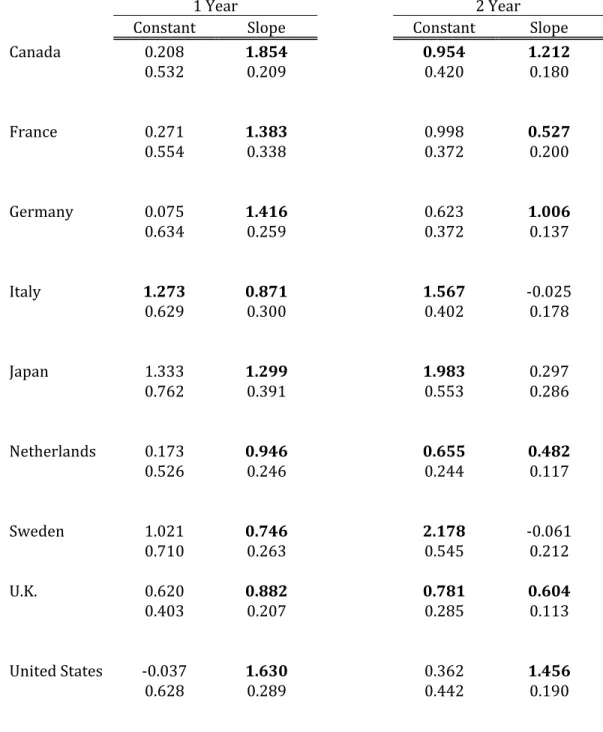
We turn first to the results from the model using the complete interest rate data set (1970‐2009), displayed in table 1. All countries exhibit a significant slope parameter over the one year forecast horizon, suggesting the yield spread may hold some forecasting value. The magnitude of the parameter estimate is also economically significant. For example, the slope coefficient of 1.38 for France implies that for each percentage point increase in the yield spread, French industrial production growth will increase by 1.38 percentage points over the subsequent year.
Figure 2 displays the estimated slope coefficients for all countries in the data set. These coefficients vary markedly across countries, ranging from a high of 1.85 in Canada to a low of
7 We have investigated whether the variables are stationary or not. Unit root tests indicate that the spreads and
0.75 in the Sweden. A Chow test confirms the fact that the relationship between the yield spread and economic growth is not identical across countries.
Despite the existence of statistically significant parameter estimates in each country, the goodness of fit for the model (according to the R‐squared statistic), varies substantially across country models. That being said, the relative proportion of variation across countries is of interest. The yield spread in United States, Germany, France and Canada explains more than 20 percent of the changes in annual industrial production growth. In contrast, the yield spread explains less than 10% of the variation in output in Italy, the Netherlands, and Sweden.
Following Bonser‐Neal and Morley (1997) and Kozicki (1997), we also examine the corresponding specification for growth over a two year horizon. While many of the variables are still significant, the explanatory power of the model deteriorates for many countries. Additionally, in every case the magnitude slope coefficient is smaller in the two‐year model relative to the one‐year model. The decrease in explanatory power and magnitude of the coefficient estimates at the two‐year versus one‐year horizon suggests most of the explanatory power is concentrated at the shorter horizon.8 Figure 3 displays the goodness of fit according to the R‐squared coefficient across countries over one and two‐year growth forecast horizons. Only the German, United Kingdom and United States models exhibit better fit in the two‐year model relative to the one‐year model.
In order to investigate the time variation in the strength and nature of the yield curve/growth relation, we split the sample at 1997/98. The choice of that specific date is primarily pragmatic in nature; it sets each subsample to be roughly similar in size. At the same time, the choice is somewhat fortuitous, as the latter subsample then conforms approximately to the post‐EMU period.
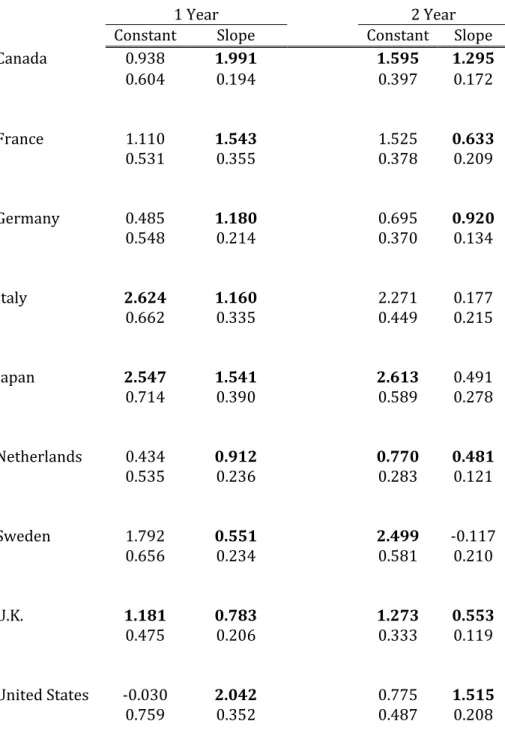
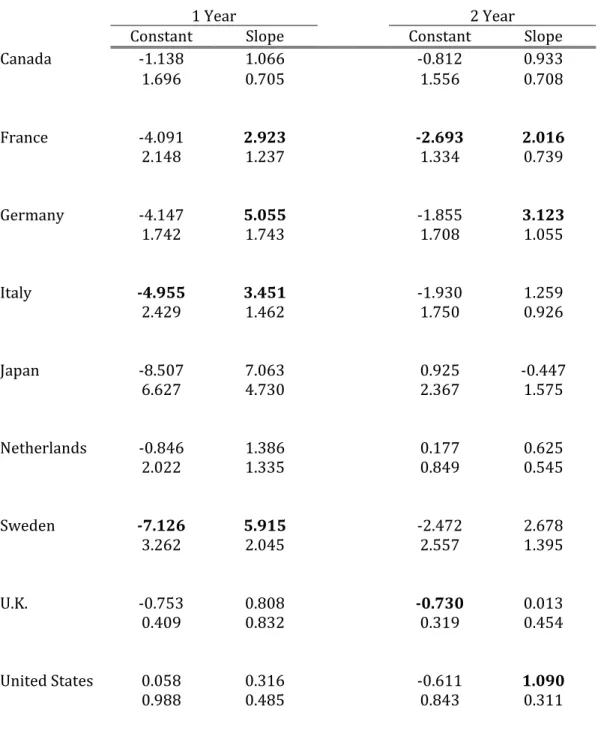
Tables 2 and 3 contain results from the two sub‐samples of data, and highlight a key finding. The detection of a statistically significant relationship between term spreads and subsequent output growth is driven by the early portion of the sample. The regressions on the data from the early sample (1970‐1997) yield coefficients that are significant for every country at the 95 percent confidence level. In contrast, the coefficient estimates obtained using the more recent data sample (1998‐2009) are significantly different from zero in only four of nine countries, suggesting a general deterioration in the relationship between the yield spread and economic growth in recent years.9
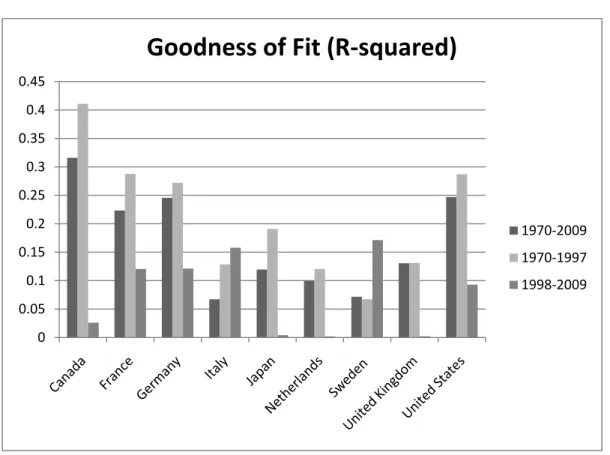
Examining the goodness of fit across sub‐samples in Figure 4 leads to similar
conclusions. Only the Sweden and Italy models exhibit a better fit when using the later data subset. In Italy’s case the slope coefficient is not significant at the 95 percent confidence level. Only in four (very important) cases – the US, France, Germany and Italy ‐‐ does the the
goodness of fit hold steady. Japan exhibits the sharpest dropoff in goodness of fit from the two subsets, starting at nearly 0.2 in the 1970‐1997 subsample and reaching nearly zero in the
9 Interestingly the level of the coefficient for Sweden is three‐fold higher in the later sample relative to the early
1998‐2009 subsample. This data period coincides with the Asian financial crisis and may reflect Japan’s short term rates hitting the zero interest lower bound.
One interpretation of the negative coefficient could be as follows: typically a central bank will lower the policy rate to stimulate the economy. To the extent that the long‐term rate is less responsive to policy rates compared to short‐term rates, a lowering of the policy rate is associated with an increase in the yield spread. When the policy rate hits zero and the central bank engages in quantitative easing to replace reductions in the policy rate, longer term interest rates fall. The result is a narrowing of the yield spread. If succesful, these lower long‐ term rates should spur the economy and future growth should be on the horizon. If this were the case, and if the only shocks hitting the economy were variations in the extent of
quantitative easing, we would expect the relationship between the yield spread and future growth when the policy rate is at zero to be inverse to the reationship when the policy rate is positive. One obvious implication of the Japanese results is that, going forward, one might expect a degraded fit for the US yield curve/output relationship, given the fact that the effective Fed Funds rate has essentially hit zero.
Our results are consistent with those of Haubrich and Dombrosky (1996) and Dotsey (1998) that suggest that the relationship between the yield spread and future growth diminishes using data since 1985. The results of our analysis suggest that the relationship continues to deteriorate post 1997, but with a couple of exceptions.
3.3 Out‐of‐Sample results
Since we are interested in the forecasting power of the yield curve, in‐sample fit is not necessarily the most relevant metric. Consider the prediction error at time t; this error is obtained using a fit obtained including observations realized after time t, and in this sense utilizes information that would not be available to a forecaster at time t.
One way to more clearly identify the forecasting power of a particular specification is by conducting an out‐of‐sample forecasting exercise.10 Each yield spread observation is used to predict future growth with truncated data such that the only data used is data that existed prior to the observation. For example, if we have a data set that ranges from 1970‐2009 and we want to predict industrial production growth from January 1980 to January 1981, we could restrict our regression to only use data from 1970‐1979 in calculating the constant and slope parameters for our estimation of 1980‐1981 growth. Then, to forecast IP growth from February 1980 to February 1981, we re‐estimate the regressions adding the January 1980 data and use the updated parameter estimates to predict growth over that time period.
The parameter estimates from these recursive regressions are used to generate a series of fitted values for year‐over‐year growth for each country. We opt to compare the root mean square error (RMSE) criterion, and compare against a naïve forecast RMSE. In this case, our naïve forecast is a simple AR1 model of growth.
The results can be succinctly summarized. We conclude that there exists a marginal benefit to estimating a growth model with the yield spread (as opposed to the simple AR(1) model) if the RMSE from the yield spread model specification is less than that of the AR(1) model. Figure 5 displays the fitted values for the out‐of‐sample model, using the yield spread as the independent variable. While extreme fluctuations were not always well predicted, the general contours of the growth rate series seem to be captured in many cases. However, none of the models, including those that outperformed the AR1 models, were able to predict the most recent contraction in industrial production.
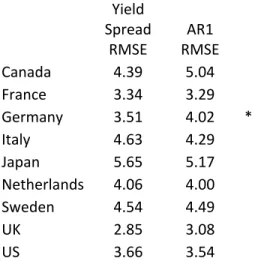
Results relative to the AR(1) model across all countries were mixed. Table 4 displays the results of the RMSE scores for both model specifications. Three of the nine country models scored lower RSME from the yield curve specification as opposed to the AR(1) model, while the remaining five increased. Two of the three yield curve models exhibiting lower RMSE than the AR(1) models were European countries. In terms of statistical significance, in only one case – Germany – did the yield curve outperform the AR(1) specification at the 10% msl, according to a Diebold‐Mariano test.11
The relatively poor out‐of sample results could, in part, be due to fundamental changes in the relationship between the yield curve and economic activity over time. If the structure of the relationship changed in the middle of our sample the forecasting power, coefficient
estimates using historical data may not be useful in predicting growth out of sample. A number
of events over the past ten years may have affected the predictive power of the yield curve including: the advent of the European monetary union, the “great moderation”, the global savings glut and the Japanese experience with a zero lower bound policy rate. Each of these events affected different subsets of countries within our dataset. Therefore if we witness a simultaneous deterioration of predictive power across countries affected by the same event, it may suggest that that event was partially responsible for the observed deterioration. For instance, if each model corresponding to a country that adopted the Euro exhibits a
simultaneous drop in the significance of the yield curve coefficient shortly after the advent of the euro (and relative to other countries), this suggests the adoption of the Euro changed what the yield curve tells us about future economic growth.
To examine changes in the predictive power of the yield curve through time we use rolling windows for the regressions. The originating sample runs from January of 1970 through December of 1979; we estimate the regression, and then forecast out, move the sample up one period, and then repeat the process until we exhaust all observations. Figure 6 plots the coefficient estimate and 95% confidence intervals corresponding to the yield curve coefficients for each overlapping 10 year interval from January 1970 – December 1979 through January 1999 –December 2008. The grey shaded area roughly approximates the time period of interest including the global savings glut, European monetary union and the second half of the “great moderation”. Generally declining coefficient estimates and widening confidence bands confirm our suspicion that the relationship between the yield curve and economic growth has
deteriorated over the last ten to fifteen years. However many models exhibit a strengthening over the past one or two years.
The Euro area countries appear similar to one another in some respects: the coefficient estimates tend to decline into 1990 when they generally become insignificant. This is
consistent with the fact that many macroeconomic variables (including both industrial
production and the yield spread) became significantly less volatile decreasing the detectability of any relationship. The recent uptick in the coefficient estimates is consistent with recent macroeconomic volatility. However coincidental deterioration is less obvious post 1998 where the coefficient estimates are generally insignificant.
Canada, the United Kingdom and the United States all exhibit deterioration in the post 1998 era; the significance band widens in the United states and Canada while the coefficient estimate draws closer to zero in the United Kingdom. Some have speculated that the global savings glut may have affected not only the United States but also other countries with strong legal regimes and liquid financial markets12. If Canada and the United Kingdom were affected by the global savings glut in the same way that the United States may have been, this is the coincidental deterioration in forecast performance one might expect.
Finally, Japan may have been the most dramatic of all models in our sample. As the regression begins to include data after the zero lower bound policy rate the coefficient estimate swings wildly to the negative side (albeit mostly insignificant). However the estimate swinging
negative is what we would have expected as the short rate hits zero and the government attempts to lower long‐term rates as well.
3.4 Marginal predictive value
In general, the simple univariate regression results suggest the yield curve does hold significant predictive power, especially when the sample includes many business cycles. Next we explore if yield curve data continues exhibit predictive information when other common leading
indicators are introduced into the equation. For the leading indicators, we chose five data series commonly used to construct leading economic indexes13: New Private Housing Permits,
Average Weekly Hours Worked, Money Supply (as measured by M2), Manufacturers’ New Orders of Non‐defense Capital Goods, and Stock Prices. Where exact matches were not available for a particular country, the most similar data series was used.
To represent the leading indicators we construct a single “factor” by applying principal component analysis to 12‐month changes of five common leading index components.14 The factor is defined to be the first principle component. For each of the countries we estimate the following equation15: k t t t k t t Spread Factor IPGrowth, 01 2
13 For more on leading economic index components, see the Conference Board’s website:
http://www.conference‐board.org/
14 This procedure is suggested by Stock and Watson (2005). We adopt an ad hoc approach to selecting the
components. A more formal approach is outlined in Groen and Kapetanios (2009).
Table 5 summarizes the results of these regressions. Due to data limitations of some leading indicators, the sample size for a number of countries has been reduced for this exercise. Regardless, in nearly every case, results suggest the yield spread does contain information above and beyond other common leading indicators. The Netherlands is the sole exception; the small sample size may be contributing to the inconclusive results.
Leading indicator data in Canada, Japan and the United States span the original sample, beginning in 1970. For these countries coefficient estimates for the yield curve are little changed with or without the inclusion of the factor. The largest difference is manifested in the case of the United States, where the coefficient estimate on the spread drops from 1.6 to 1.2. As expected, the constructed factor is also significant in explaining variation in industrial
production growth in many countries, although the relationship appears to be weaker than that between the yield curve and growth.
3.5 Real‐time data results
In the previous exercises we used historical data as they looked at the time. However industrial production data, as are most measures of economic activity, is subject to revision. For instance, United States industrial production for December 2008 was originally reported as 106.1 by April 2009, December data had been revised down to 104.8. From a forecasting perspective, using data as it appears most recently (the current vintage) is not the same as using data as it looked prior to the estimation period. If, today, we want to evaluate how the model would have performed in December 2008, using data as it appeared in December 2008 as opposed to today, more closely simulates estimating the model in 2008.
Koenig, Dolmas & Piger (2003) point out that the relationship between early estimates of economic output and early estimates of explanatory variables is the relationship of interest to forecasters. Any given vintage prior to a forecasting period will have historical figures that have been revised as well as early estimates of more recent data. To capture the relationship between early estimates of output and explanatory variable Koenig, Dolmas and Piger suggest creating a “real‐time vintage” by compiling a single time series for each variable that include only the first estimate. Furthermore, Koenig, Dolmas and Piger argue that revisions to data are unpredictable (essentially extraneous noise) at the time if issuance so using a real‐time vintage on the left‐hand side of an equation eliminates the noise and in fact provides more accurate forecasts.
In this section we use real‐time vintage data created from the OECD Main Economic Indicators real‐time data and revisions database16. Due to data availability, we use GDP deflated by CPI as a measure of economic output and restrict our sample of countries to: Canada,
Germany, Japan, U.K. and U.S. Since the interest rates used to construct the yield spread are not typically revised, therefore using the current vintage for the yield spread sufficiently
represents a real‐time vintage. Each data point in the GDP growth real‐time vintage represents the first estimate of nominal four‐quarter growth deflated by CPI.
Table 6 displays the results of the real‐time data estimation. For comparison, the second column displays estimates of the same equation using a single, recent vintage. Significant
parameter estimates across all countries, except Japan, suggest the yield curve does tend to provide significant information regarding first estimate economic growth over the next four quarters. However, the real‐time data does not appear to significantly outperform single‐ vintage data when using the full sample of data.
We next turn to out of sample estimation with the real‐time vintage data to test forecasting performance. The RMSE of the recursive estimates are displayed in table 7. The results from the real‐time vintage data are compared with results from the current vintage. In all cases excluding Germany, the real‐time data provided increased forecasting power. If revisions are indeed unpredictable at the time of the initial estimate, stripping the added noise caused by the revisions could be driving the improved performance of the real‐time equation.
4. The Yield Curve and “Recessions”
We now move to a nonlinear version of the same question we asked earlier, to the extent that recessions are a specific characterization of (negative) output growth. Following Montea (2003) and Wright (2006), we test if the yield spread is a predictor of recessions, defined as a binary dependent variable.
There is little agreement in terms of the findings in the literature, especially in this cross‐ country context. While Montea (2003) finds the yield curve alone is a useful predictor of
recessions when using aggregate Euro area data, Wright (2006) argues there is no reason to believe that an increase in the short‐term interest rate should have the same consequence as a
decrease in the long term rate. Consequently, we augment the conventional recession/yield curve specification with the Federal funds rate to isolate the effect of changes in the short‐term rate. Wright’s model performed better when adding the Federal funds when using United States data. Following the literature, the models we use are as follows:
Rtt tt kk
Spreadtt mot
Spread R 3 1 Pr 1 Pr 2 1 0 , 1 1 0 , 1 Where t is the current time period and k is the forecast period and
denotes thestandard normal cumulative distribution function. We use the 3‐month interest rate to isolate the effect of movements in short‐term interest rates. The recession indicator equals one if a given economy is in a recession for any month between t1 through tk, inclusive. We estimate both models using k equal to 6 and again with k equal to 12 (i.e. a six month and one year forecast).
In terms of our recession indicators, we use the NBER measure for the United States. Since there are not comparable measures for the other countries, we use the recession indicator from the Economic Cycle Research Institute (ECRI).
Table 8 displays the results from the probit model estimates for each country. The first two columns are the results from a six‐month forecasting horizon, while the third and fourth columns display the twelve‐month forecasting results. The pseudo R‐squared statistic (which does not penalize for increased model size) is shown as an indicator of goodness of fit.
Generally the models that include the short‐term interest rate out‐perform those that only include the yield spread.
For the United States, our results differ somewhat from the results obtained by Wright (2006); the yield spread parameter is significant over both the six‐month and twelve‐month forecasting periods. However, the 3‐month interest rate parameter is statistically insignificant over either horizon. Additionally, we do not see a significant increase in goodness of fit when adding the short‐term rate.
The results from the Germany model are very similar to the United States model: model performance improves very little when adding the short‐term interest rate and the short‐term interest rate parameter is not statistically significant. Interestingly, results for the remaining countries outside the United States are starkly different. Across many other non‐US countries, adding the short term rate to the model reduces both the magnitude and significance of the yield spread, while increasing the overall goodness of fit. In Canada, Sweden and the United Kingdom the short‐term rate is statistically significant while the yield spread coefficient actually becomes statistically insignificant. The most dramatic instance of this is the Canada where the magnitude of the t‐statistic for the yield spread parameter declines from negative 5 to just negative 0.5 when adding the short‐term rate in the six‐month forecast; at the same time the pseudo R‐squared statistic jumped from 0.31 to 0.48. In all countries excluding Japan, the coefficient on for the short‐term interest rate is positive, suggesting high relative short‐term interest rates precede periods of slower growth.
We display in Figure 7 the estimated probabilities of recession in the subsequent 6 months using only the yield spread, and both the yield curve and 3‐month interest rate. Generally speaking recessions were well predicted by the yield curve across countries in the 1970s and 1980s. When we look at recessions in the 1990s and 2000s however, results are less consistent. Across most countries recessions earlier in the data set were predicted better when including the short‐term interest rate level whereas more recent recessions tend to be better predicted with the yield spread alone. While this stylized fact may be indicative of a structural change in the relationship between interest rates and future economic activity, it could also be due to the decline in short‐term interest rate volatility relative to the decline in yield spread volatility since 1995.17
Some findings merit specific comment. For Germany, estimated probabilities peaked near one hundred percent predicted probability prior to the recessions in the 1970s and 1980s, as anticipated. Moreover, the estimated probability exceeded 80 percent preceding the 1990 recession. While the probability peaked at lower levels before the 2000 and 2007 recessions, in both cases the model ascribed a probability well in excess of 50 percent. The results for the United Kingdom and Italy paint a different picture. Probabilities generated by the model fit the recession data well for through 1990; however, the models failed to signal a downturn in the months leading up to the 2007 recession. In both cases the model excluding the short‐term
17 Variance of 3‐month interest rate was, on average, 9.75 times greater in 1970‐1994 when compared to 1995‐ 2008 data while the variance of the yield spread was, on average, 4.95 percent higher in 1970‐1994 when
compared to 1995‐2008. Only two countries exhibited increased relative volatility of the 3‐month spread: Sweden
rate actually produced a higher probability of recession then the model including both the yield spread and the short‐term interest rate. These outcomes suggest something may have been structurally different about the recessions of the 2000s. It is tempting to speculate on the impact of Economic and Monetary Union on this phenomenon, since the 2001 recession is the first one occurring when the ECB was setting short term rates, and long rates had converged to relatively small differentials.18
The results for Japan are unique. When using only the yield spread as in independent variable, the yield curve coefficient is not statistically significant. When adding the short‐term interest rate, both coefficients become highly significant and the explanatory power of the model increases markedly. Additionally, the sign of the short‐term interest rate coefficient is negative, indicating that lower relative short‐term interest rates tend to precede times of slower growth in Japan.
5. Conclusion
This paper has explored the importance of the yield spread in forecasting future industrial production growth and recession. Overall, when using the entire data series from 1970‐2009, in‐sample results suggest the yield spread is indeed important and has significant predictive power when forecasting industrial production growth over a one‐year time horizon. The results
18 Note that CEPR, using a methodology reminiscent of NBER’s, did not declare a recession for this period. See
deteriorate when forecasting growth two years ahead. Moreover, it appears that the predictive power of the yield curve for subsequent one‐year growth is much weaker in the last decade. However, four out of six European country models exhibited relatively high R‐squared statistics (above 0.1) when using data from 1998‐2009, and for two countries (Italy and Sweden) the proportion of variation actually increased. While the explanatory power is somewhat less for certain models estimated over the 1970‐1997 data, the data still suggest the yield curve might possess some forecasting power for European countries. The marked deterioration of the significance in the Japan model when using data corresponding to Japan’s period of zero interest rate policy (ZIRP) might presage a weakening of the significance of the relationship in the United States, given the effective Federal funds rate has reached the zero lower bound.
The results we obtained in the out‐of‐sample forecasting exercises were less convincing. Of the European countries examined, only for Germany and the United Kingdom did the yield curve possess greater predictive power than a simple AR(1). Certainly the relationship between the yield spread and growth has declined in recent years; however it appears that the
relationship has held up best in some European countries and may have strengthened with the increasing volatility of macroeconomic data over the past two years.
In terms of in‐sample explanatory power, the yield curve appears to have predictive power for one year ahead industrial production, even after accounting for other variables that have predictive power. We obtain this result by augmenting the yield curve regression with a factor based upon five variables that are typically used in leading indicators.
The contrast across countries was marked for the probit models. The short‐term rate was significant in several instances; however inclusion of the short‐rate often resulted in a decrease in the economic and statistical significance of the yield spread. The model predicted recessions relatively well for the US, Germany and Sweden over the entire data set while the remaining models largely failed to anticipate the recessions of the 2000s. The Japanese case is distinct from all the others. Low short‐term rates appear to precede future economic
slowdown and the model performs very poorly without the short‐term rate.
In other words, we do not obtain a simple story for the yield curve’s predictive power. The yield curve clearly possesses some forecasting power. However, there is also some evidence the United States is something of an outlier, in terms of its usefulness for this purpose. And overall, the predictive power of the yield curve seems, with some notable exceptions, to be declining over time.
References
Bonser‐Neal, Catherine and Timothy R. Morley. 1997. “Does the Yield Sperad Predict Real Economic Activity? A Multicountry Analysis,” Federal Reserve Bank of Kansas City
Economic Review 82(3), pp. 37‐53.
Chen, Nai‐Fu. 1991. “Financial Investment Opportunities and the Macroeconomy,” Journal of
Finance 46(2), pp. 529‐54.
Council of Economic Advisors. 2009. The Economic Reoprt of the President Washington, DC: Government Printing Office.
Davis, E. Philip and Gabriel Fagan. 1997. “Are Financial Spreads Useful Indicators of Future Inflation and Output Growth in EU Countries?” Journal of Applied Econometrics 12, pp. 701‐14.
Davis, E. Philip and S.G.B. Henry. 1994. “ The Use of Financial Spreads as Indicator Variables: Evidence for the United Kingdom and Germany,” IMF Staff Papers 41, pp. 517‐25.
Dotsey, Michael. 1998. “The Predictive Content of the Interest Rate Term Spread for future Economic Growth,” Fed. Reserve Bank Richmond Economic Quarterly 84:3, pp. 31‐51. Estrella, Arturo and Gikas Hardouvelis. 1991. “The Term Structure as a Predictor of Real
Economic Activity,” Journal of Finance 46(2), pp.555‐76
Estrella, Arturo and Frederic S. Mishkin. 1997. “The Predictive Power of the Term Structure of Interest Rates in Europe and the United States: Implications for the European Central Bank,” European Economic Review 41, pp. 1375‐401.
Estrella, Arturo; Antheony P. Rodrigues and Sebastian Schich. 2003. “How Stable is the Predictive power of the Yield Curve? Evidence from Germany and the United States,”
Review of Economics and Statistics 85:3.
Groen, Jan J.J. and George Kapetanios. 2009. “Model Selection Criteria for Factor‐Augmented Regressions,” Staff Report no. 363 (Federal Reserve Bank of New York, February).
Hamilton, James D., and Dong Heon Kim. 2002. “A Reexamination of the Predictability of Economic Activity Using the Yield Spread,” Journal of Money, Credit and Banking 34(2), pp. 340‐360.
Harvey, Cam 340‐360 pbell R. 1988. “The Real Term Structure and Consumption Growth,” J.
Harvey, Campbell R. 1989. “Forecasts of Economic Growth from the Bond and Stock Markets,” Financial Analyst Journal 45(5), pp. 38‐45
Harvey, Campbell R. 1991. “The Term Structure and World Economic Growth,” Journal of Fixed
Income (June), pp 7‐19.
Haurbrich, Joseph G. and Ann M. Dombrosky. 1996. “Predicting Real Growth Using the Yield Curve,” Federal Reserve Bank of Cleveland Economic Review 32(1), pp. 26‐34.
Koenig, Evan, Sheila Dolmas, and Jeremy Piger. 2003. “The Use and Abuse of ‘Real‐Time’ Data in Economic Forecasting,” Review of Economics and Statistics 85.
Kozicki, Sharon. 1997. “Predicting Real Growth and Inflation with the Yield Spread,” Federal
Reserve Bank Kansas City Economic Review 82, pp. 39‐57.
Moneta, Fabio. 2003. “Does the Yield Spread Predict Recessions in the Euro Area?” European
Central Bank Working Paper Series 294.
Plosser, Charles I. and K. Geert Rouwenhorst. 1994. “International Term Structures and Real Economic Growth,” Journal of Monetary Economics 33, pp. 133‐56.
Rudebusch, Glenn, Eric T. Swanson and Tao Wu. 2006. “The Bond Yield “Conundrum” from a Macro‐Finance Perspective,” Federal Reserve Bank of San Francisco Working Paper No. 2006‐16.
Sarno, Lucio and Giorgio Valente (2009), “Exchange Rates and Fundamentals: Footloose or Evolving Relationship?," Journal of the European Economic Association 7(4), pp 786‐830.
Smets, Frank and Kostas Tsatsaronis. 1997. “Why Does the Yield Curve Predicte Economic Activity? Dissecting the Evidence for Germany and the United States,” BIS Working
Paper 49.
Stock, James and Mark Watson. 1989. “New Indexes of Coincedent and Leading Economic Indicators,” NBER Macroeconomics Annual Vol. 4 pp. 351‐394.
Stock, James and Mark Watson. 2005. “Implications of Dynamic Factor Models for VAR Analysis,” NBER Working Paper No. 11467 (July).
Stock, James and Mark Watson. 2003. “Forecasting Output and Inflation: The Role of Asset Prices,” Journal of Economic Literature Vol. XLI pp. 788‐829.
Warnock, Frank and Veronica Cacdac Warnock. 2006. “International Capital Flows and U.S. Interest Rates,” NBER Working Paper No. 12560.
Wright, Jonathan. 2006. “The Yield Curve and Predicting Recessions,” Finance and Economic
Discussion Series No. 2006‐07, Federal Reserve Board, 2006.
Wu, Tao. 2008. “Accounting for the Bond‐Yield Conundrum,” Economic Letter 3(2) (Dallas: Federal Reserve Bank of Dallas, February).
Data Appendix
Data for this paper came from two sources. All of the recent data came from Haver Analytics. When the series in Haver did not extend back to 1970, the Haver series were spliced with data from the Bonser‐Neal and Morely (1997) dataset. These data include the following:
Canada:
3‐month interest rate from 1/1970 to 12/1979 (IFS) Industrial Production from 1/1970 to 12/1980 (BIS) France:
3‐month interest rate from 1/1970 to 5/1989 (BIS) 10‐year interest rate from 1/1970 to 8/81 (BIS) Germany:
10‐year interest rate from 1/1970 to 12/1979 (OECD, FRB) Italy:
3‐month interest rate from 1/1971 to 12/1979 (lFS) 10‐year interest rate from 1/70 to 12/79 (BIS, IFS) Industrial Production from 1/60 to 12/79 (BIS) Japan
3‐month interest rate from 1/70‐4/79 (BIS) 10‐year interest rate from 1/70 – 8/87 (BIS) Netherlands
3‐month interest rate from 10/72 – 12/81 (BIS) 10‐year interest rate from 1/70‐4/82 (IFS) Industrial Production from 1/70 – 12/79 (IFS) Sweden
3‐month interest rate from 1/70 – 12/82 (IFS) 10‐year interest rate from 1/70 – 12/86 (IFS) Industrial Production from 1/70 – 12/89 (FRB)
UK
3‐month interest rate from 1/1970‐12/1985 (FRB)
Where OECD indicates Organization for Economic Cooperation and Development, BIS indicates Bank for International Settlements, IFS indicates IMF, International Financial Statistics, and FRB indicates Federal Reserve Board internal database.
Table 1: Yield Curve/Growth Recessions, Full Sample (1970‐2009)
1 Year 2 Year
Constant Slope Constant Slope
Canada 0.208 1.854 0.954 1.212 0.532 0.209 0.420 0.180 France 0.271 1.383 0.998 0.527 0.554 0.338 0.372 0.200 Germany 0.075 1.416 0.623 1.006 0.634 0.259 0.372 0.137 Italy 1.273 0.871 1.567 ‐0.025 0.629 0.300 0.402 0.178 Japan 1.333 1.299 1.983 0.297 0.762 0.391 0.553 0.286 Netherlands 0.173 0.946 0.655 0.482 0.526 0.246 0.244 0.117 Sweden 1.021 0.746 2.178 ‐0.061 0.710 0.263 0.545 0.212 U.K. 0.620 0.882 0.781 0.604 0.403 0.207 0.285 0.113 United States ‐0.037 1.630 0.362 1.456 0.628 0.289 0.442 0.190
Notes: OLS regression coefficients. HAC robust standard errors below OLS estimates. Bold entries indicate significance at 5% msl.
Table 2: Yield Curve/Growth Recessions, Early Sample (1970‐1997)
1 Year 2 Year
Constant Slope Constant Slope
Canada 0.938 1.991 1.595 1.295 0.604 0.194 0.397 0.172 France 1.110 1.543 1.525 0.633 0.531 0.355 0.378 0.209 Germany 0.485 1.180 0.695 0.920 0.548 0.214 0.370 0.134 Italy 2.624 1.160 2.271 0.177 0.662 0.335 0.449 0.215 Japan 2.547 1.541 2.613 0.491 0.714 0.390 0.589 0.278 Netherlands 0.434 0.912 0.770 0.481 0.535 0.236 0.283 0.121 Sweden 1.792 0.551 2.499 ‐0.117 0.656 0.234 0.581 0.210 U.K. 1.181 0.783 1.273 0.553 0.475 0.206 0.333 0.119 United States ‐0.030 2.042 0.775 1.515 0.759 0.352 0.487 0.208
Notes: OLS regression coefficients. HAC robust standard errors below OLS estimates. Bold entries indicate significance at 5% msl.
Table 3: Yield Curve/Growth Recessions, Late Sample (1998‐2009)
1 Year 2 Year
Constant Slope Constant Slope
Canada ‐1.138 1.066 ‐0.812 0.933 1.696 0.705 1.556 0.708 France ‐4.091 2.923 2.693 2.016 2.148 1.237 1.334 0.739 Germany ‐4.147 5.055 ‐1.855 3.123 1.742 1.743 1.708 1.055 Italy 4.955 3.451 ‐1.930 1.259 2.429 1.462 1.750 0.926 Japan ‐8.507 7.063 0.925 ‐0.447 6.627 4.730 2.367 1.575 Netherlands ‐0.846 1.386 0.177 0.625 2.022 1.335 0.849 0.545 Sweden 7.126 5.915 ‐2.472 2.678 3.262 2.045 2.557 1.395 U.K. ‐0.753 0.808 0.730 0.013 0.409 0.832 0.319 0.454 United States 0.058 0.316 ‐0.611 1.090 0.988 0.485 0.843 0.311
Notes: OLS regression coefficients. HAC robust standard errors below OLS estimates. Bold entries indicate significance at 5% msl.
Table 4: Out of Sample Forecasting Performance Yield Spread RMSE AR1 RMSE Canada 4.39 5.04 France 3.34 3.29 Germany 3.51 4.02 * Italy 4.63 4.29 Japan 5.65 5.17 Netherlands 4.06 4.00 Sweden 4.54 4.49 UK 2.85 3.08 US 3.66 3.54
Notes: * indicates yield spread specification out‐performs the AR1 model at the 10% msl,
according to the Diebold Mariano test. Data sample ranges from January, 1970 to
September, 2009.
Table 5: Marginal Predictive Value
Sample
Start Date Constant
Yield
Spread Factor R‐squared
Durbin‐ Watson Canada 1970m1 0.253 1.804 0.149 0.279 0.148 0.527 0.229 0.380 France 1999m1 4.340 2.583 1.302 0.358 0.386 1.892 1.012 0.529 Germany 1995m1 ‐3.590 3.373 1.300 0.303 0.184 2.524 1.320 0.845 Italy 1998m1 6.077 3.947 2.212 0.357 0.270 2.379 1.393 0.957 Japan 1970m1 1.215 1.087 2.487 0.327 0.184 0.677 0.377 0.523 Netherlands 1991m1 0.491 0.315 0.375 0.028 0.692 0.855 0.435 0.422 United Kingdom 1987m12 0.268 0.699 ‐0.169 0.138 0.181 0.364 0.193 0.270 United States 1970m1 0.454 1.210 1.596 0.409 0.147 0.494 0.270 0.360 Notes: OLS regression coefficients. HAC robust standard errors below OLS estimates.
Bold entries indicate significance at 5% msl.
Table 6: Real‐time data
Real‐Time GDP Vintage Current Vintage
Constant Slope Constant Slope
Canada 1.569 0.942 2.900 1.088 .0441 0.231 0.475 0.232 Germany 0.832 0.701 1.135 0.486 0.383 0.160 0.211 0.109 Japan 1.436 0.057 1.330 ‐0.191 0.447 0.190 0.475 0.164 United 1.567 0.489 2.522 0.486 Kingdom 0.310 0.179 0.421 0.210 United States 1.698 0.794 1.850 0.744 0.309 0.126 0.326 0.128
Notes: OLS regression coefficients. HAC robust standard errors below OLS estimates. Bold entries indicate significance at 5% msl. Data sample ranges from 1973Q1 to 2009Q2. Table 7: Real Time Out‐of ‐Sample Forecasting Performance Real‐ Time RMSE Current Vintage RMSE Canada 2.510 2.604 Germany 2.246 2.124 Japan 2.631 2.720 UK 2.393 2.685 US 2.029 2.072
Notes: Data sample ranges from 1973Q1 to 2009Q2.
Table 8: Probit Model Performance
Next 6 Months Next 12 Months
Canada 10 yr-3 mo -0.526 -0.064 -0.606 -0.140 (0.104) (0.133) (0.127) (0.182) 3 mo 0.317 0.345 (0.083) (0.097) Pseudo R2 0.307 0.480 0.354 0.533 France 10 yr-3 mo -0.351 -0.219 -0.402 -0.269 (0.088) (0.110) (0.115) (0.136) 3 mo 0.100 0.102 (0.058) (0.063) Pseudo R2 0.100 0.146 0.117 0.163 Germany 10 yr-3 mo -0.647 -0.541 -0.602 -0.480 (0.148) (0.199) (0.159) (0.201) 3 mo 0.083 0.102 (0.098) (0.110) Pseudo R2 0.324 0.332 0.286 0.299 Italy 10 yr-3 mo -0.256 -0.152 -0.202 -0.111 (0.081) (0.105) (0.091) (0.124) 3 mo 0.059 0.052 (0.040) (0.048) Pseudo R2 0.087 0.119 0.054 0.087 Japan 10 yr-3 mo -0.047 -0.715 -0.013 -0.633 (0.088) (0.156) (0.113) (0.170) 3 mo -0.371 -0.352 (0.074) (0.091) Pseudo R2 0.003 0.241 0.000 0.225
Table 8 (Continued) Sweden 10 yr-3 mo -0.286 -0.123 -0.290 -0.147 (0.109) (0.131) (0.126) (0.154) 3 mo 0.125 0.111 (0.053) (0.067) Pseudo R2 0.105 0.163 0.106 0.154 United Kingdom 10 yr-3 mo -0.254 -0.117 -0.300 -0.178 (0.118) (0.128) (0.137) (0.152) 3 mo 0.176 0.184 (0.069) (0.079) Pseudo R2 0.099 0.238 0.130 0.273 United Sates 10 yr-3 mo -0.433 -0.341 -0.652 -0.573 (0.110) (0.125) (0.143) (0.154) 3 mo 0.092 0.121 (0.078) (0.110) Pseudo R2 0.139 0.163 0.252 0.284
Notes: OLS regression coefficients. HAC robust standard errors below OLS estimates. Bold entries indicate significance at 5% msl. Data ranges from January, 1970 to September, 2009.
Figure 1
Figure 2
*Effect of a 1 percentage point increase in the yield spread on growth of industrial production
**Euro area data from 1990‐2008
Figure 3
*Euro area data from 1990‐2008
0 0.2 0.4 0.6 0.8 1 1.2 1.4 1.6 1.8 2 Percentage Points
Slope
Coefficients
for
One
‐
year
Forecast*
0 0.05 0.1 0.15 0.2 0.25 0.3 0.35
Goodness
of
Fit
(R
‐
squared)
One‐year
Figure 4 0 0.05 0.1 0.15 0.2 0.25 0.3 0.35 0.4 0.45
Goodness
of
Fit
(R
‐
squared)
1970‐2009
1970‐1997
Figure 5
Figure 6
Figure 7