The Auditor-General ANAO Report No.40 2014–15
Performance Audit
Transport Services for Veterans
Department of Veterans’ Affairs
© Commonwealth of Australia 2015
ISSN 1036–7632 (Print) ISSN 2203–0352 (Online) ISBN 978‐1‐76033‐046‐0 (Print) ISBN 978‐1‐76033‐047‐7 (Online)Except for the content in this document supplied by third parties, the Australian
National Audit Office logo, the Commonwealth Coat of Arms, and any material
protected by a trade mark, this document is licensed by the Australian National Audit
Office for use under the terms of a Creative Commons Attribution‐NonCommercial‐
NoDerivatives 3.0 Australia licence. To view a copy of this licence, visit http://creativecommons.org/licenses/by‐nc‐nd/3.0/au/.
You are free to copy and communicate the document in its current form for
non‐commercial purposes, as long as you attribute the document to the Australian
National Audit Office and abide by the other licence terms. You may not alter or adapt
the work in any way.
Permission to use material for which the copyright is owned by a third party must be
sought from the relevant copyright owner. As far as practicable, such material will be
clearly labelled.
For terms of use of the Commonwealth Coat of Arms, visit the It’s an Honour website
at http://www.itsanhonour.gov.au/.
Requests and inquiries concerning reproduction and rights should be addressed to:
Executive Director
Corporate Management Branch
Australian National Audit Office
19 National Circuit BARTON ACT 2600 Or via email: [email protected].
Canberra ACT 3 June 2015
Dear Mr President Dear Madam Speaker
The Australian National Audit Office has undertaken an independent performance audit in the Department of Veterans’ Affairs titled Transport Services for Veterans. The audit was conducted in accordance with the authority contained in the Auditor-General Act 1997. I present the report of this audit to the Parliament.
Following its presentation and receipt, the report will be placed on the Australian National Audit Office’s website—http://www.anao.gov.au.
Yours sincerely
Ian McPhee
The Honourable the President of the Senate
The Honourable the Speaker of the House of Representatives Parliament House
Canberra ACT
AUDITING FOR AUSTRALIA The Auditor‐General is head of the
Australian National Audit Office
(ANAO). The ANAO assists the
Auditor‐General to carry out his
duties under the Auditor‐General Act 1997 to undertake performance
audits, financial statement audits and
assurance reviews of Commonwealth
public sector bodies and to provide
independent reports and advice for
the Parliament, the Australian
Government and the community. The
aim is to improve Commonwealth
public sector administration and
accountability.
For further information contact:
The Publications Manager
Australian National Audit Office
GPO Box 707 Canberra ACT 2601 Phone: (02) 6203 7505 Fax: (02) 6203 7519 Email: [email protected] ANAO audit reports and information
about the ANAO are available on our
website: http://www.anao.gov.au
Audit Team Marian Allen Anne White Franco Rosin Clifford Lloyd Fiona Knight
Contents
Abbreviations ... 7
Glossary ... 8
Summary and Recommendation ... 9
Summary ... 11
Introduction ... 11
Audit objective and criteria ... 12
Overall conclusion ... 13
Key findings by chapter ... 15
Summary of entity response ... 19
Recommendation ... 20
Audit Findings ... 21
1. Introduction ... 23
Background ... 23
Administrative arrangements ... 24
Recent changes to the Repatriation Transport Scheme ... 28
Previous audit coverage ... 30
Audit objective, scope and criteria ... 31
Report structure ... 33
2. Travel Reimbursement ... 34
Introduction ... 34
Overview of claims process ... 34
Changes to travel reimbursement ... 36
Controls framework for travel reimbursement ... 40
Training and staff support ... 47
Conclusion ... 50
3. Booked Car Scheme ... 51
Introduction ... 51
Procurement of services ... 52
Contract management... 57
Operation of the national booking system... 61
Booking system risks and controls ... 66
Conclusion ... 72
4. Performance Monitoring and Reporting ... 74
Introduction ... 74
External reporting ... 74
Internal reporting ... 80
Appendices ... 85
Appendix 1 Entity Response ... 87
Index ... 88
Series Titles ... 89
Better Practice Guides ... 94
Tables Table 1.1: Report structure ... 33
Table 2.1: Key changes to travel reimbursement since 2011 ... 37
Table 2.2: Risk management strategies implemented by DVA ... 38
Table 2.3: ANAO assessment of travel reimbursement controls ... 41
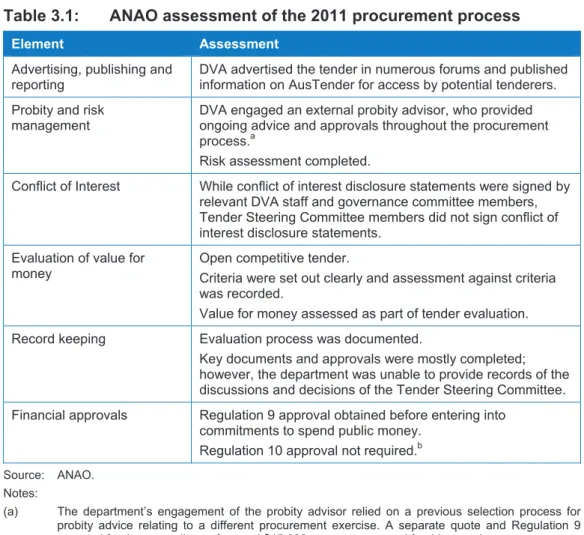
Table 3.1: ANAO assessment of the 2011 procurement process ... 55
Table 3.2: Key Performance Indicators—DVA contracted transport providers ... 58
Table 3.3: ANAO assessment of Transport Booking and Invoicing System controls ... 67
Table 4.1: Performance framework for the Repatriation Transport Scheme... 75
Table 4.2: DVA program 2.5 budgeted and actual expenses 2010–11 to 2013–14 ... 78
Table 4.3: Repatriation Transport Scheme Key Performance Indicators 2010–14 ... 80
Figures Figure 1.1: Number of claims for travel reimbursement and Booked Car Scheme trips 2008–14 ... 26
Figure 1.2: Booked Car Scheme and travel reimbursement claims expenditure 2008–14 ... 27
Figure 1.3: Timeline of key developments in the Repatriation Transport Scheme ... 29
Figure 2.1: Main steps in travel reimbursement process ... 35
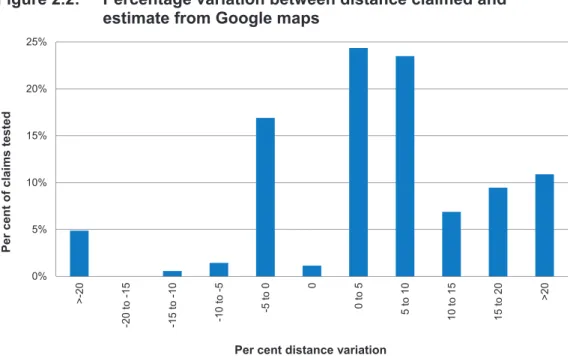
Figure 2.2: Percentage variation between distance claimed and estimate from Google maps ... 46
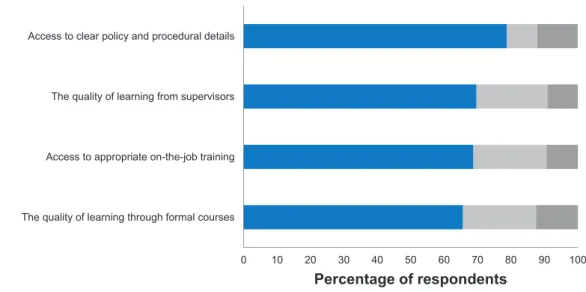
Figure 2.3: Level of staff satisfaction with training and support ... 49
Figure 3.1: Transport Booking and Invoicing System booking process ... 62
Figure 3.2: Percentage of Booked Car Scheme bookings manually allocated in the Transport Booking and Invoicing System ... 65
Figure 3.3: Number of TBIS, CTVS and DBM bookings 2011–14 ... 69
Abbreviations
ANAO Australian National Audit Office
BCS Booked Car Scheme
CMVS Choice and Maintainability in Veterans’ Services program
CPGs Commonwealth Procurement Guidelines
CTVS New South Wales Country Taxi Voucher Scheme
DBM Direct Booking Model
DMIS Departmental Management Information System
DVA Department of Veterans’ Affairs
Finance Department of Finance
FMA Financial Management and Accountability Act 1997
KPI Key Performance Indicator
PBS Portfolio Budget Statements
RFT Request for Tender
RTCPS Repatriation Transport Claims Processing System
RTS Repatriation Transport Scheme
TBIRP Transport Business Intelligence Reporting Project
TBIS Transport Booking and Invoicing System
VEA Veterans’ Entitlements Act 1986
Glossary
Commissions DVAʹs operations are closely bound to two statutory
entities: the Repatriation Commission and the Military
Rehabilitation and Compensation Commission, both of
which have broad powers with respect to veteransʹ
entitlements and policy.
Gold card Card issued by DVA which entitles veterans to access
subsidised health services for the treatment of all
conditions.
RTCPS The Repatriation Transport Claims Processing System is
used to record claims made by veterans for travel
assistance, calculate entitlements based on data entered,
and facilitate the payment of travel allowances to veterans.
TBIRP The Transport Business Intelligence Reporting Project was a
DVA information technology project to develop reporting
capability and post‐payment monitoring of transport events
for the Repatriation Transport Scheme.
TBIS The Transport Booking and Invoicing System is an
electronic system used for the Booked Car Scheme to record
transport bookings and automatically allocate and dispatch
jobs to transport providers.
Transport
providers
Taxi and hire car operators contracted by DVA to provide
transport to veterans under the Booked Car Scheme.
Veteran For the purposes of this report, the term ‘veteran’ includes
entitled veterans, war widows, war widowers, current and
former serving members and other entitled beneficiaries.
White card Card issued by DVA which entitles veterans to access
subsidised health services for the treatment of conditions
accepted by the department only.
Summary and
Summary
Introduction
1. The Repatriation Transport Scheme (RTS or the Scheme) is a
well‐established program introduced by the Australian Government in 1986 to
assist eligible veterans1 attend medical appointments.2 Administered by the
Department of Veterans’ Affairs (DVA), the RTS has three primary
components: travel reimbursement; the Booked Car Scheme (BCS); and
ambulance services. Travel reimbursement was the initial support component
of the RTS and involves DVA paying veterans for travel expenses they have
incurred, including the cost of a medically required attendant. The BCS was
introduced in the early 1990s as an additional support measure to assist frail
veterans aged 80 and over, and involves DVA arranging and paying for taxi,
hire car, or long distance travel.3
2. In 2013–14, the department processed around 160 000 claims for travel
reimbursement at a cost of $21.4 million, and organised over one million trips
to and from medical appointments through the Booked Car Scheme, at a cost
of $64.4 million.4 In 2014–15, the department budgeted $191 million for the RTS
as a whole with projected expenditure estimated to increase by an average of
$4 million per annum over the next three years. This growth can be attributed
to increasing use of ambulance and Booked Car Scheme services, particularly
by the ageing cohort of Second World War veterans.
3. In its administration of the RTS, DVA draws on funding from the
Veterans’ Entitlements Act 1986 Special Appropriation. The principal basis for
reimbursing travel expenses is under Section 110 of the Veterans’ Entitlements
Act 1986 (VEA)5, and the circumstances and amounts of travel assistance
1 For the purposes of this report, the term ‘veteran’ includes entitled veterans, war widows, war widowers, current and former serving members and other entitled beneficiaries.
2 The RTS provides transport for veterans who have a ‘white card’ or a ‘gold card’ under the Veterans’
Entitlements Act 1986 (VEA). Veterans with a VEA gold card are able to access assistance for travel
to and from medical treatment for all conditions, whereas white card holders are provided with travel assistance for the treatment of conditions accepted by DVA.
3 DVA will also arrange travel for veterans that are legally blind or have dementia regardless of age and for veterans under 80 years for travel to a limited number of treatment locations.
4 In 2013–14, expenditure on the ambulance component of the RTS was $89.9 million. Ambulance services delivered under the RTS are outside the scope of this audit.
5 Other sections of the Veterans’ Entitlements Act 1986 also provide for travel assistance in specific circumstances.
payable under the RTS are set out in the Veterans’ Entitlements Regulations 1986.
For the Booked Car Scheme, DVA arranges and pays for travel for frail and
aged veterans under sub‐sections 84(1) and 84(2) of the VEA. In contrast to
travel reimbursement arrangements, the Act and Regulations do not provide
any further description of the Booked Car Scheme, and details of these
arrangements are based on departmental policy and rules.
Previous audit coverage
4. ANAO Audit Report No.6 2002–03 Fraud Control Arrangements in the
Department of Veterans’ Affairs examined fraud control arrangements across
DVA including the RTS. The audit concluded that DVA had no systematic
approach in place, or a quality assurance process, that would assist in
identifying claim anomalies and potential fraud. The ANAO recommended
that: ‘DVA take action to standardise travel allowance claim procedures and
documentation under the RTS to be consistent with the Veterans’ Entitlements
Act 1986 and its Regulations’. The department agreed to the recommendation,
acknowledging that there was a need to introduce a national quality assurance
system for travel payments.6 As part of the department’s response to the
recommendation, a quality assurance framework for the RTS was introduced
in 2006 and operated until May 2012. Recent changes to quality assurance are
examined in this performance audit.
Audit objective and criteria
5. The audit objective was to assess the effectiveness of the Department of
Veterans’ Affairs (DVA) administration of the Repatriation Transport Scheme
(RTS).
6. To form a conclusion against the audit objective the ANAO adopted the
following high level criteria:
DVA administers the RTS in accordance with legislation and relevant
guidelines;
DVA has implemented systems and processes to provide authorised
transport services and travel reimbursements to eligible clients in an
accurate and timely manner;
6 ANAO Audit Report No.6 2002–03 Fraud Control Arrangements in the Department of Veterans’
Summary
DVA has procured transport services in accordance with relevant
guidelines and effectively manages relevant contracts; and
DVA effectively monitors and reports on performance to inform its
delivery of the RTS.
7. The ANAO did not examine DVA’s administration of funding to state
and territory governments for the provision of ambulance services under the
RTS.
Overall conclusion
8. The Repatriation Transport Scheme (RTS or the Scheme) was
introduced in 1986 to assist eligible veterans to attend medical appointments.
Assistance is provided through: the reimbursement of costs incurred for travel;
a Booked Car Scheme (BCS); and ambulance transport in some circumstances.
Veterans seeking travel reimbursement tend to be younger and can generally
make their own travel arrangements, while the Booked Car Scheme is intended
to assist aged and frail veterans with higher levels of need through contracted
transport providers. In 2013–14, DVA processed around 160 000 claims for
travel reimbursement at a cost of $21.4 million and organised over one million
trips under the Booked Car Scheme, using over 300 contracted transport
providers at a cost of $64.4 million. The department has budgeted $191 million
for the RTS in 2014–15 and anticipates that expenditure will increase by
approximately $4 million annually over the next three years.
9. Overall, DVA’s procurement and delivery of services to veterans under
the RTS has been generally effective. The department provides transport services
to many thousands of veterans on a daily basis, has reported consistently good
performance against its targets for processing travel claims, and receives
relatively few complaints relating to travel bookings arranged by the
department. Further, DVA’s procurement of transport providers in 2011–12
introduced a more competitive pricing structure across a national network of
transport service providers, and the department has actively managed its
contracts with transport providers to maintain service quality. However, there
remains scope for improvement in the RTS control framework to enhance the
level of confidence regarding the validity and accuracy of travel claims and
10. In 2013–14, DVA reported that 93 per cent of all travel reimbursement
claims were processed within the 28 day target7,8 and a consistently low level
of complaints was recorded in relation to travel reimbursement claims and
travel bookings arranged by the department.9 To effectively deliver the BCS,
the department undertook a national procurement exercise in 2011–12 with a
view to introducing a level of competition between transport providers and
achieving better value for money outcomes. DVA subsequently entered into
contracts with over 300 taxi and hire car providers, and has actively managed
the agreements so as to maintain services at specified levels.
11. The department has also sought to improve services to veterans
through the introduction of online claiming for the reimbursement of travel
costs. As part of that process, in 2012 DVA removed key safeguards against
fraudulent or incorrect payments—specifically the requirement for veterans to
submit receipts with travel claims and the need for health providers to
formally endorse the necessity for travel to a medical appointment. While the
risks associated with the removal of these core payment controls were
identified at the time, the department failed to implement its planned
mitigation measures—the introduction of post‐payment monitoring and
enhanced quality assurance processes—and the risks remained largely
untreated for three years.
12. During the course of this audit, DVA revised its quality management
framework for travel claims reimbursement to include a process for
monitoring the validity and accuracy of payments once they have been made.
Implementation of the revised quality management framework is at an early
stage, and in light of past experience the department should review its overall
approach to implementing the planned initiatives so as to provide
management assurance that agreed risk mitigation measures will be
progressed and will operate as anticipated.
13. The administration of payments to contracted transport providers
under the BCS is supported by appropriate controls built into the relevant ICT
system, known as the Transport Booking and Invoicing System (TBIS).
7 Department of Veterans’ Affairs, Annual Report 2013–14, p. 99.
8 Performance against the target ranged from 89 to 99 per cent between 2010–11 and 2013–14. 9 The number of complaints relative to the number of travel bookings for the BCS ranged from 0.02 per
cent to 0.05 per cent between 2010–11 and 2013–14. The number of complaints relative to the number of travel reimbursement claims in 2013–14 was 0.08 per cent.
Summary
However, two older booking methods under the BCS—the Direct Booking
Model and NSW Country Taxi Voucher Scheme—continue to operate outside
the TBIS control framework. In particular, bookings are not made through
TBIS and DVA staff cannot conduct normal pre‐travel eligibility checks or
provide travel approvals, and the department only becomes aware that travel
has been undertaken when an invoice is received. The annual cost of bookings
made through these methods is approximately $16 million, or one‐quarter of
the value of all bookings under the BCS. To strengthen the level of assurance
that BCS requirements are met, there would be benefit in the department also
applying the post‐payment monitoring capability for travel reimbursement,
currently under development, to the BCS.
14. A key lesson of this audit is the importance of senior management
oversight and monitoring of planned implementation activities, and timely
escalation when implementation risks emerge. As mentioned, in the course of
implementing online service improvements in 2012, DVA failed to implement
planned risk mitigation measures to help maintain the integrity of travel
claims under the RTS. The ANAO has made one recommendation focusing on
the provision of management assurance relating to the implementation of
agreed risk mitigation measures.
Key findings by chapter
Travel Reimbursement (Chapter 2)
15. In May 2012 DVA removed a number of controls for travel
reimbursement claims processing—including the reconciliation of
reimbursement claims against receipts and endorsement by health providers of
the need to travel—as part of its development of online claiming by veterans. At
the time, the department identified a number of potential risks prior to the
implementation of online claiming, such as increased non‐compliance by clients,
and proposed a number of risk mitigation measures. The measures included
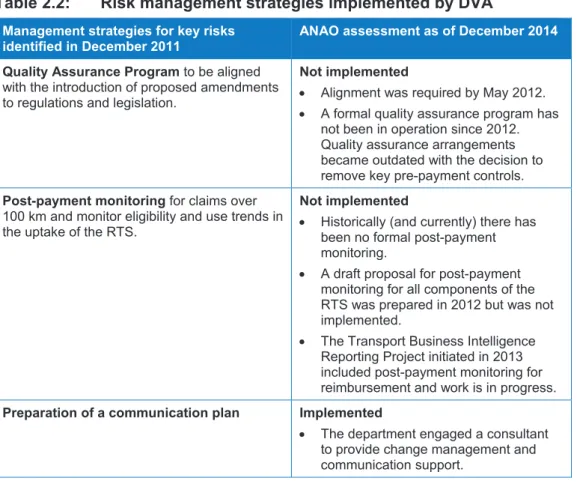
post‐payment monitoring and enhanced quality assurance processes.10
However, the planned measures were not implemented in a timely manner, and
the identified risks remained largely untreated for almost three years.
10 DVA undertakes some quality assurance activities involving ad hoc checks of claims for reimbursement.
16. During the course of the audit DVA was developing its capacity to
review the validity and accuracy of payments to reimburse travel, through
revisions to the RTS quality management framework. Implementation of the
revised framework is at an early stage, and the department should review the
overall implementation approach to provide management assurance that the
agreed risk mitigation measures will be progressed as planned, and will
operate as anticipated. For instance, the appointment of a senior responsible
officer and the development of a project implementation and risk management
plan11 would contribute to the successful introduction of planned
post‐payment monitoring arrangements and enhanced quality assurance.
There would also be benefit in DVA considering the introduction of internal
performance measures to help monitor the operation and effectiveness of these
arrangements.
17. The ANAO’s controls testing of the travel reimbursement processing
system, known as the Repatriation Transport Claims Processing System
(RTCPS), identified shortcomings in relation to: the absence of post‐payment
monitoring; quality assurance arrangements; ad hoc confirmation of distances
claimed; and a lack of clarity regarding the period that receipts must be
retained by veterans to facilitate checking by DVA. For instance, receipts for
claims over $30 are only required to be kept for four months, which may limit
the department’s capacity to check receipts as part of the post‐payment
monitoring arrangements currently being planned.
Booked Car Scheme (Chapter 3)
18. In 2011–12, DVA undertook a competitive national procurement
exercise which resulted in the establishment of contracts with over 300 taxi and
hire car providers to provide transport services under the Booked Car Scheme.
The department set out to introduce a level of competition between transport
providers so as to deliver value for money outcomes. While DVA’s tender and
evaluation processes were generally sound, there remained scope for
improvement in two areas, specifically: maintaining adequate records for the
Tender Steering Committee; and the completion of conflict of interest
11 To be effective, policy and program implementation requires there to be a senior responsible officer who is accountable for the success of implementation. Effective implementation planning is also a critical factor contributing to an entity’s ability to successfully prepare for the delivery of initiatives. Implementation planning should reflect adequate consideration of key risks to implementation. See Department of the Prime Minister and Cabinet and Australian National Audit Office, Better Practice
Summary
disclosure statements for all members of relevant committees involved with
evaluating tenders.
19. The department actively manages its Booked Car Scheme transport
provider contracts to maintain adequate services for veterans. In particular,
ongoing communication with contracted providers has contributed to effective
service delivery by helping the department develop an understanding of
service providers and the environment in which they operate. DVA has also
acted promptly to amend contracts and booking allocations in response to
frequent changes in taxi and hire car ownership arrangements—for example
when existing contractors leave the transport industry or the owners of
contracted companies change.
20. The introduction of automated booking arrangements in 2011 was
expected to result in savings of $1.35 million per annum from a reduction in
manual processing of tasks. However, DVA assessed that the changes
delivered less than $25 000 in the first year after implementation. In particular,
the 30 per cent target for uptake of the online bookings by service providers
was not realised, with only 313 out of a possible 90 000 health providers
(0.35 per cent) utilising the system by November 2012. The department has
acknowledged that a key factor in the low take‐up was insufficient
consultation with health providers.
21. The Booked Car Scheme Transport Booking and Invoicing System
(TBIS), has in‐built system controls which are generally effective in supporting
the integrity of transport bookings and associated payments to transport
providers. In particular, controls built into this system assist staff in making
soundly based assessments of eligibility, allocating bookings to transport
providers according to predetermined percentages, and complying with
program rules such as travel being to the ‘closest practical provider’ to the
veteran. The manual and automatic checks established through TBIS provide a
reasonable level of assurance that transactions are processed and recorded
accurately.
22. However, two older BCS booking methods—the Direct Booking Model
control framework of TBIS.12 As bookings are not made through TBIS, DVA
staff cannot undertake the regular manual and automatic checks discussed in
paragraph 21, and the department only becomes aware that travel has
occurred after receiving an invoice. The annual cost of bookings made through
these methods is approximately $16 million, or one‐quarter of the value of all
BCS bookings, and the payment integrity risks relating to these booking
methods merit review by the department. To strengthen the level of assurance
that BCS requirements are met, there would be benefit in the department also
applying the post‐payment monitoring capability for travel reimbursement,
currently under development, to the Booked Car Scheme.
Performance Monitoring and Reporting (Chapter 4)
23. The department reports against two key performance indicators (KPIs)
in its annual report in respect to travel for treatment—timely processing of
claims and the percentage of complaints. In 2013–14, DVA reported that 93 per
cent of all travel reimbursement claims were processed within the 28 day
target13, and performance against the target was between 89 and 100 per cent
from 2010–11 to 2013–14. Further, a consistently low level of complaints was
reported in relation to travel bookings arranged by the department, ranging
from 0.02 per cent to 0.05 per cent from 2010–11 to 2013–14.
24. While the current KPIs provide an indication of the overall quality of
travel services delivered by DVA, payment accuracy is also an important
measure for the department and its clients. There would be benefit in the
department considering the development of a performance measure for the
accuracy of claims processing, in the context of implementing revised
performance reporting arrangements under the Public Governance, Performance
and Accountability Act 2013.14
25. DVA has access to reliable information on travel reimbursement
through the RTCPS, and operational information on transport service
providers from TBIS. However, the department has recognised that while
12 The two booking methods are older components of the RTS and are not well aligned with the general direction of recent DVA policy. For instance, the NSW Country Taxi Voucher Scheme can be used by eligible veterans of any age, whereas the Booked Car Scheme is generally limited to eligible veterans over 80 years of age.
13 Department of Veterans’ Affairs, Annual Report 2013–14, p. 99.
14 The revised performance framework will enable entities to adopt a range of performance reporting tools in addition to KPIs. See Department of Finance, Resource Management Guide No. 130, April 2015, pp. 6–7.
Summary
these systems provide valuable operational data, they do not provide reliable
information for effective internal monitoring of key trends in program
performance. The recent completion of the Transport Business Intelligence
Reporting Project (TBIRP) provides the department with the means to generate
meaningful internal reports on key trends and will also contribute to
post‐payment monitoring.
Summary of entity response
26. The Department of Veterans’ Affairs provided the following summary
response to the audit report. The formal departmental response is included at
Appendix 1.
The Department of Veterans’ Affairs notes the findings of the report and
agrees with the recommendation suggested by the Australian National
Audit Office.
Recommendation
Recommendation No. 1
Paragraph 2.25
The ANAO recommends that DVA review its approach to
the implementation of post‐payment monitoring and
enhanced quality assurance arrangements for the
Repatriation Transport Scheme, to provide management
assurance that the planned measures—intended to
improve the level of confidence of the validity and
accuracy of travel claims and bookings—will operate as
anticipated.
DVA response: Agreed.
1. Introduction
This chapter outlines the Repatriation Transport Scheme’s purpose, legislative
framework and operation. It also describes the audit objective, scope and criteria.
Background
1.1 The Department of Veterans’ Affairs (DVA) is responsible for developing
and delivering programs that assist the veteran community, including health
and related support services. The Repatriation Transport Scheme (RTS or the
Scheme) provides eligible veterans15 and their medically required attendants
with financial assistance when travelling to approved medical treatment. Under
the RTS, financial assistance is provided towards the cost of transport, meals and
accommodation.
1.2 Eligible veterans have either ‘gold card’ or ‘white card’ access to
government funded health services. Veterans who qualify for gold card access
are eligible for financial assistance towards travel for treatment of all health
conditions; whereas white card holders are only eligible for financial assistance
for specific medical conditions accepted by DVA. Dependants of eligible
veterans and approved attendants may also qualify for transport assistance
under the RTS.
1.3 The RTS has three components: travel reimbursement, the Booked Car
Scheme16, and ambulance services.17 The RTS is a well‐established program, with
travel reimbursement introduced through the Veterans’ Entitlements Act 1986
(VEA)18 and the Booked Car Scheme evolving out of COMCAR19 in the early
1990s.
15 For the purposes of this report, the term ‘veteran’ includes entitled veterans, war widows, war widowers, current and former serving members and other entitled beneficiaries.
16 The Booked Car Scheme is also referred to as the ‘Booked Car With Driver Scheme’ or ‘DVA arranged transport’.
17 The funding and provision of ambulance services are outside the scope of this audit.
18 There are a number of transport provisions in other legislation administered by DVA which are outside the scope of this audit. The legislation includes: the Military Rehabilitation and Compensation Act 2004 (MRCA); the Safety, Rehabilitation and Compensation Act 1988 (SRCA); and Australian Participants in British Nuclear Tests (Treatment) Act 2006 (Participants in British Nuclear Tests – Extension of Eligibility) Instrument 2012.
19 Under COMCAR, DVA used Commonwealth cars to transport veterans to and from repatriation general hospitals or related medical services. When these health services were outsourced in the early 1990s, DVA commenced contracting taxi and hire car providers to transport veterans.
Administrative arrangements
Legislative framework
1.4 The RTS has a statutory basis. Section 110 of the VEA is the principal
basis for reimbursing travel expenses under the RTS20, and the Veterans’
Entitlements Regulations (Regulation 9) detail the circumstances and amounts of
travel assistance that may be paid.21
1.5 DVA arranges and pays for travel for frail and aged veterans through the
Booked Car Scheme22, under sub‐sections 84(1) and 84(2) of the VEA. In contrast
to the travel reimbursement arrangements described above, the VEA and
Regulations do not provide any further description of the Booked Car Scheme or
long distance transport booked by DVA under the RTS. Details of these
arrangements are based on Repatriation Commission and departmental policy
and rules.
Program components
1.6 Travel reimbursement was the original focus of the RTS when it was
introduced in 1986 and is available to all eligible veterans who hold a VEA white
or gold card. Veterans seeking travel reimbursement tend to be younger and can
generally make their own travel arrangements, using either a private vehicle or
public transport. Veterans subsequently claim reimbursement of travel and
related expenses from DVA. If a veteran declares that their medical condition
prevents them using a private vehicle or certain types of public transport, they
may be reimbursed for taxis, community transport or air travel.23 The
department provides a contribution towards the cost of attending medical
treatment, and may not cover all costs incurred by the veteran. The amount
reimbursed is determined by travel reimbursement processing staff, who must
20 Sections 132 and 132A of the VEA (Disability and Income Support Pensions), 170B and 170C (Veterans’ Review Board) and 196ZO and 196ZP (Specialist Medical Review Council) also provide travel assistance in relation to attendance at the request of the Repatriation Commission in relation to a claim or review.
21 Veterans who qualify for travel assistance under the Australian Participants in British Nuclear Tests
(Treatment) Act 2006 (APBNTTA) can also access the RTS. Access to the Booked Car Scheme and
long distance transport is enabled by Section 4 and travel reimbursement by Sections 19–21 of the APBNTTA.
22 To be eligible for Booked Car Scheme transport to all treatment locations, veterans must be aged 80 or over. Veterans aged under 80 who are legally blind or have dementia are also eligible.
23 In addition, veterans may claim for the reimbursement of costs associated with an attendant, road tolls, and parking, and may receive allowances for meals and/or accommodation.
Introduction
consider whether the veteran has used the most economical means of attending
treatment.24
1.7 The Booked Car Scheme was introduced to assist aged veterans with
higher levels of need. Under the Booked Car Scheme, the department may
arrange and pay for a taxi, hire car, or long distance transport (generally by
plane). There are no out‐of‐pocket expenses for eligible persons, although
allowances for associated meals and accommodation must be claimed using a
DVA claim form.25 Given that a large proportion of eligible veterans are now
over 80 years of age, the number of Booked Car Scheme trips now exceeds the
number of claims for travel reimbursement, and the Booked Car Scheme has
become the primary focus of the RTS.
1.8 The Booked Car Scheme was changed in 2007 to allow health providers
to book transport directly with DVA contracted transport providers in certain
areas (predominantly metropolitan). This arrangement is referred to as the
Direct Booking Model (DBM) and was implemented as a workload risk
mitigation strategy in response to Repatriation Commission26 and Military
Rehabilitation and Compensation Commission decisions to extend the Booked
Car Scheme for transport to local medical officers (general practitioners) and
allied health professionals for gold card holders aged 80 years and over. In NSW
country areas, the Booked Car Scheme includes the New South Wales Country
Taxi Voucher Scheme (CTVS), which requires veterans to arrange their own taxi
or hire car transport and obtain a DVA issued taxi voucher from their health
provider to pay for transport.
Usage and expenditure trends
1.9 In 2013–14, DVA processed 159 905 travel reimbursement claims, a
decrease of three per cent compared to 2012–13. The department also arranged
24 DVA’s assessment of travel reimbursement is informed by a number of program rules. For example, in order to receive the maximum allowable reimbursement amount, veterans must attend their ‘closest practical provider’. Health providers who are located within 50km of the veteran’s home or temporary residence are classified as the ‘closest practical provider’. DVA will consider exceptions to this on a case-by-case basis if a clinical need has been identified by the health provider.
25 There are set allowance rates for meals and accommodation, which are indexed annually by movements in the Consumer Price Index on 1 July.
26 DVA’s operations are closely bound to two statutory entities: the Repatriation Commission and the Military Rehabilitation and Compensation Commission, both of which have broad powers with respect to veterans’ entitlements and policy. Submissions relating to the RTS are always provided to the Repatriation Commission, and are frequently also provided to the Military Rehabilitation and Compensation Commission.
1 002 844 person trips27 through the Booked Car Scheme in 2013–14, a five per
cent increase on the previous year’s total (see Figure 1.1). DVA reported in its
2013–14 Annual Report that these trends reflect an ageing population.28
Figure 1.1: Number of claims for travel reimbursement and Booked Car Scheme trips 2008–14
Source: DVA Annual Report data.
Notes: A ‘claim’ for travel reimbursement may contain a number of visits to a health provider as well as associated parking, tolls, meals, accommodation, and other costs. There is no limit on the number of trips that can be included on a claim. The number of trips per claim has ranged from between one and 165 on a single claim form.
A Booked Car Scheme trip is a one way trip to, or from, a health provider.
Figures for the number of Booked Car Scheme person trips for 2010–11 are not directly comparable with earlier years due to the introduction of the Booked Car Scheme transport booking and invoicing system (TBIS).
1.10 The Australian Government budgeted $184 million for veteransʹ travel
for treatment purposes and $7 million for subsistence (meals and
accommodation allowances paid by DVA) in the 2014–15 Budget. The RTS is a
27 ‘Person trips’ refers to approved trips to or from medical appointments under Booked Car Scheme arrangements.
28 Department of Veterans’ Affairs Annual Report2013–14, DVA, Canberra, p. 107.
0 100 200 300 400 500 600 700 800 900 1000 2008–09 2009–10 2010–11 2011–12 2012–13 2013–14 No. of claims/trips ('000) Financial Year
Introduction
demand‐driven program with funding drawn from a Veterans’ Entitlements Act
1986 Special Appropriation. The department expects RTS expenditure to
increase in the future as an ageing veteran population accesses a greater quantity
and variety of healthcare services, notwithstanding a decreasing health card
holder population.29 Over the next three years the cost of the RTS is estimated to
total $585 million.
Figure 1.2: Booked Car Scheme and travel reimbursement claims
expenditure 2008–14
Source: DVA Internal Data.
1.11 Figure 1.2 indicates that combined expenditure on the travel
reimbursement and Booked Car Scheme components of the RTS was around
29 The budget forward estimates indicate a reduction in the number of veterans with gold and white card access. For 2014–15, the health treatment card population was 204 000 with a reduction to 172 900 expected over the next three years.
$0 $10 $20 $30 $40 $50 $60 $70 $80 $90 $100 2008–09 2009–10 2010–11 2011–12 2012–13 2013–14 Expenditure ($m) Year
$85 million in 2013–14.30 The cost of administering the RTS was $4.85 million in
2013–14, and has remained relatively stable over the last five years.31
Recent changes to the Repatriation Transport Scheme
1.12 The RTS is managed by the Veterans’ Transport Services Section within
DVA’s Health and Community Services Division. From 2005, the administration
of the RTS shifted from a state‐based approach to a national basis, to improve
national consistency and increase efficiency. Processing of all claims for travel
reimbursement and long distance travel is now undertaken in Brisbane, whilst
all accounts and contract management functions are managed in Sydney. The
management of bookings under the Booked Car Scheme is undertaken by DVA
offices in Sydney, Brisbane, Melbourne, Adelaide and Perth. As at 1 July 2014,
there were 63.5 staff in the section, the majority of whom were responsible for
making transport bookings under the Booked Car Scheme.
1.13 Other key developments in the RTS in recent years include:
changes to travel reimbursement introduced in May 2012 which
removed the requirement for claims to be certified by health providers
and receipts to be attached, to facilitate the introduction of online
claiming;
a national panel of taxi and hire car providers established through a
2011–12 procurement process;
the introduction of a new Booked Car Scheme IT system in June 2011—
the Transport Booking and Invoicing System (TBIS); and
the addition of transport data to DVA’s client database warehouse
system in April 2014, which has enabled the department to interrogate
multiple databases used for the RTS and report broad trends.32
1.14 Figure 1.3 summarises the key developments in the RTS over the last two
decades.
30 In 2013–14, expenditure on the ambulance component of the RTS was $89.9 million. Ambulance services delivered under the RTS are outside the scope of this audit.
31 This departmental funding also includes the cost of administering the ambulance component of the RTS.
32 The enhancements were achieved through the department’s Transport Booking Intelligence Reporting Project (TBIRP).
Timeline of ke
y develo
p
ments in the Repatriation Transport Scheme
. May 201 2 Introductio n of MyAc count Ju n 2011 Im p leme n ta ti o n of new book ing sys te m fo r the B ook e d Car Sch e me (T B IS) Mar 201 2 Co mm en ce m e n t of B ook e d Car Sche me trans p ort prov ider co n tr act s Ap r 20 14 Introduction of Tran sport B ooking In te llig e n ce Re p o rt in g Proj ect 20 03 Fi rs t R e ques t For Tender to cont ra ct ta xi an d hir e ca rs to prov id e B ooked Ca r Scheme servi ce s 200 5 – 07 In tr o duc ti on of Di re ct B ook ing Mo d e l 5 ooking i and sp o rt ed sport te m ) 19 99 Re p atria ti on n sp o rt Cla im s oc essi ng Sy stem introdu ced 20 09 Le gi sl at iv e chan ge s to Ve te ra n s’ Ent itle m ents Act 198 6 to in cr ea se num ber of tr ea tm en t loc at ions e lig ib le fo r rei m burs e ment Ma r 201 1 Com m is si on s appro ve Re q u e st for Tender to co n tr act a pan e l of tran sport prov iders ‘O ne DV A’ in it ia tiv e sh if ts op e ra tio n s fr o m sta te ‐ bas e d to na ti o na l 2 006 No v 201 0 Ch anges to admi ni strative arran gemen ts to imp ro ve ICT ta ke up ena b led : ‐ gold and w h ite ca rd h o ld ers to dec lar e el igib ility ; ‐ vetera n s abl e to in itiate own bo o kings ; an d ‐ in cre ase d flex ib ili ty in d etermin in g clo se st pr ac ti ca l pr o vide r. De c 20 11 Am end m en ts to th e Ve te ra ns’ En ti tl eme n ts Re gul ati ons to fa ci lit at e online cl ai min g
Previous audit coverage
1.15 ANAO Audit Report No.6 2002–03 Fraud Control Arrangements in the
Department of Veterans’ Affairs examined fraud control arrangements across DVA
including the RTS. In that audit, DVA staff advised the ANAO of their concerns
about, and scope for, fraud in the RTS.33 In respect to the RTS, the audit
concluded that:
the department’s procedures were not consistent with applicable
sections of the Veterans’ Entitlements Act 1986 and Regulations; and
there was no systematic approach in place, or a quality assurance
process, that would assist in identifying claim anomalies and potential
fraud.
1.16 The ANAO recommended that: ‘DVA take action to standardise travel
allowance claim procedures and documentation under the RTS to be consistent
with the Veterans’ Entitlements Act 1986 and its Regulations’. The department
agreed to the recommendation, acknowledging that there was a need to
introduce a national quality assurance system for travel claims, and indicated
that it would standardise travel allowance payment processes to ensure they
were consistent with the Veterans’ Entitlements Act 1986.34 Progress in
implementing the recommendation is examined in Chapter 2 of this audit.
1.17 In 2014–15, the ANAO tabled a cross‐agency audit on the overall
governance of fraud control arrangements in selected entities, including DVA.35
The audit concluded that the department was generally compliant with the
applicable mandatory requirements of the 2011 Fraud Control Guidelines.
1.18 Since 2009–10, DVA has conducted four internal audits relevant to this
audit:
a review of DVA’s quality assurance in February 2010 found that the
quality assurance program for travel reimbursement did not serve the
current business objectives and was not adequate as a control in limiting
errors. Recommendations related to reviewing the quality assurance
program and developing new recording and reporting requirements;
33 ANAO Audit Report No.6 2002–03 Fraud Control Arrangements in the Department of Veterans’
Affairs, p. 66.
34 ibid. pp. 66–67.
Introduction
a review of transport for treatment in November 2010 focused on travel
reimbursement and identified control weaknesses, an ineffective quality
assurance program and inappropriate access to the travel reimbursement
system;
a review in April 2012 focusing on the Booked Car Scheme identified a
range of issues in relation to quality assurance and post‐payment
monitoring, transport payment arrangements, poor controls in the
processing system and payment approval inefficiencies. The audit
recommended that the department complete a risk assessment and
review of post‐payment monitoring and update the quality assurance
framework; and
a post‐implementation review of the Choice and Maintainability in
Veterans’ Services transport booking module in November 2012
concluded that, while the Transport Booking and Invoicing System had
delivered many of the planned benefits, there were limitations to these
benefits. In response, DVA developed an action plan to address control
and other issues.
Audit objective, scope and criteria
1.19 The audit objective was to assess the effectiveness of the Department of
Veteransʹ Affairs (DVA) administration of the Repatriation Transport Scheme
(RTS).
1.20 To form a conclusion against the audit objective the ANAO adopted the
following high level criteria:
DVA administers the RTS in accordance with legislation and relevant
guidelines;
DVA has implemented systems and processes to provide authorised
transport services and travel reimbursements to eligible clients in an
accurate and timely manner;
DVA has procured transport services in accordance with relevant
guidelines and effectively manages relevant contracts; and
DVA effectively monitors and reports on performance to inform its
Scope of the audit
1.21 The audit focused on the administration of travel reimbursement and
Booked Car Scheme transport funded through the RTS. The audit did not
examine the administration of funding provided under the RTS to state and
territory governments for the provision of ambulance services to eligible
veterans.
Audit methodology
1.22 The audit methodology included:
reviewing relevant documentation including legislation, briefings,
policies, procedures, reports and correspondence;
interviewing DVA management and staff members;
conducting a staff survey to assess training and development
requirements, in addition to reviewing training and guidance material;
reviewing written submissions from key stakeholders, including
Ex‐Service Organisations, contracted transport providers, and
representatives of the taxi industry;
mapping travel reimbursement and Booked Car Scheme processes to
identify and test the effectiveness of existing controls;
substantive testing of a selection of claims for travel reimbursement to
verify the accuracy of claims processing; and
identifying controls and associated risks for DVA’s systems for
processing claims for travel reimbursement (Repatriation Transport
Claims Processing System) and Booked Car Scheme bookings
(Transport Booking and Invoicing System).
1.23 Field work was conducted between August and December 2014 in
DVA’s national office in Canberra, and in DVA state offices in Brisbane and
Sydney.
1.24 The audit was conducted in accordance with the ANAO’s auditing
Introduction
Report structure
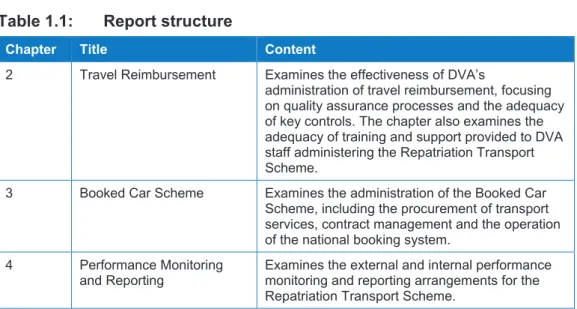
Table 1.1: Report structure
Chapter Title Content
2 Travel Reimbursement Examines the effectiveness of DVA’s
administration of travel reimbursement, focusing on quality assurance processes and the adequacy of key controls. The chapter also examines the adequacy of training and support provided to DVA staff administering the Repatriation Transport Scheme.
3 Booked Car Scheme Examines the administration of the Booked Car
Scheme, including the procurement of transport services, contract management and the operation of the national booking system.
4 Performance Monitoring
and Reporting Examines the external and internal performance monitoring and reporting arrangements for the Repatriation Transport Scheme.
2. Travel
Reimbursement
This chapter examines the effectiveness of DVA’s administration of travel
reimbursement, focusing on quality assurance processes and the adequacy of key
controls. It also examines training and support provided to DVA staff administering
the Repatriation Transport Scheme.
Introduction
2.1 Sound reimbursement processes feature a risk management approach,
effective controls, quality assurance mechanisms, and appropriate training and
guidance for staff. The ANAO examined DVA’s administration of travel
reimbursement for the Repatriation Transport Scheme (RTS or the Scheme),
including key changes implemented since 2009, to assess the overall integrity of
reimbursement arrangements.
Overview of claims process
2.2 Travel reimbursement is a long‐established component of the RTS.36
DVA is responsible for paying a contribution towards travelling expenses, in the
form of an allowance, for veterans attending DVA‐approved medical treatment
within Australia. Eligible veterans can claim reimbursement for kilometres
travelled using a private vehicle, parking fees, road tolls, taxi fares, air travel,
public transport costs and accommodation costs associated with medical travel.37
Eligible veterans need to attend the closest practical health provider to their
residence and travel by the most economical and suitable means of transport
available at the time.
2.3 Veterans claim for travel reimbursement under the Veterans’ Entitlements
Act 1986. Claims can be made using ‘MyAccount’, which is the DVA online
services channel, or by lodging a D800 Claim for Travelling Expenses form by post.
The three main processing steps performed by DVA are to:
36 In 2013–14, travel reimbursement represented 12 per cent ($21.4 million) of expenditure under the RTS. The proportion of staff responsible for processing reimbursement of travel claims is
approximately 20 per cent (13 of the staffing complement of 63.5) of overall staffing resources in the Veterans’ Transport Services Section as at 1 July 2014.
37 Travel reimbursement for private transport is based on an allowance payable at a per kilometre rate. When travel involves an overnight stay or longer, reimbursement can be claimed for the cost of accommodation and meals and the costs of an attendant, if required. An attendant (also referred to as a medical attendant) is defined as any person who is responsible, competent and physically able to assist a veteran when they are travelling to treatment. They do not have to be medically qualified.
Travel Reimbursement
determine the eligibility of the claimant;
assess the claimant’s entitlement (including checking claim accuracy
and making adjustments to claims, if necessary); and
approve reimbursement of the travel claim.
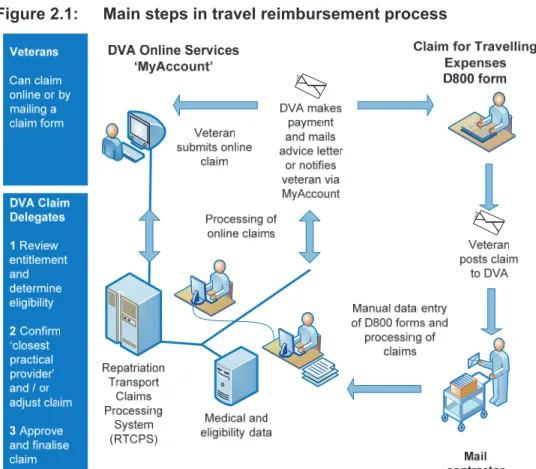
2.4 Figure 2.1 illustrates the main steps in the travel reimbursement process.
Figure 2.1: Main steps in travel reimbursement process
Source: ANAO analysis.
2.5 DVA’s Repatriation Transport Claims Processing System (RTCPS) is an
electronic system used to record claims made by veterans for travel assistance,
allowances to veterans.38 The RTCPS has operated for 15 years and is central to
the processing of reimbursement claims.39
2.6 DVA has been aware for some time of limitations in the RTCPS, which
requires a high degree of manual processing and intervention to process
claims.40 Over time, enhancements have been made to the system and the
department has also examined options to redevelop or replace the RTCPS. In
2008, the RTCPS was scheduled for replacement but the new system was not
implemented due to unsatisfactory performance during testing. The department
advised the ANAO that options for the replacement and/or redevelopment of
the RCTPS are again under review.
Changes to travel reimbursement
2.7 Significant changes to the administration of travel reimbursement
resulted from the Choice and Maintainability in Veterans Services (CMVS)
program initiated by DVA in 2009. The program sought improvements to
service delivery throughout the department, including simplifying travel
reimbursement and providing greater online access to veterans.41 The
department obtained endorsement from the Repatriation Commission for a
range of changes to the D800 travel expenses claim form to facilitate online
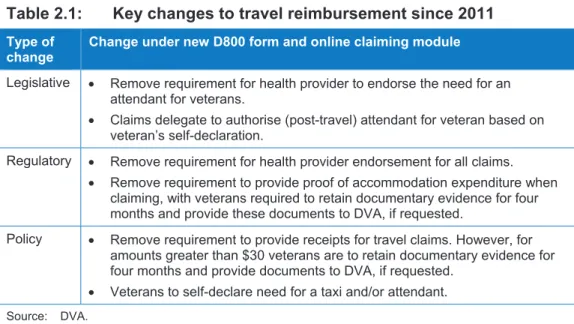
claiming in December 2011.42 The online lodgement of travel claims through
‘MyAccount’ was also introduced in May 2012. Table 2.1 outlines the key
changes to travel reimbursement arrangements.
38 As of October 2014, approximately 630 claims per day were being processed. In 2013–14, the department reported that 159 905 claims were reimbursed at a cost of $21.4 million.
39 The RTCPS is supported by two main payment systems. The majority of payments are direct credit payments to veterans through the Integrated Payment System (IPS). DVA’s accounting information system, the Departmental On Line Accounting and Reporting System (DOLARS) is also used for cheque payments (usually to the estates of deceased veterans). This audit did not examine the operation of these payment systems. DOLARS and IPS are examined as part of the ANAO’s annual financial statement audit of DVA.
40 For example, reimbursement staff interviewed by the ANAO advised that the daily sorting process for incoming mail (which represents approximately 60 per cent of claims for reimbursement) can take three hours, and up to a day if only one staff member is available.
41 The changes were originally scoped as part of a large scale project which included a review of a number of components of the RTS that was approved by the Repatriation Commission in November 2010. The department’s rationale for the review was that prescriptive regulations, a strong compliance focus, and low tolerance of risk resulted in an onerous and outdated claiming process for veterans and high administration costs for DVA.
42 Approval by the Minister was not required. The department briefed the Minister on the changes to travel reimbursement prior to their introduction in May 2012.