Relaxed Dependence Tracking for Parallel Runtime Support
∗
Minjia Zhang
Swarnendu Biswas
Michael D. Bond
Ohio State University(USA)
{zhanminj,biswass,mikebond}@cse.ohio-state.edu
Abstract
It is notoriously difficult to achieve both correctness and scalabil-ity for many shared-memory parallel programs. To improve cor-rectness and scalability, researchers have developed various kinds ofparallel runtime supportsuch as multithreaded record & replay and software transactional memory. Existing forms of runtime sup-port slow programs significantly in order to track an execution’s cross-thread dependences accurately.
This paper investigates the potential for runtime support to hide latency introduced by dependence tracking, by tracking depen-dences in arelaxedway—meaning that not all dependences are tracked accurately. The key challenge in relaxing dependence track-ing is to preserve both the program’s semantics and the runtime support’s guarantees. We present an approach called relaxed de-pendence tracking(RT) and demonstrate its potential by building two types of RT-based runtime support. Our evaluation shows that RT hides much of the latency incurred by dependence tracking, al-though RT-based runtime support incurs costs and complexity in order to handle relaxed dependence information. By demonstrating how to relax dependence tracking to hide latency while preserving correctness, this work shows the potential for addressing a key cost of dependence tracking, thus advancing knowledge in the design of parallel runtime support.
Categories and Subject Descriptors D.1.4 [Programming Lan-guages]: Processors—Run-time environments
Keywords Runtime support for parallelism, dependence tracking, multithreaded record & replay, software transactional memory
1.
Introduction
Software must become more parallel in order to fully utilize hard-ware that provides more, instead of faster, cores in successive gen-erations. However, achieving both correctness and scalability for shared-memory parallel programs is notoriously difficult. To this end, researchers and practitioners have developed various kinds of parallel runtime supportthat check or enforce concurrency cor-rectness properties such as atomicity, data-race freedom, and deter-minism. For example,multithreaded record & replayenables of-fline debugging and online replication [18, 26, 27, 36, 52, 56, 60].
∗This material is based upon work supported by the National Science
Foundation under Grants CSR-1218695, CAREER-1253703, and CCF-1421612.
Transactional memoryenforces atomicity, avoiding several chal-lenges associated with using fine-grained locking [13, 21, 28, 30, 31, 33, 40, 41, 47, 51, 59, 62]. However, existing runtime sup-port isimpractical: it relies on unrealistic custom hardware, adds high overhead, or has other serious limitations. This paper focuses on runtime support for commodity systems, often called “software only.” Runtime support generally needs totrack(i.e., detect or con-trol) cross-thread data dependences soundly, which entails using synchronizedinstrumentation to ensure that each program access and its instrumentation execute together atomically (Section 2.1).
This paper explores the potential for reducing the run-time over-head of tracking dependences byrelaxing the requirement that runtime support must track all dependences accurately—while preserving the runtime support’s guarantees and adhering to the language’s semantics. We introduce relaxed dependence track-ing (RT), which enables a thread to continue executing past a memory access involved in a cross-thread dependence, without accurately tracking the dependence. Our design of RT targets de-pendence tracking based on so-calledbiased reader–writer lock-ing[11, 14, 31, 32, 46, 48, 49, 57] (Section 2.2), which avoids the costs of reacquiring a lock for non-conflicting accesses, but incurs latency at conflicting accesses in order to perform coor-dinationamong conflicting threads (Section 2.3). The high cost of coordination provides both a challenge and an opportunity for RT to hide this latency, by relaxing the tracking of dependences at accesses involved in dependences. RT’s design consists of two elements: arelaxed coordination protocoland support forrelaxed loads and stores. We show that in order to overlap relaxed loads and stores with relaxed coordination correctly, relaxed stores should be deferred, and relaxed loads should be logged and handled in a runtime-support-specific way.
In addition to designing RT, we design two kinds of runtime support that use RT: (1) anRT-based dependence recorder and (2) anRT-based software transactional memory (STM) system. We implement RT and the RT-based recorder and STM in a high-performance Java virtual machine. We evaluate and compare per-formance on a multicore platform running benchmarked versions of large, real-world Java applications. On average across all pro-grams, RT reduces overhead by 49% compared withstrict depen-dence tracking(ST)—this paper’s term for an existing approach that tracks dependences accurately. In addition to reducing average overhead, RT benefits several high-conflict programs substantially. For programs that incur high coordination costs, RT speeds up exe-cution significantly, achieving on average 84% of the ideal speedup that would be possible if all coordination costs were hidden.
RT’s potential is limited by correctness constraints requiring waiting at some program operations; we introduce and evaluate optimizations for overcoming this limitation, but find they have limited benefit. The RT-based recorder outperforms an ST-based recorder by hiding coordination costs, although the improvement is partially offset by recording more events than the ST-based recorder. The RT-based STM’s ability to hide coordination costs is
This is the author’s version of the work. It is posted here for your personal use. Not for redistribution. The definitive version was published in the following publication: CC’16, March 17–18, 2016, Barcelona, Spain
ACM. 978-1-4503-4241-4/16/03... http://dx.doi.org/10.1145/2892208.2892229
limited by correctness constraints, and its benefit diminishes with more threads. It minimally outperforms an ST-based STM, but for reasons not directly related to hiding coordination costs.
Overall, these results demonstrate the potential for using novel mechanisms to address a key performance bottleneck of parallel runtime support.
2.
Background and Motivation
To check or enforce concurrency correctness properties,parallel runtime supportmust track cross-thread dependences (i.e., write– read, write–write, and read–write data dependences involving two threads). In order to track dependences, runtime support must per-form synchronized instrumentation at essentially every program memory access. Tracking dependences by usingbiased locking of-ten provides performance advantages, except that lock ownership transfers incur expensive coordination among threads.
2.1 Tracking Cross-Thread Dependences
Runtime support generally needs to track cross-thread depen-dences, which means doing one of the following:
Detecting (identifying) dependences: Runtime support includes data race detectors (e.g., [23, 24]), atomicity checkers (e.g., [6, 25]), and dependence recorders for record & replay (e.g., [11, 36]).
Controlling (enforcing) dependences: Runtime support includes transactional memory (e.g., [28, 62]), memory model enforcement (e.g., [44, 50]), and deterministic execution (e.g., [5, 43]). For data-race-free (DRF) executions, tracking dependences re-quires instrumenting onlysynchronizationoperations, since mem-ory models for shared-memmem-ory languages guarantee serializability of synchronization-free regions for DRF executions [1, 2, 9, 38].
However, programs routinely have intentional and unintentional data races [36]. Thus, runtime support must instrument every access that might be involved in a data race.1Furthermore, to ensure that dependences are captured soundly, runtime support needs to ensure that an access and its instrumentation execute together atomically, a property we callinstrumentation–accessatomicity.
To preserve instrumentation–access atomicity, runtime support often synchronizes on a lock associated with each object2(e.g.,
rep-resented with an extra word in the object’s header). The runtime support’s instrumentation acquires the lock for reading and/or writ-ing the object. An implementation typically relies on atomic oper-ations and memory fences, which introduce remote cache misses and serialize in-flight instructions (e.g., [24, 25, 35, 36, 51]).
We note that some approaches have sidestepped these chal-lenges but incur other limitations. For example, record & replay can avoid tracking dependences by relying on replication and specula-tion, but its performance relies on extra available cores [56]. Some STMs avoid acquiring a lock for every accessed object in a trans-action, but sacrifice scalability as a result (e.g., [20]). Some analy-ses, notably data race detection, need not preserve instrumentation– access atomicity, but still require instrumentation atomicity, which ends up incurring similarly high costs [24, 39].
2.2 Tracking Dependences with Biased Locking
Prior work introduces so-calledbiased locking, in which each ob-ject’s lock is “biased” toward one thread (or multiple threads in the case of reader locks) [11, 14, 31, 32, 46, 48, 49, 57]. These “owner” thread(s) can reacquire the lockwithoutperforming an atomic op-eration or even a store. In order for a threadTto acquire a lock
1Even after applying sound (no false negatives) static data race detection as a filter, many accesses cannot be proven to be DRF [17, 23, 36, 58]. 2This paper uses the term “object” to refer to any unit of shared memory.
1 if (o. state != WrExT) {
2 slowPath(o); /∗ acquire o. state for write ∗/
3 }
4 o. f = ...; // program store to the object field o. f
5 if (o. state != WrExT&& 6 o. state != RdExT&&
7 (o. state != RdShc || T.rdShCount<c)){
8 slowPath(o); /∗ acquire o. state for read ∗/
9 }
10 ... = o.f ; // program load to the object field o. f
Figure 1.Pseudocode for biased reader–writer locking’s instrumentation fast path.Tis the executing thread.
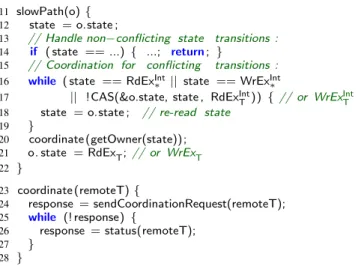
11 slowPath(o){
12 state = o.state ;
13 // Handle non−conflicting state transitions :
14 if ( state == ...) { ...; return; }
15 // Coordination for conflicting transitions : 16 while ( state == RdExInt
∗ || state == WrEx
Int
∗
17 || !CAS(&o.state, state , RdExInt
T)) {// or WrExIntT
18 state = o.state ; // re-read state
19 }
20 coordinate (getOwner(state));
21 o. state = RdExT;// or WrExT
22 } 23 coordinate (remoteT){ 24 response = sendCoordinationRequest(remoteT); 25 while (! response) { 26 response = status(remoteT); 27 } 28 }
Figure 2.Pseudocode for biased reader–writer locking’s slow path.Tis the executing thread.
owned by other thread(s),Tmustcoordinatewith the owner(s), so that they do not continue to access the corresponding object racily. This paper focuses on biasedreader–writerlocks, which sup-port accesses to read-shared data more efficiently than writer locks. We emphasize that our focus is on locks used to implement runtime support—not on locks used by programmers in order to enforce mutual exclusion in applications (Section 7).
Without loss of generality, this paper builds on one design of biased reader–writer locks. The rest of this section describes this design, which is most closely based on prior work called Oc-tet[11]. Each object’s lock can have any of the following states:
WrExT(write-exclusive for thread T),RdExT(read-exclusive for
T), or RdShc (read-shared for all threads, subject to a counterc that helps detect dependences from the last write soundly [11]). Figure 1 shows the instrumentation that the compiler adds at each program load and store; the instrumentation “acquires” a write or read lock on the accessed object’s lock. If a thread already owns the lock for an object, the instrumentation takes the synchronization-free, write-freefast path. Otherwise, the instrumentation executes theslow path, which changes the state and handles potential cross-thread dependences, as described next.
2.3 Conflicts Require Coordination
When a thread needs to acquire a read or write lock that it does not already own (e.g., at a read byT2to an object whose lock is in
WrExT1state), it mustcoordinatewith the owner thread(s), so they can acknowledge the ownership transfer and cease unsynchronized accesses to the object.
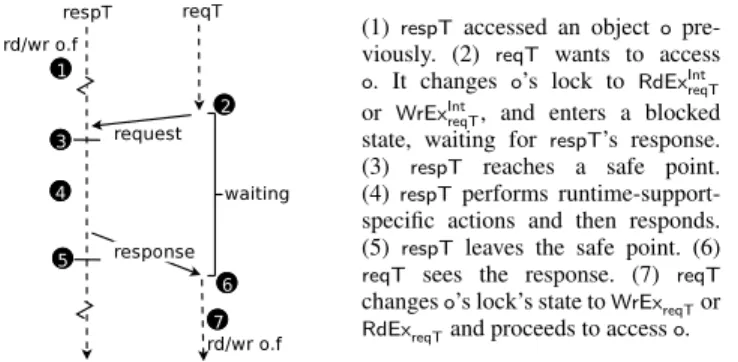
Handling conflicting transitions with coordination. Suppose a thread, called therequesting thread,reqT, wants to acquire an
ob-(1) respTaccessed an object o pre-viously. (2) reqT wants to access
o. It changes o’s lock to RdExInt reqT or WrExIntreqT, and enters a blocked state, waiting for respT’s response. (3) respT reaches a safe point. (4)respT performs runtime-support-specific actions and then responds. (5) respT leaves the safe point. (6)
reqT sees the response. (7) reqT
changeso’s lock’s state toWrExreqTor
RdExreqTand proceeds to accesso. Figure 3.Coordination using an explicit request.
ject’s lock held in a conflicting state by other thread(s); each of these other thread(s) is aresponding thread,respT. If the object’s lock is inWrExrespTorRdExrespTstate, then there is one responding thread,respT. If the object’s lock is inRdSh state, then all other threads are responding threads, and reqT coordinates with each responding thread separately. For simplicity of exposition, we de-scribe the case of a single responding threadrespT.
The pseudocode in Figure 2 shows the slow path.3 First, reqT
atomically changes the state of the object’s lock to anintermediate state,RdExInt
reqTorWrExIntreqT(depending on whether a read or write lock is needed), with a CAS (line 17).4The intermediate state sim-plifies the protocol by allowing only one thread at a time to perform a conflicting transition on an object’s lock. If there is another thread that has already changed the object to an intermediate state,reqT
waits for the other thread to finish coordination (lines 17–19). After reqT successfully changes the object’s lock state to
RdExInt
reqT or WrExIntreqT, it coordinates withrespT(line 20) to en-sure that reqT’s state change does not interfere with respT’s instrumentation–access atomicity.respTparticipates in coordina-tion only when it is at asafe point: a program point that is def-initelynot in the middle of instrumentation or its corresponding access—hence preserving instrumentation–access atomicity. Man-aged language VMs already place safe points at periodic points in compiled code (e.g., method entries and exits and loop back edges) for profiling and timely yielding for parallel garbage collection. Blockingoperations such as waiting to acquire a program lock or waiting for I/O are also safe points.
If respT is at a blocking safe point, reqT makes an implicit
request torespT(at line 24) by atomically updatingrespT’s status, whichrespTwill see when it leaves the blocking state. The helper method sendCoordinationRequest() returns true if and only if it performs an implicit request. Otherwise, reqT sends anexplicit request torespT:reqTsends a request torespTby adding a request
to respT’s request queue, and then must wait (lines 25–27) for
respTto reach a safe point to respond. WhilereqTis performing
coordination (lines 16–20, including the body ofcoordinate), it is considered to be at a blocking safe point (mechanism not shown in the pseudocode), to allow other threads to perform implicit requests withreqTacting as arespondingthread, thus avoiding deadlock. Figure 3 illustrates how coordination works when using an explicit request (this paper’s approach modifies only how explicit requests work). Finally, reqTchanges the state toWrExreqT or RdExreqT
(line 21) and proceeds with its access to the field.
Coordination is expensive. As our results show (Section 6), coor-dination can slow programs substantially, even for programs that perform relatively few conflicting accesses (e.g., 0.1–1% of
ac-3The pseudocode omits memory fences required by the implementation. 4The atomic operationCAS(addr, oldVal, newVal)attempts to updateaddr fromoldValtonewVal, returningtrueon success.
cesses triggering coordination). The following table reports the av-erage cost of coordination using explicit versus implicit requests, compared with the cost of instrumentation that does not change the lock’s state (Section 6.2 describes experimental methodology):
Same state Implicit request Explicit request
CPU cycles 47 360 9,200
Coordination is substantially more expensive than a same-state check because coordination requires several memory accesses, in-cluding atomic operations and memory fences. On average, coor-dination using an explicit request is more than an order of magni-tude more costly than using an implicit request, since an explicit request incurs significant latency waiting for roundtrip communi-cation. Our work thus focuses on optimizing coordination that uses explicit requests.
3.
Relaxed Dependence Tracking
The last section described prior work’s approach for tracking de-pendences based on biased reader–writer locking. That approach tracks each cross-thread dependence soundly (i.e., does not miss any dependences), by waiting to acquire a read or write lock before proceeding with each access. The rest of this paper refers to that approach asstrict dependence tracking(ST).
In contrast, this section introduces our novel approach called re-laxed dependence tracking(RT), which relaxes the instrumentation– access atomicity guarantee provided by ST,5 allowing threads to
continue executing program code without acquiring a dependence tracking lock. The challenge in making RT work lies in preserving both program semantics and runtime-support-specific guarantees.
RT consists of two components: Arelaxed coordination proto-col(Section 3.1) and support for performingrelaxed accessesthat overlap with coordination (Section 3.2).
3.1 The Relaxed Coordination Protocol
In RT, a requesting thread doesnotwait for responses after sending requests. Thus, a requesting thread receives responses at some later point in its execution, and a requesting thread may have outstanding requests for multiple objects simultaneously. To support this func-tionality, the relaxed coordination protocol differs from the strict coordination protocol in the following ways:
• A responding thread canrespondeither implicitly or explicitly, depending on whether therequestingthread is blocking or ac-tively executing program code.
• To support explicit responses, relaxed coordination extends strict coordination’s request queue to a request-and-response queuethat holds both requests and responses. At safe points, threads can receive not only requests, but also responses. Figure 4 shows how the relaxed coordination protocol works.reqT
sends an explicit request torespTand continues execution. When
respTreaches a safe point, it responds toreqTeither explicitly or implicitly. IfreqTis blocked,respTresponds implicitly, as shown in Figure 4(a), by first puttingreqTinto a “blocked and held” state (so thatreqTdoes not leave the blocking state unless it is “unheld”) and then changing the object’s lock’s state. Finally, the responding thread removes its hold on the requesting thread. Otherwise (reqT
is not blocked),respTresponds explicitly, as Figure 4(b) shows, by adding a response toreqT’s queue. OncereqTreaches a safe point, it changes the object’s lock’s state.
Although Figure 4 shows a single requesting thread sending requests torespT, multiple requesting threads can send requests to
5Although our design of RT targets coordination latency introduced by biased reader–writer locking, it should be possible to adapt RT to other dependence-tracking mechanisms.
(a)Implicit response:(1)respTaccessed
oat some prior time. (2)reqTwants to ac-cesso. It changeso’s lock toRdExInt
reqTor
WrExIntreqT. (3)reqTproceeds without wait-ing to receive respT’s response. (4) re-spTreaches a safe point (SP) and (5) sees
reqTin a blocking state, sorespT puts
reqTin a “blocked and held” state. (6) re-spTchangeso’s lock’s state toWrExreqT orRdExreqT. (7)respTremoves the hold onreqT, then leaves the safe point. (8)
reqTfinishes blocking, then waits until all holds have been removed.
(b) Explicit response: (1) re-spT accessed o at some prior time. (2) reqT wants to ac-cess o. It changes o’s lock to
RdExIntreqTorWrEx Int
reqT. (3)reqT proceeds without waiting to re-ceiverespT’s response. (4) re-spTreaches a safe point (SP), (5) sends an explicit response, and (6) leaves the safe point. (7)
reqT reaches a safe point and sees the response.reqTchanges
o’s lock’s state to WrExreqT or
RdExreqT.
Figure 4. Therelaxedcoordination protocol (for explicit requests only). respTbeforerespTreaches a safe point. WhenrespTreaches a safe point, it responds to each queued request in turn.
For a conflicting transition from WrExrespT or RdExrespT to
WrExreqTorRdExreqT,reqTreceives just one response. In contrast, for a transition fromRdShtoWrExreqT,reqTmay need to wait for multiple responses. The protocol maintains a counter of unreceived responses for each object lock in this situation, which responding and requesting threads decrement as they respond implicitly and receive explicit responses, respectively.
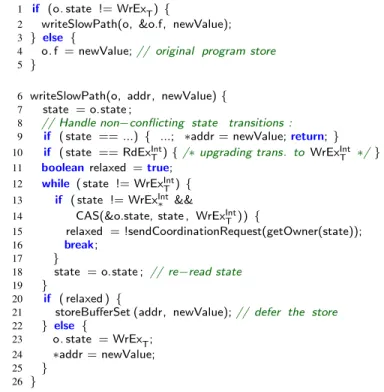
Figures 5 and 6 show the pseudocode for RT’s load and store instrumentation. RT uses the same fast path as ST (Section 2.2), except that it skips the original program access if it takes the slow path, delegating the access to the slow path instead. For both loads and stores, ST initiates coordination by changing the state of the object toWrExInt
T (line 14 in Figure 5) or RdExIntT (line 17 in Figure 6) and sending a request to the responding thread (line 15 in Figure 5 and line 18 in Figure 6). After sending the coordination request,Tcontinues execution immediately, subject to constraints about accessing objects that are not yet locked in the needed state.
Since T does not wait for responses, it instead receives re-sponses at safe points (not shown). A responding threadresponds either implicitly or explicitly, depending on whether or not the re-questing thread is at blocking safe point. BeforeTreceives a re-sponse, the conflicting objectostays in theWrExInt
T orRdExIntT state, since bothTand other threads might perform accesses to it. If the access is a store, andois inRdExInt
T state, RT upgrades the state toWrExInt
T (line 10 in Figure 5), in order to track relaxed stores, introduced shortly. Ifois locked inWrExInt
∗ but notWrExIntT (i.e., other threads performing relaxed stores too), the access needs to wait until the state has changed to a non-intermediate state. If the access is a load, as long asois inWrExInt
∗ orRdEx
Int
∗ , the access can
avoid performing coordination.
We note that RT’s relaxed coordination protocol differs from the strict coordination protocol forexplicitrequests only. In RT, when coordination uses animplicitrequest, it follows the same steps as strict coordination.
1 if (o. state != WrExT){
2 writeSlowPath(o, &o.f, newValue); 3 } else {
4 o. f = newValue;// original program store
5 }
6 writeSlowPath(o, addr, newValue){
7 state = o.state ;
8 // Handle non−conflicting state transitions :
9 if ( state == ...) { ...; ∗addr = newValue;return;}
10 if ( state == RdExInt
T){/∗upgrading trans. to WrExIntT ∗/} 11 booleanrelaxed =true;
12 while ( state != WrExInt T){
13 if ( state != WrExInt
∗ &&
14 CAS(&o.state, state , WrExInt
T)) {
15 relaxed = !sendCoordinationRequest(getOwner(state));
16 break;
17 }
18 state = o.state ; // re−read state
19 }
20 if ( relaxed ) {
21 storeBufferSet (addr, newValue);// defer the store
22 } else {
23 o. state = WrExT;
24 ∗addr = newValue;
25 }
26 }
Figure 5.The fast and slow paths of RT’s instrumentation at stores.
1 if (o. state != WrEx
T&& 2 o. state != RdExT&&
3 (o. state != RdShc || T.rdShCount <c))
4 ... = readSlowPath(o, &o.f); {
5 } else {
6 ... = o.f ; // original program load
7 }
8 readSlowPath(o, addr){
9 state = o.state ;
10 // Handle non−conflicting state transitions :
11 if ( state == ...) { ...; return ∗addr; }
12 if ( state == WrExInt
T && storeBufferContains(addr)) 13 return storeBufferGet (addr);
14 booleanrelaxed =true; 15 while ( state != WrExInt
∗ && state != RdEx
Int
∗ ){
16 // Coordination for conflicting transition : 17 if (CAS(&o.state, state , RdExInt
T)){
18 relaxed = !sendCoordinateRequest(getOwner(state));
19 break;
20 }
21 state = o.state ; // re-read state
22 } 23 value =∗addr; 24 if ( relaxed ) 25 logLoadedValue(addr, value) ; 26 else 27 o. state = RdExT; 28 return value ; 29 }
Figure 6. The fast and slow paths of RT’s instrumentation at loads.
Interestingly, the relaxed coordination protocol handles requests and responses in a largely symmetric way. Requests and responses each involve sending a message to another thread, either implicitly
if the receiving thread is at a blocking safe point; or else explicitly via a queue that the receiving thread processes at its next safe point.
3.2 Handling Relaxed Accesses
A threadTperformsrelaxed accesses6to objects whose locks are not (yet) in the needed state. RT defers arelaxed storeuntil it re-ceives coordination response(s) for the object’s lock. As we ex-plain, relaxed stores still conform to the language memory model as long as they are not deferred past synchronization release op-erations. RT performs arelaxed loadby loading from an object before receiving coordination response(s) for the object’s lock. Re-laxed loads do not affect program correctness, but they can affect runtime support’s guarantees.
Relaxed stores. A threadTperforms a relaxed store bydeferring the store, buffering the location (address) and new value inT’sstore buffer(line 21 in Figure 5). The intuition behind deferring stores is that another thread may be simultaneously (racily) accessing the same location, so allowing the store to be performed could cause a cross-thread dependence to be missed. Once Tgets exclusive ownership of the conflicting objecto(by changingo’s lock’s state toWrExT), it performs all deferred stores toousing the store buffer. For simplicity, our current design limits relaxed stores byTto objects locked in WrExInt
T state. (We have found that supporting relaxed stores to other lock states provides little benefit.)
Deferring program stores changes program behavior since other threads can read out-of-date values from the affected memory loca-tions. However, language memory models, including for Java and C++, allow substantial reordering of operations, except across syn-chronization operations [1, 2, 9, 38], thus permitting significant de-ferring of stores. To conform to the memory model and preserve program semantics, the key constraint is that storescannotbe de-ferred past program synchronizationreleaseoperations (e.g., lock release, thread fork, and Javavolatileor C++atomicwrites).
Relaxed loads. At a relaxed load byTto an objecto,Tfirst checks whether the same location has already been buffered inT’s store buffer (line 12 in Figure 6). (Tonly needs to check its store buffer ifo’s lock is inWrExInt
T state.) If so,Tuses the store buffer’s value (line 13 in Figure 6) instead of loading from memory. Otherwise,
Tperforms the load directly from memory (line 23 in Figure 6). A relaxed load thus doesnotaffect program semantics: the execution still conforms to the memory model (since performing the load would be permitted in the original program). However, a relaxed load could certainly impact the correctness of runtime support that needs to detect or control cross-thread dependences. In particular, another thread might be simultaneously (racily) writing to the same memory location, compromising the ability of runtime support to capture the write–read or read–write dependence.
RT thus handles each relaxed load bylogging the loaded value in aruntime-support-specific way(line 25 in Figure 6). The intu-ition is that logging the value enables runtime support to handle all values resulting from potentially untracked cross-thread depen-dences. For example, our RT-based dependence recorder logs the value in order to assist replay (Section 4), and our RT-based STM logs the value in order to validate it later (Section 5).
3.3 Optimizations at Synchronization Release Operations
As presented so far, a thread must wait at each program synchro-nization release operation for every outstanding deferred relaxed store (i.e., every entry in its store buffer). This restriction limits RT’s ability to overlap coordination with program execution; we have found that threads routinely end a critical section (by releasing a lock) shortly after performing a store to a shared variable. Here
6This paper’s relaxed accesses should not be confused with
mem-ory order relaxedoperations onatomicvariables in C/C++ [9].
we present two optimizations for avoiding waiting at release oper-ations. As our evaluation shows, these optimizations have perfor-mance benefits but also drawbacks that lead to mixed perforperfor-mance relative to the base RT design described so far.
Defer release operations. Instead of waiting at a release opera-tion for outstanding deferred stores, a thread candefer the release operation. Our design currently supports deferringlockrelease op-erations. To defer a lock release, a thread continues to hold the lock past the release operation; the thread records the lock into a per-threadlock buffer. It releases the lock only when all responses have been received for deferred relaxed stores that executed before the lock release (according to bookkeeping).
This behavior naturally preserves program semantics because a thread continues to hold a lock while it waits for responses for relaxed stores, effectively expanding the lock’s critical section— making other threads wait and thus increasing lock contention. Effectively enlarging critical sections can serendipitously avoid some erroneous behaviors, which may be desirable or undesirable, depending on the goals and setting.
Avoid stalling at release. An alternate approach is to permit a threadTto continue execution at a release operation—as long as no other thread may access the object(s) that are the targets of deferred stores. A straightforward way to provide this restriction is to disallow all accesses by other threads to objects locked in
WrExInt
T state. (Note that, in contrast, the base RT design allows loads, but not stores, to an object in any intermediate state.)
This optimization allows threads to continue without waiting at release operations, but it incurs other costs because a threadT2
must wait to access an object locked inWrExInt T1state.
4.
Recording Dependences
This section shows how to use RT to optimizemultithreaded record & replay, which enables deterministically replaying a recorded execution. Record & replay enables both offline debugging [36, 56] and system features such as replication-based fault tolerance [12, 37]. Recording dependences efficiently is the key challenge of multithreaded record & replay. However, recording dependences is expensive due to the high cost of tracking dependences between all potentially shared memory accesses [35, 36].
4.1 ST-Based Dependence Recorder
Prior work builds a dependence recorder, which we call the ST-based recorder, on top of biased reader–writer locks that use strict dependence tracking [11]. It records all happens-before edges [34] at transitions between WrEx, RdEx, andRdSh states. It records each happens-before edge by recording itssourceand sink, each of which is recorded as adynamic program location(DPL), which consists of a static program location (e.g., method and line num-ber) and a per-thread counter incremented at every method entry, method exit, and loop back edge. Another execution can replay these happens-before edges deterministically by making the sink wait for its corresponding source to be reached.
4.2 RT-Based Dependence Recorder
OurRT-based dependence recorderextends the ST-based recorder by using relaxed, instead of strict, dependence tracking. The RT-based recorder allows relaxed loads and stores to objects that are not yet “owned” by the current thread. Given this behavior, how is it possible to record dependences accurately and thus guarantee deterministic replay?
We refer back to Figure 4 on page 4 for examples of happens-before edges recorded by the RT-based recorder. For an implicit response, at point #6,respTrecords the source of the edge. At point #8,reqTrecords the edge’s sink. For an explicit response,respT
#7. Note that if the replayed execution replays these same edges, it will not necessarily reproduce the same behavior because the relaxed accesses at point #3 (and other relaxed accesses potentially overlapping with coordination) are not ordered by the edge.
The key to addressing this problem is to record enough informa-tion about loads and stores that arenotwell-ordered by happens-before edges, such that they can be replayed faithfully.
Handling stores. To handle deferred stores to objects locked in
WrExInt
reqTstate, the RT-based recorder uses the following strategy: reqT records an event for each deferred store, to indicate that the store should also be deferredduring replay. When stores are performed from the store buffer at a safe point,reqTrecords an event indicating that deferred stores should be performed at that safe point. By referring to indices of entries in the store buffer, the recorded event unambiguously indicateswhichstores should be performed from the store buffer at each safe point during replay.
Handling loads. When a requesting threadreqTloads a value from an object whose lock is in an intermediate state, the responding thread may be simultaneously writing the object. Thus, it doesnot seem possible to record a happens-before edge that will yield the same value for the load. Instead,reqTrecords the valuereturned by the load (at point #3 in both Figure 4(a) and Figure 4(b)). A replayed execution can reuse this value to ensure determinism.
During the recorded execution, subsequent loads to the same memory location record the (possibly updated) loaded value. WheneverreqThandles a load by getting the value from its store buffer (Section 3.2), it still records the value in its log, so a re-played execution can load the correct value without needing to know which loads should read from the store buffer.
Value determinism. Our RT-based recorder providesvalue deter-minism, i.e., each load reads the same value during replay as dur-ing record. If a load was relaxed durdur-ing record, it will load from the log during replay. Notably, this value will match the value of the variable in memory (i.e., the value thatwouldnormally have been loaded from memory) unless there is a data race. Other ef-ficient record & replay techniques, such as DoublePlay [56] and Respec [37], provideoutput determinism, which is weaker than value determinism but is still useful for both offline replay (e.g., replaying buggy executions) and online replay (e.g., replicating a multithreaded process).
5.
Software Transactional Memory
This section describes how we extend an existing software transac-tional memory (STM) system to use RT. In essence, ourRT-based STMcombines lazy and eager concurrency control in a novel way: it uses eager mechanisms for most accesses and lazy mechanisms for accesses that would otherwise incur latency.
5.1 ST-Based STM
Prior work introduces an STM that uses biased reader–writer locks that employ strict dependence tracking [62]. We call this STM the ST-based STM. The ST-based STM employs biased reader–writer locks to provide eager concurrency control: it detects and resolves conflicts before performing each memory access. Conflict detection and resolution piggyback on coordination.
Here we focus on how the STM piggybacks on coordination that uses anexplicitrequest. In that case, therespondingthread detects and resolves conflicts between the responding thread’s transaction and the requesting thread’s transaction or non-transactional access.
5.2 RT-Based STM
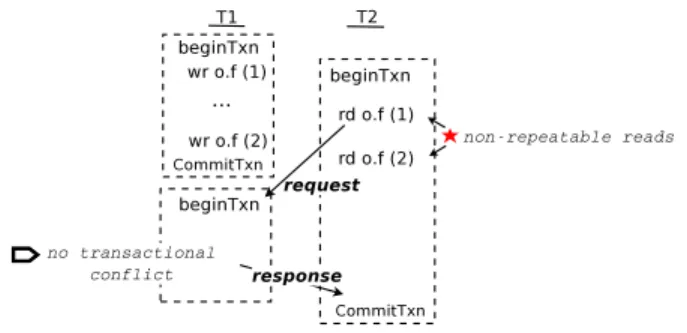
Extending the ST-based STM to use RT presents challenges. Un-less handled properly, the STM could be unable to detect and re-solve transactional conflicts for relaxed loads and stores. Figure 7
Figure 7.Allowing unhandled relaxed accesses in transactions would lead to serializability violations. The values in parentheses after each executed store and load are the values written and read, respectively.
shows an example of a problematic execution. ThreadT2performs two relaxed loads fromo.f in a transaction, since o’s lock is in
WrExT1 state.T1performs conflict detection when it responds to
T2, but by thenT1has started another transaction that has not ac-cessedo, soT1accurately reports no transactional conflict. How-ever, the result is unserializable becauseT2’s loads see different values. Another problematic issue (not shown) is that performing relaxed transactional stores directly could lead to unserializable re-sults due to another thread loading the value simultaneously.
OurRT-based STMaddresses these issues as follows. In the RT-based STM, each relaxed, transactional load logs its loaded value, andvalidatesthe value later. (In Figure 7,T2’s transaction would fail the read validation before commit and abort.) Each relaxed, transactional store is deferred, to provide opacity of intermediate updates before the transaction commits. Before a transaction com-mits, it waits for coordination responses so it can validate all re-laxed loads and perform all deferred stores.
Relaxed loads. A requesting threadreqTperforms a relaxed load when it reads from an objectolocked in theWrExInt
reqTorRdExIntreqT state.reqTfirst checks its store buffer for the value (only if the ob-ject’s state isWrExInt
reqT). If not found,reqTperforms the load—but responding thread(s) may be simultaneously writing too, poten-tially violating serializability.reqT thus logs the loaded location and value in aread validation log.
WhenreqTreceives the response foro, it validates all entries in the read validation log againsto’scurrentvalue(s), as the following pseudocode shows:
foreach (addr, value) in readValidationLog if (∗addr != value) abortTxn();
For every field or array element ofoin the read validation log, the current value must match the log’s value. This logic makes sense as follows. The responding thread responded at some safe point where it performed conflict detection (and potentially conflict resolution). Validating the loaded value ensures that the values that were read previously foroare the same as if the values had all been read at the responding thread’s responding safe point. If validation fails,reqT
must abort its current transaction. (IfrespTresponds implicitly, it performs the above work on behalf ofreqT.)
Relaxed stores. A requesting threadreqT defers a relaxed store by buffering its location (address) and value in the store buffer, which is analogous to theredo log used by STMs that use lazy versioning [29]. AfterreqTreceives all responses foro, it performs the store(s) forofrom the store buffer—and also logs the store(s) in theundolog. (IfrespTresponds implicitly, it performs all of these actions on behalf ofreqT.)
Commit and abort. Before a transaction commits or aborts, it waits for all outstanding responses, in order to validate loads and perform deferred stores. Unlike our general RT design, our RT-based STM
doesnotsupport loads byTto objects locked in intermediate states other thanWrExInt
T andRdExIntT; supporting loads from other states would require a mechanism for eventually changing the lock’s state toWrExT,RdExT, orRdShin order to validate reads before commit.
Guaranteeing progress. TheST-basedSTM guarantees progress by detecting all conflicts eagerly and then aborting the younger transaction [54, 62]. However, theRT-basedSTM cannot guarantee progress, since any transaction that fails read validation must abort. Other mixed-mode STMs have similarly lacked progress guaran-tees [30, 47]. Standard techniques such as exponential backoff can help to alleviate livelock. For the RT-based STM, a simple (unim-plemented) solution exists: if a transaction repeatedly fails read val-idation, it falls back to usestrictdependence tracking, guaranteeing it will commit (at least once it becomes oldest).
Correctness. At a high level, the RT-based STM provides serializ-ability by guaranteeing that all of a committing transaction’s oper-ations appear as though they happened instantaneously at commit time. For conflicting accesses handled by ST, eager conflict de-tection and resolution guarantee that conflicting accesses between the committing transaction’s accesses and commit time will be de-tected and resolved. (The RT-based STM uses the same mechanism for relaxed stores, but defers making the store visible until relaxed coordination has finished.) For relaxed loads, commit-time value validation ensures that each value from a relaxed load is consistent with the commit-time value of the memory location.
Semantics. Lazy read validation can lead to so-called zombie transactions whose behavior is impossible in any serializable ex-ecution [29]. In managed languages such as Java, zombies are not a serious problem because memory and type safety are pre-served [19, 40]. Targeting a native language such as C++ would require additional support to providesandboxingof zombie trans-actions [19]. Another issue is that zombie transtrans-actions can get stuck in infinite loops that are impossible in any serializable execution. The RT-based STM cannot experience this issue because it vali-dates relaxed loads within a bounded amount of time.
Comparison with prior work. Most STMs employ either entirely lazy or entirely eager concurrency control (e.g., [20, 22, 54, 62]). Some STMs combine lazy and eager mechanisms, by using eager concurrency control forwritesand lazy validation forreads[30, 47]. The RT-based STM combines eager and lazy concurrency control in a novel way, using eager and lazy concurrency control for non-conflicting and conflicting accesses, respectively.
6.
Evaluation
This section first evaluates the performance and run-time character-istics of relaxed dependence tracking (RT) without runtime support, compared with strict dependence tracking (ST). It then evaluates the two case studies of runtime support built upon RT, compared with ST-based approaches.
6.1 Implementation
We have implemented RT and the RT-based recorder and STM in Jikes RVM, a Java virtual machine (JVM) [3, 4] that performs com-petitively with commercial JVMs [7]. We have made our imple-mentations publicly available on the Jikes RVM Research Archive. Our RT implementation builds on the publicly available ST implementation calledOctet [11]. Our RT-based recorder builds on the publicly available ST-based recorder [10, 11]. Our RT-based STM builds on the publicly available ST-RT-based STM called LarkTM[62]. Our implementations reuse features of the ST-based implementations as much as possible.
6.2 Methodology
Benchmarks. The experiments execute the following benchmarks:
• Benchmarked versions of large, real programs: the DaCapo benchmarks, versions 2006-10-MR2 and 9.12-bach (2009) [8], excluding single-threaded programs and programs that Jikes RVM cannot execute
• Business logic benchmarks:fixed-workload versions of SPEC-jbb2000 and SPECjbb20057
• Medium-sized benchmarks that stress various multithreaded execution scenarios:the Java Grande benchmarks (excluding microbenchmarks) [53]
• Transactional benchmarks: the STAMP benchmarks [16], ported to Java providing six working programs [21, 33, 62]
Experimental setup. For each implementation, we build a high-performance configuration of Jikes RVM. Each high-performance result is the median of 25 trials. We also show the mean, as the center of 95% confidence intervals.
Platform. Experiments execute on a machine with 4 Intel Xeon E5-4620 8-core processors (32 cores total) running Linux 2.6.32.
6.3 Evaluating Relaxed Dependence Tracking
This section evaluates RT and compares it with ST, by executing instrumentation that tracks dependences but provides no runtime support on top of it.
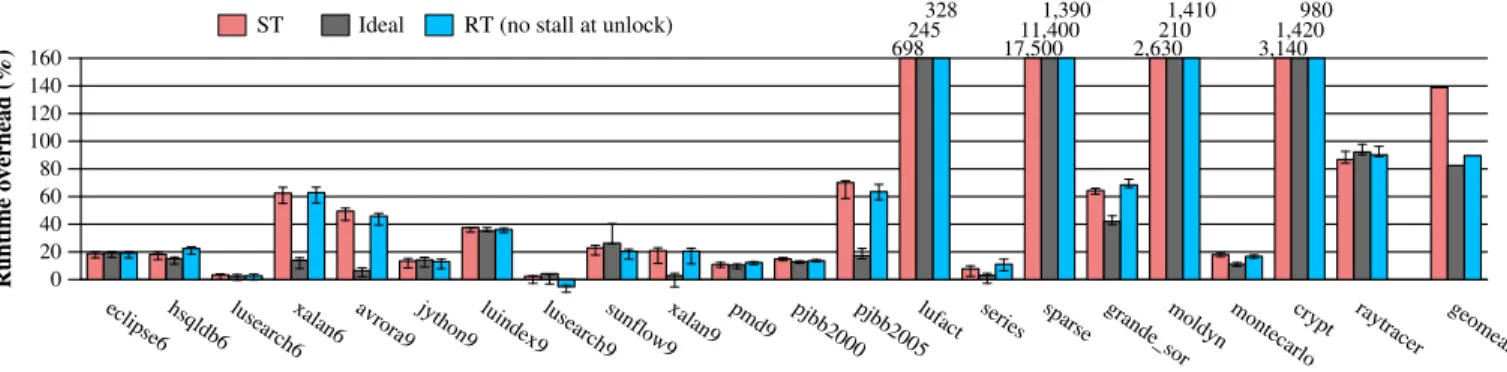
Measuring the problem. We first measure the cost of ST, as well as the maximum benefit that can be obtained from optimizations. Figure 8 shows runtime overhead of three configurations over an unmodified JVM. Each configuration instruments accesses to track dependences using biased reader–writer locks. The first configu-ration,ST, uses strict tracking (as described in Section 2.3) and adds 139% overhead on average. This overhead varies consider-ably across the evaluated programs; the overhead for each program is closely linked to the fraction of accesses that trigger coordination using explicit requests (as shown later in this section), which is the main cost of tracking dependences.
Idealis anunsoundconfiguration that eliminates most of the cost of strict coordination. In this configuration, after a thread sends an explicit request, it continues execution without waiting for any response. Responding threads in turn ignore requests. This config-uration attempts to estimate an upper bound on the performance that RT might be able to provide. On average,Idealadds 82% overhead—a little more than half of the overhead added by the sound configuration. The remaining costs are due to fast-path in-strumentation at every access, as well as other transitions, includ-ing conflictinclud-ing transitions that trigger coordination usinclud-ing implicit requests. In addition, although requesting threads do not wait for responses and responding threads ignore requests,Idealincurs re-mote cache misses by sending explicit requests.
RT’s effectiveness at hiding coordination costs. Figure 8’s last configuration,RT (no stall at unlock), uses relaxed dependence tracking with the second optimization from Section 3.3. Its over-head over baseline execution is 90%, a significant reduction (49% relative to baseline execution time) from ST’s 139% overhead. Fur-thermore, RT achieves much of the maximum possible benefit, ap-proachingIdeal’s 82% overhead.
We note that forsparse, RT significantly outperforms theIdeal configuration. This counterintuitive result is due to the fact that theIdealconfiguration estimates the cost of coordination without latency, but it does not account for potential other improvements that RT might provide. As we show later in this section, RT can reduce the number of conflicting transitions (compared with ST);
7http://www.spec.org/jbb200{0,5}, http://users.cecs.anu.edu.au/
ST Ideal RT (no stall at unlock)
eclipse6 hsqldb6 lusearch6xalan6 avrora9 jython9 luindex9lusearch9sunflow9xalan9 pmd9 pjbb2000pjbb2005lufact series sparse grande_sormoldyn montecarlocrypt raytracer geomean 0 20 40 60 80 100 120 140 160 Runtime overhead (%) 698245 328 17,50011,400 1,390 2,630210 1,410 3,1401,420 980
Figure 8. Run-time overhead added to an unmodified JVM by capturing dependences using (1) ST, compared with (2) an ideal, unsound configuration that eliminates coordination latency and (3) RT.
RT (stall at unlock) RT (defer unlock) RT (no stall at unlock) Ideal
eclipse6 hsqldb6 lusearch6xalan6 avrora9 jython9 luindex9lusearch9sunflow9xalan9 pmd9 pjbb2000pjbb2005lufact series sparse grande_sormoldyn montecarlocrypt raytracer geomean
1.0 1.2 1.4 1.6 1.8 2.0 Speedup over ST 2.3 11.211.7 11.8 8.8 3.03.0 3.02.1
Figure 9.Speedup of RT relative to ST.Idealis an unsound configuration that provides an upper bound on RT’s performance.
RT reducessparse’s conflicting transitions substantially, leading to significantly lower overhead than forIdeal.
Figure 9 is aspeedupgraph (higher is better) that shows the same configurations as Figure 8 plus two additional RT configura-tions. The RT configurations, which are all sound, are as follows:
RT (stall at unlock):The default design from Section 3. Threads wait at synchronization release operations for all outstanding relaxed stores.
RT (defer unlock):The first optimization described in Section 3.3. At a lock release, a thread defers the lock release if there are outstanding relaxed stores.
RT (no stall at unlock):The second optimization described in Section 3.3 (and also shown in Figure 8). At a lock release, a thread continues execution even if there are outstanding re-laxed stores. However, no thread except Tcan read from an object locked inWrExInt
T state.
The three RT configurations each provide an average speedup of 1.16–1.26X over ST. These speedups are not far from the average speedups achieved byIdeal(1.31X), suggesting that RT is getting most of the maximum possible benefit from hiding the cost of coordination due to explicit requests.
While the RT configurations outperformST and get close to Ideal’s performance on average, RT does not help much with the gap betweenSTandIdealin several cases (hsqldb6,xalan6,avrora9,
xalan9,grand sor, andmontecarlo). As we show later, RT changes the balance of explicit versus implicit coordination requests (rela-tive to ST), by causing threads to spend more time executing code instead of blocking at safe points. This change cancels out RT’s potential performance benefits in several cases, and it represents a challenge for future work. Another significant source of RT over-head is bookkeeping costs: its queue representation leads to more
costs than for ST, and keeping track of relaxed events and accesses requires performing additional work.
TheRT (defer unlock)configuration does not improve perfor-mance on average (nor significantly for any individual program) compared with theRT (stall at unlock). Although deferring lock release operations has the potential to hide coordination latency, it incurs two additional costs. First, deferring releases incurs addi-tional bookkeeping costs. Second, deferring releases often changes the balance between explicit and implicit requests triggered for coordination, since threads are more likely to be executing code rather than blocked at release operation waiting for coordination responses. These factors are enough to outweigh any potential ben-efit provided by deferring unlocks.
Similarly, theRT (no stall at unlock)configuration helps hide latency, but it introduces another source of latency: a thread (except forT) must wait to read an object locked in WrExInt
T state. On average, these factors cancel each other, soRT (no stall at unlock) provides almost no average benefit overRT (stall at unlock).
Run-time characteristics. Next we focus on understanding factors contributing to the performance difference between RT and ST. Table 1 reports runtime statistics for tracking dependences with RT and ST. The table uses the RT configurationRT (no stall at unlock). For each type of coordination, Lock state transitions counts how many accesses execute instrumentation that requires either no lock state change (Same state) or aConflictingtransition that triggers coordination. An interesting point is that RT sometimes reduces how many conflicting transitions occur, relative to ST. This phenomenon occurs because of cases in which an object is heavily contended, and two or more threads repeatedly transfer its ownership in quick succession. When using ST, a thread must wait for coordination at each access, enabling another thread to make progress and trigger coordination for the next access to the object, leading to many conflicting transitions. In contrast, when
Strict dependence tracking Relaxed dependence tracking
Lock state transitions Coord. requests Lock state transitions Coord. requests Coord. responses Relaxed accesses Same state Conflicting Explicit Implicit Same state Conflicting Explicit Implicit Explicit Implicit Read Write
eclipse6 1.2×10¹⁰ 1.4×10⁵ (0.0011%) 1.6×10⁴ 2.9×10⁵ 1.2×10¹⁰ 1.4×10⁵ (0.0011%) 1.1×10⁴ 2.6×10⁵ 9.6×10³ 1.4×10³ 1.4×10⁴ 4.8×10³ hsqldb6 6.2×10⁸ 9.0×10⁵ (0.14%) 3.5×10⁴ 3.8×10⁶ 6.2×10⁸ 9.0×10⁵ (0.14%) 3.4×10⁴ 4.4×10⁶ 3.1×10⁴ 3.5×10³ 4.7×10⁴ 3.8×10⁴ lusearch6 2.4×10⁹ 4.4×10³ (0.00018%) 2.3×10³ 4.5×10³ 2.4×10⁹ 4.4×10³ (0.00018%) 2.3×10³ 4.6×10³ 8.8×10² 1.4×10³ 2.2×10³ 2.1×10³ xalan6 1.1×10¹⁰ 1.9×10⁷(0.17%) 1.3×1075.9×106 1.1×10¹⁰ 1.9×10⁷(0.17%) 1.4×1075.2×106 1.3×1076.3×105 1.6×1071.8×107 avrora9 6.1×10⁹ 5.9×10⁶ (0.097%) 4.1×10⁶ 1.8×10⁷ 6.1×10⁹ 5.7×10⁶ (0.093%) 2.8×10⁶ 1.4×10⁷ 2.2×10⁶ 5.5×10⁵ 2.1×10⁶ 1.9×10⁶ jython9 5.1×10⁹ 6.6×101 (0.0000013%) 1.8×101 1.5×100 5.1×10⁹ 6.2×101 (0.0000012%) 1.5×101 4.5×100 1.3×101 2.0×100 2.3×101 0 luindex9 3.5×10⁸ 3.7×10² (0.00011%) 1.5×101 3.3×10² 3.5×10⁸ 3.7×10² (0.00011%) 1.2×101 3.3×10² 9.5×100 3.0×100 1.9×101 2.5×100 lusearch9 2.4×10⁹ 2.9×10³ (0.00012%) 4.6×10³ 4.4×10³ 2.4×10⁹ 2.9×10³ (0.00012%) 5.0×10³ 3.3×10³ 1.3×10³ 3.7×10³ 6.4×10³ 4.1×10² sunflow9 1.7×10¹⁰ 1.4×10⁴ (0.000078%) 1.5×10⁴ 7.6×10³ 1.7×10¹⁰ 9.3×10³ (0.000054%) 9.6×10³ 8.7×10³ 3.3×10³ 6.3×10³ 2.4×10⁵ 8.4×10³ xalan9 1.0×10¹⁰ 1.8×10⁷ (0.18%) 9.7×10⁶ 8.7×10⁶ 1.0×10¹⁰ 2.0×10⁷ (0.20%) 1.3×10⁷ 7.1×10⁶ 1.3×10⁷ 6.4×10⁵ 2.0×10⁷ 2.1×10⁷ pmd9 5.7×10⁸ 4.4×10⁴(0.0077%) 3.1×1045.3×104 5.7×10⁸ 4.3×10⁴(0.0075%) 2.7×1044.9×104 2.0×1046.9×103 2.5×1043.4×104 pjbb2000 1.7×10⁹ 9.5×10⁵ (0.055%) 6.2×10⁴ 9.0×10⁵ 1.7×10⁹ 9.5×10⁵ (0.055%) 6.1×10⁴ 9.0×10⁵ 5.7×10⁴ 3.5×10³ 2.3×10⁵ 9.7×10⁴ pjbb2005 6.6×10⁹ 4.6×10⁷ (0.69%) 3.2×10⁷ 5.7×10⁷ 6.5×10⁹ 4.1×10⁷ (0.61%) 2.5×10⁷ 6.2×10⁷ 1.9×10⁷ 5.5×10⁶ 1.2×10⁷ 1.6×10⁷ lufact 8.0×10⁹ 6.0×10⁵(0.0075%) 5.3×1061.4×106 8.4×10⁹ 5.2×10⁵(0.0061%) 8.5×1058.4×105 3.3×1055.3×105 1.2×1073.1×105 series 4.0×10⁶ 2.0×10⁶(33%) 2.0×1063.0×104 4.0×10⁶ 2.0×10⁶(33%) 1.4×1066.2×105 1.2×1061.4×105 1.2×1021.4×106 sparse 6.7×10⁹ 2.4×10⁸(3.4%) 3.8×1088.3×107 6.0×10⁹ 4.5×10⁷(0.74%) 3.1×1071.8×107 2.8×1073.3×106 5.0×1084.9×108 grande sor 3.7×10⁹ 3.9×10⁴(0.0011%) 4.2×1051.2×105 3.6×10⁹ 3.9×10⁴(0.0011%) 3.7×1051.3×105 4.2×1043.3×105 8.8×1042.8×104 moldyn 4.0×10¹⁰ 9.7×10⁷ (0.25%) 1.7×10⁸ 8.0×10⁷ 3.3×10¹⁰ 8.5×10⁷ (0.26%) 7.8×10⁷ 5.3×10⁷ 4.9×10⁷ 2.9×10⁷ 6.6×10⁷ 5.3×10⁷ montecarlo 2.4×10⁹ 5.2×10⁵ (0.022%) 3.2×10⁵ 2.0×10⁵ 2.4×10⁹ 4.3×10⁵ (0.018%) 2.7×10⁵ 1.5×10⁵ 2.5×10⁵ 2.2×10⁴ 2.2×10⁵ 3.1×10⁵ crypt 5.2×10⁸ 3.9×10⁷ (7.0%) 3.9×10⁷ 3.2×10⁵ 5.2×10⁸ 7.4×10⁶ (1.4%) 4.8×10⁶ 2.6×10⁶ 4.8×10⁶ 1.1×10⁴ 2.2×10³ 3.7×10⁷ raytracer 3.3×10¹⁰ 1.1×10⁴ (0.000032%) 7.1×10³ 5.2×10³ 3.3×10¹⁰ 1.1×10⁴ (0.000032%) 5.6×10³ 6.4×10³ 4.4×10³ 1.2×10³ 1.6×10⁵ 1.6×10³ Table 1. Run-time characteristics of strict and relaxed dependence tracking.
using RT—particularly when executing past release operations as permitted by theRT no stall at unlockconfiguration—a thread is more likely to perform consecutiverelaxedaccesses to a contended object, leading to fewer conflicting transitions, compared with ST. This effect is directly responsible for RT outperforming theIdeal configuration forsparse.
The Coord. requests columns count explicit and implicit re-quests, which can sum to more thanConflictingtransitions because
RdSh-to-WrExtransitions involve multiple requests. Programs with more explicit requests generally have higher coordination overhead and can benefit more from RT.
TheCoord. responsescolumns tally RT responses. Each sum equals the number of explicit requests, since there is one response for every explicit request. Since explicit responses do not incur latency, the ratio of explicit to implicit responses does not affect performance significantly.
The last two columns count relaxed accesses. While some of these accesses immediately follow coordination requests, others are repeat accesses to the same memory location or loads from objects for which some other thread has initiated coordination. Due to these cases, relaxed accesses can outnumber conflicting transitions. On the other hand, conflicting transitions can outnumber relaxed accesses, since an implicit request does not lead to a relaxed access.
6.4 Performance of Runtime Support
This section evaluates whether RT can benefit runtime support that detects cross-thread dependences (dependence recorder) and controls cross-thread dependences (STM).
Dependence recorder. Figure 10 shows the performance of the ST-and RT-based recorders. Not surprisingly, the performance story for the recorders is similar to the story for tracking dependences alone. On average, the RT recorder is 1.23X faster than the ST-based recorder, and four benchmarks show large improvements.
We note that although RT can hide coordination latency, the RT-based recorder still needs to record each happens-before edge. Some relaxed loads can avoid conflicting transitions and coordi-nation entirely, but the recorder must log each of the loaded val-ues. The RT-based recorder thus often logsmorethan the ST-based recorder. Notably, the RT-based recorder’s log size is about 2X the ST-based recorder’s forlusearch6,xalan6, andxalan9; and about 6X forgrande sor. For all other programs, the RT-based recorder logs less than 50% more than the ST-based recorder.
eclipse6hsqldb6lusearch6xalan6avrora9jython9luindex9lusearch9sunflow9xalan9pmd9pjbb2000pjbb2005lufactseriessparsegrande_sormoldynmontecarlocryptraytracergeomean
1.0 1.2 1.4 1.6 1.8 2.0 Run-time speedup 5.2
Figure 10.Run-time speedup of the RT-based dependence recorder over the ST-based dependence recorder.
Software transactional memory. Next we compare the ST- and RT-based STMs using the transactional STAMP benchmarks. Fig-ure 11 shows the execution time of the ST- and RT-based STMs. We first note that both STMs typically scale poorly after 8 threads; prior work has also found that STAMP has limited scalability [63]. Furthermore, our platform has 8 cores per socket, leading to greater inter-thread communication for>8 threads.
Forgenomeandvacation, RT reduces overhead for 2–8
appli-cation threads, but the benefit decreases with more threads. For
genome, the ratio of implicit to explicit requests increases substan-tially with more threads (statistics not shown), leading to fewer opportunities for RT to improve performance. Forvacation, the implicit-to-explicit ratio stays fairly constant across thread counts, but RT’s benefit diminishes because accesses per thread decrease as threads increase, leading to less latency per thread for RT to reduce. Fewer than 0.01% of labyrinth3d’s accesses trigger coordina-tion, so it cannot benefit noticeably from RT.
For kmeans, intruder, andssca2, RT provides sustained or in-creasing benefit over ST for 8 to 32 threads. For these programs, the RT-based STM achieves a significantly lower rate of aborting transactions than the ST-based STM. The RT-based STM validates relaxed loads at object field and array element granularity, as op-posed to the ST-based STM’s loads, which use reader locks and read sets at object granularity, leading to more transactional con-flicts due to false sharing—an interesting side effect of supporting relaxed loads. However, direct benefits from RT are limited because
ST-based STM RT-based STM 10 20 30 0 10 20 30 40 Execution time (s) (a)genome 10 20 30 0 20 40 60 80 (b)vacation 10 20 30 0 5 10 Execution time (s) (c)labyrinth3d 10 20 30 0 50 100 150 200 250 (d)kmeans 10 20 30 Application threads 0 100 200 300 400 500 Execution time (s) (e)intruder 10 20 30 Application threads 0 20 40 60 (f)ssca2 Figure 11. Performance of the ST- and RT-based STMs.
many transactions are short, and the RT-based STM must wait at transaction end for all outstanding relaxed accesses (Section 5.2). In summary, RT reduces the cost of tracking dependences sig-nificantly, particularly for programs with high coordination costs, recovering much of the maximum possible performance achiev-able by eliminating coordination latency entirely. RT’s benefit is limited by correctness constraints (e.g., limitations on deferring stores past synchronization) and indirect effects (e.g., increases to the explicit-to-implicit request ratio when using RT compared with ST). Although the RT-based recorder and STM suffer draw-backs (increased log size and transactional correctness constraints, respectively) that limit the improvement somewhat, these results demonstrate the potential of RT to improve the performance of dependence-tracking-based runtime support.
7.
Related Work
This compares relaxed dependence tracking to other approaches not already covered in Section 2 and the end of Section 5.2.
Targeting synchronization costs. Prior work has targeted the costs of using biased locking to provide instrumentation–access atomic-ity for dependence tracking. Cao et al. hybridize biased and unbi-ased locking [15]. Von Praun and Gross use a model that switches to an unbiased state for shared objects [57], but unbiased states re-quire atomic operations, leading to high overhead [11].
Neamtiu and Hicks introduce “relaxed synchronization” to al-low threads to keep executing while waiting to join a global syn-chronization barrier (for dynamic software update) [42]. Their work does not track dependences. We note that RT not only relaxes synchronization, but it relaxes dependence tracking guarantees.
Biased program locks. This paper focuses on one context for bi-ased locking: providing instrumentation–access atomicity for
cap-turing cross-thread dependences. Other work has used biased lock-ing for program locks [32, 46, 55]. Biased program locks typically mitigate coordination costs by switching a conflicting lock to an unbiased state after the first conflict.
Hardware support. Intel’s recent Transactional Extensions (TSX) provide limited, best-effort hardware support for speculative atom-icity [61]. TSX could potentially help solve the same problem as software-based reader–writer locks. However, recent work suggests that TSX struggles to outperform even atomic-operation-based syn-chronization if transactions are short [39, 45, 61]. In contrast, bi-ased reader–writer locks avoid atomic operations. An empirical comparison is beyond this paper’s scope.
8.
Conclusion
Runtime support based on biased reader–writer locking can achieve significantly lower overhead than traditional locks, but conflicting accesses require threads to coordinate with each other. Relaxed de-pendence tracking (RT) seeks to relax the requirement of track-ing all dependences soundly, by allowtrack-ing coordination latency to overlap with useful program work. RT’s novel approach provides modest benefit overall since (1) many programs incur low coordi-nation costs to begin with; (2) RT cannot hide all costs, particularly the cost of remote cache misses; and (3) correctness requirements limit relaxation at program synchronization release operations and transaction commits. This work contributes to the design of paral-lel runtime support, by showing that opportunities exist to exploit the flexibility of program semantics and the mechanics of sound runtime support.
Acknowledgments
We thank our shepherd, Matthew Flatt, and the anonymous review-ers for their insightful comments and suggestions; and Man Cao and Aritra Sengupta for helpful discussions.
References
[1] S. V. Adve and H.-J. Boehm. Memory Models: A Case for Rethinking Parallel Languages and Hardware.CACM, 53:90–101, 2010. [2] S. V. Adve and M. D. Hill. Weak Ordering—A New Definition. In
ISCA, pages 2–14, 1990.
[3] B. Alpern, C. R. Attanasio, J. J. Barton, M. G. Burke, P. Cheng, J.-D. Choi, A. Cocchi, S. J. Fink, J.-D. Grove, M. Hind, S. F. Hummel, D. Lieber, V. Litvinov, M. Mergen, T. Ngo, J. R. Russell, V. Sarkar, M. J. Serrano, J. Shepherd, S. Smith, V. C. Sreedhar, H. Srinivasan, and J. Whaley. The Jalape˜no Virtual Machine.IBM Systems Journal, 39(1):211–238, 2000.
[4] B. Alpern, S. Augart, S. M. Blackburn, M. Butrico, A. Cocchi, P. Cheng, J. Dolby, S. Fink, D. Grove, M. Hind, K. S. McKinley, M. Mergen, J. E. B. Moss, T. Ngo, and V. Sarkar. The Jikes Research Virtual Machine Project: Building an Open-Source Research Commu-nity.IBM Systems Journal, 44:399–417, 2005.
[5] T. Bergan, O. Anderson, J. Devietti, L. Ceze, and D. Grossman. Core-Det: A Compiler and Runtime System for Deterministic Multithreaded Execution. InASPLOS, pages 53–64, 2010.
[6] S. Biswas, J. Huang, A. Sengupta, and M. D. Bond. DoubleChecker: Efficient Sound and Precise Atomicity Checking. InPLDI, pages 28– 39, 2014.
[7] S. Biswas, M. Zhang, M. D. Bond, and B. Lucia. Valor: Efficient, Software-only Region Conflict Exceptions. InOOPSLA, pages 241– 259, 2015.
[8] S. M. Blackburn, R. Garner, C. Hoffman, A. M. Khan, K. S. McKin-ley, R. Bentzur, A. Diwan, D. Feinberg, D. Frampton, S. Z. Guyer, M. Hirzel, A. Hosking, M. Jump, H. Lee, J. E. B. Moss, A. Phansalkar, D. Stefanovi´c, T. VanDrunen, D. von Dincklage, and B. Wieder-mann. The DaCapo Benchmarks: Java Benchmarking Development and Analysis. InOOPSLA, pages 169–190, 2006.
[9] H.-J. Boehm and S. V. Adve. Foundations of the C++ Concurrency Memory Model. InPLDI, pages 68–78, 2008.