National Archives of Sweden
Digital Preservation in Archives:
Overview of Current Research and Practices
January 2004 - February 2005
Raivo Ruusalepp
Table of Contents
1. INTRODUCTION ... 1
1.1ARCHIVES AS A STAKEHOLDER 1 1.2STRUCTURE OF THE REPORT 3 2. DIGITAL RECORDS IN RECORDS MANAGEMENT ... 5
2.1GUIDANCE AND CONSULTATION OF RECORDS CREATORS 5 2.2METADATA USED IN RECORDS MANAGEMENT 9 2.3DIGITAL SIGNATURES AS RECORDS AUTHENTICATION METHOD 11 2.4APPRAISAL OF ELECTRONIC RECORDS 12 2.5CONCLUSION 13 3. FROM AGENCY TO ARCHIVE... 14
3.1WHAT TO CAPTURE? 14 3.2SIGNIFICANT PROPERTIES OF ELECTRONIC RECORDS 15 3.3TRANSFER OF ELECTRONIC RECORDS AND ITS LEGAL REGULATION 17 3.4CONCLUSION 18 4. DIGITAL PRESERVATION AND DIGITAL ARCHIVE ... 20
4.1DIGITAL PRESERVATION STRATEGIES 21 4.1.1 Emulation... 21
4.1.2 Migration strategies ... 26
4.1.3 Encapsulation... 33
4.1.4 Persistent Objects / Persistent Archives ... 35
4.2COMPARING DIGITAL PRESERVATION STRATEGIES – A SMALL SUMMARY 38 4.3DIGITAL ARCHIVE MODELS AND SYSTEMS 40 4.3.1 The OAIS model... 40
4.3.2 OAIS model implementations and related projects ... 43
4.3.3 Digital repository management systems ... 47
4.4DIGITAL PRESERVATION – CONCLUSION 49 5. FROM ARCHIVE TO USERS ... 52
5.1SIGNIFICANT PROPERTIES 52 5.2DYNAMIC DOCUMENTS 53 5.3AUTOMATION OF FINDING AIDS 53 5.4DIGITISATION OF ARCHIVES’ HOLDINGS 54 5.5ACCESS TO DIGITAL ARCHIVES – CONCLUSIONS 55 6. CONCLUSION – A LOOK INTO THE FUTURE ... 57
6.1COST MODELS FOR DIGITAL ARCHIVING 58 6.2AUTOMATION AND SCALABILITY OF DIGITAL ARCHIVES 58 6.3BENCHMARKING 59 6.4RISK ANALYSIS 59 6.5PRESERVATION OF WEB AND DYNAMIC RECORDS 59 6.6METADATA 60 6.7RECORDS CREATED WITH OPEN-SOURCE SOFTWARE 60 7. BIBLIOGRAPHY ... 63
APPENDIX 1. MATRIX OF DIGITAL PRESERVATION RESEARCH PROJECTS AND RESEARCH TOPICS... 68
1. Introduction
“The last decade and a half has produced more records than any previous similar period of human activity. The fact, that the majority of these records is less reliable, retrievable or accessible than ever before, is one of the ironies of the modern information age.”1 Idiosyncratic software systems generate, manage and store digital data using proprietary technologies and media that are not developed to prevent manipulation and that are subject to obsolescence. Therefore, long-term preservation of digital information is plagued by storage media short lifespan, obsolete hardware and software, proprietary file formats, defunct technologies and web sites. Indeed, the majority of computer products and services on the market today did not exist five years ago.2 The essence of the “problem” with digital preservation is the lack of proven methods to ensure that the digital information will continue to exist, that we will be able to access this information using the available technology tools, or that any accessible information is authentic and reliable.
The last twenty five years have seen vigorous research into issues of digital preservation: technological obsolescence, storage media fragility, the manipulability of electronic systems that challenge our capacity of guaranteeing the long-term preservation, and the authenticity of electronic records. The formidable body of literature that has accumulated on the topic is divided between (sometimes-conflicting) suggestions:
• to study and understand the technological context of electronic records in each individual case;
• that the preservation of authenticity of records over time should be based on
requirements and procedures that are independent of specific technological contexts;
• to use platform-independent and open, standardised file formats for preservation;
• to emulate the original technological environment on future technology platforms;
• to migrate the records into formats suitable for access on current platforms;
• preserve the contents of digital records on paper or microfilm;
• etc.
Practical implementations of these (theoretical) suggestions by archives are twofold: on the level of policies and strategies; and ad hoc practical solutions where time for planning has been short. Rarely have the two been joined into a whole, as the following report testifies, with insufficient funding often cited as the main cause. Resources devoted to preservation of electronic records within archival institutions have not been commensurate with the task. Policy and strategy are fine, but without implementation they are not worth very much.3 Implementation is arguably the greatest unresolved issue of digital preservation, and the most difficult to deliver, because it involves major resources, compliant organisations, dedicated management and appropriately skilled staff. Archivists have sometimes felt that they are expected to provide answers and solutions to problems that outstretch their capabilities.
1.1 Archives as a stakeholder
Naturally, archives are but one interest group involved in finding solutions to the questions of long-term digital preservation – librarians, science communities, cultural heritage, businesses
1
L. Duranti, ’From Here to Eternity’: Concepts and Principles for the Management of Electronic Records (1999), p. 1
2
S.S. Chen, The Paradox of Digital Preservation (2001), p. 2 3
and government agencies, technology industry, medical institutions and many others are seeking to overcome the same problems with technology obsolescence and extending usability of digital data that depends on this technology. Many of these stakeholders have their specific requirements and correspondingly a specific angle to the digital preservation problem. For many years, different interest groups have worked on their theories and solutions separately, but in recent years, different communities have started to co-operate again and the results of this are beginning to emerge. The specific needs of different stakeholders have also become clearer and better defined through this co-operation, and this includes archives.
For archives, public or private, the provision of their “traditional” services of providing long-term access to authentic and usable records, has become considerably more complicated through the use of digital technology. And in developing their “new”, digital services, the archives have to bear in mind their own stakeholders who have different interests. For example:
• The users of archives
Who have ever rising expectations to the access to resources in archives: access should be electronic, rapid, precise and preferably on-line.
• The records’ creators
Who have invested into technical infrastructure for creating records electronically and who clearly want that functionality of their records maintained also in the archives and for the long term.
• The society in general
Digital records form part of the society’s memory and need to be kept for future generations as a proof and sign of our time and generation.
• The heritage industry
In general public perception archives are often grouped together with ‘heritage organisations’ or ‘memory organisations’, alongside with libraries, museums and other institutions that “do preservation”. Many archives are making various collections accessible to the general public on-line through their digitisation programmes. Digitised material, even if created only for providing access to digital copies of original materials, tends to increase the need for digital preservation in the archives.
• Technology
Technology that keeps developing and changing and making the archivists’ task of preserving access to digital resources easier and more difficult at the same time. First serious attempts to air the archivists’ concerns with the technology development to the ICT industry were made by the DLM-Forum4 and were met with a supportive response.5
• Fundmakers
Archivists and records managers need to constantly convince their paymasters that the solutions they are suggesting offer a good return on investment. Archives have occasionally suffered a temporary “loss of voice” because the answers to all the problems with managing and preserving digital records are not easy to find, particularly in a situation where the solutions sought by governments have to be clearly defined, cheap to implement, easy to use and reliable for long-term. These answers and solutions are only
4
see: http://europa.eu.int/historical_archives/dlm_forum/doc/dlm-message-to-industry-en.pdf
5
being developed and, in the meantime, there is little to copy from and only a few who can be asked for guidance.
Digital environment has, perhaps more than ever before, prompted a need for archivists to come up with completely new solutions in a very short space of time, borrow theories and practices from other areas and collaborate with other disciplines that have not been traditionally close allies of archivists. This has launched an almost existential discussion of what it is the archives are doing but has also resulted in new approaches being developed, new funding opportunities, new methods of organisational co-operation, new ways of thinking. Archivists now understand better that in order to “sell” their needs and requirements for records processes, they need to develop convincing theoretical solutions and have to learn how to implement these into practice.
Digital preservation is a complex problem and solving it has to start already with the creation of a digital record: “the time between a object’s “creation” and its preservation is shrinking rapidly for digital materials [and] preservation will need to be addressed increasingly at the time of acquisition or even creation of the digital resource”.6 In order for an archive to make informed strategic decisions for its digital preservation services, it needs to consider the records life-cycle as a whole, including the stages prior to preservation in archives and accessing and using the records in the archive. Preservation is one part of an integrated service that archives are providing to their users, and digital preservation is with growing significance in this integrated whole.
There is still no 100 per cent guaranteed solution for long-term digital preservation, yet. Nevertheless, an array of approaches and methods to reduce the risk of inaccessibility of records in the future, are available and the list is growing every year. Research into digital preservation issues has not stopped and many new, innovative solutions will continue to emerge, funding opportunities permitting.
1.2 Structure of the report
In December 2001, the Swedish Riksarkivet commissioned a report about the state of digital preservation research around the world as part of the wider archival investigation into improving archival services in Sweden. The purpose of the report was to provide an overview of what areas of digital preservation are currently being researched, what are the main outcomes of this research, what organisational models are being developed for both research and preservation itself and what of these achievements might be useful in the Swedish context. The report was to “take the pulse” of digital preservation research in order to help the Riksarkivet in defining its own requirements and deciding on future strategies for preserving digital records. The current text is an update of the original report presented to the Swedish National Archives in 2002.
The report takes a broad look at the digital preservation problem that begins with the creation of digital resources and ends with their usage in the archives. The report is structured (loosely) according to the life-cycle of a digital record, relating the different stages in the life-cycle of a record to the digital preservation issues from an archival perspective. The general approach to the digital preservation in this report is from an archives’ point of view and addressing mainly the aspects of this area that have concerned archivists. The report includes descriptions of research in a selection of countries and by specific research projects.
6
The report was prepared and updated by Raivo Ruusalepp, consultant with the Estonian Business Archives, Ltd., between December 2001 and February 2005. I would like to thank Magnus Geber, Göran Kristiansson and Christina Olsson from the Swedish Riksarkivet for their practical help as well as comments on the text of the report.
2. Digital records in records management
Traditionally, the archives have had limited means of impacting the way records are managed prior to their transfer to the archives – the legal context and status of (national) archives is slightly different in every country. The widespread use of electronic records has made this a significant problem and archives in many countries have begun finding new ways to regulate, guide and audit their depositor organisations’ management of electronic records.
2.1 Guidance and consultation of records creators
The ways and means for creating and managing digital records prior to their transfer to the archives for long-term preservation, are important from the archives’ point of view because they have a direct impact on the quality of records that the archive will accession. In essence, archives are interested in exercising certain “quality control” over the life cycle of the material that they will have to preserve and provide long-term access to. The other purpose with getting involved in the earlier stages of the records life-cycle control is to distribute the responsibility for the digital preservation among all stakeholders who are involved with the same digital records. Archives alone cannot be responsible for the long-term preservation of digital records if these are created in unsuitable formats or if their condition has deteriorated through inappropriate handling during usage or storage.
Archives are participating more and more in regulating the complex synergy of technical and organisational issues that surround the creation of electronic records and their management throughout the active stages of life-cycle. Three levels can be identified in the control that archives are exercising over the earlier stages of the record life-cycle:
• Setting legal or recommended requirements
In many countries the remit of archives does not formally reach further than setting requirements for the records transfer stage. Specific guidelines for transferring electronic records to the national archives have been issued in Denmark, Sweden, Norway, Germany (see also ch. 2.3).
Following the publication of the Australian national Records Management Standard (AS 4390) in 1996, the National Archives of Australia has put much emphasis on the electronic recordkeeping systems that government agencies have been implementing in order to make sure that these systems contain features for managing records over time. The National Archives maintains an on-line manual on designing and implementing a recordkeeping system (DIRKS).7 Guidelines for storing electronic records in organisations until their transfer to the national archives have also been published in Australia: Protecting and handling magnetic media (2002)8, Protecting and handling optical discs (1999)9. General guidelines for managing electronic records have also been issued by the Swedish National Archives: Riksarkivets föreskrifter och allmänna råd om upptagningar för automatisk databehandling (ADB-upptagningar) (RA-FS 1994:2, 2003:2)10; by the National Archives of the Netherlands: Regeling geordende en toegangelijke staat archiefbescheiden (2002)11; by the National Archives in the UK: 7 http://www.naa.gov.au/recordkeeping/dirks/dirksman/dirks.html, http://www.naa.gov.au/recordkeeping/rkpubs/advices/advice51.html 8 http://www.naa.gov.au/recordkeeping/rkpubs/advices/advice5.html 9 http://www.naa.gov.au/recordkeeping/rkpubs/advices/advice6.html 10 http://www.ra.se/ra/pdf/RAFS/RAFS%201994-2.pdf, http://www.ra.se/ra/pdf/RAFS/RA-FS%202003-02.pdf 11 http://www.rijksarchiefinspectie.nl/pdf/regeling12.pdf
Guidelines for Management, Appraisal and Preservation of Electronic Records (1999)12 and Electronic Records Toolkits13; etc.
• Issuing a functional requirements for electronic records management systems
Compared to recommended best practice guidance and regulating the records transfer process, more control over the record life-cycle can be gained through setting
requirements for systems that produce and manage records. Many national archives are either involved or in charge of developing functional requirements for electronic records management systems (ERMS).
The National Archives of Canada was probably the first to issue clear requirements for electronic document and records management systems used in the government agencies: Records/Document/Information Management (RDIM): Integrated Document Management System for the Government of Canada – Requirements (1996).14 The requirements were contextualised in more general treatments of records management in the digital age: Electronic Work Environment (EWE) Vision15 and Record Keeping in the Electronic Work Environment: Vision.16 Based on these texts, the official Canadian RDIMS – Records, Document and Information Management System – concept was compiled that by now comprises of over five different software products that the agencies are encouraged to use in order to guarantee good recordkeeping.17
The UK National Archives (TNA) has issued already two versions of functional requirements for electronic records management systems: Functional Requirements for Electronic Records Management Systems (1999 and 2002).18 The last revision includes, in addition to the requirements and a reference volume, a record management metadata standard and an implementation guide. The TNA requirements, together with a separate guidance text Guidelines for Management, Appraisal and Preservation of Electronic Records (1999) are, perhaps, the most thorough example of functional requirements for ERMS that are directed also to practical use by the agencies and organisations.
Following a request of the DLM Forum, the European Commission’s Interchange of Data between Administrations (IDA) programme tendered, in 1999, for a specification of functional requirements for the management of electronic records. Development of the functional requirements was carried out by Cornwell Affiliates plc, supported by a guiding team of experts from several countries, with international validation organisations from both the private and public sectors. The resulting set of model requirements for the management of electronic records was finished in 2001: MoReq: Model Requirements for the Management of Electronic Records.19
The MoReq requirements contain a model of how file plans, files and records relate to each other. The model is thought to be applicable to both electronic and hybrid files that contain both electronic and paper records. MoReq also includes a metadata model. Originally produced in English, MoReq is now available in at least five different languages. The DLM Forum has set up a working group for further development and certification for the Model Requirements for Electronic Document and Records Management Systems (EDRMS).
12 http://www.nationalarchives.gov.uk/electronicrecords/advice/guidelines.htm 13 http://www.nationalarchives.gov.uk/electronicrecords/advice/ 14 http://www.archives.ca/06/docs/4rdims.pdf 15 http://www.archives.ca/06/docs/2ewe.pdf 16 http://www.archives.ca/06/docs/3rk.pdf 17 http://www.rdims.gc.ca/index_e/RDIMS-overview.pdf 18 http://www.nationalarchives.gov.uk/electronicrecords/reqs2002/ 19 http://europa.eu.int/ISPO/ida/export/files/en/635.pdf
The National Archives in the United States have formally endorsed and given suggestions for improvements20 for the standard developed by the U.S. Department of Defence: Electronic Records Management Application (RMA) Design Criteria Standard, DoD 5015.2-STD (1997, 2002).21 After careful consideration, the National Archives have recommended the standard functional requirements for use by all government agencies.
Functional requirements can be used for certification of electronic records management software systems for compliance with the requirements. In the UK, the National Archives has taken on the role of ERMS certification, in the U.S. the Department of Defence runs a similar programme. The Canadian RDIMS “package” consists of software products already certified as compliant with the RDIM requirements. A form of systems certification is also in place in Denmark, although there are no formally established functional requirements for the ERM systems. Decree of the national archivist Anmeldelse og godkendelse af elektroniske journaler og dokumenthåndteringssystemer (2002) and a user guide to it,22 make it mandatory for all government agencies to get their records management and recordkeeping systems approved by the National Archives within three months of their implementation or significant alteration. The National Archives has developed a form for describing the system that the agencies need to fill in and present to the Archives.
• Perhaps the most effective control over the earlier stages of a record life-cycle can be exercised through standardisation of records management processes. Standardising record management and -keeping practices in all government agencies is a very complex and laborious task and has been achieved only in a few smaller countries. Larger countries have developed only general models of records management. A standard or model that determines what functionalities a software package used for managing records must provide and how it should perform these functions, can be used to guarantee that electronic records are created and managed in a way that makes it possible to preserve authentic electronic records for long term in an archive. Full record life-cycle control and full consideration of archival requirements for preservation of electronic records has been the central part of the few examples of such standards.
The Norwegian freedom of information act of 1969 made it mandatory for all government agencies to make their diary systems (registries of incoming and outgoing documents) publicly accessible. Over the years this requirement led to the automation of diary systems and a trend towards standardisation of records management processes associated with the diary systems. As a result, the first version of the NOARK standard (NOrsk ARKivsystem) was enacted in 1984. The main responsibility for developing the standard lies with the National Archives of Norway that has by now published four versions of the standard. NOARK-4 was published in 1999 and most of it has been translated into English.23
NOARK sets requirements for records management systems’:
1) informational content – what records they must be able to capture and manage; 2) data structure – relations between individual data elements;
20 http://www.archives.gov/records_management/initiatives/dod_standard_5015_2.html 21 http://jitc.fhu.disa.mil/recmgt/standards.htm 22 http://www.sa.dk/sa/statamtkom/arklov/nyanmcirk.htm and http://www.sa.dk/sa/statamtkom/vejledninger/Anmvejljour.pdf 23 http://www.riksarkivet.no/noark-4/Noark-eng.pdf
3) functionality – what the systems must be able to do;
4) in some cases, also to the user interface of systems and how the user must be able to interact with the system.
NOARK has a specialised module for transferring records to the National Archives according to a standard set by the Archives. The NOARK version 4.1 (2002) updated this module to include an XML-based transfer form for records and metadata.24
The Swiss federal administrative tradition relies on the same instrument as the German tradition — the registry plan (Registraturplan or Aktenplan) that relates particular activities with their respective functions. Such a registry plan reflects the hierarchy of functions and business processes of an agency as it performs its activities.
Since 1988 the Swiss Federal Archives has been involved in developing a core data model for automating the registry plan in a way that meets the archival requirements in the electronic environment. The project is called Geschäftswervaltung — GEVER; it is a joint project between the Federal Archives and the Federal Office for Information Technology.25 It released its first records management standard in 1995. Further regulations for records management were released in 1998 and a revision of GEVER standard appeared in 1999; latest updates of the standard were issued in 2003.26 The standard provides a framework of processes and function for records management systems. Aside records management, functions are provided for workflow management and its control mechanisms. Based on the 1999 version of the GEVER standard a new project GBL99 (GEVER Basis Lösung) was started with the aim of developing a practical implementation of the standard and a technical specification for systems and tools that are to be built after this standard model. In co-operation with software companies UNISYS and Fabasoft some electronic records management systems where adapted to meet the GBL99 requirements27 and their data model was published as a general GBL standard in 2001.28
The State Archives of Basel-Stadt canton has also chosen the way of standardisation of records management processes. A project called PRISMA (Produktivitätssteigerun dank Informationssystem im Archivbetrieb) that ran between 1996 and 1999, developed an archival information system with functionality for transfer of records (including electronic records) from agencies to archives and a user-module for users of archives. Based on the PRISMA project a new project, ELGAR (Elektronisches Geschäfts- und Aktenregistrierungssystem), was initiated in 1999 with the aim of developing a model registry plan system.29 This records registration and record keeping tool is based on various standardised models that have been developed internationally (incl. NOARK, GEVER, MoReq, DOMEA) and is offering a software-independent business process integrated record keeping standard. Contrary to the previous two models, the ELGAR implementation was started as a bottom-up exercise with the prototype software being tested in real agency working environment and requirements for functionality were developed from the results of the testing.
The decision in 1991 to share administrative functions of the German Government between Bonn and Berlin prompted an urgent need for a geographically distributed, yet consistent way of managing government administration electronically. The Joint 24 http://www.riksarkivet.no/noark-4/noark-4_1.pdf 25 http://www.isb.admin.ch/internet/gever/index.html 26 http://www.isb.admin.ch/internet/informatikstandards/standardindex/01431/index.html?lang=de 27 http://www.fabasoft.com/html/news/news/2001-02-22-ch.htm 28 http://www.isb.admin.ch/internet/informatikstandards/standardindex/00461/index.html?lang=de 29 http://www.bs.ch/stabs/main_projekte-e.html
Bonn Information System (Informationsverbund Berlin-Bonn, IVBB30) became the umbrella for many pilot projects in the areas of electronic document management, electronic records management, workflow systems, and digital archiving. The Federal Archives has been actively involved in several of these projects, most notably in the DOMEA project31 — Dokumenten Management und Elektronische Archivierung im IT-gestützten Geschäftsgang — which has become the focal point of research, regulation and requirements for electronic records issues. Led by the Co-ordinating and Advising Agency for Information Technology at the Ministry of the Interior (Koordinierungs- und Beratungsstelle der Bundesregierung für Informationstechnik in der Bundesverwaltung, KBSt) and with participation of the Federal Archives, the DOMEA project has developed a concept for the electronic, “less-paper” office32 that follows the German Registraturprinzip and sets out its principles for handling digital documents. The concept is formulated as a set of functions and data models which has been, since 2002, used for certification of software products that comply with the standard.33
The Victorian Electronic Records Strategy began as a project in 1995 at the Public Record Office of Victoria (PROV) in Australia to examine issues related to the long term preservation of electronic records. The initial investigation produced a report called Keeping Electronic Records Forever (1996),34 which included a number of recommendations. To implement these, in 1998 the Victorian Electronic Records Strategy project (VERS) was started, and out of this work the comprehensive Standard for the Management of Electronic Records (PROS 99/07) has been developed. Following the publication of the standard, work was continued to develop functional requirements for recordkeeping systems and to develop software to meet the requirements. The software was tested as part of the VERS@DOI project35 and a VERS Toolkit was produced with guidance for the agencies. The second version of the VERS standard was released in 200336 and includes a number of “Advises” that help the implementation process of the standard as well as software development for both managing electronic records and archiving them.
Archives in many countries have actively been developing requirements for records management standards and -tools. Many of the standardisation processes initiated by archives have later become parts of official e-government strategies of many governments gaining thus wider context and importance.
2.2 Metadata used in records management
Metadata created together with and for the records forms the basis of records authenticity control and choosing the preservation methods for them in the archives. The participation of archival institutions in setting requirements for records management metadata is, essentially, another form of records quality control – only electronic records with sufficient metadata can be preserved for long term. Archives are also interested in compliance between the records management and archival metadata standards.
30 http://www.kbst.bund.de/Anlage302891/Informationsverbund+Berlin-Bonn+-+English+Version.pdf 31 http://www.kbst.bund.de/dokumente/Publikation/,-300364/dok.htm 32 http://www.kbst.bund.de/Anlage300422/Band+45+komplett+%28347+kB%29.pdf 33 http://www.kbst.bund.de/Anlage300444/Band+53+komplett+%281.2+MB%29.pdf 34 http://www.prov.vic.gov.au/vers/kerf.htm 35 http://www.prov.vic.gov.au/vers/projects/versdoi.htm 36 http://www.prov.vic.gov.au/vers/standard/default.htm
The International Standards Organisation (ISO) Technical Committee ISO/TC 46, Information and Documentation is about to approve a general technical report for records management metadata ISO/PDTR 23081 Information and documentation - Records Management Processes - Metadata for Records - Principles. The technical report does not contain metadata elements or schemas, but offers good practice guidelines for creating and maintaining metadata.
One of the pioneers among archives developing metadata schemas for records management was the National Archives of Australia, together with the provincial archives of the country. Co-operating with the Records Continuum Research Group at the Monash University, the National Archives released its Recordkeeping Metadata Standard for Commonwealth Agencies (1999)37 as a common descriptive standard across government agencies. Compliance with the Recordkeeping Metadata Standard is intended to help agencies to identify, authenticate, describe and manage their electronic records in a systematic and consistent way to meet business, accountability and archival requirements.
As part of the Victorian Electronic Records Strategy (VERS) project PROV have developed a VERS Metadata Scheme (2003)38 – an elaboration of the national recordkeeping metadata standard with added metadata for digital preservation. The New South Wales Record Office NSW Recordkeeping Metadata Standard (2001)39 is an adaptation of the standard of the National Archives for use in provincial administration.
Led by the National Archives, the Canadian Information Management Forum developed a position paper Approach to the Description and Classification of Government Records (1999),40 that presented main requirements for describing electronic records within the RDIM systems. Based on this document, a metadata standard was published a few years later – Record Keeping Metadata Requirements for the Government of Canada (2001).41
The Swiss GBL99 standard includes a section on records management metadata standard that the software systems complying with the GEVER model must support: GEVER Basislösung Metadaten zu den Objekten Ordnungssystem, Dossier und Dokument (2001).42
As part of the functional requirements for electronic records management systems the National Archives in the UK has developed a metadata schema Requirements for Electronic Records Management Systems, part 2: Metadata Standard (2002).43 The new version of the standard (2004)44 includes sections on digital preservation.
Recordkeeping and records management metadata schemas have been cloned from the existing ones and developed anew by many other institutions in different countries. Some examples include: Minnesota Recordkeeping Metadata Standard (IRM 20);45 United Nations ARMS Standard on Recordkeeping Metadata (2003);46 South Australian Recordkeeping Metadata Standard (SARKM) (2004);47 etc.
37 http://www.naa.gov.au/recordkeeping/control/rkms/summary.htm 38 http://www.prov.vic.gov.au/vers/standards/pros9907vers2/pdf/99-7-2_Std_ver2-0.pdf 39 http://www.records.nsw.gov.au/publicsector/erk/metadata/metadata-std/NRKMStitle.htm 40 http://www.imforumgi.gc.ca/new_docs/draft_e.html 41 http://www.imforumgi.gc.ca/products/meta/metadata3_e.pdf 42 http://www.isb.admin.ch/internet/informatikstandards/standardindex/00581/index.html?lang=de 43 http://www.nationalarchives.gov.uk/electronicrecords/reqs2002/pdf/metadatafinal.pdf 44 http://www.govtalk.gov.uk/documents/Records_management_metadata_standard_2002.pdf 45 http://www.mnhs.org/preserve/records/metamrms.pdf 46 http://www.un.org/Depts/archives/ARMS_MetadataStandard.pdf 47 http://www.archives.sa.gov.au/files/management_standard_metadata.pdf
Records management metadata cannot exist in isolation – within a single agency or records management system alone – they must be exchangeable, interoperable and be preserved for long term across several technical platforms. Hence, most of the metadata schemas developed by national archives are either linked to or integrated into models of records management systems (e.g., DOMEA, GEVER, NOARK, etc.); have become part of the government-wide information exchange systems (e.g., Government Information Locator Systems in the United States and Australia, RUPA network in Italy, etc.); or are tightly integrated with the national information exchange standards (e.g., e-GIF in the UK).
The specific interest on national archives at that is the compliance and interoperability of records management metadata with the archival description – a vital component of the transfer of electronic records into the archive is the (automatic) transfer of metadata records from agency to archive. The better the compliance between the metadata schemas, the less processing the transfer will require and consequently the cheaper it is. The participation of archives in the records management metadata standardisation is, thus, driven by the practical need to ensure comprehensive and even description of records throughout their life-cycle.
2.3 Digital signatures as records authentication method
Authenticity of digital records and its preservation is a subject of continuing discussion, but the authenticity criteria have not been conclusively defined yet. In records management practice, digital signatures and encryption techniques are widely used as methods for shorter term proof of record’s authenticity. The use of digital signatures has in most countries been regulated with legal acts, but these do not, as a rule, cover the preservation of digital signatures in archives.
Digital signature technologies both offer solutions and raise new problems. Solutions include possibilities to identify the author of the record and check whether the content of the record has been changed. Combining digital signatures with time-stamps offers additional authenticity guarantees for records. Main problem has been the short “lifespan” of digital signatures (or their issuing certificates) and dependency on particular, often proprietary software solutions. Suggestions for preserving the digital signatures for longer term focus on preserving the public keys and their certificates together with the records, but national archives have, so far quite unanimously, been against preserving the functionality of digital signatures in the archive. This means that although digitally signed records may be accepted to the archive, but the possibility of authenticating the digital signatures (or their issuing certificates) will not be provided by the archive. It is a common requirement that all records transferred to the national archives must be free of any kind of encryption or specialised encoding, yet still authentic. The presumption, thus, is that the electronic records are authentic at the time of their acquisition and the archive will be responsible for their continuing authenticity throughout preservation in the archive.
Directives of the European Commission regarding the use of digital signatures (1997 and 1999) prompted the member states of the European Union to change their legislation to allow for use of digital signatures and create the public key infrastructure for certification of digital signatures. First of the digital signature laws were enacted in Germany and Italy (1997) and the national archives of these countries were the first to react to new requirements. The German Federal Archive requires decryption and “opening” of digitally signed records before their transfer to the archive, the records must be readable and useable without requiring any specialised software or keys, and the archive will not preserve the functionality of digital
signatures.48 National archives in other countries, where new legal acts were passed mainly in 2000 and 2001, are sharing this approach. For example in Finland, where the certificates of digital signatures were, according to the law, deemed for permanent preservation, the National Archives contested this rule since the National Archives is the only agency apprising records for permanent preservation. The retention period of certificates has now been shortened to 10 years.49
The Canadian National Archives has issued Guidelines For Records Created Under a Public Key Infrastructure Using Encryption And Digital Signatures (2001)50 with a requirement that all records be decrypted and made freely readable prior to their transfer to the archives. The National Archives will not provide digital signature verification services after the records have been transferred.
The National Archives of United States (NARA) has produced guidance material for agencies Records Management Guidance for Agencies Implementing Electronic Signature Technologies (2000).51 The guidance document includes recommendations for implementing the digital signature technology, but at the same time sets a requirement that for records with a permanent retention must have name of the signer and time of signing recorded also in human-readable text (e.g., in metadata). Otherwise NARA will not accept the record for acquisition. A further guidance text advises agencies in implementing the PKI-infrastructure: Records Management Guidance for PKI-Unique Administrative Records (2003).52
One of the hindrances to the widespread use of digital signature technology in records management has been the lack of methods for long-term preservation of authentic digitally signed records. Archives, feeling under pressure from new arriving technology, have refused to take on new functions (preservation and verification of certificates of digital signatures, essentially acting as certification authority for the duration of the records retention period). Instead, archives have offered a combined solution where during the active stages of the records life-cycle technological means are used to prove its authenticity (e.g., digital signatures) and when the records reach the archive, organisational methods will be used to preserve the authenticity of records. Using the so-called audit trail of authenticity where all actions performed on a record are recorded does, nevertheless, not satisfy all groups of archives’ users. First court cases where non-verifiable digital signatures have not been accepted as trustworthy proof, have prompted the technology providers to seek new solutions. The European Electronic Signature Standardization Initiative (EESSI) has offered on new, “preservation-proof” digital signature formats53 and the concept of Trusted Archival Services (TAS),54 that should guarantee certificates of digital signatures that can be preserved forever. No comments from archivists are available to these proposals as yet.
2.4 Appraisal of electronic records
Appraisal of records derived from electronic environments does not differ substantially from the appraisal of traditional records, but some subtle differences remain. In order to be able to preserve electronic records for long term, the archive must appraise the technical condition, context and authenticity of records, alongside their value. The evaluation of the technical
48
M. Wettengel, A. Engel, Disposition and archiving of authentic electronic records in the Information Network Berlin-Bonn (2000), p. 107
49
R. Pohjola, Implications of electronic signatures – the situation in Finland (2002) 50 http://www.archives.ca/06/0618_e.html 51 http://www.archives.gov/records_management/pdf/electronic_signiture_technology.pdf 52 http://www.archives.gov/records_management/pdf/final_pki_guidance.pdf 53
ETSI TS 101733: Electronic Signature Formats and ETSI TS 101903: XML Advanced E-Signatures 54
condition of an electronic record and finding out whether it has been altered or tampered with since its creation, generally require new skills from archivists and new approaches to the appraisal process.
A summary of recent appraisal-related, mostly theoretical, research has been compiled by the InterPARES project,55 whose task force has also published a study on the impact of digital technology on appraisal.56 One of the European Commission’s DLM-Forum conferences was dedicated to the appraisal of electronic records.57 National archives in several countries have issued guidelines and recommendations for new methods in appraisal.58
2.5 Conclusion
Most national archives have only a few digital records in their collections since the bigger “wave” of electronic office documents and records is still held by the agencies. And this is also the main drive for the archives to issue guidelines and regulate the creation, management and storage of electronic records in the agencies. Archives have initiated research projects for this purpose and are increasingly attempting to tie their own initiatives and projects with larger e-government developments undertaken by governments. The accomplishments in this process testify both the usefulness and success of the archival projects.
55 http://archivi.beniculturali.it/Divisione_V/convenzioni/censimento/appraisal.html 56 http://www.gseis.ucla.edu/us-interpares/pdf/AppraisalTaskForceReport.pdf 57 http://www.narc.fi/dlm/ 58 http://www.nationalarchives.gov.uk/electronicrecords/advice/pdf/procedures4.pdf; http://www.archives.govt.nz/continuum/dls/pdfs/s1-standard-appraisal.pdf
3. From agency to archive
The transfer of electronic records from agency to archive and transformation of records to a state that is fit for long-term preservation in archives has both theoretical and practical implications. Thus far, the theory is more advanced than the practice. The latter derives largely from the methods developed in archives in the 1970’s and 1980’s and is often causing losses in functionality of records when they are archived. The archival theory does and probably should not develop as rapidly as the technology that is used for creating electronic records. However, the archival approach should still offer a method for capturing the necessary records from the wide spectrum of digital information types that the agencies are creating. The archival methods currently in use have been described as conservative, backward and destructive, because they are mostly based on fixing or freezing an electronic record to a static state or format that can be preserved for longer term. Some new ideas for capturing records for archiving have emerged from research projects recently.
3.1 What to capture?
The question “What is a record?” has been one of the fundamental issues in debates and discussions of digital preservation over the past fifteen to twenty years. Attempts to arrive at general definition of an electronic record made in the last decade by several research projects (e.g., Pittsburgh, UBC, VERS, partly also InterPARES I) have by now replaced by somewhat more constructive approach to define these properties and functionalities of electronic records that need to be preserved in a given context. An electronic record can be perceived to be a package or a set of technical properties and possibilities, and of administrative context where some of these technical possibilities were put to use. The purpose of digital preservation is, therefore, maintenance of the technical possibilities used in a given administrative context and their usability through time. Some of the technical possibilities of the electronic record, that were not used in the given administrative context can be ignored, on the condition that this does not jeopardise the authenticity of the record. For example, if a record deemed for long-term preservation is contained in a database-based web-site solution, it may be sufficient to archive only the web document and the database engine, the pop-up advertisements, news bullets, etc. visible on the web page may be left out; when an MS Word document is converted into PDF format; etc.
The InterPARES project, second phase of which began in 2002, is working on theoretical and methodological issues that are fundamental to preserving electronic records for the long term. Based on the research, model strategies and standards are formulated to help with the digital preservation process. The current project is divided into four strategic areas, two of which are closely related to significant properties of electronic records and their requirements (Authenticity Task Force, Appraisal Task Force). In their work, these working groups are tackling questions like: what are the common characteristics of all electronic records? what criteria are used to categorise electronic records? what characteristics of electronic records are vital to preserving its authenticity? At what stage in the life-cycle should appraisal happen and should it be done more than once? etc.
Studying the properties and characteristics of documents and records, the InterPARES Authenticity Task Force came to a conclusion that because of the complexity of electronic records and record keeping, it is both difficult and problematic for those researching or managing electronic records to identify a single, appropriate unit of analysis. Diplomatics approaches the issue from the perspective of the individual record; archival science, from that of the record aggregate; and systems analysis, from that of the automated information or recordkeeping system. Each of these perspectives contributes to both understanding the nature of the record and its long-term preservation. What is also required, however, is an overall
systems approach that takes into account the total record-keeping environment, that is, the sum of all of the identified contexts.59 It is hoped that with the remaining two years, the project will work on developing such an overall approach.
A slightly different approach has been taken by the Victoria Public Record Office in Australia that has published its Victoria Electronic Records Strategy (VERS) standard (version 2, 2003).60 The standard includes requirements that every electronic record must meet in order to enable the preservation of integrity of record’s content, context and structure: functional requirements for recordkeeping systems, required metadata elements for records and their aggregates and the encapsulation format for records.
The theoretical framework that was set out in the PROV 1996 study report advocated the creation of a ‘static record’ that was inviolable, satisfied evidentiary requirements of court and government, and that records should be captured at the time of creation. The overall approach taken was data driven, rather than systems oriented, which led to the recommendation for a long term electronic record format. The recommended standard record format prescribed that data structure should encapsulate the documents, the context, and authentication in a single object. One of the two main developments after the 1999 VERS Standard for the Management of Electronic Records (PROS 99/07) was the definition of a long-term preservation format for electronic records. The format is known as VEO – VERS Encapsulated Object. The VEO encapsulates in an XML wrapper the binary (either PDF, TIFF) or ASCII format of the record and the capsule is digitally signed.61 The VEO is designed to exist independently of the system used for creating or managing the record, can be preserved for long term (PROV considers long-term to be at least 100 years) and has to be equipped with necessary metadata from its creation. The planned digital preservation strategy for VEO’s will be migration.
New Zealand offers an example of a guideline issued by the national archives regarding identification of records in complex record keeping systems.62
These two examples are only a fraction of the attempts to define the electronic record, its properties and an ideal format for its preservation. Both projects described here have admitted, that not all issues have been solved yet and the work is continuing. In the new VERS standard the VEO concept has been updated in several technical aspects that were not there when the first version of the standard came out (e.g., the mandatory digital signatures in the VEO). Standards similar to VERS – NOARK and GEVER, for example – that are more systems-centred, yet still define file formats for records management and archiving, are also in constant development and change with new versions having to encompass new trends in the developing technology.
It should be concluded that there is, as yet, no description of the electronic record, neither in theory nor working in practice, that would “free” the archivist from making choices based on the technical condition and properties of the record. In other words, the possibilities an archive has for preserving electronic records are still largely determining the choices what records can be preserved and what not. Crucial role in this choice is played by the significant properties of electronic records.
3.2 Significant properties of electronic records
59
InterPARES, Authenticity Task Force Report (2002), p. 32 60
Management of Electronic Records, PROS 99/007 (Version 2) 61
http://www.prov.vic.gov.au/vers/standards/pros9907vers2/spec_03/default.htm and
http://www.prov.vic.gov.au/vers/published/vers.dtd
62
Preserving the electronic records as bit-streams only, with no regard to their content, is not sufficient for the archives nor for their users. The level at which an archive can offer (future) access to electronic records is dependent on the type of the record, its properties and how well the archive can preserve the usability of these properties. The archive can only preserve the record with properties that it had at the time of transfer to the archive – the archival preservation does and should not augment the record or its properties.
The concept of significant properties (also essential characteristics, essential attributes) has so far been treated mostly from the technical aspects of a record – they have been understood as properties of the file, its format and the software its use requires. Through the efforts of the CEDARDS project (UK) and others, the concept of significant properties has been extended to include properties of the record as a conceptual whole, rather than just a file saved onto a storage media.
The Cedars project (CURL Exemplars in Digital ARchiveS)63 began in 1998 as a collaboration between three university libraries – Leeds, Oxford and Cambridge. The main objective of the project was to address strategic, methodological and practical issues and provide guidance in best practice for digital preservation. Running altogether for four years, the project produced a number of guidance documents that summarise the main areas of research of the project: intellectual property rights, preservation metadata, collection management, digital preservation strategies and the Cedars distributed archive prototype.64 Of the three main participants of the Cedars project, the University of Leeds Library is now involved with the CAMiLEON project. Preservation of an electronic record always includes the identification of an abstract model of the record data that preserves all the necessary properties of the record data, i.e. the significant properties of the record. This abstract model Cedars calls the ‘underlying abstract form’. In many cases, the choice of underlying abstract form is obvious, but sometimes this is not so, and several choices present themselves. Key to making the choice of underlying abstract form is the identification of the resource's significant properties. Each potential choice is then weighed against its ability to preserve these significant properties. For example, under UNIX the case of file names is a significant property, and should be preserved, but it need not be preserved in a Windows system; to confuse the names in a UNIX file system has the potential to lose data by overwriting files when copying the file tree; etc.65 One way to perform this assessment is to imagine that the original hardware is still available, and to ask if one could — in principle — recreate a working copy of the preserved object from the data as represented in the putative abstract form.66
Different classes of digital objects will have different types of significant properties, for a complex digital object a lot of effort may go into deducing significant properties. The view of what is significant can also be subjective, but while knowing what we are preserving, it is important to note what we are not preserving or are consciously leaving aside. It is good practice to state any assumptions, and think of what is significant to us now — omissions may easily occur because they are the norm to us at the moment. The expectation is that the analysis of what is significant can often be carried out for a whole class of objects (e.g., MS Word files), and the preservation of a newly arrived digital object in such a format merely re-uses the analysis.
63 http://www.leeds.ac.uk/cedars/ 64 http://www.leeds.ac.uk/cedars/pubconf/pubconf.html 65 http://www.leeds.ac.uk/cedars/testSitePhase2/sigProp1.html 66 http://www.leeds.ac.uk/cedars/guideto/dpstrategies/dpstrategies.html, ch. 13
The concept of significant properties of a record has more recently been enhanced to include the context of creation and use of a digital object that both also add significant, worthy of preservation properties (e.g., authenticity, provenance).67 It is to be hoped that this new approach gives rise to new treatments of the archives ingest process and decisions it precludes.
3.3 Transfer of electronic records and its legal regulation
In order to make it easier for national archives to control the transfer of electronic records from agencies and the processing of records, many countries have augmented their legislation. The changes in legislation have shortened the time when records are kept by the agencies and made it possible to transfer electronic records to the national archives as soon as the agency no longer has a need for them. If the archive is to preserve all the significant properties of a record, the record must reach the archive with all such properties present and their existence recorded in the metadata. Shortening the transfer deadlines will certainly improve the chances that the archive will receive an “original” electronic record and as much metadata with it as was created with the record.
Many archives have developed semi-automated tools for transferring electronic records and their metadata from agencies to the archive. These tools serve several purposes, including the assessment of significant properties of records, ensuring compatibility of metadata and performing quality checks of records. The National Archives in the UK ran the DRUID (Departmental Record Users Information Database) project to standardise the description of records as well as applications for and timing of transfers. Using a unified database reduced significantly the formerly paper-based administration of the records transfer process and in the National Archives internally. The DRUID software has by now been upgraded with new tools that connects it directly to the National Archives automated cataloguing system PROCAT to which government departments can enter descriptions of their records directly.68
The Norwegian records management standard NOARK includes procedures for transferring records from agencies to the National Archives. The National Archives has also developed a number of automated tools for creating the description of electronic records and the quality control of existing metadata. Perhaps the most important of these tools is the ADDMML (Archives' Data Description and Manipulation Mark-up Language),69 an XML DTD that is used for describing the records to be transferred and that forms the basis for processing of records within the National Archives with other automated tools (e.g., Arkadukt, Arkade, etc.).70
A similar model for describing electronic records has been set up by the Danish National Archives where the agencies are filling in an XML-based description form developed by the archives.71 The description model is also available in MS Word72 and a detailed user manual has been published to assist the agencies filling in the description forms.73
Several countries have set up Government Information Locator Services (GILS). These serve, albeit indirectly, the same purpose – the metadata standards effectively established through GILS mean that records generated in agencies are described with essential metadata. These
67
cf. OCLC/RLG, Trusted Digital Repositories: Attributes and Responsibilities (2002), p. 24 68
cf. http://www.nationalarchives.gov.uk/recordsmanagement/advice/cataloguing.htm
69
http://www.arkivverket.no/noark-4/dtd/addmml.dtd 70
cf. J.A. Haugen, Arkivenes plass i den informationsteknologiske utviklingen (2000), pp. 133-138 71 http://www.sa.dk/sa/itogarkiv/teknologi/vejledning/sa_md_11.xsd 72 http://www.sa.dk/sa/itogarkiv/teknologi/vejledning/XMLMacro.dot 73 http://www.sa.dk/sa/itogarkiv/teknologi/vejledning/metadatatest.htm
metadata can be used by archives to appraise, transfer and assess the processing needs of records in agencies. Some examples of governmental information locator services and associated metadata standards are:
• Australian AGILS,74 where one of the main developers is the National Archives of Australia;
• UK Electronic Government Interoperability Framework (e-GIF)75 and the
e-Government Metadata Standard (e-GMS),76 where the National Archives is involved in the development of metadata standards;
• United States Government Information Locator Service (GILS);77
• Italian government agencies unified “net” and records registration standard Rete Unitaria della Pubblica Amministrazione (RUPA);78
• New Zealand Government Locator Service (NZGLS);79
• etc.
Due to different legal systems the deadline for transferring records from agencies to the national archives differs from country to country, but the average is 25-30 years after the records were created. This length of time is clearly too long for electronic records – the records will be unusable by the time they reach the national archives if the agency itself does not get involved in pro-active digital preservation. In order to get a better overview of electronic records held by the agencies and to plan better for their processing, national archives are changing legislation to shorten the period of electronic records storage at the agencies. Agencies should be able to transfer their electronic records to the national archives sooner than the 25-30 year deadline. The average period after which agencies can transfer or deposit their records to the national archives is now becoming only 5-7 years after their creation. Changes in legislation to allow for this have been discussed for example in Italy and the UK. Australian National Archives, who for several years was pioneering the non-custodial method of preservation for electronic records, has changed its policy since 2000, has launched two new programmes e-Permanence and Agency to Researcher (AtoR) Digital Preservation Project,80 and is now receiving electronic records for long-term preservation.
In Scandinavian countries, depositing of records in the national archives is common practice, where the archives takes the responsibility for keeping and preserving the records, but the agency has the right to borrow or remove its records from the archive. Regulations for this practice have been issued by the national archivist in Norway81 and Denmark.82 In Sweden, where agencies and companies can legally deposit their paper records with the National Archives, no special arrangement has been made for the electronic records. 83
3.4 Conclusion 74 cf. http://www.naa.gov.au/recordkeeping/gov_online/agls/summary.html 75 http://www.govtalk.gov.uk/schemasstandards/egif.asp 76 http://www.govtalk.gov.uk/schemasstandards/metadata.asp 77 cf. http://www.archives.gov/records_management/policy_and_guidance/gils.html 78 cf. http://www.ctrupa.it/RETE-RUPA/Generalit-/index.htm and http://www.ctrupa.it/allegati/rupa/Schema_Interop_IndicePA-1.pdf 79 http://www.e-government.govt.nz/nzgls/standard/index.asp 80 http://www.naa.gov.au/recordkeeping/preservation/digital/summary.html 81
Forskrift om utfyllende tekniske og arkivfaglige bestemmelser om behandling av offentlige arkiver (2002)
http://www.lovdata.no/for/sf/kk/xk-19991201-1566.html
82
D. Tørning, Handling of the electronic records issue and cooperation with public administration. Experience of the Danish National Archives (1997)
83
Preserving something digitally has and still does mean that some properties or functionalities of the preserved object are eventually lost either through conversion or changing technology. Attempts to arrive at a theoretical definition what or what kind should an electronic record be, so that it could be preserved forever without losses, have not produced final results yet. Attempts to define archival file formats in practice, or define descriptive “wrappers” around records have also not given widely accepted results as yet. Work on brining closer to each other and connecting the digital object used in daily management of records and objects fit for preservation for long term is continuing.
Although archives in some countries are beginning to benefit from the general e-government developments and programmes that establish standards for metadata, records management and information exchange, the prime responsibility for good, well described records reaching the archives, lies still with the national archives.84
As part of their overall duties and services, archives have started to develop tools for automatic or semi-automatic transfer of electronic records and records metadata from agencies, quality checking of transferred records and creation of their description. Since the role of the creating agency in ensuring the quality and authenticity of records has risen significantly with the use of electronic records, it is also in the interests of archives to provide the creating agencies with tools and guidance for creating and maintaining quality digital records. One such measure is the archives taking the responsibility for records preservation at a much earlier date than the traditional transfer deadlines of 20-30 years. Archives are increasingly taking on the role of the mediator “between the agency and researcher”.
84
4. Digital preservation and digital archive
Digital preservation is still regarded as an issue that is not completely resolved, yet it is, nevertheless, being put into practice in archives, its methods are discussed and techniques compared. Perhaps we do not have a complete disquisition of the digital preservation problem yet, at least partly because the theory of digital preservation had to be “invented post factum”, when archives had already been preserving digital material already for quite some time and the information technology specialists had already developed methods for it. Digital technology is developing at a rapid pace and it is difficult to come up with fundamental archival treatment of all the issues raised by the use of this changing technology. This is probably the main reason why so many research projects are dwelling on smaller, individual problems within the digital preservation domain. This “bottom-up” method of building a theory of digital preservation has been compared to building a house from individual bricks85 (but it remains unclear whether there is an overall design and drawings for the house that is being built) or to solving a jigsaw puzzle by trying to connect the individual pieces.86 One way or the other, there seems to be an implicit assumption in the discussions of digital preservation that the “whole picture or drawing” does indeed exist and we just have to find it, invent it, or recognise it.
The theory of digital preservation was, for a number of years “stuck” on the level of physical storage media and bit streams, but has developed further to consider the logical, or the software level issues of preserving access to digital objects. In recent years, the central focus of research projects and theorists has shifted to the ‘conceptual level’, or the digital object level (e.g. a record) and defining requirements for digital preservation based on the real-life objects that the archivists are handling in their daily job. Significant properties of an electronic record, its use and context all have a bearing on the preservation requirements of the two more basic levels (the logical and physical levels). As a result, the former theories that in order to preserve the electronic record, its constituent file and bit-stream must be preserved intact, are being revised and the complex relationships between the physical, logical and conceptual level of a digital record are being studied further. Any digital preservation strategy must take into account all three levels of a digital object and significant properties of the object on these three levels.
For the past five-six years the main discussions within digital preservation domain have been largely about two methods for digital preservation: emulation and migration, and their respective benefits. The emulation strategy is aiming to preserve the possibility of running the original software for using the preserved electronic record or other digital object as it appeared originally. Migration, on the other hand, will change the logical level encoding of the digital object so that it can be used with the current software and hardware. While emulating the hard- and software environment rests on the premise that it is the original technical environment that helps preserving an authentic record, the migration strategy is based on belief that it is not necessary to preserve the physical and logical level in order to preserve an authentic electronic record, but they can, under certain conditions, be changed. In addition to these two strategies, new approaches have been suggested in recent years and these will be analysed in the following.
85
G. Mackenzie, Searching for Solutions: Electronic Records Problems Worldwide (2000) 86
4.1 Digital preservation strategies
4.1.1 Emulation
It became clear, quite early on in the development of digital archives, that establishing a so called museum of computer technology is not a viable long-term strategy for digital preservation for costs reasons. Emulation is, in a way, an extension of the museum of computer technology idea, aiming to achieve preservation of the functionality of the original technology through artificially simulating it under a newer technological environment.
Theory of emulation
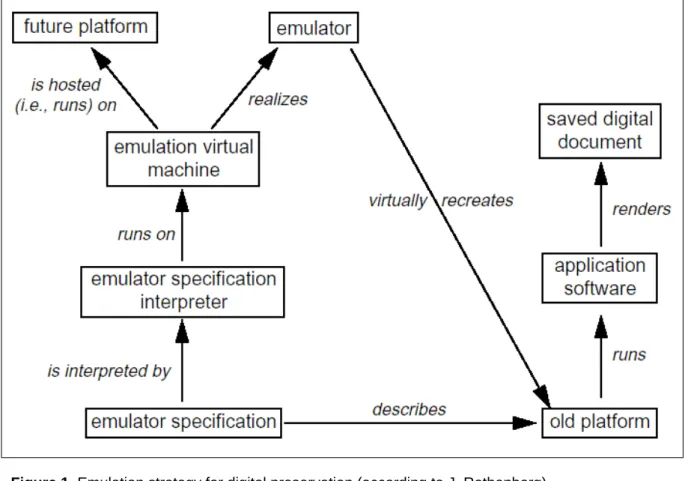
Emulation means the ‘re-creation on current hardware of the technical environment required to view and use digital objects from earlier times’.87 Technical environment that may need to be emulated may include not only the original hardware, but also operating systems and application software. Emulation is seen as offering a method of preservation that can preserve the functionality and the ‘look and feel’ of digital objects that migration may not be able to achieve; and it could prove to be much more cost effective solution in certain circumstances — creating one emulator can be cheaper than migrating every digital object in the archive.
Jeff Rothenberg, perhaps the best known advocate of the emulation strategy, has suggested to work on developing emulator specifications that would make it possible to build an actual emulator when the need arose. The “ideal emulation solution” has been defined by him as:
“[A]n ideal approach should provide a single, extensible, long-term solution that can be designed once and for all and applied uniformly, automatically, and in synchrony to all
87
D. Holdsworth, P. Wheatley, Emulation, Preservation and Abstraction (2001)
types of documents and all media, with minimal human intervention.”88
This is, in essence, an attempt to specify a single approach to emulation that will work for all possible cases. Rothenberg has developed his idea further,89 but at the same time this approach has been the most criticised, also by other proponents of emulation. The critics of emulation strategy have pointed out that:90
• So far, the strategy has largely existed in theory alone as there has been very little practical experience with emulators;
• The cost-effectiveness of developing an emulator has not been demonstrated conclusively;
• Emulation is trying to preserve the wrong thing by preserving information systems functionality rather than records;
• Emulation suffers from the same complication as migration sometimes does: the lack of reliable software and systems documentation and specifications that are required for building emulators;
• Preserving and using such proprietary specifications can raise intellectual property and copyright questions;
• Components of a stored digital objects may represent software that was developed over a period of time, because software developers re-use old components when releasing new versions. Therefore, an object can be assessed as to the age of its components. Most implementations of the emulation strategy in practice have ended up defining levels that can be achieved with emulation (e.g., emulating older hardware; emulating commands of one operating system under another; using older application software on new operating system platforms; etc.), and have distanced from the original Rothenberg’s idea of defining a single universal emulator.
The CAMiLEON project findings
One of the most influential research projects working on the emulation strategy was the CAMiLEON project (Creative Archiving at Michigan & Leeds: Emulating the Old on the New).91 As the name reveals, CAMiLEON was a collaborative project between libraries of two universities – Michigan and Leeds; In the case of Leeds University it became the continuation of the CEDARDS project. Started in 1999 and initially planned as a three-year project, it actually finished in September 2003 and the last results are only being published now. The three main objectives of the project were:
• To explore the options for long-term retention of the original functionality and ‘look and feel’ of digital objects.
• To investigate technology emulation as a strategy for long-term preservation and access to digital objects — evaluate publicly available emulators, explore emulation development, conduct test cases, etc.
• To consider where and how emulation fits into a suite of digital preservation strategies.
88
J. Rothenberg, Avoiding Technical Quicksand (1999) 89
J. Rothenberg, An Experiment in Using Emulation to Preserve Digital Publications (2000) 90
cf. D. Bearman, Reality and Chimeras in the Preservation of Electronic Records (1999); J.C. Bennett, A Framework of Data Types and Formats, and Issues Affecting the Long Term Preservation of Digital Materials (1997); S. Granger, Emulation as a Digital Preservation Strategy (2000)
91