Macro Trends, Complexity, and
So6ware Defined Networking
David Meyer
CTO and Chief ScienAst, Brocade
Director, Advanced Technology Center, University of Oregon NANOG 58
New Orleans, Louisiana
dmm@{brocade.com,uoregon.edu,1-‐4-‐5.net,…}
Agenda
•
Macro Trends?
•
Context: SDN Problem Space and Hypothesis
•
SDN: How did we get here?
•
Where is all of this going
–
And what role does SDN play?
•
Summary and Q&A if we have Ame
Danger Will Robinson!!!
This talk is intended to be controversial/provoca4ve
(and a bit “sciencey”)
3BoSom Line Here
I hope to convince you that there are exist
“macro trends” that are inducing uncertainty
and volaAlity in the network space, why this
is the case, how SDN (and the rise of so6ware
in general) is acceleraAng this effect, and
finally, what we might do to take advantage
of it.
1
Macro Trends
Trend: The Evolu.on of Intelligence
Precambrian (RepAlian) Brain to Neocortex
Hardware to So6ware
SOFTWARE
HARDWARE
•
Key Architectural Features of Scalable/Evolvable Systems
• RYF-‐Complexity
• Bow.e architectures
• Massively distributed control
• Highly layered with robust control
• Component reuse
Once you have the h/w
Trend: Everything De-‐silos
•
VerAcal -‐> Horizontal IntegraAon
•
Everything Open {APIs, Protocols, Source}
•
Everything Modular/Pluggable
Trend: Network Centric to IT Centric
•
Shi6 in influence and speed
•
Shi6 in locus of purchasing influence
•
Changes in cost structures
–
ETSI NfV, ATIS, IETF, Open Source, ...
Other Important Macro Trends
•
Everything Virtualizes
–
Well, we’ve seen this
•
Data Center new “center” of the universe
–
Looks like ~ 40% of all traffic is currently sourced/sinked in a DC
–
Dominant service delivery point
•
Integrated orchestraAon of almost everything
•
BoSom Line: Increasing influence of so6ware *everywhere*
–
All integrated with our compute, storage, idenAAes, …
–
Increasing compute, storage, and network “power”
increasing
volaAlity/uncertainty
Oh Yeah, This Talk Was Supposed To
Have Something To Do With SDN
•
Well then, what is the SDN problem space?
•
Network architects, engineers and operators are being presented with the following
challenge:
–
Provide state of the art network
infrastructure and services while minimizing TCO
•
SDN Hypothesis
: It is
the lack of ability to innovate in the underlying network
coupled
with the lack of proper network abstracAons results in the inability to keep pace with
user requirements and to keep TCO under control.
– Is this true? Hold that quesAon…
•
Note future uncertain
: Can’t
“skate to where the puck is going to be”
because curve is
unknowable (this is a consequence, as we will see, of the “so6ware world” coupled with
Moore’s law and open-‐loop control).
– That is, there is quite a bit of new research that suggests that such uncertainty is inevitable
Maybe this is the problem?
Or This?
Many protocols, many touch points, few open interfaces or abstrac.ons,..
Robustness vs. Complexity
Systems View
Increasing number of policies, protocols, configura.ons and interac.ons (well, and code)
Domain of the Fragile
Domain of the Robust
So what are Robustness and Fragility?
•
Defini4on
: A
[property
] of a
[system]
is
robust
if it is
[invariant]
with respect to a
[set of
perturba@ons]
,
up to some limit
•
Fragility
is the opposite of robustness
– If you're fragile you depend on 2nd order effects (acceleraAon) and the curve is concave
– A liSle more on this later…
•
A system can have a
property
that is
robust
to one set of perturbaAons and yet
fragile
for
a
different property
and/or perturbaAon
the system is
Robust Yet Fragile (RYF-‐
complex)
– Or the system may collapse if it experiences perturbaAons above a certain threshold (K-‐fragile)
•
Example: A possible
RYF tradeoff
is that a system with high efficiency (i.e., using minimal
system resources) might be unreliable (i.e., fragile to component failure) or hard to evolve
– Example: VRRP provides robustness to failure of a router/interface, but introduces fragiliAes in the protocol/
implementaAon
– Complexity/Robustness Spirals
•
Conjecture: The
RYF tradeoff
is a hard limit
See Alderson, D. and J. Doyle, “ContrasAng Views of Complexity and Their ImplicaAons For Network-‐Centric Infrastructures”, IEEE TRANSACTIONS ON SYSTEMS, MAN, AND CYBERNETICS—PART A: SYSTEMS AND HUMANS,
VOL. 40, NO. 4, JULY 2010
Robust
Yet Fragile
RYF Examples
Efficient, flexible metabolism
Complex development
and
Immune systems
Regeneration & renewal
Complex societies
Advanced technologies
Obesity and diabetes
Rich microbe ecosystem
Inflammation, Auto-Im.
Cancer
Epidemics, war, …
Catastrophic failures
•
“Evolved” mechanisms for robustness
allow for,
even
facilitate,
novel, severe fragiliAes elsewhere
•
O6en involving hijacking/exploiAng the same mechanism
–
We’ve certainly seen this in the Internet space
–
Consider DDOS of various varieAes
•
There are hard constraints (i.e., theorems with proofs)
System features cast as Robustness
•
Scalability
is robustness to changes to the size and
complexity of a system as a whole
•
Evolvability
is robustness of lineages to changes on long
Ame scales
•
Other system features cast as robustness
–
Reliability
is robustness to component failures
–
Efficiency
is robustness to resource scarcity
–
Modularity
is robustness to component rearrangements
•
In our case: holds for protocols, systems, and operaAons
Brief Aside: Fragility and Scaling
(geeking out for a sec…)
•
A bit of a formal descripAon of fragility
–
Let
z
be some stress level,
p
some property, and
–
Let
H(p,z)
be the (negaAve valued) harm funcAon
–
Then for the fragile the following must hold
•
H(p,nz) < nH(p,z) for 0 < nz < K
•
For example, a coffee cup on a table suffers non-‐linearly more from large
deviaAons (
H(p, nz)
) than from the cumulaAve effect of smaller events (
nH(p,z)
)
– So the cup is damaged far more by tail events than those within a few σ of the mean
– Too theoreAcal? Perhaps, but consider: ARP storms, micro-‐loops, congesAon collapse, AS 7007, …
– BTW, nature requires this property
• Consider: jump off something 1 foot high 30 Ames v/s jumping off something 30 feet high once
•
When we say something scales like
O
(n
2), what we mean is the damage to the
network has constant acceleraAon (2) for
weird
enough n (e.g., outside say, 10 σ)
–
Again, ARP storms, congesAon collapse, AS 7007, DDOS, …
non-‐linear damage
What Is AnAfragility?
•
Antifragility
is not the opposite
of fragility
–
Robustness
is the opposite of fragility
–
Antifragile systems
improve
as a result of [perturbation]
•
Metaphors
–
Fragile
:
Sword of Damocles
•
Upper bound: No damage
•
Lower bound: Completely destroyed
–
Robust
:
Phoenix
•
Upper bound == lower bound == no damage
–
An.fragile
:
Hydra
•
Lower bound: Robust
•
Upper bound: Becomes beSer as a result of perturbaAons (within bounds)
•
More detail on this later (if we have Ame)
–
But see Jim’s blog
–
hSp://www.renesys.com/blog/2013/05/syrian-‐internet-‐fragility.shtml
Aside: What is
Complexity
?
“In our view, however, complexity is most
succinctly discussed in terms of funcAonality and
its robustness. Specifically,
we argue that
complexity in highly organized systems arises
primarily from design strategies intended to
create robustness to uncertainty in their
environments and component parts.
”
See Alderson, D. and J. Doyle, “ContrasAng Views of Complexity and Their ImplicaAons For Network-‐Centric Infrastructures”, IEEE TRANSACTIONS ON SYSTEMS, MAN, AND CYBERNETICS—PART A: SYSTEMS AND HUMANS, VOL. 40, NO. 4, JULY 2010
BTW, This Might Also Obvious But…
•
Networks are incredibly general and expressive structures
–
G = (V,E)
•
Networks are extremely common in nature
–
Immune systems, energy metabolism, transportaAon systems, health care systems,
Internet
, macro economies, forest ecology, the main sequence (stellar evoluAon),
galacAc structures, ….
–
“Almost everything you see can be explained as either a network and/or a queue”
•
So it comes as no surprise that we study, for example, biological systems in
our aSempts to get a deeper understanding of complexity and the
architectures that provide for scalability, evolvability, and the like
•
Ok, this is cool, but what are the key architectural takeaways from this
work for us ?
–
where
us \in {ops, engineering, architects …}
–
And how might this effect the way we build and operate networks?
–
Keep this quesAon in mind…
Ok, Key Architectural Takeaways?
•
What we have learned is that there are fundamental architectural
building blocks found in systems that scale and are evolvable. These
include
–
RYF complexity
–
Bow.e architectures
–
Massively distributed with
robust
control loops
• Contrast opAmal control loops and hop-‐by-‐hop control
–
Highly layered
• But with layer violaAons, e.g., Internet, overlay virtualizaAon
–
Protocol Based Architectures (PBAs)
–
Degeneracy
BowAes 101
Constraints that Deconstrain
For example, the reacAons and metabolites of core metabolism, e.g., ATP metabolism, Krebs/Citric Acid cycle signaling networks, …
See Kirschner M., and Gerhart J., “Evolvability”, Proc Natl Acad Sci USA , 95:8420–8427, 1998.
But Wait a Second
Anything Look Familiar?
BowAe Architecture
The Protocol Hourglass idea appears to have originated with Steve Deering. See Deering, S., “Watching the Waist of the Protocol Hourglass”, IETF 51, 2001, hSp://www.iab.org/wp-‐content/IAB-‐uploads/2011/03/hourglass-‐london-‐ie€.pdf. See also Akhshabi, S. and C. Dovrolis, “The EvoluAon of Layered Protocol Stacks Leads to an Hourglass-‐Shaped Architecture”, hSp://conferences.sigcomm.org/sigcomm/2011/papers/sigcomm/p206.pdf.
Hourglass Architecture
Ok, Back to SDN
How Did We Get Here?
Basically, everything
networking
was too verAcally integrated, Aghtly coupled, non-‐standard.
Goes without saying that this made the job of the network researcher almost impossible.
QuesAon: What is the relaAonship between the job of the network researcher and
the task of fielding of a producAon network?
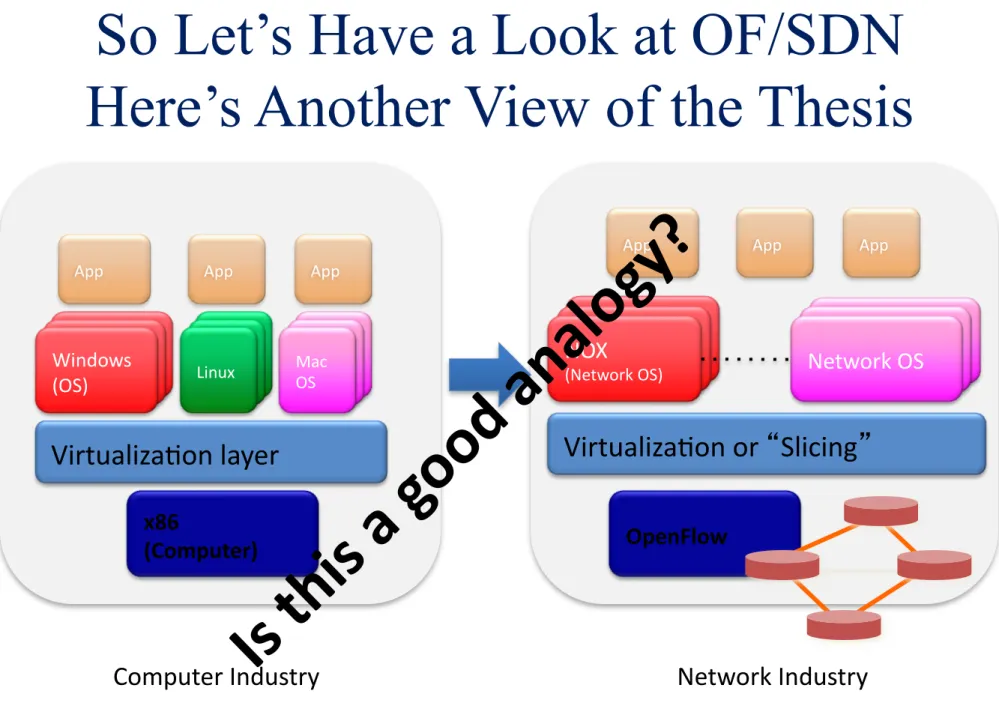
Windows (OS) Windows (OS) Linux Mac OS
x86
(Computer)
Windows (OS) App App LinuxLinux Mac OS Mac OS
VirtualizaAon layer
AppController 1
App AppController
2
VirtualizaAon or Slicing
App
OpenFlow
Controller 1
NOX
(Network OS)Controller
2
Network OS
So Let’s Have a Look at OF/SDN
Here’s Another View of the Thesis
Computer Industry
Network Industry
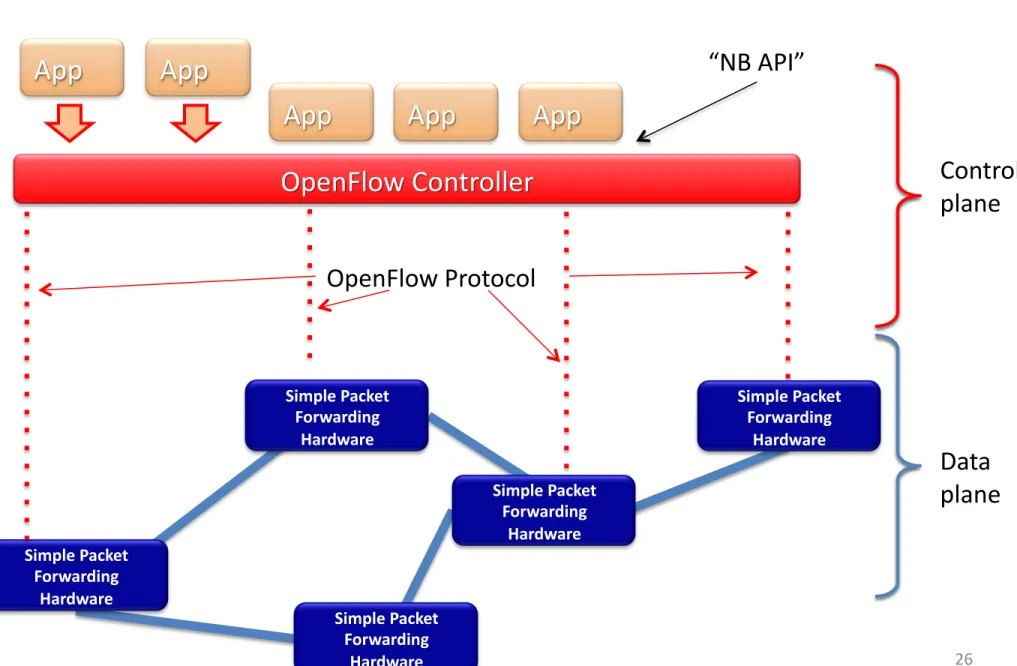
• SeparaAon of Control and Data Planes
• Open Interface to Data Plane
• Centralized Control (logically?) Graphic Courtesy Rob Sherwood
Simple Packet Forwarding Hardware Simple Packet Forwarding Hardware Simple Packet Forwarding Hardware Simple Packet Forwarding Hardware Simple Packet Forwarding Hardware
A Closer Look
26Control
plane
Data
plane
OpenFlow Protocol
Graphic courtesy Nick Mckeown
“NB API”
Graphic courtesy James Hamilton, hSp://mvdirona.com/jrh/TalksAndPapers/JamesHamilton_POA20101026_External.pdf.
So Does the OF/SDN-‐Compute Analogy Hold?
A beVer analogy would be an open source network stack/OS on white-‐box hardware
Really Doesn’t Look Like It
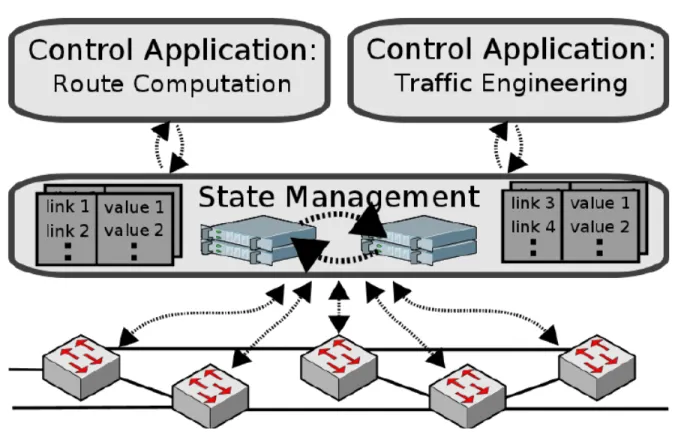
BTW, Logically Centralized?
Graphic courtesy Dan Levin <[email protected]‐labs.tu-‐berlin.de>
Key Observa.on: Logically centralized distributed system tradeoffs between control plane convergence and state consistency model. See the CAP Theorem.
Architectural Implica.on: If you break CP/DP fate sharing you have to deal the following physics: Ω(convergence) = Σ RTT(controller, switchi) + PPT(i,controller) + PPT(switchi)
BTW, Nothing New Under The Sun…
•
Separa4on of control and data planes and centralized control
are not a new
ideas. Examples include:
–
SS7
–
Ipsilon Flow Switching
• Centralized flow based control, ATM link layer
• GSMP (RFC 3292)
–
AT&T SDN
• Centralized control and provisioning of SDH/TDM networks
–
TDM voice to VOIP transiAon
• So6switch Controller
• Media gateway Switch
• H.248 Device interface
• Note 2nd order effect: This was really about circuit packet
–
ForCES
• SeparaAon of control and data planes
• RFC 3746 (and many others)
Drilling Down: What is OpenFlow 1.0?
Drop
Flow Table
(TCAM)
Redirect to Controller
Forward with
edits
Packet
Apply acAons
Encapsulate packet to controller
Too simple:
-‐
Feature/funcAonality
-‐
Expressiveness – consider shared table learning/forwarding bridge
•
Switch Model (Match-‐AcAon Tables)
•
Binary wire protocol
•
Transport (TCP, SSL, …)
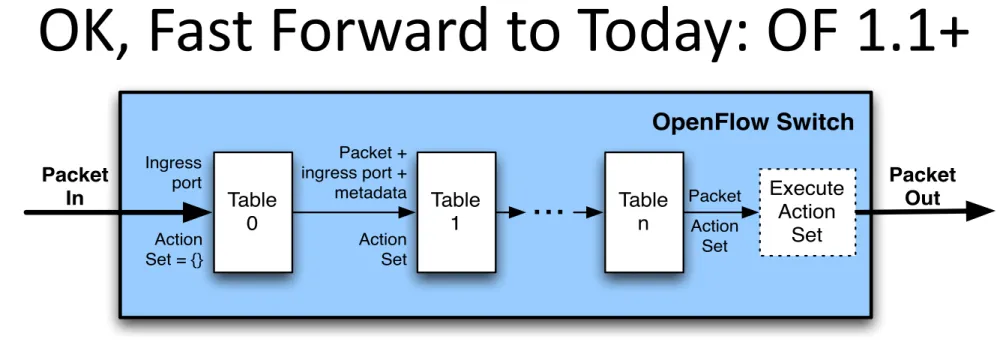
OK, Fast Forward to Today: OF 1.1+
OpenFlow Switch Specification Version 1.1.0 Implemented
Table 0 Table 1 Table n Packet Execute Action Set Packet In Action Set Action Set = {}
OpenFlow Switch
Packet Out...
Ingress port Packet + ingress port + metadata Action Set(a) Packets are matched against multiple tables in the pipeline
Match fields: Ingress port + metadata + pkt hdrs Action set Flow Table
!
Find highest-priority matching flow entry"
Apply instructions:i. Modify packet & update match fields (apply actions instruction)
ii. Update action set (clear actions and/or write actions instructions)
iii. Update metadata
#
Send match data and action set tonext table
!
"
#
Action set Match fields: Ingress port + metadata + pkt hdrs(b) Per-table packet processing
Figure 2: Packet flow through the processing pipeline
The flow tables of an OpenFlow switch are sequentially numbered, starting at 0. Pipeline processing always starts at the first flow table: the packet is first matched against entries of flow table 0. Other flow tables may be used depending on the outcome of the match in the first table.
If the packet matches a flow entry in a flow table, the corresponding instruction set is executed (see 4.4). The instructions in the flow entry may explicitly direct the packet to another flow table (using the Goto Instruction, see 4.6), where the same process is repeated again. A flow entry can only direct a packet to a flow table number which is greater than its own flow table number, in other words pipeline processing can only go forward and not backward. Obviously, the flow entries of the last table of the pipeline can not include the Goto instruction. If the matching flow entry does not direct packets to another flow table, pipeline processing stops at this table. When pipeline processing stops, the packet is processed with its associated action set and usually forwarded (see 4.7).
If the packet does not match a flow entry in a flow table, this is a table miss. The behavior on ta-ble miss depends on the tata-ble configuration; the default is to send packets to the controller over the control channel via a packet-in message (see 5.1.2), another options is to drop the packet. A table can also specify that on a table miss the packet processing should continue; in this case the packet is processed by the next sequentially numbered table.
6
•
Why this design?
• Combinatoric explosion(s) s/a routes*policies in single table
•
However, intractable complexity:
O(
n!) paths through tables of a
single switch
• c ≈ a(2^l) + α
• where a = number of acAons in a given table, l = width of match field, and
• α all the factors I didn’t consider (e.g., table size, funcAon, group tables, meter tables, …)
•
Too complex/briSle
• Algorithmic complexity
• What is a flow?
• Not naturally implementable on ASIC h/w
• Breaks new reasoning systems/network compilers
• No fixes for lossy abstracAons (loss/leakage)
• Architectural quesAons
So ques.on: Is the flow-‐based
abstrac.on “right” for general
network programmability?
A Perhaps Controversial View
•
OF/SDN is a point in a larger design space
–
But not the only one
•
The larger space includes
–
Control plane programmability
–
Overlays
–
Compute, Storage, and Network Programmability
•
My model: “SDN conAnuum”
FP/SDN
ProperAes:
-‐-‐ Complete SeparaAon of CP and FP -‐-‐ Centralized Control
-‐-‐ Open Interface/programmable Forwarding Plane -‐-‐ Examples: OF, ForCES, various control pla€orms
OL/SDN
ProperAes:
-‐-‐ Retains exisAng (simplified) Control Planes -‐-‐ Programmable overlay control plane -‐-‐ Examples: Various Overlay technologies
CP/SDN
ProperAes:
-‐-‐ Retains exisAng (distributed) Control Planes -‐-‐ Programmable control plane
-‐-‐ Examples: PCE, I2RS,BGP-‐LS, vendor SDKs
Physical and Virtual Resources
(CSN)
Control and Orchestra.on
(overly simplified view)
Apps
…
Apps
Service Layers
A Simplified View of the
SDN
Con@nuum
May be repeated (stacked or recursive)
BowAes/Hourglasses?
OF/SDN?
OL/SDN
CP/SDN
•
OF/SDN?
•
CP/SDN
makes exisAng control planes programmable
•
OL/SDN
is an applicaAon
from the perspec@ve of the Internet’s waist
Open Loop Control + s/w + Moore’s Law
Randomness, Uncertainty, and Vola4lity
So The Future: Where’s it All Going?
But More Seriously….
•
High order bit:
– System(s) we’re building are inherently uncertain cloudy crystal balls
– Architect for change and rapid evoluAon – see XP/Agile methodologies for a clue
– Increasing roles for s/w and programmability + Moore’s law vola.lity/uncertainty
– Lucky thing for many of us: we work primarily around the narrow waist, most stable place to be
– “Above the waist” characterized by uncertainty, e.g., hSp://spotcloud.com/
•
ConvenAonal Technology Curves – S & F
– Moore’s Law and the repAlian brain• Someone eventually has to forward packets on the wire
– 400G and 1T in the “near” term
– Silicon photonics, denser core count, ….
•
The future is all about Ecosystems
– Open Interfaces: Protocols, APIs, Code, Tool Chains
– Open Control Pla€orms at every level
– “Best of Breed” markets
– And again, more vola4lity/uncertainty injected into system as a whole
•
Open *everything*
Summary – What are our OpAons
• Be conservaAve with the narrow waist -‐-‐ constraints that deconstrain– We’re preSy good at this
– Reuse parts where possible (we’re also preSy good at this; traceroute a canonical example)
• Expect uncertainty and volaAlity from above
– Inherent in so6ware, and importantly, in acceleraAon
• We know the network is RYF-‐complex so we know that for H(p,x), the “harm” funcAon, d2H(p,x)/dx2 ≠ 0
• When you architect for robustness, understand what fragiliAes have been created
– So6ware (SDN or hSp://spotcloud.com or …) is inherently non-‐linear, volaAlity, and uncertain
• We need to learn to live with/benefit from the non-‐linear, random, uncertain • DevOps
• Develop our understanding boSom up (by “Ankering”)
– Actually an “Internet principle”. We learn incrementally…
– Avoid the top-‐down (in epistemology, science, engineering,…)
– BoSom-‐up v. top-‐down innovaAon cycles – cf CurAs Carlson
• Design future so6ware ecosystems to benefit from variability and uncertainty rather than trying to
engineer it out (as shielding these systems from the random may actually cause harm)
– For example, design in degeneracy -‐-‐ i.e., “ability of structurally different elements of a system to perform the same funcAon”. In other words, design in parAal funcAonal overlap of elements capable of non-‐rigid, flexible and versaAle funcAonality. This allows for evoluAon *plus* redundancy. Contrast m:n redundancy (i.e., we do just the opposite).